1 Corinthians 12:5

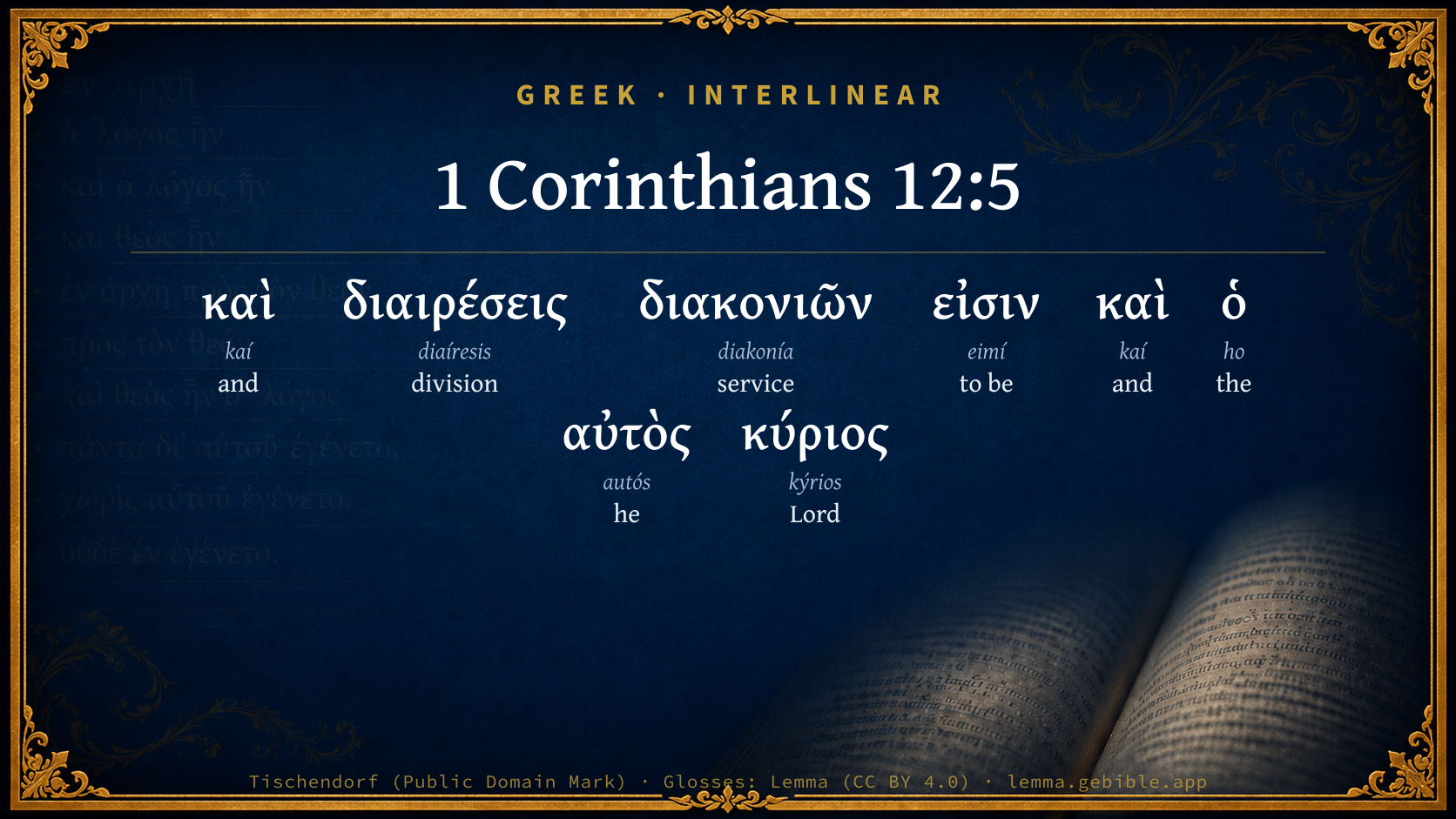
Greek (Tischendorf 8th ed.) 1 Corinthians 12:5 appears in the Greek New Testament. The text above is from the Tischendorf 8th edition. Each word links to its Strong’s number and a concise gloss. Click any word for its full Thayer’s Greek Lexicon entry.
Download image
Cite this verse

1 Corinthians 12:5 (World English Bible). Public Domain. Lemma interlinear Bible study tool, https://lemma.gebible.app/v/1-corinthians/12/5.

Show BibTeX & RIS
BibTeX
RIS
English Translation
There are various kinds of service, and the same Lord.
World English Bible · Public Domain
Download a study sheet

One document with this verse’s original text, its word-by-word gloss line, the meaning frame, cross-references with their text, attributed commentary, and full source and license credits — printable, and it pastes into notes with its structure intact.

This verse Autodidact and up

Study sheet (.html) Plain text (.txt)

A passage Seminary Student

Up to 50 verses in one chapter. A passage sheet keeps up to 6 commentary sources and 12 cross-references per verse, in the order this page ranks them, and says so on the sheet whenever that leaves anything out. Ask for a single verse and you get the Autodidact verse sheet above.

Everything on this page stays free to read, with no account — the sheet is a download of what is already on screen, not access to it.

Want to remove ads? Support Godless Engineer
Compare translations 3

The same verse in 3 English versions, stacked beneath the original-language interlinear above. Click any original word for its lexicon entry.

Each is an independent rendering of the whole verse — the interlinear is not word-aligned to these translations.

Highlighted words mark where these versions differ — a whole-verse word diff, not a word-by-word alignment.

  • World English Bible Public Domain
    There are various kinds of service, and the same Lord.
  • King James Version Public Domain
    And there are differences of administrations, but the same Lord.
  • unfoldingWord Literal Text CC BY-SA 4.0
    And there are varieties of ministries, but the same Lord.

unfoldingWord Literal Text — © unfoldingWord, licensed CC BY-SA 4.0. Word-aligned USFM3 via Door43 (git.door43.org/unfoldingWord/en_ult).

Versions to compare (up to 4)

3 of 4 selected

Show all 19 translations

Every available English version of this verse, each an independent rendering of the whole verse.

  • World English Bible Public Domain
    There are various kinds of service, and the same Lord.
  • Berean Standard Bible Public Domain
    There are different ministries, but the same Lord.
  • Majority Standard Bible Public Domain
    There are different ministries, but the same Lord.
  • King James Version Public Domain
    And there are differences of administrations, but the same Lord.
  • American Standard Version (1901) Public Domain
    And there are diversities of ministrations, and the same Lord.
  • Revised Version (1885) Public Domain
    And there are diversities of ministrations, and the same Lord.
  • Geneva Bible (1599) Public Domain
    And there are diuersities of administrations, but the same Lord,
  • Douay-Rheims (1899) Public Domain
    And there are diversities of ministries, but the same Lord;
  • Young's Literal Translation Public Domain
    and there are diversities of ministrations, and the same Lord;
  • Literal Standard Version CC BY-SA 4.0
    and there are diversities of ministries, and the same Lord;
  • Unlocked Literal Bible CC BY-SA 4.0
    There are different ministries, but the same Lord;
  • unfoldingWord Literal Text CC BY-SA 4.0
    And there are varieties of ministries, but the same Lord.
  • Darby Bible Public Domain
    and there are distinctions of services, and the same Lord;
  • World Messianic Bible Public Domain
    There are various kinds of service, and the same Lord.
  • Webster's Bible Public Domain
    And there are differences of administrations, but the same Lord.
  • Free Bible Version CC BY-SA 4.0
    There are different kinds of ministries, but they come from the same Lord.
  • Bible in Basic English Public Domain
    And there are different sorts of servants, but the same Lord.
  • Text-Critical English NT CC BY 4.0
    and there are varieties of ministries, but the same Lord;
  • Tyndale New Testament (1534) Public Domain
    And ther are differences of administracions and yet but one lorde.

Literal Standard Version (2020), Covenant Press — licensed CC BY-SA 4.0. Text via the HelloAO Bible API (eBible.org). Unlocked Literal Bible (unfoldingWord) — licensed CC BY-SA 4.0. Text via the HelloAO Bible API (eBible.org). unfoldingWord Literal Text — © unfoldingWord, licensed CC BY-SA 4.0. Word-aligned USFM3 via Door43 (git.door43.org/unfoldingWord/en_ult). Free Bible Version, Dr. Jonathan Gallagher — licensed CC BY-SA 4.0. Text via the HelloAO Bible API (eBible.org).

Word by word

More ways to search: Search by grammar → Find every occurrence → Compare this word →

Practice this passage: Drill this verse → Learn its vocabulary →

About this verse

These counts appear in no published source. They are computed here, from the morphology-tagged text and Lemma’s own curated glosses. What Lemma adds →

8
words
7
distinct lemmas
Pauline Epistles
section

Notable vocabulary

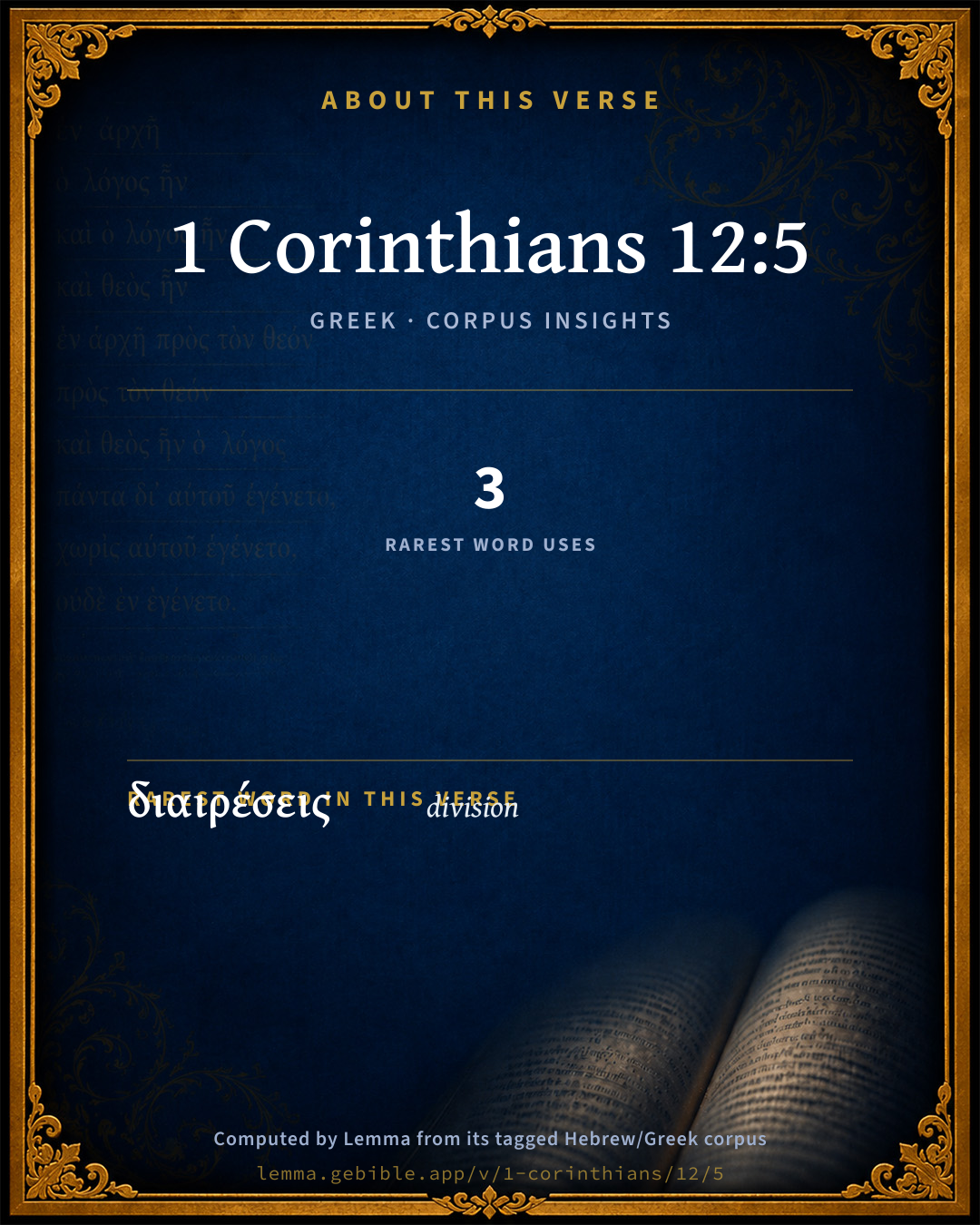
The rarest word here is διαιρέσεις division G1243 — appearing just 3 times in the whole Greek New Testament.

Shared distinctive vocabulary

διαιρέσεις division G1243 occurs in 3 verses of the Greek New Testament. Also found in:

Repetition

A word recurs within this verse:

Cross-references

8

Topical passages linked to 1 Corinthians 12:5 in the Treasury of Scripture Knowledge — connected by theme and wording, ordered by reader-vote popularity; previews shown in the World English Bible.

  • Ephesians 4:11–12 He gave some to be apostles; and some, prophets; and some, evangelists; and some, shepherds and teachers;
  • Romans 12:6–8 Having gifts differing according to the grace that was given to us, if prophecy, let us prophesy according to the proportion of our faith;
  • Romans 14:8–9 For if we live, we live to the Lord. Or if we die, we die to the Lord. If therefore we live or die, we are the Lord's.
  • Matthew 23:10 Neither be called masters, for one is your master, the Christ.
  • 1 Corinthians 8:6 yet to us there is one God, the Father, of whom are all things, and we for him; and one Lord, Jesus Christ, through whom are all things, and we live through him.
  • 1 Corinthians 12:28–29 God has set some in the assembly: first apostles, second prophets, third teachers, then miracle workers, then gifts of healings, helps, governments, and various kinds of languages.
  • Acts 10:36 The word which he sent to the children of Israel, preaching good news of peace by Jesus Christ--he is Lord of all--
  • Philippians 2:11 and that every tongue should confess that Jesus Christ is Lord, to the glory of God the Father.

Cross-references courtesy of OpenBible.info (CC BY 4.0).

Commentary

Notes on 1 Corinthians 12:5 from classic Christian and Jewish commentators (each source and its license shown beneath its notes). The classic Christian expositions comment on the surrounding passage and are grouped to its opening verse, so a note may address several verses; the Jewish commentaries on the Tanakh (Rashi and others) are per-verse, so they appear only where the commentator wrote on this verse.

Lemma curates 59 commentaries, every one of them public domain or Creative Commons licensed, each selected and text-cleaned for this edition rather than reprinted as found. About our sources →

The Biblical Illustrator

Joseph S. Exell

1Co_12:5-6

There are differences of administration, but the same Lord.

The agencies of the Church

I. Are widely diversified.

1. Every branch has its own sphere.

2. Every member his own office.

(1) Differing in character, importance, scope.

(2) Yet all necessary.

II. Are under the control of the same Lord--Christ, who--

1. Appoints every man his duty.

2. Supplies him with grace.

3. Observes and rewards his conduct.

III. Are directed to one end. Hence the meanest office--

1. Is honourable.

2. Is useful.

3. Should be faithfully fulfilled. (J. Lyth, D.D.)

Differences of administrations

Glycera, the flower-girl, knew so well how to diversify the combination and arrangement of her flowers, as with the same flowers to make a great variety of nosegays. So that when the painter Pausias tried to emulate her skill he failed, for he could not vary his painting so many ways as Glycera did her nosegays. Thus the Holy Ghost disposes and arranges with so much variety the instructions of devotion which He gives us by the tongues and pens of His servants that, although the doctrines are always the same, the treatises which are made out of them are very different, according to the different ways in which they are put together. (St. Francis de Sales.)

There are diversities of operations, but it is the same God.

The diversity of the Divine operations

These words suggest practical reflections as to--

I. The vast variety of classes for whom Christian work is carried on. Such work is work--

1. For all varieties of need.

(1) Bodily. The hospital; the sanitary enterprise of any form is included.

(2) Mental. All true educational work, not least of all when it aims at fixing a ladder that shall rise from the gutter to the university, is included.

(3) Moral. Every crusade for temperance and chastity is included.

(4) Spiritual. The proclamation, in its manifold fulness, of the gospel that converts, comforts, and edifies is included.

(5) National. Right endeavour in the cause of peace, of land reform, etc., is included.

2. For the needs of people of all ages--the child, the youth, the adult, the aged.

3. For the needs of people of all places. The prediction as to the usefulness of the men of the early Church (Act_1:8) seems to hint at what we call

(1) City missions--witnesses for Me in Jerusalem.

(2) Home missions--and in all Judaea.

(3) Colonial missions--and in Samaria.

(4) Foreign missions--and unto the uttermost part of the earth.

II. The vast variety of means by which Christian work is carried on. There are methods in which the individual is a potent force, and others in which the elaborate machinery fulfils a useful function. There are spheres for highest culture, and others for simplest speech, domains for the pen and for the tongue. True Christian enterprise is hydra-handed. It touches the unnumbered strings on the great harp of humanity, sometimes gently, as with the delicacy of womans fingers, and sometimes mightily, as with the smiting of a seraphs hand.

III. The one motive spirit under whose influence Christian work is carried on. In all and through all who are true to Christ there is one impelling motive, i.e., love to Him. This is the great unifying force at the central heart of all Christly men. (U.R. Thomas.)

The Divine operations

I. Are richly exemplified--

1. In nature.

2. In the Church.

II. Are wonderfully varied.

III. Are singularly harmonious.

IV. Exhibit the glory of the one God--His

1. Wisdom.

2. Power.

3. Love. (J. Lyth, D.D.)

The diversity of the Spirits operations

The witnessing of the Spirit admits of degrees. Just as a rich mans window may be wider than a poor mans, and so the sun may make his house the more light, that the things within it may be better discerned, yet the poor man may really enjoy the beams of the sun, and see what is in his house; so the poorest, the weakest believer may know the Spirit hath shined into his heart, as well as others that enjoy brighter beams than he hath been acquainted with. (T. H. Leary, D.C.L.)

The Biblical Illustrator, edited by Joseph S. Exell (c. 1880s–1900s) — public domain. Text from a community e-Sword module.

Bengel's Gnomon

Johann Albrecht Bengel

1Co 12:5. Διακονιῶν, of ministrations) 1Co 12:28.—ὁ δὲ αὐτὸς Κύριος, but the same Lord) The Son of God whom the Holy Ghost glorifies by those ministers.

Bengel's Gnomon of the New Testament — English translation (T&T Clark, Edinburgh, 1860) — public domain. Text from a community e-Sword module.

Meyer's Critical & Exegetical Commentary

Heinrich August Wilhelm Meyer

1Co_12:5-6. Continuation of the representation of the difference and yet relative unity of the χαρίσματα, illustrated in two characteristic forms of their action, in so far, namely, as they present themselves practically as διακονίαι and as ἐνεργήματα. These are not merely different names for the charismata (as the Greek Fathers held), nor yet distinct species of them (Estius and others), but different forms of expression in which they show themselves and appear to the observer.

And there are distributions of services, but it is the same Lord (Christ as Lord of the church) who is served thereby. To make the διακονίαι refer to the specific offices in the church, 1Co_12:28 (Beza, Grotius, Estius, Olshausen, and many others), is to narrow the meaning too much; for in accordance with the first sentence, and in accordance generally with the comprehensive scope of the whole three sentences, all charismata must be meant, in so far, namely, as all, according to the relation of their exercise to Christ, manifest themselves as services rendered.And there are distributions of workings (deeds of power), but it is the same God who works them all (ἐνεργήματα) in all (in all who are acting in the power of the Spirit). Ἐνεργ. is as little to be taken in a special sense here as διακ. in the previous sentence; it is neither to be referred to the working of miracles alone (so most interpreters on the ground of 1Co_12:10, where, however, it is joined with δυνάμ.). nor to the healings of the sick (so Olshausen, quite arbitrarily). No, all charismata may manifest their operation in deeds (comp on ἘΝΕΡΓΉΜΑΤΑ, Polyb. ii. 42. 7, iv. 8. 7; Diod. iv. 51), whether these may be miraculous or not.

REMARK.

The Divine Trinity is here indicated in an ascending climax (comp on Eph_4:6), in such a way that we pass from the Spirit, who bestows the gifts, to the Lord, who is served by means of them, and finally to God, who, as the absolute First Cause and Possessor of all Christian powers, works the entire sum of charismatic deeds in all who are gifted. This passage has always (from Chrysostom and Theodoret onwards) been rightly adduced in opposition to anti-Trinitarian error (comp too Calovius against the Socinians); but it is to be observed also here, that with all the equality of nature and inseparable unity (2Co_13:13) of the Three, still no dogmatic canon can do away with the relation of subordination which is also manifest. Comp Gess, v. d. Person Christi, p. 158 f.; Kahnis, Dogm. III. p. 206 ff.

Meyer — Critical and Exegetical Commentary on the New Testament — English translation by Peter Christie, edited by Frederick Crombie (T&T Clark, 1880) — public domain. Text from a community e-Sword module.

Jamieson, Fausset & Brown

Robert Jamieson, A. R. Fausset & David Brown

"Gifts" (Co1 12:4), "administrations" (the various functions and services performed by those having the gifts, compare Co1 12:28), and "operations" (the actual effects resulting from both the former, through the universally operative power of the one Father who is "above all, through all, and in us all"), form an ascending climax [HENDERSON, Inspiration].

same Lord--whom the Spirit glorifies by these ministrations [BENGEL].

Jamieson, Fausset & Brown — Commentary Critical and Explanatory on the Whole Bible (1871) — public domain (CC PDM 1.0). Text via the HelloAO Bible API.

Adam Clarke's Commentary

Verse 5. Differences of administrations] διακονιων. Various offices in the Church, such as apostle, prophet, and teacher; under which were probably included bishop or presbyter, pastor, deacon, c. the qualifications for such offices, as well as the appointments themselves, coming immediately from the one Lord Jesus Christ.

Adam Clarke's Commentary on the Bible (1810–1826) — public domain. Text from a community e-Sword/MySword module.

The Cambridge Bible for Schools and Colleges

gen. ed. J. J. S. Perowne

5. differences] The Greek word is the same in 1Co_12:4-6. It is used in the Septuagint (1Ch_26:1; 1Ch_8:14; Ezr_6:18) of the divisions or courses of the Priests and Levites.

administrations] Rather, as margin, ministeries, i.e. services rendered to Christ and His members by His disciples. Wiclif’s rendering is, and dyuerse seruyces ther ben, but it is al oo Lord.

The Cambridge Bible for Schools and Colleges (gen. ed. J. J. S. Perowne; Cambridge University Press, 1878–1918) — public domain. Text from a community e-Sword module.

John Gill's Exposition

And there are differences of administrations,.... Or ministries; offices in the church, ministered in by different persons, as apostles, prophets, pastors, or teachers and deacons; who were employed in planting and forming of churches, ordaining elders, preaching the word, administering ordinances, and taking care of the poor; for which different gifts were bestowed on them, they not all having the same office.

But the same Lord; meaning either Jesus Christ, whom the believer, by the Holy Ghost, says is Lord; who, as the ascended King of saints, and Lord and head of the church, appoints different offices and officers in it; and having received, gives gifts unto them, qualifying them for the same; all which comes through the same hand, and not another's; or rather the Lord, the Spirit, who calls men to these several ministrations, separates and fits them for them, and constitutes and installs them into them, and assists them in the discharge of them; since he only, and all along, is spoken of in the context as the efficient of these several things.

John Gill's Exposition of the Whole Bible (1746–1763) — public domain (CC PDM 1.0). Text via the HelloAO Bible API.

Trapp's Complete Commentary

John Trapp

5 And there are differences of administrations, but the same Lord.

Ver. 5. Differences of administrations] i.e. Ecclesiastical functions, all of them the dona honoraria of the Lord Christ, Eph 4:8-11.

John Trapp, A Commentary or Exposition upon All the Books of the Old and New Testament (1647–1656) — public domain. Text from a community e-Sword module.

Albert Barnes' Notes on the Bible

Of administrations - Margin, “Ministries.” The word properly denotes “ministries;” so that there are different ranks and grades in the ministries which Christ has appointed, to wit, those specified in 1Co 12:9-10, 1Co 12:28.

But the same Lord - This refers evidently to the Lord Jesus, by whom these various orders of ministers were appointed, and under whose control they are; see the note at Act 1:24; compare Eph 4:5. The term “Lord,” when it stands by itself in the New Testament, usually refers to the Lord Jesus, the name by which he was commonly known by the disciples; see Joh 20:25. The fact also that this stands between the mention of the work of the Spirit 1Co 12:4 and the work of God 1Co 12:6, and the fact that to the Lord Jesus appertained the appointment of these various grades of officers in the church (compare Mat 10:1 ff, and Luk 10:1 ff), is further proof that this refers to him. The design of the verse is, to show that all these offices had their appointment from him; and that since all were his appointment, and all were necessary, no one should be proud of an elevated station; no one should be depressed, or feel himself degraded, because he had been designated to a more humble office.

Albert Barnes' Notes on the Bible (1834–1885) — public domain. Text from a community e-Sword/MySword module.

Matthew Poole's English Annotations

There are divers offices or ministries in the church of God; one ministereth in the office of an elder, another in the office of a deacon; one in one service of the church, another in another service; but there is but one Lord to whom they minister; they all serve the great Lord of the church, Jesus Christ, though in divers orders and places of ministration.

Matthew Poole's English Annotations on the Holy Bible (1683–1685) — public domain. Text from a community e-Sword/MySword module.

Whedon's Commentary on the Bible

Daniel D. Whedon

5. Differences of administrations—Different Church offices, duties, or exercises, in which the gifts were employed.

Daniel D. Whedon (gen. ed.), Commentary on the Old and New Testaments (1874–1909) — public domain. Text from a community e-Sword module.

The Pulpit Commentary

Administrations. Different individuals render different services, and even apply the same gifts in different ways, as we see in Rom_12:6-8. The same Lord. Who, as Head of the Church, directs all ministries and assigns all functions.

The Pulpit Commentary (1880–1919), ed. H.D.M. Spence-Jones & Joseph S. Exell — public domain. Text from a community e-Sword module.

John Wesley's Explanatory Notes

Administrations - Offices. But the same Lord appoints them all.

John Wesley, Explanatory Notes Upon the Whole Bible (1754–1765) — public domain. Text via the GEBible commentary corpus.

Godbey's Commentary on the New Testament

William B. Godbey

5. “There are diversities of ministries, but the same Lord.” The Holy Ghost bestows on appreciative sinners the gifts of illumination, conviction, justification, regeneration, adoption, and the witness of the Spirit. Without this beautiful group of gifts, no sinner would ever be saved. In sanctification the glorified Savior gives you the Holy Ghost Himself to sanctify, comfort, fill and keep you forever. After the Holy Spirit has moved into your heart, He has another cohort of inestimable gifts which He wishes to bestow on you, not only to fortify you against the adversary, but especially to panoply you for the Lord’s war and empower you to become instrumental in the salvation of others. There are nine of these gifts, all entirely different either from other. Hence there is quite a “diversity,”

developing infinite dissimilitude among their possessors. When Jesus is crowned Lord of all on the throne of the heart, He dispenses an infinite diversity of ministries to His saints, sending them in all directions on missions of love and mercy, doing His will on earth as the angels do it in Heaven.

William B. Godbey, Commentary on the New Testament (1896–1900) — public domain. Text from a community e-Sword module.

McGarvey & Pendleton's Commentaries

J. W. McGarvey

And there are diversities of ministrations, and the same Lord .

J. W. McGarvey (with Philip Y. Pendleton), Commentaries on the New Testament (The Fourfold Gospel, 1914; Acts; and the epistles) — public domain. Text from a community e-Sword/MySword module.

The People's New Testament

B. W. Johnson

5. Differences of ministrations; of ministries or offices, but all are in the service of the same Lord.

B. W. Johnson's The People's New Testament with Notes (1889–1891) — public domain. Electronic text from the Christian Classics Ethereal Library (CCEL) ThML edition.

Cambridge Greek Testament for Schools and Colleges

5. διακονιῶν. Ministries, i.e. services rendered to Christ and His members by His disciples.

Cambridge Greek Testament for Schools and Colleges (Cambridge University Press, 1896; 21 vols, various authors incl. Carr, Maclear, Plummer, Farrar, Lumby, Moule, M. R. James, Simcox) — public domain. Text from a community e-Sword module.

Alford’s Greek Testament

Henry Alford

5.] and there are varieties of ministries (appointed services in the church, in which as their channels of manifestation the χαρίσματα would work), and the same Lord (Christ, the Lord of the church, whose it is to appoint all ministrations in it. These διακονίαι must not be narrowed to the ecclesiastical orders, but kept commensurate in extent with the gifts which are to find scope by their means, see vv. 7-10): and varieties of operations (effects of divine ἐνέργειαι: not to be limited to miraculous effects, but understood again commensurately with the gifts of whose working they are the results), and the same God. Who works all of them in all persons (all the χαρίσματα in all who are gifted). Thus we have God the Father, the First Source and Operator of all spiritual influence in all: God the Son, the Ordainer in His Church of all ministries by which this influence may be legitimately brought out for edification: God the Holy Ghost, dwelling and working in the church, and effectuating in each man such measure of His gifts as He sees fit.

Henry Alford, The Greek Testament (1849–1861) — public domain. Text from a community e-Sword module.

International Critical Commentary

5. διακονιῶν. Like χάρισμα, the word has both a general and a special meaning: (1) any Christian ministration or service (here; Rom 11:13; Eph 4:12), whether of an Apostle or of the humblest believer; (2) some special administration, as of alms, or attendance to bodily needs (16:15; 2Co 8:4). “Spiritual service of an official kind” is not included in the meaning, but may be implied in the context. See Hort, Christian Ecclesia, pp. 202 f.

καὶ ὁ αὐτὸς Κύριος. Here there is no antithesis (καί, not δέ) between the many and the one: the two facts are stated as parallel. On the one side are the apportionments of ministrations; on the other is He who ‘came not to be ministered to, but to minister’ (Mar 10:45), but who counts all service to others as service done to Himself (Mat 25:40). ‘Ye serve the Lord Christ’ (Col 3:24): it is He who is glorified by the diverse distribution of ministries.

5. χαρ. ἰαμάτων 4. δυνάμεις 4. δυνάμεις

International Critical Commentary — older volumes (1896–1929), various authors — public domain. Text from a community e-Sword module.

Godet's Commentaries

Frédéric Louis Godet

Vv. 5. But there exists in the Church a second kind of Divine manifestations; charges, namely, or ministries, διακονίαι. This word denotes, not like the preceding, inward aptitudes, but external offices, with which certain individuals are put in charge. There are different kinds of them; some may be related to the whole Church, like the apostolate or the office of evangelist (missionary); others to a particular community, and that either with a view to the spiritual life, as the episcopate, or with a view to different kinds of temporal helps, such as the numerous branches of the diaconate; under these offices even there must have existed functions of an inferior order relating to those material services which were called for by the holding of assemblies and of the agapae, etc. What was the relation of these charges to the gifts? Probably certain of them, the highest, rested on a spiritual gift which the community had recognised and ordained to a regular function; others, the inferior ones, were mere offices committed to individuals by the Church.

As there are gifts which, by their very nature, cannot become the basis of an office (speaking in tongues or prophecy, for example), and others which may easily be transformed into a regular function (the gift of teaching, for example), so there are also offices of a wholly external kind, management of material affairs, for example, which are scarcely related to any gift, while others, like the apostolate, have for their foundation a special gift or a whole combination of gifts. These varied offices have, like the gifts, their principle of unity; but this principle is, so to speak, before, not behind them. As the various gifts rest on one and the same principle, the Spirit, so the offices tend to one and the same end, the Lord, by whose authority and for whose service they act. To connect the two propositions of this verse, instead of δέ, but, Paul here says καί, and, no doubt to join this second principle of unity to the preceding, the Spirit, mentioned 1Co 12:4.

Frédéric Louis Godet — Commentaries on Luke, John, Romans, and 1 Corinthians — English translation (T&T Clark, Edinburgh, 1870s–1890s) — public domain. Text from a community e-Sword module.

Hodge's Commentary on Romans, Ephesians & First Corinthians

Charles Hodge

1Co_12:4-6

Now there are diversities of gifts, but the same Spirit. And there are differences of administrations, but the same Lord. And there are diversities of operations, but it is the same God which worketh all in all.

The second thing which the apostle teaches concerning these gifts is, their diversity of character in connection with the unity of their source and design. He is not, however, to be understood as here dividing these gifts into three classes, under the heads of gifts, ministrations, and operations; but as presenting them each and all under three different aspects. Viewed in relation to the Spirit, they are gifts; in relation to the Lord, they are ministrations; and in relation to God, they are operations, i.e. effects wrought by his power. And it is the same Spirit, the same Lord, and the same God who are concerned in them all. That is, the same Spirit is the giver; it is he who is the immediate and proximate author of all these various endowments. It is the same Lord in whose service and by whose authority these various gifts are exercised. They are all different forms in which he is served, or ministered to. And it is the same God the Father, who having exalted the Lord Jesus to the supreme headship of the church, and having sent the Holy Ghost, works all these effects in the minds of men. There is no inconsistency between this statement and 1Co_12:11, where the Spirit is said to work all these gifts; because God works by his Spirit. So in one place we are said to be born of God, and in another to be born of the Spirit. Thus, the doctrine of the Trinity underlies the whole scheme of redemption in its execution and application as well as in its conception.

Those who understand this passage as describing three distinct classes of gifts, one as derived from the Spirit, the other from the Son, and the other from the Father, suppose that to the first class belong wisdom, knowledge, and faith; to the second, church-offices; and to the third, gift of miracles. But this view of the passage is inconsistent with the constant and equal reference of these gifts to the Holy Spirit; they all come under the head of spiritual gifts; and with what follows in 1Co_12:8-10, where a different classification is given. That is, the nine gifts there mentioned are not classified in reference to their relation to the Father, Son, and Spirit; and therefore it is unnatural to assume such a classification here. They are all and equally gifts of the Spirit, modes of serving the Son, and effects due to the efficiency of the Father.

Charles Hodge — Commentary on Romans (1835), First Corinthians (1857), and Ephesians (1856) — public domain. Text from a community e-Sword module.

Lesson kit

Teaching starters — assembled from the data on this page, not authored interpretation. Every prompt links to the verse data it draws on. Edit before teaching.

1 Corinthians, in the Pauline Epistles, opens this verse with 8 words (7 distinct Greek lemmas). Its most distinctive word is diaíresis (“division”). A historical commentator’s framing appears above. Read the whole chapter for the surrounding context.

Discussion questions

  1. How does “division” (diaíresis) shape what this verse is saying?
  2. How does 1 Corinthians 12:4, which shares the word «division», read alongside this verse?
  3. What does the repetition of “and” (2× in this one verse) do in this verse?
  4. These translations render this verse differently; the difference is in the English rendering, not the original. What questions does that raise?
  5. Compare how The Biblical Illustrator and Bengel's Gnomon read this verse. Where do they agree or differ?

Things to notice

  • These translations choose different wording for 7 words in this verse.
  • “and” occurs 2× in this single verse.
  • 7 distinct Greek lemmas span 8 words in this verse.

Reading settings

Reading text

Shown beneath each verse's original-language words.

Old Testament
Old Testament edition

Read the OT as the Masoretic Hebrew (MT) or the Greek Septuagint (LXX).

English shown for the Greek Septuagint (in the Hebrew ↔ Greek comparison).

Comparing translations? Open the Compare panel on any verse page to stack up to four side by side.