1 Corinthians 15:44

Greek (Tischendorf 8th ed.) 1 Corinthians 15:44 appears in the Greek New Testament. The text above is from the Tischendorf 8th edition. Each word links to its Strong’s number and a concise gloss. Click any word for its full Thayer’s Greek Lexicon entry.
Download image
Cite this verse

1 Corinthians 15:44 (World English Bible). Public Domain. Lemma interlinear Bible study tool, https://lemma.gebible.app/v/1-corinthians/15/44.

Show BibTeX & RIS
BibTeX
RIS
English Translation
It is sown a natural body; it is raised a spiritual body. There is a natural body and there is also a spiritual body.
World English Bible · Public Domain
Download a study sheet

One document with this verse’s original text, its word-by-word gloss line, the meaning frame, cross-references with their text, attributed commentary, and full source and license credits — printable, and it pastes into notes with its structure intact.

This verse Autodidact and up

Study sheet (.html) Plain text (.txt)

A passage Seminary Student

Up to 50 verses in one chapter. A passage sheet keeps up to 6 commentary sources and 12 cross-references per verse, in the order this page ranks them, and says so on the sheet whenever that leaves anything out. Ask for a single verse and you get the Autodidact verse sheet above.

Everything on this page stays free to read, with no account — the sheet is a download of what is already on screen, not access to it.

Want to remove ads? Support Godless Engineer
Compare translations 3

The same verse in 3 English versions, stacked beneath the original-language interlinear above. Click any original word for its lexicon entry.

Each is an independent rendering of the whole verse — the interlinear is not word-aligned to these translations.

Highlighted words mark where these versions differ — a whole-verse word diff, not a word-by-word alignment.

  • World English Bible Public Domain
    It is sown a natural body; it is raised a spiritual body. There is a natural body and there is also a spiritual body.
  • King James Version Public Domain
    It is sown a natural body; it is raised a spiritual body. There is a natural body, and there is a spiritual body.
  • unfoldingWord Literal Text CC BY-SA 4.0
    It is sown a natural body; it is raised a spiritual body. If there is a natural body, there is also a spiritual.

unfoldingWord Literal Text — © unfoldingWord, licensed CC BY-SA 4.0. Word-aligned USFM3 via Door43 (git.door43.org/unfoldingWord/en_ult).

Versions to compare (up to 4)

3 of 4 selected

Show all 19 translations

Every available English version of this verse, each an independent rendering of the whole verse.

  • World English Bible Public Domain
    It is sown a natural body; it is raised a spiritual body. There is a natural body and there is also a spiritual body.
  • Berean Standard Bible Public Domain
    It is sown a natural body; it is raised a spiritual body. If there is a natural body, there is also a spiritual body.
  • Majority Standard Bible Public Domain
    It is sown a natural body; it is raised a spiritual body. There is a natural body; there is also a spiritual body.
  • King James Version Public Domain
    It is sown a natural body; it is raised a spiritual body. There is a natural body, and there is a spiritual body.
  • American Standard Version (1901) Public Domain
    it is sown a natural body; it is raised a spiritual body. If there is a natural body, there is also a spiritual `body'.
  • Revised Version (1885) Public Domain
    it is sown a natural body; it is raised a spiritual body. If there is a natural body, there is also a spiritual body.
  • Geneva Bible (1599) Public Domain
    It is sowen a naturall body, and is raysed a spirituall body: there is a naturall body, and there is a spirituall body.
  • Douay-Rheims (1899) Public Domain
    It is sown a natural body, it shall rise a spiritual body. If there be a natural body, there is also a spiritual body, as it is written:
  • Young's Literal Translation Public Domain
    it is sown a natural body, it is raised a spiritual body; there is a natural body, and there is a spiritual body;
  • Literal Standard Version CC BY-SA 4.0
    it is sown a natural body, it is raised a spiritual body; there is a natural body, and there is a spiritual body;
  • Unlocked Literal Bible CC BY-SA 4.0
    It is sown a natural body; it is raised a spiritual body. If there is a natural body, there is also a spiritual body.
  • unfoldingWord Literal Text CC BY-SA 4.0
    It is sown a natural body; it is raised a spiritual body. If there is a natural body, there is also a spiritual.
  • Darby Bible Public Domain
    It is sown a natural body, it is raised a spiritual body: if there is a natural body, there is also a spiritual [one].
  • World Messianic Bible Public Domain
    It is sown a natural body; it is raised a spiritual body. There is a natural body and there is also a spiritual body.
  • Webster's Bible Public Domain
    It is sown a natural body, it is raised a spiritual body. There is a natural body, and there is a spiritual body.
  • Free Bible Version CC BY-SA 4.0
    It is sown as a natural body; it is raised as a spiritual body. Just as there are natural bodies there are spiritual bodies.
  • Bible in Basic English Public Domain
    It is planted a natural body; it comes again as a body of the spirit. If there is a natural body, there is equally a body of the spirit.
  • Text-Critical English NT CC BY 4.0
    It is sown as a natural body; it is raised as a spiritual body. There is a natural body, and there is a spiritual body.
  • Tyndale New Testament (1534) Public Domain
    It is sowne a naturall body and ryseth a spretuall body. Ther is a naturall bodye and ther is a spretuall body:

Literal Standard Version (2020), Covenant Press — licensed CC BY-SA 4.0. Text via the HelloAO Bible API (eBible.org). Unlocked Literal Bible (unfoldingWord) — licensed CC BY-SA 4.0. Text via the HelloAO Bible API (eBible.org). unfoldingWord Literal Text — © unfoldingWord, licensed CC BY-SA 4.0. Word-aligned USFM3 via Door43 (git.door43.org/unfoldingWord/en_ult). Free Bible Version, Dr. Jonathan Gallagher — licensed CC BY-SA 4.0. Text via the HelloAO Bible API (eBible.org).

Word by word

More ways to search: Search by grammar → Find every occurrence → Compare this word →

Practice this passage: Drill this verse → Learn its vocabulary →

ψυχικόν
psychikós
G5591
“soulish”
Adjective, Nominative, Singular, Neuter
Part of Speech
Adjective
Case
Nominative
Number
Singular
Gender
Neuter
Full Thayer's Definition

Origin: from G5590

TDNT: 20:01,1

1. of or belonging to breath a. having the nature and characteristics of the breath 1. the principal of animal life, which men have in common with the brutes b. governed by breath 1. the sensuous nature with its subjection to appetite and passion
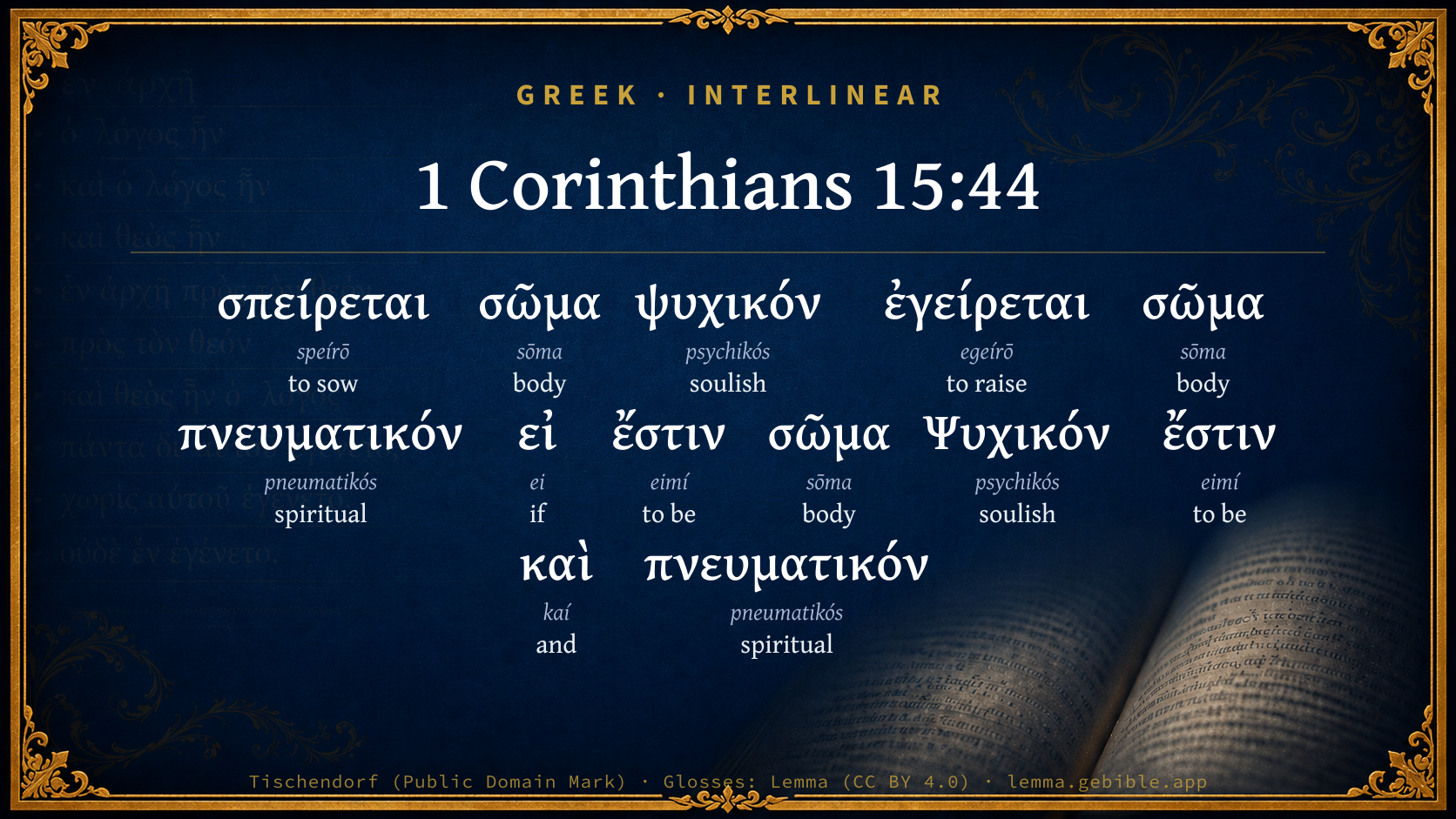
  1. σπείρεται speírō G4687 “to sow” Verb, Present, Passive, Indicative, 3rd person, Singular
  2. σῶμα sōma G4983 “body” Noun, Nominative, Singular, Neuter
  3. ἐγείρεται egeírō G1453 “to raise” Verb, Present, Passive, Indicative, 3rd person, Singular
  4. σῶμα sōma G4983 “body” Noun, Nominative, Singular, Neuter
  5. πνευματικόν pneumatikós G4152 “spiritual” Adjective, Nominative, Singular, Neuter
  6. εἰ ei G1487 “if” Conditional
  7. ἔστιν eimí G1510 “to be” Verb, Present, Active, Indicative, 3rd person, Singular
  8. σῶμα sōma G4983 “body” Noun, Nominative, Singular, Neuter
  9. Ψυχικόν psychikós G5591 “soulish” Adjective, Nominative, Singular, Neuter
  10. ἔστιν eimí G1510 “to be” Verb, Present, Active, Indicative, 3rd person, Singular
  11. καὶ kaí G2532 “and” Conjunction
  12. πνευματικόν pneumatikós G4152 “spiritual” Adjective, Nominative, Singular, Neuter

About this verse

These counts appear in no published source. They are computed here, from the morphology-tagged text and Lemma’s own curated glosses. What Lemma adds →

13
words
8
distinct lemmas
Pauline Epistles
section

Notable vocabulary

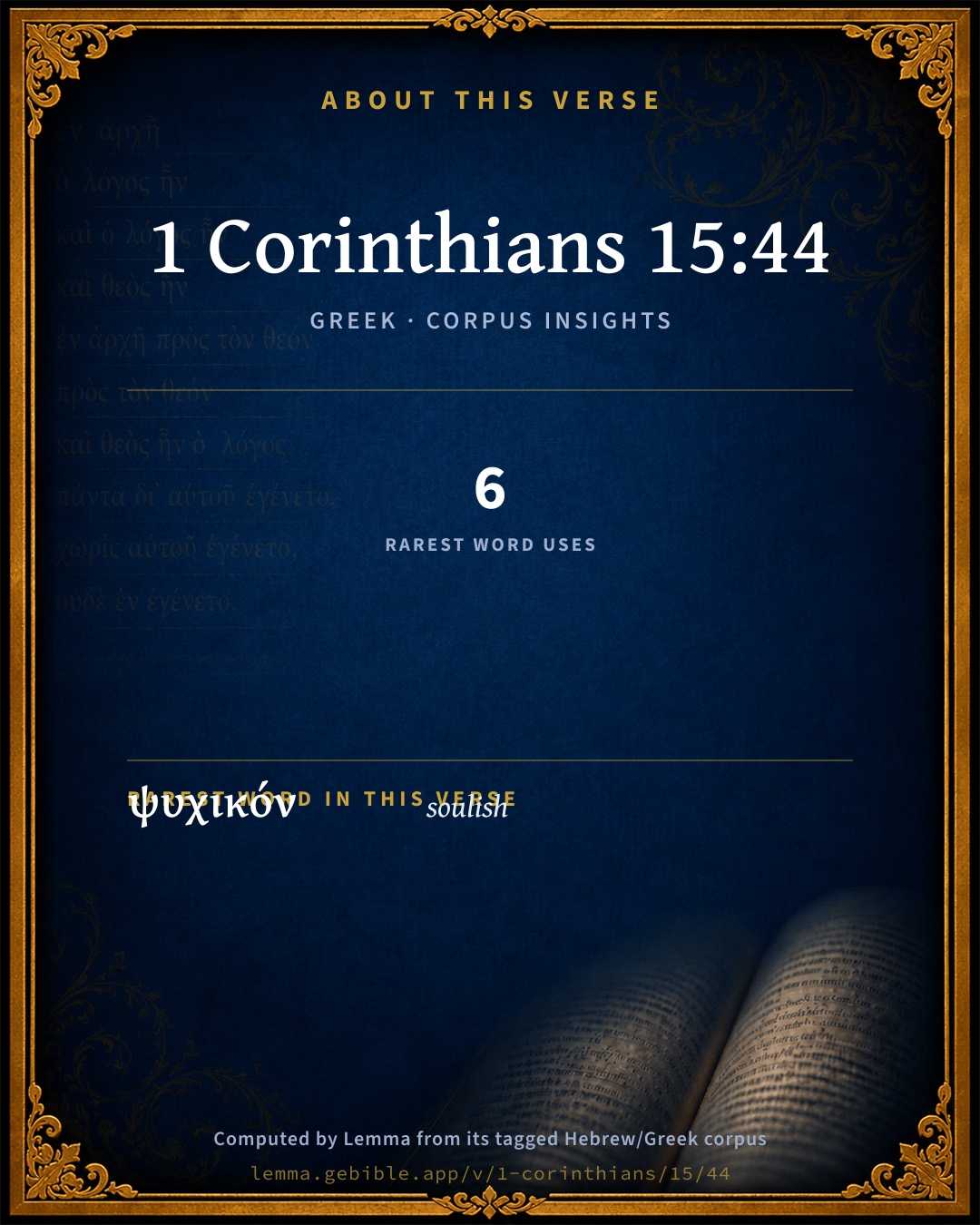
The rarest word here is ψυχικόν soulish G5591 — appearing just 6 times in the whole Greek New Testament.

Shared distinctive vocabulary

ψυχικόν soulish G5591 occurs in 5 verses of the Greek New Testament. Also found in:

Repetition

Words recur within this verse:

  • σῶμα body G4983 ×3
  • ψυχικόν soulish G5591 ×2
  • πνευματικόν spiritual G4152 ×2
  • ἔστιν to be G1510 ×2

Cross-references

4

Topical passages linked to 1 Corinthians 15:44 in the Treasury of Scripture Knowledge — connected by theme and wording, ordered by reader-vote popularity; previews shown in the World English Bible.

  • 1 Corinthians 15:50 Now I say this, brothers, that flesh and blood can't inherit the Kingdom of God; neither does corruption inherit incorruption.
  • Luke 24:31 Their eyes were opened, and they recognized him, and he vanished out of their sight.
  • John 20:19 When therefore it was evening, on that day, the first day of the week, and when the doors were locked where the disciples were assembled, for fear of the Jews, Jesus came and stood in the midst, and said to them, "Peace be to you."
  • John 20:26 After eight days again his disciples were inside, and Thomas was with them. Jesus came, the doors being locked, and stood in the midst, and said, "Peace be to you."

Cross-references courtesy of OpenBible.info (CC BY 4.0).

Where the printed editions differ

1 variant

Places in this verse where the major printed Greek editions disagree on the wording in a way that affects the translation — a comparison of editions, not a manuscript-by-manuscript collation. The editions are the modern critical texts (Nestlé-Aland 28/27, SBL, Westcott-Hort, Tregelles, Tyndale House) and the traditional texts behind the KJV (the Textus Receptus and the Byzantine/Majority text). It is not a claim about which reading is original.

  1. Extra text
    εἰ

    “If”

    In NA28NA27TynSBLWHTreg Not in TRByz

    εἰ (ei) 'If' is only in older manuscripts (NA28+NA27+Tyn+SBL+WH+Treg)

Textual data: Translators Amalgamated Greek New Testament (STEPBible TAGNT) · CC BY 4.0.

Commentary

Notes on 1 Corinthians 15:44 from classic Christian and Jewish commentators (each source and its license shown beneath its notes). The classic Christian expositions comment on the surrounding passage and are grouped to its opening verse, so a note may address several verses; the Jewish commentaries on the Tanakh (Rashi and others) are per-verse, so they appear only where the commentator wrote on this verse.

Lemma curates 59 commentaries, every one of them public domain or Creative Commons licensed, each selected and text-cleaned for this edition rather than reprinted as found. About our sources →

Bengel's Gnomon

Johann Albrecht Bengel

1Co 15:44. Ψυχικὸν, animal [natural] body) which, consisting of flesh and blood, 1Co 15:50, is wholly moulded [given form and fashion to] by the animal soul.—πνευματικὸν, spiritual) which is wholly moulded by the spirit.—καὶ) and so consequently.

Bengel's Gnomon of the New Testament — English translation (T&T Clark, Edinburgh, 1860) — public domain. Text from a community e-Sword module.

Expositor's Greek Testament

ed. W. Robertson Nicoll

1Co 15:44 . “There is sown a psychic body; there is raised a spiritual body.” This dictum grounds the antithesis unfolded in 1Co 15:42 f. upon its proper basis; the diff [2540] is not a matter of condition merely, but of constitution . Corruption, dishonour, feebleness are, in great part, penal inflictions (Rom 5:12 ff.), signalising not a natural defect, but a positive subjection to the power of sin (1Co 15:53-56 ); man, however, is essentially ψυχὴ under the present order (1Co 15:45 ), and his body therefore is essentially ψυχικὸν as determined by that order ( cf. 1Co 6:13 , and note; Col 2:20 ff., Mat 22:30 , etc.), being fitted to and expressive of the “soul” wherein his earthly being centres; see the note on ψυχικός 1Co 2:14 . Though inadequate, “natural” is the best available rendering of this adj [2541] ; it indicates the moulding of man’s body by its environment and its adaptation to existing functions; the same body is χοϊκὸν in respect of its material (1Co 15:47 ). ψυχικὸν is only relatively a term of disparagement; the “psychic body” has in it the making of the “spiritual”; “its adaptation for the present service of the soul is the sowing of it, that is the initial step in its adaptation for the future uses of the spirit. An organism fitted to be the seat of mind, to express emotion, to carry out the behests of will, is in process of being adapted for a still nobler ministry” (Ed [2542] ): “he that sows to the Spirit (in the natural body), will reap of the Spirit (in the spiritual body),” Gal 6:8 . “If there is a psychic body, there is also a spiritual”: a frame suited to man’s earthly life argues a frame suited to his heavenly life, according to the principle of 1Co 15:38 b ( cf. the argument from lower to higher in Mat 6:30 ); and the σῶμα πν . lies, in some way, germinally hidden in the σῶμα ψ ., to be unfolded from it under “the universal law of progress” (Ed [2543] ). ἔστιν ( existit ) bears emphasis in each clause; from the fact of sense P. argues to the fact of faith. Observe txtl. notes 1 3.

[2540] difference, different, differently.

[2541] adjective.

[2542] T. C. Edwards’ Commentary on the First Ep. to the Corinthians . 2

[2543] T. C. Edwards’ Commentary on the First Ep. to the Corinthians . 2

The Expositor's Greek Testament, edited by W. Robertson Nicoll (1897–1910) — public domain. Text from a community e-Sword module.

Godet's Commentaries

Frédéric Louis Godet

Vv. 44. “It is sown a psychical body, it is raised a spiritual body; there is a psychical body, and there is a spiritual body.”

The terms animated or animal body are the only ones in our language by which we can render the term reproduced in our translation by the Anglicized Greek term. The meaning of the epithet is clear; it denotes a body, not of the same substance as the soul itself,—otherwise it would not be a body,—but formed by and for a soul, destined to serve as an organ to that breath of life called ψυχή, which presided over its development. Neither, consequently, is the spiritual body a body of a spiritual nature,—it would still less be a body in that case,—but a body formed by and for a principle of life which is a spirit, and fully appropriated to its service. As the soul does not create the substance of the animal body, but finds it already prepared in a previously existing organism, so the spirit does not create the spiritual body,—which would exclude all continuity between it and the earthly body,—but it takes hold of a germ released from the present body, and causes it to open, not to resume, as in the generation of plants and animals, the cycle of its former existence, but to begin a mode of existence infinitely superior to the old one. The law of the beings belonging to nature is to revolve uniformly in the same circle; the privilege of spiritual being is to surmount this iron circle and to rise from the natural phase, which for it is only the means, to a higher sphere which is its end. This contrast arises from the wholly different mode of being possessed by the soul and the spirit. The soul is only a breath of life endowed with a certain measure of power, capable of taking hold of a material substance, subjecting it to itself, converting it into its agent, and using this organ for a fixed time up to the moment when it will no longer lend itself to such use. The characteristic of the spirit is that it possesses a life which is constantly being renewed, while acting and communicating itself (Joh 4:14). In a new order of things, after extracting from the body an organ adapted to its nature, it will perpetually renew its strength and glory. Such a body will never be to the principle of its life what the earthly body so often is to the inhabiting soul, a burden and a hindrance; it will be the docile instrument of the spirit, fulfilling its wishes and thoughts with inexhaustible power of action, as we even now see the artist using his hand or his voice with marvellous freedom, and thus foreshadowing the perfect spiritualization of the body. If any one should deny the capacity of matter thus to yield to the action of the spirit, I should ask him to tell me what matter is; then, by way of showing what spiritualized matter may be, I should invite him to consider the human eye, that living mirror in which all the emotions of the soul are expressed in a way so living and powerful. These are simple foreshadowings of the glory of a resurrection body. We cannot go further; a spiritual body is one of those things “which eye hath not seen, which have not entered into the mind of man, and which God reserves for them whom He loves.”

The spirit, the future body’s principle of life, is not directly the Spirit of God, it is spirit as the higher element of the human personality, but acting in its union with the Divine Spirit. We have already seen (1Co 14:14) that the apostle ascribes to man, not only a ψυχή, soul, but also a πνεῦμα, spirit, which is the soul’s organ in perceiving the Divine world.

The second part of 1Co 15:44 presents three rather important variants. The Alexandrine and Greco-Latin documents read εἰ, if, before the first ἔστι; then they place the καί, also, after the second; finally, they omit the word σῶμα, body, in the second proposition: “If there is a psychical body, there is also a spiritual.” The T. R. omits the εἰ, if; it places the καί, and, before ἔστι; and it reads σῶμα (body) in the second proposition: “There is a psychical body, and there is a spiritual body.” It is impossible for me to share the preference of modern commentators (de Wette and Hofmann excepted) for the first of these two readings. The apostle had just expressed a paradoxical idea; the term spiritual body seemed even to be a contradictio in adjecto. Hence it is that, according to the reading of the T. R., he stops expressly to affirm the reality of this notion: “I do not use the expression at random: there is truly a psychical body..., a spiritual.” Of this forcible affirmation, the Alexandrine and Western copyists have wished to make a demonstration. They have added εἰ, if, thus making the existence of the psychical body a premiss from which to infer logically the existence of a spiritual body. Then they have transposed the καί, also, to make it the correlative of the εἰ, if, and thereby to emphasize the correctness of the conclusion which is certainly false, for it does not appear how it follows from the fact that a soul can have a body, that a spirit should have one. Meyer seeks to justify this argument logically; but he does not succeed. Holsten appeals to this understood idea: The soul and spirit are only the two modes of existence belonging to one and the same vital principle; whence it follows that if the soul needs a body in order to act, it is so also with the spirit. But if substantially the soul and spirit are one and the same thing, Paul would here prove the same by the same. Beet adduces this law: God ever wills what is perfect; hence it follows that His work proceeding from the imperfect, which is its beginning, must reach the goal which is the perfect. But how can we infer from this the necessity of a spiritual body? If, as was no doubt thought by the opponents of the resurrection, the purely spiritual state is superior to the spiritual state united to the bodily, the law referred to recoiled against the thesis of a resurrection. But, according to the true reading, that of the Byzantines, there is no argument at all. As Hofmann says, the apostle’s purpose is simply to state the contrast between the two kinds of bodies. This is exactly what the Byzantine reading does. No doubt it might be denied that the εἰ, if, of the Alex. must be taken in the sense of a proof. But if Paul had meant to make a simple comparison, he would have said καθώς or ὥσπερ.

In regard to the repetition or omission of the word σῶμα, body, in the second proposition, it seems to me that the omission would weaken the force of the paradox which the apostle wishes to affirm, while the exact repetition of the same terms renders the expression of it more striking. — In support of this affirmation of two kinds of bodies, Paul produces a saying from Scripture.

Frédéric Louis Godet — Commentaries on Luke, John, Romans, and 1 Corinthians — English translation (T&T Clark, Edinburgh, 1870s–1890s) — public domain. Text from a community e-Sword module.

Hodge's Commentary on Romans, Ephesians & First Corinthians

Charles Hodge

1Co_15:43, 1Co_15:44

It is sown in dishonor, it is raised in glory: it is sown in weakness, it is raised in power: it is sown a natural body, it is raised a spiritual body. There is a natural body, and there is a spiritual body.

The apostle contemplates the body as at the moment of interment, and therefore these predicates are to be understood with special reference to its condition at that time. It is the dead body that is sown in dishonor, despoiled of the short-lived attractiveness which it had while living. It is raised in glory, i.e. in that resplendent brightness which diffuses light and awakens admiration. It is to be fashioned like unto the glorious body of the Son of God, Phi_3:21. It is sown in weakness. Nothing is more absolutely powerless than a corpse it can do nothing and it can resist nothing. The weakness which belonged to it in life, is perfected in death. It is raised in power. The future body will be instinct with energy, endowed, it may be, with faculties of which we have now no conception. It is sown a natural body, it is raised a spiritual body. This comprehends all that has been said. A natural body, σῶμα ψυχικόν, is a body of which the ψυχή, or animal life, is the animating principle; and a spiritual body σῶμα πνευματικόν, is a body adapted to the πνεῦμα, the rational, immortal principle of our nature. We know from experience what a natural body is. It is a body which has essentially the same properties as those of brutes. A natural body consists of flesh and blood; is susceptible of pain and decay; and needs air, food, and rest. It is a mere animal body, adapted to the conditions of an earthly existence. What a spiritual body is, we know only from Pauls description, and from the manifestation of Christ in his glorified body. We know that it is incorruptible, glorious, and powerful, adapted to the higher state of existence in heaven, and therefore not adapted to an earthly condition. Spiritual, in this connection, does not mean ethereal, refined, much less made of spirit, which would be a contradiction. Nor does it mean animated by the Holy Spirit. But as σῶμα ψυχικόν is a body adapted to the ψυχή or principle of animal life, the σῶμα πνευματικόν is a body adapted to the πνεῦμα or principle of rational life. The Bible uses these terms just as we do, without intending to teach that the ψυχή or life, is a distinct substance or subject from the πνεῦμα or rational spirit, but only that as we have certain attributes, considered as living creatures, in common with irrational animals, so we have now a body suited to those attributes; and, on the other hand, as we have attributes unspeakably higher than those which belong to brutes, we shall hereafter possess bodies adapted to those higher attributes. The Bible recognizes in man only two subjects or distinct separable substances, the soul and body. And this has ever been a fundamental principle of Christian anthropology.

There is a natural body, and there is a spiritual body. This is a vindication of the apparently contradictory expression, spiritual body, which according to the letter, is tantamount to immaterial matter. If, however, it is proper to speak of σῶμα ψυχικόν, a natural body, i.e. a body adapted to the principle of animal life; it is right to speak of a σῶμα πνευματικόν, a spiritual body, i.e. a body adapted to the spirit. Lachmann, Rückert, and Tischendorf, after the ancient MSS. and versions, adopt the reading εἰ ἔστι, k. t. l. If there is a natural body, there is a spiritual body. Just as certainly as we have a body adapted to our lower nature, we shall have one adapted to our higher nature. If the one exists, so does the other.

Charles Hodge — Commentary on Romans (1835), First Corinthians (1857), and Ephesians (1856) — public domain. Text from a community e-Sword module.

Geneva Bible (1599)

Geneva Bible translators

He showeth perfectly in one word, this change of the quality of the body by the resurrection, when he saith, that of a natural body, it shall become a spiritual body, which two qualities being clean different, the one from the other, he straightway expoundeth and setteth forth diligently.

Geneva Bible (1599) marginal notes — public domain. Text via Bolls.life.

Jamieson, Fausset & Brown

Robert Jamieson, A. R. Fausset & David Brown

a natural body--literally, "an animal body," a body moulded in its organism of "flesh and blood" (Co1 15:50) to suit the animal soul which predominates in it. The Holy Spirit in the spirit of believers, indeed, is an earnest of a superior state (Rom 8:11), but meanwhile in the body the animal soul preponderates; hereafter the Spirit shall predominate, and the animal soul be duly subordinate.

spiritual body--a body wholly moulded by the Spirit, and its organism not conformed to the lower and animal (Luk 20:35-36), but to the higher and spiritual, life (compare Co1 2:14; Th1 5:23).

There is, &c.--The oldest manuscripts read, "IF there is a natural (or animal-souled) body, there is also a spiritual body." It is no more wonderful a thing, that there should be a body fitted to the capacities and want of man's highest part, his spirit (which we see to be the case), than that there should be one fitted to the capacities and wants of his subordinate part, the animal soul [ALFORD].

Jamieson, Fausset & Brown — Commentary Critical and Explanatory on the Whole Bible (1871) — public domain (CC PDM 1.0). Text via the HelloAO Bible API.

Adam Clarke's Commentary

Verse 44. It is sown a natural body] σωμα ψυχικον. An animal body, having a multiplicity of solids and fluids of different kinds, with different functions; composed of muscles, fibres, tendons, cartilages, bones, arteries, veins, nerves, blood, and various juices, requiring continual support from aliment; and hence the necessity of labour to provide food, and skill to prepare it; which food must be masticated, digested, and refined; what is proper for nourishment secreted, brought into the circulation, farther elaborated, and prepared to enter into the composition of every part; hence growth and nutrition; without which no organized body can possibly exist.

It is raised a spiritual body.] One perfect in all its parts; no longer dependent on natural productions for its support; being built up on indestructible principles, and existing in a region where there shall be no more death; no more causes of decay leading to dissolution; and consequently, no more necessity for food, nutrition, c. The body is spiritual, and has a spiritual existence and spiritual support.

What the apostle says here is quite consistent with the views his countrymen had on this subject.

In Sohar Chadash, fol. 43, it is said: "So shall it be in the resurrection of the dead only, the old uncleanness shall not be found."

R. Bechai, on the law, fol. 14, says: "When the godly shall arise, their bodies shall be pure and innocent; obedient to the instinct of the soul: there shall be no adversary, nor any evil disease."

Rab. Pinchas says: "The holy blessed God shall make the bodies of the righteous as beautiful as the body of Adam was when he entered into paradise."

Rab. Levi says: "When the soul is in heaven, it is clothed with celestial light; when it returns to the body, it shall have the same light; and then the body shall shine like the splendour of the firmament of heaven. Then shall men gain the knowledge of what is perfect." Sohar. Gen., fol. 69.

The Jews have an opinion that the os coxendicis, the lower joint of the backbone, survives the corruption of the body; and that it is out of this bone that the resurrection body is formed. In the place last quoted, fol. 70, we have the following teachings on this subject: "Let us borrow an example from what relates to the purifying of silver. First, the ore is cast into the burning furnace, that it may be separated from its earthly impurities; it is then silver, but not perfect silver. They put it into the furnace a second time, and then all its scoriae are separated from it, and it becomes perfect silver, without any adulteration. Thus does the holy blessed God: he first buries our bodies under the earth, where they putrefy and corrupt, that nothing remains but that one bone: from this a new body is produced, which is indeed a body, but not a perfect body. But in that great day, when all bodies are hidden in the earth, and the soul departs, then even that bone decays, and the body which was formed out of it remains, and is as the light of the sun, and the splendour of heaven. Thus, as the silver was purified, so is the body: and no imperfect mixture remains." See Schoettgen.

These things must not be treated as rabbinical dotages; the different similes used for the apostle have the same spirit and design: as the seed which is sown in the earth rots, and out of the germ contained in it God in his providence produces a root, stalk, leaves, ear, and a great numerical increase of grains; is it not likely that God, out of some essential parts of the body that now is, will produce the resurrection body; and will then give the soul a body as it pleaseth him; and so completely preserve the individuality of every human being, as he does of every grain; giving to each its own body? 1Co 15:38. So that as surely as the grain of wheat shall produce wheat after it is cast in the earth, corrupts, and dies; so surely shall our bodies produce the same bodies as to their essential individuality. As the germination of seeds is produced by his wisdom and power, so shall the pure and perfect human body be in the resurrection. Hence he does not say the body is buried, but the body is sown; it is sown in weakness, it is sown in dishonour, &c., &c.

There is a natural body, and there is a spiritual body.] This very saying is found in so many words, in Yalcut Rubeni, fol. 126: "There are different kinds of men."

אית אדם דאיהו אדם דנשמתא ואיה אדם רגופא

"There is a spiritual Adam, and there is also a corporeal Adam."

Adam Clarke's Commentary on the Bible (1810–1826) — public domain. Text from a community e-Sword/MySword module.

Ellicott's Commentary for English Readers

(44) It is sown a natural body.—Here is a further and different application of the three analogies. It is not only that there is a variety of body in these illustrations, but there is also an adaptability. The “body” which a plant has when it is in the form of seed is suited to the condition in which seed is placed; the “body” which it has when grown into a plant is suited to the changed conditions in which a plant exists; the “flesh” in the “body” form of a bird is suited to its sphere of life; the “flesh” in the “body” form of a fish is suited to its condition; and so on. It is not an accidental but a purposely adapted variety. So it will be in the variety of “bodies” for Humanity. A man’s organism is sown (i.e., is born into this world) a natural body; it is raised (through and by death) a spiritual body. The body which we have here on earth is suited with a marvellous detail of adaptability to the life, physical and intellectual, amid which we are placed, and of which we form a part. It is, however, a hindrance to the spiritual man in each of us. (See 2 Corinthians 5) There will be a time for each when the body will become as perfectly adapted to the spiritual man in each as the human body here is to the natural man—no longer its hindrance, but its help. The “willing spirit” will then never be hampered and thwarted by a “weak flesh;” the body, having become spiritual itself, will be spiritually strong.

There is a natural body, and there is a spiritual body.—This emphatic assertion that there are two bodies for man—as really as seed and a blossom are two bodies yet the same plant—is introductory to the further thought introduced in the next verse.

A Bible Commentary for English Readers, edited by Charles John Ellicott (1878–1897) — public domain. Text from a community e-Sword module.

The Cambridge Bible for Schools and Colleges

gen. ed. J. J. S. Perowne

44. it is sown a natural body; it is raised a spiritual body] For the word natural see ch. 1Co_2:14. The ‘natural body’ is the body accommodated to, and limited by, the needs of the animal life of man. Man possesses a spiritual life through union with Jesus Christ, but his present body is not adapted to the requirements of such a life. It is called a ‘body of death,’ Rom_7:24 (‘this body of death,’ in the E. V. ‘the body of this death.’). ‘The corruptible body (Wis_9:15) presseth down the soul,’ and we groan under its weight, and look earnestly forward to its redemption (Rom_8:23; 2Co_5:2; 2Co_5:4). But the spiritual body will not only be a body in which the spiritual principle dominates the whole organism (Theodoret), but it will be adapted to the needs of that principle, and therefore will be possessed of powers hitherto unknown. So St Chrysostom. See also last note and 2Co_5:1, ‘we have in the heavens a house not made with hands.’ “The earthly and celestial body are not identical, but not absolutely different; the elements of the former are employed in the formation of the latter, the operation of Christ in believers gradually transforms the one into the other.” Olshausen. This remark, however, leaves out of sight the fact that however gradual the transformation of the natural man into the spiritual man in this life, it is completed by a process which is not gradual, namely the Resurrection.

There is a natural body, and there is a spiritual body] Most modern editors have received the better supported reading, ‘if there is a natural body, there is a spiritual one also.’ It is also the reading of the Vulgate and of Wiclif. The reading in the text, which is that received by Tyndale, is the more easy to understand, but perhaps it is for that very reason that it has been substituted for the other. If we receive it, the passage is a simple assertion of the existence of a spiritual as well as of a natural body. If we prefer the other, it affirms that the life spiritual of necessity demands a proper vehicle as much as the life natural; that if the latter has—and we see that this is so—a body corresponding to its demands, it follows that the life spiritual will have one also.

The Cambridge Bible for Schools and Colleges (gen. ed. J. J. S. Perowne; Cambridge University Press, 1878–1918) — public domain. Text from a community e-Sword module.

John Gill's Exposition

The first man is of the earth, earthy,.... He was formed out of the earth, Gen 2:7 and the word there used signifies red earth. Josephus (c) observes, that the first man was called Adam, which in the Hebrew tongue signifies red, because he was made out of red earth; for such, adds he, is the true and virgin earth: Pausanias (d) makes mention of a clay, which is not the colour of earth, but like the sand of brooks and rivers; and gives a smell very near to that of the skin, or body of men; and which is said to be the remains of that clay, out of which all mankind was made: but be that as it will, Adam was certainly made out of the earth, and had his habitation and abode assigned him in the garden of Eden, and was made to cultivate and till it; his lordship and dominion, at most and best, only extended to the terraqueous globe, and the creatures in it; and having sinned, he was not only thrust out of the garden to till the ground out of which he was taken, but doomed to return to the dust from whence he came; and whose sin and fall had such an influence on him and his posterity, as to make their souls sensual and earthly, to mind, affect, and cleave unto earthly things:

the second man is the Lord from heaven; as Adam was the first man, Christ is the second man; and these two are spoken of, as it they were the only two men in the world; because as the former was the head and representative of all his natural posterity, so the latter is the head and representative of all his spiritual offspring: and he is "the Lord from heaven"; in distinction from the first man, who was of the earth, and whose lordship reached only to the earth; whereas Christ is Lord of all, not only Lord of lords below, but Lord of angels and saints above; the whole family in heaven and in earth is named of him; and he has all power in heaven and in earth, and a name above every name in this world, and that to come, and is indeed higher than the heavens: this is not to be understood of his human nature, or of his human body, as if that came down from heaven, and passed through the virgin, as some heretics of old said, as water through a pipe; for though it was conceived and formed in a miraculous manner, under the overshadowing of the Holy Ghost from on high, yet was formed out of the matter and substance of the virgin, and so was of the earth; and was indeed an earthly body, supported by earthly means, and at last returned to the earth, and was interred in it: but it is to be understood either of Christ as a divine person, as the Son of God, as Lord of all, coming down from heaven at his incarnation; not by local motion, or change of place, but by assumption of the human nature into union with him, the Lord from heaven; or rather of him as he shall descend from heaven, as the Lord and Judge of all at the last day, when he will come in his glorious, spiritual, and heavenly body; and raise the righteous dead, and fashion their bodies like his own; when what follows will have its full accomplishment. The Cabalistic doctors among the Jews often speak (e) of , "the superior man", and , "the inferior man"; and in their Cabalistic table (f), in the sixth "sephirah", or number, they place the man from above, the heavenly Adam; and, in one of their writings (g), have these remarkable words,

"anynt Mdaw hale Mda Nam, "who is the supreme man and the second man", but of whom it is said, Pro 30:4 "what is his name, and what is his son's name?" what is his name? this is the supreme man; what is his son's name? this is the inferior man; and both of them are intimated in that Scripture, Exo 3:13 "and they shall say unto me, what is his name? what shall I say?"''

Some copies, and the Vulgate Latin and Ethiopic versions; leave out the word "Lord", and add the word "heavenly", reading the clause thus, "the second man from heaven, heavenly".

(c) Antiqu. l. 1. c. 1. sect. 2. (d) Phocica, sive l. 10. p. 615. (e) Raziel, fol. 26. 1. & 31. 1. & 33. 1. Tzeror Hammor, fol. 1. 4. (f) In Cabala Denudata, par. 2. p. 9. (g) Zohar in Gen. fol. 39. 2.

John Gill's Exposition of the Whole Bible (1746–1763) — public domain (CC PDM 1.0). Text via the HelloAO Bible API.

Trapp's Complete Commentary

John Trapp

44 It is sown a natural body; it is raised a spiritual body. There is a natural body, and there is a spiritual body.

Ver. 44. A spiritual body] Luther saith the body shall move up and down like thought. Augustine saith, they shall move to any place they will, as soon as they will. As birds (saith Zanchius) being hatched, do fly lightly up into the skies, which being eggs, were a heavy and slimy matter; so man, being hatched by the resurrection, is made pure and nimble, and able to mount up into the heavens.

John Trapp, A Commentary or Exposition upon All the Books of the Old and New Testament (1647–1656) — public domain. Text from a community e-Sword module.

Albert Barnes' Notes on the Bible

It is sown a natural body - (σῶμα ψυχικὸν sōma psuchikon). This word, “natural,” denotes properly that which is endowed with “animal” life, having breath, or vitality. The word from which it is derived (ψυχή psuchē) denotes properly the breath; vital breath; the soul, as the vital principle; the animal soul, or the vital spirit; the soul, as the seat of the sentient desires, passions, and propensities; and then a living thing, an animal. It may be applied to any animal, or any living thing, whether brutes or men. It is distinguished from the soul or spirit (Πνεῦμα Pneuma), inasmuch as that more commonly denotes the rational spirit, the immortal soul, that which thinks, reasons, reflects, etc. The word “natural” here, therefore, means that which has “animal” life; which breathes and acts by the laws of the animal economy; that which draws in the breath of life; which is endowed with senses, and which has need of the supports of animal life, and of the refreshments derived from food, exercise, sleep, etc.

The apostle here, by affirming that the body will be spiritual, intends to deny that it will need that which is now necessary to the support of the animal functions; it will not be sustained in that way; it will lay aside these special animal organizations, and will cease to convey the idea which we now attach to the word animal, or to possess that which we now include under the name of vital functions. Here the body of man is endowed simply with animal functions. It is the dwelling-place indeed of an immortal mind; but as a body it has the properties of animal life, and is subject to the same laws and inconveniences as the bodies of other animals. It is sustained by breath, and food, and sleep; it is endowed with the organs of sense, the eye, the ear, the smell, the touch, by which alone the soul can hold communication with the external world; it is liable to disease, languor, decay, death. These animal or vital functions will cease in heaven, and the body be raised in a different mode of being, and where all the inconveniences of this mere animal life shall be laid aside.

It is raised a spiritual body - Not a mere spirit, for then it would not be a body. The word spiritual (πνευματικόν pneumatikon) here stands opposed to the word natural, or animal. it will not be a body that is subject to the laws of the vital functions, or organized or sustained in that way. It will still be a “body” (σῶμα sōma), but it will have so far the nature of spirit as to be without the vital functions which here control the body. This is all that the word here means. It does not mean refined, sublimated, or transcendental; it does not mean that it will be without shape or form; it does not mean that it will not be properly a body. The idea of Paul seems to be this: “We conceive of soul or spirit as not subject to the laws of vital or animal agency. It is independent of them. It is not sustained or nourished by the functions of the animal organization. It has an economy of its own; living without nourishment; not subject to decay; not liable to sickness, pain, or death. So will be the body in the resurrection. It will not be subject to the laws of the vital organization. It will be so much like a spirit as to be continued without food or nutriment; to be destitute of the special physical organization of flesh, and blood, and bones; of veins, and arteries, and nerves, as here 1Co 15:50.; and it will live in the manner in which we conceive spirits to live; sustained, and exercising its powers, without waste, weariness, decay, or the necessity of having its powers recruited by food and sleep.” All, therefore, that has been said about a refined body, a body that shall be spirit, a body that shall be pure, etc., whatever may be its truth, is not sustained by this passage. It will be a body without the vital functions of the animal economy; a body sustained in the manner in which we conceive the spirit to be.

There is a natural body - This seems to be added by Paul in the way of strong affirmation arising from earnestness, and from a desire to prevent misconception. The affirmation is, that there is a natural body; that is apparent: it is everywhere seen. No one can doubt it. So, with equal certainty, says Paul, there is a spiritual body. It is just as certain and indisputable. This assertion is made, not because the evidence of both is the same, but is made on his apostolic authority, and is to be received on that authority. That there was an animal body was apparent to all; that there was a spiritual body was a position which he affirmed to be as certain as the other. The only proof which he alleges is in 1Co 15:45, which is the proof arising from revelation.

Albert Barnes' Notes on the Bible (1834–1885) — public domain. Text from a community e-Sword/MySword module.

Matthew Poole's English Annotations

It is sown a natural body; such a body as all living creatures have by nature, which is upheld by the actions of the soul that quickeneth it; both the vegetative powers, by which it is nourished by the use of meat and drink, the eating, concocting, and digesting it, &c.; and the sensitive powers, &c. But it shall be

raised a spiritual body; spiritual, not as to the substance of it, for in that sense a spiritual body is a contradiction, but in respect of the qualities and conditions of it, Mat 22:30; Luk 20:35,36. Bodies which, in respect of many new qualities they shall have, shall be more like angels and other spirits, than human bodies; beautiful, incorruptible, free from infirmities, not subject to hunger, or thirst, or injuries from cold or heat, &c.; not using meat, drink, clothes, physic, or marriage; free, active, and nimble as spirits, 1Th 4:17.

Spiritual, because they shall perfectly obey the soul made perfect, and be by it commanded to spiritual actions only; of subtile, spiritual, refined constitutions.

Matthew Poole's English Annotations on the Holy Bible (1683–1685) — public domain. Text from a community e-Sword/MySword module.

Whedon's Commentary on the Bible

Daniel D. Whedon

44. Natural body… spiritual body—The word natural, to the English reader, entirely breaks the thread of the apostle’s thought. If we assume a difference between soul and spirit, and coin the word soulical as the antithesis of spiritual, we present his exact idea, and the connexion with the word soul, 1Co_15:45, will be immediately made. The Greek word ψυχη, psyche—soul or life—when used as antithetical to πνευμα, pneuma— spirit—signifies that animating, formative, and thinking soul or anima which belongs to the animal, and which man, as animal, shares as his lower nature, with the animals. Its range is within the limits of the five senses, within which limits it is able to think and to reason. Such is the power of the highest animals. Overlying this, is the spirit which man shares with higher natures, by which thought transcends the range of the senses, and man thinks of immensity, eternity, infinity, immortality, the beautiful, the holy, and God. Whether soul and spirit exist in man as two entities distinct from each other, we need not here discuss; yet it is certain that man’s mind possesses both these two classes or sets of thoughts. The lower faculties may exist without the higher; for they do so exist in brutes. The brute has also a higher set of faculties overlying those of the oyster. But it is all-important to note that it is by man’s spiritual faculties that he rises into a supernal region, and shows affinities with celestial natures.

When St. Paul says it is sown a soulical body, as in the two preceding cases (1Co_15:42-43) of the sown, he does not refer to the dead or dying body, but to the body as mortal in life, and sown in death. It is a soulical body while living, and is buried as the vacated frame of a soulical body.

The body dies because the animal soul either fuses into surrounding nature, or is borne by the spirit into the spirit region.

There is—The anti-resurrectionists of the Corinthian Church seem never to have understood this striking assertion. A soulical body… a spiritual body— But as the soulical body is not all pure soul, so the spiritual body is not pure spirit. For a pure spirit is not a body at all. As the soulical body is soul-pervaded body, so the spiritual body is spirit-pervaded body. But while the soul pervades and gives sensitive life to body alone, the spirit pervades both soul and body, and gives supernal life to both; forming the unit of body, soul, and spirit.

Scholars agree that the true reading here is, If there is a natural body, there is also a spiritual body. By the body’s becoming a “spiritual body” we understand that it will be so subtilized, so adjusted to the pure spirit, and so subjected in every part and particle to the volition and power of the spirit, that while the spirit becomes, so to speak, more substantiated, the personal unit of the two natures possesses all the capabilities that our thought usually attributes to the pure spirit. By volition it passes with lightning rapidity through measureless distances. It clairvoyantly sees, at volition, through a finite immensity. By volition it transforms itself to any shape, and invests itself with a countless variety of properties and phenomenal presentations. It can become as the dark, rolling cloud, the flashing lightning, the solid rock. And yet it will have a normal figure and face which will at once be the true expression of its essential nature, (far more truly than human physiognomy now manifests the character,) and will reveal to the intuition of the fellow-celestials the particular personality, and perhaps the entire past history, of the individual. When asked, Will the glorified bodies have teeth? we reply, If they please; and eat with them, too, as the angels did who visited Abraham. If asked, Will they have hair? we reply, Yes, if they please. And when asked, Where will they get their clothes? we answer, Just where the “two angels” who stood before the apostles at Christ’s ascension, procured their “shining raiment.” it is perfectly clear, we think, that varying phenomenal form and properties are more or less at the command both of the pure spirit and of the unit of spirit and spiritual body. See note on Luk_24:39.

Daniel D. Whedon (gen. ed.), Commentary on the Old and New Testaments (1874–1909) — public domain. Text from a community e-Sword module.

The Pulpit Commentary

A natural body. The adjective is the word yucikon, which is so difficult to translate; it means a body only animated by the psyche, or natural life. The word is sometimes in our Authorized Version rendered "carnal." A spiritual body. The apparent contradiction in terms is inevitable. The thing meant is a body which is not under the sway of corporeal desires or of intellectual and passionate impulses, but is wholly dominated by the Spirit, and therefore has no desire or capacity to fulfil the lusts of the flesh. There is. The better supported reading (a, A, B, C, D, F, G), is, if there is a natural body, etc. The existence of the one is no more impossible than the existence of the other.

The Pulpit Commentary (1880–1919), ed. H.D.M. Spence-Jones & Joseph S. Exell — public domain. Text from a community e-Sword module.

John Wesley's Explanatory Notes

It is sown in this world a merely animal body - Maintained by food, sleep, and air, like the bodies of brutes: but it is raised of a more refined contexture, needing none of these animal refreshments, and endued with qualities of a spiritual nature, like the angels of God.

John Wesley, Explanatory Notes Upon the Whole Bible (1754–1765) — public domain. Text via the GEBible commentary corpus.

Burkitt's Expository Notes on the New Testament

William Burkitt

Observe here, 1. Our apostle draws a parallel between the two Adams, the first man and Christ; they were two roots and distinct fountains, from whence all life did spring and flow; all natural life from the first Adam, all spiritual life from Christ the second Adam; The first Adam was made a living soul, the last Adam was made a quickening spirit.

Observe, 2. The apostle compares the animal life we live by the union of our souls and bodies, with the spiritual life we live by the union of our souls with Christ. In point of dignity and real excellency, the spiritual life is far before the natural; but in point of priority, the natural life is before the spiritual. First that which is natural, and afterwards that which is spiritual.

Observe, 3. What the pedigree and original of man was and is: He is of the earth, earthy. Earth is the original of man, the matter out of which his form was produced. Hence the earth is called his earth, His breath goeth forth, and he returneth to his earth. Psa 146:4

Observe, 4. As believers have borne in their bodies here on earth the image of the first Adam, so in the resurretion their bodies shall bear the image of the heavenly Adam; that is be changed into the likeness of Christ’s glorious body. This is the highest degree of dignity and honour that a human body is capable of.

Those bodies which in their first formation were of dust and clay, and which in their dissolution are no better than a lump of corruption, when the grave delivers them back again shall be shining and excellent fabrics, bearing the image of Christ the heavenly Adam.

Then will the saints’ bodies be absolutely and everlastingly freed from all natural infirmities, from all accidental deformities, from all wants and necessities; and shall never more be subject to death, that formidable adversary of human nature.

O blessed hour! when both soul and body shall live immediately upon God, and act freely and delightfully for God, and be forever satisfied in the full fruition and final enjoyment of God.

William Burkitt's Expository Notes on the New Testament (1700–1703) — public domain. Text from a community e-Sword module.

Godbey's Commentary on the New Testament

William B. Godbey

AN ANIMAL BODY AND A SPIRITUAL BODY

44. “It is sown an animal body, it is raised a spiritual body. If there is an animal body, there is also a spiritual body.” The conclusion from these Scriptures is clear and irresistible. Precisely as the present body is for the occupancy of the animal life, soul and intellect, for all of this really belongs to the animal kingdom; e. g., the horse has an intelligent mind, so has every animal an amount of intelligence. There is this fact in reference to all animals: while you can teach them many things, you can not teach them anything about God; from the fact that while they have a mind, they have no spirit homogeneous to the human spirit. Hence my body, like that of the animal, is the tenement in which my animal life dwells. In a similar manner the resurrection body will be a tenement for my spirit to live in. Hence you may depend on it, as Paul here certifies, that there is a body for human spirit to live in, as well as a body for the animal life, soul and intellect to dwell in.

William B. Godbey, Commentary on the New Testament (1896–1900) — public domain. Text from a community e-Sword module.

McGarvey & Pendleton's Commentaries

J. W. McGarvey

it is sown a natural body; it is raised a spiritual body. If there is a natural body, there is also a spiritual body . [This power of God to preserve identity in diversity works out glorious results for man. Our earthly body, when planted in death, will indeed bring forth after its kind, but God, in the fullness of his power and grace, shall cause it to lay aside its terrestrial glory, and assume the celestial. The nature of the change thus effected is illustrated by four contrasts, the corruption, dishonor, weakness and animal nature of the terrestrial body being laid aside for the incorruptible, glorious, powerful and spiritual body of the celestial world. If man owns a natural, or psychical, body, i. e., a body which is sustained and operated by his lower or soul-life, and suited to this world of death; so he also owns a spiritual body, suited to the desires, motions and operations of the spirit and eternal life; a body wherein the soul takes its proper position of subordination to the spirit, according to God's original plan and purpose when he created man in his image. Paul says "is," for such a body already exists, and is occupied by Christ our head-- Rev_1:18 ]

J. W. McGarvey (with Philip Y. Pendleton), Commentaries on the New Testament (The Fourfold Gospel, 1914; Acts; and the epistles) — public domain. Text from a community e-Sword/MySword module.

The People's New Testament

B. W. Johnson

44. Sown a natural body. A fleshly body with animal life. Raised a spiritual body. A body whose life principle is the spirit. Not a fleshly body, but a spiritual existence. We cannot comprehend the nature of this existence, but we can know that it is not a body of flesh, bones, and blood; perhaps not more material than the forms of the angels. See verse 50.

B. W. Johnson's The People's New Testament with Notes (1889–1891) — public domain. Electronic text from the Christian Classics Ethereal Library (CCEL) ThML edition.

Cambridge Greek Testament for Schools and Colleges

44. εἰ אABCDFG Vetus Lat. Vulg. Rec. om. with E and Peshito. Rec. adds σῶμα before πνευματικόν with Peshito. Text אABCDEFG Vetus Lat. Vulg.

44. ψυχικόν. See ch. 1Co 2:14. The σῶμα ψυχικόν is the body accommodated to, and limited by, the needs of the animal life of man. Man possesses a spiritual life through union with Jesus Christ, but his present body is not adapted to the requirements of such a life. It is called a ‘body of death,’ Rom 7:24 (in the A.V. ‘the body of this death’). ‘The corruptible body (Wis 9:15) presseth down the soul,’ and we groan under its weight, and look earnestly forward to its redemption (Rom 8:23; 2Co 5:2; 2Co 5:4). But the spiritual body will not only be a body in which the spiritual principle dominates the whole organism (Theodoret), but it will be adapted to the needs of that principle, and therefore will be possessed of powers hitherto unknown. So Chrysostom. See also last note and 2Co 5:1, ‘we have in the heavens a house not made with hands.’ ‘The earthly and celestial body are not identical, but not absolutely different; the elements of the former are employed in the formation of the latter, the operation of Christ in believers gradually transforms the one into the other.’ Olshausen. This remark, however, leaves out of sight the fact that however gradual the transformation of the natural man into the spiritual man in this life, it is completed by a process which is not gradual, namely, the Resurrection.

εἰ ἔστιν αῶμα ψυχικόν. The rec. reading (see Critical Note) is the more easy to understand, but perhaps it is for that very reason that it has been substituted for the other. If it be accepted the passage is a simple assertion of the existence of a spiritual as well as of a natural body. If we prefer the text, it affirms that the life spiritual of necessity demands a proper vehicle as much as the life natural; that if the latter has—and we see that this is so—a body corresponding to its demands, it follows that the life spiritual will have one also.

Cambridge Greek Testament for Schools and Colleges (Cambridge University Press, 1896; 21 vols, various authors incl. Carr, Maclear, Plummer, Farrar, Lumby, Moule, M. R. James, Simcox) — public domain. Text from a community e-Sword module.

International Critical Commentary

44. εἰ ἓστιν … ἒστιν καί. The emphasis is on ἔστιν in both clauses; ‘If there is a natural body (and of course you cannot deny that), there is also a spiritual.’ Is it likely that the highest development of all is left blank? * This a priori argument may be confirmed by Scripture.

International Critical Commentary — older volumes (1896–1929), various authors — public domain. Text from a community e-Sword module.

Vincent's Word Studies in the New Testament

Marvin R. Vincent

A natural body [σωμα ψυχικον] . See on ch. 1Co 2:14. The word yucikon natural occurs only twice outside this epistle; Jas 3:15; Jude

1Co 15:19The expression natural body signifies an organism animated by a yuch soul (see on Rom 11:4); that phase of the immaterial principle in man which is more nearly allied to the sarx flesh, and which characterizes the man as a mortal creature; while pneuma spirit is that phase which looks Godward, and characterizes him as related to God. "It is a brief designation for the whole compass of the non - corporeal side of the earthly man" (Wendt). "In the earthly body the yuch soul, not the pneuma spirit is that which conditions its constitution and its qualities, so that it is framed as the organ of the yuch. In the resurrection - body the pneuma spirit, for whose life - activity it is the adequate organ, conditions its nature" (Meyer). Compare Plato : "The soul has the care of inanimate being everywhere, and traverses the whole heaven in divers forms appearing; when perfect and fully winged she soars upward, and is the ruler of the universe; while the imperfect soul loses her feathers, and drooping in her flight, at last settles on the solid ground - there, finding a home, she receives an earthly frame which appears to be self - moved, but is really moved by her power; and this composition of soul and body is called a living and mortal creature. For immortal no such union can be reasonably believed to be; although fancy, not having seen nor surely known the nature of God, may imagine an immortal creature having a body, and having also a soul which are united throughout all time" (" Phaedrus, " 246).

Spiritual body [σωμα πνευματικον] . A body in which a divine pneuma spirit supersedes the yuch soul, so that the resurrection - body is the fitting organ for its indwelling and work, and so is properly characterized as a spiritual body.

"When, glorious and sanctified, our flesh Is reassumed, 132 then shall our persons be More pleasing by their being all complete; For will increase whate'er bestows on us Of light gratuitous the Good Supreme, Light which enables us to look on Him; Therefore the vision must perforce increase, Increase the ardor which from that is kindled, Increase the radiance from which this proceeds. But even as a coal that sends forth flame, And by its vivid whiteness overpowers it So that its own appearance it maintains, Thus the effulgence that surrounds us now Shall be o'erpowered in aspect by the flesh, Which still to - day the earth doth cover up; Nor can so great a splendor weary us, For strong will be the organs of the body To everything which hath the power to please us." " Paradiso, " 14, 43 - 60.

There is. The best texts insert if. If there is a natural body, there is also a spiritual body. The existence of the one forms a logical presumption for the existence of the other.

Marvin R. Vincent, Word Studies in the New Testament (1887–1900) — public domain. Text from a community e-Sword/MySword module.

Lesson kit

Teaching starters — assembled from the data on this page, not authored interpretation. Every prompt links to the verse data it draws on. Edit before teaching.

1 Corinthians, in the Pauline Epistles, opens this verse with 13 words (8 distinct Greek lemmas). Its most distinctive word is psychikós (“soulish”). A historical commentator’s framing appears above. Read the whole chapter for the surrounding context.

Discussion questions

  1. How does “soulish” (psychikós) shape what this verse is saying?
  2. How does 1 Corinthians 2:14, which shares the word «soulish», read alongside this verse?
  3. What does the repetition of “body” (3× in this one verse) do in this verse?
  4. These translations render this verse differently. What is at stake in choosing one wording over another?
  5. Compare how Bengel's Gnomon and Expositor's Greek Testament read this verse. Where do they agree or differ?

Things to notice

  • These translations choose different wording for 1 word in this verse.
  • “body” occurs 3× in this single verse.
  • 8 distinct Greek lemmas span 13 words in this verse.

Reading settings

Reading text

Shown beneath each verse's original-language words.

Old Testament
Old Testament edition

Read the OT as the Masoretic Hebrew (MT) or the Greek Septuagint (LXX).

English shown for the Greek Septuagint (in the Hebrew ↔ Greek comparison).

Comparing translations? Open the Compare panel on any verse page to stack up to four side by side.