
1 Corinthians 9:6

Greek (Tischendorf 8th ed.) 1 Corinthians 9:6 appears in the Greek New Testament. The text above is from the Tischendorf 8th edition. Each word links to its Strong’s number and a concise gloss. Click any word for its full Thayer’s Greek Lexicon entry.
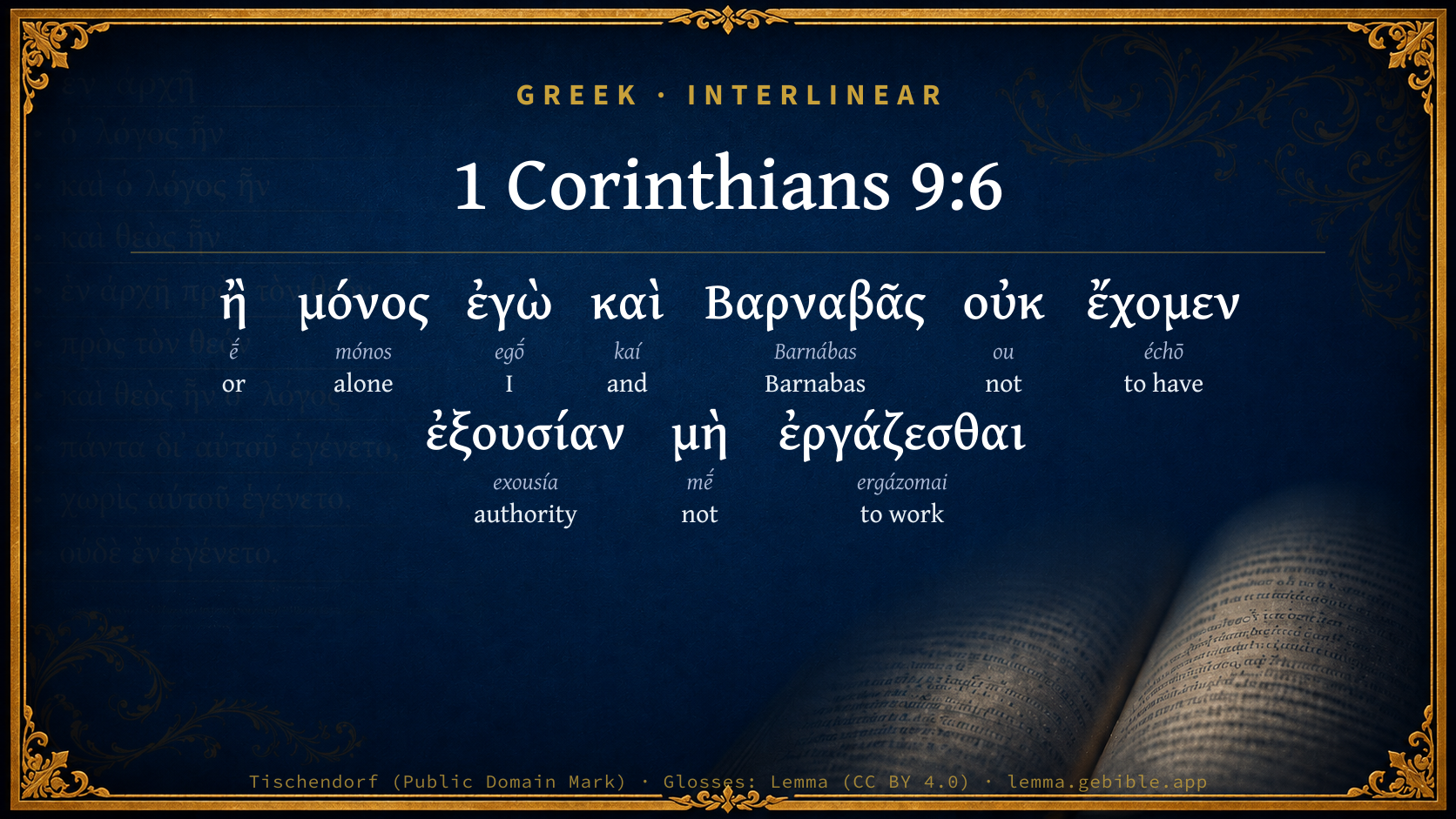
Download image
Cite this verse

1 Corinthians 9:6 (World English Bible). Public Domain. Lemma interlinear Bible study tool, https://lemma.gebible.app/v/1-corinthians/9/6.

Show BibTeX & RIS
BibTeX
RIS
English Translation
Or have only Barnabas and I no right to not work?
World English Bible · Public Domain
Download a study sheet

One document with this verse’s original text, its word-by-word gloss line, the meaning frame, cross-references with their text, attributed commentary, and full source and license credits — printable, and it pastes into notes with its structure intact.

This verse Autodidact and up

Study sheet (.html) Plain text (.txt)

A passage Seminary Student

Up to 50 verses in one chapter. A passage sheet keeps up to 6 commentary sources and 12 cross-references per verse, in the order this page ranks them, and says so on the sheet whenever that leaves anything out. Ask for a single verse and you get the Autodidact verse sheet above.

Everything on this page stays free to read, with no account — the sheet is a download of what is already on screen, not access to it.

Want to remove ads? Support Godless Engineer
Compare translations 3

The same verse in 3 English versions, stacked beneath the original-language interlinear above. Click any original word for its lexicon entry.

Each is an independent rendering of the whole verse — the interlinear is not word-aligned to these translations.

Highlighted words mark where these versions differ — a whole-verse word diff, not a word-by-word alignment.

  • World English Bible Public Domain
    Or have only Barnabas and I no right to not work?
  • King James Version Public Domain
    Or I only and Barnabas, have not we power to forbear working?
  • unfoldingWord Literal Text CC BY-SA 4.0
    Or do only Barnabas and I not have a right not to work?

unfoldingWord Literal Text — © unfoldingWord, licensed CC BY-SA 4.0. Word-aligned USFM3 via Door43 (git.door43.org/unfoldingWord/en_ult).

Versions to compare (up to 4)

3 of 4 selected

Show all 19 translations

Every available English version of this verse, each an independent rendering of the whole verse.

  • World English Bible Public Domain
    Or have only Barnabas and I no right to not work?
  • Berean Standard Bible Public Domain
    Or are Barnabas and I the only apostles who must work for a living?
  • Majority Standard Bible Public Domain
    Or are Barnabas and I the only apostles who must work for a living?
  • King James Version Public Domain
    Or I only and Barnabas, have not we power to forbear working?
  • American Standard Version (1901) Public Domain
    Or I only and Barnabas, have we not a right to forbear working?
  • Revised Version (1885) Public Domain
    Or I only and Barnabas, have we not a right to forbear working?
  • Geneva Bible (1599) Public Domain
    Or I only and Barnabas, haue not we power not to worke?
  • Douay-Rheims (1899) Public Domain
    Or I only and Barnabas, have not we power to do this?
  • Young's Literal Translation Public Domain
    or only I and Barnabas, have we not authority -- not to work?
  • Literal Standard Version CC BY-SA 4.0
    Or do only Barnabas and I have no authority not to work?
  • Unlocked Literal Bible CC BY-SA 4.0
    Or is it only Barnabas and I who must work?
  • unfoldingWord Literal Text CC BY-SA 4.0
    Or do only Barnabas and I not have a right not to work?
  • Darby Bible Public Domain
    Or *I* alone and Barnabas, have we not a right not to work?
  • World Messianic Bible Public Domain
    Or have only Barnabas and I no right to not work?
  • Webster's Bible Public Domain
    Or I only and Barnabas, have we not power to forbear working?
  • Free Bible Version CC BY-SA 4.0
    Is it only Barnabas and myself who have to work to support ourselves?
  • Bible in Basic English Public Domain
    Or I only and Barnabas, have we no right to take a rest from work?
  • Text-Critical English NT CC BY 4.0
    Or is it only Barnabas and I who must work to support ourselves?
  • Tyndale New Testament (1534) Public Domain
    Ether only I and Barnabas have not power this to do?

Literal Standard Version (2020), Covenant Press — licensed CC BY-SA 4.0. Text via the HelloAO Bible API (eBible.org). Unlocked Literal Bible (unfoldingWord) — licensed CC BY-SA 4.0. Text via the HelloAO Bible API (eBible.org). unfoldingWord Literal Text — © unfoldingWord, licensed CC BY-SA 4.0. Word-aligned USFM3 via Door43 (git.door43.org/unfoldingWord/en_ult). Free Bible Version, Dr. Jonathan Gallagher — licensed CC BY-SA 4.0. Text via the HelloAO Bible API (eBible.org).

Word by word

More ways to search: Search by grammar → Find every occurrence → Compare this word →

Practice this passage: Drill this verse → Learn its vocabulary →

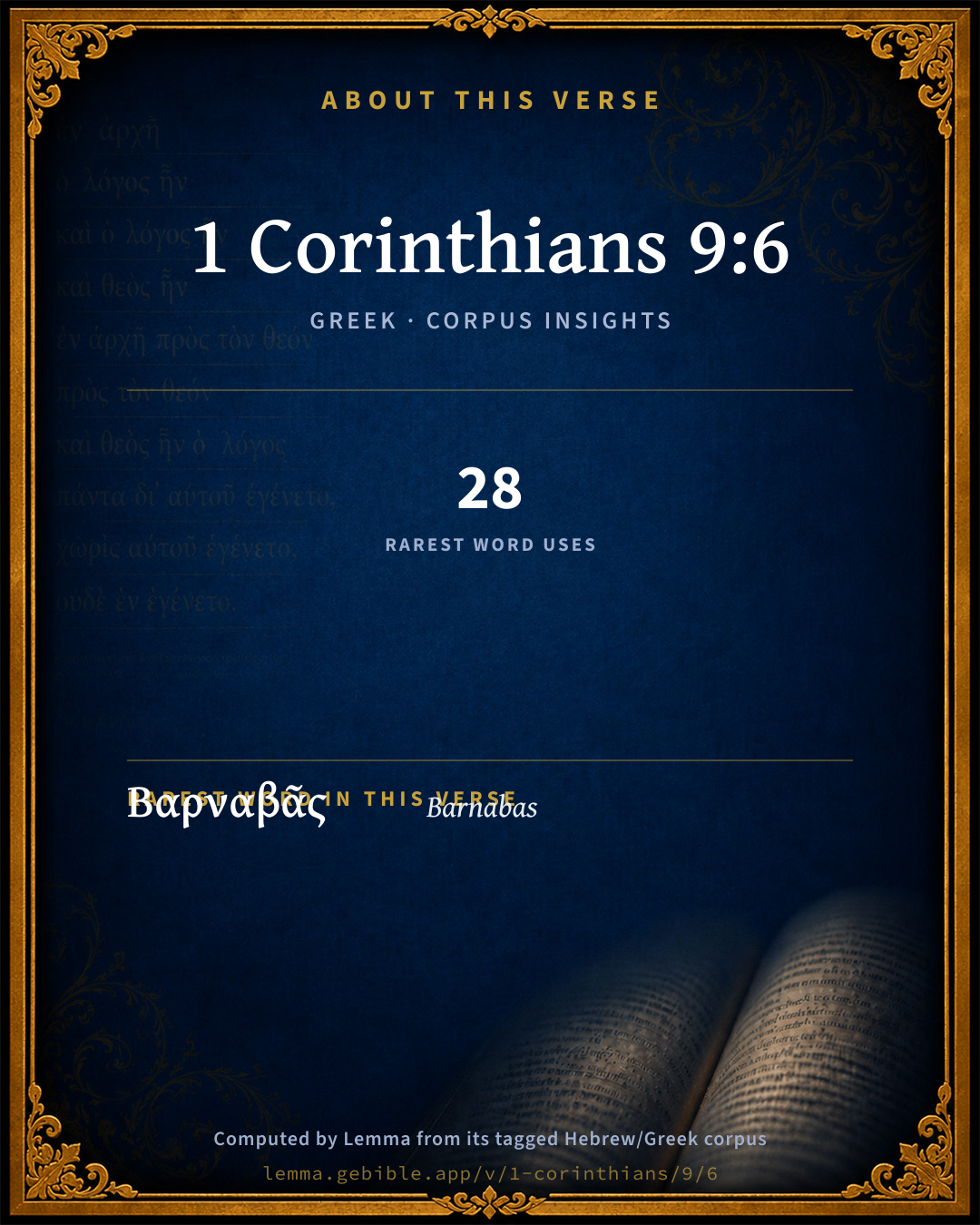
About this verse

These counts appear in no published source. They are computed here, from the morphology-tagged text and Lemma’s own curated glosses. What Lemma adds →

10
words
10
distinct lemmas
Pauline Epistles
section

Shared distinctive vocabulary

Βαρναβᾶς Barnabas G921 occurs in 27 verses of the Greek New Testament. Also found in:
Cross-references

11

Topical passages linked to 1 Corinthians 9:6 in the Treasury of Scripture Knowledge — connected by theme and wording, ordered by reader-vote popularity; previews shown in the World English Bible.

  • 2 Thessalonians 3:7–9 For you know how you ought to imitate us. For we didn't behave ourselves rebelliously among you,
  • Acts 13:1–2 Now in the assembly that was at Antioch there were some prophets and teachers: Barnabas, Simeon who was called Niger, Lucius of Cyrene, Manaen the foster-brother of Herod the tetrarch, and Saul.
  • Acts 4:36 Joses, who by the apostles was surnamed Barnabas (which is, being interpreted, Son of Encouragement), a Levite, a man of Cyprus by race,
  • Acts 18:3 and because he practiced the same trade, he lived with them and worked, for by trade they were tent makers.
  • 1 Thessalonians 2:9 For you remember, brothers, our labor and travail; for working night and day, that we might not burden any of you, we preached to you the Gospel of God.
  • Acts 11:22 The report concerning them came to the ears of the assembly which was in Jerusalem. They sent out Barnabas to go as far as Antioch,
  • Acts 14:12 They called Barnabas "Jupiter," and Paul "Mercury," because he was the chief speaker.
  • Acts 15:36–37 After some days Paul said to Barnabas, "Let's return now and visit our brothers in every city in which we proclaimed the word of the Lord, to see how they are doing."
  • Acts 20:34–35 You yourselves know that these hands ministered to my necessities, and to those who were with me.
  • 1 Corinthians 4:11–12 Even to this present hour we hunger, thirst, are naked, are beaten, and have no certain dwelling place.
  • Acts 13:50 But the Jews stirred up the devout and prominent women and the chief men of the city, and stirred up a persecution against Paul and Barnabas, and threw them out of their borders.

Cross-references courtesy of OpenBible.info (CC BY 4.0).

Commentary

Notes on 1 Corinthians 9:6 from classic Christian and Jewish commentators (each source and its license shown beneath its notes). The classic Christian expositions comment on the surrounding passage and are grouped to its opening verse, so a note may address several verses; the Jewish commentaries on the Tanakh (Rashi and others) are per-verse, so they appear only where the commentator wrote on this verse.

Lemma curates 59 commentaries, every one of them public domain or Creative Commons licensed, each selected and text-cleaned for this edition rather than reprinted as found. About our sources →

Joseph Benson's Commentary

1Co 9:6-7. Or I only and Barnabas — Of all the preachers of the gospel; have not we power to forbear working — With our hands? “From this it appears that Barnabas, as well as Paul, preached the gospel without demanding a maintenance from his disciples; and that, like Paul, he was hated for his doctrine by the Judaizers. The honourable mention which Paul makes of Barnabas in this passage deserves notice, as it shows that these good men, notwithstanding their sharp contention about John Mark, Act 15:13, entertained no resentment against each other on that account, but mutually esteemed each other: and perhaps, on some occasions after that, preached the gospel together, as before.” Who goeth a warfare — Serveth in the war; at any time, at his own charges — Does not the community furnish provisions for those who guard it, and fight its battles? And if the services of a soldier, engaged in the defence of his country, deserve a maintenance, how much more may it be expected by us, who daily hazard our lives, as well as wear them out, for men’s everlasting happiness? Who planteth a vineyard, and doth not think himself entitled to eat of the fruit of it? or who feedeth a flock, and doth not think he hath a right to eat of the milk of the flock? — And if it be judged reasonable that men should have an equivalent for their labours about natural things, and the accommodations of the body, is it not more evidently so when the felicity of immortal souls is concerned?

Joseph Benson's Commentary on the Old and New Testaments (1811–1818) — public domain. Text from a community e-Sword module.

Bengel's Gnomon

Johann Albrecht Bengel

1Co 9:6. Τοῦ μὴ ἐργάζεσθαι), to forbear working with the hand.

Bengel's Gnomon of the New Testament — English translation (T&T Clark, Edinburgh, 1860) — public domain. Text from a community e-Sword module.

Meyer's Critical & Exegetical Commentary

Heinrich August Wilhelm Meyer

1Co_9:6. Ἤ] or, i.e. unless it were true that, etc. In that case, indeed, the ἐξουσία, of which I spoke in 1Co_9:4-5, must of course be wanting! We have therefore no third ἐξουσία introduced here (Pott, Rückert), but ἤ conveys an argument, as it usually does.

Βαρνάβας] see on Act_4:36. He was formerly (see on Act_15:38) Pauls companion in his missionary labours, and as such held a high apostolic position (Gal_2:9).

τοῦ μὴ ἐργάζ.] Have we not the right to cease from working? Paul supported himself by tent-making (Act_18:3); in what way Barnabas did so, is unknown. Both of them, very probably, after mutual consultation, had laid it down as a principle to maintain themselves by their own independent labour, and acted upon this rule even when working separately, whereas the rest of the apostolic teachers (see μόνος) claimed support from the resources of the churches. Ἐργάζεσθαι is the word constantly used for working, 2Th_3:8; Act_18:3; Homer, Il. xviii. 469, Od. xiv. 272; Xen. Cyr. i. 6. 11, al[1417] The rendering: hoc operandi (Vulgate and Latin Fathers), arises from a different reading (without the μή).

[1417] l. and others; and other passages; and other editions.

Meyer — Critical and Exegetical Commentary on the New Testament — English translation by Peter Christie, edited by Frederick Crombie (T&T Clark, 1880) — public domain. Text from a community e-Sword module.

Hodge's Commentary on Romans, Ephesians & First Corinthians

Charles Hodge

1Co_9:6

Or I only and Barnabas, have we not power to forbear working?

The power to forbear working; literally, the right of not working. Is there any reason why I and Barnabas should be the only exceptions to the rule that preachers of the word are to be supported by the churches? From this it appears that Barnabas, while the apostles missionary companion, followed his example in working with his own hands, that he might make the gospel of Christ without charge. Paul proceeds to demonstrate the right in question, not on grounds peculiar to the apostles or to that particular age of the church; but on grounds applicable to all ministers and to all ages. His first argument is from the universally recognized principle that labor is entitled to reward. This principle is illustrated in the following verse.

Charles Hodge — Commentary on Romans (1835), First Corinthians (1857), and Ephesians (1856) — public domain. Text from a community e-Sword module.

Geneva Bible (1599)

Geneva Bible translators

Not to live by the work of our hands?

Geneva Bible (1599) marginal notes — public domain. Text via Bolls.life.

Jamieson, Fausset & Brown

Robert Jamieson, A. R. Fausset & David Brown

Barnabas--long the associate of Paul, and, like him, in the habit of self-denyingly forbearing to claim the maintenance which is a minister's right. So Paul supported himself by tent-making (Act 18:3; Act 20:34; Th1 2:9; Th2 3:8).

Jamieson, Fausset & Brown — Commentary Critical and Explanatory on the Whole Bible (1871) — public domain (CC PDM 1.0). Text via the HelloAO Bible API.

Adam Clarke's Commentary

Verse 6. Or I only and Barnabas] Have we alone of all the apostles no right to be supported by our converts? It appears from this,

1. That the apostles did not generally support themselves by their own labour.

2. That Paul and Barnabas did thus support themselves.

Some of the others probably had not a business at which they could conveniently work; but Paul and Barnabas had a trade at which they could conveniently labour wherever they came.

Adam Clarke's Commentary on the Bible (1810–1826) — public domain. Text from a community e-Sword/MySword module.

Ellicott's Commentary for English Readers

(6) Or I only and Barnabas.—“Or” here does not introduce a question which implies a new right in addition to the rights already claimed, but it completes the argument. Granting the existence of the rights established by the previous questions, the Apostle now says—still preserving the interrogative form—“These things being so, the only way you can possibly do away with this right is by making exceptions of myself and Barnabas.” The form in which the question is put shows the impossibility of any such arbitrary exception being made. They as well as the others had the right to abstain from working for their living. Barnabas’ early association with St. Paul (Act_11:30; Act_12:25; Act_15:38) probably led him to adopt the Apostle’s practice of supporting himself, and not being dependent on his fellow-Christians. The word “only” implies that all the other Apostles and brethren of the Lord exercised their right of maintenance by the Church.

A Bible Commentary for English Readers, edited by Charles John Ellicott (1878–1897) — public domain. Text from a community e-Sword module.

The Cambridge Bible for Schools and Colleges

gen. ed. J. J. S. Perowne

6. Or I only and Barnabas] St Paul and St Barnabas (1) resigned their claim to support on the part of the Church, (2) they were not of the number of the twelve, (3) they were left by the Apostles to undertake the sole charge of the missions to the heathen (Gal_2:9). On these grounds a charge was brought against them that they were no true Apostles of Christ. For Barnabas, see Act_4:36; Act_11:22; Act_11:25; Act_11:29; Act_12:25; Act_13:1-2; Act_13:50; Act_14:12; Act_15:2; Act_15:12; Act_15:37; Gal_2:1; Gal_2:9; Gal_2:13.

The Cambridge Bible for Schools and Colleges (gen. ed. J. J. S. Perowne; Cambridge University Press, 1878–1918) — public domain. Text from a community e-Sword module.

John Gill's Exposition

Who goeth a warfare any time at his own charges?.... Some people have done so, as did the Habessines (e), and the ancient Romans (f); though before the apostle wrote this, the senate had made an act, that the soldiers should have a stipend from the public; and this being now so common, and universally obtaining everywhere, the apostle puts the question he does; and his meaning is, that since ministers of the Gospel are the good soldiers of Jesus Christ, and are engaged in a warfare state, in fighting the good fight of faith, against his enemies, and those of his church, it is but reasonable that their charges should be bore, and they maintained at the public expense:

who planteth a vineyard, and eateth not of the fruit thereof? The church of Christ is a vineyard, it is often so called in Scripture; ministers are planters, vinedressers, and labourers in it; and as the mystical Solomon, the owner of the vineyard, ought to have his thousand, the cultivators of it, the keepers of the fruit, should have their two hundred, Sol 8:12

Or who feedeth a flock, and eateth not of the milk of the flock? The churches of Christ are compared to flocks of sheep; the ministers of the word are pastors, or shepherds, who have the care and oversight of them, and feed them with knowledge and understanding; and it is but right and just that they enjoy the fruit of their labours, and have a proper and suitable maintenance, as it is that he who feeds a flock should eat of the milk which that produces.

(e) Ludolph. Hist. Ethiop. l. 2. c. 14. (f) Liv. Hist. l. 4. prope finem. Alex. ab Alex. Genial. Dier. l. 6. c. 22.

John Gill's Exposition of the Whole Bible (1746–1763) — public domain (CC PDM 1.0). Text via the HelloAO Bible API.

Trapp's Complete Commentary

John Trapp

6 Or I only and Barnabas, have not we power to forbear working?

Ver. 6. To forbear working] At our trade? Yes, or else I should easily be of Melancthon’s mind, who when one had said of the ministry, that it was the art of arts, and the science of sciences; if he had added (said Melancthon) that it is the misery of miseries, he had hit the nail on the head. (Joh. Manl. loc. com. 471.)

John Trapp, A Commentary or Exposition upon All the Books of the Old and New Testament (1647–1656) — public domain. Text from a community e-Sword module.

Albert Barnes' Notes on the Bible

Or I only and Barnabas - Paul and Barnabas had worked together as tent-makers at Corinth; Act 18:3. From this fact it had been inferred that they “knew” that they had no claim to a support.

Power to forbear working - To abstain from labor, and to receive support as others do. The question implies a strong affirmation that they had such power. The sense is, ‘Why should I and Barnabas be regarded as having no right to support? Have we been less faithful than others? Have we done less? Have we given fewer evidences that we are sent by the Lord, or that God approves us in our work? Have we been less successful? Why then should we be singled out; and why should it be supposed that we are obliged to labor for our support? “Is there no other conceivable reason” why we should support ourselves than a consciousness that we have no right to support from the people with whom we labor?” It is evident from 1Co 9:12, that Barnabas as well as Paul relinquished his right to a support, and labored to maintain himself. And it is manifest from the whole passage, that there was some special “spleen” (“Doddridge”) against these two ministers of the gospel. What it was we know not. It might have arisen from the enmity and opposition of Judaizing teachers, who were offended at their zeal and success among the Gentiles, and who could find no other cause of complaint against them than that they chose to support themselves, and not live in idleness, or to tax the church for their support. That must have been a bad cause which was sustained by such an argument.

Albert Barnes' Notes on the Bible (1834–1885) — public domain. Text from a community e-Sword/MySword module.

Matthew Poole's English Annotations

Are I and Barnabas the only apostles who are obliged for our livelihood to work with our hands? As Paul did, Act 18:3, making tents. We certainly, as well as the rest of the apostles, if we would run out to the utmost end of the line of our liberty in things, without having any regard to the circumstances of our brethren, might forbear working with our hands, and expect that those amongst whom we labour should maintain us.

Matthew Poole's English Annotations on the Holy Bible (1683–1685) — public domain. Text from a community e-Sword/MySword module.

Whedon's Commentary on the Bible

Daniel D. Whedon

6. Barnabas—Note on Act_15:39. It would appear that though Barnabas never visited Corinth, yet his name was familiar there. This is, indeed, probably true of most of the personages mentioned in the preceding verse. Indeed, the Corinthians seem to have been lively and critical canvassers of the eminent Christian leaders. Probably the fact that Barnabas was commissioned by the Gentile Church of Antioch (Act_13:2) at the same time with Paul, would bring his name into the discussion. The Judaizers would maintain that the apostolic authority of both was equally illegitimate, having neither come from Christ nor started from Jerusalem. The inference drawn by some commentators, that Barnabas, like Paul, maintained himself by his own manual labour, is not valid. During the first apostolic tour, in which Barnabas and Paul were associated, their career appears to have been too rapid for such labour, and nothing of the kind is intimated in the narrative. Paul here asserts only Barnabas’s right; not that he declined to use the right.

Forbear working—Working at manual labour for our support while we preach a gratuitous Gospel. Is it I and Barnabas alone that must preach for nothing, and support ourselves?

Daniel D. Whedon (gen. ed.), Commentary on the Old and New Testaments (1874–1909) — public domain. Text from a community e-Sword module.

The Pulpit Commentary

And Barnabas. Like St. Paul, Barnabas was in every respect a genuine apostle, by the Divine call. (Act_13:2; Gal_2:9) though not one of the twelve. He seems to have continued in his separate mission work the practice of independence which he had learnt from St. Paul. This allusion is interesting, because it is the last time that the name of Barnabas occurs, and it shows that, even after the quarrel and separation, Paul regarded him with love and esteem. To forbear working. To give up the manual labour by which we maintain ourselves without any expense to the Churches. (Act_18:3; 2Th_3:8, 2Th_3:9) If, then, St. Paul toiled at the dull, mechanical, despised, and ill paid work of tent making, he did so, not because it was, in the abstract, his duty to earn his own living, but because he chose to be nobly independent, that the absolute disinterestedness of his motives might be manifest to all the world. For this reason even when he was most in need he would never receive assistance from any Church except that of Philippi, where he had at least one wealthy convert, and where he was beloved with a peculiar warmth of affection.

The Pulpit Commentary (1880–1919), ed. H.D.M. Spence-Jones & Joseph S. Exell — public domain. Text from a community e-Sword module.

John Wesley's Explanatory Notes

To forbear working - With our hands.

John Wesley, Explanatory Notes Upon the Whole Bible (1754–1765) — public domain. Text via the GEBible commentary corpus.

McGarvey & Pendleton's Commentaries

J. W. McGarvey

Or I only and Barnabas [Though not one of the twelve, he is called an apostle ( Act_14:14 ), for he was a messenger or apostle of the Holy Spirit, and of the church at Antioch ( Act_13:2 ) and was associated with Paul ( Gal_2:9 ). His name was illustrious enough at Corinth to give countenance to Paul's course. If Barnabas and Paul wrought out their self-support to be nobly independent, did their voluntary sacrifice of rights abolish those rights, or prove that they never existed? This late reference to Barnabas is interesting, for it shows that he was still at work and was still loved of Paul despite their disagreement concerning John Mark. Having thus proved his right to maintenance by the example of other church leaders, Paul now goes on to give an argument in six heads showing that the practice of these leaders was wholly lawful and proper. First argument: Wages for service is the rule in all employment; in proof of this, three instances are cited, the soldier, the vine-dresser, the shepherd], have we not a right to forbear working?

J. W. McGarvey (with Philip Y. Pendleton), Commentaries on the New Testament (The Fourfold Gospel, 1914; Acts; and the epistles) — public domain. Text from a community e-Sword/MySword module.

The People's New Testament

B. W. Johnson

6. Or have Barnabas and I only, etc. He and Barnabas worked with their own hands to sustain themselves while preaching. Others were sustained. Had not they the same right? He next shows that they had the right by various illustrations.

B. W. Johnson's The People's New Testament with Notes (1889–1891) — public domain. Electronic text from the Christian Classics Ethereal Library (CCEL) ThML edition.

Cambridge Greek Testament for Schools and Colleges

6. [τοῦ] after ἐξουσίαν omit אABDEFG. Rec. inserts with E.

6. ἢ μόνος ἐγὼ καὶ Βαρνάβας. St Paul and St Barnabas (1) resigned their claim to support on the part of the Church, (2) were not of the number of the Twelve, (3) were left by the Apostles to undertake the sole charge of the missions to the heathen (Gal 2:9). On these grounds a charge was brought against them that they were no true Apostles of Christ. For Barnabas, see Act 4:36; Act 11:22-25; Act 11:30; Act 12:25; Act 13:1-2; Act 13:50; Act 14:12; Act 15:2; Act 15:12; Act 15:37; Gal 2:1; Gal 2:9; Gal 2:13. The reason why Paul and Barnabas refused to accept payment for their services is not hard to discover. They went on a mission to the Gentiles, the other Apostles to the Jews. The latter fully understood that the ministers of religion should be maintained by the offerings of the worshippers. The Gentiles, on the contrary, had so long known what it was to be plundered by greedy sophists who lived by their wits, that it was above all things necessary for the Apostles of Christ to avoid being confounded with such persons. Justin Martyr tells us, in his Dialogue with Trypho (ch. 2), how a certain Peripatetic philosopher demanded his fee at a very early period of their intercourse, and how the demand shook his confidence in his teacher.

Cambridge Greek Testament for Schools and Colleges (Cambridge University Press, 1896; 21 vols, various authors incl. Carr, Maclear, Plummer, Farrar, Lumby, Moule, M. R. James, Simcox) — public domain. Text from a community e-Sword module.

Alford’s Greek Testament

Henry Alford

6.] Or (implying what the consequence would then be, see ch. 6:2, 9: does not introduce a new ἐξουσία, but a consequence of the denial of the last two) have only I and Barnabas (why Barnabas? Perhaps on account of his former connexion with Paul, Act 11:30; Act 12:25; Act 13:1-15. Act 13:39; but this seems hardly enough reason for his being here introduced. It is not improbable that having been at first associated with Paul, who appears from the first to have abstained from receiving sustenance from those among whom he was preaching, Barnabas, after his separation from our Apostle, may have retained the same self-denying practice. “This is the only time when he is mentioned in conjunction with St. Paul, since the date of the quarrel in Act 15:39.” Stanley) not power to abstain from working (i.e. power to look for our maintenance from the churches, without manual labour of our own. The Vulg. has ‘hoc operandi,’ so also Tertull., Ambrose, al., omitting μή, and against the usage of ἐργάζεσθαι, see reff.)?

7-12] Examples from common life, of the reasonableness of the workman being sustained by his work.

Henry Alford, The Greek Testament (1849–1861) — public domain. Text from a community e-Sword module.

International Critical Commentary

6. ἢ μόνος ἐγὼ καί . The ἤ, as in 6:2, 9, puts the question from the other point of view; that it adds “some degree of emotion” is not so clear. ‘Or is it only I and Barnabas that have not a right to forbear working with our hands for a living?’ The reason for including Barnabas is uncertain, and it seems to be an afterthought; hence the singular μόνος. It implies that Barnabas, like Paul, had refused maintenance; and it is possible that there had been an agreement between them that on their missionary journey (Act 13:3) they would not cost the Churches anything. It seems also to imply that the practice of Barnabas was well known.

ἐργάζεσθαι. Manual labour, to earn a livelihood, is commonly meant by the word, with (4:12; 1Th 4:11) or without (Mat 21:28; Luk 13:14; Act 18:3) ταῖς χερσίν added. Here again Greek sentiment would be against the Apostle’s practice. That a teacher who claimed to lead and to rule should work with his hands for a living would be thought most unbecoming: nothing but the direst necessity excused labour in a free citizen (Arist. Pol. 3:5). Contrast 2Th 3:6-12.

International Critical Commentary — older volumes (1896–1929), various authors — public domain. Text from a community e-Sword module.

Vincent's Word Studies in the New Testament

Marvin R. Vincent

Barnabas. The only mention of Barnabas along with Paul since the quarrel, Act 14:39.

Forbear working. For their own support. Ergazesqai to work, is the regular word for manual labor. See Mt 21:28; Act 18:3. See on 3Jo 1:5; and trade, Rev 18:17.

Marvin R. Vincent, Word Studies in the New Testament (1887–1900) — public domain. Text from a community e-Sword/MySword module.

Godet's Commentaries

Frédéric Louis Godet

Vv. 6. The conj. ἤ, or, has here the meaning which it so frequently has in Paul’s writings: “Or indeed in the opposite case would it happen that...?”

No doubt Barnabas had not been called to the apostleship by the Lord, in the same way as Paul (1Co 9:1); but, by his co-operation in the work of the apostle of the Gentiles, he was included, as it were, in his apostleship. Yet there remains an important difference between him and Paul, a difference which comes out in a characteristic way, by the application of the adjective μόνος, only, exclusively to Paul. It is exactly the same relation as is supposed by Galatians 2 (comparing especially 1Co 9:8-9).

The term working receives a determinate sense from the context: gaining one’s livelihood by his work. Some Latin authorities omit the negative μή and translate: to do so, that is to say, to live at your cost. This meaning of the word ἐργάζεσθαι is impossible.

To this historical argument, taken from the example of the apostles, Paul adds a second, borrowed from common right.

Frédéric Louis Godet — Commentaries on Luke, John, Romans, and 1 Corinthians — English translation (T&T Clark, Edinburgh, 1870s–1890s) — public domain. Text from a community e-Sword module.

Lesson kit

Teaching starters — assembled from the data on this page, not authored interpretation. Every prompt links to the verse data it draws on. Edit before teaching.

1 Corinthians, in the Pauline Epistles, opens this verse with 10 words (10 distinct Greek lemmas). Its most distinctive word is Barnábas (“Barnabas”). A historical commentator’s framing appears above. Read the whole chapter for the surrounding context.

Discussion questions

  1. How does “Barnabas” (Barnábas) shape what this verse is saying?
  2. Acts 4:36 shares the word «Barnabas» with this verse. How do the two illuminate each other?
  3. These translations render this verse differently; the difference is in the English rendering, not the original. What questions does that raise?
  4. Reading how Joseph Benson's Commentary and Bengel's Gnomon read this verse, where do the two commentators agree and where do they part?

Things to notice

Reading settings

Reading text

Shown beneath each verse's original-language words.

Old Testament
Old Testament edition

Read the OT as the Masoretic Hebrew (MT) or the Greek Septuagint (LXX).

English shown for the Greek Septuagint (in the Hebrew ↔ Greek comparison).

Comparing translations? Open the Compare panel on any verse page to stack up to four side by side.