
1 Corinthians 16:17

Greek (Tischendorf 8th ed.) 1 Corinthians 16:17 appears in the Greek New Testament. The text above is from the Tischendorf 8th edition. Each word links to its Strong’s number and a concise gloss. Click any word for its full Thayer’s Greek Lexicon entry.
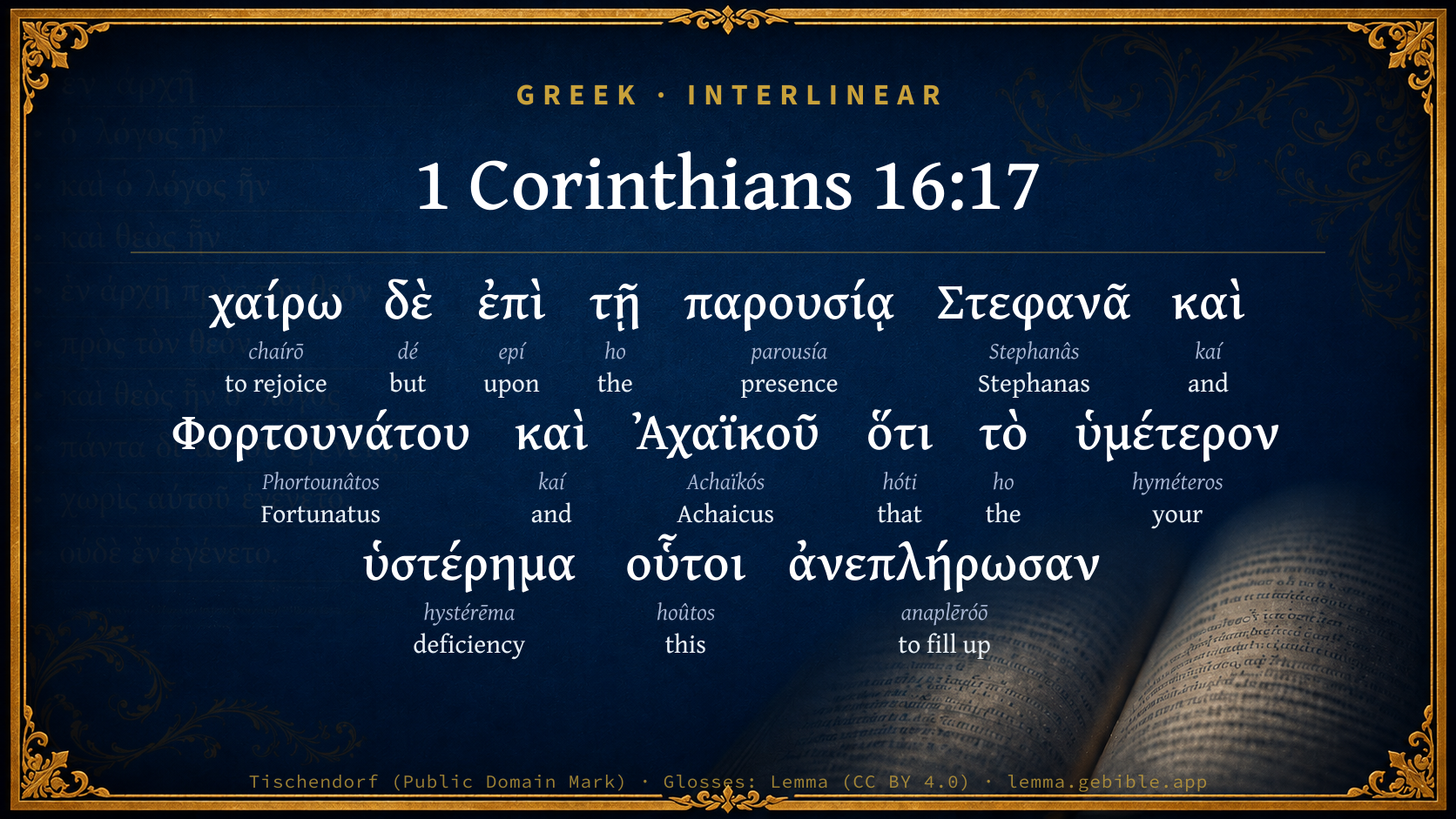
Download image
Cite this verse

1 Corinthians 16:17 (World English Bible). Public Domain. Lemma interlinear Bible study tool, https://lemma.gebible.app/v/1-corinthians/16/17.

Show BibTeX & RIS
BibTeX
RIS
English Translation
I rejoice at the coming of Stephanas, Fortunatus, and Achaicus; for that which was lacking on your part, they supplied.
World English Bible · Public Domain
Highlights
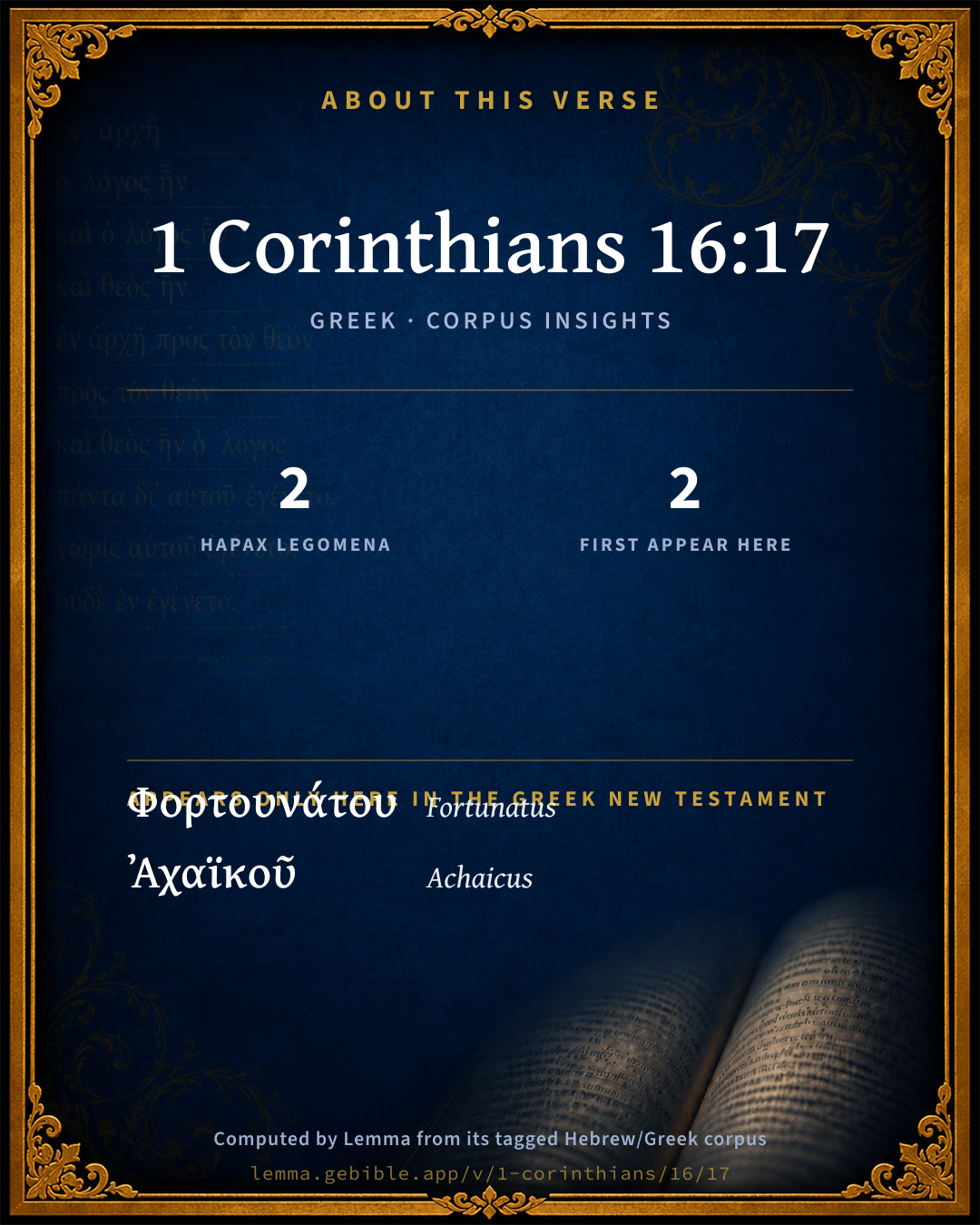
  • 2 hapax legomena — only here in the Greek New Testament
  • 2 first appearances in the Greek New Testament
Full analysis ↓
Download a study sheet

One document with this verse’s original text, its word-by-word gloss line, the meaning frame, cross-references with their text, attributed commentary, and full source and license credits — printable, and it pastes into notes with its structure intact.

This verse Autodidact and up

Study sheet (.html) Plain text (.txt)

A passage Seminary Student

Up to 50 verses in one chapter. A passage sheet keeps up to 6 commentary sources and 12 cross-references per verse, in the order this page ranks them, and says so on the sheet whenever that leaves anything out. Ask for a single verse and you get the Autodidact verse sheet above.

Everything on this page stays free to read, with no account — the sheet is a download of what is already on screen, not access to it.

Want to remove ads? Support Godless Engineer
Compare translations 3

The same verse in 3 English versions, stacked beneath the original-language interlinear above. Click any original word for its lexicon entry.

Each is an independent rendering of the whole verse — the interlinear is not word-aligned to these translations.

Highlighted words mark where these versions differ — a whole-verse word diff, not a word-by-word alignment.

  • World English Bible Public Domain
    I rejoice at the coming of Stephanas, Fortunatus, and Achaicus; for that which was lacking on your part, they supplied.
  • King James Version Public Domain
    I am glad of the coming of Stephanas and Fortunatus and Achaicus: for that which was lacking on your part they have supplied.
  • unfoldingWord Literal Text CC BY-SA 4.0
    Now I rejoice at the coming of Stephanas and Fortunatus and Achaicus, because they have supplied was lacking from you;

unfoldingWord Literal Text — © unfoldingWord, licensed CC BY-SA 4.0. Word-aligned USFM3 via Door43 (git.door43.org/unfoldingWord/en_ult).

Versions to compare (up to 4)

3 of 4 selected

Show all 19 translations

Every available English version of this verse, each an independent rendering of the whole verse.

  • World English Bible Public Domain
    I rejoice at the coming of Stephanas, Fortunatus, and Achaicus; for that which was lacking on your part, they supplied.
  • Berean Standard Bible Public Domain
    I am glad that Stephanas, Fortunatus, and Achaicus have arrived, because they have supplied what was lacking from you.
  • Majority Standard Bible Public Domain
    I am glad that Stephanas, Fortunatus, and Achaicus have arrived, because they have supplied what was lacking from you.
  • King James Version Public Domain
    I am glad of the coming of Stephanas and Fortunatus and Achaicus: for that which was lacking on your part they have supplied.
  • American Standard Version (1901) Public Domain
    And I rejoice at the coming of Stephanas and Fortunatus and Achaicus: for that which was lacking on your part they supplied.
  • Revised Version (1885) Public Domain
    And I rejoice at the coming of Stephanas and Fortunatus and Achaicus: for that which was lacking on your part they supplied.
  • Geneva Bible (1599) Public Domain
    I am glad of the comming of Stephanas, and Fortunatus, and Achaicus: for they haue supplied the want of you.
  • Douay-Rheims (1899) Public Domain
    And I rejoice in the presence of Stephanas, and Fortunatus, and Achaicus, because that which was wanting on your part, they have supplied.
  • Young's Literal Translation Public Domain
    and I rejoice over the presence of Stephanas, and Fortunatus, and Achaicus, because the lack of you did these fill up;
  • Literal Standard Version CC BY-SA 4.0
    and I rejoice over the coming of Stephanas, and Fortunatus, and Achaicus, because these filled up the lack of you;
  • Unlocked Literal Bible CC BY-SA 4.0
    I rejoice at the coming of Stephanas, Fortunatus, and Achaicus. They have made up for your absence.
  • unfoldingWord Literal Text CC BY-SA 4.0
    Now I rejoice at the coming of Stephanas and Fortunatus and Achaicus, because they have supplied was lacking from you;
  • Darby Bible Public Domain
    But I rejoice in the coming of Stephanas and Fortunatus and Achaicus; because *they* have supplied what was lacking on your part.
  • World Messianic Bible Public Domain
    I rejoice at the coming of Stephanas, Fortunatus, and Achaicus; for that which was lacking on your part, they supplied.
  • Webster's Bible Public Domain
    I am glad of the coming of Stephanas, and Fortunatus, and Achaicus: for that which was lacking on your part, they have supplied.
  • Free Bible Version CC BY-SA 4.0
    I'm delighted that Stephanas, Fortunatas, and Achaicus have arrived here, for they did what you weren't able to.
  • Bible in Basic English Public Domain
    And I am glad of the coming of Stephanas and Fortunatus and Achaicus: for they have done what was needed to make your work complete.
  • Text-Critical English NT CC BY 4.0
    I rejoice over the coming of Stephanas, Fortunatus, and Achaicus, because these men have supplied what was lacking on your part.
  • Tyndale New Testament (1534) Public Domain
    I am gladde of the comynge of Stephana Fortunatus and Achaicus: for that which was lackinge on youre parte they have supplied.

Literal Standard Version (2020), Covenant Press — licensed CC BY-SA 4.0. Text via the HelloAO Bible API (eBible.org). Unlocked Literal Bible (unfoldingWord) — licensed CC BY-SA 4.0. Text via the HelloAO Bible API (eBible.org). unfoldingWord Literal Text — © unfoldingWord, licensed CC BY-SA 4.0. Word-aligned USFM3 via Door43 (git.door43.org/unfoldingWord/en_ult). Free Bible Version, Dr. Jonathan Gallagher — licensed CC BY-SA 4.0. Text via the HelloAO Bible API (eBible.org).

Word by word

More ways to search: Search by grammar → Find every occurrence → Compare this word →

Practice this passage: Drill this verse → Learn its vocabulary →

Φορτουνάτου
Phortounâtos
G5415
“Fortunatus”
Noun, Genitive, Singular, Masculine
Part of Speech
Noun
Case
Genitive
Number
Singular
Gender
Masculine
Full Thayer's Definition

Origin: of Latin origin

TDNT: None

Fortunatus = "well freighted" 1. a Christian of Corinth
  1. χαίρω chaírō G5463 “to rejoice” Verb, Present, Active, Indicative, 1st person, Singular
  2. δὲ dé G1161 “but” Conjunction
  3. ἐπὶ epí G1909 “upon” Preposition
  4. τῇ ho G3588 “the” Article, Dative, Singular, Feminine
  5. παρουσίᾳ parousía G3952 “presence” Noun, Dative, Singular, Feminine
  6. Στεφανᾶ Stephanâs G4734 “Stephanas” Noun, Genitive, Singular, Masculine
  7. καὶ kaí G2532 “and” Conjunction
  8. καὶ kaí G2532 “and” Conjunction
  9. Ἀχαϊκοῦ Achaïkós G883 “Achaicus” Noun, Genitive, Singular, Masculine
  10. ὅτι hóti G3754 “that” Conjunction
  11. τὸ ho G3588 “the” Article, Accusative, Singular, Neuter
  12. ὑμέτερον hyméteros G5212 “your” Possessive pronoun, 2nd person, Accusative, Plural, Neuter
  13. ὑστέρημα hystérēma G5303 “deficiency” Noun, Accusative, Singular, Neuter
  14. οὗτοι hoûtos G3778 “this” Demonstrative pronoun, Nominative, Plural, Masculine
  15. ἀνεπλήρωσαν anaplēróō G378 “to fill up” Verb, Aorist, Active, Indicative, 3rd person, Plural

About this verse

These counts appear in no published source. They are computed here, from the morphology-tagged text and Lemma’s own curated glosses. What Lemma adds →

16
words
14
distinct lemmas
Pauline Epistles
section

Notable vocabulary

2 hapax legomena — words that appear only here in the entire Greek New Testament:

  • Φορτουνάτου Fortunatus G5415
  • Ἀχαϊκοῦ Achaicus G883

First appearance in Scripture

These words make their first canonical appearance in the Greek New Testament here:

  • Φορτουνάτου Fortunatus G5415
  • Ἀχαϊκοῦ Achaicus G883

Shared distinctive vocabulary

Στεφανᾶ Stephanas G4734 occurs in 3 verses of the Greek New Testament. Also found in:
Repetition

Words recur within this verse:

Cross-references

3

Topical passages linked to 1 Corinthians 16:17 in the Treasury of Scripture Knowledge — connected by theme and wording, ordered by reader-vote popularity; previews shown in the World English Bible.

  • 2 Corinthians 11:9 When I was present with you and was in need, I wasn't a burden on anyone, for the brothers, when they came from Macedonia, supplied the measure of my need. In everything I kept myself from being burdensome to you, and I will continue to do so.
  • Philippians 2:30 because for the work of Christ he came near to death, risking his life to supply that which was lacking in your service toward me.
  • Philemon 1:13 whom I desired to keep with me, that on your behalf he might serve me in my chains for the Gospel.

Cross-references courtesy of OpenBible.info (CC BY 4.0).

Commentary

Notes on 1 Corinthians 16:17 from classic Christian and Jewish commentators (each source and its license shown beneath its notes). The classic Christian expositions comment on the surrounding passage and are grouped to its opening verse, so a note may address several verses; the Jewish commentaries on the Tanakh (Rashi and others) are per-verse, so they appear only where the commentator wrote on this verse.

Lemma curates 59 commentaries, every one of them public domain or Creative Commons licensed, each selected and text-cleaned for this edition rather than reprinted as found. About our sources →

The Biblical Illustrator

Joseph S. Exell

1Co_16:17-18

I am glad of the coming of Stephanas,… for they have refreshed my spirit and yours.

Spiritual refreshment

These three honoured members of the Corinthian Church came to consult the apostle on matters of faith and practice. But their visit was not simply official, for they were personally attached to Paul, and his grateful language is suggestive of the refreshment of spirit which is the result of Christian association.

I. The need of spiritual refreshment.

1. Work may weigh down the soul as well as the body.

2. Trials such as desertion, disappointment, may dispose to melancholy.

3. Living much alone is wearisome; the energies flag, the work suffers.

II. Its appointed agents. Letters and books are precious, but often inadequate. Living fellowship with those likeminded with ourselves has a peculiar power in restoring the equilibrium of the soul. Paul felt, as we do, it hard to work without the smiles and personal encouragements of his friends.

III. Its means. The presence of Christian friends is much, but the opening of their hearts, the inquiry concerning our successes and failures, are more.

IV. Its results.

1. Depression gives way to cheerfulness.

2. Weariness to vigour.

3. Sluggishness to vivacity.

4. Despondency to hope. (Prof. J. R. Thomson.)

The Biblical Illustrator, edited by Joseph S. Exell (c. 1880s–1900s) — public domain. Text from a community e-Sword module.

Joseph Benson's Commentary

1Co 16:17-18. I am glad of the coming of Stephanas, &c. — This Stephanas is supposed by many to have been the son of Stephanas mentioned 1Co 16:15. He, with Fortunatus and Achaicus, are supposed to have been the messengers sent, by the sincere part of the Corinthian church, with the letter mentioned 1Co 7:1. For that which was lacking on your part they have supplied — They have performed the offices of love which you could not supply, by reason of your absence. For they have refreshed my spirit — By their obliging behaviour and edifying conversation, as I doubt not they have often refreshed yours, by their ministrations among you; or will refresh yours by informing you of my success in preaching the gospel.

Joseph Benson's Commentary on the Old and New Testaments (1811–1818) — public domain. Text from a community e-Sword module.

Tyndale Open Study Notes

Tyndale Open Resources

16:17 Together with Stephanas (see also 1:16; 16:15), Fortunatus and Achaicus had apparently traveled from Corinth to visit Paul in Ephesus.

Tyndale Open Study Notes — © Tyndale Open Resources, licensed CC BY-SA 4.0. Text via the HelloAO Bible API.

Bengel's Gnomon

Johann Albrecht Bengel

1Co 16:17. Χαίρω, I rejoice) Paul in respect of God, gives thanks, when he might have said, I rejoice; ch. 1Co 1:14, but when he writes to men, he says, I rejoice or I rejoiced, instead of I give thanks; Php 4:10; Phm 1:7: comp. Act 10:33; 3Jn 1:3. Now again the deputies of the Corinthians had departed; and yet he says in the present tense, I rejoice; for a pleasant remembrance of them remained, and the present is supposed to accord with the time of the reading of the epistle at Corinth.—Στεφανᾶ, of Stephanas) This person seems to have been the son of that Stephanas, whose house is mentioned, but not himself at 1Co 16:15.—ὑστέρημα, [that which was lacking] the deficiency) So far as you had been awanting to me, and were not yourselves able to refresh me in my absence.

Bengel's Gnomon of the New Testament — English translation (T&T Clark, Edinburgh, 1860) — public domain. Text from a community e-Sword module.

Meyer's Critical & Exegetical Commentary

Heinrich August Wilhelm Meyer

1Co_16:17-18. Regarding Fortunatus (probably not different from the person named in Clem. 1 Cor. 59) and Achaicus no particulars are known. They are not to be included (as de Wette would have it) in the family of Stephanas, which has been spoken of already. Grotius holds them to be Chloes people; but see on 1Co_1:11.

ὅτι τὸ ὑμέτερον ὑστέρημα αὐτοὶ ἀνεπλ.] because they for their part have supplied your lack (your absence). Comp. on Php_2:30. Ὑμέτ. is thus taken objectively (comp. 1Co_15:31): the lack of your presence; and ὑμέτ. and αὐτοί (see the critical remarks) have the emphasis. Observe how courteously the expression: the want of you (of your presence), is chosen. Hofmann, on the contrary, misses this delicate touch by taking it as: what was lacking in you, in this respect, namely, that you could not appear with me in person. With still less delicacy Grotius, who adduces in his support 2Co_9:12 : quod vos omnes facere oportuit, id illi fecerunt; certiorem me fecere de vestris morbis. He is followed by Rückert, who founds wrongly upon Php_2:30 : what should have been done by you, that have they done, inasmuch, namely, as they had given him joy, which had not been done by the Corinthians. But we must not decide here by passages from other Epistles, since linguistically both renderings alike may be correct, but simply by the connection, according to which the men as ambassadors from the Corinthians were the compensation to the apostle for the lack of the presence of the latter. Comp. Chrysosto.

ἀνέπαυσαν γὰρ κ.τ.λ.] reason assigned for the preceding τὸ ὑστέρημα αὐτ. ἀνεπλ.[110] Regarding the phrase, comp. 2Co_7:13; Phm_1:7; Phm_1:20.

ΚΑῚ ΤῸ ὙΜῶΝ] for they have refreshed (by their arrival here, and the communications and assurances connected therewith, comp. 2Co_7:13) my spirit and yours. The latter, inasmuch as they had come not in their own name, but as representatives of the whole church; their meeting therefore with Paul could not but be refreshing to the consciousness of the whole church. As they by their presence provided for Paul the joy of ἀνάπαυσις, so they provided it also for the church, which through them had entered into this fellowship with the apostle, and thus owed to them the refreshment which it could not but experience in the consciousness of this living intercourse of love with Paul brought about through these men. Comp. Chrysostom: οὐ Παύλῳ μόνον, ἀλλὰ καὶ ἐκείνοις αὐτοὺς χαρισαμένους δείκνυσι τῷ τὴν πόλιν ἅπασαν ἐν αὐτοῖς περιφέρειν. Paul thus expresses not simply reciprocity in general,that which is presupposed where there is good-will (de Wette),but the relation implied in the representation of the church by their delegates,a relation, therefore, which for the latter, in virtue of their acceptance of the embassage, was one of merit. There lies here, also, in the addition of this second pronoun, a tender delicacy (comp. on 1Co_1:2), which the readers acquainted with the manner of the apostle could well appreciate. Grotius makes the reference to be to the assurances of Pauls love which those men had brought with them to the Corinthians. But τὸ ὑμῶν also, like ΤῸ ἘΜῸΝ ΠΝΕῦΜΑ, must refer to the time of the presence of the delegates with Pau.

ἘΠΙΓΙΝΏΣΚΕΤΕ] Attention to the compound verb: recognise them rightly (comp. on 1Co_13:12), should of itself have sufficed to prevent alterations of the sense of the word (such as: prize them highly, so Theophylact, Grotius, Flatt, Neander, and others). The high esteem is the consequence of the ἐπιγιν.

τοὺς τοιούτους] as in 1Co_16:16.

[110] Had Paul and his readers met together in person, this would have been refreshing for both parties (comp. Rom_1:12); and this refreshment of both parties had now taken place through those delegates.

Meyer — Critical and Exegetical Commentary on the New Testament — English translation by Peter Christie, edited by Frederick Crombie (T&T Clark, 1880) — public domain. Text from a community e-Sword module.

Expositor's Greek Testament

ed. W. Robertson Nicoll

1Co 16:17-18 . “But I rejoice at the presence ( or coming) of Stephanas, and Fortunatus, and Achaïcus.” The stress lying on παρουσίᾳ explains the introductory δέ : “You must show respect to such men, when they reach home; but I am glad that just now they are here ”. Fortunatus (Lat. name, and common) and Achaïcus (Gr [2684] , and rare) are Stephanas’ companions in the deputation; the three will speedily return to Cor [2685] Since P. thus commends them at the end of his Ep., written in reply to the Letter they had brought from Cor [2686] , perhaps they were to be its bearers also. On Stephanas , see 1Co 1:16 . The two latter names are also h.ll . in N.T.; a Fortunatus appears in Clement’s list of emissaries from Rom. to Cor [2687] ( ad Cor . § 65). Ed [2688] supposes all three to be slaves ( Achaïcus , at least, resembles a slave-name), and identifies them with οἱ τ . Χλοῆς of 1Co 1:11 ; but this does not comport with the position given to Stephanas in 1Co 16:15 f.; see, further, note on 1Co 1:11 . (“I rejoice at their presence), because the ( or my) lack of you these have filled up”. ὑμέτερον represents the objective gen [2689] ( cf. 1Co 15:31 ): the presence of the three with P. could not make up any lack in Cor [2690] , but it made up to P. for the absence of the Cor ., supplying him, representatively, with their desired society. El [2691] and others read the poss. pron [2692] subjectively “what you were lacking in ( i.e. , your want of access) towards me”: this constr [2693] is consistent with the usage of ὑστέρημα (see parls.); but the former suits better the antithesis to παρουσία (Ed [2694] ), and Paul’s fine courtesy. “For they refreshed my spirit and yours.” ἀναπαύω (see parls.) describes the restful effect of friendly converse and sympathy. Paul adds καὶ ὑμῶν , realising that the comfort of heart received by himself will react upon his friends at Cor [2695] : the Cor [2696] will be cheered to know that their fellowship, in the persons of S., [2697] ., and A., has so greatly cheered him at a time of weariness and heavy trial ( cf. 2Co 2:3 ; 2Co 7:3 ).

[2684] Greek, or Grotius’ Annotationes in N.T.

[2685] Corinth, Corinthian or Corinthians.

[2686] Corinth, Corinthian or Corinthians.

[2687] Corinth, Corinthian or Corinthians.

[2688] T. C. Edwards’ Commentary on the First Ep. to the Corinthians . 2

[2689] genitive case.

[2690] Corinth, Corinthian or Corinthians.

[2691] C. J. Ellicott’s St. Paul’s First Epistle to the Corinthians .

[2692] pronoun.

[2693] construction.

[2694] T. C. Edwards’ Commentary on the First Ep. to the Corinthians . 2

[2695] Corinth, Corinthian or Corinthians.

[2696] Corinth, Corinthian or Corinthians.

[2697] Codex Augiensis (sæc. ix.), a Græco-Latin MS., at Trinity College, Cambridge, edited by Scrivener in 1859. Its Greek text is almost identical with that of , and it is therefore not cited save where it differs from that MS. Its Latin version, f, presents the Vulgate text with some modifications.

1Co 16:18 b repeats in another form the advice of 1Co 16:16 : “Acknowledge (know well) then such men as these”. For τοὺς τοιούτους , see parls., and 1Co 16:16 . ἐπιγινώσκω (see parls.) denotes strictly accurate knowledge , of persons or things; but knowledge of personal qualities implies corresponding regard to and treatment of those who possess such qualities: cf. 1Th 5:12 f.

The Expositor's Greek Testament, edited by W. Robertson Nicoll (1897–1910) — public domain. Text from a community e-Sword module.

Hodge's Commentary on Romans, Ephesians & First Corinthians

Charles Hodge

1Co_16:17

I am glad of the coming of Stephanas and Fortunatus and Achaicus: for that which was lacking on your part they have supplied.

These were members of the church in Corinth, who visited Ephesus probably for the express purpose of seeing the apostle, and of consulting him on the condition of the church. They were probably the bearers of the letter from the Corinthians to Paul, to which he alludes in 1Co_7:1. The reason why he rejoiced in their presence was, that they supplied what was lacking on the part of the Corinthians; or rather, the want of you (τὸ ὑμέτερον ὑοτέρημα; ὑμέτερον being objective, as in 1Co_15:31.) The presence of these brethren made up to the apostle, in a measure, the absence of the Corinthians. Another explanation is, they have done what you failed to do, i.e. informed the of the true state of things in Corinth. The former view of the meaning is the common one, and is more in keeping with the tone of the passage, which is affectionate and conciliatory. This too is confirmed by what follows.

Charles Hodge — Commentary on Romans (1835), First Corinthians (1857), and Ephesians (1856) — public domain. Text from a community e-Sword module.

Jamieson, Fausset & Brown

Robert Jamieson, A. R. Fausset & David Brown

Fortunatus . . . Achaicus--probably of Stephanas' household.

that . . . lacking on your part--So far as you were unable yourselves to "refresh my spirit," in that you are absent from me, "they have supplied" by coming to me from you, and so supplying the means of intercourse between you and me. They seem to have carried this letter back; see the subscription below: hence the exhortations, Co1 16:16, Co1 16:18, as though they would be at Corinth when the Epistle arrived.

Jamieson, Fausset & Brown — Commentary Critical and Explanatory on the Whole Bible (1871) — public domain (CC PDM 1.0). Text via the HelloAO Bible API.

Adam Clarke's Commentary

Verse 17. I am glad of the coming of Stephanas, c.] It was by these that the Corinthians had sent that letter to the apostle, to answer which was a main part of the design of St. Paul in this epistle.

Fortunatus] This man is supposed to have survived St. Paul and to be the same mentioned by Clement in his epistle to the Corinthians, sec. 59, as the bearer of that epistle from Clement at Rome to the Christians at Corinth.

For that which was lacking on your part] This may either refer to additional communications besides those contained in the letter which the Corinthians sent to the apostle-which additional circumstances were furnished by the persons above; and from them St. Paul had a fuller account of their spiritual state than was contained in the letter-or to some contributions on their part for the support of the apostle in his peregrinations and labours.

Adam Clarke's Commentary on the Bible (1810–1826) — public domain. Text from a community e-Sword/MySword module.

The Cambridge Bible for Schools and Colleges

gen. ed. J. J. S. Perowne

17. Fortunatus and Achaicus] Fortunatus is referred to by Clement as the bearer of his Epistle. See Introduction, Ch. iii. Nothing is known of Achaicus.

that which was lacking on your part] i.e. the void occasioned by your absence, not the pecuniary need of the Apostle as in 2Co_11:9 (cf. Php_2:30). For the Apostle there says that it is his boast, of which no man shall deprive him, that he has never cast any of the burden of his maintenance upon the Corinthian Church. See also ch. 9.

The Cambridge Bible for Schools and Colleges (gen. ed. J. J. S. Perowne; Cambridge University Press, 1878–1918) — public domain. Text from a community e-Sword module.

John Gill's Exposition

The churches of Asia salute you,.... The Syriac version renders it, "all" the churches. This shows, that this epistle was not written from Philippi, as the subscription to it attests, for then he would rather have said; the churches of Macedonia salute you, but at Ephesus, where he now was; see Co1 16:8; and this is the more confirmed, by the following salutation of Aquila and Priscilla, who it is plain from Act 18:18, were with the apostle at Ephesus:

Aquila and Priscilla salute you much in the Lord; Aquila was a Jew of Pontus, and Priscilla was his wife, who came from Italy, all Jews being obliged to depart from Rome, by the order of Claudius Caesar. These came to Corinth, where they met with the apostle; and being of the same occupation, stayed and wrought with him; and when he went from thence to Ephesus, accompanied him thither; see Act 18:3; wherefore having personal knowledge of the members of this church, through their stay with the apostle there, for the space of a year and a half, send their Christian salutations to them, with great affection and respect:

with the church that is in their house: their family consisting of believers, and being kept in such good decorum, and employed daily in singing, praying, expounding, and conferring together about divine things, looked like a little church; and it may be that at certain times the principal members of the church at Ephesus met in their house for religious worship, and to consider and debate about the affairs of the church; and very likely as they were of the same occupation with the apostle, he himself dwelt here; and which might be the more an occasion of the church assembling here at times; and the Vulgate Latin version adds, "with whom also I lodge".

John Gill's Exposition of the Whole Bible (1746–1763) — public domain (CC PDM 1.0). Text via the HelloAO Bible API.

Trapp's Complete Commentary

John Trapp

17 I am glad of the coming of Stephanas and Fortunatus and Achaicus: for that which was lacking on your part they have supplied.

Ver. 17. They have supplied] viz. Your absence; for in them I take a short view of you all.

John Trapp, A Commentary or Exposition upon All the Books of the Old and New Testament (1647–1656) — public domain. Text from a community e-Sword module.

Albert Barnes' Notes on the Bible

I am glad of the coming - That is, I am glad that they have come to me at Ephesus. I rejoice that he who was converted by my ministry in Achaia, and who has so long shown himself to be a personal friend to me, and an aid in my work, came where I am.

Stephanas - The same person evidently mentioned in the previous verses. Probably he, as one of the oldest and most respected members of the church, had been selected to carry the letter of the Corinthians 1Co 7:1 to Paul, and to consult with him respecting the affairs of the church there.

Fortunatus and Achaieus - These persons are not referred to anywhere else in the New Testament. It appears that Fortunatus survived Paul, for he was subsequently the messenger of the church at Corinth to that at Rome, and bore back to the Corinthians the Epistle which Clement of Rome sent to them. See that epistle, Section 59.

For that which was lacking ... - The word which is used here, and rendered “that which was lacking” (ὑστέρημα husterēma), does not occur in the Classic writers. It means properly that which is missing, want, lack - Robinson. It may be used to denote a want or lack of any kind, whether of support, sustenance, aid, consolation, information, or counsel; see Luk 21:4; Phi 2:30; 1Th 3:10. What this was which the Corinthians had neglected or failed to furnish Paul, and which had been supplied by the presence of these persons, can be only a matter of conjecture; and different commentators have supposed different things. It might be a neglect to provide for his needs, or a defect of informing him about their affairs in the letter which they had sent him; or it might be that these persons had furnished, by their presence and conversation, those consolations and friendly offices which the church at Corinth would have rendered had they been all present; and Paul may mean to say, that he had enjoyed with them that friendly contact and Christian communion which he had desired with them, but which was lacking, that is, which he had not been permitted to enjoy by reason of his absence. This is the view which is given by Rosenmuller, Doddridge, Bloomfield; and as Paul does not seem here inclined to blame them, this view is most in accordance with the general strain of the passage.

Albert Barnes' Notes on the Bible (1834–1885) — public domain. Text from a community e-Sword/MySword module.

Haydock's Catholic Bible Commentary

Which was wanting on your part, they have supplied, by informing me, and giving me a full account of all. (Witham)

George Leo Haydock (1774–1849), Haydock's Catholic Family Bible and Commentary, 1859 edition — public domain. Excludes Psalms (Douay-Rheims chapter numbering differs from Protestant) and Deuterocanonical books (Catholic canon only).

Matthew Poole's English Annotations

It should seem that this church had sent these three persons to Paul at this time (as most think) at Ephesus, to acquaint him with the state of their churches; these men supplied the want of that whole church’s coming, or they made a report to the apostle of the Corinthians more fully than they had done in their letters. He adds, that they had refreshed his spirit, not with bringing him any money, (for the apostle hath told us, 1Co 9:15, that he gloried in this, that he had preached the gospel to them freely, without being any charge to them), but by their visit, and the conference that he had had with them about the state of that church. The apostle addeth, that they had refreshed their spirits also; intimating, that their joy was his, and that what was a refreshing to him, ought also to be so to them; he therefore recommendeth these men, and such as they were, to be reverenced and respected by this church.

Matthew Poole's English Annotations on the Holy Bible (1683–1685) — public domain. Text from a community e-Sword/MySword module.

Whedon's Commentary on the Bible

Daniel D. Whedon

17. Coming of—The three who brought the letter from the Corinthians and reported to the apostle the true state of his Corinthian Church. Stanley thinks that this Stephanas was a slave in the household of Stephanas, bearing, according to custom, his master’s name.

Lacking on your part— All the service I need which you could not render me they supplied. This seems the natural meaning; but we are unable to say in what the lack consisted. But it very probably means the enjoyment of presence and society. The want of you in my heart they by their presence supplied. They were you in miniature for the time.

Daniel D. Whedon (gen. ed.), Commentary on the Old and New Testaments (1874–1909) — public domain. Text from a community e-Sword module.

The Pulpit Commentary

Of the coming; rather, at the presence of. They were now with St. Paul in Ephesus. Fortunatus. A Christian of this name also carried the letter of St. Clement to Corinth. That which was lacking on your part. This sounds like a reproach in the Authorized Version, but is quite the reverse. It should be rendered, the void caused by your absence. The same word occurs in 2Co_8:13, 14 9:12 11:9, etc. The nearest parallel to the usage here is Php_2:30.

The Pulpit Commentary (1880–1919), ed. H.D.M. Spence-Jones & Joseph S. Exell — public domain. Text from a community e-Sword module.

John Wesley's Explanatory Notes

I rejoice at the coming of Stephanas, and Fortunatus, and Achaiacus - Who were now returned to Corinth but the joy which their arrival had occasioned remained still in his heart. They have supplied what was wanting on your part - They have performed the offices of love, which you could not, by reason of your absence.

John Wesley, Explanatory Notes Upon the Whole Bible (1754–1765) — public domain. Text via the GEBible commentary corpus.

Scofield Reference Notes

C. I. Scofield

coming of

(Greek - παρουσία, personal presence).

The Scofield Reference Bible (1917 edition), notes by C. I. Scofield — public domain. Text from a community e-Sword module.

Burkitt's Expository Notes on the New Testament

William Burkitt

It is very probable that the faithful in the church of Corinth did send these three persons, namely, Stephanas, Fortunatus, and Achaicus, to St. Paul, at this time at Ephesus, to acquaint him with the state of the church, the rents and scisms that were amongst them; and to desire the interposure of his authority, and the exercise of his apostolical power, in order to the healing of those unhappy breaches.

Now, says the apostle, I am glad of the coming of these men, whom you sent with your letters of inquiry to me; for that account of your affairs which was lacking on your parts in your letter, they have supplied: I am glad, I say, for they have refreshed my spirit with their presence and discourse, and will at their return refresh yours also; therefore acknowledge ye them that are such, own their services, and honour them for the same. There is a tribute of double honour, respect, and reverence, due and payable to such as labour in the church’s services even unto weariness, and are willing to spend and be spent in such services as they are capable of, for the benefit of the church in general, or any member thereof in particular.

William Burkitt's Expository Notes on the New Testament (1700–1703) — public domain. Text from a community e-Sword module.

Godbey's Commentary on the New Testament

William B. Godbey

17. Doubtless Stephenas, Fortunatus and Achaicus, who had come from Corinth to see him, and thus bring him word in reference to the state of the church, became the bearers of this epistle.

William B. Godbey, Commentary on the New Testament (1896–1900) — public domain. Text from a community e-Sword module.

McGarvey & Pendleton's Commentaries

J. W. McGarvey

And I rejoice at the coming of Stephanas and Fortunatus and Achaicus: for that which was lacking on your part they supplied .

J. W. McGarvey (with Philip Y. Pendleton), Commentaries on the New Testament (The Fourfold Gospel, 1914; Acts; and the epistles) — public domain. Text from a community e-Sword/MySword module.

The People's New Testament

B. W. Johnson

17. I am glad of the coming of Stephanas. Stephanas is named in 1 Cor. 1:16 and above in verse 15. The other two are not named elsewhere. These three doubtless brought to Paul the letter referred to in 7:1, and probably carried back the present letter.

B. W. Johnson's The People's New Testament with Notes (1889–1891) — public domain. Electronic text from the Christian Classics Ethereal Library (CCEL) ThML edition.

unfoldingWord translationNotes

Door43 World Missions Community

Stephanas, Fortunatus, and Achaicus

These men were either some of the first Corinthian believers or church elders who were co-workers with Paul.

Stephanas, Fortunatus, and Achaicus

These are men's names. (See: How to Translate Names)

They have made up for your absence

"They made up for the fact that you were not here."

For they have refreshed my spirit

Paul is saying he was encouraged by their visit.

translationWords

joy

spirit

unfoldingWord translationNotes — © Distant Shores Media and the Door43 World Missions Community, licensed CC BY-SA 4.0. Source: git.door43.org/Door43/en_tn.

Cambridge Greek Testament for Schools and Colleges

17. ὑμέτερον BCDEFG. ὑμῶν Rec. with אA.

17. Φορτουνάτου καὶ Ἀχαϊκοῦ. Fortunatus is referred to by Clement as the bearer of his Epistle. See Introduction, Ch. 3. Nothing is known of Achaicus.

τὸ ὑμέτερον ὑστέρημα, i.e. the void occasioned by your absence, not the pecuniary need of the Apostle as in 2Co 11:9 (cf. Php 2:25; Php 2:30). For the Apostle there says that it is his boast, of which no man shall deprive him, that he has never cast any of the burden of his maintenance upon the Corinthian Church. See also ch. 9.

Cambridge Greek Testament for Schools and Colleges (Cambridge University Press, 1896; 21 vols, various authors incl. Carr, Maclear, Plummer, Farrar, Lumby, Moule, M. R. James, Simcox) — public domain. Text from a community e-Sword module.

Alford’s Greek Testament

Henry Alford

17.] Perhaps Fortunatus and Achaicus were members of the family of Stephanas. The Fortunatus mentioned by Clement at the end of his Ep. i. to the Corinthians (c. 59, p. 328) may be the same.

παρουσίᾳ] viz. in Ephesus.

τὸ ὑμέτερον ὑστ.] The want of you (ref.): i.e. of your society. Grotius interprets it, “Quod vos omnes facere oportuit, id illi fecerunt: certiorem me fecere de vestris morbis,” and holds them to have been οἱ Χλοῆς of chap. 1:11. But it is very improbable that he should mention thus a family so distinguished as this: he names them just after, ch. 1:16, as the household of Stephanas:—and still more improbable that one of so fine feeling should add of the bearers of such tidings, ἀνέπαυσαν κ.τ.λ., which would on that hypothesis be almost ironical.

Henry Alford, The Greek Testament (1849–1861) — public domain. Text from a community e-Sword module.

International Critical Commentary

17. χαίρω δὲ ἐπὶ τῇ παρουσίᾳ Σ. κ.τ.λ. ‘And it is a joy to me to have Stephanas and Fortunatus and Achaicus here.’ They had probably brought the Corinthian letter and were waiting to take this letter in reply to it. They were a little bit of Corinth, and as such a delight to the Apostle. That Fortunatus and Achaicus were members of the οἰκία Σπεφανᾶ is unlikely; they would have been mentioned in a different way, if they had been; and it is improbable that all the delegates would be taken from one household. Lightfoot thinks that there is no improbability in identifying Fortunatus with the Fortunatus mentioned by Clem. Rom. (Cor. 65): but the identification is precarious, for that Fortunatus may have been a Roman, and the name is not at all rare.† It is possible that the use of παρουσία, implies that the visit of the delegates was official; see on 15:23.

τὸ ὑμέτερον ὑστέρημα. Does this mean ‘my want of you,’ or ‘your want of me’? Both are possible, and each makes good sense. ‘I am deprived of you; but they compensate for your absence’; which is a pleasing way of expressing his affection for the Corinthians and his joy at having some of them with him. On the other hand; ‘You cannot all of you come to me; but these excellent delegates will do quite as well.’ The latter is perhaps a little more probable. In the other case, would he have said ἀνεπλήρωσαν? that these three men quite made up for their absence (Php 2:30)? But, as regards answering the Corinthians’ questions, these delegates were an adequate substitute for the whole community; there was no need for the whole community to interview the Apostle.

א A K L, Chrys. have ὑμῶν τὸ ὑστέρημα: B C D E F G M P read τὸ ὑμέτὲρον ὑδτξρημα, which is more likely to be right. For οὗτοι (א B C K L P, Copt. Arm. Aeth. Goth.), A D E F G M, Vulg. Syrr. read αὐτό, which Lachmann and Alford uncritically prefer.

International Critical Commentary — older volumes (1896–1929), various authors — public domain. Text from a community e-Sword module.

Vincent's Word Studies in the New Testament

Marvin R. Vincent

That which was lacking on your part [το υμετερο υστερημα] . Or the (i. e. my) lack of you. The Greek will bear either rendering. Compare Phi 2:30; 2Co 8:14; 2Co 9:12. The latter is preferable. Edwards, somewhat naively says : "I do not see what could be lacking on the part of the Corinthians which Stephanas and his two friends could supply at Ephesus."

Marvin R. Vincent, Word Studies in the New Testament (1887–1900) — public domain. Text from a community e-Sword/MySword module.

Godet's Commentaries

Frédéric Louis Godet

Vv. 17, 18. “I am glad of the coming of Stephanas and Fortunatus and Achaicus: for that which was lacking on your part they have supplied, 18. for they have refreshed my spirit and yours: therefore acknowledge ye them that are such.” — Paul here extends to the two other members of the deputation what he had just said of the first. Fortunatus is probably the same person who was afterwards the bearer of the letter of Clement of Rome (c. 65). Achaicus is unknown. As slaves often bore the name of the country of their birth, Edwards thinks that this last was one of Chloe’s slaves (1Co 1:11). Weizsäcker supposes that both were slaves of Stephanas himself. The second supposition is at least more probable than the first. The expression: ὑστέρημα ὑμῶν, literally: your shortcoming, denotes the blank felt by Paul from the absence of the Corinthians, and the impossibility of communicating directly with them. The three deputies have filled this void, because it seemed to him as if in these three men he had the whole Church; comp. Php 2:30. The γάρ, for, 1Co 16:18, shows that this verse should explain the preceding expression. They have dissipated the uneasiness which filled the apostle’s heart in regard to the Corinthians. By telling him of the love of the Church, and perhaps showing him many things in a less distressing light than he supposed, they have given him real comfort; they have consoled him, not merely in his human sensibilities—this would require ψυχή, soul,—but even in his inmost being, his πνεῦμα, spirit, the organ of his relations to God.

And it is not only he whom they have thus comforted; but also the Corinthians themselves. By adding to: my spirit, the words: and yours, the apostle transports himself to the time when the deputies, returned to Corinth, will give account to the congregation of their conferences with Paul, and when the Church also in turn will find in this communication that spiritual tranquillizing which it needs. Now such services should be acknowledged, for it is not every one who could refresh a Paul and a Church of Corinth. Hence the exhortation which closes this paragraph: “Acknowledge the work of such men, and what is due to them.” What exquisite delicacy is stamped on every line!

Frédéric Louis Godet — Commentaries on Luke, John, Romans, and 1 Corinthians — English translation (T&T Clark, Edinburgh, 1870s–1890s) — public domain. Text from a community e-Sword module.

Lesson kit

Teaching starters — assembled from the data on this page, not authored interpretation. Every prompt links to the verse data it draws on. Edit before teaching.

1 Corinthians, in the Pauline Epistles, opens this verse with 16 words (14 distinct Greek lemmas). Its most distinctive word is Phortounâtos (“Fortunatus”). A historical commentator’s framing appears above. Read the whole chapter for the surrounding context.

Discussion questions

  1. How does “Fortunatus” (Phortounâtos) shape what this verse is saying?
  2. This verse holds 2 words here found nowhere else in the Greek New Testament. What might the rare words draw attention to?
  3. 2 words here appear for the first time in Scripture. What is being introduced at this debut?
  4. 1 Corinthians 1:16 shares the word «Stephanas» with this verse. How do the two illuminate each other?
  5. “the” occurs 2× in this one verse. What is the effect of the repetition?
  6. These translations render this verse differently; the difference is in the English rendering, not the original. What questions does that raise?
  7. Reading how The Biblical Illustrator and Joseph Benson's Commentary read this verse, where do the two commentators agree and where do they part?

Things to notice

  • 2 words in this verse appear nowhere else in the Greek New Testament.
  • 2 words make their first canonical appearance in Scripture here.
  • These translations choose different wording for 9 words in this verse.
  • “the” occurs 2× in this single verse.
  • 14 distinct Greek lemmas span 16 words in this verse.

Reading settings

Reading text

Shown beneath each verse's original-language words.

Old Testament
Old Testament edition

Read the OT as the Masoretic Hebrew (MT) or the Greek Septuagint (LXX).

English shown for the Greek Septuagint (in the Hebrew ↔ Greek comparison).

Comparing translations? Open the Compare panel on any verse page to stack up to four side by side.