1 Corinthians 10:3

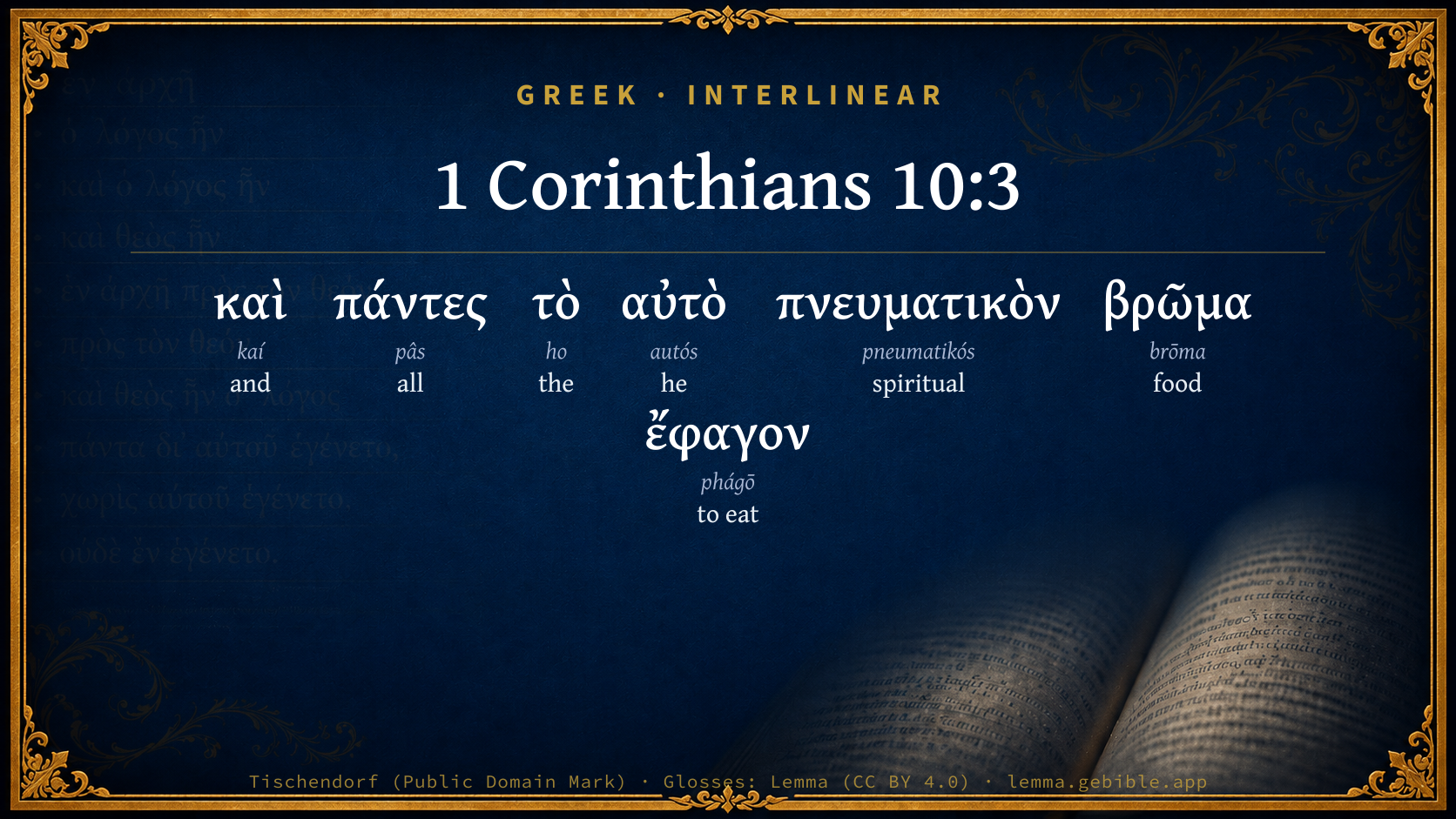
Greek (Tischendorf 8th ed.) 1 Corinthians 10:3 appears in the Greek New Testament. The text above is from the Tischendorf 8th edition. Each word links to its Strong’s number and a concise gloss. Click any word for its full Thayer’s Greek Lexicon entry.
Download image
Cite this verse

1 Corinthians 10:3 (World English Bible). Public Domain. Lemma interlinear Bible study tool, https://lemma.gebible.app/v/1-corinthians/10/3.

Show BibTeX & RIS
BibTeX
RIS
English Translation
and all ate the same spiritual food;
World English Bible · Public Domain
Download a study sheet

One document with this verse’s original text, its word-by-word gloss line, the meaning frame, cross-references with their text, attributed commentary, and full source and license credits — printable, and it pastes into notes with its structure intact.

This verse Autodidact and up

Study sheet (.html) Plain text (.txt)

A passage Seminary Student

Up to 50 verses in one chapter. A passage sheet keeps up to 6 commentary sources and 12 cross-references per verse, in the order this page ranks them, and says so on the sheet whenever that leaves anything out. Ask for a single verse and you get the Autodidact verse sheet above.

Everything on this page stays free to read, with no account — the sheet is a download of what is already on screen, not access to it.

Want to remove ads? Support Godless Engineer
Compare translations 3

The same verse in 3 English versions, stacked beneath the original-language interlinear above. Click any original word for its lexicon entry.

Each is an independent rendering of the whole verse — the interlinear is not word-aligned to these translations.

Highlighted words mark where these versions differ — a whole-verse word diff, not a word-by-word alignment.

  • World English Bible Public Domain
    and all ate the same spiritual food;
  • King James Version Public Domain
    And did all eat the same spiritual meat;
  • unfoldingWord Literal Text CC BY-SA 4.0
    and they all ate the same spiritual food,

unfoldingWord Literal Text — © unfoldingWord, licensed CC BY-SA 4.0. Word-aligned USFM3 via Door43 (git.door43.org/unfoldingWord/en_ult).

Versions to compare (up to 4)

3 of 4 selected

Show all 19 translations

Every available English version of this verse, each an independent rendering of the whole verse.

  • World English Bible Public Domain
    and all ate the same spiritual food;
  • Berean Standard Bible Public Domain
    They all ate the same spiritual food
  • Majority Standard Bible Public Domain
    They all ate the same spiritual food
  • King James Version Public Domain
    And did all eat the same spiritual meat;
  • American Standard Version (1901) Public Domain
    and did all eat the same spiritual food;
  • Revised Version (1885) Public Domain
    and did all eat the same spiritual meat;
  • Geneva Bible (1599) Public Domain
    And did all eat the same spiritual meat,
  • Douay-Rheims (1899) Public Domain
    And did all eat the same spiritual food,
  • Young's Literal Translation Public Domain
    and all the same spiritual food did eat,
  • Literal Standard Version CC BY-SA 4.0
    and all ate the same spiritual food,
  • Unlocked Literal Bible CC BY-SA 4.0
    and all ate the same spiritual food.
  • unfoldingWord Literal Text CC BY-SA 4.0
    and they all ate the same spiritual food,
  • Darby Bible Public Domain
    and all ate the same spiritual food,
  • World Messianic Bible Public Domain
    and all ate the same spiritual food;
  • Webster's Bible Public Domain
    And all ate the same spiritual food;
  • Free Bible Version CC BY-SA 4.0
    They all ate the same spiritual food
  • Bible in Basic English Public Domain
    And they all took the same holy food;
  • Text-Critical English NT CC BY 4.0
    and all ate the same spiritual food,
  • Tyndale New Testament (1534) Public Domain
    and dyd all eate of one spirituall meate

Literal Standard Version (2020), Covenant Press — licensed CC BY-SA 4.0. Text via the HelloAO Bible API (eBible.org). Unlocked Literal Bible (unfoldingWord) — licensed CC BY-SA 4.0. Text via the HelloAO Bible API (eBible.org). unfoldingWord Literal Text — © unfoldingWord, licensed CC BY-SA 4.0. Word-aligned USFM3 via Door43 (git.door43.org/unfoldingWord/en_ult). Free Bible Version, Dr. Jonathan Gallagher — licensed CC BY-SA 4.0. Text via the HelloAO Bible API (eBible.org).

Word by word

More ways to search: Search by grammar → Find every occurrence → Compare this word →

Practice this passage: Drill this verse → Learn its vocabulary →

About this verse

These counts appear in no published source. They are computed here, from the morphology-tagged text and Lemma’s own curated glosses. What Lemma adds →

7
words
7
distinct lemmas
Pauline Epistles
section

Notable vocabulary

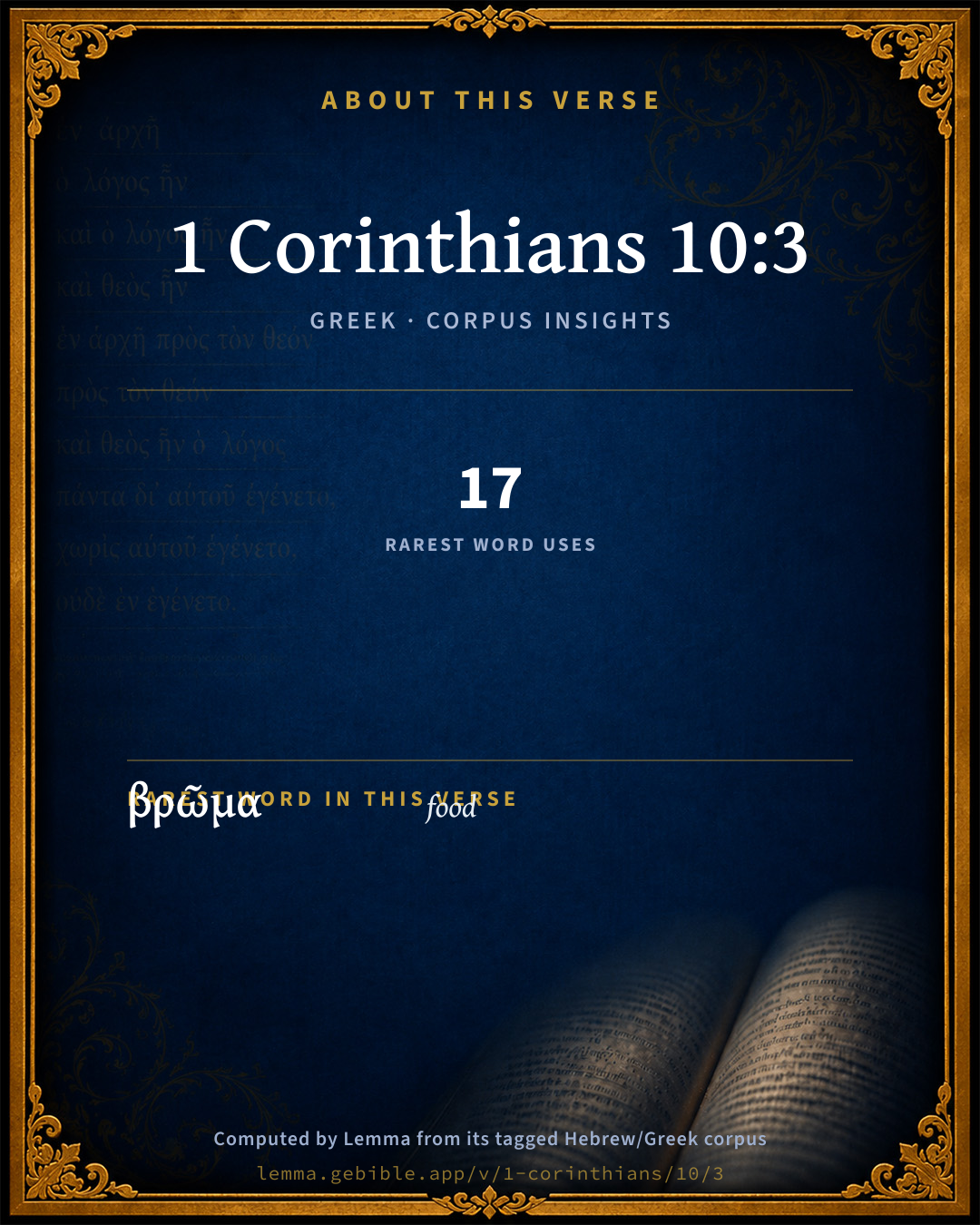
The rarest word here is βρῶμα food G1033 — appearing just 17 times in the whole Greek New Testament.

Shared distinctive vocabulary

βρῶμα food G1033 occurs in 15 verses of the Greek New Testament. Also found in:

Cross-references

9

Topical passages linked to 1 Corinthians 10:3 in the Treasury of Scripture Knowledge — connected by theme and wording, ordered by reader-vote popularity; previews shown in the World English Bible.

  • Deuteronomy 8:3 He humbled you, and allowed you to hunger, and fed you with manna, which you didn't know, neither did your fathers know; that he might make you know that man does not live by bread only, but by everything that proceeds out of the mouth of Yahweh does man live.
  • Nehemiah 9:15 and gave them bread from the sky for their hunger, and brought forth water for them out of the rock for their thirst, and commanded those who they should go in to possess the land which you had sworn to give them.
  • Exodus 16:4 Then said Yahweh to Moses, "Behold, I will rain bread from the sky for you, and the people shall go out and gather a day's portion every day, that I may test them, whether they will walk in my law, or not.
  • Exodus 16:35 The children of Israel ate the manna forty years, until they came to an inhabited land. They ate the manna until they came to the borders of the land of Canaan.
  • Nehemiah 9:20 You gave also your good Spirit to instruct them, and didn't withhold your manna from their mouth, and gave them water for their thirst.
  • Exodus 16:15 When the children of Israel saw it, they said one to another, "What is it?" For they didn't know what it was. Moses said to them, "It is the bread which Yahweh has given you to eat."
  • Psalms 105:40 They asked, and he brought quails, And satisfied them with the bread of the sky.
  • Psalms 78:23–25 Yet he commanded the skies above, And opened the doors of heaven.
  • John 6:22–58 On the next day, the multitude that stood on the other side of the sea saw that there was no other boat there, except the one in which his disciples had embarked, and that Jesus hadn't entered with his disciples into the boat, but his disciples had gone away alone.

Cross-references courtesy of OpenBible.info (CC BY 4.0).

Commentary

Notes on 1 Corinthians 10:3 from classic Christian and Jewish commentators (each source and its license shown beneath its notes). The classic Christian expositions comment on the surrounding passage and are grouped to its opening verse, so a note may address several verses; the Jewish commentaries on the Tanakh (Rashi and others) are per-verse, so they appear only where the commentator wrote on this verse.

Lemma curates 59 commentaries, every one of them public domain or Creative Commons licensed, each selected and text-cleaned for this edition rather than reprinted as found. About our sources →

Tyndale Open Study Notes

Tyndale Open Resources

10:3-4 Spiritual food . . . spiritual water: God graciously and supernaturally provided food and water in the wilderness, especially for the people of Israel (see Exod 16:4-35; 17:1-7; Num 20:2-17). The Corinthians’ situation was analogous. • The spiritual rock that traveled with them alludes to the rock that Moses struck to get water (Exod 17:1-7; Num 20:2-17). Early Jewish tradition understood both occurrences of the miracle to involve the same rock that was traveling with them. • that rock was Christ: Paul’s interpretation of Israel’s experience provides a parallel between God’s provision in the wilderness and the Lord’s Supper (1 Cor 10:14-18; cp. John 4:14; 7:37-39; Rev 22:17). Both the Israelites and Christians share in the spiritual provisions of Christ; and just as the Israelites were therefore judged for their sins, so Christians will be judged if they sin (1 Cor 10:5-22).

Tyndale Open Study Notes — © Tyndale Open Resources, licensed CC BY-SA 4.0. Text via the HelloAO Bible API.

Bengel's Gnomon

Johann Albrecht Bengel

1Co 10:3. Καὶ πάντες, and all) The three former particularly refer to baptism; this and the following, to the Lord’s Supper. If there were more sacraments of the New Testament, Paul would have laid down something that bore likewise a resemblance to the others.—τὸ αὐτὸ) the same, in respect of the fathers that fell, or did not fall; not in respect of them and us; for in the New Testament there is none of the Mosaic manna; comp. of one [partakers of that one bread], 1Co 10:17.—βρῶμα, meat) Exo 16:14.—πνευματικὸν, spiritual) Manna was spiritual food, not in itself, Joh 6:32; nor merely in the way of prefiguration; but because there was give from Christ to the Israelites, along with food for the body, food for the soul, the manna, which is far more noble than external food: comp. the next verse; and in this better sense, the denomination is given; comp. Psa 78:24-25: and there was spiritual food not only to believers, but also, on the part of God [as far as God’s part is concerned], to the others.

Bengel's Gnomon of the New Testament — English translation (T&T Clark, Edinburgh, 1860) — public domain. Text from a community e-Sword module.

Meyer's Critical & Exegetical Commentary

Heinrich August Wilhelm Meyer

1Co_10:3-4. Just as all received the self-same type of baptism (1Co_10:1-2), so too all were partakers of one and the same analogue of the Christian ordinance of the Supper.[1583]

τὸ αὐτό] so that each one therefore stood on the very same level of apparent certainty of not being cast off by God.

The βρῶμα πνευματικόν is the manna (Exo_16:13 ff.), inasmuch as it was not, like common food, a product of nature, but came as bread from heaven (Psa_78:24 f.; Wis_16:20; Joh_6:31 f.), the gift of God, who by His Spirit wrought marvellously for His people. Being vouchsafed by the χάρις πνευματική of Jehovah, it was, although material in itself, a χάρισμα πνευματικόν, a food of supernatural, divine, and spiritual origin. Comp Theodore of Mopsuestia: πνευματικὸν καλεῖ καὶ τὸ βρῶμα καὶ τὸ πόμα, ὡς ἂν τοῦ πνεύματος ἄμφω διὰ τοῦ Μωϋσέως κατὰ τὴν ἀπόῤῥητον αὐτοῦ παρασχόντος δύναμιν. οὕτω δὲ καὶ πνευματικὴν ἐκάλεσεν τὴν πέτραν, ὡς ἂν τῇ δυνάμει τοῦ πνεύματος ἐκδοῦσαν τὰ ὕδατα. What the Rabbins invented about the miraculous qualities of the manna may be seen in von der Hardt, Ephem. phil. pp. 101, 104; Eisenmengers entdeckt. Judenth. II. p. 876 f., I. pp. 312, 467. Philo explains it as referring to the Logos, Leg. alleg. ii. p. 82, Quod deter. pot. insid. sol. p. 213.

πόμα] Exo_17:1-6; Num_20:2-11. Regarding the forms πόμα and πῶμα, see Lobeck, Paral. p. 425 f.

ἔπινον … Χριστός] a parenthetic explanation in detail as to the quite peculiar and marvellous character of this πόμα. The imperfect does not, like the preceding aorist, state the drinking absolutely as a historical fact, but is the descriptive imperfect, depicting the process of the ἔπιον according to the peculiar circumstances in which it took place; it thus has a modal force, showing how things went on with the πάντες … ἔπιον, while it was taking place. Bengel remarks rightly on the γάρ: qualis petra, talis aqua.

ἐκ πνευματ. ἀκολ. πέτρας· ἡ δὲ πέτρα ἦν ὁ Χ.] from a spiritual rock that followed them; the Rock, however (which we speak of here), was Christ. Πνευματικῆς has the emphasis; it corresponds to the preceding πνευματικόν, and is explained more specifically by ἡ δὲ π. ἦν ὁ Χ. The relation denoted by ἀκολουθούσης, again, is assumed to be self-evident, and therefore no further explanation is given of the word. The thoughts, to which Paul here gives expression, are the following:(1) To guard and help the Israelites in their journey through the wilderness, Christ accompanied them, namely, in His pre-existent divine nature, and consequently as the Son of God (= the Λόγος of John), who afterwards appeared as man (comp Wis_10:15 ff.). (2) The rock, from which the water that they drank flowed, was not an ordinary natural rock, but a πέτρα πνευματική; not the mere appearance or phantasm of a rock, but an actual one, although of supernatural and heavenly origin, inasmuch as it was the real self-revelation and manifestation of the Son of God, who invisibly accompanied the host on its march; it was, in other words, the very Christ from heaven, as being His own substantial and efficient presentation of Himself to men (comp Targ. Isa_16:1, and Philos view, p. 1103 A, that the rock was the σοφία). (3) Such being the state of the case as to the rock, it must of necessity be a rock that followed, that accompanied and went with the children of Israel in their way through the desert; for Christ in His pre-existent condition, the heavenly substratum, so to speak, of this rock, went constantly with them, so that everywhere in the wilderness His essential presence could manifest itself in their actual experience through the rock with its abundant water; and, in point of fact, did so manifest itself again and again. In drinking from the rock, they had their thirst quenched by Christ, who, making the rock His form of manifestation, supplied the water from Himself, although this marvellous speciality about the way in which their thirst was met remained hidden from the Israelites.

Since the apostles words thus clearly and completely explain themselves, we have no right to ascribe to Paul, what was a later invention of the Rabbins, the notion that the rock rolled along after the marching host (Bammidbar, R. S. 1; Onkelos on Num_21:18-20; and see Wetstein and Schöttgen, also Lund, Heiligth., ed. Wolf, p. 251); such fictions as these, when compared with what the apostle actually says, should certainly be regarded as extravagant aftergrowths (in opposition to Rückert and de Wette). It is just as unwarrantable, however, to explain away, by any exegetical expedient, this rock which followed them, and which was Christ. The attempts which have been made with this view run directly counter to the plain meaning of the words; e.g. the interpretation of Erasmus, Beza, Calvin, Piscator, Drusius, Grotius, Lightfoot, Billroth, al[1587] (which dates from Theodore of Mopsuestia), that the rock means here what came from it, the water (!), which, they hold, followed the people and prefigured Christ (ἦν). That ἦν denotes here significabat (so too Augustine, Vatablus, Salmasius, Bengel, Loesner, al[1588]), is a purely arbitrary assumption, seeing that Paul neither says ἐστί, nor τύπος ἦν, or the like, nor even indicates in any way in the context a typico-allegorical reference. This applies also against what Ch. F. Fritzsche has in his Nova opusc. p. 261: The rock in the wilderness was a rock of blessing, strength, and life-giving for the Jews, and thus it prefigures Christ, etc. Paul does not say anything of the sort; it is simply his expositors who insert it on their own authority. Baur, too, does violence to the apostles words (comp his neut. Theol. p. 193), by asserting that Paul speaks of Christ as the πνευμ. πέτρα only in so far as he saw a type which had reference to Christ in the rock that followed the Israelites, according to the allegoric interpretation which he put upon it.[1590] See, in opposition to this, Räbiger, Christol. Paul. p. 31 f.; Weiss, bibl. Theol. p. 319. The ordinary exposition comes nearer to the truth, but fails to reach it in this respect, that it does not keep firm enough hold of the statement, that that rock was Christ, and so of its identity with Him, but takes Christ to be the Rock only in an ideal and figurative sense, regarding Him as different from the rock from which the water flowed, but as the author of its supply. So, in substance, Chrysostom,[1591] Oecumenius, Theophylact, Melanchthon, Cornelius a Lapide, and many others, among whom are Flatt, Kling in the Stud. und Krit. 1839, p. 835; Osiander, Neander, Hofmann.[1592]

[1583] Bengel well says: Si plura essent N. T. sacramenta, ceteris quoque simile quiddam posuisset Paulus. At the same time, it should be observed that the ecclesiastical notion of a sacrament does not appear in the N. T., but is an abstraction from the common characteristics of the two ordinances in question. Both, however, are equally essential and characteristic elements in the fellowship of the Christian life. Comp. Baur, neut. Theol. p. 200; Weiss, bibl. Theol. p. 353.

[1587] l. and others; and other passages; and other editions.

[1588] l. and others; and other passages; and other editions.

[1590] Baur is wholly unwarranted in taking πνευματικός, ver. 3 f., in the sense of typical or allegorically significant. His appeal to Rev_11:8 and Barnab. 10 is irrelevant.

[1591] οὐ γὰρ ἡ τῆς πέτρας φύσις τὸ ὕδωρ ἠφίει φησὶν οὐ γὰρ ἂν καὶ πρὸ τούτου ἀνέβλυζεν, ἀλλ ἑτέρα τις πέτρα πνευματικὴ τὸ πᾶν εἰργάζετο, τουτέστιν ὁ Χριστὸς ὁ παρὼν αὐτοῖς πανταχοῦ καὶ πάντα θαυματουργῶν.

[1592] Comp. his Schriftbew. I. p. 171: The rock from which the water flowed was a natural one, and stood fast in its own place; but the true Rock that really gave the water was the צוּר יִשְׂרָאֵל (Isa_30:29), was Jehovah, who went with Israel. By not calling the Rock God, but Christ, the apostle points forward, as it were (according to Hofmann), to the application which he is about to make of the words, namely, to the cup which Christ gives us to drink. But Pauls words are so simple, clear, and definite, that it is impossible to get off by any quid pro quo. For the rest, it is to be observed that in this passage, as in the previous one, where the crossing of the sea is taken as a typical prefiguration of baptism, we have doubtless a Rabbinical process of thought on the part of the apostle, which, as such, is not to be measured by the taste of our day, so that this unvarnished exegetical conception of it might be set down as something absurd, as is done by Hofmann. The Rabbinical culture of his time, under which the apostle grew up, was not done away with by the fact of his becoming the vessel of divine grace, revelation, and power. Comp. Gal_4:22 ff. Our passage has nothing whatever to do with Isa_30:29, where men go up into the temple to Jehovah, the Rock of Israel. It is of importance, however, in connection with Pauls doctrine regarding the pre-existence of Christ and its accordance with the doctrine of the Logos.

Meyer — Critical and Exegetical Commentary on the New Testament — English translation by Peter Christie, edited by Frederick Crombie (T&T Clark, 1880) — public domain. Text from a community e-Sword module.

Expositor's Greek Testament

ed. W. Robertson Nicoll

1Co 10:3-4 . After deliverance came the question of sustenance . This was effected in the desert by means no less miraculous and symbolic: “and they all ate the same spiritual food, and all drank the same spiritual drink” the manna of Exo 16:13 ff., etc., and the stream drawn from the rocks of Rephidim (Exo 17 .) and Kadesh (Num 20 .). The epithe πνευματικὸν does not negative the materiality of the βρῶμα and πόμα , any more than the corporeality of the ripe Christian man described in 1Co 2:15 ; it ascribes to these nutriments a higher virtue such as, e.g ., the bread of Christ’s miracles had for intelligent partakers a spiritual meaning and influence : for the bread, see Deu 8:2 f. ( cf. Mat 4:3 f., Joh 6:31 ff., Psa 78:23 ff.); for the water, Exo 17:7 , Num 20:13 , Psa 105:41 , Isa 35:6 . In drinking from the smitten rock the Israelites “were drinking” at the same time “of a spiritual rock ” and that not supplying them once alone, but “following” them throughout their history. 1Co 10:4 b explains 4 a ( γὰρ ): P. justifies his calling the miraculous water “spiritual,” not by saying that the rock from which it issued was a spiritual (and no material) rock, but that there was “ a spiritual rock accompanying” God’s people; from this they drank in spirit, while their bodies drank from the water flowing at their feet. The lesson is strictly parl [1414] to that of Deu 8:3 f. respecting the manna. In truth, another rock was there beside the visible cliff of Rephidim: “Now this rock ( ἡ πέτρα δέ ) was the Christ! ” The “meat” and “drink” are the actual desert food “the same” for “all,” but endowed for all with a “spiritual” grace; the “spiritual rock” which imparted this virtue is distinguished as “following” the people, being superior to local limitations a rock not symbolic of Christ, but identical with Him . This identification our Lord virtually made in the words of Joh 7:37 . The impf [1415] ( ἔπινον ) (4 b ), exchanged for ἔπιον (4 a ), indicates the continuous aid drawn from this “following rock”.

[1414] parallel.

[1415]mpf. imperfect tense.

Baur, Al [1416] , and others suppose P. to be adopting the Rabbinical legend that the water-bearing Rephidim rock journeyed onwards with the Israelites (see Bammidbar Rabba , s. 1; Eisenmenger, Entd. Judenthum , I. 312, 467, II. 876 f.). Philo allegorized this fable in application to the Logos ( Leg. alleg . II. §§ 21 f.; Quod det. pot. insid. solet , § 30). This may have suggested Paul’s conception, but the predicate πνευματικῆς ) emphatically discards the prodigy; “we must not disgrace P. by making him say that the pre-incarnate Christ followed the march of Israel in the shape of a lump of rock!” (Hf [1417] ). ὁ Χριστός not the doctrine , nor the hope of the Christ, but Himself assumes that Christ existed in Israelite times and was spiritually present with the O.T. Church, and that the grace attending its ordinances was mediated by Him. “The spiritual homogeneity of the two covenants” which gives to the Apostle’s warning its real cogency “rests on the identity of the Divine Head of both. The practical consequence saute aux veux : Christ lived already in the midst of the ancient people, and that people has perished! How can you suppose, you Christians, that you are secured from the same fate!” (Gd [1418] ).

[1416] Alford’s Greek Testament .

[1417] J. C. K. von Hofmann’s Die heilige Schrift N.T. untersucht , ii. 2 (2te Auflage, 1874).

[1418] F. Godet’s Commentaire sur la prem. Ép. aux Corinthiens (Eng. Trans.).

Holsten rejects the parenthetical ἡ πέτρα δέ clause as a theological gloss; but it is necessary to explain the previous ἐκ πνευμ . ἀκολ . πέτρας , and is covered doctrinally by the διʼ οὗ τὰ πάντα of 1Co 8:6 (see note). Already Jewish theology had referred to the hypostatized “Wisdom” (see Wisdom 10), or “the Logos” (Philo passim ), the protection and sustenance of ancient Israel. The O.T. saw the spiritual “rock of Israel” in Jehovah (Deu 32 , 2Sa 23:3 , Isa 17:10 ; Isa 26:4 , etc.), whose offices of grace, in the N.T. view of things, devolve on Christ. The Ap. does not in so many words associate the “spiritual food” and “drink” of 1Co 10:3 f. with the Lord’s Supper, as he did the crossing of the Red Sea with Baptism; but the second analogy is suggested by the first, and by the reference to the Eucharist in 1Co 10:15 ff. In no other place in the N. T. are the two Sacraments collocated.

The Expositor's Greek Testament, edited by W. Robertson Nicoll (1897–1910) — public domain. Text from a community e-Sword module.

Hodge's Commentary on Romans, Ephesians & First Corinthians

Charles Hodge

1Co_10:3

And did all eat the same spiritual meat;

As they had their baptism, so they had their eucharist; and they all had it. They all eat the same spiritual meat. They were all alike favored, and had therefore equal grounds of hope. Yet how few of them reached the promised rest!

The reference is here obviously to the manna, which the apostle calls spiritual meat. Why it is so called is very doubtful.

1. The word spiritual may mean, partaking of the nature of spirit, a sense attributed to the word in 1Co_15:44, where, spiritual body is assumed to mean a refined, aetherial body. The manna, according to this view, is called spiritual meat, because it was a refined kind of food; much in the way in which we use the word celestial as an epithet of excellence. This interpretation derives some support from Psa_78:25 where the manna is called angels food. By Josephus, A. III. 1:6, it is called, divine and wonderful food.

2. A second interpretation assumes that spiritual means having a spiritual import. Spiritual meat would then be equivalent to typical. They eat of that bread which was the type of the true bread from heaven. Neither of these views, however, is consistent with the scriptural use of the word. Spiritual neither means refined nor typical. In 1Co_15:44, spiritual body means a body adapted to the spirit as its organ.

3. Others give the word here its very common sense, pertaining to the spirit; as, in the preceding chapter, carnal things are things pertaining to the body, and spiritual things are things pertaining to the soul. The manna, according to this interpretation, was designed not only for the body, but for the soul. It was spiritual food; food intended for the spirit, because attended by the Holy Spirit and made the means of spiritual nourishment. This is a very commonly received interpretation. Calvin assumes it to be the only possible meaning of the passage, and founds on it an argument for his favorite doctrine, that the sacraments of the Old Testament had the same efficacy as those of the New. But this exalts the manna into a sacrament, which it was not. It was designed for ordinary food; as Nehemiah (Neh_9:15) says, Thou gavest them bread from heaven for their hunger, and broughtest forth for them water out of the rock for their thirst. And our Lord represents it in the same light, when he said, Your fathers did eat manna in the wilderness and are dead. Joh_6:49. He contrasts himself, as the true bread from heaven which gives life to the soul, with the manna which had no spiritual efficacy.

4. One of the most common meanings of the word spiritual in Scripture is, derived from the Spirit. Spiritual gifts and spiritual blessings are gifts and blessings of which the Spirit is the author. Every thing which God does in nature and in grace, he does by the Spirit. He garnished the heavens by the Spirit; and the Spirit renews the face of the earth. When therefore it is said, God gave them bread from heaven to eat, it means that the Spirit gave it; for God gave it through the Spirit. Thus God is said to renew and sanctify men, because the Spirit of God is the author of regeneration and sanctification. The manna therefore was spiritual food, in the same sense in which the special gifts of God are called spiritual gifts. That is, it was given by the Spirit. It was not natural food, but food miraculously provided. In the same sense, in the next verse, the water is called spiritual drink, because miraculously produced. In Gal_4:29 the natural birth of Isaac is said to have been after the Spirit, because due to the special intervention of God. As the miraculous deliverance and miraculous guidance of the Israelites was their baptism, so their being miraculously fed was their Lords Supper. They were as signal marks of the divine presence and favor as sacraments are to us. If their privileges did not prevent their perishing in the wilderness, ours will not save us. If the want of self-denial and vigilance destroyed them, it will destroy us.

Charles Hodge — Commentary on Romans (1835), First Corinthians (1857), and Ephesians (1856) — public domain. Text from a community e-Sword module.

Geneva Bible (1599)

Geneva Bible translators

The same that we do.

Manna, which was a spiritual meat to the believers, which in faith lay hold upon Christ who is the true meat.

Geneva Bible (1599) marginal notes — public domain. Text via Bolls.life.

Jamieson, Fausset & Brown

Robert Jamieson, A. R. Fausset & David Brown

same spiritual meat--As the Israelites had the water from the rock, which answered to baptism, so they had the manna which corresponded to the other of the two Christian sacraments, the Lord's Supper. Paul plainly implies the importance which was attached to these two sacraments by all Christians in those days: "an inspired protest against those who lower their dignity, or deny their necessity" [ALFORD]. Still he guards against the other extreme of thinking the mere external possession of such privileges will ensure salvation. Moreover, had there been seven sacraments, as Rome teaches, Paul would have alluded to them, whereas he refers to only the two. He does not mean by "the same" that the Israelites and we Christians have the "same" sacrament; but that believing and unbelieving Israelites alike had "the same" spiritual privilege of the manna (compare Co1 10:17). It was "spiritual meat" or food; because given by the power of God's spirit, not by human labor [GROTIUS and ALFORD] Gal 4:29, "born after the Spirit," that is, supernaturally. Psa 78:24, "corn of heaven" (Psa 105:40). Rather, "spiritual" in its typical signification, Christ, the true Bread of heaven, being signified (Joh 6:32). Not that the Israelites clearly understood the signification; but believers among them would feel that in the type something more was meant; and their implicit and reverent, though indistinct, faith was counted to them for justification, of which the manna was a kind of sacramental seal. "They are not to be heard which feign that the old fathers did look only for transitory promises" [Article VII, Church of England], as appears from this passage (compare Heb 4:2).

Jamieson, Fausset & Brown — Commentary Critical and Explanatory on the Whole Bible (1871) — public domain (CC PDM 1.0). Text via the HelloAO Bible API.

Adam Clarke's Commentary

Verse 3. Spiritual meat] The manna which is here called spiritual.

1. Because it was provided supernaturally; and,

2. Because it was a type of Christ Jesus, who speaking of it, Joh 6:31, &c., tells us that it was a type of that true bread which came down from heaven, which gives life to the world, Joh 6:33, and that himself was the bread of life, Joh 6:48.

Adam Clarke's Commentary on the Bible (1810–1826) — public domain. Text from a community e-Sword/MySword module.

John Calvin's Commentaries

3. The same spiritual meat He now makes mention of the other sacrament, which corresponds to the Holy Supper of the Lord. “The manna,” says he, “and the water that flowed forth from the rock, served not merely for the food of the body, but also for the spiritual nourishment of souls.” It is true, that both were means of sustenance for the body, but this does not hinder their serving also another purpose. While, therefore, the Lord relieved the necessities of the body, he, at the same time, provided for the everlasting welfare of souls. These two things would be easily reconciled, were there not a difficulty presented in Christ’s words, (John 6:31,) where he makes the manna the corruptible food of the belly, which he contrasts with the true food of the soul. That statement appears to differ widely from what Paul says here. This knot, too, is easily solved. It is the manner of scripture, when treating of the sacraments, or other things, to speak in some cases according to the capacity of the hearers, and in that case it has respect not to the nature of the thing, but to the mistaken idea of the hearers. Thus, Paul does not always speak of circumcision in the same way, for when he has a view to the appointment of God in it, he says, that it was a seal of the righteousness of the faith, (Romans 4:11,) but when he is disputing with those who gloried in an outward and bare sign, and reposed in it a mistaken confidence of salvation, he says, that it is a token of condemnation, because men bind themselves by it to keep the whole law (Galatians 5:2, 3.) For he takes merely the opinion that the false apostles had of it, because he contends, not against the pure institution of God, but against their mistaken view. In this way, as the carnal multitude preferred Moses to Christ, because he had fed the people in the desert for forty years, and looked to nothing in the manna but the food of the belly, (as indeed they sought nothing else,) Christ in his reply does not explain what was meant by the manna, but, passing over everything else, suits his discourse to the idea entertained by his hearers. “Moses is held by you in the highest esteem, and even in admiration, as a most eminent Prophet, because he filled the bellies of your fathers in the desert. For this one thing you object against me: I am accounted nothing by you, because I do not supply you with food for the belly. But if you reckon corruptible food of so much importance, what ought you to think of the life-giving bread, with which souls are nourished up unto eternal life?.” We see then that the Lord speaks there — not according to the nature of the thing, but rather according to the apprehension of his hearers. Paul, on the other hand, looks here — not to the ordinance of God, but to the abuse of it by the wicked.

Farther, when he says that the fathers ate the same spiritual meat, he shows, first, what is the virtue and efficacy of the Sacraments, and, secondly, he declares, that the ancient Sacraments of the Law had the same virtue as ours have at this day. For, if the manna was spiritual food, it follows, that it is not bare emblems that are presented to us in the Sacraments, but that the thing represented is at the same time truly imparted, for God is not a deceiver to feed us with empty fancies. A sign, it is true, is a sign, and retains its essence, but, as Papists act a ridiculous part, who dream of transformations, (I know not of what sort,) so it is not for us to separate between the reality and the emblem which God has conjoined. Papists confound the reality and the sign: profane men, as, for example, Suenckfeldius, and the like, separate the signs from the realities. Let us maintain a middle course, or, in other words, let us observe the connection appointed by the Lord, but still keep them distinct, that we may not mistakingly transfer to the one what belongs to the other.

It remains that we speak of the second point — the resemblance between the ancient signs and ours. It is a well-known dogma of the schoolmen — that the Sacraments of the ancient law were emblems of grace, but ours confer it. This passage is admirably suited for refuting that error, for it shows that the reality of the Sacrament was presented to the ancient people of God no less than to us. It is therefore a base fancy of the Sorbonists, that the holy fathers under the law had the signs without the reality. I grant, indeed, that the efficacy of the signs is furnished to us at once more clearly and more abundantly from the time of Christ’s manifestation in the flesh than it was possessed by the fathers. Thus there is a difference between us and them only in degree, or, (as they commonly say,) of “more and less,” for we receive more fully what they received in a smaller measure. It is not as if they had had bare emblems, while we enjoy the reality.

Some explain it to mean, that they ate the same meat together among themselves, and do not wish us to understand that there is a comparison between us and them; but these do not consider Paul’s object. For what does he mean to say here, but that the ancient people of God were honored with the same benefits with us, and were partakers of the same sacraments, that we might not, from confiding in any peculiar privilege, imagine that we would be exempted from the punishment which they endured? At the same time, I should not be prepared to contest the point with any one; I merely state my own opinion. In the meantime, I am well aware, what show of reason is advanced by those who adopt the opposite interpretation — that it suits best with the similitude made use of immediately before — that all the Israelites had the same race-ground marked out for them, and all started from the same point: all entered upon the same course: all were partakers of the same hope, but many were shut out from the reward. When, however, I take everything attentively into consideration, I am not induced by these considerations to give up my opinion; for it is not without good reason that the Apostle makes mention of two sacraments merely, and, more particularly, baptism. For what purpose was this, but to contrast them with us? Unquestionably, if he had restricted his comparison to the body of that people, he would rather have brought forward circumcision, and other sacraments that were better known and more distinguished, but, instead of this, he chose rather those that were more obscure, because they served more as a contrast between us and them. Nor would the application that he subjoins be otherwise so suitable — “All things that happened to them are examples to us, inasmuch as we there see the judgments of God that are impending over us, if we involve ourselves in the same crimes.”

John Calvin's Commentaries (1540-1563) — public domain. Text from the Calvin Translation Society English edition (1840s-50s) via the Christian Classics Ethereal Library (ccel.org). Calvin's coverage is partial (roughly two-thirds of the Bible); uncommented books and verses are honest gaps, never fabricated. The 19th-century editor's footnotes and remarks are omitted so the notes are faithfully Calvin's own voice.

Ellicott's Commentary for English Readers

(3) Spiritual meat.—The manna (Exo_16:13) was not natural food, for it was not produced in the natural way, but it was supplied by the Spirit and power of God. Bread from earth would be natural bread, but this was bread from heaven (Joh_6:31). Our Lord (Joh_6:50) had already made the Christian Church familiar with the “true bread,” of which that food had been the typical forecast.

A Bible Commentary for English Readers, edited by Charles John Ellicott (1878–1897) — public domain. Text from a community e-Sword module.

The Cambridge Bible for Schools and Colleges

gen. ed. J. J. S. Perowne

3. and did all eat the same spiritual meat] The manna (Exodus 16), “inasmuch as it was not like common bread, a product of nature, but came as bread from heaven (Psa_78:24; Wis_16:20; St Joh_6:31), the gift of God, Who, by His Spirit, wrought marvellously for His people.” Meyer. Cf. also Neh_9:15.

The Cambridge Bible for Schools and Colleges (gen. ed. J. J. S. Perowne; Cambridge University Press, 1878–1918) — public domain. Text from a community e-Sword module.

John Gill's Exposition

And did all eat the same spiritual meat. Meaning the manna; and which the Jews also call (h) , "spiritual food", as also their sacrifices, (i) , "spiritual bread": not that the manna was so in own nature; it was corporeal food, and served for the nourishment of the body; but either because it was prepared by angels, who are ministering spirits, at the command of God, and hence called angels' food, Psa 78:25 or rather because it had a mystical and spiritual meaning in it; it was not the true bread, but was typical of Christ, who is so: it resembled Christ in its original; it was prepared of God, as Christ is, as his salvation prepared before the face of all his people; it was the free gift of God, as Christ is to the mystical Israel; it came down from heaven, as Christ, the true bread of life did: it answered to him in its nature; it was in form round, expressive of his being from everlasting to everlasting, and of the perfection both of his divine and human natures; it was in colour white, signifying his purity of nature, and holiness of life and conversation; it was in quantity small, setting forth his outward meanness and despicableness in the eyes of men; and in quality it was sweet in taste, as Christ, and all the blessings and fruits of his grace are to believers. The usefulness of the manna was very great, a vast number, even all the Israelites, were supplied with it, and supported by it for forty years together, as all the elect of God, and the whole family of Christ are by the fulness of grace which is in him; and as in order that it might be proper and suitable food, it was ground in mills, or beaten in a mortar, and baked in pans; so Christ was bruised, and wounded, and endured great sufferings, and death itself, that he might be agreeable food for our faith: and as the Israelites had all an equal quantity of this food, none had more or less than others, so all the saints have an equal share and interest in Christ, in his blood, righteousness, and sacrifice; as they have the same like precious faith, they have the same object of it. To say no more, as the manna was the food of the wilderness, or of the people of Israel, whilst travelling in it, so Christ, and the fulness of grace that is in him, are the food and supply of the spiritual Israel, and church of God, whilst they are passing through this world to the heavenly glory. Now, though all the Israelites did not eat of Christ, the true bread, which was typified by the manna; yet they all ate the same food, which had a spiritual meaning in it, and a respect to Christ, but did not all enter into the land flowing with milk and honey.

(h) Yade Mose in Shemot Rabba, fol. 109. 3. (i) Tzeror Hammor, fol. 93. 2.

John Gill's Exposition of the Whole Bible (1746–1763) — public domain (CC PDM 1.0). Text via the HelloAO Bible API.

Trapp's Complete Commentary

John Trapp

3 And did all eat the same spiritual meat;

Ver. 3. And did all eat] They fed upon sacraments, and yet died in God’s displeasure. The carcase of the sacrament cannot give life, but the soul of it, which is the thing represented. It is well observed that sacraments do not work as physic, whether men sleep or wake, ex opere operate, by virtue inherent in them; but ex opere operantis, according to the disposition and qualification of the party that partaketh.

John Trapp, A Commentary or Exposition upon All the Books of the Old and New Testament (1647–1656) — public domain. Text from a community e-Sword module.

Albert Barnes' Notes on the Bible

And did all eat the same spiritual meat - That is, “manna.” Exo 16:15, Exo 16:35; Neh 9:15, Neh 9:20. The word meat here is used in the old English sense of the word, to denote “food” in general. They lived on “manna.” The word “spiritual” here is evidently used to denote that which was given by the Spirit, or by God; that which was the result of his miraculous gift, and which was not produced in the ordinary way, and which was not the gross food on which people are usually supported. It had an excellency and value from the fact that it was the immediate gift of God, and is thus called “angels food.” Psa 78:25. It is called by Josephus “divine and extraordinary food.” Ant. Psa 3:1. In the language of the Scriptures, that which is distinguished for excellence, which is the immediate gift of God, which is unlike that which is gross and of earthly origin, is called “spiritual,” to denote its purity, value, and excellence. Compare Rom 7:14; 1Co 3:1; 1Co 15:44, 1Co 15:46; Eph 1:3. The idea of Paul here is, that all the Israelites were nourished and supported in this remarkable manner by food given directly by God; that they all had thus the evidence of the divine protection and favor, and were all under his care.

Albert Barnes' Notes on the Bible (1834–1885) — public domain. Text from a community e-Sword/MySword module.

Haydock's Catholic Bible Commentary

All eat the same spiritual food, to wit, the manna, which seemed to come from heaven, and was a figure of the eucharist, the spiritual food of our souls. --- All drank the same spiritual drink, and....rock that followed them, by which is understood the stream of water, that came miraculously out of the rock struck by Moses, and which is said to have followed them, because it ran plentifully through their camp. --- And the rock was Christ, a figure of Christ; for all these things (ver. 11.) happened to them in figure. (Witham)

George Leo Haydock (1774–1849), Haydock's Catholic Family Bible and Commentary, 1859 edition — public domain. Excludes Psalms (Douay-Rheims chapter numbering differs from Protestant) and Deuterocanonical books (Catholic canon only).

Matthew Poole's English Annotations

Those of the Jews that perished in the wilderness, did all eat the same manna which Caleb and Joshua ate of, who went into Canaan; or, those Jews that so perished in the wilderness did eat the same spiritual meat that we do, they in the type, we in the antitype. Manna is called

spiritual meat:

1. Because it was bread which came down from heaven, the habitation of spiritual beings, Joh 6:31.

2. It was miraculously produced.

3. Because it was angels’ food, given out by their ministry.

4. But principally, because it signified Christ, who was the true bread from heaven, Joh 6:32.

Matthew Poole's English Annotations on the Holy Bible (1683–1685) — public domain. Text from a community e-Sword/MySword module.

Whedon's Commentary on the Bible

Daniel D. Whedon

3, 4. All… same—The same baptism, the same spiritual meat, the same spiritual drink were shared by all. And all shared the same faith. The people feared the Lord, and believed the Lord and his servant Moses. This emphatic repetition of the same spiritual state of all deserves a more marked attention than has usually been bestowed upon it. Israel was now the complete Church, in which all had the same faith, baptism, and, consequently, the same regeneration. Yet the large majority of them apostatized utterly and totally, and under divine wrath their carcasses strewed the wilderness. Here not the bare possibility of apostasy is affirmed, but its actual reality. The racers all start in the same Christian race alike. The Israelites all start alike through regeneration for the promised land. Yet they fail of both the earthly and the heavenly Canaan.

Spiritual meat… spiritual drink—Of which the manna and the water from the smitten rock are the suggestive similes. Like the bread and wine of the sacrament, the manna, the water, and even the rock, are all emblematical of the body or blood of Christ. Hence all Israel partook not only of the manna, but of the spiritual meat of which the manna was the emblem.

Spiritual drink—The water of life, of which the water from the smitten rock was an emblem.

Spiritual Rock… Christ—Hence it is not the rock smitten by Moses that St. Paul calls the spiritual Rock; but Christ, typified by the smitten rock, is the real spiritual Rock, of which they all did drink. Dr. Hodge and most other commentators involve themselves in inextricable confusion by making Paul call the material manna water, and rock spiritual.

Rock that followed them—Rabbinical tradition affirmed that either the rock smitten by Moses, or the water flowing from it, followed the Israelites through all their journey from Rephidim to Canaan. If, as Dr. Hodge interprets, it is the material manna, water, and rock, that Paul means, then it follows conclusively that Paul endorses the tradition as true. And Alford not only carries the physical interpretation through, but he affirms that it is violence not to agree that Paul actually affirms the truth of the tradition! But when Paul tells us that the Rock was Christ, it is inadmissible to make him say that the material rock, or the stream from it, followed them.

That Christ was the Jehovah of the Old Testament, the angel-Jehovah, has ever been a scriptural maxim in the Christian Church. Dr. Hodge well says: “Our Lord said, Abraham saw his day, for he was before Abraham.

Joh_8:58. John says, (Joh_12:41,) Isaiah beheld his glory in the temple; Paul says, the Israelites tempted him in the wilderness, (1Co_10:9;) and that Moses suffered his reproach. Heb_11:26. Jud_1:5 says, the Lord, or (as Lachmann, after the ancient versions and manuscripts, reads) Jesus, saved his people out of Egypt.” Hence there was a rock and a stream that followed Israel all their journey through; but that rock was not the rock of Horeb, as the rabbins fancied, but Christ himself.

Schoettgen quotes a Jewish writer thus: “There was a rock, shaped like a beehive, globular, and it rolled itself and went with them in their journeyings. When the camps stopped at their stations, and the tabernacle stood still, this rock came and placed itself in the threshold of the tent. Then came the princes, and, standing near it, said, Spring up, O well, etc., (Num_21:17,) and it sprung up.”

Dr. Wordsworth says, that as there were clouds to rain manna all their journey through, so there were rocks (genetically, rock) to supply water.

“He clave the rocks in the wilderness, and gave them drink as out of the great depths.” Psa_78:15. “He opened the rock, and the waters gushed out; they ran in the dry places like a river.” Psa_105:41.

Daniel D. Whedon (gen. ed.), Commentary on the Old and New Testaments (1874–1909) — public domain. Text from a community e-Sword module.

The Pulpit Commentary

And did all eat the same spiritual meat. As the cloud and the Red Sea symbolized the waters of baptism, so the manna and the water of the rock symbolized the elements of the other Christian sacrament, the Lord"s Supper. The manna might be called "a spiritual food," both because it was "angels" food". (Psa_78:25 RAPC Wis 16:20) and "bread from heaven". (Psa_78:24; Joh_6:31) and also because it was a type of "God"s good Spirit," which he "gave to instruct them". (Neh_9:20) St. Paul only knows of two sacraments.

HOMILIES BY D. FRASER Vers. 3, 4.

Meat and drink for God"s people.

By a few master strokes of his pen St. Paul indicated the typical significance of Israel"s life in the wilderness. His object in these allusions to the Old Testament was to correct party spirit among the Greek Christians of the first century, by showing that, like the tribes of Israel in the old time, the people of Christ are one in respect of their redemption and consolation in him. As all the Hebrew fathers were delivered from slavery in Egypt, so all the Christians are delivered from the bondage of the flesh. As all of them were baptized unto Moses in the cloud and the sea, so all the Christians have been baptized into Christ by death and burial with him. As all of them ate of the manna from the Lord, so all Christians have the same spiritual food; and as all of them drank of the water from the smitten rock in Horeb, so all Christians drink of the same spiritual Rock, which is Christ. Thus what God did for Israel, he did for all; what he gave to Israel, he gave to all that people. It was the fault of the people that this unity was broken. "Some of them were idolaters;" "some of them committed fornication;" "some of them tempted the Lord;" "some of them murmured." Christians should mark this, and beware lest any of them, through temptations to idolatry, fleshliness, or wilfulness, forfeit what the Lord has provided for all of them without respect of persons. Here are the necessaries of the spiritual as of the natural life food and drink, bread and water.

I SPIRITUAL FOOD. The Israelites got manna as a direct and free gift from God. Christians receive Christ as "the true Bread which came down from heaven," a direct and a free gift from God. The bread is his flesh which he has given for the life of the world; i.e. Christ nourishes his people through the efficacy of his atonement. Whosoever heartily believes in Christ crucified eats by faith of the flesh which is heavenly bread. The emphasis in this passage lies on the words, "They all did eat the same." In the wilderness, every family of the whole redeemed nation ate daily of exactly the same bread with every other family. Moses himself partook of the manna, and so did the lowest of the people. There was no difference between the princes of Israel and the feeblest in the tribes, between the old people and the children, or between masters and servants. All partook of the same daily bread. So there is the same Christ for all of us. Believers have the same life and the same support or staff of life. No matter what social and intellectual distinctions may be among us, or what varieties of view on secondary points; in this we are at one, that we have the same spiritual food. And we show this when we all partake together of the Lord"s Supper.

II SPIRITUAL DRINK. The water from the rock at Horeb not only supplied the immediate want, but was of use to the tribes of Israel for many days. Now, that rock signified Christ. Jehovah said to Moses, "I will stand before thee there upon the rock in Horeb." So God is now before us in Christ Jesus, able and willing to satisfy all the poor and needy whose hearts faint and" fail them for thirst." Christ as the Rock smitten is a Fountain of life, available to us now, and not now only, but all our lives long. As the bread resolves itself into the flesh, so the stream also into the precious blood of Christ. We eat the flesh and drink the blood of the Son of man, according to his own teaching at Capernaum. Thus we are again brought to the fact and virtue of the atonement. That which it would be gross and intolerable to eat and drink after a literal and carnal manner, is, after a spiritual manner, full of sweetness and strength. And again, the emphasis is on the participation by all Christians of the same spiritual drink, which is symbolized in the Lord"s Supper. "The cup of blessing which we bless, is it not the communion of the blood of Christ?" Other Scriptures follow more closely the idea of water gushing from a rocky fountain. As the blood of Christ signifies his atonement, so the water is a sign of the communication of the Holy Ghost. By the former our Lord gives peace to the conscience; by the latter, cleansing and healing to the heart. Christ, our Rock, spoke more than once of his power to impart to all comers the water of life. (Joh_4:10-14 Joh_7:37-39) And now, as from a height above the plain on which his people still walk as pilgrims, our Saviour in heaven gives this water to the thirsty. To it all are welcome. Water is no luxury for the few, but an acknowledged universal necessary of life; and so a participation of the Spirit of life in Christ Jesus is no privilege of a few superlative Christians, but necessary to the inward life of every one who is a Christian at all "If any man have not the Spirit of Christ, he is none of his." How can a rock follow? The rock in Horeb did not move from its place, but followed the people in the stream which issued from it and flowed through the lower levels of the wilderness. So Jesus Christ remains at God"s right hand; yet is with us always in the continual efficacy of his shed blood and the continual fellowship of his Holy Spirit. The fountain never runs dry. We never find anything less than fulness in him. And there is no need to go on a long pilgrimage to our sacred well. The Rock follows us.

III HOW TO GET THIS NOURISHMENT. By grace, through faith. When the children of Israel saw the manna, they "wist not what it was." Then Moses told them from God what it was, and bade them gather it, "every man according to his eating." So now, men do not know of themselves what Christ is; but it is preached or proclaimed as from God that this is the true Bread. Take, and eat, and live. Why should any household be without the heavenly Bread? When the rock was smitten, no one stood by but Moses and the eiders, who had gone in advance of the host. One can imagine those elders hastening back to the camp, and calling aloud to the several tribes, "Water! water! He, every one that thirsteth, come to the waters!" Shall we who have found life and peace in Jesus Christ hold our peace? Nay, but we call to every thirsty soul, "Come, and drink, and live. F.

Vers. 3, 4.

The spiritual meat and drink.

Give account of the historical facts to which the apostle refers. It seems as if he had in mind also the Jewish tradition that the rocki.e. a fragment broken off from the rock smitten by Moses followed the Israelites through their journey. St. Paul sees, in that symbol of the Divine presence and providing, an aid towards our realizing the gracious abiding presence of the Lord Jesus Christ with his Church. His point here is that God"s people, in the olden times and still, are divinely led and divinely fed; so no excuse for apostasy can be found in any "straitening in God.

I DIVINELY LED. By God in the pillar cloud that loomed dark against the clear sky by day, but shone like fire at night, and moved or rested to direct the people"s journeyings. By God"s power through the Red Sea, whose waters were held back, making a great pathway over the dried sands. The fact of such leadings ought to have bound the people to Jehovah in everlasting bonds. Then show what is the answering Christian fact to this, and how, when we are brought to Christ, a new light shines upon the wondrous providences of our whole lives, and so we feel freshly bound to our Lord, and say

Jesus, still lead on, Till our rest be won.

II DIVINELY FED. By God in the provision of the manna day by day. By God in the smitten rock, that provided in a miraculous manner for them when natural supplies failed. Such daily signs of Divine presence and care ought to have held them fast to daily obedience and service. Then we may realize that

(1) the manna answers to Christ, the Bread of life for us; and

(2) the water answers to Christ, the Rock sorely smitten for us. And then we should feel how, in the daily provisions of Christ"s grace in the supply of all our need, we are bound to his service, daily urged to "yield ourselves unto him, and our members instruments of righteousness unto his service.

R.T.

The Pulpit Commentary (1880–1919), ed. H.D.M. Spence-Jones & Joseph S. Exell — public domain. Text from a community e-Sword module.

John Wesley's Explanatory Notes

And all ate the same manna, termed spiritual meat, as it was typical,

1. Of Christ and his spiritual benefits:

2. Of the sacred bread which we eat at his table. Exod. xvi, 15.

John Wesley, Explanatory Notes Upon the Whole Bible (1754–1765) — public domain. Text via the GEBible commentary corpus.

Burkitt's Expository Notes on the New Testament

William Burkitt

They, that is, the fathers in the wilderness, did all eat of the manna which came down from heaven, which is here called spiritual meat; either because it came down from heaven, which is the habitation of spiritual beings; or because it was food given out by the ministry of angels, those spiritual agents; or else it is called spiritual, that is, sacramental, meat, because it typified Christ, who is the bread of life, the true bread which came down from heaven.

That manna was a type of Christ, thus appears: "Was manna provided by God for the Israelites without their labour and industry? so is Christ given unto men without any merit or work of theirs, but of the free gift and goodness of God.

Did manna come down from heaven beside the ordinary course of nature?

so was Christ’s birth wonderful, and not as the birth of other men; being not begotten of mortal seed, but by the influence of the Holy Ghost.

Was manna distributed to all alike, one not having more, and another less, but all an equal share?

in like manner Christ communicates himself unto all alike, without acceptance of persons.

A beggar may have as great a part in Christ as a prince.

Again, as manna was food, plentiful food, sweet and pleasant food; so is Christ the food of life, very sweet to such a soul as can truly relish him.

Farther, must the manna, before fit for food, be beaten in a mortar, or broken in a mill, and baked in an oven?

so Christ, our heavenly manna, was broken on the cross, scorched in the fire of his Father’s wrath, that he might become the spiritual food wherewith our souls are nourished unto everlasting life.

Finally, as manna was given only in the wilderness, and ceased when the Israelites came into Canaan; so is Christ our spiritual meat, our sacramental food, whilst we are in the wilderness of this world; but when we shall come to the heavenly Canaan, we shall have no more any need of sacramental supports, but shall behold him face to face, and be satisfied with his likeness."

And they did all drink of that spiritual rock which followed them, and that rock Christ. Here the water out of the rock is also called spiritual drink, it being typically and sacramentally so.

That rock was Christ; that is, it typified Christ. The word is doth import as much as signifies or represents; so the rock is Christ; that is, it signified, represented, and typified Jesus Christ.

For as the rock gave no water before it was smitten with the rod of Moses; so was Christ smitten upon the cross, and out of his side came forth water; and it was the rod in Moses’s hand that smote and broke the rock; so was Christ smitten with the curse of the law, in the day when his soul was made an offering for sin.

In a word, as the rock yielded water, not only to them that were first present at the proaching of it, but followed them with its streams, in their stations through the wilderness; in like manner the water which gushed out from our smitten Saviour, the sweet fruits and benefits of his death, did not only belong to them who were present at the time and place of his suffering, but it doth and will accompany all believers to the end of this world. The virtue and efficacy of Christ’s blood is now as great, as efficacious and effectual, as it was the first hour it was shed; the divinity of his person adds an eternal efficacy to his passion.

William Burkitt's Expository Notes on the New Testament (1700–1703) — public domain. Text from a community e-Sword module.

McGarvey & Pendleton's Commentaries

J. W. McGarvey

and did all eat the same spiritual food ;

J. W. McGarvey (with Philip Y. Pendleton), Commentaries on the New Testament (The Fourfold Gospel, 1914; Acts; and the epistles) — public domain. Text from a community e-Sword/MySword module.

The People's New Testament

B. W. Johnson

3. And did all eat the same spiritual meat. The manna (Exod. 16:15), called “spiritual,” because supernaturally supplied, and because a type of the spiritual bread of the Christian.

B. W. Johnson's The People's New Testament with Notes (1889–1891) — public domain. Electronic text from the Christian Classics Ethereal Library (CCEL) ThML edition.

Cambridge Greek Testament for Schools and Colleges

3. πνευματικὸν βρῶμα. The manna (Exodus 16), ‘inasmuch as it was not like common bread, a product of nature, but came as bread from heaven (Psa 78:24; Wis 16:20; Joh 6:31), the gift of God, Who, by His Spirit, wrought marvellously for His people.’ Meyer. Cf. also Neh 9:15. And Josephus Ant. III. 1 θεῖον βρῶμα καὶ παράδοξον. It may also mean subjectively as well as objectively spiritual, that is, it may not merely be the work of the Spirit, but may produce the work of the Spirit by teaching man his dependence upon God. See Mat 4:4.

Cambridge Greek Testament for Schools and Colleges (Cambridge University Press, 1896; 21 vols, various authors incl. Carr, Maclear, Plummer, Farrar, Lumby, Moule, M. R. James, Simcox) — public domain. Text from a community e-Sword module.

Alford’s Greek Testament

Henry Alford

3.] They had what answered to the one Christian sacrament, Baptism: now the Apostle shews that they were not without a symbolic correspondence to the other, the Lord’s Supper. The two elements in this Christian sacrament were anticipated in their case by the manna and the miraculous stream from the rock: these elements, in their case, as well as ours, symbolizing the Body and Blood of Christ. The whole passage is a standing testimony, incidentally, but most providentially, given by the great Apostle to the importance of the Christian sacraments, as necessary to membership of Christ, and not mere signs or remembrances: and an inspired protest against those who, whether as individuals or sects, would lower their dignity, or deny their necessity.

βρῶμα πνευματικὸν κ.τ.λ.] The manna is thus called, from its being no mere physical production, but miraculously given by God—the work of His Spirit. Thus Isaac is called, Gal 4:29, ὁ κατὰ πνεῦμα γεννηθείς, in opposition to Ishmael, ὁ κατὰ σάρκα γεννηθείς. Josephus calls the manna θεῖον βρῶμα καὶ παράδοξον, Antt. iii. 1. 6: and in Ps. 77:24, it is said ἄρτον οὐρανοῦ ἔδωκεν αὐτοῖς.

We can scarcely avoid recognizing in these words a tacit reference to our Lord’s discourse, or at all events to the substanee of it,—Joh 6:31-58. “For the sense of πνευματικός, as ‘typical,’ ‘seen in the light of the spirit,’ cf. Rev 11:8, ἥτις καλεῖται πνευματικῶς Σόδομα.” Stanley.

Henry Alford, The Greek Testament (1849–1861) — public domain. Text from a community e-Sword module.

International Critical Commentary

3. τὸ αὐτὸ βρῶμα πνενματικόν. The manna which typified the bread in the Eucharist (Joh 6:31, Joh 6:32) was ‘spiritual’ as being of supernatural origin, ἄρτος ἀγγέλων (Psa 78:25), ἀγγέλων τροφή (Wisd. 16:20). In all three passages, as here and Neh 9:15, Neh 9:20, the aorist is used throughout;—quite naturally, of an act which is past, and the repetition of which is not under consideration. It is possible that πνευματικόν also means that “the immediate relief and continuous supply of their bodily needs tended to have an effect upon their spirit; that is, to strengthen their faith” (Massie). Israelitis, una cum cibo corporis, alimentum animarum datum est (Beng.). Others take it as meaning that the manna and the water had a spiritual or allegorical meaning. It is remarkable that St Paul chooses the manna and the rock, and not any of the Jewish sacrifices, as parallels to the Eucharist. In class. Grk. πῶμα is more common than πόμα.

WH. bracket the first τὸ αὐτό, which א*, Aeth. omit, while A C* omit αὐτό: but τὸ αὺτό is verystrongly attested (א3 B C2 D E F G K L P Latt.). MSS. vary between πν. βρ. ἐφ.(א* B C2 P), πν. ἐφ.(א* D E F G K L), and πν. ἐφ.Βρ. (A 17). A omits the second αὐτό, abd again thers is difference as to the order; πν. ἐπ. πόμα (א A B C P). πόμα πν. ἐπ. (D E F G K L).

International Critical Commentary — older volumes (1896–1929), various authors — public domain. Text from a community e-Sword module.

Vincent's Word Studies in the New Testament

Marvin R. Vincent

Spiritual meat. The manna, called spiritual because coming from heaven. See Psa 78:25; Joh 6:31; and on Rev 11:8; Rev 2:17.

Marvin R. Vincent, Word Studies in the New Testament (1887–1900) — public domain. Text from a community e-Sword/MySword module.

Godet's Commentaries

Frédéric Louis Godet

Vv. 3, 4. “And did all eat the same spiritual meat; 4. And did all drink the same spiritual drink; for they drank of that spiritual Rock that followed them; and that Rock was Christ.”

As the Holy Supper serves to maintain in salvation those who have entered into it by the faith professed in baptism, so the Israelites also received, after the initial deliverance, the favours necessary to their preservation. These benefits, corresponding to the bread and wine of the Supper, were the manna daily received, and the water which God caused to issue from a rock in two cases of exceptional distress. The epithet πνευματικός, spiritual, cannot refer to the nature of these two Divine gifts; for they were material in substance. We may interpret it in two ways: either in the sense of typical, if we regard the material gift as the figure of a higher and future one; or in the sense of supernatural, in so far as these gifts were the immediate products of creative energy, regarded as proceeding from the Divine Spirit (Gen 1:2; Psa 33:6). I doubt whether examples can be quoted sufficient to establish the first of these two meanings; Rev 11:8, the only passage adduced by Edwards, is not convincing. The second meaning, on the contrary, is in harmony with biblical language in general and with that of the apostle in particular, though Holsten alleges the contrary; comp. Gal 4:29. Moreover, it must be considered that the first meaning, by lowering the gifts made to the Israelites to the level of mere figures, would so far diminish the force of the argument; while the second, by representing them as miraculous gifts, gives it additional solidity: Heavenly food, and He did not save them! Supernatural water, and those who drank it perished under condemnation! — The pronoun τὸ αὐτό, the same (food), does not refer, as is thought by Calvin and Heinrici, to the identity of these gifts with those bestowed on Christians. The one point in question is the relation of the Israelites to one another. All partook equally of this miraculous nourishment; and two were saved!

Vv. 4. Paul here refers to the two events related Exo 17:6 and Num 20:11. The miraculous character of the water which came from the rock is explained by the following proposition (for); it follows from the spiritual nature of the rock whence it flowed. The word spiritual cannot therefore have here a meaning exactly similar to that which it had in the foregoing propositions. There this epithet denoted the supernatural origin of the material gifts. Applied, as it is here, to the source of the miraculous water, it can only designate the nature of the rock; for it is this nature which explains the creative energy that was inherent in it and the supernatural effects it could produce. To produce this supernatural water, there was needed a rock Divine in its nature. — Several commentators, Rückert, Baur, de Wette, Meyer (1st edns.), have thought that Paul was here appropriating the Rabbinical fable, according to which a material rock rolled over hill and dale across the desert beside the camp of the Israelites, so as to supply them with the water they needed; it was Miriam, Moses’ sister, who above all was said to possess the secret of getting this water. But how can we imagine for a moment the most spiritual of the apostles holding and teaching the Churches such puerilities? In any case, even if he meant to allude to so ridiculous a fable, which we greatly doubt, he has done so in such a way as to make palpable the wide divergence between the Rabbinical opinion and his own.

In fact, the object of the two epithets ἀκολουθούσης and πνευματικῆς, accompanying and spiritual, is certainly to distinguish exactly the invisible and spiritual Rock of which he himself speaks, from the material rock spoken of in Exodus, that of which the Lord said to Moses the first time: “I will stand before thee there upon the rock in Horeb, and thou shalt smite the rock, and there shall come water out of it,” and the second time in the wilderness of Sin: “Take the rod...and speak to the rock..., and thou shalt bring forth water from the rock.” These two rocks already stood there when Israel arrived in these localities, and they remained there when Israel left them. Paul, therefore, can only mean one thing: that behind these material and immoveable rocks, there was one invisible and moveable, the true giver of the water, to wit, the Christ Himself. If anyhow such is the meaning of the narrative of Exodus, in Paul’s view, where is place left for a third sort of rock at once spiritual and material and of a nature wholly incomprehensible? The imperfect ἔπινον, drank, indicates duration, a repetition of similar cases; and this because the spiritual Rock was always present in the mysterious cloud which accompanied Israel. This is what the apostle expresses when he adds: and that Rock was Christ. Meyer, after abandoning his first explanation, adopts the view, since his 4th ed., that these words constrain us to hold that Paul regarded the Rock as a visible and real manifestation of the Christ, who accompanied Israel in the cloud, according to the words of the Targum of Isaiah (1Co 16:1) and of Philo, who say that “the rock was wisdom.”

But the idea of the incarnation of the Christ in a rock is so contrary to the spirit of St. Paul, that one cannot entertain it seriously, and 1Co 10:9 represents the Christ in the wilderness acting as the representative of Jehovah, from the midst of the cloud! Is it not perfectly simple to explain this figure of which Paul makes use, by the numerous sayings of Deuteronomy, in which the Lord is called the Rock of Israel: “The Rock, His work is perfect” (Deu 32:4); “Israel lightly esteemed the Rock of his salvation” (Deu 32:15); “Of the Rock that begat thee thou art unmindful” (Deu 32:18), etc., and by all those similar ones of Isaiah: “Thou hast not been mindful of the Rock of thy strength” (Isa 17:10); “in the Lord is the Rock of ages” (Isa 26:4)? Only, what is special in the passage of Paul is, that this title of Rock of Israel, during the wilderness history, is ascribed here, not to Jehovah, but to the Christ. The passage forms an analogy to the words Joh 12:41, where the apostle applies to Jesus the vision in which Isaiah beholds Adonai, the Lord, in the temple of His glory (ch. 6). Christ is represented in these passages, by Paul and John, as pre-existent before His coming to the earth, and presiding over the theocratic history. In ch. 1Co 8:6, Paul had designated Christ as the Being by whom God created all things. Here he represents Him as the Divine Being who accompanied God’s people in the cloud through the wilderness, and who gave them the deliverances which they needed. We have the same view here as appears in the angel of the Lord, so often identified in Genesis with the Lord Himself, and yet distinct from Him, in the Being who is called in Isaiah the angel of His presence (Isa 63:9), and in Malachi the angel of the covenant, Adonai (Mal 3:1), the Mediator between God and the world, specially with a view to the work of salvation. It is easy to understand the relation there is between the mention of this great theocratic fact and the idea which the apostle wishes to express in our passage. The spiritual homogeneity of the two covenants, and of the gifts accompanying them, rests on this identity of the Divine head of both. The practical consequence is obvious at a glance: Christ lived in the midst of the ancient people, and the people perished! How can you think yourselves, you Christians, secure from the same lot!

It is clear that there is no good ground for holding, as Holsten does, the second part of this verse to be interpolated. It enters perfectly into the course of the argument.

Reuss alleges that with such a conception of history as the apostle here expresses, “one comes very near seeing nothing more in it than pure allegories, and not realities.” It seems as if this critic would like to make St. Paul the forerunner of his own critical system. He forgets that it is one thing to derive a moral application from an accomplished fact, and another to assert that the fact itself is only an illustration of the moral idea.

It has been justly observed that in this passage we find for the first time the combination of the two sacred acts of baptism and the Lord’s Supper, as forming a complete whole: the one representing the grace of entrance into the new life, the other the grace by which we are maintained and strengthened in it. The combination of these two acts, under the particular name of sacraments, is not therefore an arbitrary invention of dogmatic.

The Israelites, after their exodus from Egypt, all received Divine favours analogous though inferior to those which Christians themselves enjoy; and, notwithstanding, what a judgment!

Frédéric Louis Godet — Commentaries on Luke, John, Romans, and 1 Corinthians — English translation (T&T Clark, Edinburgh, 1870s–1890s) — public domain. Text from a community e-Sword module.

Lesson kit

Teaching starters — assembled from the data on this page, not authored interpretation. Every prompt links to the verse data it draws on. Edit before teaching.

1 Corinthians, in the Pauline Epistles, opens this verse with 7 words (7 distinct Greek lemmas). Its most distinctive word is brōma (“food”). A historical commentator’s framing appears above. Read the whole chapter for the surrounding context.

Discussion questions

  1. The word brōma carries the sense “food.” How does it shape the verse?
  2. How does Matthew 14:15, which shares the word «food», read alongside this verse?
  3. These translations render this verse differently. What is at stake in choosing one wording over another?
  4. Compare how Tyndale Open Study Notes and Bengel's Gnomon read this verse. Where do they agree or differ?

Things to notice

Reading settings

Reading text

Shown beneath each verse's original-language words.

Old Testament
Old Testament edition

Read the OT as the Masoretic Hebrew (MT) or the Greek Septuagint (LXX).

English shown for the Greek Septuagint (in the Hebrew ↔ Greek comparison).

Comparing translations? Open the Compare panel on any verse page to stack up to four side by side.