
1 Corinthians 5:8

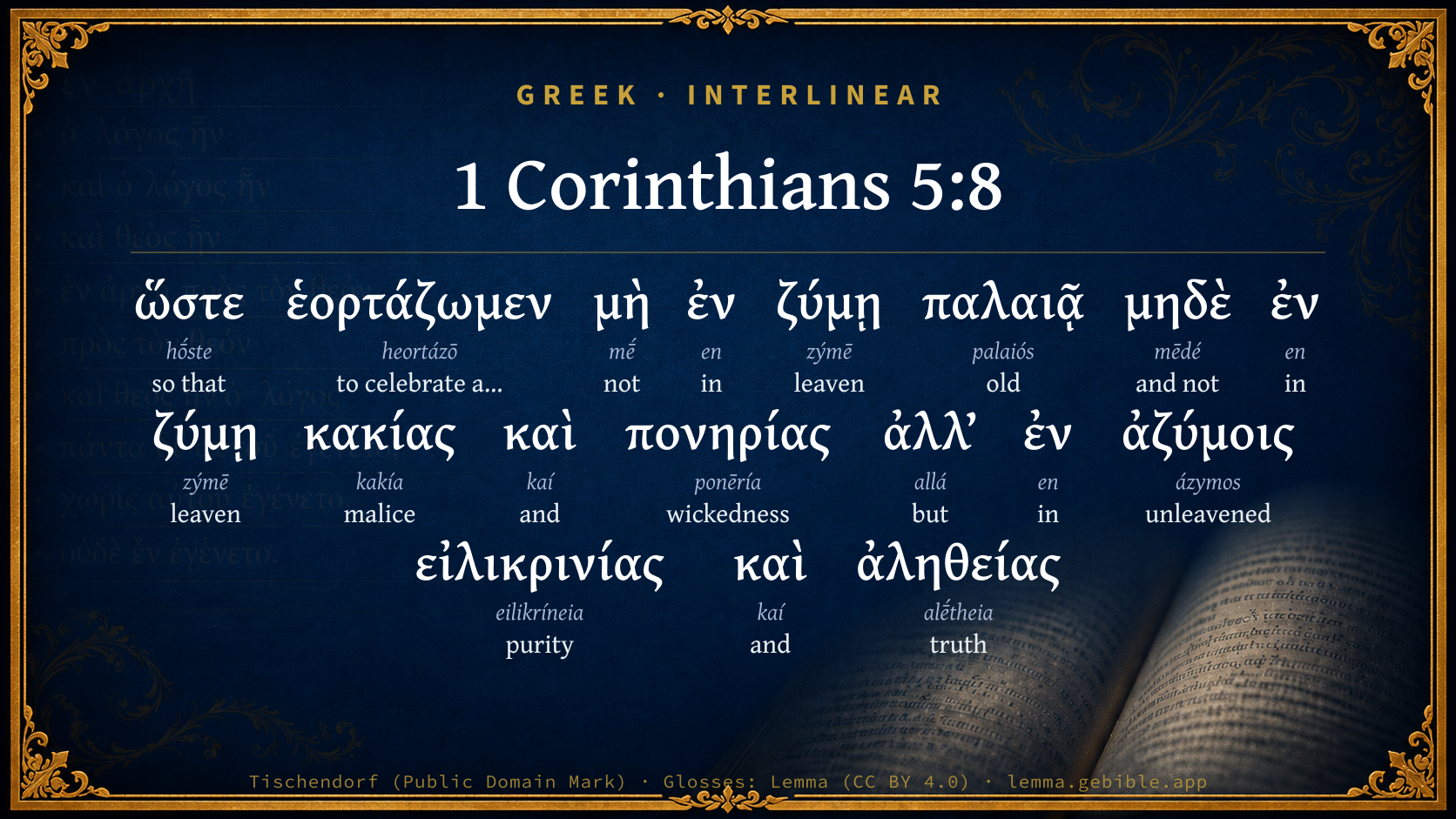
Greek (Tischendorf 8th ed.) 1 Corinthians 5:8 appears in the Greek New Testament. The text above is from the Tischendorf 8th edition. Each word links to its Strong’s number and a concise gloss. Click any word for its full Thayer’s Greek Lexicon entry.
Download image
Cite this verse

1 Corinthians 5:8 (World English Bible). Public Domain. Lemma interlinear Bible study tool, https://lemma.gebible.app/v/1-corinthians/5/8.

Show BibTeX & RIS
BibTeX
RIS
English Translation
Therefore let us keep the feast, not with old yeast, neither with the yeast of malice and wickedness, but with the unleavened bread of sincerity and truth.
World English Bible · Public Domain
Highlights
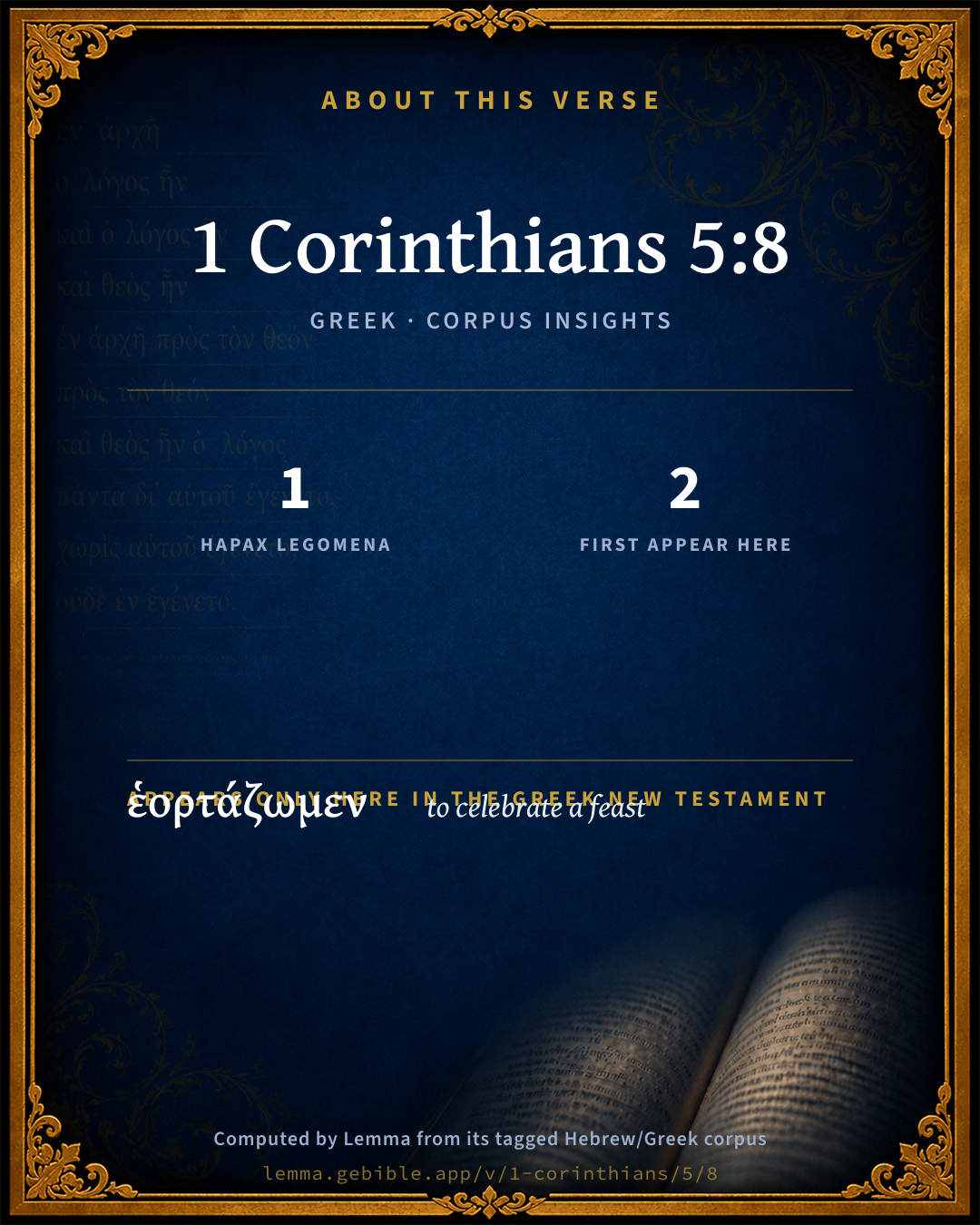
  • 1 hapax legomenon — only here in the Greek New Testament
  • 2 first appearances in the Greek New Testament
Full analysis ↓
Download a study sheet

One document with this verse’s original text, its word-by-word gloss line, the meaning frame, cross-references with their text, attributed commentary, and full source and license credits — printable, and it pastes into notes with its structure intact.

This verse Autodidact and up

Study sheet (.html) Plain text (.txt)

A passage Seminary Student

Up to 50 verses in one chapter. A passage sheet keeps up to 6 commentary sources and 12 cross-references per verse, in the order this page ranks them, and says so on the sheet whenever that leaves anything out. Ask for a single verse and you get the Autodidact verse sheet above.

Everything on this page stays free to read, with no account — the sheet is a download of what is already on screen, not access to it.

Want to remove ads? Support Godless Engineer
Compare translations 3

The same verse in 3 English versions, stacked beneath the original-language interlinear above. Click any original word for its lexicon entry.

Each is an independent rendering of the whole verse — the interlinear is not word-aligned to these translations.

Highlighted words mark where these versions differ — a whole-verse word diff, not a word-by-word alignment.

  • World English Bible Public Domain
    Therefore let us keep the feast, not with old yeast, neither with the yeast of malice and wickedness, but with the unleavened bread of sincerity and truth.
  • King James Version Public Domain
    Therefore let us keep the feast, not with old leaven, neither with the leaven of malice and wickedness; but with the unleavened bread of sincerity and truth.
  • unfoldingWord Literal Text CC BY-SA 4.0
    So then, we should celebrate the festival, not with old yeast, nor with yeast of evil and wickedness, but with unleavened bread of sincerity and truth.

unfoldingWord Literal Text — © unfoldingWord, licensed CC BY-SA 4.0. Word-aligned USFM3 via Door43 (git.door43.org/unfoldingWord/en_ult).

Versions to compare (up to 4)

3 of 4 selected

Show all 19 translations

Every available English version of this verse, each an independent rendering of the whole verse.

  • World English Bible Public Domain
    Therefore let us keep the feast, not with old yeast, neither with the yeast of malice and wickedness, but with the unleavened bread of sincerity and truth.
  • Berean Standard Bible Public Domain
    Therefore let us keep the feast, not with the old bread, leavened with malice and wickedness, but with the unleavened bread of sincerity and of truth.
  • Majority Standard Bible Public Domain
    Therefore let us keep the feast, not with the old bread, leavened with malice and wickedness, but with the unleavened bread of sincerity and of truth.
  • King James Version Public Domain
    Therefore let us keep the feast, not with old leaven, neither with the leaven of malice and wickedness; but with the unleavened bread of sincerity and truth.
  • American Standard Version (1901) Public Domain
    wherefore let us keep the feast, not with old leaven, neither with the leaven of malice and wickedness, but with the unleavened bread of sincerity and truth.
  • Revised Version (1885) Public Domain
    wherefore let us keep the feast, not with old leaven, neither with the leaven of malice and wickedness, but with the unleavened bread of sincerity and truth.
  • Geneva Bible (1599) Public Domain
    Therefore let vs keepe the feast, not with olde leauen, neither in the leauen of maliciousnes and wickednesse: but with the vnleauened bread of synceritie and trueth.
  • Douay-Rheims (1899) Public Domain
    Therefore let us feast, not with the old leaven, nor with the leaven of malice and wickedness; but with the unleavened bread of sincerity and truth.
  • Young's Literal Translation Public Domain
    so that we may keep the feast, not with old leaven, nor with the leaven of evil and wickedness, but with unleavened food of sincerity and truth.
  • Literal Standard Version CC BY-SA 4.0
    so that we may keep the celebration, not with old leaven, nor with the leaven of evil and wickedness, but with unleavened [bread] of sincerity and truth.
  • Unlocked Literal Bible CC BY-SA 4.0
    So let us then celebrate the festival, not with the old yeast, the yeast of bad behavior and wickedness. Instead, let us celebrate with the unleavened bread of sincerity and truth.
  • unfoldingWord Literal Text CC BY-SA 4.0
    So then, we should celebrate the festival, not with old yeast, nor with yeast of evil and wickedness, but with unleavened bread of sincerity and truth.
  • Darby Bible Public Domain
    so that let us celebrate the feast, not with old leaven, nor with leaven of malice and wickedness, but with unleavened [bread] of sincerity and truth.
  • World Messianic Bible Public Domain
    Therefore let’s keep the feast, not with old yeast, neither with the yeast of malice and wickedness, but with the unleavened bread of sincerity and truth.
  • Webster's Bible Public Domain
    Therefore let us keep the feast, not with old leaven, neither with the leaven of malice and wickedness; but with the unleavened bread of sincerity and truth.
  • Free Bible Version CC BY-SA 4.0
    So let us celebrate this festival, not with old yeast or the yeast of evil and wickedness, but with the bread made without yeast, the bread of sincerity and truth.
  • Bible in Basic English Public Domain
    Let us then keep the feast, not with old leaven, and not with the leaven of evil thoughts and acts, but with the unleavened bread of true thoughts and right feelings.
  • Text-Critical English NT CC BY 4.0
    So then, let us celebrate the feast, not with old leaven, nor with the leaven of malice and evil, but with the unleavened bread of sincerity and truth.
  • Tyndale New Testament (1534) Public Domain
    Therfore let vs kepe holy daye not with olde leve nether with the leven of maliciousnes and wickednes: but with the swete breed of purenes and truth.

Literal Standard Version (2020), Covenant Press — licensed CC BY-SA 4.0. Text via the HelloAO Bible API (eBible.org). Unlocked Literal Bible (unfoldingWord) — licensed CC BY-SA 4.0. Text via the HelloAO Bible API (eBible.org). unfoldingWord Literal Text — © unfoldingWord, licensed CC BY-SA 4.0. Word-aligned USFM3 via Door43 (git.door43.org/unfoldingWord/en_ult). Free Bible Version, Dr. Jonathan Gallagher — licensed CC BY-SA 4.0. Text via the HelloAO Bible API (eBible.org).

Word by word

More ways to search: Search by grammar → Find every occurrence → Compare this word →

Practice this passage: Drill this verse → Learn its vocabulary →

ἑορτάζωμεν
heortázō
G1858
“to celebrate a feast”
Verb, Present, Active, Subjunctive, 1st person, Plural
Part of Speech
Verb
Tense
Present
Voice
Active
Mood
Subjunctive
Person
1st person
Number
Plural
Full Thayer's Definition

Origin: from G1859

TDNT: None

1. to keep a feast day, celebrate a feast
  1. ὥστε hṓste G5620 “so that” Conjunction
  2. μὴ mḗ G3361 “not” Particle, Negative
  3. ἐν en G1722 “in” Preposition
  4. ζύμῃ zýmē G2219 “leaven” Noun, Dative, Singular, Feminine
  5. παλαιᾷ palaiós G3820 “old” Adjective, Dative, Singular, Feminine
  6. μηδὲ mēdé G3366 “and not” Conjunction, Negative
  7. ἐν en G1722 “in” Preposition
  8. ζύμῃ zýmē G2219 “leaven” Noun, Dative, Singular, Feminine
  9. κακίας kakía G2549 “malice” Noun, Genitive, Singular, Feminine
  10. καὶ kaí G2532 “and” Conjunction
  11. πονηρίας ponēría G4189 “wickedness” Noun, Genitive, Singular, Feminine
  12. ἀλλ’ allá G235 “but” Conjunction
  13. ἐν en G1722 “in” Preposition
  14. ἀζύμοις ázymos G106 “unleavened” Adjective, Dative, Plural, Neuter
  15. εἰλικρινίας eilikríneia G1505 “purity” Noun, Genitive, Singular, Feminine
  16. καὶ kaí G2532 “and” Conjunction
  17. ἀληθείας alḗtheia G225 “truth” Noun, Genitive, Singular, Feminine

About this verse

These counts appear in no published source. They are computed here, from the morphology-tagged text and Lemma’s own curated glosses. What Lemma adds →

18
words
14
distinct lemmas
Pauline Epistles
section

Notable vocabulary

1 hapax legomenon — a word that appears only here in the entire Greek New Testament:

  • ἑορτάζωμεν to celebrate a feast G1858

First appearance in Scripture

These words make their first canonical appearance in the Greek New Testament here:

  • ἑορτάζωμεν to celebrate a feast G1858
  • εἰλικρινίας purity G1505

Shared distinctive vocabulary

εἰλικρινίας purity G1505 occurs in 3 verses of the Greek New Testament. Also found in:
Repetition

Words recur within this verse:

Cross-references

30

Topical passages linked to 1 Corinthians 5:8 in the Treasury of Scripture Knowledge — connected by theme and wording, ordered by reader-vote popularity; previews shown in the World English Bible.

  • 1 Peter 2:1–2 Putting away therefore all wickedness, all deceit, hypocrisies, envies, and all evil speaking,
  • Exodus 12:15 Seven days shall you eat unleavened bread; even the first day you shall put away yeast out of your houses, for whoever eats leavened bread from the first day until the seventh day, that soul shall be cut off from Israel.
  • Deuteronomy 16:3 You shall eat no leavened bread with it; seven days shall you eat unleavened bread therewith, even the bread of affliction; for you came forth out of the land of Egypt in haste: that you may remember the day when you came forth out of the land of Egypt all the days of your life.
  • Matthew 16:6 Jesus said to them, "Take heed and beware of the yeast of the Pharisees and Sadducees."
  • Mark 8:15 He charged them, saying, "Take heed: beware of the yeast of the Pharisees and the yeast of Herod."
  • Luke 12:1 Meanwhile, when a multitude of many thousands had gathered together, so much so that they trampled on each other, he began to tell his disciples first of all, "Beware of the yeast of the Pharisees, which is hypocrisy.
  • Matthew 16:12 Then they understood that he didn't tell them to beware of the yeast of bread, but of the teaching of the Pharisees and Sadducees.
  • John 1:47 Jesus saw Nathanael coming to him, and said about him, "Behold, an Israelite indeed, in whom is no deceit!"
  • 1 Corinthians 5:6 Your boasting is not good. Don't you know that a little yeast leavens the whole lump?
  • 1 Corinthians 6:9–11 Or don't you know that the unrighteous will not inherit the Kingdom of God? Don't be deceived. Neither the sexually immoral, nor idolaters, nor adulterers, nor male prostitutes, nor homosexuals,
  • Ephesians 6:24 Grace be with all those who love our Lord Jesus Christ with incorruptible love. Amen.
  • 1 Peter 4:2 that you no longer should live the rest of your time in the flesh for the lusts of men, but for the will of God.
  • Leviticus 23:6 On the fifteenth day of the same month is the feast of unleavened bread to Yahweh. Seven days you shall eat unleavened bread.
  • Numbers 28:16–17 In the first month, on the fourteenth day of the month, is Yahweh's Passover.
  • Psalms 32:2 Blessed is the man to whom Yahweh doesn't impute iniquity, In whose spirit there is no deceit.
  • Psalms 42:4 These things I remember, and pour out my soul within me, How I used to go with the crowd, and led them to the house of God, With the voice of joy and praise, a multitude keeping a holy day.
  • Isaiah 25:6 In this mountain will Yahweh of Hosts make to all peoples a feast of fat things, a feast of wines on the lees, of fat things full of marrow, of wines on the lees well refined.
  • Isaiah 30:29 You shall have a song as in the night when a holy feast is kept; and gladness of heart, as when one goes with a pipe to come to the mountain of Yahweh, to the Rock of Israel.
  • Exodus 13:6 Seven days you shall eat unleavened bread, and in the seventh day shall be a feast to Yahweh.
  • Deuteronomy 16:16 Three times in a year shall all your males appear before Yahweh your God in the place which he shall choose: in the feast of unleavened bread, and in the feast of weeks, and in the feast of tents; and they shall not appear before Yahweh empty:
  • Joshua 24:14 Now therefore fear Yahweh, and serve him in sincerity and in truth; and put away the gods which your fathers served beyond the River, and in Egypt; and serve you Yahweh.
  • Matthew 26:4–5 They took counsel together that they might take Jesus by deceit, and kill him.
  • John 18:28–30 They led Jesus therefore from Caiaphas into the Praetorium. It was early, and they themselves didn't enter into the Praetorium, that they might not be defiled, but might eat the Passover.
  • 1 Corinthians 3:3 for you are still fleshly. For insofar as there is jealousy, strife, and factions among you, aren't you fleshly, and don't you walk in the ways of men?
  • 1 Corinthians 5:1 It is actually reported that there is sexual immorality among you, and such sexual immorality as is not even named among the Gentiles, that one has his father's wife.
  • 2 Corinthians 1:12 For our boasting is this: the testimony of our conscience, that in holiness and sincerity of God, not in fleshly wisdom but in the grace of God we behaved ourselves in the world, and more abundantly toward you.
  • 2 Corinthians 8:8 I speak not by way of commandment, but as proving through the earnestness of others the sincerity also of your love.
  • Ephesians 4:17–22 This I say therefore, and testify in the Lord, that you no longer walk as the rest of the Gentiles also walk, in the futility of their mind,
  • 1 John 3:18–21 My little children, let's not love in word only, neither with the tongue only, but in deed and truth.
  • 2 Corinthians 12:20–21 For I am afraid that by any means, when I come, I might find you not the way I want to, and that I might be found by you as you don't desire; that by any means there would be strife, jealousy, outbursts of anger, factions, slander, whisperings, proud thoughts, riots;

Cross-references courtesy of OpenBible.info (CC BY 4.0).

Commentary

Notes on 1 Corinthians 5:8 from classic Christian and Jewish commentators (each source and its license shown beneath its notes). The classic Christian expositions comment on the surrounding passage and are grouped to its opening verse, so a note may address several verses; the Jewish commentaries on the Tanakh (Rashi and others) are per-verse, so they appear only where the commentator wrote on this verse.

Lemma curates 59 commentaries, every one of them public domain or Creative Commons licensed, each selected and text-cleaned for this edition rather than reprinted as found. About our sources →

MacLaren's Expositions of Holy Scripture

Alexander MacLaren

1 Corinthians

THE FESTAL LIFE

1Co 5:8.

There had been hideous immorality in the Corinthian Church. Paul had struck at it with heat and force, sternly commanding the exclusion of the sinner. He did so on the ground of the diabolical power of infection possessed by evil, and illustrated that by the very obvious metaphor of leaven, a morsel of which, as he says, ‘will leaven the whole lump,’ or, as we say, ‘batch.’ But the word ‘leaven’ drew up from the depths of his memory a host of sacred associations connected with the Jewish Passover. He remembered the sedulous hunting in every Jewish house for every scrap of leavened matter; the slaying of the Paschal Lamb, and the following feast. Carried away by these associations, he forgets the sin in the Corinthian Church for a moment, and turns to set forth, in the words of the text, a very deep and penetrating view of what the Christian life is, how it is sustained, and what it demands. ‘Wherefore,’ says he, ‘let us keep the feast . . . with the unleavened bread of sincerity and truth.’ That ‘wherefore’ takes us back to the words before it, And what are these? ‘Christ our Passover is sacrificed for us’; therefore-because of that sacrifice, to us is granted the power, and on us is laid imperatively the obligation, to make life a festival and to purge ourselves. Now, in the notion of a feast, there are two things included-joy and plentiful sustenance. So there are three points here, which I have already indicated-what the Christian life is, a festival; on what it is sustained, the Paschal Sacrifice; what it demands, scrupulous purging out of the old leaven.

I. The Christian life ought to be a continual festival.

The Christian life a feast? It is more usually represented as a fight, a wrestle, a race; and such metaphors correspond, as it would appear, far more closely to the facts of our environment, and to the experiences of our hearts, than does such a metaphor as this. But the metaphor of the festival goes deeper than that of the fight or race, and it does not ignore the strenuous and militant side of the Christian life. No man ever lived a more strenuous life than Paul; no man had heavier tasks, and did them more cheerily; no man had a sterner fight and fought it more bravely. There is nothing soft, Epicurean, or oblivious of the patent sad facts of humanity in the declaration that after all, beneath all, above all, central to all, the Christian life is a glad festival, when it is the life that it ought to be.

But you say, ‘Ah! it is all very well to call it so; but in the first place, continual joy is impossible in the presence of the difficulties, and often sadnesses, that meet us on our life’s path; and, in the second place, it is folly to tell us to pump up emotions, or to ignore the occasions for much heaviness and sorrow of heart.’ True; but, still, it is possible to cultivate such a temper as makes life habitually joyful. We can choose the aspect under which we by preference and habitually regard our lives. All emotion follows upon a preceding thought, or sensible experience, and we can pick the objects of our thoughts, and determine what aspect of our lives to look at most.

The sky is often piled with stormy, heaped-up masses of blackness, but between them are lakes of calm blue. We can choose whether we look at the clouds or at the blue. These are in the lower ranges; that fills infinite spaces, upwards and out to the horizon. These are transient, eating themselves away even whilst we look, and black and thunderous as they may be, they are there but for a moment-that is perennial. If we are wise, we shall fix our gaze much rather on the blue than on the ugly cloud-rack that hides it, and thus shall minister to ourselves occasions for the noble kind of joy which is not noisy and boisterous, ‘like the crackling of thorns under a pot,’ and does not foam itself away by its very ebullience, but is calm like the grounds of it; still, like the heaven to which it looks; eternal, like the God on whom it is fastened. If we would only steadfastly remember that the one source of worthy and enduring joy is God Himself, and listen to the command, ‘Rejoice in the Lord,’ we should find it possible to ‘rejoice always.’ For that thought of Him, His sufficiency, His nearness, His encompassing presence, His prospering eye, His aiding hand, His gentle consolation, His enabling help will take the sting out of even the bitterest of our sorrows, and will brace us to sustain the heaviest, otherwise crushing burdens, and greatly to ‘rejoice, though now for a season we are in heaviness through manifold temptations.’ The Gulf Stream rushes into the northern hemisphere, melts the icebergs and warms the Polar seas, and so the joy of the Lord, if we set it before us as we can and should do, will minister to us a gladness which will make our lives a perpetual feast.

But there is another thing that we can do; that is, we can clearly recognise the occasions for sorrow in our experience, and yet interpret them by the truths of the Christian faith. That is to say, we can think of them, not so much as they tend to make us sad or glad, but as they tend to make us more assured of our possession of, more ardent in our love towards, and more submissive in our attitude to, the all-ordering Love which is God. Brethren, if we thought of life, and all its incidents, even when these are darkest and most threatening, as being what it and they indeed are, His training of us into capacity for fuller blessedness, because fuller possession of Himself, we should be less startled at the commandment, ‘Rejoice in the Lord always,’ and should feel that it was possible, though the figtree did not blossom, and there was no fruit in the vine, though the flocks were cut off from the pastures, and the herds from the stall, yet to rejoice in the God of our salvation. Rightly understood and pondered on, all the darkest passages of life are but like the cloud whose blackness determines the brightness of the rainbow on its front. Rightly understood and reflected on, these will teach us that the paradoxical commandment, ‘Count it all joy that ye fall into divers temptations,’ is, after all, the voice of true wisdom speaking at the dictation of a clear-eyed faith.

This text, since it is a commandment, implies that obedience to it, and therefore the realisation of this continual festal aspect of life, is very largely in our own power. Dispositions differ, some of us are constitutionally inclined to look at the blacker, and some at the brighter, side of our experiences. But our Christianity is worth little unless it can modify, and to some extent change, our natural tendencies. The joy of the Lord being our strength, the cultivation of joy in the Lord is largely our duty. Christian people do not sufficiently recognise that it is as incumbent on them to seek after this continual fountain of calm and heavenly joy flowing through their lives, as it is to cultivate some of the more recognised virtues and graces of Christian conduct and character.

Secondly, we have here-

II. The Christian life is a continual feeding on a sacrifice.

‘Christ our Passover is sacrificed for us. Wherefore let us keep the feast.’ It is very remarkable that this is the only place in Paul’s writings where he articulately pronounces that the Paschal Lamb is a type of Jesus Christ. There is only one other instance in the New Testament where that is stated with equal clearness and emphasis, and that is in John’s account of the Crucifixion, where he recognises the fact that Christ died with limbs unbroken, as being a fulfilment, in the New Testament sense of that word, of what was enjoined in regard to the antitype, ‘a bone of him shall not be broken.’

But whilst the definite statement which precedes my text that Christ is ‘our Passover,’ and ‘sacrificed for us’ as such, is unique in Paul’s writings, the thought to which it gives clear and crystallised expression runs through the whole of the New Testament. It underlies the Lord’s Supper. Did you ever think of how great was the self-assertion of Jesus Christ when He laid His hand on that sacredest of Jewish rites, which had been established, as the words of the institution of it say, to be ‘a perpetual memorial through all generations,’ brushed it on one side, and in effect, said: ‘You do not need to remember the Passover any more. I am the true Paschal Lamb, whose blood sprinkled on the doorposts averts the sword of the destroying Angel, whose flesh, partaken of, gives immortal life. Remember Me, and this do in remembrance of Me.’ The Lord’s Supper witnesses that Jesus thought Himself to be what Paul tells the Corinthians that He is, even our Passover, sacrificed for us. But the point to be observed is this, that just as in that ancient ritual, the lamb slain became the food of the Israelites, so with us the Christ who has died is to be the sustenance of our souls, and of our Christian life. ‘Therefore let us keep the feast.’

Feed upon Him; that is the essential central requirement for all Christian life, and what does feeding on Him mean? ‘How can this man give us his flesh to eat?’ said the Jews, and the answer is plain now, though so obscure then. The flesh which He gave for the life of the world in His death, must by us be taken for the very nourishment of our souls, by the simple act of faith in Him. That is the feeding which brings not only sustenance but life. Christ’s death for us is the basis, but it is only the basis, of Christ’s living in us, and His death for me is of no use at all to me unless He that died for me lives in me. We feed on Him by faith, which not only trusts to the Sacrifice as atoning for sin, but feeds on it as communicating and sustaining eternal life-’Christ our Passover is sacrificed for us, wherefore let us keep the Feast.’

Again, we keep the feast when our minds feed upon Christ by contemplation of what He is, what He has done, what He is doing, what He will do; when we take Him as ‘the Master-light of all our seeing,’ and in Him, His words and works, His Passion, Resurrection, Ascension, Session as Sovereign at the right hand of God, find the perfect revelation of what God is, the perfect discovery of what man is, the perfect disclosure of what sin is, the perfect prophecy of what man may become, the Light of light, the answer to every question that our spirits can put about the loftiest verities of God and man, the universe and the future. We feed on Christ when, with lowly submission, we habitually subject thoughts, purposes, desires, to His authority, and when we let His will flow into, and make plastic and supple, our wills. We nourish our wills by submitting them to Jesus, and we feed on Him when we not only say ‘Lord! Lord!’ but when we do the things that He says. We feed on Christ, when we let His great, sacred, all-wise, all-giving, all satisfying love flow into our restless hearts and make them still, enter into our vagrant affections and fix them on Himself. Thus when mind and conscience and will and heart all turn to Jesus, and in Him find their sustenance, we shall be filled with the feast of fat things which He has prepared for all people. With that bread we shall be satisfied, and with it only, for the husks of the swine are no food for the Father’s son, and we ‘spend our money for that which is not bread, and our labour for that which satisfieth not,’ if we look anywhere else than to the Paschal Lamb slain for us for the food of our souls.

III. The Christian life is a continual purging out of the old leaven.

I need not remind you how vivid and profoundly significant that emblem of leaven, as applied to all manner of evil, is. But let me remind you how, just as in the Jewish Ritual, the cleansing from all that was leavened was the essential pre-requisite to the participation in the feast, feeding on Jesus Christ, as I have tried to describe it, is absolutely impossible unless our leaven is cleansed away. Children spoil their appetites for wholesome food by eating sweetmeats. Men destroy their capacity for feeding on Christ by hungry desires, and gluttonous satisfying of those desires with the delusive sweets of this passing world. But, my brother, your experience, if you are a Christian man at all, will tell you that in the direct measure in which you have been drawn away into paltering with evil, your appetite for Christ and your capacity for gazing upon Him, contemplating Him, feeding on Him, has died out. There comes a kind of constriction in a man’s throat when he is hungering after lesser good, especially when there is a tinge of evil in the supposed good that he is hungering after, which incapacitates Him from eating the bread of God, which is Jesus Christ.

But let us remember that absolute cleansing from all sin is not essential, in order to have real participation in Jesus Christ. The Jew had to take every scrap of leaven out of his house before he began the Passover. If that were the condition for us, alas! for us all; but the effort after purity, though it has not entirely attained its aim, is enough. Sin abhorred does not prevent a man from participating in the Bread that came down from heaven.

Then observe, too, that for this power to cleanse ourselves, we must have had some participation in Christ, by which there is given to us that new life that conquers evil. In the words immediately preceding my text, the Apostle bases his injunction to purge out the old leaven on the fact that ‘ye are unleavened.’ Ideally, in so far as the power possessed by them was concerned, these Corinthians were unleavened, even whilst they were bid to purge out the leaven. That is to say, be what you are; realise your ideal, utilise the power you possess, and since by your faith there has been given to you a new life that can conquer all corruption and sin, see that you use the life that is given. Purge out the old leaven because ye are unleavened.

One last word-this stringent exhortation, which makes Christian effort after absolute purity a Christian duty, and the condition of participation in the Paschal Lamb, is based upon that thought to which I have already referred, of the diabolical power of infection which Evil possesses. Either you must cast it out, or it will choke the better thing in you. It spreads and grows, and propagates itself, and works underground through and through the whole mass. A water-weed got into some of our canals years ago, and it has all but choked some of them. The slime on a pond spreads its green mantle over the whole surface with rapidity. If we do not eject Evil it will eject the good from us. Use the implanted power to cast out this creeping, advancing evil. Sometimes a wine-grower has gone into his cellars, and found in a cask no wine, but a monstrous fungus into which all the wine had, in the darkness, passed unnoticed. I fear some Christian people, though they do not know it, have something like that going on in them.

It is possible for us all to keep this perpetual festival. To live in, on, for, Jesus Christ will give us victory over enemies, burdens, sorrows, sins. We may, if we will, dwell in a calm zone where no tempests rage, hear a perpetual strain of sweet music persisting through thunder peals of sorrow and suffering, and find a table spread for us in the presence of our enemies, at which we shall renew our strength for conflict, and whence we shall rise to fight the good fight a little longer, till we sit with Him at His table in His Kingdom, and ‘eat, and live for ever.’

Alexander MacLaren, Expositions of Holy Scripture (1904–1910) — public domain. Text from a community e-Sword module.

Bengel's Gnomon

Johann Albrecht Bengel

1Co 5:8. Ἑορτάζωμεν, let us keep the feast) The Vulgate has epulemur, “let us feast:” an apposite expression.—παλαιᾷ, with the old) of Judaism and heathenism. These constitute the genus.—κακίας καὶ πονηρίας) These constitute the species: κακία is vice, the reverse of virtue, and that too, virtue unmixed, or in sincerity, τῇ εἰλικρινείᾳ. πονηρία is in those, who strenuously retain and defend κακίαν, and is opposed, τῇ ἀληθείᾳ, to the truth. Ammonius writes thus: πονηρὸς, ὁ δραστικὸς κακοῦ, he who is disposed TO DO evil;[40] comp. 1Co 5:13. Sincerity takes care not to allow evil to be mixed up with good; truth, not to allow evil to be mistaken for good.

[40] Κακία is the evil habit of the mind: πονηρία, the outcoming of the same. Calvin defines κακία, “animi pravitas,” on Eph 4:32. πονηρός is ὁ παρέχων πόνους. See Trench, Syr. Gr. Text.—ED.

Bengel's Gnomon of the New Testament — English translation (T&T Clark, Edinburgh, 1860) — public domain. Text from a community e-Sword module.

Meyer's Critical & Exegetical Commentary

Heinrich August Wilhelm Meyer

1Co_5:8. The paschal lamb having been slain, there follows the keeping of the feast, and that not with leaven, but with what is unleavened. Since, then, Christ has been slain as the Christians paschal lamb, they too must keep their feast in an ethical sense, that is to say, by leading a holy life, without sinful admixture, with pure and true Christian virtue. Hence the admonition: let us therefore keep feast, etc. The ἑορτή implied in ἑορτάζ is, it is true, the feast of the Passover, but in such a sense that the keeping of the Passover is meant to be a figurative representation of the character of the whole of a Christians walk and conversation, because this is to be without moral leaven, etc. Comp Philo, de congr. er. qu. gr. p. 447 D. It may be added, that Theodore of Mopsuestia says aptly: ὡς γὰρ παρὼν, οὕτω πρὸς τοὺς παρόντας λοιπὸν διαλέγεται.

ἐν ζύμῃ παλ]. Precisely as in 1Co_5:7; not as a designation of the incestuous person (Michaelis, Rosenmüller, Heydenreich), which would, besides, have required the article. ἘΝ is used in the sense of provided with. Comp on 1Co_4:21.

ΜΗΔῈ ἘΝ ΖΎΜῌ ΚΑΚ. Κ. ΠΟΝ.] singles out something special from the general ΜῊ ἘΝ Ζ. ΠΑΛ.: and in particular not with the leaven of maliciousness and wickedness (see on Rom_1:29). The genitives are genitives appositionis. The apostle must have had ground enough in the condition of the church, even apart from the case of the incestuous man, for laying such peculiar stress in the way of warning upon nequitia and malitia.

ἀζύμοις] from ἌΖΥΜΑ, what is unleavened, i.e. מַצוֹת (Exo_12:15; Exo_12:18). There is nothing (such as ἌΡΤΟΙς) that needs to be supplied.

ΕἸΛΙΚΡΙΝ. and ἈΛΗΘ. differ from each other only in degree; the former is moral purity (καθαρότης διανοίας καὶ ἀδολότης οὐδὲν ἔχουσαι συνεσκιασμένον καὶ ὕπουλον, Theophylact on 2Co_1:12); the latter, moral truth, the essence of actual moral goodness. See on Joh_3:21; Eph_5:9; Php_4:8.

REMARK.

This whole allegory, 1Co_5:6-8, would have been unnatural on Pauls part, had he been writing this Epistle, which was written before Pentecost (1Co_16:8), after Easter, and so between that feast and Pentecost,extremely natural, on the other hand, if the Jewish Passover was then in immediate prospect. Were that the case, this very allegory, which is taken up by him in no other place, would offer itself to him unsought, so that the peculiar stamp of his discourse would be accounted for as bearing the impress of the festal thoughts awakened within him by the approach of the Passo1Co 5:The passage before us, therefore, compared with 1Co_16:8, is rightly regarded by Bengel and most of the succeeding commentators (comp especially Wieseler, Chronologie d. Apost. Zeitalt. p. 327 ff.) as giving evidence of the fact that Paul was now writing shortly before Easter. The few expositors who oppose this view (Henke on Paleys Hor. Paul. p. 413 ff.; Eichhorn, Einl. III. p. 138; de Wette, Curtius, de temp. quo prior P. ad Tim., etc. p. 43; Schrader, II. p. 132; Hofmann) have only this in their favour, that a demonstrative proof is of course impossible. But it is a misunderstanding of the passage to find in it an admonition to celebrate properly the approaching feast of Easter (see especially Heydenreich). Considering the figurative nature of the expression (see on 1Co_5:8), we must not try to draw any inferences from this passage as to the question whether or how Christians kept the feast of Easter in those days (against Weitzel, Passahf. p. 183 ff.; Lechler, p. 350). Theophylact says well: δείκνυσιν ὅτι πᾶς ὁ χρόνος ἑορτῆς ἐστι καιρὸς τοῖς Χριστιανοῖς διὰ τὴν ὑπερβολὴν τῶν δοθέντων αὐτοῖς ἀγαθῶν· διἀ τοῦτο γὰρ ὁ υἱὸς τοῦ Θεοῦ ἄνθρωπος γέγονε καὶ ἐτύθη, ἵνα σε ἑορτάζειν ποιήσῃ. Comp Hilgenfeld, Paschastreit, p. 173 f.

Meyer — Critical and Exegetical Commentary on the New Testament — English translation by Peter Christie, edited by Frederick Crombie (T&T Clark, 1880) — public domain. Text from a community e-Sword module.

Expositor's Greek Testament

ed. W. Robertson Nicoll

[837] aorist tense.

[838] Corinth, Corinthian or Corinthians.

[839] J. A. Beet’s St. Paul’s Epp. to the Corinthians (1882).

1Co 5:8 explains the symbolical ἄζυμοι . Participation in the sacrifice of Christ presumes unleavenedness in the participants; the unleavened bread and the passover are related (objectively) as repentance and faith (subjectively): “For indeed our passover has been slain , even Christ”. τὸ πάσχα … ἐτύθη (aor [840] , of historical fact) the Passover Lamb killed, and leaven not yet cast out: what a contradiction! The Law prescribed no exact time, but usage required every scrap of leaven to be got rid of from the house at the beginning (eve) of the day, Nisan 14, on which the Lamb was slain. πάσχα stands for the Paschal Lamb , the sacrifice of which legally constituted the Passover (Mar 14:12 , cf. Joh 1:29 ).

[840] aorist tense.

“Our (Christian) passover,” cf. Heb 13:10 ; and for Paul’s appropriation to the Church of the things of the Old Covenant, Rom 11:17 , Gal 4:26 ; Gal 6:16 , Phi 3:3 . This identification of Christ crucified with the Paschal Lamb lends some support to the view that Jesus died, as the Fourth Gospel appears to represent, on the 14 th Nisan; but the precise coincidence is not essential to his interpretation. The Pascha (Aram. pascha = Heb. pesach ) in O.T. “Jehovah’s Passover” was the sacrificial covenant-feast of the kingdom of God in Israel. It contained three essential elements: (1) the blood of the victim, sprinkled at the exodus on each house-door, afterwards on the national altar, as an expiation to God ( cf. Rom 3:25 ), who “passes over” when He “sees the blood”; (2) the flesh of the lamb, supplying the food of redeemed Israel as it sets out to the Holy Mount and the Promised Land (see 1Co 10:16 f., Joh 6:32 ; Joh 6:51 ); (3) the continued feast , an act of fellowship, grounded on redemption, between Jehovah and Israel and amongst the Israelites; cf. 1Co 10:16-22 , 1Co 11:20 , and notes.

With the leaven removed and the Passover Lamb slain, “let us keep the feast” ( ἑορτάζωμεν , pr [841] sbj [842] of continued action ) this term again allegorical not literal (see ἄζυμοι , 7), “a figurative characterisation of the whole Christian conduct of life” (Mr [843] ). ἅπας ὁ βίος αὐτοῦ πανήγυρις ἄγια (Clem. Al [844] , Strom. , viii., quoted by Ed [845] ); to the same effect Cm [846] , δείκνυσιν ὅτι πᾶς ὁ χρόνος ἑορτῆς ἐστι καιρὸς τ . Χριστιανοῖς διὰ τ . ὑπερβολὴν τ . ἀγαθῶν αὐτοῖς δοθέντων . διὰ τοῦτο γὰρ ὁ υἱὸς τ . Θεοῦ ἄνθρωπος γέγονε καὶ ιτύθη , ἵνα σε ἑορτάζειν ποιήσῃ ; cf. , earlier than P., Philo’s interpretation of the Feast, De migr. Abrah. , 16; De congr. quærend. erudit. gratia , 28. For ὥστε with impv [847] , see note on 1Co 4:5 . The ἄζυμα (unleavened cakes), to be partaken of by the ἄζυμοι (1Co 5:7 ), are described by the attributes εἰλικρινίας καὶ ἀληθείας , “of sincerity and truth” a sound inward disposition, and a right position in accord with the reality of things. To the forbidden ἐν ζύμῃ παλαιᾷ (see note, 7) is added, by way of closer specification, μηδὲ ἐν ζύμῃ κακίας κ . πονηρίας ( malitiæ et nequitiæ ) “ κακία the vicious disposition, πονηρία the active exercise of it” (Lt [848] ); see Trench, Syn [849] , § 11. The associations of approaching Easter, probably, suggested this train of thought ( cf. 1Co 15:23 , ἀπαρχή ); nowhere else does P. call Christ “the Pascha”.

[841] present tense.

[842] subjunctive mood.

[843] Meyer’s Critical and Exegetical Commentary (Eng. Trans.).

[844] Alford’s Greek Testament .

[845] T. C. Edwards’ Commentary on the First Ep. to the Corinthians . 2

[846] John Chrysostom’s Homiliœ († 407).

[847] imperative mood.

[848] J. B. Lightfoot’s (posthumous) Notes on Epp. of St. Paul (1895).

[849] synonym, synonymous.

The Expositor's Greek Testament, edited by W. Robertson Nicoll (1897–1910) — public domain. Text from a community e-Sword module.

Hodge's Commentary on Romans, Ephesians & First Corinthians

Charles Hodge

1Co_5:8

Therefore let us keep the feast, not with old leaven, neither with the leaven of malice and wickedness; but with the unleavened (bread) of sincerity and truth.

Let us therefore keep the feast. That is, since our passover Christ is slain, let us keep the feast. This is not an exhortation to keep the Jewish passover because the whole context is figurative, and because the death of Christ is no reason why the Corinthians should keep the Jewish passover. Christians are nowhere exhorted to observe the festivals of the old dispensation. Neither is the feast referred to the Lords Supper. There is nothing in the connection to suggest a reference to that ordinance. A feast was a portion of time consecrated to God. To keep the feast means, Let your whole lives be as a sacred festival, i.e. consecrated to God. As a feast lasting seven days was connected with the slaying of the paschal lamb; so a life of consecration to God should be connected with the death of our passover Christ. This feast is not to be celebrated with the old or corrupt leaven, which is explained to mean the leaven of malice and wickedness. Πονηρία, wickedness, is a stronger word than κακία, badness. Any one who does wrong is κακός, bad; but he who does evil with delight and with persistency, is πονηρός. Hence Satan is called ὁ πονηρός, The evil one. But with the unleavened bread of sincerity and truth. Sincerity and truth are the unleavened bread with which the Christians life-long feast should be celebrated. Sincerity, (εἰλικρίνεια) is purity, transparent clearness; something through which the sun may shine without revealing any flaw. Truth is in scripture far more than veracity. In its subjective sense, it means that inward state which answers to the truth; that moral condition which is conformed to the law and character of God.

Charles Hodge — Commentary on Romans (1835), First Corinthians (1857), and Ephesians (1856) — public domain. Text from a community e-Sword module.

Geneva Bible (1599)

Geneva Bible translators

Let us lead our whole life, as it were a continual feast, honestly and uprightly.

Geneva Bible (1599) marginal notes — public domain. Text via Bolls.life.

Jamieson, Fausset & Brown

Robert Jamieson, A. R. Fausset & David Brown

not . . . old leaven--of our unconverted state as Jews or heathen.

malice--the opposite of "sincerity," which allows no leaven of evil to be mixed up with good (Mat 16:6).

wickedness--the opposite of "truth," which allows not evil to be mistaken for good. The Greek for "malice" means the evil habit of mind; "wickedness," the outcoming of the same in word and deed. The Greek for "sincerity" expresses literally, a thing which, when examined by the sun's light, is found pure and unadulterated.

Jamieson, Fausset & Brown — Commentary Critical and Explanatory on the Whole Bible (1871) — public domain (CC PDM 1.0). Text via the HelloAO Bible API.

Adam Clarke's Commentary

Verse 8. Therefore let us keep the feast] It is very likely that the time of the passover was now approaching, when the Church of Christ would be called to extraordinary acts of devotion, in commemorating the passion, death, and resurrection of Christ; and of this circumstance the apostle takes advantage in his exhortation to the Corinthians. See the Introduction, sect. xii.

Not with old leaven] Under the Christian dispensation we must be saved equally from Judaism, heathenism, and from sin of every kind; malice and wickedness must be destroyed; and sincerity and truth, inward purity and outward holiness, take their place.

The apostle refers here not more to wicked principles than to wicked men; let us keep the feast, not with the old leaven-the impure principles which actuated you while in your heathen state; neither with the leaven of malice and wickedness, κακιας και πονηριας, wickedness, radical depravity, producing unrighteousness in the life; nor with the persons who are thus influenced, and thus act; but with the unleavened bread, αλλ' εν αζυμοις, but with upright and godly men, who have sincerity, ειλικρινεια, such purity of affections and conduct, that even the light of God shining upon them discovers no flaw, and truth-who have received the testimony of God, and who are inwardly as well as outwardly what they profess to be.

The word πονηριας, which we translate wickedness, is so very like to πορνειας, fornication, that some very ancient MSS. have the latter reading instead of the former; which, indeed, seems most natural in this place; as κακιας, which we translate malice, includes every thing that is implied in πονηριας, wickedness whereas πορνειας, as being the subject in question, see 1Co 5:1, would come more pointedly in here: Not with wickedness and fornication, or rather, not with wicked men and fornicators: but I do not contend for this reading.

Adam Clarke's Commentary on the Bible (1810–1826) — public domain. Text from a community e-Sword/MySword module.

John Calvin's Commentaries

8. Now, in the solemnity of this sacred feast we must abstain from leaven, as God commanded the fathers to abstain. But from what leaven? As the outward passover was to them a figure of the true passover, so its appendages were figures of the reality which we at this day possess. If, therefore, we would wish to feed on Christ’s flesh and blood, let us bring to this feast sincerity and truth Let these be our loaves of unleavened bread Away with all malice and wickedness, for it is unlawful to mix up leaven with the passover In fine, he declares that we shall be members of Christ only when we shall have renounced malice and deceit. In the meantime we must carefully observe this passage, as showing that the ancient passover was not merely μνημοσυνον, a memorial of a past benefit, but also a sacrament, representing Christ who was to come, from whom we have this privilege, that we pass from death to life. Otherwise, it would not hold good, that in Christ is the body of the legal shadows. (Colossians 2:17.) This passage will also be of service for setting aside the sacrilege of the Papal mass. For Paul does not teach that Christ is offered daily, but that the sacrifice having been offered up once for all, it remains that the spiritual feast be celebrated during our whole life.

John Calvin's Commentaries (1540-1563) — public domain. Text from the Calvin Translation Society English edition (1840s-50s) via the Christian Classics Ethereal Library (ccel.org). Calvin's coverage is partial (roughly two-thirds of the Bible); uncommented books and verses are honest gaps, never fabricated. The 19th-century editor's footnotes and remarks are omitted so the notes are faithfully Calvin's own voice.

Ellicott's Commentary for English Readers

(8) Old leaven—i.e., in their old state generally; and then the Apostle proceeds to particularise. Sincerity and truth are to take the place of malice and wickedness in the continuous life of the Christian. St. Chrysostom well remarks: “He said ‘Let us keep the feast’ as pointing out that the whole of time is a festival unto Christians, because of the excellence of the good things which have been given.”

A Bible Commentary for English Readers, edited by Charles John Ellicott (1878–1897) — public domain. Text from a community e-Sword module.

The Cambridge Bible for Schools and Colleges

gen. ed. J. J. S. Perowne

8. keep the feast] Rather, keep festival, referring to the perpetual feast the Christian Church keeps on the Flesh and Blood of her Lord. Not ‘the feast’ as in our version, which would imply some particular festival.

malice and wickedness] Rather, perhaps, vice and wickedness, cf. ch. 1Co_14:20.

sincerity and truth] The word here translated sincerity is derived either (1) from a word signifying to revolve, as though rejecting by its rapid revolution all extraneous matter, or (2) by most etymologists as from the rays of the sun, which by their searching character would immediately reveal the presence of any impurity. It would, therefore, seem to mean transparent honesty of purpose and character.

The Cambridge Bible for Schools and Colleges (gen. ed. J. J. S. Perowne; Cambridge University Press, 1878–1918) — public domain. Text from a community e-Sword module.

John Gill's Exposition

Therefore let us keep the feast,.... Not the feast of the passover, which was now ceased, though this is said in allusion to it; when the master of the house used to say (l),

"everyone that is hungry, let him come and eat; he that hath need, let him come "and paschatize", or keep the feast of the passover:''

but rather the feast of the Lord's supper is here meant, that feast of fat things Isaiah prophesied of; in which are the richest entertainments, even the flesh and blood of Christ; though it seems best to understand it of the whole course of a Christian's life, spent in the exercise of spiritual joy and faith in Christ; he that is of a merry heart, as the believer of all men in the world has reason to be of, "hath a continual feast", Pro 15:15 of spiritual mirth and pleasure, rejoicing always in Christ, as he ought to do: which feast, or course of life, is to be kept "not with old leaven"; in the old, vain, sinful manner of conversation, as before:

neither with the leaven of malice and wickedness; not in malice to any man, or one another, nor in any sort of wickedness, living in no known sin, and allowing of it:

but with the unleavened bread of sincerity; as opposed to malice, of sincere love to God and Christ, and to his people: and of truth; of Gospel doctrine, discipline, and conversation.

(l) Haggada Shel Pesach, p. 4. Ed. Rittangel.

John Gill's Exposition of the Whole Bible (1746–1763) — public domain (CC PDM 1.0). Text via the HelloAO Bible API.

Trapp's Complete Commentary

John Trapp

8 Therefore let us keep the feast, not with old leaven, neither with the leaven of malice and wickedness; but with the unleavened bread of sincerity and truth.

Ver. 8. Let us keep the feast] The benefits we receive by Christ should crown the calendar of our lives with continual festivals; yea, make us everlastingly merry at our convivium iuge everflowing feast of a good conscience. Diogenes could say, that a good man keeps every day a holy day. (Plut.) And the Jews were bound to rejoice at all their feasts. "Eat therefore thy meat with joy, and drink thy wine with gladness, since God now accepteth thy works," Ecc 9:7.

John Trapp, A Commentary or Exposition upon All the Books of the Old and New Testament (1647–1656) — public domain. Text from a community e-Sword module.

Albert Barnes' Notes on the Bible

Let us keep the feast - Margin, “Holy day” ἑορτάζωμεν heortazōmen. This is language drawn from the paschal feast, and is used by Paul frequently to carry out and apply his illustration. It does not mean literally the paschal supper here - for that had ceased to be observed by Christians - nor the Lord’s Supper particularly; but the sense is “As the Jews when they celebrated the paschal supper, on the slaying and sacrifice of the paschal lamb, put away all leaven - as emblematic of sin - so let us, in the slaying of our sacrifice, and in all the duties, institutions and events consequent thereon, put away all wickedness from our hearts as individuals, and from our societies and churches. Let us engage in the service of God putting away by all evil.”

Not with the old leaven - Not under the influence, or in the indulgence of the feelings of corrupt and unrenewed human nature - The word “leaven” is very expressive of that former or “old” condition, and denotes the corrupt and corrupting passions of our nature before it is renewed.

The leaven of malice - Of unkindness and evil - which would diffuse itself, and pervade the mass of Christians. The word “malice” (κακίας kakias) denotes “evil” in general.

And wickedness - Sin; evil. There is a particular reference here to the case of the incestuous person. Paul means that all wickedness should be put away from those who had been saved by the sacrifice of their “Passover,” Christ; and, therefore, this sin in a special manner.

But with the unleavened bread ... - That is, with sincerity and truth. Let us be sincere, and true, and faithful; as the Jews partook of bread unleavened, which was emblematic of purity, so let us be sincere and true. It is implied here that this could not be done unless they would put away the incestuous person - No Christians can have, or give evidence of sincerity, who are not willing to put away all sin.

Albert Barnes' Notes on the Bible (1834–1885) — public domain. Text from a community e-Sword/MySword module.

Matthew Poole's English Annotations

Therefore let us keep the feast: here is a manifest allusion to the feast of the Jewish passover, which was immediately followed with the feast of unleavened bread for seven days. As the passover prefigured Christ, who is our paschal Lamb, whose flesh we eat and whose blood we drink by believing, and sacramentally in the Lord’s supper; so the Jewish subsequent feast of unleavened bread prefigured all the days of a Christian’s life, which are to be spent,

not with the old leaven, neither with the leaven of malice and wickedness; but with the unleavened bread of sincerity and truth: which may be either understood of those evil and good habits which they signify, and so let us know the duty of every particular Christian to take heed of any malice or wickedness; or else (which seemeth most proper to this place) the abstract is put for the concrete, malice and wickedness for wicked and malicious men, and sincerity and truth for persons that are true and sincere. So that we are from hence taught, both the duty of every particular Christian, considering that Christ hath died as a sacrifice for his sin, to live up to the rule which he hath given us, abhorring malice and all wickedness, and acting truth and sincerity; and also the duty of every true church of Christ, to keep their communion pure from the society of wicked and malicious men, and made up of men of truth and sincerity. The latter seemeth to be principally intended.

Matthew Poole's English Annotations on the Holy Bible (1683–1685) — public domain. Text from a community e-Sword/MySword module.

Whedon's Commentary on the Bible

Daniel D. Whedon

8. Keep the feast—As Christ is our sacrifice once offered, with perpetual efficacy, for us, so our redeemed life is a perpetual paschal feast.

Old leaven—The unregeneracy of our old man. Leaven, consisting of malice— Greek, κακια, internal evil disposition.

Wickedness—In permanent, external practice.

Sincerity—The Greek word implies such a pure transparency of substance that the sun shines through it without detecting a speck. Hence purity.

Truth—The opposite of error or deceit.

Daniel D. Whedon (gen. ed.), Commentary on the Old and New Testaments (1874–1909) — public domain. Text from a community e-Sword module.

The Pulpit Commentary

Therefore let us keep the feast. Let us keep the Christian feast of Christ"s resurrection in that spirit of holiness of purging away sin from the midst of us which was symbolized by the Jewish removal of leaven. Not with old leaven. For now ye are "in Christ," and, therefore, are a "new creation." Leaven is the type of hypocrisy (Luk_12:1) in its secret workings, but more generally it is a type of every corrupting influence. Of sincerity and truth. "All that corresponds to an unsullied, uncontaminated, and genuine Christian character." The beautiful Greek word for "sincerity" means freedom from all admixture. It is, perhaps, derived from "testing in the sunshine," and is used by St. Paul in 2Co_1:12 2Co_2:17. "Truth" means "reality.

The Christian festival.

The apostle seems to represent the whole of the Christian life as one long Passover festival and solemnity, and to invite his readers to unite with him in an appropriate and perpetual observance.

I THIS FESTIVAL IS BASED UPON THE SACRIFICE AND REDEMPTION OF CHRIST JESUS. As the events connected with Israel"s emancipation from Egypt constituted the foundation of the national and religious life of the Hebrews, so we Christians date our fellowship, our standing, our privileges from the redeeming and mediatorial work of our Divine Saviour. Apart from him there would have been no foundation for our new life and hallowed communion; he accounts for all, and is himself "all and in all.

II THE OBSERVANCE OF THIS FESTIVAL MUST CORRESPOND WITH THE PURPOSE AND WITH THE CHARACTER OF OUR LORD. "The leaven of malice and wickedness" has no place in the household of faith and holiness. As the Israelites ate the unleavened bread during the celebration of the Passover festival, so are Christians called to make their daily spiritual feast upon the purity, the sincerity, the truth which are the appropriate aliment of the consecrated Israel of God. In the Church which Christ has purchased with his precious blood, nothing impure, corrupt, defiling, should be tolerated. The Eucharistic meal should impart something of its character to all meals; and the holy and public observances of the Church should cast something of their glow and beauty upon the daily employments of the Lord"s consecrated people.

III THIS IS AN UNBROKEN AND PERPETUAL FESTIVAL. The times and seasons, the sabbaths, new moons, and festivals, which were observed among the Jews, were doubtless designed to inculcate the practice and to familiarize with the idea of holiness. And they were intended to prepare for the dispensation which teaches that all days and all scenes, all relationships and all actions, are holy unto God. The spiritual festival to which Christians are bidden is one which never ends, the viands of Divine grace are never exhausted, the fellowship of the saints never wearies, and the Master of the banquet never departs. T.

The Pulpit Commentary (1880–1919), ed. H.D.M. Spence-Jones & Joseph S. Exell — public domain. Text from a community e-Sword module.

John Wesley's Explanatory Notes

Therefore let us keep the feast - Let us feed on him by faith. Here is a plain allusion to the Lord's supper, which was instituted in the room of the passover. Not with the old leaven - Of heathenism or Judaism. Malignity is stubbornness in evil. Sincerity and truth seem to be put here for the whole of true, inward religion.

John Wesley, Explanatory Notes Upon the Whole Bible (1754–1765) — public domain. Text via the GEBible commentary corpus.

Godbey's Commentary on the New Testament

William B. Godbey

8. “Therefore let us not feast on the old leaven, nor the leaven of sin and iniquity, but on the unleavened bread of purity and truth.” The word here which I translate “purity” — the E.V. having “sincerity,” which is from the Latin sine, “without,” and cera, “wax,” meaning strained honey, which is a current Old Testament definition of sanctification, as you find a bee-hive in conversion, but in sanctification get all the wax, comb, trash and dead bees strained out, so that you feast on the pure, strained honey in the sanctified experience — is eilikrinia, from eile, “a sunbeam,” and krino, “to judge.” Hence it derived its signification from the custom of the ancients to expose a thing to the bright sunbeams shining through it, and see whether there was any impurity in it; e. g., when a little boy I have often been interested in looking at the bright beams of the morning sun shining in through the chinks of our log cottage, and revealing vast clouds of dust in the room, which were only visible where the solar rays interpenetrated. The application in the gracious economy of the symbol is transcendently forcible; i. e., that God proposes to make my heart so clean that when illuminated by the great Sun of Righteousness, the Omniscient Eye will see no impurity in it. You can spread yourself preaching Christian purity, and have no fear of putting it too strong, since Paul, inspired by the Holy Ghost, has already gone ahead of anything you can think or say.

William B. Godbey, Commentary on the New Testament (1896–1900) — public domain. Text from a community e-Sword module.

McGarvey & Pendleton's Commentaries

J. W. McGarvey

wherefore let us keep the feast, not with old leaven, neither with the leaven of malice and wickedness, but with the unleavened bread of sincerity and truth . [Verses 6-8 form an enlargement of verse 2. The reference to the passover was probably suggested by the season of the year ( 1Co_16:8 ), and was very apropos. Leaven is a type of evil, illustrating the hidden constant way in which it spreads. To the Jew it was a symbol of the corruption of Egypt, and he was directed just before the passover to search for it diligently in every part of his house, and remove it ( Exo_12:15 ). But to the Christian Christ is a perpetual sacrifice, an ever-present paschal Lamb, demanding and enforcing constant vigilance and unceasing cleanliness. The individual must put away every sinful habit of the old life. The church must purge itself of all whose lives are sources of corruption.]

J. W. McGarvey (with Philip Y. Pendleton), Commentaries on the New Testament (The Fourfold Gospel, 1914; Acts; and the epistles) — public domain. Text from a community e-Sword/MySword module.

The People's New Testament

B. W. Johnson

8. Let us keep the feast. Let us keep feast, or festival. There is no article in the Greek. The reference is not to the Lord's Supper, or to Easter, as some have supposed, so much as to a constant duty. We always have a Paschal Lamb; hence it is always our duty to keep festival by casting out all leaven; either the old leaven of heathen vice, or of malice and wickedness, or any sin.

B. W. Johnson's The People's New Testament with Notes (1889–1891) — public domain. Electronic text from the Christian Classics Ethereal Library (CCEL) ThML edition.

Cambridge Greek Testament for Schools and Colleges

8. ὥστε ἑορτάζωμεν. So, therefore, let us keep festival, referring to the perpetual feast the Christian Church keeps on the Flesh and Blood of her Lord. Not ‘the feast’ as in our version, which would imply the Paschal feast.

κακίας. Vice, cf. ch. 1Co 14:20. These are genitives of apposition.

εἰλικρινείας καὶ ἀληθείας. εἰλικρινεία is derived either (1) from a word signifying to revolve, as though rejecting by its rapid revolution all extraneous matter, or (2) by most etymologists from εἵλη, the sun’s rays, or rather heat, which by their searching character would immediately reveal the presence of any impurity. It would, therefore, seem to mean transparent honesty of purpose and character. See Plato, Phaed. 66 A, 67 A, where this word is used to express the pure essence of a thing without any foreign admixture. There is a remarkable coincidence between Plato’s language in this last passage, and that of St Paul. Plato speaks of πᾶν τὸ εἰλικρινές· τοῦτο δ’ ἐστὶν ἴσως τἀληθές.

Cambridge Greek Testament for Schools and Colleges (Cambridge University Press, 1896; 21 vols, various authors incl. Carr, Maclear, Plummer, Farrar, Lumby, Moule, M. R. James, Simcox) — public domain. Text from a community e-Sword module.

International Critical Commentary

8. ὥστε. With cohortative subjunctive as with imperative, see on 3:21.

ἑορτάζωμεν. “Our passover-feast is not for a week, but for a life-time” (Godet), ὅτι πᾶς ὁ χρόνος ἑορτῆς ἐστι καιρὸς τοῖς Χριστιανοῖς (Chrys.). The verb occurs nowhere else in N.T., but is frequent in LXX. Ἱησοῦς ὁ Χριστός ἐστιν ἡ νέα ζύμη (Orig.).

ἐν ζύμῃ. See on 4:21 for this use of ἐν.

κακίας καὶ πονηρίας. Trench, Syn. § ii., makes κακία the vicious principle, πονηρία its outward exercise. It is doubtful whether this is correct. In LXX both words are used indifferently to translate the same Hebrew words, which shows that to Hellenists they conveyed ideas not widely distinct. In the Vulgate both malitia and nequitia are used to translate both words, malitia being used most often for κακία, and nequitia for πονηρία, for which iniquitas also is used. ‘Malice’ may translate κακία in most places in the N.T., but not in Mat 6:34, where Vulg. has malitia (!), not in Act 8:22, where it has nequitia. It is noteworthy that pravitas is not used for either word. Luk 11:39 shows that πονηρία may mean thoughts or purposes of wickedness; cf. Mar 7:22. The genitives are genitives of apposition.

ἀζύμοις. Perhaps ‘unleavened bread’ (AV., RV.) is right, with reference to the unleavened cakes eaten at the Passover; ἑπτὰ ἡμέρας ἄζυμα ἔδεσθε (Exo 12:15). But ἄζυμα is very indefinite; ‘unleavened elements.’ Origen refers this to 1:2.

εἰλικρινίας. The word is a crux as regards etymology, but it seems to mean ‘transparency,’ ‘limpid purity,’ and hence ‘ingenuousness.’

ἀληθείας. In its wider sense, ‘rectitude,’ ‘integrity’; cf. 13:6; Eph 5:9; Joh 3:21.*

ἐορτάζωμεν (א B C F G L de Vulg.) rather than ἐορτάζομεν (A D E P). For πονηρίας F has πορνείας.

International Critical Commentary — older volumes (1896–1929), various authors — public domain. Text from a community e-Sword module.

Vincent's Word Studies in the New Testament

Marvin R. Vincent

Let us keep the feast [εορταζωμεν] . Only here in the New Testament. The epistle was probably written a short time before the Passover. See ch. 1Co 16:8.

Sincerity [ειλικρινειας] . See on pure minds, 2Pe 3:1.

Truth. Bengel observes : "Sincerity takes care not to admit evil with the good; truth, not to admit evil instead of good."

Marvin R. Vincent, Word Studies in the New Testament (1887–1900) — public domain. Text from a community e-Sword/MySword module.

Godet's Commentaries

Frédéric Louis Godet

Vv. 8. The Christian’s Paschal feast does not last a week, but all his life. In an admirable discourse Chrysostom has developed this idea: “For the true Christian, it is always Easter, always Pentecost, always Christmas.” Such is the sense in which the apostle exhorts the Corinthians to keep the feast.

The words, not with old leaven, signify, in accordance with what precedes: not by persisting in the corrupt dispositions of the old man.

The particle μηδέ, nor any more, according to Edwards, does not introduce an additional thought, but only the explanation of the preceding allegorical phrase. I do not think this meaning possible. The μηδέ seems to me intended to bring out a special feature in the general idea in direct connection with present circumstances; so, or nearly so, de Wette, Rückert, Meyer, etc. The word κακία denotes rather corruption of the nature or state, and the word πονηρία, deliberate malice of the will. In the context, the first of these terms relates to a corrupt state of the soul, which does not allow it to be indignant against evil, but leaves it to act toward it with lax toleration; the second goes further: it denotes active connivance and protection. These two vices, both proceeding from the leaven of the old nature, had been prominently manifested in the Church’s conduct towards the incestuous person. With these dispositions Paul contrasts those which should characterize the renewing of the purified mass. The two complements εἰλικρινείας and ἀληθείας are, like the two preceding, genitives of apposition: “unleavened bread consisting of...” The word εἰλικρίνεια, according to the most probable etymology, πρὸς εἴλην κρίνειν, to judge by the light of the sun, denotes proved transparency, and so the purity of a heart perfectly sincere before God, to which all sympathy with evil is completely foreign. This pure crystal is the opposite of κακία, the corrupted nature.

The second term, truth, ἀλήθεια, denotes righteousness in its active form, inflexible firmness, constancy in maintaining all that is revealed to the conscience as good, and consequently in struggling against evil without making the smallest compromise; it is the opposite of πονηρία. Hofmann has taken up the unfortunate idea—and he has been followed by Heinrici—of explaining the charge of malice contained in this verse by the misunderstanding, to some extent voluntary, on the part of the Corinthians, which Paul now proceeds to rectify. The apostle does not condescend to such petty recriminations.

Must it be concluded from these verses that the apostle wrote this letter at the time of the Passover? The figures used do not, as we have seen, contain anything which does not admit of explanation independently of all connection with the actual celebration of the Passover. Yet it is certain, that if we hold this feast and the composition of our letter to have been simultaneous, the choice of the figures, which come on us somewhat abruptly, is more naturally explained. This induction is confirmed by 1Co 16:8 : “I will tarry at Ephesus until Pentecost.” And as Act 20:6 shows that St. Paul, as well as the Churches founded by him, observed the Passover and celebrated it at the same time as the Jews, we shall not assuredly be going beyond his thought if we find in the words, “Let us keep the feast,” an allusion to that which was being celebrated at the time in the Churches.

A second question often discussed is the following: May the words, “Christ, our Passover, has been sacrificed,” be regarded as a testimony in favour of John’s narrative, according to which Jesus died on the day (14th Nisan) when the Paschal lamb was sacrificed, and not, as it has been thought necessary to conclude from the synoptics, on the afternoon of the 15th Nisan? It seems to me that the name Paschal lamb, given to Jesus by St. Paul, does not depend in the least on the day or hour when He died. His relation to the Paschal lamb lies in the essence of things, and does not depend on a chronological coincidence. But there is one aspect in which Paul’s words cannot be well understood, as it appears to me, except from that point of view which the narrative of John brings into light. The feast of unleavened bread began on the 14th in the evening, after the slaying of the lamb. Now this relation, which forms the basis of our passage, would be disturbed if Jesus, in Paul’s view, did not die till the afternoon of the 15th, after the feast of unleavened bread had already lasted for a whole day.

After pointing out to the Church what it should have done, the apostle gives it to understand the reason why it has not done so: it is because the old leaven has regained the upper hand in its moral life, and that it requires to undergo a complete renovation. This said, the subject of discipline is finished; if Pauls adds a few more observations, it is to dissipate a misunderstanding arising from a passage of his on the subject in a letter which he had previously addressed to them.

Frédéric Louis Godet — Commentaries on Luke, John, Romans, and 1 Corinthians — English translation (T&T Clark, Edinburgh, 1870s–1890s) — public domain. Text from a community e-Sword module.

Lesson kit

Teaching starters — assembled from the data on this page, not authored interpretation. Every prompt links to the verse data it draws on. Edit before teaching.

1 Corinthians, in the Pauline Epistles, opens this verse with 18 words (14 distinct Greek lemmas). Its most distinctive word is heortázō (“to celebrate a feast”). A historical commentator’s framing appears above. Read the whole chapter for the surrounding context.

Discussion questions

  1. How does “to celebrate a feast” (heortázō) shape what this verse is saying?
  2. This verse holds 1 word here found nowhere else in the Greek New Testament. What might the rare word draw attention to?
  3. 2 words here appear for the first time in Scripture. What is being introduced at this debut?
  4. 2 Corinthians 1:12 shares the word «purity» with this verse. How do the two illuminate each other?
  5. “leaven” occurs 2× in this one verse. What is the effect of the repetition?
  6. These translations render this verse differently. What is at stake in choosing one wording over another?
  7. Reading how MacLaren's Expositions of Holy Scripture and Bengel's Gnomon read this verse, where do the two commentators agree and where do they part?

Things to notice

  • 1 word in this verse appears nowhere else in the Greek New Testament.
  • 2 words make their first canonical appearance in Scripture here.
  • These translations choose different wording for 14 words in this verse.
  • “leaven” occurs 2× in this single verse.
  • 14 distinct Greek lemmas span 18 words in this verse.

Reading settings

Reading text

Shown beneath each verse's original-language words.

Old Testament
Old Testament edition

Read the OT as the Masoretic Hebrew (MT) or the Greek Septuagint (LXX).

English shown for the Greek Septuagint (in the Hebrew ↔ Greek comparison).

Comparing translations? Open the Compare panel on any verse page to stack up to four side by side.