1 Corinthians 9:4

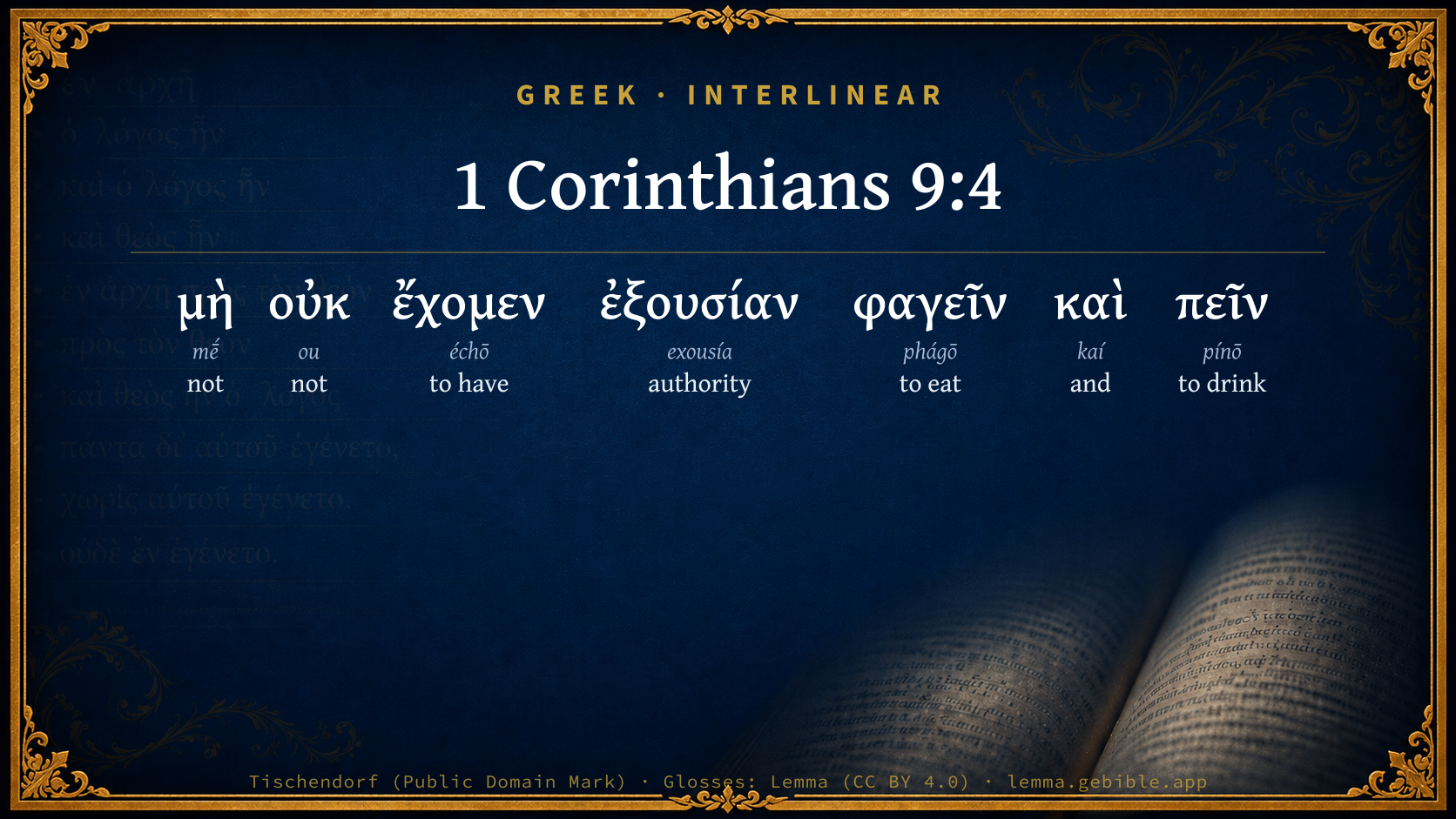
Greek (Tischendorf 8th ed.) 1 Corinthians 9:4 appears in the Greek New Testament. The text above is from the Tischendorf 8th edition. Each word links to its Strong’s number and a concise gloss. Click any word for its full Thayer’s Greek Lexicon entry.
Download image
Cite this verse

1 Corinthians 9:4 (World English Bible). Public Domain. Lemma interlinear Bible study tool, https://lemma.gebible.app/v/1-corinthians/9/4.

Show BibTeX & RIS
BibTeX
RIS
English Translation
Have we no right to eat and to drink?
World English Bible · Public Domain
Download a study sheet

One document with this verse’s original text, its word-by-word gloss line, the meaning frame, cross-references with their text, attributed commentary, and full source and license credits — printable, and it pastes into notes with its structure intact.

This verse Autodidact and up

Study sheet (.html) Plain text (.txt)

A passage Seminary Student

Up to 50 verses in one chapter. A passage sheet keeps up to 6 commentary sources and 12 cross-references per verse, in the order this page ranks them, and says so on the sheet whenever that leaves anything out. Ask for a single verse and you get the Autodidact verse sheet above.

Everything on this page stays free to read, with no account — the sheet is a download of what is already on screen, not access to it.

Want to remove ads? Support Godless Engineer
Compare translations 3

The same verse in 3 English versions, stacked beneath the original-language interlinear above. Click any original word for its lexicon entry.

Each is an independent rendering of the whole verse — the interlinear is not word-aligned to these translations.

Highlighted words mark where these versions differ — a whole-verse word diff, not a word-by-word alignment.

  • World English Bible Public Domain
    Have we no right to eat and to drink?
  • King James Version Public Domain
    Have we not power to eat and to drink?
  • unfoldingWord Literal Text CC BY-SA 4.0
    Do we certainly not have a right to eat and to drink?

unfoldingWord Literal Text — © unfoldingWord, licensed CC BY-SA 4.0. Word-aligned USFM3 via Door43 (git.door43.org/unfoldingWord/en_ult).

Versions to compare (up to 4)

3 of 4 selected

Show all 19 translations

Every available English version of this verse, each an independent rendering of the whole verse.

  • World English Bible Public Domain
    Have we no right to eat and to drink?
  • Berean Standard Bible Public Domain
    Have we no right to food and to drink?
  • Majority Standard Bible Public Domain
    Have we no right to food and to drink?
  • King James Version Public Domain
    Have we not power to eat and to drink?
  • American Standard Version (1901) Public Domain
    Have we no right to eat and to drink?
  • Revised Version (1885) Public Domain
    Have we no right to eat and to drink?
  • Geneva Bible (1599) Public Domain
    Haue we not power to eat and to drinke?
  • Douay-Rheims (1899) Public Domain
    Have not we power to eat and to drink?
  • Young's Literal Translation Public Domain
    have we not authority to eat and to drink?
  • Literal Standard Version CC BY-SA 4.0
    do we not have authority to eat and to drink?
  • Unlocked Literal Bible CC BY-SA 4.0
    Do we not have the right to eat and drink?
  • unfoldingWord Literal Text CC BY-SA 4.0
    Do we certainly not have a right to eat and to drink?
  • Darby Bible Public Domain
    Have we not a right to eat and to drink?
  • World Messianic Bible Public Domain
    Have we no right to eat and to drink?
  • Webster's Bible Public Domain
    Have we not power to eat and to drink?
  • Free Bible Version CC BY-SA 4.0
    Don't we have the right to be provided with food and drink?
  • Bible in Basic English Public Domain
    Have we no right to take food and drink?
  • Text-Critical English NT CC BY 4.0
    Do we not have a right to eat and to drink?
  • Tyndale New Testament (1534) Public Domain
    Have we not power to eate and to drynke?

Literal Standard Version (2020), Covenant Press — licensed CC BY-SA 4.0. Text via the HelloAO Bible API (eBible.org). Unlocked Literal Bible (unfoldingWord) — licensed CC BY-SA 4.0. Text via the HelloAO Bible API (eBible.org). unfoldingWord Literal Text — © unfoldingWord, licensed CC BY-SA 4.0. Word-aligned USFM3 via Door43 (git.door43.org/unfoldingWord/en_ult). Free Bible Version, Dr. Jonathan Gallagher — licensed CC BY-SA 4.0. Text via the HelloAO Bible API (eBible.org).

Word by word

More ways to search: Search by grammar → Find every occurrence → Compare this word →

Practice this passage: Drill this verse → Learn its vocabulary →

About this verse

These counts appear in no published source. They are computed here, from the morphology-tagged text and Lemma’s own curated glosses. What Lemma adds →

7
words
7
distinct lemmas
Pauline Epistles
section

Cross-references

8

Topical passages linked to 1 Corinthians 9:4 in the Treasury of Scripture Knowledge — connected by theme and wording, ordered by reader-vote popularity; previews shown in the World English Bible.

  • 1 Thessalonians 2:6 nor seeking glory from men (neither from you nor from others), when we might have claimed authority as apostles of Christ.
  • 2 Thessalonians 3:8–9 neither did we eat bread from anyone's hand without paying for it, but in labor and travail worked night and day, that we might not burden any of you;
  • Luke 10:7 Remain in that same house, eating and drinking the things they give, for the laborer is worthy of his wages. Don't go from house to house.
  • Matthew 10:10 Take no bag for your journey, neither two coats, nor shoes, nor staff: for the laborer is worthy of his food.
  • 1 Corinthians 9:7–14 What soldier ever serves at his own expense? Who plants a vineyard, and doesn't eat of its fruit? Or who feeds a flock, and doesn't drink from the flock's milk?
  • Galatians 6:6 But let him who is taught in the word share all good things with him who teaches.
  • 1 Thessalonians 2:9 For you remember, brothers, our labor and travail; for working night and day, that we might not burden any of you, we preached to you the Gospel of God.
  • 1 Timothy 5:17–18 Let the elders who rule well be counted worthy of double honor, especially those who labor in the word and in teaching.

Cross-references courtesy of OpenBible.info (CC BY 4.0).

Commentary

Notes on 1 Corinthians 9:4 from classic Christian and Jewish commentators (each source and its license shown beneath its notes). The classic Christian expositions comment on the surrounding passage and are grouped to its opening verse, so a note may address several verses; the Jewish commentaries on the Tanakh (Rashi and others) are per-verse, so they appear only where the commentator wrote on this verse.

Lemma curates 59 commentaries, every one of them public domain or Creative Commons licensed, each selected and text-cleaned for this edition rather than reprinted as found. About our sources →

Tyndale Open Study Notes

Tyndale Open Resources

9:4 As an apostle, Paul had the right to expect food and housing from those to whom he ministered (cp. 9:14; Luke 10:7-8). Nevertheless, to avoid any possible criticism, he did not take advantage of this privilege (see 9:6, 12, 14-15, 18; 2 Cor 11:7-9; 12:13-14).

Tyndale Open Study Notes — © Tyndale Open Resources, licensed CC BY-SA 4.0. Text via the HelloAO Bible API.

Bengel's Gnomon

Johann Albrecht Bengel

1Co 9:4. [72] ΜῊ ΟὐΚ ἜΧΟΜΕΝ; have we not?) He comes from the singular to the plural, including his colleagues [in the apostleship].—φαγεῖν καὶ πιεῖν, to eat and to drink) without labouring with his hands.

[72] Αὕτη ἐστὶ, is this) namely, that you are the seal of my office.—V.g.

Bengel's Gnomon of the New Testament — English translation (T&T Clark, Edinburgh, 1860) — public domain. Text from a community e-Sword module.

Meyer's Critical & Exegetical Commentary

Heinrich August Wilhelm Meyer

1Co_9:4 f. Returning from the digression in 1Co_9:2-3, Paul begins a new series of questions, with the view of now making good the prerogative arising out of his apostleship, which in point of fact he declined to exercise.

μὴ οὐκ ἔχομεν] i.e. we surely are not destitute of the right to lead, etc.? Comp Rom_10:18; 1Co_11:22. The plural cannot be restricted in its reference to Paul alone, seeing that it has just been preceded, and is again followed in 1Co_9:6, by the singular, but must imply that the apostle is thinking both of himself and of whosoever else acts in like manner. More particularly, 1Co_9:6 shows that he has here in his eye, not his companions in labour generally (Hofmann), but Barnabas in particular besides himself (for see the μόνος in 1Co_9:6), and him only. It may be added, that Calovius is right in saying, against the abuse of this passage in the interests of monasticism, that Paul is not speaking here of what semper et ubique vitari oporteat sed de eo tantum quod in casu noxii scandali infirmorum fratrum vitandum est.

φαγεῖν κ. πιεῖν] i.e. at the cost of the churches. To understand it of non-observance of the Jewish laws about food (Hunnius, Heydenreich, Billroth, comp Olshausen), or of sacrificial flesh and wine (Schrader), is contrary to the context. See 1Co_9:6 ff. The right of eating and drinking, in the sense in which the reader would naturally understand it as an apostolic prerogative (Luk_10:7), required nothing to be added to define it. The analogy of Mat_11:19 (Hofmann) has no bearing on the clause before us, the point of view there being that of asceticism.

The infinitives are exegetical, and need no τοῦ (Mat_9:6; Mar_2:10, al[1410]).

ἈΔΕΛΦῊΝ ΓΥΝ. ΠΕΡΙΆΓ.] to lead about (along with me on my official journeys) a sister (a female believer) as a wife. The view taken by several of the Fathers (see Aug. de op. Monach. iv. 5, Jerome, τινές in Theodoret, Theophylact; comp generally, Suicer, Thes. I. p. 810), that a serviens matrona is meant (so also Erasmus, Cornelius a Lapide, and Estius), is against the plain meaning of the words, without shadow of historical support in the life of the apostle, supposes a somewhat unseemly relation, and is contrary to the example of Peter, Mat_8:14.[1412] It has, however, been still defended of late by Roman Catholic writers (Maier) on wholly insufficient grounds. On περιάγειν, comp Xen. Cyr. ii. 2. 28; it occurs oftener in the middle, as Xen. Mem. i. 7. 2; Polyb. xx. 5. 8.

ὡς καὶ οἱ λοιπ. ἀπ.] It does not follow from this that all the other apostles were married, but the majority of them must have been so, otherwise the phrase, which must be meant to hold at least a potiori, would be unsuitable.

καὶ οἱ ἀδελφοὶ τοῦ Κυρίου] Now, the brethren of the Lord are in Act_1:14 expressly distinguished from the Twelve; further, in Gal_1:19, James, the Lords brother, is equally distinguished from those who were apostles in the narrower and original sense (such as Peter); and further still, we have no trace in any of the lists of the apostles (Mat_10:2 f.; Mar_3:16 f.; Luk_6:14 f.) that there were brethren of the Lord among the Twelve,a supposition which would also be decidedly at variance with Joh_7:3; Mar_3:21. The ἈΔΕΛΦΟῚ ΤΟῦ ΚΥΡΊΟΥ, therefore, should not be put on a level with Cephas (Hofmann), and sought within the number of the Twelve, but are the actual brothers of Jesus, not His half-brothers merely (sons of Joseph by a former marriage), but His uterine brothers, later-born sons of Joseph and Mary (Mat_1:25; Luk_2:7; Mat_12:46; Mat_13:55), who had become believers and entered upon apostolic work after the resurrection of Jesus (1Co_15:7; Act_1:14), and among whom James, in particular, as president of the church in Jerusalem (Act_15:13; Act_21:18), had obtained a high apostolic position (Gal_2:9). see on Act_12:17; Gal_1:19. This view (which is held also by de Wette, Billroth, Rückert, Osiander, Neander, and Ewald, among the more recent expositors of the passage before us) runs counter to what was formerly the common view, namely, that of Jerome, which still prevails with Roman Catholics, and is supported by Hengstenberg and others, that the phrase denotes the sons of Christs mothers sister, so that James, the Lords brother, would be identical with the son of Alphaeus (but see on Joh_19:25), and would bear the name of brother of the Lord (אָח in the wider sense) as a title of honour from his near relationship to Jesus. Comp on Mat_12:46. In like manner Lange, in his apost. Zeitalter, p. 189, understands the Alphaeidae to be meant; they were, he holds, the adopted brothers of Jesus, Joseph having adopted as his own the children of Alphaeus, who was his brother, after the latters death. All this is nothing but arbitrary imagination, resting simply upon the false assumption that Mary brought forth Jesus, not as her first-born (Mat_1:25; Luk_2:7), but as her only child. Lange is wrong here in making the καί a proof that the brethren of the Lord were among the Twelve, and are but singled out from their number in this verse for special mention. What Paul says is rather: as also the other apostles and the brethren of the Lord; and then, having set before us this august circle formed by the Twelve and those brethren of the Lord closely associated with them since the resurrection of Jesus (Act_1:14), in which, too, he himself, as an apostle, had an equal place, he singles out in conclusion the most illustrious of them all, one who was looked upon as the head of the whole circle (Gal_1:18), by adding: and, i.e. and, to mention him in particular by name, Cephas; so that it is only the last καί, and not the second as well (as Hofmann, too, maintains), that carries the force of special distinction (Fritzsche, a[1415] Marc. p. 11); comp Mar_16:7.

The design of the whole question, μὴ οὐκ ἔχ. ἐξουσ. ἀδελφ. γ. π., has no bearing upon scruples (of the Christ-party) as to marriage being allowed (Olshausen), but is closely connected with the purport of the first question, as is plain from ΠΕΡΙΆΓΕΙΝ: Am I denied, then, the right to live at the cost of the churches, and to have, like the other apostles, etc., a consort journeying along with me from place to place? in which latter case a similar support from the churches is, from the nature of the circumstances, and from the scope of the context (1Co_9:4; 1Co_9:6), manifestly assumed as a matter of course.

Peters wife is called by tradition sometimes Concordia, sometimes Perpetua. See Grabe, Spicil. Patr. I. p. 330.

[1410] l. and others; and other passages; and other editions.

[1412] Valla perceived rightly fuisse apostolos suas uxores comitatas, but thinks that they were called sisters, quod tanquam non uxores jam erant. An elegans argutia (Calvin)!

[1415] d refers to the note of the commentator or editor named on the particular passage.

Meyer — Critical and Exegetical Commentary on the New Testament — English translation by Peter Christie, edited by Frederick Crombie (T&T Clark, 1880) — public domain. Text from a community e-Sword module.

Expositor's Greek Testament

ed. W. Robertson Nicoll

1Co 9:4-6 . The rights P. vindicates for himself and his fellow-labourers in the Gospel, are ( a ) the right to maintenance; ( b ) to marriage; ( c ) to release from manual labour . ( a ) μὴ οὐκ ἔχομεν ; “Is it that we have not?” ironical question, as in 1Co 11:22 “Of course we have”. P. writes in pl [1282] collegas includens (Bg [1283] ), the ἀποστολὴ suggesting οἱ λοιποὶ mentioned in the next ver. ἐξουσίαν φαγεῖν καὶ πεῖν (later Gr [1284] for πιεῖν ), “right to eat and drink,” sc. as guests of the Church: see Mar 6:10 , Luk 10:7 ; Luk 22:30 . The added καὶ πεῖν , and the illustrations of 1Co 9:7 ; 1Co 9:13 , show that the obj [1285] of the two vbs. is not the idolothyta, but the material provision for Christ’s apostles, supplied by those they serve (1Co 9:11 ); this ἐξουσία is analogous to, not parl [1286] with, that of 1Co 8:9 , belonging not to the ἐλεύθερος as such, but to the ἀπόστολος ; cf. the Didaché , 13, “Every true prophet is worthy of his food”. George Fox characteristically notes the moderation of the demand: “The Ap. said ‘Have I not power to eat and to drink?’ But he did not say, ‘to take tithes, Easter reckonings, Midsummer dues, augmentations, and great sums of money’.” ἐξουσίαν , as a verbal noun, governs the bare inf [1287] , like ἔξεστιν . ( b ) Paul claims, in order to renounce, the ἐξουσίαν ἀδελφὴν γυναῖκα περιάγειν the “right to take about (with us) a sister as wife” i.e. , a Christian wife: brachyology for “to have a Christian sister to wife, and take her about with us”. ἀδελφὴν is obj [1288] , γυναῖκα objective complement to περιάγειν , on which the stress lies; “non ex habendo, sed ex circumducendo sumtus afferebatur ecclesiis” (Bg [1289] ). The Clementine Vg [1290] rendering, mulierem sororem circumducendi (as though from γυν . ἀδελφ .), gives a sense at variance both with grammar and decorum, not to be justified by Luk 8:2 f. This misinterpreted text was used in defence of the scandalous practice of priests and monks keeping as “sisters” γυναῖκες συνεισακτοί , which was condemned by the Nicene Council, and often subsequently; so Jerome (Ep. 23, ad Eustoch. ), “Agapetarum pestis … sine nuptiis aliud nomen uxorum … novum concubinarum genus” (see Suicer’s Thesaurus, s. vv. Ἀγαπητή , Ἀδελφή ). From the ὡς καὶ clause it appears that “the rest of the App.,” generally speaking, were married, and their wives often travelled with them; the “forsaking” of Luk 18:28-30 was not final (in the parl [1291] Mat 19:28 f., Mar 10:28 ff., γυνὴ does not appear); according to tradition, John however was celibate. “The brothers of the Lord” were also orthodox Jews in this respect (on their relationship to Jesus, see Lt [1292] , Essay in Comm [1293] on Galatians); indeed, they came near to founding a kind of Christian dynasty in Jerus. “And Cephas,” separately mentioned as the most eminent instance of the married Christian missionary. The association of the ἀδελφοὶ τ . Κυρ . with the ἀπόστολοι does not prove that they were counted amongst these, or bore this title of office: while distinguished from the latter by their specific name ( cf. Gal 1:19 ), they are linked with them as persons of like eminence; see the position of James in Acts. ( c ) The third ἐξουσία , μὴ ἐργάζεσθαι , Paul and his old comrade Barnabas had laid aside. Barn. had stripped himself of property at Jerus. in the early days (Act 4:36 f.); and he and P. together, in the pioneer mission of Acts 13 f., worked their way as handicraftsmen. Now separated, they both continued this practice, which was exceptional μόνος ἐγὼ κ . Βαρνάβας . The allusion implies wide-spread knowledge of the career of Barn., which ends for us at Act 15:39 . Notwithstanding the παροξυσμὸς in which they parted, the two great missionaries remained in friendly alliance; cf. Paul’s reff. to Mark, Barnabas’ cousin, in Col 4:10 , 2Ti 4:11 . For ἐργάζομαι , as denoting manual labour, see parls.; a cl [1294] usage, like that of Eng. workmen . This third ἐξουσία was the negative side of the first ( cf. 1Th 2:9 , also 2Co 11:9 , and ἀδάπανον θήσω of 18 below). The three rights in fact amount to the one which Paul argues for in the sequel: he might justly have imposed his personal support, and that in the more expensive character of a married man, upon the Christian communities for which he laboured, thus sparing himself the disadvantages and hardships of manual toil.

[1282] plural.

[1283] Bengel’s Gnomon Novi Testamenti.

[1284] Greek, or Grotius’ Annotationes in N.T.

[1285] grammatical object.

[1286] parallel.

[1287] infinitive mood.

[1288] grammatical object.

[1289] Bengel’s Gnomon Novi Testamenti.

[1290] Latin Vulgate Translation.

[1291] parallel.

[1292] J. B. Lightfoot’s (posthumous) Notes on Epp. of St. Paul (1895).

[1293] commentary, commentator.

[1294] classical.

The Expositor's Greek Testament, edited by W. Robertson Nicoll (1897–1910) — public domain. Text from a community e-Sword module.

Hodge's Commentary on Romans, Ephesians & First Corinthians

Charles Hodge

1Co_9:4

Have we not power to eat and drink?

Power here as above, 1Co_8:9, means right. Have we not the right to eat and drink? This, taken by itself, might mean, Have we not the same right that others have as to meats and drinks? All distinctions on this subject are abolished as much for us as for others. Are we not free? The context shows, however, clearly that such is not the apostles meaning. The right in question is that which he goes on to establish. It is the right to abstain from working, and of being supported by the church. Having proved his apostleship, he proves his right to be supported, and then shows that he had not availed himself of that right. He could, therefore, with the greater freedom urge the Corinthians to forego their right to eat of things offered to idols for the sake of their weaker brethren.

Charles Hodge — Commentary on Romans (1835), First Corinthians (1857), and Ephesians (1856) — public domain. Text from a community e-Sword module.

Geneva Bible (1599)

Geneva Bible translators

Upon the expense of the Church?

Now touching the matter itself, he saith, Seeing that I am free, and truly an Apostle, why may not I (I say not, eat of all things offered to idols) but be maintained by my labors, yea and keep my wife also, as the residue of the apostles lawfully do, as by name, John and James, the Lord’s cousins, and Peter himself?

Geneva Bible (1599) marginal notes — public domain. Text via Bolls.life.

Jamieson, Fausset & Brown

Robert Jamieson, A. R. Fausset & David Brown

Have we not power--Greek, "right," or lawful power, equivalent to "liberty" claimed by the Corinthians (Co1 8:9). The "we" includes with himself his colleagues in the apostleship. The Greek interrogative expresses, "You surely won't say (will you?) that we have not the power or right," &c.

eat and drink--without laboring with our hands (Co1 9:11, Co1 9:13-14). Paul's not exercising this right was made a plea by his opponents for insinuating that he was himself conscious he was no true apostle (Co2 12:13-16).

Jamieson, Fausset & Brown — Commentary Critical and Explanatory on the Whole Bible (1871) — public domain (CC PDM 1.0). Text via the HelloAO Bible API.

Adam Clarke's Commentary

Verse 4. Have we not power to eat and to drink?] Have we not authority, or right, εξουσιαν, to expect sustenance, while we are labouring for your salvation? Meat and drink, the necessaries, not the superfluities, of life, were what those primitive messengers of Christ required; it was just that they who laboured in the Gospel should live by the Gospel; they did not wish to make a fortune, or accumulate wealth; a living was all they desired. It was probably in reference to the same moderate and reasonable desire that the provision made for the clergy in this country was called a living; and their work for which they got this living was called the cure of souls. Whether we derive the word cure from cura, care, as signifying that the care of all the souls in a particular parish or place devolves on the minister, who is to instruct them in the things of salvation, and lead them to heaven; or whether we consider the term as implying that the souls in that district are in a state of spiritual disease, and the minister is a spiritual physician, to whom the cure of these souls is intrusted; still we must consider that such a labourer is worthy of his hire; and he that preaches the Gospel should live by the Gospel.

Adam Clarke's Commentary on the Bible (1810–1826) — public domain. Text from a community e-Sword/MySword module.

John Calvin's Commentaries

4. Have we not power? He concludes from what has been already said, that he had a right to receive food and clothing from them, for Paul ate and drank, but not at the expense of the Church. This, then, was one liberty that he dispensed with. The other was, that he had not a wife — to be maintained, also, at the public expense. Eusebius infers from these words that Paul was married, but had left his wife somewhere, that she might not be a burden to the Churches, but there is no foundation for this, for he might bring forward this, even though unmarried. In honoring a Christian wife with the name of sister, he intimates, first of all, by this, how firm and lovely ought to be the connection between a pious pair, being held by a double tie. Farther he hints at the same time what modesty and honorable conduct ought to subsist between them. Hence, too, we may infer, how very far marriage is from being unsuitable to the ministers of the Church. I pass over the fact, that the Apostles made use of it, as to whose example we shall have occasion to speak ere long, but Paul here teaches, in general terms, what is allowable for all.

John Calvin's Commentaries (1540-1563) — public domain. Text from the Calvin Translation Society English edition (1840s-50s) via the Christian Classics Ethereal Library (ccel.org). Calvin's coverage is partial (roughly two-thirds of the Bible); uncommented books and verses are honest gaps, never fabricated. The 19th-century editor's footnotes and remarks are omitted so the notes are faithfully Calvin's own voice.

Ellicott's Commentary for English Readers

(4) Have we not power . . .?—This follows 1 Corinthians 6 after the parenthetical argument contained in 1Co_9:2-3. Having established his right to be called an Apostle by the fact that he had seen the Lord, and had been instrumental in their conversion, he now in the same interrogative style asserts his rights as an Apostle. The use of the plural “we” carries on the thought that he is claiming this right as being one of the Apostles—all of whom have, as Apostles, such a right. The form in which the question is asked implies, Surely we have this right. This verse, taken in connection with 1Co_8:9, where the same word in the Greek, “liberty,” occurs in connection with eating, shows how this line of thought has grown out of the preceding subject. The question there, however, was that of eating meat offered to idols; the question here is the right to eat and drink (i.e., live) at the expense of the Church (Luk_10:7).

A Bible Commentary for English Readers, edited by Charles John Ellicott (1878–1897) — public domain. Text from a community e-Sword module.

The Cambridge Bible for Schools and Colleges

gen. ed. J. J. S. Perowne

4. Have we not power to eat and to drink?] i.e. at the expense of the Church, cf. St Luk_10:7. This privilege, said St Paul’s opponents, was confined to the original twelve Apostles of the Lord.

The Cambridge Bible for Schools and Colleges (gen. ed. J. J. S. Perowne; Cambridge University Press, 1878–1918) — public domain. Text from a community e-Sword module.

John Gill's Exposition

Have we not power to lead about a sister, a wife,.... The phrase "a sister, a wife", is an Hebraism, and answers to "my sister, spouse", Sol 4:9. The Jews called their wives, sisters, not on account of religion, which also is not the meaning here; but because of the common relation that men and women, all mankind, stand in to one another, antecedent to any nearer relation, as that of man and wife. The sense the Papists put on these words, to secure them from being a proof of the lawfulness of the marriage of the ministers of the Gospel, can by no means be the true one; which is, that they are to be understood of a rich woman, or women, the apostles had a power to carry about with them, to minister of their substance to them, and provide for them; for such a sense is directly contrary to the subject and argument the apostle is upon; which is to show the right that he and others had, of casting themselves entirely upon the churches for a maintenance; whereas this is contriving a way for relieving the churches of such a charge; besides, the act of "leading", or carrying "about", is expressive of such a power over them, as cannot be thought to agree with persons of such substance; and whose voluntary act this must be, to go along with them and supply them; add to this, that for the apostles to lead about with them wherever they went women, whether rich or poor, that were not their wives, would be of no good report, and must tend to hurt their character and reputation: moreover, though these words clearly imply the lawfulness of a minister's marriage, and suppose it, yet they do not express the act itself, or the lawfulness of entering into such a state, but rather what follows after it; and the sense is this, that the apostle and others, supposing them to have wives, and it may be added also, and children, they had a right to take these with them wherever they went, and insist upon the maintenance of them, as well as of their own, at the public expense:

as well as other apostles; who it seems did so, that had wives and families, as Philip the Evangelist had four daughters, Act 21:8.

And as the brethren of the Lord: who it seems were married persons, and took such a method; by whom are meant James, Joses, Judas, and Simon; who were the near kinsmen of Christ, it being usual with the Jews to call such brethren:

and Cephas; that is, Peter, who it is certain had a wife; see Mat 8:14 and therefore it is with a very ill grace that the pope, who pretends to be Peter's successor, should forbid the marriage of ecclesiastical persons.

John Gill's Exposition of the Whole Bible (1746–1763) — public domain (CC PDM 1.0). Text via the HelloAO Bible API.

Trapp's Complete Commentary

John Trapp

4 Have we not power to eat and to drink?

Ver. 4. To eat and to drink] At the Church’s charge; so that we do it moderately without excess, as Josiah did, and it went well with him, Jer 22:15.

John Trapp, A Commentary or Exposition upon All the Books of the Old and New Testament (1647–1656) — public domain. Text from a community e-Sword module.

Albert Barnes' Notes on the Bible

Have we not power - (ἐξουσίαν exousian) Have we not the “right.” The word “power” here is evidently used in the sense of “right” (compare Joh 1:12, “margin”); and the apostle means to say that though they had not exercised this “right by demanding” a maintenance, yet it was not because they were conscious that they had no such right, but because they chose to forego it for wise and important purposes.

To eat and to drink - To be maintained at the expense of those among whom we labor. Have we not a right to demand that they shall yield us a proper support? By the interrogative form of the statement, Paul intends more strongly to affirm that they had such a right. The interrogative mode is often adopted to express the strongest affirmation. The objection here urged seems to have been this, “You, Paul and Barnabas, labor with your own hands. Act 18:3. Other religious teachers lay claim to maintenance, and are supported without personal labor. This is the case with pagan and Jewish priests, and with Christian teachers among us. You must be conscious, therefore, that you are not apostles, and that you have no claim or right to support.” To this the answer of Paul is, “We admit that we labor with our own hands. But your inference does not follow. It is not because we have not a right to such support, and it is not because we are conscious that we have no such claim, but it is for a higher purpose. It is because it will do good if we should not urge this right, and enforce this claim.” That they had such a right, Paul proves at length in the subsequent part of the chapter.

Albert Barnes' Notes on the Bible (1834–1885) — public domain. Text from a community e-Sword/MySword module.

Matthew Poole's English Annotations

Could I not eat and drink of such things offered to idols as well as you? Have not I as great a knowledge, and as much liberty? Yet, you see, I forbear. But the generality of interpreters rather incline to interpret it by what followeth: then, though it be here shortly expressed, and more fully opened afterward, yet the sense is: Have not I power to ask a maintenance of you, by which I should be enabled to eat and drink?

Matthew Poole's English Annotations on the Holy Bible (1683–1685) — public domain. Text from a community e-Sword/MySword module.

Whedon's Commentary on the Bible

Daniel D. Whedon

4. Power—Rightful authority. The change from the I of the previous verses to the we of this doubtless anticipates the mention of Barnabas, 1Co_9:6, as included in the question.

Eat… drink—Of the contributions of the Church.

Daniel D. Whedon (gen. ed.), Commentary on the Old and New Testaments (1874–1909) — public domain. Text from a community e-Sword module.

The Pulpit Commentary

To eat and to drink. To be supported by those to whom we preach. (Luk_10:7)

Vers. 4-18.

Ministerial support.

Having vindicated his claim to be reckoned among the apostles of Christ, Paul proceeds to assert his right to a temporal maintenance at the hands of those to whom he ministered. The other apostles received support, not only for themselves, but also for their wives: why should he not make the same claim? Though he was unmarried, and though he had hitherto supported himself by the labour of his own hands, this did not invalidate his right. Consider

I THE RIGHT OF MINISTERS TO A SUITABLE MAINTENANCE. This is upheld by various arguments and analogies, 1. The labourer is worthy of his reward. Three instances are adduced in illustration (ver. 7).

(1) The soldier. The duty of fighting for his country throws the burden of his support upon others. Why should it be otherwise with the Christian soldier? (2Ti_2:4)

(2) The husbandman. His labour is rewarded by the fruit. The minister of the gospel is also a husbandman. (1Co_3:6-9)

(3) The shepherd. Does he not receive the milk of the flock, partly for food and partly for exchange? Why should not the Christian pastor, who tends the flock of Christ, have a similar return? (1Pe_5:2) The principle in these instances is that every occupation in common life yields support to the worker, and that he does not require to go beyond it for daily sustenance. In like manner, the minister of the gospel is entitled to an adequate maintenance without having to resort to secular work to supply his wants.

1. The teaching of the Mosaic Law. "Thou shalt not muzzle the ox, etc. (ver. 9; Deu_25:4; comp. 1Ti_5:18) What was the meaning of this injunction? It shows, indeed, the care of the Lawgiver for the brute creation, but it is only a particular application of a great principle. The Law has regard for oxen, not for their own sake, but for the sake of him to whom they are in subjection. And if even the labouring ox was to be fed, how much more should the plougher and the thresher work in hope of partaking! The Law of Moses thus confirms the teaching of natural analogy, that the labourer is to be maintained by his work.

2. The fairness of the claim. "If we sowed unto you spiritual things," etc. (ver. 11). In every case the sower expects to reap; but there is more than this in the apostle"s argument. The preacher of the gospel sows spiritual things those great truths that minister to the spirit: is it a great matter if he looks for carnal things in return those things that minister only to the flesh? If he is the instrument, in God"s hand, of saving the souls of his hearers, what amount of gold can be an adequate recognition of the service rendered?

3. Analogy of the Jewish priesthood. (Ver. 13.) The rule was that they who served at the altar should receive a portion of the sacrifices and other gifts that were constantly brought to the temple. A sufficient support was thus secured; and the Divine sanction implied in that ancient rule applies equally to the case of the Christian ministry.

4. The express ordinance of the Lord Christ. (Ver. 14.) When he sent forth his apostles to preach, he said, "Get you no gold, nor silver, nor brass in your purses; for the labourer is worthy of his food". (Mat_10:9, Mat_10:10) This was their marching order. They were to depend on the offerings of the people among whom they laboured; and the reference here shows that this was no temporary arrangement, but that it was intended to be the New Testament rule for preachers of the gospel. Instead of having to turn aside to secular pursuits, they are to be free to give themselves wholly to their work. By these various arguments the apostle establishes the right of ministers to claim support at the hands of the Christian people, and the corresponding duty of the people to contribute that support. Both the right and the duty have been but imperfectly recognized by the Church. This will appear if we consider:

(1) The average rate of ministerial support. Compare this with the incomes of men in the other learned professions or in mercantile pursuits.

(2) The manner in which giving to the cause of Christ is frequently regarded. How many either give with a grudge or do not give at all! The evil resulting is twofold spiritual loss to the individual, and a crippling of the Church in her work. Not until all the tithes are brought into the storehouse will the Lord open the windows of heaven and pour out a blessing. (Mal_3:8-10)

II THE RENUNCIATION OF THIS SIGHT. (Vers. 15-18.) Strongly as Paul insists upon his right to temporal maintenance, it is not with a view to urge his claim upon the Corinthians, but to bring into clearer relief his renunciation of it. That he preached the gospel free of charge was to him a matter of boasting which he would rather die than be deprived of. It was no glory to him that he was a preacher; for, as a steward put in trust with the gospel, this was his simple duty. But it was no part of his stewardship to labour without support; and this, accordingly, was a proof of his sincerity in which he was entitled to boast. In this act of self denial he had a reward in making the gospel entirely free, and in securing that on this ground no hindrance should be put in its way (ver. 12). Here some practical considerations emerge.

1. How a minister of the gospel should bear himself towards pecuniary support. There are cases in which he may forego his right, especially where he sees that this renunciation will tend to the advancement of the gospel. Usually, however, it is his duty to accept a stipend at the hands of the Christian people, and that for the reason which led Paul to decline it. To

2. receive a reasonable maintenance is to be in the best position for devoting one"s self entirely to the ministry of the Word. But at all times it should be manifest that the servant of Christ does not act from mercenary motives. The shepherd is not to tend the flock for the sake of the fleece. "Not yours, but you," should be his motto. (2Co_12:14)

3. The obligation to preach the gospel. "Necessity is laid upon me." There is a Divine must in the case of every true preacher, as there was in the case of Jesus. (comp. Mar_8:31; Luk_4:43 Luk_19:5; Joh_3:14) The love of Christ, not less than the command of Christ, constrains him. It is with him as with the prophet: "Then I said, I will not make mention of him, nor speak any more in his Name. But his word was in mine heart as a burning fire shut up in my bones, and I was weary with forbearing, and I could not stay". (Jer_20:9)

4. The doctrine of reward. The apostle"s statement regarding the reward he expected for his optional renunciation of support has been adduced by popish divines in support of their doctrine of supererogation; but it will not bear such an application. The distinction he makes is between what was plainly a part of his bounden duty as a steward, and what seemed best for the furtherance of the gospel in his peculiar circumstances. In one sense it was a matter for his own choice whether he should accept a temporal maintenance, but this is not the sense required by the Romish argument. Whatever promises to conduce to the furtherance of Christ"s kingdom, becomes thereby a duty to the apostle; for "to him that knoweth to do good, and doeth it not, to him it is sin". (Jam_4:17) There is no actwhich is not included under love to God and love to man. There is no self denial to which the love of Christ should not prompt us. The gospel doctrine of reward does not rest on any theory of supererogation, but rather on the principle that God is pleased to recognize the fidelity of his servants. B.

The Pulpit Commentary (1880–1919), ed. H.D.M. Spence-Jones & Joseph S. Exell — public domain. Text from a community e-Sword module.

John Wesley's Explanatory Notes

Have we not power - I and my fellowlabourers. To eat and to drink - At the expense of those among whom we labour.

John Wesley, Explanatory Notes Upon the Whole Bible (1754–1765) — public domain. Text via the GEBible commentary corpus.

McGarvey & Pendleton's Commentaries

J. W. McGarvey

Have we no right to eat and to drink? [are we not entitled to be fed by the church?]

J. W. McGarvey (with Philip Y. Pendleton), Commentaries on the New Testament (The Fourfold Gospel, 1914; Acts; and the epistles) — public domain. Text from a community e-Sword/MySword module.

Cambridge Greek Testament for Schools and Colleges

4. μὴ οὐκ. ‘Is it really true that we have not’? μή containing the question, οὐκ the denial of the right.

ἐξουσίαν φαγεῖν καὶ πιεῖν. The right to eat and to drink, i. e. at the expense of the Church, cf. Luk 10:7. This privilege, said St Paul’s opponents, was confined to the original twelve Apostles of the Lord.

Cambridge Greek Testament for Schools and Colleges (Cambridge University Press, 1896; 21 vols, various authors incl. Carr, Maclear, Plummer, Farrar, Lumby, Moule, M. R. James, Simcox) — public domain. Text from a community e-Sword module.

Alford’s Greek Testament

Henry Alford

4.] He resumes the questions which had been interrupted by giving the proof of his Apostleship.

μὴ οὐκ ἔχ.] μή asks the question: οὐκ ἔχομεν is the thing in question: Is it so, that we have not power.…? The plur. seems to apply to Paul alone: for though Barnabas is introduced momentarily in ver. 6, there can be no reference to him in ver. 11. It may perhaps be used as pointing out a matter of right, which any would have had on the same conditions (see ver. 11), and as thus not belonging personally to Paul, as do the things predicated in vv. 1, 2, 15. This however will not apply to ver. 12, where the emphatic ἡμεῖς is personal.

φαγεῖν κ. πεῖν] To eat and to drink, sc. at the cost of the churches: not with any reference to the eating of things offered to idols (as Schrader, iv. 132), nor to Jewish distinctions of clean and unclean (as Billroth and Olshausen);—see below, vv. 6, 7.

Henry Alford, The Greek Testament (1849–1861) — public domain. Text from a community e-Sword module.

International Critical Commentary

4. Μὴ οὐκ ἔχομεν ἐξουσιαν; The μή is the interrogative num; the οὐκ belongs to the verb. ‘Do you mean to say that we have no right?’ Numquid non habemus potestatem (Vulg.): cf. 11:22; Rom 10:19. Here, as often in the Pauline Epistles, we are in doubt whether the plur. includes others with the Apostle: he may mean himself and Barnabas. Where he means himself exclusively he commonly uses the singular: but it is more certain that the singular is always personal than that the plural commonly includes some one else. See Lightfoot on 1Th 2:4.

φαγεῖν καὶ πεῖν. ‘To eat and drink what those to whom we preach provide for us.’ He is not now thinking of eating idol-meats: that subject is for the moment quite in abeyance. Still less is he contending that preachers are not bound to be ascetics. He says that although he personally refuses entertainment at the cost of those to whom he ministers, yet he has a right to it. He can do as he likes (ἔξεστί μοι) about it; he has the privilege of being maintained. See Clem. Hom. iii. 71; Luk 10:7.

πεῖν (or πῖν) as 2nd aor. inf. of πίνω is well supported here and 10:7 (א B* D* F G) against πιεῖν (A B3 D3 E K L P), and appears everywhere as a variant, except Mat 20:22. It is frequent in MSS. of LXX. See WH. 11. Notes, p. 170.

International Critical Commentary — older volumes (1896–1929), various authors — public domain. Text from a community e-Sword module.

Vincent's Word Studies in the New Testament

Marvin R. Vincent

Eat - drink. At the expense of the churches. Compare Luk 10:7.

Marvin R. Vincent, Word Studies in the New Testament (1887–1900) — public domain. Text from a community e-Sword/MySword module.

Godet's Commentaries

Frédéric Louis Godet

Vv. 4-6. “Have we not right to eat and to drink? 5. Have we not right to lead about a sister as wife, as well as the other apostles and the brethren of the Lord and Cephas? 6. Or I only and Barnabas, have not we power to forbear working?”

Paul uses the plural (we have), because he is thinking also of Barnabas, who acted in this respect in the same way as himself (1Co 9:6); perhaps he means also to include Silas and Timothy, who had laboured with him in founding the Church of Corinth, joining him in his mode of living; comp. 1Co 9:11 : “If we have sown among you spiritual things....” The terms eat and drink receive from the context this special meaning: to eat and drink at the Church’s expense. The eating of sacrificed meats is no longer in question. The interrogative μή assumes the negative answer: “It is not however (μή) possible that we have not (οὐκ) the right....?”

Frédéric Louis Godet — Commentaries on Luke, John, Romans, and 1 Corinthians — English translation (T&T Clark, Edinburgh, 1870s–1890s) — public domain. Text from a community e-Sword module.

Lesson kit

Teaching starters — assembled from the data on this page, not authored interpretation. Every prompt links to the verse data it draws on. Edit before teaching.

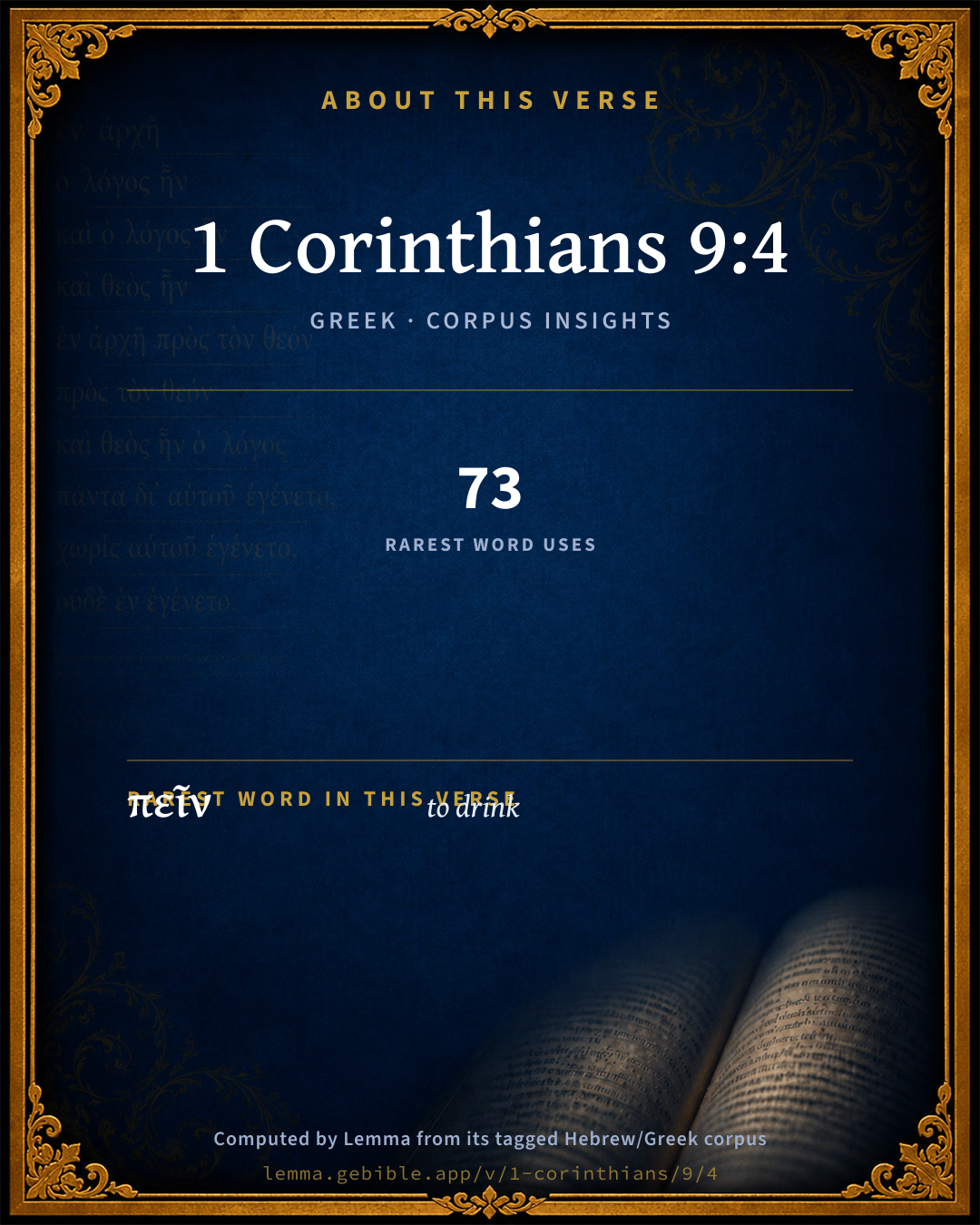
1 Corinthians, in the Pauline Epistles, opens this verse with 7 words (7 distinct Greek lemmas). Its most distinctive word is pínō (“to drink”). A historical commentator’s framing appears above. Read the whole chapter for the surrounding context.

Discussion questions

  1. The word pínō carries the sense “to drink.” How does it shape the verse?
  2. 1 Thessalonians 2:6 shares this passage’s theme. How do the two illuminate each other?
  3. The translations on this page render this verse differently — a whole-verse word diff, not a word-by-word alignment. What might account for the different wordings?
  4. Reading how Tyndale Open Study Notes and Bengel's Gnomon read this verse, where do the two commentators agree and where do they part?

Things to notice

Reading settings

Reading text

Shown beneath each verse's original-language words.

Old Testament
Old Testament edition

Read the OT as the Masoretic Hebrew (MT) or the Greek Septuagint (LXX).

English shown for the Greek Septuagint (in the Hebrew ↔ Greek comparison).

Comparing translations? Open the Compare panel on any verse page to stack up to four side by side.