1 Corinthians 4:11

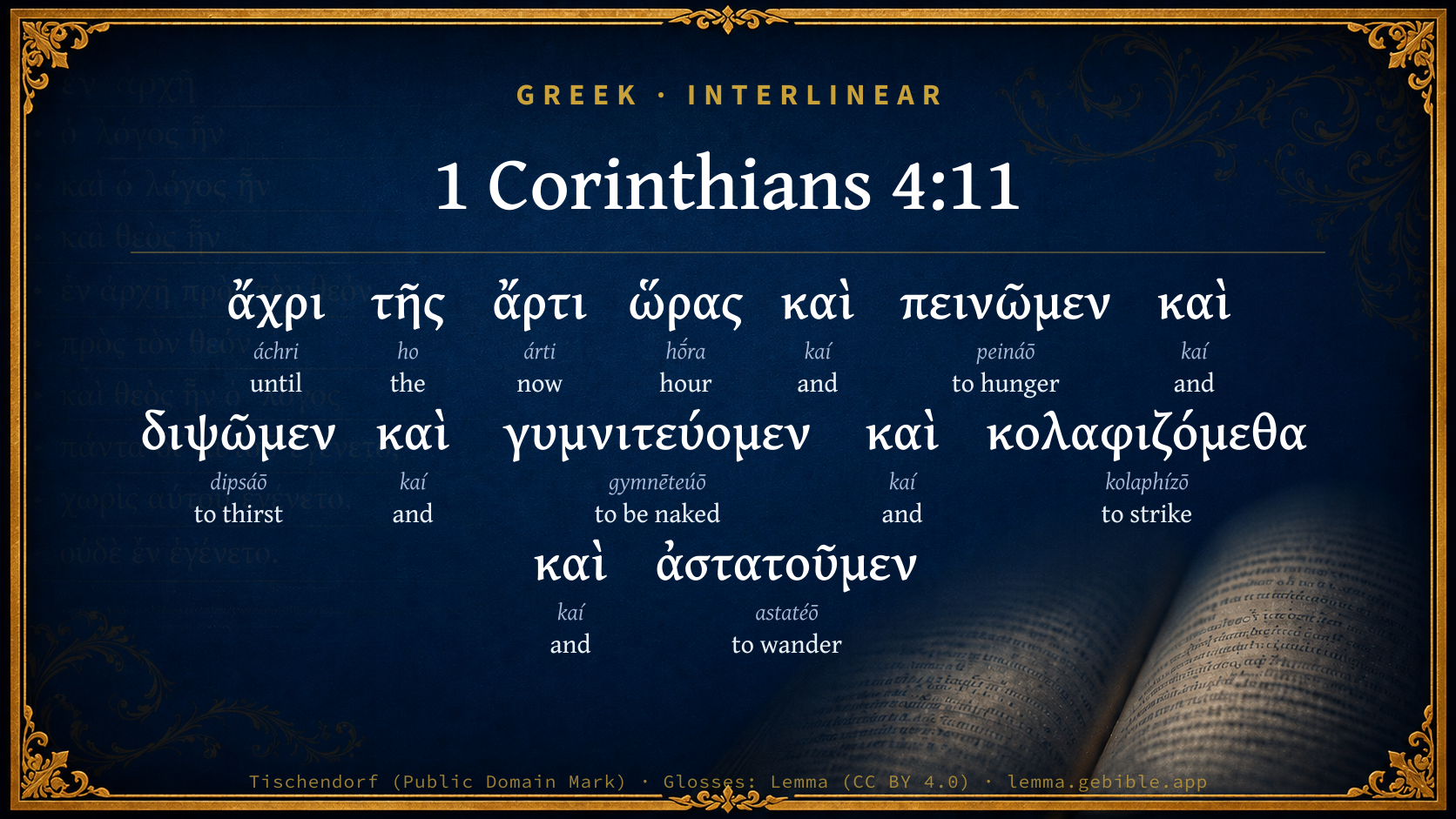
Greek (Tischendorf 8th ed.) 1 Corinthians 4:11 appears in the Greek New Testament. The text above is from the Tischendorf 8th edition. Each word links to its Strong’s number and a concise gloss. Click any word for its full Thayer’s Greek Lexicon entry.
Download image
Cite this verse

1 Corinthians 4:11 (World English Bible). Public Domain. Lemma interlinear Bible study tool, https://lemma.gebible.app/v/1-corinthians/4/11.

Show BibTeX & RIS
BibTeX
RIS
English Translation
Even to this present hour we hunger, thirst, are naked, are beaten, and have no certain dwelling place.
World English Bible · Public Domain
Highlights
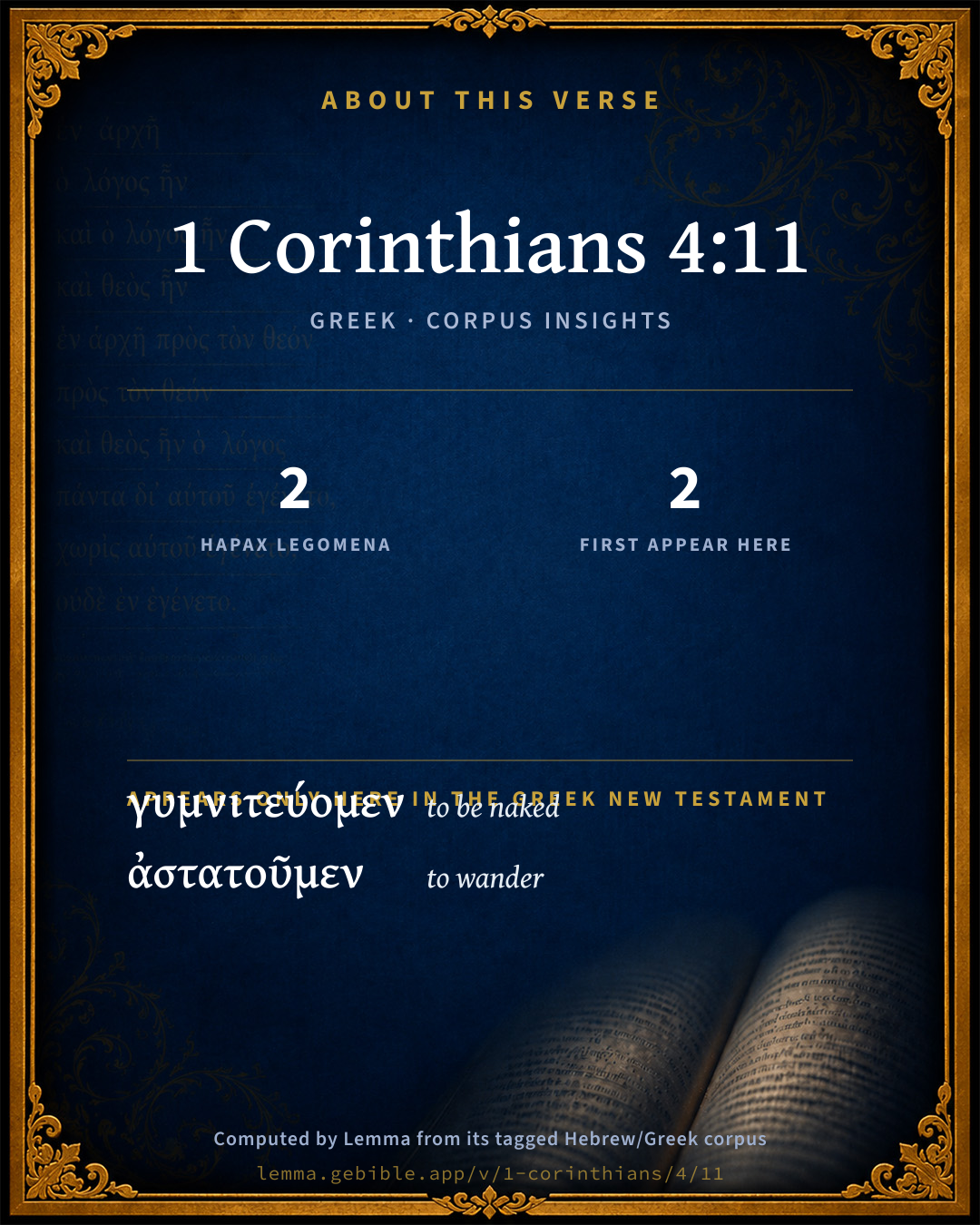
  • 2 hapax legomena — only here in the Greek New Testament
  • 2 first appearances in the Greek New Testament
Full analysis ↓
Download a study sheet

One document with this verse’s original text, its word-by-word gloss line, the meaning frame, cross-references with their text, attributed commentary, and full source and license credits — printable, and it pastes into notes with its structure intact.

This verse Autodidact and up

Study sheet (.html) Plain text (.txt)

A passage Seminary Student

Up to 50 verses in one chapter. A passage sheet keeps up to 6 commentary sources and 12 cross-references per verse, in the order this page ranks them, and says so on the sheet whenever that leaves anything out. Ask for a single verse and you get the Autodidact verse sheet above.

Everything on this page stays free to read, with no account — the sheet is a download of what is already on screen, not access to it.

Want to remove ads? Support Godless Engineer
Compare translations 3

The same verse in 3 English versions, stacked beneath the original-language interlinear above. Click any original word for its lexicon entry.

Each is an independent rendering of the whole verse — the interlinear is not word-aligned to these translations.

Highlighted words mark where these versions differ — a whole-verse word diff, not a word-by-word alignment.

  • World English Bible Public Domain
    Even to this present hour we hunger, thirst, are naked, are beaten, and have no certain dwelling place.
  • King James Version Public Domain
    Even unto this present hour we both hunger, and thirst, and are naked, and are buffeted, and have no certain dwellingplace;
  • unfoldingWord Literal Text CC BY-SA 4.0
    Up to the present hour we are both hungry and thirsty and are poorly clothed and are brutally beaten and are homeless

unfoldingWord Literal Text — © unfoldingWord, licensed CC BY-SA 4.0. Word-aligned USFM3 via Door43 (git.door43.org/unfoldingWord/en_ult).

Versions to compare (up to 4)

3 of 4 selected

Show all 19 translations

Every available English version of this verse, each an independent rendering of the whole verse.

  • World English Bible Public Domain
    Even to this present hour we hunger, thirst, are naked, are beaten, and have no certain dwelling place.
  • Berean Standard Bible Public Domain
    To this very hour we are hungry and thirsty, we are poorly clothed, we are brutally treated, we are homeless.
  • Majority Standard Bible Public Domain
    To this very hour we are hungry and thirsty, we are poorly clothed, we are brutally treated, we are homeless.
  • King James Version Public Domain
    Even unto this present hour we both hunger, and thirst, and are naked, and are buffeted, and have no certain dwellingplace;
  • American Standard Version (1901) Public Domain
    Even unto this present hour we both hunger, and thirst, and are naked, and are buffeted, and have no certain dwelling-place;
  • Revised Version (1885) Public Domain
    Even unto this present hour we both hunger, and thirst, and are naked, and are buffeted, and have no certain dwelling place;
  • Geneva Bible (1599) Public Domain
    Vnto this houre we both hunger, and thirst, and are naked, and are buffeted, and haue no certaine dwelling place,
  • Douay-Rheims (1899) Public Domain
    Even unto this hour we both hunger and thirst, and are naked, and are buffeted, and have no fixed abode;
  • Young's Literal Translation Public Domain
    unto the present hour we both hunger, and thirst, and are naked, and are buffeted, and wander about,
  • Literal Standard Version CC BY-SA 4.0
    to the present hour we both hunger, and thirst, and are naked, and are battered, and wander,
  • Unlocked Literal Bible CC BY-SA 4.0
    Up to this present hour we are hungry and thirsty, we are poorly clothed, we are brutally beaten, and we are homeless.
  • unfoldingWord Literal Text CC BY-SA 4.0
    Up to the present hour we are both hungry and thirsty and are poorly clothed and are brutally beaten and are homeless
  • Darby Bible Public Domain
    To the present hour we both hunger and thirst, and are in nakedness, and buffeted, and wander without a home,
  • World Messianic Bible Public Domain
    Even to this present hour we hunger, thirst, are naked, are beaten, and have no certain dwelling place.
  • Webster's Bible Public Domain
    Even to this present hour we both hunger, and thirst, and are naked, and are buffeted, and have no certain dwelling-place;
  • Free Bible Version CC BY-SA 4.0
    Right up till now we're hungry and thirsty. We have no clothes. We're badly beaten up, and we have no place to call home.
  • Bible in Basic English Public Domain
    Even to this hour we are without food, drink, and clothing, we are given blows and have no certain resting-place;
  • Text-Critical English NT CC BY 4.0
    To the present hour we hunger and thirst; we are poorly clothed and beaten down, with no home of our own.
  • Tyndale New Testament (1534) Public Domain
    Even vnto this daye we honger and thyrst and are naked and are boffetted with fistes and have no certayne dwellinge place

Literal Standard Version (2020), Covenant Press — licensed CC BY-SA 4.0. Text via the HelloAO Bible API (eBible.org). Unlocked Literal Bible (unfoldingWord) — licensed CC BY-SA 4.0. Text via the HelloAO Bible API (eBible.org). unfoldingWord Literal Text — © unfoldingWord, licensed CC BY-SA 4.0. Word-aligned USFM3 via Door43 (git.door43.org/unfoldingWord/en_ult). Free Bible Version, Dr. Jonathan Gallagher — licensed CC BY-SA 4.0. Text via the HelloAO Bible API (eBible.org).

Word by word

More ways to search: Search by grammar → Find every occurrence → Compare this word →

Practice this passage: Drill this verse → Learn its vocabulary →

γυμνιτεύομεν
gymnēteúō
G1130
“to be naked”
Verb, Present, Active, Indicative, 1st person, Plural
Part of Speech
Verb
Tense
Present
Voice
Active
Mood
Indicative
Person
1st person
Number
Plural
Full Thayer's Definition

Origin: from a derivative of G1131

TDNT: None

1. to be lightly or poorly clad 2. to be a light armed soldier
  1. ἄχρι áchri G891 “until” Adverb
  2. τῆς ho G3588 “the” Article, Genitive, Singular, Feminine
  3. ἄρτι árti G737 “now” Adverb
  4. ὥρας hṓra G5610 “hour” Noun, Genitive, Singular, Feminine
  5. καὶ kaí G2532 “and” Conjunction
  6. πεινῶμεν peináō G3983 “to hunger” Verb, Present, Active, Indicative, 1st person, Plural
  7. καὶ kaí G2532 “and” Conjunction
  8. διψῶμεν dipsáō G1372 “to thirst” Verb, Present, Active, Indicative, 1st person, Plural
  9. καὶ kaí G2532 “and” Conjunction
  10. καὶ kaí G2532 “and” Conjunction
  11. κολαφιζόμεθα kolaphízō G2852 “to strike” Verb, Present, Passive, Indicative, 1st person, Plural
  12. καὶ kaí G2532 “and” Conjunction
  13. ἀστατοῦμεν astatéō G790 “to wander” Verb, Present, Active, Indicative, 1st person, Plural

About this verse

These counts appear in no published source. They are computed here, from the morphology-tagged text and Lemma’s own curated glosses. What Lemma adds →

14
words
10
distinct lemmas
Pauline Epistles
section

Notable vocabulary

2 hapax legomena — words that appear only here in the entire Greek New Testament:

  • γυμνιτεύομεν to be naked G1130
  • ἀστατοῦμεν to wander G790

First appearance in Scripture

These words make their first canonical appearance in the Greek New Testament here:

  • γυμνιτεύομεν to be naked G1130
  • ἀστατοῦμεν to wander G790

Shared distinctive vocabulary

κολαφιζόμεθα to strike G2852 occurs in 5 verses of the Greek New Testament. Also found in:

Repetition

A word recurs within this verse:

Cross-references

12

Topical passages linked to 1 Corinthians 4:11 in the Treasury of Scripture Knowledge — connected by theme and wording, ordered by reader-vote popularity; previews shown in the World English Bible.

  • Romans 8:35 Who shall separate us from the love of Christ? Could oppression, or anguish, or persecution, or famine, or nakedness, or peril, or sword?
  • 2 Corinthians 11:23–27 Are they servants of Christ? (I speak as one beside himself) I am more so; in labors more abundantly, in prisons more abundantly, in stripes above measure, in deaths often.
  • Philippians 4:12 I know how to be humbled, and I know also how to abound. In everything and in all things I have learned the secret both to be filled and to be hungry, both to abound and to be in need.
  • Matthew 8:20 Jesus said to him, "The foxes have holes, and the birds of the sky have nests, but the Son of Man has nowhere to lay his head."
  • 2 Timothy 3:11 persecutions, and sufferings: those things that happened to me at Antioch, Iconium, and Lystra. I endured those persecutions. Out of them all the Lord delivered me.
  • Job 22:6 For you have taken pledges from your brother for nothing, And stripped the naked of their clothing.
  • 2 Corinthians 6:4–5 but in everything commending ourselves, as servants of God, in great endurance, in afflictions, in hardships, in distresses,
  • Acts 14:19 But some Jews from Antioch and Iconium came there, and having persuaded the multitudes, they stoned Paul, and dragged him out of the city, supposing that he was dead.
  • Acts 16:23 When they had laid many stripes on them, they threw them into prison, charging the jailer to keep them safely,
  • Acts 23:2 The high priest, Ananias, commanded those who stood by him to strike him on the mouth.
  • 1 Corinthians 9:4 Have we no right to eat and to drink?
  • 2 Corinthians 4:8 We are pressed on every side, yet not crushed; perplexed, yet not to despair;

Cross-references courtesy of OpenBible.info (CC BY 4.0).

Commentary

Notes on 1 Corinthians 4:11 from classic Christian and Jewish commentators (each source and its license shown beneath its notes). The classic Christian expositions comment on the surrounding passage and are grouped to its opening verse, so a note may address several verses; the Jewish commentaries on the Tanakh (Rashi and others) are per-verse, so they appear only where the commentator wrote on this verse.

Lemma curates 59 commentaries, every one of them public domain or Creative Commons licensed, each selected and text-cleaned for this edition rather than reprinted as found. About our sources →

Ellicott's Commentary for English Readers

(11) We both hunger.—From the strong irony of the last verse, the Apostle here passes, in the pathethic and sad description which occupies 1Co_4:11-13, to show how intensely true that last word “despised” was, as expressing his own position, not only in time past, but at the very hour of his writing. Here still there is an implied contrast between their condition (“full,” “rich,” “kings,” of 1Co_4:8) and that of St. Paul himself.

Are naked.—The better reading is, we are in need of sufficient clothing (as 2Co_11:27).

Are buffeted—i.e., are treated like slaves, and not like “kings,” as you are.

Have no certain dwellingplace.—To be without a fixed home was a peculiar sign of want and degradation. (See Mat_8:20; Mat_10:23.)

A Bible Commentary for English Readers, edited by Charles John Ellicott (1878–1897) — public domain. Text from a community e-Sword module.

Tyndale Open Study Notes

Tyndale Open Resources

4:11-13 Paul reminds the Corinthians how much he had endured for Christ’s sake (cp. 2 Cor 6:4-5; 11:23-28).

Tyndale Open Study Notes — © Tyndale Open Resources, licensed CC BY-SA 4.0. Text via the HelloAO Bible API.

Bengel's Gnomon

Johann Albrecht Bengel

1Co 4:11. Γυμνητεύομεν, we are naked) The highest degree of poverty, 2Co 11:27. [So far were the heralds of the kingdom of Christ from being adorned with any splendour. We imagine ourselves to be quite the reverse of all this.—V. g.]—κολαφιζόμεθα, we are buffeted) as slaves, therefore we are not kings.

Bengel's Gnomon of the New Testament — English translation (T&T Clark, Edinburgh, 1860) — public domain. Text from a community e-Sword module.

Meyer's Critical & Exegetical Commentary

Heinrich August Wilhelm Meyer

1Co_4:11-13. Down to the present hour this despised condition of ours continues uninterruptedly, manifesting itself also (καί) in all manner of privations, sufferings, and humiliations.

The assumption that we are not to understand this ἄχρι τῆς ἄρτι ὥρας, as also ἕως ἄρτι in 1Co_4:13,[680] in a strictly literal sense, is rash, seeing that, even apart from the fact that we have no other means of knowing the precise position of Paul at that time (comp 2Co_11:27), he is speaking here not of himself alone, but of the position of the apostles in general.

γυμνητεύομεν] i.e. we lack necessary raiment. Comp on γυμνός in Mat_25:36; Jam_2:15; and Theile in loc[683] The verb, as used both in this sense and of being lightly armed, belongs to the later Greek. The form γυμνιτεύομεν (Lachmann and Tischendorf), although vouched for by a majority of the codd[684], is nothing but an ancient clerical error; see Fritzsche, de conform. Lachm. p. 21.

ΚΟΛΑΦΙΖ.] quite literally: we are beaten with fists. Comp Mat_26:67; 1Pe_2:20; 2Co_12:7. A concrete representation of rude maltreatment in general.

ἀστατοῦμεν] we are unsettled, have no abiding dwelling-place, Rufinus, Ep. 20. Theophylact: ἐλαυνόμεθα, φεύγομεν.

κοπιῶμεν κ.τ.λ[686]] we toil hard, working with our own hands. Comp as regards Paul, 1Co_9:6 ff.; 2Co_11:7 ff.; 1Th_2:9 ff.; 2Th_3:8; Act_20:34; and who is in a position to deny that others of the apostles too acted in the same way? Paul includes this among the elements of their despised condition, which he adduces; and he had a right to do so, for it was such in the eyes of the world, which could not and would not recognise and honour so noble a self-denial.

λοιδορ. εὐλογ. Κ.Τ.Λ[688]] The picture of the ignominious condition of the apostles is continued, and its effect heightened by the contrast of their demeanour. We are so utterly empty and void of all honour with others, that as respects those who revile (insult, see Dissen, a[689] Dem. de Cor. p. 294), persecute, and slander us (δυσφημ., see the critical remarks, and comp 1Ma_7:41; Aesch. Ag. 1078; Soph. El. 1182; Eur. Heracl. 600), we do not in any wise defend ourselves or seek vengeance against them (as men do who have honour to vindicate and maintain); but, on the contrary, wish good to our revilers, remain quiet and patient towards our persecutors, and give beseeching words to our slanderers.[691] Whether Paul says this in remembrance of the words of Jesus in Mat_5:44, Luk_6:27 f., which became known to him by tradition (Rückert and others), is very dubious, considering the difference of expression; but the disposition required by Jesus lived in him.

ὡς περικαθάρματα κ.τ.λ[692]] Delineation, as a whole, of the condition hithertofrom 1Co_4:11 onwardssketched in single traits: We have become as out-sweepings of the world, i.e. our experience has become such, as though we were the most utterly worthless of existing things, like dirt which men have swept off from the face of the world. The κόσμος is the world of men (Rom_3:6; Rom_5:12), corresponding to the πάντων which follows. ΠΕΡΙΚΆΘΑΡΜΑ (from ΠΕΡΙΚΑΘΑΊΡΩ, to cleanse round about, on every side) means quisquiliae, what one removes by cleansing, both in a literal sense and figuratively, like our offscourings, scum (Arrian. Diss. Epict. iii. 22. 78). The simple κάθαρμα is more common; and it especially is often found in this figurative sense in Demosthenes and later writers (see Wetstein, Loesner, Obss. p. 276 f.; comp also Kühner, II. p. 26). With this rendering Erasmus, H. Stephanus, Beza, Estius, and others, including Rückert, de Wette, Ewald, Maier, Neander, Hofmann, are content, following Theodoret, Theophylact, and Oecumenius. ΚΑΘΆΡΜΑΤΑ, however, is likewise used to denote those who, in times of plague and other public calamities, were offered up to expiate the wrath of the gods (see Schol. a[694] Arist. Plut. 454; Bos, Exercitatt. p. 125 ff.; Munth. Obss. e Diod. p. 321 f.), and in Pro_21:18, περικάθαρμα corresponds to the Hebrew כֹּפֶר, while ΠΕΡΙΚΑΘΑΡΜΌς, too, in Plato, Legg. vii. p. 815 C, means lustratio, and ΠΕΡΙΚΑΘΑΡΤΉΡΙΟΝ in Hesychius (sub voce θεώματα), a sacrifice for purification; and, on these grounds, Luther and many others (among them Pott, Olshausen, Osiander) assume that Paul refers here to that Greek sacrificial custom (see especially Photius, Quaest. Amphil. 155), and means by περικάθ. expiatory sacrifices,the idea of reprobate, utterly worthless men being at the same time essentially involved, inasmuch as such men were taken for sacrifices of that nature (see Bos and Grotius). According to this view, the sense would be: contemnimur ut homines, qui ad iram Deorum ab omnibus hominibus avertendam sacrificio offeruntur, Pott; and Olshausen asserts, in spite of the ὡς, that Paul ascribes a certain power even to his sufferings. Now the current and constant word for the expiatory offering is ΚΆΘΑΡΜΑ (not ΠΕΡΙΚΆΘΑΡΜΑ);[695] but, even supposing that Paul had conceived περικαθάρματα as piacula, he would in that case have again used the Plural περιψήματα in the next clause, for περίψημα is synonymous with περικάθαρμα, and each individual would be a piaculum. If, on the other hand, he conceived περικαθάρματα as offscourings, castings away, he could very suitably interchange this phrase afterwards with the collective singular (rubbish).

πάντων-g0- περίψ-g0-.] The refuse of all. The emphasis lies on πάντων, and ὡς is to be supplied again before it. Περίψημα (what is removed by wiping) being substantially the same in meaning with περικάθαρμα (see Photius, s.v., Tob_5:18, and Fritzsche in loc[696]), has been as variously interpreted by the commentators.

ἕως ἄρτι] belongs to ἐγενήθ., and repeats with emphatic force at the close of the description the selfsame thought with which it had began in 1Co_4:11.

The torrent is at an end; now again we have the gentle stream of fatherly kindness, which, however, in 1Co_4:18 once more swells into sternness and threatening. Observe how Paul at this point abandons the comprehensive plural form (ἡμεῖς), in order now at the close of the section to make his readers feel again, in the most impressive way, that personal relation of his to them, which he, as being the founder of the church, was entitled in truth to urge on their attention, despite of all the party-strife which had crept in.

[680] The two expressions are synonymous; hence, too, this passage is a proof that the distinction between ἄχρι and μέχρι, maintained by Tittmann, Synon. p. 33 ff., is erroneous. See Fritzsche, ad Rom. I. p. 308 ff.

[683] n loc. refers to the note of the commentator or editor named on the particular passage.

[684] odd. codices or manuscripts. The uncial manuscripts are denoted by the usual letters, the Sinaitic by א.

[686] .τ.λ. καὶ τὰ λοιπά.

[688] .τ.λ. καὶ τὰ λοιπά.

[689] d refers to the note of the commentator or editor named on the particular passage.

[691] Παρακαλοῦμεν: being slandered, we entreat. See regarding παρακαλ., to entreat, Bleek on Heb. II. 1, p. 454 ff. Theophylact puts it happily: πρᾳοτέροις λόγοις καὶ μαλακτικοῖς ἀμειβόμεθα. Comp. Act_16:39. Grotius explains it: Deum pro ipsis precamur. But Deum and pro ipsis are unwarrantably inserted on the ground of Mat_5:10; Mat_5:44. Compare rather 2Ma_13:23 : τοὺς Ἰουδαίους παρεκάλεσεν, he gave good words to the Jews.

[692] .τ.λ. καὶ τὰ λοιπά.

[694] d refers to the note of the commentator or editor named on the particular passage.

[695] Hence Valckenaer holds the reading of G, min., ὡσπερεὶ καλάρματα, to be the true be, because Paul ritus Graecos noverat et linguam.

[696] n loc. refers to the note of the commentator or editor named on the particular passage.

Meyer — Critical and Exegetical Commentary on the New Testament — English translation by Peter Christie, edited by Frederick Crombie (T&T Clark, 1880) — public domain. Text from a community e-Sword module.

Expositor's Greek Testament

ed. W. Robertson Nicoll

1Co 4:11-12 a . ἄχρι τῆς ἄρτι ὥρας … ταῖς ἰδίαις χερσὶν describes the ἄτιμοι , reduced to this position by the world’s contempt and with no means of winning its respect a life at the farthest remove from that of the Gr [734] gentleman. The despicableness of his condition touches the Ap. New features are added to this picture in 2Co 11:23-33 . On ἄρτι , see note to ἤδη , 1Co 4:8 ; cf. 1Co 4:13 . Hunger, thirst, ill-clothing the common accompaniments of poverty; blows, homelessness, manual toil specific hardships of Paul’s mission. The sentences are pl [735] : all Christian missionaries (1Co 4:9 ) shared in these sufferings, P. beyond others (1Co 15:10 ). γυμνιτεύω (later Gr [736] ) denotes light clothing or armour; cf. γυμνός , Mat 25:36 , Jas 2:15 ( ill-clad ). κολαφίζω (see parls.), to fisticuff , extended to physical violence generally sometimes lit [737] true in Paul’s case. ἀστατέω , to be unsettled, with no fixed home to Paul’s affectionate nature the greatest of privations, and always suspicious in public repute to be a vagrant. On ἐργαζ . τ . ἰδ . χερσίν at Eph. now (Act 20:34 ), at Cor [738] formerly (Act 18:3 ) see note, 1Co 9:6 ; manual labour was particularly despised amongst the ancients: “Non modo labore meo victum meum comparo, sed manuario labore et sordido” (Cv [739] ).

[734] Greek, or Grotius’ Annotationes in N.T.

[735] plural.

[736] Greek, or Grotius’ Annotationes in N.T.

[737] literal, literally.

[738] Corinth, Corinthian or Corinthians.

[739] Calvin’s In Nov. Testamentum Commentarii .

1Co 4:12 b , 1Co 4:13 . Beside their abject condition (1Co 4:11-12 a ), the world saw in the meekness of the App. the marks of an abject spirit , shown in the three particulars of λοιδορούμενοι … παρακαλοῦμεν : “id mundus spretum putat” (Bg [740] ). λοιδορ . ( reviled to our faces ) implies insulting abuse, δυσφημούμενοι ( defamed ) injurious abuse: for the former, cf. 1Pe 2:23 . διωκόμενοι ἀνεχόμεθα , “persecuted, we bear with (lit [741] put-up with) it” implying patience , while ὑμομένω (1Co 13:7 , etc.) implies courage in the sufferer. The series of ptps. is pr [742] , denoting habitual treatment not “when” but “while we are reviled,” etc. εὐλογοῦμεν … παρακαλοῦμεν : to revilings they retort with blessings , to calumnies with benevolent exhortation; “they beg men not to be wicked, to return to a better mind, to be converted to Christ” (Gd [743] ); cf. the instructions of Luk 6:27 ff. “It is on this its positive side that” Christian meekness “surpasses the abstention from retaliation urged by Plato” ( Crit. , p. 49: Ed [744] ). ὡς περικαθάρματα τοῦ κόσμου … πάντων περίψημα (from περι - καθαίρω , - ψάω respectively, to cleanse, wipe all round , with - μα of result): the ne plus ultra of degradation; they became “as rinsings of the world, a scraping of all things” ( purgamenta et ramentum , Bz [745] ), the filth that one gets rid of through the sink and the gutter.

[740] Bengel’s Gnomon Novi Testamenti.

[741] literal, literally.

[742] present tense.

[743] F. Godet’s Commentaire sur la prem. Ép. aux Corinthiens (Eng. Trans.).

[744] T. C. Edwards’ Commentary on the First Ep. to the Corinthians . 2

[745] Beza’s Nov. Testamentum: Interpretatio et Annotationes (Cantab., 1642).

The above terms may have a further significance: “the Ap. is carrying on the metaphor of ἐπιθανατίους above. Both περικαθ . and περίψ . were used esp. of those condemned criminals of the lowest class who were sacrificed as expiatory offerings, as scapegoats in effect, because of their degraded life. It was the custom at Athens to reserve certain worthless persons who in case of plague, famine, or other visitations from heaven, might be thrown into the sea, in the belief that they would ‘cleanse away,’ or ‘wipe off,’ the guilt of the nation” (Lt [746] ). περικάθαρμα (for the earlier κάθαρμα ) occurs in this sense in Arr.-Epict., III., xxii., 78; also in Pro 21:11 (LXX). This view is supported by Hesychius, Luther, Bg [747] , Hn [748] , Ed [749] ; rejected, as inappropriate, by Er [750] , Est., Cv [751] , Bz [752] , Mr [753] , Gd [754] , El [755] Certainly P. does not look on his sufferings as a piaculum; but he is expressing the estimate of “the world,” which deemed its vilest fittest to devote to the anger of the Gods. Possibly some cry of this sort, anticipating the “Christiani ad leones” of the martyrdoms, had been raised against P. by the Ephesian populace ( cf. 1Co 15:32 ; also Act 22:22 ). ἕως ἄρτι , repeated with emphasis from 1Co 4:11 , shows P. to be writing under the smart of recent outrage. With his temper, Paul keenly felt personal indignities.

[746] J. B. Lightfoot’s (posthumous) Notes on Epp. of St. Paul (1895).

[747] Bengel’s Gnomon Novi Testamenti.

[748] C. F. G. Heinrici’s Erklärung der Korintherbriefe (1880), or 1 Korinther in Meyer’s krit.-exegetisches Kommentar (1896).

[749] T. C. Edwards’ Commentary on the First Ep. to the Corinthians .

[750] Erasmus’ In N.T. Annotationes .

[751] Calvin’s In Nov. Testamentum Commentarii .

[752] Beza’s Nov. Testamentum: Interpretatio et Annotationes (Cantab., 1642).

[753] Meyer’s Critical and Exegetical Commentary (Eng. Trans.).

[754] F. Godet’s Commentaire sur la prem. Ép. aux Corinthiens (Eng. Trans.).

[755] C. J. Ellicott’s St. Paul’s First Epistle to the Corinthians .

The Expositor's Greek Testament, edited by W. Robertson Nicoll (1897–1910) — public domain. Text from a community e-Sword module.

Godet's Commentaries

Frédéric Louis Godet

Vv. 11-13. “Even unto this present hour we both hunger and thirst, are naked, buffeted, without certain dwelling - place; 12. labour, working with our own hands. Being reviled, we bless; being persecuted, we suffer it; 13. being defamed, we intreat; we are made as the filth of the world, the offscouring of all, even until now.”

The first words, even to this present hour, reproduce the thought of the whole passage: “As for us, up to this hour, we are little aware that the dispensation of triumph has already begun.” The following enumeration bears, in the first place, on the privations and sufferings of all kinds endured by the apostles (1Co 4:11-12 a). To the want of suitable food and clothing there is sometimes added bad treatment; the word κολαφίζεσθαι may denote either blows with the fist or with the palm of the hand. Besides, as the rule, want of a fixed dwelling-place, of a home. Finally (1Co 4:12 a), the manual labour imposed on Paul, especially the voluntary obligation to gain his livelihood by his own work (1Co 9:6).

The enumeration goes on by indicating the humble and patient conduct of the apostles in the midst of these sufferings (1Co 4:12-13). Three particulars form a double gradation: insults with sneering (λοιδορεῖσθαι), persecutions in a judicial form (διώκεσθαι), calumnies which assail honour (δυσφημεῖσθαι). The T. R. reads βλασφημούμενοι; but as the verb δυσφημεῖσθαι is much more rarely used in the New Testament, and as it is found in almost all the Mjj., it deserves the preference.

To sneering the apostles reply with blessing. The word εὐλογεῖν in the New Testament signifies to wish well, and that in the form which alone can render the wish efficacious, that of prayer.

To ill-treatment they reply by suffering (ἀνέχεσθαι, to exercise self-control); they do not even complain. Finally, they oppose to calumnies kindly intreating; they beseech men not to be so wicked, to return to better feelings, to be converted to Christ.

But with this way of acting what do they get from the world? They become the object of its more complete disdain. This is what is expressed by 1Co 4:13 b. The term περικάθαρμα, filth, denotes literally what is collected by sweeping all round the chamber (περί); and περίψημα the dirt which is detached from an object by sweeping or scraping it all round. These two figures therefore represent what is most abject. It has been sought to give to these two terms a tragical meaning, that of an expiatory victim, a sense in which they were sometimes taken among the Greeks. At times of public calamity, a criminal was chosen who was devoted to the angry gods to appease their wrath. This man, who was, as it were, the defilement of the people incarnate, bore the curse of all and perished for all. He was designated by the terms κάθαρμα or περίψημα. The formula with which the priest hurled him into the sea was this (according to Suidas): περίψημα ἡμῶν γενοῦ, ἤτοι σωτηρία καὶ ἀπολύτρωσις (“be our expiatory victim, and so our salvation and deliverance”). Did Paul mean to allude to the religious sense of the two terms which he uses? I do not think so; the saying thus understood would take an emphasis which hardly suits the sorrowful humility of the whole passage.

The plural of the first substantive relates to the different apostles, while the second substantive in the singular makes them one mass, an object of contempt, which is still more forcible. The adjuncts of the world and of all both indicate the totality to which the apostles naturally belong, but from which they are distinguished as being the most contemptible it contains. To the plural, sweepings (filth), there corresponds the singular, of the world; and to the singular, the offscouring, the plural, of all: They are what Paul says: each for all, and all for each.

The last words, even until now, betray yet once more before closing the feeling of sorrowful irony which inspired the whole passage. They are the counterpart of the ἤδη, now, with which he had begun, and they sum it up likewise as a whole. Rückert cannot approve of the sarcastic tone of this passage. He says, frankly (pp. 124, 125): “This passage of Paul’s has always produced on me a repulsive impression....There are found in it undeniable traces of wounded personal feeling, of irritation caused him by the loss of the consideration which he enjoyed at Corinth...everywhere there reigns concern about his own personality. I am pained to have to pass such a judgment on this great man; but he too was human...” This eminent commentator has not considered,—1. that as against proud infatuation, the weapon of ridicule is often the only efficacious one; 2. that the indignation which inspired this passage bore on a state of things which was not only an attack on the apostle’s person, but a mortal danger to the spiritual life and the whole future of the Church; 3. that the following words, expressive of incomparable fatherly tenderness and solicitude, do not well agree with those wholly personal feelings, which he ascribes so daringly to the apostle.

Frédéric Louis Godet — Commentaries on Luke, John, Romans, and 1 Corinthians — English translation (T&T Clark, Edinburgh, 1870s–1890s) — public domain. Text from a community e-Sword module.

Hodge's Commentary on Romans, Ephesians & First Corinthians

Charles Hodge

1Co_4:11

Even unto this present hour we both hunger, and thirst, and are naked, and are buffeted, and have no certain dwelling-place;

That a man should freely subject himself to hunger, thirst, and nakedness, and submit to be buffeted, and homeless, for no selfish purpose, but simply to preach Christ, was indeed, in the eyes of the world, foolishness. The fact that Paul gladly submitted to all these afflictions, presented his case in glaring contrast with that of his opposers in Corinth, who exposed themselves to no such sufferings out of zeal for Christ.

Charles Hodge — Commentary on Romans (1835), First Corinthians (1857), and Ephesians (1856) — public domain. Text from a community e-Sword module.

Jamieson, Fausset & Brown

Robert Jamieson, A. R. Fausset & David Brown

(Co2 11:23-27).

naked--that is, insufficiently clad (Rom 8:35).

buffeted--as a slave (Pe1 2:20), the reverse of the state of the Corinthians, "reigning as kings" (Act 23:2). So Paul's master before him was "buffeted" as a slave, when about to die a slave's death (Mat 26:67).

Jamieson, Fausset & Brown — Commentary Critical and Explanatory on the Whole Bible (1871) — public domain (CC PDM 1.0). Text via the HelloAO Bible API.

Adam Clarke's Commentary

Verse 11. We both hunger and thirst, &c.] Who would then have been an apostle of Christ, even with all its spiritual honours and glories, who had not a soul filled with love both to God and man, and the fullest conviction of the reality of the doctrine he preached, and of that spiritual world in which alone he could expect rest? See the Introduction, sect. vi.

Have no certain dwelling place] We are mere itinerant preachers, and when we set out in the morning know not where, or whether we shall or not, get a night's lodging.

Adam Clarke's Commentary on the Bible (1810–1826) — public domain. Text from a community e-Sword/MySword module.

John Calvin's Commentaries

11. For to this hour. The Apostle here describes his condition, as if in a picture, that the Corinthians may learn, from his example, to lay aside that loftiness of spirit, and embrace, as he did, the cross of Christ with meekness of spirit. He discovers the utmost dexterity in this respect, that in making mention of those things which had rendered him contemptible, he affords clear proof of his singular fidelity and indefatigable zeal for the advancement of the gospel; and, on the other hand, he tacitly reproves his rivals, who, while they had furnished no such proof, were desirous, nevertheless, to be held in the highest esteem. In the words themselves there is no obscurity, except that we must take notice of the distinction between those two participles — λοιδορουμενοι και βλασφημουμενοι (reviled and defamed.) As λοιδορια means — that harsher sort of raillery, which does not merely give a person a slight touch, but a sharp bite, and blackens his character by open contumely, there can be no doubt that λοιδορειν means — wounding a person with reproach as with a sting. I have accordingly rendered it — harassed with revilings Βλασφημια signifies a more open reproach, when any one is severely and atrociously slandered.

John Calvin's Commentaries (1540-1563) — public domain. Text from the Calvin Translation Society English edition (1840s-50s) via the Christian Classics Ethereal Library (ccel.org). Calvin's coverage is partial (roughly two-thirds of the Bible); uncommented books and verses are honest gaps, never fabricated. The 19th-century editor's footnotes and remarks are omitted so the notes are faithfully Calvin's own voice.

The Cambridge Bible for Schools and Colleges

gen. ed. J. J. S. Perowne

11. Even unto this present hour we both hunger, and thirst] The Apostle would point out to his converts the true glory of the Christian minister. Labour and suffering for Christ’s sake are the marks of the servants of God, not self-conceit and self-praise.

The Cambridge Bible for Schools and Colleges (gen. ed. J. J. S. Perowne; Cambridge University Press, 1878–1918) — public domain. Text from a community e-Sword module.

John Gill's Exposition

Even unto this present hour,.... What is about to be related was not what befell the apostles now and then, and a great while ago; but what for a considerable time, and unto the present time, was more or less the common constant series and course of life they were inured to:

we both hunger, and thirst, and are naked; wanted the common necessaries of life, food to eat, and raiment to put on, and gold and silver to purchase any with; which might be, when, as it was sometimes their case, they were in desert places, or on the seas; or when they fell among thieves; or had given all away, as they sometimes did, for the relief of others; or when they were not, as sometimes, taken notice of, and provided for, where they ministered, as they ought to have been.

And are buffeted; not only by Satan, as the apostle was, but by men; scourged, whipped, and beaten by them; scourged in the synagogues by the Jews with forty stripes save one; and beaten with rods by the Romans, and other Gentiles.

And have no certain dwelling place; were in an unsettled state, always moving from one place to another, and had no place they could call their own; like their Lord and master, who had not where to lay his head; and like some of the Old Testament saints, who wandered about in sheep skins and goat skins, in deserts, and in mountains, in dens and caves of the earth.

John Gill's Exposition of the Whole Bible (1746–1763) — public domain (CC PDM 1.0). Text via the HelloAO Bible API.

Trapp's Complete Commentary

John Trapp

11 Even unto this present hour we both hunger, and thirst, and are naked, and are buffeted, and have no certain dwellingplace;

Ver. 11. Even to this present] Thus he complaineth, not out of impatience (for he was active in his sufferings), but to stain their pride, that permitted it so to be, when it was in their power to have relieved him.

John Trapp, A Commentary or Exposition upon All the Books of the Old and New Testament (1647–1656) — public domain. Text from a community e-Sword module.

Albert Barnes' Notes on the Bible

Even unto this present hour - Paul here drops the irony, and begins a serious recapitulation of his actual sufferings and trials. The phrase used here “unto this present hour” denotes that these things had been incessant through all their ministry. They were not merely at the commencement of their work, but they had continued and attended them everywhere. And even then they were experiencing the same thing. These privations and trials were still continued, and were to be regarded as a part of the apostolic condition.

We both hunger and thirst - The apostles, like their master, were poor, and in traveling about from place to place, it often happened that they scarcely found entertainment of the plainest kind, or had money to purchase it. It is no dishonor to be poor, and especially if that poverty is produced by doing good to others. Paul might have been rich, but he chose to be poor for the sake of the gospel. To enjoy the luxury of doing good to others, we ought to be willing to be hungry and thirsty, and to be deprived of our ordinary enjoyments.

And are naked - In traveling; our clothes become old and worn out, and we have no friends to replace them, and no money to purchase new. It is no discredit to be clad in mean raiment, if that is produced by self-denying toils in behalf of others. There is no, honor in gorgeous apparel; but there is real honor in voluntary poverty and want, when produced in the cause of benevolence. Paul was not ashamed to travel, to preach, and to appear before princes and kings, in a soiled and worn-out garment, for it was worn out in the service of his Master, and Divine Providence had arranged the circumstances of his life. But how many a minister now would he ashamed to appear in such clothing! How many professed Christians are ashamed to go to the house of God because they cannot dress well, or be in the fashion, or outshine their neighbors! If an apostle was willing to be meanly clad in delivering the message of God, then assuredly we should be willing to preach, or to worship him in such clothing as he provides. We may add here, what a sublime spectacle was here; and what a glorious triumph of the truth. Here was Paul with an impediment in his speech; with a personage small and mean rather than graceful; and in a mean and tattered dress; and often in chains, yet delivering truth before which kings trembled, and which produced everywhere a deep impression on the human mind. Such was the power of the gospel then! And such triumph did the truth then have over men. See Doddridge.

And are buffeted - Struck with the hand; see the note at Mat 26:67. Probably it is used here to denote harsh and injurious treatment in general; compare 2Co 12:7.

And have no certain dwelling-place - No fixed or permanent home. They wandered to distant lands; threw themselves on the hospitality of strangers, and even of the enemies of the gospel; when driven from one place they went to another; and thus they led a wandering, uncertain life, amidst strangers and foes. They who know what are the comforts of home; who are surrounded by beloved families; who have a peaceful and happy fireside; and who enjoy the blessings of domestic tranquility, may be able to appreciate the trials to which the apostles were subjected. All this was for the sake of the gospel; all to purchase the blessings which we so richly enjoy.

Albert Barnes' Notes on the Bible (1834–1885) — public domain. Text from a community e-Sword/MySword module.

Matthew Poole's English Annotations

Our state in the world is low and mean; though you be full, we are hungry and thirsty; though you be richly clothed, yet we

are next to naked, clothed with rags; though you be hugged and embraced by the men of the world, yet we

are buffeted; though you have rich and famous houses, yet we

have no certain dwelling-place. Thus it hath been with us from the beginning of our profession of Christ, and thus it is with us at this day, saith the apostle: from whence he gives these Corinthians and their false teachers a just reason to suspect themselves, whether they were true and sincere professors, yea or no, and to consider how it came to pass, that their lot in the world was so different from the lot of those whom the Lord had dignified with the title and office of his apostles. The condition of the most faithful and able ministers and the most sincere Christians that have been in the world, hath always been a mean and afflicted state and condition.

Matthew Poole's English Annotations on the Holy Bible (1683–1685) — public domain. Text from a community e-Sword/MySword module.

Whedon's Commentary on the Bible

Daniel D. Whedon

11. Even unto this present hour—While I write to you from Ephesus I am the subject of such a life.

Buffeted—Struck with the clenched fist.

No certain dwellingplace—Without position, or fixed residence.

Daniel D. Whedon (gen. ed.), Commentary on the Old and New Testaments (1874–1909) — public domain. Text from a community e-Sword module.

The Pulpit Commentary

Unto this present hour. In these three verses he draws a picture of the condition of the apostles, especially of the trials to which he was himself subjected, on which the best comment is in 2Co_11:23-27. This letter was written from Ephesus, where he had so much to do and to endure. (Act_20:31) Hunger and thirst. "In hunger and thirst, in fastings often". (2Co_11:27) Are naked (Mat_25:36; Jam_2:15; and comp. 2Co_11:27) And are buffeted. The verb means literally, are slapped in the face. (2Co_12:7) Such insults, together with scourgings, fell to the lot of St. Paul (Act_23:2, etc.) and the other apostles, (Acts 1Pe_2:20) as well as to that of their Lord. (Mat_26:57, etc.) It showed the utter contempt with which they were treated; for though St. Paul ought to have been exempt from such violence, both as a freeman and a Roman citizen, he was treated as vilely as if he had been a mere foreign slave. Have no certain dwelling place. This homelessness was among the severest of all trials. (Mat_8:20 Mat_10:23)

Vers. 11-13.

The best and most useful often the most afflicted.

I HISTORY AND PERSONAL OBSERVATION TEACH US THIS. Heb_11:35-38. Paul"s case is a striking illustration. Note the

(1) variety,

(2) painfulness,

(3) strangeness, of the apostolic afflictions.

See also another list. (2Co_11:23-27)

II LET US LEARN THAT:

1. Affliction is not always significant of Divine displeasure. Often we have chastisement because of our sins, but sometimes sorrow comes to us when

2. most firmly we tread the path of duty. Under such circumstances it should not dismay or depress us.

3. Suffering even severe suffering is not always a valid reason for relinquishing active service. Some people are too anxious to "retire." Work done under suffering is sometimes marvellously effective, Our woes fit us to deal with the woe begone. When under great stress we feel that we can do nothing, we sometimes become Samsons; when we feel that we can do everything, we are generally mere Philistines.

1. Much affliction need not necessarily be even a hindrance to us in our work. Paul"s sufferings did not make him less active in the cause of Christ. He abounded in toil whilst he abounded in sorrow.

2. Affliction comes to us in the path of duty, it should not drive us from that path. Most of Paul"s sorrows were caused by his zeal and faithfulness. He would preach Christ. To choose an easier path would not have been wise for him is not wise for us.

3. Affliction is sanctified to God"s faithful servants. Beyond all doubt Paul was greatly the better for his many sorrows. Humanly speaking, he could never have been Paul without them. That which seems likely to hinder may help. Men who have to do much have generally to suffer much. Biography furnishes multitudinous illustrations of this.

4. Extraordinary sufferings sometimes bear with them the promise of unusual usefulness. Idlers have thus been made remarkably diligent, sleepers have been awakened, the worldly have become consecrated. The first true and inspiring view of Christian service has been obtained from the flame of the furnace. The apprenticeship of some "of whom the world was not worthy" has been served in the fires. Some great lives have begun with martyrdom.

5. Affliction should be received in a spirit of meekness, even when it comes directly from men who have no reason to use us ill. Paul, when reviled, blessed; when persecuted, calmly endured it, without after retaliation; when defamed, he entreated (perhaps God to pardon his enemies). Herein Paul was like Christ. He employed conquering kindness. To imitate him will require much grace. It is often much easier to take affliction from the hands of God than from the hands of men. H.

The Pulpit Commentary (1880–1919), ed. H.D.M. Spence-Jones & Joseph S. Exell — public domain. Text from a community e-Sword module.

John Wesley's Explanatory Notes

And are naked - Who can imagine a more glorious triumph of the truth, than that which is gained in these circumstances when St. Paul, with an impediment in his speech, and a person rather contemptible than graceful, appeared in a mean, perhaps tattered, dress before persons of the highest distinction, and yet commanded such attention. and made such deep impressions upon them!

John Wesley, Explanatory Notes Upon the Whole Bible (1754–1765) — public domain. Text via the GEBible commentary corpus.

Burkitt's Expository Notes on the New Testament

William Burkitt

Observe here, 1. The several kinds of sufferings which the holy apostles were exposed to, and exercised with; namely, hunger, and want, poverty, and reproach, persecution, and death. They suffered in their bodies by hunger, and nakedness, and stripes; in their names, by scandals and reproaches, being accounted the filth of the world, and the off-scouring of all things.

The word, say some, signifies that dirt and filth which scavengers do rake together in the streets, and carry to the dung-hill. Others think it an allusion to the sacrifices which the heathens used for the lustration of a city, who when their city was under any great calamity, chose out some very base, vile, and nasty person, and burnt him in a ditch, and cast his ashes into the sea, as a sacrifice unto Neptune, saying, Be thou a purgation for us. Such a base and vile esteem had the world of the holy apostles and messengers of Christ.

Lord! to see such a man as St. Paul going up and down the world with a naked back and empty belly, without a house of settled abode to hide his head in; one that did more service for God in his day, than perhaps we have done him all our days: can we, the ministers of Christ, complain of hard usage form the world, when we consider that this great apostle suffered in the world?

Observe, 2. The duration and continuance of the apostles’ sufferings, Even unto this day, and unto this present hour. It was not only at their first entrance upon the apostolical office, when all the world was set against Christianity, that they met with this usage, but all along, from the first hour they began to preach the gospel, even unto this hour, did they meet with opposition and persecution.

As long as there is a devil in hell, and wicked men upon earth, all that will live godly in Christ Jesus shall suffer persecution: but surely the dregs in this cup have in all ages been reserved for the ministers of Christ Jesus; as if to preach were nothing else but to stir up the rage, and be blotted with the obloquies of men.

Observe, 3. The holy and humble behaviour, the meek and patient carriage and demeanour, of the apostles, under all this load and burden of reproach and scorn, disgrace and shame, persecution and ill usage: being reviled, we bless. When we meet with opprobrious words, we are so far from rendering evil for evil, or railing for railing, that we speak well of, and wish well to, the persons that are thus injurious to us: Being persecuted by them, we suffer it patiently from them; being defamed by any of them, we entreat God for them, to pity and pardon them; and we entreat them to pity themselves.

To publish invectives against those, though the worst of men, who reproach and persecute us, is a modern piece of zeal, which the blessed apostles and holy sufferers in the primitive times were not only little acquainted with, but perfect strangers to.

William Burkitt's Expository Notes on the New Testament (1700–1703) — public domain. Text from a community e-Sword module.

Godbey's Commentary on the New Testament

William B. Godbey

11. “Unto this hour we hunger and thirst.” When they had nothing to eat, they rejoiced in a fast and profited by it spiritually. If I ate like other people, I could not do the work God has given me. I am editor in the morning, teacher in the afternoon, and preacher at night. Hence one meal and a lunch are all I can manage. “We are naked.” This is literal. Of course, it is to be understood in a modified sense. The Orientals do not clothe the entire body like the Occidentals. At that time there were no factories, therefore clothing was scarce and costly. We can not evade the conclusion that the apostles suffered much from insufficient clothing. Their overland traveling was all on foot, which was decidedly in their favor. They were great walkers. “We are buffeted;” i. e., they were often cruelly flogged (2Co 11:25). “We tramp.” When you turn with disgust from tramps, remember the apostles were tramps. If Jesus were now on earth, He would everywhere be so considered. If Christ and His apostles were now on earth, walking from place to place — their clothing meager, cheap, poor and insufficient, peculiar to the poorest people, soiled and untidy, preaching on the streets and in the hovels of the peasantry, denouncing sin in the clergy as well as the laity — they would be shunned by the influential, shut out of the churches, ostracized from society, and very probably arrested, punished and imprisoned, as when they were on the earth; going into a popular church and speaking, as was their custom, the officers would lead them out, and the service go right on as if nothing had happened.

William B. Godbey, Commentary on the New Testament (1896–1900) — public domain. Text from a community e-Sword module.

McGarvey & Pendleton's Commentaries

J. W. McGarvey

Even unto this present hour we both hunger, and thirst, and are naked, and are buffeted [smitten with the clenched fist], and have no certain dwelling-place [ Mat_8:20 ; Mat_10:23 ];

J. W. McGarvey (with Philip Y. Pendleton), Commentaries on the New Testament (The Fourfold Gospel, 1914; Acts; and the epistles) — public domain. Text from a community e-Sword/MySword module.

The People's New Testament

B. W. Johnson

11. Unto this present hour, etc. All through our ministry we suffer want for the needs of life, are often in want of food and drink and clothing, are beaten (buffeted), and, like the Master, have no certain home.

B. W. Johnson's The People's New Testament with Notes (1889–1891) — public domain. Electronic text from the Christian Classics Ethereal Library (CCEL) ThML edition.

Cambridge Greek Testament for Schools and Colleges

11. γυμνιτεύομεν אBCDEFG. But as in the Fathers the rec. γυμνητεύομεν is found, Meyer rejects the reading in the text as ‘an ancient clerical error.’ A omits the word altogether.

11. ἄχρι τῆς ἄρτι ὥρας. The Apostle would point out to his converts the true glory of the Christian minister. Labour and suffering for Christ’s sake are the marks of the servants of God, not self-conceit and self-praise.

γυμνιτεύομεν. See Critical Note.

ἀστατοῦμεν. Later Greek word. It is used by Appian of the waves of the sea.

Cambridge Greek Testament for Schools and Colleges (Cambridge University Press, 1896; 21 vols, various authors incl. Carr, Maclear, Plummer, Farrar, Lumby, Moule, M. R. James, Simcox) — public domain. Text from a community e-Sword module.

Alford’s Greek Testament

Henry Alford

11-13.] He enters into the particulars of this state of affliction, which was not a thing past, but enduring to the present moment.

11.] ἄχρι τ. ἄρτι ὥρας is evidently not to be taken strictly as indicative of the situation of Paul at the time of writing the Epistle, but as generally describing the kind of life to which, then and always, he and the other Apostles were exposed: οὐ παλαιὰ διηγοῦμαι πράγματα, ἀλλʼ ἅπερ καὶ ὁ παρών μοι καιρὸς μαρτυρεῖ. Chrys See, on the subject-matter, 2Co 11:23-27.

γυμνιτ.] are in want of sufficient clothing: cf. ἐν ψύχει κ. γυμνότητι, 2Co 11:27. Meyer (after Fritzsche) believes γυμνιτεύομεν to be a mistake in writing the word, of very ancient date: but surely we are not justified, in such a conventional matter as the form of writing a word, to desert the unanimous testimony of the oldest mss. And we have the forms γυμνίτης, and γυμνῖτις: why not then γυμνιτεύω?

κολαφ.] are buffeted—see reff., there is no need to press the strict meaning.

ἀστατ.] τουτέστιν, ἐλαυνόμεθα, φεύγομεν. Theophyl.

Henry Alford, The Greek Testament (1849–1861) — public domain. Text from a community e-Sword module.

International Critical Commentary

11. ἄχρι τῆς ἄρτι ὥρας. Their ἀτιμία is without respite, and is unbroken, up to the moment of writing. This is emphatically restated at the end of v. 13: privation, humiliation, and utter contempt is their continual lot.

γυμνιτεύομεν. ‘We are scantily clothed’; ἑν ψύχει καὶ γυμνότητι (2Co 11:27). The word generally means ‘to go light-armed’ (Plut., Dio. Cass.); it occurs nowhere else in N.T. or LXX, Cf. Jas 2:15, where γυμνός means ‘scantily clad.’

κολαφιζόμεθα. ‘We are buffeted,’ ‘are struck with the fist.’ The verb is late, and probably colloquial (1Pe 2:20; Mar 14:65; Mat 26:67). The substantive κόλαφος is said to be Doric = Attic κόνδυλος. The verb is possibly chosen rather than δέρειν (9:26; 2Co 11:20), or τύπτειν (Act 23:2), or ὑπωπιάζειν (9:26, 27), or κονδυλιζειν (Amo 2:7; Mal 3:5), to mark the treatment of a slave: velut servi; adeo non regnamus (Beng.). Seneca, in the last section of the Apocolocyntosis, says that Caesar successfully claimed a man as his slave after producing witnesses who had seen the man beaten by Caesar flagris, ferulis, colaphis. In 2Co 12:7 the verb is used of the ἄγγελος Σατανᾶ, ‘buffeting’ the Apostle.

ἀστατοῦμεν, ‘Are homeless,’ ‘have not where to lay our head’ (Mat 8:20; Luk 9:58). The verb occurs nowhere else in N.T. or LXX, but is used by Aquila for ἄστεγος in Isa 58:7. It certainly does not mean instabiles sumus (Vulg.), but nusquam habemus sedem (Primasius). The Apostles fiegabantur ab infidelibus de loco in locum (Atto); ἐλαυνόμεθα γάρ (Chrys.). Their life had no repose; they were vagrants, and were stigmatized as such.

γυμνιτεύομεν is accepted by all editors, L alone reading γυμνητεύομεν. Gregory, Prolegomena to Tisch., p. 81.

International Critical Commentary — older volumes (1896–1929), various authors — public domain. Text from a community e-Sword module.

Vincent's Word Studies in the New Testament

Marvin R. Vincent

We have no certain dwelling - place [αστατουμεν] . From astatov unstable, strolling about. Only here in the New Testament. Compare Mt 8:20; Mt 10:23; Heb 11:37. Wyc., we ben unstable.

Marvin R. Vincent, Word Studies in the New Testament (1887–1900) — public domain. Text from a community e-Sword/MySword module.

Lesson kit

Teaching starters — assembled from the data on this page, not authored interpretation. Every prompt links to the verse data it draws on. Edit before teaching.

1 Corinthians, in the Pauline Epistles, opens this verse with 14 words (10 distinct Greek lemmas). Its most distinctive word is gymnēteúō (“to be naked”). A historical commentator’s framing appears above. Read the whole chapter for the surrounding context.

Discussion questions

  1. The word gymnēteúō carries the sense “to be naked.” How does it shape the verse?
  2. 2 words here appear nowhere else in the Greek New Testament. Why might the author reach for such rare wording?
  3. 2 words make their first appearance in Scripture here. What does this debut establish?
  4. How does Matthew 26:67, which shares the word «to strike», read alongside this verse?
  5. What does the repetition of “and” (5× in this one verse) do in this verse?
  6. These translations render this verse differently. What is at stake in choosing one wording over another?
  7. Compare how Ellicott's Commentary for English Readers and Tyndale Open Study Notes read this verse. Where do they agree or differ?

Things to notice

  • 2 words in this verse appear nowhere else in the Greek New Testament.
  • 2 words make their first canonical appearance in Scripture here.
  • These translations choose different wording for 19 words in this verse.
  • “and” occurs 5× in this single verse.
  • 10 distinct Greek lemmas span 14 words in this verse.

Reading settings

Reading text

Shown beneath each verse's original-language words.

Old Testament
Old Testament edition

Read the OT as the Masoretic Hebrew (MT) or the Greek Septuagint (LXX).

English shown for the Greek Septuagint (in the Hebrew ↔ Greek comparison).

Comparing translations? Open the Compare panel on any verse page to stack up to four side by side.