1 Corinthians 12:26

Greek (Tischendorf 8th ed.) 1 Corinthians 12:26 appears in the Greek New Testament. The text above is from the Tischendorf 8th edition. Each word links to its Strong’s number and a concise gloss. Click any word for its full Thayer’s Greek Lexicon entry.
Download image
Cite this verse

1 Corinthians 12:26 (World English Bible). Public Domain. Lemma interlinear Bible study tool, https://lemma.gebible.app/v/1-corinthians/12/26.

Show BibTeX & RIS
BibTeX
RIS
English Translation
When one member suffers, all the members suffer with it. Or when one member is honored, all the members rejoice with it.
World English Bible · Public Domain
Download a study sheet

One document with this verse’s original text, its word-by-word gloss line, the meaning frame, cross-references with their text, attributed commentary, and full source and license credits — printable, and it pastes into notes with its structure intact.

This verse Autodidact and up

Study sheet (.html) Plain text (.txt)

A passage Seminary Student

Up to 50 verses in one chapter. A passage sheet keeps up to 6 commentary sources and 12 cross-references per verse, in the order this page ranks them, and says so on the sheet whenever that leaves anything out. Ask for a single verse and you get the Autodidact verse sheet above.

Everything on this page stays free to read, with no account — the sheet is a download of what is already on screen, not access to it.

Want to remove ads? Support Godless Engineer
Compare translations 3

The same verse in 3 English versions, stacked beneath the original-language interlinear above. Click any original word for its lexicon entry.

Each is an independent rendering of the whole verse — the interlinear is not word-aligned to these translations.

Highlighted words mark where these versions differ — a whole-verse word diff, not a word-by-word alignment.

  • World English Bible Public Domain
    When one member suffers, all the members suffer with it. Or when one member is honored, all the members rejoice with it.
  • King James Version Public Domain
    And whether one member suffer, all the members suffer with it; or one member be honoured, all the members rejoice with it.
  • unfoldingWord Literal Text CC BY-SA 4.0
    And if one member suffers, all the members suffer together; if a member is honored, all the members rejoice with.

unfoldingWord Literal Text — © unfoldingWord, licensed CC BY-SA 4.0. Word-aligned USFM3 via Door43 (git.door43.org/unfoldingWord/en_ult).

Versions to compare (up to 4)

3 of 4 selected

Show all 19 translations

Every available English version of this verse, each an independent rendering of the whole verse.

  • World English Bible Public Domain
    When one member suffers, all the members suffer with it. Or when one member is honored, all the members rejoice with it.
  • Berean Standard Bible Public Domain
    If one part suffers, every part suffers with it; if one part is honored, every part rejoices with it.
  • Majority Standard Bible Public Domain
    If one part suffers, every part suffers with it; if one part is honored, every part rejoices with it.
  • King James Version Public Domain
    And whether one member suffer, all the members suffer with it; or one member be honoured, all the members rejoice with it.
  • American Standard Version (1901) Public Domain
    And whether one member suffereth, all the members suffer with it; or `one' member is honored, all the members rejoice with it.
  • Revised Version (1885) Public Domain
    And whether one member suffereth, all the members suffer with it; or one member is honoured, all the members rejoice with it.
  • Geneva Bible (1599) Public Domain
    Therefore if one member suffer, all suffer with it: if one member be had in honour, all the members reioyce with it.
  • Douay-Rheims (1899) Public Domain
    And if one member suffer any thing, all the members suffer with it; or if one member glory, all the members rejoice with it.
  • Young's Literal Translation Public Domain
    and whether one member doth suffer, suffer with `it' do all the members, or one member is glorified, rejoice with `it' do all the members;
  • Literal Standard Version CC BY-SA 4.0
    and whether one member suffers, all the members suffer with [it], or one member is glorified, all the members rejoice with [it];
  • Unlocked Literal Bible CC BY-SA 4.0
    So when one member suffers, all the members suffer together; or when one member is honored, all the members rejoice together.
  • unfoldingWord Literal Text CC BY-SA 4.0
    And if one member suffers, all the members suffer together; if a member is honored, all the members rejoice with.
  • Darby Bible Public Domain
    And if one member suffer, all the members suffer with [it]; and if one member be glorified, all the members rejoice with [it].
  • World Messianic Bible Public Domain
    When one member suffers, all the members suffer with it. When one member is honored, all the members rejoice with it.
  • Webster's Bible Public Domain
    And thus if one member suffers all the members suffer with it; or, if one member is honored, all the members rejoice with it.
  • Free Bible Version CC BY-SA 4.0
    So when one part is suffering, all the other parts of the body suffer with it, and when one part is treated well, then all the other parts of the body are happy too!
  • Bible in Basic English Public Domain
    And if there is pain in one part of the body, all the parts will be feeling it; or if one part is honoured, all the parts will be glad.
  • Text-Critical English NT CC BY 4.0
    If one member suffers, all the other members suffer with it; if one member is honored, all the other members rejoice with it.
  • Tyndale New Testament (1534) Public Domain
    And yf one member suffer all suffer with him: yf one member be had in honoure all members be glad also.

Literal Standard Version (2020), Covenant Press — licensed CC BY-SA 4.0. Text via the HelloAO Bible API (eBible.org). Unlocked Literal Bible (unfoldingWord) — licensed CC BY-SA 4.0. Text via the HelloAO Bible API (eBible.org). unfoldingWord Literal Text — © unfoldingWord, licensed CC BY-SA 4.0. Word-aligned USFM3 via Door43 (git.door43.org/unfoldingWord/en_ult). Free Bible Version, Dr. Jonathan Gallagher — licensed CC BY-SA 4.0. Text via the HelloAO Bible API (eBible.org).

Word by word

More ways to search: Search by grammar → Find every occurrence → Compare this word →

Practice this passage: Drill this verse → Learn its vocabulary →

συνπάσχει
sympáschō
G4841
“to suffer together”
Verb, Present, Active, Indicative, 3rd person, Singular
Part of Speech
Verb
Tense
Present
Voice
Active
Mood
Indicative
Person
3rd person
Number
Singular
Full Thayer's Definition

Origin: from G4862 and G3958 (including its alternate)

TDNT: 5:925 & 7:787,798 & 1102

1. to suffer or feel pain together 2. to suffer evils (troubles, persecutions) in the like manner with another
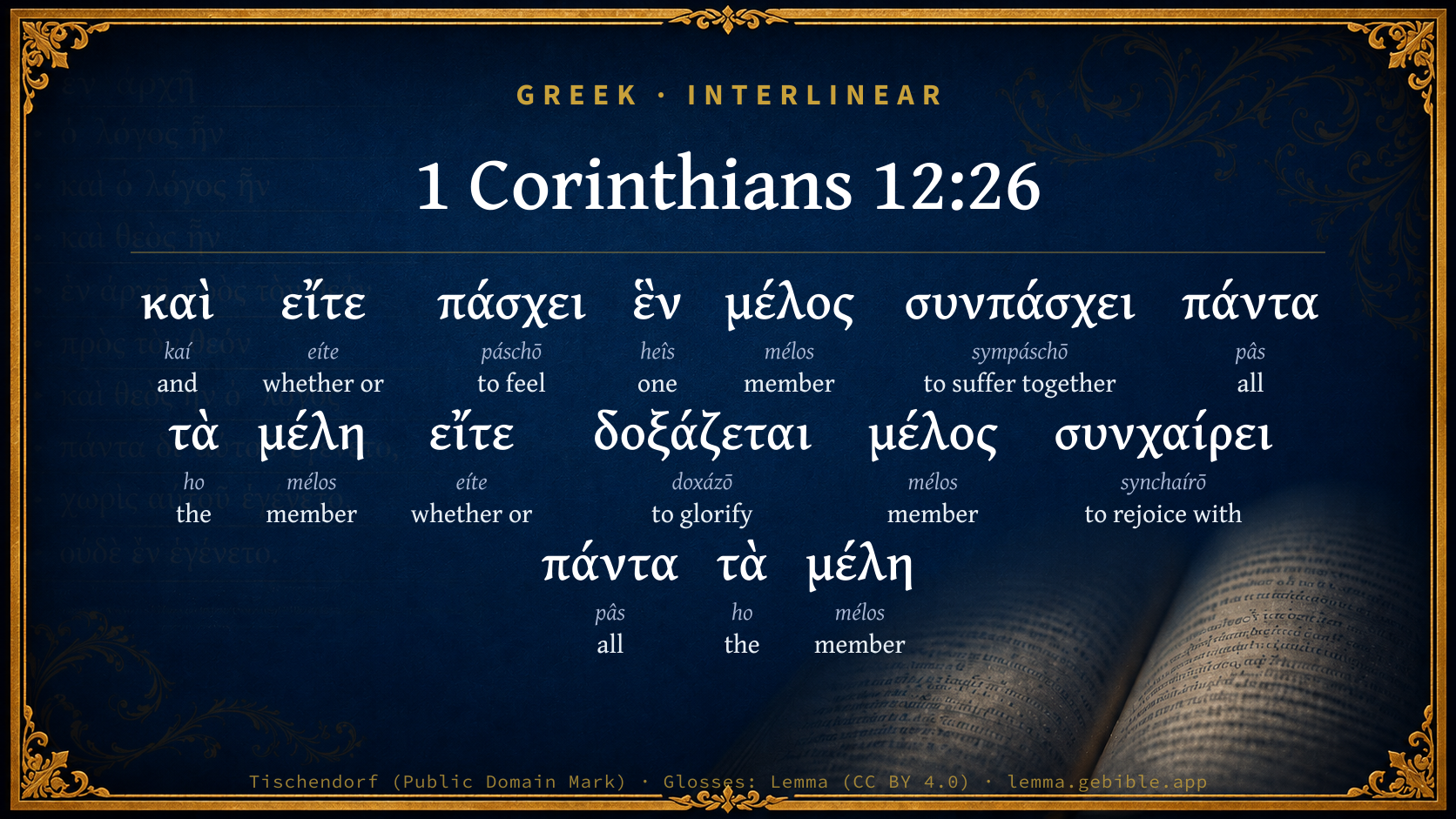
  1. καὶ kaí G2532 “and” Conjunction
  2. εἴτε eíte G1535 “whether or” Conjunction
  3. πάσχει páschō G3958 “to feel” Verb, Present, Active, Indicative, 3rd person, Singular
  4. ἓν heîs G1520 “one” Adjective, Nominative, Singular, Neuter
  5. μέλος mélos G3196 “member” Noun, Nominative, Singular, Neuter
  6. πάντα pâs G3956 “all” Adjective, Nominative, Plural, Neuter
  7. τὰ ho G3588 “the” Article, Nominative, Plural, Neuter
  8. μέλη mélos G3196 “member” Noun, Nominative, Plural, Neuter
  9. εἴτε eíte G1535 “whether or” Conjunction
  10. δοξάζεται doxázō G1392 “to glorify” Verb, Present, Passive, Indicative, 3rd person, Singular
  11. μέλος mélos G3196 “member” Noun, Nominative, Singular, Neuter
  12. συνχαίρει synchaírō G4796 “to rejoice with” Verb, Present, Active, Indicative, 3rd person, Singular
  13. πάντα pâs G3956 “all” Adjective, Nominative, Plural, Neuter
  14. τὰ ho G3588 “the” Article, Nominative, Plural, Neuter
  15. μέλη mélos G3196 “member” Noun, Nominative, Plural, Neuter

About this verse

These counts appear in no published source. They are computed here, from the morphology-tagged text and Lemma’s own curated glosses. What Lemma adds →

16
words
10
distinct lemmas
Pauline Epistles
section

Notable vocabulary

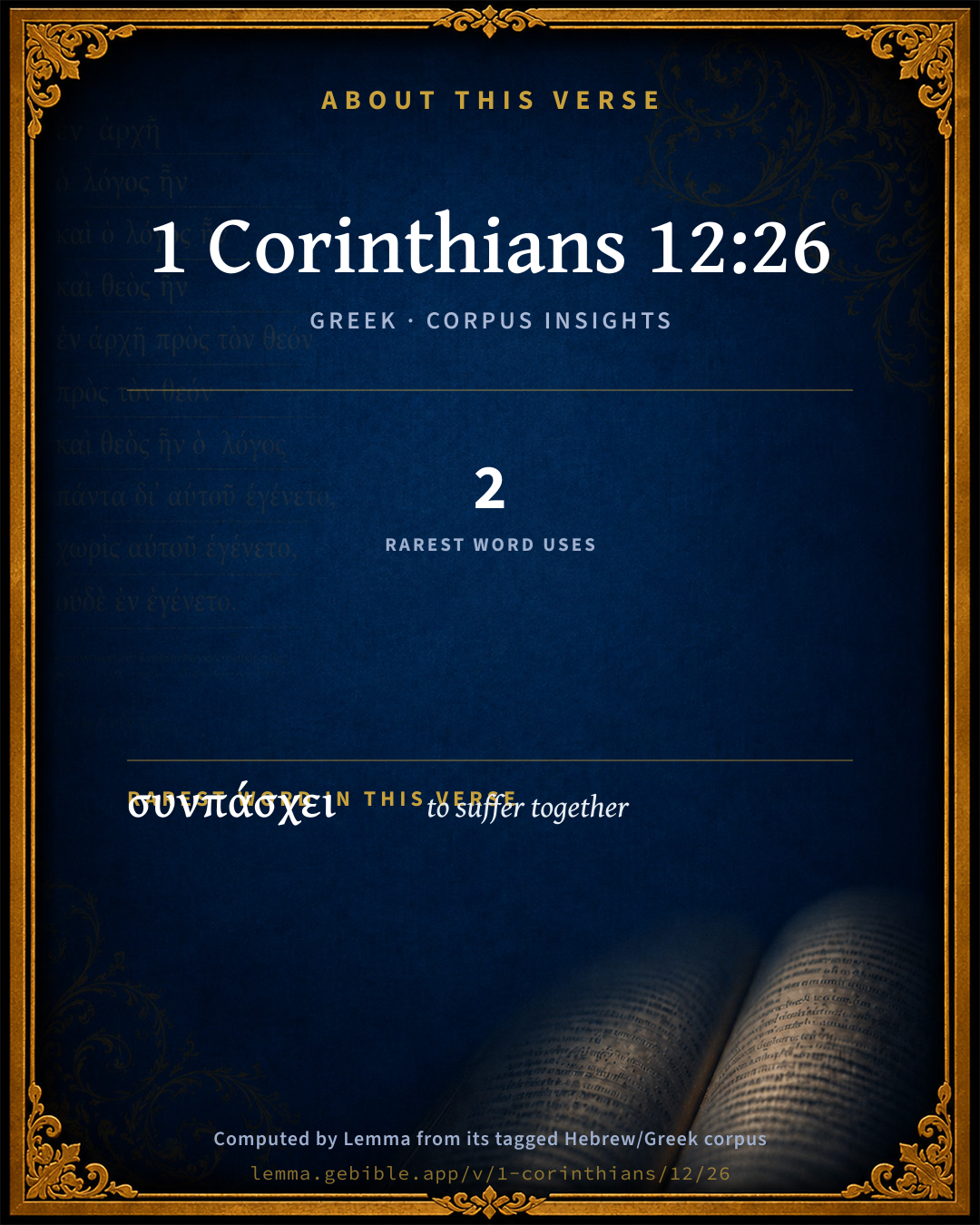
The rarest word here is συνπάσχει to suffer together G4841 — appearing just 2 times in the whole Greek New Testament.

Shared distinctive vocabulary

συνπάσχει to suffer together G4841 occurs in 2 verses of the Greek New Testament. Also found in:

Repetition

Words recur within this verse:

  • μέλος member G3196 ×4
  • εἴτε whether or G1535 ×2
  • πάντα all G3956 ×2
  • τὰ the G3588 ×2

Cross-references

4

Topical passages linked to 1 Corinthians 12:26 in the Treasury of Scripture Knowledge — connected by theme and wording, ordered by reader-vote popularity; previews shown in the World English Bible.

  • Romans 12:15 Rejoice with those who rejoice. Weep with those who weep.
  • Galatians 6:2 Bear one another's burdens, and so fulfill the law of Christ.
  • Hebrews 13:3 Remember those who are in bonds, as bound with them; and those who are ill-treated, since you are also in the body.
  • 1 Peter 3:8 Finally, be all like-minded, compassionate, loving as brothers, tenderhearted, courteous,

Cross-references courtesy of OpenBible.info (CC BY 4.0).

Commentary

Notes on 1 Corinthians 12:26 from classic Christian and Jewish commentators (each source and its license shown beneath its notes). The classic Christian expositions comment on the surrounding passage and are grouped to its opening verse, so a note may address several verses; the Jewish commentaries on the Tanakh (Rashi and others) are per-verse, so they appear only where the commentator wrote on this verse.

Lemma curates 59 commentaries, every one of them public domain or Creative Commons licensed, each selected and text-cleaned for this edition rather than reprinted as found. About our sources →

Bengel's Gnomon

Johann Albrecht Bengel

1Co 12:26. Συγχαίρει) rejoice with it. Both this expression and suffer with not only denote the affection, but also the effect.

Bengel's Gnomon of the New Testament — English translation (T&T Clark, Edinburgh, 1860) — public domain. Text from a community e-Sword module.

Meyer's Critical & Exegetical Commentary

Heinrich August Wilhelm Meyer

1Co_12:26. And how perfectly is this design of God realized in the mutual sympathy of the members! This happy result of the divine appointment stands most suitably here at the close of the whole discussion before the application ensues in 1Co_12:27, although Hofmann denies the connection of thought.

δοξάζεται] is glorified, which may take place practically by flourishing growth, by adornment, dress, anointing, and the like, and further by recognition of its usefulness, beauty, strength, dexterity, and so forth.

In view of the sympathy of the whole organism, and in consideration of the personifying style of the description, the concrete literal sense of the verse ought by no means to be modified.

Meyer — Critical and Exegetical Commentary on the New Testament — English translation by Peter Christie, edited by Frederick Crombie (T&T Clark, 1880) — public domain. Text from a community e-Sword module.

Expositor's Greek Testament

ed. W. Robertson Nicoll

1Co 12:26 illustrates the unselfish solicitude of the bodily organs; the nervous connexion makes it a veritable συμπάθεια ( συμπάσχει ). Plato applies the same analogy to the State in a striking passage in his Politicus , 462C;.see also Cm [1929] , ad loc [1930] δοξάζεται ( glorificatur , Cv [1931] ; not gloriatur , Vg [1932] ) goes beyond nervous sympathy; “ δόξα is more than εὐεξία ” (Ed [1933] ): for δοξάζω , applied to the body , cf. 1Co 15:40 ff., Phi 3:21 . Cm [1934] says finely, “When the head is crowned, the whole man feels itself glorified; when the mouth speaks, the eyes laugh and are filled with gladness”.

[1929] John Chrysostom’s Homiliœ († 407).

[1930] ad locum , on this passage.

[1931] Calvin’s In Nov. Testamentum Commentarii .

[1932] Latin Vulgate Translation.

[1933] T. C. Edwards’ Commentary on the First Ep. to the Corinthians . 2

[1934] John Chrysostom’s Homiliœ († 407).

The Expositor's Greek Testament, edited by W. Robertson Nicoll (1897–1910) — public domain. Text from a community e-Sword module.

Hodge's Commentary on Romans, Ephesians & First Corinthians

Charles Hodge

1Co_12:25, 1Co_12:26

That there should be no schism in the body; but (that) the members should have the same care one for another. And whether one member suffer, as the members suffer with it; or one member be honored, all the members rejoice with it.

God has so constituted the body that there should be no schism in it, i.e. no diversity of feeling or interest. Schism means simply division, but when spoken of an organized body, or of a society, it commonly includes the idea of alienation of feeling. Such was the schism which existed among the Corinthians, see 1Co_1:10; 1Co_11:18. But that the members should have the same care one for another. That is, that one member should have the same care for another member that it has for itself. The body is so constituted that the eye is as solicitous for the welfare of the foot as it is for its own well-being. The consequence is that if one member suffers all the members suffer with it; and if one member be honored, all the members rejoice with it. This is the law of our physical nature. The body is really one. It has a common life and consciousness. The pain or pleasure of one part is common to the whole.

Charles Hodge — Commentary on Romans (1835), First Corinthians (1857), and Ephesians (1856) — public domain. Text from a community e-Sword module.

Geneva Bible (1599)

Geneva Bible translators

Now he applieth the same doctrine to the Corinthians without any allegory, warning them that seeing there are divers functions and divers gifts, it is their duty, not to offend one against another, either by envy or ambition, but rather that they being joined together in love and charity one with another, every one of them bestow to the profit of all, that which he hath received, according as his ministry doth require.

Geneva Bible (1599) marginal notes — public domain. Text via Bolls.life.

Jamieson, Fausset & Brown

Robert Jamieson, A. R. Fausset & David Brown

And--Accordingly.

all . . . suffer with it--"When a thorn enters the heel, the whole body feels it, and is concerned: the back bends, the belly and thighs contract themselves, the hands come forward and draw out the thorn, the head stoops, and the eyes regard the affected member with intense gaze" [CHRYSOSTOM].

rejoice with it--"When the head is crowned, the whole man feels honored, the mouth expresses, and the eyes look, gladness" [CHRYSOSTOM].

Jamieson, Fausset & Brown — Commentary Critical and Explanatory on the Whole Bible (1871) — public domain (CC PDM 1.0). Text via the HelloAO Bible API.

Adam Clarke's Commentary

Verse 26. And whether one member suffer] As there is a mutual exertion for the general defence, so there is a mutual sympathy. If the eye, the hand, the foot, c., be injured, the whole man grieves and if by clothing, or any thing else, any particular member or part is adorned, strengthened, or better secured, it gives a general pleasure to the whole man.

Adam Clarke's Commentary on the Bible (1810–1826) — public domain. Text from a community e-Sword/MySword module.

John Calvin's Commentaries

26. Whether one member suffers “Such a measure of fellow-feeling.” (συμπάθεια,) says he, “is to be seen in the human body, that, if any inconvenience is felt by any member, all the others grieve along with it, and, on the other hand, rejoice along with it, in its prosperity. Hence there is no room there for envy or contempt.” To be honored, here, is taken in a large sense, as meaning, to be in prosperity and happiness. Nothing, however, is better fitted to promote harmony than this community of interest, when every one feels that, by the prosperity of others, he is proportionally enriched, and, by their penury, impoverished.

John Calvin's Commentaries (1540-1563) — public domain. Text from the Calvin Translation Society English edition (1840s-50s) via the Christian Classics Ethereal Library (ccel.org). Calvin's coverage is partial (roughly two-thirds of the Bible); uncommented books and verses are honest gaps, never fabricated. The 19th-century editor's footnotes and remarks are omitted so the notes are faithfully Calvin's own voice.

Ellicott's Commentary for English Readers

(26) And whether one member suffer.—This verse completes the statement of the perfect unity of the members in one body and with one another. They are not only physically joined together, but they are so united as to feel together.

A Bible Commentary for English Readers, edited by Charles John Ellicott (1878–1897) — public domain. Text from a community e-Sword module.

The Cambridge Bible for Schools and Colleges

gen. ed. J. J. S. Perowne

26. And whether one member suffer, all the members suffer with it] This is a matter of the most ordinary experience in the human body. A pain in any portion, even the most remote from the seats of life, affects the whole. A glance at history will shew us that it is the same with the body politic. Whatever is physically, morally, or spiritually injurious to any one portion of society, or of the Church of Christ, is sure in the long run to produce injury, moral and spiritual deterioration to the rest.

or one member be honoured, all the members rejoice with it] St Chrysostom eloquently remarks here, “Is the head crowned? All the man is glorified. Do the lips speak? The eyes also laugh and rejoice.” This part of the verse is as true as the former. Whatever tends to exalt the character and purify the aims of any one class in society, is sure in a greater or less degree to affect every other. If the one thought is calculated to alarm us by calling our attention to the infinite mischief which may be wrought by one act of thoughtlessness or selfishness, it is an immense encouragement to be reminded by the other that no work for good, undertaken from unselfish motives and carried out in an unselfish spirit, can possibly be without effect.

The Cambridge Bible for Schools and Colleges (gen. ed. J. J. S. Perowne; Cambridge University Press, 1878–1918) — public domain. Text from a community e-Sword module.

John Gill's Exposition

And whether one member suffer,.... Pain; even the meanest, lowest, and most distant, as the foot or hand, toe or finger:

all the members suffer with it; are more or less affected therewith, and bear part of the distress; as is easily discerned, by their different forms and motions on such an occasion: so when anyone member of the mystical body is in affliction, whether inward or outward, of body or mind, the rest are, or should be, affected with it, condole, sympathize, help, and assist; and remember them that are in bonds, as bound with them, as if they themselves were in bonds, and them that suffer adversity, whether spiritual or temporal, as being in the body, not only in the flesh, but as being part of the body, the church; and therefore should weep with them that weep, and bear a part with them in their sorrows. The Jews have a saying (f), that

"if one brother dies, all the brethren grieve; and if one of a society dies, , "the whole society grieves";''

and also another (g),

"that everyone that afflicts himself, , "with the congregations", is worthy to see or enjoy the comfort of the congregation or church;''

or one member be honoured; by being set in the highest place, and employed to the greatest usefulness, or by being most richly and beautifully clothed and adorned:

all the members rejoice with it; as sharing in the honour, Or benefit of it: so if one member of the church of Christ is honoured with an high office, with great gifts, with a large measure of grace, spiritual light, knowledge, and experience, with great discoveries of the love of God, with the presence of Christ, and the communion of the Holy Ghost, or with the good things of this life, and an heart to make use of them for the interest of religion, the other members rejoice at it; for so it becomes the saints to rejoice with them that rejoice, and be glad, both at the temporal and spiritual prosperity of each other: and upon the whole it is clear, that the meanest have no reason to be discouraged, nor the highest and greatest to be proud and elated.

(f) T. Bab. Sabbat, fol. 105. 2. & 106. 1. Vid. Maimon. Hilch. Ebel, c. 13. sect. 12. & Seder Olam Rabba, p. 9. (g) T. Bab. Taanith. fol. 11. 1.

John Gill's Exposition of the Whole Bible (1746–1763) — public domain (CC PDM 1.0). Text via the HelloAO Bible API.

Trapp's Complete Commentary

John Trapp

26 And whether one member suffer, all the members suffer with it; or one member be honoured, all the members rejoice with it.

Ver. 26. And whether one man suffer] This spiritual sympathy, mirum est quam frigide tractetur inter Christianos hodie, saith Aretius on this text. {See Trapp on "1Co 12:20"} {See Trapp on "1Co 12:27"} Luther in a certain epistle of his to Lampertus Thorn, a prisoner for Christ, thus writeth, Consolabor me quod vestra vincula men sunt, vestri carceres et ignes mei sunt; sunt vero, dum ea confiteor et praedico, vobisque simul compatior, et congratulor, that is, I doubt (and it is a grief to me) that I shall never have the honour of martyrdom as you have. But herein I can comfort myself, that your bonds are my bonds, your imprisonment and burning at a stake mine; for so they are so long as I confess and extol them; so long as I both suffer with you and rejoice with you. (Tom. ii. Epist.)

John Trapp, A Commentary or Exposition upon All the Books of the Old and New Testament (1647–1656) — public domain. Text from a community e-Sword module.

Albert Barnes' Notes on the Bible

And whether one member suffer - One member, or part of the body.

All the members suffer with it - This, we all know, is the case with the body. A pain in the foot, the hand, or the head excites deep solicitude. The interest is not confined to the part affected; but we feel that we ourselves are affected, and that our body, as a whole, demands our care. The word “suffer” here refers to disease, or sickness. It is true also that not only we feel an “interest” in the part that is affected, but that disease in any one part tends to diffuse itself through, and to affect the whole frame. If not arrested, it is conveyed by the blood through all the members until life itself is destroyed. It is not by mere interest, then, or sympathy, but it is by the natural connection and the inevitable result that a diseased member tends to affect the whole frame. There is not, indeed, in the church the same “physical” connection and “physical” effect, but the union is really not less close and important, nor is it the less certain that the conduct of one member will affect all. It is implied here also, that we should feel a deep interest in the welfare of all the members of the body of Christ. If one is tempted or afflicted, the other members of the church should feel it, and “bear one another’s burdens, and so fulfil his law.” If one is poor, the others should aid him, and supply his needs; if one is persecuted and opposed for righteousness’ sake, the others should sympathize with him, and make common cause with him. In all things pertaining to religion and to their mutual welfare, they should feel that they have a common cause, and regard it as a privilege to aid one another. Nor should a man regard it as any more a burden and hardship to aid a poor or afflicted brother in the church, than it should be deemed a hardship that the head, and the heart, and the hands should sympathize when any other member of the body is diseased.

Or one member be honoured - If applied to the body, this means, if one member or part be regarded and treated with special care; be deemed honorable; or be in a sound, healthy, and vigorous condition. If applied to the church, it means, if one of its members should be favored with extraordinary endowments; or be raised to a station of honor and influence above his brethren.

All the members rejoice with it - That is, in the body, all the other members partake of the benefit and honor. If one member be sound and healthy, the benefit extends to all. If the hands, the feet, the heart, the lungs, the brain be in a healthy condition, the advantage is felt by all the members, and all derive advantage from it. So in the church. If one member is favored with remarkable talent, or is raised to a station of influence, and exerts his influence in the cause of Christ, all the members of the church partake of the benefit. It is for the common good; and all should rejoice in it. This consideration should repress envy at the elevation of others, and should lead all the members of a church to rejoice when God, by his direct agency, or by the arrangements of his providence, confers extraordinary endowments, or gives opportunity for extended usefulness to others.

Albert Barnes' Notes on the Bible (1834–1885) — public domain. Text from a community e-Sword/MySword module.

Matthew Poole's English Annotations

From this union of the members in the body natural, of all the members proceedeth a natural sympathy, that if one member suffereth, all are afflicted, and ready to contribute to the relief and help each of other; and likewise the honour that is reflected on the body, is reflected on all the parts, and all rejoice in the good that affecteth any one single member.

Matthew Poole's English Annotations on the Holy Bible (1683–1685) — public domain. Text from a community e-Sword/MySword module.

Whedon's Commentary on the Bible

Daniel D. Whedon

26. One… all… suffer—So wonderfully is our nervous system diffused through the body that every part sympathizes with every other part, and the whole with any one part.

All… rejoice—Joy, like pain, experienced in one part becomes the joy of the whole. A striking illustration of the oneness of a true Christian Church.

Daniel D. Whedon (gen. ed.), Commentary on the Old and New Testaments (1874–1909) — public domain. Text from a community e-Sword module.

The Pulpit Commentary

Whether one member suffer, all the members suffer with it, etc. St. Chrysostom illustrates this verse by saying that if a thorn runs into the heel, the whole body feels it and is troubled; and that, on the ether hand, if the head is garlanded, the whole man is glorified.

Sympathy.

The desirableness and preciousness of sympathy are unquestionable. Selfishness is the curse of human nature and human society. There is a tendency towards absorption in individual interests, pleasures, and sorrows, which needs to be counteracted. Sympathy is as natural a principle as selfishness, though not so strong. Christianity tends to strengthen it for the conflict; and in the new humanity the love of the Saviour awakens and fosters regard for all those for whom Christ died.

I CHRIST HIMSELF IS THE DIVINE FOUNDATION OF SYMPATHY.

1. Christ"s words are the law of sympathy. It was he who uttered admonitions which have been so potent to affect the heart and influence society; e.g. "Do unto others," etc.; "Love one another," etc. And his apostles" words are his; e.g. "Bear ye one another"s burdens;" "Look not every man," etc.; "Rejoice with them," etc.

2. Christ"s life was the model of sympathy. In the Gospels we behold him sympathizing with sufferers, mourners, doubters, and inquirers, the ignorant and uncared for, sinners who repented of sin, and others. He is still the High Priest touched with a feeling of our infirmities.

3. Christ"s cross is the motive to sympathy. It presents the Redeemer suffering with and for mankind; and those who can say, "He gave himself for me," feel the constraint of the cross, the love of Christ.

4. Christ"s Spirit is the power of sympathy an unseen, but mighty and gracious force.

II THE VAST RANGE OF CHRISTIAN SYMPATHY.

1. The whole Church of the Redeemer demands its exercise. Christians are members of the one body, and subject to the one Head. Their mutual relations to one another are consequent upon their common relations to their Lord. Hence their interdependence and sympathy. When the head is crowned, the whole body is glorified; when the eyes brighten, all the features respond; when a limb aches, the whole frame is depressed. In such sympathy the body is a picture of the Church as it should be, and as it is just in proportion as it is pervaded by the Spirit of the Lord.

2. The whole race of mankind is included in its scope and action. Christianity alone can attack human isolation, and serve as the bond of universal brotherhood. The wanderers have to be gathered into the fold, and to this end they must first be pitied and yearned over and sought.

III THE MANIFESTATIONS OF CHRISTIAN SYMPATHY. These are especially:

1. Sympathetic suffering with the sad and distressed, as opposed to indifference or malicious pleasure in others" misfortunes.

2. Sympathetic joy in the advancement and honors of others, as opposed to envy and jealousy.

3. Sympathetic action; for emotion leads to practical interposition and help. Aid, gifts, self denying effort, may prove the reality of the feeling expressed in words.

IV THE ADVANTAGES AND BLESSINGS OF CHRISTIAN SYMPATHY.

1. To those who display it, it is advantageous as developing and fostering spiritual qualities.

2. To those who partake of it, whose cheerfulness is augmented and whose sorrows are relieved.

3. To society in general, which is thus leavened by Christian spirit and influence. T.

The common bearing of a Christian Church.

one member suffer, all the members suffer with it." "This is a matter of the most ordinary experience in the human body. A pain in any portion, even the most remote from the seats of life, affects the whole. A glance at history will show us that it is the same with the body politic. Whatever is physically, morally, or spiritually injurious to any one portion of society, or of the Church of Christ, is sure in the long run to produce injury, moral and spiritual deterioration, to the rest." "So whatever tends to exalt the character and purify the aims of any one class in society, is sure in a greater or less degree to affect every other. If the one thought is calculated to alarm us by calling our attention to the infinite mischief which may be wrought by one act of thoughtlessness or selfishness, it is an immense encouragement to be reminded by the other that no work for good, undertaken from unselfish motives and carried out in an unselfish spirit, can possibly be without effect." Chrysostom says, "When a thorn enters the heel, the whole body feels it and is concerned; the back bends, the belly and thighs contract themselves, the hands come forward and draw out the thorn, the head stoops, and the eyes regard the affected member with intense gaze." John Howe says, "It is a most unnatural thing to rejoice in the harm of another. In the body, when one member is suffering, all the members suffer with it. And to delight in the harm of others is as contrary to the spiritual nature which is diffused in the true body of Christ, as if the head or any other member should rejoice that the hand or foot is in pain." Two points may be fully treated.

1. As suffering in any part of the body disturbs the whole frame, exciting sympathetic feeling in the most distant parts, so suffering, and even more truly sin, in the lowest and lowliest member of a Christian Church, affects, injures, and grieves the whole. Every member ought to suffer and sympathize with the sufferer or the sinner.

2. As pain elsewhere in the body is really a sympathetic effort to relieve local pain, so sympathetic pain in other members of the Church finds its proper use in the help afforded, and relief given to the suffering or sinning member. R.T.

The Pulpit Commentary (1880–1919), ed. H.D.M. Spence-Jones & Joseph S. Exell — public domain. Text from a community e-Sword module.

McGarvey & Pendleton's Commentaries

J. W. McGarvey

And whether one member suffereth, all the members suffer with it; or one member is honored, all the members rejoice with it .

J. W. McGarvey (with Philip Y. Pendleton), Commentaries on the New Testament (The Fourfold Gospel, 1914; Acts; and the epistles) — public domain. Text from a community e-Sword/MySword module.

Cambridge Greek Testament for Schools and Colleges

26. καὶ εἴτε πάσχει ἕν μέλος. This is a matter of the most ordinary experience in the human body. A pain in any portion, even the most remote from the seats of life, affects the whole. A glance at history will shew us that it is the same with the body politic. Whatever is physically, morally, or spiritually injurious to any one portion of society, or of the Church of Christ, is sure in the long run to produce injury, moral and spiritual deterioration to the rest.

εἴτε δοξάζεται μέλος. Chrysostom eloquently remarks here, ‘Is the head crowned? All the man is glorified. Do the lips speak? The eyes also laugh and rejoice.’ This part of the verse is as true as the former. Whatever tends to exalt the character and purify the aims of any one class, or even individual member of society, is sure in a greater or less degree to affect every other. If the one thought is calculated to alarm us by calling our attention to the infinite mischief which may be wrought by one act of thoughtlessness or selfishness, it is an immense encouragement to be reminded by the other that no work for good, undertaken from unselfish motives and carried out in an unselfish spirit, can possibly be without effect.

Cambridge Greek Testament for Schools and Colleges (Cambridge University Press, 1896; 21 vols, various authors incl. Carr, Maclear, Plummer, Farrar, Lumby, Moule, M. R. James, Simcox) — public domain. Text from a community e-Sword module.

Alford’s Greek Testament

Henry Alford

26.] καί, and accordingly, in matter of fact: we see that God’s temperament of the body has not failed of its purpose, for the members sympathize most intimately with one another.

πάσχει … συνπάσχει] καὶ γὰρ τῇ πτέρνῃ πολλάκις προσπαγείσης ἀκάνθης, ὅλον τὸ σῶμα αἰσθάνεται καὶ μεριμνᾷ· καὶ νῶτος κάμπτεται, καὶ γαστὴρ καὶ μηροὶ συστέλλονται, καὶ χεῖρες καθάπερ δορυφόροι κ. ὑπηρέται προσιόντες ἀνέλκουσι τὸ παγέν, καὶ κεφαλὴ ἐπικύπτει, καὶ ὀφθαλμοὶ μετὰ πολλῆς ὁρῶσι τῆς φροντίδος. Chrys. p. 282.

δοξάζεται … συγχαίρει] Chrys. again with equal beauty instances, στεφανοῦται ἡ κεφαλή, καὶ ἅπας ὁ ἄνθρωπος δοξάζεται· λέγει τὸ στόμα, καὶ γελῶσιν ὀφθαλμοὶ καὶ εὐφραίνονται (ibid.). But perhaps the analogy requires that we should rather understand δοε. of those things which physically refresh or benefit the member, e.g. anointing or nourishment.

Henry Alford, The Greek Testament (1849–1861) — public domain. Text from a community e-Sword module.

International Critical Commentary

26. καί. ‘And so (as a consequence of the perfect blending), whether one member suffereth, all the members rejoice with it.’ Not only are the members united to one another and careful for one another, but what is felt by one is felt by all. See St Paul’s own sympathy, 2Co 11:28, 2Co 11:29. Plato (Repub. v. 462) points out that when one’s finger is hurt, one does not say, “My finger is in pain,” but “I have a pain in my finger”; and Chrysostom (ad loc.) graphically describes how the various organs are affected when a thorn runs into the foot, and also when the head is crowned. ‘Is glorified’ may mean either by adornment, or by healthy action, or by special cultivation. In συγχαίρει the personification of the organs is complete: congaudent (Vulg.), congratulantur (Beza). But Beza, by substituting simul dolent for compatiuntur (Vulg.), makes συμπάσχελ imply as much personification as συγχαίρει. The Christian principle is the law of sympathy. The interests of all individuals, of all classes, and of all nations are really identical, although we are seldom able to take a view sufficiently extended to see that this is so: but we must try to believe it. The benefit of one is the benefit of every one; and a wrong done to one is a wrong done to every one. Salva esse societas, nisi amore et custodia partium, non potest (Seneca).* The verb in N.T. is found only in Paul and Luke.

God, in the nature of its being, founds

Its proper bliss, and sets its proper bounds:

But as He framed a whole the whole to bless,

On mutual wants built mutual happiness.

Thus God and nature linked the general frame,

And bade self-love and social be the same.

Pope, Essay on Man, iii. 109, 217.

International Critical Commentary — older volumes (1896–1929), various authors — public domain. Text from a community e-Sword module.

Vincent's Word Studies in the New Testament

Marvin R. Vincent

Suffer with it. Compare Plutarch of Solon's Laws : "If any one was beaten or maimed or suffered any violence, any man that would and was able might prosecute the wrongdoer; intending by this to accustom the citizens, like members of the same body, to resent and be sensible of one another's injuries" (Solon). And Plato : "As in the body, when but a finger is hurt, the whole frame, drawn towards the soul and forming one realm under the ruling power therein, feels the hurt and sympathizes all together with the part affected" (" Republic, " 5, 462).

Is honored [δοξαζεται] . Or glorified. Receives anything which contributes to its soundness or comeliness. So Chrysostom : "The head is crowned, and all the members have a share in the honor; the eyes laugh when the mouth speaks."

Marvin R. Vincent, Word Studies in the New Testament (1887–1900) — public domain. Text from a community e-Sword/MySword module.

Godet's Commentaries

Frédéric Louis Godet

Vv. 26. “And whether one member suffer, all the other members suffer with it; or one member be honoured, all the others rejoice with it.”

Καί: and really. “This mutual care cannot be wanting for the body, for in fact...” The shame or contempt which overtakes one of the members of the body exercises a depressing influence on the condition of all the others. The honour, on the contrary, rendered to one, to the head, for example, when it is crowned, or to this or that other part of the body when it is brilliantly adorned, reacts on the attitude of the whole body, which erects itself and takes on a princely bearing. The application of these figures was self-evident: If gifts inferior in appearance are despised and checked, the state of the whole Church cannot fail to feel it. The honour which the most eminent gifts receive in such circumstances will not be of good quality. It cannot subserve the honour of the whole body, except in so far as the least of its members shares in it. It is clear that the special applications of all these figures must have been self-evident to the minds of the Corinthians. And so the apostle does not enunciate them; he contents himself with a wholly general application, which he gives in 1Co 12:27-30. The idea is summarily indicated in 1Co 12:27.

Frédéric Louis Godet — Commentaries on Luke, John, Romans, and 1 Corinthians — English translation (T&T Clark, Edinburgh, 1870s–1890s) — public domain. Text from a community e-Sword module.

Lesson kit

Teaching starters — assembled from the data on this page, not authored interpretation. Every prompt links to the verse data it draws on. Edit before teaching.

1 Corinthians, in the Pauline Epistles, opens this verse with 16 words (10 distinct Greek lemmas). Its most distinctive word is sympáschō (“to suffer together”). A historical commentator’s framing appears above. Read the whole chapter for the surrounding context.

Discussion questions

  1. How does “to suffer together” (sympáschō) shape what this verse is saying?
  2. Romans 8:17 shares the word «to suffer together» with this verse. How do the two illuminate each other?
  3. “member” occurs 4× in this one verse. What is the effect of the repetition?
  4. The translations on this page render this verse differently — a whole-verse word diff, not a word-by-word alignment. What might account for the different wordings?
  5. Reading how Bengel's Gnomon and Meyer's Critical & Exegetical Commentary read this verse, where do the two commentators agree and where do they part?

Things to notice

  • These translations choose different wording for 6 words in this verse.
  • “member” occurs 4× in this single verse.
  • 10 distinct Greek lemmas span 16 words in this verse.

Reading settings

Reading text

Shown beneath each verse's original-language words.

Old Testament
Old Testament edition

Read the OT as the Masoretic Hebrew (MT) or the Greek Septuagint (LXX).

English shown for the Greek Septuagint (in the Hebrew ↔ Greek comparison).

Comparing translations? Open the Compare panel on any verse page to stack up to four side by side.