1 Corinthians 10:9

Greek (Tischendorf 8th ed.) 1 Corinthians 10:9 appears in the Greek New Testament. The text above is from the Tischendorf 8th edition. Each word links to its Strong’s number and a concise gloss. Click any word for its full Thayer’s Greek Lexicon entry.
Download image
Cite this verse

1 Corinthians 10:9 (World English Bible). Public Domain. Lemma interlinear Bible study tool, https://lemma.gebible.app/v/1-corinthians/10/9.

Show BibTeX & RIS
BibTeX
RIS
English Translation
Neither let us test the Lord, as some of them tested, and perished by the serpents.
World English Bible · Public Domain
Download a study sheet

One document with this verse’s original text, its word-by-word gloss line, the meaning frame, cross-references with their text, attributed commentary, and full source and license credits — printable, and it pastes into notes with its structure intact.

This verse Autodidact and up

Study sheet (.html) Plain text (.txt)

A passage Seminary Student

Up to 50 verses in one chapter. A passage sheet keeps up to 6 commentary sources and 12 cross-references per verse, in the order this page ranks them, and says so on the sheet whenever that leaves anything out. Ask for a single verse and you get the Autodidact verse sheet above.

Everything on this page stays free to read, with no account — the sheet is a download of what is already on screen, not access to it.

Want to remove ads? Support Godless Engineer
Compare translations 3

The same verse in 3 English versions, stacked beneath the original-language interlinear above. Click any original word for its lexicon entry.

Each is an independent rendering of the whole verse — the interlinear is not word-aligned to these translations.

Highlighted words mark where these versions differ — a whole-verse word diff, not a word-by-word alignment.

  • World English Bible Public Domain
    Neither let us test the Lord, as some of them tested, and perished by the serpents.
  • King James Version Public Domain
    Neither let us tempt Christ, as some of them also tempted, and were destroyed of serpents.
  • unfoldingWord Literal Text CC BY-SA 4.0
    Nor should we put the Lord to the test, just as many of them put to the test and were destroyed by the snakes.

unfoldingWord Literal Text — © unfoldingWord, licensed CC BY-SA 4.0. Word-aligned USFM3 via Door43 (git.door43.org/unfoldingWord/en_ult).

Versions to compare (up to 4)

3 of 4 selected

Show all 19 translations

Every available English version of this verse, each an independent rendering of the whole verse.

  • World English Bible Public Domain
    Neither let us test the Lord, as some of them tested, and perished by the serpents.
  • Berean Standard Bible Public Domain
    We should not test Christ, as some of them did, and were killed by snakes.
  • Majority Standard Bible Public Domain
    We should not test Christ, as some of them also did, and were killed by snakes.
  • King James Version Public Domain
    Neither let us tempt Christ, as some of them also tempted, and were destroyed of serpents.
  • American Standard Version (1901) Public Domain
    Neither let us make trial of the Lord, as some of them made trial, and perished by the serpents.
  • Revised Version (1885) Public Domain
    Neither let us tempt the Lord, as some of them tempted, and perished by the serpents.
  • Geneva Bible (1599) Public Domain
    Neither let vs tempt Christ, as some of them also tempted him, and were destroyed of serpents.
  • Douay-Rheims (1899) Public Domain
    Neither let us tempt Christ: as some of them tempted, and perished by the serpents.
  • Young's Literal Translation Public Domain
    neither may we tempt the Christ, as also certain of them did tempt, and by the serpents did perish;
  • Literal Standard Version CC BY-SA 4.0
    neither may we tempt the Christ, as also certain of them tempted, and perished by the serpents;
  • Unlocked Literal Bible CC BY-SA 4.0
    Neither let us put Christ to the test, as many of them did and were destroyed by snakes.
  • unfoldingWord Literal Text CC BY-SA 4.0
    Nor should we put the Lord to the test, just as many of them put to the test and were destroyed by the snakes.
  • Darby Bible Public Domain
    Neither let us tempt the Christ, as some of them tempted, and perished by serpents.
  • World Messianic Bible Public Domain
    Let’s not test Messiah, as some of them tested, and perished by the serpents.
  • Webster's Bible Public Domain
    Neither let us tempt Christ, as some of them also tempted, and were destroyed by serpents.
  • Free Bible Version CC BY-SA 4.0
    Nor should we push God to the limit, as some of them did, and were killed by snakes.
  • Bible in Basic English Public Domain
    And let us not put the Lord to the test, as some of them did, and came to their death by snakes.
  • Text-Critical English NT CC BY 4.0
    We must not put Christ to the test, as some of them did and were killed by serpents.
  • Tyndale New Testament (1534) Public Domain
    Nether let vs tempte Christ as some of them tempted and were destroyed of serpentes.

Literal Standard Version (2020), Covenant Press — licensed CC BY-SA 4.0. Text via the HelloAO Bible API (eBible.org). Unlocked Literal Bible (unfoldingWord) — licensed CC BY-SA 4.0. Text via the HelloAO Bible API (eBible.org). unfoldingWord Literal Text — © unfoldingWord, licensed CC BY-SA 4.0. Word-aligned USFM3 via Door43 (git.door43.org/unfoldingWord/en_ult). Free Bible Version, Dr. Jonathan Gallagher — licensed CC BY-SA 4.0. Text via the HelloAO Bible API (eBible.org).

Word by word

More ways to search: Search by grammar → Find every occurrence → Compare this word →

Practice this passage: Drill this verse → Learn its vocabulary →

ἐκπειράζωμεν
ekpeirázō
G1598
“to test”
Verb, Present, Active, Subjunctive, 1st person, Plural
Part of Speech
Verb
Tense
Present
Voice
Active
Mood
Subjunctive
Person
1st person
Number
Plural
Full Thayer's Definition

Origin: from G1537 and G3985

TDNT: 06:23,8

1. to prove, test, thoroughly 2. to put to proof God's character and power
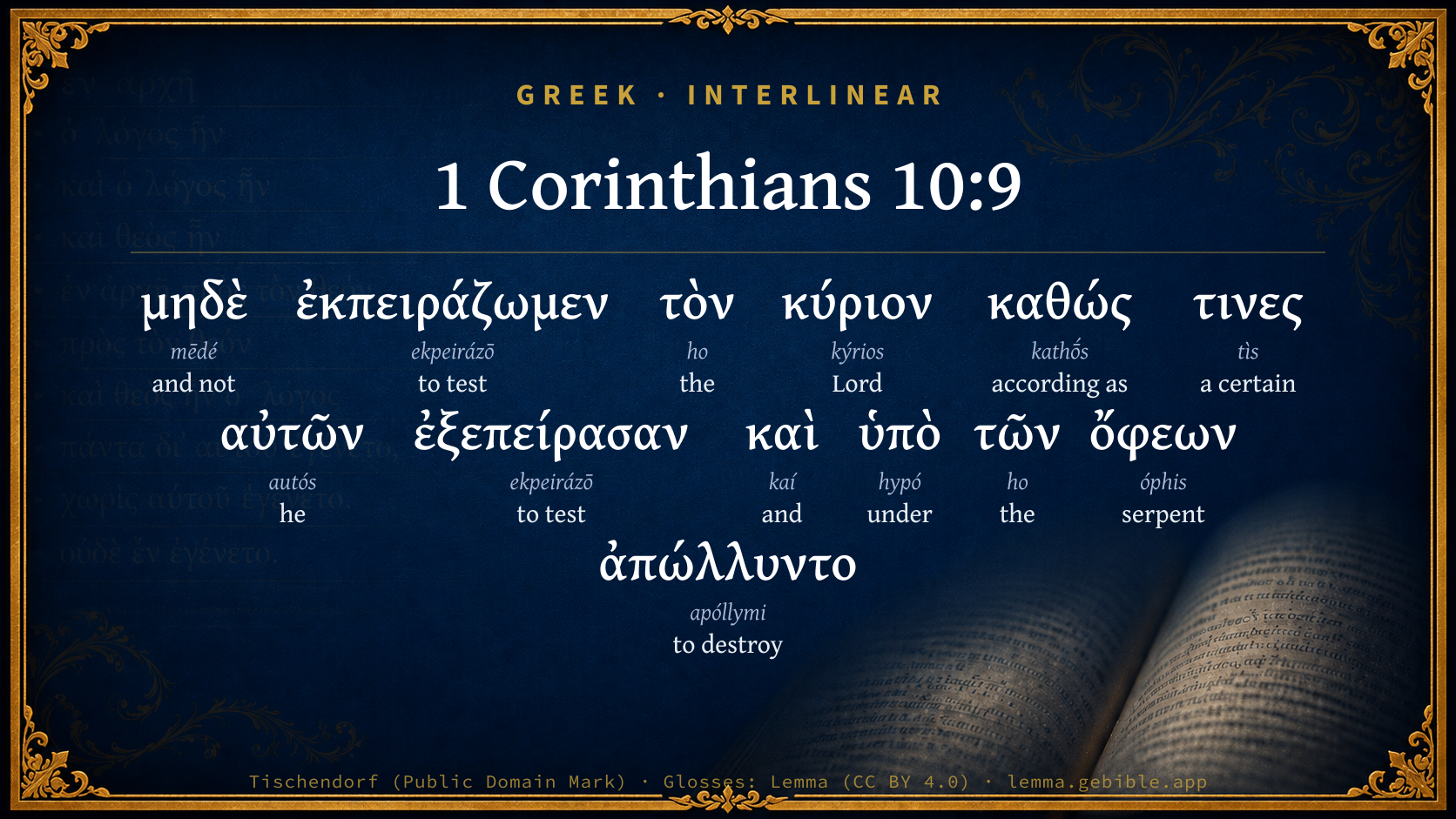
  1. μηδὲ mēdé G3366 “and not” Conjunction, Negative
  2. τὸν ho G3588 “the” Article, Accusative, Singular, Masculine
  3. κύριον kýrios G2962 “Lord” Noun, Accusative, Singular, Masculine
  4. καθώς kathṓs G2531 “according as” Adverb
  5. τινες tìs G5100 “a certain” Indefinite pronoun, Nominative, Plural, Masculine
  6. αὐτῶν autós G846 “he” Personal pronoun, Genitive, Plural, Masculine
  7. ἐξεπείρασαν ekpeirázō G1598 “to test” Verb, Aorist, Active, Indicative, 3rd person, Plural
  8. καὶ kaí G2532 “and” Conjunction
  9. ὑπὸ hypó G5259 “under” Preposition
  10. τῶν ho G3588 “the” Article, Genitive, Plural, Masculine
  11. ὄφεων óphis G3789 “serpent” Noun, Genitive, Plural, Masculine
  12. ἀπώλλυντο apóllymi G622 “to destroy” Verb, Imperfect, Middle, Indicative, 3rd person, Plural

About this verse

These counts appear in no published source. They are computed here, from the morphology-tagged text and Lemma’s own curated glosses. What Lemma adds →

13
words
11
distinct lemmas
Pauline Epistles
section

Notable vocabulary

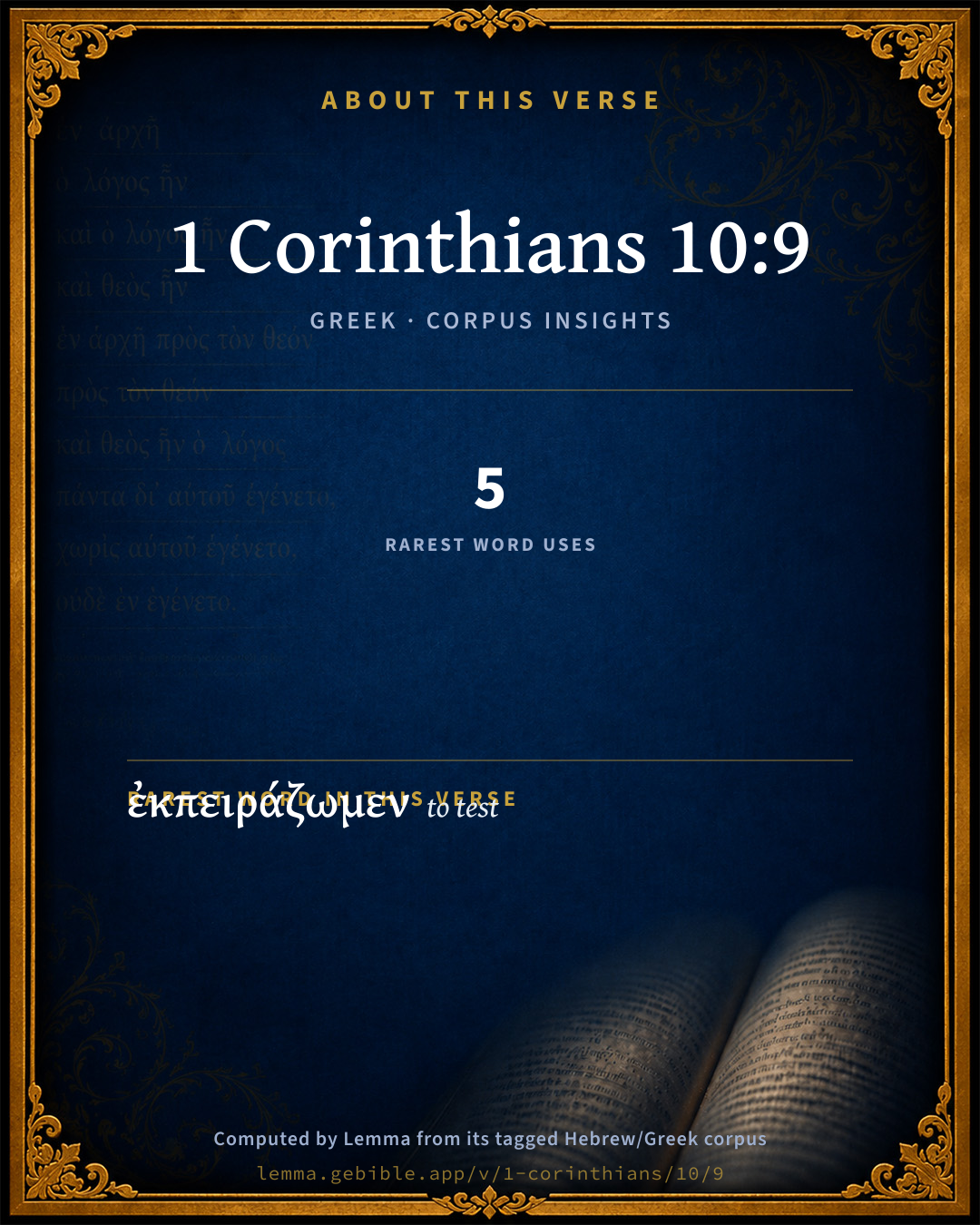
The rarest word here is ἐκπειράζωμεν to test G1598 — appearing just 5 times in the whole Greek New Testament.

Shared distinctive vocabulary

ἐκπειράζωμεν to test G1598 occurs in 4 verses of the Greek New Testament. Also found in:

Repetition

Words recur within this verse:

  • ἐκπειράζωμεν to test G1598 ×2
  • τὸν the G3588 ×2

Cross-references

11

Topical passages linked to 1 Corinthians 10:9 in the Treasury of Scripture Knowledge — connected by theme and wording, ordered by reader-vote popularity; previews shown in the World English Bible.

  • Numbers 21:5–6 The people spoke against God, and against Moses, Why have you brought us up out of Egypt to die in the wilderness? for there is no bread, and there is no water; and our soul loathes this light bread.
  • Psalms 78:18 They tempted God in their heart By asking food according to their desire.
  • Hebrews 3:8–11 Don't harden your hearts, as in the provocation, Like as in the day of the trial in the wilderness,
  • Exodus 17:2 Therefore the people quarreled with Moses, and said, "Give us water to drink." Moses said to them, "Why do you quarrel with me? Why do you test Yahweh?"
  • Exodus 17:7 He called the name of the place Massah, and Meribah, because the children of Israel quarreled, and because they tested Yahweh, saying, "Is Yahweh among us, or not?"
  • Deuteronomy 6:16 You shall not tempt Yahweh your God, as you tempted him in Massah.
  • Psalms 78:56 Yet they tempted and rebelled against the Most High God, And didn't keep his testimonies;
  • Exodus 23:20–21 "Behold, I send an angel before you, to keep you by the way, and to bring you into the place which I have prepared.
  • Psalms 95:9 When your fathers tempted me, Tested me, and saw my work.
  • Psalms 106:14 But gave in to craving in the desert, And tested God in the wasteland.
  • Hebrews 10:28–30 A man who disregards Moses' law dies without compassion on the word of two or three witnesses.

Cross-references courtesy of OpenBible.info (CC BY 4.0).

Where the printed editions differ

1 variant

Places in this verse where the major printed Greek editions disagree on the wording in a way that affects the translation — a comparison of editions, not a manuscript-by-manuscript collation. The editions are the modern critical texts (Nestlé-Aland 28/27, SBL, Westcott-Hort, Tregelles, Tyndale House) and the traditional texts behind the KJV (the Textus Receptus and the Byzantine/Majority text). It is not a claim about which reading is original.

  1. Different wording
    Χριστόν

    “Christ”

    In NA28NA27SBLTRByz Not in TynWHTreg

    κύριον (kurion) 'Lord' occurs in a few manuscripts (Tyn+WH+Treg) instead of Χριστόν (Christon) 'Christ' in older manuscripts (NA28+NA27+SBL+TR+Byz)

Textual data: Translators Amalgamated Greek New Testament (STEPBible TAGNT) · CC BY 4.0.

Commentary

Notes on 1 Corinthians 10:9 from classic Christian and Jewish commentators (each source and its license shown beneath its notes). The classic Christian expositions comment on the surrounding passage and are grouped to its opening verse, so a note may address several verses; the Jewish commentaries on the Tanakh (Rashi and others) are per-verse, so they appear only where the commentator wrote on this verse.

Lemma curates 59 commentaries, every one of them public domain or Creative Commons licensed, each selected and text-cleaned for this edition rather than reprinted as found. About our sources →

Jamieson, Fausset & Brown

Robert Jamieson, A. R. Fausset & David Brown

tempt Christ--So the oldest versions, IRENÆUS (264), and good manuscripts read. Some of the oldest manuscripts read "Lord"; and one manuscript only "God." If "Lord" be read, it will mean Christ. As "Christ" was referred to in one of the five privileges of Israel (Co1 10:4), so it is natural that He should be mentioned here in one of the five corresponding sins of that people. In Num 21:5 it is "spake against God" (whence probably arose the alteration in the one manuscript, Co1 10:9, "God," to harmonize it with Num 21:5). As either "Christ" or "Lord" is the genuine reading, "Christ" must be "God." Compare "Why do ye tempt the Lord?" (Exo 17:2, Exo 17:7. Compare Rom 14:11, with Isa 45:22-23). Israel's discontented complainings were temptings of Christ especially, the "Angel" of the covenant (Exo 23:20-21; Exo 32:34; Isa 63:9). Though they drank of "that Rock . . . Christ" (Co1 10:4), they yet complained for want of water (Exo 17:2, Exo 17:7). Though also eating the same spiritual meat (Christ, "the true manna," "the bread of life"), they yet murmured, "Our soul loatheth this light bread." In this case, being punished by the fiery serpents, they were saved by the brazen serpent, the emblem of Christ (compare Joh 8:56; Heb 11:26). The Greek for "tempt" means, tempt or try, so as to wear out the long-suffering of Christ (compare Psa 95:8-9; Num 14:22). The Corinthians were in danger of provoking God's long-suffering by walking on the verge of idolatry, through overweening confidence in their knowledge.

Jamieson, Fausset & Brown — Commentary Critical and Explanatory on the Whole Bible (1871) — public domain (CC PDM 1.0). Text via the HelloAO Bible API.

Joseph Benson's Commentary

1Co 10:9-10. Neither let us tempt Christ — By our unbelief and distrusting his providence, after the tokens he hath given us to encourage our faith, and engage our dependance; as some of them — Of the next generation; tempted him — While he resided among them as the angel of God’s presence, who led them through the wilderness, Exo 23:20-21; Isa 63:9; and were destroyed of serpents — From the venom of which others were recovered by looking at the brazen serpent, which was so illustrious a type of the Messiah. “In the history, these are called fiery serpents, Deu 8:15; and Gesner is of opinion that these serpents were of the dipsas kind, (a name taken from the thirst they cause in those they sting,) which Lucian hath described in his treatise, entitled Dipsades, where, speaking of the deserts of Lybia, he says, ‘Of all the serpents which inhabit these solitudes, the most cruel is the dipsas, no bigger than a viper, but whose sting causes most dismal pains, even till death. For it is a gross venom, which burns, breeds thirst, and putrifies; and those who are afflicted with it, cry as if they were in the fire.’ For an account of this serpent, see Kolben’s State of the Cape of Good Hope, vol. 2. p. 165.” — Macknight. Neither murmur ye — Under those dispensations of providence, which may seem at present very afflictive, particularly on account of the malice and power of your enemies; as some of them murmured — When they heard the report of the spies, Num 14:2; and were destroyed of the destroyer — The destroying angel, who was commissioned by one judgment after another to take them off. The Jews generally interpret this of him whom they fancy to be the angel of death, and whom they called Sammael. See on Heb 2:14.

Joseph Benson's Commentary on the Old and New Testaments (1811–1818) — public domain. Text from a community e-Sword module.

Tyndale Open Study Notes

Tyndale Open Resources

10:9 Nor . . . put Christ to the test: See Deut 6:16; Ps 78:18-20; Matt 4:7. • Christ: Some manuscripts read the Lord, which probably represents a scribe’s attempt to harmonize with the Old Testament context.

Tyndale Open Study Notes — © Tyndale Open Resources, licensed CC BY-SA 4.0. Text via the HelloAO Bible API.

Bengel's Gnomon

Johann Albrecht Bengel

1Co 10:9. Μηδὲ ἐκπειράζωμεν) The compound verb, as in Mat 4:7. The simple verb follows immediately after.—τὸν Χριστὸν, Christ) Paul mentions five benefits, 1Co 10:1-4, of which the fourth and fifth were closely connected; and five crimes, of which the fourth and fifth were in like manner closely connected. In speaking of the fifth benefit, he expressly mentions Christ; and in speaking of the fourth crime, he shows that it was committed against Christ. [See Appendix., P. II., on this passage, where the reading Χριστὸν is defended against Artemonius, Not. Crit.[86]].—ἘΠΕΊΡΑΣΑΝ, tempted) Num 21:5. Christ is therefore God. Comp. Exo 17:2. Often those things which are declared concerning the Lord in Old Testament, are spoken of Christ in New Testament, Rom 14:10-11; and that temptation, by which the people sinned, was an offence peculiarly against Christ, Exo 23:20; Exo 32:34; Isa 63:9; for when they had drunk from that Rock, which was Christ, 1Co 10:4, they yet complained for want of water, Num 21:5. Therefore they were also preserved from the fiery serpents, by raising a serpent on a pole, a type of Christ. As Abraham “saw Christ’s day” [Joh 8:56], as Moses embraced “the reproach of Christ” [Heb 11:26], so the Israelites tempted Christ: and yet the Corinthians could more directly tempt Christ.

[86] Lachm. reads Κύριον with BC, and some MSS. of Memph. Vers. But Tischend., with D(Λ)Gfg Vulg., both Syr. Versions, Memph., Theb., and Marcion, according to Epiphanius (ὁ δὲ Μαρκίων ἀντὶ τοῦ Κύριον Χριστὸν ἐποίησεν), Iren. 264, Χριστόν. This last is the better attested reading therefore. A has θεόν.—ED.

Bengel's Gnomon of the New Testament — English translation (T&T Clark, Edinburgh, 1860) — public domain. Text from a community e-Sword module.

Meyer's Critical & Exegetical Commentary

Heinrich August Wilhelm Meyer

1Co_10:9. Ἐκπειρ.] Stronger than the simple verb (to prove to the full), Mat_4:7; Luk_10:25. Comp the classic ἐκπειράομαι (Herod, iii. 135; Plat. ep. 13, p. 362 E). To try the Lord,[1604] נִסָּה אֶת־יְהֹוָה, means generally, to let it come to the point whether He will show Himself to be God; in this case: whether He will punish (quousque itura sit ejus patientia, Grotius). See in general, Wetstein, a[1605] Mat_4:7. What special kind of trying Paul has here in view, appears from καθὼς κ.τ.λ[1606], where the reference is to the people after their deliverance losing heart over the contrast between their position in the wilderness and the pleasures of Egypt. See Num_21:4-6. The readers therefore could not fail to understand that what the apostle meant was discontent on their part with their present Christian position, as involving so much renunciation of sensual pleasures formerly indulged in. How many, forgetting the blessings of their spiritual deliverance, might look back with a discontented longing to the licence of the past! It is a common opinion that Paul designates their participation in the sacrificial feasts as a tempting of God (comp 1Co_10:22, where, however, the connection is totally different, and ΤῸΝ ΚΎΡΙΟΝ does not apply to God at all). So Billroth, Rückert, de Wette, Osiander, Maier; but this is quite at variance with the context, because not in keeping with the historical events indicated by the ΚΑΘῺς ΚΑῚ Κ.Τ.Λ[1608], and familiar to the readers. The context equally forbids the interpretations of Chrysostom and Theophylact: the craving for wonders; Theodoret, the speaking with tongues; Grotius, the conduct of the schismatics; and Michaelis, that of the anti-Pauline party.

ἐπείρασαν] namely, αὐτόν, not in an absolute sense (Winer, Reiche).

ἀπώλλυντο] see the critical remarks. The imperfect lays the stress on the continuous development of what occurred, and thus places it in the foreground of the historic picture. See Kühner, II. p. 74. As to ὑπό with ἀπώλλ., see Valckenaer, p. 261. Ellendt, Lex. Soph. II. p. 880.

[1604] The Κύριος is God in Num_21:4 ff. Pauls readers, whose familiarity with the history in question is taken for granted, had no reason to refer it to Christ as the λόγος ἄσαρκος (from which comes the Recepta Χριστόν).

[1605] d refers to the note of the commentator or editor named on the particular passage.

[1606] .τ.λ. καὶ τὰ λοιπά.

[1608] .τ.λ. καὶ τὰ λοιπά.

Meyer — Critical and Exegetical Commentary on the New Testament — English translation by Peter Christie, edited by Frederick Crombie (T&T Clark, 1880) — public domain. Text from a community e-Sword module.

Expositor's Greek Testament

ed. W. Robertson Nicoll

1Co 10:9-10 . The sins condemned in 1Co 10:7-8 are sins of sensuality ; these, of unbelief (Ed [1445] ) which takes two forms: of presumption , daring God’s judgments; or of despair , doubting His goodness. The whole wilderness history, with its crucial events of Massah and Meribah, is represented as a “trying of the Lord” in Psa 95:8 ff. ( cf. Num 14:22 ), a δοκιμασία (Heb 3:7-12 ); this process culminated in the insolence of Num 21:4 f., which was punished by the infliction of the “fiery serpents”. The like sin, of presuming on the Divine forbearance, the Cor [1446] would commit if they trifled with idolatry ( cf. 1Co 10:22 ) and “sinned wilfully after receiving the knowledge of the truth” (Heb 10:26 ; Rom 6:1 ); cf. Deu 6:16 (Mat 4:7 ), Psa 78:17 ff., for this trait of the Israelite character. ἐκ - πειράζω is to try thoroughly, to the utmost as though one would see how far God’s indulgence will go. The graphic impf [1447] , ἀπώλλυντο , “lay a-perishing,” transports us to the scene of misery resulting from this experiment upon God! ὑπὸ of agent after ἀπόλλυμι a cl [1448] idiom, h.l . for N.T. elsewhere construed with dat [1449] , or ἐν and dat [1450] , of cause or ground of destruction (1Co 8:11 , Rom 14:15 , etc.). The “murmuring” also occurred repeatedly in the wilderness; but P. alludes specifically to the rebellion of Korah and its punishment the only instance of violent death overtaking this sin (Num 16:41 ). The ὀλοθρευτὴς in such supernatural chastisement is conceived as the “destroying angel” (2Sa 24:16 , Isa 37:36 ), called ὁ ὀλοθρεύων in Exo 12:23 , Heb 11:28 ( cf. Wis 18:25 ); in later Jewish theology, Sammael , or the Angel of Death (Weber, Altsyn. Théologie , p. 244). The O.T. analogy suggests that P. had in view the murmurings of jealous partisans and unworthy teachers at Cor [1451] ( 1Co 1:12 , 1Co 3:6 , 1Co 4:6 ; 1Co 4:18 ff.); at this point he reverts to the impv [1452] of 2nd. pers [1453] , γογγύζετε . τινες ( quidam ), used throughout of the Israelite offenders, may mean many or few , anything short of “all” (1Co 10:1-4 ); cf. , 1Co 10:5 , also 1Co 9:22 , 1Co 8:7 , Rom 3:3 .

[1445] T. C. Edwards’ Commentary on the First Ep. to the Corinthians . 2

[1446] Corinth, Corinthian or Corinthians.

[1447]mpf. imperfect tense.

[1448] classical.

[1449] dative case.

[1450] dative case.

[1451] Corinth, Corinthian or Corinthians.

[1452] imperative mood.

[1453]ers. grammatical person, or personal.

The Expositor's Greek Testament, edited by W. Robertson Nicoll (1897–1910) — public domain. Text from a community e-Sword module.

Hodge's Commentary on Romans, Ephesians & First Corinthians

Charles Hodge

1Co_10:9

Neither let us tempt Christ,‹16› as some of them also tempted, and were destroyed of serpents.

To tempt is to try, either in the sense of attempting, or of putting to the test, with a good or evil intent. God is said to tempt his people, when he puts their faith and patience to the test for the sake of exercising and strengthening those graces, Heb_11:17. Satan and evil men are said to tempt others, when they put their virtue to the test with the design of seducing them into sin, Gal_6:1. Jam_1:3. Mat_4:1 etc. Men are said to tempt God when they put his patience, fidelity or power to the test. Act_5:9. Mat_4:7. Heb_3:9. It was thus the Israelites tempted him in the wilderness. They tried his forbearance, they provoked him. The exhortation is that we should not thus tempt Christ. This supposes that Christ has authority over us, that he is our moral governor to whom we are responsible, and who has the power to punish those who incur his displeasure. In other words, the passage assumes that we stand in the relation to Christ which rational creatures can sustain to God alone. Christ, therefore, is God. Whether the Corinthians are warned against tempting Christ by their impatience and discontent, as the Israelites did in the particular case here referred to; or whether they are cautioned against putting his fidelity to the test by running unnecessarily into danger (see Mat_4:7), is uncertain. Probably the former.

As some of them also tempted. As Christ is mentioned in the immediate context, it is most natural to supply the pronoun him. Let us not tempt Christ, as they tempted him. This is not only the most natural explanation, but it is sustained by a reference to 1Co_10:4, and by the analogy of Scripture, as the Bible elsewhere teaches that the leader of the Israelites was the Son of God. It is only on theological grounds, that is, to get rid of the authority of the passage as a proof of our Lords divinity, that others interpret the passage thus, Let us not tempt Christ, as they tempted God. It is only one form of the argument, however, which is thus met. For according to this view the passage still teaches that we sustain the relation to Christ which the Israelites sustained to God. And were destroyed of serpents. Num_21:6. The people provoked God by their complaints and by their regretting their deliverance out of Egypt. And the Lord sent fiery serpents among the people, and they bit the people; and much people of Israel died. Similar judgments awaited the Corinthians if they exhausted the forbearance of the Lord.

Charles Hodge — Commentary on Romans (1835), First Corinthians (1857), and Ephesians (1856) — public domain. Text from a community e-Sword module.

Geneva Bible (1599)

Geneva Bible translators

To tempt Christ, is to provoke him to a combat as it were which those men do, who abuse the knowledge that he hath given them, and make it to serve for a cloak for their lusts and wickedness.

Geneva Bible (1599) marginal notes — public domain. Text via Bolls.life.

Adam Clarke's Commentary

Verse 9. Neither let us tempt Christ] I have already supposed, in Clarke's note on "1Co 10:4", that Christ is intended by the spiritual rock that followed them: and that it was he, not the rock, that did follow or accompany the Israelites in the wilderness. This was the angel of God's presence who was with the Church in the wilderness, to whom our fathers would not obey, as St. Stephen says, Act 7:38, Act 7:39. Instead of χριστον, Christ, several MSS. and a few versions have κυριον, the Lord, and some few θεον, God. But though some respectable MSS. have the Lord instead of Christ, yet this latter has the greatest proportion of authority on its side. And this affords no mean proof that the person who is called Yehovah in the Old Testament, is called Christ in the New. By tempting Christ is meant disbelieving the providence and goodness of God; and presuming to prescribe to him how he should send them the necessary supplies, and of what kind they should be, &c.

Adam Clarke's Commentary on the Bible (1810–1826) — public domain. Text from a community e-Sword/MySword module.

John Calvin's Commentaries

9. Neither let us tempt Christ This part of the exhortation refers to the history that is recorded in Numbers 21:6. For the people, having become weary of the length of time, began to complain of their condition, and to expostulate with God — “Why has God deceived us,” etc. This murmuring of the people Paul speaks of as a tempting; and not without good reason, for tempting is opposed to patience. What reason was there at that time why the people should rise up against God, except this — that, under the influence of base desire, they could not wait in patience the arrival of the time appointed by the Lord? Let us, therefore, take notice, that the fountain of that evil against which Paul here warns us is impatience, when we wish to go before God, and do not give ourselves up to be ruled by Him, but rather wish to bind him to our inclination and laws. This evil God severely punished in the Israelitish people. Now he remains always like himself — a just Judge. Let us therefore not tempt him, if we would not have experience of the same punishment.

This is a remarkable passage in proof of the eternity of Christ; for the cavil of Erasmus has no force — “Let us not tempt Christ, as some of them tempted God;” for to supply the word God is extremely forced. Nor is it to be wondered that Christ is called the Leader of the Israelitish people. For as God was never propitious to his people except through that Mediator, so he conferred no benefit except through his hand. Farther, the angel who appeared at first to Moses, and was always present with the people during their journeying, is frequently called יהוה, Jehovah. Let us then regard it as a settled point, that that angel was the Son of God, and was even then the guide of the Church of which he was the Head. As to the term Christ, from its having a signification that corresponds with his human nature, it was not as yet applicable to the Son of God, but it is assigned to him by the communication of properties, as we read elsewhere, that

the Son of Man came down from heaven. (John 3:13.)

John Calvin's Commentaries (1540-1563) — public domain. Text from the Calvin Translation Society English edition (1840s-50s) via the Christian Classics Ethereal Library (ccel.org). Calvin's coverage is partial (roughly two-thirds of the Bible); uncommented books and verses are honest gaps, never fabricated. The 19th-century editor's footnotes and remarks are omitted so the notes are faithfully Calvin's own voice.

Ellicott's Commentary for English Readers

(9) Neither let us tempt Christ.—Better, Neither let us tempt the Lord, as some of them tempted, and perished by serpents. There is much controversy as to whether the word here is “God” or “Christ” or “the Lord,” each having a certain amount of MS. support. On the whole, the reading here adopted (the Lord) seems from internal evidence to have been most likely the true reading. It is possible that the word “God” crept into the text, having been put as a marginal explanation to get over the supposed difficulty involved in applying the words which follow, “they also tempted,” to Christ. For in what sense could it have been said that the Israelites tempted Christ? There is no reason, however, for connecting “some of them tempted” (the word “also” is not in the original) with the object of the previous clause: and it is noticeable that the second word translated “tempted” is not the same as the first. “Let us not tempt” is in the original an intensified form of the verb which is used in its simple form in “some of them tempted.” The reading “Christ” may have come into the text as being an explanation that by the word “Lord” St. Paul meant the Redeemer.

The real meaning of the passage, however, is evident. The Israelites had, by their longing after the things left behind in Egypt, tried God so that God had asserted Himself in visiting them with punishment, and so Christians must be on their guard, with such a warning before them, not to tempt their Lord by hankering after those worldly and physical pleasures from which He by His death has delivered them. (See Num_21:4-6.) Some of the Corinthian Christians seemed by their conduct, as regards eating and drinking and indulging in sensuality, to long for that liberty in reference to things which they had enjoyed before conversion, instead of enjoying these spiritual blessings and feeding on the spiritual sustenance which Christ had provided for them.

Were destroyed of serpents.—Better, and were destroyed by the serpents. The article before “serpents” indicates that the reference is to a particular and well known fact.

A Bible Commentary for English Readers, edited by Charles John Ellicott (1878–1897) — public domain. Text from a community e-Sword module.

The Cambridge Bible for Schools and Colleges

gen. ed. J. J. S. Perowne

9. Neither let us tempt Christ] Whether we read Christ here with the authorized version, or ‘the Lord’ with many MSS. and editors, makes but little difference. In either case Christ is meant, Who, as the Angel of the Covenant (see note on 1Co_10:4), was the guide of the Israelites throughout all their wanderings. What it was to tempt Christ we may best learn from the Old Testament narrative. See Num_14:22. It was to try Him, to see whether He would be as good as His word, whether He would punish their sin as He had declared He would. The word in the original means to try to the uttermost. For the occasion referred to see Num_21:6, though this is not the only occasion on which the Israelites were said to have tempted God.

of serpents] Literally, by the serpents, i.e. the well-known fiery flying serpents mentioned in Moses’ narrative.

The Cambridge Bible for Schools and Colleges (gen. ed. J. J. S. Perowne; Cambridge University Press, 1878–1918) — public domain. Text from a community e-Sword module.

John Gill's Exposition

Neither let us tempt Christ,.... As all such persons do, who, presuming on the power and grace of Christ to keep them, or upon what they have received from him, unnecessarily expose themselves to snares and temptations, and so to danger; and as many of the Corinthians did, who are here chiefly respected, who trusting to their gifts and attainments, their knowledge and Christian liberty, would go into an idol's temple, sit down at meat there, and exposed themselves great and imminent danger; which was a tempting Christ, whether he would preserve them or not:

as some of them also tempted; that is, as some of the Israelites tempted, which they did more than once; but what is referred to here, is the time they spake against God and Moses, in Num 21:5 as appears from the punishment annexed, their being destroyed by serpents. The Arabic version adds "him", meaning Christ, which is a right interpretation of the text; otherwise there would be no force in the apostle's reasoning; for Christ was the angel that went before the Israelites in the wilderness, the angel of God's presence, that bore, and carried, and saved them; he is the Jehovah they tempted at Massah and Meribah, and elsewhere, and God they spake against at this place referred to; hence it is clear that our Lord existed before his incarnation, and that he is truly and properly God; the Alexandrian copy reads, "neither let us tempt God", and so the Ethiopic version: "and were destroyed of serpents"; fiery ones, which were sent among them by the Lord Christ, they tempted and spoke against, which bit them, and of these bites many of them died. This might lead to the consideration, of the original cause of man's sin and fall, and the ruin of human nature, by the means of a serpent; and may be an emblem of the future destruction of the wicked, which will be everlasting fire, prepared for the devil, the old serpent, and his angels.

John Gill's Exposition of the Whole Bible (1746–1763) — public domain (CC PDM 1.0). Text via the HelloAO Bible API.

Trapp's Complete Commentary

John Trapp

9 Neither let us tempt Christ, as some of them also tempted, and were destroyed of serpents.

Ver. 9. Neither let us tempt] By provoking him to jealousy, as 1Co 10:22, especially by idolatry, that land desolating sin.

John Trapp, A Commentary or Exposition upon All the Books of the Old and New Testament (1647–1656) — public domain. Text from a community e-Sword module.

Albert Barnes' Notes on the Bible

Neither let us tempt Christ ... - The word “tempt,” when applied to man, means to present motives or inducements to sin; when used with reference to God, it means to try his patience, to provoke his anger, or to act in such a way as to see how much he will bear, and how long he will endure the wickedness and perverseness of people. The Israelites tempted him, or “tried his patience and forbearance,” by rebellion, complaining, impatience, and dissatisfaction with his dealings. In what way the Corinthians were in danger of tempting Christ is not known, and can only be conjectured. It may be that the apostle cautions them against exposing themselves to temptation in the idol temples - placing themselves, as it were, under the unhappy influence of idolatry, and thus needlessly trying the strength of their religion, and making an experiment on the grace of Christ, as if he were bound to keep them even in the midst of dangers into which they needlessly ran. They would have the promise of grace to keep them only when they were in the way of their duty, and using all proper precautions. To go beyond this, to place themselves in needless danger, to presume on the grace of Christ to keep them in all circumstances, would be to tempt him, and provoke him to leave them; see the note at Mat 4:7.

As some of them also tempted - There is evidently here a word to be understood, and it may be either “Christ” or “God.” The construction would naturally require the former; but it is not certain that the apostle meant to say that the Israelites tempted Christ. The main idea is that of temptation, whether it is of Christ or of God; and the purpose of the apostle is to caution them against the danger of tempting Christ, from the fact that the Israelites were guilty of the sin of tempting their leader and protector, and thus exposing themselves to his anger. It cannot be denied, however, that the more natural construction of this place is that which supposes that the word “Christ” is understood here rather than “God.” In order to relieve this interpretation from the difficulty that the Israelites could not be said with any propriety to have tempted “Christ,” since he had not then come in the flesh, two remarks may be made.

First, by the “angel of the covenant,” and the “angel of his presence” Exo 23:20, Exo 23:23; Exo 32:34; Exo 33:2; Num 20:16; Isa 63:9; Heb 11:26, that went with them, and delivered them from Egypt, there is reason to think the sacred writers understood the Messiah to be intended; and that he who subsequently became incarnate was he whom they tempted. And secondly, We are to bear in mind that the term “Christ” has acquired with us a signification somewhat different from that which it originally had in the New Testament. We use it as “a proper name,” applied to Jesus of Nazareth. But it is to be remembered that it is the mere Greek word for the Hebrew “Anointed,” or the “Messiah;” and by retaining this signification of the word here, no small part of the difficulty will be avoided; and the expression then will mean simply that the Israelites tempted “the Messiah;” and the idea will be that he who conducted them, and against whom they sinned, and whom they tempted, was “the Messiah,” who afterward became incarnate; an idea that is in accordance with the ancient ideas of the Jews respecting this personage, and which is not forbidden, certainly, in any part of the Bible.

And were destroyed of serpents - Fiery serpents; see Num 21:6.

Albert Barnes' Notes on the Bible (1834–1885) — public domain. Text from a community e-Sword/MySword module.

Haydock's Catholic Bible Commentary

As some of them tempted Christ. This cannot but be understood of Christ, as God. (Witham)

George Leo Haydock (1774–1849), Haydock's Catholic Family Bible and Commentary, 1859 edition — public domain. Excludes Psalms (Douay-Rheims chapter numbering differs from Protestant) and Deuterocanonical books (Catholic canon only).

Matthew Poole's English Annotations

To tempt, in the general notion of the term, signifies to make a trial; applied unto God, it signifieth to make a trial of God, either with reference to his power, Psa 78:18-20, or to his truth and goodness: not to be satisfied with God’s word, but to challenge him to a sensible demonstration, is to tempt God. Or else to tempt may signify more generally, to provoke God; for indeed all notorious sinning against God is a tempting of God, not believing the wrath of God, which he hath revealed in his word against sin, till men feel it. The term

Christ here is very remarkable to prove Christ’s Divine nature and existence before he was incarnate; for the same person who is here called Christ, is called God, Psa 106:14, and Jehovah also in the same Psalm; neither could they have tempted Christ at that time, if at that time he had not been existent.

Were destroyed of serpents; by serpents he meaneth the fiery serpents; we have the history, Num 21:6-9.

Matthew Poole's English Annotations on the Holy Bible (1683–1685) — public domain. Text from a community e-Sword/MySword module.

Whedon's Commentary on the Bible

Daniel D. Whedon

9. Tempt Christ—Some manuscripts read the Lord, instead of Christ. The meaning would then be the same, but the analogy of 1Co_10:4 and of Heb_11:26 is convincing proof that Christ is the true reading. To tempt the Divine Being is to provoke and dare his wrath by a persistence in presumptuous sin. The allusion is to Num_21:4-6, where Israel is described as provoking God by reproaches for bringing them into the desert and feeding them upon manna. So the Corinthian Christians might rebel at their separation from the pagan social world, and their restriction under the severe morality of Christ. In this way myriads of professing Christians have tempted Christ, have apostatized from his religion, and died of the fiery bite of the old serpent or his “infernal brood.”

Daniel D. Whedon (gen. ed.), Commentary on the Old and New Testaments (1874–1909) — public domain. Text from a community e-Sword module.

The Pulpit Commentary

Tempt Christ (see the note on ver. 4). Christ is here identified with the angel which went before the Israelites, whom they were specially warned not "to provoke," because "my Name is in him". (Exo_23:20, Exo_23:21) Another reading is "the Lord." "Christ" may have come in from a marginal gloss. On the other hand, since "Christ" is the more difficult reading, it was, perhaps, the more likely to be altered by copyists. The word for "tempt" means "tempt utterly," "tempt beyond endurance." As some of them. (Exo_17:2, Exo_17:7; Num_14:22 Num_21:5, Num_21:6) Of serpents; rather, perished by the serpents, viz. the "fiery serpents" of the wilderness. (Num_21:6)

Tempting Christ.

Whether we read here "the Lord," or "Christ" the meaning is the same. The relation of Israel to Jehovah was parallel, was identical, with the relation of Christians to their Lord Christ. If we are loyal to our King Jesus, then we are in the position of the Hebrews when they reverenced and served the Lord their God; if we are traitors to him whom we call Master and Lord, then we stand in the same condemnation as rebellious Israel. The language of the apostle implies that there is danger lest we presumptuously test, by our unbelief, ingratitude, and rebellion, the forbearance and the grace of him whose we profess to be, whom we profess to serve.

I THE WAYS IN WHICH WE ARE IN DANGER OF TEMPTING CHRIST.

1. Some hearers of the gospel tempt the Lord by neglecting his gospel as unimportant and unnecessary.

2. Some by deferring that adhesion and devotion to Christ which his authority and circumstances require.

3. Some Christians tempt the Lord by their longings for the sins from which he came and died to deliver them. As the Israelites lusted for the flesh pots of Egypt, so it is to be feared there are Christians who cast a longing eye upon the sinful and worldly pleasures from which they should be delivered.

4. Some by their ingratitude, murmuring, and rebelliousness. As at Corinth there were those who were dissatisfied with the simplicity of the gospel, those who resisted the authority of the apostle, those who had little sympathy with the Christian spirit of self denial; so in the Church are there not a few whose temper and conduct are such as to put to the utmost trial the long suffering and forbearance of the Lord.

II THE REASONS TO BE FOUND IN CHRIST HIMSELF WHY HIS PEOPLE SHOULD NOT TEMPT HIM.

1. They are bound to honour and obey him as the Son of God.

2. They are bound to acknowledge his claims upon their gratitude, love, and service.

3. They may well be affected by the touching spectacle of his patience and long suffering. Has he not "borne with their manners in the wilderness"? Can they any longer subject him to a trial so unjust and so cruel?

III THE REASONS RELATING TO THEMSELVES WHY CHRIST"S PEOPLE SHOULD NOT TEMPT HIM.

1. Continuance in unbelief and rebellion will certainly harden the heart, and unfit and indispose for his service.

2. The blessed and sacred opportunity which life affords for grateful consecration and obedience will pass by unimproved.

3. An example of the kind deprecated will tend to embolden others to persevere in irreligion and in iniquity.

4. It must not be forgotten that, although Christ is a Saviour, he is also a Judge. His forbearance will not last for ever. Where he cannot acquit, he must and will condemn. Men may try Christ too long and too far. Sentence may be deferred, but it will be pronounced and it will be executed. After all, it is not so much the case that we are testing and trying Christ, as that he is testing and trying us. Now is the time of our probation. How do we endure when he puts us to the proof? T.

The Pulpit Commentary (1880–1919), ed. H.D.M. Spence-Jones & Joseph S. Exell — public domain. Text from a community e-Sword module.

John Wesley's Explanatory Notes

Neither let us tempt Christ - By our unbelief. St. Paul enumerates five benefits, ver. 1-4; of which the fourth and fifth were closely connected together; and five sins, the fourth and fifth of which were likewise closely connected. In speaking of the fifth benefit, he expressly mentions Christ; and in speaking of the fourth sin, he shows it was committed against Christ. As some of them tempted him - This sin of the people was peculiarly against Christ; for when they had so long drank of that rock, yet they murmured for want of water. Num. xxi, 4, &c.

John Wesley, Explanatory Notes Upon the Whole Bible (1754–1765) — public domain. Text via the GEBible commentary corpus.

Burkitt's Expository Notes on the New Testament

William Burkitt

Observe here a double sin, which the Corinthians are warned against: tempting and murmuring. Neither tempt ye Christ, by trying how long his patience will last, as the Israelites did, when (as the angel of the covenant) he went before them in the wilderness, Num 21:5-6

Here note, The object or person whom the Israelites are said to tempt, Christ: which proves,

1. His pre-existence before his incarnation: the Israelites could not have then tempted him, had he not been then existent.

2. His divinity; he who is here called Christ, is by the Psalmist called God, Psa 106:14

They tempted God in the desert. Christ had not a human nature then to be tempted in, they tempted him therefore as he was God: a good argument to prove the divinity of our Saviour, made use of by the ancients.

The other sin warned against is, murmuring: Neither murmur ye: that is, do not repine, because ye are forbidden to be present at the idolatrous feasts of the Gentiles in the idol-temples; neither do ye murmur, by reason of the persecutions which you do or may endure for the sake of Christianity, and the cause of Christ.

Learn hence, That to murmur at, or be impatient under, any of the providential dispensations of God, is both great sin and folly. ’Tis as high presumption and wickedness to be dissatisfied with God’s works of providence, as with his work of creation; to quarrel at what God doth, is as unchristian-like, yea, as uncreature-like, as to quarrel at what God has made. Therefore murmur not, as the Israelites murmured.

Observe, secondly, A double punishment inflicted on the Israelites for this double sin committed; such as tempted were destroyed of fiery serpents, Num 21:6-7. The Lord sent fiery serpents among the people: the sting and venom of those serpents was inflaming, spreading, and killing: much people of Israel died. And such as murmured, were destroyed of the destroyer: that is, by the destroying angel, in that plague mentioned, Num 14:37. Such variety of judgments has Almighty God, with which to punish and plague an incorrigible and unreclaimable people.

William Burkitt's Expository Notes on the New Testament (1700–1703) — public domain. Text from a community e-Sword module.

McGarvey & Pendleton's Commentaries

J. W. McGarvey

Neither let us make trial of the Lord, as some of them made trial, and perished by the serpents . [ Num_21:4-6 . Compare Joh_3:14-15 . To "tempt" here means to try beyond all patience or endurance. Israel tempted God in the case referred to, by its spirit of unbelieving discontent. Compare also Exo_17:2-7 ; Num_14:22 . As Israel became discontented under the hardships of the wilderness, so the Corinthians were liable to a like discontent because of the severe persecutions brought upon them by ungodly men. Chrysostom, Theodoret and Oecuminius think that Paul warns the Corinthians against tempting God by asking for signs. But this was not the besetting sin of the Greeks ( 1Co_1:22 ), nor is there any evidence that the Christians at Corinth were at all addicted to this sin. Besides, it is at variance with the analogy which Paul has cited. As a matter of fact, men tempt God by putting his fidelity, patience or power to unnecessary tests-- Mat_4:7 ; Act_5:9 ; Heb_3:9 ]

J. W. McGarvey (with Philip Y. Pendleton), Commentaries on the New Testament (The Fourfold Gospel, 1914; Acts; and the epistles) — public domain. Text from a community e-Sword/MySword module.

The People's New Testament

B. W. Johnson

9. Neither let us tempt Christ, as, etc. The event referred to is narrated in Num. 21:4–6, which see. The application is, that we should not be discontented over hardships or long for the sinful pleasures of a former life from which we have parted.

B. W. Johnson's The People's New Testament with Notes (1889–1891) — public domain. Electronic text from the Christian Classics Ethereal Library (CCEL) ThML edition.

unfoldingWord translationNotes

Door43 World Missions Community

did and were destroyed by snakes

This can be stated in active form. AT: "did. As a result, snakes destroyed them" (See: Active or Passive)

grumble

complaining

did and were destroyed by an angel of death

This can be stated in active form. AT: "did. As a result, an angel of death destroyed them" (See: Active or Passive)

translationWords

Christ

test

angel

die

unfoldingWord translationNotes — © Distant Shores Media and the Door43 World Missions Community, licensed CC BY-SA 4.0. Source: git.door43.org/Door43/en_tn.

Cambridge Greek Testament for Schools and Colleges

9. κύριον אBC. Rec. χριστόν with DEFG, Vetus Lat. Vulg. Peshito. Epiphanius declares that χριστόν was substituted for κύριον by Marcion. But in this case it is remarkable that the ancient Latin translation of Irenaeus should have Christum. See the whole passage cited in Iren. Contr. Haer., IV. 27.

ἀπώλλυντο אAB. ἀπώλοντο rec. with CDEFG.

9. ἐκπειράζωμεν τὸν κύριον. Whether we read χριστόν here with rec. or κύριον as in the text, makes but little difference. In either case Christ is meant, Who, as the Angel of the Covenant (see note on 1Co 10:4), was the guide of the Israelites throughout all their wanderings. What it was to tempt Christ we may best learn from the Old Testament narrative. See Num 14:22. It was to try Him, to see whether He would be as good as His word, whether He would punish their sin as He had declared He would. The word in the original means to try to the uttermost. For the occasion referred to see Num 21:6, though this is not the only occasion on which the Israelites were said to have tempted God.

ὑπὸ τῶν ὄφεων. By the serpents, i.e. the well-known fiery serpents mentioned in Moses’ narrative.

Cambridge Greek Testament for Schools and Colleges (Cambridge University Press, 1896; 21 vols, various authors incl. Carr, Maclear, Plummer, Farrar, Lumby, Moule, M. R. James, Simcox) — public domain. Text from a community e-Sword module.

Alford’s Greek Testament

Henry Alford

9.] ἐκπειρ.—tempt beyond endurance, ‘tempt thoroughly.’ Similarly ἐξαρνεῖσθαι, ‘to persist in denying,’ al., as Suidas, ἡ γὰρ ἐξ πρόθεσις, ἐπίτασιν δηλοῖ. See Musgr. on Eurip. Iph. Taur. 249, and cf. ἐκπληρόω, Act 13:32. So also in Latin, ‘oro’ and ‘exoro,’ &c.

τὸν κύριον] There may be two views taken of the internal evidence concerning the reading here. On the one hand it may be said that χριστόν being the original reading, it was variously altered to κύριον or θεόν by those who found a difficulty in supposing that the Jews of old tempted Christ, or even by those who wished to obliterate this assertion of His præ-existence: and so De Wette, al. On the other it may be said, that κύριον being the original, it was variously explained in the margin χριστόν and θεόν, as is often the case: and so Meyer. On comparing these, it seems to me that the latter alternative is the more probable. The inference that τινες αὐτῶν ἐπείρασαν requires τὸν χριστόν as an object, is not a necessary one, and hardly likely to have produced the alteration, closely connected as τ. χρ. is with the verb in the first person. I have therefore with Meyer adopted the reading κύριον.

The tempting of the Lord was,—as on the other occasions alluded to Num 14:22, where it is said that they tempted God ten times,—the daring Him, in trying His patience by rebellious conduct and sin. Cf. the similar use of πειράζω Act 5:9; Act 15:10. And he warns the Corinthians, that they should not in like manner provoke God by their sins and their partaking with idols. Chrys., Theophyl., and Œ understand the temptation of God to be the seeking for signs: Theodoret, to be in danger arising from those who spoke with different tongues, ἐπείραζον δὲ κ. οἱ ταῖς διαφόροις κεχρημένοι γλώτταις, κατὰ φιλοτιμίαν μᾶλλον ἢ χρείαν ταύτας ἐπʼ ἐκκλησίας προσφέροντες.

ὑπὸ τῶν ὄφεων, by the (well-known) serpents. The art. is so often omitted after a preposition, that wherever it is expressed, we may be sure there was a reason for it.

Henry Alford, The Greek Testament (1849–1861) — public domain. Text from a community e-Sword module.

International Critical Commentary

9. μηδὲ ἐκπειράζωμεν τὸν Κύριον. ‘Neither let us sorely tempt the Lord,’ try Him out and out, provoke Him to the uttermost, till His longsuffering ceases. This the Israelites did by their frequent rebellion. It is rather fanciful to connect this with v. 8, as v. 8 is connected with v. 7. It is true that “fornication leads to tempting God”; but is that the Apostle’s reason for passing from πορνεύωμεν to ἐκπειράζωμεν? The compound occurs (in quotations from LXX of Deu 6:16) Mat 4:7; Luk 4:12; also Luk 10:25; in LXX, both of man trying God (Psa 78:18), and of God trying man (Deu 8:2, Deu 8:16). It implies prolonged and severe testing. See on 3:18. Here the meaning is that God was put to the proof, as to whether He had the will and the power to punish. In class. Grk. ἐκπειρᾶσθαι is used. It is doubtful whether the Apostle is thinking of anything more definite than the general frailty and faultiness of the Corinthian Christians. Misuse of the gift of tongues (Theodoret) and a craving for miracles (Chrysostom) are not good conjectures.

ὑπὸ τῶν ὄφεων ἀπώλλυντο. ‘Perished day by day by the serpents.’ The imperfect marks the continual process, and the article points to the well-known story. ‘Perished’ = ‘were destroyed,’ and hence ὑπό is admissible. In class. Grk. ὑπό is used of the agent after an intrans. verb, but it is not very frequent in N.T. We have πάσχειν ὑπό, Mat 17:12 and 1Th 2:14, where Milligan quotes from papyri, βίαν πάσχων ἑκάστοτε ὑπὸ Ἑκύσεως. See Winer, p. 462.

We may safely prefer τὀν Κύριον (א B C P 17, Aeth. Arm.) to τὸν Χριστόν (D E F G K L, Latt.) or τὸν Θεόν (A). No doubt Χριστόν, if original, might have been changed to Κύροιν or Θεόν because of the difficulty of supposing that the Israelites in the wilderness tempted Christ. On the other hand, either Χριστόν or Θεόν might be a gloss to explain the meaning of Κύριον. Epiphanius says that Marcion substituted Χριστόν for Κύριον, that the Apostle might not appear to assert the lordship of Christ. Whatever may be the truth about this, it is rash to say that ‘Marcion was right in thinking that the reading Κύριον identifies the Lord Jehovah of the narrative with the historical Jesus Christ’. It is safer to say with Hort on 1Pe 2:3, “No such identification can be clearly made out in the N.T”. But see on Rom 10:12, Rom 10:13. In the N.T. ό Κύριος commonly means ‘our Lord’; but this is by no means always the case, and here it almost certainly means Jehovah, as Num 21:4-9 and Psa 78:18 imply. There seems to be no difference in LXX between Κύροις and ὀ Κὐριος, and in Nm.T. we can lay down no rule that Κύριος means God and ὀ Κύριος Christ. See Bigg on 1Pe 1:3, 1Pe 1:25, 1Pe 1:2:3, 1Pe 1:3:15; Nestle, Text. Crit. of N.T. p. 307.

καθώς τινες (א A B C D* F G P 17) rather than καθώς καί τινες (D2 E K L). ἐπείρασαν (A B D3 K L) rather than ἐξεπείρασαν (א C D* F G P 17), the latter being an assimilation to ἐκπειράζωμεν. It is more difficult to decide between ἀπώλλυντο (א A B) and ἀπώλοντο (C D E F G K L P); but ἀπώλλυντο would be more likely to be changed to ἀπώλοντο (v. 10) than vice versa.

International Critical Commentary — older volumes (1896–1929), various authors — public domain. Text from a community e-Sword module.

Vincent's Word Studies in the New Testament

Marvin R. Vincent

Let us tempt Christ [εκπειραζωμεν τον χριστον] . The compound word is very significant, "to tempt out" [εκ] ; tempt thoroughly; try to the utmost. It occurs in three other places : Mt 4:7; Luk 4:12; Luk 10:25; and, in every case, is used of tempting or testing Christ. Compare Psa 77:18 (Sept.). For Christ read Kurion the Lord.

Marvin R. Vincent, Word Studies in the New Testament (1887–1900) — public domain. Text from a community e-Sword/MySword module.

Godet's Commentaries

Frédéric Louis Godet

Vv. 9, 10. “Neither let us tempt the Christ as some of them tempted Him, and were destroyed of serpents; 10. Neither murmur ye as some of them murmured, and were destroyed of the destroyer.”

The first of the two sins against which the Corinthians are indirectly put on their guard in these verses, is evidently the discontent which they feel on account of the self-denial required by their Christian call. The example quoted is that of the Israelites dissatisfied with the food to which they are reduced in the wilderness, and who are punished by the scourge of the fiery serpents (Num 21:5 seq.).

The expression to tempt God, so often used in Scripture, signifies: to put God to the proof, to try whether He will manifest His goodness, power, and wisdom either by succouring us from a danger to which we have rashly exposed ourselves, or by extricating us from a difficulty which we have ourselves wilfully created while reckoning on Him, or by pardoning a sin for which we had beforehand discounted His grace. This, according to the biblical view, is one of the greatest sins man can commit. The Jews committed it in the wilderness by their murmurs, because they sought thereby to challenge the display of Divine power in the service of their lusts. The Corinthians in their turn committed it by pushing to its utmost limits the use of their Christian liberty in regard to heathen feasts. Could our Christianity, said they, really forbid to us those pleasures? Is not God able to keep us from falling even in such circumstances? And even if we should fall, would not His grace be ready to pardon and raise us again? They thus claimed to make God move at their pleasure, even should it be necessary to work miracles of power or mercy to save them.

Of the three readings τὸν κύριον, the Lord, τὸν Χριστόν, the Christ, and τὸν θεόν, God, the last should be set aside without hesitation; it has only the Alexandrinus in its favour; it is a correction following the usual biblical phrase to tempt God. The other two come to the same thing in point of sense; for the term the Lord always denotes Christ in the New Testament when it is not found in a quotation from the Old. It might be said in favour of the reading the Lord, that it explains more easily the other two; but in favour of the Christ, we have, first, the agreement of the two Greco-Latin and Byzantine families, then the more extraordinary form and the greater difficulty of the expression, finally, its appropriateness in the application of the saying to the Corinthians and the comparison of 1Co 10:4. This reading is also preferred by Osiander, Reuss, Heinrici, Hofmann, etc. For the meaning of it, see on 1Co 10:4.

Vv. 10. Here is the fourth trespass of which St. Paul speaks: the murmuring against Moses and Aaron. The fact which he cites is that related Numbers 16; the revolt of Korah, Dathan, and Abiram, in consequence of which a sudden plague destroyed the despisers of the servants of the Lord. Some have thought of the event related Numbers 14, where, in consequence of the report of the spies sent to Canaan, the people murmured and rebelled. But this sin was not followed by any immediate judgment; it became the occasion of the sentence pronounced on those who were more than twenty years of age when they came out of Egypt, a sentence which was executed only slowly during their whole journeying in the wilderness. The intervention of the destroying angel indicates a sudden and mortal plague; this circumstance is certainly not mentioned in the narrative of the punishment of Korah and his companions; but it is supposed by the term maggepha, the plague, v. 48 (Hebrew text, 17:13), which St. Paul interprets by Exo 12:23. In quoting this example, he certainly has in view the irritation felt by a party among the Corinthians against himself, his fellow-labourers, and those of the leaders of the flock who along with them disapprove of taking part in heathen rejoicings. This party chafed at their severity, which gave rise to so painful a situation for Christians in relation to their friends, and they asked, as Korah and his followers did in respect of Moses and Aaron, Whether the authority they exercised over the Church was not a usurpation?

Of the two readings murmur and let us murmur, the first ought to be preferred, in the first place, because the second probably arises from an assimilation of this verb to the verbs of 1Co 10:8-9; and next, because we have here an admonition altogether special, applicable only to the Church of Corinth, like that of 1Co 10:7, where already the second person was used. — The imperfect ἀπώλλυντο, were perishing, is preferable to the aor. ἀπώλοντο, perished; it makes us witnesses, as it were, of the mournful scene.

Frédéric Louis Godet — Commentaries on Luke, John, Romans, and 1 Corinthians — English translation (T&T Clark, Edinburgh, 1870s–1890s) — public domain. Text from a community e-Sword module.

Lesson kit

Teaching starters — assembled from the data on this page, not authored interpretation. Every prompt links to the verse data it draws on. Edit before teaching.

1 Corinthians, in the Pauline Epistles, opens this verse with 13 words (11 distinct Greek lemmas). Its most distinctive word is ekpeirázō (“to test”). A historical commentator’s framing appears above. Read the whole chapter for the surrounding context.

Discussion questions

  1. The word ekpeirázō carries the sense “to test.” How does it shape the verse?
  2. How does Matthew 4:7, which shares the word «to test», read alongside this verse?
  3. What does the repetition of “to test” (2× in this one verse) do in this verse?
  4. These translations render this verse differently. What is at stake in choosing one wording over another?
  5. Compare how Jamieson, Fausset & Brown and Joseph Benson's Commentary read this verse. Where do they agree or differ?

Things to notice

Reading settings

Reading text

Shown beneath each verse's original-language words.

Old Testament
Old Testament edition

Read the OT as the Masoretic Hebrew (MT) or the Greek Septuagint (LXX).

English shown for the Greek Septuagint (in the Hebrew ↔ Greek comparison).

Comparing translations? Open the Compare panel on any verse page to stack up to four side by side.