
1 Corinthians 15:38

Greek (Tischendorf 8th ed.) 1 Corinthians 15:38 appears in the Greek New Testament. The text above is from the Tischendorf 8th edition. Each word links to its Strong’s number and a concise gloss. Click any word for its full Thayer’s Greek Lexicon entry.
Download image
Cite this verse

1 Corinthians 15:38 (World English Bible). Public Domain. Lemma interlinear Bible study tool, https://lemma.gebible.app/v/1-corinthians/15/38.

Show BibTeX & RIS
BibTeX
RIS
English Translation
But God gives it a body even as it pleased him, and to each seed a body of its own.
World English Bible · Public Domain
Download a study sheet

One document with this verse’s original text, its word-by-word gloss line, the meaning frame, cross-references with their text, attributed commentary, and full source and license credits — printable, and it pastes into notes with its structure intact.

This verse Autodidact and up

Study sheet (.html) Plain text (.txt)

A passage Seminary Student

Up to 50 verses in one chapter. A passage sheet keeps up to 6 commentary sources and 12 cross-references per verse, in the order this page ranks them, and says so on the sheet whenever that leaves anything out. Ask for a single verse and you get the Autodidact verse sheet above.

Everything on this page stays free to read, with no account — the sheet is a download of what is already on screen, not access to it.

Want to remove ads? Support Godless Engineer
Compare translations 3

The same verse in 3 English versions, stacked beneath the original-language interlinear above. Click any original word for its lexicon entry.

Each is an independent rendering of the whole verse — the interlinear is not word-aligned to these translations.

Highlighted words mark where these versions differ — a whole-verse word diff, not a word-by-word alignment.

  • World English Bible Public Domain
    But God gives it a body even as it pleased him, and to each seed a body of its own.
  • King James Version Public Domain
    But God giveth it a body as it hath pleased him, and to every seed his own body.
  • unfoldingWord Literal Text CC BY-SA 4.0
    But God gives it a body just as he desires, and to each of the seeds, its own body.

unfoldingWord Literal Text — © unfoldingWord, licensed CC BY-SA 4.0. Word-aligned USFM3 via Door43 (git.door43.org/unfoldingWord/en_ult).

Versions to compare (up to 4)

3 of 4 selected

Show all 19 translations

Every available English version of this verse, each an independent rendering of the whole verse.

  • World English Bible Public Domain
    But God gives it a body even as it pleased him, and to each seed a body of its own.
  • Berean Standard Bible Public Domain
    But God gives it a body as He has designed, and to each kind of seed He gives its own body.
  • Majority Standard Bible Public Domain
    But God gives it a body as He has designed, and to each kind of seed He gives its own body.
  • King James Version Public Domain
    But God giveth it a body as it hath pleased him, and to every seed his own body.
  • American Standard Version (1901) Public Domain
    but God giveth it a body even as it pleased him, and to each seed a body of its own.
  • Revised Version (1885) Public Domain
    but God giveth it a body even as it pleased him, and to each seed a body of its own.
  • Geneva Bible (1599) Public Domain
    But God giueth it a body at his pleasure, euen to euery seede his owne body,
  • Douay-Rheims (1899) Public Domain
    But God giveth it a body as he will: and to every seed its proper body.
  • Young's Literal Translation Public Domain
    and God doth give to it a body according as He willed, and to each of the seeds its proper body.
  • Literal Standard Version CC BY-SA 4.0
    and God gives a body to it according as He willed, and its proper body to each of the seeds.
  • Unlocked Literal Bible CC BY-SA 4.0
    But God will give it a body as he chooses, and to each seed its own body.
  • unfoldingWord Literal Text CC BY-SA 4.0
    But God gives it a body just as he desires, and to each of the seeds, its own body.
  • Darby Bible Public Domain
    and God gives to it a body as he has pleased, and to each of the seeds its own body.
  • World Messianic Bible Public Domain
    But God gives it a body even as it pleased him, and to each seed a body of its own.
  • Webster's Bible Public Domain
    But God giveth it a body as it hath pleased him, and to every seed its own body.
  • Free Bible Version CC BY-SA 4.0
    God makes the plant grow into the form he has chosen, and different seeds produce different plants with different forms.
  • Bible in Basic English Public Domain
    But God gives it a body, as it is pleasing to him, and to every seed its special body.
  • Text-Critical English NT CC BY 4.0
    But God gives it a body just as he has determined, and he gives to each of the seeds its own body.
  • Tyndale New Testament (1534) Public Domain
    and God geveth it a body at his pleasure to every seed a severall body.

Literal Standard Version (2020), Covenant Press — licensed CC BY-SA 4.0. Text via the HelloAO Bible API (eBible.org). Unlocked Literal Bible (unfoldingWord) — licensed CC BY-SA 4.0. Text via the HelloAO Bible API (eBible.org). unfoldingWord Literal Text — © unfoldingWord, licensed CC BY-SA 4.0. Word-aligned USFM3 via Door43 (git.door43.org/unfoldingWord/en_ult). Free Bible Version, Dr. Jonathan Gallagher — licensed CC BY-SA 4.0. Text via the HelloAO Bible API (eBible.org).

Word by word

More ways to search: Search by grammar → Find every occurrence → Compare this word →

Practice this passage: Drill this verse → Learn its vocabulary →

σπερμάτων
spérma
G4690
“seed”
Noun, Genitive, Plural, Neuter
Part of Speech
Noun
Case
Genitive
Number
Plural
Gender
Neuter
Full Thayer's Definition

Origin: from G4687

TDNT: 15:56,1

1. from which a plant germinates a. the seed i.e. the grain or kernel which contains within itself the germ of the future plants 1. of the grains or kernels sown b. metaph. a seed i.e. a residue, or a few survivors reserved as the germ of the next generation (just as seed is kept from the harvest for the sowing) 2. the semen virile a. the product of this semen, seed, children, offspring, progeny b. family, tribe, posterity c. whatever possesses vital force or life giving power 1. of divine energy of the Holy Spirit operating within the soul by which we are regenerated
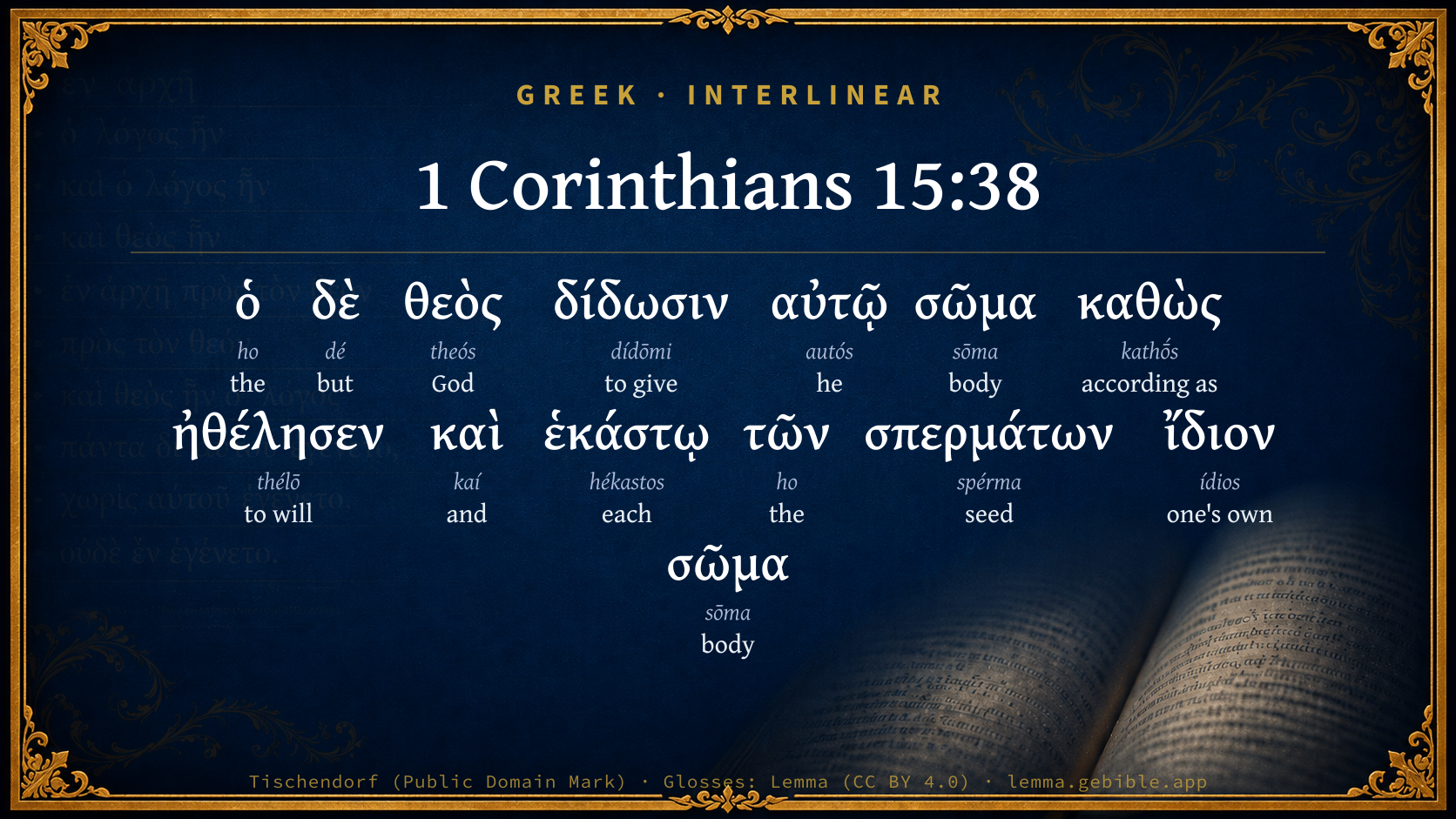
  1. ὁ ho G3588 “the” Article, Nominative, Singular, Masculine
  2. δὲ dé G1161 “but” Conjunction
  3. θεὸς theós G2316 “God” Noun, Nominative, Singular, Masculine
  4. δίδωσιν dídōmi G1325 “to give” Verb, Present, Active, Indicative, 3rd person, Singular
  5. αὐτῷ autós G846 “he” Personal pronoun, Dative, Singular, Masculine
  6. σῶμα sōma G4983 “body” Noun, Accusative, Singular, Neuter
  7. καθὼς kathṓs G2531 “according as” Adverb
  8. ἠθέλησεν thélō G2309 “to will” Verb, Aorist, Active, Indicative, 3rd person, Singular
  9. καὶ kaí G2532 “and” Conjunction
  10. ἑκάστῳ hékastos G1538 “each” Adjective, Dative, Singular, Neuter
  11. τῶν ho G3588 “the” Article, Genitive, Plural, Neuter
  12. ἴδιον ídios G2398 “one's own” Adjective, Accusative, Singular, Neuter
  13. σῶμα sōma G4983 “body” Noun, Accusative, Singular, Neuter

About this verse

These counts appear in no published source. They are computed here, from the morphology-tagged text and Lemma’s own curated glosses. What Lemma adds →

14
words
12
distinct lemmas
Pauline Epistles
section

Shared distinctive vocabulary

σπερμάτων seed G4690 occurs in 41 verses of the Greek New Testament. Also found in:
Repetition

Words recur within this verse:

Cross-references

5

Topical passages linked to 1 Corinthians 15:38 in the Treasury of Scripture Knowledge — connected by theme and wording, ordered by reader-vote popularity; previews shown in the World English Bible.

  • 1 Corinthians 3:7 So then neither he who plants is anything, nor he who waters, but God who gives the increase.
  • Isaiah 61:11 For as the earth brings forth its bud, and as the garden causes the things that are sown in it to spring forth; so the Lord Yahweh will cause righteousness and praise to spring forth before all the nations.
  • Genesis 1:11–12 God said, "Let the earth put forth grass, herbs yielding seed, and fruit trees bearing fruit after their kind, with its seed in it, on the earth," and it was so.
  • Psalms 104:14 He causes the grass to grow for the cattle, And plants for man to cultivate, That he may bring forth food out of the earth:
  • Mark 4:26–29 He said, "The Kingdom of God is as if a man should cast seed on the earth,

Cross-references courtesy of OpenBible.info (CC BY 4.0).

Commentary

Notes on 1 Corinthians 15:38 from classic Christian and Jewish commentators (each source and its license shown beneath its notes). The classic Christian expositions comment on the surrounding passage and are grouped to its opening verse, so a note may address several verses; the Jewish commentaries on the Tanakh (Rashi and others) are per-verse, so they appear only where the commentator wrote on this verse.

Lemma curates 59 commentaries, every one of them public domain or Creative Commons licensed, each selected and text-cleaned for this edition rather than reprinted as found. About our sources →

Bengel's Gnomon

Johann Albrecht Bengel

1Co 15:38. Ὁ δὲ Θεὸς, but God) Not thou, O man; not the grain itself.—αὐτῷ, to it) to the grain.—ἠθέλησε, He hath willed) The preterite in respect of creation, Gen 1:11: or at least because willing is before giving,—ἑκάστῳ, to every one) not only to the seed of fruits, but also to that of animals. A gradation to the following verse.—ἴδιον, its own) suitable to the species, peculiar to the individual, produced from the substance of the seed. This peculiarity is further explained in the following verse.

Bengel's Gnomon of the New Testament — English translation (T&T Clark, Edinburgh, 1860) — public domain. Text from a community e-Sword module.

Meyer's Critical & Exegetical Commentary

Heinrich August Wilhelm Meyer

1Co_15:38. Ὁ δὲ θεός] setting over against the σὺ ὃ σπείρεις, 1Co_15:36, what is done on Gods part with the seed which on mans part is sowe.

ἠθέλ.] has willed. It denotes the (already at the creation) completed act of the divine volition as embodied in the laws of natur.

καί] and indeed, as 1Co_3:5.

The diversity of the (peculiar, ἴδιον) organisms, which God bestows uponi.e. causes to spring forth out ofthe different seeds sown, while preserving the identity of the kinds, exposes all the more the folly of the question: ποίῳ δὲ σώματι ἔρχονται, in so far as it was meant to support the denial of the resurrection. As if God, who gives such varied plant-bodies to the sown grains, each according to its kind, could not also give new resurrection-bodies to the buried dead! How foolish to think that the same body which is buried (as e.g. the Pharisees conceived of the matter) must come forth again, if there is a resurrection! Every stalk of wheat, etc., refutes thee!

Meyer — Critical and Exegetical Commentary on the New Testament — English translation by Peter Christie, edited by Frederick Crombie (T&T Clark, 1880) — public domain. Text from a community e-Sword module.

Hodge's Commentary on Romans, Ephesians & First Corinthians

Charles Hodge

1Co_15:38

But God giveth it a body as it hath pleased him, and to every seed his own body.

What is deposited in the earth is very different from that which springs from it. Every seed produces its own plant. The product depends on the will of God. It was determined at the creation, and therefore the apostle says that God, in the continual agency of his providence, gives to each seed its own appropriate produce, as he willed, i.e. he originally purposed. The point of this is, if God thus gives to all the products of the earth each its own form, why may he not determine the form in which the body is to appear at the resurrection? You cannot infer from looking at a seed what the plant is to be; it is very foolish, therefore, to attempt to determine from our present bodies what is to be the nature of our bodies hereafter.

Charles Hodge — Commentary on Romans (1835), First Corinthians (1857), and Ephesians (1856) — public domain. Text from a community e-Sword module.

Geneva Bible (1599)

Geneva Bible translators

We see a diversity both in one and the selfsame thing which hath now one form and then another, and yet keepeth its own kind, as it is evident in a grain which is sown bare, but springeth up far after another sort: and also in divers kinds of one selfsame sort, as amongst beasts: and also among things of divers sorts, as the heavenly bodies and the earthly bodies: which also differ very much one from another. Therefore there is no cause why we should reject either the resurrection of the bodies, or changing of them into a better state, as a thing impossible, or strange.

Geneva Bible (1599) marginal notes — public domain. Text via Bolls.life.

Jamieson, Fausset & Brown

Robert Jamieson, A. R. Fausset & David Brown

as it hath pleased him--at creation, when He gave to each of the (kinds of) seeds (so the Greek is for "to every seed") a body of its own (Gen 1:11, "after its kind," suited to its species). So God can and will give to the blessed at the resurrection their own appropriate body, such as it pleases Him, and such as is suitable to their glorified state: a body peculiar to the individual, substantially the same as the body sown.

Jamieson, Fausset & Brown — Commentary Critical and Explanatory on the Whole Bible (1871) — public domain (CC PDM 1.0). Text via the HelloAO Bible API.

Adam Clarke's Commentary

Verse 38. But God giveth it a body] And is there any other way of accounting for it but by the miraculous working of God's power? For out of that one bare grain is produced a system of roots, a tall and vigorous stalk, with all its appendages of leaves, c., besides the full corn in the ear the whole making several hundred times the quantum of what was originally deposited. There are no proofs that what some call nature can effect this: it will ever be a philosophical as well as a Scriptural truth, that God giveth it a body as it pleaseth him; and so doth he manage the whole of the work, that every seed shall have its own body: that the wheat germ shall never produce barley; nor the rye, oats. See Clarke on Ge 1:12.

Adam Clarke's Commentary on the Bible (1810–1826) — public domain. Text from a community e-Sword/MySword module.

The Cambridge Bible for Schools and Colleges

gen. ed. J. J. S. Perowne

38. but God giveth it a body as it hath pleased him] Literally, as He willed. Cf. ch. 1Co_12:11 (where however the word is not the same in the Greek). “Life even in its lowest form has the power of assimilating to itself atoms.” Robertson. And these are arranged and developed according to the law that God has impressed on each seed.

and to every seed his own body] “That body with which it is raised may be called its own body, and yet it is a new body. It is raised anew with stem and leaves and fruit, and yet all the while we know that it is no new corn: it is the old life in the seed reappearing, developed in a higher form.” Robertson.

The Cambridge Bible for Schools and Colleges (gen. ed. J. J. S. Perowne; Cambridge University Press, 1878–1918) — public domain. Text from a community e-Sword module.

John Gill's Exposition

There is one glory of the sun,.... Which is the greater light, the fountain of light, and whose glory exceeds that of the other heavenly bodies:

and another glory of the moon; which is the lesser light, and receives its light from the sun, and consequently its glory is inferior:

and another glory of the stars; which though very bright and sparkling, and are innumerable, have a lesser glory, at least to our appearance, than the sun and moon: the Jews have a notion (u), that

"all the stars and the orbs are endued with a soul, and with knowledge, and understanding; and that they live, and stand, and know him that said, and the world was; and everyone of them, "according to his greatness", , "and according to his dignity", praise and glorify their Creator, as the angels; and as they know God, so they know themselves, and the angels that are above them; for the knowledge of the stars and the orbs is lesser than the knowledge of angels, and greater than the knowledge of men:''

for one star differeth from another star in glory; all which is to be understood, not as if the glory of the sun meant the glory of Christ, the sun of righteousness, who excels in glory, even in his human nature; and the glory of the moon, the glory of the church, who receives her's from Christ; and the glory of the stars; the glory of particular saints; and as if there will be, in the resurrection state, degrees of glory among them: for what peculiar glory can be thought to be upon the body of one, that is not upon another, when the righteous shall shine forth as the sun, in the kingdom of their Father? and admitting there was any truth in this, it is not the truth of this text; the only design of which, as the above, is to show, that as not only celestial and terrestrial bodies differ from each other, but even heavenly ones, so at the resurrection, the bodies of the saints then will differ in glory from their present ones; though these are now the members of Christ, are presented to God an holy sacrifice, and are washed with pure water.

(u) Maimon. Iesode Hatorah, c. 3. sect. 11.

John Gill's Exposition of the Whole Bible (1746–1763) — public domain (CC PDM 1.0). Text via the HelloAO Bible API.

Trapp's Complete Commentary

John Trapp

38 But God giveth it a body as it hath pleased him, and to every seed his own body.

Ver. 38. But God giveth it a body] Deus naturae vires et vices ita moderatur, &c., saith one. God so orders all, that nothing is done without him. The same Hebrew word מליוה that signifieth an ear of grain, doth also signify a word; because every field of grain is a book of God’s praise, every land a sheaf, every sheaf a verse, every ear a word, every corn of wheat a letter to express the power and goodness of God.

John Trapp, A Commentary or Exposition upon All the Books of the Old and New Testament (1647–1656) — public domain. Text from a community e-Sword module.

Albert Barnes' Notes on the Bible

But God giveth it a body ... - God gives to the seed sown its own proper body, formation, and growth. The word body here, as applied to grain, seems to mean the whole system, or arrangement of roots, stalks, leaves, flowers, and kernels that start out of the seed that is sown The meaning is, that such a form is produced from the seed sown as God pleases. Paul here traces the result to God, to show that there is no chance, and that it did not depend on the nature of things, but was dependent on the wise arrangement of God. There was nothing in the decaying kernel itself that would produce this result; but God chose that it should be so. There is nothing in the decaying body of the dead which in itself should lead to the resurrection; but God chose it should be so.

As it hath pleased him - As he chose. It is by his arrangement and agency. Though it is by regular laws, yet it is as God pleases. He acts according to his own pleasure, in the formation of each root, and stalk, and kernel of grain. It is, probably, here intimated that God would give to each one of the dead at the resurrection such a body as he should choose, though it will be, doubtless, in accordance with general laws.

And to every seed his own body - That which appropriately belongs to it; which it is suited to produce; which is of the same kind. He does not cause a stalk of rye to grow from a kernel of wheat; nor of maize from barley; nor of hemp from lenthes. He has fixed proper laws, and he takes care that they shall be observed. So it will be in the resurrection. Everyone shall have his own, that is, his proper body - a body which shall belong to him, and be suited to him. The wicked shall not rise with the body of the just, or with a body adapted to heaven; nor shall the saint rise with a body adapted to perdition. There shall be a fitness or appropriateness in the new body to the character of him who is raised. The argument here is designed to meet the inquiry how should the body be raised, and it is that there is nothing more remarkable and impossible in the doctrine of the resurrection, than in the fact constantly before us, that grain that seems to rot sends up a shoot or stalk, and is reproduced in a wonderful and beautiful manner. In a manner similar to this, the body will be raised; and the illustration of Paul meets all the difficulties about the fact of the resurrection. It cannot be shown that one is more difficult than the other; and as the facts of vegetation are constantly passing before our eyes, we ought not to deem it strange if similar facts shall take place hereafter in regard to the resurrection of the dead.

Albert Barnes' Notes on the Bible (1834–1885) — public domain. Text from a community e-Sword/MySword module.

Matthew Poole's English Annotations

But God giveth to every grain, or kind of seed, such a kind of body as it pleaseth him, and a several body, according to the nature of the grain; yet none will deny, but it is the seed sown which cometh up, though with a different body, in respect of some qualities.

Matthew Poole's English Annotations on the Holy Bible (1683–1685) — public domain. Text from a community e-Sword/MySword module.

Whedon's Commentary on the Bible

Daniel D. Whedon

38. But God giveth it—And it was just because the Gnostical objector had a semi-pagan ignorance of God, (note on 1Co_15:34,) that he could not realize that God can reorganize old matter in new glory.

Pleased him— For the laws of the resurrection, like the laws of nature, are a mode of the divine volition. The new body is produced by God’s power, and just as he wills.

To every (kind of) seed his own body—And so God may modify the resurrection body so as to destroy the objector’s supposition that the same body means a corrupt body.

Daniel D. Whedon (gen. ed.), Commentary on the Old and New Testaments (1874–1909) — public domain. Text from a community e-Sword module.

The Pulpit Commentary

But God giveth it a body. The material body of each living organism results from those laws of assimilation which God has made a part of His secret of life. They are not the life, only the instrument and expression and manifestation of the life. The "life" is the individual identity. The life of Hamlet is not in its essence the physical life of "the machine which is to him Hamlet," but the spiritual life which is linked on earth to that perpetual flux of material particles which we call the body, but is independent of those particles. As it hath pleased him; literally, as he willed. And in the word "as" lies the scope for all theories about the part played by what are called "natural laws." Their action is a part of God"s will. To every seed his own body. Each of the seeds sown is provided with a body of its own, which is not identical with the seed, bat results from the germ of life in the seed.

The Pulpit Commentary (1880–1919), ed. H.D.M. Spence-Jones & Joseph S. Exell — public domain. Text from a community e-Sword module.

John Wesley's Explanatory Notes

But God - Not thou, O man, not the grain itself, giveth it a body as it hath pleased him, from the time he distinguished the various Species of beings; and to each of the seeds, not only of the fruits, but animals also, (to which the Apostle rises in the following verse,) its own body; not only peculiar to that species, but proper to that individual, and arising out of the substance of that very grain.

John Wesley, Explanatory Notes Upon the Whole Bible (1754–1765) — public domain. Text via the GEBible commentary corpus.

McGarvey & Pendleton's Commentaries

J. W. McGarvey

but God giveth it a body even as it pleased him [guided by his sense of fitness and propriety], and to each seed a body of its own . [In this paragraph Paul answers the first question of 1Co_15:35 . The Corinthians, like all materialists, made the resurrection a puzzling problem. They wondered how God could restore a body which returned to the dust, passed thence into vegetation, and thence into the bodies of animals and other men. Paul calls the man who thus puzzles himself a foolish one, because he denies that the all-powerful God can do with a human body that which he himself practically does annually with the bodies (grains) of wheat, etc., by merely availing himself of the common course of nature. When he sows a grain of wheat he does not expect it to come up a naked grain as he sowed it, but he knows that it will die, and in its death produce another body, consisting of stalk, blade, head and other grains similar to the one sown. He knows that though the body thus produced bear small outward resemblance to the single grain planted, yet it is the product of the grain's germinal life, and on examination can be absolutely demonstrated to be such. Moreover, by doing this same thing with corn, oats and other grain he finds that each produces a body of its own kind, adapted by the wisdom of God to its needs. With all this before him, how foolish in man to deny that God can cause the dead body to rise in a higher and nobler form, and that he can also cause each man to have a resurrected body true to his individuality, so that Smith shall no more rise in the likeness of Jones than corn come up after the similitude of oats. But the analogy taught by nature is true in another respect; i. e., the body produced by the seed is greater and more excellent than the seed. Paul enlarges and applies this thought.]

J. W. McGarvey (with Philip Y. Pendleton), Commentaries on the New Testament (The Fourfold Gospel, 1914; Acts; and the epistles) — public domain. Text from a community e-Sword/MySword module.

The People's New Testament

B. W. Johnson

38. But God giveth it a body, etc. To the seed planted God gives a new body, the stalk of wheat or corn, or whatever it may be. This new body bears no outward resemblance to the seed planted.

B. W. Johnson's The People's New Testament with Notes (1889–1891) — public domain. Electronic text from the Christian Classics Ethereal Library (CCEL) ThML edition.

Cambridge Greek Testament for Schools and Colleges

38. καθὼς ἠθέλησεν. Literally, as He willed. Cf. ch. 1Co 12:11 (where however the word is not the same in the Greek). ‘Life even in its lowest form has the power of assimilating to itself atoms.’ Robertson. And these are arranged and developed according to the law that God has impressed on each seed.

ἴδιον σῶμα. The omission of the article of the rec. text gives a more vivid sense, and to every seed a body of its own. ‘That body with which it is raised may be called its own body, and yet it is a new body. It is raised anew with stem and leaves and fruit, and yet all the while we know that it is no new corn: it is the old life in the seed reappearing, developed in a higher form.’ Robertson.

Cambridge Greek Testament for Schools and Colleges (Cambridge University Press, 1896; 21 vols, various authors incl. Carr, Maclear, Plummer, Farrar, Lumby, Moule, M. R. James, Simcox) — public domain. Text from a community e-Sword module.

Alford’s Greek Testament

Henry Alford

38.] ἠθέλησεν, willed, viz. at the creation: the aor. setting forth the one act of the divine Will giving to the particular seed the particular development at first, which the species retains: whereas θέλει would imply a fresh act of the divine Will giving to every individual seed (not ἑκάστῳ τῶν σπερμάτων, but ἐκάστῳ σπέρματι, or rather ἑκάστῳ κόκκῳ) his own body. But the whole gift to the species being God’s, to continue or withhold, the pres. δίδωσιν still holds good.

ἑκάστ. τῶν σπερμ.] to each of the (kinds of) seed; see above: τῶν is generic.

ἵδιον σῶμα] a body of its own. Such then being the case with all seeds, why should it be thought necessary that the same body should rise as was sown, or that God cannot give to each a resurrection-body, as in nature?

Henry Alford, The Greek Testament (1849–1861) — public domain. Text from a community e-Sword module.

International Critical Commentary

38. ὁ δὲ Θεός. This is the important point. Neither the seed itself, nor the sower, provides the new body; ‘but it is God that giveth it a body exactly as He willed, and to each of the seeds a body of its own,’ i.e. the right body, the one that is proper to its kind. Therefore to every buried human being He will give a proper resurrection-body. The use of σῶμα of vegetation reminds us that the illustration has reference to the human body: and καθὼς ἠθέλησεν, as in 12:18 (not καθὼς θέλει, or καθὼς βούλεται, as in 12:11), shows that God does not deal with each case separately, just as He pleases at the moment, but according to fixed laws, just as it pleased Him when the world was created and regulated. * From the first, vegetation has had its laws κατὰ γένος καὶ καθʼ ὁμοιότητα (Gen 1:11, Gen 1:12), and great as is the variety of plants, the seed of each has a body of its own, in which the vital principle, to be brought into action by death and decay, resides. See Orr, Expositor, Nov. 1908, p. 436; Milligan, Greek Papyri, pp. 91, 101.

International Critical Commentary — older volumes (1896–1929), various authors — public domain. Text from a community e-Sword module.

Vincent's Word Studies in the New Testament

Marvin R. Vincent

As it hath pleased [καθως ηθελησεν] . Lit., even as He willed; at the creation, when He fixed the different types of grain, so that each should permanently assume a form according to its distinctive type - a body of its own : that wheat should always be wheat, barley barley, etc. Compare Gen 1:11, 12.

Marvin R. Vincent, Word Studies in the New Testament (1887–1900) — public domain. Text from a community e-Sword/MySword module.

Godet's Commentaries

Frédéric Louis Godet

Vv. 38. With this bareness of the grain deposited in the earth, the apostle contrasts God’s creative power, which quickly invests the seed with the covering, the body assigned to its kind, by making the plant sprout which is to serve as its organ. By saying: as it hath pleased Him, and not: as it pleases Him, Paul certainly refers to the law of vegetation established by God for every plant at the time of creation. This Divine volition remains in the bosom of changing nature; it controls beforehand the result of the sower’s action. It is obvious how false it is to allege that Scripture knows nothing of the constancy of the laws of nature. The author who wrote, Gen 1:11, in speaking of plants of all sorts: “bearing fruit after their kind,” already understood this fundamental fact.

Thus the hundred thousand species of plants of which the vegetable kingdom is composed are all organized in such a way that to this infinite variety of seeds there corresponds an exactly similar variety of vegetable organisms. The article τό, the, before ἴδιον is to be rejected. In these last words: “A body of its own,” there is implicitly contained the answer to the second question of 1Co 15:35 : With what body? The God who took care at the creation to furnish every seed with a body of its own, will know how to give to the energy hidden in our terrestrial body the new organ it will need when this vital principle shall be set free by death from the temporary wrapping in which it is now hidden. And to satisfy the inquirer who put the questions of 1Co 15:35, on the subject of the new organ which is to replace our earthly body, and to prevent his imagining that God might be at a loss to produce a body entirely different from the present, the apostle invites him to cast a glance over the infinite diversity of the organisms which form the visible universe: 1Co 15:39-41. The variety of vegetable organisms bears on form only, not on substance; it would not therefore of itself authorize the conclusion which the apostle wishes to establish, namely, the possibility of a new body, substantially different from our present body. Hence it is that he instances in the totality of nature differences still more profound than he had pointed out between the various kinds of plants.

Frédéric Louis Godet — Commentaries on Luke, John, Romans, and 1 Corinthians — English translation (T&T Clark, Edinburgh, 1870s–1890s) — public domain. Text from a community e-Sword module.

Lesson kit

Teaching starters — assembled from the data on this page, not authored interpretation. Every prompt links to the verse data it draws on. Edit before teaching.

1 Corinthians, in the Pauline Epistles, opens this verse with 14 words (12 distinct Greek lemmas). Its most distinctive word is spérma (“seed”). A historical commentator’s framing appears above. Read the whole chapter for the surrounding context.

Discussion questions

  1. The word spérma carries the sense “seed.” How does it shape the verse?
  2. Matthew 13:24 shares the word «seed» with this verse. How do the two illuminate each other?
  3. “body” occurs 2× in this one verse. What is the effect of the repetition?
  4. These translations render this verse differently. What is at stake in choosing one wording over another?
  5. Reading how Bengel's Gnomon and Meyer's Critical & Exegetical Commentary read this verse, where do the two commentators agree and where do they part?

Things to notice

Reading settings

Reading text

Shown beneath each verse's original-language words.

Old Testament
Old Testament edition

Read the OT as the Masoretic Hebrew (MT) or the Greek Septuagint (LXX).

English shown for the Greek Septuagint (in the Hebrew ↔ Greek comparison).

Comparing translations? Open the Compare panel on any verse page to stack up to four side by side.