1 Corinthians 5:2

Greek (Tischendorf 8th ed.) 1 Corinthians 5:2 appears in the Greek New Testament. The text above is from the Tischendorf 8th edition. Each word links to its Strong’s number and a concise gloss. Click any word for its full Thayer’s Greek Lexicon entry.
Download image
Cite this verse

1 Corinthians 5:2 (World English Bible). Public Domain. Lemma interlinear Bible study tool, https://lemma.gebible.app/v/1-corinthians/5/2.

Show BibTeX & RIS
BibTeX
RIS
English Translation
You are puffed up, and didn't rather mourn, that he who had done this deed might be removed from among you.
World English Bible · Public Domain
Download a study sheet

One document with this verse’s original text, its word-by-word gloss line, the meaning frame, cross-references with their text, attributed commentary, and full source and license credits — printable, and it pastes into notes with its structure intact.

This verse Autodidact and up

Study sheet (.html) Plain text (.txt)

A passage Seminary Student

Up to 50 verses in one chapter. A passage sheet keeps up to 6 commentary sources and 12 cross-references per verse, in the order this page ranks them, and says so on the sheet whenever that leaves anything out. Ask for a single verse and you get the Autodidact verse sheet above.

Everything on this page stays free to read, with no account — the sheet is a download of what is already on screen, not access to it.

Want to remove ads? Support Godless Engineer
Compare translations 3

The same verse in 3 English versions, stacked beneath the original-language interlinear above. Click any original word for its lexicon entry.

Each is an independent rendering of the whole verse — the interlinear is not word-aligned to these translations.

Highlighted words mark where these versions differ — a whole-verse word diff, not a word-by-word alignment.

  • World English Bible Public Domain
    You are puffed up, and didn't rather mourn, that he who had done this deed might be removed from among you.
  • King James Version Public Domain
    And ye are puffed up, and have not rather mourned, that he that hath done this deed might be taken away from among you.
  • unfoldingWord Literal Text CC BY-SA 4.0
    And you are puffed up, and you did not mourn instead, so that the one having done this deed might be removed from among you.

unfoldingWord Literal Text — © unfoldingWord, licensed CC BY-SA 4.0. Word-aligned USFM3 via Door43 (git.door43.org/unfoldingWord/en_ult).

Versions to compare (up to 4)

3 of 4 selected

Show all 19 translations

Every available English version of this verse, each an independent rendering of the whole verse.

  • World English Bible Public Domain
    You are puffed up, and didn't rather mourn, that he who had done this deed might be removed from among you.
  • Berean Standard Bible Public Domain
    And you are proud! Shouldn’t you rather have been stricken with grief and have removed from your fellowship the man who did this?
  • Majority Standard Bible Public Domain
    And you are proud! Shouldn’t you rather have been stricken with grief and have removed from your fellowship the man who did this?
  • King James Version Public Domain
    And ye are puffed up, and have not rather mourned, that he that hath done this deed might be taken away from among you.
  • American Standard Version (1901) Public Domain
    And ye are puffed up, and did not rather mourn, that he that had done this deed might be taken away from among you.
  • Revised Version (1885) Public Domain
    And ye are puffed up, and did not rather mourn, that he that had done this deed might be taken away from among you.
  • Geneva Bible (1599) Public Domain
    And ye are puffed vp and haue not rather sorowed, that he which hath done this deede, might be put from among you.
  • Douay-Rheims (1899) Public Domain
    And you are puffed up; and have not rather mourned, that he might be taken away from among you, that hath done this deed.
  • Young's Literal Translation Public Domain
    and ye are having been puffed up, and did not rather mourn, that he may be removed out of the midst of you who did this work,
  • Literal Standard Version CC BY-SA 4.0
    And you are having been puffed up, and did not rather mourn, that he may be removed out of the midst of you who did this work,
  • Unlocked Literal Bible CC BY-SA 4.0
    You are so arrogant! Should you not mourn instead? The one who did this must be removed from among you.
  • unfoldingWord Literal Text CC BY-SA 4.0
    And you are puffed up, and you did not mourn instead, so that the one having done this deed might be removed from among you.
  • Darby Bible Public Domain
    And *ye* are puffed up, and ye have not rather mourned, in order that he that has done this deed might be taken away out of the midst of you.
  • World Messianic Bible Public Domain
    You are arrogant, and didn’t mourn instead, that he who had done this deed might be removed from among you.
  • Webster's Bible Public Domain
    And ye are puffed up, and have not rather mourned, that he who hath done this deed might be taken away from among you.
  • Free Bible Version CC BY-SA 4.0
    You are so proud of yourselves! Shouldn't you have wept with sadness, and excluded the man who did this?
  • Bible in Basic English Public Domain
    And in place of feeling sorrow, you are pleased with yourselves, so that he who has done this thing has not been sent away from among you.
  • Text-Critical English NT CC BY 4.0
    And you are puffed up! You should have mourned instead and removed the man who did this from among you.
  • Tyndale New Testament (1534) Public Domain
    And ye swell and have not rather sorowed that he which hath done this dede myght be put from amonge you.

Literal Standard Version (2020), Covenant Press — licensed CC BY-SA 4.0. Text via the HelloAO Bible API (eBible.org). Unlocked Literal Bible (unfoldingWord) — licensed CC BY-SA 4.0. Text via the HelloAO Bible API (eBible.org). unfoldingWord Literal Text — © unfoldingWord, licensed CC BY-SA 4.0. Word-aligned USFM3 via Door43 (git.door43.org/unfoldingWord/en_ult). Free Bible Version, Dr. Jonathan Gallagher — licensed CC BY-SA 4.0. Text via the HelloAO Bible API (eBible.org).

Word by word

More ways to search: Search by grammar → Find every occurrence → Compare this word →

Practice this passage: Drill this verse → Learn its vocabulary →

πεφυσιωμένοι
physióō
G5448
“to inflate”
Verb, Perfect, Passive, Participle, Nominative, Plural, Masculine
Part of Speech
Verb
Tense
Perfect
Voice
Passive
Mood
Participle
Case
Nominative
Number
Plural
Gender
Masculine
Full Thayer's Definition

Origin: from G5449 in the primary sense of blowing

TDNT: None

1. to make natural, to cause a thing to pass into nature 2. to inflate, blow up, to cause to swell up a. to puff up, make proud b. to be puffed up, to bear one's self loftily, be proud
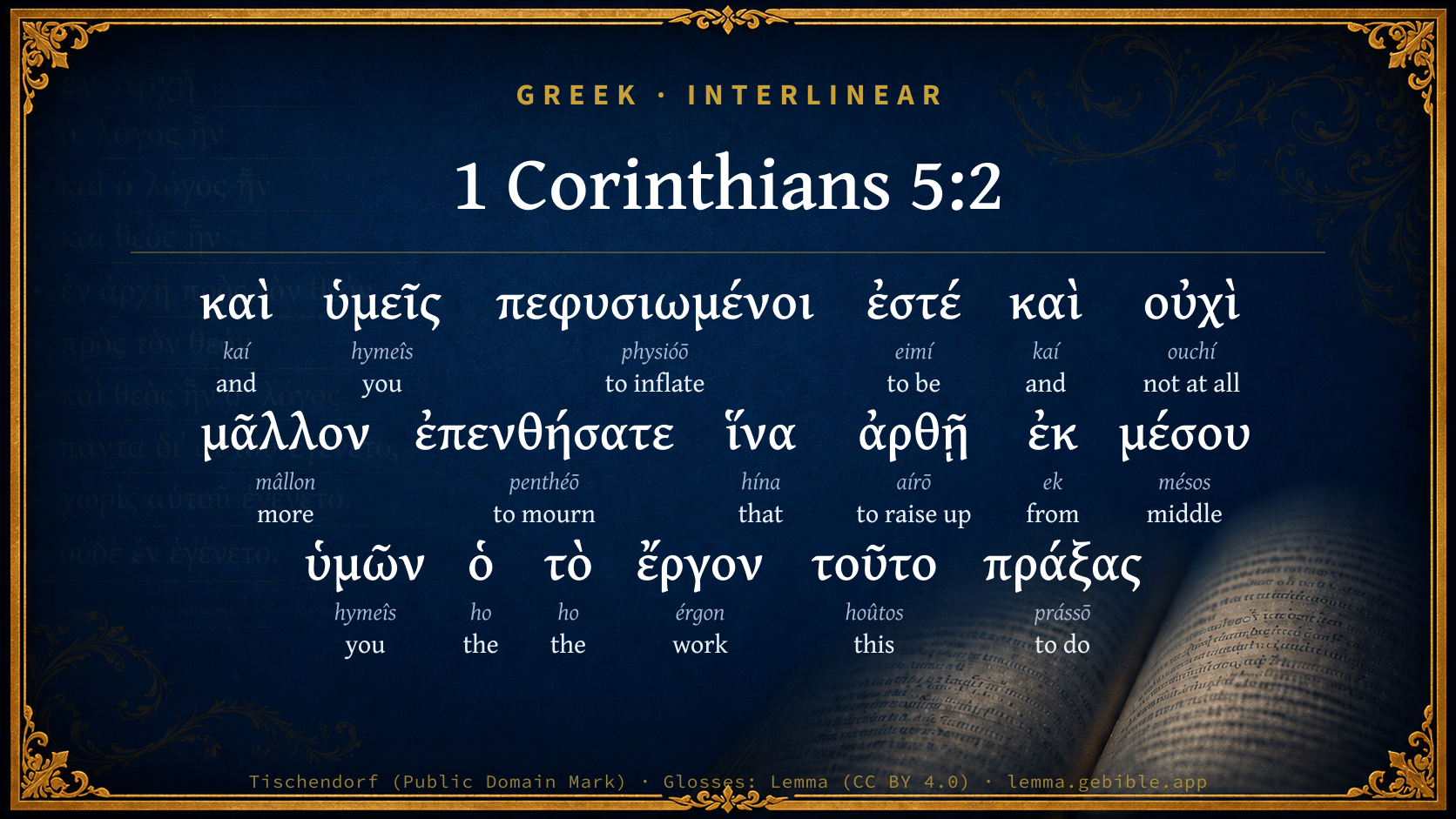
  1. καὶ kaí G2532 “and” Conjunction
  2. ὑμεῖς hymeîs G5210 “you” Personal pronoun, 2nd person, Nominative, Plural
  3. ἐστέ eimí G1510 “to be” Verb, Present, Active, Indicative, 2nd person, Plural
  4. καὶ kaí G2532 “and” Conjunction
  5. οὐχὶ ouchí G3780 “not at all” Particle, Interrogative
  6. μᾶλλον mâllon G3123 “more” Adverb
  7. ἐπενθήσατε penthéō G3996 “to mourn” Verb, Aorist, Active, Indicative, 2nd person, Plural
  8. ἵνα hína G2443 “that” Conjunction
  9. ἀρθῇ aírō G142 “to raise up” Verb, Aorist, Passive, Subjunctive, 3rd person, Singular
  10. ἐκ ek G1537 “from” Preposition
  11. μέσου mésos G3319 “middle” Adjective, Genitive, Singular, Neuter
  12. ὑμῶν hymeîs G5210 “you” Personal pronoun, 2nd person, Genitive, Plural
  13. ὁ ho G3588 “the” Article, Nominative, Singular, Masculine
  14. τὸ ho G3588 “the” Article, Accusative, Singular, Neuter
  15. ἔργον érgon G2041 “work” Noun, Accusative, Singular, Neuter
  16. τοῦτο hoûtos G3778 “this” Demonstrative pronoun, Accusative, Singular, Neuter
  17. πράξας prássō G4238 “to do” Verb, Aorist, Active, Participle, Nominative, Singular, Masculine

About this verse

These counts appear in no published source. They are computed here, from the morphology-tagged text and Lemma’s own curated glosses. What Lemma adds →

18
words
15
distinct lemmas
Pauline Epistles
section

Notable vocabulary

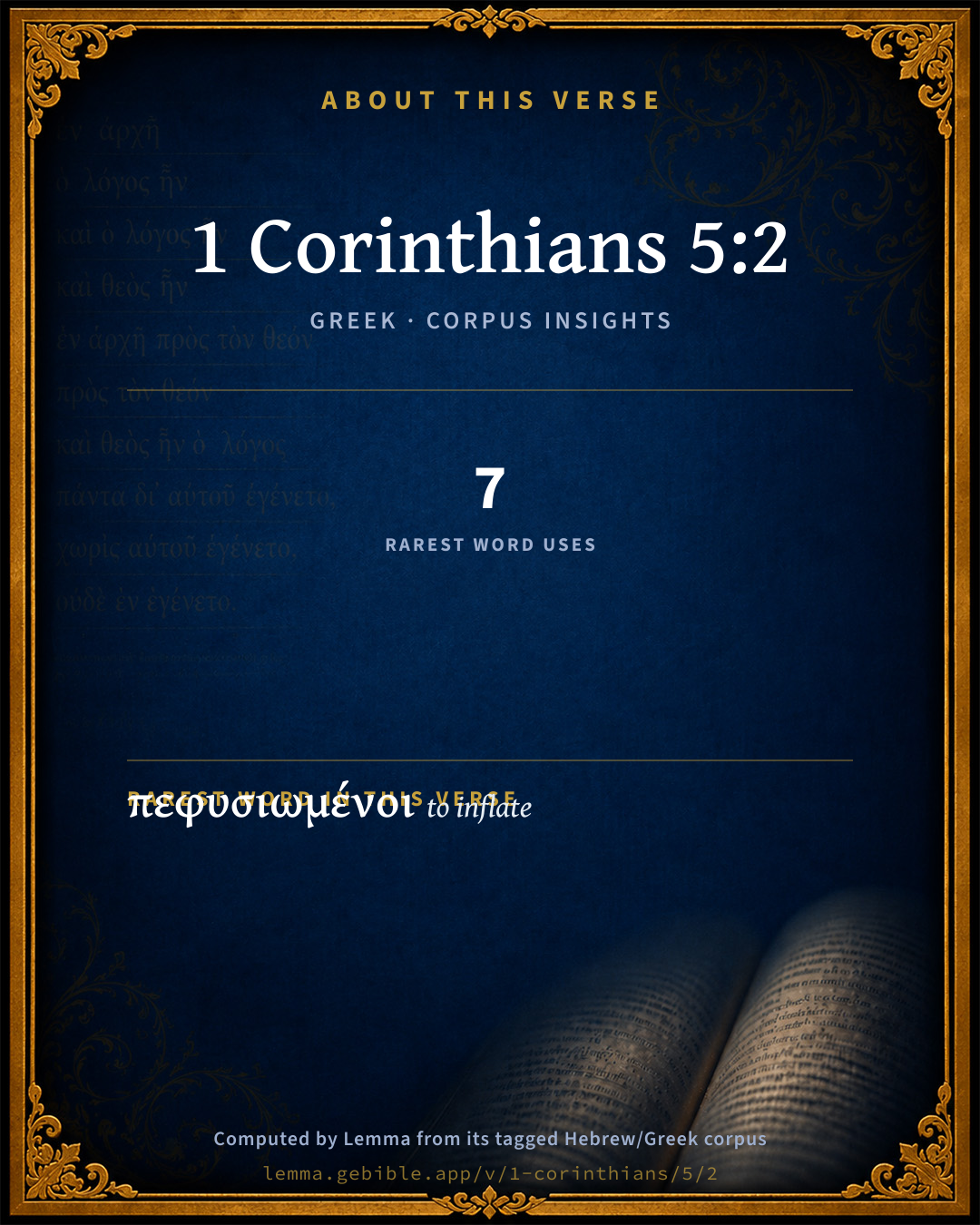
The rarest word here is πεφυσιωμένοι to inflate G5448 — appearing just 7 times in the whole Greek New Testament.

Shared distinctive vocabulary

πεφυσιωμένοι to inflate G5448 occurs in 7 verses of the Greek New Testament. Also found in:

Repetition

Words recur within this verse:

Cross-references

15

Topical passages linked to 1 Corinthians 5:2 in the Treasury of Scripture Knowledge — connected by theme and wording, ordered by reader-vote popularity; previews shown in the World English Bible.

  • Revelation 2:20–22 But I have this against you, that you tolerate your woman, Jezebel, who calls herself a prophetess. She teaches and seduces my servants to commit sexual immorality, and to eat things sacrificed to idols.
  • 2 Corinthians 7:7–11 and not by his coming only, but also by the comfort with which he was comforted in you, while he told us of your longing, your mourning, and your zeal for me; so that I rejoiced still more.
  • 1 Corinthians 5:13 But those who are outside, God judges. "Put away the wicked man from among yourselves."
  • 2 Corinthians 12:21 that again when I come my God would humble me before you, and I would mourn for many of those who have sinned before now, and not repented of the uncleanness and sexual immorality and lustfulness which they committed.
  • Numbers 25:6 Behold, one of the children of Israel came and brought to his brothers a Midianite woman in the sight of Moses, and in the sight of all the congregation of the children of Israel, while they were weeping at the door of the tent of meeting.
  • 2 Kings 22:19 because your heart was tender, and you did humble yourself before Yahweh, when you heard what I spoke against this place, and against the inhabitants of it, that they should become a desolation and a curse, and have torn your clothes, and wept before me; I also have heard you, says Yahweh.
  • Ezra 9:2–6 For they have taken of their daughters for themselves and for their sons, so that the holy seed have mixed themselves with the peoples of the lands: yes, the hand of the princes and rulers has been chief in this trespass.
  • Ezra 10:1–6 Now while Ezra prayed and made confession, weeping and casting himself down before the house of God, there was gathered together to him out of Israel a very great assembly of men and women and children; for the people wept very sore.
  • Psalms 119:136 Streams of tears run down my eyes, Because they don't observe your law.
  • Jeremiah 13:17 But if you will not hear it, my soul shall weep in secret for [your] pride; and my eye shall weep sore, and run down with tears, because Yahweh's flock is taken captive.
  • Ezekiel 9:4 Yahweh said to him, Go through the midst of the city, through the midst of Jerusalem, and set a mark on the foreheads of the men that sigh and that cry over all the abominations that are done in the midst of it.
  • Ezekiel 9:6 kill utterly the old man, the young man and the virgin, and little children and women; but don't come near any man on whom is the mark: and begin at my sanctuary. Then they began at the old men that were before the house.
  • 1 Corinthians 4:6–8 Now these things, brothers, I have in a figure transferred to myself and Apollos for your sakes, that in us you might learn not to think beyond the things which are written, that none of you be puffed up against one another.
  • 1 Corinthians 4:18 Now some are puffed up, as though I were not coming to you.
  • 1 Corinthians 5:5–7 are to deliver such a one to Satan for the destruction of the flesh, that the spirit may be saved in the day of the Lord Jesus.

Cross-references courtesy of OpenBible.info (CC BY 4.0).

Commentary

Notes on 1 Corinthians 5:2 from classic Christian and Jewish commentators (each source and its license shown beneath its notes). The classic Christian expositions comment on the surrounding passage and are grouped to its opening verse, so a note may address several verses; the Jewish commentaries on the Tanakh (Rashi and others) are per-verse, so they appear only where the commentator wrote on this verse.

Lemma curates 59 commentaries, every one of them public domain or Creative Commons licensed, each selected and text-cleaned for this edition rather than reprinted as found. About our sources →

Tyndale Open Study Notes

Tyndale Open Resources

5:2 The Corinthian Christians were proud (see 4:8, 10, 18; 5:6), when they should have been mourning in sorrow and shame over such sin among them. • remove this man from your fellowship: This instruction might presuppose that the man had refused their appeals, or that such blatant sin required immediate discipline (cp. Matt 18:15-18).

Tyndale Open Study Notes — © Tyndale Open Resources, licensed CC BY-SA 4.0. Text via the HelloAO Bible API.

Bengel's Gnomon

Johann Albrecht Bengel

1Co 5:2. Καὶ ὑμεῖς, and ye) He presses their sin home to them.—πεφυσιωμένοι, puffed up) [as if you were free from blame in the matter.—V.g.]—The force of the word is evident from its antithesis, to mourn.—ἐστε, ye are) hitherto.—ἐπενθήσατε, you have mourned) Paul himself wrote these words mourning, nay weeping; 2Co 2:4; we should mourn over the transgressions of others; 2Co 12:21, and repent of our own; and we should do both as regards the first and original sin.—ἵνα, that) you have felt no grief, which might stir you up, that, etc.—ἀρθῆ, he might be taken away) Paul has already in his mind what he is about to write at 1Co 5:13.—αἴρειν is a milder word here, than ἐξαίρειν afterwards.[38]

[38] Τὸ ἔργον, the daring deed) It was a wicked action, without marriage.—V. g.

Bengel's Gnomon of the New Testament — English translation (T&T Clark, Edinburgh, 1860) — public domain. Text from a community e-Sword module.

Meyer's Critical & Exegetical Commentary

Heinrich August Wilhelm Meyer

1Co_5:2. A question suddenly introduced with and, laying bare the incongruity of this state of things with the attitude previously noticed (see Hartung, Partikell. I. p. 146 f.).

ὑμεῖς emphatic: Ye, the people among whom so disgraceful a thing can occur; for κοινὸν πάντων τὸ ἔγκλημα γέγονε, Chrysostom.

πεφυσ. ἐστέ] What is meant is the spiritual self-conceit already censured (1Co_4:6 ff., 1Co_4:18) regarding the lofty degree of Christian wisdom and perfection in general, which they supposed themselves to have reached; not pride in the incestuous person himself, who is conceived to have been a highly-esteemed teacher (Chrysostom, Theophylact, Grotius).

ἐπενθήσ.] are fallen into distress (penitential mourning), for by reason of the fellowship between Christians (comp 1Co_12:26) ἜΔΕΙ ΠΕΝΘῆΣΑΙ, ΔΙΌΤΙ ΕἸς ΤῸ ΚΟΙΝῸΝ Τῆς ἘΚΚΛΗΣΊΑς Ἡ ΔΙΑΒΟΛῊ ΠΡΟΕΧΏΡΗΣΕΝ, Theophylact, comp Chrysostom.

ἽΝΑ ἈΡΘῇ Κ.Τ.Λ[759]] The design which, according to the apostles view, the ἐπενθ. ought to have had, and the attainment of which would have been its result, had it taken place: in order that he might be removed, etc. It intensifies and completes the contrast with their conceited self-assurance, and leads appropriately to the introduction of his own judicial sentence, which comes in, 1Co_5:3, with ἐγὼ μὲν γὰρ κ.τ.λ[760]; all the less, therefore, is ἽΝΑ ἈΡΘῇ Κ.Τ.Λ[761] to be regarded as forming such a judicial utterance (Pott, Hofmann) standing forth with imperative independence: Away with him, etc. (see on 2Co_8:7). That does not come in until 1Co_5:13.

ἔργον] facinus, the nature of which is shown by the context. See Ellendt, Lex. Soph. I. p. 671.

[759] .τ.λ. καὶ τὰ λοιπά.

[760] .τ.λ. καὶ τὰ λοιπά.

[761] .τ.λ. καὶ τὰ λοιπά.

Meyer — Critical and Exegetical Commentary on the New Testament — English translation by Peter Christie, edited by Frederick Crombie (T&T Clark, 1880) — public domain. Text from a community e-Sword module.

Expositor's Greek Testament

ed. W. Robertson Nicoll

1Co 5:2 . What are the Cor [805] doing under this deep disgrace? Not even grieving . Καὶ ὑμεῖς πεφυσιωμένοι ἐστέ ; κ . τ . λ .: “And are you (still) puffed up? and did you not rather mourn?” For the grammatical force of πεφυσ . ἐστέ , see parls. in 1Co 1:10 , 1Co 4:8 ; and for the vb [806] , note to 1Co 4:6 . P. confronts the pride of the Cor [807] Church with this crushing fact; no intellectual brilliance, no religious enthusiasm, can cover this hideous blot: “argumentatur a contrario, ubi enim luctus est, cessit gloria” (Cv [808] ). The ver. is best read interrogatively , in view of the οὐχὶ in 2nd clause ( cf. 1Co 1:20 ), and in Paul’s expostulatory style ( cf. 1Co 4:7 f.). ἐπενθήσατε (see parls.) connotes funeral mourning over “a brother dead to God, by sin, alas! undone;” the tense signifies “ going into mourning” “breaking out in grief” (Ev [809] ) when you heard of it. Of such grief the fit sequel is expressed by ἵνα ἄρθῃ ἐκ μέσου ὑμῶν , “that he should be removed from your midst, who so perpetrated this deed”. This is the later Gr [810] “sub-final” ἵνα , of the desired result: see Wr [811] , p. 420; Bm [812] , p. 237; cf. 1Co 14:12 f. πράξας , as distinguished from ποιήσας (T.R.), implies quality in the action (see parls.).

[805] Corinth, Corinthian or Corinthians.

[806] verb

[807] Corinth, Corinthian or Corinthians.

[808] Calvin’s In Nov. Testamentum Commentarii .

[809] T. S. Evans in Speaker’s Commentary .

[810] Greek, or Grotius’ Annotationes in N.T.

[811] Winer-Moulton’s Grammar of N.T. Greek (8th ed., 1877).

[812] A. Buttmann’s Grammar of the N.T. Greek (Eng. Trans., 1873).

The Expositor's Greek Testament, edited by W. Robertson Nicoll (1897–1910) — public domain. Text from a community e-Sword module.

Hodge's Commentary on Romans, Ephesians & First Corinthians

Charles Hodge

1Co_5:2

And ye are puffed up, and have not rather mourned, that he that hath done this deed might be taken away from among you.

They were puffed up, i.e. elated with the conceit of their good estate, notwithstanding they were tolerating in their communion a crime which even the heathen abhorred. Some have endeavored to account for the occurrence of such an offense, and for the remissness of the church in relation to it, by supposing that both the offender and the church acted on the principle taught by many of the Jews, that all bonds of relationship were dissolved by conversion. The proselyte to Judaism became a new creature. He received a new name. His father was no longer his father, or his mother his mother. The Rabbins therefore taught that a proselyte might lawfully marry any of his nearest kindred. It is possible that such a notion may have partially prevailed among the Jewish portion of the church; but not very probable,

1. Because of its absurdity;

2. Because its prevalence among the Jews was only after their reprobation as a people;

3. Because the wiser class of the Jews themselves condemned it.

It is more probable, if the crime was defended at all, it was on the principle that the Scriptures and nature condemn intermarriages on the ground only of consanguinity and not also of affinity. A principle opposed to Leviticus 18, and to what the apostle here teaches.

And have not rather mourned (ἐπενθήσατε), i.e. grieved for yourselves. Your condition, instead of filling you with pride, should humble you and make you sad. That (ἵνα), not so that, but in order that, as expressing the design which the apostle contemplated in their humiliation and sorrow. Comp. Joh_11:15. I would that ye were grieved and sorry for yourselves, in order that he who had done this deed might be taken away. The ἵνα may depend on a word implied. Ye have not mourned, desiring that, etc. Chrysostom says the idea is, that they should have acted as they would have done had a pestilence appeared among them which called for mourning and supplication in order that it might be removed. It is a right inherent in every society, and necessary for its existence, to judge of the qualification of its own members; to receive those whom it judges worthy, and to exclude the unworthy. This right is here clearly recognized as belonging to the church. It is also clear from this passage that this right belongs to each particular church or congregation. The power was vested in the church of Corinth, and not in some officer presiding over that church. The bishop or pastor was not reproved for neglect of discipline; but the church itself, in its organized capacity.

Charles Hodge — Commentary on Romans (1835), First Corinthians (1857), and Ephesians (1856) — public domain. Text from a community e-Sword module.

Geneva Bible (1599)

Geneva Bible translators

There are none more proud, than they that least know themselves.

Geneva Bible (1599) marginal notes — public domain. Text via Bolls.life.

Jamieson, Fausset & Brown

Robert Jamieson, A. R. Fausset & David Brown

puffed up--with your own wisdom and knowledge, and the eloquence of your favorite teachers: at a time when ye ought to be "mourning" at the scandal caused to religion by the incest. Paul mourned because they did not mourn (Co2 2:4). We ought to mourn over the transgressions of others, and repent of our own (Co2 12:21) [BENGEL].

that--ye have not felt such mourning as would lead to the result that, &c.

taken away from among you--by excommunication. The incestuous person was hereby brought to bitter repentance, in the interval between the sending of the first and second Epistles (Co2 2:5-10). Excommunication in the Christian Church corresponded to that in the Jewish synagogue, in there being a lighter and heavier form: the latter an utter separation from church fellowship and the Lord's house, the former exclusion from the Lord's Supper only but not from the Church.

Jamieson, Fausset & Brown — Commentary Critical and Explanatory on the Whole Bible (1871) — public domain (CC PDM 1.0). Text via the HelloAO Bible API.

Adam Clarke's Commentary

Verse 2. Ye are puffed up] Ye are full of strife and contention relative to your parties and favourite teachers, and neglect the discipline of the Church. Had you considered the greatness of this crime, ye would have rather mourned, and have put away this flagrant transgressor from among you.

Taken away from among you.] Ἱνα εξαρθη εκ μεσου υμων. This is supposed by some to refer to the punishment of death, by others to excommunication. The Christian Church was at this time too young to have those forms of excommunication which were practised in succeeding centuries. Probably no more is meant than a simple disowning of the person, accompanied with the refusal to admit him to the sacred ordinances, or to have any intercourse or connection with him.

Adam Clarke's Commentary on the Bible (1810–1826) — public domain. Text from a community e-Sword/MySword module.

John Calvin's Commentaries

2. And ye are puffed up “Are ye not ashamed,” says he, “to glory in what affords so much occasion for humiliation?” He had observed previously, that even the highest excellence gives no just ground of glorying, inasmuch as mankind have nothing of their own, and it is only through the grace of God that they possess any excellence. (1 Corinthians 4:7.) Now, however, he attacks them from another quarter. “You are,” says he, “covered with disgrace: what ground have you, then, for pride or haughtiness? For there is an amazing blindness in glorying in the midst of disgrace, in spite, as it were of angels and men.”

When he says, and have not rather mourned, he argues by way of contrast; for where there is grief there is no more glorying. It may be asked: “Why ought they to have mourned over another man’s sin?” I answer, for two reasons: first, in consequence of the communion that exists among the members of the Church, it was becoming that all should feel hurt at so deadly a fall on the part of one of their number; and secondly, when such an enormity is perpetrated in a particular Church, the perpetrator of it is all offender in such a way, that the whole society is in a manner polluted. For as God humbles the father of a family in the disgrace of his wife, or of his children, and a whole kindred in the disgrace of one of their number, so every Church ought to consider, that it contracts a stain of disgrace whenever any base crime is perpetrated in it. Nay, farther, we see how the anger of God was kindled against the whole nation of Israel on account of the sacrilege of one individual — Achan. (Joshua 7:1.) It was not as though God had been so cruel as to take vengeance on the innocent for another man’s crime; but, as in every instance in which anything of this nature has occurred among a people, there is already some token of his anger, so by correcting a community for the fault of one individual, he distinctly intimates that the whole body is infected and polluted with the contagion of the offense. Hence we readily infer, that it is the duty of every Church to mourn over the faults of individual members, as domestic calamities belonging to the entire body. And assuredly a pious and dutiful correction takes its rise in our being inflamed with holy zeal through displeasure at the offense; for otherwise severity will be felt to be bitter.

That he might be taken away from among you. He now brings out more distinctly what he finds fault with in the Corinthians — remissness, inasmuch as they connived at such an abomination. Hence, too, it appears that Churches are furnished with this power — that, whatever fault there is within them, they can correct or remove it by strictness of discipline, and that those are inexcusable that are not on the alert to have filth cleared away. For Paul here condemns the Corinthians. Why? Because they had been remiss in the punishment of one individual. Now he would have accused them unjustly, if they had not had this power. Hence the power of excommunication is established from this passage. On the other hand, as Churches have this mode of punishment put into their hands, those commit sin, as Paul shows here, that do not make use of it, when it is required; for otherwise he would act unfairly to the Corinthians in charging them with this fault.

John Calvin's Commentaries (1540-1563) — public domain. Text from the Calvin Translation Society English edition (1840s-50s) via the Christian Classics Ethereal Library (ccel.org). Calvin's coverage is partial (roughly two-thirds of the Bible); uncommented books and verses are honest gaps, never fabricated. The 19th-century editor's footnotes and remarks are omitted so the notes are faithfully Calvin's own voice.

Ellicott's Commentary for English Readers

(2) And ye are puffed up.—Better, And are ye puffed up? &c. We have instances of similar sentences beginning with “and,” Luk_10:29. The Apostle cannot mean that they actually gloried in this act of sin, but that their temper of mind was of that kind which he has already described in the earlier chapters, puffing themselves up, one against another, in party rivalry, instead of being united in one common grief by this common cause, which would lead them as one man to remove from among them the person who had done this deed.

A Bible Commentary for English Readers, edited by Charles John Ellicott (1878–1897) — public domain. Text from a community e-Sword module.

The Cambridge Bible for Schools and Colleges

gen. ed. J. J. S. Perowne

2. And ye are (lit. have been) puffed up, and have not rather mourned] Puffed up. Vulgate, inflati. Tyndale, ye swell. Wiclif, are bolnun, i.e. swollen with pride. It sheds a terrible light upon the self-satisfaction of the Corinthian Church, that it was not disturbed by such a scandal as this.

might be taken away from among you] The power of excommunication, that is of separating from the Christian society those whose lives were a disgrace to the Christian profession, has always been a power claimed by the Church of Christ. Our own Church declares that it is “much to be wished” that such discipline could be restored among ourselves. But the power has unquestionably been misused, and the consequence of its abuse has been to a great extent to take away its use.

The Cambridge Bible for Schools and Colleges (gen. ed. J. J. S. Perowne; Cambridge University Press, 1878–1918) — public domain. Text from a community e-Sword module.

John Gill's Exposition

And ye are puffed up,.... Either with the gifts, learning, and eloquence of their preachers, and particularly of this man, who, by some, is thought to be one of their teachers; and though he was guilty of so foul a crime, yet they still applauded him, and cried him up for a wonderful preacher: or one party was puffed up against another; that which was opposite to the party this man belonged to, boasting over the other as free from the scandal that was exposed unto; or the other were puffed up with their lenity and forbearance, boasting of it as an act of humanity and good nature, and an instance of charity, showing that they were not severe upon one another, for mistakes in life: or else were puffed up and gloried in the thing itself, as an instance of Christian liberty, and their freedom from the law, through a sad mistake of it; and in which they might be strengthened by a notion of the Jews, that it was lawful for proselyted Gentiles to do such things, for so says Maimonides (b).

"The sentence of the law is, that it is free for a Gentile , "to marry his mother", or his sister that are made proselytes; but the wise men forbid this thing, that they may not say we are come from a holiness that is heavy, to one that is light.''

But this writer concludes that a proselyte might marry his father's brother's wife, and his father's wife; and so says his commentator (c), and observes, that it was the opinion of R. Akiba, which Rabbi was contemporary with the Apostle Paul: so that this notion prevailed in his days, and does in some measure account for the commission of such a sin by a church member, and the church's negligence about it:

and have not rather mourned; not only personally, and separately, but as a body; they ought to have met together as a church, and humbled themselves before God for this scandalous iniquity done in the midst of them, and pray unto him,

that he that hath done this deed might be taken away from among you; not by excommunication, for that they could and ought to have done themselves; but by the immediate hand of God, inflicting some visible punishment, and taking him away by an untimely death, which the Jews call "cutting off", by the hand of God; and such a punishment, they say, this crime deserved; according to them, there were six and thirty cuttings off in the law, or so many things which deserved death by the hand of God; and the two first that are mentioned are these, he that lies with his mother or with his father's wife (d).

(b) Hilchot lssure Bia, c. 14. sect. 12, 13. (c) Auctor Ceseph Misna in ib. (d) Misn. Ceritot, c. 1. sect. 1.

John Gill's Exposition of the Whole Bible (1746–1763) — public domain (CC PDM 1.0). Text via the HelloAO Bible API.

Trapp's Complete Commentary

John Trapp

2 And ye are puffed up, and have not rather mourned, that he that hath done this deed might be taken away from among you.

Ver. 2. And ye are puffed up] And yet ye are puffed up (so Piscator reads it), viz. with your spiritual gifts, and your brave teachers; whereas you have more cause to be cast down for your other men’s sins now made yours, because unlamented by you. There were great divisions among them at this time; and when this incest occured, the other faction thought they had an advantage against the whole party, and this puffed them up, -Nay, do ye not see what one of them hath done, &c.

And have not rather mourned] That any of you should incur the censure of excommunication; at which time they did anciently fast and lament.

John Trapp, A Commentary or Exposition upon All the Books of the Old and New Testament (1647–1656) — public domain. Text from a community e-Sword module.

Albert Barnes' Notes on the Bible

And ye are puffed up - See the note at 1Co 4:18. You are filled with pride, and with a vain conceit of your own wisdom and purity, notwithstanding the existence of this enormous wickedness in your church. This does not mean that they were puffed up, or proud on account of the existence of this wickedness, but they were filled with pride notwithstanding, or in spite of it. They ought to have been a humbled people. They should have mourned; and should have given their first attention to the removal of the evil. But instead of this, they had given indulgence to proud feeling, and had become elated with a vain confidence in their spiritual purity. People are always elated and proud when they have the least occasion for it.

And have not rather mourned ... - Have not rather been so afflicted and troubled as to take the proper means for removing the offence. The word “mourn” here is taken in that large sense. Ye have not been “so much” afflicted - so troubled with the existence of this wickedness, as to take the proper measures to remove the offender - Acts of discipline in the church should always commence with mourning that there is occasion for it. It should not be anger, or pride, or revenge, or party feeling, which prompt to it. It should be deep grief that there is occasion for it; and tender compassion for the offender.

Might be taken away - By excommunication. He should not, while he continues in this state, be allowed to remain in your communion.

Albert Barnes' Notes on the Bible (1834–1885) — public domain. Text from a community e-Sword/MySword module.

Haydock's Catholic Bible Commentary

You are puffed up, seem to be unconcerned, to take pride in it, instead of having the man separated from you. (Witham)

George Leo Haydock (1774–1849), Haydock's Catholic Family Bible and Commentary, 1859 edition — public domain. Excludes Psalms (Douay-Rheims chapter numbering differs from Protestant) and Deuterocanonical books (Catholic canon only).

Matthew Poole's English Annotations

And ye are puffed up; you are so conceited of your own parts and gifts, and are so full of your contentions about the preference of ministers, and things of little concernment to your souls and the interest of the church, that you have not been able to find leisure to deal with this scandalous person, as a church of Christ ought to have done. This seemeth rather the reason of their not mourning, than any rejoicing in iniquity, as if they had thought the gospel had opened that door against this licentiousness which the law had shut, or triumphed in this incestuous person, being one of their teachers (which can hardly be thought).

And have not rather mourned, that he that hath done this deed might be taken away from among you: they ought rather to have mourned, keeping times of fasting and prayer, on the behalf of this scandalous member amongst them, that his sin might (upon his due sense of it, and repentance for it) have been forgiven him, and the blot upon their church, by their having such a one in their fellowship, might be washed out, by his being cast out of their fellowship and communion. It was no time for them to glory in their gifts, and be puffed up with the parts of their teachers or members, when they had such a blot upon them by a putrid member that was amongst them. They had a great deal more cause for humiliation, than for pride and glorying.

Matthew Poole's English Annotations on the Holy Bible (1683–1685) — public domain. Text from a community e-Sword/MySword module.

Whedon's Commentary on the Bible

Daniel D. Whedon

2. Puffed up—Note on 1Co_4:6. Neither shame nor grief over this foul sin reduced their inflation. Sensuality was a fashionable indulgence in Corinth. The precise shape and rigidity of Christian ethics were not in their minds fixed; the Church took the matter easily; neither its exultation over its worldly prosperity, nor its pride in possession of spiritual gifts, was toned down.

Rather mourned—Instead of indifference and persistent pride the whole Church should have melted in grief for the downfall of this one man. The Christian body should have sympathetic nerves for the sin or sorrow of each and every member.

That—To the end that. Their grief should have prompted them to the instant removal of the sin, even at the expense of the excommunication of the sinner.

Taken away—By the law of Christ, the great head of the Church. That not by death but by excommunication is meant, is clear from Paul’s directions 1Co_5:4-5.

Daniel D. Whedon (gen. ed.), Commentary on the Old and New Testaments (1874–1909) — public domain. Text from a community e-Sword module.

The Pulpit Commentary

And ye are puffed up; perhaps rather, And have ye been puffed up? The "ye," being expressed m the Greek, is emphatic the very persons whose horror ought to have been most intense." It might seem inconceivable that any community calling itself Christian would fall so low as to be puffed up at the existence of such an offence among them. There is, indeed, a subtle and close connection between arrogance and sensuality, and beth are sometimes fatally linked to the conceit of religious knowledge without the reality. But not even a heathen community could have been "puffed up" on such grounds. Yet the Corinthians may have been "puffed up" with the conceited reasons which induced them to leave the offence unrebuked, because they boasted the possession of some spurious "knowledge." Perhaps they bad seized some deadly notion of antinomian liberty, such as has existed at times among Gnostic sects, like the Ophites in ancient and the Anabaptists in modern days. Perhaps they sheltered themselves under the arrogant Jewish rule that all a man"s conditions of life were altered by becoming a proselyte that old relationships were for him entirely abolished; for the Jews held that a prosolyte was like "a newborn child," and had begun life a second time (Bechoroth, f. 47, 1), and might marry any of his relatives. Such miserable sophisms would acquire fresh force from the universal impurity with which Corinthian society was stained, and which rendered it necessary for St. Paul in these Epistles to utter his most solemn warnings against every kind of sensuality. (1Co_5:11 1Co_6:15-18 1Co_10:8 1Co 15:83, 1Co_15:34; 2Co_5:11, etc.) But besides all this, St. Paul"s remark does not necessarily mean that their "inflation" was exclusively connected with Gnostic excesses, which bore on the ease of this offender. It may mean, "Here is a gross fault in the midst of you, and yet not propter hoc, but cum hoc the characteristic of your religious factions is pride and conceit." This was indeed Korinqiazesqai, "to play the Corinthian," in the worst sense, of that proverbial taunt. Possibly the prominence or wealth of the offender may have led to a more easy condonation of his crime. Exculpatory sophism may have been suggested by self interest. That; i.e. in order that, as a result of your godly sorrow, the offender might be removed from your midst. He that hath done this deed. The language of St. Paul, as always, is as delicate as clearness would allow. The fact that the verb is in the past aorist may perhaps allow us to hope that the offence, at any rate in its most aggravated forms, had ceased to be committed. The manner of the crime ("in such a way") seems to have been an aggravation of the crime itself. In this indignant verse we have, as Stanley says, "the burst of the storm, the mutterings of which had been heard in the earlier chapters." So intense was the effect produced by St. Paul"s stern severity, that a great part of the Second Epistle had to be devoted to allaying the agitation which these words had excited. (see especially 2Co_7:8-12)

HOMILIES BY R. TUCK Vers. 2-5.

Right feeling towards erring brethren.

There have been a great variety of forms in which men have attempted to associate religion and immorality. Multiplied explanations and excuses have been given, if so be the indulgence of the immoral may be maintained; but it remains as searchingly true as ever it was, that into the kingdom of our Lord and Saviour here or yonder nothing entereth that "defileth, or worketh abomination, or maketh a lie: and that every Christian man should know how to possess the vessel of his body in sanctification and honour, net being "conformed to this world, but transformed by the renewing of his mind." He is to "come out from the world, and to be separate, and in no wise touch the unclean thing." There were special forms of sensuality characteristic of and encouraged by paganism; but the sin into which the member of the Christian Church at Corinth had fallen was one which would be utterly repudiated and condemned by Gentile and Jew alike. It was one wholly subversive of family and social relations; and anything approaching to the toleration of it in the Christian Church would seriously imperil its character, and give at least apparent ground for the shameful accusations which its enemies brought against it. For the Levitical law upon the matter, Lev_18:8. In advising the Church as to its mode of dealing with this erring brother, there is an unusual severity in the apostle"s language; and this is accounted for rather by the attitude which he understood the Church had taken towards the offender, than by his sense of the enormity of the offence. St. Paul"s supreme jealousy was ever concerning the purity, good order, and moral worth of the Churches. He seems to have highly valued character in the individual and in the Church as being the best witness among men for Christ. He strongly affirmed the absolute necessity of the connection between morality and Christianity, and based his argument on this foundation principle our whole being, spirit, mind, and body, is the Lord"s; and this whole being is redeemed in Christ, and is to be, in actual fact, wholly won and held for Christ. It may also be noted, in introducing the subject, that our idea as to the purity, unity, and model order of the early Church is quite a fanciful one. Probably there was no separate Church of those times that came anywhere near realizing the Christian ideal. We consider, from these verses, two things.

I THE SIN OF A CHRISTIAN PROFESSOR. It may be shown:

1. Whence it may come.

(1) from relics of old evil;

(2) from circumstances reviving old feeling;

(3) from neglect of due self watchfulness and culture;

(4) from undue fulness of eating and drinking;

(5) from the friendship of those who may lead astray;

(6) from sudden influx of bodily passion; and

(7) from actual occasions of temptation.

Though regenerate in will and life principle, the Christian must never forget that he is not free from the relics of evil in his nature and habits, or from the influence of evil in his surroundings; and therefore he constantly needs the counsel, "Watch and be sober." It should be especially pointed out that the most perilous temptations to which Christian professors are subject are those which come suddenly, reaching them at moments when some unguardedness or some self confidence lays them open to assault.

2. How it may gain its support. Here only one point is dwelt on. The apostle is anxious about the perversion of Christian doctrine to the excusing of sin. In many ways what is known as the antinomian spirit has been made the excuse of sin. It cannot be too constantly affirmed that, so far from releasing its members from the claims and obligations of the moral Law, Christianity presses them with tenfold urgency, for it demands an obedience that shall not be merely formal, but one that concerns motive and feeling and will. See the teaching of our Lord in Mat_5:17-48.

II THE RELATION OF FELLOW PROFESSORS TO SUCH SIN. No doubt, at Corinth, each individual Christian would strongly and decidedly condemn this erring brother, but party spirit was so rife in the Church, that some took his side, and laboured to find excuses for him, or to secure the continuance of his membership. It is still found most difficult to carry out the due discipline of the Church, seeing that party feeling gathers round even the drunken, the dishonest, and the immoral. It is, indeed, important that all judicial action should be taken by the Church itself, and that individuals should not have independent authority to exclude or to punish, but only right of speaking and of acting in the Church"s name. St. Paul urges:

1. That every effort should be made to cherish and to inculcate right sentiment concerning the sin.

2. That action should be taken which would clear the Church of any suspicion of complicity in or approval of the sin. It must be made quite plain that the sin is the sin of an individual, and is an outrage on the Church"s principles and purity.

3. And the action must be taken in such a way as may hopefully bear on the recovery of the sinner from his sin. This appears to be the idea of St. Paul in the figure of "delivering to Satan." The sinner was to be given over for a while to suffer the miserable consequences of his sin, but only in the hope that he would be humbled and brought to penitence and confession; and this seems to have been the result in the case of the Corinthian offender.

In conclusion, press that

(1) the moral purity of the Christian Church should be the supreme anxiety of every member of it; and

(2) that the maintenance of such purity is quite consistent with the fullest Christian charity, which, through all its dealings, keeps steadily in view the reformation of the offender. R.T.

The Pulpit Commentary (1880–1919), ed. H.D.M. Spence-Jones & Joseph S. Exell — public domain. Text from a community e-Sword module.

John Wesley's Explanatory Notes

Are ye puffed up? Should ye not rather have mourned - Have solemnly humbled yourselves, and at that time of solemn mourning have expelled that notorious sinner from your communion?

John Wesley, Explanatory Notes Upon the Whole Bible (1754–1765) — public domain. Text via the GEBible commentary corpus.

Scofield Reference Notes

C. I. Scofield

And ye are puffed up

What contempt this pours upon the divisions among the Corinthians: "Apollonians," and "Paulinians," and "Cephasites," all alike indifferent to this instance of gross sin!

The Scofield Reference Bible (1917 edition), notes by C. I. Scofield — public domain. Text from a community e-Sword module.

Burkitt's Expository Notes on the New Testament

William Burkitt

Here note, 1. The fault charged upon the church: they did not censure this offender, therefore the apostle censures them. The tolerating of scandalous sins in particular members of churches, is a thing very displeasing to Christ, and offensive to his ministers.

Note, 2. As they did not censure the offenders, so neither did they mourn for the offence, as they should and ought to have done.

Learn, That the falls of particular members of churches are a just cause of mourning to the whole church: as members of the same body, we should sympathize with one another; what the natural members do, the mystical members ought to do.

Note, 3. The cause of both, why they did neither censure the offender, nor mourn for the offence: they were puffed up; partly with pride of their own gifts, and partly with vain-glory, upon account of their admired teachers. Now this pride hindered their sorrow; a proud man is seldom a compassionate man; true humility will teach us to lament and bewail others’ frailty. Ye are puffed up, and have not mourned; the original word, to mourn, seems to refer to a custom in the primitive time, when Christians put on solemnly mourning attire, and bewailed excommunicate persons as those that are dead. These Corinthians being puffed up with pride, were so far from their compassionate mourning over this incestuous person, that they rather rejoiced at it, and insulted over that party to whom this person belonged. So prone are persons to rejoice at the downfall of others, either by sin, or by affliction!

William Burkitt's Expository Notes on the New Testament (1700–1703) — public domain. Text from a community e-Sword module.

Godbey's Commentary on the New Testament

William B. Godbey

2. “And you have been puffed up, and did not rather mourn, in order that the one having done this deed may be taken from your midst.

William B. Godbey, Commentary on the New Testament (1896–1900) — public domain. Text from a community e-Sword module.

McGarvey & Pendleton's Commentaries

J. W. McGarvey

And ye are puffed up, and did not rather mourn, that he that had done this deed might be taken away from among you . [Our last section shows in what manner they had been puffed up. Had they been mourning over their real sinfulness, instead of priding themselves in their philosophical knowledge, this offender would have been taken away by excommunication.]

J. W. McGarvey (with Philip Y. Pendleton), Commentaries on the New Testament (The Fourfold Gospel, 1914; Acts; and the epistles) — public domain. Text from a community e-Sword/MySword module.

The People's New Testament

B. W. Johnson

2. And ye are puffed up. In the face of such a scandal, such a disgrace upon the church of which he is a member, ye are still puffed up, instead of being humiliated and covered with a sense of shame. To manifest sorrow was your duty, and to take such steps that the evil doer might be taken away from among you by means of church discipline. The early church mourned those who fell into licentious or other grievous sins as dead (Origen), and if they repented, received then as risen from the dead.

B. W. Johnson's The People's New Testament with Notes (1889–1891) — public domain. Electronic text from the Christian Classics Ethereal Library (CCEL) ThML edition.

Cambridge Greek Testament for Schools and Colleges

2. ὑμεῖς πεφυσιωμένοι ἐστέ. Ye have been puffed up. The ὑμεῖς has an emphasis. ‘Ye, who have been so far from the enlightenment of the true Christian as to condone an offence like this, are actually filled with a sense of your own excellence.’

καὶ οὐχὶ μᾶλλον ἐπενθήσατε. And did not rather mourn. It sheds a terrible light upon the self-satisfaction of the Corinthian Church, that it was not disturbed by such a scandal as this.

ἵνα. The context here seems rather to suggest the result than the means. St Paul does not mean that the mourning would of itself bring about the expulsion of the offender, but that, if they had mourned, it would have been evidence of a spirit which would bring about that result.

ἀρθῇ ἐκ μέσου. An Hebraism. See for instance Jos 4:18 (Heb. and LXX.). Also in N. T. Mat 13:49; Act 17:33, and in St Paul’s Epistles 2Co 6:17; Col 2:14; 2Th 2:7. The power of excommunication, that is of separating from the Christian society those whose lives were a disgrace to the Christian profession, has always been a power claimed by the Church of Christ. Our own Church declares that it is ‘much to be wished’ that such discipline could be restored among ourselves. But the power has unquestionably been misused, and the consequence of its abuse has been to a great extent to take away its use.

Cambridge Greek Testament for Schools and Colleges (Cambridge University Press, 1896; 21 vols, various authors incl. Carr, Maclear, Plummer, Farrar, Lumby, Moule, M. R. James, Simcox) — public domain. Text from a community e-Sword module.

Alford’s Greek Testament

Henry Alford

2.] καί often introduces a question, especially one by which something inconsistent or preposterous is brought out,—see reff.: and note on 2Co 2:2.

πεφυς. ἐστέ] Not, which would be absurd,—at the occurrence of this crime, οὐκ ἐπὶ τῷ ἁμαρτήματι· τοῦτο γὰρ ἀλογίας. Chrys.: neither, as he proceeds,—ἀλλʼ ἐπὶ τῇ διδασκαλίᾳ τῇ ἐκείνου, imagining the offender to have been some party teacher: so also Theophyl.:—but as before, with a notion of their own wisdom and spiritual perfection: the being puffed up is only cum hoc, not propter hoc.

ἐπενθήσατε] And did ye not rather mourn (viz. when the crime became first known to you), in order that (your mourning would be because of the existence of the evil, i.e. with a view to its removal) he who did this deed (the past part. ποιήσας is itself used from the past point of time indicated by ἐπενθήσατε, and must therefore be expressed by the past) might (may) be removed from among you (viz. by your casting him out from your society)?

Henry Alford, The Greek Testament (1849–1861) — public domain. Text from a community e-Sword module.

International Critical Commentary

2. καὶ ὑμεῖς. The pronoun is emphatic; ‘you, among whom this enormity has taken place and is notorious, you are puffed up.’ He does not mean that they were puffed up because of this outrage, as if it were a fine assertion of Christian freedom, but in spite of it. It ought to have humbled them to the dust, and yet they still retained their self-satisfied complacency. WH., Tisch., Treg. and RV. marg. make this verse interrogative; ‘Are ye puffed up? Did ye not rather mourn?’ But the words are more impressive as the statement of an amazing and shocking fact: οὐχί is not always interrogative (10:29; Luk 12:51, Luk 12:13:3, Luk 12:5, Luk 12:16:30; Joh 9:9, Joh 9:13:10, Joh 9:11). Their morbid selfimportance, which made them so intolerant of petty wrongs (6:7), made them very tolerant of deep disgrace.

ἐπενθήσατε. ‘Mourned,’ as if for one who was dead.

ἵνα αρθῇ. The ἵνα indicates, not the purpose of the mourning, but the result of it, contemplated as its normal effect (see on 1:15). A proper Christian instinct would have led them to have expelled the guilty person in irrepressible horror at his conduct.

ὁ τὸ ἔργον τοῦτο πράξας. Qui hoc facinus patravit (Beza). The language is purposely vague, but the context suggests a bad meaning: πράξας (not ποιήσας) indicates a moral point of view. The attitude of the Corinthian Christians towards such conduct is probably to be accounted for by traditional Corinthian laxity.* It is said that the Rabbis evaded the Mosaic prohibitions of such unions (Lev 20:11; Deu 22:30) in the case of proselytes. A proselyte made an entirely new start in life and cut off all his former relationships; therefore incest, in his case, was impossible, for he had no relations, near or distant. It is not likely that this evasion of the Mosaic Law, if already in existence, was known to the Corinthians and had influenced them.

L has ἐξαρθῇ for ἄρθῇ (א A B C D E F G P); and B D E F G L P have ποιήσας for πράξας (א A C 17, and other cursives). It is not easy to decide in this latter case, and editors are divided. Compare 2Co 12:21; Rom 1:32, Rom 2:1-3.

International Critical Commentary — older volumes (1896–1929), various authors — public domain. Text from a community e-Sword module.

Godet's Commentaries

Frédéric Louis Godet

Vv. 2. “And ye are puffed up, and have not rather mourned, that he that hath done this deed might be taken away from among you. ”

Even this fact has not sufficed to disturb the proud self-satisfaction which he has already rebuked in the Corinthians in the previous chapter, or to make them come down from the celestial heights on which they are now walking to the real state of things.

The word πεφυσιωμένοι, puffed up, goes back on the words, 1Co 4:6 (φυσιοῦσθε), and especially v. 19 (τῶν πεφυσιωμένων). What have they done, those grand talkers, in view of this monstrous scandal? This is what the apostle called “having speech but not power.” Should not this moral catastrophe have opened their eyes to the fallen state in which their Church lay? Calvin admirably says: “Ubi luctus est, ibi cessat gloriatio.”

A living Church, which had in it the δύναμις of its Head, would have risen as one man, and gone into a common act of humiliation and mourning, like a family for the death of one of its members. This is what is expressed by the verb πενθεῖν, to conduct a mourning.

The aorist ἐπενθήσατε cannot merely designate a feeling of inward grief. It shows that Paul is thinking of a positive, solemn deed, of something like a day of repentance and fasting, on which the whole Church before the Lord deplored the scandal committed, and cried to Him to bring it to an end.

The words, that might be taken away, are referred by most commentators to the excommunication which the Church would not have failed to pronounce upon the guilty one as the result of such an act of humiliation. Calvin says without hesitation, “The power of excommunication is established by this passage.” But it seems to me that neither the conjunction that nor the passive might be taken away is suitable to an act which the Corinthians should have done themselves. The that rather indicates a result which would be produced, independently of them, in consequence of the mourning called for by the apostle. It is the same with the passive form might be taken away. If Paul had thought of an exclusion pronounced by the Church itself, he would have said: “That ye might take away;” or, better still, “Ye have not mourned, and then taken away the offender.” At the most he would have said, “Ye have not mourned, so that (ὥστε) he might be taken away.” Whether we refer the ἵνα to the intention which would have dictated the mourning (Meyer, Edwards), or to that of the apostle who calls for it (de Wette), we do not sufficiently account for it, any more than for the passive form might be taken away. It must be confessed, it seems to me, that in Paul’s view he who does the act of taking away is different from him who mourns, though the mourning is the condition of his intervening to strike. This is what the Corinthians should have known well, and this is precisely the reason why they should have mourned that he whose part it was to take away might act. The mysterious arm, which, if the Church had felt its shame, would have removed it by striking the guilty one, can only be the arm of God Himself. To the grief and prayer of the Church He would have responded in a way similar to that in which He had acted, on the words of Peter, toward Ananias and Sapphira, or as He was acting at that very time at Corinth, by visiting with sickness, and even with death, the profaners of the Supper (1Co 11:30-32).

Hofmann sees that in the ordinary construction these expressions cannot apply to an act done by the Church. And, as he does not suppose that the term can designate anything else than excommunication, he begins a new sentence with ἵνα, regarding this conjunction, with Pott, as the periphrasis of an imperative: “Let such a man be taken away from among you (by a sentence of excommunication)!” No doubt the ἵνα, that, is sometimes used thus. But it is hard to see how such an order would harmonize with what follows, where Paul relates what he has done to make up for what the Corinthians had not done. Besides, this construction would here be entirely unexpected and far from natural. The ἐξαρθῇ of the T. R. is taken from 1Co 5:13. The reading should be ἀρθῇ, with most of the Mjj.

The verb αἴρειν, or ἐξαίρειν, is ordinarily used in Leviticus and Deuteronomy to denote the capital punishment inflicted on malefactors in Israel; comp. also the ἀπαρθῇ, Mat 9:15, and parallel, applied to the Messiah’s violent death.

In saying from among you, Paul is certainly thinking of the way in which he had characterized his readers at the beginning of his letter: “Sanctified in Christ Jesus, saints by call.” How could one guilty of adultery and incest have a place in such an assembly!

The term τὸ ἔργον τοῦτο has a certain emphasis: “An act such as this.” The reading πράξας, in three Alex., might be preferred, because the verb πράσσειν is pretty often used in an unfavourable sense, in opposition to ποιεῖν (see Joh 3:20-21; Joh 5:29, etc.). But ποιεῖν better expresses than πράσσειν the accomplishment of the deed.

After characterizing both the guilty pride and softness of the Church, the apostle contrasts with them his own mode of acting.

Frédéric Louis Godet — Commentaries on Luke, John, Romans, and 1 Corinthians — English translation (T&T Clark, Edinburgh, 1870s–1890s) — public domain. Text from a community e-Sword module.

Lesson kit

Teaching starters — assembled from the data on this page, not authored interpretation. Every prompt links to the verse data it draws on. Edit before teaching.

1 Corinthians, in the Pauline Epistles, opens this verse with 18 words (15 distinct Greek lemmas). Its most distinctive word is physióō (“to inflate”). A historical commentator’s framing appears above. Read the whole chapter for the surrounding context.

Discussion questions

  1. How does “to inflate” (physióō) shape what this verse is saying?
  2. 1 Corinthians 4:6 shares the word «to inflate» with this verse. How do the two illuminate each other?
  3. “and” occurs 2× in this one verse. What is the effect of the repetition?
  4. The translations on this page render this verse differently — a whole-verse word diff, not a word-by-word alignment. What might account for the different wordings?
  5. Reading how Tyndale Open Study Notes and Bengel's Gnomon read this verse, where do the two commentators agree and where do they part?

Things to notice

Reading settings

Reading text

Shown beneath each verse's original-language words.

Old Testament
Old Testament edition

Read the OT as the Masoretic Hebrew (MT) or the Greek Septuagint (LXX).

English shown for the Greek Septuagint (in the Hebrew ↔ Greek comparison).

Comparing translations? Open the Compare panel on any verse page to stack up to four side by side.