1 Corinthians 7:30

Greek (Tischendorf 8th ed.) 1 Corinthians 7:30 appears in the Greek New Testament. The text above is from the Tischendorf 8th edition. Each word links to its Strong’s number and a concise gloss. Click any word for its full Thayer’s Greek Lexicon entry.
Download image
Cite this verse

1 Corinthians 7:30 (World English Bible). Public Domain. Lemma interlinear Bible study tool, https://lemma.gebible.app/v/1-corinthians/7/30.

Show BibTeX & RIS
BibTeX
RIS
English Translation
and those who weep, as though they didn't weep; and those who rejoice, as though they didn't rejoice; and those who buy, as though they didn't possess;
World English Bible · Public Domain
Download a study sheet

One document with this verse’s original text, its word-by-word gloss line, the meaning frame, cross-references with their text, attributed commentary, and full source and license credits — printable, and it pastes into notes with its structure intact.

This verse Autodidact and up

Study sheet (.html) Plain text (.txt)

A passage Seminary Student

Up to 50 verses in one chapter. A passage sheet keeps up to 6 commentary sources and 12 cross-references per verse, in the order this page ranks them, and says so on the sheet whenever that leaves anything out. Ask for a single verse and you get the Autodidact verse sheet above.

Everything on this page stays free to read, with no account — the sheet is a download of what is already on screen, not access to it.

Want to remove ads? Support Godless Engineer
Compare translations 3

The same verse in 3 English versions, stacked beneath the original-language interlinear above. Click any original word for its lexicon entry.

Each is an independent rendering of the whole verse — the interlinear is not word-aligned to these translations.

Highlighted words mark where these versions differ — a whole-verse word diff, not a word-by-word alignment.

  • World English Bible Public Domain
    and those who weep, as though they didn't weep; and those who rejoice, as though they didn't rejoice; and those who buy, as though they didn't possess;
  • King James Version Public Domain
    And they that weep, as though they wept not; and they that rejoice, as though they rejoiced not; and they that buy, as though they possessed not;
  • unfoldingWord Literal Text CC BY-SA 4.0
    and the ones weeping, as not weeping; and the ones rejoicing, as not rejoicing; and the ones buying, as not possessing;

unfoldingWord Literal Text — © unfoldingWord, licensed CC BY-SA 4.0. Word-aligned USFM3 via Door43 (git.door43.org/unfoldingWord/en_ult).

Versions to compare (up to 4)

3 of 4 selected

Show all 19 translations

Every available English version of this verse, each an independent rendering of the whole verse.

  • World English Bible Public Domain
    and those who weep, as though they didn't weep; and those who rejoice, as though they didn't rejoice; and those who buy, as though they didn't possess;
  • Berean Standard Bible Public Domain
    those who weep, as if they did not; those who are joyful, as if they were not; those who make a purchase, as if they had nothing;
  • Majority Standard Bible Public Domain
    those who weep, as if they did not; those who are joyful, as if they were not; those who make a purchase, as if they had nothing;
  • King James Version Public Domain
    And they that weep, as though they wept not; and they that rejoice, as though they rejoiced not; and they that buy, as though they possessed not;
  • American Standard Version (1901) Public Domain
    and those that weep, as though they wept not; and those that rejoice, as though they rejoiced not; and those that buy, as though they possessed not;
  • Revised Version (1885) Public Domain
    and those that weep, as though they wept not; and those that rejoice, as though they rejoiced not; and those that buy, as though they possessed not;
  • Geneva Bible (1599) Public Domain
    And they that weepe, as though they wept not: and they that reioyce, as though they reioyced not: and they that bye, as though they possessed not:
  • Douay-Rheims (1899) Public Domain
    And they that weep, as though they wept not; and they that rejoice, as if they rejoiced not; and they that buy, as though they possessed not;
  • Young's Literal Translation Public Domain
    and those weeping, as not weeping; and those rejoicing, as not rejoicing; and those buying, as not possessing;
  • Literal Standard Version CC BY-SA 4.0
    and those weeping, as not weeping; and those rejoicing, as not rejoicing; and those buying, as not possessing;
  • Unlocked Literal Bible CC BY-SA 4.0
    Those who weep should act as though they were not weeping, and those who rejoice as though they were not rejoicing, and those who buy as though they did not possess anything,
  • unfoldingWord Literal Text CC BY-SA 4.0
    and the ones weeping, as not weeping; and the ones rejoicing, as not rejoicing; and the ones buying, as not possessing;
  • Darby Bible Public Domain
    and they that weep, as not weeping; and they that rejoice, as not rejoicing; and they that buy, as not possessing;
  • World Messianic Bible Public Domain
    and those who weep, as though they didn’t weep; and those who rejoice, as though they didn’t rejoice; and those who buy, as though they didn’t possess;
  • Webster's Bible Public Domain
    And they that weep, as though they wept not; and they that rejoice, as though they rejoiced not; and they that buy, as though they possessed not;
  • Free Bible Version CC BY-SA 4.0
    and those who weep as if they did not weep, and those that celebrated as if they had not celebrated, and those that bought as if they did not own,
  • Bible in Basic English Public Domain
    And for those who are in sorrow, to give no signs of it; and for those who are glad, to give no signs of joy; and for those who are getting property, to be as if they had nothing;
  • Text-Critical English NT CC BY 4.0
    and those who weep as though they were not weeping, and those who rejoice as though they were not rejoicing, and those who buy as though they did not possess,
  • Tyndale New Testament (1534) Public Domain
    and they that wepe be as though thy wept not: and they that reioyce be as though they reioysed not: and they that bye be as though they possessed not:

Literal Standard Version (2020), Covenant Press — licensed CC BY-SA 4.0. Text via the HelloAO Bible API (eBible.org). Unlocked Literal Bible (unfoldingWord) — licensed CC BY-SA 4.0. Text via the HelloAO Bible API (eBible.org). unfoldingWord Literal Text — © unfoldingWord, licensed CC BY-SA 4.0. Word-aligned USFM3 via Door43 (git.door43.org/unfoldingWord/en_ult). Free Bible Version, Dr. Jonathan Gallagher — licensed CC BY-SA 4.0. Text via the HelloAO Bible API (eBible.org).

Word by word

More ways to search: Search by grammar → Find every occurrence → Compare this word →

Practice this passage: Drill this verse → Learn its vocabulary →

κατέχοντες
katéchō
G2722
“to hold back”
Verb, Present, Active, Participle, Nominative, Plural, Masculine
Part of Speech
Verb
Tense
Present
Voice
Active
Mood
Participle
Case
Nominative
Number
Plural
Gender
Masculine
Full Thayer's Definition

Origin: from G2596 and G2192

TDNT: 15:49,3

1. to hold back, detain, retain a. from going away b. to restrain, hinder (the course or progress of) 1. that which hinders, Antichrist from making his appearance 2. to check a ship's headway i.e. to hold or head the ship c. to hold fast, keep secure, keep firm possession of 2. to get possession of, take a. to possess
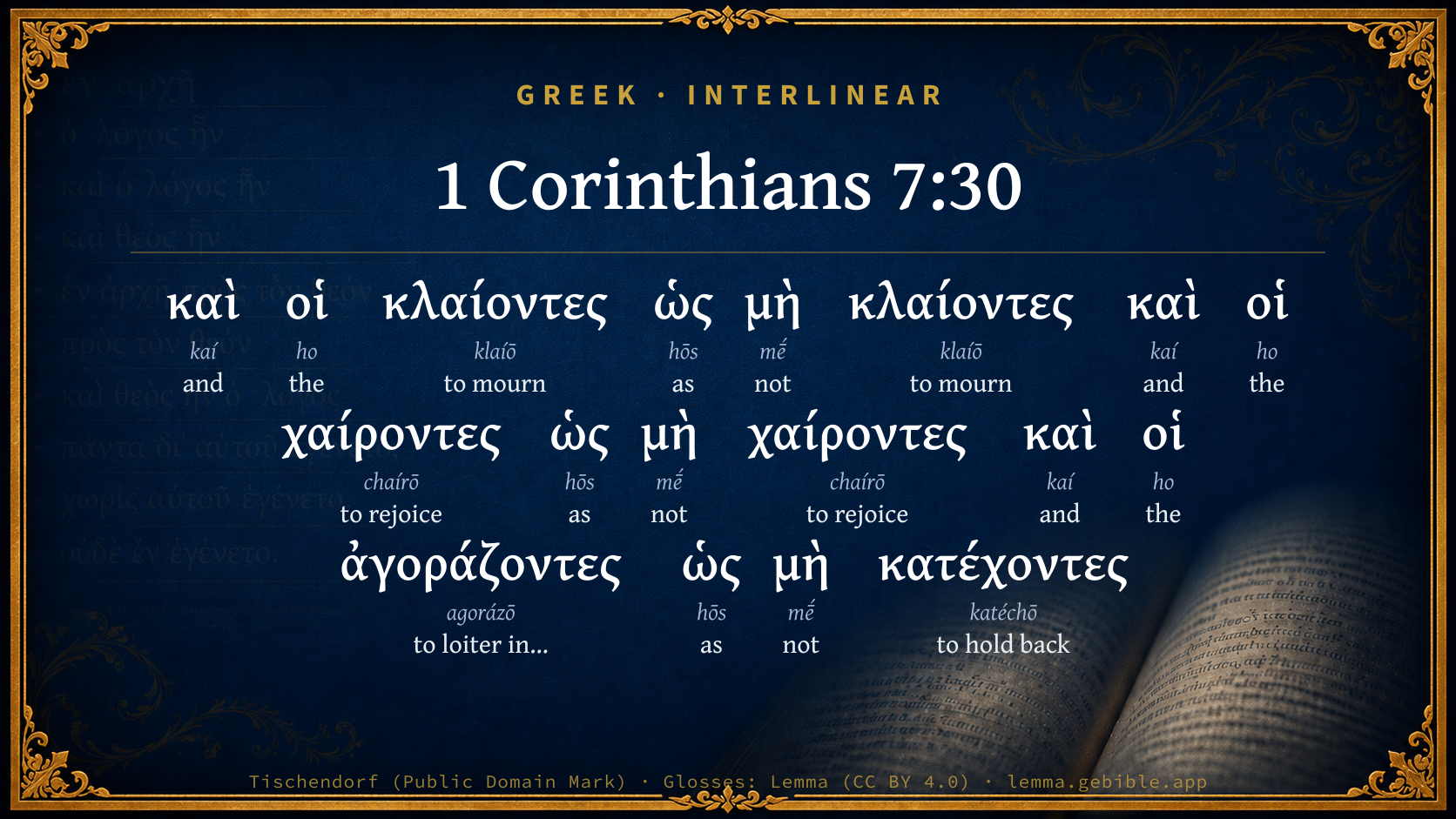
  1. καὶ kaí G2532 “and” Conjunction
  2. οἱ ho G3588 “the” Article, Nominative, Plural, Masculine
  3. κλαίοντες klaíō G2799 “to mourn” Verb, Present, Active, Participle, Nominative, Plural, Masculine
  4. ὡς hōs G5613 “as” Adverb
  5. μὴ mḗ G3361 “not” Particle, Negative
  6. κλαίοντες klaíō G2799 “to mourn” Verb, Present, Active, Participle, Nominative, Plural, Masculine
  7. καὶ kaí G2532 “and” Conjunction
  8. οἱ ho G3588 “the” Article, Nominative, Plural, Masculine
  9. χαίροντες chaírō G5463 “to rejoice” Verb, Present, Active, Participle, Nominative, Plural, Masculine
  10. ὡς hōs G5613 “as” Adverb
  11. μὴ mḗ G3361 “not” Particle, Negative
  12. χαίροντες chaírō G5463 “to rejoice” Verb, Present, Active, Participle, Nominative, Plural, Masculine
  13. καὶ kaí G2532 “and” Conjunction
  14. οἱ ho G3588 “the” Article, Nominative, Plural, Masculine
  15. ἀγοράζοντες agorázō G59 “to loiter in marketplace” Verb, Present, Active, Participle, Nominative, Plural, Masculine
  16. ὡς hōs G5613 “as” Adverb
  17. μὴ mḗ G3361 “not” Particle, Negative

About this verse

These counts appear in no published source. They are computed here, from the morphology-tagged text and Lemma’s own curated glosses. What Lemma adds →

18
words
8
distinct lemmas
Pauline Epistles
section

Notable vocabulary

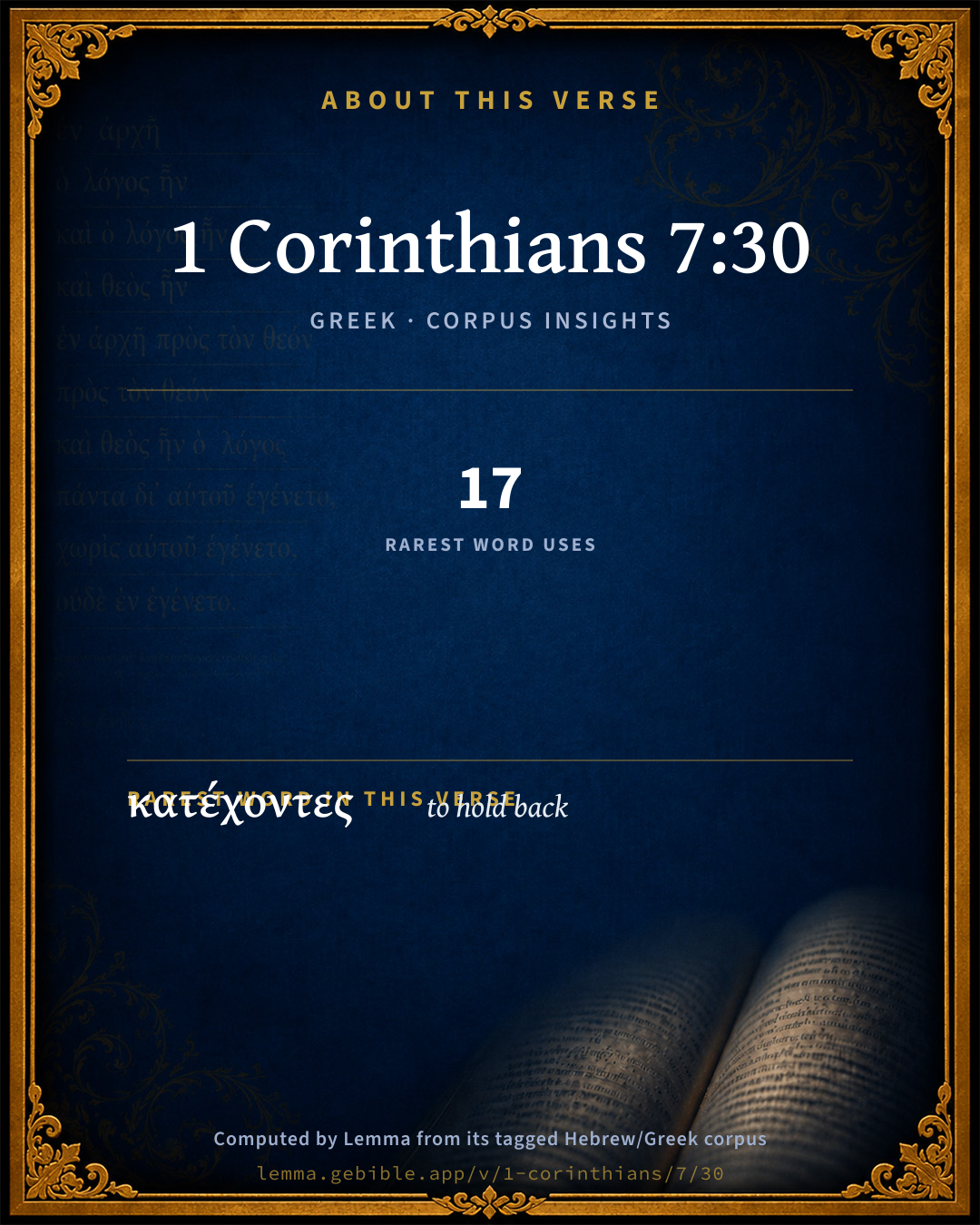
The rarest word here is κατέχοντες to hold back G2722 — appearing just 17 times in the whole Greek New Testament.

Shared distinctive vocabulary

κατέχοντες to hold back G2722 occurs in 17 verses of the Greek New Testament. Also found in:

Repetition

Words recur within this verse:

  • κλαίοντες to mourn G2799 ×2
  • χαίροντες to rejoice G5463 ×2
  • καὶ and G2532 ×3
  • οἱ the G3588 ×3
  • ὡς as G5613 ×3
  • μὴ not G3361 ×3

Cross-references

11

Topical passages linked to 1 Corinthians 7:30 in the Treasury of Scripture Knowledge — connected by theme and wording, ordered by reader-vote popularity; previews shown in the World English Bible.

  • Ecclesiastes 3:4 A time to weep, And a time to laugh; A time to mourn, And a time to dance;
  • Luke 6:21 Blessed are you who hunger now, For you will be filled. Blessed are you who weep now, For you will laugh.
  • John 16:22 Therefore you now have sorrow, but I will see you again, and your heart will rejoice, and no one will take your joy away from you.
  • Psalms 30:5 For his anger is but for a moment; His favor is for a lifetime. Weeping may stay for the night, But joy comes in the morning.
  • Psalms 126:5–6 Those who sow in tears will reap in joy.
  • Luke 6:25 Woe to you, you who are full now! For you will be hungry. Woe to you who laugh now! For you will mourn and weep.
  • Isaiah 25:8 He has swallowed up death forever; and the Lord Yahweh will wipe away tears from off all faces; and the reproach of his people will he take away from off all the earth: for Yahweh has spoken it.
  • Isaiah 30:19 For the people shall dwell in Zion at Jerusalem; you shall weep no more; he will surely be gracious to you at the voice of your cry; when he shall hear, he will answer you.
  • Luke 16:25 "But Abraham said, 'Son, remember that you, in your lifetime, received your good things, and Lazarus, in like manner, bad things. But now here he is comforted and you are in anguish.
  • Revelation 7:17 for the Lamb who is in the midst of the throne shepherds them, and leads them to springs of waters of life. And God will wipe away every tear from their eyes."
  • Revelation 18:7 However much she glorified herself, and grew wanton, so much give her of torment and mourning. For she says in her heart, 'I sit a queen, and am no widow, and will in no way see mourning.'

Cross-references courtesy of OpenBible.info (CC BY 4.0).

Commentary

Notes on 1 Corinthians 7:30 from classic Christian and Jewish commentators (each source and its license shown beneath its notes). The classic Christian expositions comment on the surrounding passage and are grouped to its opening verse, so a note may address several verses; the Jewish commentaries on the Tanakh (Rashi and others) are per-verse, so they appear only where the commentator wrote on this verse.

Lemma curates 59 commentaries, every one of them public domain or Creative Commons licensed, each selected and text-cleaned for this edition rather than reprinted as found. About our sources →

Bengel's Gnomon

Johann Albrecht Bengel

1Co 7:30. Οἱ χαίροντες, they who rejoice) he does not say, they who laugh. [Rom 12:15. The train of thought is here (in the words, “they that rejoice”) of nuptial feasts; as in the preceding words (they that weep) of the death of a wife, etc.—V. g.] He speaks soberly as is suitable in the vale of tears.—ὡς μὴ κατέχοντες, as though they possessed not) To possess, after, to buy, makes an epitasis [an emphatic addition to the previous words. Append.]: as after use, abuse comes, in the next verse, from which it is evident, that the figure Ploce [the same word twice, once simply, next expressing an attribute. Append.] occurs in the three preceding clauses; for as the Apostle Paul exhorts the teacher to teach, and every one employed in doing good to be active in doing it, Rom 12:7; so they, that rejoice, rejoice in the world, which same is the very thing that he forbids.

Bengel's Gnomon of the New Testament — English translation (T&T Clark, Edinburgh, 1860) — public domain. Text from a community e-Sword module.

Geneva Bible (1599)

Geneva Bible translators

By weeping, the Hebrews understand all adversity, and be joy, all prosperity.

Geneva Bible (1599) marginal notes — public domain. Text via Bolls.life.

Jamieson, Fausset & Brown

Robert Jamieson, A. R. Fausset & David Brown

they that weep . . . wept not--(Compare Co2 6:10).

they that buy . . . possessed not--(Compare Isa 24:1-2). Christ specifies as the condemning sin of the men of Sodom not merely their open profligacy, but that "they bought, they sold," &c., as men whose all was in this world (Luk 17:28). "Possessed" in the Greek implies a holding fast of a possession; this the Christian will not do, for his "enduring substance" is elsewhere (Heb 10:34).

Jamieson, Fausset & Brown — Commentary Critical and Explanatory on the Whole Bible (1871) — public domain (CC PDM 1.0). Text via the HelloAO Bible API.

Adam Clarke's Commentary

Verse 30. They that weep, c.] There will shortly be such a complete system of distress and confusion that private sorrows and private joys will be absorbed in the weightier and more oppressive public evils: yet, let every man still continue in his calling, let him buy, and sell, and traffic, as usual though in a short time, either by the coming persecution or the levelling hand of death, he that had earthly property will be brought into the same circumstances with him who had none.

Adam Clarke's Commentary on the Bible (1810–1826) — public domain. Text from a community e-Sword/MySword module.

The Cambridge Bible for Schools and Colleges

gen. ed. J. J. S. Perowne

30. they that rejoice, as though they rejoiced not] “Look round this beautiful world of God’s: ocean dimpled into myriad smiles; the sky a trembling, quivering mass of blue, thrilling hearts with ecstasy; every tint, every form, replete with beauty. God says, ‘be glad.’ Do not force young, happy hearts to an unnatural solemnity, as if to be happy were a crime. Let us hear their loud, merry, ringing laugh, even if sterner hearts can be glad no longer; to see innocent mirth and joy does the heart good. But now observe, everlasting considerations are to come in, not to sadden joy, but to calm it.… We are to be calm. cheerful, self-possessed; to sit loose to all these sources of enjoyment, masters of ourselves.” Robertson.

The Cambridge Bible for Schools and Colleges (gen. ed. J. J. S. Perowne; Cambridge University Press, 1878–1918) — public domain. Text from a community e-Sword module.

John Gill's Exposition

And they that weep, as though they wept not,.... They that weep for troubles and crosses, things adverse and afflicting in a marriage state, for the loss of wives or children, should express their sorrow in such a manner and degree, as if they wept not; not that the apostle here introduces and establishes a stoical apathy, and would have persons show no manner of concern for these things; but he directs to a moderate use of sorrow, to such a degree as not to hinder and divert from the exercises of piety and religion:

and they that rejoice, as though they rejoiced not; such who are blessed with great prosperity, and with whom everything goes well; they have married wives, and have children, and thrive in the world; let them rejoice on the account of these things, in such a still, silent way, as if they rejoiced not, their hearts not being set upon their outward felicity, nor elated with it; but rejoicing rather that their names were written in heaven, that they had an interest in Christ and his grace, and a right and title to the glories of another world, and at the same time be thankful to God for what they enjoy in this:

and they that buy as though they possessed not; meaning, not any sort of buyers, everyone is a buyer in some sense; but such as purchase estates, buy houses and lands, and become proprietors of large tracts. These the apostle would not have hold their substance for themselves, but hold it as if they did not hold it, parting with it for the use of others; and as persons that are only stewards, and not properly owners, and in a little time must quit it all, and be accountable for their use and disposition of it.

John Gill's Exposition of the Whole Bible (1746–1763) — public domain (CC PDM 1.0). Text via the HelloAO Bible API.

Trapp's Complete Commentary

John Trapp

30 And they that weep, as though they wept not; and they that rejoice, as though they rejoiced not; and they that buy, as though they possessed not;

Ver. 30. And they that weep] viz. In the loss of wife or children: let them moderate their grief, as Abraham did in the loss of Sarah, Gen 23:2; "He came to weep for her;" where the Hebrew hath one little letter extraordinary, {Hebrew Text Note} to note, that Abraham wept but a little for her; and this, not because she was old and overly worn (as the Rabbins give the reason), but because he had hope of a happy resurrection, 1Th 4:14, and because she was his still, though dead; therefore he so often in that chapter calleth her "my dead," 1Co 7:4; 1Co 7:11; 1Co 7:13; 1Co 7:15.

And they that rejoice] In the marrying of wives, or birth of children. The marriage day is called the day of "the rejoicing of a man’s heart," Son 3:11: and when should men be merry rather than at the recovering of the lost rib? But he was to blame that said, he had married a wife, and therefore he could not come. And he was a wiser man that said, Uxori nubere nolo meae, ( Martial.)

As if they possessed not] Mind earthly things we must, as if we minded them not: as a man may hear a tale, and have his mind elsewhere; or as a man that baits at an inn, his mind is somewhere else. A right believer (saith Mr Ward) goes through the world as a man whose mind is in a deep study; or as one that hath special haste of some weighty business. Rebus non me trado, sed commodo, saith Seneca. Be not wholly dulled or drowned in the world; look at it out of the eyes’ end only, lest, as the serpent Scytale, it bewitch us with its beautiful colours, and sting us to death.

John Trapp, A Commentary or Exposition upon All the Books of the Old and New Testament (1647–1656) — public domain. Text from a community e-Sword module.

Albert Barnes' Notes on the Bible

And they that weep - They who are afflicted.

As though they wept not - Restraining and moderating their grief by the hope of the life to come. “The general idea in all these expressions is, that in whatever situation Christians are, they should be dead to the world, and not improperly affected by passing events.” It is impossible for human nature not to feel when persecuted, maligned, slandered, or when near earthly friends are taken away. But religion will calm the troubled spirit; pour oil on the agitated waves; light up a smile in the midst of tears; cause the beams of a calm and lovely morning to rise on the anxious heart; silence the commotions of the agitated soul, and produce joy even in the midst of sorrow. Religion will keep us from immoderate grief, and sustain the soul even when in distress nature forces us to shed the tear of mourning. Christ sweat great drops of blood, and Christians often weep; but the heart may be calm, peaceful, elevated, confident in God in the darkest night and the severest tempest of calamity.

And they that rejoice - They that are happy; they that are prospered; that have beloved families around them; that are blessed with success, with honor, with esteem, with health. They that have occasion of rejoicing and gratitude.

As though they rejoiced not - Not rejoicing with excessive or immoderate joy. Not with riot or unholy mirth. Not satisfied with these things; though they may rejoice in them. Not forgetting that they must soon be left; but keeping the mind in a calm, serious, settled, thoughtful state, in view of the fact that all these things must soon come to an end. O how would this thought silence the voice of unseemly mirth; How would it produce calmness, serenity, heavenly joy, where is now often unhallowed riot; and true peace, where now there is only forced and boisterous revelry!

As though they possessed not - It is right to buy and to obtain property. But it should be held with the conviction that it; is by an uncertain tenure, and must soon be left. People may give a deed that shall secure from their fellow man; but no man can give a title that shall not be taken away by death. Our lands and houses, our stocks and bonds and mortgages, our goods and chattels, shall soon pass into other hands. Other people will plow our fields, reap our harvests, work in our shops, stand at our counters, sit down at our firesides, eat on our tables, lie upon our beds. Others will occupy our places in society, have our offices, sit in our seats in the sanctuary. Others will take possession of our gold, and appropriate it to their own use; and we shall have no more interest in it, and no more control over it, than our neighbor has now, and no power to eject the man that has taken possession of our houses and our lands. Secure therefore as our titles are safe as are our investments, yet how soon shall we lose all interest in them by death; and how ought this consideration to induce us to live above the world, and to secure a treasure in that world where no thief approaches, and no moth corrupts.

Albert Barnes' Notes on the Bible (1834–1885) — public domain. Text from a community e-Sword/MySword module.

Haydock's Catholic Bible Commentary

And they who weep. In this passage the apostle teaches us, in the midst of our greatest afflictions not to suffer ourselves to be overwhelmed with grief, but to recollect that the time of this life is short, and that temporary pains will be recompensed with the never-fading joys of eternity. (Estius)

George Leo Haydock (1774–1849), Haydock's Catholic Family Bible and Commentary, 1859 edition — public domain. Excludes Psalms (Douay-Rheims chapter numbering differs from Protestant) and Deuterocanonical books (Catholic canon only).

Matthew Poole's English Annotations

And they that weep, as though they wept not; this consideration also should weigh with those who have a more afflicted portion in this life, and are mourners for the loss of their near relations; they have but lost what they could not long have kept, and for the time they kept them must have enjoyed them, probably, with a great deal of sorrow and bitterness.

And they that rejoice, as though they rejoiced not; and so for any of those who rejoiced in any worldly enjoyments, the shortness of the time they are like to have them to rejoice in, should admonish them to govern and moderate their joy, for it is like to be but like the crackling of thorns under a pot.

And that they buy as though they possessed not; and those that have liberal possessions of good things in this life, they should look upon them as none of theirs, and use them as not like to be their possessions long.

Matthew Poole's English Annotations on the Holy Bible (1683–1685) — public domain. Text from a community e-Sword/MySword module.

Whedon's Commentary on the Bible

Daniel D. Whedon

30. Weep—Weeping must be done. The sorrow has its actual existence; and, when looked at by itself, has its reality. But when surveyed in comparison with the eternity within a step’s distance, it becomes—nothing. Weep, then, as weep you may; but weep as realizing that your weeping has its nothingness.

Rejoice—For joy is becoming in our finite sphere. Even on these low grounds of earthly existence there is a round of pleasantnesses that may prompt the smile and the gratitude. But forget not that there is a higher, an eternal joy, that dwarfs this earthly rejoicing to nothing.

Buy— Trade, labour, literature, politics, all have their place as duties and engagements of an earthly life; but there is a life whose interests are so stupendous as to shrivel them all to insignificance.

Men boast of worldly greatness. Statesmen, warriors, and princes, figure proudly in human history. And these will and must exist—accomplish their programme—and amaze and fill the minds of men. But it is only by forgetfulness of eternity that they are great. One thought of the infinite truth empties them, like a pricked balloon, of all their swell.

Daniel D. Whedon (gen. ed.), Commentary on the Old and New Testaments (1874–1909) — public domain. Text from a community e-Sword module.

The Pulpit Commentary

They that weep, etc. Earthly sorrow and joy and wealth are things which are merely transient and unreal when compared with the awful, eternal, permanent realities which we shall all soon have to face.

The Pulpit Commentary (1880–1919), ed. H.D.M. Spence-Jones & Joseph S. Exell — public domain. Text from a community e-Sword module.

John Wesley's Explanatory Notes

And they that weep, as if they wept not - "Though sorrowful, yet always rejoicing." They that rejoice, as if they rejoiced not - Tempering their joy with godly fear. They that buy, as if they possessed not - Knowing themselves to be only stewards, not proprietors.

John Wesley, Explanatory Notes Upon the Whole Bible (1754–1765) — public domain. Text via the GEBible commentary corpus.

McGarvey & Pendleton's Commentaries

J. W. McGarvey

and those that weep, as though they wept not; and those that rejoice, as though they rejoiced not; and those that buy, as though they possessed not ;

J. W. McGarvey (with Philip Y. Pendleton), Commentaries on the New Testament (The Fourfold Gospel, 1914; Acts; and the epistles) — public domain. Text from a community e-Sword/MySword module.

Cambridge Greek Testament for Schools and Colleges

30. καὶ οἱ χαίροντες ὡς μὴ χαίροντες. ‘Look round this beautiful world of God’s: ocean dimpled into myriad smiles; the sky a trembling, quivering mass of blue, thrilling hearts with ecstasy; every tint, every form, replete with beauty. God says, “be glad.” Do not force young, happy hearts to an unnatural solemnity, as if to be happy were a crime. Let us hear their loud, merry, ringing laugh, even if sterner hearts can be glad no longer; to see innocent mirth and joy does the heart good. But now observe, everlasting considerations are to come in, not to sadden joy, but to calm it.… We are to be calm, cheerful, self-possessed; to sit loose to all these sources of enjoyment, masters of ourselves.’ Robertson.

κατέχοντες. This word is used in two different senses in the N. T. Here, and in 2Co 6:10, the intensitive sense of κατά in composition is required (see note on next verse). In 2Th 2:6-7, the sense of holding back must be given. In Rom 1:18, it is doubtful which sense is to be preferred. μή throughout the whole of this passage denotes that the proposition is hypothetical.

Cambridge Greek Testament for Schools and Colleges (Cambridge University Press, 1896; 21 vols, various authors incl. Carr, Maclear, Plummer, Farrar, Lumby, Moule, M. R. James, Simcox) — public domain. Text from a community e-Sword module.

Alford’s Greek Testament

Henry Alford

30. ὡς μὴ κατέχοντες] as not possessing (their gains). So in the line of Lucretius (iii. 984), “Vitaque mancupio nulli datur, omnibus usu.”

Henry Alford, The Greek Testament (1849–1861) — public domain. Text from a community e-Sword module.

International Critical Commentary

30. ὡς μὴ κατέχοντες. ‘As not entering upon full ownership,’ or ‘keeping fast hold upon’ (11:2, 15:2; 2Co 6:10; 1Th 5:21, where see Milligan, p. 155). Earthly goods are a trust, not a possession.

International Critical Commentary — older volumes (1896–1929), various authors — public domain. Text from a community e-Sword module.

Hodge's Commentary on Romans, Ephesians & First Corinthians

Charles Hodge

1Co_7:29-31

But this I say, brethren, the time (is) short; it remaineth, that both they that have wives be as though they had none; and they that weep, as though they wept not; and they that rejoice, as though they rejoiced not; and they that buy, as though they possessed not; and they that use this world, as not abusing (it): for the fashion of this world passeth away.

This is another reason why you should not marry. You will soon have to leave your wives. It is nothing relating to your permanent and eternal interests which I urged you to forego, but only something which pertains to the fleeting relations of this changing world.

But this I say, i.e. This I would have you bear in mind, as giving force to my advice. The time, i.e. the appointed time (καιρός, not χρόνος) is short (συνεσταλμένος). The verb properly means to roll or wind up, Act_5:6, then to contract or shorten. The time is shortened. Comp. Mat_24:22. Mar_13:20, where the idea is the same, though the word used is different. This interpretation is on the whole preferable to another almost equally common. The time is calamitous; for this use of the word, however, no certain authority can be given. The words rendered, it remaineth, properly belong to the preceding clause. The meaning is not, It remaimeth that, but The time henceforth (τὸ λοιπόν) is short. That is, the allotted time is brief. That does not depend on This I say, as though the sense were I say that; but on what immediately precedes. The time is shortened in order that, etc. It is the design of God in allowing us but a brief period in this world, or in this state, that we should set lightly by all earthly things; that those who have wives should be as though they had them not, and those that weep, as though they wept not; those who rejoices as though they rejoiced not; those who buy, as though they possessed not; those using the world, as though they used it not. We should set our affections on things above, and not on the things on the earth. Col_3:2. The clause rendered they that use this world as not abusing it, is properly so translated, as καταχράομαι means to use overmuch. The only reason for preferring the other translation is the analogy of the other passages. Either version is consistent with the usage of the word. For the fashion of this world passeth away, i.e. is in the act of passing away. The fashion (σχῆμα) the external form, the essence as it appears, the present state of things. The figure is derived from the scenes of a theatre, in the actual process of change. The fact that the present condition of the world is not to last long, and that our participation in its joys and sorrows is to be so shortlived, is the reason which the apostle urges why we should not be wedded to earthly things.

Charles Hodge — Commentary on Romans (1835), First Corinthians (1857), and Ephesians (1856) — public domain. Text from a community e-Sword module.

Lesson kit

Teaching starters — assembled from the data on this page, not authored interpretation. Every prompt links to the verse data it draws on. Edit before teaching.

1 Corinthians, in the Pauline Epistles, opens this verse with 18 words (8 distinct Greek lemmas). Its most distinctive word is katéchō (“to hold back”). A historical commentator’s framing appears above. Read the whole chapter for the surrounding context.

Discussion questions

  1. The word katéchō carries the sense “to hold back.” How does it shape the verse?
  2. How does Luke 4:42, which shares the word «to hold back», read alongside this verse?
  3. What does the repetition of “to mourn” (2× in this one verse) do in this verse?
  4. The translations on this page render this verse differently — a whole-verse word diff, not a word-by-word alignment. What might account for the different wordings?
  5. Compare how Bengel's Gnomon and Geneva Bible (1599) read this verse. Where do they agree or differ?

Things to notice

  • These translations choose different wording for 15 words in this verse.
  • “to mourn” occurs 2× in this single verse.
  • 8 distinct Greek lemmas span 18 words in this verse.

Reading settings

Reading text

Shown beneath each verse's original-language words.

Old Testament
Old Testament edition

Read the OT as the Masoretic Hebrew (MT) or the Greek Septuagint (LXX).

English shown for the Greek Septuagint (in the Hebrew ↔ Greek comparison).

Comparing translations? Open the Compare panel on any verse page to stack up to four side by side.