1 Corinthians 15:14

Greek (Tischendorf 8th ed.) 1 Corinthians 15:14 appears in the Greek New Testament. The text above is from the Tischendorf 8th edition. Each word links to its Strong’s number and a concise gloss. Click any word for its full Thayer’s Greek Lexicon entry.
Download image
Cite this verse

1 Corinthians 15:14 (World English Bible). Public Domain. Lemma interlinear Bible study tool, https://lemma.gebible.app/v/1-corinthians/15/14.

Show BibTeX & RIS
BibTeX
RIS
English Translation
If Christ has not been raised, then our preaching is in vain, and your faith also is in vain.
World English Bible · Public Domain
Download a study sheet

One document with this verse’s original text, its word-by-word gloss line, the meaning frame, cross-references with their text, attributed commentary, and full source and license credits — printable, and it pastes into notes with its structure intact.

This verse Autodidact and up

Study sheet (.html) Plain text (.txt)

A passage Seminary Student

Up to 50 verses in one chapter. A passage sheet keeps up to 6 commentary sources and 12 cross-references per verse, in the order this page ranks them, and says so on the sheet whenever that leaves anything out. Ask for a single verse and you get the Autodidact verse sheet above.

Everything on this page stays free to read, with no account — the sheet is a download of what is already on screen, not access to it.

Want to remove ads? Support Godless Engineer
Compare translations 3

The same verse in 3 English versions, stacked beneath the original-language interlinear above. Click any original word for its lexicon entry.

Each is an independent rendering of the whole verse — the interlinear is not word-aligned to these translations.

Highlighted words mark where these versions differ — a whole-verse word diff, not a word-by-word alignment.

  • World English Bible Public Domain
    If Christ has not been raised, then our preaching is in vain, and your faith also is in vain.
  • King James Version Public Domain
    And if Christ be not risen, then is our preaching vain, and your faith is also vain.
  • unfoldingWord Literal Text CC BY-SA 4.0
    but if Christ has not been raised, then our preaching in vain, and your faith in vain.

unfoldingWord Literal Text — © unfoldingWord, licensed CC BY-SA 4.0. Word-aligned USFM3 via Door43 (git.door43.org/unfoldingWord/en_ult).

Versions to compare (up to 4)

3 of 4 selected

Show all 19 translations

Every available English version of this verse, each an independent rendering of the whole verse.

  • World English Bible Public Domain
    If Christ has not been raised, then our preaching is in vain, and your faith also is in vain.
  • Berean Standard Bible Public Domain
    And if Christ has not been raised, our preaching is worthless, and so is your faith.
  • Majority Standard Bible Public Domain
    And if Christ has not been raised, our preaching is worthless, and so is your faith.
  • King James Version Public Domain
    And if Christ be not risen, then is our preaching vain, and your faith is also vain.
  • American Standard Version (1901) Public Domain
    and if Christ hath not been raised, then is our preaching vain, your faith also is vain.
  • Revised Version (1885) Public Domain
    and if Christ hath not been raised, then is our preaching vain, your faith also is vain.
  • Geneva Bible (1599) Public Domain
    And if Christ be not risen, then is our preaching vaine, and your faith is also vaine.
  • Douay-Rheims (1899) Public Domain
    And if Christ be not risen again, then is our preaching vain, and your faith is also vain.
  • Young's Literal Translation Public Domain
    and if Christ hath not risen, then void `is' our preaching, and void also your faith,
  • Literal Standard Version CC BY-SA 4.0
    and if Christ has not risen, then our preaching [is] void, and your faith [is] also void,
  • Unlocked Literal Bible CC BY-SA 4.0
    and if Christ has not been raised, then our preaching is in vain, and your faith also is in vain.
  • unfoldingWord Literal Text CC BY-SA 4.0
    but if Christ has not been raised, then our preaching in vain, and your faith in vain.
  • Darby Bible Public Domain
    but if Christ is not raised, then, indeed, vain also [is] our preaching, and vain also your faith.
  • World Messianic Bible Public Domain
    If Messiah has not been raised, then our proclaiming is in vain and your faith also is in vain.
  • Webster's Bible Public Domain
    And if Christ is not raised, then is our preaching vain, and your faith is also vain.
  • Free Bible Version CC BY-SA 4.0
    And if Christ isn't raised, then our message we shared with you is pointless, and your trust in God is pointless too.
  • Bible in Basic English Public Domain
    And if Christ did not come again from the dead, then our good news and your faith in it are of no effect.
  • Text-Critical English NT CC BY 4.0
    And if Christ has not been raised, then our preaching is in vain, and your faith is also in vain.
  • Tyndale New Testament (1534) Public Domain
    If Christ be not rysen then is oure preachinge vayne and youre faith is also in vayne.

Literal Standard Version (2020), Covenant Press — licensed CC BY-SA 4.0. Text via the HelloAO Bible API (eBible.org). Unlocked Literal Bible (unfoldingWord) — licensed CC BY-SA 4.0. Text via the HelloAO Bible API (eBible.org). unfoldingWord Literal Text — © unfoldingWord, licensed CC BY-SA 4.0. Word-aligned USFM3 via Door43 (git.door43.org/unfoldingWord/en_ult). Free Bible Version, Dr. Jonathan Gallagher — licensed CC BY-SA 4.0. Text via the HelloAO Bible API (eBible.org).

Word by word

More ways to search: Search by grammar → Find every occurrence → Compare this word →

Practice this passage: Drill this verse → Learn its vocabulary →

κήρυγμα
kḗrygma
G2782
“proclamation”
Noun, Nominative, Singular, Neuter
Part of Speech
Noun
Case
Nominative
Number
Singular
Gender
Neuter
Full Thayer's Definition

Origin: from G2784

TDNT: 14:54,4

1. that which is proclaimed by a herald or public crier, a proclamation by herald 2. in the NT the message or proclamation of the heralds of God or Christ
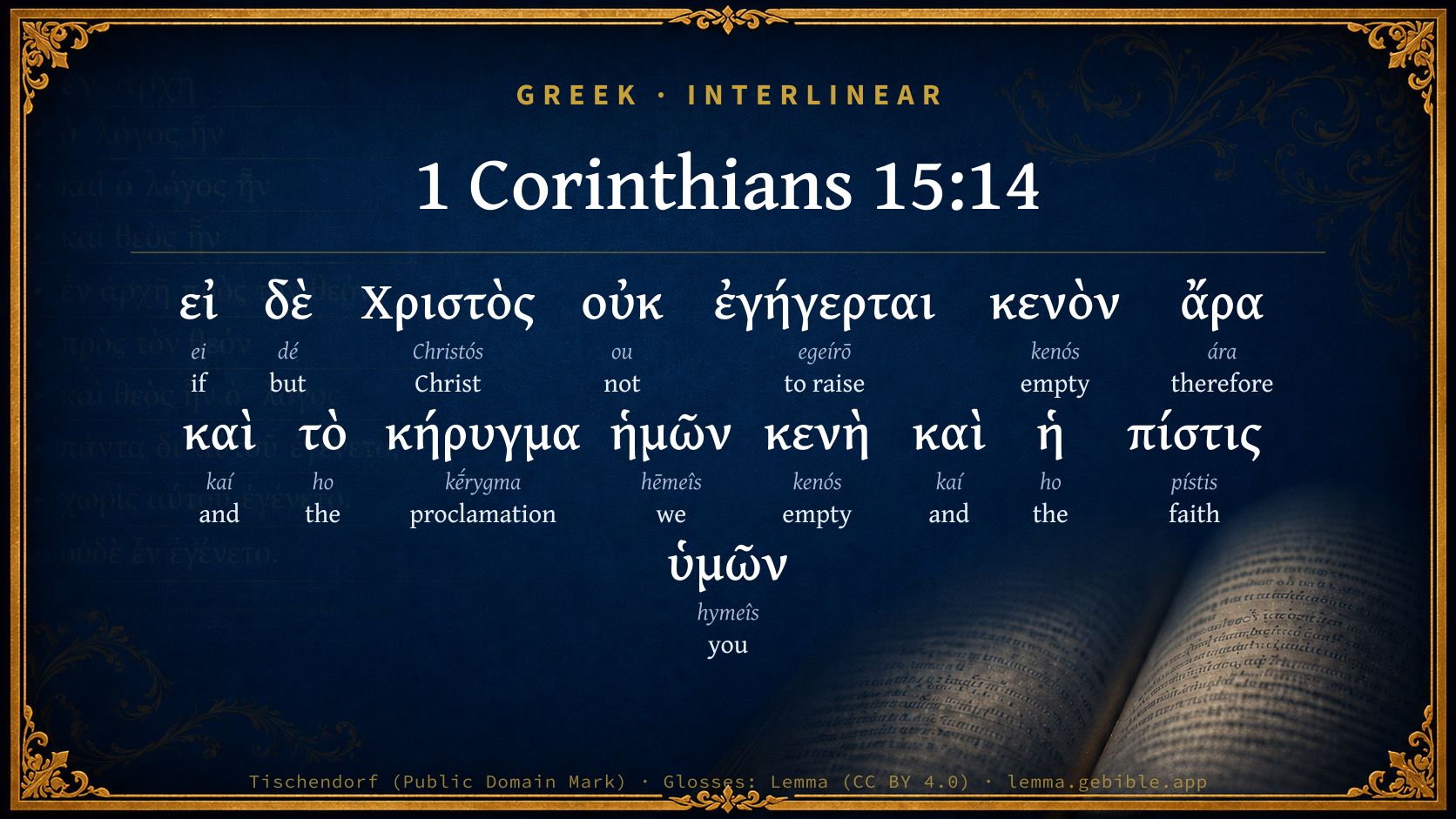
  1. εἰ ei G1487 “if” Conditional
  2. δὲ dé G1161 “but” Conjunction
  3. Χριστὸς Christós G5547 “Christ” Noun, Nominative, Singular, Masculine
  4. οὐκ ou G3756 “not” Particle, Negative
  5. ἐγήγερται egeírō G1453 “to raise” Verb, Perfect, Passive, Indicative, 3rd person, Singular
  6. κενὸν kenós G2756 “empty” Adjective, Nominative, Singular, Neuter
  7. ἄρα ára G686 “therefore” Particle
  8. καὶ kaí G2532 “and” Conjunction
  9. τὸ ho G3588 “the” Article, Nominative, Singular, Neuter
  10. ἡμῶν hēmeîs G2249 “we” Personal pronoun, 1st person, Genitive, Plural
  11. κενὴ kenós G2756 “empty” Adjective, Nominative, Singular, Feminine
  12. καὶ kaí G2532 “and” Conjunction
  13. ἡ ho G3588 “the” Article, Nominative, Singular, Feminine
  14. πίστις pístis G4102 “faith” Noun, Nominative, Singular, Feminine
  15. ὑμῶν hymeîs G5210 “you” Personal pronoun, 2nd person, Genitive, Plural

About this verse

These counts appear in no published source. They are computed here, from the morphology-tagged text and Lemma’s own curated glosses. What Lemma adds →

16
words
13
distinct lemmas
Pauline Epistles
section

Notable vocabulary

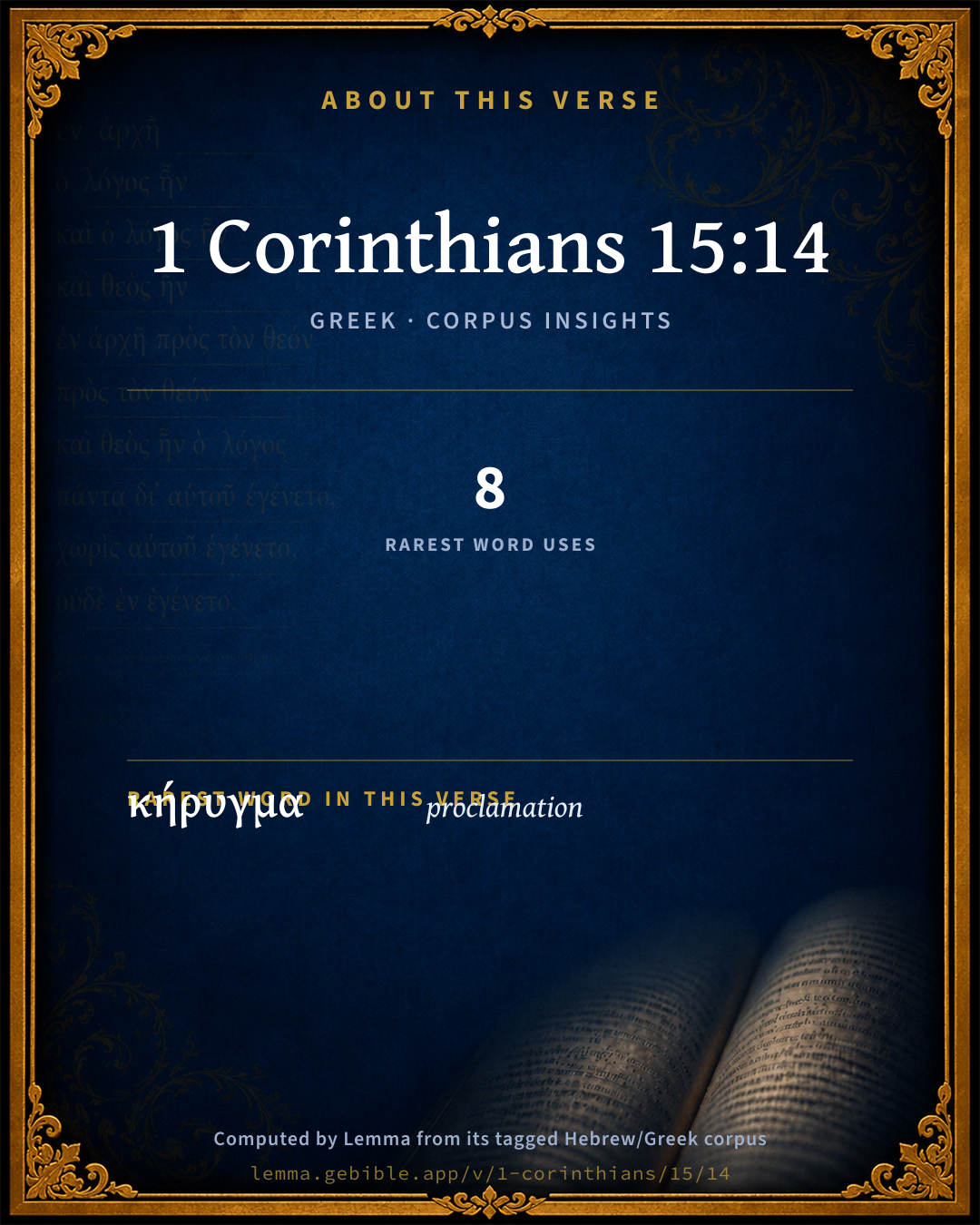
The rarest word here is κήρυγμα proclamation G2782 — appearing just 8 times in the whole Greek New Testament.

Shared distinctive vocabulary

κήρυγμα proclamation G2782 occurs in 8 verses of the Greek New Testament. Also found in:

Repetition

Words recur within this verse:

Cross-references

11

Topical passages linked to 1 Corinthians 15:14 in the Treasury of Scripture Knowledge — connected by theme and wording, ordered by reader-vote popularity; previews shown in the World English Bible.

  • 1 Corinthians 15:17 If Christ has not been raised, your faith is vain; you are still in your sins.
  • 1 Thessalonians 4:14 For if we believe that Jesus died and rose again, even so those who have fallen asleep in Jesus will God bring with him.
  • Acts 17:31 because he has appointed a day in which he will judge the world in righteousness by the man whom he has ordained; of which he has given assurance to all men, in that he has raised him from the dead."
  • Matthew 15:9 And in vain do they worship me, Teaching as doctrine rules made by men.'"
  • James 2:20 But do you want to know, vain man, that faith apart from works is dead?
  • Psalms 73:13 Surely in vain I have cleansed my heart, And washed my hands in innocence,
  • Isaiah 49:4 But I said, I have labored in vain, I have spent my strength for nothing and vanity; yet surely the justice [due] to me is with Yahweh, and my recompense with my God.
  • 1 Corinthians 15:2 by which also you are saved, if you hold firmly the word which I preached to you--unless you believed in vain.
  • Galatians 2:2 I went up by revelation, and I laid before them the Gospel which I preach among the Gentiles, but privately before those who were respected, for fear that I might be running, or had run, in vain.
  • Genesis 8:8 He sent forth a dove from him, to see if the waters were abated from off the surface of the ground,
  • James 1:26 If anyone among you thinks himself to be religious while he doesn't bridle his tongue, but deceives his heart, this man's religion is worthless.

Cross-references courtesy of OpenBible.info (CC BY 4.0).

Where the printed editions differ

1 variant

Places in this verse where the major printed Greek editions disagree on the wording in a way that affects the translation — a comparison of editions, not a manuscript-by-manuscript collation. The editions are the modern critical texts (Nestlé-Aland 28/27, SBL, Westcott-Hort, Tregelles, Tyndale House) and the traditional texts behind the KJV (the Textus Receptus and the Byzantine/Majority text). It is not a claim about which reading is original.

  1. Different wording
    ὑμῶν.

    “of you.”

    In NA28NA27TynSBLTregTRByz Not in WH

    ἡμῶν (hēmōn) 'of us' occurs in a few manuscripts (WH) instead of ὑμῶν. (humōn) 'of you.' in older manuscripts (NA28+NA27+Tyn+SBL+Treg+TR+Byz)

Textual data: Translators Amalgamated Greek New Testament (STEPBible TAGNT) · CC BY 4.0.

Commentary

Notes on 1 Corinthians 15:14 from classic Christian and Jewish commentators (each source and its license shown beneath its notes). The classic Christian expositions comment on the surrounding passage and are grouped to its opening verse, so a note may address several verses; the Jewish commentaries on the Tanakh (Rashi and others) are per-verse, so they appear only where the commentator wrote on this verse.

Lemma curates 59 commentaries, every one of them public domain or Creative Commons licensed, each selected and text-cleaned for this edition rather than reprinted as found. About our sources →

Joseph Benson's Commentary

1Co 15:14-18. Then is our preaching — In consequence of a commission supposed to be given after his resurrection; vain — Without any real foundation, and destitute of truth; and your faith — In our preaching; is vain — Is grounded on falsehood and deception; yea, and we are false witnesses of God — Having testified that Jesus of Nazareth is his Son and the Messiah; that he hath atoned for sin; hath risen from the dead and ascended into heaven; hath obtained for his followers the Holy Spirit in his gifts and graces; a resurrection from the dead, and eternal life; and is constituted the final Judge of men and angels; — all which things, depending on his resurrection, are absolutely false, if he be not risen; and, of consequence, ye are yet in your sins — Unpardoned and unrenewed, without either a title to heaven or a meetness for it. So that there needed something more than reformation, (which was plainly wrought in them,) in order to their being delivered from the guilt of sin, and renewed after the divine image; even that atonement, the sufficiency of which God attested by raising our great Surety from the grave, and the influences of the Divine Spirit procured for us by that atonement. Then they who are fallen asleep in Christ — Who have died for him, or believing in him; are perished — Have lost their life and being together. This sentence shows, that in this discourse the apostle has the resurrection of the just principally in view, and that what he hath written concerning the excellent qualities of the bodies to be raised, is to be understood of the bodies of the saints only.

Joseph Benson's Commentary on the Old and New Testaments (1811–1818) — public domain. Text from a community e-Sword module.

Tyndale Open Study Notes

Tyndale Open Resources

15:14-18 If Christ has not risen from the dead, then Christian faith is useless. But in reality, Jesus’ resurrection is proof that the sacrifice of Christ fully atoned for human sins (see 15:3). If Christ has not been raised, then human beings remain unforgiven, under the judgment of God—still guilty of their sins (see Rom 3:19; Eph 2:1-3).

Tyndale Open Study Notes — © Tyndale Open Resources, licensed CC BY-SA 4.0. Text via the HelloAO Bible API.

Bengel's Gnomon

Johann Albrecht Bengel

1Co 15:14. Κενὸν—κενὴ, vain—vain) contrary to what you yourselves have acknowledged, 1Co 15:11.—κενὴ, without reality, differs from ματαία, vain, 1Co 15:17, without use.

Bengel's Gnomon of the New Testament — English translation (T&T Clark, Edinburgh, 1860) — public domain. Text from a community e-Sword module.

Meyer's Critical & Exegetical Commentary

Heinrich August Wilhelm Meyer

1Co_15:14. Δέ] continues the series of inferences. Without the resurrection of Jesus, what are we with our preaching! what you with your faith! The former is then dealt with in 1Co_15:15 f., the latter in 1Co_15:17-19.

ἄρα] is the simple therefore, thus (rebus ita comparatis). See against Hartungs view, that it introduces the unexpected (this may be implied in the connection, but not in the particle), Klotz, ad Devar. p. 160 ff.

κενόν and κενή are put first with lively emphasi.

οὐκ ἐγήγ.] i.e. has remained in the grave.

κενόν] empty, i.e. without reality (Eph_5:6; Col_2:8), without really existing contents, inasmuch, namely, as the redemption in Christ and its completion through the Messianic σωτηρία are the contents of the preaching; but this redemption has not taken place and the Messianic salvation is a chimera, if Christ has not risen. Comp. 1Co_15:17; Rom_1:4; Rom_4:25; Rom_8:34.

καί] also. If it holds of Christ that He is not risen, then it holds also of our preaching that it is empt.

ἡ πίστις ὑμῶν] your faith in Jesus as the Messiah,[37] 1Co_15:11. Christ would, in fact, not be the Redeemer and Atoner, as which, however, He is the contents of your faith.[38] Comp. Simonides in Plato, Prot. p. 345 C: κενεὰν … ἐλπίδα, Soph. Ant 749: κενὰς γνώμας, Eur. Iph. Aul. 987, Hel. 36.

[37] The reading ἡμῶν, which Olshausen prefers from a total misapprehension of the connection, has only the weak attestation of D* min. and some vss. and Fathers, and is a mechanical repetition of the preceding ἡμῶν.

[38] Comp. Krauss, p. 74 ff.

Meyer — Critical and Exegetical Commentary on the New Testament — English translation by Peter Christie, edited by Frederick Crombie (T&T Clark, 1880) — public domain. Text from a community e-Sword module.

Expositor's Greek Testament

ed. W. Robertson Nicoll

1Co 15:14-15 . The implicit affirmative conclusion just intimated P. will develop afterwards. He has first to push the opposing axiom to further consequences. (1) if the fact is untrue, the testimony is untrue “But if Christ is not raised, vain therefore is our proclamation, vain also your faith”. κενός (see note on οὐ κενή , 10; and cf. κενόω , 1Co 1:17 , etc.) signifies void, unsubstantial ( inanis , Vg [2312] ) a hollow witness, a hollow belief, while μάταιος (1Co 15:17 ; see parls.) is “vain” as ineffectual, frustrate . For κήρυγμα , see note on 1Co 1:21 ; on its distinction from λόγος (2), see 1Co 2:4 : ἡμῶν includes P. and his colleagues (1Co 15:11 ). For ἄρα , see 1Co 5:10 . If “the message is empty,” declaring a thing that is not, “the faith is also empty,” building on the thing that is not; preaching and faith have no genuine content; the Gospel is evacuated of all reality. For the character of P. and his fellow-witnesses this conclusion has a serious aspect: “We are found moreover (to be) false witnesses of God” men who have given lying testimony, and that about God , “the worst sort of impostors” (Gd [2313] )! τοῦ Θεοῦ is objective gen [2314] , as the next clause shows; it is always “God” to whom P. imputes the raising of Christ, who by this act gave His verdict concerning Jesus (Rom 1:4 , Gal 1:1 , Eph 1:20 ; Act 2:36 ; Act 13:30-39 ; Act 17:31 ). δὲ καὶ calls emphatic attention to another and contrasted side of the matter in hand. εὑρισκόμεθα approaches the sense of ἐλεγχόμεθα or ἁλισκόμεθα (see parls.) “discovered” in a false and guilty position. Nothing can be stronger evidence than this passage to the objective reality, in Paul’s experience, of the risen form of Jesus. The suspicion of hallucination , on his own part or that of the other witnesses, was foreign to his mind; the matter stood on the plain footing of testimony, given by a large number of intelligent, sober, and responsible witnesses to a sensible, concrete, circumstantial fact: “Either He rose from the grave, or we lied in affirming it” the dilemma admits of no escape. ὅτι ἐμαρτυρήσαμεν κ . τ . λ .: “in that we testified against God that He raised up the Christ whom He did not raise, if indeed then (as ‘some’ affirm) dead (men) are not raised up”. κατὰ τ . Θεοῦ , adversus Deum (Vg [2315] , Est., Mr [2316] , Hn [2317] , Gd [2318] , Ed [2319] , Sm [2320] ), as always in such connexion in N.T. (see 1Co 4:6 and parls.), not de Deo (Er [2321] , Bz [2322] , Al [2323] , El [2324] , A.V.); the falsehood ( ex hyp .) would have wronged God, as, e.g ., the ascription of miracles to God traduces Him in the eyes of Deists. ἤγειρε τὸν Χριστόν , “the Messiah,” whom “according to the Scriptures” (1Co 15:3 f.; cf. Luk 24:46 , Act 17:3 ; Act 26:22 f., etc.) God was bound to raise from the dead. εἴπερ ἄρα , si videlicet (Bz [2325] ), supposing to be sure ; see 1Co 8:5 ; and 1Co 5:10 , for ἄρα .

[2312] Latin Vulgate Translation.

[2313] F. Godet’s Commentaire sur la prem. Ép. aux Corinthiens (Eng. Trans.).

[2314] genitive case.

[2315] Latin Vulgate Translation.

[2316] Meyer’s Critical and Exegetical Commentary (Eng. Trans.).

[2317] C. F. G. Heinrici’s Erklärung der Korintherbriefe (1880), or 1 Korinther in Meyer’s krit.-exegetisches Kommentar (1896).

[2318] F. Godet’s Commentaire sur la prem. Ép. aux Corinthiens (Eng. Trans.).

[2319] T. C. Edwards’ Commentary on the First Ep. to the Corinthians . 2

[2320] P. Schmiedel, in Handcommentar zum N.T. (1893).

[2321] Erasmus’ In N.T. Annotationes .

[2322] Beza’s Nov. Testamentum: Interpretatio et Annotationes (Cantab., 1642).

[2323] Alford’s Greek Testament .

[2324] C. J. Ellicott’s St. Paul’s First Epistle to the Corinthians .

[2325] Beza’s Nov. Testamentum: Interpretatio et Annotationes (Cantab., 1642).

The Expositor's Greek Testament, edited by W. Robertson Nicoll (1897–1910) — public domain. Text from a community e-Sword module.

Hodge's Commentary on Romans, Ephesians & First Corinthians

Charles Hodge

1Co_15:14

And if Christ be not risen, then (is) our preaching vain, and your faith (is) also vain.

This is the first consequence of denying the resurrection of Christ. The whole gospel is subverted. The reason why this fact is so essential, is, that Christ rested the validity of all his claims upon his resurrection. If he did rise, then he is truly the Son of God and Savior of the world. His sacrifice has been accepted, and God is propitious. If he did not rise, then none of these things is true. He was not what he claimed to be, and his blood is not a ransom for sinners. In Rom_1:3, the apostle expresses his truth in another form, by saying that Christ was by his resurrection demonstrated to be the Son of God. It was on account of the fundamental importance of this fact that the apostles were appointed to be the witnesses of Christs resurrection, Act_1:22. Then, i.e. in case Christ be not risen, our preaching is vain, i.e. empty, void of all truth, reality, and power. And your faith is also vain, i.e. empty, groundless. These consequences are inevitable. For, if the apostles preached a risen and living Savior, and made his power to save depend on the fact of his resurrection, of course, their whole preaching was false and worthless, if Christ were still in the grave. The dead cannot save the living. And if the object of the Christians faith be the Son of God as risen from the dead and seated at the right hand of God in heaven, they believed a falsehood if Christ be not risen.

Charles Hodge — Commentary on Romans (1835), First Corinthians (1857), and Ephesians (1856) — public domain. Text from a community e-Sword module.

Geneva Bible (1599)

Geneva Bible translators

The proof of that absurdity by other absurdities: If Christ be not risen again, the preaching of the Gospel is in vain, and the credit that you gave unto it is vain, and we are liars.

Geneva Bible (1599) marginal notes — public domain. Text via Bolls.life.

Jamieson, Fausset & Brown

Robert Jamieson, A. R. Fausset & David Brown

your faith . . . vain-- (Co1 15:11). The Greek for "vain" here is, empty, unreal: in Co1 15:17, on the other hand, it is, without use, frustrated. The principal argument of the first preachers in support of Christianity was that God had raised Christ from the dead (Act 1:22; Act 2:32; Act 4:10, Act 4:33; Act 13:37; Rom 1:4). If this fact were false, the faith built on it must be false too.

Jamieson, Fausset & Brown — Commentary Critical and Explanatory on the Whole Bible (1871) — public domain (CC PDM 1.0). Text via the HelloAO Bible API.

Adam Clarke's Commentary

Verse 14. Then is our preaching vain] Our whole doctrine is useless, nugatory and false.

And your faith is also vain.] Your belief of a false doctrine must necessarily be to you unprofitable.

Adam Clarke's Commentary on the Bible (1810–1826) — public domain. Text from a community e-Sword/MySword module.

Ellicott's Commentary for English Readers

(14) If Christ be not risen.—Better, but if Christ be not raised; and so all through this passage.

Then is our preaching vain, and your faith is also vain.—The Apostles had preached a risen Christ, their converts had believed in a risen Christ, but now the proposition is, There is no resurrection; therefore Christ is not risen; therefore the preaching and the faith which are based on the delusion that He is risen are both vain and useless. The argument is still purely an appeal to historical evidence supporting an historical fact, and to the consequences involved in denying that fact (see 1Co_15:16).

A Bible Commentary for English Readers, edited by Charles John Ellicott (1878–1897) — public domain. Text from a community e-Sword module.

The Cambridge Bible for Schools and Colleges

gen. ed. J. J. S. Perowne

14. vain] i.e. useless, in vain, as we say. Literally, empty. Vulg. inanis. “You have a vaine faith if you believe in a dead man. He might be true man, though He remained in death. But it concerns you to believe that He was the Son of God too. And He was ‘declared to be the Son of God with power by the resurrection from the dead.’ Rom_1:4.” Dr Donne, Sermon on Easter Day.

The Cambridge Bible for Schools and Colleges (gen. ed. J. J. S. Perowne; Cambridge University Press, 1878–1918) — public domain. Text from a community e-Sword module.

John Gill's Exposition

And if Christ be not risen,.... If this is a truth, and must be taken as granted, as it must be, if there is no resurrection at all:

then is our preaching vain; false, empty, delusory, unprofitable, and useless; not only that part of it which more especially concerns the resurrection of Christ, but even the whole of it; preaching Christ as the Son of God, which was the subject of the apostle's ministry, and which he set out with, is to no purpose, if he is not risen; for one considerable proof of his sonship depends upon his resurrection, which is the declaration of it; for who can believe him to be the Son of God, if he is detained under the power of the grave? one reason why he could not be held of death, and the pains and cords of it, any longer than was necessary, and was his pleasure, was because he was the Son of God, as well as surety of his people, who had paid the whole debt: so the preaching of his incarnation, obedience, sufferings, and death, is of no use and avail, if he has not abolished death, and brought life and immortality to light, first in himself, and then for his people:

and your faith is also vain; either the grace of faith, by which they believed on Christ, or the doctrine of faith; or since this is repeated, Co1 15:17 the one may be meant here, and the other there. The doctrine of faith they had given their assent to, not only respecting the resurrection of Christ, but any other truth relating to his person and office, must be vain and empty, and without any foundation; even that faith which is one, uniform, harmonious, and consistent, which was once delivered to the saints; which they are to stand fast in, to strive, contend, and fight for, and not part with at any rate, upon any account whatever; and yet this, and the preaching and belief of it, are useless and insignificant things, if Christ is not risen; such wretched absurdities must follow upon the denial of that truth.

John Gill's Exposition of the Whole Bible (1746–1763) — public domain (CC PDM 1.0). Text via the HelloAO Bible API.

Trapp's Complete Commentary

John Trapp

14 And if Christ be not risen, then is our preaching vain, and your faith is also vain.

Ver. 14. Then is our preaching vain] Never was there any imposture put upon the world as Christianity, if Christ be yet in the grave.

John Trapp, A Commentary or Exposition upon All the Books of the Old and New Testament (1647–1656) — public domain. Text from a community e-Sword module.

Albert Barnes' Notes on the Bible

And if Christ is not risen, then is our preaching vain - Another consequence which must follow if it be held that there was no resurrection, and consequently that Christ was not risen. it would be vain and useless to preach. The substance of their preaching was that Christ was raised up; and all their preaching was based on that. If that were not true, the whole system was false, and Christianity was an imposition. The word vain here seems to include the idea of useless, idle, false. It would be “false” to affirm that the Christian system was from heaven; it would be useless to proclaim such a system, since it could save no one.

And your faith is also vain - It is useless to believe. It can be of no advantage. If Christ was not raised, he was an impostor, since he repeatedly declared that he would rise Mat 16:21; Mat 18:22-23; Luk 9:22, and since the whole of his religion depended on that. The system could not be true unless Christ had been raised, as he said he would be; and to believe a false system could be of no use to any man. The argument here is one addressed to all their feelings, their hopes, and their belief. It is drawn from all their convictions that the system was true. Were they, could they be prepared to admit a doctrine which involved the consequence that all the evidences which they had that the apostles preached the truth were delusive, and that all the evidences of the truth of Christianity which had affected their minds and won their hearts were false and deceptive? If they were not prepared for this, then it followed that they should not abandon or doubt the doctrine of the resurrection of the dead.

Albert Barnes' Notes on the Bible (1834–1885) — public domain. Text from a community e-Sword/MySword module.

Matthew Poole's English Annotations

Now, (saith the apostle), if Christ be not raised, in what a case are you! And we also, who have preached his resurrection to you! Our preaching is vain and false, and your faith is so also, for the object of it faileth, which is a Christ risen from the dead.

Matthew Poole's English Annotations on the Holy Bible (1683–1685) — public domain. Text from a community e-Sword/MySword module.

Whedon's Commentary on the Bible

Daniel D. Whedon

14. Our preaching… your faith—Our preaching and your faith are alike a vanity. St. Paul does not suppose that any one will reply. But even without a resurrection, is not the soul immortal, and may not its immortality be blissful through Christ? He does not anticipate this reply, because those deniers did not admit any such immortality. Nor, to all appearance, does Paul himself base our Christian hopes upon an immortality of soul that is not based on Christ, that is, of which our resurrection is not the base, and that based on his resurrection. He preached not Jesus and the immortality of the soul, but Jesus and the resurrection. That he believed in the separate existence and immortality of the soul appears from Php_1:23-24. But man is an immortal being, not because he is a thinking substance, for brutes think; but because he is by God placed in the conditions for immortality. A lamp will burn forever if the conditions of carbon and oxygen are properly supplied. An animal would be immortal if placed by God in the conditions for its immortality. Now man is an immortal being because he is placed by God in a probationary system, the basis of which is the resurrection, the accompaniment of which resurrection is the perpetuation of the existence of the soul through the intermediate state until its reunion with the body. Of this destiny for immortality, the proofs drawn from the high intuitive character of the spirit of man are valid and powerful. Animals fear death, and avoid localities of danger. But animals are below the conception of immortality, which is a form of the idea of the Infinite.

From this view it is clear that no argument can be drawn against the immortality of man from the high intellective character of some animals. We are not, indeed, obliged by Christianity to deny the immortality of brutes, or insects. We are perfectly free to believe even that every case of individualized perceptive life, (that is, every intellective entity individualized by being once united to a material organism,) remains a thinking individual forever. But the Pauline ground for man’s immortality is the assumed fact of man’s probationary condition under the headship of Christ, as heir of the resurrection.

Daniel D. Whedon (gen. ed.), Commentary on the Old and New Testaments (1874–1909) — public domain. Text from a community e-Sword module.

The Pulpit Commentary

Vain. You accepted our proclamation (kerugma), yet it would be utterly void if its central testimony was false. The word translated "then" has a sort of ironic force all," or "it seems." The whole argument is at once an argumentum ad hominem and a reductio ad absurdum. Your faith is also vain. For it would be faith in a crucified man, not in the risen Christ.

The Pulpit Commentary (1880–1919), ed. H.D.M. Spence-Jones & Joseph S. Exell — public domain. Text from a community e-Sword module.

John Wesley's Explanatory Notes

Then is our preaching - From a commission supposed to be given after the resurrection. Vain - Without any real foundation.

John Wesley, Explanatory Notes Upon the Whole Bible (1754–1765) — public domain. Text via the GEBible commentary corpus.

Godbey's Commentary on the New Testament

William B. Godbey

14. “And if Christ is not risen, then truly is our preaching vain, and your faith is vain.” The doctrine of a corporeal resurrection was the most incredible of all the inspired curriculum. The Greek philosophers hissed and hooted at it, actually ejecting Paul from the Areopagus because he preached it. It staggered the Jews awfully, the Sadducees, the richest and most influential sect of the Jewish church, rejecting it altogether; the Hebrews being actually more favorable to translation, however paradoxical, than to the resurrection. Even after Paul had preached at Corinth eighteen months, and Peter and Apollos had preached there, all perfectly sound and clear on corporeal resurrection, yet there were some in the Corinthian church who did not receive it. At the present day the Swedenborgians, and some others, reject it altogether; while the popular theology in the orthodox churches actually restricts this grand problem to one single and final resurrection of the dead, whereas the Scriptures are so clear and explicit on the two resurrections, i. e., the first and the second; the former including the Bridehood and the latter all others. “I saw thrones and they sat on them, and the government was given unto them;” that evidently includes the Bridehood in general, who had gone up in the rapture and returned with the Heavenly Bridegroom to inaugurate His Millennial Theocracy, and have thus taken possession of the earthly thrones as His subordinates, to reign with Him a thousand years. “And” (I saw) “the souls of those who had been beheaded for the witness of Jesus and the word of God” (i. e., a supplement to the first resurrection in order to take in the tribulation saints) “and who did not worship the beast nor his image, nor receive the mark upon their forehead nor upon their hand: and they lived and reigned with Christ a thousand years. The rest of the dead live not until the thousand years were finished. This is the first resurrection. Blessed and holy is he that hath part in the first resurrection: over these the second death has no power, but they shall be priests of God and of Christ, and shall reign with him a thousand years” (Revelation 20). This passage is absolutely unanswerable in favor of the conclusion that there will be two resurrections, the first preceding and the second following the Millennium. The logic that does away the former inevitably does away the latter, as the Holy Ghost uses the same identical word, anastasia, to reveal the resurrection in the former case as in the latter. We are not seeking controversy, but truth. It is a significant and astounding fact that the masses of the popular churches, theologians included, discard the first resurrection here specified, utterly explaining it away by spiritualizing it and construing it identical with spiritual regeneration. Of course, the soul is raised from the dead in regeneration, but there is no possible nor conceivable allusion to it in these Scriptures. Since the very same phraseology is used by the Holy Ghost to reveal both of these resurrections, it is utterly impossible to construe one spiritual and the other corporeal. If the first is spiritual, so is the second, and the Swedenborgians are right, and Paul and John are wrong, for they also very emphatically preach unto us the resurrection. So we need not wonder that there were people in the Corinthian church of Paul’s own planting who did not accept the doctrine of bodily resurrection, when we consider the fact that the rank and file of Christendom today are heretical on the first resurrection, only accepting one, while the Bible so explicitly reveals two. The grand argument of Paul here is generic on the subject in order to settle it as a fundamental Bible truth; in other Scriptures he stoutly advocates the two resurrections; e. g., Php 3:11, “If perchance I may attain to the resurrection which is out from the dead,” i. e., an especial and extraordinary resurrection. You see in this argument his grand, salient fact is the corporeal resurrection of Christ, which is conclusively demonstrative that all the dead will rise. This follows as a logical sequence from the perfect humanity of Christ, the uniformity of humanity and the representation of humanity by the world’s Messiah, who must take our nature (sin excepted) in order to serve as Mediator between God and man. In this argument you see Paul ties the proposition fast to the resurrection of Christ, to stand or to fall. Hence the logical sequence that if there is no resurrection of the dead, then is Christ not risen. If He is not risen the Christhood of Jesus is a failure, the scheme of redemption collapses, and we are all left in our sins.

William B. Godbey, Commentary on the New Testament (1896–1900) — public domain. Text from a community e-Sword module.

McGarvey & Pendleton's Commentaries

J. W. McGarvey

and if Christ hath not been raised, then is our preaching vain, your faith also is vain . [The resurrection of Christ was the very heart of the gospel, the essence of gospel preaching. The Corinthians had not realized how serious a matter it was to admit the impossibility of any resurrection. By so doing they made the resurrection of Jesus a fiction, and if his resurrection was fictitious, then Christian preaching and Christian faith were both empty vanities. Verily the argument of the rationalists had proved too much, causing them to deny the very faith which they professed. The apostle goes on to develop this thought, in connection with another thought--the nature of the issue between the rationalists and Christ's ministers. It was not an issue of truth or mistake, but of truth or falsehood--a direct accusation that the apostles and their colleagues were liars-- Act_2:32 ; Act_4:33 ; Act_13:30 ]

J. W. McGarvey (with Philip Y. Pendleton), Commentaries on the New Testament (The Fourfold Gospel, 1914; Acts; and the epistles) — public domain. Text from a community e-Sword/MySword module.

The People's New Testament

B. W. Johnson

14. Then is our preaching vain. For in that case we have preached what is false, and you have believed it, so that your faith is vain.

B. W. Johnson's The People's New Testament with Notes (1889–1891) — public domain. Electronic text from the Christian Classics Ethereal Library (CCEL) ThML edition.

Cambridge Greek Testament for Schools and Colleges

14. εἰ δέ. And if. Here and in 1Co 15:16 it is the simple continuation of the argument.

κενή, i.e. useless, in vain, as we say. Literally, empty. Vulg. inanis. ‘You have a vaine faith if you believe in a dead man. He might be true man, though He remained in death. But it concerns you to believe that He was the Son of God too. And He was “declared to be the Son of God with power by the resurrection from the dead.” Rom 1:4.’ Dr Donne, Sermon on Easter Day.

Cambridge Greek Testament for Schools and Colleges (Cambridge University Press, 1896; 21 vols, various authors incl. Carr, Maclear, Plummer, Farrar, Lumby, Moule, M. R. James, Simcox) — public domain. Text from a community e-Sword module.

Alford’s Greek Testament

Henry Alford

14.] δέ, again introducing a new inference.

οὐκ ἐγ.] Again repeating and using as matter of fact (οὐκ) the inference of the last verse; q. d. εἰ δὲ χρ. οὐκ-ἐγήγερται.

κενόν] idle, ‘empty,’ ‘without result:’ placed first for emphasis.

ἄρα] then: ‘rebus ita comparatis’ (Meyer).

καί] also, q. d. “If Christ’s Resurrection be gone, then also our faith is gone.” Without the copula δέ, the clause is much more forcible:—idle also is our preaching, idle also is your faith. Thus καί both times refers to the hypothesis, εἰ χρ. οὐκ ἐγήγ.

Henry Alford, The Greek Testament (1849–1861) — public domain. Text from a community e-Sword module.

International Critical Commentary

14. The sceptics still persist, and accept the denial of the antecedent: Christ is not risen. St Paul goes on to show what this denial involves, viz. (1) the falsification of Apostolic teaching and of Christian faith (14-17), and (2) the destruction of all Christian hope (18, 19). Thus by a reductio ad impossibile the denial is disproved. In short, the Resurrection of Christ is not an isolated fact or doctrine which can be accepted or rejected independently of other truths: it is the very centre of the Gospel.

εἰ δὲ Χρ. οὐκ ἐγήγερται. ‘But if Christ hath not been raised (οὐκ emphatic), void certainly (ἄρα) is our preaching, void also is your faith.’* Τὸ κήρυγμα looks back to κηρύσσομεν (v. 11), and means, ‘what we preach,’ the substance of it (1:21, 2:4); and πίστις looks back to ἐπιστεύσατε (v. 11): ἄρα, ‘in that case,’ ‘then,’ as an inevitable result; κενός, inanis (see above on v. 10), ‘empty,’ ‘hollow,’ ‘devoid of reality’: comp. κενὴ ἡ ἐλπὶς αὐτῶν (Wisd. 3:11); κεναὶ ἐλπίδες καὶ Ψευδεῖς (Ecclus. 31:1). Here κενόν and κενή are emphatic by position. But, as Origen points out, ‘Seeing that our preaching is not void, and your faith is not void, then Christ has been raised.’ Cf. Eph 5:6; Col 2:8.

International Critical Commentary — older volumes (1896–1929), various authors — public domain. Text from a community e-Sword module.

Vincent's Word Studies in the New Testament

Marvin R. Vincent

Vain [κενον] . Empty, a mere chimaera

Marvin R. Vincent, Word Studies in the New Testament (1887–1900) — public domain. Text from a community e-Sword/MySword module.

Godet's Commentaries

Frédéric Louis Godet

Vv. 14. The testimony of the apostles had for its essential subject the resurrection of Christ. If this is not a fact, their testimony is an imposture.

The word κενόν, vain, denotes a testimony the matter of which is an unreal event. And if the testimony is such, it is the same with faith in the testimony; it is also vain (κενή), in that the object which it believed itself to be taking hold of is purely fictitious.

In the reading of B L (καί after ἄρα) the two καί should be regarded as correlative: “both...and...”

Frédéric Louis Godet — Commentaries on Luke, John, Romans, and 1 Corinthians — English translation (T&T Clark, Edinburgh, 1870s–1890s) — public domain. Text from a community e-Sword module.

Lesson kit

Teaching starters — assembled from the data on this page, not authored interpretation. Every prompt links to the verse data it draws on. Edit before teaching.

1 Corinthians, in the Pauline Epistles, opens this verse with 16 words (13 distinct Greek lemmas). Its most distinctive word is kḗrygma (“proclamation”). A historical commentator’s framing appears above. Read the whole chapter for the surrounding context.

Discussion questions

  1. What does “proclamation” (kḗrygma) contribute to the verse as a whole?
  2. Matthew 12:41 shares the word «proclamation» with this verse. How do the two illuminate each other?
  3. “empty” occurs 2× in this one verse. What is the effect of the repetition?
  4. These translations render this verse differently. What is at stake in choosing one wording over another?
  5. Reading how Joseph Benson's Commentary and Tyndale Open Study Notes read this verse, where do the two commentators agree and where do they part?

Things to notice

  • These translations choose different wording for 5 words in this verse.
  • “empty” occurs 2× in this single verse.
  • 13 distinct Greek lemmas span 16 words in this verse.

Reading settings

Reading text

Shown beneath each verse's original-language words.

Old Testament
Old Testament edition

Read the OT as the Masoretic Hebrew (MT) or the Greek Septuagint (LXX).

English shown for the Greek Septuagint (in the Hebrew ↔ Greek comparison).

Comparing translations? Open the Compare panel on any verse page to stack up to four side by side.