1 Corinthians 15:48

Greek (Tischendorf 8th ed.) 1 Corinthians 15:48 appears in the Greek New Testament. The text above is from the Tischendorf 8th edition. Each word links to its Strong’s number and a concise gloss. Click any word for its full Thayer’s Greek Lexicon entry.
Download image
Cite this verse

1 Corinthians 15:48 (World English Bible). Public Domain. Lemma interlinear Bible study tool, https://lemma.gebible.app/v/1-corinthians/15/48.

Show BibTeX & RIS
BibTeX
RIS
English Translation
As is the one made of dust, such are those who are also made of dust; and as is the heavenly, such are they also that are heavenly.
World English Bible · Public Domain
Download a study sheet

One document with this verse’s original text, its word-by-word gloss line, the meaning frame, cross-references with their text, attributed commentary, and full source and license credits — printable, and it pastes into notes with its structure intact.

This verse Autodidact and up

Study sheet (.html) Plain text (.txt)

A passage Seminary Student

Up to 50 verses in one chapter. A passage sheet keeps up to 6 commentary sources and 12 cross-references per verse, in the order this page ranks them, and says so on the sheet whenever that leaves anything out. Ask for a single verse and you get the Autodidact verse sheet above.

Everything on this page stays free to read, with no account — the sheet is a download of what is already on screen, not access to it.

Want to remove ads? Support Godless Engineer
Compare translations 3

The same verse in 3 English versions, stacked beneath the original-language interlinear above. Click any original word for its lexicon entry.

Each is an independent rendering of the whole verse — the interlinear is not word-aligned to these translations.

Highlighted words mark where these versions differ — a whole-verse word diff, not a word-by-word alignment.

  • World English Bible Public Domain
    As is the one made of dust, such are those who are also made of dust; and as is the heavenly, such are they also that are heavenly.
  • King James Version Public Domain
    As is the earthy, such are they also that are earthy: and as is the heavenly, such are they also that are heavenly.
  • unfoldingWord Literal Text CC BY-SA 4.0
    As the earthly, so also the ones of earth; and as the heavenly, so also the ones of heaven.

unfoldingWord Literal Text — © unfoldingWord, licensed CC BY-SA 4.0. Word-aligned USFM3 via Door43 (git.door43.org/unfoldingWord/en_ult).

Versions to compare (up to 4)

3 of 4 selected

Show all 19 translations

Every available English version of this verse, each an independent rendering of the whole verse.

  • World English Bible Public Domain
    As is the one made of dust, such are those who are also made of dust; and as is the heavenly, such are they also that are heavenly.
  • Berean Standard Bible Public Domain
    As was the earthly man, so also are those who are of the earth; and as is the heavenly man, so also are those who are of heaven.
  • Majority Standard Bible Public Domain
    As was the earthly man, so also are those who are of the earth; and as is the heavenly man, so also are those who are of heaven.
  • King James Version Public Domain
    As is the earthy, such are they also that are earthy: and as is the heavenly, such are they also that are heavenly.
  • American Standard Version (1901) Public Domain
    As is the earthy, such are they also that are earthy: and as is the heavenly, such are they also that are heavenly.
  • Revised Version (1885) Public Domain
    As is the earthy, such are they also that are earthy: and as is the heavenly, such are they also that are heavenly.
  • Geneva Bible (1599) Public Domain
    As is the earthly, such are they that are earthly: and as is the heauenly, such are they also that are heauenly.
  • Douay-Rheims (1899) Public Domain
    Such as is the earthly, such also are the earthly: and such as is the heavenly, such also are they that are heavenly.
  • Young's Literal Translation Public Domain
    as `is' the earthy, such `are' also the earthy; and as `is' the heavenly, such `are' also the heavenly;
  • Literal Standard Version CC BY-SA 4.0
    as [is] the earthly, such [are] also the earthly; and as [is] the heavenly, such [are] also the heavenly;
  • Unlocked Literal Bible CC BY-SA 4.0
    Just as the one made from dust is, so also are those who are made of the dust, and as the man of heaven is, so also are those who are of heaven.
  • unfoldingWord Literal Text CC BY-SA 4.0
    As the earthly, so also the ones of earth; and as the heavenly, so also the ones of heaven.
  • Darby Bible Public Domain
    Such as he made of dust, such also those made of dust; and such as the heavenly [one], such also the heavenly [ones].
  • World Messianic Bible Public Domain
    As is the one made of dust, such are those who are also made of dust; and as is the heavenly, such are they also that are heavenly.
  • Webster's Bible Public Domain
    As is the earthy, such are they also that are earthy: and as is the heavenly, such are they also that are heavenly.
  • Free Bible Version CC BY-SA 4.0
    Earthly people are like the man made from the earth; heavenly people are like the man from heaven.
  • Bible in Basic English Public Domain
    Those who are of the earth are like the man who was from the earth: and those who are of heaven are like the one from heaven.
  • Text-Critical English NT CC BY 4.0
    As was the man made of dust, so are those made of dust; and as is the heavenly man, so are those who are heavenly.
  • Tyndale New Testament (1534) Public Domain
    As is the erthy soche are they that are erthye. And as is the hevely soche are they that are hevenly.

Literal Standard Version (2020), Covenant Press — licensed CC BY-SA 4.0. Text via the HelloAO Bible API (eBible.org). Unlocked Literal Bible (unfoldingWord) — licensed CC BY-SA 4.0. Text via the HelloAO Bible API (eBible.org). unfoldingWord Literal Text — © unfoldingWord, licensed CC BY-SA 4.0. Word-aligned USFM3 via Door43 (git.door43.org/unfoldingWord/en_ult). Free Bible Version, Dr. Jonathan Gallagher — licensed CC BY-SA 4.0. Text via the HelloAO Bible API (eBible.org).

Word by word

More ways to search: Search by grammar → Find every occurrence → Compare this word →

Practice this passage: Drill this verse → Learn its vocabulary →

χοϊκός
choïkós
G5517
“earthy”
Adjective, Nominative, Singular, Masculine
Part of Speech
Adjective
Case
Nominative
Number
Singular
Gender
Masculine
Full Thayer's Definition

Origin: from G5522

TDNT: 16:52,1

1. made of earth, earthy
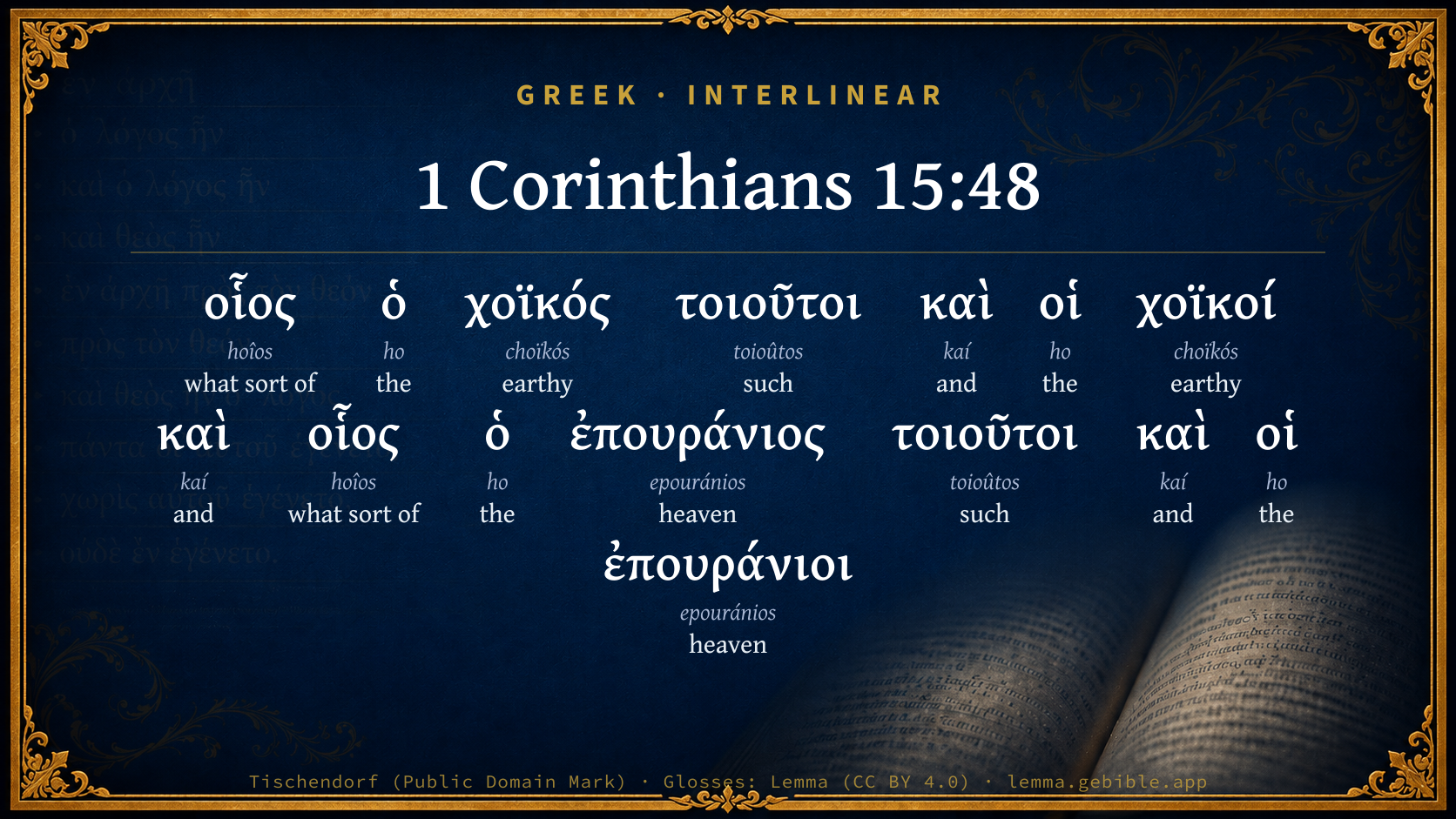
  1. οἷος hoîos G3634 “what sort of” Correlative pronoun, Nominative, Singular, Masculine
  2. ὁ ho G3588 “the” Article, Nominative, Singular, Masculine
  3. τοιοῦτοι toioûtos G5108 “such” Demonstrative pronoun, Nominative, Plural, Masculine
  4. καὶ kaí G2532 “and” Conjunction
  5. οἱ ho G3588 “the” Article, Nominative, Plural, Masculine
  6. χοϊκοί choïkós G5517 “earthy” Adjective, Nominative, Plural, Masculine
  7. καὶ kaí G2532 “and” Conjunction
  8. οἷος hoîos G3634 “what sort of” Correlative pronoun, Nominative, Singular, Masculine
  9. ὁ ho G3588 “the” Article, Nominative, Singular, Masculine
  10. ἐπουράνιος epouránios G2032 “heaven” Adjective, Nominative, Singular, Masculine
  11. τοιοῦτοι toioûtos G5108 “such” Demonstrative pronoun, Nominative, Plural, Masculine
  12. καὶ kaí G2532 “and” Conjunction
  13. οἱ ho G3588 “the” Article, Nominative, Plural, Masculine
  14. ἐπουράνιοι epouránios G2032 “heaven” Adjective, Nominative, Plural, Masculine

About this verse

These counts appear in no published source. They are computed here, from the morphology-tagged text and Lemma’s own curated glosses. What Lemma adds →

15
words
6
distinct lemmas
Pauline Epistles
section

Notable vocabulary

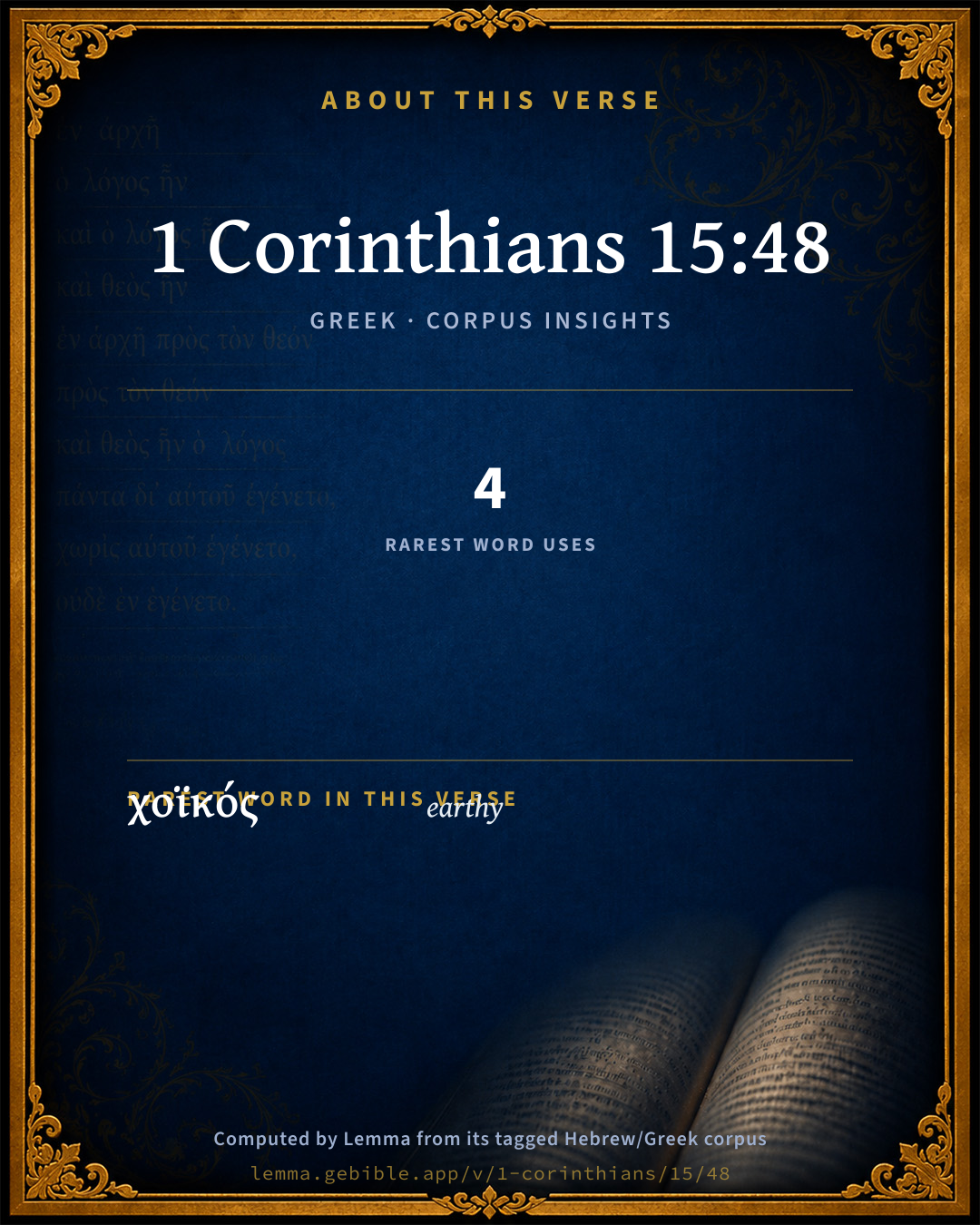
The rarest word here is χοϊκός earthy G5517 — appearing just 4 times in the whole Greek New Testament.

Shared distinctive vocabulary

χοϊκός earthy G5517 occurs in 3 verses of the Greek New Testament. Also found in:

Repetition

Words recur within this verse:

  • οἷος what sort of G3634 ×2
  • χοϊκός earthy G5517 ×2
  • τοιοῦτοι such G5108 ×2
  • ἐπουράνιος heaven G2032 ×2
  • ὁ the G3588 ×4
  • καὶ and G2532 ×3

Cross-references

6

Topical passages linked to 1 Corinthians 15:48 in the Treasury of Scripture Knowledge — connected by theme and wording, ordered by reader-vote popularity; previews shown in the World English Bible.

  • Genesis 5:3 Adam lived one hundred thirty years, and became the father of a son in his own likeness, after his image, and named him Seth.
  • John 3:6 That which is born of the flesh is flesh. That which is born of the Spirit is spirit.
  • Philippians 3:20–21 For our citizenship is in heaven, from where we also wait for a Savior, the Lord Jesus Christ;
  • Job 14:4 Who can bring a clean thing out of an unclean? Not one.
  • Romans 5:12–21 Therefore, as sin entered into the world through one man, and death through sin; and so death passed to all men, because all sinned.
  • 1 Corinthians 15:21–22 For since death came by man, the resurrection of the dead also came by man.

Cross-references courtesy of OpenBible.info (CC BY 4.0).

Commentary

Notes on 1 Corinthians 15:48 from classic Christian and Jewish commentators (each source and its license shown beneath its notes). The classic Christian expositions comment on the surrounding passage and are grouped to its opening verse, so a note may address several verses; the Jewish commentaries on the Tanakh (Rashi and others) are per-verse, so they appear only where the commentator wrote on this verse.

Lemma curates 59 commentaries, every one of them public domain or Creative Commons licensed, each selected and text-cleaned for this edition rather than reprinted as found. About our sources →

Tyndale Open Study Notes

Tyndale Open Resources

15:48 Earthly people (literally those of the dust): Like Adam, natural human beings are under the curse of sin and death. All return to dust (see Gen 3:19)—they all die. • heavenly people are like the heavenly man: Those who belong to Christ are like him in having an unending spiritual life.

Tyndale Open Study Notes — © Tyndale Open Resources, licensed CC BY-SA 4.0. Text via the HelloAO Bible API.

Meyer's Critical & Exegetical Commentary

Heinrich August Wilhelm Meyer

1Co_15:48. Application to our present and future bodily nature. We are to supply simply ἐστί and εἰσί.

ὁ χοϊκός] Adam.

οἱ χοϊκοί] all Adams posterity, as such, in so far as they have the same material nature with their first father. This common nature is the psychical corporeity.

ὁ ἐπουράνιος] He who is in heaven (comp. the frequent ἐπουράνιοι θεοί in Homer; Mat_18:35; Php_2:10; 2Ma_3:39; see also on 1Co_15:40), i.e. Christ; not, however, as the heavenly archetype of humanity, as which He was pre-existent in God (Beyschlag), but as the exalted to heaven, Php_2:9; Eph_4:8 ff.

οἱ ἐπουράνιοι] These are the risen Christians, inasmuch as they shall be citizens of the heavenly commonwealth, Php_3:20; Heb_12:22; 2Ti_4:18. The common nature of the ἐπουράνιος and the ἐπουράνιοι is the pneumatic body. Comp. Php_3:21. Instead of referring the twofold resemblance in kind to the nature of the body, Hofmann makes it refer to the nature of the life,on the one side, sinfulness and nothingness; on the other side, holiness and glory. But the matter is thus turned to its ethical side, which Paul cannot have in view here in accordance with the whole connection, which has to do only with the twofold bodily conditionthat belonging to the first, and that to the last Adam. This also in opposition to van Hengel.

Meyer — Critical and Exegetical Commentary on the New Testament — English translation by Peter Christie, edited by Frederick Crombie (T&T Clark, 1880) — public domain. Text from a community e-Sword module.

Godet's Commentaries

Frédéric Louis Godet

Vv. 48, 49. “As is the earthly, such are they also that are earthly: and as is the heavenly, such are they also that are heavenly. 49. And as we have borne the image of the earthly, we shall also bear the image of the heavenly.”

The two facts pointed out in 1Co 15:48 rest on this principle: that every race bears the characteristics of the head from which it proceeds. As Adam was, such is Adamite humanity; as is the glorified Christ, such is humanity glorified in Him. Hence the final consequence drawn in 1Co 15:49.

Vv. 49. Καί: “and in consequence of this law.” The two verbs, the one in the past, the other in the future, show that Paul transports himself to the time of the Advent, which for believers will separate their Adamite past from their Messianic future. During their whole earthly life, even after their conversion, believers bear to the end the image of man taken from the dust, as he was created at the beginning. The past: we have borne, places us at that glorious point of time when we shall have laid down this inheritance, and when our existence as sons and heirs of Adam will give place to existence as sons and heirs of God, thenceforth like to the Lord Himself.

In the second clause the large majority of the Mjj. and Fathers read the subjunctive aorist φορέσωμεν, let us bear, that is to say: “Let us strive to bear.” And most modern editors think themselves obliged to follow these authorities. But here again, as in the perfectly analogous case Rom 5:1, we do not hesitate for an instant to prefer the reading which is by far the least supported. The future has on its side only the Vaticanus and the Peschito; but it is demanded by the context, which does not admit of an exhortation any more than in the case of Rom 5:1. The object is simply to conclude the argument begun in 1Co 15:39 : “Such, then, is the body with which they will come: a heavenly body like that of the Lord Himself.” If this were an exhortation, it would be necessary, with Chrysostom, to take the word εἰκών, image, in the moral sense: “Let us therefore put on the holiness of Christ,” which is manifestly contrary to the entire preceding and subsequent context. We shall see at 1Co 15:50 what has led this Father into his false explanation. This reading was early introduced, because, as Holsten says, it was customary to quote passages separately, and with a view to giving them a practical application.

The future indicative corresponds to the aorist ἐφορέσαμεν, exactly as these same two tenses correspond to one another, Rom 6:5; with this difference, that the past and the future are there separated by conversion, here by the Advent. The necessity for reading the future is confessed by Meyer, Rückert, Osiander, Holsten, etc.; and it is vain for Heinrici, Hofmann, Beet, Edwards, to defend the other reading so evidently condemned by the context.

The apostle has answered the two difficulties which were raised at Corinth to the hope of a resurrection: How will it be effected after death has dissolved the body? — By that very death and dissolution. — But with what body will the risen appear?

With a body like that of the glorified Christ, as appropriate to their spiritual state as the present body is to our psychical state.

After this very compact and complete discussion, there remained another case, not anticipated in these answers, that of believers whom the Lord shall find living on the earth at the time of His return. How will it go with them? Here was a question which the apostle, who never forgets a single side of the subjects he treats, could not neglect. This is the theme of the passage 1Co 15:50-52.

Frédéric Louis Godet — Commentaries on Luke, John, Romans, and 1 Corinthians — English translation (T&T Clark, Edinburgh, 1870s–1890s) — public domain. Text from a community e-Sword module.

Hodge's Commentary on Romans, Ephesians & First Corinthians

Charles Hodge

1Co_15:48

As (is) the earthy, such (are) they also that are earthy; and as (is) the heavenly, such (are) they also that are heavenly.

The earthy is of course Adam; they that are earthy are his descendants. The heavenly is Christ; they that are heavenly are his risen people. The descendants of Adam derive from him an earthly body like his. Those who are Christs are to have a body fashioned like unto his glorious body, Phi_3:21.

Charles Hodge — Commentary on Romans (1835), First Corinthians (1857), and Ephesians (1856) — public domain. Text from a community e-Sword module.

Geneva Bible (1599)

Geneva Bible translators

He applieth both the earthly naturalness of Adam (if I may so say) to our bodies, so long as they are naturally conversant on earth, to wit, in this life, and in the grave: and also the spirituality of Christ to the same our bodies, after that they are risen again: and he saith, that that goeth before and this shall follow.

Geneva Bible (1599) marginal notes — public domain. Text via Bolls.life.

Jamieson, Fausset & Brown

Robert Jamieson, A. R. Fausset & David Brown

As is the earthy--namely, Adam.

they . . . that are earthy--All Adam's posterity in their natural state (Joh 3:6-7).

the heavenly--Christ.

they . . . that are heavenly--His people in their regenerate state (Phi 3:20-21). As the former precedes the latter state, so the natural bodies precede the spiritual bodies.

Jamieson, Fausset & Brown — Commentary Critical and Explanatory on the Whole Bible (1871) — public domain (CC PDM 1.0). Text via the HelloAO Bible API.

Adam Clarke's Commentary

Verse 48. As is the earthy, c.] As Adam was, who was formed from the earth, so are all his descendants frail, decaying, and subject to death.

As is the heavenly] As is the heavenly state of Adam and all glorified beings, so shall be the state of all those who, at the resurrection, are found fit for glory.

Adam Clarke's Commentary on the Bible (1810–1826) — public domain. Text from a community e-Sword/MySword module.

The Cambridge Bible for Schools and Colleges

gen. ed. J. J. S. Perowne

48. As is the earthy] i.e. Adam. Man, when united to Christ by faith, partakes of both natures. He is liable, therefore, still to the weakness and infirmities of the former. “This infection of nature doth remain, yea in them that are regenerated.” Art. IX. And this he must bear to the end. He must be subject to the law of the natural order of things, before he attains fully to the law of the spiritual order. He must receive the wages of sin, namely death. But, possessing faith in Christ, he possesses the imperishable principle of life.

as is the heavenly] i.e. Christ. ‘When that which is perfect is come, then that which is in part shall be brought to an end.’ ‘Mortality shall be swallowed up of life:’ the old Adam shall be done away in Christ Cf. Php_3:20-21.

The Cambridge Bible for Schools and Colleges (gen. ed. J. J. S. Perowne; Cambridge University Press, 1878–1918) — public domain. Text from a community e-Sword module.

John Gill's Exposition

Behold, I show you a mystery,.... Or a secret, which could never have been discovered by reason, or the light of nature, and what is of pure revelation; and which perhaps the apostle became acquainted with, when he was caught up into the third heaven; and is what is never made mention of by any prophet, or apostle, but himself: he prefaces the account of it in this manner, partly to show the great respect he had for these Corinthians, that he treated them as his bosom friends, to whom he communicated his secrets; and partly to excite their curiosity and attention:

we shall not all sleep, but we shall all be changed; some copies read, "we shall all rise again, but we shall not all be changed", and so the Vulgate Latin version; according to which the sense is, all will rise again, both just and unjust, but all will not be changed into a state of glory; but the apostle is only speaking of the saints, of whom it is true, not only that they shall rise again, but shall be changed from corruption to incorruption; wherefore this cannot be a true reading: others read the words thus, "we shall all die, but we shall not all be changed"; and so the Ethiopic version and the Alexandrian copy seem to have read; which is just the reverse of the text, and arises from a wrong sense of Heb 9:27 where it is not said, it is "appointed unto all men", but "unto men once to die"; from which rule there has been some exceptions, as the instances of Enoch and Elijah show; and there will be more at the time of Christ's coming, for all will not sleep in their graves, or die, for death is meant by sleeping; they will not die as men ordinarily do, and continue under the power of death, but they will be changed at once from corruption to incorruption, from dishonour to glory, from weakness to power, from being natural to be spiritual bodies; this change all the saints will undergo, whether dead or alive, at Christ's coming; the dead by a resurrection from the dead, and the living by a secret and sudden power, which will at once render their bodies, without separating them from their souls, immortal and glorious: and this reading and sense are confirmed by the Syriac and Arabic versions.

John Gill's Exposition of the Whole Bible (1746–1763) — public domain (CC PDM 1.0). Text via the HelloAO Bible API.

Trapp's Complete Commentary

John Trapp

48 As is the earthy, such are they also that are earthy: and as is the heavenly, such are they also that are heavenly.

Ver. 48. They that are earthy] κερυμος ο ανθρωπος, Vulgus fictilis. Man is but an earthen pot, Isa 64:8.

John Trapp, A Commentary or Exposition upon All the Books of the Old and New Testament (1647–1656) — public domain. Text from a community e-Sword module.

Albert Barnes' Notes on the Bible

As is the earthy - Such as Adam was.

Such are they also ... - Such are all his descendants; all who derive their nature from him. That is, they are frail, corruptible, mortal; they live in an animal body as he did, and like him, they are subject to corruption and decay.

And as is the heavenly - As is he who was from heaven; as is the Lord Jesus now in is glorified body. “Such are they also, etc.” Such will they be also. They will be like him; they will have a body like his. This idea is more fully expressed in Phi 3:21, “Who shall change our vile body, that it may be fashioned like unto his glorious body.”

Albert Barnes' Notes on the Bible (1834–1885) — public domain. Text from a community e-Sword/MySword module.

Matthew Poole's English Annotations

Such a body as Adam had, (which was earthy), such all the sons of Adam have; and such a body as Christ now hath since his resurrection, (which is a heavenly body), such a body also shall believers, who are heavenly, have in the resurrection.

Matthew Poole's English Annotations on the Holy Bible (1683–1685) — public domain. Text from a community e-Sword/MySword module.

Whedon's Commentary on the Bible

Daniel D. Whedon

48. As… earthy, such… earthy—By the universal law of descent, earthly beings inherit the nature of their progenitors. See note, Rom_5:12, on the phrase all have sinned.

Heavenly—But the nature of the heavenly is stamped at the resurrection upon the earthy by a direct act of divine power.

Daniel D. Whedon (gen. ed.), Commentary on the Old and New Testaments (1874–1909) — public domain. Text from a community e-Sword module.

The Pulpit Commentary

As is the earthy, etc. Men resemble their first parent Adam; Christians, their spiritual Redeemer, Christ. (Php_3:20, 21)

The Pulpit Commentary (1880–1919), ed. H.D.M. Spence-Jones & Joseph S. Exell — public domain. Text from a community e-Sword module.

John Wesley's Explanatory Notes

They that are earthy - Who continue without any higher principle. They that are heavenly - Who receive a divine principle from heaven.

John Wesley, Explanatory Notes Upon the Whole Bible (1754–1765) — public domain. Text via the GEBible commentary corpus.

McGarvey & Pendleton's Commentaries

J. W. McGarvey

As is the earthy, such are they also that are earthy: and as is the heavenly, such are they also that are heavenly .

J. W. McGarvey (with Philip Y. Pendleton), Commentaries on the New Testament (The Fourfold Gospel, 1914; Acts; and the epistles) — public domain. Text from a community e-Sword/MySword module.

The People's New Testament

B. W. Johnson

48. As is the earthy. All have earthly bodies like that of Adam. As is the heavenly. When we are raised to heaven we shall have spiritual bodies like Christ's, not like the body he received from Mary, but the glorious body in which he appears to saints and angels on high. Do we ask what body we shall have? It shall be like Christ's glorious body. See Phil. 3:21. Not of flesh and blood, for (verse 50)

flesh and blood cannot inherit the kingdom of God. If of flesh and blood, our bodies would be corruptible, and would not be suited to the eternal kingdom.

B. W. Johnson's The People's New Testament with Notes (1889–1891) — public domain. Electronic text from the Christian Classics Ethereal Library (CCEL) ThML edition.

Cambridge Greek Testament for Schools and Colleges

48. οἷος ὁ χοϊκός, i. e. Adam. Man, when united to Christ by faith, partakes of both natures. He is liable, therefore, still to the weakness and infirmities of the former. ‘This infection of nature doth remain, yea in them that are regenerated.’ Art. IX. And this they must bear to the end. They must be subject to the law of the natural order of things, before they attain fully to the law of the spiritual order. They must receive the wages of sin, namely, death. But, possessing faith in Christ, they possess the imperishable principle of life.

οἷος ὁ ἐπουράνιος, i. e. Christ. ‘When that which is perfect is come, then that which is in part shall be brought to an end.’ ‘Mortality shall be swallowed up of life’: the old Adam shall be done away in Christ. Cf. Php 3:20-21.

Cambridge Greek Testament for Schools and Colleges (Cambridge University Press, 1896; 21 vols, various authors incl. Carr, Maclear, Plummer, Farrar, Lumby, Moule, M. R. James, Simcox) — public domain. Text from a community e-Sword module.

Alford’s Greek Testament

Henry Alford

48.] ὁ χοϊκός, Adam; οἱ χ., his posterity on earth: ὁ ἐπουρ., Christ; οἱ ἐπ., His risen people. See, as admirably illustrating this verse, Php 3:20, Php 3:21.

Henry Alford, The Greek Testament (1849–1861) — public domain. Text from a community e-Sword module.

International Critical Commentary

48, 49. Each race has the attributes of its Head. As a consequence of this law (καί), we who once wore the likeness of the earthly Adam shall hereafter wear that of the glorified Christ. What Adam was, made of dust to be dissolved into dust again, such are all who share his life; and what Christ is, risen and eternally glorified, such will be all those who share His life. A body, conditioned by ψυχή, derived from Adam, will be transformed into a body conditioned by πνεῦμα, derived from Christ. See 1Th 4:16; 2Th 1:7; Php 3:20, Php 3:21; Eph 2:6, Eph 2:20; also Swete, The Ascended Christ, p. 138.

If, with the best editors, we follow the greatly preponderating external evidence and read φορέσωμεν rather than φορέσομεν, ‘let us wear’ or ‘let us put on for wear’ rather than ‘we shall wear,’ the meaning will be that the attaining to the glorified body depends upon our own effort: see Goudge, p. 155. “But not only the context and the whole tenor of the argument are in favour of the future, but the hortative subjunctive is here singularly out of place and unlocked for” (Ellicott). Perhaps we have here “a very early instance of itacism.” Compare Jas 4:15, where the balance of evidence is very different and the future is undoubtedly right. Alford thinks that here “a desire to turn a physical assertion into an ethical assertion” has corrupted the reading.

φορέσομεν, B 17 46 Arm. Aeth., Theodoret expressly (τὸ γὰρ φορέσομεν προρρητικῶς, οὐ παραινετικῶς εἴρηκεν): φορέσωμεν, א A C D E F G K L P, Latt. Copt. Goth., Chrysostom expressly (τοῦτʼ ἐστιν, ἄριστα πράξωμεν).

International Critical Commentary — older volumes (1896–1929), various authors — public domain. Text from a community e-Sword module.

Lesson kit

Teaching starters — assembled from the data on this page, not authored interpretation. Every prompt links to the verse data it draws on. Edit before teaching.

1 Corinthians, in the Pauline Epistles, opens this verse with 15 words (6 distinct Greek lemmas). Its most distinctive word is choïkós (“earthy”). A historical commentator’s framing appears above. Read the whole chapter for the surrounding context.

Discussion questions

  1. What does “earthy” (choïkós) contribute to the verse as a whole?
  2. How does 1 Corinthians 15:47, which shares the word «earthy», read alongside this verse?
  3. What does the repetition of “what sort of” (2× in this one verse) do in this verse?
  4. These translations render this verse differently; the difference is in the English rendering, not the original. What questions does that raise?
  5. Compare how Tyndale Open Study Notes and Meyer's Critical & Exegetical Commentary read this verse. Where do they agree or differ?

Things to notice

  • These translations choose different wording for 10 words in this verse.
  • “what sort of” occurs 2× in this single verse.
  • 6 distinct Greek lemmas span 15 words in this verse.

Reading settings

Reading text

Shown beneath each verse's original-language words.

Old Testament
Old Testament edition

Read the OT as the Masoretic Hebrew (MT) or the Greek Septuagint (LXX).

English shown for the Greek Septuagint (in the Hebrew ↔ Greek comparison).

Comparing translations? Open the Compare panel on any verse page to stack up to four side by side.