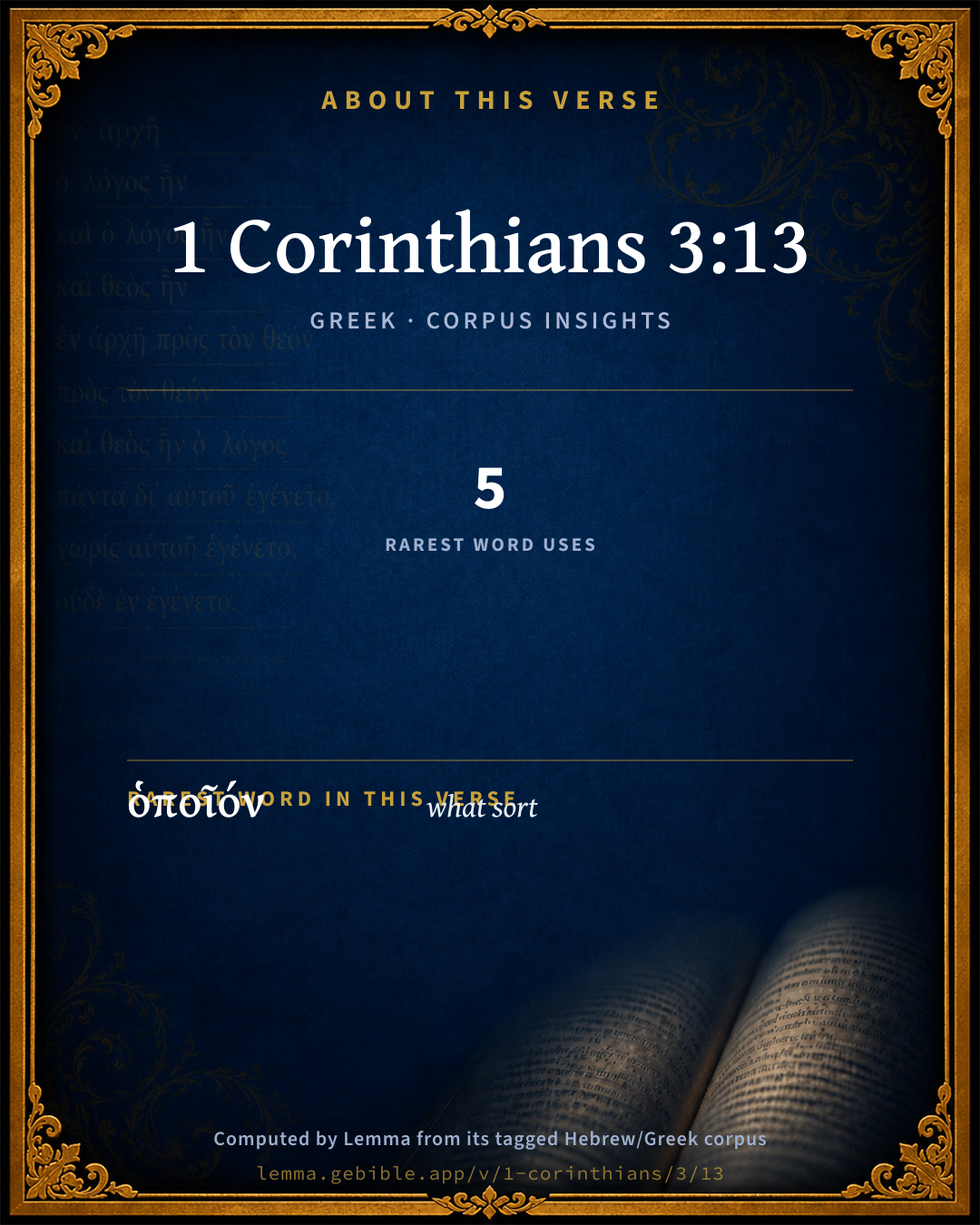
1 Corinthians 3:13

Greek (Tischendorf 8th ed.) 1 Corinthians 3:13 appears in the Greek New Testament. The text above is from the Tischendorf 8th edition. Each word links to its Strong’s number and a concise gloss. Click any word for its full Thayer’s Greek Lexicon entry.
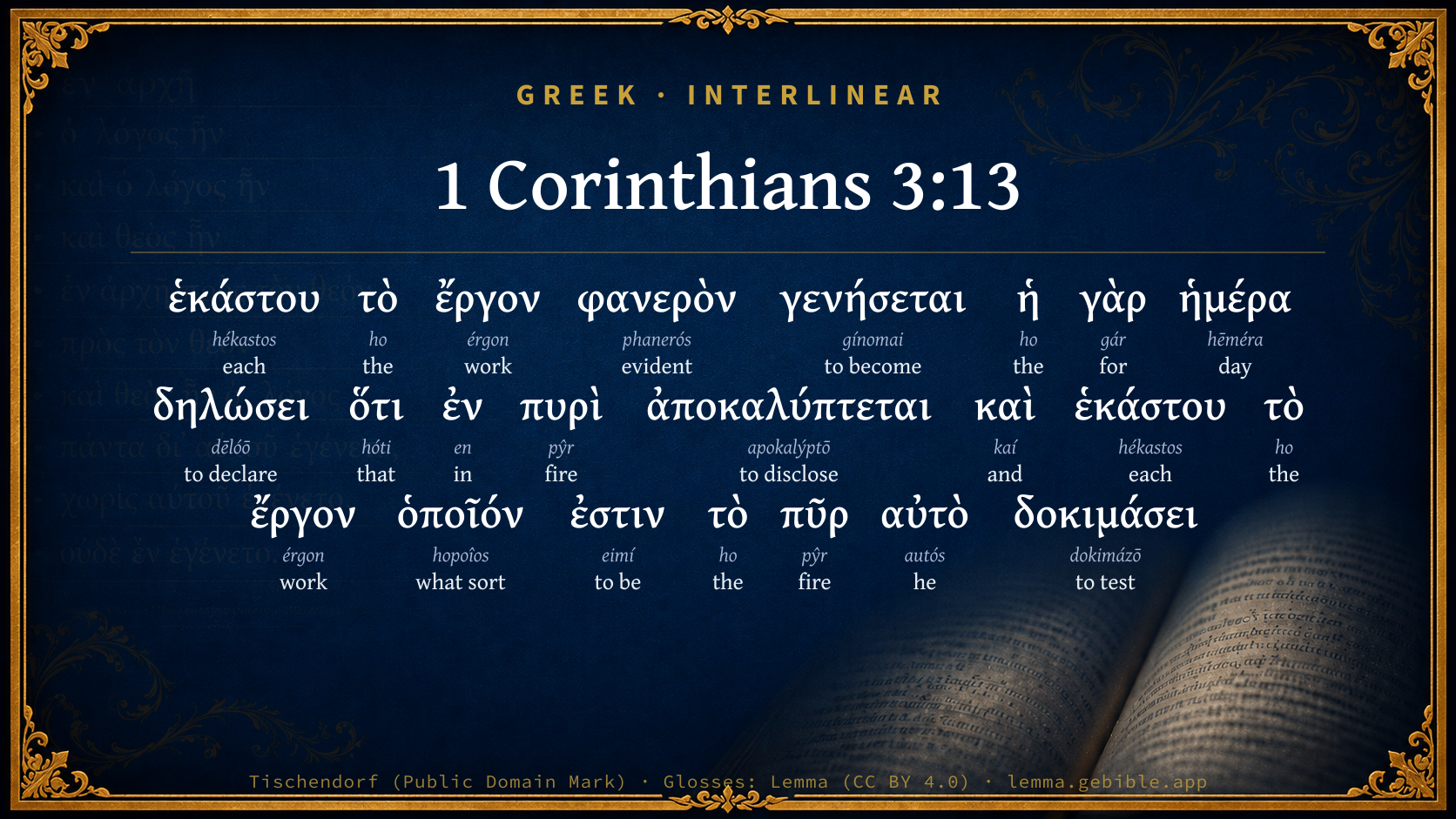
Download image
Cite this verse

1 Corinthians 3:13 (World English Bible). Public Domain. Lemma interlinear Bible study tool, https://lemma.gebible.app/v/1-corinthians/3/13.

Show BibTeX & RIS
BibTeX
RIS
English Translation
each man's work will be revealed. For the Day will declare it, because it is revealed in fire; and the fire itself will test what sort of work each man's work is.
World English Bible · Public Domain
Download a study sheet

One document with this verse’s original text, its word-by-word gloss line, the meaning frame, cross-references with their text, attributed commentary, and full source and license credits — printable, and it pastes into notes with its structure intact.

This verse Autodidact and up

Study sheet (.html) Plain text (.txt)

A passage Seminary Student

Up to 50 verses in one chapter. A passage sheet keeps up to 6 commentary sources and 12 cross-references per verse, in the order this page ranks them, and says so on the sheet whenever that leaves anything out. Ask for a single verse and you get the Autodidact verse sheet above.

Everything on this page stays free to read, with no account — the sheet is a download of what is already on screen, not access to it.

Want to remove ads? Support Godless Engineer
Compare translations 3

The same verse in 3 English versions, stacked beneath the original-language interlinear above. Click any original word for its lexicon entry.

Each is an independent rendering of the whole verse — the interlinear is not word-aligned to these translations.

Highlighted words mark where these versions differ — a whole-verse word diff, not a word-by-word alignment.

  • World English Bible Public Domain
    each man's work will be revealed. For the Day will declare it, because it is revealed in fire; and the fire itself will test what sort of work each man's work is.
  • King James Version Public Domain
    Every man's work shall be made manifest: for the day shall declare it, because it shall be revealed by fire; and the fire shall try every man's work of what sort it is.
  • unfoldingWord Literal Text CC BY-SA 4.0
    the work of each one will become evident, for the day will display; for it is revealed in fire, and the fire itself will test of what sort is the work of each one.

unfoldingWord Literal Text — © unfoldingWord, licensed CC BY-SA 4.0. Word-aligned USFM3 via Door43 (git.door43.org/unfoldingWord/en_ult).

Versions to compare (up to 4)

3 of 4 selected

Show all 19 translations

Every available English version of this verse, each an independent rendering of the whole verse.

  • World English Bible Public Domain
    each man's work will be revealed. For the Day will declare it, because it is revealed in fire; and the fire itself will test what sort of work each man's work is.
  • Berean Standard Bible Public Domain
    his workmanship will be evident, because the Day will bring it to light. It will be revealed with fire, and the fire will prove the quality of each man’s work.
  • Majority Standard Bible Public Domain
    his workmanship will be evident, because the Day will bring it to light. It will be revealed with fire, and the fire will prove the quality of each man’s work.
  • King James Version Public Domain
    Every man's work shall be made manifest: for the day shall declare it, because it shall be revealed by fire; and the fire shall try every man's work of what sort it is.
  • American Standard Version (1901) Public Domain
    each man's work shall be made manifest: for the day shall declare it, because it is revealed in fire; and the fire itself shall prove each man's work of what sort it is.
  • Revised Version (1885) Public Domain
    each man’s work shall be made manifest: for the day shall declare it, because it is revealed in fire; and the fire itself shall prove each man’s work of what sort it is.
  • Geneva Bible (1599) Public Domain
    Euery mans worke shalbe made manifest: for the day shall declare it, because it shalbe reueiled by the fire: and the fire shall trie euery mans worke of what sort it is.
  • Douay-Rheims (1899) Public Domain
    Every man's work shall be manifest; for the day of the Lord shall declare it, because it shall be revealed in fire; and the fire shall try every man's work, of what sort it is.
  • Young's Literal Translation Public Domain
    of each the work shall become manifest, for the day shall declare `it', because in fire it is revealed, and the work of each, what kind it is, the fire shall prove;
  • Literal Standard Version CC BY-SA 4.0
    the work will become visible of each, for the day will declare [it], because it is revealed in fire, and the work of each, what kind it is, the fire will prove;
  • Unlocked Literal Bible CC BY-SA 4.0
    his work will be revealed, for the daylight will reveal it. For it will be revealed in fire. The fire will test the quality of what each one had done.
  • unfoldingWord Literal Text CC BY-SA 4.0
    the work of each one will become evident, for the day will display; for it is revealed in fire, and the fire itself will test of what sort is the work of each one.
  • Darby Bible Public Domain
    the work of each shall be made manifest; for the day shall declare [it], because it is revealed in fire; and the fire shall try the work of each what it is.
  • World Messianic Bible Public Domain
    each man’s work will be revealed. For the Day will declare it, because it is revealed in fire; and the fire itself will test what sort of work each man’s work is.
  • Webster's Bible Public Domain
    Every man's work will be made manifest: for the day will declare it, because it will be revealed by fire; and the fire will try every man's work, of what sort it is.
  • Free Bible Version CC BY-SA 4.0
    but whatever is used to build with will be exposed. For on the Day of Judgment, fire will reveal it and test it. Everyone's work will be shown for what it is.
  • Bible in Basic English Public Domain
    Every man's work will be made clear in that day, because it will be tested by fire; and the fire itself will make clear the quality of every man's work.
  • Text-Critical English NT CC BY 4.0
    his work will become evident, for the Day will make it clear, because it is revealed by fire. And the fire will test each person's work and reveal what sort of work it is.
  • Tyndale New Testament (1534) Public Domain
    every mannes worke shall appere. For the daye shall declare it and it shalbe shewed in fyre. And ye fyre shall trye euery mannes worke what it is.

Literal Standard Version (2020), Covenant Press — licensed CC BY-SA 4.0. Text via the HelloAO Bible API (eBible.org). Unlocked Literal Bible (unfoldingWord) — licensed CC BY-SA 4.0. Text via the HelloAO Bible API (eBible.org). unfoldingWord Literal Text — © unfoldingWord, licensed CC BY-SA 4.0. Word-aligned USFM3 via Door43 (git.door43.org/unfoldingWord/en_ult). Free Bible Version, Dr. Jonathan Gallagher — licensed CC BY-SA 4.0. Text via the HelloAO Bible API (eBible.org).

Word by word

More ways to search: Search by grammar → Find every occurrence → Compare this word →

Practice this passage: Drill this verse → Learn its vocabulary →

ὁποῖόν
hopoîos
G3697
“what sort”
Adjective, Nominative, Singular, Neuter
Part of Speech
Adjective
Case
Nominative
Number
Singular
Gender
Neuter
Full Thayer's Definition

Origin: from G3739 and G4169

TDNT: None

1. of what sort or quality, what manner of
  1. ἑκάστου hékastos G1538 “each” Adjective, Genitive, Singular, Masculine
  2. τὸ ho G3588 “the” Article, Nominative, Singular, Neuter
  3. ἔργον érgon G2041 “work” Noun, Nominative, Singular, Neuter
  4. φανερὸν phanerós G5318 “evident” Adjective, Nominative, Singular, Neuter
  5. γενήσεται gínomai G1096 “to become” Verb, Future, Middle deponent, Indicative, 3rd person, Singular
  6. ἡ ho G3588 “the” Article, Nominative, Singular, Feminine
  7. γὰρ gár G1063 “for” Conjunction
  8. ἡμέρα hēméra G2250 “day” Noun, Nominative, Singular, Feminine
  9. δηλώσει dēlóō G1213 “to declare” Verb, Future, Active, Indicative, 3rd person, Singular
  10. ὅτι hóti G3754 “that” Conjunction
  11. ἐν en G1722 “in” Preposition
  12. πυρὶ pŷr G4442 “fire” Noun, Dative, Singular, Neuter
  13. ἀποκαλύπτεται apokalýptō G601 “to disclose” Verb, Present, Passive, Indicative, 3rd person, Singular
  14. καὶ kaí G2532 “and” Conjunction
  15. ἑκάστου hékastos G1538 “each” Adjective, Genitive, Singular, Masculine
  16. τὸ ho G3588 “the” Article, Nominative, Singular, Neuter
  17. ἔργον érgon G2041 “work” Noun, Nominative, Singular, Neuter
  18. ἐστιν eimí G1510 “to be” Verb, Present, Active, Indicative, 3rd person, Singular
  19. τὸ ho G3588 “the” Article, Nominative, Singular, Neuter
  20. πῦρ pŷr G4442 “fire” Noun, Nominative, Singular, Neuter
  21. αὐτὸ autós G846 “he” Personal pronoun, Nominative, Singular, Neuter
  22. δοκιμάσει dokimázō G1381 “to test” Verb, Future, Active, Indicative, 3rd person, Singular

About this verse

These counts appear in no published source. They are computed here, from the morphology-tagged text and Lemma’s own curated glosses. What Lemma adds →

23
words
17
distinct lemmas
Pauline Epistles
section

Notable vocabulary

The rarest word here is ὁποῖόν what sort G3697 — appearing just 5 times in the whole Greek New Testament.

Shared distinctive vocabulary

ὁποῖόν what sort G3697 occurs in 5 verses of the Greek New Testament. Also found in:

Repetition

Words recur within this verse:

  • ἑκάστου each G1538 ×2
  • ἔργον work G2041 ×2
  • πυρὶ fire G4442 ×2
  • τὸ the G3588 ×4

Cross-references

19

Topical passages linked to 1 Corinthians 3:13 in the Treasury of Scripture Knowledge — connected by theme and wording, ordered by reader-vote popularity; previews shown in the World English Bible.

  • 1 Peter 1:7 that the proof of your faith, which is more precious than gold that perishes even though it is tested by fire, may be found to result in praise, glory, and honor at the revelation of Jesus Christ--
  • 1 Corinthians 3:14–15 If any man's work remains which he built on it, he will receive a reward.
  • Revelation 20:12 I saw the dead, the great and the small, standing before the throne, and they opened books. Another book was opened, which is the book of life. The dead were judged out of the things which were written in the books, according to their works.
  • 1 Corinthians 4:5 Therefore judge nothing before the time, until the Lord comes, who will both bring to light the hidden things of darkness, and reveal the counsels of the hearts. Then each man will get his praise from God.
  • Zechariah 13:9 I will bring the third part into the fire, And will refine them as silver is refined, And will test them like gold is tested. They will call on my name, and I will hear them. I will say, 'It is my people;' And they will say, 'Yahweh is my God.'"
  • 1 Peter 4:12 Beloved, don't be astonished at the fiery trial which has come upon you, to test you, as though a strange thing happened to you.
  • Romans 2:16 in the day when God will judge the secrets of men, according to my Gospel, by Jesus Christ.
  • 2 Peter 3:10 But the day of the Lord will come as a thief in the night; in which the heavens will pass away with a great noise, and the elements will be dissolved with fervent heat, and the earth and the works that are in it will be burned up.
  • 2 Thessalonians 1:7–10 and to give relief to you that are afflicted with us, when the Lord Jesus is revealed from heaven with his mighty angels in flaming fire,
  • Malachi 3:17 They shall be mine," says Yahweh of Hosts, "my own possession in the day that I make, and I will spare them, as a man spares his own son who serves him.
  • 1 Corinthians 1:8 who will also confirm you until the end, blameless in the day of our Lord Jesus Christ.
  • Romans 2:5 But according to your hardness and unrepentant heart you are treasuring up for yourself wrath in the day of wrath, revelation, and of the righteous judgment of God;
  • 2 Timothy 1:18 (the Lord grant to him to find the Lord's mercy in that day); and in how many things he served at Ephesus, you know very well.
  • Jeremiah 23:29 Isn't my word like fire? says Yahweh; and like a hammer that breaks the rock in pieces?
  • Ezekiel 13:10–16 Because, even because they have seduced my people, saying, Peace; and there is no peace; and when one builds up a wall, behold, they daub it with whitewash:
  • 2 Timothy 3:9 But they will proceed no further. For their folly will be evident to all men, as theirs also came to be.
  • Isaiah 28:17 I will make justice the line, and righteousness the plummet; and the hail shall sweep away the refuge of lies, and the waters shall overflow the hiding-place.
  • Luke 2:35 Yes, a sword will pierce through your own soul, that the thoughts of many hearts may be revealed."
  • Isaiah 8:20 To the law and to the testimony! if they don't speak according to this word, surely there is no morning for them.

Cross-references courtesy of OpenBible.info (CC BY 4.0).

Commentary

Notes on 1 Corinthians 3:13 from classic Christian and Jewish commentators (each source and its license shown beneath its notes). The classic Christian expositions comment on the surrounding passage and are grouped to its opening verse, so a note may address several verses; the Jewish commentaries on the Tanakh (Rashi and others) are per-verse, so they appear only where the commentator wrote on this verse.

Lemma curates 59 commentaries, every one of them public domain or Creative Commons licensed, each selected and text-cleaned for this edition rather than reprinted as found. About our sources →

Joseph Benson's Commentary

1Co 3:13. Every man’s work shall be made manifest — God will bring every work into judgment, with every secret thing, whether it be good, or whether it be evil, Ecc 12:14. There is nothing covered that shall not be revealed, neither hid, that shall not be known. But the apostle’s primary meaning here is, that it shall be made manifest what kind of materials every spiritual builder uses, that is, what kind of doctrines every minister of Christ preaches, whether they are true or false, important or trivial, calculated to produce genuine repentance, faith, and holiness in the hearers, or not; to promote the real conversion of sinners, and edification of believers, or otherwise: and of consequence, what kind of converts every minister makes, whether they be such as can stand the fiery trial or not. For the day shall declare it — Perhaps, 1st, η ημερα δηλωσει, might be rendered, time will declare it; for time, generally a little time, manifests whether a minister’s doctrine be Scriptural and sound, and his converts genuine or not. If his preaching produce no saving effect upon his hearers, if none of them are reformed in their manners, and renewed in their hearts; if none of them are turned from sin to righteousness, and made new creatures in Christ Jesus, there is reason to suspect the doctrine delivered to them is not of the right kind, and therefore is not owned of God. 2d, The expression means, The day of trial shall declare it; (see 1Pe 4:12;) for a day of trial is wont to follow a day of merciful visitation; a time of suffering to succeed a season of grace. Where the gospel is preached, and a church is erected for Christ, the religion of such as profess to receive the truth is generally, in the course of divine providence, put to the test; and if it be a fabric of wood, hay, and stubble, and not of gold, silver, and precious stones, it will not be able to bear the fiery trial, but will certainly be consumed thereby. The religion (if it can be called religion) of those who are not grounded on, and built up in Christ, (Col 2:7,) will evaporate like smoke from wood, hay, and stubble, in the day of trial. But, 3d, and especially the day of final judgment, the great day of the Lord, is here intended, and this day shall declare it; shall declare every man’s work to all the universe: because it shall be revealed by fire — Which shall consume the earth with its increase, and shall melt down the foundations of the mountains; the heavens and the earth, which are now, being kept in store, reserved unto fire, against the day of judgment and perdition of ungodly men, 2Pe 3:7. And the fire shall try every man’s work — As fire tries metals, and finds out and separates whatever dross is mixed with them; or, as the fire of that great and awful day will penetrate the earth to its centre, and consume whatever is combustible, so shall the strict process of the final judgment try, not only the religion of every private Christian, but the doctrine of every public teacher, and manifest whether it came up to the Scripture standard or not. Although there is here a plain allusion to the general conflagration, yet the expression, when applied to the trying of doctrines, and consuming those that are wrong, and the trying of the characters of professors, is evidently figurative; because no material fire can have such an effect on what is of a moral nature.

Joseph Benson's Commentary on the Old and New Testaments (1811–1818) — public domain. Text from a community e-Sword module.

Bengel's Gnomon

Johann Albrecht Bengel

1Co 3:13. Ἔργον) the work, which any one has erected.—ἡ ἡμέρα, the day) of the Lord. So Heb 10:25, comp. presently ch. 1Co 4:3; 1Co 4:5, where, after an interval, as usual, he speaks more clearly. Previous days, which vividly realize to us the fire, for instance, in adversity and at death, are not altogether excluded.—δηλώσει, shall declare) to all.—[Many things are also revealed sooner, at least to some, but Paul lays down the last and most certain day of fiery trial.—V. g.]—ἐν πυρὶ ἀποκαλύπτεται) is revealed in fire, viz., the Lord, whose day that is; or, the work [so Engl. Vers.]; 2Th 1:7-8, is revealed, as present, because it is certain and near, Rev 22:20.—τὸ πὺρ, the fire) a metaphor, as throughout this whole discourse. The fire of the last day and of the Divine judgment is intended, as is evident from the subsequent language, which peculiarly applies to the last judgment, 1Co 4:5; 2Co 5:10 [2Th 1:8]; to which the visible fire on that day will correspond.—δοκιμάσει) shall try, not shall purge. This passage not only does not support [add fuel to] the fire of purgatory, but entirely extinguishes it; for it is at the last day, and not till then, that the fire shall finally try every man’s work; therefore the fire of purgatory does not precede it. Nor on that very day, shall the work be purged; but it shall be tried, of what sort it previously was on either side [good or bad], when it shall either remain or be burnt up.

Bengel's Gnomon of the New Testament — English translation (T&T Clark, Edinburgh, 1860) — public domain. Text from a community e-Sword module.

Meyer's Critical & Exegetical Commentary

Heinrich August Wilhelm Meyer

1Co_3:13. Apodosis: So will what each has done on the building (τὸ ἔργον) not remain hidden (φανερὸν γενήσ.). Then the ground of this assurance is assigned: ἡ γὰρ ἡμέρα δηλώσει, sc[521] ἑκάστου τὸ ἔργον. The day is κατʼ ἐξοχήν, the day of the Parousia (comp Heb_10:24), which is obvious from what follows on to 1Co_3:15. So, rightly, Tertullian, contra Marc. iv. 2; Origen, Cyprian, Ep. iv. 2; Lactantius, Inst. vii. 21; Hilarius, Ambrosiaster, Sedulius, Chrysostom, Theodoret, Theophylact, the Roman Catholics (some of whom, however, in the interests of purgatory, make it out to be the day of death), Bengel, and others, including Pott, Heydenreich, Billroth, Schott, Schrader, Rückert, Olshausen, de Wette, Osiander, Ewald, Hofmann. It is un-Pauline, and also against the context (for wood, etc., does not apply to the doctrines of the Judaizers alone), to interpret the phrase, with Hammond, Lightfoot, Gusset, Schoettgen, of the destruction of Jerusalem, which should reveal the nullity of the Jewish doctrines. The following expositions are alien to the succeeding context: of time in general (comp dies docebit: χρόνος δίκαιον ἄνδρα δείκνυσιν μόνος, Sophocles, Oed. Rex, 608; Stob. Ecl. I. p. 234,so Grotius, Wolf, Wetstein, Stolz, Rosenmüller, Flatt, and others); or of the time of clear knowledge of the gospel (Erasmus, Beza, Calvin, Vorstius[524]); or of the dies tribulationis (Augustine, Calovius, and others).

ὅτι ἐν πυρὶ ἀποκαλ.] We are neither to read here ὅτε[525] instead of ὅτι (Bos, Alberti), nor does the latter stand for the former (Pott), but it has a causative force: because it is revealed in fire,the day, namely (Estius, Pott, Billroth, Rückert, Olshausen, de Wette, Ewald, Hofmann), not τὸ ἔργον, as Luther and the majority of interpreters (among them Heydenreich, Flatt, Schott, Neander) hold, following Ambrosiaster and Oecumenius; for this would yield a tautology with what comes next. Bengel, joined by Osiander, imagines as the subject of the verb Ὁ ΚΎΡΙΟς, which can be evolved from Ἡ ἩΜΈΡΑ only by a very arbitrary process, since the whole context never speaks of Christ Himself.

ἘΝ ΠΥΡΊ] i.e. encompassed with fire (see Bernhardy, p. 209; Matthiae, p. 1340), so that fire is the element in which the revelation of that day takes place. For Christ, when His Parousia draws nigh, is to appear coming from heaven ἐν πυρὶ φλογός (2Th_1:8; comp Dan_7:9-10; Mal_4:1), i.e. surrounded by flaming fire (which is not to be explained away, as is often done: amid lightnings; rather comp Exo_3:2 ff; Exo_19:18). This fire, however, is not, as Chrysostom would have it, that of Gehenna (Mat_6:22; Mat_6:29, al[528]); for it is in it that Christ appears, and it seizes upon every ἔργον, even the golden, etc., and proves each, leaving the one unharmed, but consuming the other. The correct supplying of Ἡ ἩΜΈΡΑ with ἈΠΟΚΑΛ. supersedes at once the older Roman Catholic interpretation about purgatory (against which see, besides, Scaliger and Calovius), as the correct view of ἡ ἡμέρα sets aside the explanations of the wrath of God against the Jews (Lightfoot), of the Holy Spirit, who tries quae doctrina sit instar auri et quae instar stipulae (Calvin), of the fire of trial and persecution (Rosenmüller, Flatt, following Augustine, de civ. Dei, xxi. 26, Erasmus, and many old commentators; comp Isa_48:10; 1Pe_1:7; 1Pe_4:12; Sir_2:5), and of a progressive process of purifying the mind of the church (Neander). The idea rather is: The decision on the day of the Parousia will show how each has worked as a teacher; if any one has taught what is excellent and imperishable, that, as belonging to the divine ἀλήθεια, will stand this decision and survive; if any one has taught what is worthless and perishable, that will by the decision of that day cease to have any standing, fall away, and come to nought (comp on 1Co_3:12). This idea Paul, in accordance with his figure of a building, clothes in this form: At the Parousia the fire, in which it reveals itself, will seize upon the building; and then through this fiery ordeal those parts of the fabric which are of gold, silver, and precious stones will pass unharmed; but those consisting of wood, hay, and stubble will be burnt up.

ἀποκαλύπτεται] The result of this act of revelation is the ΔΗΛΏΣΕΙ already spoken of. The present marks the event as beyond doubt; the sentence is an axiom.

καὶ ἑκάστου Κ.Τ.Λ[531]] not to be connected with ὅτι (Rückert), but with the clause in the future, ἡ γὰρ ἡμ. δγλώσει. Is ἔργον in the nominative (Theophylact, Oecumenius, and many others) or accusative (Billroth, Schott, de Wette, Osiander, Ewald)? The former is more in harmony with the sense of the passage, for so ὁπ. ἐστι is made to appear not as merely inserted, but in its befitting emphasis. For the form of the statement advances from the general to the particular: the day will show it, namely, what each has wrought; and (now follows the definite specification of the quality) what is the character of the work of each,the fire itself will test.

τὸ πῦρ αὐτό] ignis ipse (see the critical remarks), i.e. the fire (in which the ἀποκάλυψις of the day takes place) by its own proper working, without intervention from any other quarter. Respecting the position of αὐτό after πῦρ, see Bornemann, a[532] Xen. Mem. ii. 5. 1. Were we to take it as the object of δοκιμάσει, pointing back to the preceding statement (Hofmann), it would be superfluous in itself, and less in keeping with the terse, succinct mode of expression of this whole passage.

δοκιμάσει] probabit, non: purgabit. Hic locus ignem purgatorium non modo non fovet, sed plane extinguit, Bengel.

[521] c. scilicet.

[524] Were this so, the text would need to contain an antithetic designation of the present time as night. And in that case, too, it would surely be the clear day of the Parousia which would be meant, as in Rom_13:12.

[525] As regards the fact of the two words being often put the one for the other by transcribers, see Schaefer, ad Greg. Cor. p. 491; Kühner, ad Xen. Anab. i. 4. 2.

[528] l. and others; and other passages; and other editions.

[531] .τ.λ. καὶ τὰ λοιπά.

[532] d refers to the note of the commentator or editor named on the particular passage.

Meyer — Critical and Exegetical Commentary on the New Testament — English translation by Peter Christie, edited by Frederick Crombie (T&T Clark, 1880) — public domain. Text from a community e-Sword module.

Expositor's Greek Testament

ed. W. Robertson Nicoll

1Co 3:13 . “The work of each ( ἑκάστου resuming the ἕκαστος of 10) will become manifest:” while the Wheat and Tares are in early growth (Mat 13:24 ff.), they are indistinguishable; one man’s work is mixed up with another’s “for the Day will disclose (it)”. Ἡ ἡμέρα can only mean Christ’s Judgment Day: see parls., esp. 1Co 1:8 , 1Co 4:3 ff., and notes; also Rom 2:16 , Act 17:31 , Mat 25:19 . “The day” suggests ( cf. 1Th 5:2 ff., Rom 13:11 ff.) the hope of daylight upon dark problems of human responsibility. But this searching is figured as the scrutiny of fire , which at once detects and destroys useless matter: ὅτι ἐν πυρὶ ἀποκαλύπτεται , “because it (the Day) is revealed in fire”. For ἀποκαλύπτεται (pr [564] , implying certainty , perhaps nearness ), see notes on 1Co 1:7 , 1Co 2:10 a supernatural, unprecedented “day,” dawning not like our mild familiar sunrise, but “in” splendour of judgment “fire”: cf. 2Th 1:8 . This image comes from the O.T. pictures of a Theophany: Dan 7:9 f., Mal 4:1 , Isa 30:27 ; Isa 64:1 ff., etc. καὶ ἑκάστου τὸ ἔργον ὁποῖόν ἐστι κ . τ . λ .: “and each man’s work, of what kind it is, the fire will prove it”. The pleonastic αὐτὸ is due to a slight anacoluthon: the sentence begins as though it were to end, “the fire will show ”; φανερώσει is, however, replaced by the stronger δοκιμάσει suitable to πῦρ , and this altered vb [565] requires with it αὐτό , to recall the object τὸ ἔργον . Mr [566] and El [567] attach the pronoun to το πῦρ , “the fire itself ,” but with pointless emphasis. Others avoid the pleonasm by construing ἑκάστου τὸ ἔργον at the beginning as a nominativus pendens (“as to each man’s work”), resembling that of Joh 15:2 ; but the qualification that follows, ὁποῖόν ἐστιν , makes this unlikely: cf. Gal 2:6 , for the interpolated interr [568] clause. δοκιμάζω is to assay (see LXX parls.), suggested by the “gold, silver” above: “ probabit , non purgabit . Hic locus ignem purgatorium non modo non fovet, sed plane extinguit” (Bg [569] ). Ἕκαστος , thrice repeated in 1Co 3:10-13 , with solemn individualising emphasis.

[564] present tense.

[565] verb

[566] Meyer’s Critical and Exegetical Commentary (Eng. Trans.).

[567] C. J. Ellicott’s St. Paul’s First Epistle to the Corinthians .

[568]nterr. interrogative.

[569] Bengel’s Gnomon Novi Testamenti.

The Expositor's Greek Testament, edited by W. Robertson Nicoll (1897–1910) — public domain. Text from a community e-Sword module.

Hodge's Commentary on Romans, Ephesians & First Corinthians

Charles Hodge

1Co_3:12, 1Co_3:13

Now, if any man build upon this foundation gold, silver, precious stones, wood, hay, stubble; every mans work shall be made manifest: for the day shall declare it, because it shall be revealed by fire; and the fire shall try every mans work, of what sort it is.

In consistency with the context, gold, silver and precious stones, can only mean truth; and wood, hay and stubble, error. If by the foundation which Paul had laid were intended the first converts in Corinth, then the above terms would naturally be understood of good and bad members of the church. The sense would then be, I laid the foundation of the church in Corinth by receiving true believers to its communion; let others take heed with what kind of members they build up the church. But as the foundation which Paul laid is expressly declared to be Jesus Christ, or the truth concerning his person and work, the words above mentioned must refer to true and false doctrines. I have laid the foundation of Christ crucified; do you take heed with what kind of doctrine you carry on the work. Besides, the whole discussion has reference to preachers and their duties. Precious stones here mean stones valuable for building, such as granite and marble. Gold and silver were extensively employed in adorning ancient temples, and are therefore appropriately used as the symbols of pure doctrine. Wood, hay, and stubble are the perishable materials out of which ordinary houses were built, but not temples. Wood for the doors and posts; hay, (χόρτος) dried grass mixed with mud for the walls; and straw, (καλάμη) for the roof. These materials, unsuitable for the temple of God, are appropriate symbols of false doctrines.

Every mans work shall be made (or, become) manifest. In this life it may be disputed whether a mans doctrines are true or false. He may have great confidence in their truth, and set himself above his brethren and even above the Bible. But his work hereafter will appear in its true character. For the day shall declare it. The day does not mean indefinitely time, Time shall declare it; nor the day of tribulation; nor the day of light and knowledge as distinguished from the present ignorance; but the great day, the day of judgment, or, as it is so often called, the day of the Lord. That day shall make manifest the truth or falsehood of the doctrines taught, because it is (i.e. is certainly to be) revealed by fire; literally, in or with fire (ἐν πυρί). In 2Th_1:8, it is said, The Lord Jesus shall be revealed in flaming fire, i.e. in the midst of flaming fire. Fire is the constant symbol of trial and judgment. The meaning therefore is, that the day of the Lord will be a day of severe trial. Every work will then be subjected to a test which nothing impure can stand. The context shows that the word day, and not work, is the nominative to revealed. The day of judgment shall declare every mans work, because that day shall be revealed with fire.

And the fire shall try every mans work of what sort it is. The figure is that of a building on which many workmen are engaged. Some use proper materials, others wood, hay and stubble. The building is to be subjected to the test of fire. The wood, hay and stubble will be burnt up; only the solid materials will stand. False doctrine can no more stand the test of the day of judgment, than hay or stubble can stand a raging conflagration.

Charles Hodge — Commentary on Romans (1835), First Corinthians (1857), and Ephesians (1856) — public domain. Text from a community e-Sword module.

Geneva Bible (1599)

Geneva Bible translators

He testifieth, as indeed the truth is, that all are not good builders, no not some of them which stand upon this one and only foundation: but howsoever this work of evil builders, saith he, stand for a season, yet shall it not always deceive, because that the light of the truth appearing at length, as day shall dissolve this darkness, and show what it is. And as that stuff is tried by the fire, whether it be good or not, so will God in his time by the touch of his Spirit and word, try all buildings, and so shall it come to pass, that such as be found pure and sound, shall still continue so, to the praise of the workman; but they that are otherwise, shall be consumed, and vanish away, and so shall the workman be frustrated of the hope of his labor, which pleased himself in a thing of nought.

Geneva Bible (1599) marginal notes — public domain. Text via Bolls.life.

Jamieson, Fausset & Brown

Robert Jamieson, A. R. Fausset & David Brown

Every man's work--each teacher's superstructure on the foundation.

the day--of the Lord (Co1 1:8; Heb 10:25; Th1 5:4). The article is emphatic, "The day," that is, the great day of days, the long expected day.

declare it--old English for "make it clear" (Co1 4:4).

it shall be revealed by fire--it, that is, "every man's work." Rather, "He," the Lord, whose day it is (Th2 1:7-8). Translate literally, "is being revealed (the present in the Greek implies the certainty and nearness of the event, Rev 22:10, Rev 22:20) in fire" (Mal 3:3; Mal 4:1). The fire (probably figurative here, as the gold, hay, &c.) is not purgatory (as Rome teaches, that is, purificatory and punitive), but probatory, not restricted to those dying in "venial sin"; the supposed intermediate class between those entering heaven at once, and those dying in mortal sin who go to hell, but universal, testing the godly and ungodly alike (Co2 5:10; compare Mar 9:49). This fire is not till the last day, the supposed fire of purgatory begins at death. The fire of Paul is to try the works, the fire of purgatory the persons, of men. Paul's fire causes "loss" to the sufferers; Rome's purgatory, great gain, namely, heaven at last to those purged by it, if only it were true. Thus this passage, quoted by Rome for, is altogether against, purgatory. "It was not this doctrine that gave rise to prayers for the dead; but the practice of praying for the dead [which crept in from the affectionate but mistaken solicitude of survivors] gave rise to the doctrine" [WHATELY].

Jamieson, Fausset & Brown — Commentary Critical and Explanatory on the Whole Bible (1871) — public domain (CC PDM 1.0). Text via the HelloAO Bible API.

Adam Clarke's Commentary

Verse 13. The day shall declare it, because it shall be revealed by fire] There is much difference of opinion relative to the meaning of the terms in this and the two following verses. That the apostle refers to the approaching destruction of Jerusalem I think very probable; and when this is considered, all the terms and metaphors will appear clear and consistent.

The day is the time of punishment coming on this disobedient and rebellious people. And this day being revealed by fire, points out the extreme rigour, and totally destructive nature, of that judgment.

And the fire shall try every man's work] If the apostle refers to the Judaizing teachers and their insinuations that the law, especially circumcision, was of eternal obligation; then the day of fire-the time of vengeance, which was at hand, would sufficiently disprove such assertions; as, in the judgment of God, the whole temple service should be destroyed; and the people, who fondly presumed on their permanence and stability, should be dispossessed of their land and scattered over the face of the whole earth. The difference of the Christian and Jewish systems should then be seen: the latter should be destroyed in that fiery day, and the former prevail more than ever.

Adam Clarke's Commentary on the Bible (1810–1826) — public domain. Text from a community e-Sword/MySword module.

John Calvin's Commentaries

13. For the day will declare it In the old translation it is the day of the Lord, but it is probable that the words of the Lord were added by some one by way of explanation. The meaning unquestionably is complete without that addition. For with propriety we give the name of day to the time when darkness and obscurity are dispelled, and the truth is brought to light. Hence the Apostle forewarns us, that it cannot always remain a secret who have acted fraudulently in the work of the Lord, or who have conducted themselves with fidelity, as though he had said: “The darkness will not always remain: the light will one day break forth; which will make all things manifest.” That day, I own, is God’s — not man’s, but the metaphor is more elegant if you read simply — the day, because Paul in this way conveys the idea, that the Lord’s true servants cannot always be accurately distinguished from false workmen, inasmuch as virtues and vices are concealed by the darkness of the night. That night, however, will not always continue. For ambition is blind — man’s favor is blind — the world’s applause is blind, but this darkness God afterwards dispels in his own time. Take notice, that he always discovers the assurance of a good conscience, and with an unconquerable magnanimity despises perverse judgments; first, in order that he may call back the Corinthians from popular applause to a right rule of judgment; and secondly, for the purpose of confirming the authority of his ministry.

Because it will be revealed by fire. Paul having spoken of doctrine metaphorically, now also applies metaphorically the name of fire to the very touchstone of doctrine, that the corresponding parts of the comparison may harmonize with each other. The fire, then, here meant is the Spirit of the Lord, who tries by his touchstone what doctrine resembles gold and what resembles stubble The nearer the doctrine of God is brought to this fire, so much the brighter will be its luster. On the other hand, what has had its origin in man’s head will quickly vanish, as stubble is consumed in the fire. There seems also to be an allusion to the day of which he makes mention: “Not only will those things which vain ambition, like a dark night, concealed among the Corinthians, be brought to light by the brightness of the sun, but there will also be a strength of heat, not merely for drying up and cleansing away the refuse, but also for burning up everything wrong.” For however men may look upon themselves, as forming acute judgments, their discernment, notwithstanding, reaches no farther than appearance, which, for the most part, has no solidity. There is nothing but that day to which the Apostle appeals, that tests everything to the quick, not merely by its brightness, but also by its fiery flame.

John Calvin's Commentaries (1540-1563) — public domain. Text from the Calvin Translation Society English edition (1840s-50s) via the Christian Classics Ethereal Library (ccel.org). Calvin's coverage is partial (roughly two-thirds of the Bible); uncommented books and verses are honest gaps, never fabricated. The 19th-century editor's footnotes and remarks are omitted so the notes are faithfully Calvin's own voice.

Ellicott's Commentary for English Readers

(13) Revealed by fire.—Better, revealed in fire. For the general scope of this passage, see 1Co_3:12 above. The day of the coming of the Lord is always thus represented as bursting suddenly with a rush of light and blaze of fire upon the earth. (See Mal_3:1-3; Mal_4:1; 2Th_1:8; 2Th_2:8.)

A Bible Commentary for English Readers, edited by Charles John Ellicott (1878–1897) — public domain. Text from a community e-Sword module.

The Cambridge Bible for Schools and Colleges

gen. ed. J. J. S. Perowne

13. it shall be revealed by fire] Rather, it is revealed in fire, being that in which the judgment day shall consist, i.e. in the fire of God’s judgment, fire being one of His many attributes (Heb_12:29; Deu_4:24; Deu_9:3; Psa_50:3; Psa_97:3; Isa_66:15-16; Mal_3:2-3; 2Th_1:8). As fire does, so does God in the end thoroughly search out and destroy all that is vile or refuse, all that is not thoroughly genuine and durable.

The Cambridge Bible for Schools and Colleges (gen. ed. J. J. S. Perowne; Cambridge University Press, 1878–1918) — public domain. Text from a community e-Sword module.

John Gill's Exposition

Every man's work shall be made manifest,.... The doctrine he preaches shall be sooner or later made manifest to himself, and to his hearers; who shall see the inconsistency, irregularity, and deformity of such a building; at first so well laid, then piled up with such excellent materials, and at last covered in with such trifling or incoherent stuff:

for the day shall declare it; meaning not the day of judgment, though that is often called the day, or that day, and will be attended with fire, and in it all secrets shall be made manifest; but the apostle intends a discovery that will be made of doctrines in this world, before that time comes: wherefore this day rather designs a day of tribulation; as of persecution, which tries men's principles, whether they are solid or not; and of error and heresy, when men are put upon a re-examination of their doctrines, whereby persons and truths that are approved are made manifest; or of some great calamity, such as the destruction of Jerusalem, whereby many wrong notions the Jews yet retained were discovered: but it is best of all to understand this day of the Gospel day, and of the progress of Gospel light, especially in some particular periods of it; as in the primitive times, at the reformation from popery, and the more remarkable Gospel daylight, which will be in the latter times, when the impertinence and inconsistency of many things which now obtain in the ministry will be seen; see Eph 5:13.

Because it shall be revealed by fire: not that day, but the man's work, or doctrine:

and the fire shall try every man's work of what sort it is; by the fire is meant, not the general conflagration of the world, when that, and all that is therein, will be burnt up; much less the fire of purgatory, the "papists" dream of, for the punishment of evil actions; for the apostle is not speaking of the actions of men, good or bad, but of the doctrines of ministers; rather the fire of tribulation and affliction, which, as it is for the trial of the grace of faith, so of the doctrine of faith, whereby it becomes much more precious than of gold that perisheth; or of some fiery dispensation of God's vengeance, as on Jerusalem: though the word of God, which is as fire, seems to be intended; which in some certain times so blazes forth, and will more especially in the latter day, that by the light of it, both ministers and churches will be able to see clearly the bright shining lustre of the gold, silver, and precious stones; and with so much heat, as to burn up the wood, hay, and stubble; when the difference between these things will be most easily discerned.

John Gill's Exposition of the Whole Bible (1746–1763) — public domain (CC PDM 1.0). Text via the HelloAO Bible API.

Trapp's Complete Commentary

John Trapp

13 Every man’s work shall be made manifest: for the day shall declare it, because it shall be revealed by fire; and the fire shall try every man’s work of what sort it is.

Ver. 13. For the day shall declare it] That is, the light of the truth, or time, the father of truth, or the day of death, when many recognize and recant their errors, shall show them their sin.

John Trapp, A Commentary or Exposition upon All the Books of the Old and New Testament (1647–1656) — public domain. Text from a community e-Sword module.

Albert Barnes' Notes on the Bible

Every man’s work shall be made manifest - What every man has built on this foundation shall be seen. Whether he has held truth or error; whether he has had correct views of piety or false; whether what he has done has been what he should have done or not.

For the day - The Day of Judgment. The great Day which shall reveal the secrets of all hearts, and the truth in regard to what every man has done. The event will show what edifices on the true foundation are firmly, and what are weakly built. Perhaps the word “day” here may mean time in general, as we say, “time will show” - and as the Latin adage says, dies docebit; but it is more natural to refer it to the Day of Judgment.

Because it shall be revealed by fire - The work, the edifice which shall be built on the true foundation shall be made known amidst the fire of the great Day. The “fire” which is here referred to, is doubtless that which shall attend the consummation of all things - the close of the world. That the world shall be destroyed by fire, and that the solemnities of the Judgment shall be ushered in by a universal conflagration, is fully and frequently revealed. See Isa 66:15; 2Th 1:8; 2Pe 3:7, 2Pe 3:10-11. The burning fires of that Day, Paul says, shall reveal the character of every man’s work, as fire sheds light on all around, and discloses the true nature of things. It may be observed, however, that many critics suppose this to refer to the fire of persecution, etc. Macknight. Whitby supposes that the apostle refers to the approaching destruction of Jerusalem. Others, as Grotius, Rosenmuller, etc. suppose that the reference is to “time” in general; it shall be declared ere long; it shall be seen whether those things which are built on the true foundation, are true by the test of time, etc. But the most natural interpretation is that which refers it to the Day of Judgment.

And the fire shall try every man’s work - It is the property of fire to test the qualities of objects. Thus, gold and silver, so far from being destroyed by fire, are purified from dross. Wood, hay, stubble, are consumed. The power of fire to try or test the nature of metals, or other objects, is often referred to in the Scripture. Compare Isa 4:4; Isa 24:15; Mal 3:2; 1Pe 1:7. It is not to be supposed here that the material fire of the last Day shall have any tendency to purify the soul, or to remove that which is unsound; but that the investigations and trials of the Judgment shall remove all that is evil, as fire acts with reference to gold and silver. As they are not burned but purified; as they pass unhurt through the intense heat of the furnace, so shall all that is genuine pass through the trials of the last great Day, of which trials the burning world shall be the antecedent and the emblem. That great Day shall show what is genuine and what is not.

Albert Barnes' Notes on the Bible (1834–1885) — public domain. Text from a community e-Sword/MySword module.

Matthew Poole's English Annotations

Now, saith he, there will come a time when every man’s, that is, every teacher’s, work, or doctrine, shall be made manifest. As the metal is brought to the touchstone to be tried, whether it be gold or silver, or some baser metal; so there will come a time, when all doctrines shall be tried and made manifest, whether they be of God or no.

For the day shall declare it: what day shall declare it is not so steadily agreed by interpreters. Some by a day here understand a long time, in process of time it shall be declared; as indeed erroneous doctrines have not used to obtain or prevail long: Dagon falls before the ark. Others understand it of a day of adversity and great affliction, the day of God’s vengeance; and indeed thus it is often seen, a false faith, or a lie believed, will not carry a man through the difficulties which he meeteth with in an evil day: the truths of the gospel are of that nature, that they will give a soul relief and support in a day of affliction and under God’s severest dispensations, but errors and falsehoods will not do it. Others understand by the day here mentioned, the day of judgment, which is indeed often called the day of the Lord, 1Co 1:8, and described by fire, Joe 2:3; 2Th 1:8; 2Pe 3:10; but this text saith not the day of the Lord, but only the day. It seemeth, therefore, rather to signify the bright shining out of the gospel; for the text seemeth to speak of such a manifestation as shall be in this life, not in the day of judgment.

Because it shall be revealed by fire; the same thing is also to he understood.

The fire shall try every man’s work of what sort it is: by the fire here mentioned, not the fire of God’s wrath, or the fire of affliction and adversity, nor the fire of the last judgment, but the truth of the gospel shining forth in the world, and burning up the dross and stubble of corrupt, false doctrine, that shall bring all the doctrines which men teach, to the trial.

Matthew Poole's English Annotations on the Holy Bible (1683–1685) — public domain. Text from a community e-Sword/MySword module.

Whedon's Commentary on the Bible

Daniel D. Whedon

13. Work—Whether doctrine he has taught, or morals he has enjoined, or Church organization he has founded.

Made manifest—Shall come under clear review.

The day—Not as Calvin, the day of millennial enlightenment; nor the day of Jerusalem’s destruction, with which the Corinthians had no relation; nor the process of time: but the day of Christ’s coming to judgment. See notes on 1Co_4:3-5.

Declare it—As if the shades of uncertainty were dispersed by the light of the judgment blaze.

Revealed by fire—Its true, indestructible character be disclosed by the fiery test.

Every man—No teacher or founder’s work will evade this trial.

Daniel D. Whedon (gen. ed.), Commentary on the Old and New Testaments (1874–1909) — public domain. Text from a community e-Sword module.

The Pulpit Commentary

Each man"s work shall be made manifest. The real nature the worth or worthlessness of each man"s work, will be made clearsooner or later. The day shall declare it. "The day" can only mean "the day of our Lord Jesus Christ", (1Co_1:8) which would specially "make manifest the counsels of the hearts", (1Co_4:5) and "judge the secrets of men", (Rom_2:16) and make all men manifest "before the judgment seat of Christ". (2Co_4:10) It shall be revealed by fire; rather, because it is being revealed in fire. The phrase "is being" is called bad English, but some such phrase is positively needed to render the continuous present tense, which here expresses certainty, natural sequence, perpetual imminence. This tense is constantly used to express the continuity and the present working of Divine laws. (Mat_3:10) As the nominative is not expressed, it is uncertain whether "it" refers to "each man"s work" or to" the day." Either gives an apposite sense (Mal_4:1; 2Th_1:8) Some would make "he" (namely, Christ) the nominative, because "the day" means "the day of Christ;" and in favour of this view they quote; 2Th_1:7, "The revelation of the Lord Jesus from heaven in flaming fire." But the ellipse of an unexpressed nominative is harsh. The fire itself shall prove each man"s work. This is the "probatory" or testing fire of the day of the Lord, of which we read very frequently in the Fathers. The doctrine of purgatory has been in some measure founded on this verse (Council of Florence, A.D. 1439) but such a view of it cannot be maintained. The reader will find the subject examined and the quotations from the Fathers given in the writer"s "Mercy and Judgment," p. 69. All that is said here is that the fire of Christ"s presence the consuming fire of God"s love shall test the work, not purge it. The fire is probatory, not purgatorial, and it is not in itself a fife of wrath, for it tests the gold and silver as well as the inferior elements of the structure. It is the fire of the refiner, not of the avenger.

The test of fire.

is a good servant, but a bad master." The element is symbolical of proof and testing; for where it has its liberty and may do its work unchecked, there is little that can withstand its assaults and outlast its ravages. How many a city, like this Corinth itself, has been burnt, and laid for the most part in ashes, so that only the most substantial buildings have survived the conflagration! So shall all spiritual work, sooner or later, be tested and put to the proof. The means may seem severe, but the result shall be decisive.

I THE WORK.

1. It is spiritual, not material work, of which the assertion is made. All are builders, not only of their own character and. destiny, but of the character and destiny of some associates. There is an awful solemnity attaching to this responsible work in which men are bound to engage.

2. Every man"s work is in question, especially that of every professedly Christian laborer who aims to build in the temple of the living God. The learned and the illiterate, the sober and the enthusiast, the sanguine and the desponding, all are teaching Christian doctrine, and are more or less exercising influence over human souls.

3. Work of every kind is included genuine and. pretentious, hasty and gradually progressive, sound and superficial.

II THE FIRE. This must be something universally applicable, since it is not represented as an accident befalling here and there one, but as an incident of every man"s labour of every kind to pass through this fire. We shall not be wrong in terming it the fire of judgment, fire being the discriminating and decisive element. The fire may purify, and it may consume. It is possible that this fire may burn here and now; it is certain that it will burn hereafter, when God "shall try every man"s work of what sort it is.

III THE TEST. There are circumstances and times which have no virtue of probation. There is weather in which the soundly built house, the well found ship, cannot be distinguished from the most ill planned and faultily constructed house, the most unseaworthy craft. But the storm tries both. And the fire of judgment puts to the proof the workmanship of the spiritual labourer. "Judge nothing before the time." "The day will declare it, for it shall be revealed in fire." None can evade this trial or deceive him who shall then cast all work into the furnace of his probation.

IV THE RESULT. It shall be unmistakable and decisive.

1. To the work which is sound and workmanlike glory shall accrue, and credit to the faithful and diligent labourer. The precious metals and the costly marbles shall be none the worse but rather the better for the test; their qualities shall shine out the more resplendent.

2. To the work which is bad destruction shall come; for the wood, hay, and stubble of false doctrine and of worthless profession shall be consumed and shall disappear. The builder may escape, though only as through the burning embers and the falling sparks. "If the righteous scarcely be saved, where shall the ungodly and the sinner appear? T.

Proof by fire.

There can be no doubt as to what day it is that is here intended. It is that "great and dreadful day" of the Lord"s coming to judgment, to which all Scripture bears more or less distinct prophetic witness the day when the final issues of time shall be gathered up, and time itself shall melt into the measureless eternity. One special characteristic of the day is that then all human works will be put to the supreme and decisive test. Consider

I THE INSTRUMENT OF THE TEST. "The fire shall prove each man"s work.

1. Literal elemental fire. It is the plain teaching of Scripture that the visible, material world around us shall undergo some wondrous transformation by fire, that out of the ashes of the old there may arise "the new heavens and the new earth, wherein dwelleth righteousness". (see Mal_4:1; 2Th_1:8; 2Pe_3:7, 2Pe_3:10) And science confirms the possibility, if not actual probability, of such an issue.

2. The fire of Divine holiness. The elemental fire is but the outward symbol of moral judgment. It was for such judgment that Christ came into the world at first. (Isa_10:17; Mal_3:2, Mal_3:3; Mat_3:11, Mat_3:12) He will finally and completely fulfil in the last day this judicial function. The holy love of God, in its fiery antagonism to all evil, is incarnated in "that Man whom he hath ordained to be the Judge of quick and dead.

II THE PURPOSE OF THE TEST. To make manifest "every man"s work of what sort it is." To make manifest:

1. The basis on which it rests. Christ is the Source of all true saintliness of character and righteousness of life in men. Only as our souls are "rooted and grounded" in him can we build up a fabric of personal virtue that will stand the searching test of that day. "This is the work of God, that ye believe on him whom he hath sent". (Joh_6:29)

2. The spirit that inspires it. The mere form of the work, the place and space it has visibly occupied on the stage of the world"s history, is of comparatively small moment. The spirit that has animated it, this is its living substance, its essential quality. It is this that makes it of "the sort it is.

3. The practical results of it. Not all the works even of the best of men will bear the revealing light and the consuming fire of that day. When the good die, "their works do follow them," as grateful memories, as enduring fruits of goodness and of blessing to the world. And yet not all. There may have been works among them that were too much "of the earth, earthy." They perish with meaner things, not worthy of immortality. While in the case of some men it is as if all were lost; they leave no lasting memorials behind them, over which the living may rejoice; but like one flying from his burning house, escaping with bare life, they are "saved; yet so as by fire." Prove yourself and yore work now by the Divine standard, "that when He shall appear you may have confidence, and not be ashamed before him at his coming. W.

Vers. 13-15.

Final testings of our life work.

In treating this passage it should be noted that the first and chief reference of it is to Christian teachers and their work, and that it can only in a second sense be applied to the ordinary Christian, and the kind of influence for good which he strives to exert. Still, a great principle is enunciated in St. Paul"s counsel to the teachers, and we may give that principle a wide and general application. The apostle is, in this part of the Epistle, dealing with the tendency of the teachers at Corinth to overpress their individual apprehensions of the truth, and so to make parties under their lead, instead of carefully preserving the unity of the Church in the common truth "as it is in Christ Jesus." "The image, in these verses, is taken from what would meet the eye of a traveller in Ephesus, where St. Paul now was, or in Corinth, where his letter was to be first read. It is such a contrast as may be seen (though not in precisely the same striking form of difference) in London in our own day. The stately palaces of marble and of granite, with roof and column glittering with gold and silver decorations, and, close by these, the wretched hovels of the poor and outcast, the walls made of laths of wood, with the interstices stuffed with straw, and a thatched roof above. Then arose before the apostle"s vision the thought of a city being visited by a mighty conflagration, such as desolated Corinth itself in the time of Mummius. The mean structures of perishable wood and straw would be utterly consumed, while, as was actually the case at Corinth, the mighty palaces and temples would stand after the fire had exhausted itself" (T. T. Shore). The point of the apostle is that, sooner or later, all earthly works come under severe and searching testings, which prove whether there is anything in them of permanent value, and destroy what had but a temporary use or was really worthless. There is a good and important sense in which the testing day is a continuous day. We need not put the thought of the proving of our life work off to some indefinite future. Every day tests and tries. Every night we may think that God weighs the day and its works in his perfectly adjusted balances. But the early Christian mind was very fully occupied with the idea of a particular day, on which Christ would appear and the judgment of mankind be completed; see 2Co_5:10.

I THE FIRE TEST FOR ALL LIFE WORK. Fire is conceived as:

1. The most destructive agent.

2. The most searching agent. Recent fires have shown how it can destroy eves buildings of brick and stone. Illustrate from the great Chicago fire.

3. The most purifying agent. Illustrate its power to cleanse the dross from metals. Compare the two other cleansing agents noticed in Scripturewater and blood. Both these cleanse by a mechanical process; fire cleanses by a chemical process, Nowadays, in great cities and in regard to great buildings, the most anxious question is, "Will the walls etc., stand fire?

We try to build places that shall be fire proof. Fire fitly represents the searching power of God: "As fire does, so does God in the end thoroughly search out and destroy all that is vile or refuse, all that is not thoroughly genuine and durable." For passages associating fire symbols with God, see Deu_4:24 Deu_9:3; Psa_1:3 Psa_97:3; Isa_66:15, Isa_66:16; Mal_3:2, Mal_3:3; 2Th_1:8; Heb_12:29. It may be shown that

(1) time,

(2) difficult circumstances,

(3) afflictions, test our life work, and act as the fire of God.

Sooner or later, even in this life, men find out of what sort their work has been, but all mistake and delusion about the quality of our work will be swept away in the great revealing day of God.

II THE REWARD FOR ALL WHOSE LIFE WORK ABIDES THE TEST. The reward is really found in the abiding, the permanent character of the work. "Those who have built well shall have their reward in their work having survived the trial: of the fire." F. W. Robertson points out the doctrine of the rewardableness of work, as taught in this passage. "All were one, on the one Foundation; yet St. Paul modifies this: they were not one in such a sense that all their work was equally valuable, for "every man shall receive his own reward according to his labour." It is incredible that the mere theologian, defending the outworks, writing a book on the evidences of Christianity, or elaborating a theological system, shall be as blessed as he who has hungered and thirsted with Christ, and like Christ suffered. Nevertheless, each in his own way shall gain the exact recompense of what he has done." On the doctrine of rewards, consider

(1) the sense in which they are present;

(2) the sense in which they are future;

(3) how far we may think of them as material, and how far as moral;

(4) their precise adaptation to the worker, and relation to the work he had done; and

(5) their coming as a gift of grace, never ks a claim of merit.

III THE LOSS OF THOSE WHOSE LIFE WORK WILL NOT ABIDE THE TEST. Their work will perish. It is proved to be "of the earth, earthy." It had no abiding spiritual character. Reference, no doubt, is to all so called Christian teaching that has mind in it, energy in it, individuality in it, but not Christ in it, and Christ wholly. All work that only glorifies the worker must perish. Only work that glorifies Christ can stand the fire test. Show with what care we should test our own work in God"s sight, to be sure that no self seeking has crept into it and spoiled it. "If we would judge ourselves we shall not be judged." But St. Paul, while writing such severe and searching things, makes most careful qualifications, so that none should be unduly discouraged. This is said for the comfort of sincere souls whose life work has proved a failure. "He himself shall be saved; yet so as by fire." "He shall be saved, while all his work shall be destroyed, just as, to use St. Paul"s metaphor, a builder escapes from his house which has been burnt over his head, and stands trembling yet safe, looking on his work in ruins." "Surely the "smell of fire" may be said to pass on him who sees all those works which he so honestly believed to be for God vanishing as worthless stubble in the searching trial which will "purge away all the dross" of our human doings, and leave only what is of real value in God"s sight." Impress how entirely our human will should be lost in the Divine will, so that our Christian work should be in no sense at all our work, but entirely God"s appointment for us, and wholly done under his guidance and in his strength. Work that has the self seeking stamp on it will be sure to burn up. Precious stonework, gold and silver work, is work done wholly for Christ, in which the self does not appear. Let each man, then, test his ministry, his teaching, his influence, now, while he may correct his errors, and begin to do better things in a better spirit. R.T.

Vers. 13-23.

The cure for the party spirit.

Having still in mind the difficulty occasioned by those who claimed to be superior teachers; and gathered parties round them, the apostle proceeds to show that merely human wisdom is in itself worthless for spiritual purposes, and, therefore, that the possession of it alone is no reason for the exaltation of the teacher who is endowed with it." A man over confident in his superior knowledge is always a dangerous man. The most learned are always the most humble. "A child like willingness to learn is the first step towards the true wisdom." To find the cure for the party spirit, we must search for the real root of its evil; just as the physician who would remove disease and restore health must discover precisely where the disease is seated and what are its essential features.

I THE ROOT OF THE PARTY SPIRIT. It is precisely self satisfaction, but it may take form as

(1) pride of wisdom;

(2) pride of place;

(3) pride of birth;

(4) pride of power.

A man wants to be separate from his brethren and to be counted superior to them. The party spirit is not, however, only shown in the leaders; there are persons who are weakly willing to take sides and follow leaders, and he who follows may be quite as wrong and as mischievous as he who leads. The root of the evil, the self seeking spirit, may be equally found in them both. Illustrate the evil of the party spirit by the silent, spreading, fatal influences of a cancer; and give cases of sectarian evil from Church history. In every age the Church has suffered from those who broke away from her unity, following this leader and that.

II THE CURE OF THE PARTY SPIRIT. It is found in a full and worthy estimate of our rights, privileges, and possessions in Christ. If we enter into and maintain right relations with Christ, we shall certainly be delivered from any undue allegiance to men. Christ is Lord, and he is supreme; all teachers are but ministers, Divine agents, by whom we believe, and who are graciously used to help our spiritual joy. Christ alone is ours to follow and obey, ministers and teachers are ours to use and to honour for their works" sake. All are God"s; all are in commission to Christ; all are in use, by him, for the instruction and edification of his Church; and therefore we ought to follow after no one of them, but only after Christ. "Let party spirit cease. Do not degrade yourselves by calling yourselves after the names of any man, foreverything is yours these teachers only exist for you. The enthusiasm of the apostle, as he speaks of the privileges of Christians, leads him on beyond the bare assertion necessary to the logical conclusion of his argument, and, enlarging the idea, he dwells, in a few brief and impressive utterances, on the limitless possessions in life and in death, in the present life and that which is future which belong to those who are united with Christ." F. W. Robertson finely dwells on the freedom from party following which those have who are supremely loyal to Christ: "Then it is that he is emancipated from circumstances then, all things are his this marvellous life, so full of endless meanings, so pregnant with infinite opportunities. Still more death, which seems to come to him like a tyrant commanding him when it will death is his in Christ, his minister to lead him to higher life. Paul is his, to teach him freedom. Apollos his, to animate him with his eloquence. Cephas his, to fire him with his courage. Every author his, to impart to him his treasures. But remark, that St. Paul refers all this to the universal law of sacrifice: all things are ours on this condition that we are Christ"s. The law which made Christ God"s has made us Christ"s. All things are yours, that is, serve you; but they only discharge the mission and obey the law involuntarily that yon are called on to discharge and obey voluntarily the law to which Christ was subject, for Christ "was God"s." So that, when the law of the cross is the law of our being when we have learnt to surrender ourselves then, and then only, we are free from all things: they are ours, not we theirs; we use them, instead of being crushed by them.

Conclude by showing the peril of nourishing the party spirit in these days, when particular aspects of doctrine are so hotly contested. There may be party feeling doing copious mischief within Christian communities, though it may not reach the length of separation or schism. We need anxiously to watch against the beginnings of this evil in ourselves and in others. R.T.

The Pulpit Commentary (1880–1919), ed. H.D.M. Spence-Jones & Joseph S. Exell — public domain. Text from a community e-Sword module.

John Wesley's Explanatory Notes

The time is coming when every one's work shall be made manifest: for the day of the Lord, that great and final day, shall declare it - To all the world. For it is revealed - What faith beholds as so certain and so near is spoken of as already present. By fire; yea, the fire shall try every one's work, of what sort it is - The strict process of that day will try every man's doctrines, whether they come up to the scripture standard or not. Here is a plain allusion to the flaming light and consuming heat of the general conflagration. But the expression, when applied to the trying of doctrines, and consuming those that are wrong, is evidently figurative; because no material fire can have such an effect on what is of a moral nature. And therefore it is added, he who builds wood, hay, or stubble, shall be saved as through the fire - Or, as narrowly as a man escapes through the fire, when his house is all in flames about him. This text, then, is so far from establishing the Romanish purgatory, that it utterly overthrows it. For the fire here mentioned does not exist till the day of judgment: therefore, if this be the fire of purgatory, it follows that purgatory does not exist before the day of judgment.

John Wesley, Explanatory Notes Upon the Whole Bible (1754–1765) — public domain. Text via the GEBible commentary corpus.

Godbey's Commentary on the New Testament

William B. Godbey

13. “The work of each one shall be made manifest, for the day will reveal it.” The great judgment day, for which all other days were made, will reveal the work of every human being. There are many other days constituting salient and notable epochs in Christian experience, and significantly adumbratory of the final Judgment, “because it is revealed in fire, and the same fire shall prove the work of each one what sort it is.” These are prominent allusions to the fires of the final judgment. This whole earth is to be sanctified by fire (2Pe 3:10), consuming out of it all the effects of sin, utterly cremating it preparatory to its transformation into a new heavenly sphere (Revelation 21), to be occupied by redeemed saints and unfallen angels forever. This combustion of the earth will be going on during the Judgment, which will be no twenty-four-hours day, but a period adequate to the magnitude of the occasion. Fire throughout the Bible symbolizes purity, and consequently typifies all the castigatory judgments of the Almighty conducively to the purification of humanity and the earth, and the vindication of Divine government. Hence fire is prominently characteristic of the final judgment.

William B. Godbey, Commentary on the New Testament (1896–1900) — public domain. Text from a community e-Sword module.

McGarvey & Pendleton's Commentaries

J. W. McGarvey

each man's work shall be made manifest: for the day [the judgment day] shall declare it, because it is revealed in fire [as to its quality]; and the fire itself shall prove each man's work of what sort it is . [All of the building materials here mentioned were familiar in Corinth. The first three kinds were found in their fireproof temples--material worthy of sacred structures, and the latter three were used in their frail, combustible huts which were in no way dedicated to divinity. The argument is that Corinthian Christians should build the spiritual temple of God, the church, with as good spiritual material as the relative earthly material employed by their fathers in constructing idolatrous shrines. The church should be built of true Christians, the proper material; and not of worldly-minded hypocrites, or those who estimate the oracles of God as on a par with the philosophies of men. The day of judgment will reveal the true character of all who are in the church, as a fire reveals the character of the material in a temple structure. The Roman Catholic doctrine of purgatory is in some measure founded on this passage; but the context shows a purging of all evil men from the church as an entirety. There is no hint that the evil in the individual is purged by fire, leaving a residuum of righteousness. Our sins are not purged by fire, but by the blood of Christ, and without the shedding of blood there is no remission-- Heb_9:22 ]

J. W. McGarvey (with Philip Y. Pendleton), Commentaries on the New Testament (The Fourfold Gospel, 1914; Acts; and the epistles) — public domain. Text from a community e-Sword/MySword module.

The People's New Testament

B. W. Johnson

13. Every man's work shall be made manifest. The kind of work that every builder does will be manifested. The day shall declare it. Probably the day of Christ's coming. As fire destroys wood, hay, stubble, but leaves gold, silver, precious stones, so the work of some builders, when tested, will vanish. They do not do solid work.

B. W. Johnson's The People's New Testament with Notes (1889–1891) — public domain. Electronic text from the Christian Classics Ethereal Library (CCEL) ThML edition.

Cambridge Greek Testament for Schools and Colleges

13. αὐτό ABC, and Peshito. אDE, Vetus Lat. and Vulg. omit.

13. ἡ ἡμέρα. The judgment day, otherwise called ‘the day of the Lord’ as in ch. 1Co 1:8, 1Co 5:5; 2Pe 3:10, &c.

ἐν πυρὶ ἀποκαλύπτεται. It is revealed in fire, as that in which the judgment day shall consist, i.e. the fire of God’s judgment, fire being one of His many attributes (Heb 12:29; Deu 4:24; Deu 9:3; Psa 50:3; Psa 97:3; Isa 66:15-16; Mal 3:2-3; 2Th 1:8). As fire does, so does God in the end thoroughly search out and destroy all that is vile or refuse, all that is not thoroughly genuine and durable. The present tense indicates the certainty of the coming of that day, like the perfect in Hebrew. Cf. Mat 17:11; Joh 4:21; Joh 4:23; Joh 4:25; Joh 16:2.

δοκιμάσει. This word is used with different shades of meaning in this Epistle. Here it means to test simply (like its use in Arist. Nic. Eth. III. 10, where it is used of tasting wines). In 1Co 11:28 it signifies to test yourself with a view to a satisfactory result. In ch. 1Co 16:3 it means to approve.

Cambridge Greek Testament for Schools and Colleges (Cambridge University Press, 1896; 21 vols, various authors incl. Carr, Maclear, Plummer, Farrar, Lumby, Moule, M. R. James, Simcox) — public domain. Text from a community e-Sword module.

Alford’s Greek Testament

Henry Alford

13.] Each man’s work (i.e. that which he has built: his part in erecting the οἰκοδομὴ θεοῦ) shall (at some time) be made evident (shall not always remain in the present uncertainty, but be tested, and shewn of what sort it is): for the day shall make it manifest (the day of the Lord, as Vulg., ‘dies domini:’ see reff.,—and so most Commentators, ancient and modern. The other interpretations are (1) ‘the day of the destruction of Jerusalem,’ which shall shew the vanity of Judaizing doctrines: so Hammond (but not clearly nor exclusively), Lightf., Schöttg., al.,—against both the context, and our Apostle’s habit of speaking, and under the assumption, that nothing but Jewish errors are spoken of:—(2) ‘the lapse of time,’ as in the proverb, ‘dies docebit;’—so Grot., Wolf, Mosheim, Rosenm., al., which is still more inconsistent with the context, which necessitates a definite day, and a definite fire:—(3) ‘the light of day,’ i.e. of clear knowledge, as opposed to the present time of obscurity and night: so Calv., Beza, Erasm.:—but the fire here is not a light-giving, but a consuming flame; and, as Meyer remarks, even in that case the ἡμέρα would be that of the παρουσία, see Rom 13:12:—(4) ‘the day of tribulation:’—so Augustine, Calov.: but this again is not definite enough: μισθὸν λήμψεται can hardly be said of mere abiding the test of tribulation);—because it (the day—not, the work, as Theophyl., Œcum., al., which would introduce a mere tautology with the next clause) is (to be) revealed (the present ἀποκαλύπτεται expresses the definite certainty of prophecy: or perhaps rather the attribute of that day, which is, to be revealed, &c., as in the expressions ὁ πειράζων, ὁ σπείρων, &c.) in fire (‘accompanied,’ ‘clothed,’ ‘girt,’ ‘with fire;’ i.e. fire will be the element in which the day will be revealed. Cf. 2Th 1:8, and Mal 3:2, Mal 3:3, Mal 3:4:1, to which latter place the reference is,—see LXX. But notice, that this is not the fire of hell, into which the gold, silver, and costly stones will never enter, but the fire of judgment, in which Christ will appear, and by which all works will be tried. This universality of trial by fire is equally against the idea of a purgatorial fire, which lucrative fiction has been mainly based by the Romanists on a perversion of this passage. See Aug. de Civ. Dei, xxi. 26. 4, vol. vii. p. 745, who mentions the idea with ‘non redarguo, quia forsitan verum est.’ See Estius, who does not maintain the allusion to Purgatory here; and Bisping, who does), and each man’s work, of what kind it is, the fire itself shall try (this clause does not depend upon ὅτι, but ranges with the following futures. It is a question whether ἔργον is nom. or acc.,—of what kind each man’s work is (Meyer),—or as above. In the only other places where Paul uses ὁποῖος, Gal 2:6, 1Th 1:9 (see also Act 26:29), it commences a clause, as here if ἔργον be accus.;—we have a very similar expression, Gal 6:4, τὸ ἔργον ἑαυτοῦ δοκιμαζέτω ἕκαστος:—and it seems more natural that the action of the fire should be described as directly passing upon the work. For these reasons, I prefer the accus. τὸ πῦρ αὐτό, the fire itself, of its own power, being a πῦρ καταναλίσκον.

Henry Alford, The Greek Testament (1849–1861) — public domain. Text from a community e-Sword module.

International Critical Commentary

13. ἑκάστου τὸ ἔργον. These words sum up the alternatives, standing in apposition to the substantival clause, εἰ δέ τις … καλάμην. Individual responsibility is again insisted upon: we have ἕκαστος four times in vv. 8-13.

ἠ γὰρ ἠ̔μέρα δηλώσει. ‘The Day’ (as in 1Th 5:4; Rom 13:12; Heb 10:25), without the addition of Κυρίου (1Th 5:2) or of κρίσεως (Mat 12:36) or of ἐκείνη (2Th 1:10; 2Ti 1:12, 2Ti 1:18, 2Ti 1:4:8), means the Day of Judgment. This is clear from 4:3, 5, ubi ex intervallo, ut solet, clarius loquitur (Beng.). The expression ‘Day of the Lord’ comes from the O.T. (Isa 2:12; Jer 46:10; Eze 7:10, etc.), and erhaps its original meaning was simply a definite period of time. But with this was often associated the idea of day as opposed to night: ‘the Day’ would be a time of light, when what had hitherto been hidden or unknown would be revealed. So here. And here the fire which illuminates is also a fire which burns, and thus tests the solidity of that which it touches. What is sound survives, what is worthless is consumed.

ἐν πυρὶ ἀποκαλύπτεται. The nominative is neither τὸ ἔργον nor ὁ Κύριος, but ἡ ἡμέρα. ‘The Day’ is (to be) revealed in fire (2Th 1:7, 2Th 1:8, 2Th 1:2:8; Dan 7:9f.; Mal 4:1). This is a common use of the present tense, to indicate that a coming event is so certain that it may be spoken of as already here. The predicted revelation is sure to take place. See on ἀποκαλύπτεται in Luk 17:30, Lightfoot on 1Th 5:2, and Hort on 1Pe 1:7, 1Pe 1:13.

St Paul is not intending to describe the details of Christ’s Second Coming, but is figuratively stating, what he states without figure in 4:5, that at that crisis the real worth of each man’s work will be searchingly tested. This test he figures as the fire of the Second Advent, wrapping the whole building round, and reducing all its worthless material to ashes. The fire, therefore, is regarded more as a testing than as an illuminating agent, as tentatio tribulationis (August. Enchir. 68), which by its destructive power makes manifest the enduring power of all that it touches. There is no thought in the passage of a penal, or disciplinary, or purgative purpose; nor again is there the remotest reference to the state of the soul between death and judgment. Hic locus ignem purgatorium non modo non fovet sed plane extinguit, nam in novissimo demum die ignis probabit. … Ergo ignis purgatorius non praecedit (Beng.). The ἐν suggests that fire is the element in which the revelation takes place. At the Parousia Christ is to appear ἐν πυρὶ φλογός (2Th 1:8) or ἐν φλογὶ πυρός (Isa 66:15). In the Apocalypse of Baruch (48:39) we have, “A fire will consume their thoughts, and in flame will the meditations of their reins be tried; for the Judge will come and will not tarry.” But elsewhere in that book (44:15, 59:2, etc.) the fire is to consume the wicked, a thought of which there is no trace here. There are no wicked, but only unskilful builders; all build, although some build unwisely, upon Christ.

καὶ ἑκάστου. Still under the ὅτι. It is better to regard τὸ ἔργον as the acc. governed by δοκιμάσει, with αὐτό as pleonastic, than as the nom. to ἐστιν. A pleonastic pronoun is found with good authority in Mat 9:27; Luk 17:7; and elsewhere; but the readings are sometimes uncertain. To take αὐτό with πῦρ, ‘the fire itself,’ has not much point. In all three verses (13, 14, 15), τὸ ἔργον refers, not to a man’s personal character, good or bad, but simply to his work as a builder (12).

א D E L, Vulg. Sah. Copt. Arm. Aeth. omit αὐτό, but we ought probably to read it with A B C P 17 and other cursives.

International Critical Commentary — older volumes (1896–1929), various authors — public domain. Text from a community e-Sword module.

Godet's Commentaries

Frédéric Louis Godet

Vv. 13. The same figure continues. The edifice before being inhabited by the Master must pass through the proof of fire, in which the materials of bad quality will be reduced to ashes, but from which the good materials will come forth intact.

Commentators are mostly at one in our time in applying the day of which the apostle speaks to the epoch of the Lord’s advent. Grotius thought of the meaning of the Latin dies in the phrase dies docebit: “time will show.” Neander also held that the history of the Church is the grand means of putting to the proof the doctrines of teachers. Calvin, adopting a similar interpretation, understands by the day the time when true Christian knowledge comes out in its clearness; as happened, for example, at the epoch of the Reformation. But it is impossible to prove that this meaning, with its different shades, can be that of the term the day. Others have applied it to the date of the destruction of Jerusalem, because this event was particularly suited to dissipate in the Church the Jewish opinions which Paul was combating; but what Paul combats in this whole passage is worldly wisdom rather than theocratic prejudices. St. Augustine thought of the day of affliction which puts to the proof the reality of the inner life; and Hofmann, of Antichrist’s great persecution, which will bring victory to the good, defeat to the bad. It seems that such was the meaning already given to our passage by the author of the Διδαχὴ τῶν δώδεκα ἀποστόλων (the doctrine of the twelve apostles) in the second century; for in chap. 16 the warning, “Watch,” is first founded on the calamities of the last days, and next the author adds: “Then will appear, like a Son of God, the seducer of the world, and the race of men will come εἰς τὴν πύρωσιν τῆς δοκιμασίας (into the burning of trial),” words which can only be taken from our passage. But, when that day is referred to in Scripture, it is more distinctly qualified; comp. Eph 6:13 (the evil day); Heb 3:8 (the day of temptation); 1Pe 2:12 (the day of visitation); Rev 3:10 (the hour of trial), etc. It is therefore more natural to abide by the first meaning: the day of Christ, when the separation will be made between believers themselves; comp. 1Co 1:8, 1Co 4:5.

The manifestation which will take place at that time will be effected by means of fire. Many, and Meyer himself, seem to take this word in its literal sense, quoting as parallel 2Th 1:8, where the Lord is represented as coming from heaven with flames of fire. But it must not be forgotten that the building to be proved exists only figuratively, and that consequently the fire which is to put it to the proof can only be also a figurative fire. The term therefore can only denote here the incorruptible judgment pronounced by the omniscience and consuming holiness of the Judge who appears. His Spirit will thoroughly explore the fruit due to the ministry of every preacher. When, in the Apocalypse, the judgment is described which the Lord passes on the Seven Churches, it is said in connection with that of Thyatira (Rev 2:18): “These things saith the Son of God, who hath eyes like unto a flame of fire.” The look of a holy man may become an insupportable fire to the wicked, how much more that of the Lord! This penetrating look will then separate between what is real, solid, indestructible, and what is only transient, apparent, factitious. The subject ordinarily assigned the verb ἀποκαλύπτεται, is manifested, is that of the preceding proposition, the day: “The day of Christ is manifested with fire or by fire. But then it seems no more possible to take the term fire in the figurative sense. Others take as subject that of the first proposition of the verse, the work: “The work is manifested by means of fire.” But this sense leads to an intolerable tautology with the following proposition; the apostle does not so repeat himself. Bengel and Osiander understand as subject, the Lord; but to reach this subject we must go back to 1Co 3:11; then it is difficult to suppose that Paul would have said: “The Lord is manifested with fire.” Is it not better to take ἀποκαλύπτεται in the impersonal sense? “For it is by fire that manifestation takes place,” that is to say, that things are manifested as what they really are. This proposition enunciates not a fact, but a principle; hence the verb in the present ἀποκαλύπτεται, which contrasts with the two futures the preceding (δηλώσει) and the following (δοκιμάσει).

The ὅτι, because, supposes the principle recognised, that judgment, of which fire is the emblem, accompanies the day of the Lord.

From this principle flows the consequence enunciated in the last proposition. — If the pronoun αὐτό is authentic, which is read after πῦρ by the Vatic. and three other Mjj., it may be taken as relating to the fire: “the fire itself,” that is to say: the fire in virtue of its own proper nature; or what seems simpler, it should be taken in relation to the work, ἔργον, and made the object of δοκιμάσει: “the fire will attest it, the work, so as to bring out what it is” (ὁποῖόν ἐστι).

The double result of this putting to the proof is described in 1Co 3:14-15.

Frédéric Louis Godet — Commentaries on Luke, John, Romans, and 1 Corinthians — English translation (T&T Clark, Edinburgh, 1870s–1890s) — public domain. Text from a community e-Sword module.

Lesson kit

Teaching starters — assembled from the data on this page, not authored interpretation. Every prompt links to the verse data it draws on. Edit before teaching.

1 Corinthians, in the Pauline Epistles, opens this verse with 23 words (17 distinct Greek lemmas). Its most distinctive word is hopoîos (“what sort”). A historical commentator’s framing appears above. Read the whole chapter for the surrounding context.

Discussion questions

  1. How does “what sort” (hopoîos) shape what this verse is saying?
  2. Acts 26:29 shares the word «what sort» with this verse. How do the two illuminate each other?
  3. “each” occurs 2× in this one verse. What is the effect of the repetition?
  4. The translations on this page render this verse differently — a whole-verse word diff, not a word-by-word alignment. What might account for the different wordings?
  5. Reading how Joseph Benson's Commentary and Bengel's Gnomon read this verse, where do the two commentators agree and where do they part?

Things to notice

Reading settings

Reading text

Shown beneath each verse's original-language words.

Old Testament
Old Testament edition

Read the OT as the Masoretic Hebrew (MT) or the Greek Septuagint (LXX).

English shown for the Greek Septuagint (in the Hebrew ↔ Greek comparison).

Comparing translations? Open the Compare panel on any verse page to stack up to four side by side.