1 Corinthians 12:14

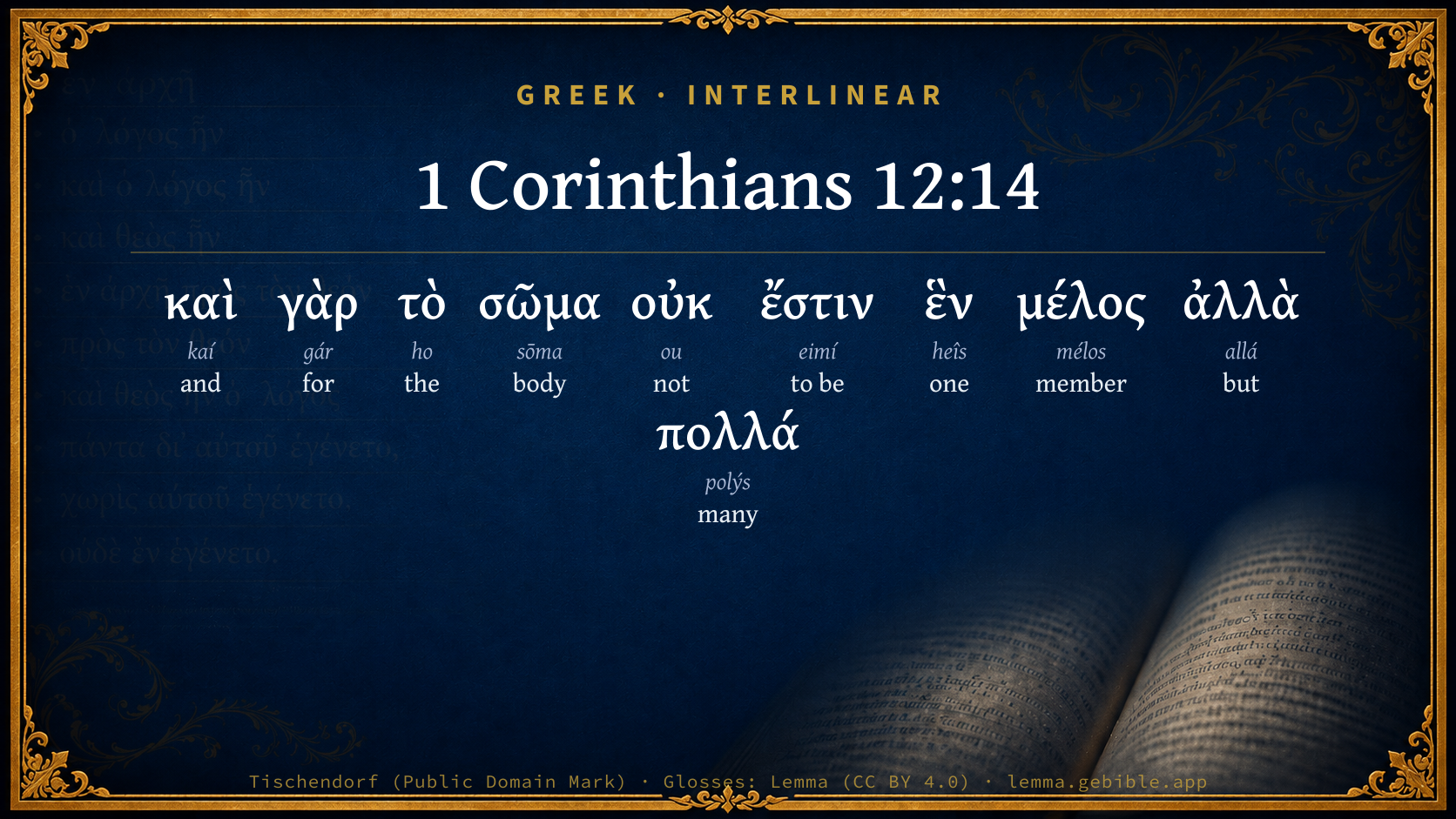
Greek (Tischendorf 8th ed.) 1 Corinthians 12:14 appears in the Greek New Testament. The text above is from the Tischendorf 8th edition. Each word links to its Strong’s number and a concise gloss. Click any word for its full Thayer’s Greek Lexicon entry.
Download image
Cite this verse

1 Corinthians 12:14 (World English Bible). Public Domain. Lemma interlinear Bible study tool, https://lemma.gebible.app/v/1-corinthians/12/14.

Show BibTeX & RIS
BibTeX
RIS
English Translation
For the body is not one member, but many.
World English Bible · Public Domain
Download a study sheet

One document with this verse’s original text, its word-by-word gloss line, the meaning frame, cross-references with their text, attributed commentary, and full source and license credits — printable, and it pastes into notes with its structure intact.

This verse Autodidact and up

Study sheet (.html) Plain text (.txt)

A passage Seminary Student

Up to 50 verses in one chapter. A passage sheet keeps up to 6 commentary sources and 12 cross-references per verse, in the order this page ranks them, and says so on the sheet whenever that leaves anything out. Ask for a single verse and you get the Autodidact verse sheet above.

Everything on this page stays free to read, with no account — the sheet is a download of what is already on screen, not access to it.

Want to remove ads? Support Godless Engineer
Compare translations 3

The same verse in 3 English versions, stacked beneath the original-language interlinear above. Click any original word for its lexicon entry.

Each is an independent rendering of the whole verse — the interlinear is not word-aligned to these translations.

Highlighted words mark where these versions differ — a whole-verse word diff, not a word-by-word alignment.

  • World English Bible Public Domain
    For the body is not one member, but many.
  • King James Version Public Domain
    For the body is not one member, but many.
  • unfoldingWord Literal Text CC BY-SA 4.0
    For indeed the body is not one member, but many.

unfoldingWord Literal Text — © unfoldingWord, licensed CC BY-SA 4.0. Word-aligned USFM3 via Door43 (git.door43.org/unfoldingWord/en_ult).

Versions to compare (up to 4)

3 of 4 selected

Show all 19 translations

Every available English version of this verse, each an independent rendering of the whole verse.

  • World English Bible Public Domain
    For the body is not one member, but many.
  • Berean Standard Bible Public Domain
    For the body does not consist of one part, but of many.
  • Majority Standard Bible Public Domain
    For the body does not consist of one part, but of many.
  • King James Version Public Domain
    For the body is not one member, but many.
  • American Standard Version (1901) Public Domain
    For the body is not one member, but many.
  • Revised Version (1885) Public Domain
    For the body is not one member, but many.
  • Geneva Bible (1599) Public Domain
    For the body also is not one member, but many.
  • Douay-Rheims (1899) Public Domain
    For the body also is not one member, but many.
  • Young's Literal Translation Public Domain
    for also the body is not one member, but many;
  • Literal Standard Version CC BY-SA 4.0
    for also the body is not one member, but many.
  • Unlocked Literal Bible CC BY-SA 4.0
    For the body is not a single member, but many.
  • unfoldingWord Literal Text CC BY-SA 4.0
    For indeed the body is not one member, but many.
  • Darby Bible Public Domain
    For also the body is not one member but many.
  • World Messianic Bible Public Domain
    For the body is not one member, but many.
  • Webster's Bible Public Domain
    For the body is not one member, but many.
  • Free Bible Version CC BY-SA 4.0
    The body is not made of one part, but many parts.
  • Bible in Basic English Public Domain
    For the body is not one part, but a number of parts.
  • Text-Critical English NT CC BY 4.0
    Even so the body does not consist of one member, but many.
  • Tyndale New Testament (1534) Public Domain
    For the body is not one member but many.

Literal Standard Version (2020), Covenant Press — licensed CC BY-SA 4.0. Text via the HelloAO Bible API (eBible.org). Unlocked Literal Bible (unfoldingWord) — licensed CC BY-SA 4.0. Text via the HelloAO Bible API (eBible.org). unfoldingWord Literal Text — © unfoldingWord, licensed CC BY-SA 4.0. Word-aligned USFM3 via Door43 (git.door43.org/unfoldingWord/en_ult). Free Bible Version, Dr. Jonathan Gallagher — licensed CC BY-SA 4.0. Text via the HelloAO Bible API (eBible.org).

Word by word

More ways to search: Search by grammar → Find every occurrence → Compare this word →

Practice this passage: Drill this verse → Learn its vocabulary →

About this verse

These counts appear in no published source. They are computed here, from the morphology-tagged text and Lemma’s own curated glosses. What Lemma adds →

10
words
10
distinct lemmas
Pauline Epistles
section

Cross-references

4

Topical passages linked to 1 Corinthians 12:14 in the Treasury of Scripture Knowledge — connected by theme and wording, ordered by reader-vote popularity; previews shown in the World English Bible.

  • 1 Corinthians 12:27–28 Now you are the body of Christ, and members individually.
  • 1 Corinthians 12:12 For as the body is one, and has many members, and all the members of the body, being many, are one body; so also is Christ.
  • 1 Corinthians 12:19 If they were all one member, where would the body be?
  • Ephesians 4:25 Therefore, putting away falsehood, speak truth each one with his neighbor. For we are members one of another.

Cross-references courtesy of OpenBible.info (CC BY 4.0).

Commentary

Notes on 1 Corinthians 12:14 from classic Christian and Jewish commentators (each source and its license shown beneath its notes). The classic Christian expositions comment on the surrounding passage and are grouped to its opening verse, so a note may address several verses; the Jewish commentaries on the Tanakh (Rashi and others) are per-verse, so they appear only where the commentator wrote on this verse.

Lemma curates 59 commentaries, every one of them public domain or Creative Commons licensed, each selected and text-cleaned for this edition rather than reprinted as found. About our sources →

Joseph Benson's Commentary

1Co 12:14-20. For the body is not one member, but many — All of which are necessary, that the various sorts of offices belonging to the body may be all performed: thus there must be different gifts and offices in the church of Christ, which all conduce to the advantage and perfection of the whole. If the foot — One of inferior gifts and place; shall say, Because I am not the hand — Do not appear in a more honourable place, and have not a more important office; I am not of the body — I am separated from, or despised by it, in my low situation; is it therefore not of the body — Is the inference good? Would it have reason on this account to represent or think itself an outcast? The foot here is elegantly introduced as speaking of the hand, the ear of the eye; each of a part that has some resemblance to it. So among men, each is apt to compare himself with those whose gifts some way resemble his own, rather than with those who are at a distance, either above or beneath him. Perhaps the foot may represent private Christians; the hand, active officers in the church; the eye, discerning teachers; and the ear, attentive hearers. If the whole body were an eye — And a man could look, at will, through every pore; where were the hearing — That important sense, which admits so much pleasing entertainment and improvement? And if the whole were hearing, where were the smelling — A sense which, though less important than the former, is not destitute of its proper delight and its proper use. The sense is, If all the members of the church had the same gifts, though the most excellent, as seeing or hearing, what would become of the church? There must be different offices and gifts for different uses, and each ought to employ his gift, according to the nature of it, for the service of the whole. But now we see God — The wise and great Creator; hath set the members in the body as it hath pleased him — With the most exquisite wisdom and goodness. If they were all one member — Or if the members were all of one form and use; where were the body — How could it possibly subsist? But now they are many members — Different from each other, possessed of different powers, and intended for different uses; yet but one harmonious, regular body — Furnished for the various animal functions, and capable of a variety of sensations and actions. And it is a necessary consequence of this unity, that the several members need one another.

Joseph Benson's Commentary on the Old and New Testaments (1811–1818) — public domain. Text from a community e-Sword module.

Tyndale Open Study Notes

Tyndale Open Resources

12:14-21 These verses move from the image of a physical body to the image of the church as a spiritual body. Every part of the body is important and essential to its proper functioning. Believers should neither boast of their spiritual ministry nor belittle it in comparison to the ministries of other believers. God, who made the body, has put each part just where he wants it (12:18).

Tyndale Open Study Notes — © Tyndale Open Resources, licensed CC BY-SA 4.0. Text via the HelloAO Bible API.

Bengel's Gnomon

Johann Albrecht Bengel

1Co 12:14. Καὶ γὰρ, for even) This protasis concerning the body extends to 1Co 12:26: and is so adjusted, that the apodosis, 1Co 12:27, is summarily added.

Bengel's Gnomon of the New Testament — English translation (T&T Clark, Edinburgh, 1860) — public domain. Text from a community e-Sword module.

Meyer's Critical & Exegetical Commentary

Heinrich August Wilhelm Meyer

1Co_12:14 ff. For the further illustration (γάρ) of this unity, the figure of the human body is again brought forward in order now to carry it out more minutely, and to show by it in detail on to 1Co_12:26 how preposterous it is to be discontented with the gift received, or to despise those differently gifted. On the whole passage, comp the speech of Menenius Agrippa in Livy, ii. 32, also Seneca, de ira, ii. 31; Marc. Anton. ii. 1, vii. 13; Clem. Cor. I. 37.

ὅτι οὐκ εἰμὶ χείρ] because I am not hand, I am not of the body, do not belong to it.

οὐ παρὰ τοῦτο κ.τ.λ[1989]] cannot, with Erasmus, Luther, Castalio, Beza, Calvin, and most expositors, including Griesbach, Scholz, Flatt, Schulz, de Wette, Ewald, Maier, Neander, be taken as a question (which Billroth, Rückert, Hofmann, following Bengel and others, rightly reject), so that the double negative should strengthen the denial: num ideo non est corporis? In this case, namely, οὐ would only be the ordinary interrogative, which presupposes an affirmative answer; but as such it can by no means warrant or explain an intensifying repetition. And an anadiplosis of the Οὐ (Klotz, a[1990] Devar. p. 696 f.; Stallbaum, a[1991] Plat. Symp. p. 199 A) would be suitable in an earnest declaratory sentence, but not in such a question as this. We must therefore delete the mark of interrogation, as Lachmann also and Tischendorf have done, so as to make Οὐ serve as a negative for the whole sentence, while the succeeding ΟὐΚ applies simply to the ἜΣΤΙΝ. We render consequently, so is he not on that account (namely, because he asserts it in that discontented expression) no part of the body; that peevish declaration does not do away with what he is, namely, a member of the body.

Regarding παρά with the accusative in the sense of: for the sake of, in virtue of, on account of, see Klausen, a[1992] Aesch. Choeph. 383; Krüger on Thuc. i. 141. 6; so often in Demosthenes. By τοῦτο[1993] cannot be meant: this, that it is not the hand (Billroth and others), but only (comp Hofmann), as the logical relation of the protasis and apodosis requires: this, that it gives vent to such discontent about its position of not being the hand, as if it could not regard itself in its capacity of foot as belonging at all to the body. Erasmus in his Paraphrase happily describes the temper of the member which spoke in this way as: deplorans sortem suam.

It may be added, that as early an interpreter as Chrysostom has appreciated the fact of Pauls placing together foot and hand, eye and ear, as analogous members: ἐπειδὴ γὰρ οὐ τοῖς σφόδρα ὑπερέχουσιν, ἀλλὰ τοῖς ὀλίγον ἀναβεβηκόσι φθονεῖν εἰώθαμεν.

[1989] .τ.λ. καὶ τὰ λοιπά.

[1990] d refers to the note of the commentator or editor named on the particular passage.

[1991] d refers to the note of the commentator or editor named on the particular passage.

[1992] d refers to the note of the commentator or editor named on the particular passage.

[1993] Comp. παρὰ τοῦτο, 4Ma_10:19; παρὰ ταῦτα πάντα, Jdt_8:25.

Meyer — Critical and Exegetical Commentary on the New Testament — English translation by Peter Christie, edited by Frederick Crombie (T&T Clark, 1880) — public domain. Text from a community e-Sword module.

Expositor's Greek Testament

ed. W. Robertson Nicoll

1Co 12:14 recalls, under the analogy of the σῶμα , the reason given in 1Co 12:12 for the diversity of spiritual powers displayed in the Church: it is not “one member,” but “many” that constitute the “body”. This thesis the rest of the § illustrates.

The Expositor's Greek Testament, edited by W. Robertson Nicoll (1897–1910) — public domain. Text from a community e-Sword module.

Godet's Commentaries

Frédéric Louis Godet

Vv. 14. The apostle impresses this idea by taking up again the figure of the body which he had used to describe the unity of the Church; to this end it is enough for him to reverse the figure. In 1Co 12:12 : many members, but one body; in 1Co 12:14 : one body, but many members.

This notion of the diversity of members is explained 1Co 12:15-26, and applied to the Church 1Co 12:27-30.

Frédéric Louis Godet — Commentaries on Luke, John, Romans, and 1 Corinthians — English translation (T&T Clark, Edinburgh, 1870s–1890s) — public domain. Text from a community e-Sword module.

Hodge's Commentary on Romans, Ephesians & First Corinthians

Charles Hodge

1Co_12:14

For the body is not one member, but many.

This is a proof that diversity of gifts and members is necessary to the unity of the church. The church no more consists of persons all having the same gifts, than the body is all eye or all ear. As the body is not one member, but many, so the church is not one member, but many. The word member means a constituent part having a function of its own. It is not merely a multiplicity of parts that is necessary to the body; nor a multiplicity of persons that is necessary to the church; but in both cases what is required is a multiplicity of members in the sense just stated. To a certain extent what Paul says of the diversity of gifts in individual members of the church, may, in the existing state of things, be applied to different denominations of Christians. No one is perfect or complete in itself; and no one can say to the others, I have no need of you. Each represents something that is not so well represented in the others. Each has its own function to exercise and work to perform, which could not so well be accomplished without it. As, therefore, harmony and cooperation, sympathy and mutual affection, are required between individual Christians as constituent members of Christs body, so also should they prevail between different denominations. It is only when the hand undertakes to turn the foot out of the body, that the foot is bound in self-defense and for the good of the whole, to defend its rights.

Charles Hodge — Commentary on Romans (1835), First Corinthians (1857), and Ephesians (1856) — public domain. Text from a community e-Sword module.

Geneva Bible (1599)

Geneva Bible translators

He amplifieth that which followed of the similitudes, as if he should say, The unity of the body is not only not left by this diversity of members, but also it could not be a body, if it did not consist of many, and those were divers members.

Geneva Bible (1599) marginal notes — public domain. Text via Bolls.life.

Jamieson, Fausset & Brown

Robert Jamieson, A. R. Fausset & David Brown

Translate, "For the body also." The analogy of the body, not consisting exclusively of one, but of many members, illustrates the mutual dependence of the various members in the one body, the Church. The well-known fable of the belly and the other members, spoken by Menenius Agrippa, to the seceding commons [LIVY, 2.32], was probably before Paul's mind, stored as it was with classical literature.

Jamieson, Fausset & Brown — Commentary Critical and Explanatory on the Whole Bible (1871) — public domain (CC PDM 1.0). Text via the HelloAO Bible API.

Adam Clarke's Commentary

Verse 14. For the body is not one member] The mystical body, the Church, as well as the natural body, is composed of many members.

Adam Clarke's Commentary on the Bible (1810–1826) — public domain. Text from a community e-Sword/MySword module.

Ellicott's Commentary for English Readers

(14) For the body is not one member, but many.—Here follows a series of suggestions as to the different parts of the body claiming independence of the body itself, which the nature of the case shows to be absurd.

A Bible Commentary for English Readers, edited by Charles John Ellicott (1878–1897) — public domain. Text from a community e-Sword module.

The Cambridge Bible for Schools and Colleges

gen. ed. J. J. S. Perowne

14. For the body is not one member, but many] The same leading idea is kept in view—the diversity of functions, offices, gifts, but the unity of the body. No more complete or apposite illustration could be given. The body is one thing, animated by one soul, belonging to one being, yet with an infinity of various parts, each contributing by their action to the fulfilment of one and the same purpose, the life and usefulness of the man.

The Cambridge Bible for Schools and Colleges (gen. ed. J. J. S. Perowne; Cambridge University Press, 1878–1918) — public domain. Text from a community e-Sword module.

John Gill's Exposition

For the body is not one member,.... Not only one; nor is anyone member the body, though ever so eminent, as the head or eye: thus the church of Christ is not one person only, or does not consist of one sort of persons; as only of Jews, or only of Gentiles, or only of rich and freemen, or only of men of extraordinary gifts and abilities, or greatly eminent for grace and spiritual knowledge:

but many; members, as the Arabic version adds; as eyes, ears, hands, feet, &c. so in the mystical body of Christ, the church, there are many members, some in a higher station, others in a lower; some of greater gifts, grace, and usefulness, others of lesser; some Jews, other Gentiles; some bond, others free; yet all one in Christ the head, and all related to each other.

John Gill's Exposition of the Whole Bible (1746–1763) — public domain (CC PDM 1.0). Text via the HelloAO Bible API.

Trapp's Complete Commentary

John Trapp

14 For the body is not one member, but many.

Ver. 14. Not one member, but many] As man’s body curiously wrought, and as it were by the book, Psa 139:16. Had God left out an eye or hand in his common place book (saith one) thou hadst wanted it.

John Trapp, A Commentary or Exposition upon All the Books of the Old and New Testament (1647–1656) — public domain. Text from a community e-Sword module.

Albert Barnes' Notes on the Bible

For the body ... - The body is made up of many members, which have various offices. So it is in the church. We are to expect the same variety there; and we are not to presume either that all will be alike, or that any member that God has placed there will be useless.

Albert Barnes' Notes on the Bible (1834–1885) — public domain. Text from a community e-Sword/MySword module.

Matthew Poole's English Annotations

As the natural body is totum integrale, a whole consisting of many members; so the body spiritual, the mystical body of Christ, is not made up of one single member, but of many members.

Matthew Poole's English Annotations on the Holy Bible (1683–1685) — public domain. Text from a community e-Sword/MySword module.

Whedon's Commentary on the Bible

Daniel D. Whedon

14. Body… many—The apostle varies the phases of the body to meet the complaints of the different cavillers. There were the weaker members met in 14-20, and the stronger in 21-27. The former would have all equal and essentially identical. But this would destroy the variety of members in the body. The whole body cannot be one limb.

Daniel D. Whedon (gen. ed.), Commentary on the Old and New Testaments (1874–1909) — public domain. Text from a community e-Sword module.

Burkitt's Expository Notes on the New Testament

William Burkitt

Our apostle here elegantly compares the state of the mystical body, the church, with that of the natural body. As the natural body is one, so is the mystical body; as the natural body is informed and animated with one spirit or soul, so the mystical body, the church, is animated by one and the same Spirit, received from our spiritual head, Christ Jesus, and communicated to all the members of his body, to give them life and motion. As the members of the natural body are not alike, but some superior, and others inferior in excellency, yet all of indispensable use; (for the wise God hath created no member of man’s body in vain; but designed all for the mutual help and benefit of one another,) in like manner is it in the church, the mystical body; there are different gifts, others are of meaner abilities; yet all conduce to the good of the whole. One of inferior gifts must not account himself useless, (for every one that cannot be excellent may yet by useful,) for if so, what would become of the church? Therefore there must be different gifts and offices for different uses. But every one must employ his gift, and perform his office, according to the nature of it, for the service of the whole.

Learn hence, 1. That several men have their several gifts, as it pleaseth the gift-giving Spirit to give unto them.

Learn, 2. That such as have the meanest talent, either of gifts or graces, ought not to esteem themselves, or be esteemed by others, as useless or unserviceable; but to employ their talent, though ever so small, for the service and benefit of the whole church.

William Burkitt's Expository Notes on the New Testament (1700–1703) — public domain. Text from a community e-Sword module.

Godbey's Commentary on the New Testament

William B. Godbey

DIVERSITY IN UNITY AND ALL EQUALLY GLORIOUS

14-27. Here Paul sets forth the fact that every regenerated soul is a member of the body of Christ, and, so far as the mere question of membership is concerned, all equally honorable in the sight of God. He beautifully and forcibly illustrates this truth by the human body; e. g., the foot is down in the mud and, from a superficial standing, dishonorable compared with the hand, which is carried aloft and kept clean. Yet we expend ten dollars on the foot to one on the hand, and we are much more careful to keep it from exposure. I would much rather have my hand amputated than my foot. The little nerves, so fine we can not see them, impart all the power to the muscles, so they would be utterly motionless if they were paralyzed. These reflections throw a flood of light on the body of Christ. I know a presiding elder who has a cleft palate, a very serious vocal deficiency. Yet God more than compensates for it. I was introduced to a man many years ago, as the Methodist pastor, who stammered so awfully that it was a consummate bore to talk to him. I observed to a brother: “Why, this man can’t preach.” “Do you go and hear him once, and if you do not want to go again, I will excuse you.” I went through Curiosity. When he began he stammered abominably. I felt exceedingly sorry for him. In five minutes I saw him getting out of the brush. In ten minutes I forgot all about his stammering and began to get deeply absorbed in his message. In twenty minutes every trace of the stammering had evanesced. Before he got through I did not know whether I was there or somewhere else. He was one of the most powerful preachers I ever heard. I heard a man tell about visiting our Congress, and seeing a little, ugly, deformed old man sitting among the members with his hat on (weak eyes), but he soon observed that he was quite a center of attraction, the great, fine-looking members frequently going to him for information. It was Alexander Stephens, of Georgia, one of the greatest statesmen of his day. If you have a deficiency in some way, look out, God will make it up with compound interest. How frequently do people who have never enjoyed a collegiate education put the cultured literate in total eclipse! Grace is the most wonderful equalizer in all the world. Are you deficient in any way? Check on God.

William B. Godbey, Commentary on the New Testament (1896–1900) — public domain. Text from a community e-Sword module.

McGarvey & Pendleton's Commentaries

J. W. McGarvey

For the body is not one member, but many .

J. W. McGarvey (with Philip Y. Pendleton), Commentaries on the New Testament (The Fourfold Gospel, 1914; Acts; and the epistles) — public domain. Text from a community e-Sword/MySword module.

unfoldingWord translationNotes

Door43 World Missions Community

where would the sense of hearing be? ... where would the sense of smell be?

This can be made a statement. AT: "you could not hear anything ... you could not smell anything" (See: Rhetorical Question)

translationWords

body

member

unfoldingWord translationNotes — © Distant Shores Media and the Door43 World Missions Community, licensed CC BY-SA 4.0. Source: git.door43.org/Door43/en_tn.

Cambridge Greek Testament for Schools and Colleges

14. οὐκ ἔστιν ἕν μέλος. The same leading idea is kept in view—the diversity of functions, offices, gifts, but the unity of the body. No more complete or apposite illustration could be given. The body is one thing, animated by one soul, belonging to one being, yet with an infinity of various parts, each contributing by their action to the fulfilment of one and the same purpose, the life and usefulness of the man.

Cambridge Greek Testament for Schools and Colleges (Cambridge University Press, 1896; 21 vols, various authors incl. Carr, Maclear, Plummer, Farrar, Lumby, Moule, M. R. James, Simcox) — public domain. Text from a community e-Sword module.

Alford’s Greek Testament

Henry Alford

14.] Analogy, by which this multiplicity in unity is justified: it is even so in the natural body,—which, though one, consists of many members. The object of the continuation of the simile seems to be, to convince them that their various gifts had been bestowed by God on them as members of the Christian body, and that they must not, because they did not happen to possess the gifts of another, consider themselves excluded from the body,—in which the weaker as well as the stronger, the less comely as well as the more comely members were necessary.

The student will remember the fable spoken by Menenius Agrippa to the mutinous plebs in Livy ii. 32. The passage is also illustrated by Seneca de Ira, ii. 31, ‘Quid si nocere velint manus pedibus, manibus oculi? Ut omnia inter se membra consentiunt, quia singula servari totius interest: ita homines singulis parcent, quia ad cœlum geniti sumus: salva autem esse societas nisi amore et custodia partium non potest:’—and by Antonin. ii. 1, where in his morning meditations on the duty of repressing anger through the day, he says, γεγόναμεν γὰρ πρὸς συνεργίαν, ὡς πόδες, ὡς χεῖρες, ὡς βλέφαρα, ὡς οἱ στοῖχοι τῶν ἄνω καὶ τῶν κάτω ὀδόντων· τὸ οὖν ἀντιπράσσειν ἀλλήλοις, παρὰ φύσιν. See also id. vii. 13: ad Cor. c. xxxvii. p. 284: and other examples in Wetstein.

Henry Alford, The Greek Testament (1849–1861) — public domain. Text from a community e-Sword module.

International Critical Commentary

14. καὶ γὰρ τὸ ς. Additional confirmation; ‘For the body also is not one member, but many.’*

International Critical Commentary — older volumes (1896–1929), various authors — public domain. Text from a community e-Sword module.

Vincent's Word Studies in the New Testament

Marvin R. Vincent

The body. The student will naturally recall the fable of the body and the members uttered by Menenius Agrippa, and related by Livy, 2, 32; but the illustration seems to have been a favorite one, and occurs in Seneca, Marcus Antoninus, and others. 122

Marvin R. Vincent, Word Studies in the New Testament (1887–1900) — public domain. Text from a community e-Sword/MySword module.

Lesson kit

Teaching starters — assembled from the data on this page, not authored interpretation. Every prompt links to the verse data it draws on. Edit before teaching.

1 Corinthians, in the Pauline Epistles, opens this verse with 10 words (10 distinct Greek lemmas). Its most distinctive word is mélos (“member”). A historical commentator’s framing appears above. Read the whole chapter for the surrounding context.

Discussion questions

  1. How does “member” (mélos) shape what this verse is saying?
  2. How does Matthew 5:29, which shares the word «member», read alongside this verse?
  3. These translations render this verse differently; the difference is in the English rendering, not the original. What questions does that raise?
  4. Compare how Joseph Benson's Commentary and Tyndale Open Study Notes read this verse. Where do they agree or differ?

Things to notice

Reading settings

Reading text

Shown beneath each verse's original-language words.

Old Testament
Old Testament edition

Read the OT as the Masoretic Hebrew (MT) or the Greek Septuagint (LXX).

English shown for the Greek Septuagint (in the Hebrew ↔ Greek comparison).

Comparing translations? Open the Compare panel on any verse page to stack up to four side by side.