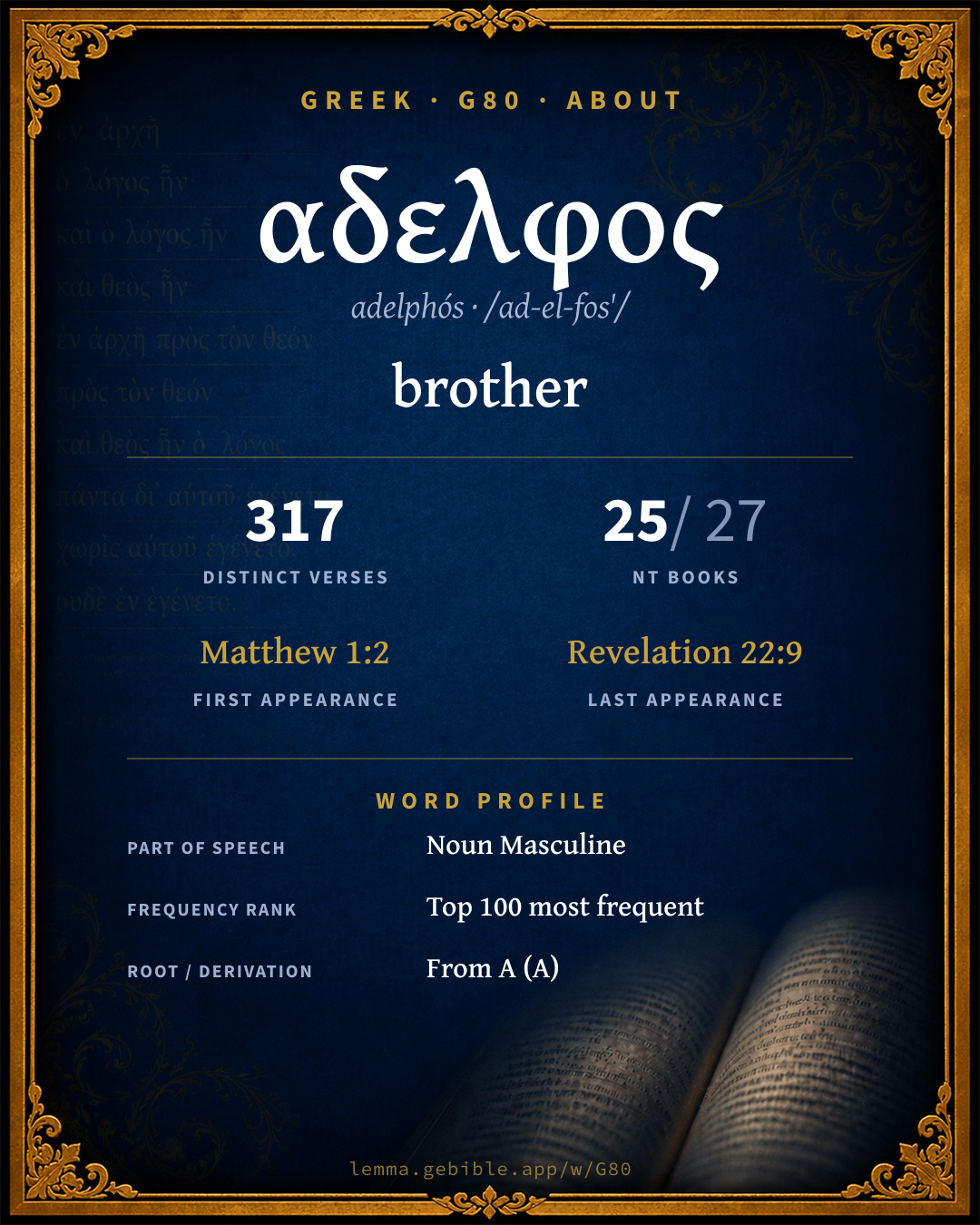
ἀδελφός
brother
‘brother’ is one of 6 main senses fuller range ↓
Full lexicon entry — Thayer's Greek Lexicon
From Thayer's Greek Lexicon
Where this word appears
See every Vocative-case word in the Greek New Testament →
Grammar key — what these labels mean
Part of speech
- Noun
- A naming word — a person, place, thing, or idea.
Case
- Vocative
- The case of direct address (“O Lord”).
- Nominative
- The case of the subject (and the predicate nominative).
- Accusative
- The case of the direct object and of extent.
- Genitive
- The case of source, possession, or “of” — answers “whose / from what.”
- Dative
- The case of the indirect object, means, or location — “to / for / with / in.”
Gender
- Masculine
- Grammatically masculine.
Number
- Plural
- More than one.
- Singular
- One.
Grammatical forms 10 distinct
- Noun, Vocative, Plural, Masculine 107 times (31%)
- Noun, Nominative, Singular, Masculine 43 times (13%)
- Noun, Accusative, Singular, Masculine 41 times (12%)
- Noun, Accusative, Plural, Masculine 39 times (11%)
- Noun, Nominative, Plural, Masculine 38 times (11%)
- Noun, Genitive, Plural, Masculine 21 times (6%)
- Noun, Dative, Plural, Masculine 17 times (5%)
- Noun, Genitive, Singular, Masculine 17 times (5%)
+2 more forms (20 occurrences)
Parsed forms decoded from the imported morphology (Robinson–Tischendorf, public domain), counted across 343 parsed occurrences — not distinct verses.
Page 1 of 2 — showing verses 1–200 of 317 distinct verses where G80 appears, across 25 books. Click any verse to open its interlinear word-by-word view. Verse text shown in the World English Bible for context — . Each verse’s Greek form is shown with its reference; the English is not keyword-highlighted, since the data carries no word-level English alignment. Use “Compare translations” on any verse to read it across multiple English versions. This concordance covers the Greek New Testament; Septuagint (Greek Old Testament) occurrences of this word are not indexed here.
Matthew 31 verses
- Matthew 1:2 ἀδελφοὺς n acc pl masc Abraham became the father of Isaac. Isaac became the father of Jacob. Jacob became the father of Judah and his brothers.
- Matthew 1:11 ἀδελφοὺς n acc pl masc Josiah became the father of Jechoniah and his brothers, at the time of the exile to Babylon.
- Matthew 4:18 ἀδελφούς ἀδελφὸν n acc pl masc n acc sg masc Walking by the sea of Galilee, he saw two brothers: Simon, who is called Peter, and Andrew, his brother, casting a net into the sea; for they were fishermen.
- Matthew 4:21 ἀδελφούς ἀδελφὸν n acc pl masc n acc sg masc Going on from there, he saw two other brothers, James the son of Zebedee, and John his brother, in the boat with Zebedee their father, mending their nets. He called them.
- Matthew 5:22 ἀδελφῷ ἀδελφῷ n dat sg masc n dat sg masc But I tell you, that everyone who is angry with his brother without a cause shall be in danger of the judgment; and whoever shall say to his brother, 'Raca!' shall be in danger of the council; and whoever shall say, 'You fool!' shall be in danger of the fire of Gehenna.
- Matthew 5:23 ἀδελφός n nom sg masc "If therefore you are offering your gift at the altar, and there remember that your brother has anything against you,
- Matthew 5:24 ἀδελφῷ n dat sg masc leave your gift there before the altar, and go your way. First be reconciled to your brother, and then come and offer your gift.
- Matthew 5:47 ἀδελφοὺς n acc pl masc If you only greet your friends, what more do you do than others? Don't even the tax collectors do the same?
- Matthew 7:3 ἀδελφοῦ n gen sg masc Why do you see the speck that is in your brother's eye, but don't consider the beam that is in your own eye?
- Matthew 7:4 ἀδελφῷ n dat sg masc Or how will you tell your brother, 'Let me remove the speck from your eye;' and behold, the beam is in your own eye?
- Matthew 7:5 ἀδελφοῦ n gen sg masc You hypocrite! First remove the beam out of your own eye, and then you can see clearly to remove the speck out of your brother's eye.
- Matthew 10:2 ἀδελφὸς ἀδελφὸς n nom sg masc n nom sg masc Now the names of the twelve apostles are these. The first, Simon, who is called Peter; Andrew, his brother; James the son of Zebedee; John, his brother;
- Matthew 10:21 ἀδελφὸς ἀδελφὸν n nom sg masc n acc sg masc "Brother will deliver up brother to death, and the father his child. Children will rise up against parents, and cause them to be put to death.
- Matthew 12:46 ἀδελφοὶ n nom pl masc While he was yet speaking to the multitudes, behold, his mother and his brothers stood outside, seeking to speak to him.
- Matthew 12:47 ἀδελφοί n nom pl masc One said to him, "Behold, your mother and your brothers stand outside, seeking to speak to you."
- Matthew 12:48 ἀδελφοί n nom pl masc But he answered him who spoke to him, "Who is my mother? Who are my brothers?"
- Matthew 12:49 ἀδελφοί n nom pl masc He stretched out his hand towards his disciples, and said, "Behold, my mother and my brothers!
- Matthew 12:50 ἀδελφὸς n nom sg masc For whoever does the will of my Father who is in heaven, he is my brother, and sister, and mother."
- Matthew 13:55 ἀδελφοὶ n nom pl masc Isn't this the carpenter's son? Isn't his mother called Mary, and his brothers, James, Joses, Simon, and Judas?
- Matthew 14:3 ἀδελφοῦ n gen sg masc For Herod had laid hold of John, and bound him, and put him in prison for the sake of Herodias, his brother Philip's wife.
- Matthew 17:1 ἀδελφὸν n acc sg masc After six days, Jesus took with him Peter, James, and John his brother, and brought them up into a high mountain by themselves.
- Matthew 18:15 ἀδελφός ἀδελφόν n nom sg masc n acc sg masc "If your brother sins against you, go, show him his fault between you and him alone. If he listens to you, you have gained back your brother.
- Matthew 18:21 ἀδελφός n nom sg masc Then Peter came and said to him, "Lord, how often shall my brother sin against me, and I forgive him? Until seven times?"
- Matthew 18:35 ἀδελφῷ n dat sg masc So my heavenly Father will also do to you, if you don't each forgive your brother from your hearts for his misdeeds."
- Matthew 19:29 ἀδελφοὺς n acc pl masc Everyone who has left houses, or brothers, or sisters, or father, or mother, or wife, or children, or lands, for my name's sake, will receive one hundred times, and will inherit eternal life.
- Matthew 20:24 ἀδελφῶν n gen pl masc When the ten heard it, they were indignant with the two brothers.
- Matthew 22:24 ἀδελφὸς ἀδελφῷ n nom sg masc n dat sg masc saying, "Teacher, Moses said, 'If a man dies, having no children, his brother shall marry his wife, and raise up seed for his brother.'
- Matthew 22:25 ἀδελφοί ἀδελφῷ n nom pl masc n dat sg masc Now there were with us seven brothers. The first married and died, and having no seed left his wife to his brother.
- Matthew 23:8 ἀδελφοί n nom pl masc But don't you be called 'Rabbi,' for one is your teacher, the Christ, and all of you are brothers.
- Matthew 25:40 ἀδελφῶν n gen pl masc "The King will answer them, 'Most assuredly I tell you, inasmuch as you did it to one of the least of these my brothers, you did it to me.'
- Matthew 28:10 ἀδελφοῖς n dat pl masc Then Jesus said to them, "Don't be afraid. Go tell my brothers that they should go into Galilee, and there they will see me."
Mark 17 verses
- Mark 1:16 ἀδελφὸν n acc sg masc Passing along by the sea of Galilee, he saw Simon and Andrew the brother of Simon casting a net in the sea, for they were fishermen.
- Mark 1:19 ἀδελφὸν n acc sg masc Going on a little further from there, he saw James the son of Zebedee, and John, his brother, who were also in the boat mending the nets.
- Mark 3:17 ἀδελφὸν n acc sg masc James the son of Zebedee; John, the brother of James, and he surnamed them Boanerges, which means, Sons of Thunder;
- Mark 3:31 ἀδελφοὶ n nom pl masc His mother and his brothers came, and standing outside, they sent to him, calling him.
- Mark 3:32 ἀδελφοί n nom pl masc A multitude was sitting around him, and they told him, "Behold, your mother, your brothers, and your sisters are outside looking for you."
- Mark 3:33 ἀδελφοί n nom pl masc He answered them, "Who are my mother and my brothers?"
- Mark 3:34 ἀδελφοί n nom pl masc Looking around at those who sat around him, he said, "Behold, my mother and my brothers!
- Mark 3:35 ἀδελφός n nom sg masc For whoever does the will of God, the same is my brother, and my sister, and mother."
- Mark 5:37 ἀδελφὸν n acc sg masc He allowed no one to follow him, except Peter, James, and John the brother of James.
- Mark 6:3 ἀδελφὸς n nom sg masc Isn't this the carpenter, the son of Mary, and brother of James, Joses, Judas, and Simon? Aren't his sisters here with us?" They were offended at him.
- Mark 6:17 ἀδελφοῦ n gen sg masc For Herod himself had sent out and arrested John, and bound him in prison for the sake of Herodias, his brother Philip's wife, for he had married her.
- Mark 6:18 ἀδελφοῦ n gen sg masc For John said to Herod, "It is not lawful for you to have your brother's wife."
- Mark 10:29 ἀδελφοὺς n acc pl masc Jesus said, "Most assuredly I tell you, there is no one who has left house, or brothers, or sisters, or father, or mother, or wife, or children, or land, for my sake, and for the Gospel's sake,
- Mark 10:30 ἀδελφοὺς n acc pl masc but he will receive one hundred times more now in this time, houses, brothers, sisters, mothers, children, and land, with persecutions; and in the age to come eternal life.
- Mark 12:19 ἀδελφὸς ἀδελφὸς ἀδελφῷ n nom sg masc n nom sg masc n dat sg masc "Teacher, Moses wrote to us, 'If a man's brother dies, and leaves a wife behind him, and leaves no children, that his brother should take his wife, and raise up offspring for his brother.'
- Mark 12:20 ἀδελφοὶ n nom pl masc There were seven brothers. The first took a wife, and dying left no offspring.
- Mark 13:12 ἀδελφὸς ἀδελφὸν n nom sg masc n acc sg masc "Brother will deliver up brother to death, and the father his child. Children will rise up against parents, and cause them to be put to death.
Luke 20 verses
- Luke 3:1 ἀδελφοῦ n gen sg masc Now in the fifteenth year of the reign of Tiberius Caesar, Pontius Pilate being governor of Judea, and Herod being tetrarch of Galilee, and his brother Philip tetrarch of the region of Ituraea and Trachonitis, and Lysanias tetrarch of Abilene,
- Luke 3:19 ἀδελφοῦ n gen sg masc but Herod the tetrarch, being reproved by him for Herodias, his brother's wife, and for all the evil things which Herod had done,
- Luke 6:14 ἀδελφὸν n acc sg masc Simon, whom he also named Peter; Andrew, his brother; James; John; Philip; Bartholomew;
- Luke 6:41 ἀδελφοῦ n gen sg masc Why do you see the speck of chaff that is in your brother's eye, but don't consider the beam that is in your own eye?
- Luke 6:42 ἀδελφῷ ἀδελφέ ἀδελφοῦ n dat sg masc n voc sg masc n gen sg masc Or how can you tell your brother, 'Brother, let me remove the speck of chaff that is in your eye,' when you yourself don't see the beam that is in your own eye? You hypocrite! First remove the beam from your own eye, and then you can see clearly to remove the speck of chaff that is in your brother's eye.
- Luke 8:19 ἀδελφοὶ n nom pl masc His mother and brothers came to him, and they could not come near him for the crowd.
- Luke 8:20 ἀδελφοί n nom pl masc It was told him by some saying, "Your mother and your brothers stand outside, desiring to see you."
- Luke 8:21 ἀδελφοί n nom pl masc But he answered them, "My mother and my brothers are these who hear the word of God, and do it."
- Luke 12:13 ἀδελφῷ n dat sg masc One of the multitude said to him, "Teacher, tell my brother to divide the inheritance with me."
- Luke 14:12 ἀδελφούς n acc pl masc He also said to the one who had invited him, "When you make a dinner or a supper, don't call your friends, nor your brothers, nor your kinsmen, nor rich neighbors, or perhaps they might also return the favor, and pay you back.
- Luke 14:26 ἀδελφοὺς n acc pl masc "If anyone comes to me, and doesn't hate his own father, mother, wife, children, brothers, and sisters, yes, and his own life also, he can't be my disciple.
- Luke 15:27 ἀδελφός n nom sg masc He said to him, 'Your brother has come, and your father has killed the fattened calf, because he has received him back safe and healthy.'
- Luke 15:32 ἀδελφός n nom sg masc But it was appropriate to celebrate and be glad, for this, your brother, was dead, and is alive again. He was lost, and is found.'"
- Luke 16:28 ἀδελφούς n acc pl masc for I have five brothers, that he may testify to them, so they won't also come into this place of torment.'
- Luke 17:3 ἀδελφός n nom sg masc Be careful. If your brother sins against you, rebuke him. If he repents, forgive him.
- Luke 18:29 ἀδελφοὺς n acc pl masc He said to them, "Most assuredly I tell you, there is no one who has left house, or wife, or brothers, or parents, or children, for the Kingdom of God's sake,
- Luke 20:28 ἀδελφὸς ἀδελφὸς ἀδελφῷ n nom sg masc n nom sg masc n dat sg masc They asked him, "Teacher, Moses wrote to us that if a man's brother dies having a wife, and he is childless, his brother should take the wife, and raise up children for his brother.
- Luke 20:29 ἀδελφοὶ n nom pl masc There were therefore seven brothers. The first took a wife, and died childless.
- Luke 21:16 ἀδελφῶν n gen pl masc You will be handed over even by parents, brothers, relatives, and friends. Some of you they will cause to be put to death.
- Luke 22:32 ἀδελφούς n acc pl masc but I prayed for you, that your faith wouldn't fail. You, when once you have turned again, establish your brothers."
John 14 verses
- John 1:41 ἀδελφὸς n nom sg masc He first found his own brother, Simon, and said to him, "We have found the Messiah!" (which is, being interpreted, Christ).
- John 1:42 ἀδελφὸν n acc sg masc He brought him to Jesus. Jesus looked at him, and said, "You are Simon the son of Jonah. You shall be called Cephas" (which is by interpretation, Peter).
- John 2:12 ἀδελφοὶ n nom pl masc After this, he went down to Capernaum, he, and his mother, his brothers, and his disciples; and they stayed there a few days.
- John 6:8 ἀδελφὸς n nom sg masc One of his disciples, Andrew, Simon Peter's brother, said to him,
- John 7:3 ἀδελφοὶ n nom pl masc His brothers therefore said to him, "Depart from here, and go into Judea, that your disciples also may see your works which you do.
- John 7:5 ἀδελφοὶ n nom pl masc For even his brothers didn't believe in him.
- John 7:10 ἀδελφοὶ n nom pl masc But when his brothers had gone up to the feast, then he also went up, not publicly, but as it were in secret.
- John 11:2 ἀδελφὸς n nom sg masc It was that Mary who had anointed the Lord with ointment, and wiped his feet with her hair, whose brother, Lazarus, was sick.
- John 11:19 ἀδελφοῦ n gen sg masc Many of the Jews had joined the women around Martha and Mary, to console them concerning their brother.
- John 11:21 ἀδελφός n nom sg masc Therefore Martha said to Jesus, "Lord, if you would have been here, my brother wouldn't have died.
- John 11:23 ἀδελφός n nom sg masc Jesus said to her, "Your brother will rise again."
- John 11:32 ἀδελφός n nom sg masc Therefore when Mary came to where Jesus was, and saw him, she fell down at his feet, saying to him, "Lord, if you would have been here, my brother wouldn't have died."
- John 20:17 ἀδελφούς n acc pl masc Jesus said to her, "Don't touch me, for I haven't yet ascended to my Father; but go to my brothers, and tell them, 'I am ascending to my Father and your Father, to my God and your God.'"
- John 21:23 ἀδελφοὺς n acc pl masc This saying therefore went out among the brothers, that this disciple wouldn't die. Yet Jesus didn't say to him that he wouldn't die, but, "If I desire that he stay until I come, what is that to you?"
Acts 56 verses
- Acts 1:14 ἀδελφοῖς n dat pl masc All these with one accord continued steadfastly in prayer and supplication, along with the women, and Mary the mother of Jesus, and with his brothers.
- Acts 1:15 ἀδελφῶν n gen pl masc In these days, Peter stood up in the midst of the disciples (and the number of names was about one hundred twenty), and said,
- Acts 1:16 ἀδελφοί n voc pl masc "Brothers, it was necessary that this Scripture should be fulfilled, which the Holy Spirit spoke before by the mouth of David concerning Judas, who was guide to those who took Jesus.
- Acts 2:29 ἀδελφοί n voc pl masc "Brothers, I may tell you freely of the patriarch David, that he both died and was buried, and his tomb is with us to this day.
- Acts 2:37 ἀδελφοί n voc pl masc Now when they heard this, they were cut to the heart, and said to Peter and the rest of the apostles, "Brothers, what shall we do?"
- Acts 3:17 ἀδελφοί n voc pl masc "Now, brothers, I know that you did this in ignorance, as did also your rulers.
- Acts 3:22 ἀδελφῶν n gen pl masc For Moses indeed said to the fathers, 'The Lord God will raise up a prophet for you from among your brothers, like me. You shall listen to him in all things whatever he says to you.
- Acts 6:3 ἀδελφοί n voc pl masc Therefore select from among you, brothers, seven men of good report, full of the Holy Spirit and of wisdom, whom we may appoint over this business.
- Acts 7:2 ἀδελφοὶ n voc pl masc He said, "Brothers and fathers, listen. The God of glory appeared to our father Abraham, when he was in Mesopotamia, before he lived in Haran,
- Acts 7:13 ἀδελφοῖς n dat pl masc On the second time Joseph was made known to his brothers, and Joseph's race was revealed to Pharaoh.
- Acts 7:23 ἀδελφοὺς n acc pl masc But when he was forty years old, it came into his heart to visit his brothers, the children of Israel.
- Acts 7:25 ἀδελφοὺς n acc pl masc He supposed that his brothers understood that God, by his hand, was giving them deliverance; but they didn't understand.
- Acts 7:26 ἀδελφοί n voc pl masc "The day following, he appeared to them as they fought, and urged them to be at peace again, saying, 'Sirs, you are brothers. Why do you wrong one another?'
- Acts 7:37 ἀδελφῶν n gen pl masc This is that Moses, who said to the children of Israel, 'The Lord our God will raise up a prophet for you from among your brothers, like me.'
- Acts 9:17 ἀδελφέ n voc sg masc Ananias departed, and entered into the house. Laying his hands on him, he said, "Brother Saul, the Lord, who appeared to you on the road by which you came, has sent me, that you may receive your sight, and be filled with the Holy Spirit."
- Acts 9:30 ἀδελφοὶ n nom pl masc When the brothers knew it, they brought him down to Caesarea, and sent him off to Tarsus.
- Acts 10:23 ἀδελφῶν n gen pl masc So he called them in and lodged them. On the next day Peter arose and went out with them, and some of the brothers from Joppa accompanied him.
- Acts 11:1 ἀδελφοὶ n nom pl masc Now the apostles and the brothers who were in Judea heard that the Gentiles had also received the word of God.
- Acts 11:12 ἀδελφοὶ n nom pl masc The Spirit told me to go with them, without discriminating. These six brothers also accompanied me, and we entered into the man's house.
- Acts 11:29 ἀδελφοῖς n dat pl masc As any of the disciples had plenty, each determined to send relief to the brothers who lived in Judea;
- Acts 12:2 ἀδελφὸν n acc sg masc He killed James, the brother of John, with the sword.
- Acts 12:17 ἀδελφοῖς n dat pl masc But he, beckoning to them with his hand to be silent, declared to them how the Lord had brought him out of the prison. He said, "Tell these things to James, and to the brothers." Then he departed, and went to another place.
- Acts 13:15 ἀδελφοί n voc pl masc After the reading of the law and the prophets, the rulers of the synagogue sent to them, saying, "Brothers, if you have any word of exhortation for the people, speak."
- Acts 13:26 ἀδελφοί n voc pl masc Brothers, children of the stock of Abraham, and those among you who fear God, the word of this salvation is sent out to you.
- Acts 13:38 ἀδελφοί n voc pl masc Be it known to you therefore, brothers, that through this man is proclaimed to you remission of sins,
- Acts 14:2 ἀδελφῶν n gen pl masc But the disbelieving Jews stirred up and embittered the souls of the Gentiles against the brothers.
- Acts 15:1 ἀδελφοὺς n acc pl masc Some men came down from Judea and taught the brothers, "Unless you are circumcised after the custom of Moses, you can't be saved."
- Acts 15:3 ἀδελφοῖς n dat pl masc They, being sent on their way by the assembly, passed through both Phoenicia and Samaria, declaring the conversion of the Gentiles. They caused great joy to all the brothers.
- Acts 15:7 ἀδελφοί n voc pl masc When there had been much discussion, Peter rose up and said to them, "Brothers, you know that a good while ago God made choice among you, that by my mouth the Gentiles should hear the word of the Gospel, and believe.
- Acts 15:13 ἀδελφοί n voc pl masc After they were silent, James answered, "Brothers, listen to me.
- Acts 15:22 ἀδελφοῖς n dat pl masc Then it seemed good to the apostles and the elders, with the whole assembly, to choose men out of their company, and send them to Antioch with Paul and Barnabas: Judas called Barsabbas, and Silas, chief men among the brothers.
- Acts 15:23 ἀδελφοὶ ἀδελφοῖς n nom pl masc n dat pl masc They wrote these things by their hand: "The apostles, the elders, and the brothers, to the brothers who are of the Gentiles in Antioch, Syria, and Cilicia: greetings.
- Acts 15:32 ἀδελφοὺς n acc pl masc Judas and Silas, also being prophets themselves, encouraged the brothers with many words, and strengthened them.
- Acts 15:33 ἀδελφῶν n gen pl masc After they had spent some time there, they were sent back with greetings from the brothers to the apostles.
- Acts 15:36 ἀδελφοὺς n acc pl masc After some days Paul said to Barnabas, "Let's return now and visit our brothers in every city in which we proclaimed the word of the Lord, to see how they are doing."
- Acts 15:40 ἀδελφῶν n gen pl masc but Paul chose Silas, and went out, being commended by the brothers to the grace of God.
- Acts 16:2 ἀδελφῶν n gen pl masc The brothers who were at Lystra and Iconium gave a good testimony about him.
- Acts 16:40 ἀδελφοὺς n acc pl masc They went out of the prison, and entered into Lydia's house. When they had seen the brothers, they encouraged them, and departed.
- Acts 17:6 ἀδελφοὺς n acc pl masc When they didn't find them, they dragged Jason and certain brothers before the rulers of the city, crying, "These who have turned the world upside down have come here also,
- Acts 17:10 ἀδελφοὶ n nom pl masc The brothers immediately sent Paul and Silas away by night to Beroea. When they arrived, they went into the Jewish synagogue.
- Acts 17:14 ἀδελφοὶ n nom pl masc Then the brothers immediately sent out Paul to go as far as to the sea, and Silas and Timothy still stayed there.
- Acts 18:18 ἀδελφοῖς n dat pl masc Paul, having stayed after this many more days, took his leave of the brothers, and sailed from there for Syria, together with Priscilla and Aquila. He shaved his head in Cenchreae, for he had a vow.
- Acts 18:27 ἀδελφοὶ n nom pl masc When he had determined to pass over into Achaia, the brothers encouraged him, and wrote to the disciples to receive him. When he had come, he greatly helped those who had believed through grace;
- Acts 21:7 ἀδελφοὺς n acc pl masc When we had finished the voyage from Tyre, we arrived at Ptolemais. We greeted the brothers, and stayed with them one day.
- Acts 21:17 ἀδελφοί n nom pl masc When we had come to Jerusalem, the brothers received us gladly.
- Acts 21:20 ἀδελφέ n voc sg masc They, when they heard it, glorified God. They said to him, "You see, brother, how many thousands there are among the Jews of those who have believed, and they are all zealous for the law.
- Acts 22:1 ἀδελφοὶ n voc pl masc "Brothers and fathers, listen to the defense which I now make to you."
- Acts 22:5 ἀδελφοὺς n acc pl masc As also the high priest and all the council of the elders testify, from whom also I received letters to the brothers, and traveled to Damascus to bring them also who were there to Jerusalem in bonds to be punished.
- Acts 22:13 ἀδελφέ n voc sg masc came to me, and standing by me said to me, 'Brother Saul, receive your sight!' In that very hour I looked up at him.
- Acts 23:1 ἀδελφοί n voc pl masc Paul, looking steadfastly at the council, said, "Brothers, I have lived before God in all good conscience until this day."
- Acts 23:5 ἀδελφοί n voc pl masc Paul said, "I didn't know, brothers, that he was high priest. For it is written, 'You shall not speak evil of a ruler of your people.'"
- Acts 23:6 ἀδελφοί n voc pl masc But when Paul perceived that the one part were Sadducees and the other Pharisees, he cried out in the council, "Men and brothers, I am a Pharisee, a son of Pharisees. Concerning the hope and resurrection of the dead I am being judged!"
- Acts 28:14 ἀδελφοὺς n acc pl masc where we found brothers, and were entreated to stay with them for seven days. So we came to Rome.
- Acts 28:15 ἀδελφοὶ n nom pl masc From there the brothers, when they heard of us, came to meet us as far as The Market of Appius and The Three Taverns. When Paul saw them, he thanked God, and took courage.
- Acts 28:17 ἀδελφοί n voc pl masc It happened that after three days Paul called together those who were the leaders of the Jews. When they had come together, he said to them, "I, brothers, though I had done nothing against the people, or the customs of our fathers, still was delivered prisoner from Jerusalem into the hands of the Romans,
- Acts 28:21 ἀδελφῶν n gen pl masc They said to him, "We neither received letters from Judea concerning you, nor did any of the brothers come here and report or speak any evil of you.
Romans 18 verses
- Romans 1:13 ἀδελφοί n voc pl masc Now I don't desire to have you unaware, brothers, that I often planned to come to you, and was hindered so far, that I might have some fruit among you also, even as among the rest of the Gentiles.
- Romans 7:1 ἀδελφοί n voc pl masc Or don't you know, brothers (for I speak to men who know the law), that the law has dominion over a man for as long as he lives?
- Romans 7:4 ἀδελφοί n voc pl masc Therefore, my brothers, you also were made dead to the law through the body of Christ, that you would be joined to another, to him who was raised from the dead, that we might bring forth fruit to God.
- Romans 8:12 ἀδελφοί n voc pl masc So then, brothers, we are debtors, not to the flesh, to live after the flesh.
- Romans 8:29 ἀδελφοῖς n dat pl masc For whom he foreknew, he also predestined to be conformed to the image of his Son, that he might be the firstborn among many brothers.
- Romans 9:3 ἀδελφῶν n gen pl masc For I could wish that I myself were accursed from Christ for my brothers' sake, my relatives according to the flesh,
- Romans 10:1 Ἀδελφοί n voc pl masc Brothers, my heart's desire and my prayer to God is for Israel, that they may be saved.
- Romans 11:25 ἀδελφοί n voc pl masc For I don't desire, brothers, to have you ignorant of this mystery, so that you won't be wise in your own conceits, that a partial hardening has happened to Israel, until the fullness of the Gentiles has come in,
- Romans 12:1 ἀδελφοί n voc pl masc Therefore I urge you, brothers, by the mercies of God, to present your bodies a living sacrifice, holy, acceptable to God, which is your spiritual service.
- Romans 14:10 ἀδελφόν ἀδελφόν n acc sg masc n acc sg masc But you, why do you judge your brother? Or you again, why do you despise your brother? For we will all stand before the judgment seat of Christ.
- Romans 14:13 ἀδελφῷ n dat sg masc Therefore let's not judge one another any more, but judge this rather, that no man put a stumbling block in his brother's way, or an occasion for falling.
- Romans 14:15 ἀδελφός n nom sg masc Yet if because of food your brother is grieved, you walk no longer in love. Don't destroy with your food him for whom Christ died.
- Romans 14:21 ἀδελφός n nom sg masc It is good to not eat meat, drink wine, nor do anything by which your brother stumbles, is offended, or is made weak.
- Romans 15:14 ἀδελφοί n voc pl masc I myself am also persuaded about you, my brothers, that you yourselves are full of goodness, filled with all knowledge, able also to admonish others.
- Romans 15:30 ἀδελφοί n voc pl masc Now I beg you, brothers, by our Lord Jesus Christ, and by the love of the Spirit, that you strive together with me in your prayers to God for me,
- Romans 16:14 ἀδελφούς n acc pl masc Greet Asyncritus, Phlegon, Hermes, Patrobas, Hermas, and the brothers who are with them.
- Romans 16:17 ἀδελφοί n voc pl masc Now I beg you, brothers, look out for those who are causing the divisions and occasions of stumbling, contrary to the doctrine which you learned, and turn away from them.
- Romans 16:23 ἀδελφός n nom sg masc Gaius, my host and host of the whole assembly, greets you. Erastus, the treasurer of the city, greets you, as does Quartus, the brother.
1 Corinthians 36 verses
- 1 Corinthians 1:1 ἀδελφός n nom sg masc Paul, called to be an apostle of Jesus Christ through the will of God, and our brother Sosthenes,
- 1 Corinthians 1:10 ἀδελφοί n voc pl masc Now I beg you, brothers, through the name of our Lord, Jesus Christ, that you all speak the same thing and that there be no divisions among you, but that you be perfected together in the same mind and in the same judgment.
- 1 Corinthians 1:11 ἀδελφοί n voc pl masc For it has been reported to me concerning you, my brothers, by those who are from Chloe's household, that there are contentions among you.
- 1 Corinthians 1:26 ἀδελφοί n voc pl masc For you see your calling, brothers, that not many are wise according to the flesh, not many mighty, and not many noble;
- 1 Corinthians 2:1 ἀδελφοί n voc pl masc When I came to you, brothers, I didn't come with excellence of speech or of wisdom, proclaiming to you the testimony of God.
- 1 Corinthians 3:1 ἀδελφοί n voc pl masc Brothers, I couldn't speak to you as to spiritual, but as to fleshly, as to babies in Christ.
- 1 Corinthians 4:6 ἀδελφοί n voc pl masc Now these things, brothers, I have in a figure transferred to myself and Apollos for your sakes, that in us you might learn not to think beyond the things which are written, that none of you be puffed up against one another.
- 1 Corinthians 5:11 ἀδελφὸς n nom sg masc But as it is, I wrote to you not to associate with anyone who is called a brother who is a sexual sinner, or covetous, or an idolater, or a slanderer, or a drunkard, or an extortioner. Don't even eat with such a person.
- 1 Corinthians 6:5 ἀδελφοῦ n gen sg masc I say this to move you to shame. Isn't there even one wise man among you who would be able to decide between his brothers?
- 1 Corinthians 6:6 ἀδελφὸς ἀδελφοῦ n nom sg masc n gen sg masc But brother goes to law with brother, and that before unbelievers!
- 1 Corinthians 6:8 ἀδελφούς n acc pl masc No, but you yourselves do wrong, and defraud, and that against your brothers.
- 1 Corinthians 7:12 ἀδελφὸς n nom sg masc But to the rest I--not the Lord--say, if any brother has an unbelieving wife, and she is content to live with him, let him not leave her.
- 1 Corinthians 7:14 ἀδελφῷ n dat sg masc For the unbelieving husband is sanctified in the wife, and the unbelieving wife is sanctified in the husband. Otherwise your children would be unclean, but now are they holy.
- 1 Corinthians 7:15 ἀδελφὸς n nom sg masc Yet if the unbeliever departs, let there be separation. The brother or the sister is not under bondage in such cases, but God has called us in peace.
- 1 Corinthians 7:24 ἀδελφοί n voc pl masc Brothers, let each man, in whatever condition he was called, stay in that condition with God.
- 1 Corinthians 7:29 ἀδελφοί n voc pl masc But I say this, brothers: the time is short, that from now on, both those who have wives may be as though they had none;
- 1 Corinthians 8:11 ἀδελφὸς n nom sg masc And through your knowledge, he who is weak perishes, the brother for whose sake Christ died.
- 1 Corinthians 8:12 ἀδελφοὺς n acc pl masc Thus, sinning against the brothers, and wounding their conscience when it is weak, you sin against Christ.
- 1 Corinthians 8:13 ἀδελφόν ἀδελφόν n acc sg masc n acc sg masc Therefore, if food causes my brother to stumble, I will eat no meat forevermore, that I don't cause my brother to stumble.
- 1 Corinthians 9:5 ἀδελφοὶ n nom pl masc Have we no right to take along a wife who is a believer, even as the rest of the apostles, and the brothers of the Lord, and Cephas?
- 1 Corinthians 10:1 ἀδελφοί n voc pl masc Now I would not have you ignorant, brothers, that our fathers were all under the cloud, and all passed through the sea;
- 1 Corinthians 11:33 ἀδελφοί n voc pl masc Therefore, my brothers, when you come together to eat, wait one for another.
- 1 Corinthians 12:1 ἀδελφοί n voc pl masc Now concerning spiritual things, brothers, I don't want you to be ignorant.
- 1 Corinthians 14:6 ἀδελφοί n voc pl masc But now, brothers, if I come to you speaking with other languages, what would I profit you, unless I speak to you either by way of revelation, or of knowledge, or of prophesying, or of teaching?
- 1 Corinthians 14:20 Ἀδελφοί n voc pl masc Brothers, don't be children in thoughts, yet in malice be babies, but in thoughts be mature.
- 1 Corinthians 14:26 ἀδελφοί n voc pl masc What is it then, brothers? When you come together, each one of you has a psalm, has a teaching, has a revelation, has another language, has an interpretation. Let all things be done to build each other up.
- 1 Corinthians 14:39 ἀδελφοί n voc pl masc Therefore, brothers, desire earnestly to prophesy, and don't forbid speaking with other languages.
- 1 Corinthians 15:1 ἀδελφοί n voc pl masc Now I declare to you, brothers, the Gospel which I preached to you, which also you received, in which you also stand,
- 1 Corinthians 15:6 ἀδελφοῖς n dat pl masc Then he appeared to over five hundred brothers at once, most of whom remain until now, but some have also fallen asleep.
- 1 Corinthians 15:31 ἀδελφοί n voc pl masc I affirm, by the boasting in you which I have in Christ Jesus our Lord, I die daily.
- 1 Corinthians 15:50 ἀδελφοί n voc pl masc Now I say this, brothers, that flesh and blood can't inherit the Kingdom of God; neither does corruption inherit incorruption.
- 1 Corinthians 15:58 ἀδελφοί n voc pl masc Therefore, my beloved brothers, be steadfast, immovable, always abounding in the Lord's work, because you know that your labor is not in vain in the Lord.
- 1 Corinthians 16:11 ἀδελφῶν n gen pl masc Therefore let no one despise him. But set him forward on his journey in peace, that he may come to me; for I expect him with the brothers.
- 1 Corinthians 16:12 ἀδελφοῦ ἀδελφῶν n gen sg masc n gen pl masc Now concerning Apollos, the brother, I strongly urged him to come to you with the brothers; and it was not at all his desire to come now; but he will come when he has an opportunity.
- 1 Corinthians 16:15 ἀδελφοί n voc pl masc Now I beg you, brothers (you know the house of Stephanas, that it is the first fruits of Achaia, and that they have set themselves to minister to the saints),
- 1 Corinthians 16:20 ἀδελφοὶ n nom pl masc All the brothers greet you. Greet one another with a holy kiss.
2 Corinthians 12 verses
- 2 Corinthians 1:1 ἀδελφός n nom sg masc Paul, an apostle of Christ Jesus through the will of God, and Timothy our brother, to the assembly of God which is at Corinth, with all the saints who are in the whole of Achaia:
- 2 Corinthians 1:8 ἀδελφοί n voc pl masc For we don't desire to have you uninformed, brothers, concerning our affliction which happened to us in Asia, that we were weighed down exceedingly, beyond our power, so much that we despaired even of life.
- 2 Corinthians 2:13 ἀδελφόν n acc sg masc I had no relief for my spirit, because I didn't find Titus, my brother, but taking my leave of them, I went out into Macedonia.
- 2 Corinthians 8:1 ἀδελφοί n voc pl masc Moreover, brothers, we make known to you the grace of God which has been given in the assemblies of Macedonia;
- 2 Corinthians 8:18 ἀδελφὸν n acc sg masc We have sent together with him the brother whose praise in the Gospel is known through all the assemblies.
- 2 Corinthians 8:22 ἀδελφὸν n acc sg masc We have sent with them our brother, whom we have many times proved earnest in many things, but now much more earnest, by reason of the great confidence which he has in you.
- 2 Corinthians 8:23 ἀδελφοὶ n nom pl masc As for Titus, he is my partner and fellow worker for you. As for our brothers, they are the apostles of the assemblies, the glory of Christ.
- 2 Corinthians 9:3 ἀδελφούς n acc pl masc But I have sent the brothers that our boasting on your behalf may not be in vain in this respect, that, just as I said, you may be prepared,
About this entry
At a glance — auto-summarized from this page’s data, not written by a person. Every figure links to its source below. This summary describes the numbers; it doesn’t interpret them.
αδελφος (adelphós) is a Greek noun most often rendered “brother.” Its English rendering has broadened — “brethren” classically, “brothers” (Berean Standard Bible) in modern versions; see the renderings breakdown. Spanning 317 verses in 25 books, it ranks among the common words of the Greek New Testament. It first appears in Matthew 1:2. Its lexical range runs to 6 senses. For the data behind this summary, explore the sense tree and the renderings breakdown below.
Gloss history
Strong's 1890 vs modern scholarship
About this word
Strong's G80 catalogs a Greek word from the Greek New Testament.
These counts are not copied from any lexicon or concordance. They are computed here, from the morphology-tagged Greek New Testament. What Lemma adds →
- 317
- distinct verses
- The word appears in 317 distinct verses.
- 25 / 27
- NT books
- The word appears in 25 of 27 New Testament books.
- #52
- by frequency
- Top 100 most frequent Greek words (rank 52 of 5,347 Greek words by occurrence).
View all 317 occurrences in the concordance →
Most concentrated in
- Acts 56 verses 18%
- 1 Corinthians 36 verses 11%
- Matthew 31 verses 10%
By section of the New Testament
By traditional corpus
Conventional, traditional groupings — biblical authorship is debated, so this is a traditional corpus grouping, not an authorship claim. Some books belong to more than one corpus (Luke is in both the Gospels and the Lukan corpus, and so on), so these shares overlap and need not total 100%. Each figure is a share of the word’s 317 distinct verses.
- Pauline corpus 127 verses · 40%
- Gospels 82 verses · 26%
- Lukan (Luke–Acts) 76 verses · 24%
- General (Catholic) Epistles 37 verses · 12%
- Johannine 35 verses · 11%
- Hebrews 10 verses · 3%
- Revelation 5 verses · 2%
How translations render this word
Counts come from each version’s own published word-to-Strong’s tagging or interlinear alignment — an approximate guide to how each version renders this word, not a word-level alignment the data otherwise carries. Because each total is that version’s own tagged count, the per-version totals vary from one another and need not match the appearance or distinct-verse counts above. These counts may also differ from a printed concordance because Lemma counts each distinctly tagged rendering and does not collapse phrase taggings into a single head-word total. This is a fixed set of word-tagged versions (KJV, ASV, BSB, ULT) and does not change with the reading translation you choose elsewhere. Each version’s license is shown beside its name below (and on Sources).
- King James Version: Brethren 224×, Brother 113×, Brother's 6×
- American Standard Version: Brethren 215×, Brother 112×, To 5×
- Berean Standard Bible: Brothers 223×, Brother 101×, Brother’s 6×
- unfoldingWord Literal Text: Brothers 223×, Brother 120×, Of 9×
King James Version Public Domain
Renders G80 across 346 tagged occurrences — most commonly:
Plus 3 renderings that appear only once — usually multi-word phrases or single function words the recovered tagging swept in, not distinct renderings.
American Standard Version Public Domain
Renders G80 across 354 tagged occurrences — most commonly:
Plus 11 renderings that appear only once — usually multi-word phrases or single function words the recovered tagging swept in, not distinct renderings.
Berean Standard Bible Public Domain
Renders G80 across 335 tagged occurrences — most commonly:
Plus 5 renderings that appear only once — usually multi-word phrases or single function words the recovered tagging swept in, not distinct renderings. Not rendered by a distinct English word in 8 further occurrences.
unfoldingWord Literal Text CC BY-SA 4.0
Renders G80 across 369 tagged occurrences — most commonly:
Plus 4 renderings that appear only once — usually multi-word phrases or single function words the recovered tagging swept in, not distinct renderings.
Senses in Thayer's
The 6 senses Thayer's distinguishes for this word, in lexicon order (not ranked by frequency or importance). The full entry — with sub-senses — is in the Lexicon Entry tab.
- a brother, whether born of the same two parents or only of the same father or mother
- having the same national ancestor, belonging to the same people, or countryman
- any fellow or man
- a fellow believer, united to another by the bond of affection
- an associate in employment or office
- brethren in Christ
Word origin
Derived from Α (A) (G1) — alpha.
Forms in the corpus
The 14 distinct written forms G80 takes in the Greek New Testament, most frequent first — each parse links to that case’s occurrences in the concordance.
| Form | Parsing | Example | Uses |
|---|---|---|---|
| ἀδελφοί adelphoí | Noun, Vocative, Plural, Masculine | Acts 1:16 | 109 |
| ἀδελφὸν adelphòn | Noun, Accusative, Singular, Masculine | Matthew 4:18 | 33 |
| ἀδελφοὶ adelphoì | Noun, Nominative, Plural, Masculine | Matthew 12:46 | 29 |
| ἀδελφοὺς adelphoùs | Noun, Accusative, Plural, Masculine | Matthew 1:2 | 28 |
| ἀδελφὸς adelphòs | Noun, Nominative, Singular, Masculine | Matthew 10:2 | 28 |
| ἀδελφῶν adelphō̂n | Noun, Genitive, Plural, Masculine | Matthew 20:24 | 21 |
| ἀδελφοῖς adelphoîs | Noun, Dative, Plural, Masculine | Matthew 28:10 | 17 |
| ἀδελφοῦ adelphoû | Noun, Genitive, Singular, Masculine | Matthew 7:3 | 17 |
| ἀδελφός adelphós | Noun, Nominative, Singular, Masculine | Matthew 5:23 | 15 |
| ἀδελφῷ adelphō̂ | Noun, Dative, Singular, Masculine | Matthew 5:22 | 14 |
| ἀδελφούς adelphoús | Noun, Accusative, Plural, Masculine | Matthew 4:18 | 11 |
| ἀδελφόν adelphón | Noun, Accusative, Singular, Masculine | Matthew 18:15 | 8 |
| Ἀδελφοί Adelphoí | Noun, Vocative, Plural, Masculine | Romans 10:1 | 7 |
| ἀδελφέ adelphé | Noun, Vocative, Singular, Masculine | Luke 6:42 | 6 |
Same root — word family
Other Thayer's entries built from the same root as G80, grouped by Strong’s listed origin. These share a root / origin per the lexicon — not necessarily a shared meaning. Each links to that word’s own entry.
Derives from
Shares the same root
- αβαρης abarḗs G4 light
- αβυσσος ábyssos G12 abyss
- αγαμος ágamos G22 unmarried
- αγενεαλογητος agenealógētos G35 without genealogy
- αγενης agenḗs G36 ignoble
- αγναφος ágnaphos G46 unprocessed
- αγνοεω agnoéō G50 to be ignorant
- αγνωσια agnōsía G56 ignorance
- αγνωστος ágnōstos G57 unknown
- αγραμματος agrámmatos G62 unlearned
- αγρυπνεω agrypnéō G69 to watch
- αδαπανος adápanos G77 free
- αδηλος ádēlos G82 obscure
- αδης háidēs G86 hell
- αδιακριτος adiákritos G87 clear
- αδιαλειπτος adiáleiptos G88 continual
- αδικος ádikos G94 unjust
- αδοκιμος adókimos G96 unapproved
- αδολος ádolos G97 guileless
- αδυνατος adýnatos G102 weak
- αζυμος ázymos G106 unleavened
- αθανασια athanasía G110 immortal
- αθεμιτος athémitos G111 unlawful
- αθεος átheos G112 godless
+149 more words share this root (not shown).
Derived from this word
Proper names from this root
People and places named from this root — a name, not an additional meaning of the word.
Compare all same-root words → Showing 4 of 178 — not the complete family. 1 of the same-root words is a proper name (a person or place). They share a root, not necessarily a meaning.
Septuagint usage
The same Greek word αδελφος appears 648 times in the Greek Old Testament (Septuagint), across 582 verses in 32 books.
- 648
- LXX occurrences
- Tagged occurrences of this Greek word in the Septuagint.
- 582
- verses
- Distinct Septuagint verses containing this word.
- 32 / 39
- OT books
- The word appears in 32 of the 39 Old Testament books.
Sample Septuagint occurrences
- Genesis 4:2 ἀδελφός
- Exodus 1:6 ἀδελφός
- Leviticus 10:4 ἀδελφός
- Numbers 6:7 ἀδελφός
- Deuteronomy 1:16 ἀδελφός
- Joshua 1:14 ἀδελφός
- Judges 1:3 ἀδελφός
- Ruth 4:3 ἀδελφός
- 1 Samuel 14:3 ἀδελφός
- 2 Samuel 1:26 ἀδελφός
- 1 Kings 1:9 ἀδελφός
- 2 Kings 1:18 ἀδελφός
Septuagint occurrences (same lexeme)
Every verse where the same Strong’s number (G80) appears in the Greek Septuagint — showing the first 50 of 582. Verse text shown in the World English Bible for context; the Greek form is the matched word — the English is not keyword-highlighted.
- Genesis 4:2 ἀδελφός Again she gave birth, to Cain's brother Abel. Abel was a keeper of sheep, but Cain was a tiller of the ground.
- Genesis 4:8 ἀδελφός Cain said to Abel, his brother, "Let's go into the field." It happened, when they were in the field, that Cain rose up against Abel, his brother, and killed him.
- Genesis 4:9 ἀδελφός Yahweh said to Cain, "Where is Abel, your brother?" He said, "I don't know. Am I my brother's keeper?"
- Genesis 4:10 ἀδελφός Yahweh said, "What have you done? The voice of your brother's blood cries to me from the ground.
- Genesis 4:11 ἀδελφός Now you are cursed because of the ground, which has opened its mouth to receive your brother's blood from your hand.
- Genesis 4:21 ἀδελφός His brother's name was Jubal, who was the father of all who handle the harp and pipe.
- Genesis 9:5 ἀδελφός I will surely require your blood of your lives. At the hand of every animal I will require it. At the hand of man, even at the hand of every man's brother, I will require the life of man.
- Genesis 9:22 ἀδελφός Ham, the father of Canaan, saw the nakedness of his father, and told his two brothers outside.
- Genesis 9:25 ἀδελφός He said, "Cursed be Canaan; A servant of servants will he be to his brothers."
- Genesis 10:21 ἀδελφός To Shem, the father of all the children of Eber, the elder brother of Japheth, to him also were children born.
- Genesis 10:25 ἀδελφός To Eber were born two sons. The name of the one was Peleg, for in his days was the earth divided. His brother's name was Joktan.
- Genesis 12:5 ἀδελφός Abram took Sarai his wife, Lot his brother's son, all their substance that they had gathered, and the souls who they had gotten in Haran; and they went forth to go into the land of Canaan. Into the land of Canaan they came.
- Genesis 13:8 ἀδελφός Abram said to Lot, "Please, let there be no strife between me and you, and between my herdsmen and your herdsmen; for we are relatives.
- Genesis 13:11 ἀδελφός So Lot chose the Plain of the Jordan for himself. Lot traveled east, and they separated themselves the one from the other.
- Genesis 14:12 ἀδελφός They took Lot, Abram's brother's son, who lived in Sodom, and his goods, and departed.
- Genesis 14:13 ἀδελφός One who had escaped came and told Abram, the Hebrew. Now he lived by the oaks of Mamre, the Amorite, brother of Eshcol, and brother of Aner; and these were allies of Abram.
- Genesis 14:14 ἀδελφός When Abram heard that his relative was taken captive, he led forth his trained men, born in his house, three hundred and eighteen, and pursued as far as Dan.
- Genesis 14:16 ἀδελφός He brought back all the goods, and also brought back his relative, Lot, and his goods, and the women also, and the people.
- Genesis 16:12 ἀδελφός He will be like a wild donkey among men. His hand will be against every man, and every man's hand against him. He will live opposite all of his brothers."
- Genesis 19:7 ἀδελφός He said, "Please, my brothers, don't act so wickedly.
- Genesis 20:5 ἀδελφός Didn't he tell me, 'She is my sister?' She, even she herself said, 'He is my brother.' In the integrity of my heart and the innocence of my hands have I done this."
- Genesis 20:13 ἀδελφός It happened, when God caused me to wander from my father's house, that I said to her, 'This is your kindness which you shall show to me. Everywhere that we go, say of me, "He is my brother."'"
- Genesis 20:16 ἀδελφός To Sarah he said, "Behold, I have given your brother a thousand pieces of silver. Behold, it is for you a covering of the eyes to all that are with you. In front of all you are vindicated."
- Genesis 22:20 ἀδελφός It happened after these things, that it was told Abraham, saying, "Behold, Milcah, she also has borne children to your brother Nahor:
- Genesis 22:21 ἀδελφός Uz his firstborn, Buz his brother, Kemuel the father of Aram,
- Genesis 22:23 ἀδελφός Bethuel became the father of Rebekah. These eight Milcah bore to Nahor, Abraham's brother.
- Genesis 24:15 ἀδελφός It happened, before he had done speaking, that behold, Rebekah came out, who was born to Bethuel the son of Milcah, the wife of Nahor, Abraham's brother, with her pitcher on her shoulder.
- Genesis 24:27 ἀδελφός He said, "Blessed be Yahweh, the God of my master Abraham, who has not forsaken his loving kindness and his truth toward my master. As for me, Yahweh has led me in the way to the house of my master's relatives."
- Genesis 24:29 ἀδελφός Rebekah had a brother, and his name was Laban. Laban ran out to the man, to the spring.
- Genesis 24:48 ἀδελφός I bowed my head, and worshiped Yahweh, and blessed Yahweh, the God of my master Abraham, who had led me in the right way to take my master's brother's daughter for his son.
- Genesis 24:53 ἀδελφός The servant brought forth jewels of silver, and jewels of gold, and clothing, and gave them to Rebekah. He gave also to her brother and to her mother precious things.
- Genesis 24:55 ἀδελφός Her brother and her mother said, "Let the young lady stay with us a few days, at least ten. After that she will go."
- Genesis 25:18 ἀδελφός They lived from Havilah to Shur that is before Egypt, as you go toward Assyria. He lived opposite all his relatives.
- Genesis 25:26 ἀδελφός After that, his brother came out, and his hand had hold on Esau's heel. He was named Jacob. Isaac was sixty years old when she bore them.
- Genesis 27:6 ἀδελφός Rebekah spoke to Jacob her son, saying, "Behold, I heard your father speak to Esau your brother, saying,
- Genesis 27:11 ἀδελφός Jacob said to Rebekah his mother, "Behold, Esau my brother is a hairy man, and I am a smooth man.
- Genesis 27:23 ἀδελφός He didn't recognize him, because his hands were hairy, like his brother, Esau's hands. So he blessed him.
- Genesis 27:29 ἀδελφός Let peoples serve you, Nations bow down to you. Be lord over your brothers, Let your mother's sons bow down to you. Cursed be everyone who curses you, Blessed be everyone who blesses you."
- Genesis 27:30 ἀδελφός It happened, as soon as Isaac had made an end of blessing Jacob, and Jacob had just gone out from the presence of Isaac his father, that Esau his brother came in from his hunting.
- Genesis 27:35 ἀδελφός He said, "Your brother came with deceit, and has taken away your blessing."
- Genesis 27:37 ἀδελφός Isaac answered Esau, "Behold, I have made him your lord, and all his brothers have I given to him for servants. With grain and new wine have I sustained him. What then will I do for you, my son?"
- Genesis 27:40 ἀδελφός By your sword will you live, and you will serve your brother. It will happen, when you will break loose, That you shall shake his yoke from off your neck."
- Genesis 27:41 ἀδελφός Esau hated Jacob because of the blessing with which his father blessed him. Esau said in his heart, "The days of mourning for my father are at hand. Then I will kill my brother Jacob."
- Genesis 27:42 ἀδελφός The words of Esau, her elder son, were told to Rebekah. She sent and called Jacob her younger son, and said to him, "Behold, your brother Esau comforts himself about you by planning to kill you.
- Genesis 27:43 ἀδελφός Now therefore, my son, obey my voice. Arise, flee to Laban, my brother, in Haran.
- Genesis 27:45 ἀδελφός until your brother's anger turn away from you, and he forgets what you have done to him. Then I will send, and get you from there. Why should I be bereaved of you both in one day?"
- Genesis 28:2 ἀδελφός Arise, go to Paddan Aram, to the house of Bethuel your mother's father. Take a wife from there from the daughters of Laban, your mother's brother.
- Genesis 28:5 ἀδελφός Isaac sent Jacob away. He went to Paddan Aram to Laban, son of Bethuel the Syrian, Rebekah's brother, Jacob's and Esau's mother.
- Genesis 29:1 ἀδελφός Then Jacob went on his journey, and came to the land of the children of the east.
- Genesis 29:4 ἀδελφός Jacob said to them, "My relatives, where are you from?" They said, "We are from Haran."
These are occurrences of the same Greek lexeme (G80) in the Septuagint — not a translation of any one Hebrew word. The store carries no word-level Hebrew↔Greek alignment, so no Hebrew original is asserted here. Counts come from the recovered LXX Strong's tagging — high-frequency vocabulary is well covered, while rare or late forms may be untagged — so they reflect tagged occurrences and may slightly undercount.