1 Corinthians 8:11

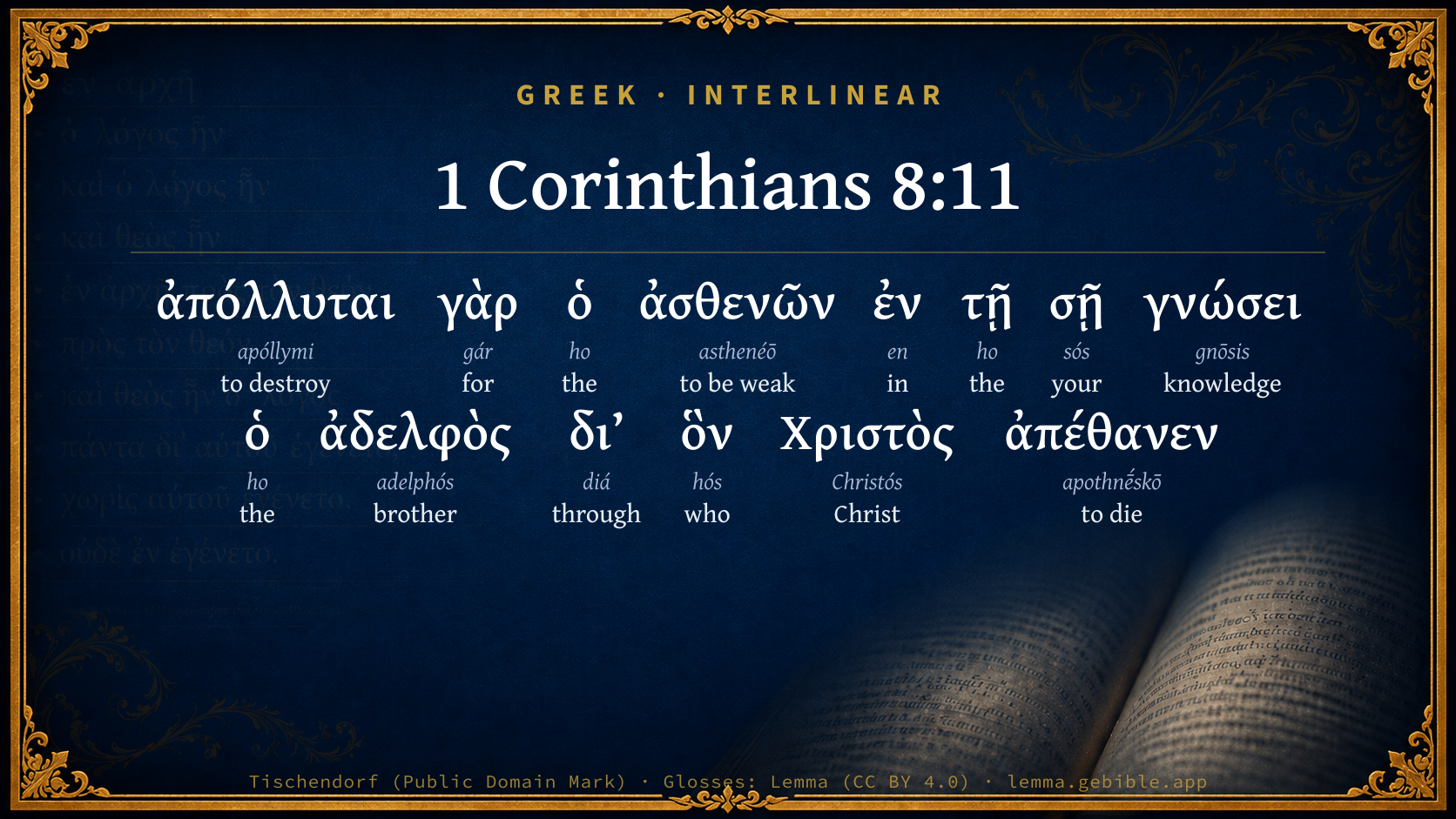
Greek (Tischendorf 8th ed.) 1 Corinthians 8:11 appears in the Greek New Testament. The text above is from the Tischendorf 8th edition. Each word links to its Strong’s number and a concise gloss. Click any word for its full Thayer’s Greek Lexicon entry.
Download image
Cite this verse

1 Corinthians 8:11 (World English Bible). Public Domain. Lemma interlinear Bible study tool, https://lemma.gebible.app/v/1-corinthians/8/11.

Show BibTeX & RIS
BibTeX
RIS
English Translation
And through your knowledge, he who is weak perishes, the brother for whose sake Christ died.
World English Bible · Public Domain
Download a study sheet

One document with this verse’s original text, its word-by-word gloss line, the meaning frame, cross-references with their text, attributed commentary, and full source and license credits — printable, and it pastes into notes with its structure intact.

This verse Autodidact and up

Study sheet (.html) Plain text (.txt)

A passage Seminary Student

Up to 50 verses in one chapter. A passage sheet keeps up to 6 commentary sources and 12 cross-references per verse, in the order this page ranks them, and says so on the sheet whenever that leaves anything out. Ask for a single verse and you get the Autodidact verse sheet above.

Everything on this page stays free to read, with no account — the sheet is a download of what is already on screen, not access to it.

Want to remove ads? Support Godless Engineer
Compare translations 3

The same verse in 3 English versions, stacked beneath the original-language interlinear above. Click any original word for its lexicon entry.

Each is an independent rendering of the whole verse — the interlinear is not word-aligned to these translations.

Highlighted words mark where these versions differ — a whole-verse word diff, not a word-by-word alignment.

  • World English Bible Public Domain
    And through your knowledge, he who is weak perishes, the brother for whose sake Christ died.
  • King James Version Public Domain
    And through thy knowledge shall the weak brother perish, for whom Christ died?
  • unfoldingWord Literal Text CC BY-SA 4.0
    So the one being weak, the brother for whom Christ died, is destroyed through your knowledge.

unfoldingWord Literal Text — © unfoldingWord, licensed CC BY-SA 4.0. Word-aligned USFM3 via Door43 (git.door43.org/unfoldingWord/en_ult).

Versions to compare (up to 4)

3 of 4 selected

Show all 19 translations

Every available English version of this verse, each an independent rendering of the whole verse.

  • World English Bible Public Domain
    And through your knowledge, he who is weak perishes, the brother for whose sake Christ died.
  • Berean Standard Bible Public Domain
    So this weak brother, for whom Christ died, is destroyed by your knowledge.
  • Majority Standard Bible Public Domain
    Should this weak brother, for whom Christ died, be destroyed by your knowledge?
  • King James Version Public Domain
    And through thy knowledge shall the weak brother perish, for whom Christ died?
  • American Standard Version (1901) Public Domain
    For through thy knowledge he that is weak perisheth, the brother for whose sake Christ died.
  • Revised Version (1885) Public Domain
    For through thy knowledge he that is weak perisheth, the brother for whose sake Christ died.
  • Geneva Bible (1599) Public Domain
    And through thy knowledge shall the weake brother perish, for whome Christ died.
  • Douay-Rheims (1899) Public Domain
    And through thy knowledge shall the weak brother perish, for whom Christ hath died?
  • Young's Literal Translation Public Domain
    and the brother who is infirm shall perish by thy knowledge, because of whom Christ died?
  • Literal Standard Version CC BY-SA 4.0
    For the [one] being weak—the brother for whom Christ died—will perish by your knowledge.
  • Unlocked Literal Bible CC BY-SA 4.0
    So because of your understanding about the true nature of idols, the weaker one, the brother for whom Christ died, is destroyed.
  • unfoldingWord Literal Text CC BY-SA 4.0
    So the one being weak, the brother for whom Christ died, is destroyed through your knowledge.
  • Darby Bible Public Domain
    and the weak [one], the brother for whose sake Christ died, will perish through thy knowledge.
  • World Messianic Bible Public Domain
    And through your knowledge, he who is weak perishes, the brother for whose sake Messiah died.
  • Webster's Bible Public Domain
    And through thy knowledge shall the weak brother perish, for whom Christ died?
  • Free Bible Version CC BY-SA 4.0
    By your “better knowledge” the weaker believer is destroyed, a believer for whom Christ died.
  • Bible in Basic English Public Domain
    And so, through your knowledge, you are the cause of destruction to your brother, for whom Christ underwent death.
  • Text-Critical English NT CC BY 4.0
    Should the weak brother, for whose sake Christ died, perish because of yoʋr knowledge?
  • Tyndale New Testament (1534) Public Domain
    And so thorow thy knowledge shall the weake brother perisshe for whom christ dyed.

Literal Standard Version (2020), Covenant Press — licensed CC BY-SA 4.0. Text via the HelloAO Bible API (eBible.org). Unlocked Literal Bible (unfoldingWord) — licensed CC BY-SA 4.0. Text via the HelloAO Bible API (eBible.org). unfoldingWord Literal Text — © unfoldingWord, licensed CC BY-SA 4.0. Word-aligned USFM3 via Door43 (git.door43.org/unfoldingWord/en_ult). Free Bible Version, Dr. Jonathan Gallagher — licensed CC BY-SA 4.0. Text via the HelloAO Bible API (eBible.org).

Word by word

More ways to search: Search by grammar → Find every occurrence → Compare this word →

Practice this passage: Drill this verse → Learn its vocabulary →

σῇ
sós
G4674
“your”
Possessive pronoun, 2nd person, Dative, Singular, Feminine
Part of Speech
Possessive pronoun
Person
2nd person
Case
Dative
Number
Singular
Gender
Feminine
Full Thayer's Definition

Origin: from G4771

TDNT: None

1. thy, thine
  1. ἀπόλλυται apóllymi G622 “to destroy” Verb, Present, Passive, Indicative, 3rd person, Singular
  2. γὰρ gár G1063 “for” Conjunction
  3. ὁ ho G3588 “the” Article, Nominative, Singular, Masculine
  4. ἀσθενῶν asthenéō G770 “to be weak” Verb, Present, Active, Participle, Nominative, Singular, Masculine
  5. ἐν en G1722 “in” Preposition
  6. τῇ ho G3588 “the” Article, Dative, Singular, Feminine
  7. γνώσει gnōsis G1108 “knowledge” Noun, Dative, Singular, Feminine
  8. ὁ ho G3588 “the” Article, Nominative, Singular, Masculine
  9. ἀδελφὸς adelphós G80 “brother” Noun, Nominative, Singular, Masculine
  10. δι’ diá G1223 “through” Preposition
  11. ὃν hós G3739 “who” Relative pronoun, Accusative, Singular, Masculine
  12. Χριστὸς Christós G5547 “Christ” Noun, Nominative, Singular, Masculine
  13. ἀπέθανεν apothnḗskō G599 “to die” Verb, Aorist, Active, Indicative, 3rd person, Singular

About this verse

These counts appear in no published source. They are computed here, from the morphology-tagged text and Lemma’s own curated glosses. What Lemma adds →

14
words
12
distinct lemmas
Pauline Epistles
section

Shared distinctive vocabulary

σῇ your G4674 occurs in 24 verses of the Greek New Testament. Also found in:

Repetition

A word recurs within this verse:

Cross-references

5

Topical passages linked to 1 Corinthians 8:11 in the Treasury of Scripture Knowledge — connected by theme and wording, ordered by reader-vote popularity; previews shown in the World English Bible.

  • Romans 14:15 Yet if because of food your brother is grieved, you walk no longer in love. Don't destroy with your food him for whom Christ died.
  • Romans 15:1–3 Now we who are strong ought to bear the weaknesses of the weak, and not to please ourselves.
  • 1 Corinthians 8:13 Therefore, if food causes my brother to stumble, I will eat no meat forevermore, that I don't cause my brother to stumble.
  • Romans 14:20–21 Don't overthrow God's work for food's sake. All things indeed are clean, however it is evil for that man who creates a stumbling block by eating.
  • 1 Corinthians 10:33–11:1 even as I also please all men in all things, not seeking my own profit, but the profit of the many, that they may be saved.

Cross-references courtesy of OpenBible.info (CC BY 4.0).

Where the printed editions differ

1 variant

Places in this verse where the major printed Greek editions disagree on the wording in a way that affects the translation — a comparison of editions, not a manuscript-by-manuscript collation. The editions are the modern critical texts (Nestlé-Aland 28/27, SBL, Westcott-Hort, Tregelles, Tyndale House) and the traditional texts behind the KJV (the Textus Receptus and the Byzantine/Majority text). It is not a claim about which reading is original.

  1. Different wording
    ἀπόλλυται

    “Is destroyed”

    In NA28NA27TynSBLWHTreg Not in TRByz

    ἀπολεῖται (apoleitai) 'will perish' occurs in traditional manuscripts (TR+Byz) instead of ἀπόλλυται (apollutai) 'Is destroyed' in older manuscripts (NA28+NA27+Tyn+SBL+WH+Treg)

Textual data: Translators Amalgamated Greek New Testament (STEPBible TAGNT) · CC BY 4.0.

Commentary

Notes on 1 Corinthians 8:11 from classic Christian and Jewish commentators (each source and its license shown beneath its notes). The classic Christian expositions comment on the surrounding passage and are grouped to its opening verse, so a note may address several verses; the Jewish commentaries on the Tanakh (Rashi and others) are per-verse, so they appear only where the commentator wrote on this verse.

Lemma curates 59 commentaries, every one of them public domain or Creative Commons licensed, each selected and text-cleaned for this edition rather than reprinted as found. About our sources →

The Biblical Illustrator

Joseph S. Exell

1Co_8:11-13

And through thy knowledge shall the weak brother perish, for whom Christ died?

Suffering, the measure of worth

I. The weak brother is not of much value in himself; but he is made valuable by the fact that Christ died for him.

1. How much of themselves men will give for one another, measures the worth in which that other is held. I love you, may mean only you are my plaything, or I love myself; but true love will give up for anothers sake time and convenience. It will employ all the resources of its being for the sake of that friend. And when, in some great exigency, all this will not avail, then love, in the glory of its power, goes to death as to the consummation of itself, and leaves a witness to itself which all mankind recognises (Joh_15:13).

2. Even when this is the fruit of instinct, it is impressive. The bear that dies defending its cubs, the hound that pines and dies on its masters grave, the little sparrow that fights the hawk and owl, not for itself, but its nest--one must be heartless indeed to feel no admiration for these fidelities of love.

3. But how much more when ones love and suffering spring from a perception of excellence in an object loved? The greater the nature that suffers, the higher is the estimate which his example gives of that for which he suffers. And by this analogue, the suffering and sacrifice of a Divine Being carries out the witness to its utmost conceivable extent.

4. We see at once a new element in the hands of the apostles after this testimony of the Master. No sooner was He gone up than they began to preach that man was valuable on account of what Christ suffered for him. A man for whom Christ died became a very different creature from a man before Christ had died for him. The fact that Christ died for a man made him worth protecting if he was weak.

5. This suffering was not founded upon mans character. It would be a testimony to the value of good character if Christ had come to die for it; but that was the very point of conflict between Him and the Pharisees. They held that Christ ought to suffer and identify Himself with them; but He most scornfully rejected that, and said, I came not to call the righteous, but sinners. I came to give My life for the lowest and worst men. He more sharply than any other discriminated between good and bad character; yet there was something behind character to which Christ was bearing witness, viz., the abstract original value which inheres in human life. The death of Christ is a testimony to the value of man in his very substance, if I may so say; so that the least and the lowest have the essence of value in them.

II. The effect which this fact has of determining mans place, his rights, and his worth.

1. Consider what the worlds way of estimation has been in judging men. Earliest, men measured physical power. Now the habit of society is to classify men into relative ranks of value by the effects which they are able to produce; by what they are worth to society. Therefore, when a great man dies men say, The world has met with a great loss. If a poor man dies, men say, The world has one less incumbrance. The dog that hunts well is better than a pauper that does not do anything, in the estimation of men. If a race are not able to hold their own against aggressive peoples men say, There is no help for it; they must go. They judge men by the standard of political economy. There is no such contempt on the globe for anything as man has for man. We need therefore to go back to this testimony of our Masters example, who came by His suffering and death to bear a testimony of that element in human nature which every man has like every other.

2. This view interprets the future. A man in the lowest condition here is not the man that he is to be; and when you have measured and weighed him, you have not estimated what he is worth in the kingdom to come. He has before him another world; and we are told most solemnly by our Saviour that the men who are the most regarded here will be worth the least there. The first shall be last, the last first. Many of the plants of our northern summer come up quickly, and do exceedingly well; but they are coarse and rank at that. And there are many seeds that I plant by the side of them every spring, which in the first summer only grow a few leaves high. There is not sun enough to make them do what it is in them to do. But if I put them in some sheltered hot-house, and give them the continuous growth of autumn and winter, and then, the next summer, put them out once more, they gather strength by this second planting, and lift up their arms and spread out the abundance of their blossoms. The plants that grew quickest the year before, are now called weeds by their side. And I doubt not that there is many a man who rushes up to a rank growth in the soil of this world, and of whom men seeing him, say, That is a great man, but there are many poor, feeble creatures in this world who will be carried safely on and up, and rooted in a better clime; and then, lifting up their whole nature, they will come out into that glorious summer of fervent love in heaven, where they will be more majestic, more fruitful, than those who so far surpass them here.

III. The effects which this doctrine will have upon our feelings and conduct to our fellow-men.

1. Let us suppose that we are in full possession of the Christian feeling--Christ died for that man. It will be a powerful restraint upon lawless liberty, and will bring us into such sympathy with all our fellow men, that, at the sacrifice of our own convenience and rights, it will be a privilege and a pleasure for us to serve them. Some men go through life, saying, I will take care of myself, and you must take care of yourself; and they feel that they have a right to go through life thus. Now no one who has drunk deeply of the spirit of the Master will refuse to accept the injunction, We that are strong ought to bear the infirmities of the weak. It is as if a strong swimmer should turn back and lend a helping hand to buoy up and lift across the flood one that was weaker or less able to swim than himself. We have no right to disregard, much less to hinder, the welfare of any human being. Have I a right to go tramp, tramp, tramp, according to the law of my physical strength, among little children? If I have had better privileges than others, and have come to conclusions which they cannot understand, have I a right to scatter sceptical notions through society? A man is bound to hold his knowledge, his conscience, his pleasures, &c., subject to this great law: Christ died for men, and I must live for men, and restrain my power, and forego my rights, even for their sake. We have a right to employ men, of course; but there is a habit which prevails in society of thinking that a man has a right to just so much of his fellow-men as he is able to extract from them. A man may fleece a hundred men during the week, and take the communion on Sunday, and nobody thinks that there is any violation of good-fellowship or of orthodoxy. But that great law of fellowship which knits every man to every other man on the globe says not only Thou art his brother, but, Thou art responsible for his weal as well as thine own. Thou shalt not in any wise harm him.

2. This is one of the most precious of doctrines to those that look and long for a better period of the world. It was almost the only thing we could urge when slavery rent our land. The single strand that held against the storms of avarice and the fire of lurid lusts was the single argument, For these Christ died. And that held; and the most wonderful change toward regeneration that the world ever saw has taken place by the simple operation of that great law. And what have we now for the weak races? Men of a hard heart and an iron-shod foot are preparing to tread these people down and deny them their rights. And I take my stand by the side of every weak creature, whatever his nationality may be, and I say, For him Christ died. Give men at the bottom a chance to come up. God, the highest, bowed down His head and came upon the earth and suffered for the weakest and the worst.

3. Christian brethren, we must arm ourselves betimes. The seeds of a better public sentiment must be sown. Then let no man be discouraged because he is labouring with a very much neglected class. There is no material in this world which is un-promising. No man is beyond salvation since Christ died for him. (H. W. Beecher.)

But when ye sin so against the brethren, and wound their weak conscience, ye sin against Christ.--

Sin against Christ

It is a proof of the intimate character of the relation between Christ and His people that it should be the very climax of reproach against Christians because of any course they followed, to charge them with sin against Christ. Language like this could be used of no merely human teacher and leader. To act without due charity is a sin against Christ because it is--

I. To offend against Christs commandment, viz., to love one another. This was to be the test of Christian discipleship.

II. To contradict Christs example. What Christ enjoined He exemplified in His whole life, and at last in His death.

III. To injure Christ in the person of one of His little ones. Christ so identified Himself with His disciples as to regard what was done to them as done to Himself. Whosoever is indifferent to the welfare of the Lords servants, sins against the Lord Himself, and shall not be held guiltless. (Prof. J. R. Thomson.)

Wounding a weak conscience

I. What a weak conscience is.

1. Such a conscience is improperly called tender; for tenderness imports quickness and exactness of sense, which is the perfection of this faculty, whose duty it is to be a spiritual watch to give us warning of whatsoever concerns us. It is opposed to a hard or seared conscience; but a weak conscience is opposed to a strong, which very strength consists in the tenderness or quickness of its discerning power.

2. The weakness of conscience here spoken of is opposed to faith (Rom_14:2), by which is not meant that act by which a man is justified, but signifies the same with knowledge (1Co_8:7; 1Co_8:10). The clear discernment of what is unlawful, and what is only indifferent, together with a firm persuasion of the lawful use of such indifferent things, all circumstances being duly observed in the using of them. And therefore, on the other side, the weak conscience is such a one as judges otherwise of the nature of things than indeed it is, supposing that to be unlawful in itself which really is not so.

3. From whence it follows that weakness of conscience implies--

(1) An ignorance of the lawfulness of some certain thing or action. That ignorance must be such a one as is not willing.

(a) Because it must be such a one as renders it in some degree excusable; but so far as any defect is resolved into the will, it is in that degree inexcusable.

(b) Because it must be such an ignorance as renders the person having it the object of compassion.

But no man pities another for any evil lying upon him, which he would not help, but which he could not. And consequently it must be resolved into the natural weakness of the understanding faculty, or else the want of opportunities or means of knowledge. Either of which makes ignorance necessary, as it is impossible for him to see who wants eyes, and equally impossible for him who wants light.

(2) A suspicion of the unlawfulness of any thing or action.

(3) A religious abstinence from the use of that thing of the lawfulness whereof it is thus ignorant or suspicious. It brings a man to that condition in Col_2:21.

II. What it is to wound or sin against it.

1. To afflict or discompose it; i.e., to rob it of its peace. For there is that concernment for Gods honour dwelling in every truly pious heart which makes it troubled at the sight of any action by which it supposes God to be dishonoured. And as piety commands us not to offend God, so charity enjoins us not to grieve our neighbour.

2. To encourage or embolden it to act against its present judgment or persuasion: which is, in other terms, to offend, or cast a stumbling-block before it: i.e., to do something which may administer to it an occasion of falling or bringing itself under the guilt of sin. So that as the former was a breach upon the peace, this is properly a wound upon the purity of the conscience.

3. The conscience may be induced to act counter to its present persuasion.

(1) By example; which is the case here expressly mentioned, and principally intended.

(2) By command; as when a person in power enjoins the doing something, of the lawfulness of which a man is not persuaded. (R. South, D. D.)

Dissuasives against an undue use of Christian liberty

1. A weak conscience is easily wounded.

2. The infliction of such a wound is a violation of the law of love.

3. It is a sin against Christ Himself. (J. Lyth, D. D.)

Wherefore, if meat make my brother to offend, I will eat no flesh while the world standeth.--

The great argument for abstinence

I. Arguments for abstinence are often grounded on.

1. Danger to ourselves.

(1) We may be led to excess.

(2) We may injure ourselves, physically or morally.

2. Wastefulness.

3. Intrinsical wrongness.

II. Such arguments frequently lack cogency.

1. The third will have no application to a large class of things indifferent in themselves, and it is generally in respect of such that the war is waged.

2. The others are open to question. Conflicting facts will be adduced, and where knowledge is imperfect the contest is likely to continue. And the argument often acts as a temptation, for when human nature is warned of peril it often delights to show how brave and steadfast it can be.

III. The apostolic argument. St. Paul--

1. Enlarges the view so that others are included as well as ourselves. Abstinence is sometimes not for ourselves at all, but only for our fellows (Php_2:4). We are units, but united units. We cannot legislate for that little area which we ourselves occupy.

2. Recognises the influence of example. Our words are a spiders web; our acts are a cable. Men do what we show them, not what we tell them. And we cannot persuade men that we are strong and they weak.

3. Asserts the obligation of self-sacrifice for the welfare of others. That which is indifferent becomes anything but that if our indulgence is injurious to others. Our sacrifice is small indeed compared with their possible loss. This argument has special force for Christians.

(1) They have the example of self-sacrifice in their Master (verse 12). They have a more impressive view of the issues involved in the fall of a fellow-creature.

(2) Their non-abstinence may be a sin against a fellow-Christian (verse 11). The fall may be, not of an unbeliever, but of a brother associated in Christian fellowship and service, and thus be--

(3) A sin against the brethren (verse 12), i.e., the Church, bringing scandal and disgrace through a brothers fall. And also--

(4) A sin against Christ (verse 12). For Christ and Christians are one--He the Head and they the members.

(5) They have in their ears such utterances of their Masters as Mat_18:6; Mat_25:40. (W. E. Hurndall, M. A.)

Personal sacrifice is

I. Necessary.

1. Not only in meats and drinks, but in many other things.

2. To avoid offence.

II. Is obligatory--

1. On Christians.

2. By the law of love, and--

3. The example of Christ.

III. Is magnanimous. It is--

1. A conquest of self.

2. An act of benevolence.

3. A feature of renewed nature.

IV. Will be abundantly compensated.

1. By the approval of conscience.

2. The benefit of others.

3. The approbation of God.

4. Final reward. (J. Lyth, D. D.)

Abstaining for the good of others

Do you not think, dear friends, that though it may be quite proper for you to take a glass of wine or a glass of beer, and there is no sin in the thing at all, your example may be injurious to somebody to whom it would be a sin to take it? Perhaps some persons cannot take a glass without taking two, three, four, five, or six glasses. You can stop, you know; but if your example leads them to start, and they cannot stop, is it right to set them going? Though you have a clear head, and can stand in a dangerous place, I would not recommend you to go there if somebody else would thus be placed in danger. If I were walking by the cliffs of Dover, and I happened to have a very fine cool head, yet, if I had my sons with me, and I knew that they had ordinary kinds of heads, I should not like to go and stand just on a jutting piece of crag so as to induce them to try the same position. No; I should feel, Though I can stand here, you cannot; and if I stand here, perhaps you will attempt it, and fall, and I shall be guilty of your blood. Let us treat men as we would treat our sons; and let us be weak to their weakness, and deny ourselves for their sakes. Is not that good and proper reasoning? It seems to me that it is. If it is not good reasoning, it is safe. I never have asked God to forgive me for my sin in going without strong drink. I have never seen any commandment in Scripture showing that I am bound to take it. I feel free to do as I like about abstaining; but especially free when for the good of others I prefer to abstain altogether. (C. H. Spurgeon.)

Christian consideration for others

Now you may say to me if you please as a man, Mr. Gough, I am a moderate drinker; I use these things in moderation, and therefore I set you a good example. I say at once, Sir, you do not. Well, if I drink one glass and there stop, is not that an example for others? No, sir; no, sir; no more than if there was a bridge built over a gulf, to fall into which was utter ruin, and that bridge will bear 150 lbs., and you weigh 1501bs., and you say to that young man (and he weighs 200 lbs.), Follow my example.--I dont like the look of that bridge. Dont be a fool, I have walked it forty years; proved it perfectly safe; never cracked with me; never sprung with me; perfectly safe.--But I dont like it. Dont be foolish; you can do that which I can do; now I am setting you a good example; follow me step by step. That young man attempts to follow it; he sets his foot on the centre; crash! crash! down he goes, with a shriek, into destruction. Now, did you set a good example? No, because you didnt take into consideration the difference of weight. Before you can say to a young man, I set you a good example, you must take into consideration the difference between his temperament and yours, his susceptibility and yours. (J. B. Gough.)

.

The Biblical Illustrator, edited by Joseph S. Exell (c. 1880s–1900s) — public domain. Text from a community e-Sword module.

Tyndale Open Study Notes

Tyndale Open Resources

8:11 For believers to insist on eating food offered to idols—because their superior knowledge assured them that they are free to eat such food—could destroy less mature Christians (who understood eating this meat as an expression of worship of pagan gods). • for whom Christ died: Cp. Rom 14:15.

Tyndale Open Study Notes — © Tyndale Open Resources, licensed CC BY-SA 4.0. Text via the HelloAO Bible API.

Bengel's Gnomon

Johann Albrecht Bengel

1Co 8:11. Ἀπολεῖται, shall perish) He will lose his faith, and, if he do not recover it, his salvation, Rom 14:23. [See, what important results a single action may produce, although externally considered it seemed to be of little consequence.—V. g.]—διʼ ὃν, for [on account of] whom) For rather than instead of suits the passage before us; that we may be taught, what we ought to do for the sake of our brethren.—ἀπέθανεν, died) prompted by the love, which thou so very little imitatest.

Bengel's Gnomon of the New Testament — English translation (T&T Clark, Edinburgh, 1860) — public domain. Text from a community e-Sword module.

Meyer's Critical & Exegetical Commentary

Heinrich August Wilhelm Meyer

1Co_8:11. Ἀπόλλυται (terrificum verbum, Clarius) γάρ unfolds the meaning of the antiphrastic element of the preceding οἰκοδ., the γάρ introducing the answer (Hartung, I. p. 477; Klotz, a[1363] Devar. p. 240; Baeumlein, Part. p. 72), in which the apostles irony loses itself in the deep earnestness which underlies it: he is in truth utterly ruined, etc.

ἀπόλλυται is meant here, as in Rom_14:15, of destruction κατʼ ἐξοχήν, the eternal ἀπώλεια to which a man becomes liable when he falls from the life of faith into that of sin through violation of his conscience. see on Rom_14:15. Billroth, indeed, holds the γάρ here to be quite inexplicable, unless we take ἀπόλλ. simply in the sense of is led astray (but see the critical remarks); while Rückert declares the γάρ utterly useless. Nevertheless, ἀπόλλυται κ.τ.λ[1364] makes it clear and unmistakeable how the case stands with the preceding ΟἸΚΟΔΟΜΗΘ., so that ΓΆΡ is logically correct.

ἘΝ Τῇ Σῇ ΓΝΏΣΕΙ] belongs to ἈΠΟΛΛ.: by means of thy knowledge, so that it, through the use thou hast made of it, has occasioned this destruction. Ἐπί (see the critical remarks) would be: upon thy knowledge, so that it was the ground of what took place.

ὁ ἀδελφ. διʼ ὃν Χ. ἀπ.] a weighty twofold motive for not bringing about such a result. Comp Rom_14:15. The ΔΙʼ ὋΝ Χ. ἈΠ. is frustrated by the ἀπολλ.! Comp 1Co_8:12. Bengel says well in reference to ΔΙʼ ὍΝ: ut doceamur, quid nos fratrum causa debeamus. Respecting διά, comp Rom_4:25.

[1363] d refers to the note of the commentator or editor named on the particular passage.

[1364] .τ.λ. καὶ τὰ λοιπά.

Meyer — Critical and Exegetical Commentary on the New Testament — English translation by Peter Christie, edited by Frederick Crombie (T&T Clark, 1880) — public domain. Text from a community e-Sword module.

Expositor's Greek Testament

ed. W. Robertson Nicoll

1Co 8:11 . “For the weak man [whom you talk of building up!] is being destroyed through thy knowledge the brother, on whose account Christ died!” (Rom 14:15 ). This affirms, with terrible emphasis, the issue implied by 1Co 8:10 : “est ædificatio ruinosa” (Cv [1267] ). ὁ ἀσθενῶν means (more than ὁ ἀσθενής ) the man in a continued state of weakness. ἐν τῇ σῇ γνώσει , “on the ground ( or in the sphere) of thy knowledge”; in this atmosphere the weak faith of the other cannot live ( cf. ἐν in 1Co 2:4 ; Eph 4:16 , ἐν ἀγάπῃ ). His “knowledge” leaves the tempter inexcusable. “Notice the threefold darkness of the picture: there perishes, thy brother, for whom Christ died” (Bt [1268] ). Paul appeals to the strongest feelings of a Christian brotherly love and loyalty to Christ. For the prospective διʼ ὅν , cf. Rom 4:25 ; Christ’s death is thus frustrated of its dear object ( cf. Gal 2:21 ) by thy heartless folly!

[1267] Calvin’s In Nov. Testamentum Commentarii .

[1268] J. A. Beet’s St. Paul’s Epp. to the Corinthians (1882).

The Expositor's Greek Testament, edited by W. Robertson Nicoll (1897–1910) — public domain. Text from a community e-Sword module.

Hodge's Commentary on Romans, Ephesians & First Corinthians

Charles Hodge

1Co_8:11

And through thy knowledge shall the weak brother perish, for whom Christ died?

That is, shall your knowledge be the occasion of the perdition of a weak brother? There are three forms in which the apostle expresses the consequence of doing what the conscience is not satisfied is right. In 1Co_8:7 he says, the conscience is defiled; here, he says, the man perishes or is lost; in Rom_14:23 he says, He that doubteth is damned (condemned) if he eat. All these forms of expression amount to the same thing. Guilt, condemnation and perdition are connected. The one implies the other. Whatever brings guilt on the conscience exposes to condemnation, and condemnation is perdition.

For whom Christ died. There is great power and pathos in these words. Shall we, for the sake of eating one kind of meat rather than another, endanger the salvation of those for whom the eternal Son of God laid down his life? The infinite distance between Christ and us, and the almost infinite distance between his sufferings and the trifling self-denial required at our hands, give to the apostles appeal a force the Christian heart cannot resist. The language of Paul in this verse seems to assume that those may perish for whom Christ died. It belongs, therefore, to the same category as those numerous passages which make the same assumption with regard to the elect. If the latter are consistent with the certainty of the salvation of all the elect, then this passage is consistent with the certainty of the salvation of those for whom Christ specifically died. It was absolutely certain that none of Pauls companions in shipwreck was on that occasion to lose his life, because the salvation of the whole company had been predicted and promised; and yet the apostle said that if the sailors were allowed to take away the boats, those left on board could not be saved. This appeal secured the accomplishment of the promise. So Gods telling the elect that if they apostatize they shall perish, prevents their apostasy. And in like manner, the Bible teaching that those for whom Christ died shall perish if they violate their conscience, prevents their transgressing, or brings them to repentance. Gods purposes embrace the means as well as the end. If the means fail, the end will fail. He secures the end by securing the means. It is just as certain that those for whom Christ died shall be saved, as that the elect shall be saved. Yet in both cases the event is spoken of as conditional. There is not only a possibility, but an absolute certainty of their perishing if they fall away. But this is precisely what God has promised to prevent. This passage, therefore, is perfectly consistent with those numerous passages which teach that Christs death secures the salvation of all those who were given to him in the covenant of redemption. There is, however, a sense in which it is scriptural to say that Christ died for all men. This is very different from saying that he died equally for all men, or that his death had no other reference to those who are saved than it had to those who are lost. To die for one is to die for his benefit. As Christs death has benefited the whole world, prolonged the probation of men, secured for them innumerable blessings, provided a righteousness sufficient and suitable for all, it may be said that he died for all. And in reference to this obvious truth the language of the apostle, should any prefer this interpretation, may be understood, Why should we destroy one for whose benefit Christ laid down his life? All this is perfectly consistent with the great scriptural truth that Christ came into the world to save his people, that his death renders certain the salvation of all those whom the Father hath given him, and therefore that he died not only for them but in their place, and on the condition that they should never die.

Charles Hodge — Commentary on Romans (1835), First Corinthians (1857), and Ephesians (1856) — public domain. Text from a community e-Sword module.

Geneva Bible (1599)

Geneva Bible translators

An amplification of the argument taken both of comparison and contraries: Thou wretched man, saith he, pleasing thyself with thy knowledge which indeed is none (for if thou haddest true knowledge, thou wouldest not sit down to meat in idol’s temple) wilt thou destroy thy brother, hardening his weak conscience by this example to do evil, for whose salvation Christ himself has died?

Geneva Bible (1599) marginal notes — public domain. Text via Bolls.life.

Jamieson, Fausset & Brown

Robert Jamieson, A. R. Fausset & David Brown

shall . . . perish--The oldest manuscripts read "perisheth." A single act seemingly unimportant may produce everlasting consequences. The weak brother loses his faith, and if he do not recover it, his salvation [BENGEL] (Rom 14:23).

for whom Christ died--and for whose sake we too ought to be willing to die (Jo1 3:16). And yet professing Christians at Corinth virtually tempted their brethren to their damnation, so far were they from sacrificing aught for their salvation. Note here, that it is no argument against the dogma that Christ died for all, even for those who perish, to say that thus He would have died in vain for many. Scripture is our rule, not our suppositions as to consequences. More is involved in redemption than the salvation of man: the character of God as at once just and loving is vindicated even in the case of the lost for they might have been saved, and so even in their case Christ has not died in vain. So the mercies of God's providence are not in vain, though many abuse them. Even the condemned shall manifest God's love in the great day, in that they too had the offer of God's mercy. It shall be the most awful ingredient in their cup that they might have been saved but would not: Christ died to redeem even them.

Jamieson, Fausset & Brown — Commentary Critical and Explanatory on the Whole Bible (1871) — public domain (CC PDM 1.0). Text via the HelloAO Bible API.

Adam Clarke's Commentary

Verse 11. Shall the weak brother perish] Being first taught by thy conduct that there was no harm in thus eating, he grieves the Spirit of God; becomes again darkened and hardened; and, sliding back into idolatry, dies in it, and so finally perishes.

For whom Christ died?] So we learn that a man may perish for whom Christ died: this admits of no quibble. If a man for whom Christ died, apostatizing from Christianity, (for he is called a brother though weak,) return again to and die in idolatry, cannot go to heaven; then a man for whom Christ died may perish everlastingly. And if it were possible for a believer, whether strong or weak, to retrace his steps back to idolatry and die in it, surely it is possible for a man, who had escaped the pollutions that are in the world, to return to it, live and die in its spirit, and perish everlastingly also. Let him that readeth understand.

Adam Clarke's Commentary on the Bible (1810–1826) — public domain. Text from a community e-Sword/MySword module.

John Calvin's Commentaries

11. And thy brother perish Mark how serious an evil it is, that mankind commonly think so little of — that of venturing upon anything with a doubtful or opposing conscience. For the object to which our whole life ought to be directed, is the will of the Lord. This, therefore, is the one thing that vitiates all our actions, when we disregard it. This we do, not merely by an outward action, but even by a thought of the mind, when we allow ourselves in anything in opposition to conscience, even though the thing be not evil in itself. Let us bear in mind, therefore, that whenever we take a step in opposition to conscience, we are on the high road to ruin.

I read, however, the sentence interrogatively, thus: Shall he perish through thy knowledge? as though he had said: “Is it reasonable that thy knowledge should give occasion of ruin to thy brother? Is it for this reason that thou knowest what is right, that thou mayest cause another’s ruin!” He makes use of the term brother, in order to expose their pride as unfeeling, in this way: “It is true that the person whom you despise is weak, but still he is your brother, for God has adopted him. You act a cruel part, therefore, in having no concern for your brother.” There is, however, still greater force in what follows — that even those that are ignorant or weak have been redeemed with the blood of Christ; for nothing were more unseemly than this, that while Christ did not hesitate to die, in order that the weak might not perish, we, on the other hand, reckon as nothing the salvation of those who have been redeemed with so great a price. A memorable saying, by which we are taught how precious the salvation of our brethren ought to be in our esteem, and not merely that of all, but of each individual in particular, inasmuch as the blood of Christ was poured out for each individual!

John Calvin's Commentaries (1540-1563) — public domain. Text from the Calvin Translation Society English edition (1840s-50s) via the Christian Classics Ethereal Library (ccel.org). Calvin's coverage is partial (roughly two-thirds of the Bible); uncommented books and verses are honest gaps, never fabricated. The 19th-century editor's footnotes and remarks are omitted so the notes are faithfully Calvin's own voice.

Ellicott's Commentary for English Readers

(11) And through thy knowledge shall . . .—Better, and by means of thy knowledge the weak one perishes—the brother for whom Christ died. It is not, as in the English version, a question, but it is the expansion and interpretation of the previous statement. There is a great variety of readings in the MSS., but the weight of evidence is in favour of this reading. Christ died for him. The sarcasm passes away in words of solemn and pathetic reproof. You won’t give up your liberty for him. You will indulge yourself, and so prevent Christ’s death being his redemption. A sacrifice of conscience destroys spiritual life.

A Bible Commentary for English Readers, edited by Charles John Ellicott (1878–1897) — public domain. Text from a community e-Sword module.

The Cambridge Bible for Schools and Colleges

gen. ed. J. J. S. Perowne

11. shall the weak brother perish] Some read, the weak brother is perishing. Cf. Rom_14:15.

The Cambridge Bible for Schools and Colleges (gen. ed. J. J. S. Perowne; Cambridge University Press, 1878–1918) — public domain. Text from a community e-Sword module.

John Gill's Exposition

And through thy knowledge,.... These words contain an aggravation of the sin such persons are guilty of, who are the means, by their example, of ensnaring weak minds, and causing them to stumble and fall, even in some sense so as to perish:

shall the weak brother perish, for whom Christ died? every word almost carries in it an exaggeration of this matter; it is not some slight injury that is done to the person, but even causing him to "perish"; and this is not said of any person, but a "brother", to whom the strongest affection, and strictest regard, should be shown; and a "weak" brother, of whom the greater care should be taken; and therefore it is an instance of cruelty to do damage to such an one, and that not ignorantly, which cannot be pretended, but "through thy knowledge"; not through the true use, but abuse of it: those that have knowledge should know better, and improve it to the edification, and not the destruction of fellow Christians; and all this done in a case of indifference, that might as well be let alone, of which there was no necessity for the doing of it: but what aggravates most of all is, that this affects a person for "whom Christ died"; that he had such a value for as to purchase and redeem with the price of his own blood; and yet these men made so little account of, as by so trifling a thing to risk their good and welfare. Some would from hence conclude the doctrine of universal redemption, that Christ died for all men, even for them that perish; but it should be observed, that the words are put by way of interrogation, and prove no matter of fact, even supposing they could be understood of eternal ruin and destruction; and at most only imply the danger and possibility thereof through offences given, were they not preserved by the power and grace of God through Christ, who died for them, and so will not suffer them to perish; though this is no thanks to them who lay stumblingblocks in their way, and, as much as in them lies, cause them to perish, in this sense: besides, the "perishing" of this weak brother is to be understood of his peace and comfort, and is explained by "defiling" his conscience, Co1 8:7 by wounding it, Co1 8:12 and making him to offend, Co1 8:13 through an imprudent use of Christian liberty in those who had the greater knowledge, and by a participation of things offered unto idols, in an idol's temple, and not of his eternal damnation in hell; which could never enter into the apostle's thought, as to be brought about hereby, as appears from Co1 8:8 and so is no proof of Christ's dying for such as perish eternally: for those for whom Christ has died, he has by his death procured such blessings for them, as a justifying righteousness, pardon of sin, peace with God, reconciliation unto him, and eternal salvation, which will for ever secure them from perishing in such sense.

John Gill's Exposition of the Whole Bible (1746–1763) — public domain (CC PDM 1.0). Text via the HelloAO Bible API.

Trapp's Complete Commentary

John Trapp

11 And through thy knowledge shall the weak brother perish, for whom Christ died?

Ver. 11. Thy weak brother perish] Revolt to paganism, or at least pollute his conscience with mortal sin, which shall be set upon thy score? And hast thou not sins enough of thine own to answer for?

John Trapp, A Commentary or Exposition upon All the Books of the Old and New Testament (1647–1656) — public domain. Text from a community e-Sword module.

Albert Barnes' Notes on the Bible

And through thy knowledge - Because you knew that an idol was nothing, and that there could be really no danger of falling into idolatry from partaking of these entertainments. You will thus be the means of deceiving and destroying him. The argument of the apostle here is, that if This was to be the result, the duty of those who had this knowledge was plain.

Shall the weak brother - The uninformed and ignorant Christian. That it means real Christian there can be no doubt. Because:

(1) It is the usual term by which Christians are designated - the endearing name of “brother;” and,

(2) The scope of the passage requires it so to be understood; see the note at Rom 14:20.

Perish - Be destroyed; ruined; lost; see the note at Joh 10:28. So the word ἀπολεῖται apoleitai properly and usually signifies. The sense is, that the tendency of this course would be to lead the weak brother into sin, to apostasy, and to ruin. But this does not prove that any who were truly converted should apostatize and be lost; for:

(1) There may be a tendency to a thing, and yet that thing may never happen. It may be arrested, and the event not occur.

(2) The warning designed to prevent it may be effectual, and be the means of saving. A man in a canoe floating down the Niagara river may have a tendency to go over the falls; but he may be hailed from the shore, and the hailing may be effectual, and he may be saved. The call to him was designed to save him, and actually had that effect. So it may be in the warnings to Christians.

(3) The apostle does not say that any true Christian would be lost. He puts a question; and affirms that if “one” thing was done, “another might” follow. But this is not affirming that anyone would be lost. So I might say that if the man continued to float on toward the falls of Niagara, he would be destroyed. If one thing was done, the other would be a consequence. But this would be very different from a statement that a man “had actually” gone over the falls, and been lost.

(4) It is elsewhere abundantly proved that no one who has been truly converted will apostatize and be destroyed; see the notes at Joh 10:28; compare the note at Rom 8:29-30.

For whom Christ died - This is urged as an argument why we should not do anything that would tend to destroy the souls of people. And no stronger argument could be used. The argument is, that we should not do anything that would tend to frustrate the work of Christ, that would render the shedding of his blood vain. The possibility of doing this is urged; and that bare possibility should deter us from a course of conduct that might have this tendency. It is an appeal drawn from the deep and tender love, the sufferings, and the dying groans of the Son of God. If He endured so much to save the soul, assuredly we should not pursue a course that would tend to destroy it. If he denied himself so much to redeem, we should not, assuredly, be so fond of self-gratification as to be unwilling to abandon anything that would tend to destroy.

Albert Barnes' Notes on the Bible (1834–1885) — public domain. Text from a community e-Sword/MySword module.

Matthew Poole's English Annotations

Through thy knowledge, in this place, is, by occasion of thy knowledge. God hath not given people knowledge that they thereby should be a means to harm and to destroy, but to do good, and to save others; it is a most absurd thing for any to use their knowledge, therefore, to the destruction of others.

Shall the weak brother perish? By perish is here meant, be led into sin, by acting contrary to the judgment of his own conscience; for, (as the apostle saith, Rom 14:23): He that doubteth is damned if he eat, for whatsoever is not of faith, that is, done out of a firm persuasion in the party doing that it is lawful, is sin.

For whom Christ died; though he be weak, yet if he be a true believer, Christ died for him, and there can be nothing more contrary to the duty of a charitable Christian, than to be a means to damn him whom Christ came down from heaven and died for, that he might save him.

Matthew Poole's English Annotations on the Holy Bible (1683–1685) — public domain. Text from a community e-Sword/MySword module.

Whedon's Commentary on the Bible

Daniel D. Whedon

11. And—The Greek is for. This particle in Greek often refers to some omitted phrase, easily understood by the context. The true rendering, with the omitted phrase supplied, with the verb perish brought into its true present tense, and the spurious interrogation point removed, is this: [Alas that it should be so,] for the weak brother perishes by thy knowledge. See note on Rom_14:15.

Christ died—A pathetic and forcible argument, drawn from the depths of Christian truth and Christian feeling, and possible for a Christian solely to adduce. Will you not suffer a privation in behalf of the soul for which Christ died?

Daniel D. Whedon (gen. ed.), Commentary on the Old and New Testaments (1874–1909) — public domain. Text from a community e-Sword module.

The Pulpit Commentary

Shall the weak brother perish. The fact that he was "weak" constituted a fresh appeal to pity. It made him more emphatically one of "Christ"s little ones," and Christ had pronounced a heavy malediction on all who caused such to offend. But if there is this "ruinous edification" upon the trembling and sandy foundation of a weak conscience, what could possibly follow but a gradual destruction? The tense is the present (the praesens futurascens), "and he who is weak, in thy knowledge, is perishing brother for whose sake Christ died." The order of the original often gives a force to the words, which it is difficult to reproduce, as here. The word "is perishing" becomes very emphatic by being placed first in the sentence. "Destroy not him with thy meat for whom Christ died". (Rom_14:16) Perish; terrificum verbum. Clarius. He could use no word which would more effectually point his warning.

The brother"s claim.

It seems as though Paul treated of this case of conscience at inordinate length. Perhaps this would be so were it not that, in disposing of this difficulty, the apostle was really disposing of many other difficulties which should emerge in the course of the centuries. Principles are laid down in this "casuistical" portion of the Epistle which are applicable to Christian conduct in varying states of society and throughout all time.

I THE DANGER TO CHRISTIAN BRETHREN OF THE UNRESTRAINED INDULGENCE OF LIBERTY. Let a Christian man consider only what will commend him to God, what is in accordance with his right and liberty; and what will be the result? This passage makes this very evident, showing that for an enlightened Christian to partake of food offered to idols may prove prejudicial to weak brethren, who take such conduct as a sanction of idol worship and of idolatrous practices generally. No doubt this is a misconception, but it is a misconception which is likely, which is certain, to happen. Thus the man of weak conscience, of little enlightenment, has his nature defiled and hardened, and, according to the very strong expression of this verse, is in danger of perishing. An awful, unforeseen, consequence to follow upon the indulgence in Christian liberty. The possibility of such a consequence is in itself sufficient to make a liberal Christian pause lest he should carry his liberty too far.

II THE GREAT CHRISTIAN MOTIVE WHICH RESTRAINS THE EXERCISE OF LIBERTY. The apostle calls upon the enlightened Corinthians to consider who he is whose welfare and salvation are endangered by the course supposed.

1. He is a brother. Who will say, "Am I my brother"s keeper?" On the contrary, the spiritual bond that unites the people of Christ one to another is so close and precious that anything that threatens its permanence should be regarded with suspicion and dread.

2. Not only so; he is one for whom Christ died. Observe the contrast which is so powerfully presented in this language. The Lord of glory died to ransom and to save each disciple and friend of his; submitted for his sake, not to inconvenience and restraint, but to sufferings, to the cross, to the grave. And shall any follower of the Lord Jesus treat with contempt even the weakness and prejudice of one whom the Lord of glory so pitied that he gave up his own life to save? Who are we that we should act in a manner so contrary to the action of our Divine Lord and Leader? Let him be our Example, as in other things, so in this; let his self sacrifice be our model and motive, that with a sympathizing and affectionate disposition we hold dear the security and well being of every Christian brother, however ignorant and however feeble. So far from assisting in the ruin, be it ours to promote the salvation of every member of the spiritual family, every sheep, every weak and helpless lamb, of the vast flock of that good Shepherd who laid down his life for his sheep. T.

The Pulpit Commentary (1880–1919), ed. H.D.M. Spence-Jones & Joseph S. Exell — public domain. Text from a community e-Sword module.

John Wesley's Explanatory Notes

And through thy knowledge shall the weak brother perish, for whom Christ died? - And for whom thou wilt not lose a meal's meat, so far from dying for him! We see, Christ died even for them that perish.

John Wesley, Explanatory Notes Upon the Whole Bible (1754–1765) — public domain. Text via the GEBible commentary corpus.

Godbey's Commentary on the New Testament

William B. Godbey

11. “For he who is weak is destroyed by thy knowledge, the brother for whom Christ died.

William B. Godbey, Commentary on the New Testament (1896–1900) — public domain. Text from a community e-Sword module.

McGarvey & Pendleton's Commentaries

J. W. McGarvey

For through thy knowledge he that is weak perisheth, the brother for whose sake Christ died . [Paul here presents a new appeal, of unapproachable pathos and power. The world had never before heard any such reason why mercy should be shown to the weak.]

J. W. McGarvey (with Philip Y. Pendleton), Commentaries on the New Testament (The Fourfold Gospel, 1914; Acts; and the epistles) — public domain. Text from a community e-Sword/MySword module.

The People's New Testament

B. W. Johnson

11. Hence his knowledge, the knowledge that made him dare eat, because he knew an idol was nothing, might be the means of destroying the weak brother by leading him to idolatry.

B. W. Johnson's The People's New Testament with Notes (1889–1891) — public domain. Electronic text from the Christian Classics Ethereal Library (CCEL) ThML edition.

unfoldingWord translationNotes

Door43 World Missions Community

your understanding

Paul is speaking to the Corinthians as if they were one person, so the word "your" here is singular. (See: Forms of You)

the weaker one ... is destroyed

The brother or sister who is not strong in his or her faith will sin or lose his or her faith.

Therefore

"Because what I have just said is true"

if food causes

"Food" here is a metonym for the person eating the food. AT: "if I cause by eating" or "if I, because of what I eat, cause" (See: Metonymy)

translationWords

false god

sin

conscience

stumble

unfoldingWord translationNotes — © Distant Shores Media and the Door43 World Missions Community, licensed CC BY-SA 4.0. Source: git.door43.org/Door43/en_tn.

Cambridge Greek Testament for Schools and Colleges

11. ἀπόλλυται γάρ אB, ἀπόλλυται οὖν A, καὶ ἀπόλλυται D. Rec. καὶ ἀπολεῖται EFG Peshito, Vulg. and Irenaeus. The copies of Vetus Lat. are divided.

11. ἀπόλλυται γάρ. This may either be rendered (1) Why! through thy knowledge the weak is perishing, or (2) for in this way through thy knowledge the weak is perishing. The rec. text καὶ ἀπολεῖται is construed without difficulty.

ὁ ἀδελφός. The reading in the text is more emphatic than the rec. text: the weak is perishing by thy knowledge—the brother for whom Christ died. ἐν here means through the exercise of.

Cambridge Greek Testament for Schools and Colleges (Cambridge University Press, 1896; 21 vols, various authors incl. Carr, Maclear, Plummer, Farrar, Lumby, Moule, M. R. James, Simcox) — public domain. Text from a community e-Sword module.

Alford’s Greek Testament

Henry Alford

11.] … and (thus) the weak perishes (hereafter: see the parallel, ref. Rom. and note) in (as the element in which,—he entering into it as his own, which it is not) thy knowledge,—the brother, in whose behalf Christ died? See again Rom. as above.

Henry Alford, The Greek Testament (1849–1861) — public domain. Text from a community e-Sword module.

International Critical Commentary

11. ἀπόλλυται γὰρ ὁ ἀσθενῶν ἐν τ. ς. γν. ‘For it is destruction that he who is weak finds in thy knowledge’. Ruin, and not building up, is what he is getting by following the example of one who is better instructed than himself. There is the tragedy of it; that the illumination of one Corinthian is precisely the field in which another Corinthian takes the road to ruin. And the tragedy reaches a climax in the fact that the one who is led astray is the brother in Christ of him who leads him astray, and is one whom Christ died to save from ruin. The last clause could hardly be more forcible in its appeal; every word tells; ‘the brother’, not a mere stranger; ‘for the sake of whom’, precisely to rescue him from destruction; ‘Christ,’ no less than He; ‘died’, no less than that: cf. Rom 14:15. Tu eris occasio mortis ejus propter quem Christus, ut redimeret, mortuus est (Herv.). See Mat 18:6.

ἀπολ. γάρ (א* B 17, Copt. Goth.) is to be preferred to καὶ ἀπολ. (א3* D, d e) or ἀπολ. οὖν (A P 39). And καί ἀπολεῖται, though well supported (D3 E F G L, Vulg. Syrr. Arm. Aeth.), looks like a correction to assimilate the tense with οἰκοδομηθήσεται and carry on the question through v. 11. The question ends at ἐσθίειν, and what follows is explanation. The emphatic position of ἀπόλλυται, and also the tense, have force; it is no less than destruction that results, and the destruction is already at work.

International Critical Commentary — older volumes (1896–1929), various authors — public domain. Text from a community e-Sword module.

Vincent's Word Studies in the New Testament

Marvin R. Vincent

Shall the weak brother perish [απολλυται ο ασθενων] . Not a question, as A. V. The participle "he that is being weak" indicates a continuance of the weakness, and the present tense, is perishing, implies that the process of moral undermining is in progress through the habitual indulgence of the better informed Christian. Rev., he that is weak perisheth.

Marvin R. Vincent, Word Studies in the New Testament (1887–1900) — public domain. Text from a community e-Sword/MySword module.

Lesson kit

Teaching starters — assembled from the data on this page, not authored interpretation. Every prompt links to the verse data it draws on. Edit before teaching.

1 Corinthians, in the Pauline Epistles, opens this verse with 14 words (12 distinct Greek lemmas). Its most distinctive word is sós (“your”). A historical commentator’s framing appears above. Read the whole chapter for the surrounding context.

Discussion questions

  1. How does “your” (sós) shape what this verse is saying?
  2. How does Matthew 7:3, which shares the word «your», read alongside this verse?
  3. What does the repetition of “the” (3× in this one verse) do in this verse?
  4. These translations render this verse differently; the difference is in the English rendering, not the original. What questions does that raise?
  5. Compare how The Biblical Illustrator and Tyndale Open Study Notes read this verse. Where do they agree or differ?

Things to notice

Reading settings

Reading text

Shown beneath each verse's original-language words.

Old Testament
Old Testament edition

Read the OT as the Masoretic Hebrew (MT) or the Greek Septuagint (LXX).

English shown for the Greek Septuagint (in the Hebrew ↔ Greek comparison).

Comparing translations? Open the Compare panel on any verse page to stack up to four side by side.