
Acts 1:14

Greek (Tischendorf 8th ed.) Acts 1:14 appears in the Greek New Testament. The text above is from the Tischendorf 8th edition. Each word links to its Strong’s number and a concise gloss. Click any word for its full Thayer’s Greek Lexicon entry.
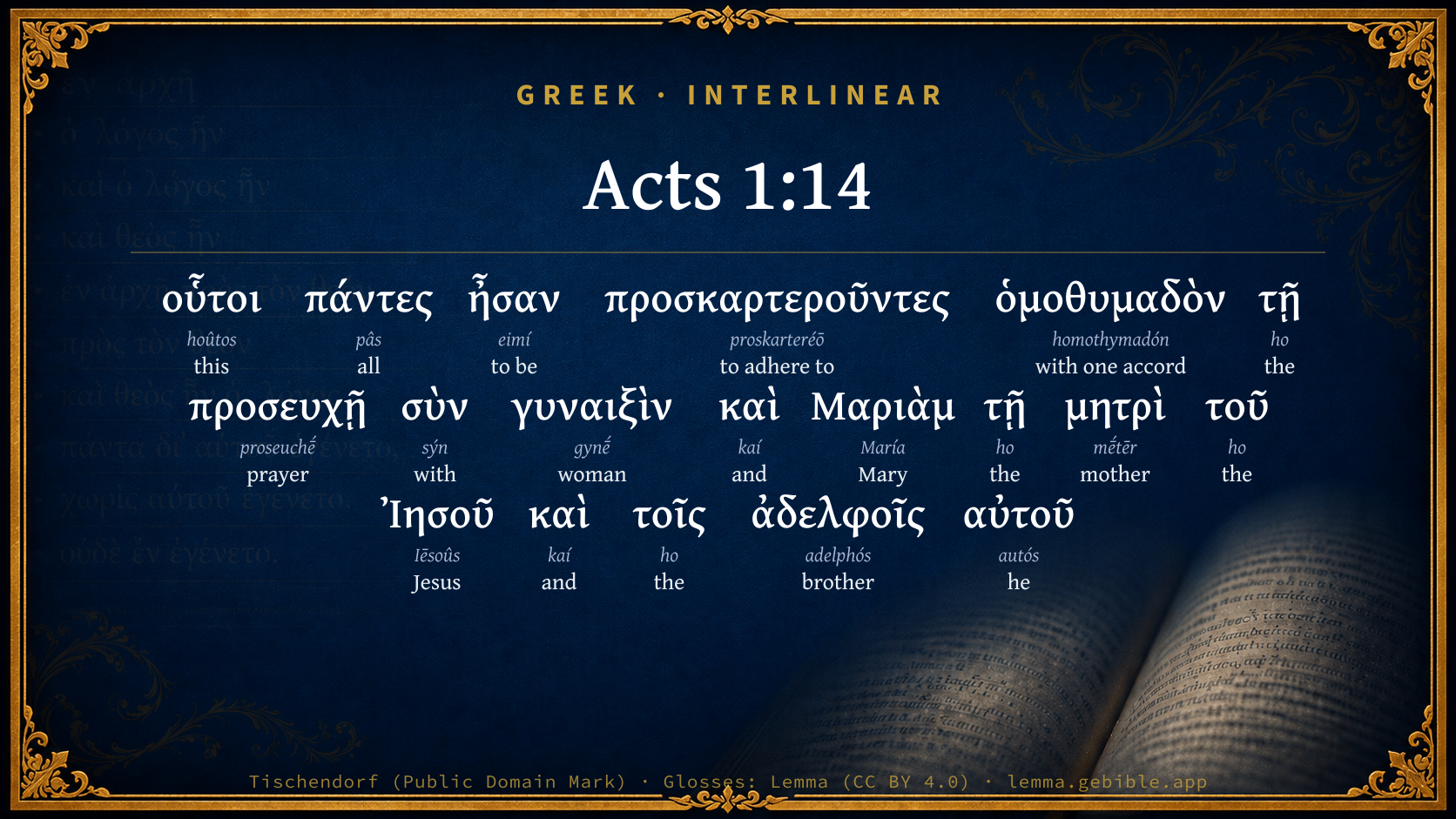
Download image
Cite this verse

Acts 1:14 (World English Bible). Public Domain. Lemma interlinear Bible study tool, https://lemma.gebible.app/v/acts/1/14.

Show BibTeX & RIS
BibTeX
RIS
English Translation
All these with one accord continued steadfastly in prayer and supplication, along with the women, and Mary the mother of Jesus, and with his brothers.
World English Bible · Public Domain
Highlights
  • 1 first appearance in the Greek New Testament
Full analysis ↓
Download a study sheet

One document with this verse’s original text, its word-by-word gloss line, the meaning frame, cross-references with their text, attributed commentary, and full source and license credits — printable, and it pastes into notes with its structure intact.

This verse Autodidact and up

Study sheet (.html) Plain text (.txt)

A passage Seminary Student

Up to 50 verses in one chapter. A passage sheet keeps up to 6 commentary sources and 12 cross-references per verse, in the order this page ranks them, and says so on the sheet whenever that leaves anything out. Ask for a single verse and you get the Autodidact verse sheet above.

Everything on this page stays free to read, with no account — the sheet is a download of what is already on screen, not access to it.

Want to remove ads? Support Godless Engineer
Compare translations 3

The same verse in 3 English versions, stacked beneath the original-language interlinear above. Click any original word for its lexicon entry.

Each is an independent rendering of the whole verse — the interlinear is not word-aligned to these translations.

Highlighted words mark where these versions differ — a whole-verse word diff, not a word-by-word alignment.

  • World English Bible Public Domain
    All these with one accord continued steadfastly in prayer and supplication, along with the women, and Mary the mother of Jesus, and with his brothers.
  • King James Version Public Domain
    These all continued with one accord in prayer and supplication, with the women, and Mary the mother of Jesus, and with his brethren.
  • unfoldingWord Literal Text CC BY-SA 4.0
    They all were continuing unanimously in prayer, with the women and Mary the mother of Jesus and with his brothers.

unfoldingWord Literal Text — © unfoldingWord, licensed CC BY-SA 4.0. Word-aligned USFM3 via Door43 (git.door43.org/unfoldingWord/en_ult).

Versions to compare (up to 4)

3 of 4 selected

Show all 19 translations

Every available English version of this verse, each an independent rendering of the whole verse.

  • World English Bible Public Domain
    All these with one accord continued steadfastly in prayer and supplication, along with the women, and Mary the mother of Jesus, and with his brothers.
  • Berean Standard Bible Public Domain
    With one accord they all continued in prayer, along with the women and Mary the mother of Jesus, and with His brothers.
  • Majority Standard Bible Public Domain
    With one accord they all continued in prayer and petition, along with the women and Mary the mother of Jesus, and with His brothers.
  • King James Version Public Domain
    These all continued with one accord in prayer and supplication, with the women, and Mary the mother of Jesus, and with his brethren.
  • American Standard Version (1901) Public Domain
    These all with one accord continued stedfastly in prayer, with the women, and Mary the mother of Jesus, and with his brethren.
  • Revised Version (1885) Public Domain
    These all with one accord continued stedfastly in prayer, with the women, and Mary the mother of Jesus, and with his brethren.
  • Geneva Bible (1599) Public Domain
    These all continued with one accorde in prayer and supplication with the women, and Marie the mother of Iesus, and with his brethren.
  • Douay-Rheims (1899) Public Domain
    All these were persevering with one mind in prayer with the women, and Mary the mother of Jesus, and with his brethren.
  • Young's Literal Translation Public Domain
    these all were continuing with one accord in prayer and supplication, with women, and Mary the mother of Jesus, and with his brethren.
  • Literal Standard Version CC BY-SA 4.0
    these were all continuing with one accord in prayer and supplication, with women, and Mary the mother of Jesus, and with His brothers.
  • Unlocked Literal Bible CC BY-SA 4.0
    They were all united as one, as they diligently continued in prayer. Included were the women, Mary the mother of Jesus, and his brothers.
  • unfoldingWord Literal Text CC BY-SA 4.0
    They all were continuing unanimously in prayer, with the women and Mary the mother of Jesus and with his brothers.
  • Darby Bible Public Domain
    These gave themselves all with one accord to continual prayer, with [several] women, and Mary the mother of Jesus, and with his brethren.
  • World Messianic Bible Public Domain
    All these with one accord continued steadfastly in prayer and supplication, along with the women and Miriam the mother of Yeshua, and with his brothers.
  • Webster's Bible Public Domain
    These all continued with one accord in prayer and supplication, with the women, and Mary the mother of Jesus, and with his brethren.
  • Free Bible Version CC BY-SA 4.0
    They all joined together in prayer, together with the women and Mary, Jesus' mother, and his brothers.
  • Bible in Basic English Public Domain
    And they all with one mind gave themselves up to prayer, with the women, and Mary the mother of Jesus, and his brothers.
  • Text-Critical English NT CC BY 4.0
    With one accord they were all devoting themselves to prayer and supplication, along with Jesus' brothers and several women, including Mary the mother of Jesus.
  • Tyndale New Testament (1534) Public Domain
    These all continued with one acorde in prayer and supplicacion with the wemen and Mary the mother of Iesu and with his brethren.

Literal Standard Version (2020), Covenant Press — licensed CC BY-SA 4.0. Text via the HelloAO Bible API (eBible.org). Unlocked Literal Bible (unfoldingWord) — licensed CC BY-SA 4.0. Text via the HelloAO Bible API (eBible.org). unfoldingWord Literal Text — © unfoldingWord, licensed CC BY-SA 4.0. Word-aligned USFM3 via Door43 (git.door43.org/unfoldingWord/en_ult). Free Bible Version, Dr. Jonathan Gallagher — licensed CC BY-SA 4.0. Text via the HelloAO Bible API (eBible.org).

Word by word

More ways to search: Search by grammar → Find every occurrence → Compare this word →

Practice this passage: Drill this verse → Learn its vocabulary →

προσκαρτεροῦντες
proskarteréō
G4342
“to adhere to”
Verb, Present, Active, Participle, Nominative, Plural, Masculine
Part of Speech
Verb
Tense
Present
Voice
Active
Mood
Participle
Case
Nominative
Number
Plural
Gender
Masculine
Full Thayer's Definition

Origin: from G4314 and G2594

TDNT: 13:18,4

1. to adhere to one, be his adherent, to be devoted or constant to one 2. to be steadfastly attentive unto, to give unremitting care to a thing 3. to continue all the time in a place 4. to persevere and not to faint 5. to show one's self courageous for 6. to be in constant readiness for one, wait on constantly
  1. οὗτοι hoûtos G3778 “this” Demonstrative pronoun, Nominative, Plural, Masculine
  2. πάντες pâs G3956 “all” Adjective, Nominative, Plural, Masculine
  3. ἦσαν eimí G1510 “to be” Verb, Imperfect, Active, Indicative, 3rd person, Plural
  4. ὁμοθυμαδὸν homothymadón G3661 “with one accord” Adverb
  5. τῇ ho G3588 “the” Article, Dative, Singular, Feminine
  6. προσευχῇ proseuchḗ G4335 “prayer” Noun, Dative, Singular, Feminine
  7. σὺν sýn G4862 “with” Preposition
  8. γυναιξὶν gynḗ G1135 “woman” Noun, Dative, Plural, Feminine
  9. καὶ kaí G2532 “and” Conjunction
  10. Μαριὰμ María G3137 “Mary” Noun, Proper, indeclinable
  11. τῇ ho G3588 “the” Article, Dative, Singular, Feminine
  12. μητρὶ mḗtēr G3384 “mother” Noun, Dative, Singular, Feminine
  13. τοῦ ho G3588 “the” Article, Genitive, Singular, Masculine
  14. Ἰησοῦ Iēsoûs G2424 “Jesus” Noun, Genitive, Singular, Masculine
  15. καὶ kaí G2532 “and” Conjunction
  16. τοῖς ho G3588 “the” Article, Dative, Plural, Masculine
  17. ἀδελφοῖς adelphós G80 “brother” Noun, Dative, Plural, Masculine
  18. αὐτοῦ autós G846 “he” Personal pronoun, Genitive, Singular, Masculine

About this verse

These counts appear in no published source. They are computed here, from the morphology-tagged text and Lemma’s own curated glosses. What Lemma adds →

19
words
15
distinct lemmas
Acts
section

Notable vocabulary

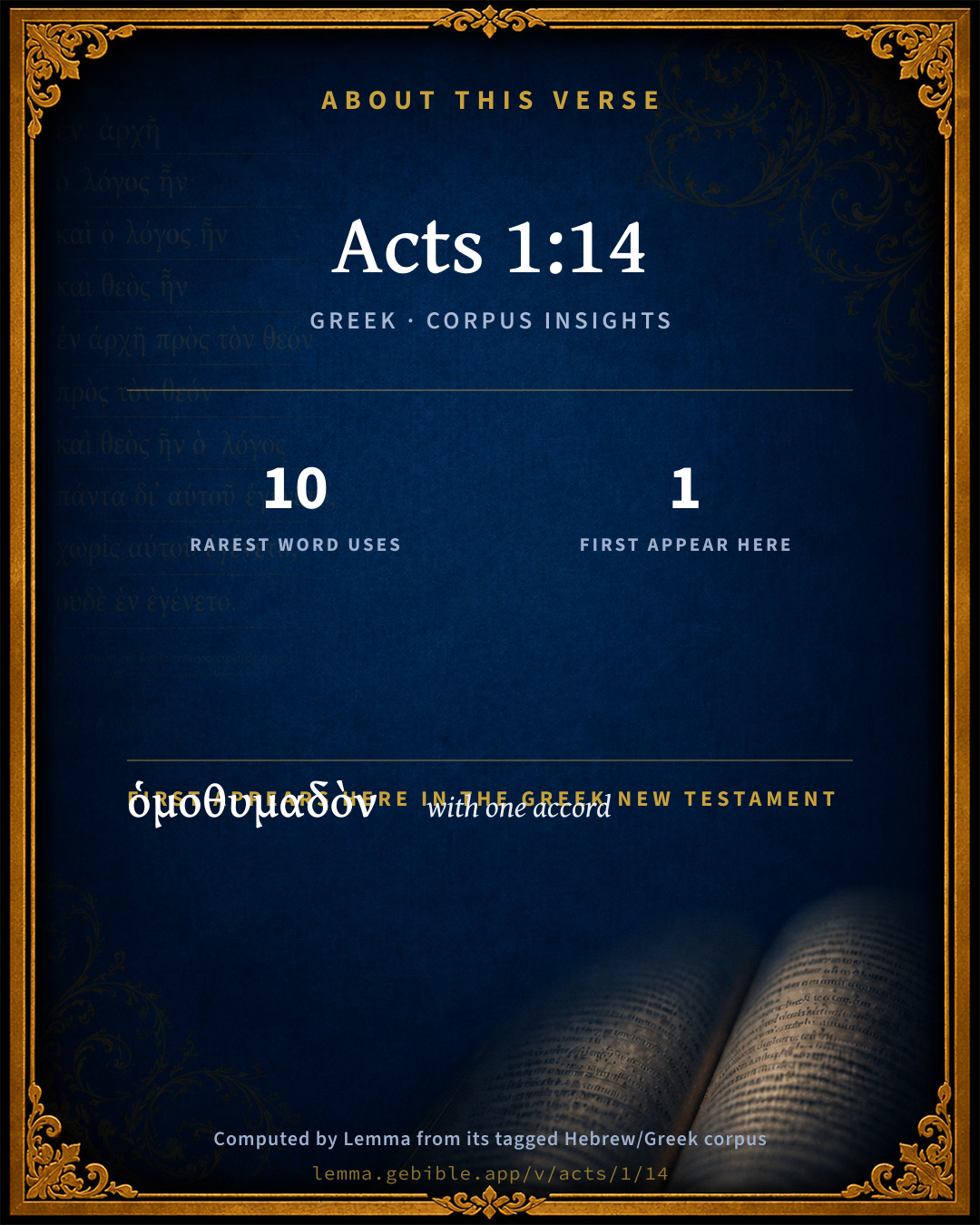
The rarest word here is προσκαρτεροῦντες to adhere to G4342 — appearing just 10 times in the whole Greek New Testament.

First appearance in Scripture

This word makes its first canonical appearance in the Greek New Testament here:

  • ὁμοθυμαδὸν with one accord G3661

Shared distinctive vocabulary

προσκαρτεροῦντες to adhere to G4342 occurs in 10 verses of the Greek New Testament. Also found in:
Repetition

Words recur within this verse:

Cross-references

24

Topical passages linked to Acts 1:14 in the Treasury of Scripture Knowledge — connected by theme and wording, ordered by reader-vote popularity; previews shown in the World English Bible.

  • Acts 6:4 But we will continue steadfastly in prayer and in the ministry of the word."
  • Ephesians 6:18 with all prayer and requests, praying at all times in the Spirit, and being watchful to this end in all perseverance and requests for all the saints:
  • Acts 2:42 They continued steadfastly in the apostles' teaching and fellowship, in the breaking of bread, and prayer.
  • Colossians 4:2 Continue steadfastly in prayer, watching therein with thanksgiving;
  • Romans 12:12 rejoicing in hope; enduring in troubles; continuing steadfastly in prayer;
  • Matthew 18:19–20 Again, assuredly I tell you, that if two of you will agree on earth concerning anything that they will ask, it will be done for them by my Father who is in heaven.
  • Luke 18:1 He also spoke a parable to them that they must always pray, and not give up,
  • Matthew 21:22 All things, whatever you ask in prayer, believing, you will receive."
  • Acts 2:1 Now when the day of Pentecost had come, they were all with one accord in one place.
  • Luke 11:13 If you then, being evil, know how to give good gifts to your children, how much more will your heavenly Father give the Holy Spirit to those who ask him?"
  • Acts 2:46 Day by day, continuing steadfastly with one accord in the temple, and breaking bread at home, they took their food with gladness and singleness of heart,
  • Acts 4:24–31 When they heard it, they lifted up their voice to God with one accord, and said, "O Lord, you are God, who made the heaven, the earth, the sea, and all that is in them;
  • Matthew 12:46 While he was yet speaking to the multitudes, behold, his mother and his brothers stood outside, seeking to speak to him.
  • Luke 24:53 and were continually in the temple, praising and blessing God. Amen.
  • Mark 3:31–35 His mother and his brothers came, and standing outside, they sent to him, calling him.
  • Mark 16:1 When the Sabbath was past, Mary Magdalene, and Mary the mother of James, and Salome, bought spices, that they might come and anoint him.
  • Luke 8:2–3 and certain women who had been healed of evil spirits and infirmities: Mary who was called Magdalene, from whom seven demons had gone out;
  • Luke 23:49 All his acquaintances, and the women who followed with him from Galilee, stood at a distance, watching these things.
  • Luke 23:55 The women, who had come with him out of Galilee, followed after, and saw the tomb, and how his body was laid.
  • Luke 24:10 Now they were Mary Magdalene, Joanna, and Mary the mother of James. The other women with them told these things to the apostles.
  • Matthew 13:55–56 Isn't this the carpenter's son? Isn't his mother called Mary, and his brothers, James, Joses, Simon, and Judas?
  • Matthew 27:55 Many women were there watching from afar, who had followed Jesus from Galilee, serving him.
  • Mark 15:40 There were also women watching from afar, among whom were both Mary Magdalene, and Mary the mother of James the less and of Joses, and Salome;
  • John 19:25–26 But there were standing by the cross of Jesus his mother, and his mother's sister, Mary the wife of Clopas, and Mary Magdalene.

Cross-references courtesy of OpenBible.info (CC BY 4.0).

Where the printed editions differ

1 variant

Places in this verse where the major printed Greek editions disagree on the wording in a way that affects the translation — a comparison of editions, not a manuscript-by-manuscript collation. The editions are the modern critical texts (Nestlé-Aland 28/27, SBL, Westcott-Hort, Tregelles, Tyndale House) and the traditional texts behind the KJV (the Textus Receptus and the Byzantine/Majority text). It is not a claim about which reading is original.

  1. Extra text
    καὶ τῇ δεήσει

    “and <the> in supplication”

    In TRByz Not in NA28NA27TynSBLWHTreg

    καὶ τῇ δεήσει (kai tēa deēsei) 'and in supplication' is only in traditional manuscripts (TR+Byz)

Textual data: Translators Amalgamated Greek New Testament (STEPBible TAGNT) · CC BY 4.0.

Commentary

Notes on Acts 1:14 from classic Christian and Jewish commentators (each source and its license shown beneath its notes). The classic Christian expositions comment on the surrounding passage and are grouped to its opening verse, so a note may address several verses; the Jewish commentaries on the Tanakh (Rashi and others) are per-verse, so they appear only where the commentator wrote on this verse.

Lemma curates 59 commentaries, every one of them public domain or Creative Commons licensed, each selected and text-cleaned for this edition rather than reprinted as found. About our sources →

Tyndale Open Study Notes

Tyndale Open Resources

1:14 The first disciples were united in worship, fellowship, and prayer (see also 2:42, 46-47; 4:24-31; 5:12; 12:5; 13:1-3). The faithful women who had been witnesses of Jesus’ crucifixion and resurrection were present (Luke 23:49, 54-56; 24:1-10, 22). • The brothers of Jesus had not believed in him during his ministry (John 7:3-5; cp. Matt 12:46-49), but became his disciples after his resurrection.

Tyndale Open Study Notes — © Tyndale Open Resources, licensed CC BY-SA 4.0. Text via the HelloAO Bible API.

Bengel's Gnomon

Johann Albrecht Bengel

Act 1:14. Ὁμοθυμαδὸν, with one accord) This particle is often employed in the Acts, suitably to the subject of the book: outside of the Acts it does not occur, save once, in the New Testament, viz. Rom 15:6.—τῇ προσευχῇ καὶ τῇ δεήσει) As to the difference between these words, see 1Ti 2:1, note [δέησις, from δεῖ, is an imploring of the Divine grace in some special need: προσευχὴ, prayer, is any presenting of our wishes and desires before God].—σὺν γυναιξὶ, with the women) Luk 24:10, at the sepulchre, “Mary Magdalene, and Joanna, and Mary the mother of James, and other women;” 1Co 9:5, “Have we not power to lead about a sister, a wife, as well as other apostles, and as the brethren of the Lord?”—Μαρίᾳ, Mary) of whom the last mention in the New Testament is made here. She being held in high esteem among the saints, on account of both her holiness and her age, furnished testimony as to all things which had taken place all along from the time of the Annunciation.—ἀδελφοῖς, with His brethren) His cousins. These two were gained over, though in the beginning they had not believed. [Joh 7:5.]

Bengel's Gnomon of the New Testament — English translation (T&T Clark, Edinburgh, 1860) — public domain. Text from a community e-Sword module.

Expositor's Greek Testament

ed. W. Robertson Nicoll

Act 1:14 . καὶ ἦσαν προσκαρτεροῦντες : on the construction see Act 1:10 . In N.T. found only in St. Luke and St. Paul (except once in St. Mar 3:9 ); most frequently with the dative of the thing, of continuing steadfast in prayer; cf. Act 6:4 , Rom 12:12 , Col 4:2 , and cf. also Act 2:42 or Act 2:46 of continuing all the time in ( ἐν ) a place; in Act 8:13 ; Act 10:7 , it is used with the dative of the person, and in Rom 13:6 with εἴς τι . It is found in Josephus with the dative of the thing, Ant. , v., 2, 6, and in Polybius, who also uses it with the dative of the person. In LXX it is found in Num 13:21 and in Susa nnah ver. 6, T heod., also in Tob 5:8 , . ὁμοθυμαδὸν , a favourite word of St. Luke: Lucæ in Actis in deliciis est (Blass) used ten or eleven times in Acts, only once elsewhere in N.T., Rom 15:6 , where it has the same meaning, Vulgate unanimiter . In the LXX it is oftener found as the equivalent of Hebrew words meaning simply “together,” and Hatch, Essays in B. G. , p. 63, would limit it to this meaning in the N.T., but the word cannot be confined to mere outward assembling together; cf. Dem., Phil. , iv., 147, ὁμοθυμαδὸν ἐκ μιᾶς γνώμης (Meyer-Wendt); so Luther einmüthig . It was very natural that St. Luke should lay stress upon the absolute unanimity of the early believers, and the word is used with reference to the Twelve, to the hundred-and-twenty, to the whole number of believers; truly the Holy Ghost was “amator concordiæ” (Corn. à Lapide). τῇ προσευχῇ καὶ τῇ δεήσει : the latter noun cannot be supported by MS. authority; the two words mark the difference between general and specific prayer; cf. Bengel on 1Ti 2:1 , and cf. Luke , Luk 5:33 . It is very doubtful whether we can confine προσευχή here to the Temple prayers; rather the article, cf. Act 6:4 and Act 2:42 , seems to point to a definite custom of common prayer as a bond of Christian fellowship (Hort, Ecclesia , p. 43, so Speaker’s Commentary, in loco ). As in his Gospel, so here and elsewhere in Acts, St. Luke lays stress upon frequency in prayer, and that too in all parts of the book (Friedrich, pp. 55 60). σὺν γυναιξὶ : it is natural to include the women already mentioned in St. Luke’s Gospel, cf. , e.g. , Luk 8:2-3 , Luk 23:55 , “with the women,” R.V., or the expression may be quite indefinite as in margin R.V. In this mention of the presence of women, as in the stress laid upon prayer, there is another point of unity between the book and the third Gospel, “The Gospel of Womanhood” (see also Ramsay, Was Christ born at Bethlehem? p. 50). (The mention of women would certainly indicate a private house rather than the Temple.) Erasmus and Calvin both interpret the words cum uxoribus , probably not without desire to make a point against celibacy. J. Lightfoot allows that this meaning may be correct, since the Apostles and disciples who had wives took them with them, “but,” he adds, “it is too strait”. Μαριάμ (for Μαρίᾳ ), so always according to W.H [104] of the Blessed Virgin, nominative, vocative, accusative, dative, except twice in a few of the best MSS. (Mat 1:20 , and Luk 2:19 ). Cf. Appendix, p. 163. See also Simcox, Language of the N. T ., p. 28, and Winer-Schmiedel, p. 91, note. The καί may be taken either to comprehend her under the other women, or as distinguishing her from them. This is the last mention of her in the N.T., and the Scripture leaves her “in prayer”. σὺν τοῖς ἀδελφοῖς αὐτοῦ : they are previously mentioned as unbelieving (Joh 7:5 , and compare Mar 6:4 ), but not only the Resurrection of the Lord but also that of Lazarus may well have overcome their unbelief. St. Chrysostom (so too Œcumenius) conjectures that Joseph was dead, for it is not to be supposed, he says, that when the brethren had become believers Joseph believed not. As the brethren are here distinguished from the Eleven, it would seem that they could not have been included in the latter (see, however, “Brethren,” B.D. 2 pp. 13, 14). But whatever meaning we give to the word “brethren” here or in the Gospels, nothing could be more significant than the fact that they had now left their settled homes in Galilee to take part in the lot of the disciples of Jesus, and to await with them the promise of the Father (Felten). It may have been that, James, “the Lord’s brother,” was converted by the Resurrection, 1Co 15:5 , and that his example constrained the other “brethren” to follow him.

[104] Westcott and Hort’s The New Testament in Greek: Critical Text and Notes.

The Expositor's Greek Testament, edited by W. Robertson Nicoll (1897–1910) — public domain. Text from a community e-Sword module.

Geneva Bible (1599)

Geneva Bible translators

The Greek word signified an invincible constancy, and steadiness.

It is to good purpose, that this concord is mentioned: for those prayers are most acceptable to God which are made with agreeing minds and wills.

The disciples prayed for the sending of the holy Ghost, and also to be delivered from present dangers wherewith they were beset.

For it was behoovable to have the wives confirmed, who were afterward to be partakers of the dangers with their husbands.

With his kinfolks.

Geneva Bible (1599) marginal notes — public domain. Text via Bolls.life.

Jamieson, Fausset & Brown

Robert Jamieson, A. R. Fausset & David Brown

continued with one accord--knit by a bond stronger than death.

in prayer and supplication--for the promised baptism, the need of which in their orphan state would be increasingly felt.

and Mary the mother of Jesus--distinguished from the other "women," but "so as to exclude the idea of her having any pre-eminence over the disciples. We find her with the rest in prayer to her glorified Son" [WEBSTER and WILKINSON]. This is the last mention of her in the New Testament. The fable of the Assumption of the Virgin has no foundation even in tradition [ALFORD].

with his brethren--(See on Joh 7:3).

Jamieson, Fausset & Brown — Commentary Critical and Explanatory on the Whole Bible (1871) — public domain (CC PDM 1.0). Text via the HelloAO Bible API.

Adam Clarke's Commentary

Verse 14. These - continued - in prayer and supplication] Waiting for the promise of the Father, according to the direction of our Lord, Lu 24:49. The words και τη δεησει, and in supplication, are omitted by ABC*DE, both the Syriac, the Coptic, AEthiopic, Armenian, Vulgate, Itala, and some of the primitive fathers. On this evidence, Griesbach has left them out of the text; and others contend for the propriety of this omission, because, say they, τη προσευχη and τη δεησει, prayer and supplication, mean the same thing. Whether the reading be genuine or spurious, this inference is not just. Prayer may simply imply any address to God, in the way of petition or request; supplication, the earnest, affectionate, and continued application to God for the blessing requested from him by prayer. Prayer asks, supplication expostulates, entreats, urges and re-urges the petition.

With the women] Probably those who had been witnesses of his resurrection, with the immediate relatives of the apostles. Peter we know was married, Mt 8:14, and so might others of the disciples; and therefore the wives of the apostles, as well as of other pious men, may be here intended.

Adam Clarke's Commentary on the Bible (1810–1826) — public domain. Text from a community e-Sword/MySword module.

John Calvin's Commentaries

14. With their wives Some translate it women; and they think that he speaketh of those which accompanied Christ. As I will not contend with any man concerning this matter, so have I not doubted to prefer that which I thought was more probable. I grant that the word which Luke useth may be interpreted both ways. But this is my reason, why I do think that he speaketh rather of wives, because, seeing that they used afterward to carry their wives about with them, as Paul doth testify, (1 Corinthians 9:5,) it is not likely that they were then asunder. For they might more easily rest together in one place, than by wandering to and fro oftentimes to change their abiding; and, secondly, seeing that they did look for the coming of the Holy Ghost, which was even then at hand, what reason was there why they should deprive their wives of so great goodness? Peter’s wife was about to be a helper unto him shortly after, which we must also think of the rest of the wives. These women had need of heroical fortitude and constancy, lest they should faint. Who would, therefore, think that they were excluded from their husbands whilst they look for the coming of the Spirit? But if they will stick to the general word, it standeth with reason that there were married women in the company. Howsoever it be, it is Luke’s mind to tell us by the way how greatly they had changed their minds. For whereas before the men, being afraid, had fled away, the women are gathered together with them now, neither do they fear any danger. He doth reckon up the mother of Jesus with the other women, whom, notwithstanding, John is said to have kept at his own house. But, as I have said before, they met altogether now only for a short season; for it is not to be doubted but that they departed one from another afterwards. It is well known that amongst the Hebrews all kinsfolk are comprehended under this word brethren.

All these did continue. Here he showeth that they did diligently look for the coming of the Holy Spirit.; For this was the cause of their prayer, that Christ would send his Spirit, as he had promised. Whereupon we may gather that this is the true faith which stirreth us up to call upon God. For the security of faith doth much differ from sluggishness. Neither doth God, therefore, assure us of this grace, that our minds may straightway become careless, but that he may rather sharpen our desire to pray. Neither is prayer any sign of doubting, but rather a testimony of our (sure hope and) confidence, because we ask those things at the Lord’s hands which we know he hath promised. So it becometh us also (after their example) to be instant in prayer, and to beg at God’s hands that he will increase in us his Holy Spirit: increase, (I say,) because before we can conceive any prayer we must needs have the first-fruits of the Spirit. For as much as he is the only Master which teacheth us to pray aright, who doth not only give us utterance, (Romans 2:25,) but also governs our inward affections.

Furthermore, Luke doth express two things which are proper to true prayer, namely, that they did persist, and that they were all of one mind. This was an exercise of their patience, in that Christ did make them stay a while, when as he could straightway have sent the Holy Spirit; so God doth oftentimes drive off, and, as it were, suffer us to languish, that he may accustom us to persevere. The hastiness of our petitions is a corrupt, yea a hurtful plague; wherefore it is no marvel if God do sometimes correct the same. In the mean season (as I have said) he doth exercise us to be constant in prayer. Therefore, if we will not pray in vain, let us not be wearied with the delay of time. As touching the unity of their minds, it is set against that scattering abroad, which fear had caused before. Yet, notwithstanding, we may easily gather, even by this, how needful a thing it is to pray generally, in that Christ commandeth every one to pray for the whole body, and generally for all men, as it were, in the person of all men: Our Father, Give us this day, etc., (Matthew 6:9.) Whence cometh this unity of their tongues but from one Spirit? Wherefore, when Paul would prescribe unto the Jews and Gentiles a right form of prayer, he removeth far away all division and dissension. That we may, (saith he,) being all of one mind, with one mouth glorify God, (Romans 15:6.) And truly it is needful that we be brethren, and agree together like brethren, that we rightly call God Father.

John Calvin's Commentaries (1540-1563) — public domain. Text from the Calvin Translation Society English edition (1840s-50s) via the Christian Classics Ethereal Library (ccel.org). Calvin's coverage is partial (roughly two-thirds of the Bible); uncommented books and verses are honest gaps, never fabricated. The 19th-century editor's footnotes and remarks are omitted so the notes are faithfully Calvin's own voice.

Ellicott's Commentary for English Readers

(14) With the women.—Looking to what we have seen in the Gospels, it is a natural inference that here, too, the “devout women” of Luk_8:2-3, were among St. Luke’s chief informants. This may, perhaps, account for the variations in the list just noticed. The women were less likely than the disciples to lay stress on what we may call the accurate coupling of the Twelve. The mention of “the women” as a definite body is characteristic of St. Luke as the only Evangelist who names them. (See Notes on Luk_8:1-3; Luk_23:49.) We may reasonably think of the company as including Mary Magdalene, Salome, Susanna, Joanna, Mary and Martha of Bethany, possibly also the woman that had been a sinner, of Luk_7:37. Here we lose sight of them, and all that follows is conjectural. It is probable that they continued to share the work and the sufferings of the growing Church at Jerusalem, living together, perhaps at Bethany, in a kind of sisterhood. The persecution headed by Saul was likely to disperse them for a time, and some may well have been among the “women” who suffered in it (Act_8:3); but they may have returned when it ceased. St. Luke, when he came to Palestine, would seem to have met with one or more of them.

Mary the mother of Jesus.—Brief as the record is, it has the interest of giving the last known fact, as distinct from legend or tradition, in the life of the mother of our Lord. St. John, we know, had taken her to his own home, probably to a private dwelling in Jerusalem (see Note on Joh_19:27), and she had now come with him to the first meeting of the Ecclesia. Here also we trace the influence of the women as St. Luke’s informants. They could not have left unnoticed the presence of her who was the centre of their group. The legends of some apocryphal books represent her as staying at Jerusalem with St. John till her death, twenty-two years after the Ascension; while others represent her as going with him to Ephesus and dying there; the Apostles gather around her death-bed; she is buried, and the next day the grave is found emptied, and sweet flowers have grown around it; Mary also had been taken up into heaven. The festival of the Assumption, which owes its origin to this legend, dates from the sixth or seventh century.

With his brethren.—The last mention of the “brethren” had shown them as still unbelieving (Joh_7:5). Various explanations of their change may be given. (1) They may have been drawn to believe before the Crucifixion by the great miracle of the resurrection of Lazarus. (2) The risen Lord had appeared to James as well as to the Apostles (1Co_15:7), and that may have fixed him and the other brothers in steadfast faith. (3) If the mother of Jesus was with John, the brethren also were likely to come, in greater or less measure, under the influence of their cousin. It may be noted that the brethren are here emphatically distinguished from the Apostles, and therefore that James the son of Aiphæus cannot rightly be identified with James the Lord’s brother. (See Note on Mat_12:46.)

A Bible Commentary for English Readers, edited by Charles John Ellicott (1878–1897) — public domain. Text from a community e-Sword module.

The Cambridge Bible for Schools and Colleges

gen. ed. J. J. S. Perowne

14. These all continued, &c.] Prayer was the fittest preparation for the gift which they were expecting. The words rendered and supplication are omitted in the best MSS.

with the women] Better, with certain women. Literally, with women. Probably some of those who during the life of Jesus had ministered to Him of their substance and had been at the cross and at His grave (Luk_8:3; Luk_24:22; Mat_27:55). The frequent mention of these and other women in the course of Christ’s ministry is a noteworthy feature of the Gospel story, and bespeaks more consideration shewn by Him for women than was usual among His nation or with other great teachers.

Mary the mother of Jesus] who would naturally remain with St John, to whose care she had been confided by Jesus at the Crucifixion (Joh_19:27). This is the last mention of the Blessed Virgin, and thus Scripture leaves her on her knees. She is mentioned apart from the other women as having a more deep interest in all that concerned Jesus than the rest had.

and with his brethren] These, called (Mat_13:55; Mar_6:3) James, Joseph (or Joses), Simon and Judas, are here clearly distinguished from the Apostles, which shews us that James, the son of Alphæus, and James, the Lord’s brother, were different persons.

The Cambridge Bible for Schools and Colleges (gen. ed. J. J. S. Perowne; Cambridge University Press, 1878–1918) — public domain. Text from a community e-Sword module.

John Gill's Exposition

These all continued, with one accord, in prayer and supplication,.... For the promise of the Spirit Christ had given them reason to expect; and that they might be preserved from their enemies, and kept faithful to their Lord; and be abundantly qualified for the preaching of the Gospel, and succeeded in it; and that their hearts might be comforted, and knit together in love: and they were unanimous in their requests, and so were under the promise of being heard; and in this work they were constant, and assiduous, and followed it with importunity. The Vulgate Latin, Syriac, and Ethiopic versions leave out the last clause, "and supplication"; and so likewise the Alexandrian copy: "with the women"; that followed Christ from Galilee, and were at his cross, and at his grave; among whom were Mary Magdalene, and Mary the wife of Cleophas, and Salome the wife of Zebedee. Some render the words, "with their wives"; the wives of the apostles; and as many as had wives, no doubt but they were with them; and it was necessary they should be, that they might be strengthened and confirmed in the faith of Christ. Beza's most ancient copy adds, "and children",

and Mary the mother of Jesus. This is the last we hear of her; how long she lived after this, is not certain: her continuance with the apostles of Christ shows her religion and piety, and was both for the increase of her faith, and spiritual comfort:

and with his brethren; See Gill on Mat 13:55.

John Gill's Exposition of the Whole Bible (1746–1763) — public domain (CC PDM 1.0). Text via the HelloAO Bible API.

Trapp's Complete Commentary

John Trapp

14 These all continued with one accord in prayer and supplication, with the women, and Mary the mother of Jesus, and with his brethren.

Ver. 14. With the women] Who might make masculine prayers, having eyes like the pools in Heshbon, Son 7:4.

John Trapp, A Commentary or Exposition upon All the Books of the Old and New Testament (1647–1656) — public domain. Text from a community e-Sword module.

Albert Barnes' Notes on the Bible

These all continued ... - The word “continued” denotes “persevering and constant attention.” The main business was devotion. Act 6:4, “we will give ourselves continually to the ministry of the word.” Rom 12:12, “continuing instant in prayer”; Rom 13:6, “Attending continually upon this very thing.” It is their main and constant employment. Compare Col 4:2.

With one accord - Greek: ὁμοθυμαδόν homothumadon - “with one mind.” The word denotes the entire harmony of their views and feelings. There were no schisms, no divided interests, no discordant purposes. This is a beautiful picture of devotion, and a specimen of what social worship ought now to be, and a beautiful illustration of Psa 133:1-3. The apostles felt that they had one great object; and their deep grief at the loss of their master, and their doubts and perplexities, led them, as all afflictions ought to lead us, to the throne of grace.

In prayer and supplication - These words are nearly synonymous, and are often interchanged. They express here petitions to God for blessings, and prayer to avert impending evils.

With the women - The women that had followed the Lord Jesus from Galilee, Luk 8:2-3, Luk 8:23, Luk 8:49, Luk 8:55; Luk 24:10; Mat 27:55. The women particularly mentioned are Mary Magdalene, Mary the mother of James and Joses, the mother of Zebedee’s children, Joanna the wife of Chuza, and Susanna. Besides these, there were others whose names are not mentioned. Most of them were relatives of the apostles or of the Saviour; and it is not improbable that some of them were wives of the apostles. Peter is known to have been married Mat 8:14, and had his wife in attendance with him in his travels 1Co 9:5; and the same was doubtless true of some of the other apostles, 1Co 9:5.- Mary, the mother of Jesus, is here particularly mentioned, showing that she now cast in her lot with the apostles. She had, besides, been specially entrusted to the care of John Joh 19:26-27, and had no other home. This is the last time that she is mentioned in the New Testament.

And with his brethren - See the notes on Mat 12:46. At first they had been unbelieving about the claims of Jesus Joh 7:5; but it seems that they had been subsequently converted.

Albert Barnes' Notes on the Bible (1834–1885) — public domain. Text from a community e-Sword/MySword module.

Matthew Poole's English Annotations

These all continued with one accord, with great resolution, notwithstanding all opposition and contradiction they met with,

in prayer and supplication, for mercies they wanted, or preventing of the evils they feared.

The women; their wives, or such women especially as we read of Mat 27:55,56.

His brethren; that is, his relations and kinsmen, which frequently in Scripture are called brethren.

Matthew Poole's English Annotations on the Holy Bible (1683–1685) — public domain. Text from a community e-Sword/MySword module.

Whedon's Commentary on the Bible

Daniel D. Whedon

14. All continued—During the ten days to the feast of Pentecost.

Prayer and supplication—The word supplication, being wanting in some manuscripts, is of doubtful genuineness. Prayer is the more general term, including all sorts of uttered or mental worship, whether of simply thanks or petition. Supplication is simply the ardent expression of our wants.

With the women—Our minds naturally revert to the women from Galilee, who supplied the wants, watched the cross, and visited the sepulchre of Jesus. But as the phrase is simply with women, the article being omitted from the Greek, we cannot be absolutely certain that they are the same. It may simply mean that both sexes were present. Mary. (See note on Mat_1:18.)

Brethren. (See note on Mat_13:55.) It is perfectly clear from this passage that these brothers of Jesus were not the same with the apostles of the same name. The semi-scepticism with which they were animated in Joh_7:3 (where see our note) has passed away. The scenes, perhaps, of the cross and the ascension have sobered their spirit and deepened their faith.

From the mount of the ascension, where their first dismay at the loss of Jesus was dismissed by the words of the angels, the apostles hasten with joy to the high place of prayer. Inspired with that measure of the Spirit once preparatorily breathed upon them by Jesus, instructed by the lessons of the forty days closed by the final ascent of the Lord, they now have attained a point at which they comprehend their position and joyfully understand their duty. They know how they are to tarry at Jerusalem for the great baptism of the Spirit and the gift of power. (Act_1:5; Act_1:8.) Then with what immediateness, continuity, and oneness of accord do they set themselves to prayer and supplication! When men object that the powerful rush of the Pentecostal Spirit implies an unseemly overthrow of the free agency of this holy company, they forget with what devout persistence in prayer their whole souls had been consecrated to the occasion, so that their clarified intellects, their inmost hearts, and their eager wills were ready at the moment to co-operate with the fulness of the Spirit, so that the most perfect freedom, both of God and man, united in the blessed work.

Daniel D. Whedon (gen. ed.), Commentary on the Old and New Testaments (1874–1909) — public domain. Text from a community e-Sword module.

The Pulpit Commentary

With one accord continued steadfastly for continued with one accord, A.V.; prayer for prayer and supplication, A.V. and T.R. The women. St. Luke, in his Gospel, makes frequent mention of the women who followed our Lord, and generally of things that happened to women. (see Luk_23:27, Luk_23:49, 55 24:10, 22, etc. See also Luk_7:37, etc.; 8:23; 10:38, 45; etc.) We notice the same tendency in the Acts, here, and in Act_2:17, 18 5:14 9:36 12:13 16:14, 16 17:4, 34 18:26 21:9 24:24 25:23; etc. Mary the mother of Jesus appears here not as an object of worship, but as humbly joining in the prayers of the Church. And with his brethren. The Lord"s brethren are spoken of by name in Mat_13:55 as "James, and Joses "Joseph," R.V. and Simon, and Judas." So also (Mar_6:3 see too Act_4:31-35) "James the Lord"s brother" is mentioned by St. Paul; (Gal_1:19) "the brethren of the Lord "are mentioned 1Co_9:5; and again in Joh_7:3, Joh_7:5, Joh_7:10, "the brethren of Jesus" are spoken of. This is not the place to enter upon the difficult question of their parentage. But it may suffice to say that if James and Judas are the two apostles of that name, (which Alford, however, thinks they certainly were not, referring to Joh_7:5, compared with Joh_6:67) then the brethren here spoken of as distinct from the apostles would be Joses and Simon.

The Church"s first prayer-meeting.

I THE PLACE IT OCCUPIES.

1. Under the cloud of a great trial. The separation from Jesus; the attitude of the Jews of the metropolis; the dependence of a company of poor and persecuted people; the sense of ignorance and feebleness. What could they do but pray, especially as they felt that the power had not as yet come?

2. At the threshold of the Church"s history. We know what grew out of that first meeting. All great religious movements have commenced in prayer. Little the actors have foreseen of the future. Luther nailing up his theses. Early meetings of the Wesleys. Modern revivals. The "Acts" a commentary upon that spiritual germination of a new life at Jerusalem. Developments of the individual characters represented by the names. Providence works with grace. They that put themselves by prayer into the hands of God are led on by his hand.

3. In the history of the world, a new social fact which is destined to enlarge until it embraces all human interests and associations within itself. A missionary prayer-meeting it was, though as yet the herald-spirit had not taken full possession of the brethren. They knew that they were sent by Jesus to the uttermost parts of the earth. It was a prayer for the baptism which should make all alike messengers of the new life. The success of all evangelistic efforts depends on their following this example of prayerfulness.

II THE LESSONS IT TEACHES.

1. The spirituality of the kingdom of Christ.

2. The equality of Christians in the Church.

3. The dependence of Divine gifts on our preparation for them, in heart and life. An outpouring of the Spirit in answer to prayer is a bestowment of grace, on those who are ready to employ it when it comes.

4. Mutual recognition in the Divine presence the prerequisite to individual callings and separate work. The spirit of prayer the preservative against division. R.

The Pulpit Commentary (1880–1919), ed. H.D.M. Spence-Jones & Joseph S. Exell — public domain. Text from a community e-Sword module.

John Wesley's Explanatory Notes

His brethren -- his near kinsmen, who for some time did not believe; it seems not till near his death.

John Wesley, Explanatory Notes Upon the Whole Bible (1754–1765) — public domain. Text via the GEBible commentary corpus.

Godbey's Commentary on the New Testament

William B. Godbey

14. Our Lord’s brothers [doubtless the sons of Joseph by a former marriage], James and Judas, the latter in E. V. called Jude to contradistinguish him from Judas Iscariot, who had brought disgrace on the name. These brothers of our Lord are not mentioned in the catalogue of the original twelve (Matthew 10). There are two named James in that catalogue, but neither of them the Lord’s brother. After our Savior’s inauguration into His official Messiahship by the baptism of John, He immediately began to astonish the world by His mighty works. All classes and nationalities are electrified and bewildered by His miracles, spontaneously clamoring, “Surely this is none other than Messias, the Shiloh of prophecy, the Christ of God, the Redeemer of Israel, and the Savior of the world.” Meanwhile, His elder brothers remained somewhat reticent, soliloquizing, “This is no one but our little brother Jesus, whom we used to rock in the cradle and entertain with flowers, while mother got dinner. He was always the best and sweetest child we ever saw, and so good and industrious to help us do the work, at an early day becoming quite an expert in the carpenter-shop. We do believe that He is a mighty prophet, like Moses, Elijah, and Elisha. They wrought stupendous miracles. But to say that He is the Christ of God, the Shiloh of prophecy, the Redeemer of Israel, and the Savior of the world, is certainly going too far. He is just one of us, and nobody but our own dear little brother.” Therefore His elder brothers, James and Jude, stand aloof and contemplate all the mighty works of their brother Jesus, till He is arrested, nailed to the cross, and they see Him expire. Then they say, “Our precious brother ventured too far; He had great power, to be sure; but He made a mistake in venturing so far as to let His enemies get their hands on him. So now he is dead.” But when they see Him walk out of the sepulcher and fly up to heaven, they utterly break down and fall into line with tremendous shouts of victory, “Glory to God in the highest, the thing is settled forever; after all, our dear brother Jesus is all that His disciples ever claimed for Him. He is none other than the Shiloh of prophecy, the Christ of God, the Redeemer of Israel, and the Savior of the world.” The Apostles hail the Lord’s brothers a happy welcome into the apostleship of their Lord, and honor James, the elder of the two, with the pastorate of the Alma Mater Church at Jerusalem.

William B. Godbey, Commentary on the New Testament (1896–1900) — public domain. Text from a community e-Sword module.

McGarvey & Pendleton's Commentaries

J. W. McGarvey

14. The manner in which these men spent the time of their waiting, which was an interval of ten days, was such as we would expect: (14) " These all continued with one accord in prayer and supplication, with the women, and Mary the mother of Jesus, and with his brothers. " The chief scene of this worship was not the upper room where the eleven were abiding, but the temple; for we learn, from Luke's former narrative, that they "were continually in the temple, praising and blessing God."

The mother of Jesus is here mentioned for the last time in New Testament history. The fact that she still remained with the disciples, instead of returning to Nazareth, indicates that John was faithful to the dying request of Jesus, and continued to treat her as his own mother. Though the prominence here given to her name shows that she was regarded with great respect by the apostles, the manner in which Luke speaks of her shows that he had not dreamed of the worship which was yet to be offered to her by an idolatrous church.

Whether those here called the "brothers" of Jesus were the sons of Mary, or more distant relatives of Jesus, is not easily determined, from the fact that the Greek word is ambiguous. The Catholic dogma of the perpetual virginity of Mary is dependent upon the solution of this question, but it properly belongs to commentaries on the gospels, and to these the reader is referred for the arguments, pro and con.

J. W. McGarvey (with Philip Y. Pendleton), Commentaries on the New Testament (The Fourfold Gospel, 1914; Acts; and the epistles) — public domain. Text from a community e-Sword/MySword module.

The People's New Testament

B. W. Johnson

14. These all continued with one accord in prayer and supplication. The latter clause is omitted in the Revision. They were waiting for the “promise of the Father,” and the time was spent in worship. There were ten days of prayer, the best preparation for the Pentecostal blessing; an example to all churches which seek an ingathering of souls. With the women. Especially those women who had followed and ministered to the Lord, lingered at his cross, and at his tomb. Mary. This is the last time she is named in the sacred history. Tradition reports that she lived until the near the time of the overthrow of Jerusalem. His brethren. The sons of Joseph and Mary. One of them, James, was afterwards the James of Jerusalem and the author of the Epistle of James. See Acts 15; also Matt. 13:55. They were unbelievers six months before (John 7:5), but now believed. James had seen the risen Lord (1 Cor. 15:7).

B. W. Johnson's The People's New Testament with Notes (1889–1891) — public domain. Electronic text from the Christian Classics Ethereal Library (CCEL) ThML edition.

Cambridge Greek Testament for Schools and Colleges

14. καὶ τῇ δεήσει omitted with אABCDE. The Vulgate has only ‘oratione.’ The insertion of the words is probably due to a marginal note taken from Php 4:6.

14. τῇ προσευχῇ. It would seem from the article here as if already some religious service had taken definite form among the disciples. This is almost implied too in the fact of their continuance therein with one accord, a description hardly consistent with mere individual supplication. The disciples had long before made the request ‘Lord, teach us to pray’ (Luk 11:1), and during the three years of association with Jesus, the form given them as an example may very well have grown into the proportions suited for general worship.

σὺν γυναιξίν, best rendered ‘with certain women’ There is nothing to define them, but from the first, women played a helpful part in Christian offices.

τῇ μητρί. It is noteworthy how from first to last the Gospel history shews our Lord acknowledging a human mother, and so causing her to be cared for by His friends, but from the dawn of consciousness at twelve years old never speaking but of a Father in heaven. The blessed Virgin would naturally remain with St John, to whose care she had been confided by Jesus at the Crucifixion (Joh 19:27). This is the last mention of the Virgin, and thus Scripture leaves her on her knees. She is mentioned apart from the other women as having a deeper interest in all that concerned Jesus than the rest could have.

ἀδελφοῖς. See Mat 13:55; Mar 6:3. The brethren of our Lord are there named James, Joses (or Joseph), Simon and Judas. Being mentioned here as persons distinct from the Eleven, we may fairly conclude that James, the son of Alphæus, and James, the Lord’s brother, were different persons.

A change has come over these ‘brethren’ since the last mention of them (Joh 7:5). There we are told that they did not believe on Jesus.

Cambridge Greek Testament for Schools and Colleges (Cambridge University Press, 1896; 21 vols, various authors incl. Carr, Maclear, Plummer, Farrar, Lumby, Moule, M. R. James, Simcox) — public domain. Text from a community e-Sword module.

Alford’s Greek Testament

Henry Alford

14.] σὺν γυναιξίν has been rendered ‘with their wives,’ to which sense Bp. Middleton inclines, justifying it by σὺν γυναιξὶν καὶ τέκνοις, ch. 21:5. But the omission of the articles there may be accounted for on the same principle as in Mat 19:29, viz. that which Bp. calls enumeration, ch. 6 § 2. Here I think we must take σὺν γυν. not as meaning ‘with women,’ as Hackett, but, the art. not being expressed after the preposition σύν, as = σὺν ταῖς γυν. (see Middl. ch. 6 § 1), and interpret γυν., the women, viz. those spoken of by Luke himself, Luk 8:2, Luk 8:3,—where, besides those named, he mentions ἕτεραι πολλαί. Many of these were certainly not wives of the Apostles; and that those women who were ‘last at the Cross and earliest at the tomb’ should not have been assembled with the company now, is very improbable.

καὶ Μαρίᾳ] The καί gives eminence to one among those previously mentioned. So τῶνδε εἵνεκα, καὶ γῆς ἱμέρῳ, Herod. i. 73. See Hartung, Partikellehre, i. 145.

This is the last mention of her in the N. T. The traditions, which describe her as (1) dying at the age of fifty-nine, in the fifth year of Claudius (Niceph. H. E. ii. 21), or (2) accompanying John to Ephesus, and being buried there (see Winer, Realwörterb. art. Maria), are untrustworthy. Other accounts, with the authorities, may be seen in Butler’s Lives of the Saints, Aug. 15. The fable of the Assumption has no foundation even in tradition.

τοῖς ἀδελφ. αὐτ.] This clearly shews, as does Joh 7:5 compared with 6:69, 70, that none of the brethren of our Lord were of the number of the Twelve. When they were converted, is quite uncertain. See the whole subject discussed in note on Mat 13:55, and in the Prolegomena to the Epistle of James. In both cases of one being distinguished from a number, cited here by Wordsw. to shew that James the Less may have been one of these brethren, viz. that of Μαρία, as distinguished among the women here, and that of Joseph, ch. 7:9, he does not observe that the general statement precedes the individual distinction, as indeed it naturally must.

Henry Alford, The Greek Testament (1849–1861) — public domain. Text from a community e-Sword module.

Vincent's Word Studies in the New Testament

Marvin R. Vincent

Continued [ησαν προσκαρτερουντες] . Participle and finite verb as above. The verb is from karterov, strong, stanch, and means originally to persist obstinately in. In this sense here, and in Rom 12:12; Rom 13:6. Hence to adhere firmly to. So in Mr 3:9, "that a small ship should wait on him;" i e., keep near at hand. The idea of steady persistence is supplied by the Rev., steadfastly.

With one accord [ομοθυμαδον] . See on agree, Mt 18:19 Mt 18:19. In prayer. The best texts omit and supplication.

Mary. Mentioned here for the last time in the New Testament.

Marvin R. Vincent, Word Studies in the New Testament (1887–1900) — public domain. Text from a community e-Sword/MySword module.

Lesson kit

Teaching starters — assembled from the data on this page, not authored interpretation. Every prompt links to the verse data it draws on. Edit before teaching.

Acts, in the Acts, opens this verse with 19 words (15 distinct Greek lemmas). Its most distinctive word is proskarteréō (“to adhere to”). A historical commentator’s framing appears above. Read the whole chapter for the surrounding context.

Discussion questions

  1. The word proskarteréō carries the sense “to adhere to.” How does it shape the verse?
  2. This is the first place “with one accord” appears in Scripture (first appears here). What does its debut here establish?
  3. How does Mark 3:9, which shares the word «to adhere to», read alongside this verse?
  4. What does the repetition of “the” (4× in this one verse) do in this verse?
  5. The translations on this page render this verse differently — a whole-verse word diff, not a word-by-word alignment. What might account for the different wordings?
  6. Compare how Tyndale Open Study Notes and Bengel's Gnomon read this verse. Where do they agree or differ?

Things to notice

  • 1 word makes its first canonical appearance in Scripture here.
  • These translations choose different wording for 10 words in this verse.
  • “the” occurs 4× in this single verse.
  • 15 distinct Greek lemmas span 19 words in this verse.

Reading settings

Reading text

Shown beneath each verse's original-language words.

Old Testament
Old Testament edition

Read the OT as the Masoretic Hebrew (MT) or the Greek Septuagint (LXX).

English shown for the Greek Septuagint (in the Hebrew ↔ Greek comparison).

Comparing translations? Open the Compare panel on any verse page to stack up to four side by side.