John 20:17

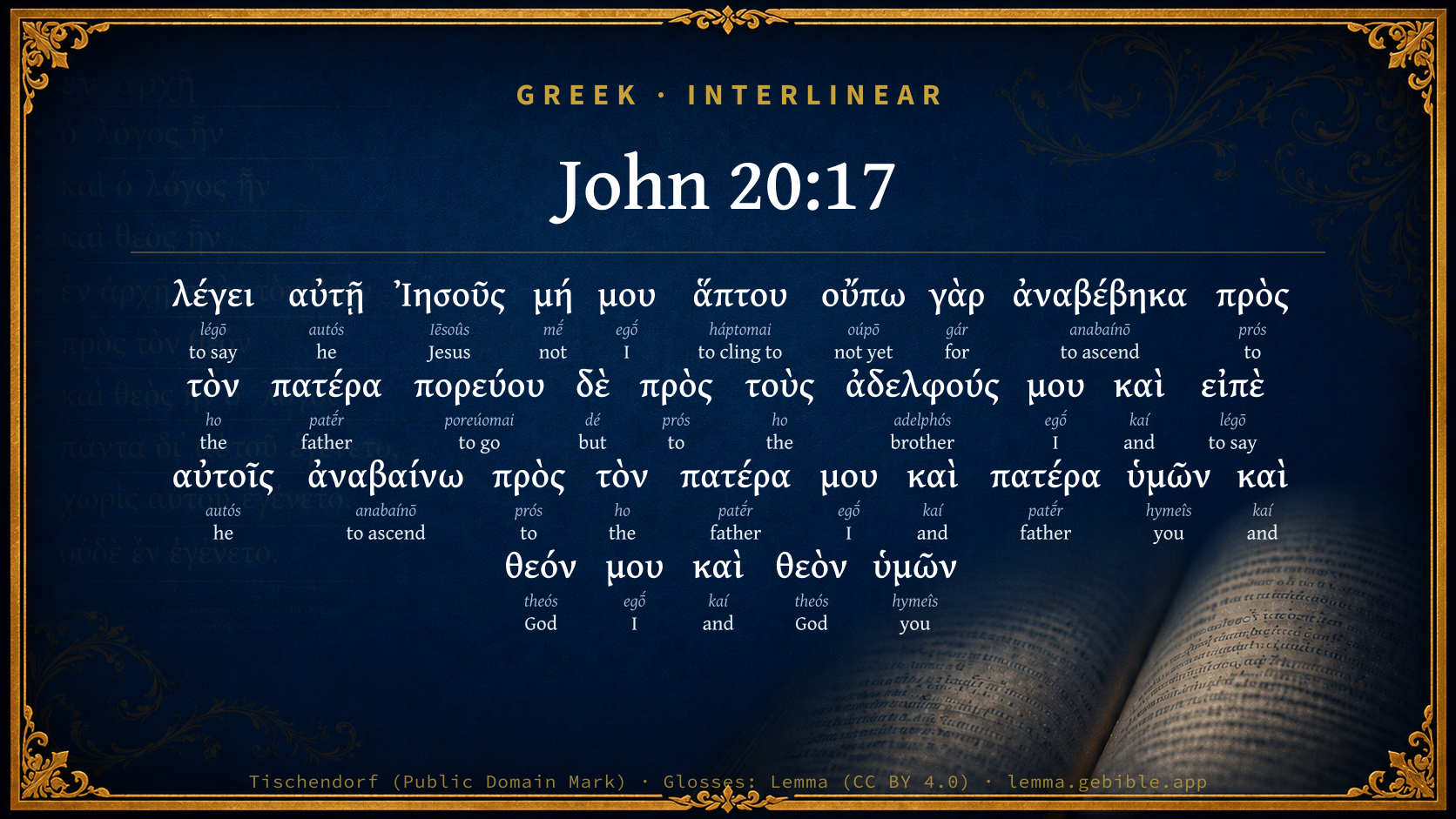
Greek (Tischendorf 8th ed.) John 20:17 appears in the Greek New Testament. The text above is from the Tischendorf 8th edition. Each word links to its Strong’s number and a concise gloss. Click any word for its full Thayer’s Greek Lexicon entry.
Download image
Cite this verse

John 20:17 (World English Bible). Public Domain. Lemma interlinear Bible study tool, https://lemma.gebible.app/v/john/20/17.

Show BibTeX & RIS
BibTeX
RIS
English Translation
Jesus said to her, "Don't touch me, for I haven't yet ascended to my Father; but go to my brothers, and tell them, 'I am ascending to my Father and your Father, to my God and your God.'"
World English Bible · Public Domain
Download a study sheet

One document with this verse’s original text, its word-by-word gloss line, the meaning frame, cross-references with their text, attributed commentary, and full source and license credits — printable, and it pastes into notes with its structure intact.

This verse Autodidact and up

Study sheet (.html) Plain text (.txt)

A passage Seminary Student

Up to 50 verses in one chapter. A passage sheet keeps up to 6 commentary sources and 12 cross-references per verse, in the order this page ranks them, and says so on the sheet whenever that leaves anything out. Ask for a single verse and you get the Autodidact verse sheet above.

Everything on this page stays free to read, with no account — the sheet is a download of what is already on screen, not access to it.

Want to remove ads? Support Godless Engineer
Compare translations 3

The same verse in 3 English versions, stacked beneath the original-language interlinear above. Click any original word for its lexicon entry.

Each is an independent rendering of the whole verse — the interlinear is not word-aligned to these translations.

Highlighted words mark where these versions differ — a whole-verse word diff, not a word-by-word alignment.

  • World English Bible Public Domain
    Jesus said to her, "Don't touch me, for I haven't yet ascended to my Father; but go to my brothers, and tell them, 'I am ascending to my Father and your Father, to my God and your God.'"
  • King James Version Public Domain
    Jesus saith unto her, Touch me not; for I am not yet ascended to my Father: but go to my brethren, and say unto them, I ascend unto my Father, and your Father; and to my God, and your God.
  • unfoldingWord Literal Text CC BY-SA 4.0
    Jesus says to her, “Do not hold on to me, for I have not yet gone up to the Father; but go to my brothers and say to them, ‘I go up to my Father and your Father, and my God and your God.’”

unfoldingWord Literal Text — © unfoldingWord, licensed CC BY-SA 4.0. Word-aligned USFM3 via Door43 (git.door43.org/unfoldingWord/en_ult).

Versions to compare (up to 4)

3 of 4 selected

Show all 19 translations

Every available English version of this verse, each an independent rendering of the whole verse.

  • World English Bible Public Domain
    Jesus said to her, "Don't touch me, for I haven't yet ascended to my Father; but go to my brothers, and tell them, 'I am ascending to my Father and your Father, to my God and your God.'"
  • Berean Standard Bible Public Domain
    “Do not cling to Me,” Jesus said, “for I have not yet ascended to the Father. But go and tell My brothers, ‘I am ascending to My Father and your Father, to My God and your God.’”
  • Majority Standard Bible Public Domain
    “Do not cling to Me,” Jesus said, “for I have not yet ascended to My Father. But go and tell My brothers, ‘I am ascending to My Father and your Father, to My God and your God.’”
  • King James Version Public Domain
    Jesus saith unto her, Touch me not; for I am not yet ascended to my Father: but go to my brethren, and say unto them, I ascend unto my Father, and your Father; and to my God, and your God.
  • American Standard Version (1901) Public Domain
    Jesus saith to her, Touch me not; for I am not yet ascended unto the Father: but go unto my brethren, and say to them, I ascend unto my Father and your Father, and my God and your God.
  • Revised Version (1885) Public Domain
    Jesus saith to her, Touch me not; for I am not yet ascended unto the Father: but go unto my brethren, and say to them, I ascend unto my Father and your Father, and my God and your God.
  • Geneva Bible (1599) Public Domain
    Iesus saith vnto her, Touch me not: for I am not yet ascended to my Father: but goe to my brethren, and say vnto them, I ascend vnto my Father, and to your Father, and to my God, and your God.
  • Douay-Rheims (1899) Public Domain
    Jesus saith to her: Do not touch me, for I am not yet ascended to my Father. But go to my brethren, and say to them: I ascend to my Father and to your Father, to my God and your God.
  • Young's Literal Translation Public Domain
    Jesus saith to her, `Be not touching me, for I have not yet ascended unto my Father; and be going on to my brethren, and say to them, I ascend unto my Father, and your Father, and to my God, and to your God.'
  • Literal Standard Version CC BY-SA 4.0
    Jesus says to her, “Do not be touching Me, for I have not yet ascended to My Father; and be going on to My brothers, and say to them, I ascend to My Father and your Father, and [to] My God and your God.”
  • Unlocked Literal Bible CC BY-SA 4.0
    Jesus said to her, “Do not touch me, for I have not yet gone up to the Father, but go to my brothers and say to them that I will go up to my Father and your Father, and my God and your God.”
  • unfoldingWord Literal Text CC BY-SA 4.0
    Jesus says to her, “Do not hold on to me, for I have not yet gone up to the Father; but go to my brothers and say to them, ‘I go up to my Father and your Father, and my God and your God.’”
  • Darby Bible Public Domain
    Jesus says to her, Touch me not, for I have not yet ascended to my Father; but go to my brethren and say to them, I ascend to my Father and your Father, and [to] my God and your God.
  • World Messianic Bible Public Domain
    Yeshua said to her, “Don’t hold me, for I haven’t yet ascended to my Father; but go to my brothers and tell them, ‘I am ascending to my Father and your Father, to my God and your God.’”
  • Webster's Bible Public Domain
    Jesus saith to her, Touch me not: for I have not yet ascended to my Father: but go to my brethren, and say to them, I ascend to my Father and your Father, and to my God and your God.
  • Free Bible Version CC BY-SA 4.0
    “Don't hold onto me,” Jesus said to her, “for I haven't yet ascended to my Father; but go to my brothers and tell them I am ascending to my Father and your Father, my God and your God.”
  • Bible in Basic English Public Domain
    Jesus said to her, Do not put your hand on me, for I have not gone up to the Father: but go to my brothers and say to them, I go up to my Father and your Father, to my God and your God.
  • Text-Critical English NT CC BY 4.0
    Jesus said to her, “Do not hold on to me, for I have not yet ascended to my Father. But go to my brothers and tell them that I am ascending to my Father and your Father, to my God and your God.”
  • Tyndale New Testament (1534) Public Domain
    Iesus sayde vnto her touche me not for I am not yet ascended to my father. But goo to my brethren and saye vnto them I ascende vnto my father and youre father to: my god and youre god.

Literal Standard Version (2020), Covenant Press — licensed CC BY-SA 4.0. Text via the HelloAO Bible API (eBible.org). Unlocked Literal Bible (unfoldingWord) — licensed CC BY-SA 4.0. Text via the HelloAO Bible API (eBible.org). unfoldingWord Literal Text — © unfoldingWord, licensed CC BY-SA 4.0. Word-aligned USFM3 via Door43 (git.door43.org/unfoldingWord/en_ult). Free Bible Version, Dr. Jonathan Gallagher — licensed CC BY-SA 4.0. Text via the HelloAO Bible API (eBible.org).

Word by word

More ways to search: Search by grammar → Find every occurrence → Compare this word →

Practice this passage: Drill this verse → Learn its vocabulary →

οὔπω
oúpō
G3768
“not yet”
Adverb, Negative
Part of Speech
Adverb
Degree
Negative
Full Thayer's Definition

Origin: from G3756 and G4452

TDNT: None

1. not yet
  1. λέγει légō G3004 “to say” Verb, Present, Active, Indicative, 3rd person, Singular
  2. αὐτῇ autós G846 “he” Personal pronoun, Dative, Singular, Feminine
  3. Ἰησοῦς Iēsoûs G2424 “Jesus” Noun, Nominative, Singular, Masculine
  4. μή mḗ G3361 “not” Particle, Negative
  5. μου egṓ G1473 “I” Personal pronoun, 1st person, Genitive, Singular
  6. ἅπτου háptomai G680 “to cling to” Verb, Present, Middle, Imperative, 2nd person, Singular
  7. γὰρ gár G1063 “for” Conjunction
  8. ἀναβέβηκα anabaínō G305 “to ascend” Verb, Perfect, Active, Indicative, 1st person, Singular
  9. πρὸς prós G4314 “to” Preposition
  10. τὸν ho G3588 “the” Article, Accusative, Singular, Masculine
  11. πατέρα patḗr G3962 “father” Noun, Accusative, Singular, Masculine
  12. πορεύου poreúomai G4198 “to go” Verb, Present, Middle or Passive deponent, Imperative, 2nd person, Singular
  13. δὲ dé G1161 “but” Conjunction
  14. πρὸς prós G4314 “to” Preposition
  15. τοὺς ho G3588 “the” Article, Accusative, Plural, Masculine
  16. ἀδελφούς adelphós G80 “brother” Noun, Accusative, Plural, Masculine
  17. μου egṓ G1473 “I” Personal pronoun, 1st person, Genitive, Singular
  18. καὶ kaí G2532 “and” Conjunction
  19. εἰπὲ légō G3004 “to say” Verb, Aorist, Active, Imperative, 2nd person, Singular
  20. αὐτοῖς autós G846 “he” Personal pronoun, Dative, Plural, Masculine
  21. ἀναβαίνω anabaínō G305 “to ascend” Verb, Present, Active, Indicative, 1st person, Singular
  22. πρὸς prós G4314 “to” Preposition
  23. τὸν ho G3588 “the” Article, Accusative, Singular, Masculine
  24. πατέρα patḗr G3962 “father” Noun, Accusative, Singular, Masculine
  25. μου egṓ G1473 “I” Personal pronoun, 1st person, Genitive, Singular
  26. καὶ kaí G2532 “and” Conjunction
  27. πατέρα patḗr G3962 “father” Noun, Accusative, Singular, Masculine
  28. ὑμῶν hymeîs G5210 “you” Personal pronoun, 2nd person, Genitive, Plural
  29. καὶ kaí G2532 “and” Conjunction
  30. θεόν theós G2316 “God” Noun, Accusative, Singular, Masculine
  31. μου egṓ G1473 “I” Personal pronoun, 1st person, Genitive, Singular
  32. καὶ kaí G2532 “and” Conjunction
  33. θεὸν theós G2316 “God” Noun, Accusative, Singular, Masculine
  34. ὑμῶν hymeîs G5210 “you” Personal pronoun, 2nd person, Genitive, Plural

About this verse

These counts appear in no published source. They are computed here, from the morphology-tagged text and Lemma’s own curated glosses. What Lemma adds →

35
words
18
distinct lemmas
Gospels
section

Notable vocabulary

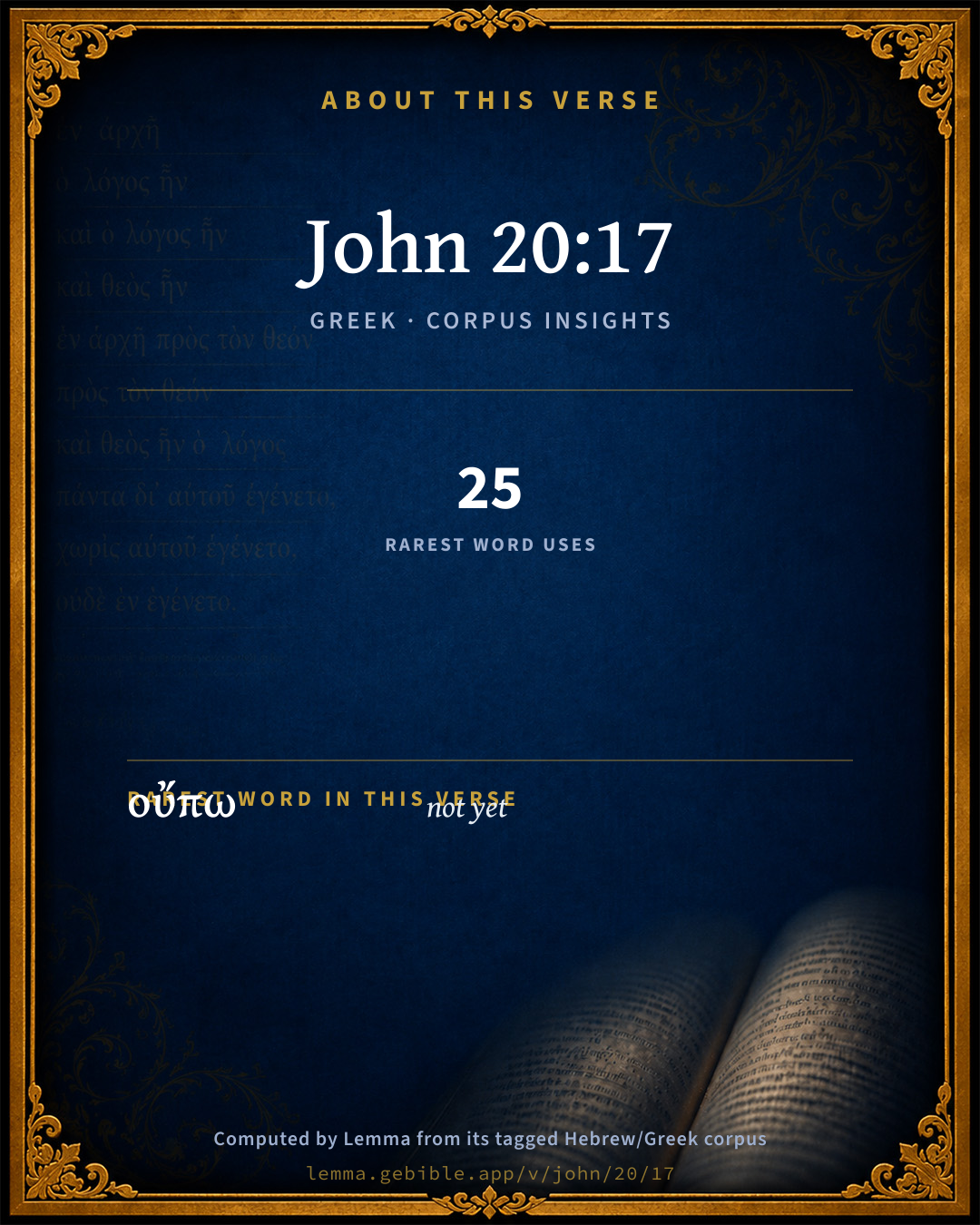
The rarest word here is οὔπω not yet G3768 — appearing just 25 times in the whole Greek New Testament.

Shared distinctive vocabulary

οὔπω not yet G3768 occurs in 25 verses of the Greek New Testament. Also found in:

Repetition

Words recur within this verse:

  • πατέρα father G3962 ×3
  • λέγει to say G3004 ×2
  • ἀναβέβηκα to ascend G305 ×2
  • θεόν God G2316 ×2
  • μου I G1473 ×4
  • καὶ and G2532 ×4
  • πρὸς to G4314 ×3
  • τὸν the G3588 ×3
  • αὐτῇ he G846 ×2
  • ὑμῶν you G5210 ×2

Cross-references

47

Topical passages linked to John 20:17 in the Treasury of Scripture Knowledge — connected by theme and wording, ordered by reader-vote popularity; previews shown in the World English Bible.

  • John 16:28 I came out from the Father, and have come into the world. Again, I leave the world, and go to the Father."
  • Ephesians 4:8–10 Therefore he says, "When he ascended on high, he led captivity captive, and gave gifts to men."
  • Galatians 4:6–7 And because you are children, God sent out the Spirit of his Son into your hearts, crying, "Abba, Father!"
  • 1 Peter 1:3 Blessed be the God and Father of our Lord Jesus Christ, who according to his great mercy became our father again to a living hope through the resurrection of Jesus Christ from the dead,
  • John 17:11 I am no more in the world, but these are in the world, and I am coming to you. Holy Father, keep them through your name which you have given me, that they may be one, even as we are.
  • Psalms 68:18 You have ascended on high. You have led away captives. You have received gifts among men, Yes, among the rebellious also, that Yah God might dwell there.
  • Mark 16:19 So then the Lord Jesus, after he had spoken to them, was received up into heaven, and sat down at the right hand of God.
  • Galatians 3:26 For you are all children of God, through faith in Christ Jesus.
  • Ephesians 1:17–23 that the God of our Lord Jesus Christ, the Father of glory, may give to you a spirit of wisdom and revelation in the knowledge of him;
  • Hebrews 2:11–13 For both he who sanctifies and those who are sanctified are all from one, for which cause he is not ashamed to call them brothers,
  • John 7:33 Then Jesus said, "I will be with you a little while longer, then I go to him who sent me.
  • John 14:6 Jesus said to him, "I am the way, the truth, and the life. No one comes to the Father, except through me.
  • John 14:28 You heard how I told you, 'I go away, and I come to you.' If you loved me, you would have rejoiced, because I said 'I am going to my Father;' for the Father is greater than I.
  • 1 John 3:2 Beloved, now we are children of God, and it is not yet revealed what we will be. But we know that, when he is revealed, we will be like him; for we will see him just as he is.
  • Matthew 12:50 For whoever does the will of my Father who is in heaven, he is my brother, and sister, and mother."
  • Matthew 28:7 Go quickly and tell his disciples, 'He has risen from the dead, and behold, he goes before you into Galilee; there you will see him.' Behold, I have told you."
  • Luke 24:49–51 Behold, I send forth the promise of my Father on you. But wait in the city of Jerusalem until you are clothed with power from on high."
  • John 1:12–13 But as many as received him, to them he gave the right to become God's children, to those who believe in his name:
  • John 13:1 Now before the feast of the Passover, Jesus knowing that his time had come that he would depart from this world to the Father, having loved his own who were in the world, he loved them to the end.
  • John 13:3 Jesus, knowing that the Father had given all things into his hands, and that he came forth from God, and was going to God,
  • John 14:2 In my Father's house are many mansions. If it weren't so, I would have told you. I am going to prepare a place for you.
  • John 17:25 Righteous Father, the world hasn't known you, but I knew you; and these knew that you sent me.
  • Romans 8:29 For whom he foreknew, he also predestined to be conformed to the image of his Son, that he might be the firstborn among many brothers.
  • 2 Corinthians 6:18 I will be to you a Father. You will be to me sons and daughters,' says the Lord Almighty."
  • Psalms 89:26 He will call to me, 'You are my Father, My God, and the rock of my salvation!'
  • Jeremiah 31:33 But this is the covenant that I will make with the house of Israel after those days, says Yahweh: I will put my law in their inward parts, and in their heart will I write it; and I will be their God, and they shall be my people:
  • Jeremiah 32:38 and they shall be my people, and I will be their God:
  • Ezekiel 36:28 You shall dwell in the land that I gave to your fathers; and you shall be my people, and I will be your God.
  • Ezekiel 37:27 My tent also shall be with them; and I will be their God, and they shall be my people.
  • Matthew 28:9–10 As they went to tell his disciples, behold, Jesus met them, saying, "Rejoice!" They came and took hold of his feet, and worshiped him.
  • Luke 10:4 Carry no purse, nor wallet, nor sandals. Greet no one on the way.
  • John 17:5 Now, Father, glorify me with your own self with the glory which I had with you before the world existed.
  • John 20:27 Then he said to Thomas, "Reach here your finger, and see my hands. Reach here your hand, and put it into my side. Don't be unbelieving, but believing."
  • Romans 8:14–17 For as many as are led by the Spirit of God, these are children of God.
  • Hebrews 8:10 "For this is the covenant that I will make with the house of Israel. After those days," says the Lord; "I will put my laws into their mind, I will also write them on their heart. I will be to them a God, And they will be to me a people.
  • Revelation 21:3 I heard a loud voice out of heaven saying, "Behold, God's dwelling is with people, and he will dwell with them, and they will be his people, and God himself will be with them as their God.
  • Revelation 21:7 He who overcomes, I will give him these things. I will be his God, and he will be my son.
  • Genesis 17:7–8 I will establish my covenant between me and you and your seed after you throughout their generations for an everlasting covenant, to be a God to you and to your seed after you.
  • 2 Kings 7:9 Then they said one to another, We aren't doing right. This day is a day of good news, and we hold our peace: if we wait until the morning light, punishment will overtake us; now therefore come, let us go and tell the king's household.
  • Psalms 22:22 I will declare your name to my brothers. In the midst of the assembly, I will praise you.
  • Psalms 43:4 Then I will go to the altar of God, To God, my exceeding joy. I will praise you on the harp, God, my God.
  • Psalms 48:14 For this God is our God forever and ever. He will be our guide even to death.
  • Matthew 25:40 "The King will answer them, 'Most assuredly I tell you, inasmuch as you did it to one of the least of these my brothers, you did it to me.'
  • Hebrews 11:16 But now they desire a better country, that is, a heavenly one. Therefore God is not ashamed of them, to be called their God, for he has prepared a city for them.
  • 2 Kings 4:29 Then he said to Gehazi, Gird up your loins, and take my staff in your hand, and go your way: if you meet any man, Don't greet him; and if anyone greets you, don't answer him again: and lay my staff on the face of the child.
  • Isaiah 41:10 Don't you be afraid, for I am with you; don't be dismayed, for I am your God; I will strengthen you; yes, I will help you; yes, I will uphold you with the right hand of my righteousness.
  • Zechariah 13:7–9 "Awake, sword, against my shepherd, And against the man who is close to me," says Yahweh of Hosts. Strike the shepherd, and the sheep will be scattered; And I will turn my hand against the little ones.

Cross-references courtesy of OpenBible.info (CC BY 4.0).

Commentary

Notes on John 20:17 from classic Christian and Jewish commentators (each source and its license shown beneath its notes). The classic Christian expositions comment on the surrounding passage and are grouped to its opening verse, so a note may address several verses; the Jewish commentaries on the Tanakh (Rashi and others) are per-verse, so they appear only where the commentator wrote on this verse.

Lemma curates 59 commentaries, every one of them public domain or Creative Commons licensed, each selected and text-cleaned for this edition rather than reprinted as found. About our sources →

The Biblical Illustrator

Joseph S. Exell

Joh_20:17-18

Jesus saith unto her, Touch Me not

Touch not

What a strange thing that both the old world and the new should have began with the same prohibition.

(Dean Burgon.)

Noli Me tangere:

The lesson is to a soul brought into the conscious presence of the Lord. Oh, to be in that condition! Mary Magdalene had wept because of her Lords absence, and longed to find Him; and now she has her desire: He stands before her. Oh, that we knew where, we might find Him (Job_23:3)! Her conduct in holding Him by the feet was natural, and yet it was forbidden by a higher wisdom than that of mortal men.

I. THE CAUTION. Touch Me not.

1. We may blunder even in our closest friendship, and need a prohibition. We have never need of greater caution than in our nearest approaches to God. Courtiers must be most careful in the throne-room.

2. We may carnalize the spiritual. This has ever been a tendency with even the best of the saints; and it has misled many in whom affection has been stronger than intellect.

3. We may seek most passionately what is by no means essential. The assurance of sense, by touch or otherwise: when the assurance of faith is far better, and quite sufficient. The detaining of one who has no intention of going.

4. We may crave what were better further on. When we are raised to eternal glory we shall be able to enjoy what now we must not ask.

5. We may be selfish in our enjoyments. Staying to contemplate alone by ourselves, when we ought rather to bless others by publishing the blessed 2Ki_7:9).

II. THE MISSION. Go to My brethren. She would have preferred to stay, but Jesus bids her go.

1. This was better for her. Contemplation alone may degenerate into the sentimental, the sensuous, the impracticable.

2. This was better for them. They heard the best of news from the most trustworthy of informants.

3. This was unquestionably done by this holy woman. What she had seen she declared. What she had heard she told. Women are said to be communicative; and so there was wisdom in the choice. Women are affectionate, and so persuasive; and therefore fit to bear such a tender message as we have now to consider.

III. THE TITLE. My brethren. Our Lord, of design, chose this title to comfort His sorrowing ones. They had so acted as almost to cease to be His followers, disciples, or friends; but brotherhood is an abiding relationship. They were

1. His brethren, though He was about to ascend to His throne. He was still a man, though no more to suffer and die. He still represented them as their risen Head. He was still one with them in all His objects and prospects.

2. His brethren, though they had forsaken Him in His shame. Relationship abiding, for brotherhood cannot be broken. Relationship owned more than ever; since their sense of guilt made them afraid. He was a true Joseph to Gen_45:4). Relationship dwelt upon, that they might be reassured. Never let us omit the tender sweetness of the gospel, its courtesies, benedictions, and love-words, such as the My brethren of the text before us. If we leave out these precious words we shall mar the Masters message of grace.

IV. THE TIDINGS. I ascend unto My Father, and your Father. This message was meant to arouse and comfort them.

1. By the news of His departure they are to be aroused.

2. By the news of His ascension they are to be confirmed.

3. By His ascension to the common Father they are to be comforted with the prospect of coming there themselves. He is not going into an unknown country, but to His home and theirs (Joh_14:2).

4. By His ascent to God they are to be struck with solemn awe, and brought the more reverently to look for His presence among them. See how practical our Lord is, and how much He values the usefulness of His servants. Have we not somewhat to tell? Whether man or woman, tell the Lords brethren what the Lord hath told to thee. (C. H. Spurgeon.)

Noli Me tangere:

Mary Magdalene, because she loved much, had this morning divers favours vouchsafed her. Now comes an unkind word and mars all. A cold salutation for an Easterday morning. A little before He asked why she wept? This is enough to set her on weeping afresh. For if she wept that others had taken away her Lord, much more now when her Lord takes away Himself. Christ came unknown, and then known; but, unknown, Christ proves better to her, for then He asked her kindly why she wept? but known, He grows strange to forbid her to touch.

I. THE RESTRAINT.

1. The thing forbidden. It is nothing to touch; and yet to touch Christ is not nothing. Many strove to touch Him, and there went virtue from Him even while He was mortal: but now He is immortal much more. That was not her case to draw ought from Him: it was for pure love. To love it is not enough to hear, or see; but to touch and take hold. The nearest union is per contactum.

2. The party. Not Christ. Why not Him? Christ was not wont to be so dainty. He suffered the rude multitude to throng and to thrust Him. Noli Me tangere would have done well on Good Friday. Why suffered He them then? why suffered He not her now? For all she had done and suffered one poor touch had been but an easy recompense. Of all other, this prohibition lay not against her: of all times, not at this.

II. If we look at THE REASON shall we shall find it yet more strange--I am not yet ascended. But when He was ascended, one would think, she should be further off still. Let us consult upon this prohibition. Noli Me tangere can rise but one of these ways.

1. On His part that was touched. Touch Me not, you will hurt Me, or, I shall hurt you; I am fire, I shall scorch you: an edge tool, I shall wound you: pitch, I shall defile you: some contagious thing, I shall infect you. But Christ was not now in state to receive or do any hurt.

2. We resolve, then, it was notch Christs part. He might be touched, and was by Thomas; but on hers she might not touch Him.

(1) Chrysostom thinks it was to correct her want of due reverence. After her wonted fashion, she made toward Him; nor with that regard which His new glorified estate demanded. The touchstone of our touching Christ is with all regard and reverence that may be. Two causes of this. One, a defect in her judgment; the other, an excess in her affection. Christs reason imports as much. You touch Me, not as if I were upon ascending, but as if to stay here still. Hence we learn, that when He sees we forget ourselves, Christ will take a little state upon Him; will not be saluted with Rabboni, but with some more seemly term. Thomas said, My Lord and my God. It is no excuse to say all was out of love. Love, if it be right, doth nothing uncomely. And such love Christ loves. A strange kind of love, when, for very love to Christ, we care not how we carry ourselves towards Him. This may be said, she was not before so carried away with sorrow, but she was now as far gone in the other of joy: and so like enough to forget herself, as Peter on the Mount. He knew not what he said, nor she what she did. Out of which our lesson is, that in the sudden surprise of any passion no touching Christ then. Say she were unfit, yet all is not clear. For why then did others touch? Thomas with his faith in his fingers ends? They touched because they believed not; she touched not because she misbelieved. They touched that they might know He was risen: she touched not that she might know He was not so risen, as in former times she had known Him. If the text be against rudeness, to restrain it; then is it for reverence to enjoin it.

(2) Gregory thinks it was to hasten the message, and that all was but to save time. As if He should have said, There is a matter in hand, would be done out of hand; and therefore for this time hands off. And the reason will follow well so. You need not be so hasty, I am not yet ascended. You may do this at some other time. To the disciples and to Christ no haste was too much; all delay too long. Yet a touch and away would not have taken up so much time. True, but He easily foresaw if He suffered her to touch that she would have taken hold too, not have let Him go.

(3) Augustine thinks it was to wean her from all fleshly touching, and teach her a new and true touch. As if, till He were ascended, He would not be touched; and then He would. And there is reason for this sense. For the touch of His body, which she so much desired; that could last but forty days. Christ Himself touched upon this point in Joh_6:62. It was her error to be all for the corporeal presence; for the touch with the fingers. So were His disciples. From which they were now to be weaned. That if they had before known Christ, or touched Him after the flesh, yet now from henceforth they were to do so no more. Christ resolves the point. The flesh, the touching, the eating, profits nothing. The words He spake were spirit. So the touching, the eating, to be spiritual And Thomas, and Mary, or whosoever touched Him on earth, if they had not been more happy to touch Him with their faith, than with their fingers end, they had had no good by it at all. It was found better with it, to touch the hem of His garment, than without it, to touch any part of His body. Now, if faith be to touch, that will touch Him no less in heaven than here. (Bp. Andrewes.)

Mary Magdalene and Thomas with the risen Christ

I. WAS MARY DENIED AND THOMAS GRANTED, THE SAME FAVOUR? Then we should see in the case of Thomas a greater condescension to the doubts and fears of the human heart. Mary did not need proof; Thomas did. The clearing away of Thomas doubts strengthened the evidence of our Lords resurrection.

II. THERE WAS NO DENIAL OF FAVOUR TO MARY. In her case the arrested act was one of affection, and Jesus may be understood as reminding her that the hour for adoration has not yet come--For I am not yet ascended. Nothing of that enters into the act of Thomas. His is not an act of worship, but of scrutiny. Mary is checked in worship; Thomas is permitted to touch, to obtain proof that it is indeed the Master.

III. BUT WHY IS MARYS REVERENCE CHECKED? Because the Master has work for her to do. Our Lord really forbids not, but checks her reverential act; and His purpose is to transfer her attention to her mission. Even if Marys act were merely one of personal affection, there would be only the more reason why duty should interrupt her demonstrations of regard.

IV. MARY THOUGHT HE WAS COME BACK TO STAY. So He virtually says: Not so; I ascend. Think of Me no more in the flesh; think of Me on the throne. For, while in one breath the Lord says, I am not yet ascended, in the next He commands her to tell His brethren, I ascend unto My Father. (The Study.)

Christ and Mary

I. IT WAS A REAL BODY THAT APPEARED TO MARY. Touch Me not; then it was possible to touch Him. Wisdom never tells us not to do what cannot be done. The voice she heard was not a dead voice; the form she saw was not a form that trembled in the twilight far within the tomb, but one that stood boldly forth in the clear, cheerful day outside.

II. HERE WAS A GENTLE REPROOF, POINTING TO THE LACK OF SPIRITUALITY IN MARYS FAITH. To her the supreme object of faith could be touched with fingers. She assumes that He has come back to the old scenes to be what He was before. She is content with this and with His unfinished work. The words of Jesus were to discipline and raise her faith, and to break to her the truth that He is no longer to be revealed under the forms of time, and in the world of sensation, but to the soul. That we may be helped to watch against this and avoid the tendency to make a fetish of Him who has now inaugurated the reign of the Spirit; and truly obey the ancient call of devotion, Lift up your hearts, let us feel that Christ is still speaking to us, in His words to Mary.

III. ALTHOUGH MARY HAD THIS CHECK, ALL THE DISCIPLES MAY TOUCH HIM, NOW HE IS IN HEAVEN. The word yet conveys this inference; and the next words, You are not to touch Me until I am gone; then you may. When My earthly manifestation ends, your privilege of touching Me begins. We actually have open to us a better and happier privilege than that which Mary thought the ultimatum of dignity and bliss. This true touch is essential to the true life. All knowledge, all sympathy is from touch; there is no food, no drink, no healing without touch. Sin is cured by the Saviours touch; and this perpetual contact is the medium through which He sends into us the Divine electricity of power and holiness. Only a few could come in contact with a simple human presence at one time; but all, at one time, can touch that which is ascended for the very purpose that it may fill all things. You may touch Him in the city, in the field, when going out, when coming in, when no eye can see, in the garret, in the cellar, in the deep mine, in mountain heights, in the turmoil of care, in atmospheres in which, without a miracle, no grace can live; and wherever He is thus touched, the manifold miracle of grace is wrought.

IV. THIS MAY HAVE INCLUDED AN INJUNCTION TO MARY NOT TO DELAY HER ERRAND TO THE DISCIPLES. Do not linger. I am going, and will soon be gone. Go to My brethren. There is no time now for tender intimacies and protracted intercourse; I have this more important employment for you: you must make haste if you would give them fair notice. So now, Christ is always calling us away from the passive to the active; from personal enjoyment to practical service.

1. Go. In the history of the new life, Christs first word is always, Come; His next, in some form or other, is always, Go.

2. To My brethren.

(1) Why was this message not sent first to His mother? Through age after age the nations have called her Our Lady, yet all through the forty days she is passed by in the narrative like one forgotten. This is an inexplicable blank, unless we understand that, foreknowing the idolatry of Mary, it was thus divinely arranged.

(2) Why were not the rejecters of Christ first informed of His resurrection? Why not go first to the Scribes and Pharisees, &c., and those who complain that they want evidence? Because of this principle: Whosoever hath, to him shall be given, &c.; because, The secret of the Lord is with them that fear Him, &c.

3. My brethren. He had never so called them before, yet they never seemed to be so unworthy. He might have said, Go, tell swearing Peter, dull Philip, doubting Thomas, cautious Nathanael, &c. Had they heard of the Resurrection thus, the news might have almost killed them; and they might have said, He is risen to smite us. But, as if to prevent this, the despatch is addressed to His brethren. Grand instance this of the truth that He is not ashamed to call us brethren. Take fresh heart at the thought of it, and learn that it is not in the power of infirmity to unbrother us. (C. Stanford, D. D.)

But go tell My brethren

Christs work in heaven and ours on earth

1. Christs words were addressed to Marys thoughts, which was, Now all is fulfilled. He has returned from the Father; He is going to take us to His kingdom, and we shall be for ever with Him. Not so, replies our Lord, I have more work to do, and so have you.

2. There is a remarkable difference between Marys case and that of Thomas. She believed too much; he too little. Her eager faith is corrected by the Touch Me not, but go; his unbelief is removed by Come, reach hither thy hand. Man would have said to faith, Touch me; to unbelief, Touch me not.

I. CHRISTS WORK. He has gone--1. To get the Spirit for us. Now He has received the promise of the Father--Gifts for men.

2. To intercede for us.

3. To prepare a place for us.

4. To give repentance and forgiveness. Thus He cautions us--Be calm and patient; I have gone to do My work. It must be done, and then no more delay.

II. OUR WORK. Mary had something else to do than touch and enjoy; so have we--work.

1. For ourselves. Follow Me, Take up your cross, Let your light shine, Grow in grace.

2. For the Church. We are members one of another to bear one anothers burdens, &c.

3. For the world--to pray for it, preach to it, save it. How long Christs work will last we know not, but ours will soon be done. Therefore, Whatsoever thy hand, &c. (H. Bonar, D. D.)

Christ teaching us how to think about Himself:

We are taught to think of

I. THE STRENGTH AND CONSTANCY OF HIS LOW. My brethren was applied

1. To those who had recently acted in a cowardly and cruel manner.

2. To those whose state of mind was most dishonouring to Himself Mar_16:10-15; Luk_24:11-21).

3. In the most momentous crisis in His history.

4. Without the slightest hint of their unworthy conduct.

II. THE COMPLETION OF HIS EARTHLY WORK--I ascend. As the farmer leaves the field when it has been cultivated, awaiting the results of his toil in the harvest; as the mariner leaps on shore when the voyage is over; as the warrior returns home when the victory is won; so our Lord turned His attention to heaven immediately on the conclusion of His work on earth, where He had been an exile.

1. In His life He had presented a perfect example of what men should be.

2. In His person and works He had supplied the most advanced revelation of God.

3. In His death He had atoned for the sins of the world, and laid the basis for a universal offer of pardon and eternal life.

4. In His resurrection He had given a pledge that His people should rise and that the last enemy should be destroyed. And now He turns His thoughts homeward.

III. THE POWER AND DOMINION ON WHICH HE HAS ENTERED.

1. His personal rest and honour. Ascend. What a contrast to His descent Joh_17:15).

2. The fulfilment of His promise respecting the Spirit (Joh_14:25-26; Joh_15:26-27).

3. His prevalent intercession (Heb_2:9-11; Heb_7:24-28).

4. His unlimited authority and power to promote our interests. Lo, I am with you alway; The Lord stood by me.

5. The certainty of His final recompense in the conquest of the world. He must reign.

6. His return to receive us unto Himself.

IV. THE ONENESS BETWEEN HIMSELF AND HIS PEOPLE. My Father, &c. Suggestive of mutual

1. Relationship.

2. Resemblance.

3. Interests.

4. Possessions.

5. Prospects. (J. Bowery.)

Christs message to His brethren

I. THE PARTIES. My brethren. Here is nothing that savours of any displeasure of remembering any old grudge, or of pride. The term brethren implies

1. Identity of nature. Then if He rose as man, man also may rise; if the nature be risen, the persons in it may. In the first Adam our nature died, in the Second our nature is risen.

2. Risen with the same love and affection He had before, or if changed changed for the better. Before He said, My friends. Here, My brethren.

II. THE COMMISSION. The fathers say that by this word she was by Christ made an apostle. Nay, an apostle to the apostles.

1. An apostle: for what lacks she?

(1) Sent immediately from Christ.

(2) Sent to declare.

(3) Sent to make known Christs ascending, the very Gospel of the gospel.

2. This day, with Christs rising, begins the gospel; not before. Crucified, dead and buried, no good news in themselves. Them the Jews believe as well as we. At her hands the apostles themselves received these glad tidings first, and from them we all.

3. Which, as it was a special honour, so was it not without some kind of reproach to them for sitting at home. Christ is fain to seek Him a new apostle.

4. And by this the amends is made her for Noli Me tangere. For to be thus the messenger of so blessed tidings is a more special favour than if she had touched Christ. Christ would never have enjoined her to leave the better to take the worse. So that hence we infer that to go and carry comfort to them that need it, to tell them of Christs rising that do not know it, is better then to do nothing but touch Christ. Touching Christ gives place to teaching Christ. How well this agrees with her offer in Joh_20:15 : You that would take and carry Me, being dead, go take and carry Me now alive. It shall be a carrying in a better sense. Stand not here then touching Me; go and touch them, and with the very touch of this report you shall work in them a resurrection from a doleful and dead to a cheerful and lively estate.

III. THE MOTION.

1. Tell them that I ascend. Why not rather I am risen (more proper for this day)? Because He needs not tell her that. She could tell that of herself. And besides, I ascend implies as much. Till He be risen, ascend He cannot. But as she saw by His rising that He had the keys of hell and death, had unlocked those doors and come out from thence, so by ascend He tells her that He hath the keys of heavens gates also, which He would now unlock, and so set open the kingdom of heaven to all believers.

2. To show us what was the end of His rising. Christ did not rise, to rise; no more must we. Christ rose to ascend; so are we to do. To rise from the bottom of the grave to the brink of it, and stand on the grave-stone, is but half a rising. To rise up as high as heaven, that is to rise indeed; that is Christs rising, and that to be ours. As there was no gospel till the Resurrection, so the Resurrection is no gospel unless ascend follow it. Resurrexit, tell that to all the world--all that die in Adam shall rise in Christ: miscreants, Jews, Turks, and all. No gospel that, properly. Tell the Christian of ascendo, too, the resurrection to life and not to condemnation. Better lie still in our graves, than rise, and rising not to ascend.

3. He saw upon these tidings they would say, He risen, then shall we have His company again as heretofore. But by sending them word of His ascending He gives them warning that He rose not to make any abode with them. This He knew would be a hard lesson. They were still and ever addicted to His bodily being with them. They would have built Him a tabernacle here. To rid them of this error He shows them thus, that for Him to be here below on earth that is not it; but for them to be with Him there above in heaven that is it. Thither would He raise them and us with this His ascendo.

4. So then seeing Christ stayed not here, we are not to set up our stay here; not to make earth our heaven.

IV. TO MY FATHER. Every motion hath a whence and a whither. To ascend is, to Christ, His natural motion; heaven is His natural place. His work being done. And to My Father no less (chap. 14:28). But to go from them is no good news. It was like touch Me not to Mary. What then is their comfort or ours? In this, To your Father as well as Mine. And He doth express here the whither by the party to whom, rather than by the place to which, because the party will soon bring us to the place, and to somewhat besides. So we have good right to make His Father ours, and His Fathers house ours, that there we may dwell together fratres in unum. There be of the Fathers that make these words as so many steps of Jacobs ladder, which we are to ascend by, or so many wheels as it were of Eliass chariot, in which he was carried up to heaven. There lie before us four pairs or combinations by which ascendo is drawn in the text.

1. Father and God, instead of the Lord God of the law. Father is a name of much good will, but many a good father wants good means to his good will. God is added that He may not be defective that way.

2. His, ours; and ours His, interchangeably. A blessed change: His great Meum for our little vestrum, little ours for great His. As there is no comfort in heaven without God, nor in God, without a Father, so is there not any either in Father, heaven, or God without ours to give us a property in them.

3. My Father will do us no good. That which must do us the good is your Father, and we need no more (Joh_14:8). But how should Hisbe ours?

4. This leads us to the last combination, My God and yours. For that His Father may be our Father, no remedy but our God must first be His.

(1) His Father, as God; His God, as Man. As the Son of God, a God He hath not; a Father He hath: as the Son of Man, a Father He hath not; a God He hath.

(2) But now, how shall we get His Father to have Him to be our Father? First, His Father He was from all eternity; He only can say properly, patrem meum. But He is content to quit that and to take us in; and He being our Brother before to make us His now. For upon His ascending He adopts us, and by adopting makes us, and by making pronounces us His brethren, and so children to His Father. But, till then, a God we had, but not a Father; at least, not such a Father of Him as since we have. So we see the necessity of both these combinations. But we are not so to look to our own comfort, but that we preserve His honour. There is order taken for that by severing each pair--mine and yours; yet otherwise His and otherwise ours; both as Father and as God. As Father: His by nature, ours by grace. As God: our God by nature. His no otherwise, then as He took upon Him our nature. (Bp. Andrewes.)

The brother-hood of Christ

I. TO WHOM IS CHRIST A BROTHER.

1. To the apostles and their associates.

2. To all who do Gods will (Mat_12:46-50).

3. To all who are undergoing sanctification (Heb_2:11).

II. HOW DOES HE FEEL TOWARDS HIS BRETHREN?

1. He is not ashamed to own the relationship (Heb_2:11).

2. He sympathizes with them and loves them (Heb_2:17).

3. He identifies Himself with them (Mat_25:40).

III. WHAT BENEFITS DO HIS BRETHREN DERIVE FROM HIS RELATIONSHIP?

1. Teaching (Heb_2:12).

2. Providential care (Mat_25:40).

3. Consciousness of His sympathy,

IV. LET US LEARN.

1. To establish this relationship by faith, love, obedience, growth.

2. To appreciate it with the honour, and help it brings.

3. To extend it to others by leading them to salvation.

4. If we are faithful we shall live with our Eider Brother for ever. (J. T.Whiteley.)

I ascend unto My Father

The ascension of our Saviour

I. THE PERSONS TO WHOM THE MESSAGE IS ADDRESSED.

1. Why not the Scribes and Pharisees, &c., and render His resurrection undeniable? Because--Whosoever hath to him shall be given, &c. He never refused explanation to any humble inquirer--but He will not force information upon those that hated knowledge. To what purpose is it to adduce evidence to those that shut their eyes? They knew the report of the guards. But His own followers only laboured under infirmities. They wished to be established in the truth. These He calls--My brethren. This is more than He could have said of angels. He is only their Lord. It behoved Him to be made like unto His brethren, &c. Many an elder brother has stood between the affections of the father and the rest of the children, and by engrossing the whole of the inheritance has reduced the younger branches to dependence, if not to want; but Jesus pitied those who were less happy than Himself, and determined to make them partakers of all His honours and riches. Thus they are heirs of God, and joint heirs with Christ. By using this name He would

1. Show that His elevation had not made Him forgetful of those He was to leave behind.

2. Comfort them. They had acted a very unworthy part, and their consciences made them uneasy. By this He seems to call after them, and say, Return, ye backsliding children. Thus He dispels their anxiety, and fills them with hope. And thus He realizes His illustrious type.

3. Intimate their duty? Since I do not disown you, notwithstanding your imperfections--follow My example; love as brethren.

II. THE SUBSTANCE OF THE INTELLIGENCE. This ascension was real and local. Let us consider it in reference to

1. Himself.

(1) He returned to the place whence He came, and assumed the glory which He obscured.

(2) To enjoy the reward of His humiliation and sufferings.

2. His enemies.

(1) Thus He is a Conqueror. He had foes, but He vanquished them; and having spoiled principalities and powers, He made a show of them openly. Sin, the devil, the world, death--these are the enemies He has overcome. And to-day He enjoys His triumph. Lift up your heads, O ye gates, &c.

(2) But as He triumphs, He also bestows upon us various and inestimable blessings--gave gifts unto men.

3. His people.

(1) He ascended as the High Priest of their profession.

(2) As their Head and Representative.

(3) As their Protector and Governor.

Conclusion: And now what remains but that we translate this article of our creed into our lives.

1. Follow Him where He now is. If ye then be risen with Christ, &c., why then are you so attached to earth? Why seek ye the living among the dead?

2. Seeing that we have a great High Priest that is passed into the heavens, Jesus, the Son of God, let us hold fast our profession.

3. What encouragement can you want to rejoice in Him? You have a Brother at court.

4. But where will the ungodly and the sinner appear? (W. Jay.)

Christs interview with Mary at the sepulchre:

Nothing is more grand, more precious, than the news to be announced to them. I ascend to My Father, He who is so by nature; and to their Father, by adoption and grace; to My God, in covenant with Me as their Head, and to their God, in covenant with them through Me and under Me. Words which at once show the triumph of Jesus Christ and the triumph of the Christian. Let us illustrate these two ideas.

I. IT WAS THE TRIUMPH OF JESUS CHRIST, AND REMROVED THE SCANDAL OF THE CROSS. If thou be the Son of God, said the blinded Jews when insulting Him, come down from the cross. Jesus did more--He came alive from the tomb; and this miracle of Divine power is only the first step of that elevation into which He is entering. Go to My brethren, and say unto them, I ascend unto My Father and your Father, and unto My God and your God. This is, then, the triumph of Christ.

II. IT IS A SOURCE OF THE RICHEST CONSOLATION AND TRUST TO ALL BELIEVERS. I would wish this text, says the excellent Baxter, written on my dying bed; I would wish to view it with my closing eyes, that I might exult in the agonies of dissolution. All! Christians, never forget it! And let it also be your rule in all your conduct; your consolation in your trials; your trust in the most disastrous situations.

1. If the Father of Jesus Christ is your Father and your God, always listen with docility to a voice at once so august and tender; follow the glorious example of the first-born among many brethren.

2. If the Father of Jesus Christ is your Father and your God, submit with an entire resignation to all the dispensations of Providence, as Jesus submitted to them.

3. If the Father of Jesus Christ is your God and Father, then let this tender assurance augment your faith, your love, your detachment from the world. (H. Kollock, D. D.)

The Biblical Illustrator, edited by Joseph S. Exell (c. 1880s–1900s) — public domain. Text from a community e-Sword module.

Tyndale Open Study Notes

Tyndale Open Resources

20:17 Mary thought that with the resurrection, Jesus would resume normal relations with his disciples. She was trying to cling to the joy she discovered in her resurrected Lord. But his fellowship with her would come in a new form (20:22). Jesus had not yet ascended to complete his return to the Father, but the process was underway. Before his final departure, he would give the Holy Spirit (20:22; see 14:15-21, 26; 15:26-27; 16:5-15).

Tyndale Open Study Notes — © Tyndale Open Resources, licensed CC BY-SA 4.0. Text via the HelloAO Bible API.

Bengel's Gnomon

Johann Albrecht Bengel

Joh 20:17. Μὴ μου ἅπτου, touch Me not) She was wishing to do so in the way of adoration; but Jesus forbids it: For, 1) there was no need to touch Him, since she already believed: 2) there was close at hand, simultaneously with His ascension, the approaching state of a more elevated kind of faith, which required no touching to assure it: 3) the tidings were to be given without delay to the disciples; comp. Luk 10:4, “Salute no man by the way” [the charge to the Seventy to avoid delay, as their business was urgent and Oriental salutations tedious].—οὔπω, not yet) By this particle the Lord indicates, that the Ascension was immediately at hand, and that the disciples ought to make haste: for that it is for their sake that He delays, when He might immediately ascend.—γὰρ, for) The Ætiology [Assigning of a reason.—See Append.]: do not touch Me: for thou oughtest to go away quickly to announce the tidings: afterwards thou, and those to whom thou shalt have announced them, shall be able both to see and to touch Me.—δὲ, but) The antithesis is between, I have not yet ascended, and, I ascend.—ἀδελφούς μου, My brethren) See on Mat 25:40. [At first He called them disciples; then friends, Joh 15:15; and once, speaking of the cross, little sons (τεκνία): after the resurrection, παιδία, little children, ch. Joh 21:5, and brethren.] [The words in Mat 12:50 rest on another and different principle, “Whosoever shall do the will of My Father in heaven, the same is My brother.”—V. g.] He calls them brethren: for His Father is also at the same time their Father; and by the appellation of Brethren, He intimates His favourable (propitious) feeling towards them, though by their flight and denial of Him they had become unworthy of all their former position and grade, and He offers to them all the fruit of His resurrection: being presently after about also to renew their commission (the sending of them forth), nay, more, about to enlarge it: Joh 20:21.—ἀναβαίνω, I ascend) This goes still further. He does not say, I have risen again; nor, I will ascend; but, I ascend. This time of the ascension is already regarded as present. Luk 9:51, note “The time that He should be received up.” [Jesus all along from the first looked on to the goal, His assumption into heaven, and regarded the forty days after His resurrection, nay, even the events preceding, as only a kind of παρασκευή or Preparation for the one great day of His Ascension]. So the mention of His glorious coming is immediately connected with His ascension. See Act 1:11, “This same Jesus, winch is taken up from you into heaven, shall so come in like manner as ye have seen Him go into heaven.” Wherein once it is said, He shall come; afterwards it is always, He cometh, in the present. Hence the disciples of themselves were about to infer, that they must make haste, in order that they might see Jesus. He had often spoken of this ascension as close at hand, by employing the word ὑπάγω, I go away.—πρὸς τὸν πατέρα μου καὶ πατέρα ὑμῶν, καὶ Θεόν μου καὶ Θεὸν ὑμῶν, to My Father and your Father, and My God and your God) Christ called God His God thrice; on the cross, Mat 27:46, “My God, My God” etc.; after His resurrection, in this passage, and in the Apocalypse, ch. Rev 2:7, note.[398] Ordinarily and elsewhere, He is wont to call God by the title of His Father. He joins together both appellations, for the first time, in this place: He calls Him Father, since He derives His Origination from Him; He calls Him God (never, His Lord), since He has Him for His End; and thus shows that He has every kind of tie binding Him to the God. Moreover, He freely bestows on His brethren a similar tie of relationship with the Father and God. He does not, however, say Our, but “My Father and your Father,” etc. We have our relationship to God through Him: He has His in a manner altogether peculiar to Himself and primarily. Here, too, the saying holds good: God is the God (and Father), not of the dead, but of the living; comp. ch. Joh 14:19, “Because I live, ye shall live also.”

[398] There seems some mistake here. The passage in which Jesus calls the Father My God, is ch. Rev 3:12; not ch. Rev 2:7, “I will write upon Him the name of My God, and the name of the city of My God, new Jerusalem, which cometh down out of heaven from My God.—E. and T.

Bengel's Gnomon of the New Testament — English translation (T&T Clark, Edinburgh, 1860) — public domain. Text from a community e-Sword module.

Meyer's Critical & Exegetical Commentary

Heinrich August Wilhelm Meyer

Joh_20:17-18. Mary sees: it is the Lord. But affected and transported in the highest degree by His miraculous appearance, she knows not: is it He bodily, actually come forth out of the grave,again become corporeally alive and risen? Or is it, on the other hand, His glorified spirit, which has been already raised up to God, and which again has descended to appear to her, so that He has only the bodily form, not the corporeal substance? Therefore, to have the certainty which her love-filled heart needed in this moment of sudden, profoundest emotion, she would take hold of, handle Him, in order by feeling to obtain the conviction which the eye alone, in presence of this marvellous happiness, could not give her. This, however, Jesus prevents: touch me not! and gazing into her soul, gives her, by His own assurance, the certainty which she seeks, adding, as a reason for that repulse: for I am not yet ascended to the Father, therefore, as yet, no glorified spirit who has again come down from heaven whither he had ascended.[261] She would touch the Lord, as Thomas did subsequently, not, however, from unbelief, but because her faith strives after a definiteness with which her love cannot dispense. Only this interpretation, which is followed also by Baeumlein, strictly corresponds to the words generally, especially also to the ΓΆΡ, which assigns a reason, and imports no scenic accompaniments into the incident which are not in the passage; for ἍΠΤΟΥ leaves the reader to suppose nothing else that Mary desired to do, save simply the mere ἍΠΤΕΣΘΑΙ, therefore no embracing and the like. But scenic accompaniments are imported, and go far beyond the simple ἍΠΤΟΥ, if it is assumed that Mary clasped the knees of Jesus (comp. the frequent ἅπτεσθαι γούνων in Homer, Od. α. 512, Ο. 76, Φ. 65, Ω. 357, et al.), and desired, as supplex, to manifest her προσκύνησις to Him, as to a Being already glorified and returned from God (my first edition), or as venerabunda (so Lücke, Maier, Lange, Hilgenfeld, comp. Ewald). This could not be expected to be gathered by the reader from the mere noli me tangere; John must, in that case, have said, μὴ ἅπτου μου γονάτων, or ΜῊ ΓΟΝΥΠΕΤΕῖ ΜΕ,, or ΜῊ ΠΡΟΣΚΎΝΗΣΌΝ ΜΟΙ, or the like, or have previously related what Mary desired,[262] to which it may be added, that Jesus elsewhere does not refuse the ΠΡΟΣΚΎΝΗΣΙς; comp. especially Mat_28:9. He does not, indeed, according to Luk_24:39, repel even the handling, but invites thereto; but in that instance, irrespective of the doubtfulness of the account, in a historical point of view, it should be noted (1) that Jesus, in Luke, loc. cit. (comp. Joh_20:24 ff.), has to do with the direct doubt of His disciples in the reality of His bodily appearance, which doubt he must expressly censure; (2) that in the present passage, a woman, and one belonging to the narrower circle of His loving fellowship, is alone with Him, to whom He might be disposed, from considerations of sacred decorum, not to permit the ἅπτεσθαι desired in the midst of overflowing excitement. How entirely different was the situation with the sinning woman, Luk_7:37 (in answer to Brückners objection)! Along with the correct interpretation of ἍΠΤΕΣΘΑΙ, in itself, others have missed the further determination of the sense of the expression, either in this way: Jesus forbade the handling, because His wounds still pained Him (Paulus)! or: because His new, even corporeally glorified life was still so delicate, that He was bound to keep at a distance from anything that would disturb it (so Olshausen, following Schleiermacher, Festpred. V. p. 303); or: because He was still bodiless, and first after His return to the Father was again to obtain a body (Weisse). There is thus imported what is certainly not contained in the words (Paulus), what is a thoroughly arbitrary presupposition (Paulus, Olshausen), and what is in complete contradiction to the N. T. idea of the risen Christ (Weisse). Others take the saying as an urging to hasten on with that which is immediately necessary;[263] she is not to detain herself with the ἅπτεσθαι, since she can see and touch Him still at a later period (so, with a different explanation in other respects of ἍΠΤΕΣΘΑΙ itself, Beza, Vatablus, Calovius, Cornelius a Lapide, Bengel, and several others); by which, however, an arbitrarily adopted sense, and one not in keeping with the subsequent ἈΝΑΒΑΊΝΩ, Κ.Τ.Λ., would be introduced into the confirmatory clause, nay, the prospect opened up, in reference to the future tangere, would be inappropriate. Others, that Jesus demands a greater proffer of honour; for as His body has already become divine, the ordinary touching of feet and mode of intercourse is no longer applicable (Chrysostom, Theodore of Mopsuestia, Theophylact, Euth. Zigabenus, Erasmus, Jansen, and several others). How inept in itself, and illogical in reference to the following οὔπω γὰρ, κ.τ.λ.! Others: it was a refusal of the enjoyment now sought in His appearance, which as yet is untimely, and is to take place not terrestri contactu, but spirituali (Melanchthon, Calvin, Aretius, Grotius, and several others; substantially also, but under various modifications, Neander, De Wette, Tholuck, Luthardt, Lange, Baumgarten, Hengstenberg, Godet),[264] by which, however, the proper contents, constituting the essence of the supposed sense, is arbitrarily read between the lines. Others still differently, as e.g. Ammon: Jesus desired to spare Mary the touch of one levitically unclean! and Hilgenfeld, Evang. p. 318: the refusal of the reverential touch was made by Jesus, for the reason that He was not yet the man again united with the Logos, but at present only the Man raised again from His grave.[265] Both interpretations are entirely foreign to the meaning. Scholtens view (p. 172) is also an impossibility, as if Jesus had said οὔπω μὲν γὰρ, κ.τ.λ., as one already glorified. Conjectures even have been attempted; Vogel: μὴ σὺ πτόου, Gersdorf and Schulthess: ΜΟΥ ἍΠΤΟΥ, or ΣΎ ΜΟΥ ἍΠΤΥ.

ΠΡῸς ΤΟῪς ἈΔΕΛΦ. ΜΟΥ] This designation of the disciples as His beloved associates in the filial relation to God, through His now fulfilled earthly work (comp. πρὸς τ. πατέρα, κ.τ.λ.), is not at all intended to serve the purpose of tranquillizing them on account of their flight (Bengel, Luthardt, comp. Luther). Of this the text contains no indication, all the less that the expression is found only in the address to Mary, but not as to be communicated to the disciples. Rather has the designation its reference to Mary herself, who is to gather from it, that the loving fellowship of the Lord with His own, far removed from being dissolved by the new conditions of this miraculous manifestation, rather continues, indeed, now first (comp. Joh_15:15) has its completion. Note the like expression in Mat_28:10, where, however (see in loc.), the pointing to Galilce is an essential variation in the tradition; against which Luthardt, without reason, objects that Mat_28:10 refers to the promise, Mat_26:32. Certainly; but this promise already has, as its historical presupposition, the appearance of the Lord before the disciples, which was to be expected in Galilee, as the same also, Mat_28:16 ff., is actually set forth as the first and only one in Matthew.

ἀναβαίνω, κ.τ.λ.] The near and certain future. To announce this consequence of His resurrection to the disciples, must be all the more on His heart, since He so frequently designates His death as His departure to the Father, and had associated with it the personal hope of the disciples. That should not be different through His resurrection; it was only the passage from death to the heavenly glory. As to the mode and way of the ascension ἀναβ. contains nothing. The added κ. πατέρα ὑμῶν and Κ. ΘΕῸΝ ὙΜῶΝ was, however, intended to confirm the hope of the disciples in respect of their own ΣΥΝΔΟΞΑΣῆΝΑΙ, since in truth, in virtue of their fellowship with Christ, the Father of Christ was also become their Father, the God of Christ (to whom Christ solely belongs and serves, comp. Mat_27:47, and see, in detail, on Eph_1:17) also their God (comp. on Rom_1:8); that is now, after the execution of the redemptive work, entirely accomplished, and will one day have also the fellowship in δόξα as its final result, comp. Rom_8:17; Rom_8:29. Note in ΠΡῸς ΤῸΝ ΠΑΤΈΡΑ, Κ.Τ.Λ., that the article does not recur, but embraces all in the unity of the Person. To understand the pres. ἈΝΑΒ., however, of that which ensues forthwith and immediately, and in the following way (Baur, p. 222 ff., and Neutest. Theol. p. 381, Hilgenfeld, and others), that already the appearance that follows is to be placed after the ascension (comp. Ewald, who understands the pres. of the ascension as already impending), is decisively opposed by the fact of the later appearance, Joh_20:26-27, if this is not given up as actual history, or if the extravagant notion of many ascensions is not, with Kinkel, laid hold of.

[261] In οὔπω γὰρ, κ.τ.λ., is expressed, therefore, not the dread of permitting a contact, and that which was thereby intended, before the ascension to the Father should be accomplished (Brückner); but Jesus means thereby to say that Mary with her ἅπτεσθαι already presupposed in Him a condition which had not yet commenced, because it must have been preceded by His ascension to the Father.

[262] This also in answer to Baur, who thinks that Jesus was precisely on the point of ascending (see on ver. 18), and therefore did not wish to allow Himself to be detained by Mary falling at His feet. Comp. Köstlin, p. 190; Kinkel in the Stud. u. Krit. 1841, p. 597 ff.Among the ancient interpreters I find the strict verbal rendering of ἅπτεσθαι most fully preserved in Nonnus, who even refers it only to the clothing: Mary had approached her right hand to His garment; then Jesus says: ἐμῶν μὴ ψαῦε χιτώνων.

[263] At this conclusion Hofmann also arrives, Schriftbew. II. 1, p. 524: Mary is not, in her joy at again having Jesus, to approach and hang upon Him, as if He had appeared in order to remain, but was to carry to the disciples the joyful message, etc. But even with this turn the words do not apply, and the thought, especially that He had appeared not to remain, would be so enigmatically expressed by οὔπω γὰρ, κ.τ.λ., that it could only be discovered by the way, in nowise indicated, of an indirect conclusion. That ἅπτεοθαι may denote attach oneself, fasten oneself on (comp. Godet: sattacher à), is well known; but just as frequently, and in the N. T. throughout, it means take hold of, touch, handle, also in 1Co_7:1; 1Jn_5:18.

[264] Melanchthon: Reprehenditur mulier, quod desiderio humano expetit complexum Christi et somniat eum revixisse ut rursus inter amicos vivat ut antea …; nondum scit, fide praesentiam invisibilis Christi deinceps agnoscendam esse. So substantially also Luther. According to Luthardt, Mary would grasp, seize, hold Jesus fast, in order to enjoy His fellowship and satisfy her love. This Jesus denies to her, because at present it was not yet time for that; abiding fellowship as hitherto will first again commence when He shall have ascended, consequently shall have returned in the Paraclete; it will not then be brought about corporeally, but the fellowship will be in the Spirit. According to Baumgarten, a renewed bodily fellowship is promised to Mary, but completely freed from sin, and sanctified by Christs blood. According to Hengstenberg, Mary would embrace Jesus in the opinion that now the wall of separation between Him and her has fallen; but the Lord repels her, for as yet His glorification is not completed, the wall of separation still in part subsists, etc. Godet: It is not yet the moment for thee to attach thyself to me, as if I were already restored to you. For I am not as yet arrived at the state in which I shall be able to contract with my disciples the superior relation which I have promised to you; thus substantially like Luthardt.

[265] In his ZeitsChr. 1868, p. 436, Hilgenfeld modifies his interpretation to the extent that Jesus, as the Risen One, did not as yet desire to be the object of the reverence which belonged to Him as Lord of the Church (Php_2:10). This was then first to begin, when, after His ascension, He should appear before His believing ones as Dispenser of the Spirit (Joh_6:62-63). But even thus the points to be understood are imported from a distance.

Meyer — Critical and Exegetical Commentary on the New Testament — English translation by Peter Christie, edited by Frederick Crombie (T&T Clark, 1880) — public domain. Text from a community e-Sword module.

Expositor's Greek Testament

ed. W. Robertson Nicoll

Joh 20:17 . Μή μου ἅπτου , “noli me tangere,” not because it was indecorous (Luk 7:38 ); nor because she wished to assure herself by touch that the appearance was real, a test which He did not prevent His disciples from applying; nor because her embrace would disturb the process of glorification through which His body was passing; nor, following Kypke’s note, can we suppose that Jesus forbids Mary to worship Him [although K. proves that ἅπτεσθαι is used of that clinging to the knees or feet which was adopted by suppliants], because He accepts Thomas’ worship even before His ascension; but, as He Himself says, οὔπω γὰρ ἀναβέβηκα πρὸς τὸν πατέρα μου , “for I have not yet ascended to my Father,” implying that this was not His permanent return to visible fellowship with His disciples. Mary, by her eagerness to seize and hold Him, showed that she considered that the μικρόν , the “little time,” of Joh 16:16 , was past, and that now He had returned to be for ever with them. Jesus checks her with the assurance that much had yet to happen before that. His disciples must at once be disabused of that misapprehension. Therefore, πορεύου … ὑμῶν , “Go to my brothers [ ἀδελφούς μου , here for the first time; in anticipation of the latter part of the sentence, cf. Mar 3:35 ] and tell them, I ascend to my Father and your Father, and my God and your God”. He thus forms a relationship which bound Him to them more closely than His bodily presence. His place by right is with God. But His love binds Him as certainly to His people on earth as His rights carry Him to God. The form of the expression is dictated by His desire to give them assurance. They had no doubt God was His God and Father. He teaches them that, if so, He is their God and Father. ἔρχεται … αὐτῇ , Mary carries forthwith the Lord’s message to the disciples, cf. Mar 16:10 ; Mat 28:10 ; Luk 24:10 .

The Expositor's Greek Testament, edited by W. Robertson Nicoll (1897–1910) — public domain. Text from a community e-Sword module.

International Critical Commentary

17. This verse must be compared with Mat 28:9, Mat 28:10 where, again, the Risen Lord is seen by Mary Magdalene and speaks to her and her companion. In that passage the women, returning from the tomb to tell the disciples of the angel’s message, are at once in fear and joy. Jesus greets them by saying Χαίρετε. They clasp His feet in worship. He then tells them not to fear, Μή φοβεῖσθε, and adds ὐπάγετε ἀπαγγείλατε τοῖς ἀδελφοῖς μου ἵνα ἀπέλθωσιν εἰς τὴν Γαλιλαίαν, κἀκεῖ με ὄψονται. This almost reproduces the words of the angel in v. 7, with the significant change of μαθηταῖς into ἀδελφοῖς. Only here in the Gospels (Joh 20:17, Mat 28:10) is Jesus represented as speaking of His disciples as “my brethren”. Cf. Heb 2:11, Heb 2:12 (quoting Psa 22:22).

It is likely that the account in Mat 28:9, Mat 28:10 of the appearance of Jesus to the Maries was based on the lost conclusion of Mk.; for Mat 28:1-8 is plainly an amplified version of the simpler Mar 16:1-8. The phrase “tell to my brethren” was probably in Mk.’s story, and we have already seen that Jn. knew Mk.,1 whose narrative he corrects, when he thinks it necessary. In this instance, the message sent to the disciples is not, as in Mk. and Mt., that they should go to Galilee, where they would see their Risen Master. Jn. represents the message quite differently. It is: “Say to them, I go up to my Father.”

This expression ἀναβαίνω πρὸς τὸν πατέρα μου is only another form of the words spoken so often by Jesus, ὑπάγω πρός τὸν πάτερα (16:10; cf. 7:33, 16:5), or πορεύομαι πρὸς τὸν πατέρα (14:12, 28, 16:28). He had warned the disciples repeatedly that He would return to the Father who had sent Him. The time for this had not been reached on the day of the Resurrection, οὔπω γὰρ ἀναβέβηκα πρὸς τὸν πατέρα, but it was near. ἀναβαίνω πρὸς τὸν πατέρα. It is said for the last time.

The term “Ascension” for us indicates the climax of the earthly life of Christ, but ἀναβαίειν, ἀνάβασις, are common Greek words, which at first were not always used of the Ascension of Christ, still less appropriated to it. They are not used of the Ascension in the Synoptists (Luk 24:51 has ἀνεφέρετο, while [Mk.] 16:19 has ἀνελήφθη). ἀναβαίνειν is thus used in Eph 4:8, which is a quotation from Psa 68:18, but Paul does not use the verb again of the ascending Christ. In Act 2:34 we have οὐ γὰρ Δαβὶδ ἀνέβη εἰς τοὺς οὐράούς, which contains an allusion to the fact that Christ did thus “go up.” But, apart from these, the only other places in N.T. where ἀναβαίνειν is thus used, are Joh 6:62 (see note, in loc.) and the present passage. Barnabas (§ 15) employs the verb thus, and so does Justin (Tryph. 38); but Justin also uses ἀνέλευσις (Apol. i. 26) and ἄνοδος (Tryph. 82) of the Ascension of Christ. It was not until the days of Creed-making that the Church settled down to ἀναβαίνειν, ἀνάβασις, as the technical terms for Christ’s ascending. We miss the point of the employment of ἀναβαίνειν in the present verse if we do not treat it as an ordinary verb for “going up,” which would be recognised by the disciples as practically equivalent to ὑπάγειν or πορεύεσθαι often used by Jesus when predicting His departure.1

Thus the message which Mary was bidden to give to the disciples would recall to them words such as those of 14:2, 3. Jesus was going to the Father’s house, where He would prepare a place for them. It is remarkable that the form of the message is like that of Mat 28:10 (probably based on the lost conclusion of Mk.), although there the place where He is to see His disciples again is not heaven but Galilee (cf. Mar 14:28). Luk 24:6, as has been already said, alters the Marcan and Matthæan tradition here, by substituting for the promise of a meeting in Galilee, the words μνήσθητε ὡς ἐλάλησεν ὑμῖν ἔτι ὢν ἐν τῇ Γαλιλαία, λέγων, that the Son of Man must die and rise again, etc. Abbott’s inference from this comparison is that “an expression misunderstood by Mk. and Mt. as meaning Galilee, and omitted by Lk. because he could not understand it at all, was understood by Jn. to mean My Father’s place, i.e. Paradise.”2 This is precarious reasoning, but at any rate it is certain that Jn. (a) was aware of the Matthæan (? Marcan) tradition and (b) that he corrected it, bringing the message into correspondence with a saying of Jesus which he has previously recorded more than once.

Attention must now be directed to the words Μή μου ἅπτου, which (according to all extant texts) Jesus addressed to Mary, His reason being “for I have not yet ascended to My Father.” It is not said explicitly in this chapter that Jesus was ever touched by His disciples after He was risen, although it is suggested both in v. 22 and in v. 27. In the latter passage, Thomas is actually invited to touch the Lord’s wounded side (although it is not said that he did so), just as in Luk 24:39, Jesus says ψηλαφήσατέ με to the assembled disciples. The only explicit statement in the Gospels of the Risen Christ being touched is Mat 28:9. Nevertheless Luk 24:39 and Joh 20:27 sufficiently indicate that, in the judgment of the evangelists, it was possible to touch Him, and that He invited such experiment to be made. (See further on v. 20.)

Hence “Touch me not, for I have not yet ascended,” is difficult of interpretation, inasmuch as within a week at any rate, and before His final manifestation at His departure, Jesus had challenged the test of touch. We can hardly suppose that Jn. means us to believe that in the interval between v. 17 and v. 27 the conditions of the Risen Life of Jesus had so changed that what was unsuitable on the first occasion became suitable on the second. And there is the further difficulty, that as the words μή μου ἅπτου οὔπω γὰρ κτλ. stand, it is implied that to “touch” Jesus would be easier after His Ascension than before. The gloss et occurrit ut tangeret eum, which is inserted before noli me tangere in some texts (see on v. 16), shows that the primitive interpretation of the words implied a physical touching, and not merely a spiritual drawing near. The parallel Mat 28:10 confirms this. Accordingly, to give to the repulse, “Touch me not,” a spiritual meaning, as if it meant that freedom of access between the disciple and the Master would not be complete until the Resurrection had been consummated in the Ascension and the Holy Spirit had been sent, seems over-subtle. Yet this is what the words must mean if μή μου ἅπτου is part of the genuine text of Jn.

Meyer cited a conjectural emendation of these words (by Gersdorf and Schulthess) which he dismissed without discussion, but for which nevertheless there is a good deal to be said. We have drawn attention already to the parallel passage, Mat 28:10, but there is yet another point to be noted. By all the Synoptists the fear of the women at the tomb is emphasised. ἐφοβοῦντο γάρ (Mar 16:8), although the νεάνισκος had said μὴ ἐκθαμβεῖσθε (Mar 16:6). They were ἔμφοβοι (Luk 24:5). And in Mat 28:5, Mat 28:10 not only the angel, but Jesus Himself prefaced His message to the disciples by saying to the women (after they had clasped His feet) μὴ φοβεῖσθε. Now in our texts of Jn. there is no hint that Mary Magdalene (who is the only woman mentioned here by this evangelist) was frightened at all. She is without fear, apparently, when she recognises the Lord. The parallel passage, Mat 28:9, would suggest (as the gloss here does) that she cast herself at His feet in awestruck homage. We should expect here (as in Mk., Mt.) that Jesus would encourage her by forbidding her to be afraid. Instead of this, we find the enigmatic words μή μου ἅπτου. But if these words are a corruption of μὴ πτόου, as might very well be the case, “be not affrighted,” all is clear This is the verb used of the fright of the disciples in Luk 24:37 (πτοηθέντες), caused as Lk. says by their idea that they saw a spirit. And μὴ πτόου would come exactly where μὴ φοβεῖσθε comes in Mat 28:10, viz. after the Lord’s feet have been clasped in homage and fear. The sequence, then, is easy. “Be not affrighted, for I have not get gone up to my Father”: I am still with you, as you knew me on earth; I have not yet resumed the awful majesty of heaven. Do not fear: carry my message to the disciples, as in the old days.

The best supported reading is μή μου ἅπτου, but B has μὴ ἅπτου μου, and two cursives (47ev and dscr) omit μου altogether. If the text were originally μὴ πρόου, an easy corruption would be μὴ ἅπτου, and then μου would naturally be added either before or after ἅπτου to make the sense clear.

οὔπω γὰρ ἀναβέβηκα, “for I have not yet gone up … ” i.e. taken my final departure. For Jn., a week at the least (v. 27, and see on 21:1) elapsed between the Resurrection and that last of the manifestations of the Risen Christ which we call the Ascension. He says nothing of the interval of forty days for which our only authority is Act 1:3. But Jn., nevertheless, uses language (6:62) which implies not only that the final departure of Christ was a startling and wonderful incident, but that it was visible, in this agreeing with Luk 24:50-52, Act 1:9; cf. Appx. to Mk. (16:19).

Ἀναβαίνω πρὸς τὸν πατέρα μου. That was what He had said often before (in effect); but now He adds καὶ πατέρα ὑμῶν. His Father was their Father too, although there was a difference in the relation (see on 2:16); and of this He would remind them now. Observe He does not say “Our Father.”

καὶ θεόν μου. So He said “My God” on the Cross (Mar 15:34); cf. Rev 3:2. He is still Man, and so Paul repeatedly has the expression “the God and Father of our Lord Jesus Christ” (Rom 15:6, etc.). And His God is the God also of His disciples — the only God.

International Critical Commentary — older volumes (1896–1929), various authors — public domain. Text from a community e-Sword module.

Geneva Bible (1599)

Geneva Bible translators

He calleth God his Father because he is his Father naturally in the Godhead, and he saith your Father, because he is our Father by grace, through the adoption of the sons of God: that is, by taking us of his free grace to be his sons, Epiphanius.

Christ which is risen, is not to be sought in this world according to the flesh, but in heaven by faith, whither he is gone before us.

By his brethren he meaneth his disciples: for in the next verse following, it is said, that Mary told his disciples.

Geneva Bible (1599) marginal notes — public domain. Text via Bolls.life.

Jamieson, Fausset & Brown

Robert Jamieson, A. R. Fausset & David Brown

Jesus saith unto her, Touch me not, for I am not yet ascended to my Father--Old familiarities must now give place to new and more awful yet sweeter approaches; but for these the time has not come yet. This seems the spirit, at least, of these mysterious words, on which much difference of opinion has obtained, and not much that is satisfactory said.

but go to my brethren--(Compare Mat 28:10; Heb 2:11, Heb 2:17). That He had still our Humanity, and therefore "is not ashamed to call us brethren," is indeed grandly evidenced by these words. But it is worthy of most reverential notice, that we nowhere read of anyone who presumed to call Him Brother. "My brethren: Blessed Jesus, who are these? Were they not Thy followers? yea, Thy forsakers? How dost Thou raise these titles with Thyself! At first they were Thy servants; then disciples; a little before Thy death, they were Thy friends; now, after Thy resurrection, they were Thy brethren. But oh, mercy without measure! how wilt Thou, how canst Thou call them brethren whom, in Thy last parting, Thou foundest fugitives? Did they not run from Thee? Did not one of them rather leave his inmost coat behind him than not be quit of Thee? And yet Thou sayest, 'Go, tell My brethren! It is not in the power of the sins of our infirmity to unbrother us'" [BISHOP HALL].

I ascend unto my Father and your Father, and to my God and your God--words of incomparable glory! Jesus had called God habitually His Father, and on one occasion, in His darkest moment, His God. But both are here united, expressing that full-orbed relationship which embraces in its vast sweep at once Himself and His redeemed. Yet, note well, He says not, Our Father and our God. All the deepest of the Church fathers were wont to call attention to this, as expressly designed to distinguish between what God is to Him and to us--His Father essentially, ours not so: our God essentially, His not so: His God only in connection with us: our God only in connection with Him.

Jamieson, Fausset & Brown — Commentary Critical and Explanatory on the Whole Bible (1871) — public domain (CC PDM 1.0). Text via the HelloAO Bible API.

Adam Clarke's Commentary

Verse 17. Touch me not] μη μου απτου, Cling not to me. απτομαι has this sense in Job 31:7, where the Septuagint use it for the Hebrew דבק dabak, which signifies to cleave, cling, stick, or be glued to. From Mt 28:9, it appears that some of the women held him by the feet and worshipped him. This probably Mary did; and our Lord seems to have spoken to her to this effect: "Spend no longer time with me now: I am not going immediately to heaven - you will have several opportunities of seeing me again: but go and tell my disciples, that I am, by and by, to ascend to my Father and God, who is your Father and God also. Therefore, let them take courage."

Adam Clarke's Commentary on the Bible (1810–1826) — public domain. Text from a community e-Sword/MySword module.

John Calvin's Commentaries

17. Touch me not. This appears not to agree with the narrative of Matthew; for he expressly says, that the women held him By The Feet, and worshipped him, (Matthew 28:9.) Now, since he allowed himself to be touched by his disciples, what reason was there for forbidding Mary to touch him? The answer is easy, provided that we remember that the women were not repelled from touching Christ, till their eagerness to touch him had been carried to excess; for, so far as it was necessary for removing doubt, he unquestionably did not forbid them to touch him, but, perceiving that their attention was too much occupied with embracing his feet, he restrained and corrected that immoderate zeal. They fixed their attention on his bodily presence, and did not understand any other way of enjoying his society than by conversing with him on the earth. We ought, therefore, to conclude, that they were not forbidden to touch him, until Christ saw that, by their foolish and unreasonable desire, they wished to keep him in the world.

For I am not yet ascended to my Father. We ought to attend to this reason which he adds; for by these words he enjoins the women to restrain their feelings, until he be received into the heavenly glory. In short, he pointed out the design of his resurrection; not such as they had imagined it to be, that, after having returned to life, he should triumph in the world, but rather that, by his ascension to heaven, he should enter into the possession of the kingdom which had been promised to him, and, seated at the right hand of the Father, should govern the Church by the power of his Spirit. The meaning of the words therefore is, that his state of resurrection would not be full and complete, until he should sit down in heaven at the right hand of the Father; and, therefore, that the women did wrong in satisfying themselves with having nothing more than the half of his resurrection, and desiring to enjoy his presence in the world. This doctrine yields two advantages. The first is, that those who are desirous to succeed in seeking Christ must raise their minds upwards; and the second is, that all who endeavor to go to him must rid themselves of the earthly affections of the flesh, as Paul exhorts,

If ye then be risen with Christ seek those things which are above, where Christ sitteth at the right hand of God, (Colossians 3:1.)

But go to my brethren. Some limit the word brethren to the cousins and relatives of Christ, but, in my opinion, improperly; for why should he have sent to them rather than to the disciples? They reply, Because John elsewhere testifies, that His Brethren did not believe in him. (John 7:5.)

But I do not think it probable that Christ conferred so great an honor on those who are there mentioned. It must also be admitted, that Mary Magdalene fully obeyed the injunctions of Christ. Now, it immediately follows, that she went to the disciples; from which we conclude, that Christ had spoken of them.

Besides, Christ knew that the disciples, whom those men, by their opinion, treat as separated, were assembled in one place; and it would have been exceedingly absurd that he should pay attention to I know not what sort of persons, and disregard the disciples, who, having been collected into one place, were subjected to a violent conflict between hope and fear. To this it may be added, that Christ appears to have borrowed this expression from Psalm 22:22, where we and these words: I will declare thy name to my brethren; for it is beyond all controversy, that this passage contains the fulfillment of that prediction.

I conclude, therefore, that Mary was sent to the disciples in general; and I consider that this was done by way of reproach, because they had been so tardy and sluggish to believe. And, indeed, they deserve not only to have women for their teachers, but even oxen and asses; since the Son of God had been so long and laboriously employed in teaching, and yet they had made so little, or hardly any progress. Yet this is a mild and gentle chastisement, when Christ thus sends his disciples to the school of the women, that by their agency, he may bring them back to himself. Here we behold also the inconceivable kindness of Christ, in choosing and appointing women to be the witnesses of his resurrection to the Apostles; for the commission which is given to them is the only foundation of our salvation, and contains the chief point of heavenly wisdom.

It ought likewise to be observed, however, that this occurrence was extraordinary, and — we might almost say — accidental. They are commanded to make known to the Apostles what they afterwards, in the exercise of the office committed to them, proclaimed to the whole world. But, in executing this injunction, they do not act as if they had been Apostles; and, therefore, it is wrong to frame a law out of this injunction of Christ, and to allow women to perform the office of baptizing. Let us be satisfied with knowing that Christ displayed in them the boundless treasures of his grace, when he once appointed them to be the teachers of the Apostles, and yet did not intend that what was done by a singular privilege should be viewed as an example. This is peculiarly apparent in Mary Magdalene, who had formerly been possessed by seven devils, (Mark 16:9; Luke 8:2;) for it amounted to this, that Christ had brought her out of the lowest hell, that he might raise her above heaven.

If it be objected, that there was no reason why Christ should prefer the women to the Apostles, since they were not less carnal and stupid, I reply, it does not belong to us, but to the Judge, to estimate the difference between the Apostles and the women. But I go farther, and say, that the Apostles deserved to be more severely censured, because they not only had been better instructed than all others, but, after having been appointed to be the teachers of the whole world, and after having been called the light of the world, (Matthew 5:14,) and the salt of the earth, (Matthew 5:13,) they so basely apostatized. Yet it pleased the Lord, by means of those weak and contemptible vessels, to give a display of his power.

I ascend to my Father. By using the word ascend he confirms the doctrine which I have lately explained; that he rose from the dead, not for the purpose of remaining any longer on the earth, but that he might enter into the heavenly life, and might thus draw believers to heaven along with him. In short, by this term he forbids the Apostles to fix their whole attention on his resurrection viewed simply in itself, but exhorts them to proceed farther, until they come to the spiritual kingdom, to the heavenly glory, to God himself. There is great emphasis, therefore, in this word ascend; for Christ stretches out his hand to his disciples that they may not seek their happiness anywhere else than in heaven;

for where our treasure is, there also must our heart be, (Matthew 6:21.)

Now, Christ declares, that he ascends on high; and, therefore, we must ascend, if we do not wish to be separated from him.

When he adds, that he ascends To God, he quickly dispels the grief and anxiety which the Apostles might feel on account of his departure; for his meaning is, that he will always be present with his disciples by Divine power. True, the word ascend denotes the distance of places; but though Christ be absent in body, yet, as he is with God, his power, which is everywhere felt, plainly shows his spiritual presence; for why did he ascend to God, but in order that, being seated at God’s right hand, he might reign both in heaven and in earth? In short, by this expression he intended to impress on the minds of his disciples the Divine power of his kingdom, that they might not be grieved on account of his bodily absence.

To my Father and your Father, and to my God and your God. The benefit and efficacy of that brotherly union, which has been lately mentioned, is expressed, when Christ declares that we have this in common with himself, that he who is his God and his Father is also our God and our Father. I ascend, says he, to my Father, who is also your Father. In other passages we learn that we are made partakers of all the blessings of Christ; but this is the foundation of the privilege, that he imparts to us the very fountain of blessings. It is, unquestionably, an invaluable blessing, that believers can safely and firmly believe, that He who is the God of Christ is their God, and that He who is the Father of Christ is their Father. Nor have we any reason to fear that this confidence will be charged with rashness, since it is founded on Christ, or that it will be proud boasting, since Christ himself has dictated it to us with his own mouth.

Christ calls Him his God, in so far as, by

taking upon him the form of a servant, he humbled himself, (Philippians 2:7.)

This is, therefore, peculiar to his human nature, but is applied to his whole person, on account of the unity, because he is both God and Man. As to the second clause, in which he says that he ascends to his Father and our Father, there is also a diversity between him and us; for he is the Son of God by nature, while we are the sons of God only by adoption; but the grace which we obtain through him is so firmly established, that it cannot be shaken by any efforts of the devil, so as to hinder us from always calling him our Father, who hath adopted us through his Only-begotten Son.

John Calvin's Commentaries (1540-1563) — public domain. Text from the Calvin Translation Society English edition (1840s-50s) via the Christian Classics Ethereal Library (ccel.org). Calvin's coverage is partial (roughly two-thirds of the Bible); uncommented books and verses are honest gaps, never fabricated. The 19th-century editor's footnotes and remarks are omitted so the notes are faithfully Calvin's own voice.

Ellicott's Commentary for English Readers

(17) Touch me not; for I am not yet ascended to my Father.—The probable explanation of these words is to be found in the fact that she had cast herself at His feet with the customary reverential embrace of the knees, and perhaps to make doubly sure the fact that it was the Lord’s body, and that His words are meant to prevent this. The words themselves must be carefully considered. “Touch” represents a Greek word which means to “cling to,” to “fasten on,” to “grasp” an object. The tense is present, and the prohibition is, therefore, not of an individual act, but of a continuance of the act, of the habit, “Do not continue clinging to Me.” Her act supposed a condition which had not yet been accomplished. He had not returned to earth to abide permanently with His disciples in the presence of the Paraclete (comp. Joh_14:18), for He had not yet ascended to the Father. There should come a permanent closeness of union in His presence in the soul; but then the spirit which her act was manifesting was one which would prevent this presence. The coming of the Paraclete depended upon His going to the Father (comp. Joh_16:7), but she would cling to a visible presence, and has not learnt the truth so hard to learn, “It is expedient for you that I go away” (Joh_16:7.)

But go to my brethren, and say unto them.—Comp. Notes on Mat_28:10, and on Joh_15:15. There is a special force in the word “brethren” as spoken by the risen Lord, in that it declares the continuance of His human nature. (See Heb_2:11.)

I ascend unto my Father, and your Father.—The present is used of the future, which He regards as immediately at hand. The message to the brethren is an assurance that the going to the Father, of which He had so often spoken to them, was about to be realised. The victory over death has been accomplished. This appearance on earth is an earnest of the return to heaven. “Unto My Father,” He now says, “and your Father.” It is a more emphatic expression than “our Father” would have been. “I ascend unto My Father. Because He is My Father, He is also your Father, and you are My brethren. My victory over death was the victory of man, whose nature has in Me conquered death. My ascension into heaven will be the ascension of human nature, which in Me goes to the Father.”

My God, and your God.—This phrase contains the same fulness of meaning, and adds the special thought of the continuity of the human nature of our Lord, which has already appeared in the word “brethren.” (See Note above.)

A Bible Commentary for English Readers, edited by Charles John Ellicott (1878–1897) — public domain. Text from a community e-Sword module.

The Cambridge Bible for Schools and Colleges

gen. ed. J. J. S. Perowne

17. Touch me not, for, &c.] This is a passage of well-known difficulty. At first sight the reason given for refraining from touching would seem to be more suitable to a permission to touch. It is perhaps needless to enquire whether the ‘for’ refers to the whole of what follows or only to the first sentence, ‘I am not yet ascended to the Father?’ In either case the meaning would be, that the Ascension has not yet taken place, although it soon will do so, whereas Mary’s action assumes that it has taken place. If ‘for’ refers to the first clause only, then the emphasis is thrown on Mary’s mistake; if ‘for’ refers to the whole of what is said, then the emphasis is thrown on the promise that what Mary craves shall be granted in a higher way to both her and others very soon. The translation ‘touch Me not’ is inadequate and gives a false impression. The verb (haptesthai) does not mean to ‘touch’ and ‘handle’ with a view to seeing whether His body was real; this Christ not only allowed but enjoined (Joh_20:27; Luk_24:39; comp. 1Jn_1:1): rather it means to ‘hold on to’ and ‘cling to.’ Moreover it is the present (not aorist) imperative; and the full meaning will therefore be, ‘Do not continue holding Me,’ or simply, hold Me not. The old and often interrupted earthly intercourse is over; the new and continuous intercourse with the Ascended Lord has not yet begun: but that Presence will be granted soon, and there will be no need of straining eyes and clinging ands to realize it. (For a large collection of various interpretations see Meyer.)

to my Father] The better reading gives, to the Father; with this ‘My brethren’ immediately following agrees better. The general relationship applying both to Him and them, is stated first, and then pointedly distinguished in its application to Him and to them.

I ascend] Or, I am ascending. The change has already begun.

my God] The risen and glorified Redeemer is still perfect man. Comp. Rev_3:12. Thus also S. Paul and S. Peter speak of ‘the God and Father of our Lord Jesus Christ.’ Comp. Eph_1:3; 2Co_11:31; 1Pe_1:3; and see on Rom_15:6; 2Co_1:3, where the expression is blurred in the A. V.

The Cambridge Bible for Schools and Colleges (gen. ed. J. J. S. Perowne; Cambridge University Press, 1878–1918) — public domain. Text from a community e-Sword module.

John Gill's Exposition

Jesus saith unto her, touch me not,.... Not that his body was an aerial one, or a mere "phantom", which could not be touched; the prohibition itself shows the contrary; and besides, Christ's body was afterwards presented to Thomas, to be touched by him, and to be handled by all the disciples; and his feet were held by the women, which is what Mary would have now done: upon the discovery of him, she threw herself at his feet, and was going to embrace and kiss them, to testify her affection and joy, when she is forbid; not as unworthy of the favour, because she sought him among the dead, for which the angels reproved her and the rest; but either because he was not to be conversed with, as before his death, his body being raised immortal and glorious; or rather, because he had an errand to send her on to his disciples, which required haste; nor need she stay now to show her respect to him, since she would have opportunity enough to do that, before his ascension; which though it was to be quickly, yet not directly and immediately; and this seems to be the sense of our Lord's reason:

for I am not yet ascended to my Father; nor shall I immediately go to him; I shall make some stay upon earth; as he did, forty days before his ascension; when he intimates, she might see him again, and familiarly converse with him; at present he would have her stay no longer with him:

but go to my brethren; this he says, to show that their carriage to him, being denied by one of them, and forsaken by them all, and the glory he was raised unto, as all this made no alteration in their relation to him, so neither in his affection to them: Mary was a very proper person to be sent unto them, since she had lately been with them, and knew where they were all assembled together:

and say unto them; as from himself, representing him as it were:

I ascend unto my Father and your Father, and to my God and your God; God was his Father, not by creation, as he is to angels, and the souls of men, and therefore is called the Father of spirits; nor by adoption, as he is to the saints; nor with respect to the incarnation of Christ, for, as man, he had no father; or with regard to his office as Mediator, for as such he was a servant, and not a Son; but he was his Father by nature, or with regard to his divine person, being begotten of him, and so his own proper Son, and he his own proper Father; which hold forth the natural and eternal sonship of Christ, his equality with him, and distinction from him: and God was the Father of his disciples by adopting grace, in virtue of the covenant of grace made with Christ, and through their spiritual relation to him, as the natural and eternal Son of God: God the Father is the God of Christ as man, who prepared, formed, anointed, supported, and glorified his human nature; and in which nature, he prayed to him as his God, believed in him, loved and obeyed him as such; wherefore the Jew (o) very wrongly infers from hence, that he is not God, because the God of Israel was his God; since this is spoken of him as he is man: and he was the God of his disciples, in and by the covenant of grace made with Christ, as their head and representative; so that their interest in God, as their covenant God and Father, was founded upon his being the God and Father of Christ, and their relation to, and concern with him; and which therefore must be firm and lasting, and will hold as long as God is the God and Father of Christ: this was good news to be brought to his disciples; which, as it carried the strongest marks of affection, and expressions of nearness of relation; and implied, that he was now risen from the dead; so it signified, that he should ascend to God, who stood in the same relation to them, as to him; when he should use all his interest and influence on their behalf, whilst they were on earth; and when the proper time was come for a remove, that they might be with him, and with his God and Father and theirs, where they would be to all eternity.

(o) R. Isaac Chizzuk Emuna, par. 2. c. 58. p. 446.

John Gill's Exposition of the Whole Bible (1746–1763) — public domain (CC PDM 1.0). Text via the HelloAO Bible API.

Trapp's Complete Commentary

John Trapp

17 Jesus saith unto her, Touch me not; for I am not yet ascended to my Father: but go to my brethren, and say unto them, I ascend unto my Father, and your Father; and to my God, and your God.

Ver. 17. Touch me not, &c.] She had caught him by the feet (as the Shunammite did Elisha, as the Shulamite did her spouse), and there she would have held him longer, out of inconsiderate zeal, Mat 28:9; Son 3:4; but that he takes her off this corporal conceit, that she may learn to live by faith, and not by sense; to be drawn after him to heaven, whither he was now ascending, and to go tell his brethren what she had seen and heard, Ne morere, sed ad perturbatos discipulos accurre et quod vidisti renuncia. (Pet. Martyr.)

John Trapp, A Commentary or Exposition upon All the Books of the Old and New Testament (1647–1656) — public domain. Text from a community e-Sword module.

Albert Barnes' Notes on the Bible

Touch me not ... - This passage has given rise to a variety of interpretations. Jesus required Thomas to touch him Joh 20:27, and it has been difficult to ascertain why he forbade this now to Mary. The reason why he directed Thomas to do this was, that he doubted whether he had been restored to life. Mary did not doubt that. The reason why he forbade her to touch him now is to be sought in the circumstances of the case. Mary, filled with joy and gratitude, was about to prostrate herself at his feet, disposed to remain with him, and offer him there her homage as her risen Lord. This is probably included in the word touch in this place; and the language of Jesus may mean this: “Do not approach me now for this purpose. Do not delay here. Other opportunities will yet be afforded to see me. I have not yet ascended - that is, I am not about to ascend immediately, but shall remain yet on earth to afford opportunity to my disciples to enjoy my presence.” From Mat 28:9, it appears that the women, when they met Jesus, held him by the feet and worshipped him. This species of adoration it was probably the intention of Mary to offer, and this, at that time, Jesus forbade, and directed her to go at once and give his disciples notice that he had risen.

My brethren - See Joh 15:15.

My Father and your Father ... - Nothing was better fitted to afford them consolation than this assurance that this God was theirs; and that, though he had been slain, they were still indissolubly united in attachment to the same Father and God.

Albert Barnes' Notes on the Bible (1834–1885) — public domain. Text from a community e-Sword/MySword module.

Haydock's Catholic Bible Commentary

I will not leave you again; be not in a hurry to touch me; you shall all have this pleasure. I will remain with you some time, before my ascension. Announce my resurrection to my apostles. You shall see me again. This is the interpretation most modern commentators put upon this place. Others suppose, that Magdalene imagined he was risen from the dead to live with men as before, like Lazarus. He addresses these words to her to disabuse her of this notion. (Calmet)

George Leo Haydock (1774–1849), Haydock's Catholic Family Bible and Commentary, 1859 edition — public domain. Excludes Psalms (Douay-Rheims chapter numbering differs from Protestant) and Deuterocanonical books (Catholic canon only).

Matthew Poole's English Annotations

There are in this verse two no mean difficulties: the one about the sense of the prohibition, when our Saviour forbade this woman to touch him; when after his resurrection {Mat 28:9} he suffered the women to hold him by the feet, and himself {Joh 20:27} called Thomas to thrust his hand into the hole of his side. There are many opinions about it: the best seems to be the opinion of those who think that our Saviour saw Mary too fond, and too much in the embraces of her Lord, as if she thought he had been raised up to such a converse with them as he had before his death; and this error is all which he tasks her of, not forbidding her any kind of touching him, so far as to satisfy herself that he was truly risen from the dead, but restraining any such gross conception. The other difficulty, What force of a reason there could be for her not touching him because he had not yet ascended? is much solved by that answer to the former; reminding Mary that he was to ascend to his Father, though he had not yet ascended, and therefore not to be enjoyed by them with so much freedom and familiarity as before. But (saith he) go and tell

my brethren, that is, my disciples; whom the apostle tells us he is not ashamed to call brethren, Heb 2:11,12; that I ascend, that is, I shall shortly ascend,

to my Father and your Father, to my God and your God: though I shall very suddenly leave them, yet I shall go but to my Father and my God, and to their Father and their God.

Matthew Poole's English Annotations on the Holy Bible (1683–1685) — public domain. Text from a community e-Sword/MySword module.

Whedon's Commentary on the Bible

Daniel D. Whedon

17. Touch me not—Several manuscripts have the words she ran forward to touch him. As if in order to realize that it was truly her Lord, and not a pure spirit, she rushed forth to touch him. The word touch here, never signifies, as some interpret it, to embrace. That she, like the other women, (Mat_28:9,) kneeling to him, embraced his knees, has no authority from any word of the Evangelists. She had the testimony of two of her senses, sight and hearing, that it was the Lord; and she now seeks the testimony of a third, namely, of feeling, in order to be sure that it is a body and not a pure spirit which addresses her. Our Lord forbids her touch, that she may not lose the honour of her pre-eminence of faith. He tests that faith by a command which she obeys, and stands first of faithful witnesses. You see me risen, Mary, according to Scripture prediction and to my promise; stop not to doubt, but bear the intelligence to the apostles.

I am not yet ascended—I have risen but not yet ascended. It is rather the implication risen, than the expression not ascended, which the Lord really most designs to convey. The real essence of the message is, that he is yet on earth, in his resurrection state and body, not yet having ascended.

I ascend—Present for future. Though yet here I soon depart.

My… your— tender intimation that even on high he is their divine brother.

It is asked why our Lord, after forbidding the touch of Mary, permitted the embrace of the other women, and even invited the touch of Thomas. The reply is, that he prohibited the touch of Mary in order not to deprive her of her true merit of faith, which this experimental touch would have depreciated; but the embrace of the women was not a contact of experiment, but of love and worship. The touch of the disciples was invited, because their weak faith could not be confirmed without it; and that of Thomas was pressed upon him to drive scepticism from his soul.

Daniel D. Whedon (gen. ed.), Commentary on the Old and New Testaments (1874–1909) — public domain. Text from a community e-Sword module.

The Pulpit Commentary

Jesus saith unto her, Touch me not; for, etc.

(1) Some, Bengal and others, make the gar govern the whole clause that follows, and so give the meaning," Stay not to touch me, but haste to my disciples, and say," etc.; but this would render the first clause very obscure, unless the further supposition be made, as by Baur, Bush, Sears, and many others, that our Lord was just on the point of ascending to heaven, i.e. of one (nay, the first) of his many ascensions to the Father, after which the touching, in the sense either of worship or of verification, would be possible and rightful, and also the supposition that an "ascension" intervened between the appearance to the Magdalene and the other women, or at all events before the revelation to the disciples at Emmaus, to Simon Peter, or to the eleven, at all of which both verification of his personality, if net worship at his feet, was permitted or encouraged. This hypothesis is perilously near to an assumption of a succession of illusive visions of that which had nothing but subjective reality.

(2) Olshausen and Schleiermacher give the utterly naturalistic view, that the Lord"s spiritual body was so tender that he could not bear a vigorous grasp or physical touch. Still worse,

(3) Paulus supposed that he was still suffering from his cruel wounds, which, of course, would only imply an apparent death on the cross, and is a denial of the Resurrection altogether.

(4) Meyer"s view seems to imply that Mary wondered whether he had only a glorified spirit without bodily form, and she wished to verify the latter by handling his Person, and "Jesus gives her by his verbal assurance the certainty she seeks, adding, For I am not yet ascended to the (my) Father; therefore as yet I am not a glorified spirit who has again come down from heaven, whither he had ascended." This is very subtle, and is equivalent to our Lord"s saying, "Do not you, Mary, seek that kind of bodily tangible proof;" "I am not yet a glorified spirit, and have not yet the glorified body which you imagined." The difficulty of this interpretation is not what Godet says, "Jesus glorified does not become pure spirit," but that Mary is credited with a breadth and depth of apprehension so far in advance of her apparent despondency and her small amount of faith in the dignity of her Lord.

(5) Many take the mh mou aptou , "Hold me not fast," as though aptomai were equal to kratein , "to hold fast," or to hold for purposes of enjoyment, and imply that Mary rushed to "embrace" our Lord (Hengstenberg and Bruckner), to clasp him by the knees or feet; that Jesus warned and repulsed the effort, implying that he repressed the exuberance of the joy which she manifested, pointing to a much higher and holier contact that would be possible when his glorification would be complete. Augustine ("Tract. in Io.," 121:3), me not," that is, Believe not thus on me according to thy present notions. For how could it be otherwise than carnally that she still believed on him whom she was weeping over as a man? For I am not yet ascended to my Father." There shalt thou touch me when thou believest me to be God in no wise unequal to the Father." Leo the Great ("Sermo," 74. 100. 4, quoted by P. Schaff): "I am unwilling that you should approach me (carnaliter) by any mere physical touch, that you should recognize me by the physical senses (sensu carnis). I am drawing you to sublimer things; I am preparing greater things for you. When I shall have ascended to the Father, then you will handle me more perfectly and truly, being ready, as you then will be, to apprehend what you do not touch, and to believe that which you do not perceive." Many of the most able of modern expositors adopt this view or some modification of it (Calvin, Melancthon, Lampe, De Wette, and Tholuck); Luthardt now sees a difficulty in this interpretation, from the twofold sense thus attributed to the word aptesyai , and falls back on the earlier view, "Cling not to me, but go and tell my disciples," etc. Godet, however, puts it thus: "I have not yet reached the state by means of" which I shall be able to live with you in the communion which I promised you;" and many of the ecclesiastical divines discover in the words an allusion to sacramental communion which will be possible in the future, when the dispensation of the Holy Spirit shall have beau inaugurated. The ascension of which he speaks is not of one definitive act, but of a continual state (anabebhka , not anebhn), and so the idea of the repeated ascensions is precluded. The difficulty arises from the permission the Lord gave to the eleven to prove by tangible evidence, by visible signs, the reality of his resurrection, showing them by way of identification the marks upon his person of the great agony. But there is no need to suppose that Mary was refused one touch when she seemed wishful to cling to his feet, and thus redouble the conviction already wrought in her by sight and hearing of his new mode of being. Aptesyai has this double meaning, "to handle" and "to hold fast." The key of the passage is in the oupw , "not yet have I ascended to the Father;" and the reasonable, nay, the imperative, inference is that when he shall have ascended to the Father, there will be ample opportunity for that spiritual communion with him which will make him for ever present with his Church. The goal of all Christ"s teaching (as recorded by John) is his return to the Father, and the consequent fullness of his disciples" joy. Because he will be glorified straightway in God himself, he will henceforth be as near to them, as competent to teach and guide and protect them, as in the days of his flesh; nay, more so, for they will do greater works than he wrought before them, because he goes to the Father, ascending up to where he was before. (Joh_14:18-21, Joh_14:23, 28 16:14, 17) He will be "seated at the right hand of the majesty in the heavens," he will pass "through these heavens, that he may fill all things." Because he is "the Lamb in the midst of the throne," he will lead them to the living fountains of water. Because he is on the eternal throne, he can dwell in them and manifest himself to them. But go to my brethren. The new name, dearer than "slaves," than "servants," than "disciples," than "ministers," than "apostles," than "friends;" one that involves in itself an eternal inheritance. Observe that, though our Lord (Mat_12:48, etc.) had prepared the way for this unspeakable privilege, it is not until he has put on the life eternal, the life of victory over death, that he freely confers this lofty designation upon that timid and dispirited band of special followers who had forsaken him and fled in his great humiliation. Peter especially (Mar_16:7) receives this significant assurance and (Luk_24:34) confirms its realization together with Paul. (1Co_15:5) These eleven men are henceforth his brethren. And say to them, I am ascending; the process of ascension has begun; I am beginning to assume all the prerogatives of spiritual corporeity; I am clothing myself with my eternal form; I have laid down my life, that I might take it again, and use it for the highest blessedness of my brethren. I am ascending to my Father, and to your Father. Let it be observed that he does not say, "to our Father." "He who is Father of Christ and Father of men, is so in different ways. He is Father of Christ by nature and of men by grace" (Westcott). "He saith not "our Father;" in one sense, therefore, is he mine, in another sense yours; by nature mine, by grace yours" (Augustine). To my God, and your God. The same remark may be made here. Christ does speak of "my God" from the throne of glory. (Rev_3:2, Rev_3:12) His human consciousness of God has throughout been unique; his eternal consciousness of the Father"s love dignified all his human relations with the Father, and became the true inspiration of all consciousness of God possessed by his disciples. "He appears in the presence before the face of God for us," and so we have access unto one Father and draw near to God. Nevertheless, he did not say to "our God," any more than to "our Father.

A message full of meaning.

The risen Christ was the link between Deity and mankind. Standing beyond the tomb, yet below the clouds, he sent a message to the disciples whom he was about to leave, concerning the Divine Father whom he was about to join. How fitly, wisely, and tenderly did he communicate with them in these words!

I DOCTRINE CONCERNING CHRIST HIMSELF.

1. His humanity. He still calls the apostles "my brethren." Although he has risen in glory, and is about to ascend in majesty, "he is not ashamed to call them brethren." Having for men"s sake passed through sorrow and death, so far from forgetting what he has endured, he regards his humiliation and sorrow as a bond of attachment uniting him to those whose experience he has partaken.

2. His Sonship. He says, "My Father." Though he has been suffered to drink the cup of bitterness, though he has uttered the cry of desolation, though his body has lain in the earth, still his relation to God is the same as before his Passion. In all he has freely done what was pleasing to God. Still and ever is he the beloved Son, in whom the Father is well pleased. He is mighty as man"s Representative. The Mediator and the Brother of mankind is the Son of God.

3. His subordination. He says, "My God." On three occasions our Lord made use of this appellation on the cross, in this connection, and in Rev_3:12 from the throne of glory. Similar language is often used of him by the apostles, who call the Eternal "the God and Father of our Lord." It is not for us to understand all that our Savior means when, in his humiliation and obedience and subjection, he declared, "My Father is greater than I

II DOCTRINE CONCERNING CHRISTIANS.

1. They are brethren of the risen Savior. So he here expressly calls them, sending them at the same time a fraternal message. It is a gracious word of cheer and encouragement to those who have been enduring suspense, sorrow, and depression.

2. They have with Christ a community of relation with God. What the infinite Father is to Christ, that such is the unity between the Master and the disciples that is he also to the lowliest and the feeblest of Christ"s friends and followers.

3. In this community, however, there is a marked distinction. Jesus does not say, "Our Father and God," as if there were equality between Jesus and his disciples. In fact, God is Father of Christ according to the nature of the Godhead, of Christians according to grace and adoption; he is God of Christ so far as our Lord"s humanity is regarded, of Christians by the covenant relation he has instituted.

4. In this community there is a mediatorial superiority on the one side, and a corresponding dependence on the other. It is through Christ Jesus that the character, the disposition, the gracious purposes of the Father are made known to us, and it is especially through him that the Divine Fatherhood is declared; and it is through Christ Jesus that the relations in question are actually established and are constantly maintained.

APPLICATION. This message, in the first instance addressed to the apostles, is left with the whole Church of the Redeemer, that all Christ"s people may not only know where he has gone, but may realize the purpose of his going as far as they are concerned, and may enjoy the assurance that his Father is their Father, and his God their God. T.

The Pulpit Commentary (1880–1919), ed. H.D.M. Spence-Jones & Joseph S. Exell — public domain. Text from a community e-Sword module.

John Wesley's Explanatory Notes

Touch me not - Or rather, Do not cling to me (for she held him by the feet,) Matt. xxviii, 9. Detain me not now. You will have other opportunities of conversing with me. For I am not ascended to my Father - I have not yet left the world. But go immediately to my brethren -- thus does he intimate in the strongest manner the forgiveness of their fault, even without ever mentioning it. These exquisite touches, which everywhere abound in the evangelical writings, show how perfectly Christ knew our frame. I ascend - He anticipates it in his thoughts, and so speaks of it as a thing already present. To my Father and your Father, to my God and your God - This uncommon expression shows that the only- begotten Son has all kind of fellowship with God. And a fellowship with God the Father, some way resembling his own, he bestows upon his brethren. Yet he does not say, Our God: for no creature can be raised to an equality with him: but my God and your God: intimating that the Father is his in a singular and incommunicable manner; and ours through him, in such a kind as a creature is capable of.

John Wesley, Explanatory Notes Upon the Whole Bible (1754–1765) — public domain. Text via the GEBible commentary corpus.

Scofield Reference Notes

C. I. Scofield

Touch me not

Cf. Mat 28:9, "and they came and held him by the feet." A contradiction has been supposed. Three views are held:

(1) That Jesus speaks to Mary as the High Priest fulfilling the day of atonement (Leviticus 16). Having accomplished the sacrifice, He was on His way to present the sacred blood in heaven, and that, between the meeting with Mary in the garden and the meeting of Mat 28:9. He had so ascended and returned: a view in harmony with types.

(2) That Mary Magdalene, knowing as yet only Christ after the flesh 2Co 5:15-17 and having found her Beloved, sought only to hold Him so; while He, about to assume a new relation to His disciples in ascension, gently teaches Mary that now she must not seek to hold Him to the earth, but rather become His messenger of the new joy.

(3) That He merely meant: "Do not detain me now; I am not yet ascended; you will see me again; run rather to my brethren," etc.

Touch me not Or, do not detain me.

The Scofield Reference Bible (1917 edition), notes by C. I. Scofield — public domain. Text from a community e-Sword module.

Cambridge Greek Testament for Schools and Colleges

17. μή μ. ἄπτου. This is a passage of well-known difficulty. At first sight the reason given for refraining from touching would seem to be more suitable to a permission to touch. Comp. Joh 4:44. It is perhaps needless to enquire whether the γάρ refers to the whole of what follows or only to the first sentence, ‘I am not yet ascended to the Father.’ In either case the meaning would be, that the Ascension has not yet taken place, although it soon will do so, whereas Mary’s action assumes that it has taken place. If γάρ refers to the first clause only, then the emphasis is thrown on Mary’s mistake; if γάρ refers to the whole of what is said, then the emphasis is thrown on the promise that what Mary craves shall be granted in a higher way to both her and others very soon. The translation ‘touch Me not’ is inadequate and gives a false impression. Ἄπτεσθαι does not mean to ‘touch’ and ‘handle’ with a view to seeing whether His body was real; this Christ not only allowed but enjoined (Joh 20:27; Luk 24:39; comp. 1Jn 1:1): rather it means to ‘hold on to’ and ‘cling to.’ Moreover it is the present (not aorist) imperative; and the full meaning will therefore be, ‘Do not continue holding Me,’ or simply, hold Me not. The old and often interrupted earthly intercourse is over; the new and continuous intercourse with the Ascended Lord has not yet begun: but that Presence will be granted soon, and there will be no need of straining eyes and clinging hands to realise it. (For a large collection of various interpretations see Meyer.) The reading πρὸς τ. πατέρα (without μου) agrees better with πρ. τ. ἀδ. μου. The general relationship applying both to Him and them is stated first, and then it is pointedly distinguished in its application to Him and to them.

ὰναβαίνω. I am ascending. The change has already begun: earth is His home no longer. In Luk 24:44 Jesus says, ‘These are My words which I spake unto you, while I was yet with you.’ Mary’s error consisted in supposing that Jesus was again with her under the old conditions. He is with them no longer after the flesh: He only appears to them. Soon He will be in them as the glorified Christ. The present interval is one of transition. But He remains perfect Man: He still speaks of ‘My God.’ Comp. Rev 3:12. Thus also S. Paul and S. Peter speak of ‘the God and Father of our Lord Jesus Christ.’ Comp. Eph 1:3; 2Co 11:31; 1Pe 1:3; and see on Rom 15:6; 2Co 1:3, where the expression is blurred in the A.V.

Cambridge Greek Testament for Schools and Colleges (Cambridge University Press, 1896; 21 vols, various authors incl. Carr, Maclear, Plummer, Farrar, Lumby, Moule, M. R. James, Simcox) — public domain. Text from a community e-Sword module.

Alford’s Greek Testament

Henry Alford

17.] The connexion between the prohibition and its reason is difficult, and has been very variously given. See a complete discussion of the exegetical literature of the passage in Stier, vi. 640-667. The sense seems to me to be connected with some gesture of the nature alluded to in the gloss above quoted, but indicating that she believed she had now gotten him again, never to be parted from Him. This gesture He reproves as unsuited to the time, and the nature of His present appearance. ‘Do not thus—for I am not yet restored finally to you in the body—I have yet to ascend to the Father.’ This implies in the background another and truer touching, when He should have ascended to the Father. “Vis me tangere, Maria; vis omnino frui amicitia mea: id nunc non licet, quum tantum οἰκονομικῶς, ad fidem vestram roborandam me do conspiciendum. At ubi ad Patrem ascendero, veniet tempus quum frui mea amicitia perfectissime poteris, non terrestri contactu, sed tali qui loco illi, i.e. cœlo conveniat, spirituali.” Grotius. With this my view nearly agrees, not confining (as indeed neither does he) the latter enjoyment to in cœlo, but understanding it to have begun here below. So Leo the Great, Serm. lxxiv. (. lxxii.) 4, p. 295: “Hinc illud est quod post resurrectionem suam Dominus Mariæ Magdalenæ personam Ecclesiæ gerenti cum ad contactum ipsius properaret accedere dicit; Noli me tangere, nondum enim ascendi ad Patrem meum: hoc est, nolo ut ad me corporaliter venias, nec ut me sensu carnis agnoscas: ad sublimiora te differo, majora tibi præparo: cum ad Patrem ascendero, tunc me perfectius veriusque palpabis, apprehensura quod non tangis, et creditura quod non cernis.”

The two renderings of ἅπτου to be guarded against are, (1) a laying hold of to retain (= μή με κράτει), (2) a laying hold of to worship (ἐκράτησαν αὐτοῦ τοὺς πόδας Mat 28:9). Neither of these senses can be extracted from the word without forcing.

πορεύου δέ] Stier remarks that this was a far greater honour than that which had been forbidden her;—just as the handling of the Lord allowed to Thomas was a far less thing than the not seeing and yet believing.

τοὺς ἀδελφ. μου] By this term He testifies that He has not put off his humanity, nor his love for his own, in his resurrection state: see Heb 2:11.

πατ. μου κ. πατ. ὑμῶν] This distinction, μου κ. ὑμῶν, when ἡμῶν seems so likely to have been said, has been observed by all Commentators of any depth, as indicating an essential difference in the relations. (Stier),—ἄλλως ἐμοῦ, κατὰ φύσιν· ἄλλως ὑμῶν, κατὰ θέσιν. :—“Non ait, Patrem nostrum; aliter ergo meum, aliter vestrum; natura meum, gratia vestrum. Et, Deum meum et Deum vestrum. Neque hic dixit Deum nostrum; ergo et hic aliter meum, aliter vestrum. Deum meum, sub quo et Ego sum homo; Deum vestrum, inter quos et Ipsum Mediator sum.” Tract. cxxi.3.

The μου is the ground and source of the ὑμῶν,—therefore the Lord so speaks. Stier, vii. 32, edn. 2. “Nos, per Illum: Ille, singularissime et primo.” Bengel. But the θεόν μου indicates that He is still man: cf. Eph 1:3 and passim: 1Co 3:23: and especially Heb 2:11. In the ἀναβαίνω is included His temporary stay which He was now making with them—I am ascending—q. d. ‘I am on my way.’

Henry Alford, The Greek Testament (1849–1861) — public domain. Text from a community e-Sword module.

Vincent's Word Studies in the New Testament

Marvin R. Vincent

Touch me not [μη μου απτου] . The verb, primarily, means to fasten to. Hence it implies here, not a mere momentary touch, but a clinging to. Mary thought that the old relations between her Lord and herself were to be renewed; that the old intercourse, by means of sight, sound, and touch, would go on as before. Christ says, "the time for this kind of intercourse is over. Henceforth your communion with me will be by faith through the Spirit. This communion will become possible through my ascending to the Father."

My Father. The best texts omit the pronoun and read the Father. See on 12 26. This expression, emphasizing the relation of God to humanity rather than to Christ himself, is explained by what follows - "my Father and your Father."

My brethren. The word brethren, applied to the disciples, occurs before (vii. 3, 5, 10), but not the phrase my brethren, which follows from my Father and your Father. Compare Mt 28:10.

I ascend [αναβαινω] . The present tense is used, not in the sense of the near future, but implying that He had already entered upon that new stage of being which the actual ascension formally inaugurated. The resurrection was really the beginning of the ascension.

Marvin R. Vincent, Word Studies in the New Testament (1887–1900) — public domain. Text from a community e-Sword/MySword module.

Godet's Commentaries

Frédéric Louis Godet

Vv. 17, 18. “Jesus says to her: Touch me not, for I am not yet ascended to my Father;but go to my brethren and say to them,I ascend to my Father and your Father, to my God and your God. 18. Mary Magdalene comes to the disciples and tells them that she has seen the Lord and that he has said these words to her.”

As Mary extends her arms towards Him, Jesus seems to put Himself on His guard; what is His thought? Could He fear this touch, which might have something painful in it for Him, either because of His wounds, which were scarcely cicatrized (Paulus), or by reason of the delicate nature of His body, in a sense freshly born (Schleiermacher, Olshausen)? As Reuss says, one cites such explanations only as a remembrance. Or might this touching seem contrary to the dignity of His body henceforth made divine (Chrysostom, Erasmus)? This explanation is incompatible with the invitation which He gives to Thomas to touch Him; comp. also Luk 24:39.

Lucke thought of the use of the verb ἅπτεσθαι in the phrase to touch the knees, forto worship, to supplicate, in Homer. The attempt has even been made to unite these words, in this sense, to what follows: “I am not yet glorified; it is not yet, therefore, the time to worship me.” But ἅπτεσθαι alone never has this meaning, and Jesus accepts a few days afterwards the adoration of Thomas.

It has been supposed (Meyer,Baumlein) that Jesus wishes to remove a feeling of anxiety from the heart of Mary, who is trying to assure herself of the reality of what she sees. But in that case ψηλαφᾶν would rather be the proper word than ἅπτεσθαι.

Or the meaning to hold back has been given to the word to touch. “Do not stop to hold me as if I were ready to escape thee, but go to my brethren” (Neander). But with this meaning, it would have been κρατεῖν (to lay hold of). This reason excludes also the explanation of Baur: “Do not hold me: for it is necessary that I ascend to my Father, to whom I have not yet returned.”

The ἅπτεσθαι, the touching, which Jesus forbids is not that of anxiety, but that of joy (2Co 6:17, Col 2:21): “Clasp not my feet; I have not come to renew the old earthly relations. The true seeing again which I have promised you is not this. To return in a real and permanent way, it must be that I shall have first ascended. That time has not yet come.” Or, as Steinmeyer says, “it is, indeed, rather for leave-taking that I have come.” The disciples imagined that the death of Jesus was the return to the Fatherof which He had spoken to them, and His reappearance (Joh 13:1) seemed to them the beginning of His permanent abiding vith them. They confounded His death with the ascension, and the promised return with the Parousia. But Jesus declares to them by this message of Mary that He is not yet ascended, and that it is only now that He is going to ascend. Instead of enjoying this moment of possession, therefore, as if Jesus were really restored to her, Mary must rise and go to tell the disciples what is taking place. Jesus does not say ἀνέβην (the aorist), butἀναβέβηκα (the perfect); He denies that He is already in the state of one who has done the act of ascending and who can contract with His own the higher relation in which they will possess Him again.

“But go” is opposed to the act of staying to enjoy. The message with which Jesus charges her for His disciples consequently signifies: “I am not yet in my state of glory; but as soon as I shall be in it, I will give you a share in it, and then nothing shall any longer interpose between you and me.” Hence the expressions: “my brethren” and “my Father and your Father.” There is here a foretaste, as it were, of the future communion. These terms set forth the indissoluble solidarity which will unite them to Him in the glorious state into which He now enters. He had not until now called them His brethren;the same expression is found again in Mat 28:10. It contains more than Weiss thinks, when he sees in it only the idea that His exaltation will not alter His fraternal relation to them. No more do I think that Jesus wishes to bring out thereby the community of action which will unite them (Steinmeyer, Keil). He calls them His brethren as sharing in the divine adoption which He has acquired for them; they will enjoy with Him filial communion with God Himself. The words: “my Father and your Father,” are the explanation of it. On this expression: my brethren, comp. Rom 8:29.

In the name of Father there is filial intimacy; in that of God, complete dependence, and this for the disciples as for Jesus Himself.

But within this equality so glorious for the believers, there remains an ineffaceable difference. Jesus does not and cannot say our Father, our God, because God is not their Father, their God, in the same sense in which He is His Father and His God.

The present ἀναβαίνω, I ascend, has been variously explained: either as designating the certain and near fact, like the presents: I go to the Father (ὑπάγω, πορεύομαι) in the previous discourses, or as going so far as even to identify the day of the resurrection with that of the ascension (Baur, Keim); whence a contradiction between John and the Synoptics. The first sense is impossible; for the opposition: “I am not yet ascended,...but I ascend,” forces us to give to the present its strict meaning. The second is not any more admissible, since this appearance has no characteristic which distinguishes it from the following ones, which would necessarily be the case if the ascension, the complete glorification, separated them. The: I ascend, must designate thus a present elevation of position which is not yet the ascension. We cannot, whatever Weiss may say, escape the idea of a progressive exaltation during the days which separated the resurrection from the ascension—an exaltation to which the gradual transformation of the body of Jesus, which appears clearly from everything that follows, corresponds. On the one hand, He is no longer with the disciples, living with them the earthly existence (Luk 24:44); on the other, He is also not yet in the state of glorification with the Father. It is a state of bodily and spiritual transition exactly denoted by the word I ascend.

By this message Jesus desires to raise the eyes of Mary and of His disciples from the imperfect joy of this momentary seeing Him again, which is only a means, to the expectation of the permanent spiritual communion, which is the end, but which must be preceded by His return to the Father (Joh 14:12; Joh 14:19, Joh 16:7; Joh 16:16). This warning applies to all the visits which shall follow, and is designed to comfort His followers for the sudden disappearances which shall put an end to them.

The present, she comes (Joh 20:18), expresses in all its vividness the surprise produced in the disciples by this arrival and this message.

We have said that the appearance to the women related by Matthew (Mat 28:9-10) seems to us to be identical with that which John has just described with more detail. And indeed it is enough to convince us of this, if we compare the words: “Touch me not,” and, “Go, and say to my brethren,” with these:

“They held him by the feet,” and: “Go, and say to my brethren.” Some modern critics, also identifying the two scenes, have supposed that John’s narrative is rather a poetic amplification of the short story of Matthew, formed by means of those of Mark and Luke. But how is it not seen that the story of Matthew is a vague traditional summary, while John’s description reproduces the real scene in all its primitive freshness and distinctness?

Frédéric Louis Godet — Commentaries on Luke, John, Romans, and 1 Corinthians — English translation (T&T Clark, Edinburgh, 1870s–1890s) — public domain. Text from a community e-Sword module.

Lesson kit

Teaching starters — assembled from the data on this page, not authored interpretation. Every prompt links to the verse data it draws on. Edit before teaching.

John, in the Gospels, opens this verse with 35 words (18 distinct Greek lemmas). Its most distinctive word is oúpō (“not yet”). A historical commentator’s framing appears above. Read the whole chapter for the surrounding context.

Discussion questions

  1. How does “not yet” (oúpō) shape what this verse is saying?
  2. How does Matthew 16:9, which shares the word «not yet», read alongside this verse?
  3. What does the repetition of “father” (3× in this one verse) do in this verse?
  4. The translations on this page render this verse differently — a whole-verse word diff, not a word-by-word alignment. What might account for the different wordings?
  5. Compare how The Biblical Illustrator and Tyndale Open Study Notes read this verse. Where do they agree or differ?

Things to notice

Reading settings

Reading text

Shown beneath each verse's original-language words.

Old Testament
Old Testament edition

Read the OT as the Masoretic Hebrew (MT) or the Greek Septuagint (LXX).

English shown for the Greek Septuagint (in the Hebrew ↔ Greek comparison).

Comparing translations? Open the Compare panel on any verse page to stack up to four side by side.