
Acts 9:30

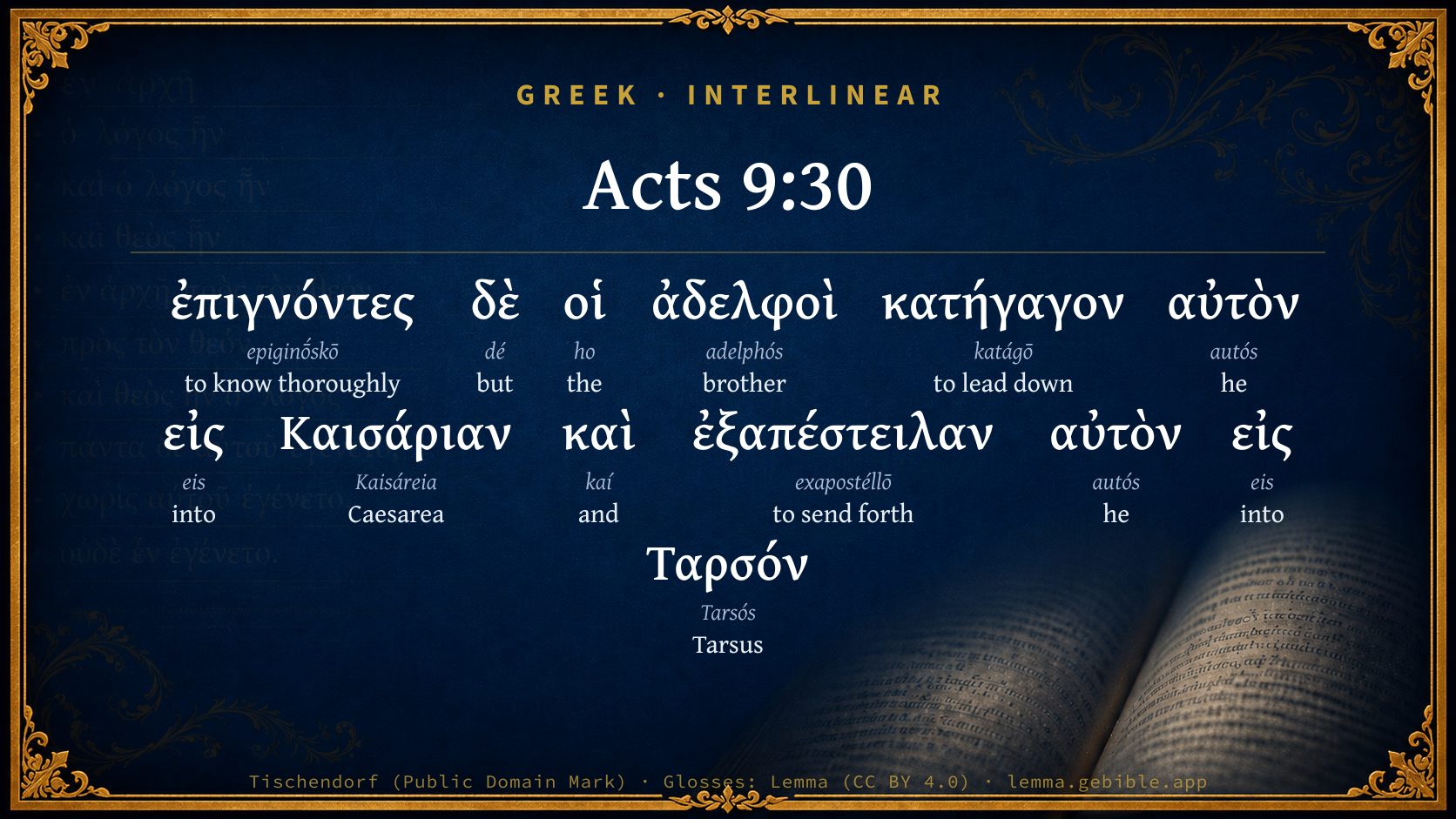
Greek (Tischendorf 8th ed.) Acts 9:30 appears in the Greek New Testament. The text above is from the Tischendorf 8th edition. Each word links to its Strong’s number and a concise gloss. Click any word for its full Thayer’s Greek Lexicon entry.
Download image
Cite this verse

Acts 9:30 (World English Bible). Public Domain. Lemma interlinear Bible study tool, https://lemma.gebible.app/v/acts/9/30.

Show BibTeX & RIS
BibTeX
RIS
English Translation
When the brothers knew it, they brought him down to Caesarea, and sent him off to Tarsus.
World English Bible · Public Domain
Highlights
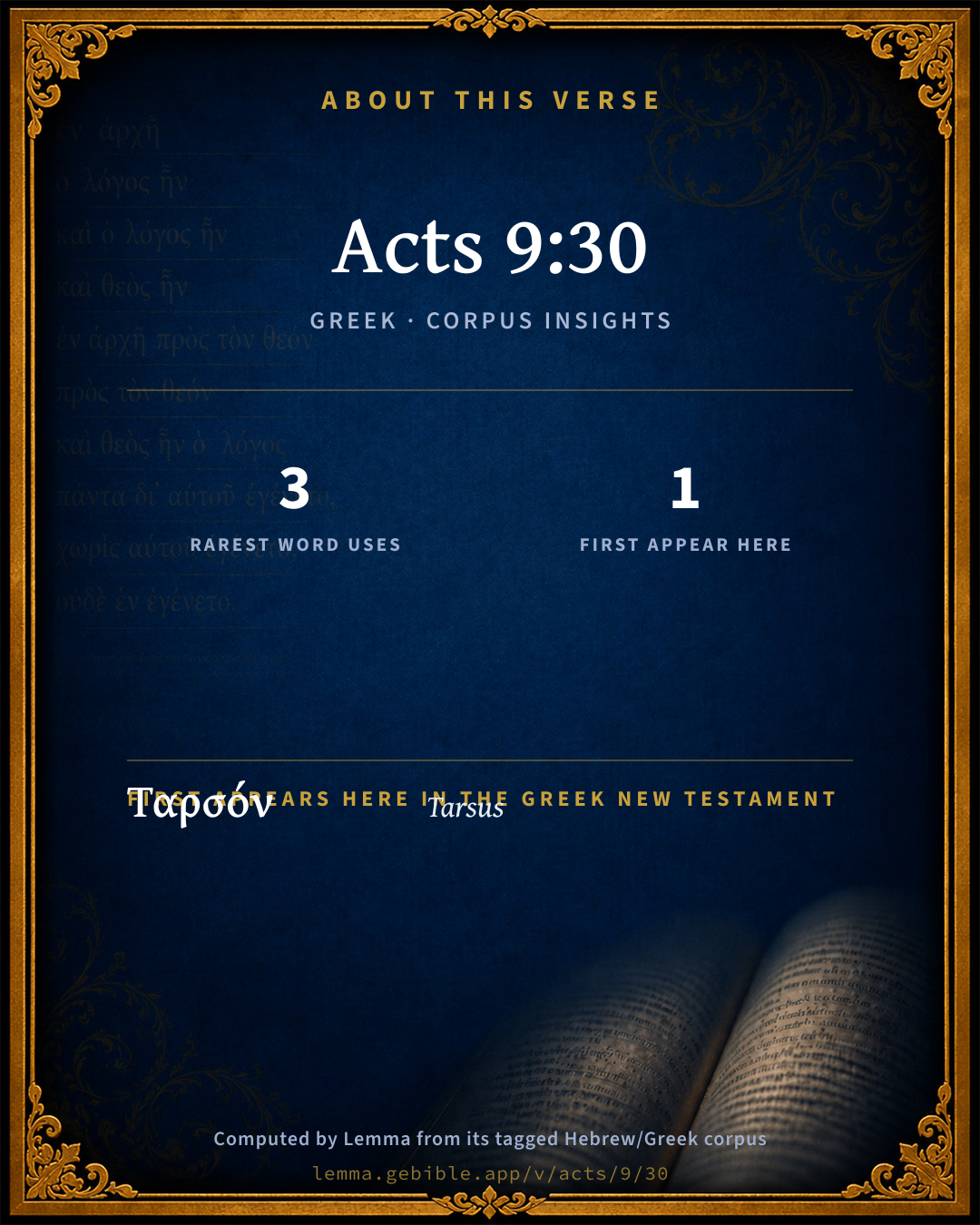
  • 1 first appearance in the Greek New Testament
Full analysis ↓
Download a study sheet

One document with this verse’s original text, its word-by-word gloss line, the meaning frame, cross-references with their text, attributed commentary, and full source and license credits — printable, and it pastes into notes with its structure intact.

This verse Autodidact and up

Study sheet (.html) Plain text (.txt)

A passage Seminary Student

Up to 50 verses in one chapter. A passage sheet keeps up to 6 commentary sources and 12 cross-references per verse, in the order this page ranks them, and says so on the sheet whenever that leaves anything out. Ask for a single verse and you get the Autodidact verse sheet above.

Everything on this page stays free to read, with no account — the sheet is a download of what is already on screen, not access to it.

Want to remove ads? Support Godless Engineer
Compare translations 3

The same verse in 3 English versions, stacked beneath the original-language interlinear above. Click any original word for its lexicon entry.

Each is an independent rendering of the whole verse — the interlinear is not word-aligned to these translations.

Highlighted words mark where these versions differ — a whole-verse word diff, not a word-by-word alignment.

  • World English Bible Public Domain
    When the brothers knew it, they brought him down to Caesarea, and sent him off to Tarsus.
  • King James Version Public Domain
    Which when the brethren knew, they brought him down to Caesarea, and sent him forth to Tarsus.
  • unfoldingWord Literal Text CC BY-SA 4.0
    But the brothers, having learned of this, brought him down to Caesarea and sent him away to Tarsus.

unfoldingWord Literal Text — © unfoldingWord, licensed CC BY-SA 4.0. Word-aligned USFM3 via Door43 (git.door43.org/unfoldingWord/en_ult).

Versions to compare (up to 4)

3 of 4 selected

Show all 19 translations

Every available English version of this verse, each an independent rendering of the whole verse.

  • World English Bible Public Domain
    When the brothers knew it, they brought him down to Caesarea, and sent him off to Tarsus.
  • Berean Standard Bible Public Domain
    When the brothers learned of this, they took him down to Caesarea and sent him off to Tarsus.
  • Majority Standard Bible Public Domain
    When the brothers learned of this, they took him down to Caesarea and sent him off to Tarsus.
  • King James Version Public Domain
    Which when the brethren knew, they brought him down to Caesarea, and sent him forth to Tarsus.
  • American Standard Version (1901) Public Domain
    And when the brethren knew it, they brought him down to Caesarea, and sent him forth to Tarsus.
  • Revised Version (1885) Public Domain
    And when the brethren knew it, they brought him down to Caesarea, and sent him forth to Tarsus.
  • Geneva Bible (1599) Public Domain
    But when the brethren knewe it, they brought him to Cesarea, and sent him forth to Tarsus.
  • Douay-Rheims (1899) Public Domain
    Which when the brethren had known, they brought him down to Caesarea, and sent him away to Tarsus.
  • Young's Literal Translation Public Domain
    and the brethren having known, brought him down to Cesarea, and sent him forth to Tarsus.
  • Literal Standard Version CC BY-SA 4.0
    and the brothers having known, brought him down to Caesarea, and sent him forth to Tarsus.
  • Unlocked Literal Bible CC BY-SA 4.0
    When the brothers learned of this, they brought him down to Caesarea and sent him away to Tarsus.
  • unfoldingWord Literal Text CC BY-SA 4.0
    But the brothers, having learned of this, brought him down to Caesarea and sent him away to Tarsus.
  • Darby Bible Public Domain
    And the brethren knowing it, brought him down to Caesarea and sent him away to Tarsus.
  • World Messianic Bible Public Domain
    When the brothers knew it, they brought him down to Caesarea and sent him off to Tarsus.
  • Webster's Bible Public Domain
    Which when the brethren knew, they brought him down to Cesarea, and sent him forth to Tarsus.
  • Free Bible Version CC BY-SA 4.0
    When the brothers learned of this they took him to Caesarea, and sent him to Tarsus.
  • Bible in Basic English Public Domain
    And when the brothers had knowledge of it, they took him to Caesarea and sent him to Tarsus.
  • Text-Critical English NT CC BY 4.0
    When the brothers found out about it, they brought him down to Caesarea and sent him off to Tarsus.
  • Tyndale New Testament (1534) Public Domain
    But when the brethren knew of that they brought hym to cesarea and sent hym forth to Tharsus.

Literal Standard Version (2020), Covenant Press — licensed CC BY-SA 4.0. Text via the HelloAO Bible API (eBible.org). Unlocked Literal Bible (unfoldingWord) — licensed CC BY-SA 4.0. Text via the HelloAO Bible API (eBible.org). unfoldingWord Literal Text — © unfoldingWord, licensed CC BY-SA 4.0. Word-aligned USFM3 via Door43 (git.door43.org/unfoldingWord/en_ult). Free Bible Version, Dr. Jonathan Gallagher — licensed CC BY-SA 4.0. Text via the HelloAO Bible API (eBible.org).

Word by word

More ways to search: Search by grammar → Find every occurrence → Compare this word →

Practice this passage: Drill this verse → Learn its vocabulary →

Ταρσόν
Tarsós
G5019
“Tarsus”
Noun, Accusative, Singular, Feminine
Part of Speech
Noun
Case
Accusative
Number
Singular
Gender
Feminine
Full Thayer's Definition

Origin: perhaps the same as tarsos (a flat basket)

TDNT: None

Tarsus = "a flat basket" 1. a major city in Cilicia and the birthplace and early home of Paul. Acts 9:11 ; 21:39 ; 22:3 . Even in the flourishing period of Greek history it was an important city. In the Roman civil wars, it sided with Caesar and on the occasion of a visit from him its name changed to Juliopolis. Augustus made it a free city. Its was renowned as a place of education under the early Roman emperors. Strabo compares it in this respect to Athens and Alexandria. Tarsus also was a place of much commerce. It was situated in a wild and fertile plain on the banks of the Cydnus. No ruins of any importance remain.
  1. ἐπιγνόντες epiginṓskō G1921 “to know thoroughly” Verb, Aorist, Active, Participle, Nominative, Plural, Masculine
  2. δὲ dé G1161 “but” Conjunction
  3. οἱ ho G3588 “the” Article, Nominative, Plural, Masculine
  4. ἀδελφοὶ adelphós G80 “brother” Noun, Nominative, Plural, Masculine
  5. κατήγαγον katágō G2609 “to lead down” Verb, Aorist, Active, Indicative, 3rd person, Plural
  6. αὐτὸν autós G846 “he” Personal pronoun, Accusative, Singular, Masculine
  7. εἰς eis G1519 “into” Preposition
  8. Καισάριαν Kaisáreia G2542 “Caesarea” Noun, Accusative, Singular, Feminine
  9. καὶ kaí G2532 “and” Conjunction
  10. ἐξαπέστειλαν exapostéllō G1821 “to send forth” Verb, Aorist, Active, Indicative, 3rd person, Plural
  11. αὐτὸν autós G846 “he” Personal pronoun, Accusative, Singular, Masculine
  12. εἰς eis G1519 “into” Preposition

About this verse

These counts appear in no published source. They are computed here, from the morphology-tagged text and Lemma’s own curated glosses. What Lemma adds →

13
words
11
distinct lemmas
Acts
section

Notable vocabulary

The rarest word here is Ταρσόν Tarsus G5019 — appearing just 3 times in the whole Greek New Testament.

First appearance in Scripture

This word makes its first canonical appearance in the Greek New Testament here:

  • Ταρσόν Tarsus G5019

Shared distinctive vocabulary

Ταρσόν Tarsus G5019 occurs in 3 verses of the Greek New Testament. Also found in:
Repetition

Words recur within this verse:

  • εἰς into G1519 ×2
  • αὐτὸν he G846 ×2

Cross-references

9

Topical passages linked to Acts 9:30 in the Treasury of Scripture Knowledge — connected by theme and wording, ordered by reader-vote popularity; previews shown in the World English Bible.

  • Acts 8:40 But Philip was found at Azotus. Passing through, he preached the Gospel to all the cities, until he came to Caesarea.
  • Acts 9:11 The Lord said to him, "Arise, and go to the street which is called Straight, and inquire in the house of Judas for one named Saul, a man of Tarsus. For behold, he is praying,
  • Acts 11:25 Barnabas went out to Tarsus to look for Saul.
  • Galatians 1:21 Then I came to the regions of Syria and Cilicia.
  • Matthew 10:23 But when they persecute you in this city, flee into the next, for most assuredly I tell you, you will not have gone through the cities of Israel, until the Son of Man has come.
  • Matthew 16:13 Now when Jesus came into the parts of Caesarea Philippi, he asked his disciples, saying, "Who do men say that I, the Son of Man, am?"
  • Acts 9:24–25 but their plot became known to Saul. They watched the gates both day and night that they might kill him,
  • Acts 17:10 The brothers immediately sent Paul and Silas away by night to Beroea. When they arrived, they went into the Jewish synagogue.
  • Acts 17:15 But those who escorted Paul brought him as far as Athens. Receiving a commandment to Silas and Timothy that they should come to him very quickly, they departed.

Cross-references courtesy of OpenBible.info (CC BY 4.0).

Commentary

Notes on Acts 9:30 from classic Christian and Jewish commentators (each source and its license shown beneath its notes). The classic Christian expositions comment on the surrounding passage and are grouped to its opening verse, so a note may address several verses; the Jewish commentaries on the Tanakh (Rashi and others) are per-verse, so they appear only where the commentator wrote on this verse.

Lemma curates 59 commentaries, every one of them public domain or Creative Commons licensed, each selected and text-cleaned for this edition rather than reprinted as found. About our sources →

Tyndale Open Study Notes

Tyndale Open Resources

9:30 After the believers heard about the plot, Saul was once again sent away (cp. 9:25), this time to Tarsus, his hometown, the capital of Cilicia (see 21:39; 22:3; 23:34; cp. Gal 1:21).

Tyndale Open Study Notes — © Tyndale Open Resources, licensed CC BY-SA 4.0. Text via the HelloAO Bible API.

Expositor's Greek Testament

ed. W. Robertson Nicoll

Act 9:30 . ἐπιγνόντες : the preposition may signify here as elsewhere accurate and certain knowledge or information a favourite word with St. Luke, in the Gospel seven times, in Acts thirteen times; it was also a favourite word with St. Paul, cf., e.g. , 1Co 13:12 , 2Co 6:9 ; frequent in LXX, or it may simply mean to find out, to ascertain (Grimm); see Blass in loco on its force in LXX. 5. οἱ ἀδελφοὶ : the expression seems expressly used to imply that the disciples at Jerusalem recognised Saul as a brother. Wendt (1899) rejects all the narrative in Acts as unhistorical, and compares with the statement here Gal 1:22 ; but there mention is only made of the “Churches of Judæa,” whilst the inference that Paul could scarcely fail to have been known to the members of the Church in Jerusalem seems quite justifiable, Lightfoot, Galatians , p. 86. κατήγαγον , i.e. , brought him down to the sea coast, ad mare deduxerunt , word used only by Luke and Paul; but by St. Luke only as a nautical expression, cf. Act 27:3 , Act 28:12 (Act 21:3 ), and Luk 5:11 ; so in classical writers. εἰς Κ . as in Act 8:40 (not Cæsarea Philippi which is always so called); if he found Philip there (Act 21:8 ), the friend and the accuser of the proto-martyr would meet face to face as brethren (Plumptre). ἐξαπέστειλαν : the word might mean by sea or by land, but the former is supported amongst recent commentators by Blass, so too Page ( cf. Lightfoot on Gal 1:21 , p. 85), Knabenbauer, p. 174. But if so, there is no contradiction with Gal 1:21 , where Paul speaks of coming into the regions of Syria and Cilicia, as if hwent to the latter through the former. The expressions in Galatians have sometimes been explained on the supposition that the two countries, Syria and Cilicia, are named there as elsewhere in that order, Act 15:23 ; Act 15:41 , as a kind of general geographical expression (Felten), the most important country being mentioned first, so Lightfoot, Nösgen, Conybeare and Howson; or that as Paul would remain at Syrian ports on the way to Cilicia, he might fairly speak as he does, or that he went first to Tarsus, and thence made missionary excursions into Syria. If neither of these or similar explanations are satisfactory, we can scarcely conclude with Blass that Gal 1:21 is accounted for “inverso per incuriam ordine”. Ramsay has lately argued with much force that here as elsewhere Paul thinks and speaks of the Roman divisions of the empire ( cf. Zahn, Einleitung in das N. T. , i., p. 124 (1897)), and that here the two great divisions, Syria and Cilicia, of the Roman province are spoken of; and he accordingly reads, with the original text of [232] , τὰ κλίματα τῆς Σ . καὶ Κ ., the article used once, and thus embracing the two parts of the one province (sometimes three parts are enumerated, Phœnicia being distinguished from Syria). There is apparently no example of the expression Prov. Syria et Cilicia , but Ramsay points to the analogy of Bithynia-Pontus; see Expositor , p. 29 ff., 1898, and “Cilicia” and “Bithynia” (Ramsay) in Hastings’ B.D. Ramsay therefore concludes that Gal 1:21 simply implies that Paul spent the following period of his life in various parts of the province Syria-Cilicia. Ταρσόν , see above, Act 9:11 ; on the years of quiet work at Tarsus and in its neighbourhood, see Ramsay, St. Paul , pp. 46, 47, and below on Act 11:25 .

[232] Codex Sinaiticus (sæc. iv.), now at St. Petersburg, published in facsimile type by its discoverer, Tischendorf, in 1862.

The Expositor's Greek Testament, edited by W. Robertson Nicoll (1897–1910) — public domain. Text from a community e-Sword module.

Geneva Bible (1599)

Geneva Bible translators

The ministers of the word may change their place, by the advice and counsel of the congregation and Church.

Geneva Bible (1599) marginal notes — public domain. Text via Bolls.life.

Jamieson, Fausset & Brown

Robert Jamieson, A. R. Fausset & David Brown

they brought him down to Cæsarea--on the coast (see on Act 8:40); accompanying him thus far. But Paul had another reason than his own apprehension for quitting Jerusalem so soon. "While he was praying in the temple, he was in a trance," and received express injunctions to this effect. (See on Act 22:17-21).

and sent him forth to Tarsus--In Gal 1:21 he himself says of this journey, that he "came into the regions of Syria and Cilicia"; from which it is natural to infer that instead of sailing direct for Tarsus, he landed at Seleucia, travelled thence to Antioch, and penetrated from this northward into Cilicia, ending his journey at Tarsus. As this was his first visit to his native city since his conversion, so it is not certain that he ever was there again. (See on Act 11:25). It probably was now that he became the instrument of gathering into the fold of Christ those "kinsmen," that "sister," and perhaps her "son," of whom mention is made in Act 23:16, &c.; Rom 16:7, Rom 16:11, Rom 16:21 [HOWSON].

Jamieson, Fausset & Brown — Commentary Critical and Explanatory on the Whole Bible (1871) — public domain (CC PDM 1.0). Text via the HelloAO Bible API.

Adam Clarke's Commentary

Verse 30. They brought him down to Caesarea] Calmet contends that this was Caesarea of Palestine, and not Caesarea Philippi; it being his opinion, and indeed that of others, that where this word occurs without any addition, in the New Testament, Caesarea of Palestine is meant, and not Caesarea Philippi. See Clarke on Ac 8:40.

Sent him forth to Tarsus.] This was his own city; and it was right that he should proclaim to his own countrymen and relatives that Gospel through which he was become wise to salvation.

Adam Clarke's Commentary on the Bible (1810–1826) — public domain. Text from a community e-Sword/MySword module.

John Calvin's Commentaries

30. In that he went to Tarsus, he did it undoubtedly to this end, that he might carry the doctrine of the gospel thither, because he hoped that he should have some favor and authority in his country, where he was famous; yet was he brought thither by the brethren, that they might deliver him from the lying in wait.

John Calvin's Commentaries (1540-1563) — public domain. Text from the Calvin Translation Society English edition (1840s-50s) via the Christian Classics Ethereal Library (ccel.org). Calvin's coverage is partial (roughly two-thirds of the Bible); uncommented books and verses are honest gaps, never fabricated. The 19th-century editor's footnotes and remarks are omitted so the notes are faithfully Calvin's own voice.

Ellicott's Commentary for English Readers

(30) They brought him down to Cæsarea.—The fact that the brethren at Jerusalem took these measures for the Apostle’s safety may be noted as a proof of their friendship. At Cæsarea he would probably, as afterwards in Act_21:8, find Philip, and the friend and the accuser of the proto-martyr met face to face as brethren. In returning to his home at Tarsus, from which he had been absent at the least for four years, and possibly for a much longer period, it would be natural for him to resume his old employment as a tent-maker. (See Note on Act_18:3.) Thence, as from a centre, he did his work as an Evangelist in the regions of Cilicia (Gal_1:21), where, in Act_15:41, we find churches already organised, which had not been founded in what we call the first mission journey of Paul and Barnabas, and must therefore have been planted by the former at an earlier period. Here, for the present, we lose sight of him. It need hardly be said that the Cæsarea here spoken of is that on the sea-coast. Cæsarea Philippi is always distinguished by its special epithet.

A Bible Commentary for English Readers, edited by Charles John Ellicott (1878–1897) — public domain. Text from a community e-Sword module.

The Cambridge Bible for Schools and Colleges

gen. ed. J. J. S. Perowne

30. Which when the brethren knew] Lit. “And when the brethren knew it.” The disciples were informed as those of Damascus had been of the plot in that city.

they brought him down to Cesarea] i.e. to the seaport so called, not to Cæsarea Philippi, for the latter place was only touched by the road which led from Tyre to Damascus. The former was a place from which Tarsus could be reached either by sea or by the road which ran northward along the coast of Syria.

and sent him forth to Tarsus] where he was born, and which perhaps, next to Jerusalem, would appear to be the best centre from which his work could be carried on. For an account of Tarsus and its fame as a seat of heathen learning, see Dict. of the Bible.

The Cambridge Bible for Schools and Colleges (gen. ed. J. J. S. Perowne; Cambridge University Press, 1878–1918) — public domain. Text from a community e-Sword module.

John Gill's Exposition

Then had the churches rest,.... Meaning not spiritual rest in Christ; this they had before, even in tribulation, but rest from persecution; not so much because of the conversion of Saul, the great persecutor of them, for his conversion had been three years before; but rather because of his removal to other parts, the sight of whose person, and especially his ministry, had afresh stirred up the Jews to wrath and fury. The Alexandrian copy, and some others, the Vulgate Latin, Syriac, and Ethiopic versions, read in the singular number, "the church": but the several countries hereafter mentioned shows that more are designed: for it follows,

throughout all Judea, and Galilee, and Samaria; for by means of the dispersion, on account of persecution, the Gospel was preached in these several places, and churches gathered, and which shared in the persecution until this time, when they began to have rest; Gal 1:22 Th1 2:14 and were edified; or built up on the foundation Christ, and their most holy faith, through the ministry of the word and ordinances, and their mutual love and holy conversation; and had an increase of members, and of grace, and of spiritual knowledge:

and walking in the fear of the Lord; which was always before their eyes, and upon their hearts, continuing in religious exercises, and in the discharge of every duty, both to God and man. Not in a slavish fear of the wrath of the Lord, and of damnation for sin committed against him; for this is not consistent with their characters, as Gospel churches, made of persons who had received not the spirit of bondage to fear, but the Spirit of adoption, nor with their edification in faith and holiness; for "he that feareth is not made perfect in love"; Jo1 4:18 which edifies; nor with the comforts of the Holy Ghost, they are afterwards said to walk in: but in a godly fear, which has the Lord for its author, is not of a man's self, but of the grace of God, and is encouraged and increased by the discoveries of his grace and goodness: and which has the Lord for its object, whose name is holy and reverend, and is to be feared by all his saints: it shows itself in an hatred of sin; in a departure from it; in a carefulness not to offend the Lord; in withholding nothing from him, though ever so dear and valuable, he calls for; and in attending to all the parts of divine worship: and walking in it denotes a continuance in it, a constant progression in all the acts of internal and external worship, which are both included in the fear of the Lord; and it requires strength, and supposes pleasure and freedom. It is said of Enoch, that "he walked with God"; which the Targum of Onkelos paraphrases, "he walked in the fear of the Lord", Gen 5:22 the same phrase which is here used.

And in the comfort of the Holy Ghost: which he communicated by shedding abroad the love of God in them, taking the things of Christ, and showing them to them, applying covenant blessings and Gospel promises to their souls, owning the word and ordinances, and making them useful to them, thereby leading them into fellowship with the Father, and with the Son. In all which he acts the part of a Comforter, and answers to the character he bears, and the office he is in: the love of God, which he directs into, and sheds abroad in the heart, refreshes and revives the Spirit of God's people; it influences and encourages every grace that is wrought in them; and makes them easy and comfortable under all providences, even the most afflicting ones: the things of Christ he takes and shows unto them are his blood, righteousness, and sacrifice; which being applied, and interest in them shown, produce abundance of peace, joy, and comfort: the promises of the covenant, and of the Gospel, he opens and applies, being such as hold forth the blessings of grace unto them; and being exceeding great, and precious, and suitable to their cases; and being absolute and unconditional, immutable, and sure, afford them much pleasure and satisfaction: and the word and ordinances being attended with the Holy Ghost, and much assurance, are breasts of consolation to them: and "walking" in those comforts which he administers, by such means, denotes a continuance of them, a long enjoyment of them, which is not very common; for, generally speaking, these comforts last but for a small time; and also it intimates much delight and pleasure in them, Psa 94:19 and so "were multiplied"; both in their gifts and graces, and in the number of converts added to them.

John Gill's Exposition of the Whole Bible (1746–1763) — public domain (CC PDM 1.0). Text via the HelloAO Bible API.

Trapp's Complete Commentary

John Trapp

30 Which when the brethren knew, they brought him down to Caesarea, and sent him forth to Tarsus.

Ver. 30. To Tarsus] His own country, that he might there break the bread of life where he first drew the breath of life, as Bishop Jewel desired to do. Physician, heal thyself, that is, thine own native country, said they to our Saviour, Luk 4:23.

John Trapp, A Commentary or Exposition upon All the Books of the Old and New Testament (1647–1656) — public domain. Text from a community e-Sword module.

Albert Barnes' Notes on the Bible

To Cesarea - See the notes on Act 8:40.

And sent him forth to Tarsus - This was his native city. See the notes on Act 9:11. It was in Cilicia, where Paul doubtless preached the gospel, Gal 1:21, “Afterward I came into the regions of Syria and Cilicia.”

Albert Barnes' Notes on the Bible (1834–1885) — public domain. Text from a community e-Sword/MySword module.

Matthew Poole's English Annotations

Caesarea; there were two towns of this name, one a coast town, spoken of, Act 8:40; the other was called Caesarea Philippi, nigh Mount Lebanon.

Tarsus, St. Paul’s birth place, where amongst his relations and acquaintance they might hope he would be safe.

Matthew Poole's English Annotations on the Holy Bible (1683–1685) — public domain. Text from a community e-Sword/MySword module.

Whedon's Commentary on the Bible

Daniel D. Whedon

30. Cesarea—See note on Act_8:40.

To Tarsus—By sea or land? Probably by land. We have shown in our notes on Act_8:40, how Philip the evangelist skirted along the beautiful Mediterranean coast, preaching in its ancient cities as he went, until he arrived at Cesarea. Saul takes up the line of march where he stopped, and preaches his way from Cesarea to his Cilician home of Tarsus. It was no doubt at this time that the Churches of Syria and Cilicia (Act_15:23) were founded by Saul. In Tarsus Saul remained until called thence by Barnabas, (Act_11:25.)

Daniel D. Whedon (gen. ed.), Commentary on the Old and New Testaments (1874–1909) — public domain. Text from a community e-Sword module.

The Pulpit Commentary

And when the brethren knew it for which when the brethren knew, A.V St. Paul gives another reason for his hasty departure from Jerusalem in his speech from the castle stairs. (Act_22:17-21) Caesarea, when standing alone, means Caesarea Stratonis, or Paraliov, or Sebaste, the seaport and Roman garrison of that name, as distinguished from Caesarea Philippi, (see Alford"s note on Act_8:30) and is always so used by St. Luke. (Luk_8:40 Luk_10:1, 24 18:22 21:8, 16 23:23, 33, showing it was a seaport) There is no reasonable doubt that it means the same place here. A seaport, near to Jerusalem, and with Roman protection, affording access to Tarsus either by sea or land as should seem best, was the natural place for Paul"s friends to take him to. If further proof were wanting, it could be found in the phrase, "brought him down," as compared with the converse, "gone up", (Act_18:22) "ascended", (Act_25:1) when the journey was from Caesarea to Jerusalem. To Tarsus. A glance at the map will show that, starting from Caesarea, a person might either go by land along the sea-coast of Phoenicia, through Acre, Tyre, Sidon, Beyrout, Tripolis, Antioch, Issus, to Tarsus; or by sea to any of the intermediate ports between Caesarea and Tarsus; or rather the artificial harbor at the mouth of the Cydnus which formed the seaport of Tarsus. It is not improbable that Paul landed at Selcucia, since he says (Gal_1:21) that he came at this time "into the regions of Syria and Cilicia," which is exactly what he would have done if he had landed at Seleucia, the seaport of Antioch.

The Pulpit Commentary (1880–1919), ed. H.D.M. Spence-Jones & Joseph S. Exell — public domain. Text from a community e-Sword module.

McGarvey & Pendleton's Commentaries

J. W. McGarvey

30. In this emergency, the brethren found opportunity to make amends for the suspicion with which they had at first regarded him. (30) " And when the brethren knew this, they took him down to Cæsarea, and sent him forth to Tarsus. " We learn, from Paul's own account of this movement, that it was not controlled by his own judgment, nor entirely by that of the brethren. While praying in the temple, he fell into a trance, in which the Lord appeared to him, and said, "Make haste, and get quickly out of Jerusalem; for they will not receive your testimony concerning me." Saul had, himself, come to a very different conclusion. Notwithstanding the murderous disposition of his opponents, he still believed that his labors among them would prove successful. He argued upon the supposition that his former position as a persecutor, like them, would now give peculiar weight, with them, to his testimony and arguments; and he ventured to urge this consideration upon the attention of the Lord: "Lord, they know that I am imprisoned and beat in every synagogue those who believe on thee; and when the blood of Stephen thy witness was shed, I was myself standing by and consenting to his death, and keeping the raiment of those who slew him." But he had erred in overlooking the peculiar odium attached to the character of one who could be styled a deserter, inclining men to listen more favorably to an habitual opponent than to him. The Lord did not argue the case with him, but peremptorily commanded him, "Depart; for I will send you far hence to the Gentiles." The fears of the brethren were confirmed by this decision of the Lord, and they promptly sent him to a place of safety.

After reaching Cæsarea, a short voyage on the Mediterranean and up the Cyndus brought him to Tarsus, the home of his childhood, and perhaps of his earlier manhood. He returns to his aged parents and the friends of his childhood, a fugitive from two great cities, and a deserter from the strictest sect in which he had been educated; but he comes to bring them glad tidings of great joy. He disappears, at this point from the pages of Luke; but he does not retire into inactivity. His own pen fills up the blank that is left there by the historian. He says that he went "into the regions of Syria and Cilicia, and was unknown by face to the Churches in Judea who were in Christ; but they heard only that he who once persecuted us is now preaching the faith which he once destroyed. And they glorified God in me." Not long after this we find mention of brethren in Syria and Cilicia, which renders it probable that his labors that were attended with his usual success. We have reason also to believe that he encountered, during this interval, a portion of the sufferings enumerated in the eleventh chapter of Second Corinthians ; such as the five times that he received from the Jews forty stripes save one, the three shipwrecks, and the night and the day that he spent in the deep. We can not refer them to a later period; for, from this interval to the time of writing that epistle, we have a continuous history of his life, in which they do not occur.

We now part company with Saul for a time, and while he is performing labors, and enduring afflictions, the full detail of which we will never learn till we meet him in eternity, we turn with our inspired guide, to contemplate some instructive scenes in the labors of the Apostle Peter.

J. W. McGarvey (with Philip Y. Pendleton), Commentaries on the New Testament (The Fourfold Gospel, 1914; Acts; and the epistles) — public domain. Text from a community e-Sword/MySword module.

The People's New Testament

B. W. Johnson

30. They brought him down to Cæsarea. The same class of Jews who had raised the persecution against Stephen now sought the death of Saul. By the aid of the brethren he was taken to the seaport of Cæsarea and sailed for his old home at Tarsus. Some think, however, from Gal. 1:21, that the journey was made by land through Syria. It is more likely that he sailed from Cæsarea to Seleucia in Syria, and from thence made his way to Tarsus. Four or five years pass before the next mention of Saul in Acts (12:25), an interval passed in preaching Christ (Gal. 1:23), and resulting in the planting of churches in Cilicia (Acts 15:23, 41).

B. W. Johnson's The People's New Testament with Notes (1889–1891) — public domain. Electronic text from the Christian Classics Ethereal Library (CCEL) ThML edition.

Cambridge Greek Testament for Schools and Colleges

30. ἐπιγνόντες δὲ οἱ ἀδελφοί, and when the brethren were aware of it. The disciples in Jerusalem, just as those in Damascus, got information about the plot which was being laid against Saul.

κατήγαγον αὐτὸν εἰς Καισάρειαν, they brought him down to Cæsarea, i.e. to the seaport so called, not to Cæsarea Philippi, for the latter place was only touched by the road which led from Tyre to Damascus. The former was a place from which Tarsus could be reached either by sea or by the road which ran northward along the coast of Syria.

εἰς Ταρσόν, to Tarsus, where he was born, and which perhaps, next to Jerusalem, would appear to be the best centre from which his work could be carried on. For an account of Tarsus and its fame as a seat of heathen learning, see Dict. of the Bible.

Cambridge Greek Testament for Schools and Colleges (Cambridge University Press, 1896; 21 vols, various authors incl. Carr, Maclear, Plummer, Farrar, Lumby, Moule, M. R. James, Simcox) — public domain. Text from a community e-Sword module.

Alford’s Greek Testament

Henry Alford

30. ἐπιγνόντες δὲ …] There was also another reason. He was praying in the temple, and saw the Lord in a vision, who commanded him to depart, for they would not receive his testimony:—and sent him from thence to the Gentiles: see ch. 22:17-21 and notes. His stay in Jerusalem at this visit was fifteen days, Gal 1:18.

εἰς Καισάρειαν] From the whole cast of the sentence, the κατήγαγον and ἐξαπέστειλαν, we should infer this to be Cæsarea Stratonis [see on ch. 10:1], even if this were not determined by the word Καισάρεια used absolutely, which always applies to this city, and not to Cæsarea Philippi (which De Dieu, Olsh., and others believe to be meant [see Mat 16:13 and note]). From Gal 1:21, it would appear that Saul about this time traversed Syria (on his way to Tarsus?). If so, he probably went by sea to Selencia, and thence to Antioch. The ἐξαπέστειλαν looks more like a ‘sending off’ by sea, than a mere ‘sending forward’ by land.

εἰς Ταρσόν] towards, ‘for,’ Tarsus. He was not idle there, but certainly preached the Gospel, and in all probability was the founder of the churches alluded to ch. 15:23 and 41.

Henry Alford, The Greek Testament (1849–1861) — public domain. Text from a community e-Sword module.

Lesson kit

Teaching starters — assembled from the data on this page, not authored interpretation. Every prompt links to the verse data it draws on. Edit before teaching.

Acts, in the Acts, opens this verse with 13 words (11 distinct Greek lemmas). Its most distinctive word is Tarsós (“Tarsus”). A historical commentator’s framing appears above. Read the whole chapter for the surrounding context.

Discussion questions

  1. What does “Tarsus” (Tarsós) contribute to the verse as a whole?
  2. This is the first place “Tarsus” appears in Scripture (first appears here). What does its debut here establish?
  3. How does Acts 11:25, which shares the word «Tarsus», read alongside this verse?
  4. What does the repetition of “into” (2× in this one verse) do in this verse?
  5. The translations on this page render this verse differently — a whole-verse word diff, not a word-by-word alignment. What might account for the different wordings?
  6. Compare how Tyndale Open Study Notes and Expositor's Greek Testament read this verse. Where do they agree or differ?

Things to notice

  • 1 word makes its first canonical appearance in Scripture here.
  • These translations choose different wording for 10 words in this verse.
  • “into” occurs 2× in this single verse.
  • 11 distinct Greek lemmas span 13 words in this verse.

Reading settings

Reading text

Shown beneath each verse's original-language words.

Old Testament
Old Testament edition

Read the OT as the Masoretic Hebrew (MT) or the Greek Septuagint (LXX).

English shown for the Greek Septuagint (in the Hebrew ↔ Greek comparison).

Comparing translations? Open the Compare panel on any verse page to stack up to four side by side.