
1 Corinthians 15:58

Greek (Tischendorf 8th ed.) 1 Corinthians 15:58 appears in the Greek New Testament. The text above is from the Tischendorf 8th edition. Each word links to its Strong’s number and a concise gloss. Click any word for its full Thayer’s Greek Lexicon entry.
Download image
Cite this verse

1 Corinthians 15:58 (World English Bible). Public Domain. Lemma interlinear Bible study tool, https://lemma.gebible.app/v/1-corinthians/15/58.

Show BibTeX & RIS
BibTeX
RIS
English Translation
Therefore, my beloved brothers, be steadfast, immovable, always abounding in the Lord's work, because you know that your labor is not in vain in the Lord.
World English Bible · Public Domain
Highlights
  • 1 hapax legomenon — only here in the Greek New Testament
  • 1 first appearance in the Greek New Testament
Full analysis ↓
Download a study sheet

One document with this verse’s original text, its word-by-word gloss line, the meaning frame, cross-references with their text, attributed commentary, and full source and license credits — printable, and it pastes into notes with its structure intact.

This verse Autodidact and up

Study sheet (.html) Plain text (.txt)

A passage Seminary Student

Up to 50 verses in one chapter. A passage sheet keeps up to 6 commentary sources and 12 cross-references per verse, in the order this page ranks them, and says so on the sheet whenever that leaves anything out. Ask for a single verse and you get the Autodidact verse sheet above.

Everything on this page stays free to read, with no account — the sheet is a download of what is already on screen, not access to it.

Want to remove ads? Support Godless Engineer
Compare translations 3

The same verse in 3 English versions, stacked beneath the original-language interlinear above. Click any original word for its lexicon entry.

Each is an independent rendering of the whole verse — the interlinear is not word-aligned to these translations.

Highlighted words mark where these versions differ — a whole-verse word diff, not a word-by-word alignment.

  • World English Bible Public Domain
    Therefore, my beloved brothers, be steadfast, immovable, always abounding in the Lord's work, because you know that your labor is not in vain in the Lord.
  • King James Version Public Domain
    Therefore, my beloved brethren, be ye stedfast, unmoveable, always abounding in the work of the Lord, forasmuch as ye know that your labour is not in vain in the Lord.
  • unfoldingWord Literal Text CC BY-SA 4.0
    Therefore, my beloved brothers, become steadfast, immovable, always abounding in the work of the Lord, knowing that your labor is not in vain in the Lord.

unfoldingWord Literal Text — © unfoldingWord, licensed CC BY-SA 4.0. Word-aligned USFM3 via Door43 (git.door43.org/unfoldingWord/en_ult).

Versions to compare (up to 4)

3 of 4 selected

Show all 19 translations

Every available English version of this verse, each an independent rendering of the whole verse.

  • World English Bible Public Domain
    Therefore, my beloved brothers, be steadfast, immovable, always abounding in the Lord's work, because you know that your labor is not in vain in the Lord.
  • Berean Standard Bible Public Domain
    Therefore, my beloved brothers, be steadfast and immovable. Always excel in the work of the Lord, because you know that your labor in the Lord is not in vain.
  • Majority Standard Bible Public Domain
    Therefore, my beloved brothers, be steadfast and immovable. Always excel in the work of the Lord, because you know that your labor in the Lord is not in vain.
  • King James Version Public Domain
    Therefore, my beloved brethren, be ye stedfast, unmoveable, always abounding in the work of the Lord, forasmuch as ye know that your labour is not in vain in the Lord.
  • American Standard Version (1901) Public Domain
    Wherefore, my beloved brethren, be ye stedfast, unmoveable, always abounding in the work of the Lord, forasmuch as ye know that your labor is not vain in the Lord.
  • Revised Version (1885) Public Domain
    Wherefore, my beloved brethren, be ye stedfast, unmoveable, always abounding in the work of the Lord, forasmuch as ye know that your labour is not vain in the Lord.
  • Geneva Bible (1599) Public Domain
    Therefore my beloued brethren, be ye stedfast, vnmoueable, aboundant alwayes in the worke of the Lord, forasmuch as ye knowe that your labour is not in vaine in the Lord.
  • Douay-Rheims (1899) Public Domain
    Therefore, my beloved brethren, be ye steadfast and unmoveable; always abounding in the work of the Lord, knowing that your labour is not in vain in the Lord.
  • Young's Literal Translation Public Domain
    so that, my brethren beloved, become ye stedfast, unmovable, abounding in the work of the Lord at all times, knowing that your labour is not vain in the Lord.
  • Literal Standard Version CC BY-SA 4.0
    so that, my beloved brothers, become steadfast, unmovable, abounding in the work of the LORD at all times, knowing that your labor in the LORD is not vain.
  • Unlocked Literal Bible CC BY-SA 4.0
    Therefore, my dear brothers, be steadfast and immovable. Always abound in the work of the Lord, because you know that your work in the Lord is not in vain.
  • unfoldingWord Literal Text CC BY-SA 4.0
    Therefore, my beloved brothers, become steadfast, immovable, always abounding in the work of the Lord, knowing that your labor is not in vain in the Lord.
  • Darby Bible Public Domain
    So then, my beloved brethren, be firm, immovable, abounding always in the work of the Lord, knowing that your toil is not in vain in [the] Lord.
  • World Messianic Bible Public Domain
    Therefore, my beloved brothers, be steadfast, immovable, always abounding in the Lord’s work, because you know that your labor is not in vain in the Lord.
  • Webster's Bible Public Domain
    Therefore, my beloved brethren, be ye steadfast, immovable, always abounding in the work of the Lord, forasmuch as ye know that your labor is not in vain in the Lord.
  • Free Bible Version CC BY-SA 4.0
    So my dear brothers and sisters: be strong, stand firm, doing everything you can for the Lord's work, since you know that nothing you do in the Lord is wasted.
  • Bible in Basic English Public Domain
    For this cause, my dear brothers, be strong in purpose and unmoved, ever giving yourselves to the work of the Lord, because you are certain that your work is not without effect in the Lord.
  • Text-Critical English NT CC BY 4.0
    So then, my beloved brothers, be steadfast and immovable, always abounding in the work of the Lord, knowing that your labor in the Lord is not in vain.
  • Tyndale New Testament (1534) Public Domain
    Therfore my deare brethren be ye stedfast and unmovable alwayes ryche in the workes of the Lorde for as moch as ye knowe how that youre labour is not in vayne in the Lorde.

Literal Standard Version (2020), Covenant Press — licensed CC BY-SA 4.0. Text via the HelloAO Bible API (eBible.org). Unlocked Literal Bible (unfoldingWord) — licensed CC BY-SA 4.0. Text via the HelloAO Bible API (eBible.org). unfoldingWord Literal Text — © unfoldingWord, licensed CC BY-SA 4.0. Word-aligned USFM3 via Door43 (git.door43.org/unfoldingWord/en_ult). Free Bible Version, Dr. Jonathan Gallagher — licensed CC BY-SA 4.0. Text via the HelloAO Bible API (eBible.org).

Word by word

More ways to search: Search by grammar → Find every occurrence → Compare this word →

Practice this passage: Drill this verse → Learn its vocabulary →

ἀμετακίνητοι
ametakínētos
G277
“unmoved”
Adjective, Nominative, Plural, Masculine
Part of Speech
Adjective
Case
Nominative
Number
Plural
Gender
Masculine
Full Thayer's Definition

Origin: from G1 (as a negative particle) and a derivative of G3334

TDNT: None

1. not to be moved from its place, unmoved 2. metaph. firmly persistent
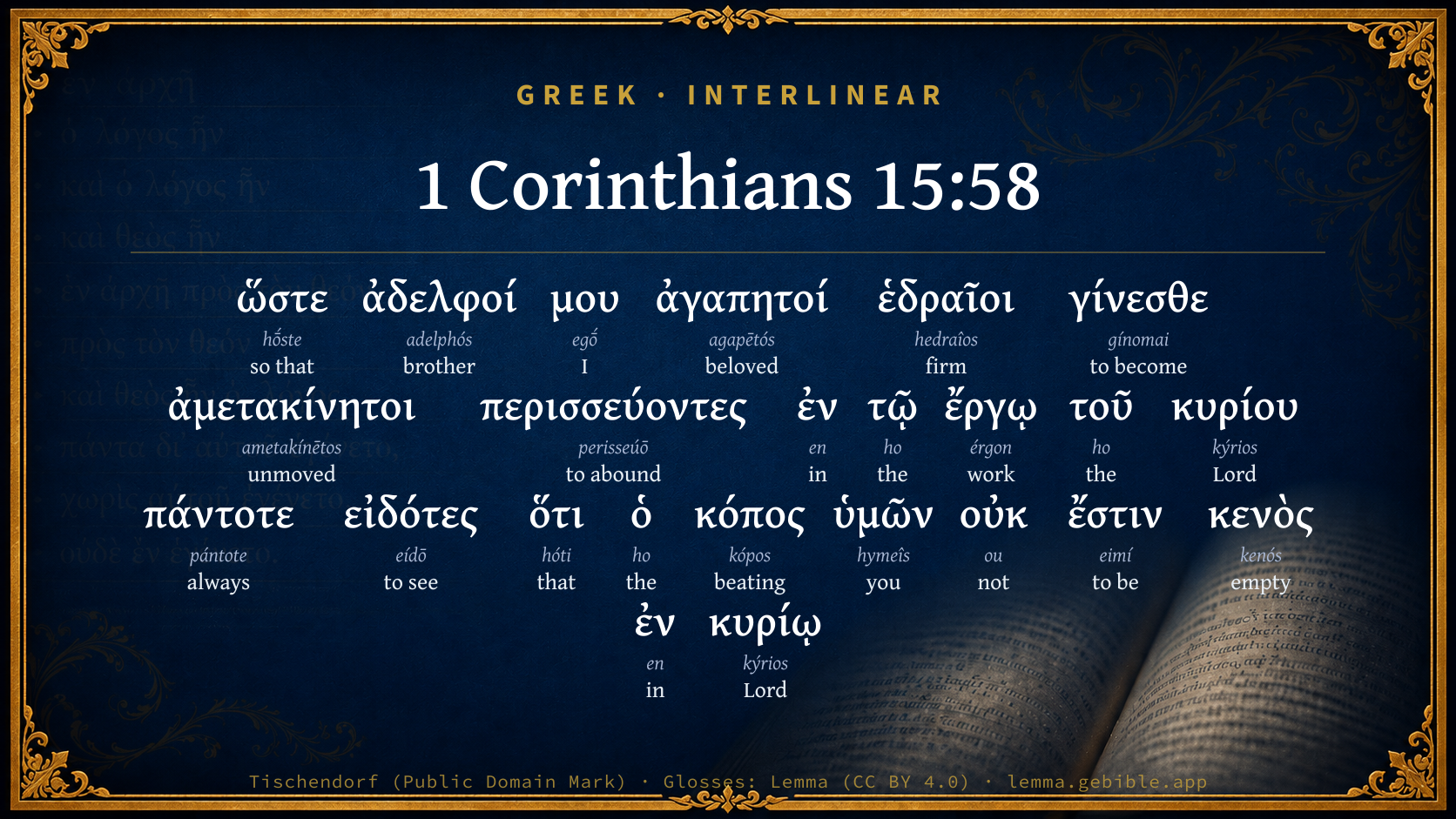
  1. ὥστε hṓste G5620 “so that” Conjunction
  2. ἀδελφοί adelphós G80 “brother” Noun, Vocative, Plural, Masculine
  3. μου egṓ G1473 “I” Personal pronoun, 1st person, Genitive, Singular
  4. ἀγαπητοί agapētós G27 “beloved” Adjective, Vocative, Plural, Masculine
  5. ἑδραῖοι hedraîos G1476 “firm” Adjective, Nominative, Plural, Masculine
  6. γίνεσθε gínomai G1096 “to become” Verb, Present, Middle or Passive deponent, Imperative, 2nd person, Plural
  7. περισσεύοντες perisseúō G4052 “to abound” Verb, Present, Active, Participle, Nominative, Plural, Masculine
  8. ἐν en G1722 “in” Preposition
  9. τῷ ho G3588 “the” Article, Dative, Singular, Neuter
  10. ἔργῳ érgon G2041 “work” Noun, Dative, Singular, Neuter
  11. τοῦ ho G3588 “the” Article, Genitive, Singular, Masculine
  12. κυρίου kýrios G2962 “Lord” Noun, Genitive, Singular, Masculine
  13. πάντοτε pántote G3842 “always” Adverb
  14. εἰδότες eídō G1492 “to see” Verb, Perfect, Active, Participle, Nominative, Plural, Masculine
  15. ὅτι hóti G3754 “that” Conjunction
  16. ὁ ho G3588 “the” Article, Nominative, Singular, Masculine
  17. κόπος kópos G2873 “beating” Noun, Nominative, Singular, Masculine
  18. ὑμῶν hymeîs G5210 “you” Personal pronoun, 2nd person, Genitive, Plural
  19. οὐκ ou G3756 “not” Particle, Negative
  20. ἔστιν eimí G1510 “to be” Verb, Present, Active, Indicative, 3rd person, Singular
  21. κενὸς kenós G2756 “empty” Adjective, Nominative, Singular, Masculine
  22. ἐν en G1722 “in” Preposition
  23. κυρίῳ kýrios G2962 “Lord” Noun, Dative, Singular, Masculine

About this verse

These counts appear in no published source. They are computed here, from the morphology-tagged text and Lemma’s own curated glosses. What Lemma adds →

24
words
20
distinct lemmas
Pauline Epistles
section

Notable vocabulary

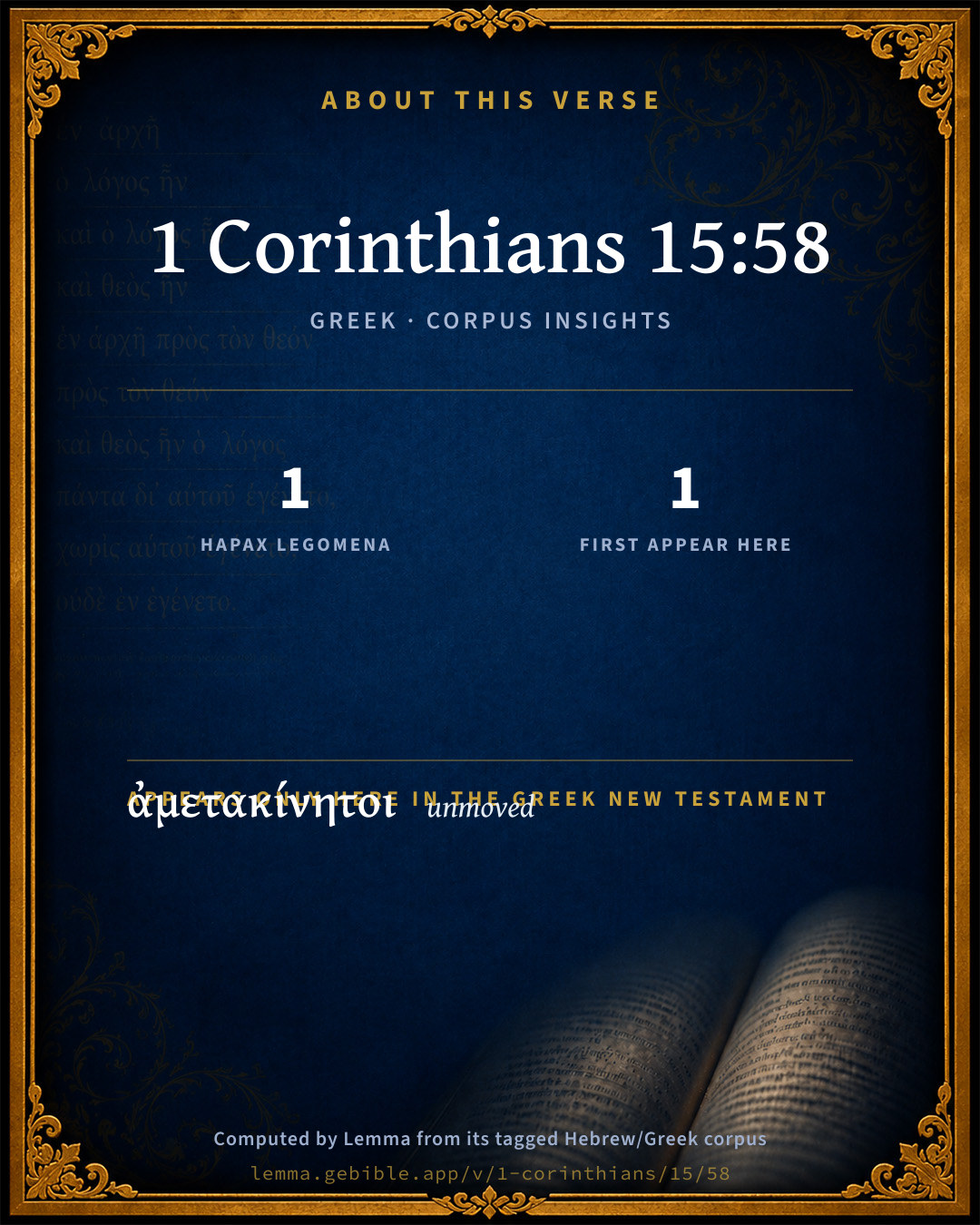
1 hapax legomenon — a word that appears only here in the entire Greek New Testament:

  • ἀμετακίνητοι unmoved G277

First appearance in Scripture

This word makes its first canonical appearance in the Greek New Testament here:

  • ἀμετακίνητοι unmoved G277

Shared distinctive vocabulary

ἑδραῖοι firm G1476 occurs in 3 verses of the Greek New Testament. Also found in:
Repetition

Words recur within this verse:

Cross-references

38

Topical passages linked to 1 Corinthians 15:58 in the Treasury of Scripture Knowledge — connected by theme and wording, ordered by reader-vote popularity; previews shown in the World English Bible.

  • Galatians 6:9 Let us not be weary in doing good, for we will reap in due season, if we don't give up.
  • 2 Chronicles 15:7 But be you strong, and don't let your hands be slack; for your work shall be rewarded.
  • Hebrews 6:10 For God is not unrighteous, so as to forget your work and the labor of love which you showed toward his name, in that you served the saints, and still do serve them.
  • Philippians 2:16 holding up the word of life; that I may have something to boast in the day of Christ, that I didn't run in vain nor labor in vain.
  • 1 Corinthians 3:8 Now he who plants and he who waters are the same, but each will receive his own reward according to his own labor.
  • 2 Peter 3:17–18 You therefore, beloved, knowing these things beforehand, beware lest, being carried away with the error of the wicked, you fall from your own steadfastness.
  • Colossians 1:23 if it is so that you continue in the faith, grounded and steadfast, and not moved away from the hope of the Gospel which you heard, which is being proclaimed in all creation under heaven; of which I, Paul, was made a servant.
  • Hebrews 13:15–16 Through him, then, let us offer up a sacrifice of praise to God continually, that is, the fruit of lips which make confession to his name.
  • 1 Thessalonians 1:3 remembering without ceasing your work of faith and labor of love and patience of hope in our Lord Jesus Christ, before our God and Father.
  • Psalms 55:22 Cast your burden on Yahweh, and he will sustain you. He will never allow the righteous to be moved.
  • John 6:28–29 They said therefore to him, "What must we do, that we may work the works of God?"
  • Hebrews 13:21 make you complete in every good work to do his will, working in you that which is well pleasing in his sight, through Jesus Christ, to whom be the glory forever and ever. Amen.
  • 1 Corinthians 16:10 Now if Timothy comes, see that he is with you without fear, for he does the work of the Lord, as I also do.
  • 1 Thessalonians 3:12 and the Lord make you to increase and abound in love one toward another, and toward all men, even as we also do toward you,
  • Colossians 2:7 rooted and built up in him, and established in the faith, even as you were taught, abounding in it in thanksgiving.
  • Psalms 112:6 For he will never be shaken. The righteous will be remembered forever.
  • 1 Thessalonians 4:1 Finally then, brothers, we beg and exhort you in the Lord Jesus, that as you received from us how you ought to walk and to please God, that you abound more and more.
  • 2 Corinthians 7:1 Having therefore these promises, beloved, let us cleanse ourselves from all defilement of flesh and spirit, perfecting holiness in the fear of God.
  • Titus 2:14 who gave himself for us, that he might redeem us from all iniquity, and purify for himself a people for his own possession, zealous for good works.
  • Matthew 25:31–40 "But when the Son of Man comes in his glory, and all the holy angels with him, then he will sit on the throne of his glory.
  • 2 Peter 3:14 Therefore, beloved, seeing that you look for these things, be diligent to be found in peace, without blemish and blameless in his sight.
  • Colossians 2:5 For though I am absent in the flesh, yet am I with you in the spirit, rejoicing and seeing your order, and the steadfastness of your faith in Christ.
  • 2 Peter 1:4–9 by which he has granted to us his precious and exceedingly great promises; that through these you may become partakers of the divine nature, having escaped from the corruption that is in the world by lust.
  • 1 Thessalonians 3:3 that no one be moved by these afflictions. For you know that we are appointed to this task.
  • Hebrews 3:14 For we have become partakers of Christ, if we hold fast the beginning of our confidence firm to the end:
  • Philippians 1:9 This I pray, that your love may abound yet more and more in knowledge and all discernment;
  • 2 Thessalonians 1:3 We are bound to always give thanks to God for you, brothers, even as it is appropriate, because your faith grows exceedingly, and the love of each and every one of you towards one another abounds;
  • Ruth 1:18 When she saw that she was steadfastly minded to go with her, she left off speaking to her.
  • Psalms 19:11 Moreover by them is your servant warned. In keeping them there is great reward.
  • Philippians 1:11 being filled with the fruits of righteousness, which are through Jesus Christ, to the glory and praise of God.
  • Matthew 10:40–42 He who receives you receives me, and he who receives me receives him who sent me.
  • Galatians 4:11 I am afraid for you, that I might have wasted my labor for you.
  • Philippians 4:17 Not that I seek for the gift, but I seek for the fruit that increases to your account.
  • Philippians 2:30 because for the work of Christ he came near to death, risking his life to supply that which was lacking in your service toward me.
  • 1 Thessalonians 3:5 For this cause I also, when I couldn't stand it any longer, sent that I might know your faith, for fear that by any means the tempter had tempted you, and our labor would have been in vain.
  • Psalms 73:13 Surely in vain I have cleansed my heart, And washed my hands in innocence,
  • Psalms 78:8 And might not be as their fathers, A stubborn and rebellious generation, A generation that didn't make their hearts loyal, Whose spirit was not steadfast with God.
  • Psalms 78:37 For their heart was not right with him, Neither were they faithful in his covenant.

Cross-references courtesy of OpenBible.info (CC BY 4.0).

Commentary

Notes on 1 Corinthians 15:58 from classic Christian and Jewish commentators (each source and its license shown beneath its notes). The classic Christian expositions comment on the surrounding passage and are grouped to its opening verse, so a note may address several verses; the Jewish commentaries on the Tanakh (Rashi and others) are per-verse, so they appear only where the commentator wrote on this verse.

Lemma curates 59 commentaries, every one of them public domain or Creative Commons licensed, each selected and text-cleaned for this edition rather than reprinted as found. About our sources →

Albert Barnes' Notes on the Bible

Therefore, my beloved brethren - In view of the great and glorious truths which have been revealed to us respecting the resurrection, Paul closes the whole of this important discussion with an exhortation to that firmness in the faith which ought to result from truths so glorious, and from hopes so elevated as these truths are suited to impart. The exhortation is so plain, that it needs little explanation; it so obviously follows from the argument which Paul had pursued, that there is little need to attempt to enforce it.

Be ye steadfast - ἑδραῖοι hedraioi, from ἕδρα hedra. Seated, sedentary (Robinson); perhaps with an allusion to a statue (Bloomfield); or perhaps to wrestling, and to standing one’s ground (Wolf). Whatever may be the allusion, the sense is clear. Be firm, strong, confident in the faith, in view of the truth that you will be raised up. Be not shaken or agitated with the strifes, the temptations, and the cares of life. Be fixed in the faith, and let not the power of sin, or the sophistry of pretended philosophy, or the arts of the enemy of the soul seduce you from the faith of the gospel.

Unmovable - Firm, fixed, stable, unmoved. This is probably a stronger expression than the former, though meaning substantially the same thing - that we are to be firm and unshaken in our Christian hopes, and in our faith in the gospel.

Always abounding in the work of the Lord - Always engaged in doing the will of God; in promoting his glory, and advancing his kingdom. The phrase means not only to be engaged in this, but to be engaged diligently, laboriously; excelling in this. The “work of the Lord” here means that which the Lord requires; all the appropriate duties of Christians. Paul exhorts them to practice every Christian virtue, and to do all that they could do to further the gospel among people.

Forasmuch as ye know - Greek “Knowing.” You know it by the arguments which have been urged for the truth of the gospel; by your deep conviction that that gospel is true.

Your labour is not in vain - It will be rewarded. It is not as if you were to die and never live again. There will be a resurrection, and you will be suitably recompensed then What you do for the honor of God will not only be attended with an approving conscience, and with happiness here, but will be met with the glorious and eternal rewards of heaven.

In the Lord - This probably means, “Your labor or work in the Lord, that is, in the cause of the Lord, will not be in vain.” And the sentiment of the whole verse is, that the hope of the resurrection and of future glory should stimulate us to great and self-denying efforts in honor of Him who has revealed that doctrine, and who purposes graciously to reward us there. Other people are influenced and excited to great efforts by the hope of honor, pleasure, or wealth. Christians should be excited to toil and self-denial by the prospect of immortal glory; and by the assurance that their hopes are not in vain, and will not deceive them.

Thus, closes this chapter of inimitable beauty, and of unequalled power of argumentation. Such is the prospect which is before the Christian. He shall indeed die like other people. But his death is a sleep - a calm, gentle, undisturbed sleep, in the expectation of being again awaked to a brighter Day, 1Co 15:6. He has the assurance that his Saviour rose, and that his people shall therefore also rise, 1Co 15:12-20. He encounters peril, and privation, and persecution he may be ridiculed and despised; he may be subjected to danger, or doomed to fight with wild beasts, or to contend with people who resemble wild beasts; he may be doomed to the pains and terrors of a martyrdom at the stake, but he has the assurance that all these are of short continuance, and that before him there is a world of eternal glory; 1Co 15:29-32. He may be poor, unhonored, and apparently without an earthly friend or protector; but his Saviour and Redeemer reigns; 1Co 15:25.

He may be opposed by wicked people, and his name slandered, and body tortured, and his peace marred, but his enemies shall all be subdued; 1Co 15:26-27. He will himself die, and sleep in his grave, but he shall live again; 1Co 15:22-23. He has painful proof that his body is corruptible, but it will be incorruptible; that it is now vile, but it will be glorious; that it is weak, frail, feeble, but it will yet be strong, and no more subject to disease or decay; 1Co 15:42-43. And he will be brought under the power of death. but death shall be robbed of its honors, and despoiled of its triumph. Its sting from the saint is taken away. and it is changed to a blessing. It is now not the dreaded monster, the king of terrors it is a friend that comes to remove him from a world of toil to a world of rest; from a life of sin to a life of glory. The grave is not to him the gloomy abode, the permanent resting-place of his body; it is a place of rest for a little time; grateful like the bed of down to a wearied frame, where he may lie down and repose after the fatigues of the day, and gently wait for the morning.

He has nothing to fear in death; nothing to fear in the dying pang, the gloom, the chill, the sweat, the paleness, the fixedness of death; nothing to fear in the chilliness, the darkness, the silence, the corruption of the grave. All this is in the way to immortality, and is closely and indissolubly connected with immortality; 1Co 15:55-57. And in view of all this, we should be patient, faithful, laborious, self-denying; we should engage with zeal in the work of the Lord; we should calmly wait till our change come; 1Co 15:58. No other system of religion has any such hopes as this; no other system does anything to dispel the gloom, or drive away the horrors of the grave. How foolish is the man who rejects the gospel - the only system which brings life and immortality to light! How foolish to reject the doctrine of the resurrection, and to lie down in the grave without peace, without hope, without any belief that there will be a world of glory; living without God, and dying like the brute.

And yet infidelity seeks and claims its chief triumphs in the attempt to convince poor dying man that he has no solid ground of hope; that the universe is “without a Father and without a God;” that the grave terminates the career of man forever; and that in the grave he sinks away to eternal annihilation. Strange that man should seek such degradation! Strange that all people, conscious that they must die, do not at once greet Christianity as their best friend, and hail the doctrine of the future state, and of the resurrection, as that which is adapted to meet the deeply-felt evils of this world; to fill the desponding mind with peace; and to sustain the soul in the temptations and trials of life, and in the gloom and agony of death!

Albert Barnes' Notes on the Bible (1834–1885) — public domain. Text from a community e-Sword/MySword module.

Tyndale Open Study Notes

Tyndale Open Resources

15:58 Nothing you do for the Lord is ever useless: There will be eternal rewards for those who serve him faithfully (see 3:12-15).

Tyndale Open Study Notes — © Tyndale Open Resources, licensed CC BY-SA 4.0. Text via the HelloAO Bible API.

Bengel's Gnomon

Johann Albrecht Bengel

1Co 15:58.[152] Ἀγαπητοὶ, beloved) The true consideration of the things, the last of all, kindles his love towards the brethren.—ἑδραῖοι, [steadfast] stable) do not ye yourselves turn aside from the faith of the resurrection.—ἀμετακίνητοι, immoveable) be not led away by others, 1Co 15:12. So Col 1:23.—ἐν τῷ ἔργῳ τοῦ Κυρίου, in the work of the Lord) Christ, Php 2:30. It is called generally, the work which is carried on for the sake of the Lord. Its more particular definition depends on the circumstances of each particular text.—εἰδότες, knowing) He is now sure of the assent of the Corinthians.—οὐκ ἔστι κενὸς, is not vain) i.e., is most profitable. They were trying to make it in vain, who denied the resurrection. Paul mildly refutes these men even in the conclusion [as well as before].

[152] Ὥστε, therefore) A grave error had to be refuted in this passage: and yet he does not neglect to subjoin the exhortation.—V. g.

Bengel's Gnomon of the New Testament — English translation (T&T Clark, Edinburgh, 1860) — public domain. Text from a community e-Sword module.

Meyer's Critical & Exegetical Commentary

Heinrich August Wilhelm Meyer

1Co_15:58. Closing admonition, drawn in the way of inference by ὥστε from τῷ διδόντι ἡμῖν τὸ νῖκος διὰ κ.τ.λ. Thereforebecause you are sure of the victorybe stedfast, etc. The εἰδότες κ.τ.λ., which glances back upon that sure νῖκος, testifies in favour of this reference of ὥστε; hence we have no adequate ground for referring ὥστε to the whole section (de Wette, van Hengel, al.), nay, even for making it extend to the whole Epistle (Hofmann).

ἑδραῖοι, ἀμετακίν.] Comp. Col_1:23. To conceive of the readers as ethical athletes (Beza), is not suggested by the context. What is expressed is Christian perseverance in general, under the figure of standing firm, comp. 1Co_7:37 (opposite: σαλεύεσθαι, comp. Theodoret), in connection with which, again, ἀμετακίν. presents the perseverance more precisely as unseduceableness, both being in opposition to the possible seductions through the deniers of the resurrection. Comp. on ἀμετακίν., Plato, Ep. vii. p. 343 A; Dion. Hal. i. p. 520; and on both words, Arist. Eth. ii. 4. 3.

περισσεύοντες ἐν τῷ ἔργῳ τ. κ. πάντ.] abounding in the work of the Lord, i.e. exceedingly active and energetic therein, always. This more precise definition of περισσ. is confirmed by the correlative ὁ κόπος ὑμῶν (your pains and labour); ἐν, again, denotes the definite sphere, wherein, etc. Comp. 2Co_8:7; Php_1:26; Col_2:7; Rom_15:13. The ἔργον τοῦ κυρίου is the work which is carried on in the service of Christ. Comp. 1Co_16:10. His is the work, in which His people labour. And they labour therein, each according to his different calling, by the active fulfilment of His will as servants of the Lord (1Co_12:5). The three points, ἑδραῖοι, ἀμετακ., περισσ. κ.τ.λ., form a climax.

εἰδότες] since ye know (comp. Rom_5:3; 2Co_1:7; 2Co_4:14); it introduces the motive, so significant in this connection, to follow the περισσ. ἐν τ. ἐ. τ. κ.; ὁ κόπος ὑμῶν, your painstaking labour, which is devoted to the ἔργον τ. κυρίου.

κενός] in vain, i.e. without result. Comp. 1Co_15:10; 1Th_3:5. So would the labour be, if there were no resurrection and no victorious consummation of eternal life, because then the blessed reward of the labour would remain unattained, namely, the salvation of the Messianic kingdom which is destined for the labourer. Rom_2:7; 2Ti_2:12; Jam_1:12, al.

ἐν κυρίῳ] is not to be connected with ὁ κόπος ὑμ., but with οὐκ ἔστι κενός. It depends upon Christ, that your labour is not fruitless; for in Him the resurrection (1Co_15:22) and the Messianic σωτηρία have their causal basis, 1Co_15:17-19; Act_4:12; Rom_5:9 f., Rom_6:22-23, Rom_10:9, al.

Meyer — Critical and Exegetical Commentary on the New Testament — English translation by Peter Christie, edited by Frederick Crombie (T&T Clark, 1880) — public domain. Text from a community e-Sword module.

Expositor's Greek Testament

ed. W. Robertson Nicoll

1Co 15:58 briefly directs the previous teaching against the unsettlement caused by Cor [2587] doubts. This unbelief was taxed in 1Co 15:32 ff. with sensualism and ignorance of God; its enervating effect on Christian work is here indicated. For ὥστε with impv [2588] , cf. 1Co 3:21 , 1Co 4:5 , etc. ἑδραῖοι γίνεσθε , “show yourselves steadfast”: see note on 1Co 7:23 , also 1Co 10:32 , 1Co 11:1 ; for the adj [2589] , see parls. In Col 1:23 the combination ἑδραῖοι , ἀμετακίνητοι (“not-to-be-moved”) is almost identically repeated; similarly in Aristotle, Nic. Eth ., ii., iv., 3, τὸ βεβαίως καὶ ἀμετακινήτως ἔχειν is specified as a condition of all right and virtuous doing. περισσεύοντες κ . τ . λ . adds the positive to the foregoing negative side of the injunction: “abounding (overflowing: see parls.) in the work of the Lord always”. τ . ἔργον τ . Κυρίου ( cf. 1Co 9:1 ; Col 3:23 f., Mat 21:28 , Mar 13:34 ) is “the work” which “the Lord” prescribes, while “the work of God” (Rom 14:20 : cf. Rom 3:9 above) is “the work” which “God” does: contrast 1Co 12:5-6 above. “Knowing (as you do) that your toil is not empty in the Lord.” εἰδότες implies assured knowledge, such as springs from the confirmation of faith given in this chap. On κόπος , see note to 1Co 3:8 ; and on κενός , 1Co 15:14 : the “toil” is “empty” which is spent on illusion; “ce n’est pas là une activité d’apparat, accomplie dans le néant, comme si souvent le travail terrestre, mais un sérieux labeur, accompli dans la sphère de l’éternelle réalité” (Gd [2590] ); hence the pr [2591] ἐστὶν rather than ἔσται . ἐν Κυρίῳ : in the sphere of Christ’s authority, wrought under His headship, which supplies the basis of all Christian relations and duties; cf. 1Co 15:36 , 1Co 4:17 , 1Co 7:22 , etc.

[2587] Corinth, Corinthian or Corinthians.

[2588] imperative mood.

[2589] adjective.

[2590] F. Godet’s Commentaire sur la prem. Ép. aux Corinthiens (Eng. Trans.).

[2591] present tense.

The Expositor's Greek Testament, edited by W. Robertson Nicoll (1897–1910) — public domain. Text from a community e-Sword module.

Hodge's Commentary on Romans, Ephesians & First Corinthians

Charles Hodge

1Co_15:58

Therefore, my beloved brethren, be ye steadfast, unmoveable, always abounding in the work of the Lord, forasmuch as ye know that your labor is not in vain in the Lord.

Such being the truth and importance of the doctrine of the resurrection, Christians should be firm in their adherence to it, not suffering themselves to be moved by the specious objections of philosophy falsely so called. They should remember that if the dead rise not, then is Christ not risen; and if Christ be not risen, their faith is vain, and they are yet in the power of sin. But as Christ has risen, and as his resurrection illustrates and renders certain that of his people, what more natural and proper than that they should abound in the work of the Lord. The work of the Lord is either that work in which the Lord is engaged, the destruction of death by destroying sin; or, it is the work which the Lord has given us to do, as parents and children, as husbands and wives, as ministers and Christians. In this work we should abound, i.e. be abundant. As Paul says, 2Co_11:23, In labors more abundant. Forasmuch as ye know that your labor is not in vain in the Lord. This with Paul was more than faith; it was knowledge. He knew that labor in the work of the Lord would not be in vain. The reward secured for it by the grace of God and merit of Christ is participation of the glories of a blessed resurrection.

Charles Hodge — Commentary on Romans (1835), First Corinthians (1857), and Ephesians (1856) — public domain. Text from a community e-Sword module.

Geneva Bible (1599)

Geneva Bible translators

Through the Lord’s help and goodness working in us.

An exhortation taken from the profit that ensueth, that seeing they understand that the glory of the other life is laid up for faithful workmen, they continue and stand fast in the truth of the doctrine of the resurrection of the dead.

Geneva Bible (1599) marginal notes — public domain. Text via Bolls.life.

Matthew Henry's Commentary

In this verse we have the improvement of the whole argument, in an exhortation, enforced by a motive resulting plainly from it.

I. An exhortation, and this threefold: - 1. That they should be stedfast - hedraioi, firm, fixed in the faith of the gospel, that gospel which he had preached and they had received, namely, That Christ died for our sins, and arose again the third day, according to the scriptures (Co1 15:3, Co1 15:4), and fixed in the faith of the glorious resurrection of the dead, which, as he had shown, had so near and necessary a connection with the former. "Do not let your belief of these truths be shaken or staggered. They are most certain, and of the last importance." Note, Christians should be stedfast believers of this great article of the resurrection of the dead. It is evidently founded on the death of Christ. Because he lives, his servants shall live also, Joh 14:19. And it is of the last importance; a disbelief of a future life will open a way to all manner of licentiousness, and corrupt men's morals to the last degree. It will be easy and natural to infer hence that we may live like beasts, and eat and drink, for tomorrow we die. 2. He exhorts them to be immovable, namely, in their expectation of this great privilege of being raised incorruptible and immortal. Christians should not be moved away from this hope of this gospel (Col 1:23), this glorious and blessed hope; they should not renounce nor resign their comfortable expectations. They are not vain, but solid hopes, built upon sure foundations, the purchase and power of their risen Saviour, and the promise of God, to whom it is impossible to lie - hopes that shall be their most powerful supports under all the pressures of life, the most effectual antidotes against the fears of death, and the most quickening motives to diligence and perseverance in Christian duty. Should they part with these hopes? Should they suffer them to be shaken? Note, Christians should live in the most firm expectation of a blessed resurrection. This hope should be an anchor to their souls, firm and sure, Heb 6:19. 3. He exhorts them to abound in the work of the Lord, and that always, in the Lord's service, in obeying the Lord's commands. They should be diligent and persevering herein, and going on towards perfection; they should be continually making advances in true piety, and ready and apt for every good work. The most cheerful duty, the greatest diligence, the most constant perseverance, become those who have such glorious hopes. Can we too much abound in zeal and diligence in the Lord's work, when we are assured of such abundant recompences in a future life? What vigour and resolution, what constancy and patience, should those hopes inspire! Note, Christians should not stint themselves as to their growth in holiness, but be always improving in sound religion, and abounding in the work of the Lord.

II. The motive resulting from the former discourse is that their labour shall not be in vain in the Lord; nay, they know it shall not. They have the best grounds in the world to build upon: they have all the assurance that can rationally be expected: as surely as Christ is risen, they shall rise; and Christ is as surely risen as the scriptures are true, and the word of God. The apostles saw him after his death, testified this truth to the world in the face of a thousand deaths and dangers, and confirmed it by miraculous powers received from him. Is there any room to doubt a fact so well attested? Note, True Christians have undoubted evidence that their labour will not be in vain in the Lord; not their most diligent services, nor their most painful sufferings; they will not be in vain, not be vain and unprofitable. Note, The labour of Christians will not be lost labour; they may lose for God, but they will lose nothing by him; nay, there is more implied than is expressed in this phrase: it means that they shall be abundantly rewarded. He will never be found unjust to forget their labour of love, Heb 6:10. Nay, he will do exceedingly abundantly above what they can now ask or think. Neither the services they do for him, nor the sufferings they endure for him here, are worthy to be compared with the joy hereafter to be revealed in them, Rom 8:18. Note, Those who serve God have good wages; they cannot do too much nor suffer too much for so good a Master. If they serve him now, they shall see him hereafter; if they suffer for him on earth, they shall reign with him in heaven; if they die for his sake, they shall rise again from the dead, be crowned with glory, honour, and immortality, and inherit eternal life.

Matthew Henry's Commentary on the Whole Bible (1708–1710) — public domain (CC PDM 1.0). Text via the HelloAO Bible API.

Jamieson, Fausset & Brown

Robert Jamieson, A. R. Fausset & David Brown

beloved--Sound doctrine kindles Christian love.

steadfast--not turning aside from the faith of the resurrection of yourselves.

unmovable--not turned aside by others (Co1 15:12; Col 1:23).

the work of the Lord--the promotion of Christ's kingdom (Phi 2:30).

not in vain--as the deniers of the resurrection would make it (Co1 15:14, Co1 15:17).

in the Lord--applying to the whole sentence and its several clauses: Ye, as being in the Lord by faith, know that your labor in the Lord (that is, labor according to His will) is not to be without its reward in the Lord (through His merits and according to His gracious appointment).

Next: 1 Corinthians Chapter 16

Jamieson, Fausset & Brown — Commentary Critical and Explanatory on the Whole Bible (1871) — public domain (CC PDM 1.0). Text via the HelloAO Bible API.

Adam Clarke's Commentary

Verse 58. Be ye steadfast] εδραιοι, from εδρα, a seat; be settled; confide in the truth of this doctrine of the resurrection, and every thing that pertains to it, as confidently as a man sits down on a SEAT, which he knows to be solid, firm, and safe; and on which he has often sat.

Unmovable] αμετακινητοι, from α, negative, and μετακινεω, to move away; let nothing shake your faith; let nothing move you away from this hope of the Gospel which is given unto you. What I tell you I receive from God; your false teachers cannot say so: in a declaration of God you may unshakingly confide.

Always abounding in the work of the Lord] The work of the Lord is obedience to his holy word; every believer in Christ is a workman of God. He that works not, to bring glory to God and good to man, is not acknowledged as a servant of Christ; and if he be not a servant, he is not a son; and if not a son, then not an heir. And he must not only work, but abound in that work; ever exceeding his former self; and this, not for a time, but always; beginning, continuing, and ending every act of life to God's glory and the good of his fellows.

Your labour is not in vain] Your labour in the Lord is not in vain; you must not only work, but you must labour-put forth all your strength; and you must work and labour in the Lord-under his direction, and by his influence; for without him ye can do nothing. And this labour cannot be in vain; you shall have a resurrection unto eternal life: not because you have laboured, but because Christ died and gave you grace to be faithful.

1. THE chapter through which the reader has passed is a chapter of great importance and difficulty; and on its difficulties much has been written in the preceding notes. Though I have used all the helps in my power to guide me in explaining it, I have, upon the whole, been obliged to think for myself, and claim only the praise of severe labour, ever directed by honest intention and an earnest desire to find out the truth.

2. There are many questions connected with the doctrine of the resurrection which I could not introduce here without writing a book instead of short notes on a very long chapter. On such subjects, I again beg leave to direct the reader to Mr. Samuel Drew's Essay on that subject.

3. One remark I cannot help making; the doctrine of the resurrection appears to have been thought of much more consequence among the primitive Christians than it is now! How is this? The apostles were continually insisting on it, and exciting the followers of God to diligence, obedience, and cheerfulness through it. And their successors in the present day seldom mention it! So apostles preached, and so primitive Christians believed; so we preach, and so our hearers believe. There is not a doctrine in the Gospel on which more stress is laid; and there is not a doctrine in the present system of preaching which is treated with more neglect!

4. Though all men shall rise again, yet it will be in widely different circumstances: some will rise to glory and honour; others to shame and everlasting contempt. Those alone who here received the salvation of God, and continued faithful unto death, shall have a resurrection to everlasting glory; not every believer, but every loving obedient believer, shall enter into the paradise of God, and have a body fashioned like unto his Lord's glorious body.

5. All glorified spirits will not have the same degree of glory. Two things will necessarily cause great difference: 1. The quantum of mind; and 2. The quantum of grace.

(1.) It is idle to suppose that God has made all human souls with the same capacities: he has not. There is an infinite diversity; he who has the greatest mind can know most, do most, suffer most, and enjoy most.

(2.) The quantum of grace will be another great cause of diversity and glory. He who received most of Christ here, and was most devoted to his service, shall have the nearest approach to him in his own kingdom. But all equally holy and equally faithful souls shall not have equal degrees of glory; for the glory will be according to the capacity of the mind, as well as the degree of grace and improvement. The greater the capacity, provided it be properly influenced by the grace of Christ, the greater will be the enjoyment.

6. That there will be great diversity in the states of glorified saints is the apostle's doctrine; and he illustrates it by the different degrees of splendour between the sun, moon, planets, and stars. This needs little application. There are some of the heavenly bodies that give heat, light, and splendour, as the SUN; and are of the utmost service to the world: some that give light, and comparative splendour, without heat, as the MOON; and yet are of very great use to mankind: others, again, which give a steady but not a splendid light, at the PLANETS; and are serviceable in their particular spheres: and lastly, others which twinkle in their respective systems, as the stars of different magnitudes.

7. One star, says the apostle, differs from another in glory, i.e. in splendour, according to what is called their different magnitudes. I will state a remarkable fact: The northern and southern hemispheres of the heavens have been divided into 102 constellations, and in these constellations Professor Bode has set down the places of 17,240 stars; simple, nebulous, conglobate, and double. The stars have been distinguished by their apparent magnitudes or rather splendour, into stars of the first, second, third, fourth, fifth, sixth, seventh, eighth, c., magnitudes: of these 17,240, only sixteen are, by astronomers in general, agreed to be of the first magnitude, all of which are set down in the following catalogue, with some of those that are remarkable in the second, third, fourth, fifth, and sixth magnitudes. The reader will observe that the name of the constellation or star is first mentioned the Greek letters, c., are those by which they are distinguished on maps and globes and they are, by astronomers, referred to by these letters and numbers. My inferences follow the table.

A TABLE of the most remarkable FIXED STARS, from the FIRST to the SIXTH MAGNITUDE.

A TABLE of the most remarkable FIXED STARS, from the FIRST to the SIXTH MAGNITUDE.

|---------------------------------------------------------------|

| First Magnitude. | Second Magnitude. |

|---------------------------------------------------------------|

| In the mouth of Canis | In the wing of Pegasus, |

| Major, or the Greater | (Algenib). . . . . . . γ |

| Dog, (Sirius, or the | In the head of the |

| Dog-star. . . . . . . α | Phoenix, . . . . . . . α |

| Bright star in Lyra, | In the tail of Cetus, . β |

| or the Harp, (Wega | In the girdle of |

| or Vega). . . . . . . α | Andromeda, . . . . . . β |

| Bright Star in Bootes, | In the Ram's following |

| (Arcturus). . . . . . α | horn,. . . . . . . . . α |

| In the heart of Leo | In the neck of Cetus, . ο |

| Major, or the Great | In the jaw of Cetus,. . α |

| Lion, (Regulus) . . . α | In the head of Medusa, |

| In the left shoulder | (Algol). . . . . . . . β |

| of Auriga, or the | In Perseus' girdle, . . α |

| Charioteer, (Capella) α | In the northern horn of |

| In the right foot of | the Bull,. . . . . . . β |

| Orion, (Rigel). . . . β | In Gemini, (Castor) . . *α |

| In the southern, or | In Gemini, (Pollux) . . *β |

| left eye of the Bull, | In Orion's shoulder,. . γ |

| (Aldebaran) . . . . . α | In the belt of Orion, . δ |

| In Eridanus, (Alnahar | In the Dove,. . . . . . α |

| or Acharnar). . . . . α | In the female Hydra,. . α |

| In the shoulder of | In Ursa Major, (Upper |

| Orion, (Betelgeuse) . α | Pointer) . . . . . . . *α |

| In the poop of the ship | In Ursa Major, (Lower |

| Argo, (Canopus) . . . α | Pointer) . . . . . . . β |

| In the loins of Canis | The Lion's tail, |

| Minor, or the little | (Denob). . . . . . . . β |

| Dog, (Procyon). . . . α | In the Cross, . . . . . β |

| Bright star in the foot | In the Dragon's tail. . α |

| of the Cross, . . . . α | In the Balance, . . . . α |

| In the spike of the | In the Balance, . . . . β |

| Virgin, . . . . . . . α | In the Swan's tail. . . α |

| In the foot of the | In Pegasus, (Markab). . α |

| Centaur . . . . . . . α | In Andromeda's head,. . α |

| In the Scorpion's | In the shoulder of |

| heart, (Antares). . . α | Pegasus, . . . . . . . β |

| In the mouth of the | In the Crane's wing,. . α |

| south Fish, | In the Eagle, (Atteer). *α |

| (Fomalhaut) . . . . . α | In the ship Argo, . . . *β |

|---------------------------------------------------------------|

|---------------------------------------------------------------|

| Third Magnitude. | Fourth Magnitude. |

|---------------------------------------------------------------|

| Brightest of the | In Libra, . . . . . . . η |

| Pleiades, . . . . . . h | ------ . . . . . . . y |

| In Taurus, . . . . . . γ | ------ . . . . . . . κ |

| ------ . . . . . . . ε | ------ . . . . . . . λ |

| ------ . . . . . . . ζ | In Scorpio, . . . . . . σ |

| In Gemini, . . . . . . δ | ------ . . . . . . . τ |

| ------ . . . . . . . ε | In Ophiuchus, . . . . . φ |

| ------ . . . . . . . μ | ------ . . . . . . . ρ |

| In Virgo,. . . . . . . β | In Sagittarius, . . . . λ |

| ------ . . . . . . . γ | ------ . . . . . . . 1μ |

| ------ . . . . . . . η | ------ . . . . . . . 1μ |

| ------ . . . . . . . ο | ------ . . . . . . . π |

| In Libra,. . . . . . . *γ | ------ . . . . . . . 1ν |

| ------ . . . . . . . 1ι | ------ . . . . . . . 2ν |

| In Scorpio,. . . . . . δ | In Capricorn, . . . . . γ |

| In Ophiuchus,. . . . . θ | ------ . . . . . . . ε |

| In Sagittarius . . . . *γ | In Aquarius,. . . . . . θ |

| ------ . . . . . . . ο | ------ . . . . . . . λ |

| ------ . . . . . . . σ | ------ . . . . . . . 2τ |

| ------ . . . . . . . τ | ------ . . . . . . . φ |

| ------ . . . . . . . φ | In Pisces,. . . . . . . δ |

| In Capricorn,. . . . . β | ------ . . . . . . . ε |

| ------ . . . . . . . δ | ------ . . . . . . . ζ |

| ------ . . . . . . . 2α | In Aries, . . . . . . . δ |

| In Ursa Major, . . . . α | In Taurus,. . . . . . . 1δ |

| In Cassiopeia. . . . . γ | ------ . . . . . . . 2δ |

| ------ . . . . . . . δ | In Gemini,. . . . . . . η |

| ------ . . . . . . . ι | ------ . . . . . . . ν |

| ------ . . . . . . . β | In Cancer,. . . . . . . γ |

| ------ . . . . . . . ε | ------ . . . . . . . δ |

| In Perscus,. . . . . . γ | In Leo, . . . . . . . . η |

| ------ . . . . . . . δ | ------ . . . . . . . ξ |

| In Ursa Major, . . . . μ | ------ . . . . . . . ο |

| ------ . . . . . . . δ | ------ . . . . . . . ρ |

| ------ . . . . . . . θ | ------ . . . . . . . τ |

| ------ . . . . . . . λ | ------ . . . . . . . υ |

| In the Dragon, . . . . δ | ------ . . . . . . . π |

| ------ . . . . . . . β | In Virgo, . . . . . . . θ |

| ------ . . . . . . . κ | ------ . . . . . . . ι |

| In the Swan, . . . . . δ | ------ . . . . . . . κ |

|---------------------------------------------------------------|

|---------------------------------------------------------------|

| Fifth Magnitude. | Sixth Magnitude. |

|---------------------------------------------------------------|

| In Pisces, . . . . . . d | In Cancer,. . . . . . . ξ |

| ------ . . . . . . . 19 | In the Sextant, . . . . 37 |

| ------ . . . . . . . 29 | ------ . . . . . . . 38 |

| ------ . . . . . . . 30 | In Leo, . . . . . . . . 56 |

| ------ . . . . . . . 33 | ------ . . . . . . . *79 |

| ------ . . . . . . . e | In Sagittarius, . . . . δ |

| ------ . . . . . . . μ | ------ . . . . . . . 1ξ |

| ------ . . . . . . . π | In Aquarius,. . . . . . *ξ |

| In Cetus,. . . . . . . 20 | ------ . . . . . . . 1h |

| In Aries,. . . . . . . ι | ------ . . . . . . . χ |

| ------ . . . . . . . 1θ | In Orion, . . . . . . . 4χ |

| ------ . . . . . . . 3ρ | In Ursa Minor,. . . . . σ |

| ------ . . . . . . . 2τ | ------ . . . . . . . υ |

| In Taurus, . . . . . . φ | ------ . . . . . . . ν |

| ------ . . . . . . . χ | ------ . . . . . . . φ |

| ------ . . . . . . . 105 | ------ . . . . . . . 1π |

| In Orion,. . . . . . . 1χ | ------ . . . . . . . 2π |

| ------ . . . . . . . 2χ | In Cepheus, . . . . . . μ |

| ------ . . . . . . . 3χ | ------ . . . . . . . ρ |

| In Auriga, . . . . . . κ | In the Dragon,. . . . . Y |

| In Gemini, . . . . . . λ | ------ . . . . . . . X |

| ------ . . . . . . . φ | ------ . . . . . . . W |

| In Cancer, . . . . . . η | ------ . . . . . . . B |

| ------ . . . . . . . θ | ------ . . . . . . . 1V |

| In Leo,. . . . . . . . ω | ------ . . . . . . . 2V |

| In Virgo,. . . . . . . ν | In Cassiopeia,. . . . . ρ |

| ------ . . . . . . . π | ------ . . . . . . . ξ |

| In Libra,. . . . . . . μ | ------ . . . . . . . π |

| In Scorpio,. . . . . . 1ω | ------ . . . . . . . 2υ |

| ------ . . . . . . . 2ω | ------ . . . . . . . χ |

| In Ophiuchus,. . . . . ψ | ------ . . . . . . . ω |

| ------ . . . . . . . ω | ------ . . . . . . . d |

| In Sagittarius,. . . . ω | In Perseus, . . . . . . g |

| In Capricorn,. . . . . ρ | ------ . . . . . . . h |

| In Aquarius, . . . . . ι | ------ . . . . . . . i |

| ------ . . . . . . . σ | ------ . . . . . . . s |

| ------ . . . . . . . 1τ | ------ . . . . . . . n |

| ------ . . . . . . . 1ψ | ------ . . . . . . . d |

| ------ . . . . . . . 2ψ | ------ . . . . . . . h |

| ------ . . . . . . . 3ψ | In Auriga,. . . . . . . 1e |

|---------------------------------------------------------------|

Observations on the preceding Table.

The five stars of the second magnitude in the above list, marked with an asterisk, are by some writers denominated of the first magnitude; and those named of the third, fourth, fifth, and sixth magnitudes, (the stars of the last-mentioned order being barely visible to the naked eye,) are such as the moon can occult, or make a near appulse to; except the last sixteen, in the column of stars of the third magnitude, and the last twenty-nine in that of the sixth magnitude, which never set in the latitude of London. The stars Algol and ο Ceti are set down according to their brightest appearance; the former varying from the second to the fourth magnitude every two days, 20 hours, 48 minutes, 58 seconds, 18 thirds, and 25 fourths; and the latter, from the second to the seventh, and sometimes to the tenth, every 331 days, 10 hours, and 19 minutes. The stars of the first magnitude, Capella and Lyra, never set in the latitude of London; Acharnar, Canopus, β in Argo, and α in the Cross and Centaur, never rise. Of the stars of the second magnitude in the preceding list, β in Medusa's head, or Algol, α in Perseus, the two Pointers, the Dragon's tail, and the Swan's tail, never set; the head of the Phoenix and the bright star in the Crane never rise. The stars marked with an asterisk in the third column are between the third and fourth magnitudes; and those in the last column with the same mark are between the fifth and sixth magnitudes. Stars fainter than those of the sixth magnitude cannot be discerned without the help of a glass, and are therefore called telescopic. The 2h, and 3h, in Aquarius, are of this last description, both of the seventh magnitude, and such as the moon can occult.

8. This subject, as far as it concerns the present place, admits of few remarks or reflections. It has already been observed, that, of all the stars which our best astronomers have been able to describe and lay down in tables and maps, only sixteen are of the first magnitude; i.e. appear more luminous than any other stars in the firmament: some, indeed, increase the number to twenty-one, by taking in Castor and Pollux, the upper Pointer, Atteer, or Atair, in the Eagle, and β in the ship Argo, which I have placed among those of the second magnitude, because astronomers are not agreed on the subject, some ranking them with stars of the first magnitude, others, with stars of the second.

The reader is probably amazed at the paucity of large stars in the whole firmament of heaven! Will he permit me to carry his mind a little farther, and either stand astonished at or deplore with me the fact, that, out of the millions of Christians in the vicinity and splendour of the eternal Sun of righteousness, how very few are found of the first order! How very few can stand examination by the test laid down in the 13th chapter of this epistle! How very few love God with all their heart, soul, mind, and strength; and their neighbour as themselves! How few mature Christians are found in the Church! How few are, in all things, living for eternity! How little light, how little heat, and how little influence and activity are to be found among them that bear the name of Christ! How few stars of the FIRST magnitude will the Son of God have to deck the crown of his glory! Few are striving to excel in righteousness; and it seems to be a principal concern with many to find out how little grace they may have, and yet escape hell; how little conformity to the will of God they may have, and yet get to heaven! In the fear of God I register this testimony, that I have perceived it to be the labour of many to lower the standard of Christianity, and to soften down, or explain away, those promises of God that himself has linked with duties; and because they know that they cannot be saved by their good works, they are contented to have no good works at all: and thus the necessity of Christian obedience, and Christian holiness, makes no prominent part of some modern creeds. Let all those who retain the apostolic doctrine, that the blood of Christ cleanseth from all sin in this life, press every believer to go on to perfection, and expect to be saved, while here below, into the fulness of the blessing of the Gospel of Jesus. To all such my soul says, Labour to show yourselves approved unto God; workmen that need not be ashamed, rightly dividing the word of truth; and may the pleasure of the Lord prosper in your hands!-Amen.

Adam Clarke's Commentary on the Bible (1810–1826) — public domain. Text from a community e-Sword/MySword module.

Ellicott's Commentary for English Readers

(58) Therefore.—Because all this is so—because there is a life hereafter—let this life here be worthy of it. You might grow weak and faint-hearted if you could think that all your work for God and truth here might be wasted; but it is not so. It cannot be “in vain if it be “in the Lord.” It is very striking and very expressive of the real spirit of the gospel that a chapter which leads us step by step through the calm process of logic, and through glowing passages of resistless eloquence to the sublimest thoughts of immortality, should at last thus close with words of plain and practical duty. Christianity never separates, in precept or in promise, “the life that now is” and “that which is to come.”

A Bible Commentary for English Readers, edited by Charles John Ellicott (1878–1897) — public domain. Text from a community e-Sword module.

The Cambridge Bible for Schools and Colleges

gen. ed. J. J. S. Perowne

58. Therefore, my beloved brethren] The aim of St Paul is always practical. Even this magnificent passage comes to what from a merely oratorical point of view is a somewhat tame conclusion, a conclusion however which, regarded from the point of view of Christian edification, is full of beauty. “Be not weary in welldoing,” the Apostle would say. “Labour on in faith and courage till life comes to an end. For your life is hid with Christ in God; and therefore your efforts and struggles here are not thrown away. Not one of them shall be lost sight of before the Eternal Throne.”

The Cambridge Bible for Schools and Colleges (gen. ed. J. J. S. Perowne; Cambridge University Press, 1878–1918) — public domain. Text from a community e-Sword module.

Trapp's Complete Commentary

John Trapp

58 Therefore, my beloved brethren, be ye stedfast, unmoveable, always abounding in the work of the Lord, forasmuch as ye know that your labour is not in vain in the Lord.

Ver. 58. Always abounding, &c.] This will strengthen faith, as the often knocking upon a stake fastens it. When faith bears fruit upward, it will take root downward.

Forasmuch as ye know] Bestir you therefore. It troubled a martyr at the stake that he should then go to a place where he should ever be receiving wages and do no more work. It will repent us (if it were possible to repent in heaven) that we began no sooner, wrought no harder.

John Trapp, A Commentary or Exposition upon All the Books of the Old and New Testament (1647–1656) — public domain. Text from a community e-Sword module.

Matthew Poole's English Annotations

The apostle concludeth his discourse, proving the resurrection of the body from the dead, founding upon it an exhortation to holiness, which is here called

the work of the Lord, because it is made up of works done by us at the command of Christ, and with direct respect to his glory in obedience to his will. He mindeth them not only to do these things, but to do them

stedfastly, not by fits, but never turning aside from them either one way or another; and unmovably, so as no temptations, either from dangers, or rewards, or false teachers, should shake their faith, as to the principles that lead unto such a holy life, this especially of the resurrection from the dead.

For as much as ye know that your labour is not in vain in the Lord; because they knew, that through the grace of God, and the merits of Christ, such works as these should not want their reward; for though the work of God be wages to itself, and Christians should not serve God merely for wages, yet it is lawful for them (as for Moses) to have an eye to the recompence of reward; and a greater reward than this of the resurrection of the body to eternal life, and that in a state of immortality and incorruption, in a spiritual and honourable estate, could not be.

Matthew Poole's English Annotations on the Holy Bible (1683–1685) — public domain. Text from a community e-Sword/MySword module.

Whedon's Commentary on the Bible

Daniel D. Whedon

58. Therefore—The Christian doctrine is a great motive force for the Christian life. All the terrors and glories of death, resurrection, judgment, and eternity, are startling admonitions to steadfast, solemn duty-doing.

My beloved brethren—St. Paul’s heart hovers in full affection, in passing from those fearful scenes, over his brethren, as if he would provide for their safety.

Steadfast, unmovable—In your faith in the resurrection which the some of 1Co_15:12 are endeavouring to overthrow. Steadfast, unmovable, and abounding, form a climax. Steadfast means positive, intrinsic firmness; unmovable implies resistance to the mightiest outward pressures and fiercest onsets; abounding means energetic action. Some Christians appear to do nothing; some to do a little; others abound in every good word and work.

Work of the Lord—The conversion of sinners, the upbuilding of the Church, and all the countless forms of Christian activity.

Not in vain—As it would be (1Co_15:29-34) were there no resurrection. But there being a resurrection, every deed in faith shall brighten the lustre of the resurrection body. “One star differeth from another star in glory.” This maxim is not, indeed, uttered by the apostle of the differences of personal glory in heaven; but it is, no doubt, applicable. The brighter our earthly Christian character, the more transcendent our heavenly glory.

In the Lord—Our labours shall attain their highest reward in Christ, who is all riches.

Daniel D. Whedon (gen. ed.), Commentary on the Old and New Testaments (1874–1909) — public domain. Text from a community e-Sword module.

The Pulpit Commentary

Therefore. Seeing that you ought not to despair, but to share in this confidence of triumph. Steadfast. Firmly fixed in your own conviction. (Col_1:23 2Jn_1:9) Unmoveable. By others. (Eph_4:14) Abounding in the work of the Lord. Doing diligently and ungrudgingly the work of your lives, which is his work. That your labour is not in vain. The thought of the verse is the same as that of Gal_6:9, "And let us not be weary in well doing; for in due season we shall reap, if we faint not.

Some general facts are very observable in this glorious chapter. 1. One is that St. Paul does not meet doubt by angry denunciation, or by crushing it with the iron mace of impatient authority. What would now be thought of Christians who denied the resurrection? Doubtless they were net mere speculative deniers of the resurrection, like Hymenaeus and Philetus, (2Ti_2:17) but recent Gentile converts, who could not get over their pagan difficulties. Yet St. Paul meets them by personal appeals, by helpful analogies, by lofty reasoning, by the glowing force of inspiring convictions. Instead of taking refugemore ecclesiastico in anathema and excommunication, he meets error by the counter presentation of ennobling truth. 2. Another noteworthy fact is that St. Paul"s hope of the resurrection rests, like all his theology, on the thought that the life of the Christian is a life "in Christ." 3. A third is his superiority to false analogies like those of the butterfly and the phoenix which sufficed many ancient reasoners. Even Christian writers like St. Clement of Rome continued to appeal to the phoenix as a proof of the resurrection. The greatest ancient thinkers like Tacitus believed in the existence of that fabulous bird, and even in the genuineness of a specimen of it which had been exhibited at Rome. Was there no "grace of superintendency" at work which prevented the sacred writers from adopting the universal error of their day? Had St. Paul appealed to the phoenix, centuries of Christian writers would have continued to maintain the existence of that creature; and science, laughing the belief to scorn, would (most unjustly) have made any allusion to it a proof of mental weakness, and of the falsity of the doctrine which it was supposed to prove. 4. A fourth point to be observed is the wisdom with which St. Paul holds himself aloof from speculative fancies, tie does not, like Plato, appeal to the doctrine of "reminiscence" (anamnesis), or of unfulfilled ideas. He does not, like Kant, build any argument on man"s failure to obey "the categorical imperative" of duty. He points to the sinless Man to the fulfilled idea of Christ. His argument, which all could understand, is summed up in the words, "Ye are Christ"s, and Christ is risen." Your resurrection from the death of sin to the life of righteousness is a pledge of your participation in Christ"s resurrection from the grave.

The work of works.

my beloved brethren, be ye steadfast, unmovable, always abounding in the work of the Lord, forasmuch as ye know that your labour is not in vain in the Lord." "Therefore." This is the practical conclusion of the sublime argument which Paul had conducted on the resurrection, in the preceding verses. All true doctrines lead to practice. "Therefore because death is not your end, because you are to live body and soul in a future state ye steadfast.

I The work of soul restoration is SPECIALLY DIVINE. It is "the work of the Lord." The work of the Lord is illimitable. The universe is his handiwork, and all its movements are his operations. Providence is his work. But the "work" referred to in the text, viz. the spiritual restoration of mankind, is in a special sense his. It is his great work. Isaiah speaks of it as a creation that will eclipse in glory the material universe. Jesus always spoke of it as the great work.

1. Think of the preparation for this work. Four thousand years were occupied, involving a long series of sacrifices, priests, seers, miracles, as preliminary.

2. Think of the sacrifices made to accomplish this work. Christ came into this world, and the Incarnate lived, suffered, and died here, etc.

3. Think of the unceasing agency of the Divine Spirit in order to effect this work. He is always striving with men from age to age and in all lands.

4. Think of the wonderful results of this work. Millions of lost souls redeemed to the knowledge, image, fellowship, and service of Almighty God. What is the value of one soul? What is the influence that one soul can exert on the universe? This, then, may emphatically be called the "work of the Lord." It is the field which he the great Husbandman has been cultivating. He will make it one day his choicest garden. It is the temple which he the great Architect has been building; it will excel in glory all former structures. It is the "new creation" which he is accomplishing; before it will pale into dimness all other productions.

II The work of soul restoration DEMANDS THE MOST EARNEST EFFORTS OF MANKIND. "Steadfast, unmovable." There are some works of the Lord in which we cannot engage. We cannot help to control the ocean, guide the stars, or even create a blade of grass, but here we are "labourers together with him.

1. Our labour must be invincible. The two words, "steadfast" and "unmovable," express this. So many are the impulses within, so many are the forces without, opposing the work, that nothing but an invincible determination can carry us through. We must have a purpose strong enough to bend and subordinate everything to itself. "This one thing I do," says Paul.

2. Our labour must be abounding. "Always abounding." The spirit of this work should reign in us, everywhere and at all times. As the parental element inspires the mother, and mingles with all her domestic arrangements and pleasures, so this spirit must inspire us and mingle with all our undertakings. It should sweeten our daily toil and breathe into our recreations and amusements. The distinction between the secular and the spiritual is a theological fiction. Religion in a man is either everywhere or nowhere, everything or nothing. Labour and business, as well as the gospel, are means of grace. As the life of the plant requires the tempest to bend its fibres, as well as the calm to yield it repose, so the religious life requires for its development the rough element of worldly business as well as the smoother influences of spiritual devotion.

III The work of soul restoration MUST INEVITABLY SUCCEED. "Forasmuch as ye know that your labour is not in vain in the Lord." There are two kinds of vain labour.

1. That which aims at a worthless end. Therefore, if it succeeds, it is useless.

2. That which is directed to a good end, but can never realize it, simply because it is too indeterminate and feeble. But here is a work that must succeed. Every true thought, every earnest prayer, every godly deed, carry in themselves success. As all the elements and forces of this world go to build up a new stratum around the globe"s surface, for geologists of coming ages to study, so all that I do and think and say in the work of the Lord goes to give blessedness to my being. Inasmuch, therefore, as you cannot fail in this work, labour.

IV The work of soul restoration will FULLY REALIZE ITS SUCCESS IN THE FUTURE WORLD. "Therefore," says Paul, "were this life our all, our spiritual labour might be considered vain." What boots our striving after knowledge, our efforts to build up a noble character, if the grave be our end? But there is a future, and in it there is a full reward. All the waters of holy thought and effort we now receive into our being go to make a well within us that shall spring up to everlasting life.

Preparation for the death triumph.

The apostle has been speaking of the believer"s triumph in the final contest with death. This is assured, for it is "through our Lord Jesus Christ" (ver. 57), who is "the same yesterday, today, and forever;" but, though assured, it needs to be prepared for. Salvation is of Christ, yet we have to "work out our own salvation with fear and trembling;" and "they that endure to the end shall be saved." So we need to make constant preparation for the last battle, that when it comes we may be ready and may be found clad in "the whole armour of God.

I THE APOSTLE URGES BELIEVERS TO ABIDE IN THE FAITH.

1. We must be "in the faith. Only thus can we anticipate triumph. Unless we know Christ we shall not know the death victory. If we are not in the faith, death will triumph over us, and the marks of death"s triumph we shall bear in all our future.

2. We must be steadfast in the faith. Not halting between two opinions of one mind today and of another tomorrow. We must choose decisively and be faithful to our choice. "Unstable as water, thou shalt not excel." That soldier is not worth much who has much loyalty today and none tomorrow.

Vacillation in Divine things is a poor preparation for death. We must be steadfast

(1) to Christ personally;

(2) to his doctrine including doctrine of resurrection, which Paul has specially in mind;

(3) to holy living.

3. We must be unmovable in the faith. Not turning aside ourselves, nor allowing others to turn us. Enemies will try to turn us our great enemy preeminently. But we must be like limpets on the rock, which cling the more tenaciously the more we seek to dislodge them. Yet with these little creatures a sudden blow will generally remove them. So we must "watch. In such an hour as we think not the fierce temptation may come. We must hold to Christ and pray Christ to hold to us. He is able to keep us from falling.

II THE APOSTLE URGES BELIEVERS TO BE DILIGENT IN THE LORD"S SERVICE,

1. We should engage in the work of the Lord. Some may think they had better concentrate their thoughts altogether upon themselves; woo delightful frames of mind; listen much to some captivating preacher; "sit and sing themselves away to everlasting bliss." Spiritual selfishness is a poor preparation for the last fight. Many Christians pamper themselves and become hopeless spiritual invalids. We must cultivate personal piety, but we may do this largely by robust Christian work. We need exercise. The spiritual sedentary life is prolific of spiritual ills. A Church of do nothings is always a hospital full of sick and complaining folks. Besides, the need of service is great, and the Master calls.

2. We should abound in the work of the Lord. We should not do as little as we can for Christ, but as much. How he "abounded" in work for us! It is the man who abounds in his work who is most fit to leave it; the diligent servant is the one most ready to meet his Lord. If we wish to be victorious over death by and by, we had need to be victorious over sloth and self seeking and indulgence now.

3. We should always abound in the work of the Lord. Our work is not to be by fits and starts; our consecration must be life consecration. Always on the same side, always serving the same Master.

4. We have much encouragement ever to abound in the work of the Lord. "Our labour is not in vain in the Lord.

(1) We may know this:

(a) By promise. "My word shall not return unto me void.

(b) By reason. The gospel, according to our judgment, meets the needs of men, and is likely to be accepted by not a few.

(c) By experience. Our own, perhaps; past work speaks in its results. The experiences of others; what vast effects have followed upon devoted service!

(2) It is not in vain; for:

(a) It pleases God. The true servant is never unsuccesful. He is always successful in pleasing his Master!

(b) It has its effect upon those immediately concerned. We say in natural things every cause produces its appropriate effect: so in spiritual. The result that we desired may not follow, but there has been an effect, as we shall perceive hereafter.

(c) It blesses ourselves. Few things are likely to do us so much good.

(d) It will assuredly bring its reward. But our labour must always be "in the Lord in his Name, in dependence upon his power, in prayer for his help, in desire for his glory. H.

The Pulpit Commentary (1880–1919), ed. H.D.M. Spence-Jones & Joseph S. Exell — public domain. Text from a community e-Sword module.

John Wesley's Explanatory Notes

Be ye steadfast - In yourselves. Unmovable - By others; continually increasing in the work of faith and labour of love. Knowing your labour is not in vain in the Lord - Whatever ye do for his sake shall have its full reward in that day. Let us also endeavour, by cultivating holiness in all its branches, to maintain this hope in its full energy; longing for that glorious day, when, in the utmost extent of the expression, death shall be swallowed up forever, and millions of voices, after the long silence of the grave, shall burst out at once into that triumphant song, O death, where is thy sting? O hades, where is thy victory?

John Wesley, Explanatory Notes Upon the Whole Bible (1754–1765) — public domain. Text via the GEBible commentary corpus.

Burkitt's Expository Notes on the New Testament

William Burkitt

Here our apostle concludes this chapter, and closes his discourse on this great subject, the doctrine of the body’s resurrection, with an exhortation to duty. Be ye steadfast; that is, in the faith of the gospel in general, and in the belief of this particular article of our Christian faith, the resurrection of the dead.

Unmoveable; that is, be not moved by any temptations or tribulations, either from the faith and hope of the gospel, or, from obedience to the gospel. Let no fear of the cross of Christ make you weary of the yoke of Christ.

Always abounding in the work of the Lord.

Here note, That the more steady and stedfast any man is in the belief of a blessed resurrection, the more forward and zealous, the more active and industrious, will he be in the service of the work of God.

Forasmuch as your labour shall not be in vain in the Lord; that is, your painfulness in the service of God shall be plentifully recompensed by him at the resurrection of the just.

Where note, 1. The nature and quality of that service, or work of God declared, it is a labour; the vast circumference of a Christian’s duty makes it so; the curious and exact manner in and after which every duty must be performed, makes it so; the great opposition that he meets with in his duty, makes it so. But the greater their labour is on earth, the sweeter will their rest be in heaven.

Note, 2. The reward that sweetens this labour: It shall not be in vain, there is the transcendency of the reward Forasmuch as ye know; there is the certainty of it. The Christian’s services for Christ shall be certainly and transcendently rewarded by Christ in another world. His labour is finite, his reward is infinite. There is no more proportion between a Christian’s labour and reward, that betwixt time and eternity. O infinite glory, the reward of our poor labour.

William Burkitt's Expository Notes on the New Testament (1700–1703) — public domain. Text from a community e-Sword module.

Godbey's Commentary on the New Testament

William B. Godbey

58. “So, my beloved brethren, be ye steadfast, unmoveable, always abounding in the work of the Lord, knowing that your labor is not in vain in the Lord.” Oh! blessed and glorious consolation! “He that giveth a saint a cup of cold water in the name of the Lord shall not fail to receive his reward.” Earth is the field of toil, peril and battle. Heaven is the mount of victory, where every pilgrim will receive a glorious reward for all our labors of love in this life.

William B. Godbey, Commentary on the New Testament (1896–1900) — public domain. Text from a community e-Sword module.

McGarvey & Pendleton's Commentaries

J. W. McGarvey

Wherefore, my beloved brethren, be ye stedfast, unmovable, always abounding in the work of the Lord, forasmuch as ye know that your labor is not vain in the Lord . [Therefore, since you see that the dead are raised and made capable of enjoying heaven, do not again be moved from your belief in these well-proven and established truths, and be careful to abound in the Lord's work, for no matter what your present sufferings and persecutions may be, the Lord will amply reward you in the resurrection, and your labor will not be in vain.]

J. W. McGarvey (with Philip Y. Pendleton), Commentaries on the New Testament (The Fourfold Gospel, 1914; Acts; and the epistles) — public domain. Text from a community e-Sword/MySword module.

The People's New Testament

B. W. Johnson

58. Therefore … be ye stedfast, unmoveable. Firm as a rock, devoted to Christian life, for their “faith is not vain.” Their labor is not vain in the Lord. Jesus Christ is The Resurrection and the Life. The hope of immortality hath sure foundations.

B. W. Johnson's The People's New Testament with Notes (1889–1891) — public domain. Electronic text from the Christian Classics Ethereal Library (CCEL) ThML edition.

unfoldingWord translationNotes

Door43 World Missions Community

Connecting Statement:

Paul wants believers, while they work for the Lord, to remember the changed, resurrected bodies that God is going to give them.

be steadfast and immovable

Paul speaks of someone who lets nothing stop him from carrying out his decisions as if he could not be physically moved. AT: "be determined" (See: Metaphor)

Always abound in the work of the Lord

Paul speaks of efforts made in working for the Lord as if they were objects that a person could acquire more of. AT: "Always work for the Lord faithfully" (See: Metaphor)

translationWords

works

vain

unfoldingWord translationNotes — © Distant Shores Media and the Door43 World Missions Community, licensed CC BY-SA 4.0. Source: git.door43.org/Door43/en_tn.

Cambridge Greek Testament for Schools and Colleges

58. ὥστε, ἀδελφοί μου ἀγαπητοί. The aim of St Paul is always practical. Even this magnificent passage comes to what from a merely oratorical point of view is a somewhat tame conclusion, a conclusion however which, regarded from the point of view of Christian edification, is full of beauty. ‘Be not weary in welldoing,’ the Apostle would say. ‘Labour on in faith and courage till life comes to an end. For your life is hid with Christ in God; and therefore your efforts and struggles here are not thrown away. Not one of them shall be lost sight of before the Eternal Throne.’ We may compare the ending of the magnificent Psalms 90, which is ascribed, and as far as internal evidence goes, not without reason, to Moses.

Cambridge Greek Testament for Schools and Colleges (Cambridge University Press, 1896; 21 vols, various authors incl. Carr, Maclear, Plummer, Farrar, Lumby, Moule, M. R. James, Simcox) — public domain. Text from a community e-Sword module.

Alford’s Greek Testament

Henry Alford

58.] Conclusion of the whole by an earnest exhortation.

ὥστε] ‘quæ cum ita sint,’—seeing that the victory is sure.

ἑδρ., ἀμετακίν.] a climax (Mey.);—in reference, viz. to the doubt which is attempted to be raised among you on this matter.

ἐν τῷ ἔργῳ τοῦ κυρ.] The work of the Lord is the Christian life, with its active and passive duties and graces,—the bringing forth the fruits of the Spirit.

εἰδότες] Knowing (as you do—being convinced by what has been said), that your labour (bestowed on the ἔργ. τοῦ κυρ.) is not vain (which it would be, were there no resurrection: see reff.) in the Lord. These last words cannot belong to ὁ κόπος ὑμ., nor very well to οὐκ ἔστι κενός (as Meyer), but are best taken with the whole sentence, your labour is not in vain: so ch. 9:1.

Henry Alford, The Greek Testament (1849–1861) — public domain. Text from a community e-Sword module.

International Critical Commentary

58. Practical result of this great assurance. They must get rid of the unsettled and unfruitful state of mind caused by habitual scepticism, and must learn to be firmly seated, so as to be able to resist the false teaching and other hostile forces that would carry them away (Col 1:23). Let there be less speculation and more work. See Thorburn, The Resurrection Narratives, pp. 183 f., on modern speculations.

Ὥστε. See on 14:39. Compare especially Php 4:1, where, as here, the Apostle adds ἀγαπητοί to ἀδελφοί: he rarely uses both words, but either ἀγαπητοί (10:14) or ἀδελφοί (3:1; 4:6, etc.). Here he desires to assure them that, in spite of the severe language which he has sometimes employed, there is no diminution in his affection: comp. 4:14. Post multas correctiones, non solum fratres, sed et dilectos appellat, ut saltem hoc remedio sublevati ad pristinam fidem reverterentur (Atto).

ἑδραῖοι γίνεσθε. Not, ‘continue to be,’ but, ‘become, prove yourselves to be’ (10:32, 11:1). They have still much to learn; they are not yet stable either in belief or behaviour (vv. 2, 33). They need to be τῇ πίστει τεθεμελιωμένοι in order to become ἑδραῖοι τῇ πίστει (Ign. Ephes. 10): comp. Polycarp Phil. 10, where this is quoted. He is speaking ὡς σαλευομένοις. He says ἀμετακίνητοι, ‘unmoveable’ (here only), not ἀκίνητοι, ‘unmoved’: they must not allow themselves to be loosed from their moorings; comp. Arist. Eth. Nic. II. 4: 3.

περισσεύοντες ἐν τῷ ἔργῳ τοῦ Κυρίου πάντοτε. Every word tells. In the abundance of results they may be equal to Apostles (v. 10); but it must be in work, not in disputation; and in the Lord’s work, which He always has ready for each one of His servants to do; and there must be no relaxing of effort, no shirking. This involves κόπος, wearisome toil. But what of that, with the full knowledge which they possess of what the conditions are? Τί λέγεισ; πάλιν κόπος; Ἀλλὰ στεφάνους ἔχων, καὶ ὑπὲρ τῶν οὐρανῶν (Chrys.).

ὀ κόπος ὁμῶν οὐκ ἔστιν κενὸς ἐν Κυρίῳ. This may mean either that the effort of doing the work of the Lord abundantly is no idle pastime, or that it is not fruitless, but is sure to have blessed results here and hereafter; vv. 10 and 14 favour the latter. If there were no Resurrection, their labour would be fruitless; but in such conditions as have been established, in such an atmosphere as that in which they work, viz. ἐν Κυρίῳ, that is impossible. We need not confine ἐν Κυρίῳ to κενός, still less to κόπος, from which it is too far removed; it probably belongs to the whole sentence. The Apostle goes on to give them an illustration of doing God’s work.

ADDITIONAL NOTE ON 15:42-44

A considerable number of scholars, and among them J. H. Bernard, R. H. Charles, G. G. Findlay, and W. Milligan, contend that σπείρεται in vv. 42-44 cannot refer to the ‘sowing’ of the corpse in the ground. No such use of σπείρειν, it is said, has been produced. Moreover, the analogy about the difference between the seed sown and the plant that rises from it shows that St Paul cannot mean burial when he speaks of ‘sowing.’ His argument is that the seed is not dead when it is sown, but that it must die before it is quickened. In the animal world, death precedes burial; but, in vegetation, the burial of the seed precedes death, the death that is necessary for the new life. The same holds good of Joh 12:24, where πεσὼν εἰς τὴν γῆν is used for being sown, and the ‘falling into the earth’ precedes the dying. In human existence, what precedes the death that prepares the way for resurrection is life in this world, and this is what is meant by σπείρεται. * The vital germ is placed in material surroundings, like seed in soil, and continues in them until death sets the vitality free to begin a new career under far more glorious conditions. With this interpretation the contradiction involved in calling a corpse a σῶμα ψυχικόν is avoided; and the sudden intrusion of the thought of burial, which occurs nowhere in the argument from v. 12 onwards, is avoided also.

It is possible that this is correct; nevertheless, the marked inclusion of Christ’s burial (καὶ ὅτι ἐτάφη) in the very brief Creed given in vv. 3, 4, gives considerable support to the common interpretation. Moreover, sowing is a very natural figure to use respecting the dead body of one who is to rise again.

† Calvin suggests that St Paul did not wish to treat of so momentous a subject until, by the rebukes and exhortations of the previous chapters, he had brought the Corinthians to a proper state of mind.

* See Act 17:18, Act 17:32, and St Paul’s speech in the Areopagus (22-31), “the most wonderful passage in the Book of Acts: in a higher sense (and probably in a strictly historical sense at some vital points) it is full of truth” (Harnack, The Mission and Expansion of Christianity, 1. p. 383; comp. p. 88).

* The reading ὀφείλετε κατέχειν (D* F, g, Ambrst.) for εἱ κατέχετε is an attempt to simplify the construction: so also is the conjecture of ὅ for εί.

†

οἱ πρὸς καιρὸν πιστεύοντες καὶ ἐν καιρῷ πειρασμοῦ ἀφιστάμενοι, εἰκῇ πιστεύονσι (Origen).

Many scholars prefer εἰκῆ το εἰκῇ The orthography is not important.

* The connexion between the Body which disappeared from the tomb and the Body which the disciples afterwards saw and were told to handle is beyond our comprehension. See Latham, The Risen Master, p. 73.

† There τῇ τρίτῃ ἡμέρᾳ is the right reading; but here the more emphatic τῇ ἡμέρᾳ τῇ τρίτῃ (א A B D E 17, Cyr.) is right. “The ‘third day’ is hardly less firmly rooted in the tradition of the Church than the Resurrection itself. We have it not only in the speech ascribed to St Peter (Act 10:40), but in the centeral testimony of St Paul, and then in the oldest form of the Aposteles’ Creed. It is strange that so slight a detail should have been preserved at all, and still stranger that it should hold the place it does in the standard of the Church’s faith” (Sanday, Outlines of the Life of Christ, p. 183). Mat 12:40 is evidence of the Evangelist’s belief in it and estimate of its importance. See J. H. Moulton, Gr. pp. 137, 141; Knowling, Test. of St Paul to Christ, p. 307. Max Krenkel (Beiträge x. Aufthellung d. Geschichte u. d. Briefe d. Ap. Paulus, pp. 385 f.) thinks that 2Ki 20:5 was regarded as a prophecy of resurrection on the third day.

* Chrysostom says that Kephas is placed first here as being τὸν πάντων ἁξιοπιστότερον, and that it was likely that Christ would appear to him first among males, because he had been the first to confess Him as the Messiah, and because he desired so much to see Him again. Although St Paul ignores the non-official testimony of the women who visited the sepulchre, he does not say that the Lord appeared first to Peter. Nota quia non dicit primo visus est Cephae (Atto). But the way in which he speaks of Peter shows that he does not consider Peter as one of the Kephas party, who are condemned in 1:12 (Zahn, Introd. to N.T. i. p. 283). See also A. T. Robertson, Epochs in the Life of St Paul, pp. 81, 82; Butkitt, Earliest Sources for the Life of Jesus, p.71.

B B (Fourth century.) The Vatican MS.

K K (Ninth century). Codex S. Synod. xcviii. Lacks 1:1-6:13 ταύτην καί: 8:7 τινὲς δὲ—8:11 ἀπέθανεν.

L L (Ninth century). Codex Angelicus; At Rome.

P P (Ninth century). Porfirianus Chiovensis. A palimpsest acquired in the East by Porphyrius Bishop of Kiew. Lacks 7:15 ὑμᾶς ὁ θεός-17 περιπάτει: 12:23 τοῦ σώματος-13:5 οὐ λογί-: 14:23 τὸ λαλεῖν μή. A good type of text in St Paul’s Epistles.

אԠא (Fourth century.) The Sinaitic MS., now at St Petersburg, the only MS. containing the whole N.T.

A A (Fifth century.) The Codex Alexandrinus; now at the British Museum.

17 17. (Ev. 33, Act_13. Ninth century.) At Paris (Nat. Gr. 14). See Westcott and Hort., Introd. §§ 211, 212.

D D (Sixth century.) Codex Clarmontanus; now at Paris. A Graeco-Latin MS. 14:13 διο͂ ὁ λαλῶν-22 σημεῖον ἐστίν is supplied by a later but ancient hand. Many subsequent hands (sixth to ninth centuries) have corrected the MS. (See Gregory, Prolegomena , pp. 418-422).

F F (Late ninth century). Codex Augiensis (from Reichenau); now at Trin. Coll. Cambr. Probably a copy of G in any case, secondary to G, from which it very rarely varies (see Gregory, p. 429).

G G (Late ninth century). Codex Boernerianus; at Dresden. Interlined with the Latin (in minluscules). Lacks 1Co 3:8-16, 1Co 6:7-14 (F).

* Dobshütz (Osteru und Pfingsten) would identify 1Co 15:6 and Joh 20:21-23 with Act 2:1-4. The same event is the basis of all three passages. Could traditions have become so different in so short a time?

E E (Ninth century). At Petrograd. A copy of D, and unimportant

* “That the Twelve henceforth rank in history as the Twelve Apostles, and in fact as the Apostles, was a result brought about by St Paul; and, paradoxically enough, this was brought about by him in the very effort to fix the value of his own Apostleship. He certainly did not work out this conception, for he neither could nor would give up the more general conception of the Apostleship. … St Paul holds fast to the wider conception of the Apostolate, but the twelve disciples form in his view the original nucleus” (Harnack, The Mission and Expansion of Christianity. 1. p. 323; p. 232, ed. 1902).

*

The proposal to read τῳ (=τινι) instead of τῷ need not be seriously considered: context and usage are against it.

Sicut abortivus quadam naturae violentia ante tempus compellitur nasci, ita ego par terribilem Domini visionem et luminis oculorum amissionem coactus sum, antequam vellem, exire de ceaco sunagogae ulero, et ad lucem fidei alque libertatem prodire (Herveius). Primasius adds a stronger point of similarity; mortua malre vivus educitur. The Judaism from which he was so violently taken was a defunct religion.

* Il n’est pas un seul critique, aujourd’ hui, qui ne reconnaisse que Paul a gradé toute sa vie, la ferme conviction d’avoir été le temoin d’une apparition extérieure du Christ ressuscité (A. Sabatier, L’Apôtre Paul, p. 46).

* Le souvenir d’ avoir persécuté cette Église de Dieu est resté pour Paul, durant toute sa vie, le sujet d’une douloureuse humiliation. Il s’en affiige comme s’il avait persecuté le Seigneur lui-méme (Sabatier, L’ Apôtre Paul, p. 8). Both Luke (Act 9:21) and Paul (Gal 1:13, Gal 1:23) use πορθεῖν as well as διώκειν of Saul’s destructive work. No other N.T. writer uses πορθεῖν.

† The Vulg. is capricious in its translation of κενός. Nearly always it has inanis (vv. 14, 58; Eph 5:6; Col 2:8, etc.), but here and Mar 12:3 it has vacuus, although in Luk 20:10 it has inanis: μάταιος is always vanus (3:20; Tit 3:9; Act 14:15, etc.).

* The reading ἐ κ ν. ὂτι ἐγ. (D E F G) puts an unintelligible emphasis on ἐκ νεκρῶν.

* This problem still remains. We do not free ourselves from difficulty by rejecting the Resurrection of Christ as unhistorical. How can we explain the origin of the evidence that He said that He would rise and of the evidence that He did rise? And how can we explain the existence of the Christian Church?

* The καί after ἄρα should probably be omitted (B L, Latt. Syrr. Copt. Arm. Aeth.); also δέ after κενή (א A B D* F P, Latt. Copt.). And ὑμῶν (אA F G K P, Latt. Syrr. Copt. Arm.) is to be preferred to ἡμῶν (B D*, Basm. Goth.).

* In the Apocalypse of Baruch (21:13) we have a similar thought; “For if there were this life only, which here belongs to all men, nothing could be more bitter than this”; because happiness is so short-lived (14, 15) and life itself must end (22). The writer may have known 1 Corinthians. See on v. 35. Novatian may have had this passage in his mind when he argued (De Trin, xiv.) thus; Si homo tantummodo Christus, cur spes in illum ponitur, cum spes in homine maledicta referatur (Jer 17:5)?

* εἰ ἀνέστη Χριστὸς ἐκ νεκρῶν, πρωτότοκος δὲ ἐκεῖνός ἐστιν ἐκ νεκρῶν, οὐδεὶς δὲ πρωτότακός ἐστιν ἐτερογενῶς, ἀνάγκη ὁμογενῆ εἵναι τὴν ἀνάστασιν αὐτοῦ τῇ ἀναστάσει τῶν ἀνισταμένων (Origen). Si caput resurrexit, necesse est ut caetera quoque membra sequantur (Primasius). On St Paul’s knowledge of the deatails of Christ’s life, see Camb. Bibl. Ess. pp. 336f. On his use of the contrast between Christ and Adam, see Abbott, The Son of Man, pp. 80f.

† The article before Ἁδάμ and before Χριστῷ points to both as historical persons, each producing an effect.

* Nothing is said about the saints being “caught up in the clouds to meet the Lord in the air” (1Th 4:17) either here or in later Epistles. Perhaps St Paul has recognized that such language is symbolical and may mislead. And nothing is said about the wicked: their fate is not much in the Apostle’s mind. He gives no hint of either further probation or annihilation: but that does not allow us to say that he denied either.

† See 3:7, 6:9, 10, 11:32,

* “Originally terms of Jewish speculation, they came in after times to play a large part in Christian thought. The Apostle’s purpose in mentioning them is to emphasise the exaltation of Christ above them all” (J. A. Robinson on Eph 1:21, p. 41). See Westcott on Heb 2:5-8.

* It is possible that some of the objectors urged that, if dead people were to be raised, they ought, like Christ, to be raised soon after death. St Paul intimates that a great deal must happen before the victory over Death is complete. See Swete, The Ascended Christ, pp. xii:f., 16 f., 32 f.

* Schmiedel urges that the use of Psa_8. here (comp. Heb 2:5) shows that the title ‘Son of Man’ was known to St Paul and other Apostles. They may have avoided the expression as likely to lead Gentiles to believe that Jesus was the son of some particular man (Knowling, The Testimony of St Paul to Christ, p. 272).

* Others propose δαπανώμενοι and δαπανῶνται for βαπτιζόμενοι and βαπτιζονται, or ἀπʼ ἔργων νεκρῶν (Heb 6:1) for ὐπὲρ τῶν νεκρῶν.

* Ramsay (St Paul, p. 230) regards it as “an interesting mixture of Greek and Roman ideas,” the Greek idea that the mob is a dangerous beast, and the Roman idea of fighting with beasts in the circus. The verb occurs nowhere else in N.T. or LXX.

† Marcus Aurelius (10:8) says that to desire to live on under debasing conditions is like the half-devoured beast-fighters (τοῖς ἡμβρώτοις θηριομάχιος), who, in spite of their ghastly wounds, beg to be respited till the morrow, only to be exposed to the same teeth and claws. The question is thoroughly discussed by Max Krenkel, Beiträge zur Aufhellung der Geschichte und der Briefe des Ap. Paulus, pp. 126-152.

f f The Latin text of F

g g The Latin text of G

* Possibly Christ meant no more than “that Abraham, Isaac, and Jacob were already enjoying a life fuller and more complete than that which the Jews were accustomed to associate with Sheol”; but such an answer seems to be hardly adequate. In 4 Maccabees, which is a philosophical Jewish homily, it is stated that the godly do not die, but live to God (ζῶσιν τῷ Θεῳ), like the Patriarchs; 7:19, 16:25.

* “In what shape will those live who live in Thy day? Will they then resume this form of the present, and put on these entrammeling members? And He answered and said to me; The earth will assuredly restore the dead, which it now receives in order to preserve them, making no change in their form, but as it has received, so will it restore them” (Apocalypse of Baruch 49:2, 3, 50:1, 2; see Charles ad loc).

* Tu, inquit, qui te sapientem putas, dum per mundi sapientiam asseris, mortuos non posse resurgere, audi ex rebus mundi, unde tua sapientia probetur insapientia (Herveius).

† It seems clear form vv. 36, 37 combined with v. 50 that St Paul did not believe that at the Resurection we shall be raised with a body consisting of material particles. There is a connexion between the body that dies and the body that is raised, but it is not a material connexion, not identity of “flesh and blood.’ See Burton, Lectures, pp. 429-431, quoted by Conybeare and Howson ad loc. See also Lightfoot, Cambridge Sermons, pp. 74-79.

* The future participle is rare in N.T. Nowhere else does γενησόμενος occur; ἐσόμενος is Luk 22:49 only.

*

Deissmann, Bible Studies, p.252, quotes similar expressions from private letters of the 2nd cent. a.d.

Even a heathen could teach that it is our wisdom to accept God’s will as expressed in the ruling of the universe; “Dare to look up to God and say, Deal with me for the future as Thou wilt; I am of the same mind as Thouart; I am Thine; I refuse nothing that pleases Thee; lead me whither Thou wilt” (Epictetus, Dis. ii. 16).

* It is not likely that he is thinking of sun, moon and stars as the bodies of angels: comp. Enoch xviii. 13, 14; Jubilees ii. 2, 3. ‘Body’ here does not mean an organism, but what is perceptible, “a permanent possibility of sensation.” Müller (Orientalische Literaturzeitung, June 1900, Art. ‘Zum Sirachproblem’) suggests that St Paul is here quothing from the Hebrew Sirach.

* The A V. omits the ‘if ’ with K L, and on the same weak authority adds ‘body’ to spiritual. There is no σῶμα before πνευματικόν in the true text.

† Primasius points out that the first Adm and the last were alike in being produced without human father and without sin. Dr. E. A. Abbott thinks that the idea of the Messiah as ‘the Last Adam’ and ‘the Second Man’ comes from Ezekiel (The Message of the Son of Man, p. 5).

C C (Fifth century). The Codex Ephraem, a Palimpsest; now at Paris. Lacks 7:18 ἐν ἀκροβυστίᾳ-9:6 τοῦ μὴ ἐργάζεσθαι: 13:8 παύσονται-14:40 ἀλλὰ ἕτερα.

*

This is the usual order (Gal 1:16; Mat 16:17), but, αἶμα καὶ σάρξ is also found (Eph 6:2; Heb 2:14). Perhaps the transitory and perishable character of man is specially meant; οὒτως γενεὰ σαρκὸς καὶ αἴματος, ἡ μὲν τελευτᾷ, ὲτέρα δὲ γεννᾶται (Ecclus. 14:18; comp. 17:31). In Enoch 15:4-6 an offspring that is flesh and blood is contrasted with spiritual beings who have immortal life.

The two meanings of ‘inherit’ are illustrated by the two renderings obtinere (Novation) and possidere (Vulg.). See Dahman, Words, p. 125; Abbott, The Son of Man, p. 576. On St Paul’s idea of the Kingdom of God see Sanday in JTS., July 1900, pp. 481f.; Robertson, Bampt. Lect. ch. ii.

* At the time when Philippians was written, the Apostle still believed ὁ Κύριος ἐγγύς (4:15), and perhaps he always did believe this.

* Theodotion has the same wording as St Paul, κατεπόθῃ ὁ θάν. εἰς ν. Aquila, καταποντίσει τὸν θάν. εἰς ν. LXX, the unintelligible κατέπιεν ὁ θάνατος ἰσχύσας.

M M (Ninth century). Harl. 5913 * at the British Museum. Contains 15:52 σαλπίσει to the end of 16. The MS. also contains fragments of 2 Corinthians and (in some leaves now at Hamburg) of Hebrews.

* D and Chrys. have δόντι, Vulg. qui dedit, which spoils the sense.

* Calvin points out this interpretation as a possible alternative; aut si mavis, illam similitudinem retinens praesentis vitae tempus metaphorice sationi comparal. The original meaning of serere is ‘to bring forth’; non temere nec fortuilo sati et creati sumus (Cic. Tusc. I. xlix. 118). He speaks of a maturitatem serendi generis humani; quod sparsum in terras alque salum, divino auctum sit animorum munere (De Leg. I. 9:24).

International Critical Commentary — older volumes (1896–1929), various authors — public domain. Text from a community e-Sword module.

Vincent's Word Studies in the New Testament

Marvin R. Vincent

Steadfast, unmovable. The former refers to their firm establishment in the faith; the latter to that establishment as related to assault from temptation or persecution. Fixedness is a condition of abounding in work. All activity has its center in rest. 136

Marvin R. Vincent, Word Studies in the New Testament (1887–1900) — public domain. Text from a community e-Sword/MySword module.

Godet's Commentaries

Frédéric Louis Godet

Vv. 58. “Therefore, my beloved brethren, become stedfast, immoveable, always abounding in the work of the Lord, forasmuch as ye know that your labour is not in vain in the Lord.”

This ὥστε, so that, therefore, is like all those which in the preceding parts served to introduce the practical conclusions to which the doctrines led up; comp. 1Co 3:21, 1Co 4:5, 1Co 7:38, 1Co 11:33, 1Co 14:39.

By the address, so full of tenderness: my beloved brethren, Paul seeks to get near those hearts which he may have repelled by his great severity.

He does not say: Be stedfast, but: become so; they are not so yet either in faith or in conduct. They must become rooted in Christ to be confirmed.

The following word immoveable, reminds them of the perils which their faith runs, such as that which he has sought to set aside throughout this whole chapter. If ye hold fast, he had said to them in 1Co 15:2, and in 1Co 15:33: Be not deceived.

Once confirmed, their spiritual activity will unfold: Abounding in the work of the Lord. The verb περισσεύειν, to abound, strictly signifies: to flow over the edges all round. By the work of the Lord, the apostle understands labour for the spread of salvation and for the development of spiritual life. The word always is added to remind them of the indefatigable perseverance which should characterize such work.

The apostle closes by indicating the motive which should always stimulate believers anew in the fulfilment of this task. They know that their labour in this domain is not in vain in the Lord. As the apostle uses the term κενός, empty, and not μάταιος (see on 1Co 15:14; 1Co 15:17), we must conclude that he is thinking less of the fruits of the labour than of its nature: this is not an activity of external demonstration, wrought in vacuity, as earthly labour so often is, but serious toil wrought in the sphere of eternal reality. This is why Paul also uses the present is, and not the future will be. These last words sum up the whole chapter, and at the same time form the transition to the following verses, which directly remind the Corinthians of one of the works to be done for the Lord. This connection with what follows is evident; but yet it is not a sufficient reason for joining this verse, as some commentators have done, to the following chapter.

Frédéric Louis Godet — Commentaries on Luke, John, Romans, and 1 Corinthians — English translation (T&T Clark, Edinburgh, 1870s–1890s) — public domain. Text from a community e-Sword module.

Lesson kit

Teaching starters — assembled from the data on this page, not authored interpretation. Every prompt links to the verse data it draws on. Edit before teaching.

1 Corinthians, in the Pauline Epistles, opens this verse with 24 words (20 distinct Greek lemmas). Its most distinctive word is ametakínētos (“unmoved”). A historical commentator’s framing appears above. Read the whole chapter for the surrounding context.

Discussion questions

  1. The word ametakínētos carries the sense “unmoved.” How does it shape the verse?
  2. This verse holds 1 word here found nowhere else in the Greek New Testament. What might the rare word draw attention to?
  3. The word “unmoved” first appears here in Scripture. What is being introduced at this debut?
  4. 1 Corinthians 7:37 shares the word «firm» with this verse. How do the two illuminate each other?
  5. “Lord” occurs 2× in this one verse. What is the effect of the repetition?
  6. The translations on this page render this verse differently — a whole-verse word diff, not a word-by-word alignment. What might account for the different wordings?
  7. Reading how Albert Barnes' Notes on the Bible and Tyndale Open Study Notes read this verse, where do the two commentators agree and where do they part?

Things to notice

  • 1 word in this verse appears nowhere else in the Greek New Testament.
  • 1 word makes its first canonical appearance in Scripture here.
  • These translations choose different wording for 15 words in this verse.
  • “Lord” occurs 2× in this single verse.
  • 20 distinct Greek lemmas span 24 words in this verse.

Reading settings

Reading text

Shown beneath each verse's original-language words.

Old Testament
Old Testament edition

Read the OT as the Masoretic Hebrew (MT) or the Greek Septuagint (LXX).

English shown for the Greek Septuagint (in the Hebrew ↔ Greek comparison).

Comparing translations? Open the Compare panel on any verse page to stack up to four side by side.