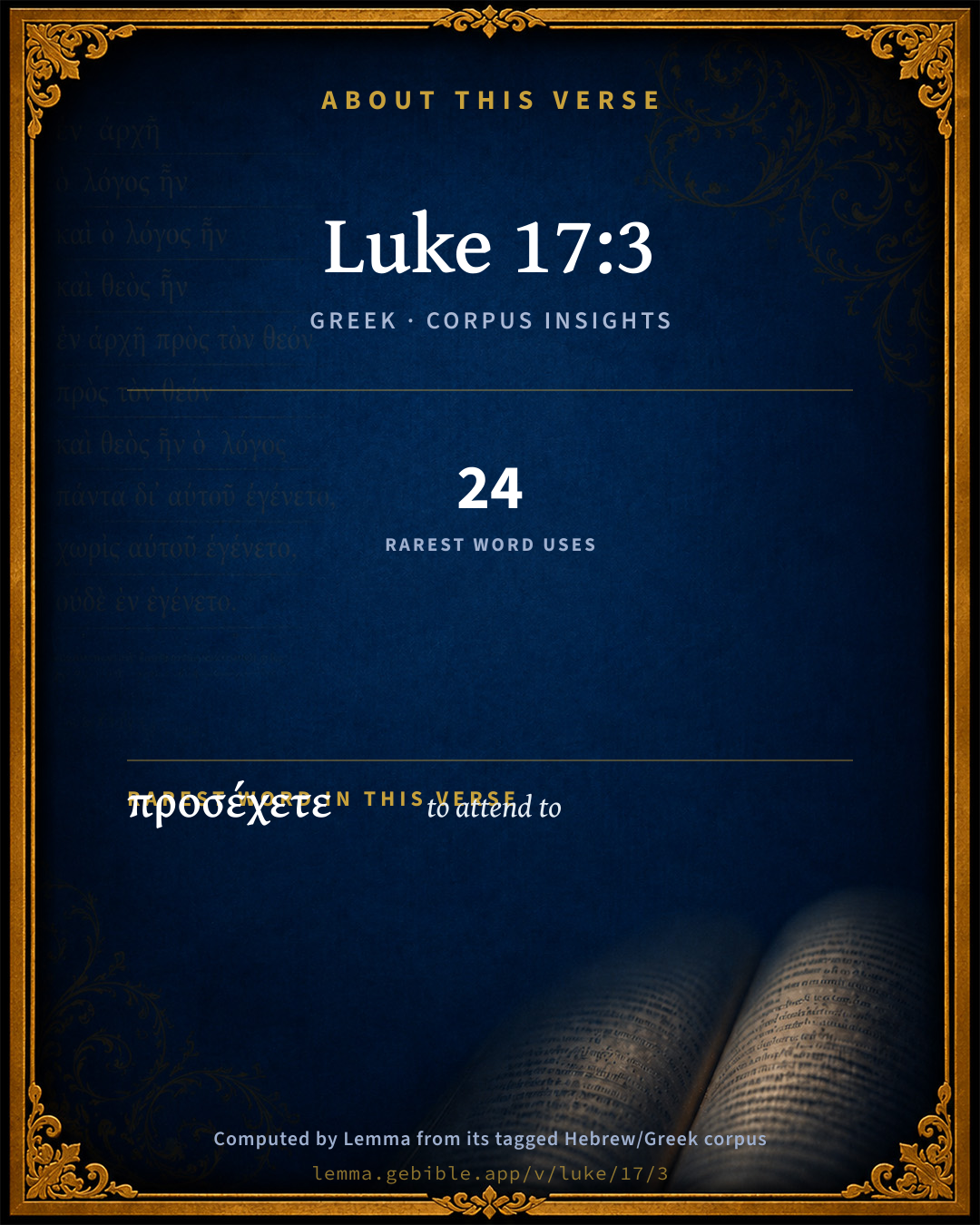
Luke 17:3

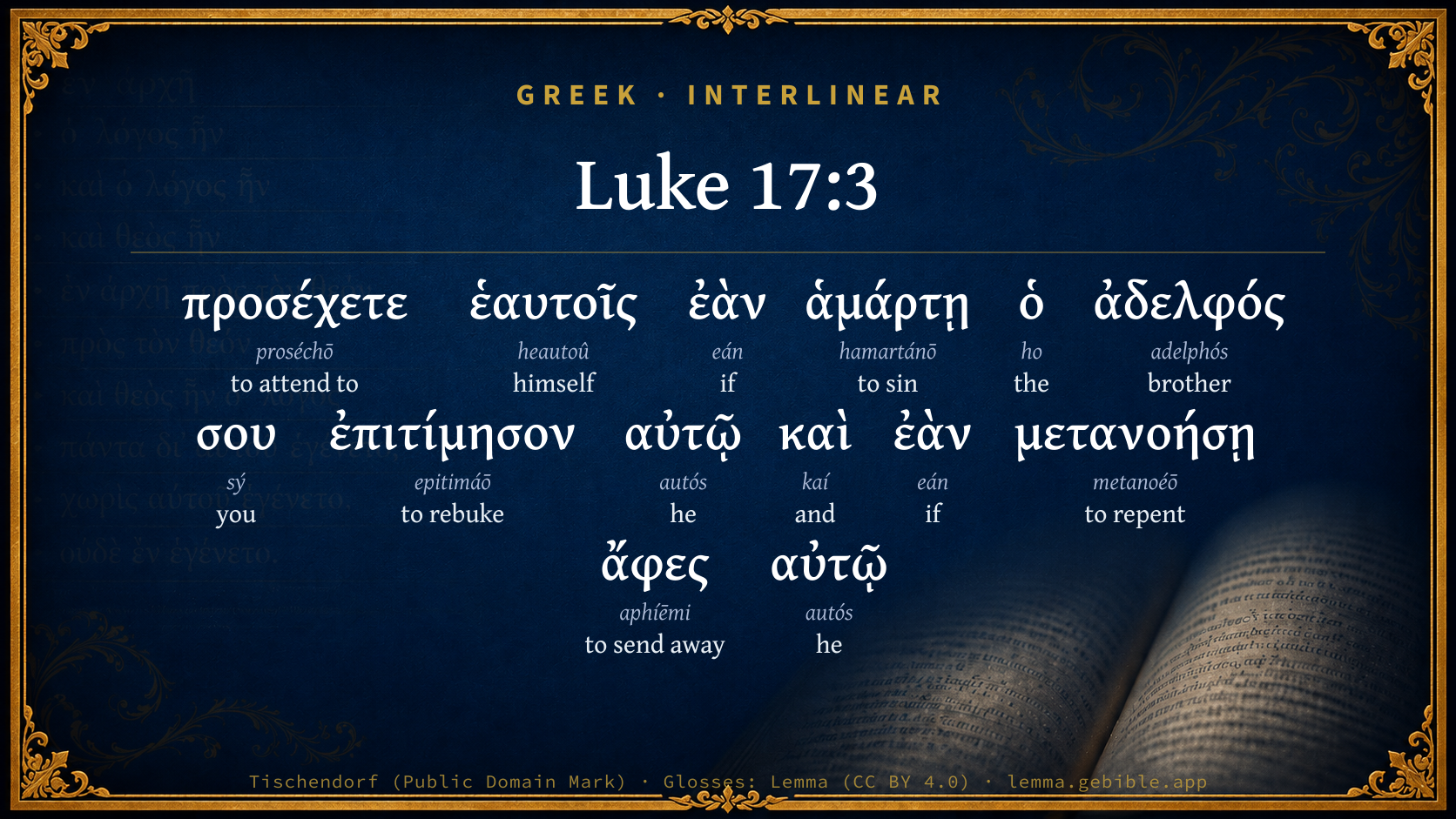
Greek (Tischendorf 8th ed.) Luke 17:3 appears in the Greek New Testament. The text above is from the Tischendorf 8th edition. Each word links to its Strong’s number and a concise gloss. Click any word for its full Thayer’s Greek Lexicon entry.
Download image
Cite this verse

Luke 17:3 (World English Bible). Public Domain. Lemma interlinear Bible study tool, https://lemma.gebible.app/v/luke/17/3.

Show BibTeX & RIS
BibTeX
RIS
English Translation
Be careful. If your brother sins against you, rebuke him. If he repents, forgive him.
World English Bible · Public Domain
Download a study sheet

One document with this verse’s original text, its word-by-word gloss line, the meaning frame, cross-references with their text, attributed commentary, and full source and license credits — printable, and it pastes into notes with its structure intact.

This verse Autodidact and up

Study sheet (.html) Plain text (.txt)

A passage Seminary Student

Up to 50 verses in one chapter. A passage sheet keeps up to 6 commentary sources and 12 cross-references per verse, in the order this page ranks them, and says so on the sheet whenever that leaves anything out. Ask for a single verse and you get the Autodidact verse sheet above.

Everything on this page stays free to read, with no account — the sheet is a download of what is already on screen, not access to it.

Want to remove ads? Support Godless Engineer
Compare translations 3

The same verse in 3 English versions, stacked beneath the original-language interlinear above. Click any original word for its lexicon entry.

Each is an independent rendering of the whole verse — the interlinear is not word-aligned to these translations.

Highlighted words mark where these versions differ — a whole-verse word diff, not a word-by-word alignment.

  • World English Bible Public Domain
    Be careful. If your brother sins against you, rebuke him. If he repents, forgive him.
  • King James Version Public Domain
    Take heed to yourselves: If thy brother trespass against thee, rebuke him; and if he repent, forgive him.
  • unfoldingWord Literal Text CC BY-SA 4.0
    Pay attention to yourselves. If your brother sins, rebuke him; and if he repents, forgive him.

unfoldingWord Literal Text — © unfoldingWord, licensed CC BY-SA 4.0. Word-aligned USFM3 via Door43 (git.door43.org/unfoldingWord/en_ult).

Versions to compare (up to 4)

3 of 4 selected

Show all 19 translations

Every available English version of this verse, each an independent rendering of the whole verse.

  • World English Bible Public Domain
    Be careful. If your brother sins against you, rebuke him. If he repents, forgive him.
  • Berean Standard Bible Public Domain
    Watch yourselves. If your brother sins, rebuke him; and if he repents, forgive him.
  • Majority Standard Bible Public Domain
    Watch yourselves. If your brother sins against you, rebuke him; and if he repents, forgive him.
  • King James Version Public Domain
    Take heed to yourselves: If thy brother trespass against thee, rebuke him; and if he repent, forgive him.
  • American Standard Version (1901) Public Domain
    Take heed to yourselves: if thy brother sin, rebuke him; and if he repent, forgive him.
  • Revised Version (1885) Public Domain
    Take heed to yourselves: if thy brother sin, rebuke him; and if he repent, forgive him.
  • Geneva Bible (1599) Public Domain
    Take heede to your selues: if thy brother trespasse against thee, rebuke him: and if hee repent, forgiue him.
  • Douay-Rheims (1899) Public Domain
    Take heed to yourselves. If thy brother sin against thee, reprove him: and if he do penance, forgive him.
  • Young's Literal Translation Public Domain
    `Take heed to yourselves, and, if thy brother may sin in regard to thee, rebuke him, and if he may reform, forgive him,
  • Literal Standard Version CC BY-SA 4.0
    Take heed to yourselves, and if your brother may sin in regard to you, rebuke him, and if he may change his mind, forgive him,
  • Unlocked Literal Bible CC BY-SA 4.0
    Watch yourselves. If your brother sins, rebuke him, and if he repents, forgive him.
  • unfoldingWord Literal Text CC BY-SA 4.0
    Pay attention to yourselves. If your brother sins, rebuke him; and if he repents, forgive him.
  • Darby Bible Public Domain
    Take heed to yourselves: if thy brother should sin, rebuke him; and if he should repent, forgive him.
  • World Messianic Bible Public Domain
    Be careful. If your brother sins against you, rebuke him. If he repents, forgive him.
  • Webster's Bible Public Domain
    Take heed to yourselves: If thy brother shall trespass against thee, rebuke him; and if he shall repent forgive him.
  • Free Bible Version CC BY-SA 4.0
    So take care what you do. If your brother sins, warn him; and if he repents, forgive him.
  • Bible in Basic English Public Domain
    Give attention to yourselves: if your brother does wrong, say a sharp word to him; and if he has sorrow for his sin, let him have forgiveness.
  • Text-Critical English NT CC BY 4.0
    Watch yourselves. If yoʋr brother sins against yoʋ, rebuke him. If he repents, forgive him.
  • Tyndale New Testament (1534) Public Domain
    Take hede to youre selves. If thy brother trespas agaynst the rebuke him: and yf he repent forgeve him.

Literal Standard Version (2020), Covenant Press — licensed CC BY-SA 4.0. Text via the HelloAO Bible API (eBible.org). Unlocked Literal Bible (unfoldingWord) — licensed CC BY-SA 4.0. Text via the HelloAO Bible API (eBible.org). unfoldingWord Literal Text — © unfoldingWord, licensed CC BY-SA 4.0. Word-aligned USFM3 via Door43 (git.door43.org/unfoldingWord/en_ult). Free Bible Version, Dr. Jonathan Gallagher — licensed CC BY-SA 4.0. Text via the HelloAO Bible API (eBible.org).

Word by word

More ways to search: Search by grammar → Find every occurrence → Compare this word →

Practice this passage: Drill this verse → Learn its vocabulary →

προσέχετε
proséchō
G4337
“to attend to”
Verb, Present, Active, Imperative, 2nd person, Plural
Part of Speech
Verb
Tense
Present
Voice
Active
Mood
Imperative
Person
2nd person
Number
Plural
Full Thayer's Definition

Origin: from G4314 and G2192

TDNT: None

1. to bring to, bring near a. to bring a ship to land, and simply to touch at, put in 2. to turn the mind to, attend to be attentive a. to a person or a thing: of caring for, providing for 3. to attend to one's self, i.e. to give heed to one's self a. give attention to, take heed 4. to apply one's self to, attach one's self to, hold or cleave to a person or a thing a. to be given or addicted to b. to devote thought and effort to
  1. ἑαυτοῖς heautoû G1438 “himself” Reflexive pronoun, 2nd person, Dative, Plural, Masculine
  2. ἐὰν eán G1437 “if” Conditional
  3. ἁμάρτῃ hamartánō G264 “to sin” Verb, Aorist, Active, Subjunctive, 3rd person, Singular
  4. ὁ ho G3588 “the” Article, Nominative, Singular, Masculine
  5. ἀδελφός adelphós G80 “brother” Noun, Nominative, Singular, Masculine
  6. σου sý G4771 “you” Personal pronoun, 2nd person, Genitive, Singular
  7. ἐπιτίμησον epitimáō G2008 “to rebuke” Verb, Aorist, Active, Imperative, 2nd person, Singular
  8. αὐτῷ autós G846 “he” Personal pronoun, Dative, Singular, Masculine
  9. καὶ kaí G2532 “and” Conjunction
  10. ἐὰν eán G1437 “if” Conditional
  11. μετανοήσῃ metanoéō G3340 “to repent” Verb, Aorist, Active, Subjunctive, 3rd person, Singular
  12. ἄφες aphíēmi G863 “to send away” Verb, Aorist, Active, Imperative, 2nd person, Singular
  13. αὐτῷ autós G846 “he” Personal pronoun, Dative, Singular, Masculine

About this verse

These counts appear in no published source. They are computed here, from the morphology-tagged text and Lemma’s own curated glosses. What Lemma adds →

14
words
12
distinct lemmas
Gospels
section

Notable vocabulary

The rarest word here is προσέχετε to attend to G4337 — appearing just 24 times in the whole Greek New Testament.

Shared distinctive vocabulary

προσέχετε to attend to G4337 occurs in 24 verses of the Greek New Testament. Also found in:

Repetition

Words recur within this verse:

  • ἐὰν if G1437 ×2
  • αὐτῷ he G846 ×2

Cross-references

18

Topical passages linked to Luke 17:3 in the Treasury of Scripture Knowledge — connected by theme and wording, ordered by reader-vote popularity; previews shown in the World English Bible.

  • Leviticus 19:17 "'You shall not hate your brother in your heart. You shall surely rebuke your neighbor, and not bear sin because of him.
  • Matthew 18:21 Then Peter came and said to him, "Lord, how often shall my brother sin against me, and I forgive him? Until seven times?"
  • Proverbs 9:8 Don't reprove a scoffer, lest he hate you. Reprove a wise man, and he will love you.
  • Matthew 18:15–17 "If your brother sins against you, go, show him his fault between you and him alone. If he listens to you, you have gained back your brother.
  • 2 Chronicles 19:6–7 and said to the judges, Consider what you do: for you don't judge for man, but for Yahweh; and [he is] with you in the judgment.
  • Proverbs 27:5 Better is open rebuke Than hidden love.
  • James 5:19 Brothers, if any among you wanders from the truth, and someone turns him back,
  • Exodus 34:12 Be careful, lest you make a covenant with the inhabitants of the land where you are going, lest it be for a snare in the midst of you:
  • Deuteronomy 4:9 Only take heed to yourself, and keep your soul diligently, lest you forget the things which your eyes saw, and lest they depart from your heart all the days of your life; but make them known to your children and your children's children;
  • Deuteronomy 4:23 Take heed to yourselves, lest you forget the covenant of Yahweh your God, which he made with you, and make you an engraved image in the form of anything which Yahweh your God has forbidden you.
  • Psalms 141:5 Let the righteous strike me, it is kindness; Let him reprove me, it is like oil on the head; Don't let my head refuse it; Yet my prayer is always against evil deeds.
  • Proverbs 17:10 A rebuke enters deeper into one who has understanding Than a hundred lashes into a fool.
  • Luke 21:34 "So be careful, or your hearts will be loaded down with carousing, drunkenness, and cares of this life, and that day will come on you suddenly.
  • Ephesians 5:15 Therefore watch carefully how you walk, not as unwise, but as wise;
  • Hebrews 12:15 looking carefully lest there be any man who falls short of the grace of God; lest any root of bitterness springing up trouble you, and thereby the many be defiled;
  • 2 John 1:8 Watch yourselves, that we don't lose the things which we have accomplished, but that we receive a full reward.
  • Deuteronomy 4:15 Take therefore good heed to yourselves; for you saw no manner of form on the day that Yahweh spoke to you in Horeb out of the midst of the fire.
  • Galatians 2:11–14 But when Peter came to Antioch, I resisted him to the face, because he stood condemned.

Cross-references courtesy of OpenBible.info (CC BY 4.0).

Where the printed editions differ

1 variant

Places in this verse where the major printed Greek editions disagree on the wording in a way that affects the translation — a comparison of editions, not a manuscript-by-manuscript collation. The editions are the modern critical texts (Nestlé-Aland 28/27, SBL, Westcott-Hort, Tregelles, Tyndale House) and the traditional texts behind the KJV (the Textus Receptus and the Byzantine/Majority text). It is not a claim about which reading is original.

  1. Extra text
    σὲ

    “you”

    In TRByz Not in NA28NA27TynSBLWHTreg

    σὲ (se) 'you' is only in traditional manuscripts (TR+Byz)

Textual data: Translators Amalgamated Greek New Testament (STEPBible TAGNT) · CC BY 4.0.

Commentary

Notes on Luke 17:3 from classic Christian and Jewish commentators (each source and its license shown beneath its notes). The classic Christian expositions comment on the surrounding passage and are grouped to its opening verse, so a note may address several verses; the Jewish commentaries on the Tanakh (Rashi and others) are per-verse, so they appear only where the commentator wrote on this verse.

Lemma curates 59 commentaries, every one of them public domain or Creative Commons licensed, each selected and text-cleaned for this edition rather than reprinted as found. About our sources →

Joseph Benson's Commentary

Luk 17:3-4. Take heed to yourselves — That you may neither offend others, nor be offended by others, but that you may keep all your passions under proper regulation, and may be preserved from those resentments of injuries, real or supposed, which, if yielded to, might occasion much sin to yourselves or others. If thy brother trespass against thee, &c. — But while our Lord cautioned them against all angry passions, and that quarrelsome temper which they naturally produce, he thus prescribed a seasonable and prudent reprehension of any fault that might be committed, accompanied with forgiveness on the part of the person injured, as the best means of disarming the temptations that might arise from such a disposition. See on Mat 18:21. And if he repent, forgive him — Immediately, without insisting on any rigorous satisfaction. And if he trespass against thee seven times a day — That is, very frequently; and seven times a day turn again, saying, I repent — That is, if he give sufficient proof that he does really repent, after having sinned ever so often; thou shalt forgive him — Shalt receive him just as if he had never sinned against thee. But this forgiveness is due only to real penitents. See on Mat 18:21-22. In a lower sense, we are to forgive all, penitent or impenitent, so as to bear them the sincerest goodwill, and to do them all the good we can; and that not seven times only, but seventy times seven.

Joseph Benson's Commentary on the Old and New Testaments (1811–1818) — public domain. Text from a community e-Sword module.

Godbey's Commentary on the New Testament

William B. Godbey

FORGIVENESS INDEFINITE

Luk 17:3-4. “Take heed unto yourselves: If thy brother may sin, correct him: if he may repent, forgive him. And if he may sin against thee seven times a day, and turn unto thee, saying, I repent; you shall forgive him.” This Scripture follows in immediate connection with the preceding on offenses. The rabbis taught that we should not forgive more than three times, as a rule; and in extreme cases, and under the most apologetical circumstances, not more than seven times. You see that our Savior makes the matter utterly indefinite, as seven times a day would actually run up to twenty-five hundred a year. Consequently there is to be no limitation whatever on this line. O how plain and unmistakable is the teaching of our Lord on every matter of duty and responsibility! It is utterly impossible to abide in God’s kingdom and knowingly disobey. Our only hope of heaven is to walk in all the light of God’s Word, Spirit, providence, and our own consciences.

William B. Godbey, Commentary on the New Testament (1896–1900) — public domain. Text from a community e-Sword module.

Bengel's Gnomon

Johann Albrecht Bengel

Luk 17:3. Προσέχετε ἑαυτοῖς, take heed to yourselves) Not only do not give offence to others, Luk 17:1-2, or take offence from others who sin against you, Luk 17:3, but also take heed lest ye be an offence or stumbling-block to yourselves; Mat 18:8. Comp. Gal 6:1, at the end of the verse.—ἄφες, forgive) So God deals with us.

Bengel's Gnomon of the New Testament — English translation (T&T Clark, Edinburgh, 1860) — public domain. Text from a community e-Sword module.

Expositor's Greek Testament

ed. W. Robertson Nicoll

Luk 17:3 . προσέχετε ἑ ., take heed to yourselves (lest ye offend), a reminiscence of the original occasion of the discourse: ambition revealing itself in the disciple-circle.

The Expositor's Greek Testament, edited by W. Robertson Nicoll (1897–1910) — public domain. Text from a community e-Sword module.

Geneva Bible (1599)

Geneva Bible translators

Our reprehensions must be just, and proceed of love and charity.

Geneva Bible (1599) marginal notes — public domain. Text via Bolls.life.

Jamieson, Fausset & Brown

Robert Jamieson, A. R. Fausset & David Brown

(See on Mat 18:15-17; Mat 18:21-22).

Jamieson, Fausset & Brown — Commentary Critical and Explanatory on the Whole Bible (1871) — public domain (CC PDM 1.0). Text via the HelloAO Bible API.

Adam Clarke's Commentary

Verse 3. - 4. If thy brother trespass] See the notes on Mt 18:21; Mt 18:22.

Adam Clarke's Commentary on the Bible (1810–1826) — public domain. Text from a community e-Sword/MySword module.

Ellicott's Commentary for English Readers

(3) Take heed to yourselves.—The position of the words is remarkable, and they have nothing corresponding to them in the parallel passage in Mat_18:21, where see Note. It is as though our Lord saw in the disciples the tendency to sit in judgment on the sins of others, on such sins especially as He had just condemned, and checked it by the words “take heed to yourselves.” They were in danger of faults hardly less fatal to the spiritual life than selfish luxury, and one of those faults was the temper of hard and unforgiving judgment. When they saw a conspicuous instance of worldliness or other evil, they did as we so often do—they condemned, but did not “rebuke.” In practice, as He taught them by example as by precept, open friendly reproof, aiming at restoration, is the truest path to the forgiveness with which, in the careless estimate of most men, it seems to be incompatible.

A Bible Commentary for English Readers, edited by Charles John Ellicott (1878–1897) — public domain. Text from a community e-Sword module.

The Cambridge Bible for Schools and Colleges

gen. ed. J. J. S. Perowne

3. Take heed to yourselves] The following lesson of forgiveness is added because the hard repellent spirit of aggressive Pharisaism and spiritual pride was of all others the most likely to cause offences. It broke up the bruised reed, and stamped on the smoking flax.

If thy brother trespass against thee] Rather, If he sin, omitting “against thee.” Comp. Mat_18:15-17; Mat_18:21-22.

rebuke him...forgive him] The former duty had been fully recognised in the old dispensation (Lev_19:17; Pro_17:10); the latter far more distinctly and emphatically in the new (Mat_18:15). The former is only intended as a help to the latter, 1Th_5:14.

The Cambridge Bible for Schools and Colleges (gen. ed. J. J. S. Perowne; Cambridge University Press, 1878–1918) — public domain. Text from a community e-Sword module.

John Gill's Exposition

And if he trespass against thee seven times in a day,.... For good men are frequently apt to fall into sin, and offend both God and man; see Pro 24:16 "and seven times in a day turn again to thee, saying, I repent"; as often as he sins, and appears to be truly sensible of it, and humble for it, and makes acknowledgments of it; and not only barely in words professes his concern for it, but there is reason to believe that he is heartily grieved for it, and to hope that he will behave better for the future:

thou shalt forgive him; this seems to be occasioned by Peter's putting such a question to Christ, how often a brother might sin against him, and he forgive him; see Mat 18:21. The Jews plead for great tenderness and readiness to forgive penitents, when they ask for forgiveness; which they insist upon should be done: they say (q),

"it is forbidden an injured person to be cruel, and not forgive; this is not the way of the seed of Israel: but when he that has done the injury asks of him, and prays him once and again, and he knows that he has returned from his sin, and hath repented of his evil, he ought to forgive him; and whoever makes haste to forgive, is praiseworthy.''

But then, they say (r),

"if he brings all the rams of Nebaioth that are in the world, he is not to have pardon, unless he asks it of him.''

And they seem also to have set times for it, as well as restrain the frequent repetition of it: they observe (s);

"if a man returns by repentance, in the intermediate time, (i.e. as the gloss explains it, between the beginning of the year, or New Year's Day, and the day of atonement,) they pardon him; but if he does not return in the intermediate time, though he brings all the rams of Nebaioth in the world, they do not pardon him.''

A man that was always forgiving, was reckoned by them an extraordinary man: it is said (t) of Mar Zutra bar Nachman, that he was , "forgiving every day"; but yet they do not seem to care to carry it to so great a length, and to repeat it so often as our Lord directs; they allow a man to forgive three times, but not a fourth; See Gill on Mat 18:22.

(q) Maimon. Hilchot Chobel Umezik, c. 5. sect. 10. (r) T. Bab. Bava Kama, fol. 92. 1. (s) T. Bab. Rosh Hashama, fol. 17. 2. (t) Juchasin, fol. 90. 2.

John Gill's Exposition of the Whole Bible (1746–1763) — public domain (CC PDM 1.0). Text via the HelloAO Bible API.

Trapp's Complete Commentary

John Trapp

3 Take heed to yourselves: If thy brother trespass against thee, rebuke him; and if he repent, forgive him.

Ver. 3. {See Trapp on "Mat 18:15"}

John Trapp, A Commentary or Exposition upon All the Books of the Old and New Testament (1647–1656) — public domain. Text from a community e-Sword module.

Albert Barnes' Notes on the Bible

See the notes at Mat 18:15, Mat 18:21-22. “Trespass against thee.” Sin against thee, or does anything that gives you an offence or does you an injury.

Rebuke - Reprove. Go and tell him his fault, and seek an explanation. Acquaint him with what has been the effect of his conduct, and the state of your feelings, that he may acknowledge his error and repent.

Albert Barnes' Notes on the Bible (1834–1885) — public domain. Text from a community e-Sword/MySword module.

Matthew Poole's English Annotations

Matthew hath something of the same tendency in Mat 18:21,22, mentioning it as an answer to a question which Peter propounded to our Lord; but the circumstances of both relations are so different that I cannot think them the same, but do believe these words spoken at another time. This doctrine of the forgiveness of our offending brother is pressed upon us in several places in the gospel and New Testament, and that upon the gravest arguments imaginable, Mat 6:15; 18:35; Mar 11:26; Luk 6:37; Eph 4:32; from whence we may justly conclude it a duty of very high concernment for us both to understand and to live in the practice of. It signifies the laying aside of all thoughts or desire of revenge in our own cause. The precept is not exclusive of our duty in seeing the glory of God avenged upon murderers, &c.; nor yet of our seeking a just satisfaction, in a legal way, for wrongs done to us relating to our limbs or estate, so far as the person is able to do it; much less doth it require the making such a one as hath so injured us our intimate and bosom friend. That which it requireth is the laying aside all malice, or desire of revenge, upon our neighbour in a case wherein our own name or honour is concerned; and it is fitly joined to what went before, this malice, or desire of revenge, being the root of all the mischief that men voluntarily do one to another, especially of that which they do to the innocent servants of God.

Matthew Poole's English Annotations on the Holy Bible (1683–1685) — public domain. Text from a community e-Sword/MySword module.

Whedon's Commentary on the Bible

Daniel D. Whedon

3. Take heed to yourselves—Ye, my little ones, take heed. Beware first of the offences, that is, the impediments and the temptations of apostacy flung in your way by these Pharisees. And, second, take heed among yourselves not to be led by a brother’s trespasses into resentment and sin.

Thy brother—Thy fellow-believer. Rebuke him, in order, and if possible in such a way, as to make him come to an “I repent.” This for the purpose of securing thy own peace and the peace of the Church, and so far as he is concerned, to prevent his falling into deeper sin and apostacy.

Daniel D. Whedon (gen. ed.), Commentary on the Old and New Testaments (1874–1909) — public domain. Text from a community e-Sword module.

The Pulpit Commentary

Take heed to yourselves: If thy Brother trespass against thee, rebuke him; and if he repent, forgive him. "But do you take heed," the Lord went on to say, "my disciples; you too are in danger of committing deadly sin yourselves, and of doing my cause irreparable injury. Soft living m selfish luxury, about which I have been speaking lately, is not the only wrong you can commit; there is sore danger that men placed as you are will judge others harshly, even cruelly, and so offend in another way "the little ones" pressing into the kingdom: this is your especial snare." Things Jesus had noticed, perhaps congratulatory, self-sufficient comments he had heard them make on the occasion of the lately spoken parable of Dives, very likely had suggested this grave warning. So here he tells them, the future teachers of his Church, how they must act: while ever the bold, untiring, fearless rebukers of all vice, of every phase of selfishness, they must be never tired of exercising forgiveness the moment the offender is sorry. The repentant sinner must never be repelled by them.

Vers. 3, 4. Our duty when wronged.

The opening words of this passage, "Take heed to yourselves," point to our Lord"s sense of the great difficulty we are likely to experience in learning the forthcoming truth, or to the great stress he lays upon its illustration in our lives it might well be either or both of these. For it is a difficult lesson to learn well; and our Master does make much, as other passages show, of this particular grace.

I OUR OPENNESS TO INJURY.

1. We come into the world with a strong sense of what is due to us. We all feel that there is due to us a certain measure of respect as human beings, as those made in the image of God; also that we can claim just and equitable treatment. Men may not withhold or remove from us that which we consider to belong to us. If they do we are aggrieved; we have a sense, more or less deep, of having been wronged our sense of injury rising and falling with the sensitiveness of our nature and the character of the offence. There is neither virtue nor vice, honour nor shame, in this. It is an instinct of our nature which we have in common with our kind.

2. There are many possibilities of offence. In our present condition we touch one another at so many points that there is great likelihood of offence being given and taken. At home; in all the complications of our business life; in all our social relations; in the Church of Christ and the worship of God; in the field of philanthropy; in all these domains "we have to do" with one another; and it is improbable in a very high degree, it is almost impossible, that we should always comport ourselves as our neighbours would expect; it is inevitable that we should occasionally differ as to what is due from one to another.

II OUR DANGER UNDER A SENSE OF INJURY.

1. The mistake we are likely to fall into when we have a sense of injury is that of instantly concluding that we have been wronged; we are apt to hurry to the conclusion that some one has slighted or injured us. But before we give way even to a strong feeling, we should make quite sure that things are as they seem to be. There are many possibilities of mistake in this world of error and misunderstanding.

2. The sin into which we are tempted to tall is that of giving way to unbecoming anger and unchristian retaliation a feeling of bitter resentment, vindictive, passionate, such as does not become the children of God; and action which is intended to result in suffering on the part of the wrong-doer; we proceed to "avenge ourselves.

III OUR DUTY WHEN WRONGED.

1. Direct communication, and, where it is necessary, friendly remonstrance. Matthew tells us that Christ enjoined upon us that, under a sense of injury, we should "go and tell our brother his fault between ourselves and him alone." This is surely most wise. Instead of dwelling upon it and magnifying it in our own mind; instead of talking about it and causing it to be spread abroad and discoloured and misrepresented, the one right thing to do is to go at once to our offending neighbour and tell him our grievance. It is very likely he will explain everything, and there will be no need of any overlooking on our part; or, if wrong has been done, it is very likely he will appreciate our fairness and friendliness in coming straight to him, and will make the apology that is due on his part. Then must come:

2. Free and full forgiveness. "If he repent, forgive him." If he should refuse to repent, we must pity him and pray for him, that his eyes may be opened and his action amended, and himself raised by doing the right and honourable thing. But if he repent, then it is our high and Christian duty to forgive. And how shall we forgive? Even as God, for Christ"s sake, forgives us. (Eph_4:32)

(1) Immediately.

(2) Frankly and heartily; reinstating the one who has wronged us in the place he occupied before in our confidence, affection, kindness.

(3) Uncalculatingly. "Seven times in a day." However often our child, our servant, our neighbour, may offend, if there be sincere penitence on his part, and therefore an honest effort to amend, we do well to forgive. The more of this grace we have in our heart and life, the closer is our resemblance and the fuller is our obedience to our forgiving Saviour. C.

The Pulpit Commentary (1880–1919), ed. H.D.M. Spence-Jones & Joseph S. Exell — public domain. Text from a community e-Sword module.

John Wesley's Explanatory Notes

Take heed to yourselves - That ye neither offend others, nor be offended by others. Matt. xviii, 15.

John Wesley, Explanatory Notes Upon the Whole Bible (1754–1765) — public domain. Text via the GEBible commentary corpus.

Kretzmann's Popular Commentary

Paul E. Kretzmann

Concerning forgiveness:

v. 3. Take heed to yourselves: If thy brother trespass against thee, rebuke him; and if he repent, forgive him.

v. 4. And if he trespass against thee seven times a day, and seven times in a day turn again to thee, saying, I repent, thou shalt forgive him.

v. 5. And the apostles said unto the Lord, Increase our faith.

v. 6. And the Lord said, If ye had faith as a grain of mustard-seed, ye might say unto this sycamine tree, Be thou plucked up by the root, and be thou planted in the sea, and it should obey you.

The children of the world make it a point literally to scandalize, give offense with deliberate intent to hurt and to lead into sin. But among Christians it also happens, and frequently, that one brother offends the other, grieves him by some unpremeditated sin or in a moment of weakness. For that reason they should take heed, they should be on the lookout as regards themselves all the time, lest they themselves become guilty and scandalize a brother. And if a brother offends in any respect, the Christian that knows of the sin should earnestly admonish him, Mat 18:21-22. As soon as the brother thereupon repents of his sin, the Christian should forgive him, fully and freely, even though the same process be repeated seven times a day. The heart of the believers should partake of the nature of God’s and Christ’s, or God’s in Christ, which knows neither end nor limit. Whenever the confession comes: I am sorry, then should the assurance be given in return that the matter is forgiven. Such a. measure of love for the erring brother, it is true, requires an unusual amount of love, and therefore a corresponding amount of faith. The apostles were conscious of that fact; as matters stood then, they hardly believed themselves equal to the task proposed by Christ. And so, after mulling over the admonition for a while, they put the request to Him to add to their faith. This prayer is necessary for every Christian every day, if he wants his love to keep pace with the many demands that are placed upon it. Faith must grow at the same rate as love. A Christian will search ever more diligently, he will plunge ever more deeply into the depths of the love of God in Jesus the Savior. Only in that way will he be able to practice the forgiveness toward his brother which is demanded by the discipleship of Christ. The Lord took the occasion to enlarge upon one of His favorite topics, that of the strength of faith. If they had faith only as large as the seed of a mustard-plant or tree, they would have the power to say to the fig mulberry or sycamore fig-tree standing before them that it should tear itself out by the roots and plant itself in the sea, and it would obey without question. Note: To grow in faith, in the power of faith, must be the earnest ambition of every Christian. Sincere prayer to the Lord, unwavering trust in His promises, a constant contemplation of His Word: those are the methods by which growth in faith may be accomplished.

Paul E. Kretzmann, Popular Commentary of the Bible (1921–1924) — public domain. Text from a community e-Sword module.

Burkitt's Expository Notes on the New Testament

William Burkitt

The doctrine of forgiving an offending brother, is pressed upon us with many forcible arguments in the New Testament, which speaks it to be a duty of indispensable necessity. This place is to understood of private offences, and personal wrongs and injuries done by one man to another; which we must first reprove, and then remit; and although it be said, If he repent, forgive him; that is not to be understood, as if we needed not to pardon our brother, if he neglects to repent and ask forgiveness; but whether he acknowledges his offence or not to us, our hearts must stand ready to forgive the wrong done to us, and to pray for forgiveness on his behalf at the hands of God; laying aside all thoughts and desires of revenge in our own cause, and standing ready to any office of love and service to our offending brother.

Learn hence,

1. That to fall often into the same offence against our brother is a great aggravation of our offences: If thy brother trespass against thee seven times in a day; that is, very often.

2. That as the multiplication of offences is a great aggravation of offences, so the multiplying of forgiveness is a great demonstration of a God-like temper in us: he that multiplies sin, does, like Satan, sin abundantly; and he that multiplies pardon, does, like God, pardon abundantly.

William Burkitt's Expository Notes on the New Testament (1700–1703) — public domain. Text from a community e-Sword module.

The People's New Testament

B. W. Johnson

3, 4. If thy brother sin, rebuke him. See notes on Matt. 18:15–22. Observe that kind rebuke, as well as forgiveness, is a duty.

B. W. Johnson's The People's New Testament with Notes (1889–1891) — public domain. Electronic text from the Christian Classics Ethereal Library (CCEL) ThML edition.

unfoldingWord translationNotes

Door43 World Missions Community

If your brother sins

This is a conditional statement that talks about an event that will probably happen in the future.

your brother

"brother" is here used in the sense of someone with the same belief. AT: "a fellow believer"

rebuke him

"tell him strongly that what he did was wrong" or "correct him"

If he sins against you seven times

This is a hypothetical future situation. It may never happen, but even if it does, Jesus tells people to forgive. (See: Hypothetical Situations)

seven times in the day, and seven times

The number seven in the Bible is a symbol for completeness. AT: "many times in a day, and each time" (See: Assumed Knowledge and Implicit Information)

translationWords

brother

sin

rebuke

repent

forgive

unfoldingWord translationNotes — © Distant Shores Media and the Door43 World Missions Community, licensed CC BY-SA 4.0. Source: git.door43.org/Door43/en_tn.

Cambridge Greek Testament for Schools and Colleges

3. προσέχετε ἑαυτοῖς. The following lesson of forgiveness is added because the hard repellent spirit of aggressive Pharisaism and spiritual pride was of all others the most likely to cause offences. It broke up the bruised reed, and stamped on the smoking flax.

ἐὰν ἁμάρτῃ. ‘If he sin,’ omitting “against thee.” Comp. Mat 18:15-17; Mat 18:21-22.

ἐπιτίμησον … ἄφες. The former duty had been fully recognised in the old dispensation (Lev 19:17; Pro 17:10); the latter far more distinctly and emphatically in the new (Mat 18:15). The former is only intended as a help to the latter, 1Th 5:14.

Cambridge Greek Testament for Schools and Colleges (Cambridge University Press, 1896; 21 vols, various authors incl. Carr, Maclear, Plummer, Farrar, Lumby, Moule, M. R. James, Simcox) — public domain. Text from a community e-Sword module.

International Critical Commentary

3, 4. § The Duty of Forgiveness. Those who connect this saying with the one which precedes it, make an unforgiving spirit to be set forth as a common way of causing others to stumble. Others regard it as an à fortiori argument. If we must avoid doing evil to others, much more must we forgive the evil which they do to us. A better link is found in the severity of vv. 1 and 2, “when thou sinnest against another,” and the tenderness of vv 3 and 4, “when others sin against thee.”

The δέ, which A etc. insert after ἐάν, is perhaps an attempt to mark a contrast between the two sayings and thus link them. Or it may come from Mat 18:15.: om. א A B L; X, Latt.Boh. Aeth. Arm. Goth. Neither here nor Mat 18:15 is the εἰς σέ, which D and some Latin authorities insert after ἁμάρτῃ, genuine: om. א A B L C D, Cod. Am. Cod. Brig. Syr. Goth. Nevertheless, what follows shows that offences εἰς σέ are specially meant.

ἐπιτίμησον . The tenderness is not to be weakness. The fault is not to be passed over without notice (Lev 19:17).

International Critical Commentary — older volumes (1896–1929), various authors — public domain. Text from a community e-Sword module.

Vincent's Word Studies in the New Testament

Marvin R. Vincent

Rebuke. See on straitly charged, ch. 9 21.

Marvin R. Vincent, Word Studies in the New Testament (1887–1900) — public domain. Text from a community e-Sword/MySword module.

Godet's Commentaries

Frédéric Louis Godet

Vers. 3 and 4. The Pardon of Trespasses.—“If thy brother trespass against thee, rebuke him; and if he repent, forgive him. 4. And if he trespass against thee seven times in a day, and seven times in a day turn again to thee, saying, I repent, thou shalt forgive him.”

Holiness and love meet together in this precept: holiness begins with rebuking; then, when the rebuke has once been taken, love pardons. The pardon to be granted to our brethren has no other limit than their repenting, and the confession by which it is expressed.

Matthew (Mat 18:15-22) places this precept in the same discourse as the preceding; it probably referred also to the altercation which had taken place between the disciples on that occasion. But there what gives rise to it is a characteristic question of Peter, which Luke did not know; otherwise he would not have omitted it; comp. Luk 12:41, where he carefully mentions a similar question put by the same apostle. Mark omits this precept about pardon; but at the end of the same discourse we find this remarkable exhortation (Mar 9:50): “Have salt in yourselves (use severity toward yourselves; comp. Luk 12:43-48), and have peace with one another,”—a saying which has substantially the same meaning as our precept on the subject of pardon. What a proof both of the radical authenticity of the sayings of Jesus and of the fragmentary manner in which tradition had preserved them, as well as of the diversity of the sources from which our evangelists derived them!

Frédéric Louis Godet — Commentaries on Luke, John, Romans, and 1 Corinthians — English translation (T&T Clark, Edinburgh, 1870s–1890s) — public domain. Text from a community e-Sword module.

Lesson kit

Teaching starters — assembled from the data on this page, not authored interpretation. Every prompt links to the verse data it draws on. Edit before teaching.

Luke, in the Gospels, opens this verse with 14 words (12 distinct Greek lemmas). Its most distinctive word is proséchō (“to attend to”). A historical commentator’s framing appears above. Read the whole chapter for the surrounding context.

Discussion questions

  1. What does “to attend to” (proséchō) contribute to the verse as a whole?
  2. Matthew 6:1 shares the word «to attend to» with this verse. How do the two illuminate each other?
  3. “if” occurs 2× in this one verse. What is the effect of the repetition?
  4. These translations render this verse differently; the difference is in the English rendering, not the original. What questions does that raise?
  5. Reading how Joseph Benson's Commentary and Godbey's Commentary on the New Testament read this verse, where do the two commentators agree and where do they part?

Things to notice

Reading settings

Reading text

Shown beneath each verse's original-language words.

Old Testament
Old Testament edition

Read the OT as the Masoretic Hebrew (MT) or the Greek Septuagint (LXX).

English shown for the Greek Septuagint (in the Hebrew ↔ Greek comparison).

Comparing translations? Open the Compare panel on any verse page to stack up to four side by side.