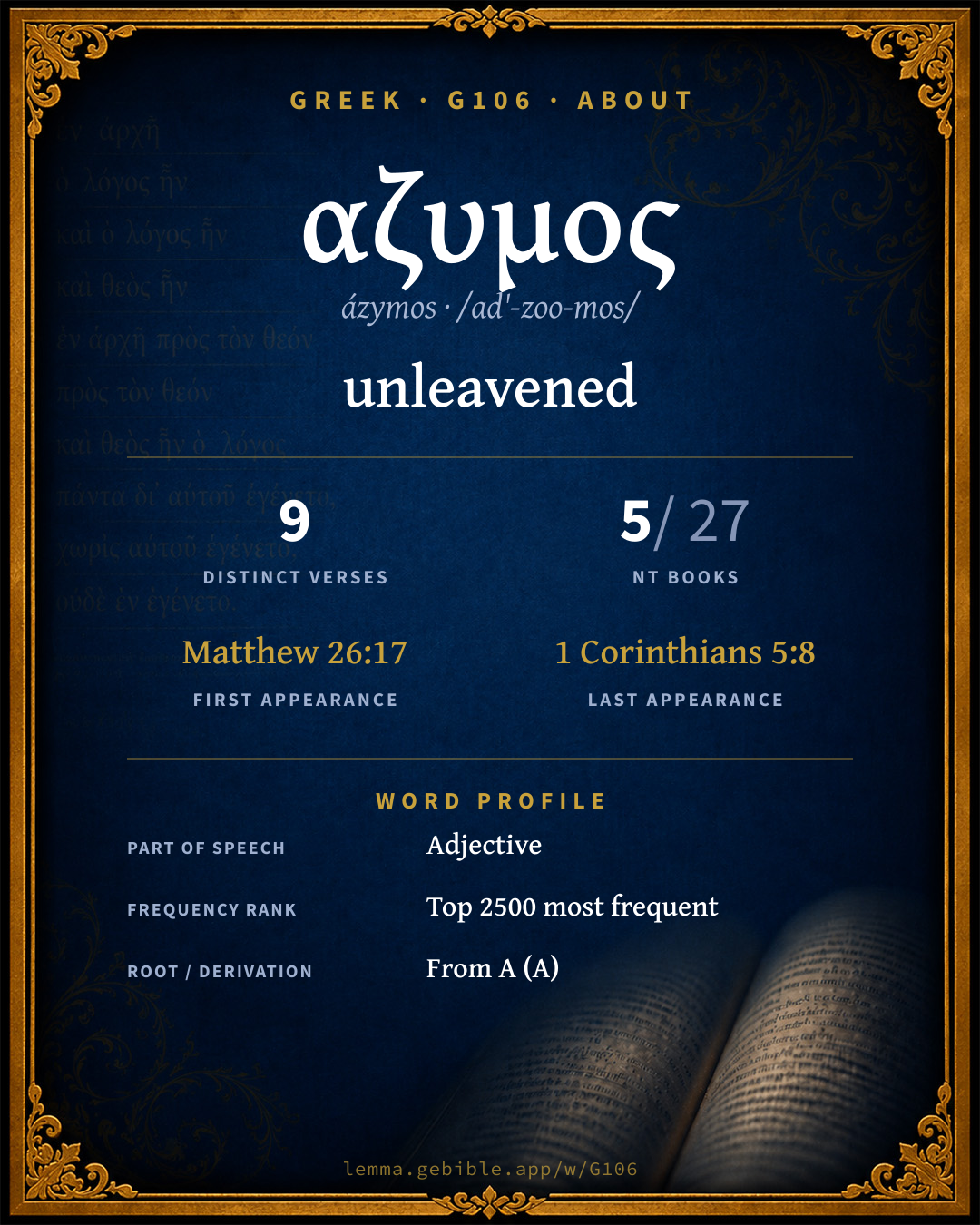
ἄζυμος
unleavened
Full lexicon entry — Thayer's Greek Lexicon
From Thayer's Greek Lexicon
Where this word appears
See every Genitive-case word in the Greek New Testament →
Grammar key — what these labels mean
Part of speech
- Adjective
- A word that describes or qualifies a noun.
Case
- Genitive
- The case of source, possession, or “of” — answers “whose / from what.”
- Dative
- The case of the indirect object, means, or location — “to / for / with / in.”
- Nominative
- The case of the subject (and the predicate nominative).
Gender
- Neuter
- Grammatically neuter.
- Masculine
- Grammatically masculine.
Number
- Plural
- More than one.
Grammatical forms
- Adjective, Genitive, Plural, Neuter 6 times (67%)
- Adjective, Dative, Plural, Neuter 1 time (11%)
- Adjective, Nominative, Plural, Masculine 1 time (11%)
- Adjective, Nominative, Plural, Neuter 1 time (11%)
Parsed forms decoded from the imported morphology (Robinson–Tischendorf, public domain), counted across 9 parsed occurrences — not distinct verses.
Every verse where G106 appears — 9 distinct verses across 5 books. Click any verse to open its interlinear word-by-word view. Verse text shown in the World English Bible for context — . Each verse’s Greek form is shown with its reference; the English is not keyword-highlighted, since the data carries no word-level English alignment. Use “Compare translations” on any verse to read it across multiple English versions. This concordance covers the Greek New Testament; Septuagint (Greek Old Testament) occurrences of this word are not indexed here.
Matthew 1 verse
Mark 2 verses
- Mark 14:1 ἄζυμα adj nom pl neut It was now two days before the feast of the Passover and the unleavened bread, and the chief priests and the scribes sought how they might sieze him by deception, and kill him.
- Mark 14:12 ἀζύμων adj gen pl neut On the first day of unleavened bread, when they sacrificed the Passover, his disciples asked him, "Where do you want us to go and make ready that you may eat the Passover?"
Luke 2 verses
Acts 2 verses
- Acts 12:3 ἀζύμων adj gen pl neut When he saw that it pleased the Jews, he proceeded to seize Peter also. This was during the days of unleavened bread.
- Acts 20:6 ἀζύμων adj gen pl neut We sailed away from Philippi after the days of Unleavened Bread, and came to them at Troas in five days, where we stayed seven days.
1 Corinthians 2 verses
- 1 Corinthians 5:7 ἄζυμοι adj nom pl masc Purge out the old yeast, that you may be a new lump, even as you are unleavened. For indeed Christ, our Passover, has been sacrificed in our place.
- 1 Corinthians 5:8 ἀζύμοις adj dat pl neut Therefore let us keep the feast, not with old yeast, neither with the yeast of malice and wickedness, but with the unleavened bread of sincerity and truth.
About this entry
At a glance — auto-summarized from this page’s data, not written by a person. Every figure links to its source below. This summary describes the numbers; it doesn’t interpret them.
αζυμος — transliterated ázymos — is a Greek adjective carrying the sense “unleavened.” Debuting at Matthew 26:17, it then recurs through the corpus. Spanning 9 verses in 5 books, it ranks among the uncommon words of the Greek New Testament. From the same root come Α, αβαρης and αβυσσος. Each statement above links to its evidence; the full detail follows below.
Gloss history
Strong's 1890 vs modern scholarship
About this word
Strong's G106 catalogs a Greek word from the Greek New Testament.
These counts are not copied from any lexicon or concordance. They are computed here, from the morphology-tagged Greek New Testament. What Lemma adds →
- 9
- distinct verses
- The word appears in 9 distinct verses.
- 5 / 27
- NT books
- The word appears in 5 of 27 New Testament books.
- #1,140
- by frequency
- Top 2500 most frequent Greek words (rank 1,140 of 5,347 Greek words by occurrence).
View all 9 occurrences in the concordance →
By section of the New Testament
By traditional corpus
Conventional, traditional groupings — biblical authorship is debated, so this is a traditional corpus grouping, not an authorship claim. Some books belong to more than one corpus (Luke is in both the Gospels and the Lukan corpus, and so on), so these shares overlap and need not total 100%. Each figure is a share of the word’s 9 distinct verses.
- Gospels 5 verses · 56%
- Lukan (Luke–Acts) 4 verses · 44%
- Pauline corpus 2 verses · 22%
How translations render this word
Counts come from each version’s own published word-to-Strong’s tagging or interlinear alignment — an approximate guide to how each version renders this word, not a word-level alignment the data otherwise carries. Because each total is that version’s own tagged count, the per-version totals vary from one another and need not match the appearance or distinct-verse counts above. These counts may also differ from a printed concordance because Lemma counts each distinctly tagged rendering and does not collapse phrase taggings into a single head-word total. This is a fixed set of word-tagged versions (KJV, ASV, BSB, ULT) and does not change with the reading translation you choose elsewhere. Each version’s license is shown beside its name below (and on Sources).
- King James Version: Unleavened bread 6×, Unleavened 2×
- American Standard Version: Unleavened bread 5×, Unleavened 2×
- Berean Standard Bible: Unleavened 4×, Feast of unleavened 3×, Unleavened bread 2×
- unfoldingWord Literal Text: Unleavened bread 6×, Festival of unleavened bread 3×
King James Version Public Domain
Renders G106 across 9 tagged occurrences — most commonly:
Plus 1 rendering that appears only once — usually multi-word phrases or single function words the recovered tagging swept in, not distinct renderings.
American Standard Version Public Domain
Renders G106 across 8 tagged occurrences — most commonly:
Plus 1 rendering that appears only once — usually multi-word phrases or single function words the recovered tagging swept in, not distinct renderings.
Berean Standard Bible Public Domain
Renders G106 across 9 tagged occurrences — most commonly:
unfoldingWord Literal Text CC BY-SA 4.0
Renders G106 across 9 tagged occurrences — most commonly:
Senses in Thayer's
The 1 sense Thayer's distinguishes for this word, in lexicon order (not ranked by frequency or importance). The full entry — with sub-senses — is in the Lexicon Entry tab.
- unfermented, free from leaven or yeast
Word origin
Derived from Α (A) (G1) — alpha.
Forms in the corpus
The 4 distinct written forms G106 takes in the Greek New Testament, most frequent first — each parse links to that case’s occurrences in the concordance.
| Form | Parsing | Example | Uses |
|---|---|---|---|
| ἀζύμων azýmōn | Adjective, Genitive, Plural, Neuter | Matthew 26:17 | 6 |
| ἀζύμοις azýmois | Adjective, Dative, Plural, Neuter | 1 Corinthians 5:8 | 1 |
| ἄζυμα ázyma | Adjective, Nominative, Plural, Neuter | Mark 14:1 | 1 |
| ἄζυμοι ázymoi | Adjective, Nominative, Plural, Masculine | 1 Corinthians 5:7 | 1 |
Same root — word family
Other Thayer's entries built from the same root as G106, grouped by Strong’s listed origin. These share a root / origin per the lexicon — not necessarily a shared meaning. Each links to that word’s own entry.
Derives from
Shares the same root
- αβαρης abarḗs G4 light
- αβυσσος ábyssos G12 abyss
- αγαμος ágamos G22 unmarried
- αγενεαλογητος agenealógētos G35 without genealogy
- αγενης agenḗs G36 ignoble
- αγναφος ágnaphos G46 unprocessed
- αγνοεω agnoéō G50 to be ignorant
- αγνωσια agnōsía G56 ignorance
- αγνωστος ágnōstos G57 unknown
- αγραμματος agrámmatos G62 unlearned
- αγρυπνεω agrypnéō G69 to watch
- αδαπανος adápanos G77 free
- αδελφος adelphós G80 brother
- αδηλος ádēlos G82 obscure
- αδης háidēs G86 hell
- αδιακριτος adiákritos G87 clear
- αδιαλειπτος adiáleiptos G88 continual
- αδικος ádikos G94 unjust
- αδοκιμος adókimos G96 unapproved
- αδολος ádolos G97 guileless
- αδυνατος adýnatos G102 weak
- αθανασια athanasía G110 immortal
- αθεμιτος athémitos G111 unlawful
- αθεος átheos G112 godless
+149 more words share this root (not shown).
Proper names from this root
People and places named from this root — a name, not an additional meaning of the word.
Compare all same-root words → Showing 4 of 176 — not the complete family. 1 of the same-root words is a proper name (a person or place). They share a root, not necessarily a meaning.
Septuagint usage
The same Greek word αζυμος appears 50 times in the Greek Old Testament (Septuagint), across 42 verses in 13 books.
- 50
- LXX occurrences
- Tagged occurrences of this Greek word in the Septuagint.
- 42
- verses
- Distinct Septuagint verses containing this word.
- 13 / 39
- OT books
- The word appears in 13 of the 39 Old Testament books.
Sample Septuagint occurrences
- Genesis 19:3 ἄζυμος
- Exodus 12:8 ἄζυμος
- Leviticus 2:4 ἄζυμος
- Numbers 6:15 ἄζυμος
- Deuteronomy 16:3 ἄζυμος
- Joshua 5:11 ἄζυμος
- Judges 6:19 ἄζυμος
- 1 Samuel 28:24 ἄζυμος
- 2 Kings 23:9 ἄζυμος
- 1 Chronicles 23:29 ἄζυμος
- 2 Chronicles 8:13 ἄζυμος
- Ezra 6:22 ἄζυμος
Septuagint occurrences (same lexeme)
Every verse where the same Strong’s number (G106) appears in the Greek Septuagint. Verse text shown in the World English Bible for context; the Greek form is the matched word — the English is not keyword-highlighted.
- Genesis 19:3 ἄζυμος He urged them greatly, and they came in with him, and entered into his house. He made them a feast, and baked unleavened bread, and they ate.
- Exodus 12:8 ἄζυμος They shall eat the flesh in that night, roasted with fire, and unleavened bread. They shall eat it with bitter herbs.
- Exodus 12:15 ἄζυμος Seven days shall you eat unleavened bread; even the first day you shall put away yeast out of your houses, for whoever eats leavened bread from the first day until the seventh day, that soul shall be cut off from Israel.
- Exodus 12:18 ἄζυμος In the first month, on the fourteenth day of the month at evening, you shall eat unleavened bread, until the twenty first day of the month at evening.
- Exodus 12:20 ἄζυμος You shall eat nothing leavened. In all your habitations you shall eat unleavened bread.'"
- Exodus 12:39 ἄζυμος They baked unleavened cakes of the dough which they brought forth out of Egypt; for it wasn't leavened, because they were thrust out of Egypt, and couldn't wait, neither had they prepared for themselves any food.
- Exodus 13:6 ἄζυμος Seven days you shall eat unleavened bread, and in the seventh day shall be a feast to Yahweh.
- Exodus 13:7 ἄζυμος Unleavened bread shall be eaten throughout the seven days; and no leavened bread shall be seen with you, neither shall there be yeast seen with you, in all your borders.
- Exodus 23:15 ἄζυμος You shall observe the feast of unleavened bread. Seven days you shall eat unleavened bread, as I commanded you, at the time appointed in the month Abib (for in it you came out from Egypt), and no one shall appear before me empty.
- Exodus 29:2 ἄζυμος unleavened bread, unleavened cakes mixed with oil, and unleavened wafers anointed with oil: you shall make them of fine wheat flour.
- Exodus 29:23 ἄζυμος and one loaf of bread, one cake of oiled bread, and one wafer out of the basket of unleavened bread that is before Yahweh.
- Exodus 34:18 ἄζυμος "You shall keep the feast of unleavened bread. Seven days you shall eat unleavened bread, as I commanded you, at the time appointed in the month Abib; for in the month Abib you came out from Egypt.
- Leviticus 2:4 ἄζυμος "'When you offer an offering of a meal offering baked in the oven, it shall be unleavened cakes of fine flour mixed with oil, or unleavened wafers anointed with oil.
- Leviticus 2:5 ἄζυμος If your offering is a meal offering of the baking pan, it shall be of unleavened fine flour, mixed with oil.
- Leviticus 6:9 ἄζυμος "Command Aaron and his sons, saying, 'This is the law of the burnt offering: the burnt offering shall be on the hearth on the altar all night until the morning; and the fire of the altar shall be kept burning on it.
- Leviticus 7:12 ἄζυμος If he offers it for a thanksgiving, then he shall offer with the sacrifice of thanksgiving unleavened cakes mixed with oil, and unleavened wafers anointed with oil, and cakes mixed with oil.
- Leviticus 8:2 ἄζυμος "Take Aaron and his sons with him, and the garments, and the anointing oil, and the bull of the sin offering, and the two rams, and the basket of unleavened bread;
- Leviticus 8:26 ἄζυμος and out of the basket of unleavened bread, that was before Yahweh, he took one unleavened cake, and one cake of oiled bread, and one wafer, and placed them on the fat, and on the right thigh.
- Leviticus 10:12 ἄζυμος Moses spoke to Aaron, and to Eleazar and to Ithamar, his sons who were left, "Take the meal offering that remains of the offerings of Yahweh made by fire, and eat it without yeast beside the altar; for it is most holy;
- Leviticus 23:6 ἄζυμος On the fifteenth day of the same month is the feast of unleavened bread to Yahweh. Seven days you shall eat unleavened bread.
- Numbers 6:15 ἄζυμος and a basket of unleavened bread, cakes of fine flour mixed with oil, and unleavened wafers anointed with oil, and their meal offering, and their drink offerings.
- Numbers 6:17 ἄζυμος He shall offer the ram for a sacrifice of peace offerings to Yahweh, with the basket of unleavened bread. The priest shall offer also its meal offering, and its drink offering.
- Numbers 6:19 ἄζυμος The priest shall take the boiled shoulder of the ram, and one unleavened cake out of the basket, and one unleavened wafer, and shall put them on the hands of the Nazirite, after he has shaved the head of his separation;
- Numbers 9:11 ἄζυμος In the second month, on the fourteenth day at evening they shall keep it; they shall eat it with unleavened bread and bitter herbs.
- Numbers 28:17 ἄζυμος On the fifteenth day of this month shall be a feast: seven days shall unleavened bread be eaten.
- Deuteronomy 16:3 ἄζυμος You shall eat no leavened bread with it; seven days shall you eat unleavened bread therewith, even the bread of affliction; for you came forth out of the land of Egypt in haste: that you may remember the day when you came forth out of the land of Egypt all the days of your life.
- Deuteronomy 16:8 ἄζυμος Six days you shall eat unleavened bread; and on the seventh day shall be a solemn assembly to Yahweh your God; you shall do no work [therein].
- Deuteronomy 16:16 ἄζυμος Three times in a year shall all your males appear before Yahweh your God in the place which he shall choose: in the feast of unleavened bread, and in the feast of weeks, and in the feast of tents; and they shall not appear before Yahweh empty:
- Joshua 5:11 ἄζυμος They ate of the produce of the land on the next day after the Passover, unleavened cakes and parched grain, in the same day.
- Judges 6:19 ἄζυμος Gideon went in, and made ready a kid, and unleavened cakes of an ephah of meal: the flesh he put in a basket, and he put the broth in a pot, and brought it out to him under the oak, and presented it.
- Judges 6:20 ἄζυμος The angel of God said to him, Take the flesh and the unleavened cakes, and lay them on this rock, and pour out the broth. He did so.
- Judges 6:21 ἄζυμος Then the angel of Yahweh put forth the end of the staff that was in his hand, and touched the flesh and the unleavened cakes; and there went up fire out of the rock, and consumed the flesh and the unleavened cakes; and the angel of Yahweh departed out of his sight.
- 1 Samuel 28:24 ἄζυμος The woman had a fattened calf in the house; and she hurried, and killed it; and she took flour, and kneaded it, and did bake unleavened bread of it:
- 2 Kings 23:9 ἄζυμος Nevertheless the priests of the high places didn't come up to the altar of Yahweh in Jerusalem, but they ate unleavened bread among their brothers.
- 1 Chronicles 23:29 ἄζυμος for the show bread also, and for the fine flour for a meal-offering, whether of unleavened wafers, or of that which is baked in the pan, or of that which is soaked, and for all manner of measure and size;
- 2 Chronicles 8:13 ἄζυμος even as the duty of every day required, offering according to the commandment of Moses, on the Sabbaths, and on the new moons, and on the set feasts, three times in the year, [even] in the feast of unleavened bread, and in the feast of weeks, and in the feast of tents.
- 2 Chronicles 30:13 ἄζυμος There assembled at Jerusalem much people to keep the feast of unleavened bread in the second month, a very great assembly.
- 2 Chronicles 30:21 ἄζυμος The children of Israel who were present at Jerusalem kept the feast of unleavened bread seven days with great gladness; and the Levites and the priests praised Yahweh day by day, [singing] with loud instruments to Yahweh.
- 2 Chronicles 30:22 ἄζυμος Hezekiah spoke comfortably to all the Levites who had good understanding [in the service] of Yahweh. So they ate throughout the feast for the seven days, offering sacrifices of peace-offerings, and making confession to Yahweh, the God of their fathers.
- 2 Chronicles 35:17 ἄζυμος The children of Israel who were present kept the Passover at that time, and the feast of unleavened bread seven days.
- Ezra 6:22 ἄζυμος and kept the feast of unleavened bread seven days with joy: for Yahweh had made them joyful, and had turned the heart of the king of Assyria to them, to strengthen their hands in the work of the house of God, the God of Israel.
- Ezekiel 45:21 ἄζυμος In the first [month], in the fourteenth day of the month, you shall have the Passover, a feast of seven days; unleavened bread shall be eaten.
These are occurrences of the same Greek lexeme (G106) in the Septuagint — not a translation of any one Hebrew word. The store carries no word-level Hebrew↔Greek alignment, so no Hebrew original is asserted here. Counts come from the recovered LXX Strong's tagging — high-frequency vocabulary is well covered, while rare or late forms may be untagged — so they reflect tagged occurrences and may slightly undercount.