

1 Corinthians 5:11
Greek (Tischendorf 8th ed.) 1 Corinthians 5:11 appears in the Greek New Testament. The text above is from the Tischendorf 8th edition. Each word links to its Strong’s number and a concise gloss. Click any word for its full Thayer’s Greek Lexicon entry.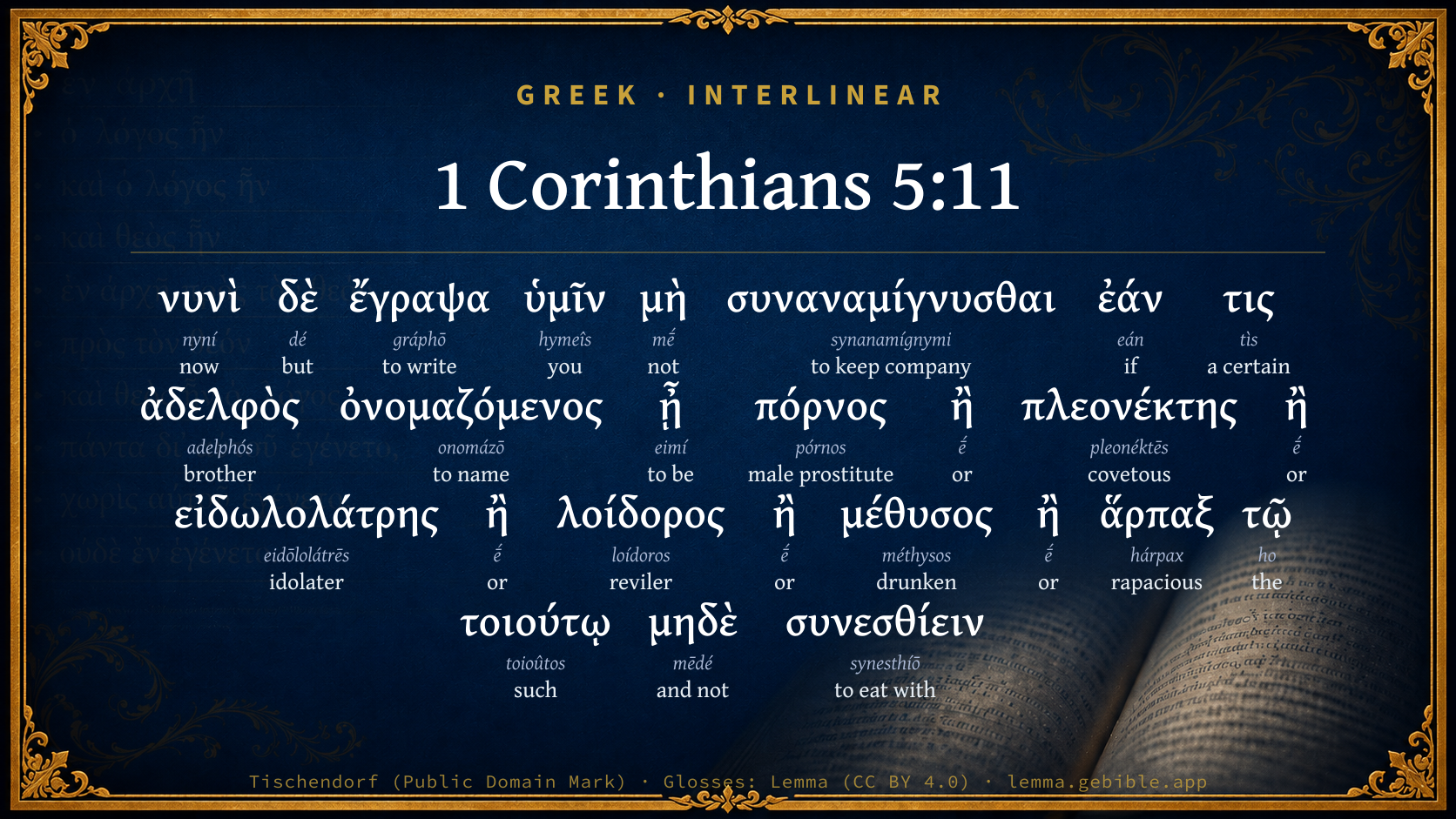
But as it is, I wrote to you not to associate with anyone who is called a brother who is a sexual sinner, or covetous, or an idolater, or a slanderer, or a drunkard, or an extortioner. Don't even eat with such a person.
Download a study sheet
One document with this verse’s original text, its word-by-word gloss line, the meaning frame, cross-references with their text, attributed commentary, and full source and license credits — printable, and it pastes into notes with its structure intact.
This verse Autodidact and up
A passage Seminary Student
Up to 50 verses in one chapter. A passage sheet keeps up to 6 commentary sources and 12 cross-references per verse, in the order this page ranks them, and says so on the sheet whenever that leaves anything out. Ask for a single verse and you get the Autodidact verse sheet above.
Everything on this page stays free to read, with no account — the sheet is a download of what is already on screen, not access to it.
Compare translations 3
The same verse in 3 English versions, stacked beneath the original-language interlinear above. Click any original word for its lexicon entry.
Each is an independent rendering of the whole verse — the interlinear is not word-aligned to these translations.
Highlighted words mark where these versions differ — a whole-verse word diff, not a word-by-word alignment.
-
World English Bible Public Domain
But as it is, I wrote to you not to associate with anyone who is called a brother who is a sexual sinner, or covetous, or an idolater, or a slanderer, or a drunkard, or an extortioner. Don't even eat with such a person.
-
King James Version Public Domain
But now I have written unto you not to keep company, if any man that is called a brother be a fornicator, or covetous, or an idolater, or a railer, or a drunkard, or an extortioner; with such an one no not to eat.
-
unfoldingWord Literal Text CC BY-SA 4.0
But now I wrote to you not to associate with any so-called brother is sexually immoral or greedy or an idolater or verbally abusive or a drunkard or a swindler. Do not even eat with such a person.
unfoldingWord Literal Text — © unfoldingWord, licensed CC BY-SA 4.0. Word-aligned USFM3 via Door43 (git.door43.org/unfoldingWord/en_ult).
Show all 19 translations
Every available English version of this verse, each an independent rendering of the whole verse.
-
World English Bible Public Domain
But as it is, I wrote to you not to associate with anyone who is called a brother who is a sexual sinner, or covetous, or an idolater, or a slanderer, or a drunkard, or an extortioner. Don't even eat with such a person.
-
Berean Standard Bible Public Domain
But now I am writing you not to associate with anyone who claims to be a brother but is sexually immoral or greedy, an idolater or a verbal abuser, a drunkard or a swindler. With such a man do not even eat.
-
Majority Standard Bible Public Domain
But now I am writing you not to associate with anyone who claims to be a brother but is sexually immoral or greedy, an idolater or a verbal abuser, a drunkard or a swindler. With such a man do not even eat.
-
King James Version Public Domain
But now I have written unto you not to keep company, if any man that is called a brother be a fornicator, or covetous, or an idolater, or a railer, or a drunkard, or an extortioner; with such an one no not to eat.
-
American Standard Version (1901) Public Domain
but as it is, I wrote unto you not to keep company, if any man that is named a brother be a fornicator, or covetous, or an idolater, or a reviler, or a drunkard, or an extortioner; with such a one no, not to eat.
-
Revised Version (1885) Public Domain
but now I write unto you not to keep company, if any man that is named a brother be a fornicator, or covetous, or an idolater, or a reviler, or a drunkard, or an extortioner; with such a one no, not to eat.
-
Geneva Bible (1599) Public Domain
But nowe I haue written vnto you, that ye companie not together: if any that is called a brother, be a fornicatour, or couetous, or an idolater, or a rayler, or a drunkard, or an extortioner, with such one eate not.
-
Douay-Rheims (1899) Public Domain
But now I have written to you, not to keep company, if any man that is named a brother, be a fornicator, or covetous, or a server of idols, or a railer, or a drunkard, or an extortioner: with such a one, not so much as to eat.
-
Young's Literal Translation Public Domain
and now, I did write to you not to keep company with `him', if any one, being named a brother, may be a whoremonger, or covetous, or an idolater, or a railer, or a drunkard, or an extortioner -- with such a one not even to eat together;
-
Literal Standard Version CC BY-SA 4.0
and now, I wrote to you not to keep company with [him], if anyone, being named a brother, may be a whoremonger, or covetous, or an idolater, or a railer, or a drunkard, or an extortioner—do not even eat together with such a one;
-
Unlocked Literal Bible CC BY-SA 4.0
But now I am writing to you not to associate with anyone who is called a brother but who is living in sexual immorality, or who is greedy, or is an idolater, or is verbally abusive, or is a drunkard, or a swindler. Do not even eat a meal with such a person.
-
unfoldingWord Literal Text CC BY-SA 4.0
But now I wrote to you not to associate with any so-called brother is sexually immoral or greedy or an idolater or verbally abusive or a drunkard or a swindler. Do not even eat with such a person.
-
Darby Bible Public Domain
But now I have written to you, if any one called brother be fornicator, or avaricious, or idolater, or abusive, or a drunkard, or rapacious, not to mix with [him]; with such a one not even to eat.
-
World Messianic Bible Public Domain
But as it is, I wrote to you not to associate with anyone who is called a brother who is a sexual sinner, or covetous, or an idolater, or a slanderer, or a drunkard, or an extortionist. Don’t even eat with such a person.
-
Webster's Bible Public Domain
But now I have written to you not to keep company, if any man that is called a brother is a lewd person, or covetous, or an idolater, or a railer, or a drunkard, or an extortioner: with such person no not to eat.
-
Free Bible Version CC BY-SA 4.0
What I meant when I wrote was that you shouldn't associate with anyone who is called a Christian who is immoral or greedy or worships idols; or who is abusive or a drunkard or who cheats others. Don't even share a meal with anyone like that!
-
Bible in Basic English Public Domain
But the sense of my letter was that if a brother had the name of being one who went after the desires of the flesh, or had the desire for other people's property, or was in the way of using violent language, or being the worse for drink, or took by force what was not his, you might not keep company with such a one, or take food with him.
-
Text-Critical English NT CC BY 4.0
But now I am writing to you not to associate with anyone who is named as a brother if he is a fornicator or greedy, an idolater or a reviler, a drunkard or a swindler; do not even eat with such a man.
-
Tyndale New Testament (1534) Public Domain
But now I write vnto you that ye company not togedder yf eny that is called a brother be a fornicator or coveteous or a worshipper of ymages ether a raylar ether a dronkard or an extorcionar: with him that is soche se that ye eate not.
Literal Standard Version (2020), Covenant Press — licensed CC BY-SA 4.0. Text via the HelloAO Bible API (eBible.org). Unlocked Literal Bible (unfoldingWord) — licensed CC BY-SA 4.0. Text via the HelloAO Bible API (eBible.org). unfoldingWord Literal Text — © unfoldingWord, licensed CC BY-SA 4.0. Word-aligned USFM3 via Door43 (git.door43.org/unfoldingWord/en_ult). Free Bible Version, Dr. Jonathan Gallagher — licensed CC BY-SA 4.0. Text via the HelloAO Bible API (eBible.org).
Word by word
More ways to search: Search by grammar → Find every occurrence → Compare this word →
Practice this passage: Drill this verse → Learn its vocabulary →
- Appears 2× in the Greek New Testament
- First appears here
- Part of Speech
- Adjective
- Case
- Nominative
- Number
- Singular
- Gender
- Masculine
Full Thayer's Definition
- νυνὶ nyní G3570 “now” Adverb
- δὲ dé G1161 “but” Conjunction
- ἔγραψα gráphō G1125 “to write” Verb, Aorist, Active, Indicative, 1st person, Singular
- ὑμῖν hymeîs G5210 “you” Personal pronoun, 2nd person, Dative, Plural
- μὴ mḗ G3361 “not” Particle, Negative
- συναναμίγνυσθαι synanamígnymi G4874 “to keep company” Verb, Present, Middle, Infinitive
- ἐάν eán G1437 “if” Conditional
- τις tìs G5100 “a certain” Indefinite pronoun, Nominative, Singular, Masculine
- ἀδελφὸς adelphós G80 “brother” Noun, Nominative, Singular, Masculine
- ὀνομαζόμενος onomázō G3687 “to name” Verb, Present, Passive, Participle, Nominative, Singular, Masculine
- ᾖ eimí G1510 “to be” Verb, Present, Active, Subjunctive, 3rd person, Singular
- πόρνος pórnos G4205 “male prostitute” Noun, Nominative, Singular, Masculine
- ἢ ḗ G2228 “or” Particle
- πλεονέκτης pleonéktēs G4123 “covetous” Noun, Nominative, Singular, Masculine
- ἢ ḗ G2228 “or” Particle
- εἰδωλολάτρης eidōlolátrēs G1496 “idolater” Noun, Nominative, Singular, Masculine
- ἢ ḗ G2228 “or” Particle
- λοίδορος loídoros G3060 “reviler” Adjective, Nominative, Singular, Masculine
- ἢ ḗ G2228 “or” Particle
- μέθυσος méthysos G3183 “drunken” Noun, Nominative, Singular, Masculine
- ἢ ḗ G2228 “or” Particle
- ἅρπαξ hárpax G727 “rapacious” Adjective, Nominative, Singular, Masculine
- τῷ ho G3588 “the” Article, Dative, Singular, Masculine
- τοιούτῳ toioûtos G5108 “such” Demonstrative pronoun, Dative, Singular, Masculine
- μηδὲ mēdé G3366 “and not” Conjunction, Negative
- συνεσθίειν synesthíō G4906 “to eat with” Verb, Present, Active, Infinitive
About this verse
These counts appear in no published source. They are computed here, from the morphology-tagged text and Lemma’s own curated glosses. What Lemma adds →
- 26
- words
- 22
- distinct lemmas
- Pauline Epistles
- section
Notable vocabulary
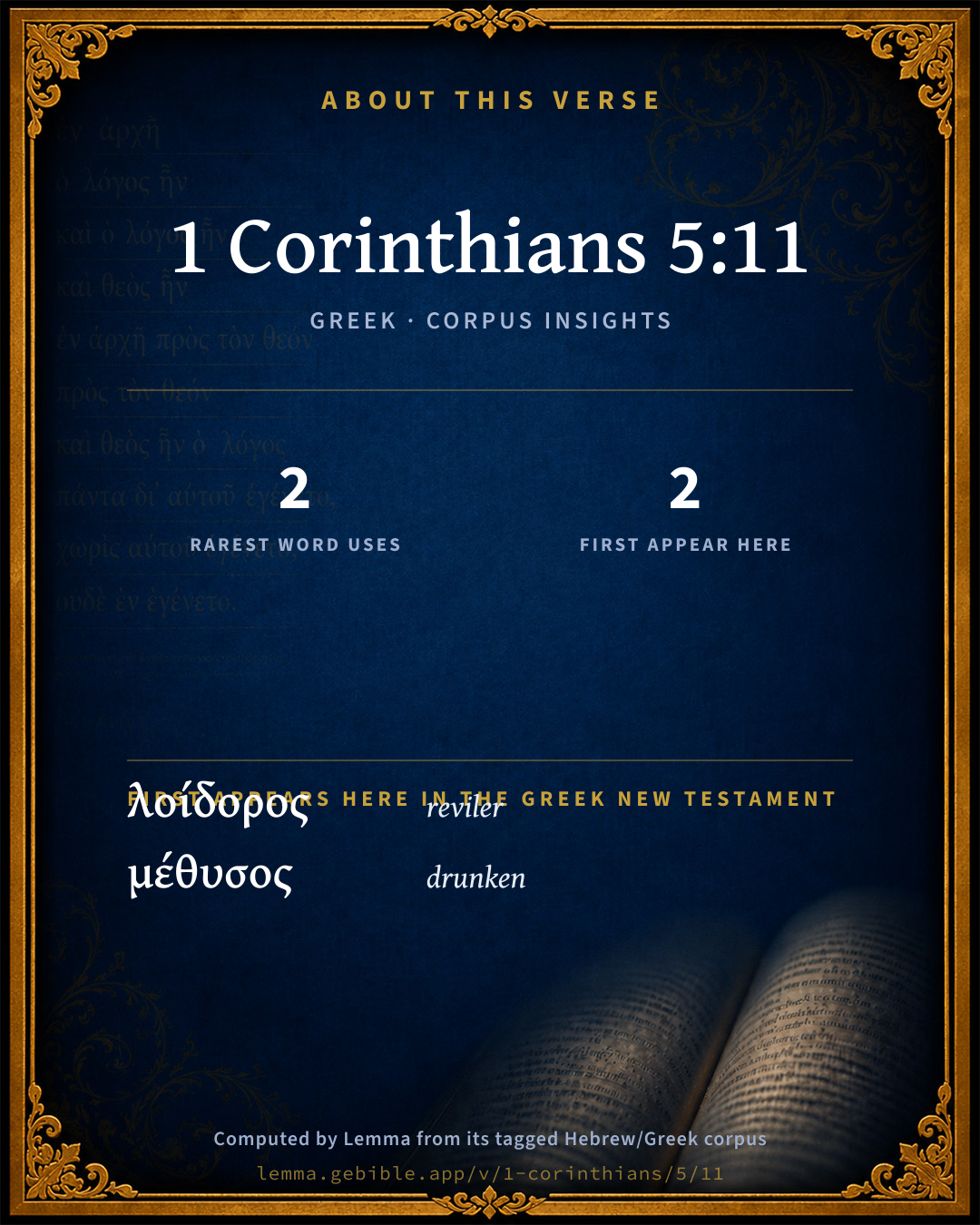
The rarest word here is λοίδορος reviler G3060 — appearing just 2 times in the whole Greek New Testament.
First appearance in Scripture
These words make their first canonical appearance in the Greek New Testament here:
Shared distinctive vocabulary
λοίδορος reviler G3060 occurs in 2 verses of the Greek New Testament. Also found in:
Repetition
A word recurs within this verse:
- ἢ or G2228 ×5
Cross-references
44Topical passages linked to 1 Corinthians 5:11 in the Treasury of Scripture Knowledge — connected by theme and wording, ordered by reader-vote popularity; previews shown in the World English Bible.
- Romans 16:17 Now I beg you, brothers, look out for those who are causing the divisions and occasions of stumbling, contrary to the doctrine which you learned, and turn away from them.
- 2 Thessalonians 3:6 Now we command you, brothers, in the name of our Lord Jesus Christ, that you withdraw yourselves from every brother who walks in rebellion, and not after the tradition which they received from us.
- 2 Thessalonians 3:14 If any man doesn't obey our word in this letter, note that man, that you have no company with him, to the end that he may be ashamed.
- Matthew 18:17 If he refuses to listen to them, tell it to the assembly. If he refuses to hear the assembly also, let him be to you as a Gentile or a tax collector.
- 1 Corinthians 5:13 But those who are outside, God judges. "Put away the wicked man from among yourselves."
- 2 John 1:10 If anyone comes to you, and doesn't bring this teaching, don't receive him into your house, and don't welcome him,
- Galatians 5:19–21 Now the works of the flesh are obvious, which are: adultery, sexual immorality, uncleanness, lustfulness,
- 1 Corinthians 5:1–10 It is actually reported that there is sexual immorality among you, and such sexual immorality as is not even named among the Gentiles, that one has his father's wife.
- Revelation 21:8 But for the cowardly, unbelieving, sinners, abominable, murderers, sexually immoral, sorcerers, idolaters, and all liars, their part is in the lake that burns with fire and sulfur, which is the second death."
- Mark 7:21–23 For from within, out of the hearts of men, proceed evil thoughts, adulteries, sexual sins, murders, thefts,
- Ephesians 5:5 Know this for sure, that no sexually immoral person, nor unclean person, nor covetous man, who is an idolater, has any inheritance in the Kingdom of Christ and God.
- 1 Timothy 3:3 not a drinker, not violent, not greedy for money, but gentle, not quarrelsome, not covetous;
- Revelation 22:15 Outside are the dogs, the sorcerers, the sexually immoral, the murderers, the idolaters, and everyone who loves and practices falsehood.
- Ezekiel 22:12 In you have they taken bribes to shed blood; you have taken interest and increase, and you have greedily gained of your neighbors by oppression, and have forgotten me, says the Lord Yahweh.
- Matthew 23:25 "Woe to you, scribes and Pharisees, hypocrites! For you clean the outside of the cup and of the platter, but within they are full of extortion and unrighteousness.
- Luke 21:34 "So be careful, or your hearts will be loaded down with carousing, drunkenness, and cares of this life, and that day will come on you suddenly.
- Revelation 2:20 But I have this against you, that you tolerate your woman, Jezebel, who calls herself a prophetess. She teaches and seduces my servants to commit sexual immorality, and to eat things sacrificed to idols.
- Psalms 50:16–21 But to the wicked God says, "What right do you have to declare my statutes, That you have taken my covenant on your lips,
- Psalms 101:5 I will silence whoever secretly slanders his neighbor. I won't tolerate one who is haughty and conceited.
- 1 Corinthians 6:10 nor thieves, nor covetous, nor drunkards, nor slanderers, nor extortioners, will inherit the Kingdom of God.
- 1 Corinthians 10:7–8 Neither be idolaters, as some of them were. As it is written, "The people sat down to eat and drink, and rose up to play."
- Colossians 3:5 Put to death therefore your members which are on the earth: sexual immorality, uncleanness, depraved passion, evil desire, and covetousness, which is idolatry;
- 1 Thessalonians 4:3–8 For this is the will of God: your sanctification, that you abstain from sexual immorality,
- 1 Thessalonians 5:7–8 For those who sleep, sleep in the night, and those who are drunken are drunken in the night.
- Psalms 10:3 For the wicked boasts of his heart's cravings, He blesses the greedy, and condemns Yahweh.
- Matthew 24:49–51 and begins to beat his fellow-servants, and eat and drink with the drunken,
- Luke 12:15–31 He said to them, "Beware! Keep yourselves from covetousness, for a man's life doesn't consist of the abundance of the things which he possesses."
- Luke 12:45–46 But if that servant says in his heart, 'My lord delays his coming,' and begins to beat the menservants and the maidservants, and to eat and drink, and to be drunken,
- Romans 13:13 Let us walk properly, as in the day; not in reveling and drunkenness, not in sexual promiscuity and lustful acts, and not in strife and jealousy.
- 1 Corinthians 6:6 But brother goes to law with brother, and that before unbelievers!
- 1 Corinthians 8:11 And through your knowledge, he who is weak perishes, the brother for whose sake Christ died.
- 1 Corinthians 10:18–22 Consider Israel after the flesh. Don't those who eat the sacrifices have communion with the altar?
- 2 Corinthians 12:20–21 For I am afraid that by any means, when I come, I might find you not the way I want to, and that I might be found by you as you don't desire; that by any means there would be strife, jealousy, outbursts of anger, factions, slander, whisperings, proud thoughts, riots;
- 2 Peter 2:14–15 having eyes full of adultery, and who can't cease from sin; enticing unsettled souls; having a heart trained in greed; children of cursing;
- Acts 9:17 Ananias departed, and entered into the house. Laying his hands on him, he said, "Brother Saul, the Lord, who appeared to you on the road by which you came, has sent me, that you may receive your sight, and be filled with the Holy Spirit."
- 1 Corinthians 7:12 But to the rest I--not the Lord--say, if any brother has an unbelieving wife, and she is content to live with him, let him not leave her.
- 1 Corinthians 7:15 Yet if the unbeliever departs, let there be separation. The brother or the sister is not under bondage in such cases, but God has called us in peace.
- 1 Corinthians 10:14 Therefore, my beloved, flee from idolatry.
- 1 Corinthians 11:21 For in your eating each one takes his own supper before others. One is hungry, and another is drunken.
- Galatians 2:12 For before some people came from James, he ate with the Gentiles. But when they came, he drew back and separated himself, fearing those who were of the circumcision.
- Ephesians 5:18 Don't be drunken with wine, in which is dissipation, but be filled with the Spirit,
- 1 Timothy 6:5 constant friction of people of corrupt minds and destitute of the truth, who suppose that godliness is a means of gain. Withdraw yourself from such.
- 1 Timothy 6:9–10 But those who are determined to be rich fall into a temptation and a snare and many foolish and harmful lusts, such as drown men in ruin and destruction.
- Revelation 2:14 But I have a few things against you, because you have there some who hold the teaching of Balaam, who taught Balak to throw a stumbling block before the children of Israel, to eat things sacrificed to idols, and to commit sexual immorality.
Cross-references courtesy of OpenBible.info (CC BY 4.0).
Lesson kit
Teaching starters — assembled from the data on this page, not authored interpretation. Every prompt links to the verse data it draws on. Edit before teaching.
1 Corinthians, in the Pauline Epistles, opens this verse with 26 words (22 distinct Greek lemmas). Its most distinctive word is loídoros (“reviler”). A historical commentator’s framing appears above. Read the whole chapter for the surrounding context.
Discussion questions
- What does “reviler” (loídoros) contribute to the verse as a whole?
- 2 words here appear for the first time in Scripture. What is being introduced at this debut?
- 1 Corinthians 6:10 shares the word «reviler» with this verse. How do the two illuminate each other?
- “or” occurs 5× in this one verse. What is the effect of the repetition?
- These translations render this verse differently; the difference is in the English rendering, not the original. What questions does that raise?
- Reading how Tyndale Open Study Notes and Bengel's Gnomon read this verse, where do the two commentators agree and where do they part?
Things to notice
- 2 words make their first canonical appearance in Scripture here.
- These translations choose different wording for 31 words in this verse.
- “or” occurs 5× in this single verse.
- 22 distinct Greek lemmas span 26 words in this verse.
Commentary
Notes on 1 Corinthians 5:11 from classic Christian and Jewish commentators (each source and its license shown beneath its notes). The classic Christian expositions comment on the surrounding passage and are grouped to its opening verse, so a note may address several verses; the Jewish commentaries on the Tanakh (Rashi and others) are per-verse, so they appear only where the commentator wrote on this verse.
Lemma curates 59 commentaries, every one of them public domain or Creative Commons licensed, each selected and text-cleaned for this edition rather than reprinted as found. About our sources →
Tyndale Open Study Notes
Tyndale Open Resources
Tyndale Open Study Notes — © Tyndale Open Resources, licensed CC BY-SA 4.0. Text via the HelloAO Bible API.
Bengel's Gnomon
Johann Albrecht Bengel
Bengel's Gnomon of the New Testament — English translation (T&T Clark, Edinburgh, 1860) — public domain. Text from a community e-Sword module.
Meyer's Critical & Exegetical Commentary
Heinrich August Wilhelm Meyer
Meyer — Critical and Exegetical Commentary on the New Testament — English translation by Peter Christie, edited by Frederick Crombie (T&T Clark, 1880) — public domain. Text from a community e-Sword module.
Expositor's Greek Testament
ed. W. Robertson Nicoll
The Expositor's Greek Testament, edited by W. Robertson Nicoll (1897–1910) — public domain. Text from a community e-Sword module.
Hodge's Commentary on Romans, Ephesians & First Corinthians
Charles Hodge
Charles Hodge — Commentary on Romans (1835), First Corinthians (1857), and Ephesians (1856) — public domain. Text from a community e-Sword module.
Jamieson, Fausset & Brown
Robert Jamieson, A. R. Fausset & David Brown
Jamieson, Fausset & Brown — Commentary Critical and Explanatory on the Whole Bible (1871) — public domain (CC PDM 1.0). Text via the HelloAO Bible API.
Adam Clarke's Commentary
Adam Clarke's Commentary on the Bible (1810–1826) — public domain. Text from a community e-Sword/MySword module.
John Calvin's Commentaries
John Calvin's Commentaries (1540-1563) — public domain. Text from the Calvin Translation Society English edition (1840s-50s) via the Christian Classics Ethereal Library (ccel.org). Calvin's coverage is partial (roughly two-thirds of the Bible); uncommented books and verses are honest gaps, never fabricated. The 19th-century editor's footnotes and remarks are omitted so the notes are faithfully Calvin's own voice.
Ellicott's Commentary for English Readers
A Bible Commentary for English Readers, edited by Charles John Ellicott (1878–1897) — public domain. Text from a community e-Sword module.
The Cambridge Bible for Schools and Colleges
gen. ed. J. J. S. Perowne
The Cambridge Bible for Schools and Colleges (gen. ed. J. J. S. Perowne; Cambridge University Press, 1878–1918) — public domain. Text from a community e-Sword module.
John Gill's Exposition
John Gill's Exposition of the Whole Bible (1746–1763) — public domain (CC PDM 1.0). Text via the HelloAO Bible API.
Trapp's Complete Commentary
John Trapp
John Trapp, A Commentary or Exposition upon All the Books of the Old and New Testament (1647–1656) — public domain. Text from a community e-Sword module.
Albert Barnes' Notes on the Bible
Albert Barnes' Notes on the Bible (1834–1885) — public domain. Text from a community e-Sword/MySword module.
Matthew Poole's English Annotations
Matthew Poole's English Annotations on the Holy Bible (1683–1685) — public domain. Text from a community e-Sword/MySword module.
Whedon's Commentary on the Bible
Daniel D. Whedon
Daniel D. Whedon (gen. ed.), Commentary on the Old and New Testaments (1874–1909) — public domain. Text from a community e-Sword module.
The Pulpit Commentary
The Pulpit Commentary (1880–1919), ed. H.D.M. Spence-Jones & Joseph S. Exell — public domain. Text from a community e-Sword module.
John Wesley's Explanatory Notes
John Wesley, Explanatory Notes Upon the Whole Bible (1754–1765) — public domain. Text via the GEBible commentary corpus.
Godbey's Commentary on the New Testament
William B. Godbey
William B. Godbey, Commentary on the New Testament (1896–1900) — public domain. Text from a community e-Sword module.
McGarvey & Pendleton's Commentaries
J. W. McGarvey
J. W. McGarvey (with Philip Y. Pendleton), Commentaries on the New Testament (The Fourfold Gospel, 1914; Acts; and the epistles) — public domain. Text from a community e-Sword/MySword module.
The People's New Testament
B. W. Johnson
B. W. Johnson's The People's New Testament with Notes (1889–1891) — public domain. Electronic text from the Christian Classics Ethereal Library (CCEL) ThML edition.
unfoldingWord translationNotes
Door43 World Missions Community
unfoldingWord translationNotes — © Distant Shores Media and the Door43 World Missions Community, licensed CC BY-SA 4.0. Source: git.door43.org/Door43/en_tn.
Cambridge Greek Testament for Schools and Colleges
Cambridge Greek Testament for Schools and Colleges (Cambridge University Press, 1896; 21 vols, various authors incl. Carr, Maclear, Plummer, Farrar, Lumby, Moule, M. R. James, Simcox) — public domain. Text from a community e-Sword module.
Alford’s Greek Testament
Henry Alford
Henry Alford, The Greek Testament (1849–1861) — public domain. Text from a community e-Sword module.
International Critical Commentary
International Critical Commentary — older volumes (1896–1929), various authors — public domain. Text from a community e-Sword module.
Godet's Commentaries
Frédéric Louis Godet
Frédéric Louis Godet — Commentaries on Luke, John, Romans, and 1 Corinthians — English translation (T&T Clark, Edinburgh, 1870s–1890s) — public domain. Text from a community e-Sword module.