
Romans 16:14

Greek (Tischendorf 8th ed.) Romans 16:14 appears in the Greek New Testament. The text above is from the Tischendorf 8th edition. Each word links to its Strong’s number and a concise gloss. Click any word for its full Thayer’s Greek Lexicon entry.
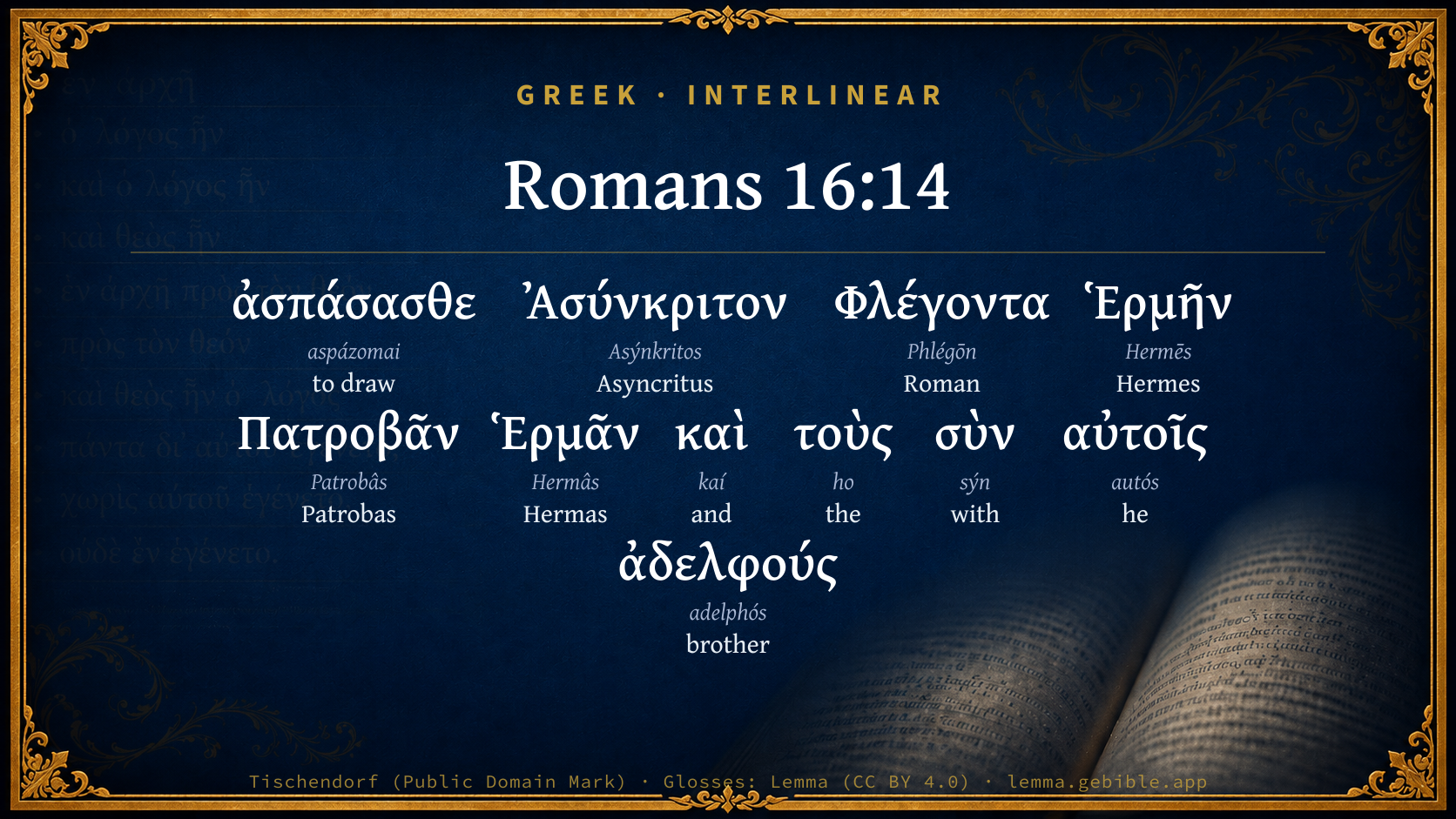
Download image
Cite this verse

Romans 16:14 (World English Bible). Public Domain. Lemma interlinear Bible study tool, https://lemma.gebible.app/v/romans/16/14.

Show BibTeX & RIS
BibTeX
RIS
English Translation
Greet Asyncritus, Phlegon, Hermes, Patrobas, Hermas, and the brothers who are with them.
World English Bible · Public Domain
Highlights
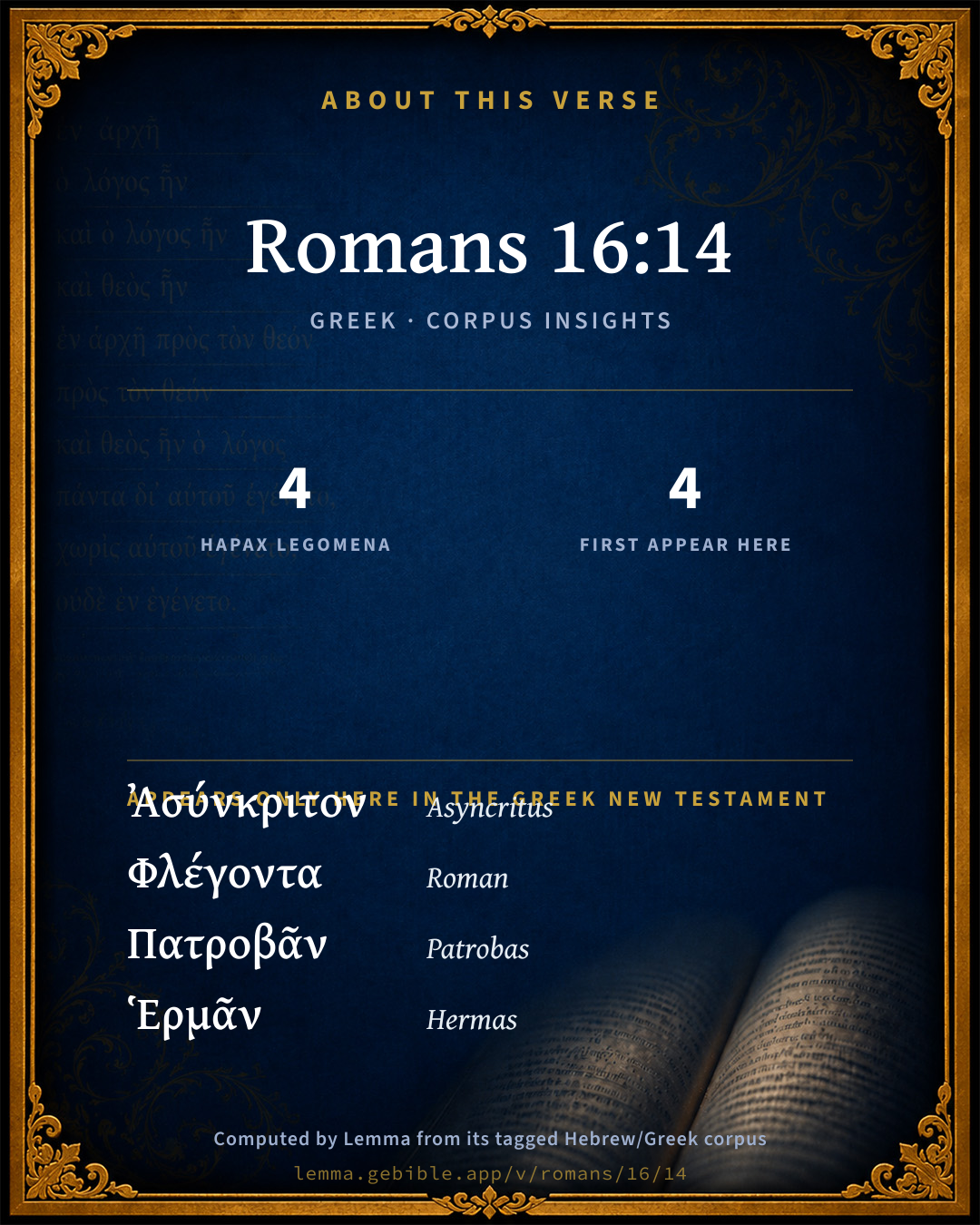
  • 4 hapax legomena — only here in the Greek New Testament
  • 4 first appearances in the Greek New Testament
Full analysis ↓
Download a study sheet

One document with this verse’s original text, its word-by-word gloss line, the meaning frame, cross-references with their text, attributed commentary, and full source and license credits — printable, and it pastes into notes with its structure intact.

This verse Autodidact and up

Study sheet (.html) Plain text (.txt)

A passage Seminary Student

Up to 50 verses in one chapter. A passage sheet keeps up to 6 commentary sources and 12 cross-references per verse, in the order this page ranks them, and says so on the sheet whenever that leaves anything out. Ask for a single verse and you get the Autodidact verse sheet above.

Everything on this page stays free to read, with no account — the sheet is a download of what is already on screen, not access to it.

Want to remove ads? Support Godless Engineer
Compare translations 3

The same verse in 3 English versions, stacked beneath the original-language interlinear above. Click any original word for its lexicon entry.

Each is an independent rendering of the whole verse — the interlinear is not word-aligned to these translations.

Highlighted words mark where these versions differ — a whole-verse word diff, not a word-by-word alignment.

  • World English Bible Public Domain
    Greet Asyncritus, Phlegon, Hermes, Patrobas, Hermas, and the brothers who are with them.
  • King James Version Public Domain
    Salute Asyncritus, Phlegon, Hermas, Patrobas, Hermes, and the brethren which are with them.
  • unfoldingWord Literal Text CC BY-SA 4.0
    Greet Asyncritus, Phlegon, Hermes, Patrobas, Hermas, and the brothers with them.

unfoldingWord Literal Text — © unfoldingWord, licensed CC BY-SA 4.0. Word-aligned USFM3 via Door43 (git.door43.org/unfoldingWord/en_ult).

Versions to compare (up to 4)

3 of 4 selected

Show all 19 translations

Every available English version of this verse, each an independent rendering of the whole verse.

  • World English Bible Public Domain
    Greet Asyncritus, Phlegon, Hermes, Patrobas, Hermas, and the brothers who are with them.
  • Berean Standard Bible Public Domain
    Greet Asyncritus, Phlegon, Hermes, Patrobas, Hermas, and the brothers with them.
  • Majority Standard Bible Public Domain
    Greet Asyncritus, Phlegon, Hermas, Patrobas, Hermes, and the brothers with them.
  • King James Version Public Domain
    Salute Asyncritus, Phlegon, Hermas, Patrobas, Hermes, and the brethren which are with them.
  • American Standard Version (1901) Public Domain
    Salute Asyncritus, Phlegon, Hermes, Patrobas, Hermas, and the brethren that are with them.
  • Revised Version (1885) Public Domain
    Salute Asyncritus, Phlegon, Hermes, Patrobas, Hermas, and the brethren that are with them.
  • Geneva Bible (1599) Public Domain
    Greete Asyncritus, Phlegon, Hermas, Patrobas, Mercurius, and the brethren which are with them.
  • Douay-Rheims (1899) Public Domain
    Salute Asyncritus, Phlegon, Hermas, Patrobas, Hermes, and the brethren that are with them.
  • Young's Literal Translation Public Domain
    salute Asyncritus, Phlegon, Hermas, Patrobas, Hermes, and the brethren with them;
  • Literal Standard Version CC BY-SA 4.0
    greet Asyncritus, Phlegon, Hermas, Patrobas, Hermes, and the brothers with them;
  • Unlocked Literal Bible CC BY-SA 4.0
    Greet Asyncritus, Phlegon, Hermes, Patrobas, Hermas, and the brothers who are with them.
  • unfoldingWord Literal Text CC BY-SA 4.0
    Greet Asyncritus, Phlegon, Hermes, Patrobas, Hermas, and the brothers with them.
  • Darby Bible Public Domain
    Salute Asyncritus, Phlegon, Hermes, Patrobas, Hermas, and the brethren with them.
  • World Messianic Bible Public Domain
    Greet Asyncritus, Phlegon, Hermes, Patrobas, Hermas, and the brothers who are with them.
  • Webster's Bible Public Domain
    Salute Asyncritus, Phlegon, Hermas, Patrobas, Hermes, and the brethren who are with them.
  • Free Bible Version CC BY-SA 4.0
    Greetings to Asyncritus, Phlegon, Hermes, Patrobas, Hermas, and the fellow-believers who are with them.
  • Bible in Basic English Public Domain
    Give my love to Asyncritus, Phlegon, Hermes, Patrobas, Hermas, and the brothers who are with them.
  • Text-Critical English NT CC BY 4.0
    Greet Asyncritus, Phlegon, Hermas, Patrobas, Hermes, and the brothers who are with them.
  • Tyndale New Testament (1534) Public Domain
    Grete Asincritus, Phlegon, Herman, Patrobas, Hermen, and the brethren which are with them.

Literal Standard Version (2020), Covenant Press — licensed CC BY-SA 4.0. Text via the HelloAO Bible API (eBible.org). Unlocked Literal Bible (unfoldingWord) — licensed CC BY-SA 4.0. Text via the HelloAO Bible API (eBible.org). unfoldingWord Literal Text — © unfoldingWord, licensed CC BY-SA 4.0. Word-aligned USFM3 via Door43 (git.door43.org/unfoldingWord/en_ult). Free Bible Version, Dr. Jonathan Gallagher — licensed CC BY-SA 4.0. Text via the HelloAO Bible API (eBible.org).

Word by word

More ways to search: Search by grammar → Find every occurrence → Compare this word →

Practice this passage: Drill this verse → Learn its vocabulary →

About this verse

These counts appear in no published source. They are computed here, from the morphology-tagged text and Lemma’s own curated glosses. What Lemma adds →

11
words
11
distinct lemmas
Pauline Epistles
section

Notable vocabulary

4 hapax legomena — words that appear only here in the entire Greek New Testament:

  • Ἀσύνκριτον Asyncritus G799
  • Φλέγοντα Roman G5393
  • Πατροβᾶν Patrobas G3969
  • Ἑρμᾶν Hermas G2057

First appearance in Scripture

These words make their first canonical appearance in the Greek New Testament here:

  • Ἀσύνκριτον Asyncritus G799
  • Φλέγοντα Roman G5393
  • Πατροβᾶν Patrobas G3969
  • Ἑρμᾶν Hermas G2057

Shared distinctive vocabulary

Ἑρμῆν Hermes G2060 occurs in 2 verses of the Greek New Testament. Also found in:
Cross-references

4

Topical passages linked to Romans 16:14 in the Treasury of Scripture Knowledge — connected by theme and wording, ordered by reader-vote popularity; previews shown in the World English Bible.

  • Romans 8:29 For whom he foreknew, he also predestined to be conformed to the image of his Son, that he might be the firstborn among many brothers.
  • Colossians 1:2 to the saints and faithful brothers in Christ at Colossae: Grace to you and peace from God our Father, and the Lord Jesus Christ.
  • Hebrews 3:1 Therefore, holy brothers, partakers of a heavenly calling, consider the Apostle and High Priest of our confession, Jesus;
  • 1 Peter 1:22–23 Seeing you have purified your souls in your obedience to the truth through the Spirit in sincere brotherly affection, love one another from the heart fervently:

Cross-references courtesy of OpenBible.info (CC BY 4.0).

Commentary

Notes on Romans 16:14 from classic Christian and Jewish commentators (each source and its license shown beneath its notes). The classic Christian expositions comment on the surrounding passage and are grouped to its opening verse, so a note may address several verses; the Jewish commentaries on the Tanakh (Rashi and others) are per-verse, so they appear only where the commentator wrote on this verse.

Lemma curates 59 commentaries, every one of them public domain or Creative Commons licensed, each selected and text-cleaned for this edition rather than reprinted as found. About our sources →

Bengel's Gnomon

Johann Albrecht Bengel

Rom 16:14. Ἀσύγκριτον, κ.τ.λ., Asyncritus, etc.) Paul joins those together, among whom there was a peculiar tie of relationship, neighbourhood, etc. The salutation offered by name to the more humble, who were perhaps not aware that they were so much as known to the apostle, could not but greatly cheer their hearts.

Bengel's Gnomon of the New Testament — English translation (T&T Clark, Edinburgh, 1860) — public domain. Text from a community e-Sword module.

Meyer's Critical & Exegetical Commentary

Heinrich August Wilhelm Meyer

Rom_16:14-15. Hermas was not, as already Origen declared him to be, the composer of the book ὁ ποιμήν,[46] which, according to the Canon Muratorianus, is said to have been composed by a brother of the Roman bishop Pius I., and in any case belongs to no earlier period than the second century.

Κ. Τ. ΣῪΝ ΑὐΤῷ ἈΔΕΛΦ.] It is possible, but on account of the more general designation deviating from Rom_16:5, not probable, that those named here as well as in Rom_16:15 were members, well known to the apostle, of two ἘΚΚΛΗΣΊΑΙ in Rome (so Hofmann), according to which view by the brethren with them would be meant the remaining persons taking part in these assemblies, for the most part doubtless unknown to him. It is possible also that some other Christian associations unknown to us (Fritzsche and Philippi think of associations of trade and commerce) are intended. We have no knowledge on this point. Reiche thinks of two mission-societies. But πάντες, Rom_16:15, points to a considerable number, and there is no trace in the Book of Acts of so formal and numerous mission-societies; they were doubtless still foreign to that period. Probably also Paul would have given some thoughtful indication or other of this important characteristic point.

The whole of the names in Rom_16:14-15 are found in Gruter and elsewhere.

Julia appears to have been the wife of Philologus; the analogy of the following ΝΗΡΈΑ Κ. ΤῊΝ ἈΔΕΛΦῊΝ ΑὐΤΟῦ makes it less probable that the name denotes a man (Julias, comp. on Rom_16:7).

[46] The critical discussions as to this work, quite recently conducted by Zahn, and Lipsius in particular, have no bearing here.

Meyer — Critical and Exegetical Commentary on the New Testament — English translation by Peter Christie, edited by Frederick Crombie (T&T Clark, 1880) — public domain. Text from a community e-Sword module.

Expositor's Greek Testament

ed. W. Robertson Nicoll

Rom 16:14 . Of Asyncritus, Phlegon and Hermes nothing is known. Patrobas (or Patrobius) may have been a dependant of a famous freedman of the same name in Nero’s time, who was put to death by Galba (Tac., Hist. , i., 49, ii., 95). Hermas has often been identified with the author of The Shepherd, but though the identification goes back to Origen, it is a mistake. “Pastorem vero nuperrime temporibus nostris in urbe Roma Herma conscripsit sedente cathedra urbis Romœ ecclesiœ Pio eps. fratre ejus ”: these words of the Canon of Muratori forbid the identification. τοὺς σὺν αὐτοῖς ἀδελφούς indicates that the persons named, and some others designated in this phrase, formed a little community by themselves perhaps an ἐκκλησία κατʼ οἶκόν τινος .

The Expositor's Greek Testament, edited by W. Robertson Nicoll (1897–1910) — public domain. Text from a community e-Sword module.

Godet's Commentaries

Frédéric Louis Godet

Vv. 14, 15. “Salute Asyncritus, Phlegon, Hermes, Patrobas, Hermas, and the brethren which are with them. Salute Philologus, and Julia, Nereus, and his sister, and Olympas, and all the saints which are with them.”

The personages whose names follow are not designated by any epithet of distinction; but it was honor enough to be marked out, were it only by name, to the respectful attention of the whole church of Rome.

The last words of both of the Rom 16:14-15 : and the brethren who are with them, prove that the persons just named are so, not simply as believers, but as directors of a whole assembly which is accustomed to meet around them. They lived, no doubt, in different quarters, and formed, besides the group which met in the house of Aquilas, two distinct assemblies.

Hermas was regarded by Origen as the author of the work famous in the primitive church, entitled the Pastor of Hermas. But it seems now established by the Fragment of Muratori that this writing dates only from the second half of the second century, and that Hermas is a wholly different person from the man who is here saluted by the apostle.

Olympas (perhaps an abbreviation of Olympiodorus) is certainly here a man’s name.

Frédéric Louis Godet — Commentaries on Luke, John, Romans, and 1 Corinthians — English translation (T&T Clark, Edinburgh, 1870s–1890s) — public domain. Text from a community e-Sword module.

Jamieson, Fausset & Brown

Robert Jamieson, A. R. Fausset & David Brown

Salute Asyncritus, &c.--These have been thought to be the names of ten less notable Christians than those already named. But this will hardly be supposed if it be observed that they are divided into two pairs of five each, and that after the first of these pairs it is added, "and the brethren which are with them," while after the second pair we have the words, "and all the saints which are with them." This perhaps hardly means that each of the five in both pairs had "a church at his house," else probably this would have been more expressly said. But at least it would seem to indicate that they were each a center of some few Christians who met at his house--it may be for further instruction, for prayer, for missionary purposes, or for some other Christian objects. These little peeps into the rudimental forms which Christian fellowship first took in the great cities, though too indistinct for more than conjecture, are singularly interesting. Our apostle would seem to have been kept minutely informed as to the state of the church at Rome, both as to its membership and its varied activities, probably by Priscilla and Aquila.

Jamieson, Fausset & Brown — Commentary Critical and Explanatory on the Whole Bible (1871) — public domain (CC PDM 1.0). Text via the HelloAO Bible API.

Adam Clarke's Commentary

Verse 14. Salute Asyncritus, c.] Who these were we know not. Hermas was probably the same to whom a work called the Shepherd is attributed a work with this title is still extant, and may be found among the writings of the apostolical fathers. But it is in vain to look for identity of persons in similarity of names; for, among the Greeks and Romans at this time there were many persons who bore the same names mentioned in this chapter.

Adam Clarke's Commentary on the Bible (1810–1826) — public domain. Text from a community e-Sword/MySword module.

Ellicott's Commentary for English Readers

(14) Of the names in this and the next verse, Hermas, Patrobas, Hermes, Philologus, Julia, Nereus (with the corresponding female name Nereis) all occur with more or less frequency in inscriptions relating to the household. Hernias and Hermes are very common. The first is a contraction from several longer forms. Patrobas is contracted from Patrobius. We find that a freed-man of Nero’s who bore this name was put to death by Galba; but the person saluted by St. Paul is more likely to have been a dependent of his than the man himself.

Taking the list of names as a whole, and comparing them with the inscriptions, we may—without going so far as to identify individuals, which would be precarious ground—nevertheless, note the general coincidence with the mention of “Cæsar’s household” in Php_4:22.

A Bible Commentary for English Readers, edited by Charles John Ellicott (1878–1897) — public domain. Text from a community e-Sword module.

The Cambridge Bible for Schools and Colleges

gen. ed. J. J. S. Perowne

14. Asyncritus, Phlegon, Hermas, Patrobas, Hermes] All otherwise unknown. The names are Greek.—Hermas was the name of the author of “The Shepherd,” a celebrated religious romance, sometimes compared as such to the Pilgrim’s Progress. But it is at least probable that “The Shepherd” belongs to a later generation than that of the Hermas here named.—On Hermes, see second note on Rom_16:1.

the brethren which are with them] Perhaps forming with them a “church” such as that of Rom_16:5; where see note. If so, the next verse may similarly be a greeting to a similar district “church,” meeting under another roof.

The Cambridge Bible for Schools and Colleges (gen. ed. J. J. S. Perowne; Cambridge University Press, 1878–1918) — public domain. Text from a community e-Sword module.

John Gill's Exposition

Salute Philologus, and Julia,.... The first of these is a Greek name, and the name of a man, and signifies a lover of learning. This name Atteius assumed to himself, which Eratosthenes had done before him, because of his great learning (y); this man is reckoned among the seventy disciples, and is said to be bishop of Sinope: See Gill on Luk 10:1. Julia is a woman's name, and Roman, probably the wife of the former; one of Stephens's copies read, "Junia":

Nereus, and his sister, and Olympas, and all the saints which are with them; who all dwelt together also in one family; and were saints, by separation, imputation, and the effectual calling; were called to be saints, and lived as such, and had a place in the apostle's affections on that account: Nerio, or Neriene, according to Gellius (z), was a name with the Sabines, signifying "strength", from whence came Nero; and Olympas is the same with Olympius, said to be of the seventy disciples, and a Roman martyr; See Gill on Luk 10:1. It deserves some notice, that among all the persons here mentioned by name, known by the apostle to be at Rome, that he takes no notice of Peter; which surely he would have done, had he been, as the Papists say, bishop of Rome, and resided there.

(y) Suetonius de illustr. Gram. c. 10. (z) Noct. Attic, l. 13. c. 22.

John Gill's Exposition of the Whole Bible (1746–1763) — public domain (CC PDM 1.0). Text via the HelloAO Bible API.

Trapp's Complete Commentary

John Trapp

14 Salute Asyncritus, Phlegon, Hermas, Patrobas, Hermes, and the brethren which are with them.

Ver. 14. Salute Asyncritus, &c.] Nothing is said of these; for haste perhaps, or else because they were (as one saith of Jesse, the father of David) Viri, probi et honesti, minus tamen clari, Good honest men, but not much noted. Or, lastly, for that the apostle had no very good opinion of them, as he seems not to have had of Demas, Col 4:14, 2Ti 4:10, who yet would needs be one in the apostle’s register there; a place he will have, though it be the last place. Hermas here mentioned was reputed by some of the ancients to be the author of that Apocryphal Book called "Pastor;" wherein he dealt not so fairly and faithfully in relating what he had received from the apostles, being sublatae fidei auctor. source of the elevated faith.

John Trapp, A Commentary or Exposition upon All the Books of the Old and New Testament (1647–1656) — public domain. Text from a community e-Sword module.

Matthew Poole's English Annotations

i.e. The Christians that are their domestics, or that dwell with them.

Matthew Poole's English Annotations on the Holy Bible (1683–1685) — public domain. Text from a community e-Sword/MySword module.

Whedon's Commentary on the Bible

Daniel D. Whedon

14. Asyncritus—We have here probably the leading male names of a congregation at one house, and the body of the Church superadded as brethren with them.

Daniel D. Whedon (gen. ed.), Commentary on the Old and New Testaments (1874–1909) — public domain. Text from a community e-Sword module.

The Pulpit Commentary

Vers. 14, 15. Salute Asyncritus, Phlegon, Hermes (not, surely, as Origen supposed, the author of "The Shepherd of Hermes," which is said in "Canon Mumtori" to have been written by a brother of Pius I, and cannot well have been of earlier date than the second century), Patrobas, Hermes, and the brethren that are with them. Salute Philologus, and Julia (these, being coupled together, may have been man and wife, or brother and sister), Nereus, and his sister, and Olympas, and all the saints which are with them. The "brethren" in ver. 14, and the "saints" in ver. 15, saluted in connection with the groups of persons named, may possibly mean the congregations that assembled under the leadership, or perhaps at the houses, of those persons. If so, there would appear to have been three congregations in Rome known of by St. Paul; for see ver. 5, which, indeed, seems in itself to imply that the Church that was in the house of Priscilla and Aquila was not the only one.

The Pulpit Commentary (1880–1919), ed. H.D.M. Spence-Jones & Joseph S. Exell — public domain. Text from a community e-Sword module.

John Wesley's Explanatory Notes

Salute Asyncritus, Phlegon, &c. - He seems to join those together, who were joined by kindred, nearness of habitation, or any other circumstance. It could not but encourage the poor especially, to be saluted by name, who perhaps did not know that the apostle bad ever heard of them. It is observable, that whilst the apostle forgets none who are worthy, yet he adjusts the nature of his salutation to the degrees of worth in those whom he salutes.

John Wesley, Explanatory Notes Upon the Whole Bible (1754–1765) — public domain. Text via the GEBible commentary corpus.

McGarvey & Pendleton's Commentaries

J. W. McGarvey

Salute Asyncritus, Phlegon, Hermes, Patrobas, Hermas, and the brethren that are with them . ["With them" indicates another section of the church meeting in the homes of these men. Comp. Rom_16:5 ; Rom_16:15 ]

J. W. McGarvey (with Philip Y. Pendleton), Commentaries on the New Testament (The Fourfold Gospel, 1914; Acts; and the epistles) — public domain. Text from a community e-Sword/MySword module.

The People's New Testament

B. W. Johnson

14. Hermas. Supposed by some to have been the author of an early Christian writing, called “The Shepherd of Hermas,” which still remains.

B. W. Johnson's The People's New Testament with Notes (1889–1891) — public domain. Electronic text from the Christian Classics Ethereal Library (CCEL) ThML edition.

Cambridge Greek Testament for Schools and Colleges

14. Ἀσύνκριτον. The two groups of five persons now following make it probable that we have here two more centres of Christian life in Rome, known to S. Paul by report, but not otherwise; there are no distinguishing epithets. The names are all slave names, many of them found among the imperial household.

Πατρόβαν, abbrev. for Patrobius.

Ἑρμᾶν, abbrev. for Hermagoras or other variations on Hermes.

Cambridge Greek Testament for Schools and Colleges (Cambridge University Press, 1896; 21 vols, various authors incl. Carr, Maclear, Plummer, Farrar, Lumby, Moule, M. R. James, Simcox) — public domain. Text from a community e-Sword module.

Alford’s Greek Testament

Henry Alford

14.] These Christians of whom we have only the names, seem to be persons of less repute than the former. Hermas (= Hermodorus, Grot.) is thought by Origen (in loc. “Puto, quod Hermas iste sit scriptor libelli istius qui Pastor appellatur”), Eus. H. E. iii. 3, and Jerome, Catal. script, eccl., c. x., vol. ii., p. 846, to be the author of the ‘Shepherd.’ But this latter is generally supposed to have been the brother of Pius, bishop of Rome, about 150 a.d.

The σὺν αὐτοῖς ἀδελφοί of ver. 14, and σὺν αὐτοῖς πάντες ἅγιοι of ver. 15, have been taken by De W. and Reiche to point to some separate associations of Christians, perhaps (De W.) assemblies as in ver. 5: or (Reiche) unions for missionary purposes.

Henry Alford, The Greek Testament (1849–1861) — public domain. Text from a community e-Sword module.

International Critical Commentary

14. Ἀσύγκριτον: the following inscription is of a freedman of Augustus who bore this name, C.I.L. vi. 12565 d. m. | asyncreto | avg ∙ lib ∙ fecit ∙ fl | avia ∙ svccessa | patrono bene | merenti. The name Flavia suggests that it is somewhat later than St. Paul’s time.

φλέγοντα. The inscriptions seem to throw no light on this name. The most famous person bearing it was the historian of the second century who is referred to by Origen, and who gave some information concerning the Christians.

Ἑρμῆν: one of the commonest of slave names, occurring constantly among members of the imperial household.

Πατρόβαν. An abbreviated form of Patrobius. This name was borne by a well-known freedman of Nero, who was put to death by Galba (Tac. Hist. i. 49; ii. 95). Lft. quotes instances of other freedmen bearing it: ti ∙ cl ∙ avg ∙ l ∙ patrobivs (Grut. p. 610. 3), and ti ∙ clavdio ∙ patrobio (Murat. p. 1329).

Ἑρμᾶς is likewise an abbreviation for various names, Hermagoras, Hermerus, Hermodorus, Hermogenes. It is common among slaves, but not so much so as Hermes. Some fathers and modern writers have identified this Hermas with the author of the ‘Shepherd,’ an identification which is almost certainly wrong.

καὶ τοὺς σὺν αὐτοῖς ἀδελφούς. This and the similar expression in the next verse seem to imply that these persons formed a small Christian community by themselves.

International Critical Commentary — older volumes (1896–1929), various authors — public domain. Text from a community e-Sword module.

Vincent's Word Studies in the New Testament

Marvin R. Vincent

Hermes. Or Hermas. A common slave - name, a contraction of several different names, as Hermagoras, Hermogenes, etc. 74

Marvin R. Vincent, Word Studies in the New Testament (1887–1900) — public domain. Text from a community e-Sword/MySword module.

Hodge's Commentary on Romans, Ephesians & First Corinthians

Charles Hodge

Rom_16:8-15

My beloved in the Lord. The preposition in (ἐν), here, as frequently elsewhere, points out the relation or respect in which the word, to which it refers is to be understood; brother beloved, both in the flesh and in the Lord (Phm_1:16), both in reference to our external relations, and our relation to the Lord. And thus in the following, Rom_16:9, our helper in Christ, i.e. as it regards Christ; Rom_16:10, approved in Christ, i.e. in his relation to Christ; an approved or tried Christian; Rom_16:12, who labor in the Lord; and, which labored much in the Lord, i.e. who, as it regards the Lord, labored much; it was a Christian or religious service. The names, Tryphena, Tryphosa, and Persis, all are feminine. The last is commonly supposed to indicate the native country of the person who bore it, as it was not unusual to name persons from the place of their origin, as Mysa, Syria, Lydia, Andria, etc.; such names, however, soon became common, and were given without any reference to the birthplace of those who received them. Chosen in the Lord, i.e. not one chosen by the Lord; chosen, (i.e., approved, precious; see 1Pe_2:4,) in his relation to the Lord, as a Christian. It is not merely elect in Christ, that is, chosen to eternal life, for this could be said of every Christian; but Rufus is here designated as a chosen man, as a distinguished Christian. It is worth noticing, that at Rome, as at Corinth, few of the great or learned seem to have been called. These salutations are all addressed to men not distinguished for their rank or official dignity. Mylius, as quoted by Calov, says: Notanda hic fidelium istorum conditio: nemo hic nominatur consul, nemo quaestor aut dictator insignitur, minime omnium episcopatuum et cardinalatuum dignitate hic personant: sed operarum, laborum, captivitate titulis plerique notantur. Ita verum etiam in Romana ecclesia fuit olim, quod apostouls scribit, non multi potentis, non multi nobiles, sed stuta mundi electa sunt a Deo. Papatus autem Caesarei, qualis adjuvante diabolo, in perniciem religionis, posteris saeculis Romae involuit, ne umbra quidem apostolorum aetate istic fuit: tantum abest, ut ille originem ab apostolis ipsis traxerit.

Charles Hodge — Commentary on Romans (1835), First Corinthians (1857), and Ephesians (1856) — public domain. Text from a community e-Sword module.

Lesson kit

Teaching starters — assembled from the data on this page, not authored interpretation. Every prompt links to the verse data it draws on. Edit before teaching.

Romans, in the Pauline Epistles, opens this verse with 11 words (11 distinct Greek lemmas). Its most distinctive word is Asýnkritos (“Asyncritus”). A historical commentator’s framing appears above. Read the whole chapter for the surrounding context.

Discussion questions

  1. What does “Asyncritus” (Asýnkritos) contribute to the verse as a whole?
  2. This verse holds 4 words here found nowhere else in the Greek New Testament. What might the rare words draw attention to?
  3. 4 words here appear for the first time in Scripture. What is being introduced at this debut?
  4. Acts 14:12 shares the word «Hermes» with this verse. How do the two illuminate each other?
  5. These translations render this verse differently. What is at stake in choosing one wording over another?
  6. Reading how Bengel's Gnomon and Meyer's Critical & Exegetical Commentary read this verse, where do the two commentators agree and where do they part?

Things to notice

  • 4 words in this verse appear nowhere else in the Greek New Testament.
  • 4 words make their first canonical appearance in Scripture here.
  • These translations choose different wording for 6 words in this verse.
  • 11 distinct Greek lemmas span 11 words in this verse.

Reading settings

Reading text

Shown beneath each verse's original-language words.

Old Testament
Old Testament edition

Read the OT as the Masoretic Hebrew (MT) or the Greek Septuagint (LXX).

English shown for the Greek Septuagint (in the Hebrew ↔ Greek comparison).

Comparing translations? Open the Compare panel on any verse page to stack up to four side by side.