
Luke 22:32

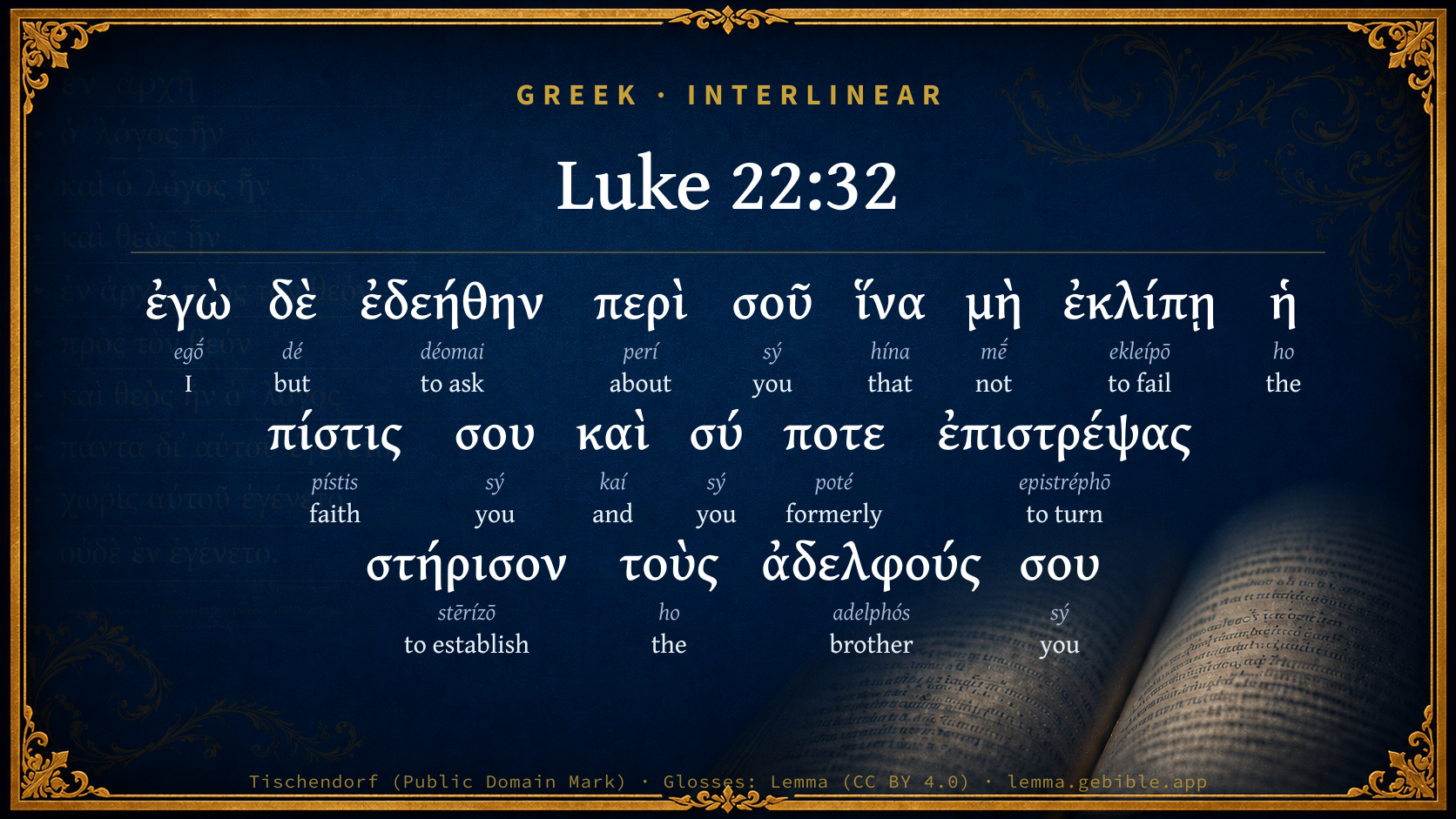
Greek (Tischendorf 8th ed.) Luke 22:32 appears in the Greek New Testament. The text above is from the Tischendorf 8th edition. Each word links to its Strong’s number and a concise gloss. Click any word for its full Thayer’s Greek Lexicon entry.
Download image
Cite this verse

Luke 22:32 (World English Bible). Public Domain. Lemma interlinear Bible study tool, https://lemma.gebible.app/v/luke/22/32.

Show BibTeX & RIS
BibTeX
RIS
English Translation
but I prayed for you, that your faith wouldn't fail. You, when once you have turned again, establish your brothers."
World English Bible · Public Domain
Highlights
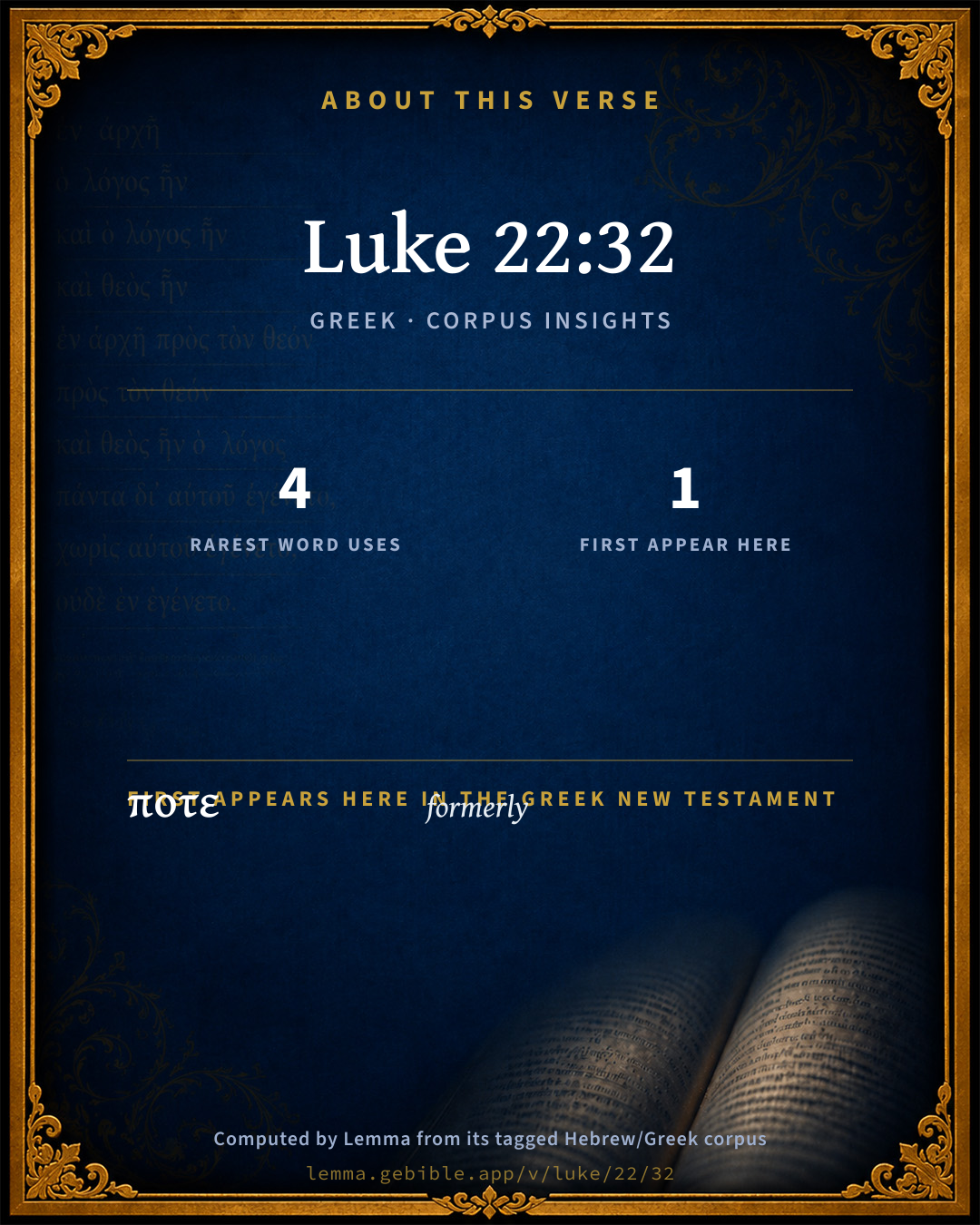
  • 1 first appearance in the Greek New Testament
Full analysis ↓
Download a study sheet

One document with this verse’s original text, its word-by-word gloss line, the meaning frame, cross-references with their text, attributed commentary, and full source and license credits — printable, and it pastes into notes with its structure intact.

This verse Autodidact and up

Study sheet (.html) Plain text (.txt)

A passage Seminary Student

Up to 50 verses in one chapter. A passage sheet keeps up to 6 commentary sources and 12 cross-references per verse, in the order this page ranks them, and says so on the sheet whenever that leaves anything out. Ask for a single verse and you get the Autodidact verse sheet above.

Everything on this page stays free to read, with no account — the sheet is a download of what is already on screen, not access to it.

Want to remove ads? Support Godless Engineer
Compare translations 3

The same verse in 3 English versions, stacked beneath the original-language interlinear above. Click any original word for its lexicon entry.

Each is an independent rendering of the whole verse — the interlinear is not word-aligned to these translations.

Highlighted words mark where these versions differ — a whole-verse word diff, not a word-by-word alignment.

  • World English Bible Public Domain
    but I prayed for you, that your faith wouldn't fail. You, when once you have turned again, establish your brothers."
  • King James Version Public Domain
    But I have prayed for thee, that thy faith fail not: and when thou art converted, strengthen thy brethren.
  • unfoldingWord Literal Text CC BY-SA 4.0
    But I have asked concerning you that your faith may not fail. And you, when you have turned back, strengthen your brothers.”

unfoldingWord Literal Text — © unfoldingWord, licensed CC BY-SA 4.0. Word-aligned USFM3 via Door43 (git.door43.org/unfoldingWord/en_ult).

Versions to compare (up to 4)

3 of 4 selected

Show all 19 translations

Every available English version of this verse, each an independent rendering of the whole verse.

  • World English Bible Public Domain
    but I prayed for you, that your faith wouldn't fail. You, when once you have turned again, establish your brothers."
  • Berean Standard Bible Public Domain
    But I have prayed for you, Simon, that your faith will not fail. And when you have turned back, strengthen your brothers.”
  • Majority Standard Bible Public Domain
    But I have prayed for you, Simon, that your faith will not fail. And when you have turned back, strengthen your brothers.”
  • King James Version Public Domain
    But I have prayed for thee, that thy faith fail not: and when thou art converted, strengthen thy brethren.
  • American Standard Version (1901) Public Domain
    but I made supplication for thee, that thy faith fail not; and do thou, when once thou hast turned again, establish thy brethren.
  • Revised Version (1885) Public Domain
    but I made supplication for thee, that thy faith fail not: and do thou, when once thou hast turned again, stablish thy brethren.
  • Geneva Bible (1599) Public Domain
    But I haue prayed for thee, that thy faith faile not: therefore when thou art conuerted, strengthen thy brethren.
  • Douay-Rheims (1899) Public Domain
    But I have prayed for thee, that thy faith fail not: and thou, being once converted, confirm thy brethren.
  • Young's Literal Translation Public Domain
    and I besought for thee, that thy faith may not fail; and thou, when thou didst turn, strengthen thy brethren.'
  • Literal Standard Version CC BY-SA 4.0
    and I implored for you that your faith may not fail; and you, when you turned, strengthen your brothers.”
  • Unlocked Literal Bible CC BY-SA 4.0
    But I have prayed for you, that your faith may not fail. After you have turned back again, strengthen your brothers.”
  • unfoldingWord Literal Text CC BY-SA 4.0
    But I have asked concerning you that your faith may not fail. And you, when you have turned back, strengthen your brothers.”
  • Darby Bible Public Domain
    but *I* have besought for thee that thy faith fail not; and *thou*, when once thou hast been restored, confirm thy brethren.
  • World Messianic Bible Public Domain
    but I prayed for you, that your faith wouldn’t fail. You, when once you have turned again, establish your brothers.”
  • Webster's Bible Public Domain
    But I have prayed for thee, that thy faith fail not; and when thou art converted, strengthen thy brethren.
  • Free Bible Version CC BY-SA 4.0
    but I have prayed for you that your trust in me may not fail. And when you have returned, encourage your brothers.”
  • Bible in Basic English Public Domain
    But I have made prayer for you, that your faith may not go from you: and when you are turned again, make your brothers strong.
  • Text-Critical English NT CC BY 4.0
    But I have prayed for yoʋ that yoʋr faith may not fail. Once yoʋ have turned back, strengthen yoʋr brothers.”
  • Tyndale New Testament (1534) Public Domain
    but I have prayed for the that thy faith fayle not. And when thou arte converted strengthe thy brethren.

Literal Standard Version (2020), Covenant Press — licensed CC BY-SA 4.0. Text via the HelloAO Bible API (eBible.org). Unlocked Literal Bible (unfoldingWord) — licensed CC BY-SA 4.0. Text via the HelloAO Bible API (eBible.org). unfoldingWord Literal Text — © unfoldingWord, licensed CC BY-SA 4.0. Word-aligned USFM3 via Door43 (git.door43.org/unfoldingWord/en_ult). Free Bible Version, Dr. Jonathan Gallagher — licensed CC BY-SA 4.0. Text via the HelloAO Bible API (eBible.org).

Word by word

More ways to search: Search by grammar → Find every occurrence → Compare this word →

Practice this passage: Drill this verse → Learn its vocabulary →

ἐκλίπῃ
ekleípō
G1587
“to fail”
Verb, Aorist, Active, Subjunctive, 3rd person, Singular
Part of Speech
Verb
Tense
Aorist
Voice
Active
Mood
Subjunctive
Person
3rd person
Number
Singular
Full Thayer's Definition

Origin: from G1537 and G3007

TDNT: None

1. fail a. to leave out, omit, pass by b. to leave, quit 2. to fail a. to leave off, cease, stop b. of the failing or eclipse of the light of the sun and the moon
  1. ἐγὼ egṓ G1473 “I” Personal pronoun, 1st person, Nominative, Singular
  2. δὲ dé G1161 “but” Conjunction
  3. ἐδεήθην déomai G1189 “to ask” Verb, Aorist, Passive, Indicative, 1st person, Singular
  4. περὶ perí G4012 “about” Preposition
  5. σοῦ sý G4771 “you” Personal pronoun, 2nd person, Genitive, Singular
  6. ἵνα hína G2443 “that” Conjunction
  7. μὴ mḗ G3361 “not” Particle, Negative
  8. ἡ ho G3588 “the” Article, Nominative, Singular, Feminine
  9. πίστις pístis G4102 “faith” Noun, Nominative, Singular, Feminine
  10. σου sý G4771 “you” Personal pronoun, 2nd person, Genitive, Singular
  11. καὶ kaí G2532 “and” Conjunction
  12. σύ sý G4771 “you” Personal pronoun, 2nd person, Nominative, Singular
  13. ποτε poté G4218 “formerly” Particle
  14. ἐπιστρέψας epistréphō G1994 “to turn” Verb, Aorist, Active, Participle, Nominative, Singular, Masculine
  15. στήρισον stērízō G4741 “to establish” Verb, Aorist, Active, Imperative, 2nd person, Singular
  16. τοὺς ho G3588 “the” Article, Accusative, Plural, Masculine
  17. ἀδελφούς adelphós G80 “brother” Noun, Accusative, Plural, Masculine
  18. σου sý G4771 “you” Personal pronoun, 2nd person, Genitive, Singular

About this verse

These counts appear in no published source. They are computed here, from the morphology-tagged text and Lemma’s own curated glosses. What Lemma adds →

19
words
15
distinct lemmas
Gospels
section

Notable vocabulary

The rarest word here is ἐκλίπῃ to fail G1587 — appearing just 4 times in the whole Greek New Testament.

First appearance in Scripture

This word makes its first canonical appearance in the Greek New Testament here:

  • ποτε formerly G4218

Shared distinctive vocabulary

ἐκλίπῃ to fail G1587 occurs in 4 verses of the Greek New Testament. Also found in:
Repetition

Words recur within this verse:

Cross-references

31

Topical passages linked to Luke 22:32 in the Treasury of Scripture Knowledge — connected by theme and wording, ordered by reader-vote popularity; previews shown in the World English Bible.

  • John 21:15–17 So when they had eaten their breakfast, Jesus said to Simon Peter, "Simon, son of Jonah, do you love me more than these?" He said to him, "Yes, Lord; you know that I have affection for you." He said to him, "Feed my lambs."
  • 1 Peter 5:8–10 Be sober and self-controlled. Be watchful. Your adversary the devil, walks around like a roaring lion, seeking whom he may devour.
  • John 17:9–11 I pray for them. I don't pray for the world, but for those whom you have given me, for they are yours.
  • Romans 8:34 Who is he who condemns? It is Christ who died, yes rather, who was raised from the dead, who is at the right hand of God, who also makes intercession for us.
  • 2 Corinthians 1:4–6 who comforts us in all our affliction, that we may be able to comfort those who are in any affliction, through the comfort with which we ourselves are comforted by God.
  • Hebrews 7:25 Therefore he is also able to save to the uttermost those who draw near to God through him, seeing he ever lives to make intercession for them.
  • 2 Peter 3:14 Therefore, beloved, seeing that you look for these things, be diligent to be found in peace, without blemish and blameless in his sight.
  • 1 John 2:1–2 My little children, I write these things to you so that you may not sin. If anyone sins, we have a Counselor with the Father, Jesus Christ, the righteous.
  • 1 Peter 1:5 who by the power of God are guarded through faith for a salvation ready to be revealed in the last time.
  • Hebrews 12:12–13 Therefore, lift up the hands that hang down and the feeble knees,
  • Luke 8:13 Those on the rock are they who, when they hear, receive the word with joy; but these have no root, who believe for a while, then fall away in time of temptation.
  • Luke 22:61–62 The Lord turned, and looked at Peter. Then Peter remembered the Lord's word, how he said to him, "Before the rooster crows you will deny me three times."
  • Acts 3:19 "Repent therefore, and turn again, that your sins may be blotted out, so that there may come times of refreshing from the presence of the Lord,
  • 2 Peter 3:17–18 You therefore, beloved, knowing these things beforehand, beware lest, being carried away with the error of the wicked, you fall from your own steadfastness.
  • Psalms 32:3–6 When I kept silence, my bones wasted away through my groaning all day long.
  • Psalms 51:12–13 Restore to me the joy of your salvation. Uphold me with a willing spirit.
  • Matthew 18:3 and said, "Most assuredly I tell you, unless you turn, and become as little children, you will in no way enter into the Kingdom of Heaven.
  • John 17:15–21 I pray not that you would take them from the world, but that you would keep them from the evil one.
  • Hebrews 12:15 looking carefully lest there be any man who falls short of the grace of God; lest any root of bitterness springing up trouble you, and thereby the many be defiled;
  • 1 Peter 1:13 Therefore, prepare your minds for action, be sober and set your hope fully on the grace that will be brought to you at the revelation of Jesus Christ--
  • 2 Peter 1:10–12 Therefore, brothers, be more diligent to make your calling and election sure. For if you do these things, you will never stumble.
  • 1 Timothy 1:13–16 although I was before a blasphemer, a persecutor, and insolent. However, I obtained mercy, because I did it ignorantly in unbelief.
  • Zechariah 3:2–4 Yahweh said to Satan, "Yahweh rebuke you, Satan! Yes, Yahweh who has chosen Jerusalem rebuke you! Isn't this a burning stick plucked out of the fire?"
  • Matthew 26:75 Peter remembered the word which Jesus had said to him, "Before the rooster crows, you will deny me three times." He went out and wept bitterly.
  • Mark 14:72 The rooster crowed the second time. Peter remembered the word, how that Jesus said to him, "Before the rooster crows twice, you will deny me three times." When he thought about that, he wept.
  • Mark 16:7 But go, tell his disciples and Peter, 'He goes before you into Galilee. There you will see him, as he said to you.'"
  • John 14:19 Yet a little while, and the world will see me no more; but you will see me. Because I live, you will live also.
  • 1 John 2:19 They went out from us, but they didn't belong to us; for if they had belonged to us, they would have continued with us. But they left, that they might be revealed that none of them belong to us.
  • Romans 5:9–10 Much more then, being now justified by his blood, we will be saved from God's wrath through him.
  • Romans 8:32 He who didn't spare his own Son, but delivered him up for us all, how would he not also with him freely give us all things?
  • 1 Peter 1:1 Peter, an apostle of Jesus Christ, to the chosen ones who are living as strangers in the Dispersion in Pontus, Galatia, Cappadocia, Asia, and Bithynia,

Cross-references courtesy of OpenBible.info (CC BY 4.0).

Commentary

Notes on Luke 22:32 from classic Christian and Jewish commentators (each source and its license shown beneath its notes). The classic Christian expositions comment on the surrounding passage and are grouped to its opening verse, so a note may address several verses; the Jewish commentaries on the Tanakh (Rashi and others) are per-verse, so they appear only where the commentator wrote on this verse.

Lemma curates 59 commentaries, every one of them public domain or Creative Commons licensed, each selected and text-cleaned for this edition rather than reprinted as found. About our sources →

MacLaren's Expositions of Holy Scripture

Alexander MacLaren

Luke

PARTING PROMISES AND WARNINGS

A GREAT FALL AND A GREAT RECOVERY

Luk 22:32.

Our Lord has just been speaking words of large and cordial praise of the steadfastness with which His friends had continued with Him in His temptations, and it is the very contrast between that continuance and the prevision of the cowardly desertion of the Apostle which occasioned the abrupt transition to this solemn appeal to him, which indicates how the forecast pained Christ’s heart. He does not let the foresight of Peter’s desertion chill His praise of Peter’s past faithfulness as one of the Twelve. He does not let the remembrance of Peter’s faithfulness modify His rebuke for Peter’s intended and future desertion. He speaks to him, with significant and emphatic reiteration of the old name of Simon that suggests weakness, unsanctified and unhelped: ‘Simon, Simon, Satan hath desired to have you, that he may sift you as wheat.’ There is a glimpse given, a corner of the curtain being lifted, into a dim region in which faith should not refuse to discern so much light as Christ has given, because superstition has so often fancied that it saw what it only dreamed. But passing from that, the words before us seem to me to suggest a threefold thought of the Intercessor for tempted souls; of the consequent re-illumination of eclipsed faith; and of the larger service for which the discipline of fall and recovery fits him who falls. Let me say a word or two about each of these thoughts.

I. We have the Intercessor for tempted souls.

Notice that majestic ‘but’ with which my text begins, ‘Satan hath desired to have you, that he may sift you as wheat, but I have prayed for thee.’ He presents Himself, then, as the Antagonist, the confident and victorious Antagonist, of whatsoever mysterious, malignant might may lie beyond the confines of sense, and He says, ‘My prayer puts the hook in leviathan’s nose, and the malevolent desire to sift, in order that not the chaff but the wheat may disappear, comes all to nothing by the side of My prayer.’

Note the discrimination of the intercession. He ‘hath desired to have you’-that is plural; ‘I have prayed for thee’-that is singular. The man that was in the greatest danger was the man nearest to Christ’s heart, and chiefly the object of Christ’s intercession. So it is always-the tenderest of His words, the sweetest of His consolations, the strongest of His succours, the most pleading and urgent of His petitions, the mightiest gifts of His grace, are given to the weakest, the neediest, the men and women in most sorrow and stress and peril, and they who want Him most always have Him nearest. The thicker the darkness, the brighter His light; the drearier our lives, the richer His presence; the more solitary we are, the larger the gifts of His companionship. Our need is the measure of His prayer. ‘Satan hath desired to have you, but thou, Peter, dost stand in the very focus of the danger, and so on thee are focussed, too, the rays of My love and care.’ Be sure, dear friends, that it is always so for us, and that when you want Christ most, Christ is most to you.

Then, I need not touch at any length upon that great subject on which none of us can speak adequately or with full comprehension-viz. our Lord as the Intercessor for us in all our weakness and need. We believe in His continual manhood, we believe that He prayed upon earth, we believe that He prays in heaven. His prayer is no mere utterance of words: it is the presentation of a fact, the bringing ever before the Infinite Divine Mind, as it were, of His great work of sacrifice, as the condition which determines, and the channel through which flows, the gift of sustaining grace from God Himself. And so we may be sure that whensoever there come to any of us trials, difficulties, conflicts, temptations, they are known to our Brother in the skies, and the stormier the gales that threaten us, the closer He wraps His protection round us. We have an Advocate and an Intercessor before the Throne; His prayer is always heard. Oh, brethren! how different our endurance would be, if we vividly believed that Christ was praying for us! How it would take the sting out of sorrow, and blunt the edge of temptation, if we realised that! O for a faith that shall rend the heavens, and rise above the things seen and temporal, and behold the eternal order of the universe, the central Throne, and at the right hand of God, the Intercessor for all who love and trust Him!

II. Notice again the consequent re-illumination of eclipsed faith.

‘I have prayed for thee, that thy faith fail not.’ Did it fail? If we look only at Peter’s denial, we must answer, Yes. If we look at the whole of the future life of the Apostle, we answer, No. Eclipse is not extinction; the momentary untruthfulness to one’s deepest convictions is not the annihilation of these convictions. Christ’s prayer is never vain, and Christ’s prayer was answered just because Peter, though he fell, did not lie in the mud, but staggered to his feet again, and with sore weeping and many an agony of shame, struggled onward, with unconquerable hope, in the path from which, for a moment, he strayed. Better one great outburst like his, the nature of which there is no possibility of mistaking, than the going on, as so many professing Christians do, from year to year, walking in a vain show of godliness, and fancying themselves to be disciples, when all the while they are recreants and apostates. There is more chance of the recovery of a good man that has fallen into some sin, ‘gross as a mountain, open, palpable,’ than there is of the recovery of those who let their religion trickle out of them in drops, and never know that their veins are empty until the heart ceases to beat at all.

Here, then, we have two large lessons from which we may take strength, taught us by this darkening and re-illumination of an eclipsed faith. One is that the sincerest love, the truest desire to follow Jesus, the firmest faith, may be overborne, and the whole set of a life contradicted for a time. Thank God, there is a vast difference between conduct which is inconsistent with being a Christian and conduct which is incompatible with being a Christian. It is dangerous, perhaps, to apply the difference too liberally in judging ourselves; it is imperative to apply it always in judging our fellows. But if it be true that Peter meant, down to the very bottom of his heart, all that he said when he said, ‘I will lay down my life for Thee,’ while yet within a few hours afterwards the sad prophecy of our Lord was fulfilled-’Thou shalt deny Me thrice!’-let us take the lesson, not, indeed, to abate our horror of the sin, but on the one hand to cut the comb of our own self-confidence, and on the other hand to judge with all charity and tenderness the faults of our brethren. ‘Be not high-minded, but fear,’ and when we look into the black gulf into which Peter fell bodily, let us cry, ‘Hold Thou me up and I shall be safe.’

The other lesson is that the deepest fall may be recovered. Our Lord in the words of our text does not definitely prophesy what He subsequently declares in plain terms, the fall of Peter, but He implies it when He says, ‘when thou art converted’-or, as the Revised Version reads it much more accurately, ‘when once thou hast turned again strengthen thy brethren.’ Then, the Apostle’s face had been turned the wrong way for a time, and he needed to turn right-about-face in order to renew the old direction of his life. He came back for two reasons-one because Christ prayed for him, and the other because he ‘turned himself.’ For the only way back is through the valley of weeping and the dark lane of penitence; and whosoever has denied with Peter, or at least grovelled with Peter, or perhaps grovelled much more than Peter, ‘denying the Lord that bought him’ by living as if He was not his Lord, will never come back to the place that Peter again won for himself, but by the road by which Peter went. ‘The Lord turned and looked upon him,’ and Christ’s face, with love and sorrow and reproach in it, taught him his sin, and bowed his heart, ‘and he went out and wept bitterly.’

Peter and Judas both ‘went out’; the one ‘went out and hanged himself,’ because his conviction of his sin was unaccompanied with a faith in his Master’s love, and his repentance was only remorse; and the other ‘went out and wept bitterly,’ and so came back with a clean heart. And on the Resurrection morning he was ready for the message: ‘Go, tell His disciples, and Peter, He goeth before you into Galilee.’ And the Lord appeared to him, in that conversation, the existence of which was known, though the particulars were unknown, to the rest; and when ‘He appeared unto Cephas,’ spoke his full forgiveness. There is the road back for all wanderers.

III. The last thought is, the larger service for which such an experience will fit him who falls.

‘Strengthen thy brethren when once thou hast turned again.’ I need not remind you how nobly the Apostle fulfilled this commandment. Satan desired to have him, that he might sift him as wheat; but Satan’s sifting was in order that he might get rid of the wheat and harvest the chaff. His malice worked indirectly the effect opposite to his purpose, and achieved the same result as Christ’s winnowing seeks to accomplish-namely, it got rid of the chaff and kept the wheat. Peter’s vanity was sifted out of him, his self-confidence was sifted out of him, his rash presumption was sifted out of him, his impulsive readiness to blurt out the first thought that came into his head was sifted out of him, and so his unreliableness and changeableness were largely sifted out of him, and he became what Christ said he had in him the makings of being-’Cephas, a rock,’ or, as the Apostle Paul, who was never unwilling to praise the others, said, a man ‘who looked like a pillar.’ He ‘strengthened his brethren,’ and to many generations the story of the Apostle who denied the Lord he loved has ministered comfort. To how many tempted souls, and souls that have yielded to temptation, and souls that, having yielded, are beginning to grope their way back again out of its vulgar delights and surfeiting sweetnesses, and find that there is a desert to be traversed before they can again reach the place where they stood before, has that story ministered hope, as it will minister to the very end! The bone that is broken is stronger, they tell us, at the point of junction, when it heals and grows again, than it ever was before. And it may well be that a faith that has made experience of falling and restoration has learned a depth of self-distrust, a firmness of confidence in Christ, a warmth of grateful love which it would never otherwise have experienced.

The Apostle about whom we have been speaking seems to have carried in his mind and memory an abiding impression from that bitter experience, and in his letter when he was an old man, and all that past was far away, he writes many words which sound like echoes and reminiscences of it. In the last chapter of his epistle, in which he speaks of himself as a witness of the sufferings of Christ, there are numbers of verses which seem to point to what had happened in the Upper Room. ‘Ye younger, submit yourselves unto the elder.’ Jesus Christ had then said, ‘He that is the greater among you, let him be as the younger.’ Peter says, ‘Be clothed with humility’; he remembers Christ wrapping a towel around Him, girding Himself, and taking the basin. He says, ‘God resisteth the proud,’ and he remembers how proud he had been, with his boast: ‘Though all should . . . yet will not I,’ and how low he fell because he was ‘fool’ enough to ‘trust in his own heart.’ ‘Be sober, be vigilant; because your adversary, the devil, as a roaring lion, walketh about, seeking whom he may devour: whom resist, steadfast in the faith.’ ‘The God of all grace stablish, strengthen, settle you.’ He thus strengthened his brethren when he reminded them of the temptation to which he himself had so shamefully succumbed, and when he referred them for all their strength to the source of it all, even God in Christ.

Alexander MacLaren, Expositions of Holy Scripture (1904–1910) — public domain. Text from a community e-Sword module.

Tyndale Open Study Notes

Tyndale Open Resources

22:32 So when you have repented: This you is singular; it refers to Peter’s restoration after his denial of Jesus.

Tyndale Open Study Notes — © Tyndale Open Resources, licensed CC BY-SA 4.0. Text via the HelloAO Bible API.

Bengel's Gnomon

Johann Albrecht Bengel

Luk 22:32. Ἐδεήθην) A striking word. I have prayed, although thou, Peter, wert not aware of what was being done. Jesus prayed for His disciples: therefore Satan was not able by his seeking to get Him to deliver them up (ἐξητήσασθαι, Luk 22:31, to get Jesus to deliver them up from their spiritual place of safety).—ἵνα μὴ ἐχλείπῃ, that thy faith might not fail) He does not say, that thou mightest not be sifted. Even though Satan sifted Peter, yet he did not altogether wrest from him his faith. Satan sought to cause an ‘eclipse’[237] of faith in Peter: but the light of faith immediately shone out again in him after the strife [Luk 22:24] and after the subsequent denial. Peter, during that instability on his part, was, notwithstanding, in secret ‘Peter’ [“A rock”] truly still: just as James and John, although they had externally a nice and refined manner of speech, were notwithstanding truly “the sons of thunder” still.—[ἡ πίστις, thy faith) which pride is assailing, and which Satan is bringing into jeopardy.—V. g.] σὺ ποτὲ) ΠΟΤῈ (Joh 9:13, ΠΟΤῈ, “a while before was blind”) is even used of a short interval of time, as Eustathius shows us. In this passage it conveys an indefinite idea [“when (soever) thou art converted,” Engl. Ver.], at some time or other, whenever it may be, at a long or short interval hence.—ἐπιστρέψας στήριξον, in thy turn strengthen [confirm]) To make up for the fact that [according as] thy brethren are now put in peril through thee: the verb ἐπιστρέφω is to be resolved into an adverb [“vicissim,” in thy turn. But Engl. Ver. “When thou art converted”], as the Heb. שוּב. Comp. ἜΣΤΡΕΨΕ, Act 7:42.[238]—στήριξον, confirm, strengthen) What I now do to thee, that do thou to those like thee [those liable to fall as thou art], whom thou hast previously weakened (by the fall). Peter did so not long after, Acts 2, 3, 4, and in both of his Epistles, where this very word is often repeated; 1Pe 5:10; 2Pe 1:12; 2Pe 3:17; 2Pe 3:16; 2Pe 2:14. And often one may thus observe the words of Jesus subsequently employed by the apostles.—τοὺς ἀδελφούς σου) thy brethren, saith Jesus, not our brethren. For the footing on (the manner in) which Peter has his ‘brethren’ is one thing, that on (in) which the Lord has His brethren is quite another thing. The rest of the apostles were brethren of Peter, Mat 23:8 [“One is your Master, even Christ, and all ye are brethren”]: but inasmuch as these afterwards did not need the confirmation (strengthening) of Peter, it is to be understood of other believers of a feebler sort.

[237] Como ἐκλείπη, from which ‘eclipse’ is derived.—E. and T.

[238] “Then God turned and gave them up to worship the host of heaven.” Engl. Vers. Rather, “God in His turn, in righteous retribution, gave them up,” etc.—E. and T.

Bengel's Gnomon of the New Testament — English translation (T&T Clark, Edinburgh, 1860) — public domain. Text from a community e-Sword module.

Expositor's Greek Testament

ed. W. Robertson Nicoll

Luk 22:32 . ἐγὼ δὲ ἐδεήθην , but I have prayed: I working against Satan, and successfully. ἵνα μὴ ἐκλίπῃ ἡ π . σ ., that thy faith may not (utterly) fail or die (Luk 16:9 ), though it prove weak or inadequate for the moment. Job’s faith underwent eclipse. He did not curse God, but for the time he lost faith in the reality of a Divine government in human affairs. So Peter never ceased to love Jesus, but he was overpowered by fear and the instinct of self-preservation. ἐπιστρέψας , having returned (to thy true self). Cf. στραφῆτε in Mat 18:3 . The word “converted,” as bearing a technical sense, should be allowed to fall into desuetude in this connection. Many regard ἐπιστρέψας as a Hebraism = vicissim : do thou in turn strengthen by prayer and otherwise thy brethren as I have strengthened thee. So, e.g. , Grotius: “Da operam ne in fide deficiant, nempe pro ipsis orans , sicut ego pro te oro”. Ingenious but doubtful. στήρισον : later form for στήριξον ; for the sense vide Act 14:22 and 1Pe 5:10 .

The Expositor's Greek Testament, edited by W. Robertson Nicoll (1897–1910) — public domain. Text from a community e-Sword module.

Geneva Bible (1599)

Geneva Bible translators

It is through the prayers of Christ, that the elect do never utterly fall away from the faith: and that for this cause, that they should stir up one another.

Geneva Bible (1599) marginal notes — public domain. Text via Bolls.life.

Jamieson, Fausset & Brown

Robert Jamieson, A. R. Fausset & David Brown

But I have prayed--have been doing it already.

for thee--as most in danger. (See on Luk 22:61-62.)

fail not--that is, entirely; for partially it did fail.

converted--brought back afresh as a penitent disciple.

strengthen, &c.--that is, make use of thy bitter experience for the fortifying of thy tempted brethren.

Jamieson, Fausset & Brown — Commentary Critical and Explanatory on the Whole Bible (1871) — public domain (CC PDM 1.0). Text via the HelloAO Bible API.

Adam Clarke's Commentary

Verse 32. I have prayed for thee] From the natural forwardness and impetuosity of thy own spirit, thou wilt be brought into the most imminent danger; but I have supplicated for thee, that thy faith may not utterly fail - εκλειπη, from εκ, out, and λειπω, I fail, to fall utterly or entirely off. Peter's faith did fail, but not utterly: he did fall, but he did not fall off, apostatize, or forsake his Master and his cause finally, as Judas did. Every body sees, from Peter's denial of his Lord, that his faith did fail, and his great courage too; and yet they read, in the common translation, that Christ prayed that it might not fail: can they then conceive that our Lord's prayer was heard? The translation which I have given above removes this embarrassment and apparent contradiction. It was certainly Peter's advantage that our Lord did pray for him; but it was not so much for his honour that he should stand in need of such a prayer, beyond all others. Lightfoot.

When thou art converted] Restored to a sense of thy folly and sin, and to me and my cause - establish these thy brethren. All the disciples forsook Jesus and fled, merely through fear of losing their lives; Peter, who continued for a while near him, denied his Master with oaths, and repeated this thrice: our Lord seems to intimate that, after this fall, Peter would become more cautious and circumspect than ever; and that he should become uncommonly strong in the faith, which was the case; and that, notwithstanding the baseness of his past conduct, he should be a proper instrument for strengthening the feeble minded, and supporting the weak. His two epistles to the persecuted Christians show how well he was qualified for this important work.

Adam Clarke's Commentary on the Bible (1810–1826) — public domain. Text from a community e-Sword/MySword module.

Ellicott's Commentary for English Readers

(32) I have prayed for thee.—The individualising pronoun is significant as indicating to the Apostle, who was most confident, it may be, of his claim to greatness, that he, of the whole company of the Twelve, was in the greatest danger. In the Greek the other pronoun also is emphatic. “It was I who prayed for thee.” The prayer was answered, and the words that follow assume the answer as certain. In one sense “faith” did “fail” when the disciple denied his Lord; but repentance came after it, and a new power was gained through that weakness to make others strong. The word for “strengthen” does not meet us in the other Gospels, but is used frequently by St. Paul (Rom_1:11; 1Th_3:2, et al.), and twice by St. Peter himself (1Pe_5:10; 2Pe_1:12).

A Bible Commentary for English Readers, edited by Charles John Ellicott (1878–1897) — public domain. Text from a community e-Sword module.

The Cambridge Bible for Schools and Colleges

gen. ed. J. J. S. Perowne

32. I have prayed for thee] Rather, I made supplication concerning thee, shewing that Peter, the most confident, was at that moment the most imperilled, though Jesus had prayed for them all (Joh_17:9; Joh_17:11).

that thy faith fail not] The word means ‘fail not utterly, or finally.

when thou art converted, strengthen thy brethren] Comp. Psa_51:13.

So, after the Resurrection, Jesus said to him, “Feed my sheep” (Joh_21:17). The very word for ‘strengthen’ sank into his heart, and is repeated in his Epistle, 1Pe_5:10.‘Converted’ has not here its technical meaning—but ‘when thou hast turned again.’ It means more, however, than merely vicissim, ‘in turn.’ Comp. 1Pe_2:25; 2Pe_2:21-22; Mat_13:15, &c.

The Cambridge Bible for Schools and Colleges (gen. ed. J. J. S. Perowne; Cambridge University Press, 1878–1918) — public domain. Text from a community e-Sword module.

John Gill's Exposition

And he said unto him,.... That is, Simon, or Simeon, said unto him, as the Syriac and Persic versions express it; he made a reply to Jesus, saying, as one fearless of danger, and confident in himself:

I am ready to go with thee, both into prison and to death; he suggests, that he was not afraid of Satan, nor of his temptations, of being sifted, shaken, and tossed by him: he was not to be frightened out of his faith by him, or to be scared with a prison, and death itself; he was ready for both; and they were welcome, come when they would; and rather than part from, or deny his Lord, he was then prepared to go with him, at once, to either of them. The phrase, to go, is not in the Syriac version.

John Gill's Exposition of the Whole Bible (1746–1763) — public domain (CC PDM 1.0). Text via the HelloAO Bible API.

Trapp's Complete Commentary

John Trapp

32 But I have prayed for thee, that thy faith fail not: and when thou art converted, strengthen thy brethren.

Ver. 32. But I have prayed] So the plaster is ready made before the wound be given; for else the patient might perish, as those do that are stung with scorpions, if not presently anointed with oil of scorpions.

That thy faith fail not] It is our faith that Satan chiefly assaulteth: he knows that nihil retinct qui fidem perdidit. (Seneca.)

Strengthen thy brethren] So he doth notably, in both his Epistles, dooming apostates most severely, 2Pe 2:1-22.

John Trapp, A Commentary or Exposition upon All the Books of the Old and New Testament (1647–1656) — public domain. Text from a community e-Sword module.

Albert Barnes' Notes on the Bible

That thy faith fail not - The word “faith,” here, seems to be used in the sense of religion, or attachment to Christ, and the words “fail not” mean “utterly fail” or fail altogether - that is, apostatize. It is true that the “courage” of Peter failed; it is true that he had not that immediate confidence in Jesus and reliance on him which he had before had; but the prayer of Jesus was that he might not altogether apostatize from the faith. God heard Jesus “always” Joh 11:42; it follows, therefore, that every prayer which he ever offered was answered; and it follows, as he asked here for a specific thing, that that thing was granted; and as he prayed that Peter’s faith might not utterly fail, so it follows that there was no time in which Peter was not really a pious man. Far as he wandered, and grievously as he sinned, yet he well knew that Jesus was the Messiah. He “did know” the man; and though his fears overcame him and led him to aggravated sin, yet the prayer of Christ was prevalent, and he was brought to true repentance.

When thou art converted - The word “converted” means turned, changed, recovered. The meaning is, when thou art turned from this sin, when thou art recovered from this heinous offence, then use “your” experience to warn and strengthen those who are in danger of like sins. A man may be “converted or turned” from any sin, or any evil course. He is “regenerated” but once - at the beginning of his Christian life; he may be “converted” as often as he falls into sin.

Strengthen thy brethren - Confirm them, warn them, encourage them. They are in continual danger, also, of sinning. Use your experience to warn them of their danger, and to comfort and sustain them in their temptations. And from this we learn:

That one design of permitting Christians to fall into sin is to show their own weakness and dependence on God; and, That they who have been overtaken in this manner should make use of their experience to warn and preserve others from the same path.

The two epistles of Peter, and his whole life, show that “he” was attentive to this command of Jesus; and in his death he manifested his deep abhorrence of this act of dreadful guilt in denying his blessed Lord, by requesting to be crucified with his head downward, as unworthy to suffer in the same manner that Christ did. Compare the notes at Joh 21:18.

Albert Barnes' Notes on the Bible (1834–1885) — public domain. Text from a community e-Sword/MySword module.

Haydock's Catholic Bible Commentary

That thy faith fail not. The faith of Peter, established by the coming of the Holy Ghost, hath never failed, nor can fail, being built upon a rock, which is Christ himself, and being guided by the spirit of truth, as Christ promised. (John xv. 26. and xvi. 13.) --- And thou being once converted, confirm thy brethren, even all the other apostles and bishops, over whom I have made and constituted thee and thy successors the chief head, that such a head being appointed by divine authority, all occasions of schisms and divisions might cease, says St. Jerome. (Witham) --- Admire the superabundance of the divine patience. That the disciple might not lose courage, he promised him pardon before he has committed the crime, and restores him again to his apostolic dignity, saying, confirm thy brethren. (St. Cyril)

George Leo Haydock (1774–1849), Haydock's Catholic Family Bible and Commentary, 1859 edition — public domain. Excludes Psalms (Douay-Rheims chapter numbering differs from Protestant) and Deuterocanonical books (Catholic canon only).

Whedon's Commentary on the Bible

Daniel D. Whedon

32. Prayed that thy faith fail not—His faith should falter, though it did not finally fail. His faith doubtless ceased to be justifying, though it remained convicting; at least so far as to form the basis of a true repentance.

Converted—From the apostacy. That re-conversion he doubtless needed to save him from damnation. The salvation of an old conversion will not survive a complete apostacy. A new repentance, faith, and conversion are necessary.

Strengthen thy brethren—Who will have been shaken and enfeebled by thy apostacy. Alford says that the use three times, in Peter’s epistles, of this word strengthened is at least remarkable. He who by sin disgraces the cause of Christ, should doubly honour it by a redoubled effort to prevent others from like folly.

Daniel D. Whedon (gen. ed.), Commentary on the Old and New Testaments (1874–1909) — public domain. Text from a community e-Sword module.

The Pulpit Commentary

But I have prayed for thee, that thy faith fail not. The prayer of Satan apparently was not refused. Jesus, however, says, that for one of that loved company, who he knew from his peculiar temperament was in especial peril, he had prayed. The prayer was answered thus: the temptation came to all the apostles; all fell; Peter, though, more disastrously by far than his brethren, but the result of the fall was not hopeless despair as in the case of Judas, but bitter remorse and a brave manly repentance. "It is said by Roman divines (e.g. Maldonatus, a Lapide, and Mai, here) that this prayer and precept of our Lord extends to all bishops of Rome as St. Peter"s successors, and that in speaking to St. Peter our Lord spoke to them. Would they be willing to complete the parallel, and say that the bishops of Rome specially need prayer, because they deny Christ? Let them not take a part of it and leave the rest" (Bishop Wordsworth). When thou art converted. "Converted" must not be understood here in its technical sense; it should rather be translated, "And thou, when thou hast turned (i.e. to God) strengthen thy brethren.

The privilege of spiritual maturity.

"When thou art converted, strengthen thy brethren." This forward-looking injunction of Christ reminds us of

I OUR NEED OF STRENGTHENING POWER. Such are the manifold and effective forces opposed to us, invisible as well as visible and human; (see Eph_6:12) so strong and so subtle are the temptations that beset us on every side; that we urgently need, not only the presence of resisting principles within us, but the aid of friendly and helpful auxiliaries around us. We want, indeed, the help which is from above; that is the first thing to seek. And, having besought that, we do well to avail ourselves of all the strength we can gain from other sources. For the battle is severe, and we are often hard pressed by our vigilant and relentless foes.

II THE HELP WE CAN FIND IN MAN. God is, as stated, the Source of spiritual strength. He renews our strength by the direct communications of his Divine Spirit. But man helps us also. "A man shall be as an hiding-place... as rivers of water... as the shadow of a great rock." Paul went through the region of Galatia, "strengthening the disciples". (Act_18:23) Peter was to "strengthen his brethren." We can and we should do much to strengthen one another, to build one another up on our holy faith. We can do this:

1. By the force of a beautiful and attractive example.

2. By the utterance of invigorating truth.

3. By the inspiration of a cheerful, hopeful, loving spirit.

III THE INCOMPETENCE OF INEXPERIENCE. Peter was not in a position to afford spiritual strength then. He was too inexperienced. He had not yet learned what the fierceness of the fire of temptation meant. He did not then understand where his true strength lay. He had not yet graduated in the school of experience. It is they, and only they, who know what spiritual struggle means who can impart to others the help they need. We must have passed through the waters before we can undertake to teach others how to swim the strong stream of trial and temptation.

IV THE UNFITNESS OF UNFAITHFULNESS. Peter was about to fall. A few hours would find him in the power of the adversary. Before another day dawned he would have to reproach himself as a disloyal disciple. He was about to rest under the shadow of great guilt, and he would have to wait until he came forth from that shadow. Not until he "was converted," not until the spirit of overweening self-confidence had given place to that of humble trust in God, not until the knowledge of Christ "after the flesh" had passed, had risen into a knowledge of him that was truly spiritual and real, not till then would he be fitted to strengthen his brethren." His case was strikingly parallel with that of David. (see Psa_51:11-13) We have similar experiences now. When the Christian disciple loses ground spiritually and morally, it becomes him to return unto the Lord" himself, and then to teach transgressors" the way of God; it becomes him to undergo a change of spirit, to be "renewed in the spirit of his mind," and then to speak the helpful and sustaining truth of Christ. Unfaithfulness to our Lord, departure and distance from him, this has no teaching function; its first duty is penitential; then it may think of useful work. But we should understand that all true usefulness rests on the foundation of spiritual integrity; it can find no other footing.

V THE PRIVILEGE OF CHRISTIAN MATURITY. Peter was to look forward to a not distant future, when, having learnt truth by what he suffered, he should strengthen his brethren in all that was true and wise and good. This he did, and in this he found a noble heritage. To this we may look forward as the reward of spiritual struggle, as the goal of earthly good. What better portion can we ask for than to be the source of spiritual strength to our brethren and sisters as they bear the burdens and fight the battles of their life? C.

The Pulpit Commentary (1880–1919), ed. H.D.M. Spence-Jones & Joseph S. Exell — public domain. Text from a community e-Sword module.

John Wesley's Explanatory Notes

But I have prayed for thee - Who wilt be in the greatest danger of all: that thy faith fail not - Altogether: and when thou art returned - From thy flight, strengthen thy brethren -- all that are weak in faith; perhaps scandalized at thy fall.

John Wesley, Explanatory Notes Upon the Whole Bible (1754–1765) — public domain. Text via the GEBible commentary corpus.

Scofield Reference Notes

C. I. Scofield

art converted

hast turned back again.

The Scofield Reference Bible (1917 edition), notes by C. I. Scofield — public domain. Text from a community e-Sword module.

Cambridge Greek Testament for Schools and Colleges

32. ἐδεήθην περὶ σοῦ. ‘I made supplication concerning thee,’ shewing that Peter, the most confident, was at that moment the most imperilled, though Jesus had prayed for them all (Joh 17:9; Joh 17:11).

μὴ ἐκλίπῃ. The aor. points to this special crisis. Some MSS. read ἐκλείπῃ which would imply a continuous failure of faith. The verb ἐκλείπω means ‘fail utterly, or finally.’

σύ ποτε ἐπιστρέψας στήρισον τοὺς ἀδελφούς σου. ‘When once thou hast turned again stablish thy brethren.’ Joh 21:4-17. For στηρίζω see Rom 1:2, 1Pe 5:10. In the latter verse it is accompanied by σθενόω ‘strengthen.’ Comp. Psa 51:13. The very word for ‘strengthen’ sank into his heart, and is repeated in his Epistle, 1Pe 5:10. Ἐπιστρέψας does not here imply conversion in the technical sense—but ‘when thou hast turned again.’ It means more, however, than merely vicissim, ‘in turn.’ Comp. 1Pe 2:25; 2Pe 2:21-22; Mat 13:15, &c.

Cambridge Greek Testament for Schools and Colleges (Cambridge University Press, 1896; 21 vols, various authors incl. Carr, Maclear, Plummer, Farrar, Lumby, Moule, M. R. James, Simcox) — public domain. Text from a community e-Sword module.

Alford’s Greek Testament

Henry Alford

32.] ἐγὼ δὲ ἐδ. π. σοῦ] As Peter was the foremost (the rest are here addressed through him), so he was in the greatest danger. It must not be supposed that our Lord’s prayer was not heard, because Peter’s faith did fail, in his denial; ἐκλίπῃ implies a total extinction which Peter’s faith did not suffer.

Though the ὑμᾶς included Judas, he is not included in the prayer: see Joh 17:6-12. We may notice here, that our Lord speaks of the total failure of even an Apostle’s faith, as possible.

ἐπιστρέψας] There can, I think, be little doubt that this word is here used in the general N.T. sense, of returning as a penitent after sin, turning to God; and not in the almost expletive meaning which it has in such passages as Psa 84:6, ὁ θεός, σὺ ἐπιστρέψας ζωώσεις ἡμᾶς (although even here it may have a somewhat similar sense to the above—see Joe 2:14: Act 7:42).

στήρισον] The use of this word and the cognate substantive thrice by Peter in his two epistles (see reff.), and in the first passage in a connexion with the mention of Satan’s temptations, is remarkable.

33,

Henry Alford, The Greek Testament (1849–1861) — public domain. Text from a community e-Sword module.

International Critical Commentary

32. ἐγὼ δὲ ἐδεήθην. See on 5:12. The ἐγὼ δέ and the aor. are in marked contrast to Satan and his request. We may regard ἐξῃτήσατο and ἐδεήθή as contemporaneous.

περὶ σοῦ As being the leader on whom so much depended, and as being in special need of help, as his fall proved. Jesus prayed for all (Joh 17:2, Joh 17:9, Joh 17:15, Joh 17:17). The interpolator of Ignatius understands this as a prayer for all: ὁ δεηθεὶς μὴ ἐκλείπειν τὴν πίστιν τῶν ἀποστόλων (Smyrn. 7.) For ἵνα after δέομας comp. 9:40, 21:36.

μὴ ἐκλίπῃ. “Fail not utterly, once for all.” Defectt in Petro ἡ ἐνέργεια τῆς πίστεως ad tempus: at ἕξιν labefactavit, non extinxit (Grotius).

καὶ σύ. Answering to ἐγὼ δέ. Christ has helped him: he must do what he can for others.

ποτε ἐπιστρέψας στήρισον. “When once thou hast turned again, stablish” (RV.). It is unnatural to take ποτε with στήρισον (Mey. Weiss); and it is a mistake to make ἐπιστρέψας a sort of Hebraism (Psa 85:7, ἐπιστρέψας ζωώσεις ἡμᾶς), meaning “in turn” (Grot. Maldon. Beng.), a use which perhaps does not occur in N.T. See Schanz. On the other hand, “when thou art converted” is too strong. It means turning again after a temporary aberration. Yet it is not turning to the brethren, but turning from the fault that is meant. It is not likely that the transitive sense is meant: “convert thy brethren and strengthen them”. comp. 1:16, 17; Jas 5:19, and contrast Act 3:19, 28:27; Mat 13:15; Mar 4:12. See Expos. Times, Oct 1899, p. 6.

This metaphorical sense of στηρίζειν is not classical: comp. Act 18:23; Rom 1:11, Rom 1:16:25; Jas 5:8, etc. The form στήρισον for στήριξον is late.

Some Latin texts add. without any Greek authority, et rogate nen iniretis in temptationem (a b c e ff2 i q).

International Critical Commentary — older volumes (1896–1929), various authors — public domain. Text from a community e-Sword module.

Vincent's Word Studies in the New Testament

Marvin R. Vincent

Prayed [εδεηθην] . See on prayers, ch. 5 33.

Art converted [επιστρεψας] . Converted is simply the Latinized rendering of the word to turn round [χονςερτερε] . Rev. renders the aorist participle, denoting a definite act, by once : "when once thou hast turned again."

Strengthen [στηρισον] . See on ch. Luk 16:25, and 1Pe 5:10. Rev., stablish, which is much better. Strengthen may denote only a temporary effect. The word implies fixedness.

Marvin R. Vincent, Word Studies in the New Testament (1887–1900) — public domain. Text from a community e-Sword/MySword module.

Lesson kit

Teaching starters — assembled from the data on this page, not authored interpretation. Every prompt links to the verse data it draws on. Edit before teaching.

Luke, in the Gospels, opens this verse with 19 words (15 distinct Greek lemmas). Its most distinctive word is ekleípō (“to fail”). A historical commentator’s framing appears above. Read the whole chapter for the surrounding context.

Discussion questions

  1. What does “to fail” (ekleípō) contribute to the verse as a whole?
  2. The word “formerly” first appears here in Scripture. What is being introduced at this debut?
  3. Luke 16:9 shares the word «to fail» with this verse. How do the two illuminate each other?
  4. “you” occurs 4× in this one verse. What is the effect of the repetition?
  5. These translations render this verse differently. What is at stake in choosing one wording over another?
  6. Reading how MacLaren's Expositions of Holy Scripture and Tyndale Open Study Notes read this verse, where do the two commentators agree and where do they part?

Things to notice

  • 1 word makes its first canonical appearance in Scripture here.
  • These translations choose different wording for 15 words in this verse.
  • “you” occurs 4× in this single verse.
  • 15 distinct Greek lemmas span 19 words in this verse.

Reading settings

Reading text

Shown beneath each verse's original-language words.

Old Testament
Old Testament edition

Read the OT as the Masoretic Hebrew (MT) or the Greek Septuagint (LXX).

English shown for the Greek Septuagint (in the Hebrew ↔ Greek comparison).

Comparing translations? Open the Compare panel on any verse page to stack up to four side by side.