Mark 6:17

Greek (Tischendorf 8th ed.) Mark 6:17 appears in the Greek New Testament. The text above is from the Tischendorf 8th edition. Each word links to its Strong’s number and a concise gloss. Click any word for its full Thayer’s Greek Lexicon entry.
Download image
Cite this verse

Mark 6:17 (World English Bible). Public Domain. Lemma interlinear Bible study tool, https://lemma.gebible.app/v/mark/6/17.

Show BibTeX & RIS
BibTeX
RIS
English Translation
For Herod himself had sent out and arrested John, and bound him in prison for the sake of Herodias, his brother Philip's wife, for he had married her.
World English Bible · Public Domain
Download a study sheet

One document with this verse’s original text, its word-by-word gloss line, the meaning frame, cross-references with their text, attributed commentary, and full source and license credits — printable, and it pastes into notes with its structure intact.

This verse Autodidact and up

Study sheet (.html) Plain text (.txt)

A passage Seminary Student

Up to 50 verses in one chapter. A passage sheet keeps up to 6 commentary sources and 12 cross-references per verse, in the order this page ranks them, and says so on the sheet whenever that leaves anything out. Ask for a single verse and you get the Autodidact verse sheet above.

Everything on this page stays free to read, with no account — the sheet is a download of what is already on screen, not access to it.

Want to remove ads? Support Godless Engineer
Compare translations 3

The same verse in 3 English versions, stacked beneath the original-language interlinear above. Click any original word for its lexicon entry.

Each is an independent rendering of the whole verse — the interlinear is not word-aligned to these translations.

Highlighted words mark where these versions differ — a whole-verse word diff, not a word-by-word alignment.

  • World English Bible Public Domain
    For Herod himself had sent out and arrested John, and bound him in prison for the sake of Herodias, his brother Philip's wife, for he had married her.
  • King James Version Public Domain
    For Herod himself had sent forth and laid hold upon John, and bound him in prison for Herodias' sake, his brother Philip's wife: for he had married her.
  • unfoldingWord Literal Text CC BY-SA 4.0
    For Herod himself, having sent, seized John and bound him in prison because of Herodias, the wife of his brother Philip, because he married her.

unfoldingWord Literal Text — © unfoldingWord, licensed CC BY-SA 4.0. Word-aligned USFM3 via Door43 (git.door43.org/unfoldingWord/en_ult).

Versions to compare (up to 4)

3 of 4 selected

Show all 19 translations

Every available English version of this verse, each an independent rendering of the whole verse.

  • World English Bible Public Domain
    For Herod himself had sent out and arrested John, and bound him in prison for the sake of Herodias, his brother Philip's wife, for he had married her.
  • Berean Standard Bible Public Domain
    For Herod himself had ordered that John be arrested and bound and imprisoned, on account of his brother Philip’s wife Herodias, whom Herod had married.
  • Majority Standard Bible Public Domain
    For Herod himself had ordered that John be arrested and bound and imprisoned, on account of his brother Philip’s wife Herodias, whom Herod had married.
  • King James Version Public Domain
    For Herod himself had sent forth and laid hold upon John, and bound him in prison for Herodias' sake, his brother Philip's wife: for he had married her.
  • American Standard Version (1901) Public Domain
    For Herod himself had sent forth and laid hold upon John, and bound him in prison for the sake of Herodias, his brother Philip's wife; for he had married her.
  • Revised Version (1885) Public Domain
    For Herod himself had sent forth and laid hold upon John, and bound him in prison for the sake of Herodias, his brother Philip’s wife: for he had married her.
  • Geneva Bible (1599) Public Domain
    For Herod him selfe had sent forth, and had taken Iohn, and bound him in prison for Herodias sake, which was his brother Philippes wife, because he had maried her.
  • Douay-Rheims (1899) Public Domain
    For Herod himself had sent and apprehended John, and bound him in prison for the sake of Herodias the wife of Philip his brother, because he had married her.
  • Young's Literal Translation Public Domain
    For Herod himself, having sent forth, did lay hold on John, and bound him in the prison, because of Herodias the wife of Philip his brother, because he married her,
  • Literal Standard Version CC BY-SA 4.0
    For Herod himself, having sent forth, laid hold on John, and bound him in the prison, because of Herodias, the wife of his brother Philip, because he married her,
  • Unlocked Literal Bible CC BY-SA 4.0
    For Herod sent to have John arrested and he had him bound in prison on account of Herodias (his brother Philip's wife), because he had married her.
  • unfoldingWord Literal Text CC BY-SA 4.0
    For Herod himself, having sent, seized John and bound him in prison because of Herodias, the wife of his brother Philip, because he married her.
  • Darby Bible Public Domain
    For the same Herod had sent and seized John, and had bound him in prison on account of Herodias, the wife of Philip his brother, because he had married her.
  • World Messianic Bible Public Domain
    For Herod himself had sent out and arrested Yochanan and bound him in prison for the sake of Herodias, his brother Philip’s wife, for he had married her.
  • Webster's Bible Public Domain
    For Herod himself had sent forth and laid hold upon John, and bound him in prison for the sake of Herodias, his brother Philip's wife: for he had married her.
  • Free Bible Version CC BY-SA 4.0
    For Herod had given orders to arrest and imprison John because of Herodias, his brother Philip's wife, whom Herod had married.
  • Bible in Basic English Public Domain
    For Herod himself had sent men out to take John and put him in prison, because of Herodias, his brother Philip's wife, whom he had taken for himself.
  • Text-Critical English NT CC BY 4.0
    For Herod himself had sent men to arrest John and chain him in prison on account of Herodias, his brother Philip's wife, whom Herod had married.
  • Tyndale New Testament (1534) Public Domain
    For Herode him sylfe, had sent forth and had taken Iohn, and bounde him and cast him into preson for Herodias sake which was his brother Philippes wyfe. For he had maried her.

Literal Standard Version (2020), Covenant Press — licensed CC BY-SA 4.0. Text via the HelloAO Bible API (eBible.org). Unlocked Literal Bible (unfoldingWord) — licensed CC BY-SA 4.0. Text via the HelloAO Bible API (eBible.org). unfoldingWord Literal Text — © unfoldingWord, licensed CC BY-SA 4.0. Word-aligned USFM3 via Door43 (git.door43.org/unfoldingWord/en_ult). Free Bible Version, Dr. Jonathan Gallagher — licensed CC BY-SA 4.0. Text via the HelloAO Bible API (eBible.org).

Word by word

More ways to search: Search by grammar → Find every occurrence → Compare this word →

Practice this passage: Drill this verse → Learn its vocabulary →

Ἡρῳδιάδα
Hērōdiás
G2266
“Herodias”
Noun, Accusative, Singular, Feminine
Part of Speech
Noun
Case
Accusative
Number
Singular
Gender
Feminine
Full Thayer's Definition

Origin: from G2264

TDNT: None

Herodias = "heroic" 1. daughter of Aristobulus and granddaughter of Herod the Great. She was first married to Herod Philip I, son of Herod the Great, a man in private life; but afterwards formed an unlawful union with Herod Antipas, whom she induced not only to slay John the Baptist but also to make the journey to Rome which ruined him; at last she followed him to exile in Gaul.
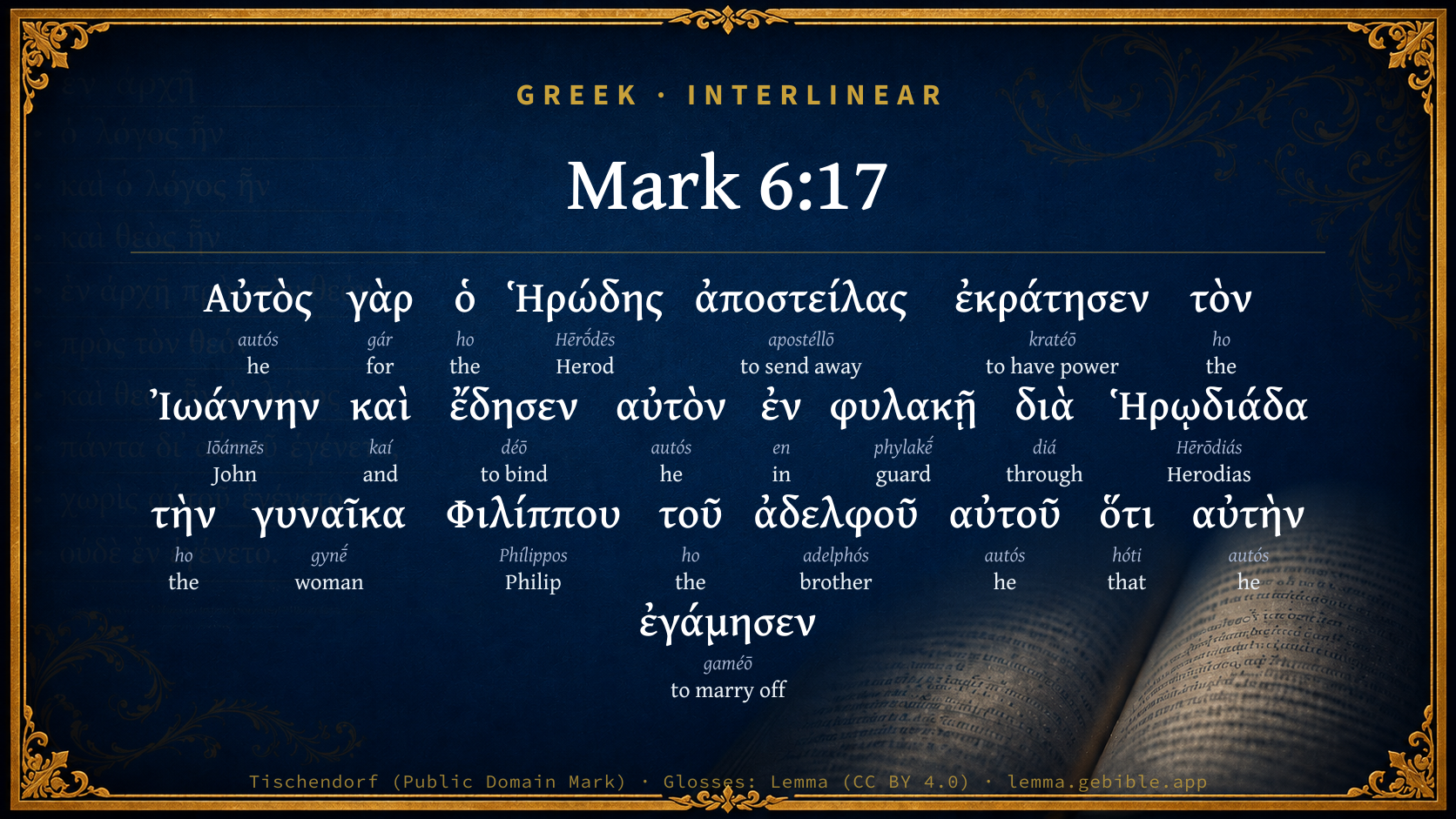
  1. Αὐτὸς autós G846 “he” Personal pronoun, Nominative, Singular, Masculine
  2. γὰρ gár G1063 “for” Conjunction
  3. ὁ ho G3588 “the” Article, Nominative, Singular, Masculine
  4. Ἡρώδης Hērṓdēs G2264 “Herod” Noun, Nominative, Singular, Masculine
  5. ἀποστείλας apostéllō G649 “to send away” Verb, Aorist, Active, Participle, Nominative, Singular, Masculine
  6. ἐκράτησεν kratéō G2902 “to have power” Verb, Aorist, Active, Indicative, 3rd person, Singular
  7. τὸν ho G3588 “the” Article, Accusative, Singular, Masculine
  8. Ἰωάννην Iōánnēs G2491 “John” Noun, Accusative, Singular, Masculine
  9. καὶ kaí G2532 “and” Conjunction
  10. ἔδησεν déō G1210 “to bind” Verb, Aorist, Active, Indicative, 3rd person, Singular
  11. αὐτὸν autós G846 “he” Personal pronoun, Accusative, Singular, Masculine
  12. ἐν en G1722 “in” Preposition
  13. φυλακῇ phylakḗ G5438 “guard” Noun, Dative, Singular, Feminine
  14. διὰ diá G1223 “through” Preposition
  15. τὴν ho G3588 “the” Article, Accusative, Singular, Feminine
  16. γυναῖκα gynḗ G1135 “woman” Noun, Accusative, Singular, Feminine
  17. Φιλίππου Phílippos G5376 “Philip” Noun, Genitive, Singular, Masculine
  18. τοῦ ho G3588 “the” Article, Genitive, Singular, Masculine
  19. ἀδελφοῦ adelphós G80 “brother” Noun, Genitive, Singular, Masculine
  20. αὐτοῦ autós G846 “he” Personal pronoun, Genitive, Singular, Masculine
  21. ὅτι hóti G3754 “that” Conjunction
  22. αὐτὴν autós G846 “he” Personal pronoun, Accusative, Singular, Feminine
  23. ἐγάμησεν gaméō G1060 “to marry off” Verb, Aorist, Active, Indicative, 3rd person, Singular

About this verse

These counts appear in no published source. They are computed here, from the morphology-tagged text and Lemma’s own curated glosses. What Lemma adds →

24
words
18
distinct lemmas
Gospels
section

Notable vocabulary

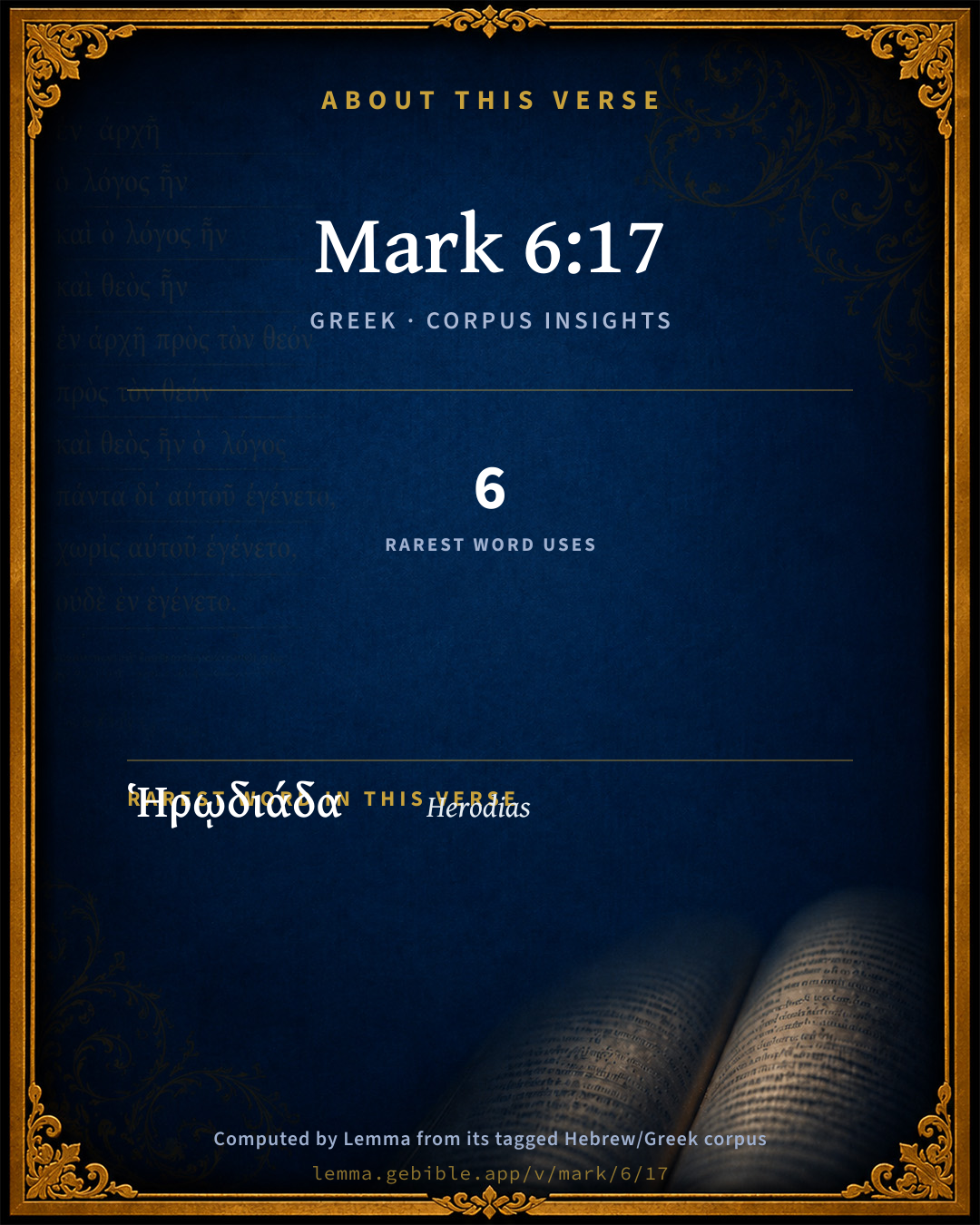
The rarest word here is Ἡρῳδιάδα Herodias G2266 — appearing just 6 times in the whole Greek New Testament.

Shared distinctive vocabulary

Ἡρῳδιάδα Herodias G2266 occurs in 6 verses of the Greek New Testament. Also found in:

Repetition

Words recur within this verse:

Cross-references

5

Topical passages linked to Mark 6:17 in the Treasury of Scripture Knowledge — connected by theme and wording, ordered by reader-vote popularity; previews shown in the World English Bible.

  • Matthew 11:2 Now when John heard in the prison the works of Christ, he sent two of his disciples
  • Luke 3:19–20 but Herod the tetrarch, being reproved by him for Herodias, his brother's wife, and for all the evil things which Herod had done,
  • Matthew 4:12 Now when Jesus heard that John was delivered up, he withdrew into Galilee.
  • Luke 3:1 Now in the fifteenth year of the reign of Tiberius Caesar, Pontius Pilate being governor of Judea, and Herod being tetrarch of Galilee, and his brother Philip tetrarch of the region of Ituraea and Trachonitis, and Lysanias tetrarch of Abilene,
  • Matthew 14:3–12 For Herod had laid hold of John, and bound him, and put him in prison for the sake of Herodias, his brother Philip's wife.

Cross-references courtesy of OpenBible.info (CC BY 4.0).

Commentary

Notes on Mark 6:17 from classic Christian and Jewish commentators (each source and its license shown beneath its notes). The classic Christian expositions comment on the surrounding passage and are grouped to its opening verse, so a note may address several verses; the Jewish commentaries on the Tanakh (Rashi and others) are per-verse, so they appear only where the commentator wrote on this verse.

Lemma curates 59 commentaries, every one of them public domain or Creative Commons licensed, each selected and text-cleaned for this edition rather than reprinted as found. About our sources →

The Biblical Illustrator

Joseph S. Exell

Mar_6:17

For Herodias sake.

Evil effects of vice

The pleasures which chiefly affect or rather bewitch the body, and by so doing become the pest and poison of the nobler and intellectual part of man, are those false and fallacious pleasures of lust and intemperance. Nothing does or can darken the mind or conscience of man more. Could Herod have ever thought himself obliged by the religion of an oath to murder the Baptist, had not his lust and his Herodias imprisoned and murdered his conscience first? It seems his besotted conscience, having broken through the seventh commandment, the sixth stood too near it to be safe long. So that it was his lust obstinately continued in which thus darkened and deluded his conscience; and the same will no doubt darken, delude, and in the end extinguish the conscience of any man breathing, who shall surrender himself up to it. (Dr. South.)

The reciprocal revenge of wrong

There is another point that should be brought out-the power which one nature has upon another, and the reciprocal revenge of wrong. When Herod ensnared his brothers wife, when he tempted her into adulterous abandonment of her husband and into unlawful intercourse with him, he was the aggressor and she was the partner; but when they were living in unholy concord she became the avenger, and her influence upon him led him into this infamous crime and this damnable cruelty. He destroyed her virtue, and she destroyed his manhood; and from that time to this how many have been destroyed by those who should have been their protectors, and who should have inspired in them purity and gentleness and forgivingness! Oh, what chance was there for sweet and wholesome water to come out of such fountains! But they rotted together and spoiled each other. How many times, if we could look into the secrets of the household, should we see the same work going on: a bad man lowering the tone of the woman that came to him pure and simple minded, destroying her aspiration, familiarizing her with vulgarity, urging all his influence and power to take away from her the fear of evil and wrong, and rather rejoicing as every barrier is broken down to bring her to his level! And how many men have been despoiled by hard, selfish, and ambitious wives, the man being simple-minded, and, on the whole, having right notions, and the woman perpetually employing the subtle arts of influence, persuasion, and fascination, and all of them in the direction of selfishness, and oftentimes in the direction of corruption and malignant crime! (H. W. Beecher.)

The Biblical Illustrator, edited by Joseph S. Exell (c. 1880s–1900s) — public domain. Text from a community e-Sword module.

Joseph Benson's Commentary

Mar 6:17-26. For Herod had laid hold on John, &c. — See the note on Mat 14:3-7. Herodias had a quarrel against him — This princess was the granddaughter of Herod the Great, by his son Aristobulus, and had formerly been married to her uncle Philip, the son of her grandfather, by Mariamne, and brother to Herod the tetrarch. Some time after that marriage this Herod, happening in his way to Rome to lodge at his brother’s house, fell passionately in love with Herodias, and on his return made offers to her; which she accepted, deserting her husband, who was only a private person, that she might share with the tetrarch in the honours of a crown. On the other hand, he, to make way for her, divorced his wife, the daughter of Aretas, king of Arabia. Wherefore both parties being guilty of incest as well as adultery, they were reproved by the Baptist, with a courage highly becoming the messenger of God. For though he had experienced the advantage of the tetrarch’s friendship, he was not afraid to displease him when his duty required it. This freedom Herod resented to such a degree, that he laid his monitor in irons. But if Herod’s resentment of the liberty which John took with him was great, that of Herodias was much greater. The crime she was guilty of being odious, she could not bear to have it named, and far less reproved. She was, therefore, enraged to the highest pitch, and nothing less than the Baptist’s head would satisfy her: and ever since he had offended her, she had been plotting against his life, but had not yet been able to get her purpose accomplished. For Herod feared John — Great and powerful as the king was, he stood in awe of John, though in low life, and for a while durst not attempt any thing against him; knowing that he was a just man and holy — Such force has virtue sometimes upon the minds of the highest offenders! And observed him — Or rather, preserved, or protected him, (as συνετηρει, it seems, should rather be rendered) namely, against all the malice and contrivances of Herodias. And when he heard him — Probably sending for him occasionally; he did many things — Recommended by him; and heard him gladly — Delusive pleasure, while he continued in the practice of known sin! Thus it often happens that they who do not truly fear God and turn to him, will go certain lengths in obedience to his commandments, provided something be remitted to them by way of indulgence. But when they are more straitly pressed, throwing off the yoke, they not only become obstinate but furious, which shows us, that no man has any reason to be satisfied with his conduct because he obeys many of the divine laws, unless he has learned to subject himself to God in every respect, and without exception. When a convenient day was come — Convenient for her purpose; that Herod made a supper for his lords, high captains, and chief estates — Greek, τοις χιλιαρχοις και τοις πρωτοις, the tribunes (or commanders of one thousand men each) and principal men of Galilee: that is, to the great men of the court, the army, and the province. When the daughter of Herodias came in and danced — See notes on Mat 14:6-12. For his oath’s sake, and for their sakes which sat with him, he would not reject her — Herod’s honour was like the conscience of the chief priests, Mat 27:6. To shed innocent blood wounded neither the one nor the other!

Joseph Benson's Commentary on the Old and New Testaments (1811–1818) — public domain. Text from a community e-Sword module.

MacLaren's Expositions of Holy Scripture

Alexander MacLaren

Mark

THE MARTYRDOM OF JOHN

Mar 6:17 - Mar 6:28.

This Herod was a son of the grim old tiger who slew the infants of Bethlehem. He was a true cub of a bad litter, with his father’s ferocity, but without his force. He was sensual, cruel, cunning, and infirm of purpose. Rome allowed him to play at being a king, but kept him well in hand. No doubt his anomalous position as a subject prince helped to make him the bad man he was. Herodias, the Jezebel to this Ahab, was his brother’s wife, and niece to both her husband and Herod. Elijah was not far off; John’s daring outspokenness, of course, made the indignant woman his implacable enemy.

I. This story gives an example of the waking of conscience.

When Christ’s name reached even the court, where such tidings would have no ready entrance, what was only an occasion of more or less languid gossip and curiosity to others stirred the sleeping accuser in Herod’s breast. He had no doubt as to who this new Teacher, armed with mightier powers than John who ‘did no miracles’ had ever possessed, was. His conviction that he was John, come back with increased power, was immediate, and was held fast, in spite of the buzz of other opinions.

Note the unusual order of the sentence in Mar 6:16: ‘John whom I beheaded, he is,’ etc. The terrified king blurts out the name of his dread first, then tremblingly takes the guilt of the deed to himself, and last speaks the terrifying thought that he is risen. A man who has a sin in his memory can never be sure that its ghost will not suddenly start up. Trivial incidents will rouse the sleeping conscience. Some nothing, a chance word, a scent, a sound, the look on a face, the glow of an evening sky, may bring all the foul past up again. A puff of wind clears away the mist of oblivion, and the old sin starts into vividness as if done yesterday. You touch a secret spring, and there yawns in the floor a gap leading down to a dungeon.

Conscience thus wakened is free from all illusions as to guilt. ‘I beheaded.’ There are no excuses now about Herodias’ urgency, or Salome’s beauty, or the rash oath, or the need of keeping it, before his guests. The deed stands clear of all these, as his own act. It is ever so. When conscience speaks, sophistications about temptations or companions, or necessity, or the more learned excuses which philosophers make about environment and heredity as weakening responsibility and diminishing guilt, shrivel to nothing. The present operations of conscience distinctly predict future still more complete remembrance of, and sense of responsibility for, long past sins. There will be a resurrection of men’s evil deeds, as well as of their bodies, and each of them will shake its gory locks at its author, and say, ‘Thou didst it.’

There is no proof that Herod was a Sadducee, disbelieving in a resurrection; but, whether he was or not, the terrors of conscience made short work of the difficulties in the way of his supposition. He was right in believing that evil deeds are gifted with an awful immortality, and will certainly rise again to shake their doer’s soul with terrors.

II. The narrative harks back to tell the story of John’s martyrdom.

It sets vividly forth the inner discord and misery of half-and-half convictions. Herodias was strong enough to get John put in prison, and apparently she tried with all the tenacity of a malignant woman to have him assassinated, by contrived accident or open sentence; but that she could not manage.

Mark’s analysis of the play of contending feeling in the weak king is barely intelligible in the Authorised Version, but is clearly shown in the Revised Version. He ‘feared John,’-the jailer afraid of his prisoner,-’knowing that he was a righteous man and an holy.’ Goodness is awful. The worst men know it when they see it, and pay it the homage of dread, if not of love. ‘And kept him safe’ {not ob- but pre-served him}; that is, from Herodias’ revenge. ‘And when he heard him, he was much perplexed.’ The reading thus translated differs from that in the Authorised Version by two letters only, and obviously is preferable. Herod was a weak-willed man, drawn by two stronger natures pulling in opposite directions.

So he alternated between lust and purity, between the foul kisses of the temptress at his side and the warnings of the prophet in his dungeon. But in all his vacillation he could not help listening to John, but ‘heard him gladly,’ and mind and conscience approved the nobler voice. Thus he staggered along, with religion enough to spoil some of his sinful delights, but not enough to make him give them up.

Such a state of partial conviction is not unusual. Many of us know quite well that, if we would drop some habit, which may not be very grave, we should be less encumbered in some effort which it is our interest or duty to make; but the conviction has not gone deeper than the understanding. Like a shot which has only got half way through the armoured skin of a man-of-war, it has done no execution, nor reached the engine-room where the power that drives the life is. In more important matters such imperfect convictions are widespread. The majority of slaves to vice know perfectly well that they should give it up. And in regard to the salvation which is in Christ, there are multitudes who know in their inmost consciousness that they ought to be Christians.

Such a condition is one liable to unrest and frequent inner conflict. Truly, he is ‘much perplexed’ whose conscience pulls him one way, and his inclinations another. There is no more miserable condition than that of the man whose will is cleft in twain, and who has a continual battle raging within. Conscience may be bound and thrust down into a dungeon, like John, and lust and pride may be carousing overhead, but their mirth is hollow, and every now and then the stern voice comes up through the gratings, and the noisy revelry is hushed, while it speaks doom.

Such a state of inner strife comes often from unwillingness to give up one special evil. If Herod could have plucked up resolve to pack Herodias about her business, other things might have come right. Many of us are ruined by being unwilling to let some dear delight go. ‘If thine eye causeth thee to stumble, pluck it out.’

We do not make up for such cowardly shrinking from doing right by pleasure in the divine word which we are not obeying. Herod no doubt thought that his delight in listening to John went some way to atone for his refusal to get rid of Herodias. Some of us think ourselves good Christians because we assent to truth, and even like to hear it, provided the speaker suit our tastes. Glad hearing only aggravates the guilt of not doing. It is useless to admire John if you keep Herodias.

III. The end of the story gives an example of the final powerlessness of such half-convictions.

One need not repeat the grim narrative of the murder. We all know it. One knows not which is the more repugnant-the degradation of the poor child Salome to the level of a dancing-girl, the fell malignity of the mother who would shame her daughter for such an end, the maudlin generosity of Herod, flushed with wine and excited passion, the hideous request from lips so young, the ineffectual sorrow of Herod, his fantastic sense of obligation, which scrupled to break a wicked promise and did not scruple to murder a prophet, or the ghastly picture of the girl hurrying to her mother with the freshly severed head, dripping on to the platter and staining her fair young hands.

This was what all the convictions of John’s righteousness had come to. So had ended the half yielding to his brave rebukes and the ineffectual aspirations after cleaner living. That chaos of lust and blood teaches that partial reformation is apt to end in a deeper plunge into fouler mire. If a man is false to his feeblest conviction, he makes himself a worse man all through. A partial thaw is generally followed by keener frost than before. A soul half melted and cooled again is harder to melt than before. An abortive slave-rising rivets the chains.

The incident teaches that simple weakness may come to be the parent of great sin. In a world like this, where there are always more voices soliciting to wrong than to right, to be weak is in the long run to be wicked. Fatal facility of disposition ruins hundreds of unthinking men. Nothing is more needful than that young people should learn to say ‘No,’ and should cultivate a wholesome obstinacy which is afraid of nothing but of sinning against God.

If we look onwards to this Herod’s last appearance in Scripture, we get further lessons. He desired to see Jesus that he might see a miracle done to amuse him, like a conjuring trick. Convictions and terrors had faded from his frivolous soul. He has forgotten that he once thought Jesus to be John come again. He sees Christ, and sees nothing in Him; and Christ says nothing to Herod, because He knew it would be useless.

It is an awful thing to put one’s self beyond the hearing of that voice, which ‘all that are in the graves shall hear.’ The most effectual stopping for our ears is neglect of what we know to be His will. If we will not listen to Him, we shall gradually lose the power of hearing Him, and then He will lock His lips, and answer nothing. We dare not say that Jesus is dumb to any man while life lasts, but we dare not refrain from saying that that condition of utter insensibility to His voice may be indefinitely approached by us, and that neglected convictions bring us terribly far on the way towards it.

Alexander MacLaren, Expositions of Holy Scripture (1904–1910) — public domain. Text from a community e-Sword module.

Godbey's Commentary on the New Testament

William B. Godbey

ARREST & IMPRISONMENT OF JOHN THE BAPTIST

Mat 14:3-5; Mar 6:17-20; Luk 3:19-21. Mark: “For Herod himself, having sent, arrested John, and bound him in prison, on account of Herodias, the wife of his brother Philip, because he married her. For John said to Herod, It is not lawful for thee to have the wife of thy brother. And Herodias hated him, and wished to kill him; and was not able. For Herod revered John, knowing him to be a righteous and holy man; and he continued to hold him in prison, and hearing him, continued to do many things, and he was hearing him delightfully.” Matthew: “And wishing to kill him, he feared the multitude, because they had him as a prophet.” Luke: “And Herod the tetrarch, being convicted by him concerning Herodias, the wife of Philip, his brother, and concerning all those wicked things which Herod did, added also this to all, he also shut up John in prison.” We see from the concurrent histories of this dark tragedy, as given by Matthew, Mark, and Luke, that John the Baptist extended no royal courtesy whatever to the king and queen; but, looking them in the face, thus boldly and fearlessly exposed them in the presence of all the people, pronouncing his withering condemnation against their unlawful matrimony, Herodias, being the legal wife of his brother Philip — not the Philip who was at that time tetrarch of Iturea and Trachonitis (Luk 3:1), but of another Philip, who was his half-brother. Here we see a notable case of an honest preacher going into prison and to the executioner’s block, losing all his liberties, and even his life, rather than withhold a solitary item of the truth. If the preachers nowadays were to expose and condemn all of the unlawful marriages in their congregations, thousands of them would lose their pastoral heads, especially in the wealthy city churches. O how the present age needs preachers having the backbone of John the Baptist! This illustrates the absolute necessity of entire sanctification on the part of the clergy, as nothing but this grace can qualify the preacher to tell the truth under all circumstances, regardless of his reputation, financial interest, and his ecclesiastical head. In this whole transaction, Herod shows up a better spirit than Herodias. You see plainly from Mark that Herod imprisoned John, and kept him in prison nearly two years, to keep Herodias from killing him. If he had not been protected by those impregnable prison-walls, and kept night and day under lock and key, the queen would have hired an assassin to go and murder him. Machaerus, a city and strong fortification, which our dragoman pointed out to us, on the east bank of the Dead Sea, where Herod also had a palace and spent a portion of his time, was the place of John’s imprisonment. During these twenty months, which wound up with his decapitation through the stratagem of Herodias, Herod frequently heard John preach. Mark says: “Knowing him to be a righteous and holy man.” We become righteous in regeneration, and holy in sanctification. Hence you see that King Herod, an intelligent, unconverted Church-member, had gumption enough to believe in the two works of grace — i.e., regeneration and sanctification — and see them both in John the Baptist. Mark here informs us that John’s preaching had a powerful effect on Herod, who, like multiplied thousands of unsaved Church-members, wanted to be good. “And hearing him, he continued to do many things, and he continued to hear him delightfully.” All this took place during those twenty months of his imprisonment at Machaerus, where Herod had a palace, and spent much of his time, meanwhile holding John in prison to keep his haughty wife from having him killed, she, of course, being too mad at him to ever hear him any more, though her royal husband heard him very frequently, ever and anon, and was delighted with the wonderful truth so ably and faithfully dispensed by his prisoner. “He continued to do many things;” i.e., he was very religious, and obeyed John in many things, being literally carried away by the red-hot truth which he preached; yet he never made the final surrender and got saved; finally permitting his diabolical wife to constrain him to imbue his hands in the innocent blood of the preacher under whose ministry he had been delighted these two years, shed many a tear, and made many a holy vow.

William B. Godbey, Commentary on the New Testament (1896–1900) — public domain. Text from a community e-Sword module.

Tyndale Open Study Notes

Tyndale Open Resources

6:17 imprison John: The Jewish historian Josephus (Antiquities 18.5.2) says that John was imprisoned in the fortress of Machaerus in Perea. • Josephus (Antiquities 18.5.1–4) states that Herodias was the wife of Herod Antipas’s half brother, Herod Philip.

Tyndale Open Study Notes — © Tyndale Open Resources, licensed CC BY-SA 4.0. Text via the HelloAO Bible API.

Meyer's Critical & Exegetical Commentary

Heinrich August Wilhelm Meyer

Mar_6:17-29. See on Mat_14:3-12. Mark narrates more circumstantially[98] and with more peculiar originality; see especially Mar_6:20, the contents of which, indeed, are held by Baur to rest on a deduction from Mat_14:9.

αὐτός] is a commentary upon the ἘΓΏ of Mar_6:16. Herod himself, namely, etc.

ἐν φυλακῇ] in a prison, without the article. At Mar_6:28, on the other hand, with the article. Comp. 1Ma_9:53; Thuc. iii. 34; Plut. Mor. p. 162 B; Plat. Leg. ix. 864 E: ἐν δημοσίῳ δεσμῷ δεθείς.

Mar_6:19-20. The ΘΈΛΕΙΝ ΑὐΤῸΝ ἈΠΟΚΤΕῖΝΑΙ is here, in variation from Matthew, denied in the case of Herod. It is not merely an apparent variation (Ebrard, p. 384; Lange), but a real one, wherein Marks narrative betrays a later shape of the tradition (in opposition to Schneckenburger, erst. kan. Ev. p. 86 f.); while with Matthew Josephus also, Antt. xviii. 5. 2, attributes to Herod the intention of putting to death. Comp. Strauss, I. p. 396 f. As to ἐνεῖχεν (she gave close heed to him), see on Luk_11:53.

ἐφοβεῖτο] he feared him; he was afraid that this holy man, if he suffered him to be put to death, would bring misfortune upon him. From this fear arose also the utterance contained in Mar_6:14; Mar_6:16 : Herodem non timuit Johannes, Bengel.

συνετήρει] not; magni eum faciebat (Erasmus, Grotius, Fritzsche, de Wette), which the word does not mean, but he guarded him (Mat_9:17; Luk_5:38; Tob_3:15; 2Ma_12:42; Polyb. iv. 60. 10; Herodian, ii. 1.11), i.e. he did not abandon him, but took care that no harm happened to him: custodiebat eum, Vulg. Comp. Jansen, Hammond, Bengel, who pertinently adds by way of explanation: contra Herodiadem; and also Bleek. According to Ewald, it is: he gave heed to him. Comp. Sir_4:20; Sir_27:12. But this thought is contained already in what precedes and in what follows. The compound strengthens the idea of the simple verb, designating its action as entire and undivided.

ἀκούσας] when he had heard him. Observe afterwards the emphasis of ἩΔΈΩς (and gladly he heard him).

πολλὰ ἐποίει] namely, which he had heard from John. Very characteristic is the reading: Π. ἨΠΌΡΕΙ, which has the strongest internal probability of being genuine, although only attested by B L א, Copt.[99]

We may add that all the imperfects apply to the time of the imprisonment, and are not to be taken as pluperfects (Grotius, Bolten). The ἤκουε took place when Herod was actually present (as was now the case; see on Mat_14:10 f.) in Machaerus; it is possible also that he had him sent for now and then to his seat at Tiberias. But in any case the expressions of Mark point to a longer period of imprisonment than Wieseler, p. 297, assumes.

Mar_6:21. ἩΜΈΡΑς ΕὔΚΑΙΡΟΥ] ΕὐΚΑΊΡΟς, in reference to time, means nothing else than at the right time, hence: a rightly-timed, fitting, appropriate day (Beza, Grotius, Jansen, Fritzsche, de Wette, Ewald, Bleek, and many others). Comp. Heb_4:16; Psa_104:27; 2Ma_14:29; Soph. O. C. 32; Herodian, i. 4. 7, i. 9. 15, v. 8. 16; and see Plat. Def. p. 413 C. Mark makes use of this predicate, having before his mind the purpose of Herodias, Mar_6:19, which hitherto had not been able to find any fitting point of time for its execution on account of the tetrarchs relation to John.[100] Grotius well says: opportuna insidiatrici, quae vino, amore et adulatorum conspiratione facile sperabat impelli posse nutantem mariti animum. Others (Hammond, Wolf, Paulus, Kuinoel) have explained it contrary to linguistic usage as: dies festivus (יוֹם טוֹב). At the most, according to a later use of ΕὐΚΑΙΡΕῖΝ (Phrynich. p. 125; comp. below, Mar_6:31), ἩΜΈΡΑ ΕὔΚΑΙΡΟς might mean: a day, on which one has convenient time, i.e. a leisure day (comp. εὐκαίρως ἔχειν, to be at leisure, Polyb. v. 26. 10, al., ΕὐΚΑΙΡΊΑ, leisure), which, however, in the connection would be inappropriate, and very different from the idea of a dies festivus.

On μεγιστᾶνες, magnates, a word in current use from the Macedonian period, see Kypke, I. p. 167; Sturz, Dial. Mac. p. 182; Lobeck, ad Phryn. p. 197.

ΚΑῚ ΤΟῖς ΠΡΏΤΟΙς Τῆς ΓΑΛ.] The first two were the chief men of the civil and military service of the tetrarch. Moreover, the principal men of Galilee, people who were not in his service (status provinciales, Bengel), were called in.

Mar_6:22. ΑὐΤῆς Τῆς ἩΡΩΔ.] of Herodias herself. The king was to be captivated with all the greater certainty by Herodias own daughter; another dancer would not have made the same impression upon him.

Mar_6:23. ἝΩς ἩΜΊΣΟΥς Κ.Τ.Λ.] in accordance with Est_5:3. See in general, Köster, Erläut. p. 194. It is thus that the unprincipled man, carried away by feeling, promises. The contracted form of the genitive belongs to the later manner of writing. Lobeck, ad Phryn. p. 347. The article was not requisite. Heindorf, ad Phaed. p. 176.

Mar_6:25. Observe the pertness of the wanton damsel. As to θέλω ἵνα (Mar_10:35 : I will that thou shouldst, etc.), see on Luk_6:31.

Mar_6:26. περίλυπος] on account of what was observed at Mar_6:20.

διὰ τοὺς ὅρκους κ. τ. συνανακ.] emphatically put first, as the determining motive.

αὐτὴν ἀθετῆσαι] eam repmdiare. Examples of ἈΘΕΤΕῖΝ, referred to persons (comp. Heliod. vii. 26: ΕἸς ὍΡΚΟΥς ἈΘΕΤΟῦΜΑΙ), may be seen in Kypke, I. p. 167 f. The use of the word in general belongs to the later Greek. Frequent in Polybius.

Mar_6:27. ΣΠΕΚΟΥΛΆΤΩΡΑ] a watcher, i.e. one of his body-guard. On them also devolved the execution of capital punishment (Seneca, de ira, i. 16, benef. iii. 25, al.; Wetstein in loc.) The Latin word (not spiculator, from their being armed with the spiculum, as Beza and many others hold) is also adopted into the Hebrew ספקלטור. See Lightfoot and Schoettgen, also Buxtorf, Lex. Talm. p. 1533. The spelling σπεκουλάτορα (Lachm. Tisch.) has decisive attestation.

[98] Mentioning even the name of Philip. Josephus, Antt. xviii. 5. 4, names him by the family name Herodes, which does not necessitate the supposition of a confusion as to the name on the part of Mark (Ewald, Gesch. Chr. p. 51). Only we may not understand Philip the tetrarch, but a half-brother of his, bearing a similar name. See on Mat_14:3.

[99] Comp. Buttmann in the Stud. u. Krit. 1860, p. 349. It is to be explained: he was perplexed about many things; what he heard from John was so heart-searching and so closely touched him. On ἀπορεῖν τι as equivalent to περί τινος, see Krüger on Thuc. v. 40. 3; Heindorf, ad Plat. Crat. p. 409 D.

[100] The appropriateness of the day is then stated in detail by ὅτε Ἡρώδης κ.τ.λ. Hence I do not deem it fitting to write, with Lachmann (comp. his Prolegom. p. xliii.), ὅ, τε.

Meyer — Critical and Exegetical Commentary on the New Testament — English translation by Peter Christie, edited by Frederick Crombie (T&T Clark, 1880) — public domain. Text from a community e-Sword module.

Expositor's Greek Testament

ed. W. Robertson Nicoll

Mar 6:17-29 . Story of Herod and the Baptist (Mat 14:3-12 ). Herod’s endorsement of the theory that Jesus is John redivivus gives a convenient opportunity for reporting here post eventum the Baptist’s fate. The report is given in aorists which need not be translated as pluperfects (as in A. V [45] and R. V [46] ).

[45] Authorised Version.

[46] Revised Version.

Mar 6:17 . αὐτὸς γὰρ ὁ Ἡ ., for the same Herod, who made the speech just reported, etc. τὴν γυναῖκα φιλίππου : some have supposed that the mistake is here made of taking Herodias for the wife of Philip the tetrarch, who in reality was husband of her daughter Salome (so Holtz. in H. C.). Herodias had previously been the wife of a rich man in Jerusalem, step-brother of Herod Antipas, referred to by Josephus (Ant. J., xviii., 5, 4) by the name of Herod, the family name. He may, of course, have borne another name, such as Philip. Even if there be a slip it is a matter of small moment compared to the moral interest of the gruesome story.

The Expositor's Greek Testament, edited by W. Robertson Nicoll (1897–1910) — public domain. Text from a community e-Sword module.

Ellicott's Commentary for English Readers

(17) For Herod himself had sent forth.—See Notes on Mat_14:3-12.

A Bible Commentary for English Readers, edited by Charles John Ellicott (1878–1897) — public domain. Text from a community e-Sword module.

The Cambridge Bible for Schools and Colleges

gen. ed. J. J. S. Perowne

17. For Herod] St Mark now proceeds more fully than the first Evangelist to relate the circumstances of the murder of the Baptist.

for Herodias’ sake] During one of his journeys to Rome, Herod Antipas had fallen in with Herodias the wife of his brother Herod Philip, a son of Herod the Great and Mariamne, who was living there as a private person. Herodias was not only the sister-in-law, but the niece of Antipas, and already had a daughter who was grown up. Herod himself had long been married to the daughter of Aretas, Emîr of Arabia Petræa, but this did not prevent him from courting an adulterous alliance with Herodias, and she consented to become his wife, on condition that the daughter of the Arabian prince was divorced. But the latter, suspecting her husband’s guilty passion, did not wait to be divorced, and indignantly fled to the castle of Machærus, and thence to her father’s rocky fortress at Petra, who forthwith assembled an army to avenge her wrongs, and defeated Herod in a decisive battle (Jos. Ant. Mar_6:1).

The Cambridge Bible for Schools and Colleges (gen. ed. J. J. S. Perowne; Cambridge University Press, 1878–1918) — public domain. Text from a community e-Sword module.

John Gill's Exposition

For Herod himself had sent forth,.... Some of his guard, a detachment of soldiers,

and laid hold upon John; who seized upon him, and took him up:

and bound him in prison; in the castle of Machaerus:

for Herodias' sake, his brother Philip's wife, for he had married her; whilst his brother was living, and who had had children by her; See Gill on Mat 14:3.

John Gill's Exposition of the Whole Bible (1746–1763) — public domain (CC PDM 1.0). Text via the HelloAO Bible API.

Trapp's Complete Commentary

John Trapp

17 For Herod himself had sent forth and laid hold upon John, and bound him in prison for Herodias’ sake, his brother Philip’s wife: for he had married her.

Ver. 17. {See Trapp on "Mat 14:2"} {See Trapp on "Mat 14:3"}

John Trapp, A Commentary or Exposition upon All the Books of the Old and New Testament (1647–1656) — public domain. Text from a community e-Sword module.

The Pulpit Commentary

In prison. Josephus ("Antiq.," 18:5, 2) informs us that this prison was the fort of Machaerus, on the confines of Galilee and Arabia, and that there John was beheaded. Herod"s father had built a magnificent palace within that fort; and so he may have been keeping the anniversary of his birthday there.

Vers. 17-29. A soul"s tragedy.

I FALSE STEPS. (Ver. 17)

1. Unlawful relations.

2. Resisting the messenger of God.

II CONFLICTING INFLUENCES. (Vers. 19, 20) The fearless court-preacher and the woman he denounced. The messenger of Truth and the associate in pleasure and vice. Representative of the way in which evil and good incarnate themselves, and work upon the heart of every man. The temptation to which Herod was subject was great; but he was not left without moral witness and aid.

III SATAN"S INSTRUMENT AND OPPORTUNITY. (Vers. 21-25)

1. The instrument is in a sense self-prepared, coming as it does out of the very heart of moral complication and love of unhallowed pleasure.

2. Yet is it also chosen and armed by the evil one.

3. It is an instrument calculated to work insidiously, unsuspectedly, and yet surely and irrevocably. Who would imagine that a damsel would wield such tremendous destinies? The weakness of every man is thoroughly understood by the enemy of souls, and unscrupulously appealed to. The works of Satan are rather hidden than manifest.

4. The attack is made when the moral sense is drowned in sensual pleasure and excitement. Company, wine, the fascination of the dance, and the flattering of pride by the presence of the Galilean nobles. What importunity cannot secure, a skillful manoeuvre may attain by surprise. The end is gained, provisionally, in the royal offer to the maid; a concealed, implicit pledge of what is not at the moment realized. Indefinite promises like this are full of danger; they cover so many unthought-of possibilities, and carry with them the illegitimate show of obligation even with respect to things not contemplated when the promise is given. The moral sense which is insensible to real duties avenges its perversion by manufacturing fictitious obligations, and attributing chief importance to them. "Honour" is the counterfeit of morality in many minds. A promise made as Herod made his is foolish and wrong, yet it cannot bind its maker to the performance of a further wrong. If men were only a tithe as attentive to their vows to God as to their vain and boastful promises and challenges to one another, they need fear no consequences. We bind ourselves with our own ropes. It was a birthday on which Herod committed spiritual suicide. Many a parallel to this may be found in the lives of men.

IV THE CATASTROPHE. The career of sin has been likened to playing the devil with his own loaded dice. The thoughtless word of Herod committed him according to his perverted sense of honor, and the sequel was already predetermined and inevitable.

1. In sanctioning John"s death, Herod violated the deepest instincts of his nature, and rejected the voice of God.

2. Crowned a life of sin by a heinous and irrevocable crime.

3. (Humanly speaking) Destroyed his own hopes of salvation. His history henceforth is one of steady degeneration and ever darker crime. In many lives there are determining circumstances like this of Herod; they put mountains and abysses between the sinner and the God he has dishonored. "John the Baptist is risen from the dead;" "Whom I beheaded John: he is risen," are discoveries which lighten not one whit the burden of his guilt, and bring no hope to his despair. They are the wails of a remorse from which has departed the grace and power of repentance. Yet is Christ greater than John, and able to save from even greater crimes than the murder of John, if he be but recognized and believed. M.

Vers. 17-29. The hero"s death.

I THE HERO OF CONSCIENCE CONTRASTED WITH THE VOLUPTUARY. The former chooses to be true and loyal to the right rather than to live; the latter postpones everything to "life," in the lowest and most sensual acceptation of the word. Yet the wicked man involuntarily respects the good man.

II THE SLAVE OF SPURIOUS HONOUR CONTRASTED WITH THE SERVANT OF THE TRUTH. Herod excuses his violent deed; nay, he pretends that it is required in order to satisfy his word as a man of honor. Such a one as his victim would never have given his word in such a case.

III THE TRUE PARTS OF MEN IN LIFE OFTEN SEEM TO BE REVERSED. John loses his head at the order of Herod. The sublime hero bows before the weak tyrant. So is it in the "whirligig of time." Unless we keep our eye firmly fixed on the unseen and spiritual, it may appear that all things are turned upside down. But there is only one relation of things, and that is God"s. Herod is really to be pitied. Over John is extended the shield of omnipotence, and in the very moment of his violence Herod is most weak. (Comp. R. Browning"s poem, "Instans Tyrannus.") J.

The Pulpit Commentary (1880–1919), ed. H.D.M. Spence-Jones & Joseph S. Exell — public domain. Text from a community e-Sword module.

Kretzmann's Popular Commentary

Paul E. Kretzmann

Herod reproved by John:

v. 17. For Herod himself had sent forth and laid hold upon John, and bound him in prison for Herodias’ sake, his brother Philip’s wife.

v. 18. For John had said unto Herod, It is not lawful for thee to have thy brother’s wife.

v. 19. Therefore Herodias had a quarrel against him, and would have killed him; but she could not,

v. 20. for Herod feared John, knowing that he was a just man and an holy, and observed him; and when he heard him, he did many things, and heard him gladly.

Some personal facts concerning Herod and his family are here told. Throughout the passage the name king is applied to him by courtesy only; for Herod was merely tetrarch of Galilee and Perea. He had resided for some time at Machaerus, a strong fortress of the Jews east of the Dead Sea. But he built Tiberius, on the Sea of Galilee, as his capital, fitting it out with all the luxury that he could devise. He had been married to the daughter of King Aretas of Arabia, but had rejected her for the sake of Herodias, then the wife of Philip, Herod’s half-brother, not the ethnarch. His philosophy of life might be summed up in the sentence: Let us eat, drink, and be merry, for tomorrow we shall be dead. The saddest incident in his life is that of which the evangelist here gives an account. John the Baptist, with the fearlessness which should characterize every preacher of repentance, had severely reprimanded him for his adulterous union with Herodias, telling him that it was not right, that it was not the proper thing, that it could not be permitted according to the Law of God that he continue in this anti-Scriptural union. "It so came to pass that Herod the king was living in open, well-known offense. For he had the wife of his brother Philip, who was still living, with him as his lawful wife. This was to John a disagreeable business, since he through his preaching was supposed to rebuke all offense and turn the people from it; for that was his calling. Therefore he does what a pious preacher should do, is not concerned about the fact that Herod is a great king, but just as he rebuked other people for their sins and admonished them to abstain from them, thus he rebukes and admonishes Herod also, and says that it is not right for him to have his brother’s wife. This displeased Herod very much; and the harlot still more, for she was troubled lest the sermon concerning her bring fruit. For this reason she lay in wait for John and would have liked to kill him, but she could not. Herod also would gladly have done it, but he was afraid, since he saw what testimony and praise John had with everybody. For that reason, since John would not desist from his rebuking and admonishing, he caused him to be arrested and put him in prison, in order that he could no longer call out so openly. " Incidentally, Herod, as is the case with many a weak. character, felt the influence of the mightier and morally greater mind. Herodias had no scruples of any kind; she was determined, she frankly sought to kill John. But feeble, vacillating Herod was between two fires, the people, on the one hand, esteeming John as a prophet, and Herodias, on the other hand, demanding his death. In the meantime Herod, in more than one instance, gave heed to the words of John, and many a word which he heard from the mouth of this fearless exhorter caused him to hesitate and think twice before committing: further lawlessness. Thus matters came to a deadlock, while John was kept in prison at Machaerus.

Paul E. Kretzmann, Popular Commentary of the Bible (1921–1924) — public domain. Text from a community e-Sword module.

The People's New Testament

B. W. Johnson

17. For the Herodias' sake. This states why John was cast into prison, on account of the instigation of the adulterous woman, a fact omitted by Matthew.

B. W. Johnson's The People's New Testament with Notes (1889–1891) — public domain. Electronic text from the Christian Classics Ethereal Library (CCEL) ThML edition.

Cambridge Greek Testament for Schools and Colleges

17. αὐτὸς γὰρ Ἡρῴδης. This confirms the emphatic ἐγώ of Antipas; For it was Herod himself who sent and laid hold on cf. Joh 3:21.

ἐν φυλακῇ. Josephus (Ant. XVIII. Mar 6:4) tells us that this was Machaerus, near the N.E. corner of the Dead Sea, a fortress, palace, and prison all in one, like that of the Popes at Avignon. It was close to the wilderness of Judaea. Tristram, Discoveries East of the Dead Sea, ch. 14.

Φιλίππου, Not the son of Herod the Great by Cleopatra (Luk 3:1), but his son by Mariamne the daughter of Simon. It is possible that Mk is in error in calling him Philip (Joseph. Ant. XVIII. Mar 6:4); but, if so, it is of no moment. Antipas divorced the daughter of Aretas IV., king of Arabia Petraea, in order to marry Herodias, for which insult Aretas afterwards attacked and defeated Antipas; see on 2Co 11:32. Herodias was a granddaughter of Herod the Great, and therefore niece of both Antipas and Philip.

Cambridge Greek Testament for Schools and Colleges (Cambridge University Press, 1896; 21 vols, various authors incl. Carr, Maclear, Plummer, Farrar, Lumby, Moule, M. R. James, Simcox) — public domain. Text from a community e-Sword module.

International Critical Commentary

17-29. Mk. tells the story of John’s imprisonment and death at the hands of Herod, in order to explain Herod’s allusion to his beheading of John.

Mk. has alluded to the fate of the Baptist, and now proceeds to tell the story of it. Herod Antipas had been married to a daughter of Aretas, king of Arabia, but on a visit to Jerusalem he had become enamoured of Herodias, the wife of his disinherited brother, and herself a member of the Herodian family, and had contracted an adulterous marriage with her. Here is where Mk. takes up the story, with John’s reproof of this adultery. It incensed Herodias especially, and though Herod imprisoned the brave prophet, he was so impressed with John’s saintliness, and even a sort of superstitious fear of him, that he protected him against his wife’s fury. But Herodias, who was biding her time, took advantage of a birthday feast given by Herod, and sent her daughter to dance before the king, and when the gratified king swore to give the girl anything she might ask, Herodias instructed her to ask for the head of John. The king was fairly trapped, and though sorely against his will, he sent a soldier and beheaded John in prison.

Philip, commonly known as Herod, was son of Herod the Great and Mariamne, the daughter of the high priest Simon, and was disinherited by his father, living as a private citizen in retirement. Secular history tells of only one Philip, the tetrarch of Gaulanitis and other districts E. of Galilee, and Volkmar and Holtzmann contend that the Evv. have confounded him with the disinherited brother, who was known only as Herod. Winer, Meyer, Weiss, and others answer that there may have been two Philips, as there were two Antipaters, especially as they were only half-brothers. Herodias was niece of both her husbands, being daughter of Aristobulus, another of Herod’s sons. It was on the occasion of a feast given by Philip to his brothers at Jerusalem, that Antipas became enamoured of the beauty of Herodias, and she of his power, and they began the intrigue which ended in their adulterous marriage. Antipas became involved in a war with Aretas, king of Arabia, his father-in-law, on account of his desertion of his first wife for Herodias. The marital relations of the Herodian family were a most extraordinary mixture, though belonging to the general license of the age. This is one of the places where the Gospels bring us into contact with the Gentile world, the Herodians being Gentile in their extraction and spirit, though nominally Jews in their religion, and the note of that Gentile world was open vice and profligacy, while of the Jewish leaders it was hypocrisy.

17-29. 17. Αὐτὸς γὰρ Ἡρώδης—for Herod himself. αὐτὸς serves to keep up in Mk.’s account the emphasis which Herod had put on the ἐγὼ, v.16. ἐκράτησε—seized.1 ὅτι αὐτὴν ἐγάμησεν—for he had married her. This states more particularly the connection between Herodias and the imprisonment of John, already denoted by διὰ Ἡρωδιάδα. It is an independent statement of cause, usually introduced by γάρ.2 But strictly, the causal conjunction is out of place, except in connection with John’s rebuke, of which it is the cause, and not of John’s imprisonment. Properly, this is one of the steps leading up to the imprisonment, and would be denoted by a relative clause, ἣν ἐγάμησεν.

International Critical Commentary — older volumes (1896–1929), various authors — public domain. Text from a community e-Sword module.

Lesson kit

Teaching starters — assembled from the data on this page, not authored interpretation. Every prompt links to the verse data it draws on. Edit before teaching.

Mark, in the Gospels, opens this verse with 24 words (18 distinct Greek lemmas). Its most distinctive word is Hērōdiás (“Herodias”). A historical commentator’s framing appears above. Read the whole chapter for the surrounding context.

Discussion questions

  1. What does “Herodias” (Hērōdiás) contribute to the verse as a whole?
  2. How does Matthew 14:3, which shares the word «Herodias», read alongside this verse?
  3. What does the repetition of “he” (4× in this one verse) do in this verse?
  4. These translations render this verse differently; the difference is in the English rendering, not the original. What questions does that raise?
  5. Compare how The Biblical Illustrator and Joseph Benson's Commentary read this verse. Where do they agree or differ?

Things to notice

Reading settings

Reading text

Shown beneath each verse's original-language words.

Old Testament
Old Testament edition

Read the OT as the Masoretic Hebrew (MT) or the Greek Septuagint (LXX).

English shown for the Greek Septuagint (in the Hebrew ↔ Greek comparison).

Comparing translations? Open the Compare panel on any verse page to stack up to four side by side.