
1 Samuel 14:3

Hebrew (Westminster Leningrad Codex) 1 Samuel 14:3 appears in the Hebrew Old Testament. The text above is from the Westminster Leningrad Codex. Each word links to its Strong’s number, a concise gloss, and parsing drawn from the Open Scriptures Hebrew Bible morphology. Click any word for its full Brown-Driver-Briggs (BDB) entry.
Download image
Cite this verse

1 Samuel 14:3 (World English Bible). Public Domain. Lemma interlinear Bible study tool, https://lemma.gebible.app/v/1-samuel/14/3.

Show BibTeX & RIS
BibTeX
RIS
English Translation
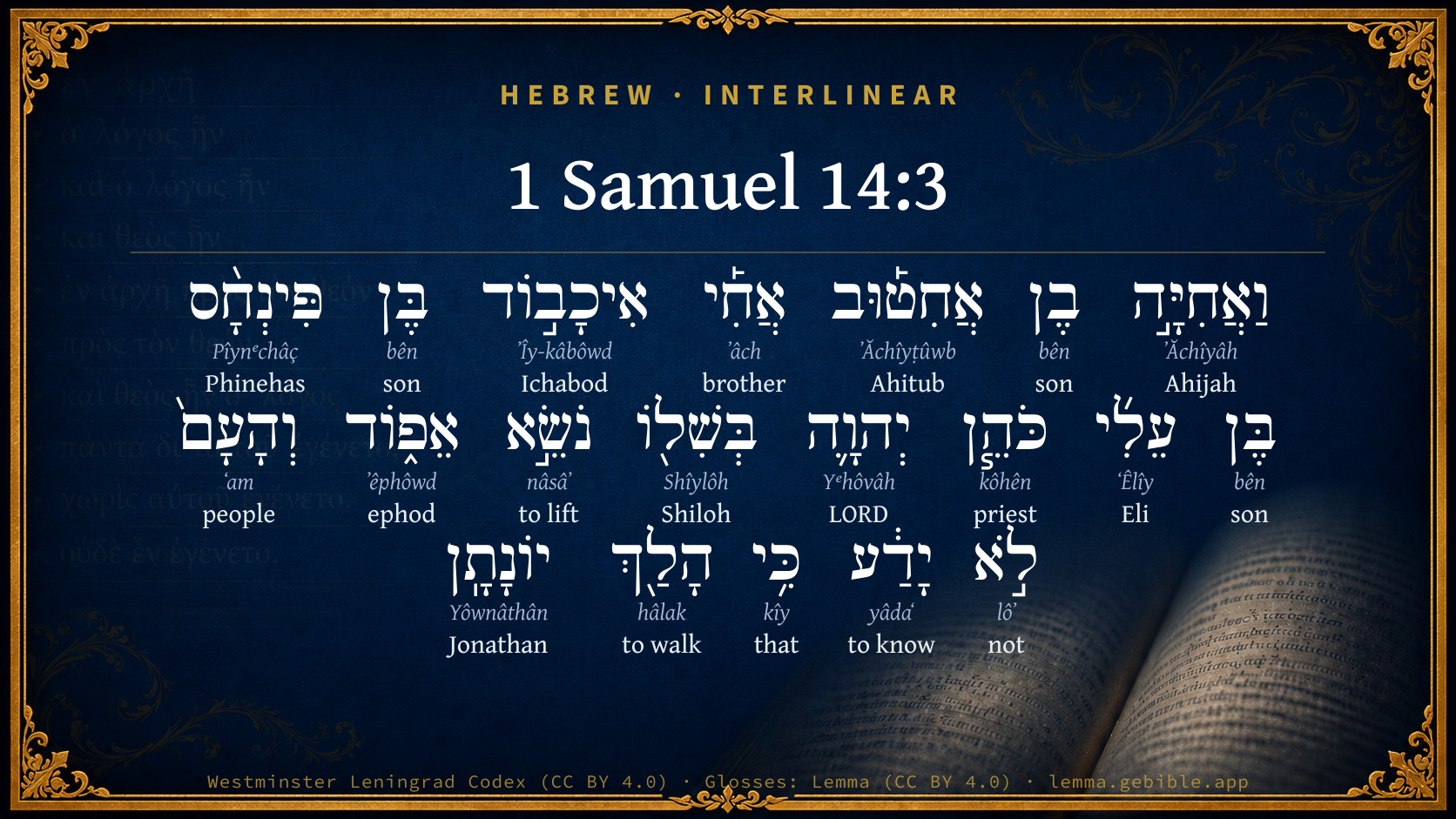
and Ahijah, the son of Ahitub, Ichabod's brother, the son of Phinehas, the son of Eli, the priest of Yahweh in Shiloh, wearing an ephod. The people didn't know that Jonathan was gone.
World English Bible · Public Domain
Highlights
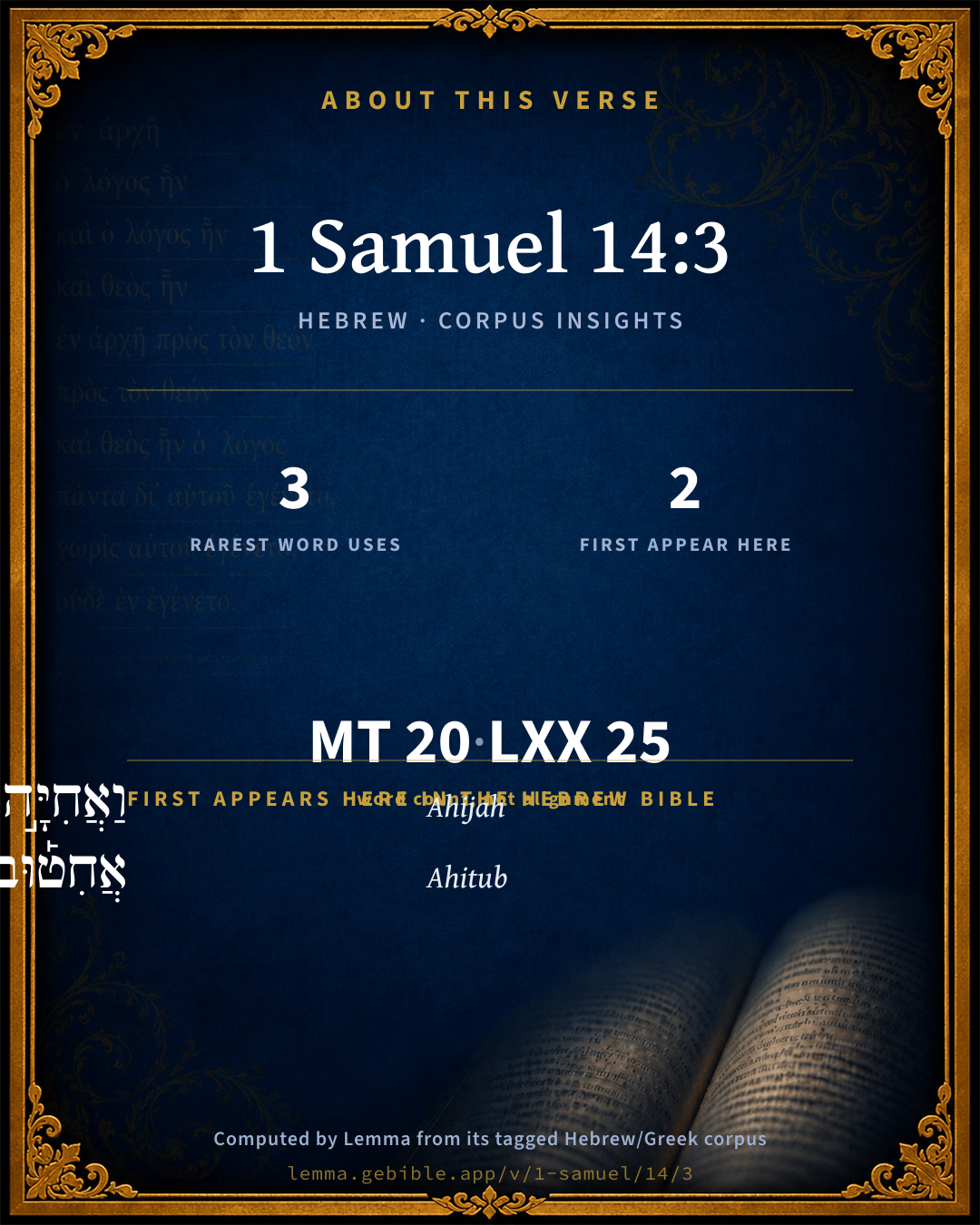
  • 2 first appearances in the Hebrew Bible
Full analysis ↓
Download a study sheet

One document with this verse’s original text, its word-by-word gloss line, the meaning frame, cross-references with their text, attributed commentary, and full source and license credits — printable, and it pastes into notes with its structure intact.

This verse Autodidact and up

Study sheet (.html) Plain text (.txt)

A passage Seminary Student

Up to 50 verses in one chapter. A passage sheet keeps up to 6 commentary sources and 12 cross-references per verse, in the order this page ranks them, and says so on the sheet whenever that leaves anything out. Ask for a single verse and you get the Autodidact verse sheet above.

Everything on this page stays free to read, with no account — the sheet is a download of what is already on screen, not access to it.

Want to remove ads? Support Godless Engineer
Compare translations 3

The same verse in 3 English versions, stacked beneath the original-language interlinear above. Click any original word for its lexicon entry.

Each is an independent rendering of the whole verse — the interlinear is not word-aligned to these translations.

Highlighted words mark where these versions differ — a whole-verse word diff, not a word-by-word alignment.

  • World English Bible Public Domain
    and Ahijah, the son of Ahitub, Ichabod's brother, the son of Phinehas, the son of Eli, the priest of Yahweh in Shiloh, wearing an ephod. The people didn't know that Jonathan was gone.
  • King James Version Public Domain
    And Ahiah, the son of Ahitub, Ichabod's brother, the son of Phinehas, the son of Eli, the LORD's priest in Shiloh, wearing an ephod. And the people knew not that Jonathan was gone.
  • unfoldingWord Literal Text CC BY-SA 4.0
    and Ahijah, the son of Ahitub, the brother of Ichabod, the son of Phinehas, the son of Eli, the priest of Yahweh at Shiloh, wearing an ephod. And the people did not know that Jonathan had gone.

unfoldingWord Literal Text — © unfoldingWord, licensed CC BY-SA 4.0. Word-aligned USFM3 via Door43 (git.door43.org/unfoldingWord/en_ult).

Versions to compare (up to 4)

3 of 4 selected

Show all 18 translations

Every available English version of this verse, each an independent rendering of the whole verse.

  • World English Bible Public Domain
    and Ahijah, the son of Ahitub, Ichabod's brother, the son of Phinehas, the son of Eli, the priest of Yahweh in Shiloh, wearing an ephod. The people didn't know that Jonathan was gone.
  • Berean Standard Bible Public Domain
    including Ahijah, who was wearing an ephod. He was the son of Ichabod’s brother Ahitub son of Phinehas, the son of Eli the priest of the LORD in Shiloh. But the troops did not know that Jonathan had left.
  • Majority Standard Bible Public Domain
    including Ahijah, who was wearing an ephod. He was the son of Ichabod’s brother Ahitub son of Phinehas, the son of Eli the priest of the LORD in Shiloh. But the troops did not know that Jonathan had left.
  • King James Version Public Domain
    And Ahiah, the son of Ahitub, Ichabod's brother, the son of Phinehas, the son of Eli, the LORD's priest in Shiloh, wearing an ephod. And the people knew not that Jonathan was gone.
  • American Standard Version (1901) Public Domain
    and Ahijah, the son of Ahitub, Ichabod's brother, the son of Phinehas, the son of Eli, the priest of Jehovah in Shiloh, wearing an ephod. And the people knew not that Jonathan was gone.
  • Revised Version (1885) Public Domain
    and Ahijah, the son of Ahitub, Ichabod’s brother, the son of Phinehas, the son of Eli, the priest of the LORD in Shiloh, wearing an ephod. And the people knew not that Jonathan was gone.
  • Geneva Bible (1599) Public Domain
    And Ahiah the sonne of Ahitub, Ichabods brother, the sonne of Phinehas, the sonne of Eli, was the Lordes Priest in Shiloh, and ware an Ephod: and the people knewe not that Ionathan was gone.
  • Douay-Rheims (1899) Public Domain
    And Achias the son of Achitob brother to Ichabod the son of Phinees, the son of Heli the priest of the Lord in Silo, wore the ephod. And the people knew not whither Jonathan was gone.
  • Young's Literal Translation Public Domain
    and Ahiah, son of Ahitub, brother of I-Chabod, son of Phinehas son of Eli priest of Jehovah in Shiloh, bearing an ephod; and the people knew not that Jonathan hath gone.
  • Literal Standard Version CC BY-SA 4.0
    and Ahiah, son of Ahitub, brother of Ichabod, son of Phinehas son of Eli priest of YHWH in Shiloh, [was] bearing an ephod; and the people did not know that Jonathan has gone.
  • Unlocked Literal Bible CC BY-SA 4.0
    including Ahijah son of Ahitub (Ichabod's brother) son of Phinehas son of Eli, the priest of Yahweh at Shiloh, who wore an ephod. The people did not know that Jonathan was gone.
  • unfoldingWord Literal Text CC BY-SA 4.0
    and Ahijah, the son of Ahitub, the brother of Ichabod, the son of Phinehas, the son of Eli, the priest of Yahweh at Shiloh, wearing an ephod. And the people did not know that Jonathan had gone.
  • Darby Bible Public Domain
    (And Ahijah the son of Ahitub, Ichabod's brother, the son of Phinehas, the son of Eli, Jehovah's priest in Shiloh, wore the ephod.) And the people did not know that Jonathan was gone.
  • World Messianic Bible Public Domain
    including Ahijah the son of Ahitub, Ichabod’s brother, the son of Phinehas, the son of Eli the priest of the LORD in Shiloh, wearing an ephod. The people didn’t know that Jonathan was gone.
  • Webster's Bible Public Domain
    And Ahiah, the son of Ahitub, I-chabod's brother, the son of Phinehas, the son of Eli, the LORD'S priest in Shiloh, wearing an ephod. And the people knew not that Jonathan was gone.
  • Free Bible Version CC BY-SA 4.0
    including Ahijah, who was wearing an ephod. He was a son of Ichabod's brother Ahitub, son of Phinehas, son of Eli, priest of the Lord in Shiloh. No one realized Jonathan had left.
  • Bible in Basic English Public Domain
    And Ahijah, the son of Ahitub, brother of Ichabod, the son of Phinehas, the son of Eli, the priest of the Lord in Shiloh, who had the ephod. And the people had no idea that Jonathan had gone.
  • JPS Tanakh (1917) Public Domain
    and Ahijah, the son of Ahitub, Ichabod's brother, the son of Phinehas, the son of Eli, the priest of the LORD in Shiloh, wearing an ephod. And the people knew not that Jonathan was gone.

Literal Standard Version (2020), Covenant Press — licensed CC BY-SA 4.0. Text via the HelloAO Bible API (eBible.org). Unlocked Literal Bible (unfoldingWord) — licensed CC BY-SA 4.0. Text via the HelloAO Bible API (eBible.org). unfoldingWord Literal Text — © unfoldingWord, licensed CC BY-SA 4.0. Word-aligned USFM3 via Door43 (git.door43.org/unfoldingWord/en_ult). Free Bible Version, Dr. Jonathan Gallagher — licensed CC BY-SA 4.0. Text via the HelloAO Bible API (eBible.org).

Word by word

More ways to search: Search by grammar → Find every occurrence → Compare this word →

Practice this passage: Drill this verse → Learn its vocabulary →

אִיכָב֣וֹד
ʼÎy-kâbôwd
H350
“Ichabod”
Noun, Proper
Part of Speech
Noun
Type
Proper
Full BDB Definition

Origin: from H336 and H3519

TWOT: None

Ichabod = "no glory" - a son of Phinehas, so named because of the capture of the Ark by the Philistines
  1. וַאֲחִיָּ֣ה ʼĂchîyâh H281 “and · Ahijah” Conjunction + Noun, Proper
  2. בֶן bên H1121 “son of” Noun, Common, Masculine, Singular, Construct
  3. אֲחִט֡וּב ʼĂchîyṭûwb H285 “Ahitub” Noun, Proper
  4. אֲחִ֡י ʼâch H251 “brother of” Noun, Common, Masculine, Singular, Construct
  5. בֶּן bên H1121 “son of” Noun, Common, Masculine, Singular, Construct
  6. פִּינְחָ֨ס Pîynᵉchâç H6372 “Phinehas” Noun, Proper
  7. בֶּן bên H1121 “son of” Noun, Common, Masculine, Singular, Construct
  8. עֵלִ֜י ʻÊlîy H5941 “Eli” Noun, Proper
  9. כֹּהֵ֧ן kôhên H3548 “priest of” Noun, Common, Masculine, Singular, Construct
  10. יְהוָ֛ה Yᵉhôvâh H3068 “LORD” Noun, Proper
  11. בְּשִׁל֖וֹ Shîylôh H7887 “in/at · Shiloh” Preposition + Noun, Proper
  12. נֹשֵׂ֣א nâsâʼ H5375 “lifting” Verb, Qal, Participle Active, Masculine, Singular, Absolute
  13. אֵפ֑וֹד ʼêphôwd H646 “ephod” Noun, Common, Masculine, Singular, Absolute
  14. וְהָעָם֙ ʻam H5971 “and · the · people” Conjunction + Particle, Definite Article + Noun, Common, Masculine, Singular, Absolute
  15. לֹ֣א lôʼ H3808 “not” Particle, Negative
  16. יָדַ֔ע yâdaʻ H3045 “to know” Verb, Qal, Perfect, 3rd Person, Masculine, Singular
  17. כִּ֥י kîy H3588 “that” Conjunction
  18. הָלַ֖ךְ hâlak H1980 “to walk” Verb, Qal, Perfect, 3rd Person, Masculine, Singular
  19. יוֹנָתָֽן Yôwnâthân H3129 “Jonathan” Noun, Proper

About this verse

These counts appear in no published source. They are computed here, from the morphology-tagged text and Lemma’s own curated glosses. What Lemma adds →

20
words
18
distinct lemmas
Historical
section

Notable vocabulary

The rarest word here is אִיכָב֣וֹד Ichabod H350 — appearing just 3 times in the whole Hebrew Bible.

First appearance in Scripture

These words make their first canonical appearance in the Hebrew Bible here:

  • וַאֲחִיָּ֣ה Ahijah H281
  • אֲחִט֡וּב Ahitub H285

Shared distinctive vocabulary

אִיכָב֣וֹד Ichabod H350 occurs in 2 verses of the Hebrew Bible. Also found in:

Grammatical profile

  • 3 verbs
  • 15 nouns
  • 1 conjunction
  • 1 particle

Verb forms

  • נֹשֵׂ֣א Qal · Participle Active
  • יָדַ֔ע Qal · Perfect
  • הָלַ֖ךְ Qal · Perfect

Repetition

A word recurs within this verse — often emphatic in Hebrew:

Hebrew & Septuagint length

In English translation the verse runs 33 words from the Hebrew and 36 from the Septuagint (LXX English) — closely comparable.

A rough comparison of the two English renderings, which tokenize alike — not a word-level alignment.

Word counts can differ between the Hebrew and the Greek without any difference in meaning — e.g. the Hebrew direct-object marker אֵת has no separate Greek word, and Greek often adds the article ὁ.

In the original languages it is 20 Hebrew tokens and 25 Greek tokens — but the two are counted differently (Hebrew bundles its prefixes and suffixes into one token; the Greek is in lemma form), so that isn’t a like-for-like length.

Cross-references

5

Topical passages linked to 1 Samuel 14:3 in the Treasury of Scripture Knowledge — connected by theme and wording, ordered by reader-vote popularity; previews shown in the World English Bible.

  • 1 Samuel 2:28 and did I choose him out of all the tribes of Israel to be my priest, to go up to my altar, to burn incense, to wear an ephod before me? and did I give to the house of your father all the offerings of the children of Israel made by fire?
  • 1 Samuel 4:21 She named the child Ichabod, saying, The glory is departed from Israel; because the ark of God was taken, and because of her father-in-law and her husband.
  • 1 Samuel 22:20 One of the sons of Ahimelech, the son of Ahitub, named Abiathar, escaped, and fled after David.
  • 1 Samuel 22:9–12 Then answered Doeg the Edomite, who stood by the servants of Saul, and said, I saw the son of Jesse coming to Nob, to Ahimelech the son of Ahitub.
  • Exodus 28:26–32 You shall make two rings of gold, and you shall put them on the two ends of the breastplate, on its edge, which is toward the side of the ephod inward.

Cross-references courtesy of OpenBible.info (CC BY 4.0).

Hebrew and Greek witnesses Masoretic Hebrew ↔ Greek Septuagint

The same verse in the two great witnesses to the Old Testament, shown verse-for-verse.

These are two independent witnesses, not word-aligned to each other, and the Septuagint is shown in lemma (dictionary) form.

Hebrew 1 Samuel 14:3 Masoretic · Westminster Leningrad Codex

וַאֲחִיָּ֣ה בֶן אֲחִט֡וּב אֲחִ֡י אִיכָב֣וֹד בֶּן פִּינְחָ֨ס בֶּן עֵלִ֜י כֹּהֵ֧ן יְהוָ֛ה בְּשִׁל֖וֹ נֹשֵׂ֣א אֵפ֑וֹד וְהָעָם֙ לֹ֣א יָדַ֔ע כִּ֥י הָלַ֖ךְ יוֹנָתָֽן

and Ahijah, the son of Ahitub, Ichabod's brother, the son of Phinehas, the son of Eli, the priest of Yahweh in Shiloh, wearing an ephod. The people didn't know that Jonathan was gone.

World English Bible · Public Domain

Greek LXX 1 Samuel 14:3 Septuagint · lemma form

καί αχια υἱός αχιτωβ ἀδελφός ιωχαβηδ υἱός φινεες υἱός ηλι ἱερεύς ὁ θεός ἐν σηλωμ αἴρω εφουδ καί ὁ λαός οὐ εἶδος ὅτι πορεύομαι ιωναθαν

And Achia son of Achitob, the brother of Jochabed the son of Phinees, the son of Heli, was the priest of God in Selom wearing an ephod: and the people knew not that Jonathan was gone.

LXX2012 (modern English Septuagint) · Public Domain

Hebrew: Westminster Leningrad Codex (CC BY 4.0). Greek: Septuagint (public domain); English from LXX2012 (modern English Septuagint) (Public Domain). How the Septuagint differs from the Hebrew →

Targum (Aramaic paraphrase)

1

The Targum is the ancient Jewish Aramaic paraphrase of the Hebrew Scriptures — an interpretive translation, not the Hebrew text itself. Onkelos (literal) and Pseudo-Jonathan (expansive) render the Torah, and Jonathan the Prophets. Coverage is partial: where no permissively-licensed English translation exists for a verse, only the Aramaic is shown. This is verse-level text, not a word-by-word alignment to the Hebrew.

  1. Targum Jonathan Prophets (Joshua–Malachi)
    וַאֲחִיָה בַּר אֲחִיטוּב אֲחוּהִי דְאִיכָבוֹד בַּר פִּינְחָס בַּר עֵלִי כָּהֵין מְשַׁמֵשׁ קֳדָם יְיָ בְּשִׁילֹה לָבֵישׁ אֵיפוֹדָא וְעַמָא לָא יְדַע אֲרֵי אֲזַל יוֹנָתָן:

    (no public-domain English translation for this verse)

    Targum Jonathan — Aramaic: “Mikraot Gedolot” (public domain). English: “Sefaria Community Translation” (CC0 1.0 (public-domain dedication)); “London "Chaldee Paraphrase," 1871” (public domain). Text via Sefaria.

Commentary

Notes on 1 Samuel 14:3 from classic Christian and Jewish commentators (each source and its license shown beneath its notes). The classic Christian expositions comment on the surrounding passage and are grouped to its opening verse, so a note may address several verses; the Jewish commentaries on the Tanakh (Rashi and others) are per-verse, so they appear only where the commentator wrote on this verse.

Lemma curates 59 commentaries, every one of them public domain or Creative Commons licensed, each selected and text-cleaned for this edition rather than reprinted as found. About our sources →

Trapp's Complete Commentary

John Trapp

1Sa 14:3 And Ahiah, the son of Ahitub, Ichabod’s brother, the son of Phinehas, the son of Eli, the LORD’S priest in Shiloh, wearing an ephod. And the people knew not that Jonathan was gone.

Ver. 3. And Ahiah.] Called also Ahimelech, {1Sa 22:11-12} and basely butchered by the command of Saul, who here had sent for him, and served himself upon him.

And the people knew not that Jonathan was gone.] Or, For what purpose. The engine that doth all in great works, is oft inward, hidden, unobserved.

John Trapp, A Commentary or Exposition upon All the Books of the Old and New Testament (1647–1656) — public domain. Text from a community e-Sword module.

Joseph Benson's Commentary

1Sa 14:3. And Ahiah, the son of Ahitub — The high-priest, who was here to attend upon the ark, which had been brought hither, 1Sa 14:18. The son of Eli, the Lord’s priest in Shiloh — These last words manifestly belong not to Ahiah, but to Eli, who was high-priest while the tabernacle was at Shiloh. Wearing an ephod — Or rather, the ephod; that is, the high-priest’s ephod, comprehending the breast-plate with the Urim and Thummim, which were inseparable from it. These Ahiah, being high-priest, now wore. Saul, being now in great distress, probably had sent for Ahiah, that he might consult God for him, as there should be occasion.

Joseph Benson's Commentary on the Old and New Testaments (1811–1818) — public domain. Text from a community e-Sword module.

Tyndale Open Study Notes

Tyndale Open Resources

14:3 Ahijah the priest was an adviser who could give Saul divine guidance through the ephod (14:18-19; see also 2:18 and corresponding study note; 23:9-10). • son of Eli: Saul, the rejected king (13:13-14), kept in his company a priest from the rejected priesthood (2:27-36). • Ichabod: See 4:21.

Tyndale Open Study Notes — © Tyndale Open Resources, licensed CC BY-SA 4.0. Text via the HelloAO Bible API.

Adam Clarke's Commentary

Verse 3. Ahiah, the son of Ahitub] Phinehas, son of Eli the high priests had two sons, Ahitub and I-chabod; the latter was born when the ark was taken, and his mother died immediately after. Ahiah is also called Ahimelech, 1Sa 22:9.

Wearing an ephod.] That is, performing the functions of the high priest. This man does not appear to have been with Saul when he offered the sacrifices, 1Sa 13:9, &c.

Adam Clarke's Commentary on the Bible (1810–1826) — public domain. Text from a community e-Sword/MySword module.

Ellicott's Commentary for English Readers

(3) Ahiah, the son of Ahitub.—The Chronicles, rehearsing these facts, show us what a terrible impression the last events in Eli’s reign as high priest had made in Israel. The destruction of Shiloh, the death of the high priest, the fall of Phinehas and his brother in battle, the melancholy circumstances of the birth of I-chabod, were still fresh in the memory of the people. Well might Jonathan be ready to sacrifice himself if he could deal an effectual blow upon these hereditary enemies of his country. Of this high priest Ahiah we never hear again in these Books of Samuel. He is generally supposed to be the same as the high priest Ahimelech, who was subsequently murdered by Doeg, by the direction of Saul, with the priests at Nob (1Sa_22:9, &c.). The name Ahiah signifies “brother,” or “friend of the Eternal”; Ahimelech, “brother of the king,” may be another form of the same name.

Wearing an ephod.—The ephod here alluded to is not the ordinary priestly vestment of white linen, but that official garment worn alone by the high priest, in which was the breast-plate of gems with the mysterious Urim and Thummim, by which inquiry used to be made of the Lord.

A Bible Commentary for English Readers, edited by Charles John Ellicott (1878–1897) — public domain. Text from a community e-Sword module.

The Cambridge Bible for Schools and Colleges

gen. ed. J. J. S. Perowne

3. And Ahiah, the son of Ahitub] And [there was with him] Ahiah, or Ahijah, as the name is usually transliterated. Ahijah is perhaps the same as Ahimelech the son of Ahitub, the priest at Nob, who was the victim of Saul’s sacrilegious vengeance (1Sa_22:9). The name Ahijah = “brother of Jah” and Ahimelech = “brother of the king” may have been applied to the same person, Melech king being substituted for the divine name Jah in ordinary intercourse. But it is also possible that Ahimelech was the brother of Ahijah and his successor in the high priesthood.

I-chabod’s brother] See 1Sa_4:21. I-chabod’s elder brother Ahitub was probably about the same age as Samuel, and his son may have been high-priest already for some time. Fifty years or more must have elapsed since the death of Eli. See Introduction, Ch. III.

the Lord’s priest in Shiloh] These words must be referred to Eli as the most famous priest during the period while the Tabernacle was at Shiloh, not to Ahijah. It is all but certain that Shiloh ceased to be the religious centre of the nation after the capture of the Ark.

wearing an ephod] i.e. officiating as high-priest. See note on 1Sa_2:18. His presence with the army is noticed to prepare the way for the fact mentioned in 1Sa_14:18.

The Cambridge Bible for Schools and Colleges (gen. ed. J. J. S. Perowne; Cambridge University Press, 1878–1918) — public domain. Text from a community e-Sword module.

John Gill's Exposition

And Ahiah the son of Ahitub, Ichabod's brother,.... Ichabod was the child that Phinehas's wife bore prematurely on hearing the news of the ark being taken and of the death of her husband and father-in-law, which name she gave him on that account, and died; see Sa1 4:19, he, it seems, had an elder brother, called Ahitub, who died young, and this Ahiah was the son of him; for not he, but Ahitub, was Ichabod's brother:

the son of Phinehas; so Ichabod was:

the son of Eli; so Phinehas was:

the Lord's priest in Shiloh; this refers not to Ahiah for he was not now priest in Shiloh, which was destroyed: and besides, he was now in the camp of Saul; but to Eli, who when living exercised the priest's office in Shiloh:

wearing an ephod; as Ahiah now did; not such as common priests wore, but the ephod the high priest wore, which had the breastplate of judgment, the Urim and Thummim, in it, by which inquiry was made, Sa1 14:37. The meaning of all this is, that the high priest is now with Saul, and the ark also, which and the high priest might be sent for on this occasion, Sa1 14:18.

and the people knew not that Jonathan was gone; or they would have gone with him, namely, the military men that were particularly with him; he and Saul were in two different parts of Gibeah, with distinct bodies of men; whether the thousand that Jonathan first had with him all continued is not certain; it seems probable they did not; it can hardly be thought he should have more with him than were with Saul; see Sa1 14:2, though from Sa1 14:17 they seem now to have been together.

John Gill's Exposition of the Whole Bible (1746–1763) — public domain (CC PDM 1.0). Text via the HelloAO Bible API.

Albert Barnes' Notes on the Bible

Whether “Ahiah” or “Ahijah” is the same person as “Ahimelech the son of Ahitub” (see the marginal reference), or whether Ahimelech was the brother or son of Ahijah, and his successor in the priesthood, it is impossible to say certainly. Most probably “Ahijah” and “Ahimilech” are variations of the same name; the latter element in each alone being different, מלך melek (king) being substituted for the divine name יה yâhh. Compare “Eliakim” and “Jehoiakim” 2Ki 23:34, “Eliab” and “Eliel” 1Ch 6:27, 1Ch 6:34.

This fragment of a genealogy is a very valuable help to the chronology. The grandson of Phinehas, the son of Eli, was now High Priest; and Samuel, who was probably a few years older than Ahitub the son of Phinehas, was now an old man. All this indicates a period of about 50 years or upward from the taking of the ark by the Philistines.

The Lord’s priest in Shiloh - But as Eli was so emphatically known and described in 1 Sam. 1–4, as God’s Priest at Shiloh, and as there is every reason to believe that Shiloh was no longer the seat of the ark in Saul’s time (see 1 Sam. 22; 1Ch 13:3-5), it is better to refer these words to Eli, and not to Ahijah, to whom the next words, “wearing an ephod,” apply. (See 1Sa 2:28; Jdg 1:1 note.)

Albert Barnes' Notes on the Bible (1834–1885) — public domain. Text from a community e-Sword/MySword module.

Haydock's Catholic Bible Commentary

Ephod; or was high priest, ver. 18. Achias is called Achimelech, chap. xxii. 9. (Calmet) --- He had succeeded his father, Achitob, in the beginning of Saul’s reign, after the former had held the dignity twenty-two years. (Salien, the year of the world 2962.)

George Leo Haydock (1774–1849), Haydock's Catholic Family Bible and Commentary, 1859 edition — public domain. Excludes Psalms (Douay-Rheims chapter numbering differs from Protestant) and Deuterocanonical books (Catholic canon only).

Matthew Poole's English Annotations

Ahiah; the same who is called Ahimelech, 1Sa 22:9,11,20, the high priest, who was here to attend upon the ark, which was brought hither, 1Sa 14:18.

An ephod, to wit, the high priest’s ephod, wherein the Urim and Thummim was.

Matthew Poole's English Annotations on the Holy Bible (1683–1685) — public domain. Text from a community e-Sword/MySword module.

Whedon's Commentary on the Bible

Daniel D. Whedon

3. Ahiah — Here we meet again with the descendants of Eli. See note on

1Sa_2:33. It is generally supposed, and quite probable, that Ahiah is only a different name for Ahimelech, mentioned 1Sa_22:9; still, it is possible that Ahimelech may have been his brother, and successor in the office of high priest. The presence of the priest with Saul is here mentioned in anticipation of what is to be stated in 1Sa_14:18-19; 1Sa_14:36-37.

Daniel D. Whedon (gen. ed.), Commentary on the Old and New Testaments (1874–1909) — public domain. Text from a community e-Sword module.

The Pulpit Commentary

Ahiah, the son of Ahitub. (See on 1Sa_13:9) It is interesting to find the house of Eli recovering at last from its disaster, and one of its members duly ministering in his office before the king. It has been debated whether he was the same person as Ahimelech, mentioned in, 1Sa_21:1, etc., the supposition being grounded on the fact that Ahiah is never spoken of again. But he may have died; and with regard to the argument drawn from the similarity of the names, we must notice that names compounded with Ah (or Ach) brother, were common in Eli"s family, while compounds with Ab, father, were most in use among Saul"s relatives. Ahiah or Ahijah means Jah is brother; his father is Ahitub, the brother is good; why should he not call another son Ahimelech, the brother is king? Jehovah"s priest in Shiloh. This refers to Eli, the regular rule in Hebrew being that all such statements belong, not to the son, but to the father. Wearing an ephod. Literally, ephod bearing. The ephod, as we have seen on 1Sa_2:18, was the usual ministerial garment; but what is meant here is not an ordinary ephod of linen, but that described in Lev_8:7, Lev_8:8, wherein was the breastplate, by which Jehovah"s will was made known to his people, until prophecy took its place. All this, the former part of the verse, must be regarded as a parenthesis.

The Pulpit Commentary (1880–1919), ed. H.D.M. Spence-Jones & Joseph S. Exell — public domain. Text from a community e-Sword module.

John Wesley's Explanatory Notes

Ahiah - The same who is called Abimelech, chap. xxii, 9, 11, 20, the high-priest, who was here to attend upon the ark which was brought thither, ver. 18. Ephod - The high-priest's ephod, wherein the Urim and Thummim was.

John Wesley, Explanatory Notes Upon the Whole Bible (1754–1765) — public domain. Text via the GEBible commentary corpus.

Scofield Reference Notes

C. I. Scofield

Ahiah

Called Ahimelech, 1Sa 22:9; 1Sa 22:11; 1Sa 22:20.

The Scofield Reference Bible (1917 edition), notes by C. I. Scofield — public domain. Text from a community e-Sword module.

Rashi

Rabbi Shlomo Yitzchaki (Rashi)

Wore the Eiphod. Meaning the Urim and Tumim.

Rashi on the Tanakh — English translations: “The Judaica Press complete Tanach with Rashi, translated by A. J. Rosenberg” (CC BY 4.0); “Pentateuch with Rashi's commentary by M. Rosenbaum and A.M. Silbermann, 1929-1934” (public domain); “The Metsudah Tanach series, Lakewood, N.J” (CC BY 4.0); and “The Book of Joshua, Metsudah Publications, 1997” (CC BY 4.0). Text via Sefaria.

Lesson kit

Teaching starters — assembled from the data on this page, not authored interpretation. Every prompt links to the verse data it draws on. Edit before teaching.

1 Samuel, in the Historical, opens this verse with 20 words (18 distinct Hebrew lemmas). Its most distinctive word is ʼÎy-kâbôwd (“Ichabod”). A historical commentator’s framing appears above. Read the whole chapter for the surrounding context.

Discussion questions

  1. What does “Ichabod” (ʼÎy-kâbôwd) contribute to the verse as a whole?
  2. 2 words here appear for the first time in Scripture. What is being introduced at this debut?
  3. 1 Samuel 4:21 shares the word «Ichabod» with this verse. How do the two illuminate each other?
  4. “son” occurs 3× in this one verse. What is the effect of the repetition?
  5. These translations render this verse differently. What is at stake in choosing one wording over another?
  6. The verb «נֹשֵׂ֣א» is Qal Participle Active. How does its form color the action?
  7. Reading how Trapp's Complete Commentary and Joseph Benson's Commentary read this verse, where do the two commentators agree and where do they part?

Things to notice

Reading settings

Reading text

Shown beneath each verse's original-language words.

Old Testament
Old Testament edition

Read the OT as the Masoretic Hebrew (MT) or the Greek Septuagint (LXX).

English shown for the Greek Septuagint (in the Hebrew ↔ Greek comparison).

Comparing translations? Open the Compare panel on any verse page to stack up to four side by side.