2 Corinthians 9:3

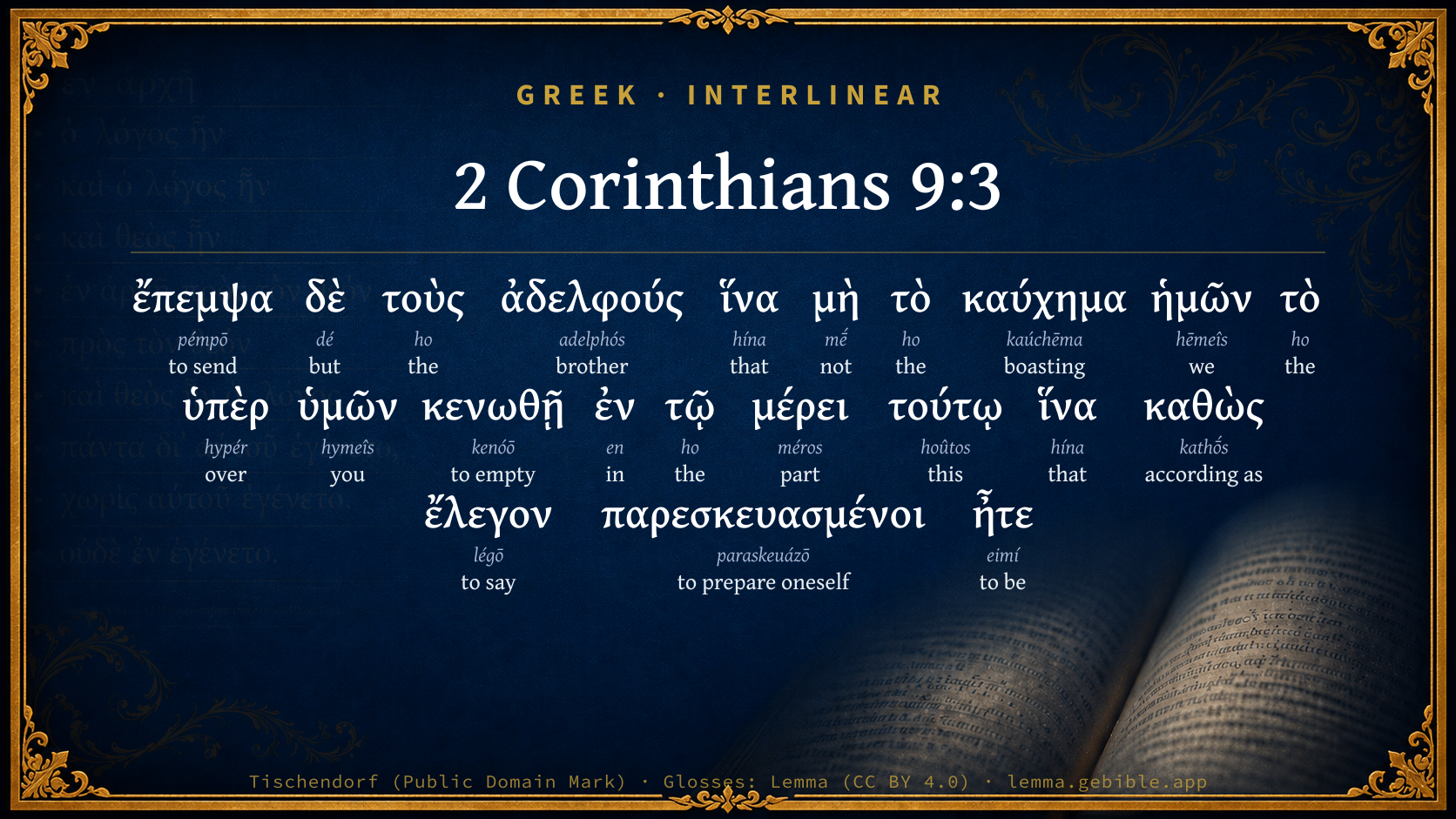
Greek (Tischendorf 8th ed.) 2 Corinthians 9:3 appears in the Greek New Testament. The text above is from the Tischendorf 8th edition. Each word links to its Strong’s number and a concise gloss. Click any word for its full Thayer’s Greek Lexicon entry.
Download image
Cite this verse

2 Corinthians 9:3 (World English Bible). Public Domain. Lemma interlinear Bible study tool, https://lemma.gebible.app/v/2-corinthians/9/3.

Show BibTeX & RIS
BibTeX
RIS
English Translation
But I have sent the brothers that our boasting on your behalf may not be in vain in this respect, that, just as I said, you may be prepared,
World English Bible · Public Domain
Download a study sheet

One document with this verse’s original text, its word-by-word gloss line, the meaning frame, cross-references with their text, attributed commentary, and full source and license credits — printable, and it pastes into notes with its structure intact.

This verse Autodidact and up

Study sheet (.html) Plain text (.txt)

A passage Seminary Student

Up to 50 verses in one chapter. A passage sheet keeps up to 6 commentary sources and 12 cross-references per verse, in the order this page ranks them, and says so on the sheet whenever that leaves anything out. Ask for a single verse and you get the Autodidact verse sheet above.

Everything on this page stays free to read, with no account — the sheet is a download of what is already on screen, not access to it.

Want to remove ads? Support Godless Engineer
Compare translations 3

The same verse in 3 English versions, stacked beneath the original-language interlinear above. Click any original word for its lexicon entry.

Each is an independent rendering of the whole verse — the interlinear is not word-aligned to these translations.

Highlighted words mark where these versions differ — a whole-verse word diff, not a word-by-word alignment.

  • World English Bible Public Domain
    But I have sent the brothers that our boasting on your behalf may not be in vain in this respect, that, just as I said, you may be prepared,
  • King James Version Public Domain
    Yet have I sent the brethren, lest our boasting of you should be in vain in this behalf; that, as I said, ye may be ready:
  • unfoldingWord Literal Text CC BY-SA 4.0
    But I sent the brothers so that our boasting which about you might not be futile in this matter so that you might be ready, as I was saying.

unfoldingWord Literal Text — © unfoldingWord, licensed CC BY-SA 4.0. Word-aligned USFM3 via Door43 (git.door43.org/unfoldingWord/en_ult).

Versions to compare (up to 4)

3 of 4 selected

Show all 19 translations

Every available English version of this verse, each an independent rendering of the whole verse.

  • World English Bible Public Domain
    But I have sent the brothers that our boasting on your behalf may not be in vain in this respect, that, just as I said, you may be prepared,
  • Berean Standard Bible Public Domain
    But I am sending the brothers in order that our boasting about you in this matter should not prove empty, but that you will be prepared, just as I said.
  • Majority Standard Bible Public Domain
    But I am sending the brothers in order that our boasting about you in this matter should not prove empty, but that you will be prepared, just as I said.
  • King James Version Public Domain
    Yet have I sent the brethren, lest our boasting of you should be in vain in this behalf; that, as I said, ye may be ready:
  • American Standard Version (1901) Public Domain
    But I have sent the brethren, that our glorying on your behalf may not be made void in this respect; that, even as I said, ye may be prepared:
  • Revised Version (1885) Public Domain
    But I have sent the brethren, that our glorying on your behalf may not be made void in this respect; that, even as I said, ye may be prepared:
  • Geneva Bible (1599) Public Domain
    Nowe haue I sent the brethren, lest our reioycing ouer you shoulde bee in vaine in this behalfe, that yee (as I haue sayde) be readie:
  • Douay-Rheims (1899) Public Domain
    Now I have sent the brethren, that the thing which we boast of concerning you, be not made void in this behalf, that (as I have said) you may be ready:
  • Young's Literal Translation Public Domain
    and I sent the brethren, that our boasting on your behalf may not be made vain in this respect; that, according as I said, ye may be ready,
  • Literal Standard Version CC BY-SA 4.0
    and I sent the brothers, that our boasting on your behalf may not be made vain in this respect; that, according as I said, you may be ready,
  • Unlocked Literal Bible CC BY-SA 4.0
    Now I have sent the brothers so that our boasting about you may not be futile, and so that you would be ready, as I said you would be.
  • unfoldingWord Literal Text CC BY-SA 4.0
    But I sent the brothers so that our boasting which about you might not be futile in this matter so that you might be ready, as I was saying.
  • Darby Bible Public Domain
    But I have sent the brethren, in order that our boasting about you may not be made void in this respect, in order that, as I have said, ye may be prepared;
  • World Messianic Bible Public Domain
    But I have sent the brothers so that our boasting on your behalf may not be in vain in this respect, that, just as I said, you may be prepared,
  • Webster's Bible Public Domain
    Yet have I sent the brethren, lest our boasting of you should be in vain in this behalf; that, as I said, ye may be ready:
  • Free Bible Version CC BY-SA 4.0
    But I'm sending these brothers so that my boasting about you regarding this won't be proved wrong, and that you're prepared, just as I said you would be.
  • Bible in Basic English Public Domain
    But I have sent the brothers, so that the good things we said about you may be seen to be true, and that, as I said, you may be ready:
  • Text-Critical English NT CC BY 4.0
    But I have sent the brothers so that our boasting about you in this matter may not prove to be empty, but that you may be prepared, just as I said you would be.
  • Tyndale New Testament (1534) Public Domain
    Never thelesse yet have I sent these brethren lest oure reioysynge over you shuld be in vayne in this behalfe and that ye (as I have sayd) preparare youre selues

Literal Standard Version (2020), Covenant Press — licensed CC BY-SA 4.0. Text via the HelloAO Bible API (eBible.org). Unlocked Literal Bible (unfoldingWord) — licensed CC BY-SA 4.0. Text via the HelloAO Bible API (eBible.org). unfoldingWord Literal Text — © unfoldingWord, licensed CC BY-SA 4.0. Word-aligned USFM3 via Door43 (git.door43.org/unfoldingWord/en_ult). Free Bible Version, Dr. Jonathan Gallagher — licensed CC BY-SA 4.0. Text via the HelloAO Bible API (eBible.org).

Word by word

More ways to search: Search by grammar → Find every occurrence → Compare this word →

Practice this passage: Drill this verse → Learn its vocabulary →

παρεσκευασμένοι
paraskeuázō
G3903
“to prepare oneself”
Verb, Perfect, Passive, Participle, Nominative, Plural, Masculine
Part of Speech
Verb
Tense
Perfect
Voice
Passive
Mood
Participle
Case
Nominative
Number
Plural
Gender
Masculine
Full Thayer's Definition

Origin: from G3844 and a derivative of G4632

TDNT: None

1. to make one's self ready, to prepare one's self 2. have prepared one's self, to be prepared or ready
  1. ἔπεμψα pémpō G3992 “to send” Verb, Aorist, Active, Indicative, 1st person, Singular
  2. δὲ dé G1161 “but” Conjunction
  3. τοὺς ho G3588 “the” Article, Accusative, Plural, Masculine
  4. ἀδελφούς adelphós G80 “brother” Noun, Accusative, Plural, Masculine
  5. ἵνα hína G2443 “that” Conjunction
  6. μὴ mḗ G3361 “not” Particle, Negative
  7. τὸ ho G3588 “the” Article, Nominative, Singular, Neuter
  8. καύχημα kaúchēma G2745 “boasting” Noun, Nominative, Singular, Neuter
  9. ἡμῶν hēmeîs G2249 “we” Personal pronoun, 1st person, Genitive, Plural
  10. τὸ ho G3588 “the” Article, Nominative, Singular, Neuter
  11. ὑπὲρ hypér G5228 “over” Preposition
  12. ὑμῶν hymeîs G5210 “you” Personal pronoun, 2nd person, Genitive, Plural
  13. κενωθῇ kenóō G2758 “to empty” Verb, Aorist, Passive, Subjunctive, 3rd person, Singular
  14. ἐν en G1722 “in” Preposition
  15. τῷ ho G3588 “the” Article, Dative, Singular, Neuter
  16. μέρει méros G3313 “part” Noun, Dative, Singular, Neuter
  17. τούτῳ hoûtos G3778 “this” Demonstrative pronoun, Dative, Singular, Neuter
  18. ἵνα hína G2443 “that” Conjunction
  19. καθὼς kathṓs G2531 “according as” Adverb
  20. ἔλεγον légō G3004 “to say” Verb, Imperfect, Active, Indicative, 1st person, Singular
  21. ἦτε eimí G1510 “to be” Verb, Present, Active, Subjunctive, 2nd person, Plural

About this verse

These counts appear in no published source. They are computed here, from the morphology-tagged text and Lemma’s own curated glosses. What Lemma adds →

22
words
18
distinct lemmas
Pauline Epistles
section

Notable vocabulary

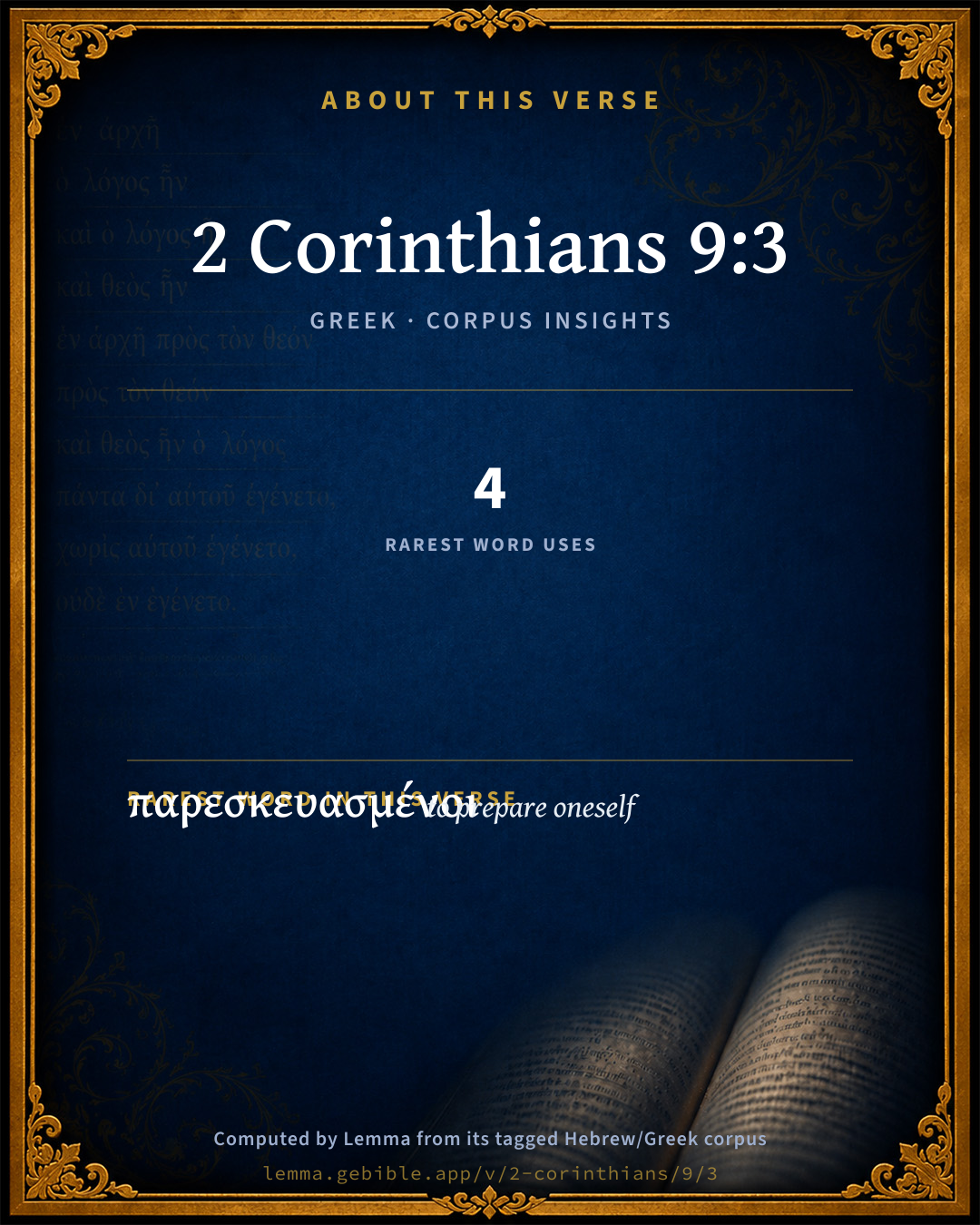
The rarest word here is παρεσκευασμένοι to prepare oneself G3903 — appearing just 4 times in the whole Greek New Testament.

Shared distinctive vocabulary

παρεσκευασμένοι to prepare oneself G3903 occurs in 4 verses of the Greek New Testament. Also found in:

Repetition

Words recur within this verse:

Cross-references

6

Topical passages linked to 2 Corinthians 9:3 in the Treasury of Scripture Knowledge — connected by theme and wording, ordered by reader-vote popularity; previews shown in the World English Bible.

  • 2 Corinthians 8:6 So we urged Titus, that as he made a beginning before, so he would also complete in you this grace.
  • 1 Corinthians 16:1–4 Now concerning the collection for the saints, as I commanded the assemblies of Galatia, you do likewise.
  • 2 Corinthians 7:14 For if in anything I have boasted to him on your behalf, I was not disappointed. But as we spoke all things to you in truth, so our glorying also which I made before Titus was found to be truth.
  • 2 Corinthians 8:17–24 For he indeed accepted our exhortation, but being himself very earnest, he went out to you of his own accord.
  • 2 Corinthians 9:4–5 so that I won't by any means, if there come with me any of Macedonia and find you unprepared, we (to say nothing of you) should be disappointed in this confident boasting.
  • Titus 3:1 Remind them to be in subjection to rulers and to authorities, to be obedient, to be ready for every good work,

Cross-references courtesy of OpenBible.info (CC BY 4.0).

Commentary

Notes on 2 Corinthians 9:3 from classic Christian and Jewish commentators (each source and its license shown beneath its notes). The classic Christian expositions comment on the surrounding passage and are grouped to its opening verse, so a note may address several verses; the Jewish commentaries on the Tanakh (Rashi and others) are per-verse, so they appear only where the commentator wrote on this verse.

Lemma curates 59 commentaries, every one of them public domain or Creative Commons licensed, each selected and text-cleaned for this edition rather than reprinted as found. About our sources →

Joseph Benson's Commentary

2Co 9:3-7. Yet have I sent the brethren — Above mentioned before me; lest our boasting of you should be in vain — Lest you should be found unprepared. To make up beforehand — To complete before my arrival; your bounty — Or gift; whereof ye had notice before — Greek, την προκατηγγελμενην, spoken of before, namely, by me to the Macedonians. Or, as some understand the expression, formerly announced to the saints in Judea. That the same might be ready — When I come; as a bounty — Or free gift, willingly bestowed; and not as of covetousness —

A thing extorted, or wrung by importunity from covetous persons. But this I say — This I wish you to keep in mind as an important declaration; He who soweth sparingly shall reap sparingly, &c. — A general rule: God will proportion the reward to the work, and the temper whence it proceeds. Every man as he purposeth, &c. — As he finds himself inclined from his own bountiful disposition, and not as being constrained thereto by me or any other; not grudgingly — Εκ λυπης, from grief, as if he were sorry to part with his money; or of necessity — Because he is ashamed to refuse. For — In matters of charity; God loveth a cheerful giver — Nor can that be acceptable to him which is given with reluctance and by constraint.

Joseph Benson's Commentary on the Old and New Testaments (1811–1818) — public domain. Text from a community e-Sword module.

Bengel's Gnomon

Johann Albrecht Bengel

2Co 9:3. Ἔπεμψα, I sent) before me, 2Co 9:5.—ἐν τῷ μέρει, in this respect [behalf]) He makes a limitation.—καθὼς ἔλεγον, as I was saying, 2Co 9:2.

Bengel's Gnomon of the New Testament — English translation (T&T Clark, Edinburgh, 1860) — public domain. Text from a community e-Sword module.

Meyer's Critical & Exegetical Commentary

Heinrich August Wilhelm Meyer

2Co_9:3. Connection: Although in regard to the collection I do not need to write to you, and that for the reason stated in 2Co_9:2, I have yet not been able to omit the sending of the brethren for this purpose, in order that, etc. Paul by this would direct attention not to the general object of this mission, but to the special one of having all things ready before his arrival. See what follows. On μὲν … δέ, which may often be translated etsi … tamen, comp. Xen. Anab. ii. 3. 10, and Kühner in loc. The same is more strongly expressed by μὲν … ὅμως δέ, Ellendt, Lex. Soph. II. p. 76, or μὲν … μέντοι, Viger. p. 536.

τοὺς ἀδελφούς] Titus and the two others, 2Co_8:17 ff.

τὸ καύχημα ἡμῶν τὸ ὑπὲρ ὑμ.] on account of the following ἐν τῷ μέρει τούτῳ, which first adds the special reference to the general, is not to be understood of the special καυχᾶσθαι described in 2Co_9:2, but is to be taken generally: in order that that, of which we boast on your behalf (καύχημα is here materies gloriandi, and not equivalent to καύχησις), might not become empty (1Co_9:15), i.e. might not be found without reality in this point, in the matter of the collection,if, namely, on our arrival it should be found that your benevolent activity had come to a standstill or become retrograde. See 2Co_9:4. In the addition ἐν τῷ μέρει τούτῳ (comp. 2Co_3:10) there lies an acris cum tacita laude exhortatio (Estius); for Paul has not a similar anxiety in respect to other sides of the καύχημα (comp. 2Co_7:4). Billroth considers ἐν τ. μέρει τ. as pointing to 2Co_9:4, and takes τὸ καύχημα κ.τ.λ. of the special boast in 2Co_9:2 : in this respect, namely, inasmuch as, if Macedonians come with me … we … are put to shame. Involved, because ἵνα καθὼς … ἦτε lies between; and at variance with the parallel ἐν τῇ ὑποστάσει ταύτῃ of 2Co_9:4.

ἵνα καθὼς κ.τ.λ.] forms, with the following μήπως κ.τ.λ., a positive parallel to the previous negative ἵνα μὴ τὸ καύχημα … τούτῳ. Comp. on ἵνα repeated in parallel clauses, Rom_7:13; Gal_3:14; Gal_4:5.

Meyer — Critical and Exegetical Commentary on the New Testament — English translation by Peter Christie, edited by Frederick Crombie (T&T Clark, 1880) — public domain. Text from a community e-Sword module.

Expositor's Greek Testament

ed. W. Robertson Nicoll

2Co 9:3 . ἔπεμψα δὲ τοὺς ἀδ . κ . τ . λ . but (the δέ corresponding to μέν of 2Co 9:1 ) I have sent (the epistolary aorist; cf. 2Co 8:18 ) the brethren ( cf. 2Co 8:16-22 ), that our glorying on your behalf may not be made void ( cf. esp. 1Co 9:15 ) in this respect, i.e. , in the matter of actually gathering the money, as distinct from their general readiness to be liberal (2Co 8:10 ), in order that, even as I said, sc. , to the Macedonians to whom he had repeatedly boasted of Corinthian generosity (2Co 9:2 ), ye may be prepared .

The Expositor's Greek Testament, edited by W. Robertson Nicoll (1897–1910) — public domain. Text from a community e-Sword module.

Jamieson, Fausset & Brown

Robert Jamieson, A. R. Fausset & David Brown

have I sent--we should say, "I send"; whereas the ancients put it in the past, the time which it would be by the time that the letter arrived.

the brethren-- (Co2 8:18, Co2 8:22) --Titus and the two others.

should be in vain in this behalf--"should be proved futile in this particular," however true in general (Co2 7:4). A tacit compliment, softening the sharp monition.

as I said--as I was saying (Co2 9:2).

Jamieson, Fausset & Brown — Commentary Critical and Explanatory on the Whole Bible (1871) — public domain (CC PDM 1.0). Text via the HelloAO Bible API.

Adam Clarke's Commentary

Verse 3. Yet have I sent the brethren] Titus and his companions, mentioned in the preceding chapter.

That, as I said, ye may be ready] And he wished them to be ready, that they might preserve the good character he had given them: this was for their honour; and if they did not take care to do so, he might be reputed a liar; and thus both they and himself be ashamed before the Macedonians, should any of them at this time accompany him to Corinth.

Adam Clarke's Commentary on the Bible (1810–1826) — public domain. Text from a community e-Sword/MySword module.

John Calvin's Commentaries

3. But I have sent the brethren. He now brings forward the reason — why it is that, while entertaining a favorable opinion as to their willingness, he, nevertheless, sets himself carefully to exhort them. “I consult,” says he, “my own good name and yours; for while I promised in your name, we would, both of us in common, incur disgrace, if words and deeds did not correspond. Hence you ought to take my fears in good part.”

John Calvin's Commentaries (1540-1563) — public domain. Text from the Calvin Translation Society English edition (1840s-50s) via the Christian Classics Ethereal Library (ccel.org). Calvin's coverage is partial (roughly two-thirds of the Bible); uncommented books and verses are honest gaps, never fabricated. The 19th-century editor's footnotes and remarks are omitted so the notes are faithfully Calvin's own voice.

Ellicott's Commentary for English Readers

(3) Yet have I sent the brethren . . .—This, then, was his purpose in the new mission. He wanted the performance not to fall short of the promise. They must be found ready, their money collected. (Comp. 1Co_16:2.)

In this behalf.—Perhaps, in this particular, or, in this respect, would be more in harmony with modern English phraseology.

A Bible Commentary for English Readers, edited by Charles John Ellicott (1878–1897) — public domain. Text from a community e-Sword module.

The Cambridge Bible for Schools and Colleges

gen. ed. J. J. S. Perowne

3. Yet have I sent] Although instructions to make the collection were needless, it was not needless for me to send the brethren. See note on 2Co_9:1. For I have sent, the Greek has I sent. But see notes on ch. 2Co_8:18; 2Co_8:22, and Introduction.

our boasting] Literally, ‘our ground of boasting,’ but see ch. 2Co_5:12. It was not that St Paul expected no result from the collection, but feared that it might be one out of all proportion to what his expressions of confidence in the Corinthian Church would have led other Churches to expect.

in this behalf] Rather, in this respect, i.e. in regard to the matter of the collection. He had not hesitated to speak of their other good qualities. See 1Co_1:4-8; and for the expression see ch. 2Co_3:10.

The Cambridge Bible for Schools and Colleges (gen. ed. J. J. S. Perowne; Cambridge University Press, 1878–1918) — public domain. Text from a community e-Sword module.

John Gill's Exposition

Yet have I sent the brethren,.... Titus, and the other two mentioned in the foregoing chapter: one manuscript reads, "we have sent"; and the Ethiopic version, "they have sent", that is, the Macedonians; but the common reading is best. It might be objected, that since the apostle knew the forwardness of their minds, how ready they were a year ago, and had boasted so much of their liberality, that it must be unnecessary to send the brethren to them, to stir them up to this work; which objection is prevented by observing the reason of his sending them:

lest our boasting of you should be in vain in this behalf: or, "in this part", in this particular thing, , "concerning this business", or affair of beneficence to the poor, as the Syriac version renders it. He had boasted of them with respect to other things besides this; but he was chiefly concerned, knowing the frailty and changeableness of human nature, and how possible it was that their forwardness might abate, and they grow cold and indifferent to such service, lest his glorying of them should be in vain in this particular instance; wherefore he sent the brethren to put them on, that as they had begun they would finish:

that as I said ye may be ready, That as he had said to the Macedonians, that they were ready in mind, it might appear to be so; or as he had ordered them in his former epistle, they might be actually ready; have their collection ready made, so that there might be no gathering when he came.

John Gill's Exposition of the Whole Bible (1746–1763) — public domain (CC PDM 1.0). Text via the HelloAO Bible API.

Albert Barnes' Notes on the Bible

Yet have I sent the brethren - The brethren referred to in 2Co 8:18, 2Co 8:22-23.

Lest our boasting of you - That you were disposed to contribute, and that you were already prepared, and that the contribution was ready.

Should be in vain - Lest anything should have occurred to prevent the collection. I have sent them that they may facilitate it, and that it may be secure and certain.

In this behalf - In this respect. That is, lest our boasting of you, in regard to your readiness to contribute to relieve the needs of others, should be found to have been ill-grounded.

Albert Barnes' Notes on the Bible (1834–1885) — public domain. Text from a community e-Sword/MySword module.

Haydock's Catholic Bible Commentary

Titus, and two others.

George Leo Haydock (1774–1849), Haydock's Catholic Family Bible and Commentary, 1859 edition — public domain. Excludes Psalms (Douay-Rheims chapter numbering differs from Protestant) and Deuterocanonical books (Catholic canon only).

Matthew Poole's English Annotations

I did not send the brethren so much to move you to this work, or quicken you to it, for you yourselves purposed it a year ago, and showed a forwardness in it; the motion proceeded from yourselves, and you showed a readiness to it, which gave me occasion to boast of you to the churches of Macedonia; but I thought you might forget it, and I would not have

our boasting in vain on this behalf. And besides, I would have the work done, that your alms might not be to gather when I come, (as he had said, 1Co 16:2), but might be in a readiness to be taken and carried away; for that is signified here by being

ready, not that readiness of mind of which he had before spoken, and which he had before mentioned as what he had found in them.

Matthew Poole's English Annotations on the Holy Bible (1683–1685) — public domain. Text from a community e-Sword/MySword module.

Whedon's Commentary on the Bible

Daniel D. Whedon

3. The brethren—The three brethren, Titus, Luke, and Erastus. Grotius quotes from Maimonides the statement that the Jews were accustomed to place three commissioners over any movement of contribution.

Daniel D. Whedon (gen. ed.), Commentary on the Old and New Testaments (1874–1909) — public domain. Text from a community e-Sword module.

The Pulpit Commentary

But. Though it is needless to write to you about this collection, I sent the brethren to make sure that all I had said about you might be justified by reality. In this behalf; i.e. about this matter, (comp. 2Co_3:10) or, as we might express it, "in this direction." He seems to have felt more uncertainty about their liberality than about other matters. (2Co_7:4)

The Pulpit Commentary (1880–1919), ed. H.D.M. Spence-Jones & Joseph S. Exell — public domain. Text from a community e-Sword module.

John Wesley's Explanatory Notes

I have sent the above mentioned brethren before me.

John Wesley, Explanatory Notes Upon the Whole Bible (1754–1765) — public domain. Text via the GEBible commentary corpus.

Burkitt's Expository Notes on the New Testament

William Burkitt

As confident and fully persuaded as the apostle was of the readiness and willingness of mind that was found in the Corinthians towards this charitable contribution, yet he judgeth it both expedient and necessary to send the brethren before to them, to get all things ready, the collection finished and over; that so when he himself, and the Macedonians, should come to Corinth, he might not be put to blush for them, having made great boasts of their charity, but finding no deeds: and also he desires their collection may be ready, with respect to themselves, that so their beneficence may appear to be their own free bounty, and not a collection difficultly extorted from them, as from covetous men, who give grudgingly and unwilligly.

Note here, 1. That it is very lawful for the ministers of Christ to use an holy craft, and innocent guilt, to draw men to a speedy compliance with their duty, sometimes by engaging their reputation in it, and sometimes alluring them by just praises to the doing of it. Thus our apostle did here.

Note, 2. That the readiness which St. Paul here presses them to, is not the readiness of the mind, but the readiness of the action: he was well satisfied, that they were ready in their preparation of the mind long ago, but he presses them to finish the collection, of which he had so much boasted to the Macedonians.

Note, 3. How the blessed apostle did consult the Corinthians’ honour and reputation equally with his own and was as desirous to prevent reflection upon them as upon himself; he would not have them ashamed, no more than himself, at his coming among them.

Note, 4. That a liberal free-giving to the saints in distress, is called here kharis khae enlogia, grace and blessing: we translate it bounty. It is called grace, because an heart to give liberally is wrought in us by the grace of God; the world shuts up our hearts till God opens them; and if the heart be open, the hands will not be shut: and works of charity are a blessing of God with our substance, and the way and means to produce his blessing upon our substance. Giving to distressed saints in proportion to what God has given us, is by Almnighty God accounted a blessing of him, and a blessing of our fellow-brethren; and whoever thus blesses God shall be blessed by him.

Note, 5. That the Corinthians being a very rich and wealthy people, the apostle stirs them up to an abundant charity. Where God gives much, he expects much: but how many, alas, grudge God a little of his own; and how difficultly is that little drawn from them, like drops of blood! Whereas to give alms purely to satisfy the importunity of others, or out of shame, misses of its reward before God.

William Burkitt's Expository Notes on the New Testament (1700–1703) — public domain. Text from a community e-Sword module.

McGarvey & Pendleton's Commentaries

J. W. McGarvey

But I have sent the brethren [Titus and the other two], that our glorying on your behalf may not be made void in this respect; that, even as I said, ye may be prepared:

J. W. McGarvey (with Philip Y. Pendleton), Commentaries on the New Testament (The Fourfold Gospel, 1914; Acts; and the epistles) — public domain. Text from a community e-Sword/MySword module.

The People's New Testament

B. W. Johnson

3–5. Yet have I sent the brethren. See 8:17, 18, 22. He sent them so that they would surely be prepared when he came.

B. W. Johnson's The People's New Testament with Notes (1889–1891) — public domain. Electronic text from the Christian Classics Ethereal Library (CCEL) ThML edition.

unfoldingWord translationNotes

Door43 World Missions Community

the brothers

This refers to Titus and the two men who accompany him.

our boasting about you may not be futile

Paul does not want others to think that the things that he had boasted about the Corinthians were false.

find you unprepared

"find you unprepared to give"

I say nothing about you

Paul uses this negative statement to emphasize that the same thing is true about the Corinthians. AT: "and you would be even more ashamed"

the brothers to come to you

From Paul's perspective, the brothers are going. AT: "the brothers to go to you" (See: Go and Come)

not as something extorted

This can be stated in active form. AT: "not as something that we forced you to give" (See: Active or Passive)

translationWords

brother

boast

shame

confidence

gift

promise

bless

unfoldingWord translationNotes — © Distant Shores Media and the Door43 World Missions Community, licensed CC BY-SA 4.0. Source: git.door43.org/Door43/en_tn.

Cambridge Greek Testament for Schools and Colleges

3. ἔπεμψα δέ. This is the second point, the δέ of the μέν in 2Co 9:1. But I am sending (epistolary aorist, as in 2Co 8:17-18; 2Co 8:22) the brethren, that our glorying on your behalf may not be made void in this particular (2Co 3:10), in the matter of the relief fund.

Cambridge Greek Testament for Schools and Colleges (Cambridge University Press, 1896; 21 vols, various authors incl. Carr, Maclear, Plummer, Farrar, Lumby, Moule, M. R. James, Simcox) — public domain. Text from a community e-Sword module.

Alford’s Greek Testament

Henry Alford

3.] But (contrast, not to μέν in ver. 1, but to καυχῶμαι above; implying fear lest he should have been making a vain boast concerning them) I sent (epistolary past, as in ch. 8:18, 22) the brethren, in order that our matter of boasting concerning you (καύχημα, our whole ‘materies gloriandi,’ not =καύχησις) may not in this particular be proved empty (ἐν τῷ μέρει τούτῳ, does not belong to καύχημα, but to κενωθῇ—‘that our boast of you, so ample and various—ch. 7:4, may not break down in this one department.’ Estius, in marg., well calls it ‘acris cum tacita laude exhortatio apostolica’); that, as I said (when? in ver. 2? or, in his boasting to the Macedonians? or, in 1Co 16:1?

Most naturally, in ver. 2. If he had meant, to the Macedonians, it would probably have been λέγω, as καυχῶμαι above: if in 1Co 161Co_161Co_16, it would have been more clearly expressed.

If so, ἔλεγον refers merely to the word παρεσκ.), ye may be prepared, (see above on ver. 2),

Henry Alford, The Greek Testament (1849–1861) — public domain. Text from a community e-Sword module.

International Critical Commentary

3. ἔπεμψα δὲ τοὺς ἀδελφούς. ‘In the second place (δέ) I am sending (epistolary aor., as in 8:17, 18, 22) the brethren,’ viz. Titus and his two colleagues.* The δέ corresponds to the μέν in v. 1. He need not urge them to give; he is sending these three to organize their giving. D E, Copt, have ἐπέμψαμεν.

ἴνα μὴ τὸ καύχημα ἡμῶν. ‘That our glorying on your behalf may not be made void in this particular.’ He had praised the Corinthians for many good qualities, and he does not want his boast to be proved an empty one in the matter of the relief-fund. He is not afraid that they will refuse to give, but he is afraid that they may be dilatory for want of organization. It will produce a bad impression if the money is not ready when it is wanted. He carefully limits his anxiety to ‘this particular.’

ἵνα καθὼς ἔλεγον παρ. ἦτε. ‘That, just as I repeatedly said (to the Macedonians) you may be prepared.’ The second ἴνα is co-ordinate with the first; cf. Gal 3:14.

International Critical Commentary — older volumes (1896–1929), various authors — public domain. Text from a community e-Sword module.

Lesson kit

Teaching starters — assembled from the data on this page, not authored interpretation. Every prompt links to the verse data it draws on. Edit before teaching.

2 Corinthians, in the Pauline Epistles, opens this verse with 22 words (18 distinct Greek lemmas). Its most distinctive word is paraskeuázō (“to prepare oneself”). A historical commentator’s framing appears above. Read the whole chapter for the surrounding context.

Discussion questions

  1. How does “to prepare oneself” (paraskeuázō) shape what this verse is saying?
  2. Acts 10:10 shares the word «to prepare oneself» with this verse. How do the two illuminate each other?
  3. “the” occurs 4× in this one verse. What is the effect of the repetition?
  4. The translations on this page render this verse differently — a whole-verse word diff, not a word-by-word alignment. What might account for the different wordings?
  5. Reading how Joseph Benson's Commentary and Bengel's Gnomon read this verse, where do the two commentators agree and where do they part?

Things to notice

Reading settings

Reading text

Shown beneath each verse's original-language words.

Old Testament
Old Testament edition

Read the OT as the Masoretic Hebrew (MT) or the Greek Septuagint (LXX).

English shown for the Greek Septuagint (in the Hebrew ↔ Greek comparison).

Comparing translations? Open the Compare panel on any verse page to stack up to four side by side.