Romans 14:13

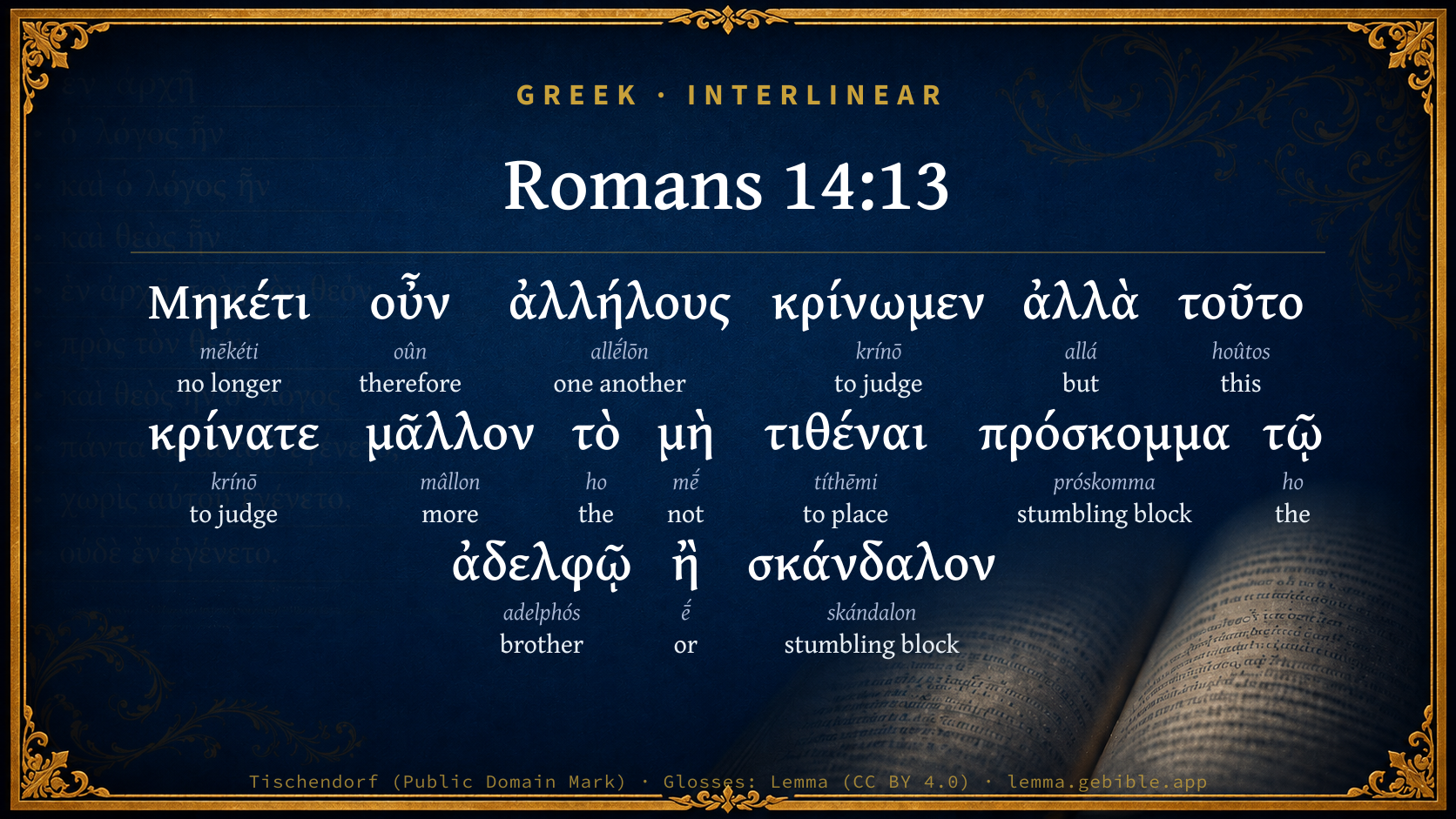
Greek (Tischendorf 8th ed.) Romans 14:13 appears in the Greek New Testament. The text above is from the Tischendorf 8th edition. Each word links to its Strong’s number and a concise gloss. Click any word for its full Thayer’s Greek Lexicon entry.
Download image
Cite this verse

Romans 14:13 (World English Bible). Public Domain. Lemma interlinear Bible study tool, https://lemma.gebible.app/v/romans/14/13.

Show BibTeX & RIS
BibTeX
RIS
English Translation
Therefore let's not judge one another any more, but judge this rather, that no man put a stumbling block in his brother's way, or an occasion for falling.
World English Bible · Public Domain
Download a study sheet

One document with this verse’s original text, its word-by-word gloss line, the meaning frame, cross-references with their text, attributed commentary, and full source and license credits — printable, and it pastes into notes with its structure intact.

This verse Autodidact and up

Study sheet (.html) Plain text (.txt)

A passage Seminary Student

Up to 50 verses in one chapter. A passage sheet keeps up to 6 commentary sources and 12 cross-references per verse, in the order this page ranks them, and says so on the sheet whenever that leaves anything out. Ask for a single verse and you get the Autodidact verse sheet above.

Everything on this page stays free to read, with no account — the sheet is a download of what is already on screen, not access to it.

Want to remove ads? Support Godless Engineer
Compare translations 3

The same verse in 3 English versions, stacked beneath the original-language interlinear above. Click any original word for its lexicon entry.

Each is an independent rendering of the whole verse — the interlinear is not word-aligned to these translations.

Highlighted words mark where these versions differ — a whole-verse word diff, not a word-by-word alignment.

  • World English Bible Public Domain
    Therefore let's not judge one another any more, but judge this rather, that no man put a stumbling block in his brother's way, or an occasion for falling.
  • King James Version Public Domain
    Let us not therefore judge one another any more: but judge this rather, that no man put a stumblingblock or an occasion to fall in his brother's way.
  • unfoldingWord Literal Text CC BY-SA 4.0
    Therefore, let us no longer judge one another, but rather judge this: to not place a stumbling block for the brother or a trap.

unfoldingWord Literal Text — © unfoldingWord, licensed CC BY-SA 4.0. Word-aligned USFM3 via Door43 (git.door43.org/unfoldingWord/en_ult).

Versions to compare (up to 4)

3 of 4 selected

Show all 19 translations

Every available English version of this verse, each an independent rendering of the whole verse.

  • World English Bible Public Domain
    Therefore let's not judge one another any more, but judge this rather, that no man put a stumbling block in his brother's way, or an occasion for falling.
  • Berean Standard Bible Public Domain
    Therefore let us stop judging one another. Instead, make up your mind not to put any stumbling block or obstacle in your brother’s way.
  • Majority Standard Bible Public Domain
    Therefore let us stop judging one another. Instead, make up your mind not to put any stumbling block or obstacle in your brother’s way.
  • King James Version Public Domain
    Let us not therefore judge one another any more: but judge this rather, that no man put a stumblingblock or an occasion to fall in his brother's way.
  • American Standard Version (1901) Public Domain
    Let us not therefore judge one another any more: but judge ye this rather, that no man put a stumblingblock in his brother's way, or an occasion of falling.
  • Revised Version (1885) Public Domain
    Let us not therefore judge one another any more: but judge ye this rather, that no man put a stumblingblock in his brother’s way, or an occasion of falling.
  • Geneva Bible (1599) Public Domain
    Let vs not therefore iudge one another any more: but vse your iudgement rather in this, that no man put an occasion to fall, or a stumbling blocke before his brother.
  • Douay-Rheims (1899) Public Domain
    Let us not therefore judge one another any more. But judge this rather, that you put not a stumblingblock or a scandal in your brother's way.
  • Young's Literal Translation Public Domain
    no longer, therefore, may we judge one another, but this judge ye rather, not to put a stumbling-stone before the brother, or an offence.
  • Literal Standard Version CC BY-SA 4.0
    therefore, may we judge one another no longer, but rather judge this, not to put a stumbling-stone before the brother, or an offense.
  • Unlocked Literal Bible CC BY-SA 4.0
    Therefore, let us no longer judge one another, but instead decide this, that no one will place a stumbling block or a snare for his brother.
  • unfoldingWord Literal Text CC BY-SA 4.0
    Therefore, let us no longer judge one another, but rather judge this: to not place a stumbling block for the brother or a trap.
  • Darby Bible Public Domain
    Let us no longer therefore judge one another; but judge ye this rather, not to put a stumbling-block or a fall-trap before his brother.
  • World Messianic Bible Public Domain
    Therefore let’s not judge one another any more, but judge this rather, that no man put a stumbling block in his brother’s way, or an occasion for falling.
  • Webster's Bible Public Domain
    Let us not therefore judge one another any more: but judge this rather, that no man put a stumbling-block, or an occasion to fall in his brother's way.
  • Free Bible Version CC BY-SA 4.0
    Therefore let's not judge each other anymore, but decide to do this instead—we won't put obstacles in the way of fellow-believers, or cause them to fall.
  • Bible in Basic English Public Domain
    Then let us not be judges of one another any longer: but keep this in mind, that no man is to make it hard for his brother, or give him cause for doubting.
  • Text-Critical English NT CC BY 4.0
    Therefore let us no longer judge one another. Instead, resolve not to put any stumbling block or snare before your brother.
  • Tyndale New Testament (1534) Public Domain
    Let vs not therfore iudge one another eny more. But iudge this rather that no man put a stomblynge blocke or an occasion to faule in his brothers waye.

Literal Standard Version (2020), Covenant Press — licensed CC BY-SA 4.0. Text via the HelloAO Bible API (eBible.org). Unlocked Literal Bible (unfoldingWord) — licensed CC BY-SA 4.0. Text via the HelloAO Bible API (eBible.org). unfoldingWord Literal Text — © unfoldingWord, licensed CC BY-SA 4.0. Word-aligned USFM3 via Door43 (git.door43.org/unfoldingWord/en_ult). Free Bible Version, Dr. Jonathan Gallagher — licensed CC BY-SA 4.0. Text via the HelloAO Bible API (eBible.org).

Word by word

More ways to search: Search by grammar → Find every occurrence → Compare this word →

Practice this passage: Drill this verse → Learn its vocabulary →

πρόσκομμα
próskomma
G4348
“stumbling block”
Noun, Accusative, Singular, Neuter
Part of Speech
Noun
Case
Accusative
Number
Singular
Gender
Neuter
Full Thayer's Definition

Origin: from G4350

TDNT: 18:25,9

1. a stumbling block a. an obstacle in the way which if one strikes his foot against he stumbles or falls b. that over which a soul stumbles i.e. by which is caused to sin
  1. Μηκέτι mēkéti G3371 “no longer” Adverb, Negative
  2. οὖν oûn G3767 “therefore” Conjunction
  3. ἀλλήλους allḗlōn G240 “one another” Reciprocal pronoun, Accusative, Plural, Masculine
  4. κρίνωμεν krínō G2919 “to judge” Verb, Present, Active, Subjunctive, 1st person, Plural
  5. ἀλλὰ allá G235 “but” Conjunction
  6. τοῦτο hoûtos G3778 “this” Demonstrative pronoun, Accusative, Singular, Neuter
  7. κρίνατε krínō G2919 “to judge” Verb, Aorist, Active, Imperative, 2nd person, Plural
  8. μᾶλλον mâllon G3123 “more” Adverb
  9. τὸ ho G3588 “the” Article, Accusative, Singular, Neuter
  10. μὴ mḗ G3361 “not” Particle, Negative
  11. τιθέναι títhēmi G5087 “to place” Verb, Present, Active, Infinitive
  12. τῷ ho G3588 “the” Article, Dative, Singular, Masculine
  13. ἀδελφῷ adelphós G80 “brother” Noun, Dative, Singular, Masculine
  14. ἢ ḗ G2228 “or” Particle
  15. σκάνδαλον skándalon G4625 “stumbling block” Noun, Accusative, Singular, Neuter

About this verse

These counts appear in no published source. They are computed here, from the morphology-tagged text and Lemma’s own curated glosses. What Lemma adds →

16
words
14
distinct lemmas
Pauline Epistles
section

Notable vocabulary

The rarest word here is πρόσκομμα stumbling block G4348 — appearing just 6 times in the whole Greek New Testament.

Shared distinctive vocabulary

πρόσκομμα stumbling block G4348 occurs in 6 verses of the Greek New Testament. Also found in:

Repetition

Words recur within this verse:

  • κρίνωμεν to judge G2919 ×2
  • τὸ the G3588 ×2

Cross-references

25

Topical passages linked to Romans 14:13 in the Treasury of Scripture Knowledge — connected by theme and wording, ordered by reader-vote popularity; previews shown in the World English Bible.

  • 2 Corinthians 6:3 We give no occasion of stumbling in anything, that our service may not be blamed,
  • 1 Corinthians 8:9–13 But be careful that by no means does this liberty of yours become a stumbling block to the weak.
  • James 4:11 Don't speak against one another, brothers. He who speaks against a brother and judges his brother, speaks against the law and judges the law. But if you judge the law, you are not a doer of the law, but a judge.
  • Luke 17:2 It would be better for him if a millstone were hung around his neck, and he were thrown into the sea, rather than that he should cause one of these little ones to stumble.
  • Romans 16:17 Now I beg you, brothers, look out for those who are causing the divisions and occasions of stumbling, contrary to the doctrine which you learned, and turn away from them.
  • Isaiah 57:14 He will say, Cast up, cast up, prepare the way, take up the stumbling-block out of the way of my people.
  • Luke 12:57 Why don't you judge for yourselves what is right?
  • Romans 14:10 But you, why do you judge your brother? Or you again, why do you despise your brother? For we will all stand before the judgment seat of Christ.
  • James 2:4 haven't you shown partiality among yourselves, and become judges with evil thoughts?
  • Matthew 7:1 "Don't judge, so that you won't be judged.
  • Revelation 2:14 But I have a few things against you, because you have there some who hold the teaching of Balaam, who taught Balak to throw a stumbling block before the children of Israel, to eat things sacrificed to idols, and to commit sexual immorality.
  • Matthew 16:23 But he turned, and said to Peter, "Get behind me, Satan! You are a stumbling-block to me, for you are not setting your mind on the things of God, but on the things of men."
  • Matthew 18:7 "Woe to the world because of occasions of stumbling! For it must be that the occasions come, but woe to that person through whom the occasion comes!
  • Romans 14:4 Who are you who judge another's servant? To his own lord he stands or falls. Yes, he will be made to stand, for God has power to make him stand.
  • 1 Corinthians 10:32 Give no occasions for stumbling, either to Jews, or to Greeks, or to the assembly of God;
  • Romans 9:32–33 Why? Because they didn't seek it by faith, but as it were by works of the law. They stumbled over the stumbling stone;
  • Romans 11:9 David says, "Let their table be made a snare, and a trap, A stumbling block, and a retribution to them.
  • 1 Corinthians 11:13 Judge for yourselves. Is it appropriate that a woman pray to God unveiled?
  • 2 Corinthians 5:14 For the love of Christ constrains us; because we judge thus, that one died for all, therefore all died.
  • Philippians 1:10 so that you may approve the things that are excellent; that you may be sincere and without offense to the day of Christ;
  • 1 Timothy 5:14 I desire therefore that the younger widows marry, bear children, rule the household, and give no occasion to the adversary for reviling.
  • 1 John 2:10 He who loves his brother remains in the light, and there is no occasion for stumbling in him.
  • Leviticus 19:14 "'You shall not curse the deaf, nor put a stumbling block before the blind; but you shall fear your God. I am Yahweh.
  • 2 Samuel 12:14 However, because by this deed you have given great occasion to Yahweh's enemies to blaspheme, the child also who is born to you shall surely die."
  • Ezekiel 14:3 Son of man, these men have taken their idols into their heart, and put the stumbling block of their iniquity before their face: should I be inquired of at all by them?

Cross-references courtesy of OpenBible.info (CC BY 4.0).

Commentary

Notes on Romans 14:13 from classic Christian and Jewish commentators (each source and its license shown beneath its notes). The classic Christian expositions comment on the surrounding passage and are grouped to its opening verse, so a note may address several verses; the Jewish commentaries on the Tanakh (Rashi and others) are per-verse, so they appear only where the commentator wrote on this verse.

Lemma curates 59 commentaries, every one of them public domain or Creative Commons licensed, each selected and text-cleaned for this edition rather than reprinted as found. About our sources →

The Biblical Illustrator

Joseph S. Exell

Rom_14:13-15

Let us not therefore judge one another any more: but judge this rather, that no man put a stumbling-block … , in his brothers way.

Limitations of Christian liberty

It is limited--

I. In its extent; by a tender regard for the weak. Love--

1. Avoids offence.

2. Respects the convictions of others.

3. Denies itself.

II. In its object; the furtherance of the kingdom of God.

1. By guarding against reproach.

2. By esteeming spiritual blessings above all others.

3. By promoting the work of God in others.

III. In its rule of action; faith.

1. Allows only what faith permits.

2. Avoids what faith does not endorse. (J. Lyth, D.D.)

The voluntary limitation of Christian liberty

I. Its extent. It--

1. Avoids offence.

2. Yields its conscious right for the sake of others.

3. Guards against the appearance of evil.

II. Its encouragements.

1. The kingdom of God suffers no disadvantage.

2. The weak brother is spared.

3. Private conviction and action are not sacrificed. (J. Lyth, D.D.)

Things indifferent

I. What things are indifferent? Things--

1. Not forbidden.

2. That have in themselves no moral value.

3. That are clearly ascertained as such by an enlightened conscience.

II. When do they cease to be so?

1. When they become a stumbling-block to others.

2. When they infringe the law of love.

3. When they oppose the work of Christ--when they occasion reproach. (J. Lyth, D.D.)

In guarding against offence we must take care

1. To preserve our personal liberty.

2. Not to violate the law of love. (J. Lyth, D.D.)

Personal responsibility

In the early part of his letter to the Romans the apostle expounds the fundamental doctrines of the Christian religion. In this latter part he applies these doctrines to the problems and duties of daily life. In the Roman Church he is confronted, as ministers of the gospel are confronted even to the present day, with two antagonistic parties, the legal and the spiritual, the conservative and the liberal, or, as he terms them, the weak and the strong. How to reconcile these two parties in the one Christian Church is the problem which engages the attention of him who has the care of all the Churches. A recognition of the Lords authority, a desire to execute the Lords purpose, and a confession of the Lords goodness, characterise both parties. But while there is good on both sides, there are on both sides manifestations of evil. A spirit of uncharitableness is seen in the judgments of both, and to this the apostle directs his teaching as he urges the exhortation, Let us not therefore judge one another any more.

1. The first argument against this habit of uncharitable criticism is found in the truth that judgment belongs unto God, man being incompetent to render it. Why dost thou judge thy brother? For we shall all stand before the judgment-seat of God. The Omniscient alone is competent to judge.

(1) We have not sufficient knowledge of the mind of the Master to determine the standard of action. Who hath known the mind of the Lord, or who hath been His counsellor? My conception is my working standard. It is the Masters commission to me. His word to my brother may be different. We may move in opposite directions and yet both fulfil the purpose of one controlling mind. Let me be assured that my feet are planted on the truth, but let me beware how I deny that my brother stands upon the truth because he does not occupy the same square-foot of ground on which I stand. No man has a monopoly of truth.

(2) Again, we are incompetent to judge because we have not sufficient knowledge of the mind of the fellow-servant to determine the motive with which his action is performed. Let not him that eateth not judge him that eateth; for the Lord hath received him. Ofttimes man can look no farther than the outward appearance. God looketh upon the heart. He weighs the motive. Yet, spite of their incompetence, how free men are to usurp this Divine prerogative of judgment! Without Gods knowledge, without Gods love, they are quick to condemn. Before the bar of God each is responsible for himself alone.

2. In this solemn fact the apostle finds his second argument against the habit of judging others. Each one of us shall give account of himself to God: let us not, therefore, judge one another any more. God does not hold us responsible for our brothers action; but He does hold us responsible for our influence upon him. The large demands of the Divine Judge upon the Christian in relation to his brethren, the apostle now urges especially upon the strong. There is reason in making the application especially to the strong, for in the matters under discussion they alone have freedom of choice. The strong Christian may eat or forbear eating. He may observe the day or not observe the day. The weak, however, in his present moral condition, has no choice. To those who have the larger opportunity the truth is the more broadly applied. But we are not obliged to think that the entire doctrine of the relation of the strong to the weak is set forth in this chapter. Were that the case it might seem as if Paul exalted the weak mans conscience to a place of tyranny. This surely is not his teaching. Truth is supreme. Opinion can never usurp her throne. If the weak brothers opinion is not the truth, his position is open to attack, and in the fuller presentation of the truth it may be necessary to oppose it. Paul himself was constantly leading in such opposition. Not only may the position of the weak brother be attacked; there are times when his scruples have to be disregarded. They may always be disregarded by you when they are opposed to a clear conviction of your duty. Let each man be fully persuaded in his own mind, and he need not, he must not desist out of regard for anothers conscience. But if, after sufficient and candid study, he is fully assured that it is his duty to act, he must act, however his action may grieve his weaker brother. Even in matters which may be termed indifferent, the scruples of the weak brother may deserve to be set aside. Paul himself is our example. To him circumcision is nothing. At one time, on account of the Jews, he circumcises Timothy. At another time, when certain came to spy out the Christians liberty and to bring him into bondage, he refuses to circumcise Titus. To these he gave place in the way of subjection, no, not for an hour, that the truth of the gospel might continue with the Christian disciples. There are, therefore, grounds on which the position of the weak brother may be attacked and his scruples disregarded. Nevertheless, there are grounds on which the position of the weaker brother must be respected, and his scruples receive special regard. If because of meat thy brother is grieved, thou walkest no longer according to love. My act is not right simply because it does not harm me. As a child of God I must look upon the things of others. Christianity is satisfied with no standard but that of love. If this is true Christian doctrine the application in Christian ethics is clear. Justice is conformity to a standard; the Christian standard of life is the loving nature of God. I cannot therefore be just in the Christian sense unless I have love. Not what is good for me alone, nor what is good for my brother alone, but what is best for all, is to determine my action as a child of God. But the law of love is not satisfied with the attainment of anything less than the best good of all. There are many goods. They are of divers values. Freedom in eating and drinking is a good, but this is not the highest good which Christianity has to bestow. For the kingdom of God is not eating and drinking; but righteousness and peace and joy in the Holy Ghost. The man who, in his zeal to establish the right to eat and drink, or the right to the free observance to a religious day, cares not how much he disturbs the peace, diminishes the joy, and undermines the righteousness of his brethren, really places the minor above the major, the subordinate above the supreme. In seeking a good, he misses the best good of the kingdom of God. But the strong may say in way of defence: Inasmuch as nothing is unclean of itself, may we not encourage other to imitate us in customs which are not opposed to any law of righteousness? No, says the apostle, not so long as the weak brother considers the thing unclean, or the act unrighteous. The end of Christianity is not right conduct, viewed apart from its motive, but virtuous character. Christianity has not attained its ideal when certain legal decrees have been obeyed, but only when certain moral experiences have been evoked. A merely legal system might be satisfied with formally correct conduct, but a vital religion demands a godly character. The teaching is sharp and decisive. Whatsoever is not of faith is sin. Whatsoever is done without consent of the moral nature, whatsoever is done contrary to what one believes to be right, is sin. This is striking doctrine. But does not our best ethics confirm this view? Do we not frequently see the unhappy results of submission to precepts which may be right, and yet are in opposition to the beliefs of the heart? In such submission the man surrenders his freedom, the birthright of moral manhood. He submits to the rule of his fellow-men. In opposition to the teaching of Christ, Call no man master, he yields his sovereignty and lets others lay down the law of his life. Whatsoever is not of faith is of foreign dictation. It is the act of the bondman, not of the freeman. By such conformity the man benumbs his sense of obligation. It is this sense which binds him to the eternal truth. It is like the cable which holds the buoy to its moorings. The sense of obligation is the one assuring evidence that God has not forgotten us. This binds us to the eternal throne. Like the clue which Ariadne gave to Theseus, it leads through devious ways out into the world of light, of life, and of love; it leads to the throne, to the feet, to the heart of God. Lose this thread and the soul is left alone, in wandering mazes lost. Cherish your own sense of obligation; beware how you injure anothers. More fundamentally still, the performance of an act which is contrary to the souls belief, to which the consent of the moral nature is not given, is essentially subordination of the impulse to live for others to the impulse to live for ones self. The teachings of this chapter become intelligible in proportion as we come to understand the end which Christianity seeks to attain. Christianity aims not simply to cause our actions to conform to a certain legal standard, but rather to make us partake of the nature and thus of the blessed experiences of the ever-blessed God. (T. D. Anderson.)

Personal responsibility

The discussion which we reach in this part of the Epistle to the Romans turns not on great and plain matters of righteousness and equity, on which there can be but one opinion. It is not aimed against our judging a wrong to be what it is, for how can we help condemning the violator of law? but it all has reference to daily questions where there is no positive rule for any one but such as grows up in the community and shifts with changing circumstances. The private conscience properly asks, Is this right for me? The social conscience asks, Is this right, all things considered? So the well-trained moral sense of the Christian is broad in its scope and unselfish in its utterances. Practical duties in the New Testament are seen to be the sequence of sublime truths. We see that there could not help being wide differences in temperament and attainments among such converts, and that many serious complications might arise in their attempts to walk according to the new Way of life. It is so everywhere in modern times in the missionary fields. We can see, from our own selves, how strong the temptation would be to take positions upon such matters where there was no, Thus saith the Lord, and where for that very reason men grow pugnaciously sure. First of all we note that while he places himself on the side of the strong and says that nothing is unclean of itself, he does not try to change the feelings of either party for the sake of a dull and heartless uniformity of practice. He does not turn to the weak brother and say to him, Give up your absurd scruples! or belabour him with proofs that he ought to be free from the law. Nor does he say to the strong, You have no right to a freedom upon things not free to others! Give up your liberty for the common good! On the contrary, he tells him to keep his faith as to all these things and have it before God. And for the establishment of this he sets up a great landmark in morals. We are personally accountable for ourselves unto God, and are never called upon to sit in judgment upon others who are the servants of the same God and show the fruits of the Spirit in their lives. Of course we must condemn wickedness wherever we behold it. While we are our brothers keeper and owe him a debt of loving care and sympathetic influence, we are not his overseer, divinely set up to regulate every attitude of his mind and the small details of his conduct. Christian love may degenerate into officiousness. The apostle shows that we ought to cultivate a regard for anothers conscience all the more if it is weak. God is speaking through it. To him that esteemeth a thing to be profane, to him it is profane. By your inconsiderate freedom, he says, you may actually destroy your brother who will stand by your side at the judgment-seat and for whom Christ died. But besides this, love is more than liberty. What is liberty? Does not all turn upon the use we make of liberty and the nature of the thing about which we are free? One observation seems proper at this point as to the use of wine. It is of the Lord that Christian sentiment should favour the weaker side everywhere, but the question may fairly arise whether the strong have any rights or any place for the use of their freedom. The words of Paul are clear that if we have faith that gives us liberty we are to hold it before God and not to create a sin for ourselves because another has found one. In the constant movements towards a better social life more and more attention is given to the poor and the oppressed, to the victims of appetite and of evil in all its forms, and more is asked of every Christian to-day in the way of personal sacrifice than ever before. But the practical guide upon a thousand matters of daily conduct, where we ask, Shall we dance? Shall we play cards? Shall we attend the theatre? Shall we visit and ride on the Lords Day? is found within these great lessons of the apostle. He says, Whatsoever is not of faith is sin. That faith is not the common belief of the Christian, but a regulative principle derived from the Word of God and the practices of His people. For us, then, if serious questions arise, let there be a simple rule. We can abstain. We can be safe. We can place ourselves where no act of ours can by any possibility destroy the delicate bloom of anothers faith, and where we give up a trifle and have a kingdom of peace within! (E. N. Packard.)

Personal rights

Well, is there no other question? Yes, oh yes, there is another question. What is that? It is the great question as to what a man may do with his rights. Paul takes the ground that every man must assert his personal rights. Now the question is, having once shown that I can indulge in such and such pleasures without any harm to me, and with some benefit, shall I go on and indulge in them without any regard to the effect which my indulgence may have on others? Oh no, says Paul. There is no harm in your eating meat dedicated to an idol, but if your brother sees you do it, and, misunderstanding the whole of it, is led conscientiously into wrong, then you do not act wisely or kindly; for you use your right to break down his conscience and his right. There are two principles in regard to rights. The first is to ascertain and vindicate them, and the next is to subject them to the law of love. There are a great many things that I have a right to, till love comes and says, Will you not forbear them for the sake of others? I have a right to eat meat; but for me to do it under circumstances such that my whole household are led to eat it, and they are thrown into a fever, is wrong. For the sake of keeping my children well, I would abstain from eating meat. I have a right to drink wine; but if I found that my drinking wine would lead poorer men to drink whiskey, or the young men around me to drink wine, I would say to myself, Shall I use a right of mine in such a way as to destroy my fellow-men for whom Christ died? That would not be acting wisely nor well. (H. W. Beecher.)

Self-denial for others

A friend told me that he was visiting a lighthouse lately, and said to the keeper, Are you not afraid to live here? it is a dreadful place to be constantly in. No, replied the man, I am not afraid. We never think of ourselves here. Never think of yourselves! How is that? The reply was a good one. We know that we are perfectly safe, and only think of having our lamps burning brightly, and keeping the reflectors clear, so that those in danger may be saved. That is what Christians ought to do. They are safe in a house built on a rock, which cannot be moved by the wildest storm, and in a spirit of holy unselfishness they should let their light gleam across the dark waves of sin, that they who are imperilled may be guided into the harbour of eternal safety. (Sword and Trowel.)

Selfishness

A man is called selfish, not for pursuing his own good, but for neglecting his neighbours. (Abp. Whately.)

The sacredness of man

While from the beginning the kindly affections of mens nature have been largely developed, outside of their own households they have seldom felt themselves under much obligation to men, and outside their acquaintanceship and nation are felt a hundred obligations of aversion. And it is one of the tokens of the Divine inspiration of the truth that Thou shalt love thy neighbour as thyself has been the declaration of the Divine law from the earliest period. And there is no duty that the Apostle Paul so developed as this. Note--

I. The ground on which he puts men is the ground of their sacredness.

1. Christians are tempted to judge men by standards that are not the highest nor the most Christian.

(1) We are tempted to put value upon men according to their social relationships. A man may be very low in the social scale, and we may be accustomed in measuring him to call him a brute, and worthless, but the man has some other value besides that which consists in his relationship to society.

(2) Nay, a mans economic value may be nil. There are many who do not produce as much as they eat. They are sick or shiftless, and die useless paupers. And we are apt to speak of them with contempt as being the dregs of society.

2. And yet, low as they are, their value may be beyond count.

(1) For every man is Gods creature in a sense that none of the inferior animals are. He is made after the image of God.

(2) More than this, every man is made sacred by what has been done for him. In the old days the colonists were forbidden to manufacture anything for themselves. The privilege of furnishing these things to them was reserved to the Crown. Not only that, but the very timber of the country was sorted out, and wherever a valiant pine or a noble oak, fit for the masts or for the ribs of ships was found, the Broad Arrow was stamped on it. The tree was in no respect different, but when people saw the Broad Arrow they said, That is the kings. Now it is not an arrow, it is a cross that is stamped upon every living soul. For every human being Christ died; and this is made to he the sign and token of the value that is in every man (verse 15).

(3) Again, men are to be greatly respected for their development into immortality. Although there is but very little value in acorns, when they are planted they will become trees; but what they will be when a hundred years have dealt with them no man can tell. And though men, as seeds, are comparatively insignificant, when they shall have been planted again, in a fairer clime and in a better soil, and shall have been under a higher culture, they will then unfold their real and true selves, to which they will not come in their relationship to time and society.

II. It is upon the ground of the value that inheres in men that we must not put any stumbling-block in their way. It is a case in which the highest are to serve the lowest. It is being to men what mothers are to children. What father is there that does not subdue himself to the level of the cradle? Accomplishments, tastes, and liberties are commanded to serve the wants of the little one. We must use our liberty and our strength for men, not them for our strength and liberty.

1. It is right, if a man is worshipping superstitiously, to supplant the superstition by a more rational worship. If I go into a Catholic church, and there stands the font of sacred water by the door, and I perceive one and another dipping their hands in and making the sign of the cross with the utmost reverence, I do not follow their example; I have no need of it; and yet I should abuse my liberty if I were to ridicule the act, or if I were to use my liberty and my intelligence to oppress the consciences of those that were lower and less than I. To a person who performs the act it may seem sacred; and if you cast contempt upon it you may be a violator of what is sacred to him, and therefore you may put a stumbling-block in his way. Idolaters were not treated with disrespect by Christ and His apostles. When Paul stood in the midst of the radiant idols at Athens he never spoke of them in such a way as to wound the feelings of any one who believed in them.

2. It is sometimes said of men, They do not preach all that they believe. They would be fools if they did. You might as well say to the mother who has a medicine chest, Give all the medicine there is in that chest, as to say to a man, Preach all that you believe. A man preaches to build men up. Are you to reproach a man for not putting all the materials for building into every edifice that he constructs? If a man builds of brick he does not think it necessary to exhaust the whole material that the country affords. And a man that teaches is not teaching for the sake of unsettling men. There are those who pile sermon upon sermon the year round, loosening everything, and at last nothing remains. But it is said, They are bold men. Yes; and they may do harm with their boldness. Well, they are honest. Honesty is a good thing; but even that should be handled prudently. It is better that men should have truth than that they should have delusion and falsity; but it is not wise that the change should be made too abruptly. Where a man has on a filthy garment, it is better that he should wear it than that he should go naked. Dont take it from him until you have a better one to put in the place of it.

3. A man has a right, in the employment of his wealth, to have regard for the comfort and refinement of himself and his household. But no man has a right to such a use of wealth as shall be exclusive and selfish. A man has a right to the use of his property, but he must use it charitably. And, on the other hand, those that are poor are not to rail at rich men, but are to act according to the spirit which is contained in the gospel (verses 2, 3).

4. There are very many pleasures which I avoid, not because I have the slightest conscience respecting the things themselves, or because I suppose they would be otherwise than beneficial to me, but because my example should be such as not to mislead, but lead aright, the young men of the community, who, in looking upon what I did, if I indulged in all those things which were harmless to me, might venture on things that I could do safely, and they could not.

5. This should be carried still further. I hold that there is no one thing that is more perilous to young men than the usages of society in the matter of intoxicating drinks. Nevertheless, if I observe that my brother, in a neighbouring church, holds a contrary view, I have no right of disputation over his conscience. I may wish that he could see as I do; I may even attempt to give him the light that I have; but if, after all, in the exercise of his own judgment and discretion, he says, I stand in my liberty before God, I have no right to cast an imputation on him and his liberty. (H. W. Beecher.)

I know … , that there is nothing unclean of itself.

How the same thing may be clean and unclean

I. Nothing is unclean of itself.

1. Every creature of God is good.

2. May be lawfully used.

3. When sanctified by an enlightened conscience.

II. Everything becomes unclean.

1. When abused.

2. When used by him that esteems it unclean. (J. Lyth, D.D.)

But if thy brother be grieved with thy meat, now walkest thou not charitably.--

The duty of sacrificing private enjoyment for anothers benefit

I. The case supposed. The enjoyment though lawful, is a stumbling-block to another.

II. The apostles decision of it. It is a violation of the law of love, because selfish in itself, injurious in its effect.

III. The consequent duty. Of abstinence, lest you destroy him for whom Christ died, leaving you an example of self-sacrifice. (J. Lyth, D.D.)

Destroy not him with thy meat, for whom Christ died.--

Christs death, a mans destruction

I. Christ died to save all. He is the propitiation … for the sins of the whole world. His death was a fact in the Divine government in which all are interested, a provision of Divine mercy, like the sun, the air, and the various elements of nature, from which all could derive the same supplies.

II. Though He died to save all, some will be destroyed. The truth has no practical influence on a man unless he studies it, and he may study it or not, rightly or not, the provision does not stream its blessings into a man, irrespective of his choice or efforts. The sun will not give its light to a man unless he open his eyes, nor will the water allay his burning thirst unless he drinks it in. Ye will not come unto Me, etc.

III. This destruction may be effected by a brother. One man can and often does spiritually ruin another by his suggestions, his spirit, his example. Whilst God saves man by man the devil damns man by man. Through man the spiritually restorative and destructive forces of the universe are everlastingly working.

IV. The brother may do this by a trifling thing--meat. By urging thy ceremonial observances thou art likely to ruin him; leave him free to his own conscience. As an invisible atom can destroy animal life, a little sin can damn a soul. (D. Thomas, D.D.)

The Biblical Illustrator, edited by Joseph S. Exell (c. 1880s–1900s) — public domain. Text from a community e-Sword module.

Joseph Benson's Commentary

Rom 14:13. Let us not therefore judge one another any more — Seeing that judgment belongs to Christ. “The apostle’s meaning is, Since we are all the servants of Christ, and are to be judged by him at the last day, we ought not to usurp his prerogative, by pronouncing one another profane, or bigoted, or wicked, merely because we differ in opinion about matters, concerning which Christ hath commanded us to judge for ourselves. Nevertheless, notorious wickedness, whether in principle or practice, whereby society is injured,” and God dishonoured, “being a matter subject to no doubt, we ought not only to judge and condemn in our own minds every instance thereof, but should rebuke those sharply who are guilty of it.” But judge this rather — Instead of judging others, let us observe this as an important rule for our conduct; that no man put a stumbling-block — Any cause of stumbling; or an occasion to fall — Into sin; in his brother’s way — Hindering him in his way to heaven: let us do nothing, how indifferent soever it may be in itself, which may tend to prejudice, discourage, or mislead any other Christian; especially let us not, by an unseasonable use of our Christian liberty, induce him to act against his conscience, or with a doubting conscience, or unnecessarily move him to hate or judge us.

Joseph Benson's Commentary on the Old and New Testaments (1811–1818) — public domain. Text from a community e-Sword module.

Tyndale Open Study Notes

Tyndale Open Resources

14:13 This verse acts as a bridge. Let’s stop condemning each other summarizes 14:1-12, while the concern about causing another believer to stumble and fall becomes the major emphasis of 14:14-23. • stumble and fall: This phrase originally applied to obstacles that could trip people as they walked, or to traps into which a person might fall. It is used metaphorically throughout the New Testament for behavior that might bring spiritual harm to another person (see 1 Cor 8:9, 13; 1 Jn 2:10; cp. Matt 21:42-44; Luke 20:17-18; Rom 9:32-33; 1 Pet 2:8).

Tyndale Open Study Notes — © Tyndale Open Resources, licensed CC BY-SA 4.0. Text via the HelloAO Bible API.

Bengel's Gnomon

Johann Albrecht Bengel

Rom 14:13. Κρίνατε, judge ye) A beautiful Mimesis[149] in relation to that which precedes, [If we are to judge, be this our judgment] let us no longer judge. [This matter requires diligent attention.—V. g.]—πρόσκομμα, a stumbling-block) if a brother be compelled by one to do the same thing [as one’s self], Rom 14:20.—σκάνδαλον, an offence) if he, the same, abhors you, for what you have done.

[149] See Appendix. An allusion to some word or thing previous which had been the subject of refutation; as here, judging.

Bengel's Gnomon of the New Testament — English translation (T&T Clark, Edinburgh, 1860) — public domain. Text from a community e-Sword module.

Meyer's Critical & Exegetical Commentary

Heinrich August Wilhelm Meyer

Rom_14:13. Μηκέτι (no more, as hitherto) ἀλλήλους κρίνωμεν is deduced (οὖν) from ἕκαστος ἡμῶν κ.τ.λ.; but κρίνωμεν here refers, as ἀλλήλ. shows, to both parties.

κρίνατε] antanaclasis: the same word, in order to make the contrast striking (for to the κρίνειν which is against ones duty that which is in accordance with duty is opposed), is repeated, but with the modification of reference and of sense, that it addresses the freer Christians (for it was they who gave the offence), and means in general: let this be your judgment, your moral maxim in this point. On the infinitive with the article after a preparatory demonstrative, comp. 2Co_2:1; Xen. de Rep. Lac. 9. 1, and see Haase in loc.; Breitenbach, ad Xen. Oec. 14. 10.

πρόσκομμα and σκάνδαλον: both quite synonymous in the metaphorical sense: moral stumbling-block, an occasion for acting contrary to conscience. But τιθέναι refers to the original proper sense of the two words. Comp. on Rom_9:32-33, Rom_11:9; LXX. Lev_19:14; Jdt_5:1. The twofold designation is an earnest and exhaustive expression of the idea; hence to attempt a real distinction between the synonyms, which differ only figuratively (stone … trap), is arbitrary.

Rom_14:13-23. Christians ought not, therefore, mutually to condemn one another, but rather to have the principle of giving no offence, Rom_14:13. Further elucidation of this principle, and exhortations to compliance with it.

Meyer — Critical and Exegetical Commentary on the New Testament — English translation by Peter Christie, edited by Frederick Crombie (T&T Clark, 1880) — public domain. Text from a community e-Sword module.

Expositor's Greek Testament

ed. W. Robertson Nicoll

Rom 14:13-23 . The Apostle now proceeds to argue the question of Christian conduct in things indifferent from another point of view that of the influence which our conduct may have on others, and of the consideration which is due to them. μηκέτι οὖν ἀλλήλους κρίνωμεν : thus much follows from what has been said already, and κρίνωμεν therefore forbids both the censorious and the contemptuous estimate of others. ἀλλὰ τοῦτο κρίνατε μᾶλλον : be this your judgment rather. Cf. 1Co 2:2 ; 1Co 7:37 . τὸ μὴ τιθέναι πρόσκομμα τῷ ἀδελφῷ : this is of course addressed to the liberal party. For πρόσκομμα see 1Co 8:9 . The word does not occur in the Gospels, but it is a remarkable fact that in most of our Lord’s express teaching about sin, it is sin in the character of σκάνδαλον , a snare or stumbling-block to others, with which He deals. Paul develops his ideas quite freely from his conception of faith, but in all probability he was familiar with what Jesus taught (Mat 18 ).

The Expositor's Greek Testament, edited by W. Robertson Nicoll (1897–1910) — public domain. Text from a community e-Sword module.

Godet's Commentaries

Frédéric Louis Godet

Vv. 13-23.

After having addressed the strong and the weak simultaneously, the apostle further addresses a warning to the former, to induce them not to use their liberty except in conformity with the law of love. As is observed by Hofmann, he had nothing similar to recommend to the weak; for he who is inwardly bound cannot change his conduct, while the strong man who feels himself free may at pleasure make use of his right or waive it in practice. To induce the strong believer to make sacrifice of his liberty, the apostle brings to bear on him the two following motives: 1st. Rom 14:13-19 a, the duty of not wounding the heart of the weak or producing inward irritation; 2d. Rom 14:19-23, the fear of destroying God’s work within him by leading him to do something against his conscience.

Vv. 13. “Let us not, therefore, judge one another any more, but judge this rather: that no man put a stumbling-block or an occasion to fall in his brother’s way.”

The first proposition sums up the whole of the first part of the chapter; for it is still addressed to both parties; it forms at the same time the transition to the second. The object of the verb: one another, proves that the term judge here includes the contempt of the strong for the weak, as well as the condemnation which these take the liberty of pronouncing on the former.

From the second proposition of the verse onward, the apostle turns to the strong exclusively. He makes a sort of play on the meaning of the word κρίνειν, to judge: “Do not judge one another; but, if you will judge absolutely, judge as follows.” Judge the second time has the meaning of decide; comp. Tit 3:12.

The wise decision to take is, according to Paul, to avoid anything that might cause a shock (πρόσκομμα), or even a fall (σκάνδαλον), to your neighbor. There must be, whatever Meyer may say, a difference of meaning between the two substantives; not only because Paul does not use pleonasms, but also on account of the particle ἤ, or, which undoubtedly expresses a gradation: or even. One strikes against (προσκόπτειν), the result is a wound; but one stumbles against an obstacle (σκανδαλίζεσθαι), the result is a fall. The second case is evidently graver than the first. It is easy even to recognize in these two terms the theme of the two following developments: the first relates to the wounded feeling of the weak, with all its vexing consequences; the second to the sin which one is in danger of making him commit by leading him into an act contrary to his conscience. The first of these evils, as we have said, is referred to in Rom 14:14-19 a.

Frédéric Louis Godet — Commentaries on Luke, John, Romans, and 1 Corinthians — English translation (T&T Clark, Edinburgh, 1870s–1890s) — public domain. Text from a community e-Sword module.

Hodge's Commentary on Romans, Ephesians & First Corinthians

Charles Hodge

Rom_14:13

Let us not therefore judge one another any more; but judge this rather, that no man put a stumbling block or an occasion to fall in his brothers way. After drawing the conclusion from the preceding discussion, that we should leave the office of judging in the hands of God, the apostle introduces the second leading topic of the chapter, viz., the manner in which Christian liberty is to be exercised. He teaches that it is not enough that we are persuaded a certain course is, in itself considered, right, in order to authorize us to pursue it. We must be careful that we do not injure others in the use of our liberty. The word (κρίνω) rendered judge, means also, to determine, to make up ones mind. Paul uses it first in the one sense, and then in the other: Do not judge one another, but determine to avoid giving offense. The words (πρόσκομμα and σκάνδαλον) rendered a stumbling block and an occasion to fall, do not differ in their meaning; the latter is simply exegetical of the former.

Charles Hodge — Commentary on Romans (1835), First Corinthians (1857), and Ephesians (1856) — public domain. Text from a community e-Sword module.

Geneva Bible (1599)

Geneva Bible translators

After that he hath concluded what is not to be done, he showeth what is to be done: to wit, we must take heed that we do not utterly cast down with abusing our liberty, our brother who is not yet strong.

He rebuketh by this way, these malicious judgers of others, which occupy their heads about nothing, but to find fault with their brethren’s life, whereas they should rather bestow their wits upon this, that they do not with their disdainfulness either cast their brethren clean down, or give them some offense.

Geneva Bible (1599) marginal notes — public domain. Text via Bolls.life.

Jamieson, Fausset & Brown

Robert Jamieson, A. R. Fausset & David Brown

Let us not therefore judge--"assume the office of judge over"

one another; but judge this rather, &c.--a beautiful sort of play upon the word "judge," meaning, "But let this be your judgment, not to put a stumbling-block," &c.

Jamieson, Fausset & Brown — Commentary Critical and Explanatory on the Whole Bible (1871) — public domain (CC PDM 1.0). Text via the HelloAO Bible API.

Adam Clarke's Commentary

Verse 13. Let us not, therefore, judge one another any more] Let us abandon such rash conduct; it is dangerous, it is uncharitable: judgment belongs to the Lord, and he will condemn those only who should not be acquitted.

That no man put a stumbling block] Let both the converted Jew and Gentile consider that they should labour to promote each other's spiritual interests, and not be a means of hindering each other in their Christian course; or of causing them to abandon the Gospel, on which, and not on questions of rites and ceremonies, the salvation of their soul depends.

Adam Clarke's Commentary on the Bible (1810–1826) — public domain. Text from a community e-Sword/MySword module.

Ellicott's Commentary for English Readers

(13) Judge this rather.—The word “judge” forms the connecting-link between what follows and what has gone before. If any judgment is to be formed at all, let it be rather as a principle to guide our own action, and not in the shape of a criticism upon others. This principle, in the case of those who are themselves liberal and large-minded, should be not to put temptation in the way of their weaker brethren.

Stumblingblock or an occasion to fall.—The same words that occur in Rom_9:33. That translated “occasion to fall,” is the origin of our word “scandal.” It is properly a trap or snare. Both the idea and the word are found in Mat_18:6 (= Mar_9:42), where it is disguised by the translation “offend,” in the sense of “cause to stumble.” The same translation appears frequently elsewhere. One of the special characteristics of Christianity is its tenderness for the weak

A Bible Commentary for English Readers, edited by Charles John Ellicott (1878–1897) — public domain. Text from a community e-Sword module.

The Cambridge Bible for Schools and Colleges

gen. ed. J. J. S. Perowne

13. judge this rather] The verb “to judge” is used elsewhere (e.g. Act_20:16,) in the sense of “to decide, to determine.” Here, of course, it is so used with epigrammatic emphasis just after the use of it in the ordinary sense.

that no man put, &c.] Wonderfully does this passage shew the harmony of true Christian independence with Christian unselfishness. The Gospel teaches that man has not merely a right to his opinion; a truth which, taken alone, leads to little save mutual repulsion or indifference. It teaches that he is responsible for his opinion to the Lord; and this leads his Christian neighbour to thoughtful watchfulness lest his own example should lead another astray in this deep matter of forming the opinions for which account must be given.—See 1 Corinthians 8 throughout for illustrations.

The Cambridge Bible for Schools and Colleges (gen. ed. J. J. S. Perowne; Cambridge University Press, 1878–1918) — public domain. Text from a community e-Sword module.

John Gill's Exposition

Let us not therefore judge one another more,.... With respect to the observance or non-observance of the laws relating to meats and drinks, and days, and times; the apostle means, that they should not judge rashly, nor anything before the time; they should not censure and judge each other's characters and states, on account of these things, but leave all to the decisive day, to Christ the Judge, and to his bar, before which all must stand:

but judge this rather; or reckon this to be the most proper, fit, and advisable:

that no man put a stumblingblock or occasion to fall in his brother's way; as in the former part of the advice the apostle seems to have respect more especially to the weak brethren, who were ready to judge and condemn such as neglected the observance of the laws about meats and days, as transgressors, and as wicked persons, that ought not to be in the communion of the church; so in this he seems more principally to have regard to the stronger brethren; who, through their imprudent use of their Christian liberty, offended weaker minds, and were the occasion of their stumbling and falling, which it became them to be careful to prevent; and rather than be a means of anything of this nature, it was much better, as he afterwards observes, neither to eat flesh, nor drink wine, and entirely drop or forego the use of their liberty.

John Gill's Exposition of the Whole Bible (1746–1763) — public domain (CC PDM 1.0). Text via the HelloAO Bible API.

Trapp's Complete Commentary

John Trapp

13 Let us not therefore judge one another any more: but judge this rather, that no man put a stumblingblock or an occasion to fall in his brother’s way.

Ver. 13. Any more] As they formerly had done; being overly sour and supercilious.

A stumblingblock, or an occasion &c.] A lighter or greater offence to make him go halting to heaven.

John Trapp, A Commentary or Exposition upon All the Books of the Old and New Testament (1647–1656) — public domain. Text from a community e-Sword module.

Albert Barnes' Notes on the Bible

Let us not therefore judge ... - Since we are to give account of ourselves at the same tribunal; since we must be there on the same “level,” let us not suppose that we have a right here to sit in judgment on our fellow-Christians.

But judge this rather - If disposed to “judge,” let us be employed in a better kind of judging; let us come “to a determination” not to injure the cause of Christ. This is an instance of the happy “turn” which the apostle would give to a discussion. Some people have an irresistible propensity to sit in judgment, to pronounce opinions. Let them make good use of that. It will be well to exercise it on what can do no injury, and which may turn to good account. Instead of forming a judgment about “others,” let the man form a determination about his own conduct.

That no man ... - A “stumbling-block” literally means anything laid in a man’s path, over which he may fall. In the Scriptures, however, the word is used commonly in a figurative sense to denote anything which shall cause him to “sin,” as sin is often represented by “falling;” see the note at Mat 5:29. And the passage means that we should resolve to act so as not “by any means” to be the occasion of leading our brethren into sin, either by our example, or by a severe and harsh judgment, provoking them to anger, or exciting jealousies, and envyings, and suspicions. No better rule than this could be given to promote peace. If every Christian, instead of judging his brethren severely, would resolve that “he” would so live as to promote peace, and so as not to lead others into sin, it would tend more, perhaps, than any other thing to advance the harmony and purity of the church of Christ.

Albert Barnes' Notes on the Bible (1834–1885) — public domain. Text from a community e-Sword/MySword module.

Matthew Poole's English Annotations

Let us not therefore judge one another any more: q.d. Seeing all must be judged by Christ, let us no more judge one another, but mend this fault for time to come.

But judge this rather: hitherto his counsel was more general, respecting both the strong and the weak. Here he begins, in a more particular manner, to apply himself to the more strong and knowing Christians; counselling them to take heed, lest, by the abuse of their Christian liberty, they should be an offence to them that were weak and more ignorant. He entereth upon this with an elegant transition, making use of the same word in a different sense; for he doth not speak contraries, when he says, judge not, but judge; for the word in the former part of the verse signifies, to condemn and censure; but here, in the following part, to deliberate or consider: q.d. Instead of judging others, let us look upon this as a rule for ourselves, and our own deportment, that we put no stumblingblock, &c.

That no man put a stumblingblock or an occasion to fall in his brother’s way: q.d. Take heed of offending your brethren in any kind; do not, by an unseasonable use of your liberty, either drive them from their Christian profession, or provoke them to imitate you, and so to sin against their consciences. You have a parallel text, 1Co 8:9. There he speaks only of a stumblingblock; here he adds an occasion of falling, or, as it is in the original, a scandal. Though these two words do differ in their etymologies, yet they have one and the same signification. The latter word, as Stephanus observes, is peculiar to Holy Scripture, and seldom, if ever, used in any common author: it signifieth, properly, the bridge in a trap, which, by its falling down, catcheth a creature in a snare, and so occasions its ruin; and from thence it is used to denote any thing which is an occasion to others of stumbling or falling; any thing whereby we so offend another, as that he is hindered from good, drawn into or confirmed in evil. Scandal, or offence, is either passive or active. Passive scandal is, when that which is good is, by reason of man’s corruption, an occasion of fillling to him. So Christ himself, and his doctrine, was a scandal to the Jews: see 1Co 1:23; 1Pe 2:8. Active scandal is, when any thing is done or said which gives occasion of offence to others, when it is an occasion of grief, or of sin to them, Rom 14:15,21. This occasion may be administered, either by evil counsel, Mat 16:23; Rev 2:14; or by evil example, Isa 9:16; Mat 15:14; or by the abuse of Christian liberty in things indifferent, 1Co 8:9.

Matthew Poole's English Annotations on the Holy Bible (1683–1685) — public domain. Text from a community e-Sword/MySword module.

Whedon's Commentary on the Bible

Daniel D. Whedon

13. Judge this rather—Rather than judge each other, let us judge what our own conduct should be toward each other.

Stumbling-block—(See note on Mat_18:7.)

Daniel D. Whedon (gen. ed.), Commentary on the Old and New Testaments (1874–1909) — public domain. Text from a community e-Sword module.

The Pulpit Commentary

Vers. 13-23. Deference to weak consciences, not condemnation of them.

Having taken his readers up to the judgment-bar of Jesus, the only Lord of the conscience, he now proceeds to show how we are to help weak brethren. It will not be by condemning their scruples, but by following Christ in seeking their salvation. We are to defer to conscience so far as our weaker brother"s spiritual interests are concerned, and surrender meat or wine, if by our total abstinence we can promote his salvation.

I WE ARE BOUND TO CONSIDER WHETHER OUR MANNER OF LIVING MAY NOT BE A STUMBLING-BLOCK TO OUR WEAK BROTHER. Having taken his readers to Christ"s judgment-bar, he now asks them to examine themselves as to the influence of their mode of living. Is their freedom an offence to the weak? Then in the spirit of the Master, who gave his life to save the weak brother, they ought to surrender their freedom in deference to their scruples. Surely, if Jesus surrendered life for the weak brother, dying to redeem him, we ought to be ready to surrender meat or to surrender wine, if by so doing we can promote our weaker brother"s welfare. Paul"s position was a noble one. He knew that nothing was unclean of itself. He was none of your squeamish and scrupulous individuals. He could eat whatever was set before him; he could drink without the least excess. But he was ready to surrender both meat and wine for the weak brother"s sake. And this is the very spirit of Christ. It is here that we base our temperance reformation; not on partaking being a sin, but being inexpedient in view of the weak brother"s dangers.

II DOUBT AS TO OUR DUTY SHOULD LEAD US TO ABSTAIN RATHER THAN INDULGE UNTIL WE ARE FULLY PERSUADED IN OUR OWN MINDS. The apostle wants every man to be fully persuaded in his own mind as to his course of action. One who is not, one who has no real faith in the course of action he is pursuing, is self condemned. Paul wishes to bring all such to the side of abstinence. Better abstain from meat or drink until such times as the path of duty is clear. Now, there are multitudes that act quite differently. They go on indulging themselves because they have not made up their minds. Now, this is moral indifference, and deserves reprobation.

III THE DEATH OF CHRIST IS THE GREAT MORAL LEVER WITH CONSCIENTIOUS SOULS. The apostle bases his whole plea for the endangered brother on the death of Christ for him. If Christ died for him, we should surely abstain for him. The death of Jesus is thus seen to be the great moral leverage for the world. Into the midst of things indifferent for "the kingdom of God is not meat and drink; but righteousness, and peace, and joy in the Holy Ghost the self-sacrifice of our Master enters and compels conscientious souls to make some sacrifices for the sake of the brethren. Their edification becomes our aim, since the things are indifferent. We are not selfishly to assert our liberty, but self-denyingly we are to forego it, and bind ourselves to abstinence for whatever may be a brother"s snare. If we could get such a deference to conscience practised in the Christian Church, society would very soon be regenerated. R.M.E.

The Pulpit Commentary (1880–1919), ed. H.D.M. Spence-Jones & Joseph S. Exell — public domain. Text from a community e-Sword module.

John Wesley's Explanatory Notes

But judge this rather - Concerning ourselves. Not to lay a stumblingblock - By moving him to do as thou doest, though against his conscience. Or a scandal - Moving him to hate or judge thee.

John Wesley, Explanatory Notes Upon the Whole Bible (1754–1765) — public domain. Text via the GEBible commentary corpus.

Kretzmann's Popular Commentary

Paul E. Kretzmann

Of the abuse of Christian liberty:

v. 13. Let us not, therefore, judge one another anymore; but judge this rather, that no man put a stumbling-block or an occasion to fall in his brother’s way.

v. 14. I know and am persuaded by the Lord Jesus that there is nothing unclean of itself; but to him that esteems anything to be unclean, to him it is unclean.

v. 15. But if thy brother be grieved with thy meat, now walkest thou not charitably. Destroy not him with thy meat for whom Christ died.

v. 16. Let not, then, your good be evil spoken of;

v. 17. for the kingdom of God is not meat and drink, but righteousness and peace and joy in the Holy Ghost.

v. 18. For he that in these things serveth Christ is acceptable to God and approved of men.

His entire admonition up to this point the apostle now condenses in the one short expression No more, now, let us judge one another. Not only the condemnation of the strong by the weaker is here referred to, but also the contempt which the strong are apt to feel for the weak. ALL such manifestations are decidedly out of place among Christians. Christian liberty, as directed by true love, is rather exercised in this way, that we make this our rule or maxim in our dealings with the brethren, not to put a stumbling-block for our brother or an offense. We should neither put something in the weaker brother’s way over which he will fall, nor should we place an offense before him which would incite him to sin. In what way this may be done the next sentence explains: I know and have the full conviction in the Lord Jesus that nothing is common in itself, but only to him that thinks something is common, to him it is common. Paul has the divine assurance based upon his intimate union with Christ, whose servant he is, that nothing in itself, no food, not even the meat of animals bought in the meat-stalls, in itself is of a nature to render a person unclean. No matter what food it is that the Christian might choose for himself, the eating of it will not in itself stain his conscience or be a sin. Only one limitation is made, namely, that resulting from the state of mind of him that eats: except as the opinion of the eater takes it to be profane and harmful. If a person thinks that some food will make him unclean, he sins in partaking of this food. It is not that the food has the inherent power to work uncleanness, but that the person believing that there is a distinction between clean and unclean foods commits a sin in offering violence to his conscience. And this sin is occasioned by the brother who abandons all consideration and tact, and deliberately, in the presence of the weaker brother, partakes of the food in question, and thus by his example entices the other to follow him. The weaker brother in that case has not yet reached a state of knowledge according to which his erring conscience has been corrected, and the result is a sin. And thus the reaction strikes also the stronger brother: For if through thy food thy brother is grieved, thou walkest no more according to love. The indulgence in itself may be harmless and innocent enough, but if in this way it becomes injurious to the Christian brethren, then the indulgence becomes a violation of the law of love, an uncharitable act, a sin. By eating of the food in question in the presence of the weaker brother, and thus challenging him to partake of the same food, the stronger Christian, upon whom the obligation of love rests, becomes guilty of uncharitable behavior. The admonition, therefore, is very emphatic: Do not destroy through thy food him for whom Christ died. It cost Christ His very life to save your brother from everlasting damnation, and it is a terrible thing to endanger the salvation of any person by an uncharitable harping upon Christian liberty. Surely it is not asking too much to renounce the eating of a certain food for the sake of a brother, to avoid giving him any offense, if Christ gave His life as a ransom to keep him from eternal perdition! "If Christ so loved him as to die for him, how base it would be in us not to submit to a little self-denial for his welfare!"

At the same time, the Christians should lead such a life and at all times, in all circumstances, comport themselves so that they do not give offense to those that are without: Let, then, your good thing not be blasphemed. This is addressed to all Christians and should be kept in mind by them always. The great possession of the Christians, the highest and most glorious good, is salvation in Christ, through which redemption has been transmitted to them. The believers should never give the unbelievers occasion to speak abusively of, to blaspheme this wonderful gift, as they would if they haggle about foods. Such behavior on the part of the members of the Church naturally causes the unbelievers to assume that mere external matters are the essence of Christianity, that salvation depends upon the fact of a person’s using or abstaining from certain foods. This the apostle substantiates: For not is the kingdom of God eating and drinking, but righteousness and peace and joy in the Holy Ghost; for he that serves Christ herein is well-pleasing to God and acceptable to men. The matters about which the Christians should be concerned are those which pertain to the kingdom of God, to that great invisible Kingdom established by Christ, the communion of saints. The act of eating and drinking does not influence a person’s standing either way in this Kingdom. The matters that do count very emphatically are justification, the certainty that we possess the righteousness of God by faith, peace with God through the merits of Jesus Christ, and the joy of faith which is characteristic of all true Christians, which is wrought in their hearts by the Holy Ghost. These are the essential blessings of the kingdom of God, upon which everything depends. If any person, in the certainty of the possession of these gifts and blessings, lives in accordance with this realization, then God takes pleasure in him, and he will be acceptable to men. Every one that has been justified before God through Christ, that has peace with God through Christ, that truly rejoices in the redemption given by faith in Christ, will make it the object of his life to serve the Lord Jesus with all the powers of body and mind. Thus the remembrance of the relation in which a person stands to God, together with the Christian conduct which results there from and its effect upon the unbelievers, will cause all Christians to heed the admonition of the apostle not to let their good be evil spoken of.

Paul E. Kretzmann, Popular Commentary of the Bible (1921–1924) — public domain. Text from a community e-Sword module.

Burkitt's Expository Notes on the New Testament

William Burkitt

Observe here, 1. How the apostle advises persons to be very cautious in the use of their Christian liberty: Put not a stumbling-block, or an occasion of falling, into your brother’s way.

Learn thence, That to use our Christian liberty when it may be an occasion of sin, by laying a stumbling-block before others, although we do not use it with an intent or purpose to make them stumble, is very sinful.

Observe, 2. The apostle’s final determination concerning those meats which some of the Jews scrupled as unclean, was taken away by our Lord Jesus Christ.

Observe, 3. That although the apostle pronounces that there is no meat unclean in itself, yet notwithstanding this, to him that esteemeth any thing unclean, to him , as to the use of it, it is unclean.

Observe, 4. With what tenderness the apostle directs all Christians to carry themselves towards their weaker brethren, even to the abridging themselves of their lawful liberty in the use of indifferent things, rather than give the weak an occasion of offence. If thy brother be grieved with thy meat, (though no meat be unclean of itself,) yet in eating thou doest amiss, for three reasons:

(1.) Because it is against the laws of charity so to act in things indifferent: If thy brother be grieved, now walkest thou uncharitably.

(2.) Because it is the way to occasion him to sin, and consequently to do what in us lies to bring destruction upon him, for whom Christ died: Destroy not him with thy meat, for whom Christ died.

(3.) Because eating thus with offence to the weak, causeth Christian liberty, purchased by Christ, to be evil spoken of before the world: Let not then your good be evil spoken of.

The sum of the whole is this, To show how uncharitable, unsafe, and unchristian a thing it is, to make such an undue use of our Christian liberty, as may occasion our weak brother to fall or stumble.

William Burkitt's Expository Notes on the New Testament (1700–1703) — public domain. Text from a community e-Sword module.

Godbey's Commentary on the New Testament

William B. Godbey

13. “Therefore let us not judge one another, but judge this rather that no one put a stumbling block or an offense in the way of his brother. All we have to do is to be true to God and keep out of each other’s way.

William B. Godbey, Commentary on the New Testament (1896–1900) — public domain. Text from a community e-Sword module.

McGarvey & Pendleton's Commentaries

J. W. McGarvey

Let us not therefore judge one another any more: but judge [decide] ye this rather, that no man put a stumblingblock in his brother's way, or an occasion of falling . [This warning is addressed both to the weak and to the strong. Each censorious judgment tempts the strong to a reactionary and excessive assertion of liberty, and each despising of the weak tends to decrease his faith in the power of God and the influence of the Holy Spirit to regenerate and sanctify men. Hence each is warned to show charity, and thus avoid placing stumbling-blocks in his brother's way. At this point Paul ceases to address both parties, and turns his remarks exclusively to the strong, since the weak have less control over their actions than the strong, and hence are mercifully spared the imposition of burdens too heavy for their strength.]

J. W. McGarvey (with Philip Y. Pendleton), Commentaries on the New Testament (The Fourfold Gospel, 1914; Acts; and the epistles) — public domain. Text from a community e-Sword/MySword module.

The People's New Testament

B. W. Johnson

13. Let us not therefore judge one another. Since God is to judge us all, brethren should not condemn each other for differences of opinion over some untaught question. But judge this rather. Rather condemn severely throwing a stumbling-block in a brother's way. A stumbling-block is anything which might cause a brother to fall.

B. W. Johnson's The People's New Testament with Notes (1889–1891) — public domain. Electronic text from the Christian Classics Ethereal Library (CCEL) ThML edition.

Cambridge Greek Testament for Schools and Colleges

13–23. While Christian freedom is to be maintained, it must not be so maintained as to violate charity. S. Paul has developed in the strongest terms the Christian right, and consequently the wrong of judging. Now he develops the higher considerations, which should influence the strong, in suspending their rights for the greater matters of righteousness, peace and joy, for love’s sake. The principle is enforced by repetition; cf. 14 a and 20 b, 15 b and 20 a; in each case some fresh aspect enforces the principle. The argument is the same as in 1Co 8:9-13.

13. μηκέτι οὖν κ.τ.λ. concludes the preceding argument.

κρίνατε = make it your judgment—different from κρίνωμεν; cf. Act 15:19.

τιθέναι κ.τ.λ. To lay a stumblingblock or trap for your brother; cf. Mat 18:6-7; 1Co 8:9 = προσκοπή 2Co 6:3; supra Rom 9:33; 1Pe 2:8.

σκάνδαλον. Orig. a trap = σκανδαληθρόν (LXX[279] tr. for noose, snare), then any cause of offence. It seems generally to include the idea of ‘causing to sin’ as well as that of ‘offending,’ so Mt. l.c[280] and Rom 16:23; 1Jn 2:10.

[279] LXX. the Septuagint Version of the Old Testament

[280] l.c. locus citatus

Cambridge Greek Testament for Schools and Colleges (Cambridge University Press, 1896; 21 vols, various authors incl. Carr, Maclear, Plummer, Farrar, Lumby, Moule, M. R. James, Simcox) — public domain. Text from a community e-Sword module.

Alford’s Greek Testament

Henry Alford

13-23.] Exhortation to the strong to have regard to the conscientious scruples of the weak, and follow peace, not having respect merely to his own conscience, but to that of the other, which is his rule, and being violated leads to his condemnation.

13.] See above.

The second κρίνατε is used as corresponding to the first, and is in fact a play on it: ‘pulchra mimesis ad id quod præcedit,’ Bengel: see Jas 2:4 for another instance:—but determine this rather.

πρόσκομμα (see ver. 21), an occasion of stumbling, in act: σκάνδαλον (ib.), an occasion of offence, in thought.

Henry Alford, The Greek Testament (1849–1861) — public domain. Text from a community e-Sword module.

International Critical Commentary

13. The Apostle now passes to another aspect of the question. He has laid down very clearly the rule that all such points are in themselves indifferent; he has rebuked censoriousness and shown that a man is responsible to God alone. Now he turns completely round and treats the question from the other side. All this is true, but higher than all is the rule of Christian charity, and this demands, above all, consideration for the feelings and consciences of others.

Μηκέτι οὖν … κρίνωμεν marks the transition to the second question by summing up the first.

κρίνατε: for the play on words cf. 12:3, 14, 13:1. ‘Do not therefore judge one another, but judge this for yourself, i. e. determine this as your course of conduct’: cf. 2Co 2:1.

τὸ μὴ τιθέναι … τῷ ἀδελφῷ … σκάνδαλον. τιθέναι is suggested by the literal meaning of σκάνδαλον, a snare or stumbling-block which is laid in the path. St. Paul has probably derived the word σκάνδαλον and the whole thought of the passage from our Lord`s words reported in Mat 18:6 f. See also his treatment of the same question in 1Co 8:9 f.

πρόσκομμα … ἤ should perhaps be omitted with B, Arm. Pesh. As Weiss points out, the fact that ἤ is omitted in all authorities which omit πρ. proves that the words cannot have been left out accidentally. πρόσκομμα would come in from 1Co 8:9 and ver. 20 below.

International Critical Commentary — older volumes (1896–1929), various authors — public domain. Text from a community e-Sword module.

Vincent's Word Studies in the New Testament

Marvin R. Vincent

Stumbling - block [προσκομμα] . Compare ch. Rom 9:32, 33; 45 20. Skandalon occasion of falling is also rendered stumbling - block in other passages. Some regard the two as synonymous, others as related to different results in the case of the injured brother. So Godet, who refers stumbling - block to that which results in a wound, and cause of stumbling to that which causes a fall or sin.

Marvin R. Vincent, Word Studies in the New Testament (1887–1900) — public domain. Text from a community e-Sword/MySword module.

Lesson kit

Teaching starters — assembled from the data on this page, not authored interpretation. Every prompt links to the verse data it draws on. Edit before teaching.

Romans, in the Pauline Epistles, opens this verse with 16 words (14 distinct Greek lemmas). Its most distinctive word is próskomma (“stumbling block”). A historical commentator’s framing appears above. Read the whole chapter for the surrounding context.

Discussion questions

  1. What does “stumbling block” (próskomma) contribute to the verse as a whole?
  2. How does Romans 9:32, which shares the word «stumbling block», read alongside this verse?
  3. What does the repetition of “to judge” (2× in this one verse) do in this verse?
  4. The translations on this page render this verse differently — a whole-verse word diff, not a word-by-word alignment. What might account for the different wordings?
  5. Compare how The Biblical Illustrator and Joseph Benson's Commentary read this verse. Where do they agree or differ?

Things to notice

  • These translations choose different wording for 19 words in this verse.
  • “to judge” occurs 2× in this single verse.
  • 14 distinct Greek lemmas span 16 words in this verse.

Reading settings

Reading text

Shown beneath each verse's original-language words.

Old Testament
Old Testament edition

Read the OT as the Masoretic Hebrew (MT) or the Greek Septuagint (LXX).

English shown for the Greek Septuagint (in the Hebrew ↔ Greek comparison).

Comparing translations? Open the Compare panel on any verse page to stack up to four side by side.