
Romans 16:17

Greek (Tischendorf 8th ed.) Romans 16:17 appears in the Greek New Testament. The text above is from the Tischendorf 8th edition. Each word links to its Strong’s number and a concise gloss. Click any word for its full Thayer’s Greek Lexicon entry.
Download image
Cite this verse

Romans 16:17 (World English Bible). Public Domain. Lemma interlinear Bible study tool, https://lemma.gebible.app/v/romans/16/17.

Show BibTeX & RIS
BibTeX
RIS
English Translation
Now I beg you, brothers, look out for those who are causing the divisions and occasions of stumbling, contrary to the doctrine which you learned, and turn away from them.
World English Bible · Public Domain
Highlights
  • 1 first appearance in the Greek New Testament
Full analysis ↓
Download a study sheet

One document with this verse’s original text, its word-by-word gloss line, the meaning frame, cross-references with their text, attributed commentary, and full source and license credits — printable, and it pastes into notes with its structure intact.

This verse Autodidact and up

Study sheet (.html) Plain text (.txt)

A passage Seminary Student

Up to 50 verses in one chapter. A passage sheet keeps up to 6 commentary sources and 12 cross-references per verse, in the order this page ranks them, and says so on the sheet whenever that leaves anything out. Ask for a single verse and you get the Autodidact verse sheet above.

Everything on this page stays free to read, with no account — the sheet is a download of what is already on screen, not access to it.

Want to remove ads? Support Godless Engineer
Compare translations 3

The same verse in 3 English versions, stacked beneath the original-language interlinear above. Click any original word for its lexicon entry.

Each is an independent rendering of the whole verse — the interlinear is not word-aligned to these translations.

Highlighted words mark where these versions differ — a whole-verse word diff, not a word-by-word alignment.

  • World English Bible Public Domain
    Now I beg you, brothers, look out for those who are causing the divisions and occasions of stumbling, contrary to the doctrine which you learned, and turn away from them.
  • King James Version Public Domain
    Now I beseech you, brethren, mark them which cause divisions and offences contrary to the doctrine which ye have learned; and avoid them.
  • unfoldingWord Literal Text CC BY-SA 4.0
    Now I urge you, brothers, to watch out for the ones causing divisions and traps, contrary to the teaching that you have learned, and turn away from them.

unfoldingWord Literal Text — © unfoldingWord, licensed CC BY-SA 4.0. Word-aligned USFM3 via Door43 (git.door43.org/unfoldingWord/en_ult).

Versions to compare (up to 4)

3 of 4 selected

Show all 19 translations

Every available English version of this verse, each an independent rendering of the whole verse.

  • World English Bible Public Domain
    Now I beg you, brothers, look out for those who are causing the divisions and occasions of stumbling, contrary to the doctrine which you learned, and turn away from them.
  • Berean Standard Bible Public Domain
    Now I urge you, brothers, to watch out for those who create divisions and obstacles that are contrary to the teaching you have learned. Turn away from them.
  • Majority Standard Bible Public Domain
    Now I urge you, brothers, to watch out for those who create divisions and obstacles that are contrary to the teaching you have learned. Turn away from them.
  • King James Version Public Domain
    Now I beseech you, brethren, mark them which cause divisions and offences contrary to the doctrine which ye have learned; and avoid them.
  • American Standard Version (1901) Public Domain
    Now I beseech you, brethren, mark them that are causing the divisions and occasions of stumbling, contrary to the doctrine which ye learned: and turn away from them.
  • Revised Version (1885) Public Domain
    Now I beseech you, brethren, mark them which are causing the divisions and occasions of stumbling, contrary to the doctrine which ye learned: and turn away from them.
  • Geneva Bible (1599) Public Domain
    Now I beseech you brethren, marke them diligently which cause diuision and offences, contrary to the doctrine which ye haue learned, and auoide them.
  • Douay-Rheims (1899) Public Domain
    Now I beseech you, brethren, to mark them who make dissensions and offences contrary to the doctrine which you have learned, and avoid them.
  • Young's Literal Translation Public Domain
    And I call upon you, brethren, to mark those who the divisions and the stumbling-blocks, contrary to the teaching that ye did learn, are causing, and turn ye away from them;
  • Literal Standard Version CC BY-SA 4.0
    And I call on you, brothers, to mark those who are causing the divisions and the stumbling-blocks, contrary to the teaching that you learned, and turn away from them;
  • Unlocked Literal Bible CC BY-SA 4.0
    Now I urge you, brothers, to think about those who are causing the divisions and stumbling. They are going beyond the teaching that you have learned. Turn away from them.
  • unfoldingWord Literal Text CC BY-SA 4.0
    Now I urge you, brothers, to watch out for the ones causing divisions and traps, contrary to the teaching that you have learned, and turn away from them.
  • Darby Bible Public Domain
    But I beseech you, brethren, to consider those who create divisions and occasions of falling, contrary to the doctrine which *ye* have learnt, and turn away from them.
  • World Messianic Bible Public Domain
    Now I beg you, brothers, look out for those who are causing the divisions and occasions of stumbling, contrary to the doctrine which you learned, and turn away from them.
  • Webster's Bible Public Domain
    Now I beseech you, brethren, mark them who cause divisions and offenses, contrary to the doctrine which ye have learned; and avoid them.
  • Free Bible Version CC BY-SA 4.0
    Now I'm pleading with you my fellow-believers: watch out for those who cause arguments and confuse people about the teachings you learned. Stay away from them!
  • Bible in Basic English Public Domain
    Now, it is my desire, brothers, that you will take note of those who are causing division and trouble among you, quite against the teaching which was given to you: and keep away from them.
  • Text-Critical English NT CC BY 4.0
    Now I urge you, brothers, to watch out for those who create divisions and obstacles contrary to the teaching that you have learned; avoid them.
  • Tyndale New Testament (1534) Public Domain
    I beseche you brethren marke them which cause division and geve occasions of evyll contrary to the doctrine which ye have learned: and avoyde them.

Literal Standard Version (2020), Covenant Press — licensed CC BY-SA 4.0. Text via the HelloAO Bible API (eBible.org). Unlocked Literal Bible (unfoldingWord) — licensed CC BY-SA 4.0. Text via the HelloAO Bible API (eBible.org). unfoldingWord Literal Text — © unfoldingWord, licensed CC BY-SA 4.0. Word-aligned USFM3 via Door43 (git.door43.org/unfoldingWord/en_ult). Free Bible Version, Dr. Jonathan Gallagher — licensed CC BY-SA 4.0. Text via the HelloAO Bible API (eBible.org).

Word by word

More ways to search: Search by grammar → Find every occurrence → Compare this word →

Practice this passage: Drill this verse → Learn its vocabulary →

διχοστασίας
dichostasía
G1370
“dissension”
Noun, Accusative, Plural, Feminine
Part of Speech
Noun
Case
Accusative
Number
Plural
Gender
Feminine
Full Thayer's Definition

Origin: from a derivative of G1364 and G4714

TDNT: 09:34,9

1. dissension, division
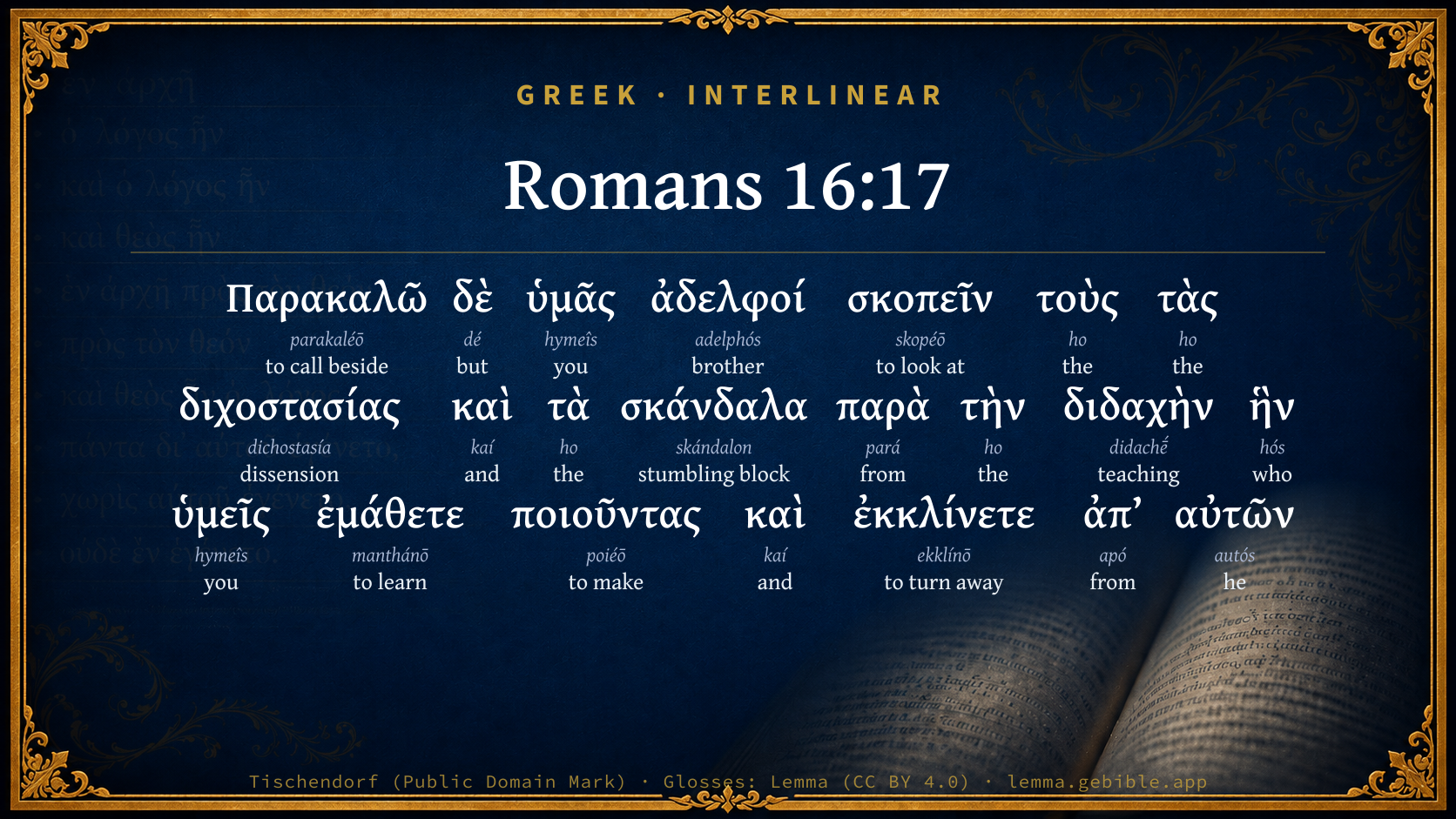
  1. Παρακαλῶ parakaléō G3870 “to call beside” Verb, Present, Active, Indicative, 1st person, Singular
  2. δὲ dé G1161 “but” Conjunction
  3. ὑμᾶς hymeîs G5210 “you” Personal pronoun, 2nd person, Accusative, Plural
  4. ἀδελφοί adelphós G80 “brother” Noun, Vocative, Plural, Masculine
  5. σκοπεῖν skopéō G4648 “to look at” Verb, Present, Active, Infinitive
  6. τοὺς ho G3588 “the” Article, Accusative, Plural, Masculine
  7. τὰς ho G3588 “the” Article, Accusative, Plural, Feminine
  8. καὶ kaí G2532 “and” Conjunction
  9. τὰ ho G3588 “the” Article, Accusative, Plural, Neuter
  10. σκάνδαλα skándalon G4625 “stumbling block” Noun, Accusative, Plural, Neuter
  11. παρὰ pará G3844 “from” Preposition
  12. τὴν ho G3588 “the” Article, Accusative, Singular, Feminine
  13. διδαχὴν didachḗ G1322 “teaching” Noun, Accusative, Singular, Feminine
  14. ἣν hós G3739 “who” Relative pronoun, Accusative, Singular, Feminine
  15. ὑμεῖς hymeîs G5210 “you” Personal pronoun, 2nd person, Nominative, Plural
  16. ἐμάθετε manthánō G3129 “to learn” Verb, Aorist, Active, Indicative, 2nd person, Plural
  17. ποιοῦντας poiéō G4160 “to make” Verb, Present, Active, Participle, Accusative, Plural, Masculine
  18. καὶ kaí G2532 “and” Conjunction
  19. ἐκκλίνετε ekklínō G1578 “to turn away” Verb, Present, Active, Imperative, 2nd person, Plural
  20. ἀπ’ apó G575 “from” Preposition
  21. αὐτῶν autós G846 “he” Personal pronoun, Genitive, Plural, Masculine

About this verse

These counts appear in no published source. They are computed here, from the morphology-tagged text and Lemma’s own curated glosses. What Lemma adds →

22
words
17
distinct lemmas
Pauline Epistles
section

Notable vocabulary

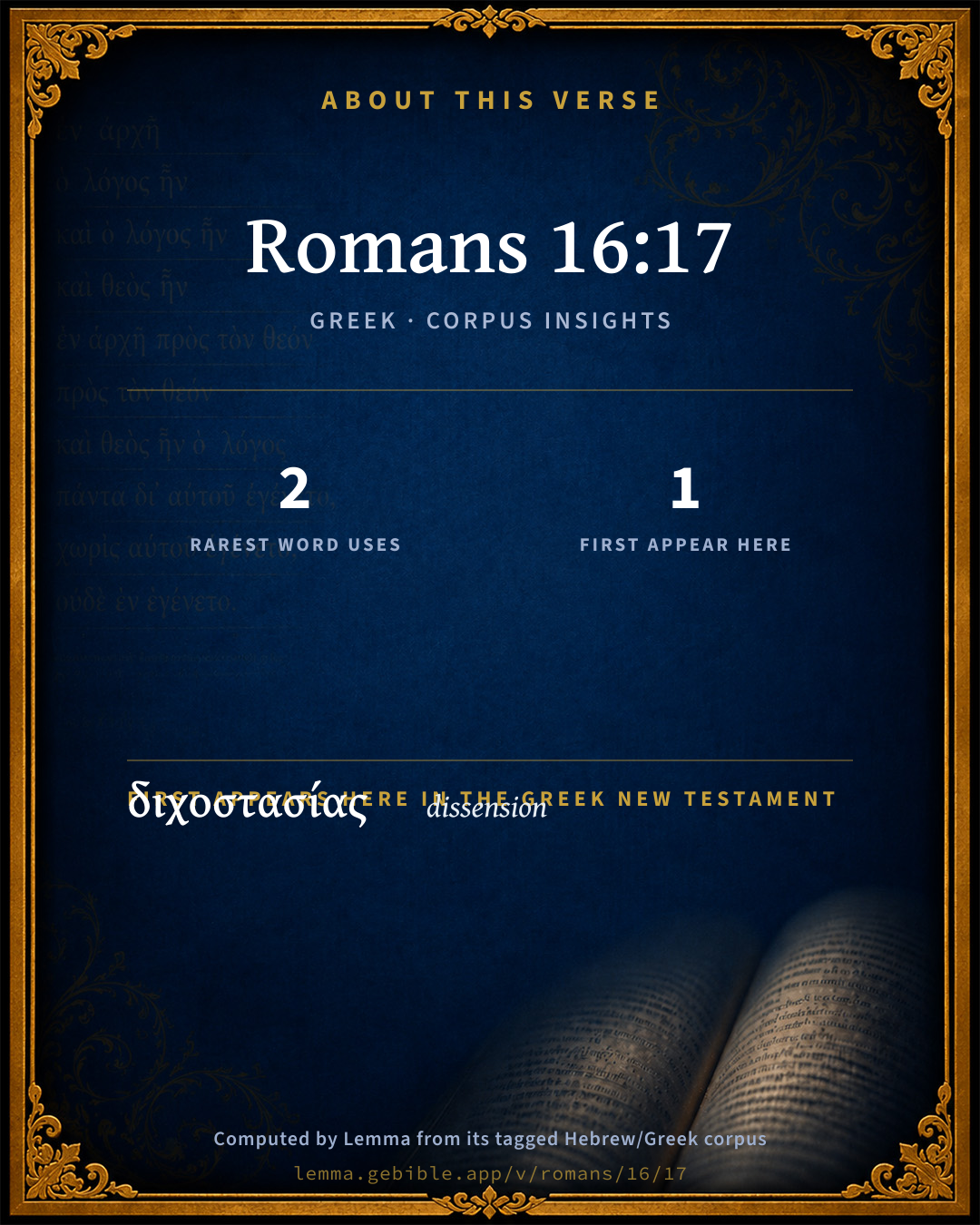
The rarest word here is διχοστασίας dissension G1370 — appearing just 2 times in the whole Greek New Testament.

First appearance in Scripture

This word makes its first canonical appearance in the Greek New Testament here:

  • διχοστασίας dissension G1370

Shared distinctive vocabulary

διχοστασίας dissension G1370 occurs in 2 verses of the Greek New Testament. Also found in:
Repetition

Words recur within this verse:

Cross-references

24

Topical passages linked to Romans 16:17 in the Treasury of Scripture Knowledge — connected by theme and wording, ordered by reader-vote popularity; previews shown in the World English Bible.

  • Jude 1:19 These are they who cause divisions, and are sensual, not having the Spirit.
  • 2 Thessalonians 3:6 Now we command you, brothers, in the name of our Lord Jesus Christ, that you withdraw yourselves from every brother who walks in rebellion, and not after the tradition which they received from us.
  • 1 Timothy 6:3–5 If anyone teaches a different doctrine, and doesn't consent to sound words, the words of our Lord Jesus Christ, and to the doctrine which is according to godliness,
  • 2 Timothy 3:5 holding a form of godliness, but having denied the power thereof. Turn away from these, also.
  • Colossians 2:8 Be careful that you don't let anyone rob you through his philosophy and vain deceit, after the tradition of men, after the elements of the world, and not after Christ.
  • Titus 3:10 Avoid a factious man after a first and second warning;
  • 2 John 1:7–11 For many deceivers have gone out into the world, those who don't confess that Jesus Christ came in the flesh. This is the deceiver and the Antichrist.
  • 2 Thessalonians 3:14–15 If any man doesn't obey our word in this letter, note that man, that you have no company with him, to the end that he may be ashamed.
  • Galatians 2:4 This was because of the false brothers secretly brought in, who stole in to spy out our liberty which we have in Christ Jesus, that they might bring us into bondage;
  • Philippians 3:17 Brothers, be imitators together of me, and note those who walk this way, even as you have us for an example.
  • 1 Timothy 1:3 As I exhorted you to stay at Ephesus when I was going into Macedonia, that you might charge certain men not to teach a different doctrine,
  • Galatians 1:7–9 and there isn't another gospel. Only there are some who trouble you, and want to pervert the Gospel of Christ.
  • Matthew 18:7 "Woe to the world because of occasions of stumbling! For it must be that the occasions come, but woe to that person through whom the occasion comes!
  • 1 Corinthians 5:9–11 I wrote to you in my letter to have no company with sexual sinners;
  • 2 Peter 2:1–2 But there also arose false prophets among the people, as among you also there will be false teachers, who will secretly bring in destructive heresies, denying even the Master who bought them, bringing on themselves swift destruction.
  • Acts 15:24 Because we have heard that some who went out from us have troubled you with words, unsettling your souls, saying, 'You must be circumcised and keep the law,' to whom we gave no commandment;
  • 1 Corinthians 1:10–13 Now I beg you, brothers, through the name of our Lord, Jesus Christ, that you all speak the same thing and that there be no divisions among you, but that you be perfected together in the same mind and in the same judgment.
  • 1 Corinthians 3:3 for you are still fleshly. For insofar as there is jealousy, strife, and factions among you, aren't you fleshly, and don't you walk in the ways of men?
  • Philippians 3:2–3 Beware of the dogs, beware of the evil workers, beware of the false circumcision.
  • Matthew 18:17 If he refuses to listen to them, tell it to the assembly. If he refuses to hear the assembly also, let him be to you as a Gentile or a tax collector.
  • Acts 15:1–5 Some men came down from Judea and taught the brothers, "Unless you are circumcised after the custom of Moses, you can't be saved."
  • Luke 17:1 He said to the disciples, "It is impossible that no occasions of stumbling should come, but woe to him through whom they come!
  • 1 Corinthians 11:18 For first of all, when you come together in the assembly, I hear that divisions exist among you, and I partly believe it.
  • 1 John 2:19 They went out from us, but they didn't belong to us; for if they had belonged to us, they would have continued with us. But they left, that they might be revealed that none of them belong to us.

Cross-references courtesy of OpenBible.info (CC BY 4.0).

Commentary

Notes on Romans 16:17 from classic Christian and Jewish commentators (each source and its license shown beneath its notes). The classic Christian expositions comment on the surrounding passage and are grouped to its opening verse, so a note may address several verses; the Jewish commentaries on the Tanakh (Rashi and others) are per-verse, so they appear only where the commentator wrote on this verse.

Lemma curates 59 commentaries, every one of them public domain or Creative Commons licensed, each selected and text-cleaned for this edition rather than reprinted as found. About our sources →

The Biblical Illustrator

Joseph S. Exell

Rom_16:17-20

Now I beseech you, brethren, mark them which cause divisions.

A caution against schismatics

I. Their character described. They--

1. Cause divisions.

2. Occasion offences.

3. Pervert doctrines.

II. Their principles exposed.

1. Their motives are impure.

2. Their words deceptive.

3. Their victims the simple.

III. Their influence counteracted by--

1. Obedience.

2. Wisdom.

3. Purity.

IV. Their destruction certain. Enemies of the God of peace, they will perish with Satan whom they serve shortly. (J. Lyth, D.D.)

Divisions in the Church arise from a want of Spiritual life

Some of the old Roman walls are compacted with such excellent cement that it would be almost impossible to separate one stone from another; in fact, the whole mass has become so consolidated that you cannot distinguish one stone from another. Happy the Church thus built up, where each cares not only for his own prosperity, but for the prosperity of all. And yet, what are some Churches but semi-religious clubs, mere conventions of people gathered together? They have not in them that holy soul which is the essence of unity. The body would soon become disjointed if the soul were not in it; and if the Spirit of Christ be absent, the whole fabric of the outward Church falls to pieces; for where there is no life there can be no true union. (C. H. Spurgeon.)

Danger of divisions

If two ships at sea, being of the same squadron, be scattered by storm from each other, how should they come to the relief of each other? If, again, they clash together, and fall foul, how should the one endanger the other and herself too? It was of old the Dutch device of two earthern pots swimming upon the water, with this motto, If we knock together, we sink together. (J. Spencer.)

Danger from within the Church

The disposition to grumble seriously threatened the well-being of the Church, it formed the gravest danger it had yet to encounter. The earth is exposed to two perils--the first arises from the storms bearing upon it from without; the second from volcanic forces assailing it from within. Of the two, the most dangerous is the volcanic force: Let the winds break as they will, the earth continues firm under our tread and steadfast in its orbit. But when internal fires burst forth, the earth quakes to its foundations, and the solid rocks shiver and split. The gravest danger to the Church arises from within; it is the spirit of discontent in the members. (S. Jones.)

Danger of dissensions

The Jesuits who came to Germany were called Spanish priests. They took possession of the universities. They conquered us, says Ranke, on our own ground, in our own homes, and stripped us of a part of our country. This, the acute historian proceeds to say, sprang certainly from the want of understanding among the Protestant theologians, and of sufficient enlargement of mind to tolerate unessential differences. The violent opposition among each other left the way open to these cunning strangers, who taught a doctrine not open to dispute. (Hallam.)

Danger of dissension

It is said that when the cranes fall out among themselves, the fight is so fierce that they beat down one another, and so are taken as they fight. (J. Spencer.)

And offences contrary to the doctrine which ye have learned; and avoid them.

True doctrine

The question is not whether a doctrine is beautiful, but whether it is true. When we want to go to a place, we dont ask whether the road leads through a pretty country, but whether it is the right road, the road pointed out by authority, the turnpike-road. (Archdeacon Hare.)

Contagion of false doctrine

Sin is like the bale of goods which came from the East to this city in the olden time, which brought the pest in it. Probably it was but a small bale, but yet it contained in it the deaths of hundreds of the inhabitants of London. In those days one piece of rag carried the infection into a whole town. So, if you permit one sin or false doctrine in a Church knowingly and wittingly, none can tell the extent to which that evil may ultimately go. The Church, therefore, is to be purged of practical and doctrinal evil as diligently as possible. That sour and corrupting thing which God abhors must be purged out, and it is to be the business of the Christian minister, and of all his fellow helpers, to keep the Church free from it. (C. H. Spurgeon.)

Danger of error

Let us beware of the first wrong direction of thought and feeling; however minute the degree, fearful may be the after-deviations. The voyager enters a current which seems propitious; there is no apparent diversion from his course; his bark speeds well; his oar does not toil, nor his sail strain; in his confidence all promises success. But, while he examines, scarcely does it seem that he has advanced. Much again and again reminds him of what he has noticed just before. A strange familiarity impresses his sense. Still, current flows into current; while onward and buoyant is his track. Soon he feels an unnatural vibration. Where he glided, he now whirls along. The truth seizes upon him; he is sweeping a whirlpool. Long since, he has entered the verge of a maelstrom, and he is now the sport of its gyrations. No power is left his helm or mast; he is the trembling, unresisting prey. He hears the roar; he is drawn into the suck of the vortex. Not only the circle lessens, the very surface slopes; the central funnel and abyss, dark-heaving, smooth, vitreous, yawns. The mariner shrieks, the skiff is swallowed up, where the waters only separate to close, where the outermost attraction was but the minister to the famine of this devouring maw. (R. W. Hamilton, D. D.)

Separation: lawful and unlawful

To separate such as agree in the truth of Christ is an impious and sacrilegious divorce; but to defend a conspiracy for promoting lies and impious doctrines, under the pretext of peace and unity, is a shameless calumny. The Papists have no foundation for exciting, by artful guile, an unfavourable impression and low opinion of us believers, from this passage; for we do not attack and confute the gospel of Christ, but the falsehoods of the devil by which it has hitherto been obscured. (J. Calvin.)

For they that are such serve not our Lord Jesus Christ, but their own belly.--

Dividers and heretics

1. Their motive.

2. Their procedure.

3. Their victims.

Dividers and heretics

I. Their characteristics.

1. They serve not the Lord Jesus.

(1) Their motive and profession was insincere. Our motive in religious matters to be carefully examined. Satan often served in Christs uniform.

(2) Christ is entitled to our service--

(a) As God.

(b) As Mediator.

(c) From gratitude to Him and obedience to the Divine command.

(3) To serve Christ is--

(a) To aim at His glory.

(b) To promote His interest.

(c) To do His will.

(4) Christ is to be served with all our powers.

2. They serve their own belly. Merely to get a living and for their own personal gain (2Co_11:12; 2Co_11:20; Php_3:18-19; Gal_6:12; Tit_1:10-11). Private interests served under the pretence of Christian zeal. Men can make a gain of godliness instead of making godliness a gain.

II. Their methods.

1. Good words. Pretending a great interest in your welfare (Psa_55:21). Satan transferred into an angel of light (2Co_11:14-15).

2. Fair speeches, lit. blessing; a stronger word than the former. Speaking well of you; promising well to you. Having mens persons in admiration for advantage (Jud_1:16). Showing not only a bland spirit, but an affected piety. The foulest errors are often introduced under the fairest promises. Satan is a skilful fowler and knows well how to set his snare. Soul destroyers are remarkable for seductive address (Gen_3:2, etc.; 2Co_11:3). Flatterers should be always suspected. Sweet tastes are not always wholesome.

III. Their effects.

1. Deceiving. Deceived themselves they seek to deceive others. Deceiver, Satans most characteristic title (Joh_8:44; Rev_12:9). He practises his deception through his deceived followers. Deceivers more to be feared than open persecutors.

2. The simple, innocent, unsuspecting, inexperienced--those who are not sufficiently guarded and grounded in the truth. More distinguished for honesty than penetration; without malice themselves and suspecting none in others, and so the natural prey of designing men (2Pe_2:14; 2Ti_3:6). (T. Robinson.)

Difficult detection

The French have grown so clever at imitating pearls, that a jeweller in the Exhibition shows a necklace which purports to be a mixture of true pearls and false; and he challenges his customers to single out the real ones if he can. Nobody has yet succeeded We are told that there is only one way by which they can be detected, and that is by their specific weight; the false are much lighter than the real pearls. (C. H. Spurgeon.)

For your obedience is come abroad unto all men.--

Obedience of faith

1. Consists in a hearty reception of the gospel and compliance with its teachings.

2. Is a source of great satisfaction to every faithful minister.

3. Needs to be confirmed by wisdom and simplicity. (J. Lyth, D. D.)

But yet I would have you wise unto that which is good, and simple concerning evil.--

Accessories to obedience

But yet. Obedience is good, but needs to be guarded. Teachableness needs discretion for its companion. Pliable tempers require a double guard. The greater the grace received the more need of caution. The richest vessels carry the strongest convoys. Living Churches and Christians Satans most coveted prey. Holy joy in others leads to holy jealousy over them (2Co_11:2).

I. Wise unto good. Wisdom is to know what is good, to embrace it, to hold it fast, to practise it, and to promote it. It includes understanding, discrimination, prudence, and discretion, and is necessary to avoid being ensnared by the crafty. The Roman Christians had already perhaps been none too cautious. The good includes doctrine, practice, and experience. The highest wisdom is to know the will of God and to do it, and the most profitable that which makes us wise unto salvation.

II. Simple concerning evil.

1. Simplicity is--

(1) Harmlessness; like an animal without horns. Believers, in respect of evil, are to be as children (1Co_14:20), wise as serpents but harmless as doves (Mat_10:16).

(2) As contrasted with wise--without cunning, dexterity, or skill. Unknowing and unpractised in the ways of evil; ignorant of the depths of Satan (Rev_2:24).

2. Evil is--

(1) Moral, i.e., sin.

(2) Harm done to others. (T. Robinson, D. D.)

True religion

If this Epistle had been lost in the streets of Rome, and had been picked up by some Roman philosopher, after reading all the wonderful things which would have filled his mind with amazement, I think he would have called this a golden sentence. What a comprehensive and beautiful wish.

I. The characteristics of true religion.

1. Wise to that which is good includes--

(1) An intelligent comprehension of the nature of acceptable goodness, which is neither morality without religion nor religion without morality. It is neither secular virtue without any root in religious faith, nor is it the mere profession of religious truth, or the mere enjoyment of religious excitement, or the mere attention upon religious ceremonies distinct from real, downright morality of life. These two things must be combined; and then there is a perfection about the human character that the man who has to do with God cannot but have to do with man under the influence of feelings that belong to God.

(2) The application of this knowledge to practical life; for wisdom is the practical application of knowledge. To be wise unto that which is good is to see to it that the principle of religious faith shall be the root and spring of holy moral action. Yet how many professors are very knowing as to the theory, but want the wisdom of the manifestation of the thing as a practical law.

(3) The being alive to whatever will promote or retard this. Most men are like horses to a chariot, one dragging and another backing, one starting aside and another standing still. But where there is a predominant principle, it will subordinate everything to itself, and make obstacles stepping-stones to the object. Now, if a Christian man has for his ruling principle a desire to advance in acceptable goodness, and if he is wise in relation to it, he will be alive to favourable circumstances. Aye, and how wise such a man will become in relation to self-knowledge! He will draw upon his memory and upon his experience. From past failures he will draw principles of caution. He will be wise to understand his weakness as well as his strength, and, guarding against weakness and seeking to increase strength, there will be a practical wisdom perpetually manifested in the way in which he will seek to improve opportunities and avoid hindrances.

(4) Promptitude and tact in doing good. And the man that is really wise to that which is good will acquire a talent for saying and doing things without giving the least offence, leaving an impression upon men which shall lead them to God.

2. Simple concerning evil.

(1) The happy simplicity of ignorance. Often the knowledge of evil is evil, and many a man has lived to regret that he has had any acquaintance with it.

(2) Perfect candour, guilelessness, simplicity of purpose and manner and language. How unenviable is the reputation of some men, who seem to be perpetually acting upon the principle of language being given to conceal the thoughts. It is painful to have to do with such people.

(3) Thinking no evil of our brother. Some men are ever suspecting and acting with every man as if he might one day be an adversary. Let us have more faith in one another. Even though we may sometimes be deceived, still do not let us give up faith in man.

(4) Steady simplicity of purpose in the resistance of evil. Man cannot say with his Master, The evil one cometh and hath nothing in me; but by the grace of God there must be perfect clearness of character, unspottedness from the world. No paltering with evil, but a manly front, arising from the rectitude of purpose, with which we desire to glorify God.

II. The way in which we may seek to realise it.

1. Frequent, deep, and devout meditation upon the ultimate object of religion. That object is not numbers, faith, profession, religious pleasure, all this it gives, but it gives and demands something more. Everything is to terminate in more and more practical fruits of the Spirit and a holy likeness to the God that gave it. Now Christian men should meditate upon it, and that would aid them in realising it.

2. Steady, constant, and conscientious use of the means of grace as means. Not to find the end in the mere coming in contact with the means, and in the pleasure which they produce; but to use these things as means to strengthen and nourish faith, holy feeling, and motives, and to lead the man from the Church into the family and all the thoroughfares of the world, there to act and to live out the principles which the means of grace cherish and strengthen within him.

3. Act the text. The really doing a good thing has a happy reflex operation, both upon a mans understanding and heart. Get over some suggestion of selfishness or feeling of revenge, go and forgive thy brother, or visit the wretched and poor, go with simplicity of purpose and desire to manifest thy love; and then come and read thy Bible. It is wonderful how beautiful thou wilt perceive the truth to be; and how every word from that very preparation of the heart will come with power upon thy soul, and strengthen within thee every holy purpose. But come from your hours of dissipation, your places of frivolous amusement, come after actually committing some act of violence, and read thy Bible; how it will strengthen the sceptic within thee! how it will cloud thine eye! how it will make thee find reasons, or attempt to find them, for denying and disbelieving this Divine thing!

Conclusion:

1. Not only is the gospel pre-eminently a practical thing, but, whether Christianity be true or false, it will be blessedness to the world for its spirit to become practically universal.

2. Christianity bears upon it, in these attributes, the indications of the source from which it comes. Take the character that the world admires; why, if that spirit were to become universal, if there were nothing to counteract it in the virtues of Christian men, the world would become like the infernal pit.

3. Admitting that a great many Christians are far inferior to the demands of the Book, a vast many of them are superior to the world. The fruits of the Spirit do appear in some degree; and after all, what would the world be if there were not a Christian Church with a Bible in it in the midst of them? (T. Binney.)

The Biblical Illustrator, edited by Joseph S. Exell (c. 1880s–1900s) — public domain. Text from a community e-Sword module.

Joseph Benson's Commentary

Rom 16:17-18. Now I beseech — Παρακαλω, I exhort you, brethren, mark them — Observe and point them out for the caution of others. The word σκοπειν, rendered to mark, signifies, to observe attentively and diligently, as those do who are placed on a watch-tower to observe the motions of their enemies. Who cause divisions — Or, separations, as διχοστασιας signifies, namely, by their false doctrine; and offences — Τα σκανδαλα, stumbling-blocks, or occasions of falling, by their factious spirit and scandalous conduct. Dr. Hammond thinks the apostle refers to the Gnostics, to whom indeed the characters, given in the next verse, of those here meant, do well agree. It is more probable, however, as Theodoret says, that he intends, τους κακους του νομου συνηγορους, the wicked advocates of the law, namely, those who preached up circumcision, and the observation of the ceremonies of the law, as necessary to the salvation of the Gentiles: and Chrysostom, Œcumenius, and Theophylact, agree with Theodoret in this opinion. And it is certain that these men caused divisions and separations from others, as unclean and not fit to be conversed with, Act 11:3; Act 15:24; Gal 2:12-13; Gal 2:21: and set up separate assemblies for the worship of God, (see Jdg 1:19,) on pretence of greater orthodoxy and sanctity than others, and who would admit none into their communion but such as joined them in their peculiarities, and who represented all others as erroneous and impious. Contrary to the doctrine which ye have learned — Of us, the apostles of Jesus Christ, or from me in this epistle. Many of the Roman brethren, probably, had heard the apostles and other inspired men in Judea and elsewhere, from whom they had learned the genuine doctrines of the gospel. Estius justly observes here, that the apostle intimates that even the common people, by the help of general principles, might discern the true doctrine, even that which was delivered by the apostles, from that which was false and not so delivered. But this could only then be done by comparing that which was declared by the apostles, and confirmed by their miracles, with that which was delivered as different from, or in opposition to it, and was not so confirmed. And this can only now be done by private Christians in general, by comparing all pretenders to the apostle’s doctrine, with those Scriptures which they wrote, under the influence of the Holy Ghost. And avoid them — Avoid all unnecessary intercourse with them. “It is worthy of notice,” says Macknight here, “that the apostle desires the faithful to mark them who caused divisions, not for the purpose of disputing with them, and far less for the purpose of apprehending and punishing them with fines, imprisonment, torture, and death; but that they might avoid their company, lest, by conversing familiarly with such, they should be infected with their errors and vices. For, as the apostle told Timothy, 2Ti 2:17, their word eats as doth a canker, or gangrene.” For they that are such serve not our Lord Jesus; they have not his glory in view, whatever they may pretend: but their own belly — Their chief aim and design is to advance their secular interests, and gratify their carnal desires. And by good words — Χρηστολογιας, by speaking kindly, or by plausible discourse, and fair speeches — Ευλογιας, by blessings; by praying for, or pronouncing blessings upon their disciples, or by praising and flattering them; deceive the hearts of the simple — Των ακακων, of the harmless, who, doing no ill themselves, are not upon their guard against them that do. The word denotes persons free from guile, upright and unsuspicious; but who have not discernment or prudence sufficient to enable them to see and avoid the snares which the wicked lay in their way.

Joseph Benson's Commentary on the Old and New Testaments (1811–1818) — public domain. Text from a community e-Sword module.

Whedon's Commentary on the Bible

Daniel D. Whedon

5. Interposed warning against dividers and offenders, Rom_16:17-20.

In the midst of greetings a warning! For in the midst of brethren is, or soon may be, the deceiver. St. Paul states not any particular heresy, but he warns against all characters that seek to divide them who are now truly united in the way of truth.

17. Mark—Closely scrutinize, set your steady eye upon them.

Divisions— The separating into parties doctrinal, ethical, or secular.

Offences— Occasions to sin.

Doctrine—Teachings, both as to truth and as to conduct.

Learned—From their religious teachers thus far. It is plain that this Church is as yet truly Pauline in its views and feelings.

Daniel D. Whedon (gen. ed.), Commentary on the Old and New Testaments (1874–1909) — public domain. Text from a community e-Sword module.

The Preacher's Complete Homiletical Commentary

Joseph S. Exell (gen. ed.)

CRITICAL NOTES

Rom_16:17.—No argument here for tradition or the inquisition. For even common people may discern true doctrine from false. We must seek for light on God’s revealed word.

MAIN HOMILETICS OF THE PARAGRAPH.—Rom_16:17-19

Mark the separatists.—It is to be borne in mind that there are separatists and separatists. Separation is not in itself a crime; some of the movements which have been most beneficial to mankind have been caused by separatists whose names have been cast out as evil. Jesus Christ Himself was a separatist, and was crucified as a destroyer of ancient customs; St. Paul was a separatist, and the Jewish Church regarded him with disfavour. On the separatist is thrown the onus probandi. If he can show worthy cause for the step he has taken, well and good; but if not, we must mark him and avoid.

I. Mark the separatist as to:

1. His doctrine. Is it contrary to, is it out of harmony with, the received doctrine? This question supposes that the doctrine which we have learned is the truth, and that is older than the hills, coequal with the divine existence. The novelty of a doctrine is rather a primâ facie argument against than for its truth, though unsound minds eagerly accept a doctrine simply because it is novel. Creeds are to be exploded, not because they are unsound, but because they are old-fashioned. Bread is an old-fashioned article of food, but it still holds a place amid most luxurious modern banquets. Mark the new doctrine; examine its claims; but do not be like some hosts, who always appear ready to smile upon a fresh face.

2. His style of delivery. In these days style is all-important. The manner in which the thing is dressed is quite as impressive as the thing. A flowing writer commands attention. What do we care about thought, if we are only charmed with glowing periods? A graceful speaker will win the modern audience, and lead captive silly souls; the man who with good words can put his own conduct in a rosy light, and by fair speeches can deceive and flatter the hearts of his hearers, will easily cause divisions and offences. We love good style, but we ask that it be the exponent of good and true doctrine.

3. His motive force. Is he serving the Lord Jesus Christ, or his own belly? There was not very much to be gained in the way of earthly good on either side in those early times. Perhaps there was the promise of gain on the side of ungodliness—that is, against the doctrines taught by the apostles. It is always difficult to judge motives; but if a man lose money, fame, influence, position, by his advocacy of certain doctrines, we may be persuaded that he, at all events, feels that they contain truth. So far he proves his sincerity.

II. Resist the separatist:

1. By obedience. The simple man, rough in speech and rude in manners it may be, will not be able to withstand the man of honeyed words and flattering speeches. But the obedient soul, however simple, will be made strong. Obedience is better than eloquence; the willing and the obedient shall eat the good of every land, intellectual and moral. Stand in the strong tower of obedience, and no weapon thrown by seductive besiegers shall do any damage.

2. By wisdom towards the good. We are asked, What is the good? We reply that the good is the morally fit and proper; the good is marked out by the noblest men of the past. What the All-good tells me is good I believe; what the Bible positively declares to be good I believe; what my enlightened conscience affirms to be good, and in the practice of which I find peace and rest, I joyfully accept.

3. By simplicity concerning evil. Some people are simple enough concerning evil; they are easily caught and victimised; the honey beguiles, and they are ignorant of the sting which it encloses. Notwithstanding the advance of education and of science and of a free press, the simplicity of many modern souls is most amusing. After all, it may be that the simplicity of the cheated is better than the duplicity of the cheater: the simplicity of the good may excite the laughter of the fast men, but while it may occasion some mistakes, it will in the long-run keep them in the safest pathway.

SUGGESTIVE COMMENTS ON Rom_16:19

What obedience does.—In the concluding chapter of this epistle St. Paul warns against such doctrines and practices as militate against a true and pure Christianity, which he styles “the doctrine which ye have learned,” and properly characterises the teachers and promoters of false doctrines as intent on serving themselves. But to those who had given up idolatry and committed themselves fully to the service of the one true God, through the grace of Christ our Lord, he says, “Your obedience is come abroad unto all men”—i.e., is generally known, for it could not be otherwise.

I. This obedience came by hearing, as the word itself implies.—“Faith cometh by hearing, and hearing by the word of God.” Hearing, to be profitable, must be serious, attentive, and conscientious. There must be a desire to learn, to profit, and to do what is seen to be good and right. Obedience to the teaching of the gospel of Christ, to be acceptable, must proceed from repentance, be inspired by faith, and be animated by the love of God, through the influence of divine grace. The obedience of the early Christians prompted them to meet the most fearful trials, and in many cases to endure martyrdom itself. The case of the martyrs at Sebaste, under the emperor Licinius, A.D. 320, well illustrates this obedience of faith in the last extremity. They were condemned to stand naked on a frozen lake during a night of bitter cold, though if any were willing to renounce Christ, they might go into a tent or cottage on the shore, where they would find food, clothing, light, and fire. In the middle of the night two men perishing with cold presented themselves at the door of the hut, and found relief and refreshment at the expense of faith and duty; but the centurion himself, with a faithful companion, went out and took the place of these two, and when the sun arose the exact number of the condemned was complete, made perfect through fearful suffering, “faithful unto death.” Our obedience is to be continued through “all the changes and chances of this mortal life,” and is to be “a light shining in a dark place.”

II. The obedient are wise unto that which is good.—They learn to distinguish “good” in reality from good only in name and appearance. To them nothing is good which has not its origin in right principle. Hence corrupt maxims, deceitful habits, and selfish purposes are avoided and hated. “Their eye is single, and their whole body full of light.” “Their eyes look right on.” They do not escape adversity, but are assured it will turn to their advantage, here or hereafter: in trial they find compensations, and in the deepest affliction the comfort of divine love. They walk on steadily, rejoicing in the presence of their Master and in the expectation of eternal blessedness. “The wisdom which is from above is theirs,” and leads them above all things to do the will of their Father in heaven. They have one aim, to keep as far as possible the words of Christ: “Be ye therefore perfect, even as your Father which is in heaven is perfect.” And so, adding grace to grace, they daily approach nearer the standard they have in mind. A friend once visited the studio of Michael Angelo, and saw him engaged on one of his great statues. In a month or two he came again, and thought that the artist had made no progress; but Angelo pointed out a line here and a wrinkle smoothed out there, when the friend said, “True; but these are but trifles.” When the great artist replied, “Trifles make perfection; but perfection is no trifle.”

III. The obedient are simple as concerning evil.—Their motives are unmixed; for so the word translated “simple” primarily means. They are not like the animal which looks up with one eye and down with the other. They realise the impossibility of serving both God and mammon. They are what they seen. They eschew

“hypocrisy,

The only ill that stalks abroad unseen by men or angels;

But goodness thinks no ill where no ill seems.”

“In simplicity of godly sincerity they have their conversation [i.e., their behaviour] in the world.” The plans, plots, and devices of the worldly enter not, should not enter, into their thoughts, or ever be entertained by them. “They avoid evil, turn from it, and pass away.” And as they hate evil, the baleful effects of evil shall not permanently affect them, and swift-winged calamity shall turn away from them. They must, however, know something of the world in order to be safe—“wise as serpents, but harmless as doves”; but they pray and endeavour to escape evil, to be delivered from its tyranny and power, “hating even the garment spotted by the flesh.”—Dr. Burrows.

ILLUSTRATIONS TO CHAPTER 16

Rom_16:17-18. Archbishop Tait on divisions.—Speaking at the Swansea Church Congress, Archbishop Tait said: “It is now many years since, I remember, this happened to me: I was travelling a whole day in the mail in company, as it happened, with a great historian, politician, and literary man, well known in that day, and well remembered still, who had then but recently returned from a lengthened sojourn in India. We were talking of the divisions which at that time distracted the kingdom of Scotland in religious matters; and he said, ‘When a man has lived a long time in a country in which people worship cows, he comes to think less of the divisions which separate Christians.’ I presume there was a great moral lesson in this random saying. I confess it made a great impression on my heart. I have never forgotten it, and it has been the endeavour of my life to profit by it. A godly bishop said to me once of a brother as godly as himself, but much given to controversy, ‘Poor man, he is always writing about the three orders of the ministry, when those to whom he is writing are doubting whether there be a God in heaven.’ ”

The Preacher's Complete Homiletical Commentary (gen. ed. Joseph S. Exell; Funk & Wagnalls, c. 1892) — public domain (pre-1929). A full-Bible homiletical/sermon-outline anthology covering 65 of 66 books (2 John is absent from the source module). Text from a community e-Sword module.

Tyndale Open Study Notes

Tyndale Open Resources

16:17 people who cause divisions: Paul had trouble with divisive false teachers elsewhere (see Galatians, Colossians, 1 Timothy), so he warned the Roman church about this danger.

Tyndale Open Study Notes — © Tyndale Open Resources, licensed CC BY-SA 4.0. Text via the HelloAO Bible API.

Bengel's Gnomon

Johann Albrecht Bengel

Rom 16:17. Ἀδελφοὶ, brethren) While he is embracing in his mind, in Rom 16:16, the churches of Christ, exhortation suggests itself incidentally; for when it is concluded in the form of a parenthesis, they, who send salutations, are added to those, who receive them: Rom 16:21.—τοὺς τὰς) There were therefore such men at Rome. The second epistle to the Thessalonians, which was written before this to the Romans, may be compared, ch. 2—τὰς διχοστασίας, divisions) by which [what is even] good is not well defended.—ταʼ σκάνδαλα, offences) by which [what is positively] evil gains admittance.—ἐμάθετε, ye have learned) To have once for all learned constitutes an obligation, 1Co 15:1; 2Co 11:4; Gal 1:9; Php 4:9; 2Ti 3:14.—ἐκκλίνατε) comp. στέλλεσθαι, 2Th 3:6; παραιτοῦ, Tit 3:10; comp. 1Co 5:11; 2 John Rom 16:10. There was not yet the form of a church at Rome. The admonition therefore is rather framed so as to apply to individuals, than to the whole body of believers. There is however a testimony regarding the future in this epistle to the Romans, as the Song of Moses was a rule to be followed by Israel.

Bengel's Gnomon of the New Testament — English translation (T&T Clark, Edinburgh, 1860) — public domain. Text from a community e-Sword module.

Meyer's Critical & Exegetical Commentary

Heinrich August Wilhelm Meyer

Rom_16:17. Σκοπεῖν] to have in view, in order, namely, to guard against; comp. βλέπετε, Php_3:2; but σκοπεῖν, speculari, is stronger, comp. also Php_3:17.

τὰς διχοστ.] comp. Gal_5:20; 1Ma_3:29; Dem. 423. 4; Plat. Legg. i. p. 630 A; Dion. Hal. viii. 72. The article denotes those anti-Pauline divisions and offences, σκάνδαλα,i.e. temptations to departure from the true Christian faith and life, well known to the readers,which at that time arose in so many quarters in Pauline churches, and might readily threaten the Romans also.

ἐκκλίνατε ἀπʼ αὐτῶν] turn away from them, shun them, go out of their way. Comp. 1Pe_3:11; Psa_119:102; Sir_22:11; Thucyd. v. 73. 3; more usually with the accusative. Grotius rashly concludes: non fuisse tunc conventus communes aut presbyterium Romae; alioquin voluisset tales excommunicari. Paul rather counsels a rule of conduct for each individual member of the church, leaving the measures to be adopted on the part of the church, in case of necessity, to the church-government there (which was one regularly organized, in opposition to Bengel, see Rom_12:6 ff.). The disturbers, besides, against whom they are warned, are in fact viewed not as members of the church, but as intruders from without. Comp. Act_15:1; Gal_2:4.

The reference to the doctrine received certainly implies a church having Pauline instruction, but not exactly one founded by Paul himself (Ewald), like that at Ephesus. Comp. Rom_6:17; Col_1:23.

Rom_16:17-20. A warning, added by way of supplement, against the erroneous teachers who were then at work. This very supplementary position given to the warning, as well as its brevity, hardly entering at all into the subject itself (comp. on the other hand, the detailed treatment in chap. 14 15 of a less important contrast), evinces that Paul is not here speaking, as Wieseler, following older interpreters, holds, against such as already were actually making divisions in Rome. He would have treated so dangerous an evil in the doctrinal connection of the epistle and at length, not in such a manner as to show that it only occurred to him at the close to add a warning word. Hence this is to be regarded as directed against an evil possibly setting in. Doubtless he was apprehensive from the manifold experience acquired by him, that, as elsewhere (comp. Gal_3:6; Gal_3:11 ff.; Col_2:8 ff.; Php_3:2 ff., Php_3:18-19; 2Co_11:13 ff.), so also in Rome, Jewish zealots for the law[48] might arise and cause divisions in their controversy with Pauline Christianity. This occasioned his warning, from which his readers knew to what kind of persons it referred,a warning, therefore, against danger, such as he gave subsequently to the Philippians also (Philippians 3), to whom the evil must have been all the nearer. Paul might, however, the more readily consider it enough to bring in this warning only supplementary and briefly, since in Rome the Gentile-Christian element was the preponderant one, and the mind of the church in general was so strongly in favour of the Pauline gospel (Rom_16:19-20; Rom_6:17), that a permanent Judaistic influence was at present not yet to be apprehended. How, notwithstanding, an anti-Pauline doctrinal agitation took place later in Rome, see Php_1:15 ff. Moreover, the precautionary destination of our passage, and that in presence of the greatness of the danger, is sufficient to make us understand its contents and expression as well as its isolated position at the close. At least there does not appear any necessity for setting it down as an original constituent portion of an epistle addressed to a church founded by Paul himself, namely, to the church of the Ephesians (Ewald, Lucht).

[48] The brief indications, vv. 17, 18, do not suggest philosophical Gentile-Christians (Hammond, Clericus), but (see on ver. 18) Judaizers, against whom Paul offers his warning. Hofmann prefers to abide by the generality of the warning, whether the troubles might be of Gentile origin or might arise from doctrines of Jewish legalism. But this view does not satisfy the concrete traits in vv. 17, 18, 20. See the correct interpretation already in Chrysostom and Theodore of Mopsuestia. The latter says: λέγει δὲ περὶ τῶν ἀπὸ Ἰουδαίων, οἳ ἁπανταχόσε περιϊόντες τοὺς ἀπὸ ἐθνῶν πιστεύοντας τῆς νομικῆς ἔχεσθαι παρατηρήσεως πείθειν ἐπειρῶντο.

Meyer — Critical and Exegetical Commentary on the New Testament — English translation by Peter Christie, edited by Frederick Crombie (T&T Clark, 1880) — public domain. Text from a community e-Sword module.

Expositor's Greek Testament

ed. W. Robertson Nicoll

Rom 16:17-20 . Warning against false teachers. This comes in very abruptly in the middle of the greetings, and as it stands has the character of an after-thought. The false teachers referred to are quite definitely described, but it is clear that they had not yet appeared in Rome, nor begun to work there. Paul is only warning the Roman Church against a danger which he has seen in other places. There is a very similar passage in Phi 3:18 f., which Lightfoot connects with this, arguing that the persons denounced are not Judaising teachers, but antinomian reactionists. It is easier to see grounds for this opinion in Philippians than here: but chap. Rom 6:1-23 may be quoted in support of it.

Rom 16:17 . σκοπεῖν : to keep your eye upon, either as an example to be followed (Phi 3:17 ), or (as in this case) as a peril to be avoided. τοὺς τὰς διχοστασίας καὶ τὰ σκάνδαλα ποιοῦντας : both the persons and their conduct are supposed to be known; “ the divisions” and “ the scandals,” which had been occasioned in other Churches, are assumed to be familiar to the Romans. τὰ σκάνδαλα refers more naturally to conduct which would create a moral prejudice against the Gospel, and so prevent men from accepting it, than to any ordinary result of Jewish legal teaching. But if the latter caused dissension and generated bad tempers in the Church, it also might give outsiders cause to blaspheme, and to stumble at the Gospel (Rom 14:13 ; Rom 14:16 ). παρὰ τὴν διδαχὴν ἣν ὑμεῖς ἐμάθετε : ὑμεῖς is emphatic, and implies that they at least are as yet untouched by the false teaching. By “the teaching which you received” is meant not “Paulinism,” but Christianity, though the words of course imply that the Roman Church was not anti-Pauline. ἐκκλίνετε with ἀπὸ in 1Pe 3:11 , Pro 4:15 .

The Expositor's Greek Testament, edited by W. Robertson Nicoll (1897–1910) — public domain. Text from a community e-Sword module.

Godet's Commentaries

Frédéric Louis Godet

Vv. 17-20.

In the First Epistle to the Corinthians, the apostle, after a passage of salutations, Rom 16:19-21, stops all at once to address to the church, as in the form of a postscript, a solemn warning (Rom 16:22). It is as if the salutation which he had just written awoke in him once more before closing the feeling of the danger which lies in the way of his readers. It is the same here, with this difference, that at Corinth the danger was present and pressing, as is shown by the whole Epistle, whereas at Rome it is still remote, though inevitable. The tone also of the warning is distinctly different in the two cases; for Corinth a threatening, for Rome a simple putting on their guard in the most affectionate and fatherly tone.

Renan, Weizsäcker, Schultz, agree in thinking that this passage can only have been addressed by Paul to a church which he had himself founded—that of Ephesus, for example. We shall examine their reasons as we study this passage. In the eyes of Baur, Lucht, Volkmar, it is not even St. Paul’s; it falls under the judgment of condemnation which, according to these critics, is due to the two chaps. 15 and 16 mostly or totally.

Critical conclusion regarding the passage, Rom 16:17-20.

The objections of Baur and Lucht to the composition of this passage by the Apostle Paul are of no weight. The only serious question is, whether the warning forms part of the Epistle to the Romans, or whether it was addressed, as is thought by so large a number of our modern critics, to the church of Ephesus. First of all, we have a right to ask how it could have happened that a warning addressed to Ephesus, and which had no force except in relation to those whom it personally concerned, made the journey from Ephesus to Rome, and was incorporated into the Epistle to the Romans? For ourselves, we know no probable explanation of such a phenomenon, nor any example of such a migration. But it is still more the intrinsic reasons which prevent us from holding this supposition. This passage applies more naturally to a church which was not instructed by the apostle personally, than to a church founded by him. He rejoices in its docile attitude to the gospel, as in a thing which he has learned, and the news of which will spread to many other ears than his (Rom 16:19). This is not how one writes to his own disciples. Besides, is it conceivable that he would address to the church of Ephesus, that church within which he had recently passed three whole years, and where he had composed the Epistle to the Galatians and the First to the Corinthians, a passage in which the readers are reckoned as still strangers to the manoeuvres of the Judaizing adversaries, and ignorant of their character? What! Paul pass all this time in this church, between Galatia on the one side and Corinth on the other, and speak to them of those parties as persons against whom they still require to be put on their guard! No, such a warning can only concern a church situated at a distance from the theatre of conflict. This church is therefore quite naturally that of Rome.

If it is so, Weizsäcker’s opinion as to the state of this church and the object of our letter is at once set aside. This critic thinks that the Epistle to the Romans was called forth by the necessity of combating a Judaizing movement which at that very time showed itself in the church. But our passage evidently points to the danger as yet to come. The letter may not have been written without the intention of forearming the church; but it cannot have had the intention of combating the enemy as already present.

Vv. 17, 18. “Now I exhort you, brethren, to mark them which cause [the] divisions and offences contrary to the doctrine which ye have learned; and turn away from them. For these persons serve not Christ our Lord, but their own belly; and by fair speeches and benedictions deceive the hearts of the simple.”

As observed by Hofmann, the apostle had regulated (chaps. 14 and 15) all that related to the internal differences which might exist in the church of Rome. But now the unity of all Christendom has just presented itself vividly to his mind; and remembering the divisions which trouble it in other churches, he thinks that they might penetrate from without into the bosom of this one. He has evidently in view those Judaizers who from Jerusalem had come down to trouble the church of Antioch, who from Syria had followed Paul step by step to Galatia, and even to Corinth, and who would be sure as soon as they heard of a church founded at Rome, to arrive on the spot, seeking to monopolize it for themselves. Facts proved that the anticipation of Paul was well founded. The beginning of the Epistle to the Philippians, written from Rome four or five years after ours, proves the pernicious activity of those fanatical partisans of the law in the church of Rome. Probably the party of the weak, chap. 14, had opened it to their entrance.

The description which follows contains details which are too minute to allow us, with Hofmann, to apply this warning to all false teachers in general, Gentile or Jew.

The article before the words divisions and offences, shows that the apostle has in view facts already known. But it does not follow that they had transpired in the church to which he was writing, as is alleged by those who maintain that this passage cannot have been addressed to the church of Rome. It was enough that these disorders were facts of notoriety in other churches, to warrant St. Paul in speaking as he does. And how could those who had labored with him in the churches of the East, and whom he has just been saluting in such numbers, Aquilas and Priscilla, for example, who had shared with him at Ephesus all the agonies of the great Corinthian conflict, have failed to know intimately the burning enmity with which the apostle was regarded by a certain number of Judeo-Christians? The term divisions refers to ecclesiastical divisions; the term offences, to the moral disorders which had so often accompanied them, particularly at Corinth; comp. 2 Corinthians 10-13

It is entirely false to conclude from the words: “contrary to the doctrine which ye have learned,” that Paul himself was the founder of the church to which this passage was addressed. He would have said more clearly in that case: “which ye learned of me;” comp. Php 4:9. This passage says nothing more than Rom 6:17, where Paul gives thanks “because the Romans have obeyed from the heart the form of doctrine according to which they were taught.” The reference, here as there, is to Paul’s gospel which had been taught to the Romans, not by himself, but by those of his fellow-laborers whom he has just saluted. The teaching opposed to this gospel is the legal system, which, according to this passage, as well as Rom 1:8; Rom 1:11-12, Rom 6:17, and the whole Epistle in general, had not yet got a footing at Rome.

These words are obviously sufficient, if they were really addressed to this church, to overthrow Baur’s opinion as to its composition and tendency. As the expression: to mark, have the eyes open to (σκοπεῖν), refers to an enemy expected rather than present, we must apply the last words of the verse: avoid them, to the time when they shall be present, and shall seek to do their work. Then there will be no need even to enter into communication with them; all that is necessary will be simply to turn the back to them; and why? The following verse answers this question.

Frédéric Louis Godet — Commentaries on Luke, John, Romans, and 1 Corinthians — English translation (T&T Clark, Edinburgh, 1870s–1890s) — public domain. Text from a community e-Sword module.

Hodge's Commentary on Romans, Ephesians & First Corinthians

Charles Hodge

Rom_16:17

Now I beseech you, brethren, mark them which cause divisions and offenses contrary to the doctrine which ye have learned, and avoid them. While he urges them to the kind reception of all faithful ministers and Christians, he enjoins upon them to have nothing to do with those who cause divisions and offenses. There were probably two evils in the apostles mind when he wrote this passage; the divisions occasioned by erroneous doctrines, and the offenses or scandals occasioned by the evil conduct of the false teachers. Almost all the forms of error which distracted the early church, were intimately connected with practical evils of a moral character. This was the case to a certain extent with the Judaizers; who not only disturbed the church by insisting on the observance of the Mosaic law, but also pressed some of their doctrines to an immoral extreme; see 1Co_5:1-5. It was still more obviously the case with those errorists, infected with a false philosophy, who are described in Col_2:10-23; 1Ti_4:1-8. These evils were equally opposed to the doctrines taught by the apostle. Those who caused these dissensions, Paul commands Christians, first, to mark (σκοπεῖν,) i.e. to notice carefully, and not allow them to pursue their corrupting course unheeded; and, secondly, to avoid, i.e. to break off connection with them.

Charles Hodge — Commentary on Romans (1835), First Corinthians (1857), and Ephesians (1856) — public domain. Text from a community e-Sword module.

Geneva Bible (1599)

Geneva Bible translators

As by namely describing them, which were worthy of commendation, he sufficiently declared when they ought to hear and follow, so doth he now point out unto them whom they ought to take heed of, yet he nameth them not, for that it was not needful.

Warily and diligently, as though you should scout out for your enemies in a watch tower.

Geneva Bible (1599) marginal notes — public domain. Text via Bolls.life.

Matthew Henry's Commentary

The apostle having endeavoured by his endearing salutations to unite them together, it was not improper to subjoin a caution to take heed of those whose principles and practices were destructive to Christian love. And we may observe,

I. The caution itself, which is given in the most obliging manner that could be: I beseech you, brethren. He does not will and command, as one that lorded it over God's heritage, but for love's sake beseeches. How earnest, how endearing, are Paul's exhortations! He teaches them, 1. To see their danger: Mark those who cause divisions and offences. Our Master had himself foretold that divisions and offences would come, but had entailed a woe on those by whom they come (Mat 18:7), and against such we are here cautioned. Those who burden the church with dividing and offending impositions, who uphold and enforce those impositions, who introduce and propagate dividing and offending notions, which are erroneous or justly suspected, who out of pride, ambition, affectation of novelty, or the like, causelessly separate from their brethren, and by perverse disputes, censures, and evil surmisings, alienate the affections of Christians one from another - these cause divisions and offences, contrary to, or different from (for that also is implied, it is para tēn didachēn), the doctrine which we have learned. Whatever varies from the form of sound doctrine which we have in the scriptures opens a door to divisions and offences. If truth be once deserted, unity and peace will not last long. Now, mark those that thus cause divisions, skopein. Observe them, the method they take, the end they drive at. There is need of a piercing watchful eye to discern the danger we are in from such people; for commonly the pretences are plausible, when the projects are very pernicious. Do not look only at the divisions and offences, but run up those streams to the fountain, and mark those that cause them, and especially that in them which causes these divisions and offences, those lusts on each side whence come these wars and fightings. A danger discovered is half prevented. 2. To shun it: "Avoid them. Shun all necessary communion and communication with them, lest you be leavened and infected by them. Do not strike in with any dividing interests, nor embrace any of those principles or practices which are destructive to Christian love and charity, or to the truth which is according to godliness. - Their word will eat as doth a canker." Some think he especially warns them to take heed of the judaizing teachers, who, under convert of the Christian name, kept up the Mosaical ceremonies, and preached the necessity of them, who were industrious in all places to draw disciples after them, and whom Paul in most of his epistles cautions the churches to take heed of.

II. The reasons to enforce this caution.

1. Because of the pernicious policy of these seducers, Rom 16:18. The worse they are, the more need we have to watch against them. Now observe his description of them, in two things: - (1.) The master they serve: not our Lord Jesus Christ. Though they call themselves Christians, they do not serve Christ; do not aim at his glory, promote his interest, nor do his will, whatever they pretend. How many are there who call Christ Master and Lord, that are far from serving him! But they serve their own belly - their carnal, sensual, secular interests. It is some base lust or other that they are pleasing; pride, ambition, covetousness, luxury, lasciviousness, these are the designs which they are really carrying on. Their God is their belly, Phi 3:19. What a base master do they serve, and how unworthy to come in competition with Christ, that serve their own bellies, that make gain their godliness, and the gratifying of a sensual appetite the very scope and business of their lives, to which all other purposes and designs must truckle and be made subservient. (2.) The method they take to compass their design: By good words and fair speeches they deceive the hearts of the simple. Their words and speeches have a show of holiness and zeal for God (it is an easy thing to be godly from the teeth outward), and show of kindness and love to those into whom they instil their corrupt doctrines, accosting them courteously when they intend them the greatest mischief. Thus by good words and fair speeches the serpent beguiled Eve. Observe, They corrupt their heads by deceiving their hearts, pervert their judgments by slyly insinuating themselves into their affections. We have a great need therefore to keep our hearts with all diligence, especially when seducing spirits are abroad.

2. Because of the peril we are in, through our proneness and aptness to be inveigled and ensnared by them: "For your obedience has come abroad unto all men - you are noted in all the churches for a willing, tractable, complying people." And, (1.) Therefore, because it was so, these seducing teachers would be the more apt to assault them. The devil and his agents have a particular spite against flourishing churches and flourishing souls. The ship that is known to be richly laden is most exposed to privateers. The adversary and enemy covets such a prey, therefore look to yourselves, Jo2 1:8. "The false teachers hear that you are an obedient people, and therefore they will be likely to come among you, to see if you will be obedient to them." It has been the common policy of seducers to set upon those who are softened by convictions, and begin to enquire what they shall do, because such do most easily receive the impressions of their opinions. Sad experience witnesses how many who have begun to ask the way to Zion, with their faces thitherward, have fatally split upon this rock, which proves it to be much the duty of ministers, with a double care, to feed the lambs of the flock, to lay a good foundation, and gently to lead those that are with young. (2.) Though it were so, yet they were in danger from these seducers. This Paul suggests with a great deal of modesty and tenderness; not as one suspicious of them, but as one solicitous for them: "You obedience has come abroad unto all men; we grant this and rejoice in it: I am glad therefore on your behalf." Thus does he insinuate their commendation, the better to make way for the caution. A holy jealousy of our friends may very well comport with a holy joy in them. "You think yourselves a very happy people, and so do I too: but for all that you must not be secure: I would have you wise unto that which is good, and simple concerning evil. You are a willing good-natured people, but you had best take heed of being imposed upon by those seducers." A pliable temper is good when it is under good government; but otherwise it may be very ensnaring; and therefore he gives two general rules: - [1.] To be wise unto that which is good, that is, to be skilful and intelligent in the truths and ways of God. "Be wise to try the spirits, to prove all things, and then to hold fast that only which is good." There is need of a great deal of wisdom in our adherence to good truths, and good duties, and good people, lest in any of these we be imposed upon and deluded. Be ye therefore wise as serpents (Mat 10:16), wise to discern that which is really good and that which is counterfeit; wise to distinguish things that differ, to improve opportunities. While we are in the midst of so many deceivers, we have great need of that wisdom of the prudent which is to understand his way, Pro 14:8. [2.] To be simple concerning evil - so wise as not to be deceived, and yet so simple as not to be deceivers. It is a holy simplicity, not to be able to contrive, nor palliate, nor carry on, any evil design; akeraious - harmless, unmixed, inoffensive. In malice be you children, Co1 14:20. The wisdom of the serpent becomes Christians, but not the subtlety of the old serpent. We must withal be harmless as doves. That is a wisely simple man that knows not how to do any thing against the truth. Now Paul was the more solicitous for the Roman church, that it might preserve its integrity, because it was so famous; it was a city upon a hill, and many eyes were upon the Christians there, so that an error prevailing there would be a bad precedent, and have an ill influence upon other churches: as indeed it has since proved in fact, the great apostasy of the latter days taking its rise from that capital city. The errors of leading churches are leading errors. When the bishop of Rome fell as a great star from heaven (Rev 8:10), his tail drew a third part of the stars after him, Rev 12:4.

3. Because of the promise of God, that we shall have victory at last, which is given to quicken and encourage, not to supersede, our watchful cares and vigorous endeavours. It is a very sweet promise (Rom 16:20): The God of peace shall bruise Satan under your feet.

(1.) The titles he gives to God: The God of peace, the author and giver of all good. When we come to God for spiritual victories, we must not only eye him as the Lord of hosts, whose all power is, but as the God of peace, a God at peace with us, speaking peace to us, working peace in us, creating peace for us. Victory comes from God more as the God of peace than as the God of war; for, in all our conflicts, peace is the thing we must contend for. God, as the God of peace, will restrain and vanquish all those that cause divisions and offences, and so break and disturb the peace of the church.

(2.) The blessing he expects from God - a victory over Satan. If he mean primarily those false doctrines and seducing spirits spoken of before, of which Satan was the prime founder and author, yet doubtless, it comprehends all the other designs and devices of Satan against souls, to defile, disturb, and destroy them, all his attempts to keep us from the purity of heaven, the peace of heaven here, and the possession of heaven hereafter. Satan tempting and troubling, acting as a deceiver and as a destroyer, the God of peace will bruise under our feet. He had cautioned them before against simplicity: now they, being conscious of their own great weakness and folly, might think, "How shall we evade and escape these snares that are laid for us? Will not these adversaries of our souls be at length too hard for us?" "No," says he, "fear not; though you cannot overcome in your own strength and wisdom, yet the God of peace will do it for you; and through him that loved us we shall be more than conquerors." [1.] The victory shall be complete: He shall bruise Satan under your feet, plainly alluding to the first promise the Messiah made in paradise (Gen 3:15), that the seed of the woman should break the serpent's head, which is in the fulfilling every day, while the saints are enabled to resist and overcome the temptations of Satan, and will be perfectly fulfilled when, in spite of all the powers of darkness, all that belong to the election of grace shall be brought triumphantly to glory. When Joshua had conquered the kings of Canaan, he called the captains of Israel to set their feet upon the necks of those kings (Jos 10:24), so will Christ, our Joshua, enable all his faithful servants and soldiers to set their feet upon Satan's neck, to trample upon, and triumph over, their spiritual enemies. Christ hath overcome for us; disarmed the strong man armed, broken his power, and we have nothing to do but to pursue the victory and divide the spoil. Let this quicken us to our spiritual conflict, to fight the good fight of faith - we have to do with a conquered enemy, and the victory will be perfect shortly. [2.] The victory shall be speedy: He shall do it shortly. Yet a little while, and he that shall come will come. He hath said it, Behold, I come quickly. When Satan seems to have prevailed, and we are ready to give up all for lost, then will the God of peace cut the work short in righteousness. It will encourage soldiers when they know the war will be at an end quickly, in such a victory. Some refer it to the happy period of their contentions in true love and unity; others to the period of the church's persecutions in the conversion of the powers of the empire to Christianity, when the bloody enemies of the church were subdued and trampled on by Constantine, and the church under his government. It is rather to be applied to the victory which all the saints shall have over Satan when they come to heaven, and shall be for ever out of his reach, together with the present victories which through grace they obtain in earnest of that. Hold out therefore, faith and patience, yet a little while; when we have once got through the Red Sea, we shall see our spiritual enemies dead on the shore, and triumphantly sing the song of Moses and the song of the Lamb. To this therefore he subjoins the benediction, The grace of our Lord Jesus Christ be with you - the good-will of Christ towards you, the good work of Christ in you. This will be the best preservative against the snares of heretics, and schismatics, and false teachers. If the grace of Christ be with us, who can be against us so as to prevail? Be strong therefore in the grace which is in Christ Jesus. Paul, not only as a friend, but as a minister and an apostle, who had received grace for grace, thus with authority blesses them with this blessing, and repeats it, Rom 16:24.

Matthew Henry's Commentary on the Whole Bible (1708–1710) — public domain (CC PDM 1.0). Text via the HelloAO Bible API.

Jamieson, Fausset & Brown

Robert Jamieson, A. R. Fausset & David Brown

Now I beseech you, brethren, mark them which cause divisions and offences contrary to the doctrine which ye have learned--"which ye learned."

and avoid them--The fomentors of "divisions" here referred to are probably those who were unfriendly to the truths taught in this epistle, while those who caused "offenses" were probably those referred to in Rom 14:15 as haughtily disregarding the prejudices of the weak. The direction as to both is, first, to "mark" such, lest the evil should be done ere it was fully discovered; and next, to "avoid" them (compare Th2 3:6, Th2 3:14), so as neither to bear any responsibility for their procedure, nor seem to give them the least countenance.

Jamieson, Fausset & Brown — Commentary Critical and Explanatory on the Whole Bible (1871) — public domain (CC PDM 1.0). Text via the HelloAO Bible API.

Adam Clarke's Commentary

Verse 17. Mark them which cause divisions] Several MSS. read ασφαλως σκοπειτε, look sharply after them; let them have no kiss of charity nor peace, because they strive to make divisions, and thus set the flock of Christ at variance among themselves; and from these divisions, offences (σκανδαλα, scandals) are produced; and this is contrary to that doctrine of peace, unity, and brotherly love which you have learned. Look sharply after such that they do you no evil, and avoid them-give them no countenance, and have no religious fellowship with them.

Adam Clarke's Commentary on the Bible (1810–1826) — public domain. Text from a community e-Sword/MySword module.

John Calvin's Commentaries

17. And I beseech you, etc. He now adds an exhortation, by which all Churches have often need of being stirred up; for the ministers of Satan are ever ready to take occasion to disturb the kingdom of Christ: and they attempt to make disturbances in two ways; for they either sow discord, by which the minds of men are drawn away from the unity of truth, or they occasion offenses, by which men are alienated from the love of the gospel. The former evil is done when the truth of God is mixed with new dogmas devised by men; and the latter takes place, when by various arts it is made odious and contemptible. He therefore bids all, who did either of these two things, to be observed, lest they should deceive and catch the unwary; and also to be shunned, for they were injurious. Nor was it without reason that he required this attention from the faithful; for it often happens through our neglect or want of care, that such wicked men do great harm to the Church, before they are opposed; and they also creep in, with astonishing subtlety, for the purpose of doing mischief, except they be carefully watched.

But observe, that he speaks of those who had been taught the pure truth of God. It is indeed an impious and sacrilegious attempt to divide those who agree in the truth of Christ: but yet it is a shameful sophistry to defend, under the pretext of peace and unity, a union in lies and impious doctrines. There is therefore no ground for the Papists to seek countenance from this passage, in order to raise ill-will against us; for we do not impugn and tear asunder the gospel of Christ, but the falsehoods of the devil, by which it has been hitherto obscured: nay, Paul clearly shows, that he did not condemn all kinds of discords, but those which destroyed consent in the orthodox faith; for the force of the passage is in the words, which ye have learnt; for it was the duty of the Romans, before they were rightly taught, to depart from the habits of their fathers and the institutions of their ancestors.

John Calvin's Commentaries (1540-1563) — public domain. Text from the Calvin Translation Society English edition (1840s-50s) via the Christian Classics Ethereal Library (ccel.org). Calvin's coverage is partial (roughly two-thirds of the Bible); uncommented books and verses are honest gaps, never fabricated. The 19th-century editor's footnotes and remarks are omitted so the notes are faithfully Calvin's own voice.

Ellicott's Commentary for English Readers

(17) Cause divisions and offences.—Set traps in the way of the unwary, so as to entice them into false doctrine and schismatical practices.

(17-20) Here the Epistle would naturally end, but an afterthought occurs to the Apostle, His experience of other churches, especially those at Corinth and in Galatia, suggests to him that he should warn his readers against false teachers, though such had not as yet obtained any great hold among them.

A Bible Commentary for English Readers, edited by Charles John Ellicott (1878–1897) — public domain. Text from a community e-Sword module.

The Cambridge Bible for Schools and Colleges

gen. ed. J. J. S. Perowne

17–20. Special warning against certain teachers of error

17. Now I beseech you, &c.] From this ver. to Rom_16:20, inclusive, we have a paragraph or section by itself. It contains a brief but earnest warning against an evil which everywhere beset and encountered the Apostle—the bold or subtle efforts of perverted and perverting teachers, Christians in name. We may gather that this evil was only just beginning at Rome; otherwise more of the Epistle would be given to it.

Bp Lightfoot, in his note on Php_3:18, gives good reason to think that the teachers specially in view here are not Judaizers, but their antipodes—Antinomians. “They (the persons in this passage) are described as … holding plausible language, (Rom_16:18,) as professing to be wise beyond others, (Rom_16:19,) and yet not innocent in their wisdom. They appear therefore to belong to the same party to which the passages Rom_6:1-23, Rom_14:1 to Rom_15:6, of that Epistle [to the Romans] are chiefly addressed.”[48]

[48] We think, however, that the opinions refuted in ch. 6 are not identical with those corrected in cch. 14, 15. In the former case, St Paul makes no compromise; in the latter, as regards abstract principle, he almost identifies himself with those whom he reproves. In the present verse, accordingly, we take the Antinomians whom the Romans are to avoid to be Antinomians in the fullest sense; rejecters of the moral (as well as ceremonial) law in all respects; heretics, in fact, of the type afterwards developed in some forms of Gnosticism,—holding, probably, that the acts of the body were indifferent to the soul. They thus may have coincided with the persons in view in ch. 16, but hardly with those in view in cch. 14, 15.

mark] watch; so as to avoid them. Cp. Php_3:17, where the same word is used with an opposite reference—“watch, so as to follow with them.”

divisions and offences] Strictly, and better, the divisions and the stumblingblocks. He refers to circumstances already well-known in various Churches, and beginning to be felt at Rome.

contrary to the doctrine which ye have learned] Lit. beyond the teaching which you (emphatic) did learn. (“Contrary,” however, rightly represents the Gr.)—The emphasis on “you” seems to indicate that the erring teachers were, or would be, visitors to Rome, not original members of the Roman Church.—“Did learn:”—at the time of their evangelization. On the question, when that time was, see Introduction, i. § 17, 23.

“The teaching they had learned” could admit no real compromise, just because it was, in its origin, “not the word of men, but the word of God.” 1Th_2:13. Cp. Gal_1:6-10.

avoid them] A peaceable but effective way of resistance.—Cp. 2Ti_3:5; 2Jn_1:10. But these parallels are not exact; for the present passage seems to be specially a caution to individual Christians, not to go as learners to the erring teachers.

The Cambridge Bible for Schools and Colleges (gen. ed. J. J. S. Perowne; Cambridge University Press, 1878–1918) — public domain. Text from a community e-Sword module.

John Gill's Exposition

For they that are such serve not our Lord Jesus Christ,.... They do not preach him, but themselves; they do not seek the things of Christ, his honour and glory, the spread of his Gospel, and the enlargement of his kingdom and interest; they seek their own things, worldly honour and applause, riches, wealth, and grandeur; they seek to please men, and so are not the servants of Christ: they introduced the observance of meats and drinks in to the kingdom of Christ, which it do not consist of, and neglected the doctrines of righteousness and peace, from whence springs joy in the Holy Ghost, and so in these spiritual things did not serve Christ; and therefore, as they were not acceptable to God, were not to be approved of by Christian men, but to be marked and avoided:

but their own belly; which they made a god of, and devoted themselves to the service of all their views were to gratify and indulge their sensual appetite. The false teachers among the Jews were particularly addicted to this vice: hence the apostle sometimes calls them dogs, Phi 3:2, on account of their voraciousness, and who, in Isaiah's time, were greedy ones that could never have enough, Isa 56:11; and in our Lord's time devoured widows' houses, under a pretence of long prayers for them, Mat 23:14; and were like the Cretians, evil beasts, and slow bellies, Tit 1:12, unwilling to labour, and lived upon the spoil of others:

and by good words, and fair speeches, deceive the hearts of the simple: they were deceivers; they lay in wait to deceive, made use of the hidden things of dishonesty, walked in craftiness, and handled the word of God deceitfully; and therefore to be marked and avoided: they deceived "the simple", harmless, and innocent, that think no evil, nor are aware of any; who have little understanding of things; persons of weak minds, easy to be imposed upon; very credulous, ready to believe every word, so the simple man does, as Solomon says, Pro 14:15; and such false teachers choose to tamper with, and make their attacks upon, being able to gain upon them the most easily, as their father the devil, the old serpent, did, when he first assailed human nature: the "hearts" of these they deceive; they work upon their affections, blind their understandings, impose on their judgments, and corrupt their minds from the simplicity that is in Christ: and this they do "by good words and fair speeches"; either by making use of the words of Scripture, and a show of arguments taken from thence; so Satan cited Scripture in his dispute with our Lord; and so heretics, in all ages, have pretended toil in favour of their principles, by which means they have gained on many to follow their pernicious ways; or by using words and phrases that faithful ministers of Christ use, such as the grace of God, the righteousness of Christ, the Spirit of Christ, but in a different sense; as some among us now frequently make mention of them, when they mean no more by them than the light of nature within them, and the dictates of a natural conscience; or by an elegant style, a set of fine words, a flow of rhetorical expressions, great swelling words of vanity, which such men generally affect, and so work themselves into the admiration of the common people; or by doctrines suited to the carnal minds and reasonings of men, which tickle human nature, and swell it with pride and vanity; as by preaching up the purity and power of it, asserting man's free will, and the strength of it to that which is good; the capacity of man to keep the law, and perform good works; justification by them before God, and acceptance with him, on account of them; atonement for sins committed, by repentance and reformation; that God does not regard trifling things, some sins are venial, and easily passed over; that concupiscence is no sin; God does not rigorously exact duty, he takes the will for the deed, and is merciful unto all, and if but sincere, there is no doubt of heaven; and such men, generally speaking, instead of correcting vice, and reproving men for their sins, connive at them, indulge them in them, soothe and flatter, commend and defend them, whereby they attach them to their persons and interest.

John Gill's Exposition of the Whole Bible (1746–1763) — public domain (CC PDM 1.0). Text via the HelloAO Bible API.

Trapp's Complete Commentary

John Trapp

17 Now I beseech you, brethren, mark them which cause divisions and offences contrary to the doctrine which ye have learned; and avoid them.

Ver. 17. Mark them which] Set a watchful and a jealous eye upon them, as upon pests and enemies. And here, let not our episcopi (whose office it is chiefly) be aposcopi, overseers, be byseers, but look well to the flock, lest these wolves worry them, Act 20:29.

And avoid them] Gr. εκκλινατε. Decline them studiously, as ye would do a serpent in your way, or poison in your food.

John Trapp, A Commentary or Exposition upon All the Books of the Old and New Testament (1647–1656) — public domain. Text from a community e-Sword module.

Albert Barnes' Notes on the Bible

Now I beseech you - One great object of this Epistle had been to promote “peace” between the Jewish and Gentile converts. So much did this subject press upon the mind of the apostle, that he seems unwilling so leave it. He returns to it again and again; and even after the Epistle is apparently concluded, he returns to it, to give them a new charge on the subject.

Mark them - Observe attentively, cautiously, and faithfully Phi 3:17; be on your guard against them. Ascertain “who are” the real causes of the divisions that spring up, and avoid them.

Which cause - Who make. Probably he refers here to “Jewish” teachers, or those who insisted strenuously on the observance of the rites of Moses, and who set up a claim for greater purity and orthodoxy than those possessed who received the Gentile converts as Christian brethren. The Jews were perpetually thus recalling the Christian converts to the Law of Moses; insisting on the observance of those rites; troubling the churches, and producing dissensions and strifes; Gal 3:1; Gal 5:1-8; Act 15:1, Act 15:24.

Divisions - Dissensions; parties; factions; 1Co 3:3; Gal 5:20. The very “attempt” to form such parties was evil, no matter what the pretence. They who attempt to form parties in the churches are commonly actuated by some evil or ambitious design.

And offences - Scandals; or that give occasion for others to fall into sin. These two things are different. The first means parties; the other denotes such a course of life as would lead others into sin. The “Jew” would form parties, on the pretence of superior holiness; the Gentiles, or some hold Gentile convert might deride the scrupulous feelings of the Jew, and might thus lead him into “sin” in regard to what his conscience really forbade; see Rom 14:15. These persons on both sides were to he avoided, and they were to refuse to follow them, and to cultivate the spirit of unity and peace.

Contrary to the doctrine - To the “teaching” which you have received in this Epistle and elsewhere; the teaching that these divisions should cease; that the Jewish ceremonies are not binding; that all should lay aside their causes of former difference, and be united in one family; see Rom. 14; 15.

And avoid them - Give them no countenance or approbation. Do not follow them; compare 1Ti 6:3-5; 2Jo 1:10; Gal 1:8-9. That is, avoid them as “teachers;” do not follow them. It does not mean that they were to be treated harshly; but that they were to be avoided in their “instructions.” They were to disregard all that they could say tending to produce alienation and strife; and resolve to cultivate the spirit of peace and union. This would be an admirable rule if always followed. Let people make “peace” their prime object; resolve to love all who “are” Christians, and it will be an infallible guage by which to measure the arguments of those who seek to promote alienations and contentions.

Albert Barnes' Notes on the Bible (1834–1885) — public domain. Text from a community e-Sword/MySword module.

Haydock's Catholic Bible Commentary

The apostle does not here say that these men caused scandals, contrary to the Scripture; but contrary to the doctrine delivered to them: this place, therefore, is an argument in favour of tradition. (Estius)

George Leo Haydock (1774–1849), Haydock's Catholic Family Bible and Commentary, 1859 edition — public domain. Excludes Psalms (Douay-Rheims chapter numbering differs from Protestant) and Deuterocanonical books (Catholic canon only).

Matthew Poole's English Annotations

He shuts up the Epistle with a seasonable admonition, which he reserved to the last, that it might be the better remembered: it is, to beware of those that

cause divisions and offences. By the former, some understand those that corrupt the doctrine of the church; by the latter, those that violate the discipline thereof: others refer divisions to faith, and offences to manners. There are that like neither of these distinctions, but, think he only cautions them against church dividers; and mentions scandal or offences as the effect or fruit of church divisions. He seems to aim more especially at those who, together with the Christian faith, did obtrude upon believers the ceremonies of the law, as necessary to salvation; of these he often complains as enemies to the gospel and cross of Christ: see Gal 1:7; Phi 3:2,18,19; Tit 1:10.

Contrary to the doctrine which ye have learned; i.e. that you have learned from those that first taught you and converted you to Christ: q.d. You have been instructed in the true doctrine of Christ; and there are some that would innovate and teach another doctrine, that broach opinions that are contrary, or, at least, beside the doctrine which is pure and apostolical, and so make divisions and factions amongst you: of such as those he speaks what follows.

And avoid them; here are two precepts with respect to innovators and church dividers. The first is, that they should be marked. The word signifies such a marking, as a watchman useth that standeth on a tower to descry enemies; he marketh diligently all comers, and giveth notice accordingly, for the safety of the place. The second is, that they should be avoided, or declined: the like counsel is given, 2Th 3:6,14; 1Ti 6:3-5; 2Ti 3:5; Tit 3:10; 2Jo 1:10. The sum is, the church should excommunicate them, and all sound Christians should turn away from them, and shun their society, that they may be ashamed.

Matthew Poole's English Annotations on the Holy Bible (1683–1685) — public domain. Text from a community e-Sword/MySword module.

The Pulpit Commentary

Now I beseech you, brethren, mark them which cause the divisions and offences (ta skandala , meaning "causes of stumbling." Both the words have the article, so as to denote things known of) contrary to the doctrine which ye learned; and avoid them; rather, turn away from them; i.e. shun them; have nothing to do with them. The allusion seems to be, not to persons within the Church, but rather to outsiders, who come with new notions to disturb its peace.

Vers. 17-20. A last warning.

There might, however, be some advent amongst them of a malign influence that should mar this brotherly love, and he must say one warning word. How had the trail of the serpent been on his path! At Galatia, in Corinth, and elsewhere, false teachers had come in, seeking to undo his work; those Judaizers, who sought to corrupt the young believers from the simplicity of the gospel. And would they not seek to undo the work at Rome? Yes, verily; for the obedience of the Roman Christians had come abroad unto all men, and the tidings of their obedience of faith would be but the signal to these destroyers for a new errand of cunning and greed. He warns them.

I THE WARNING. The work of these false teachers is spoken of first in Act_15:1, where we read, "And certain men which came down from Judaea taught the brethren, Except ye be circumcised after the manner of Moses, ye cannot be saved:" "false brethren," the apostle calls them in Gal_2:4," who came in privily to spy out our liberty which we have in Christ Jesus, that they might bring us into bondage." And the whole of the Epistle to the Galatians, and large part of the Second Epistle to the Corinthians, were occupied in the endeavour to counteract their poisonous representations. Their aim was to make the Gentiles enter the Christian Church by the Jewish door, becoming indeed but an appendage of Judaic Christianity. A yet baser aim, as we learn here, and from 2Co_11:20 and Php_3:2, 19, was their own sensual aggrandizement: they served their own belly. They would come to Rome, for they possessed truly a missionary zeal, without missionary love; they would come to Rome, and "their smooth and fair speech" might easily "beguile the hearts of the innocent." That these presentiments were sadly fulfilled, we learn from Php_1:15-17, and over these false teachers he weeps, as he tells us, in Php_3:18, 19. What was to be the attitude and action of the Romans? The prescription was a simple one: they could tell from their observance of other Churches the fruit of their teaching, viz. "divisions and occasions of stumbling," and by their fruits they were to know them. And knowing them? to "turn from them." There was to be no parleying, no disputation; the bird was not to catch the glare of the serpent"s eye, lest it be fascinated and drawn into the jaws of death! "Wise unto that which is good" they might be, using their powers of thought to advance themselves in all well-doing. But "simple unto that which is evil;" for any argumentation here is fatal, and a strong, sharp, unhesitating stroke is needed, that shall sunder us for ever from the deadly peril. Such was to be their act on. an absolute avoidance of him who was obviously, at first sight, Satan, but who, if they tarried to gaze and hearken, might soon be "transformed into an angel of light". (2Co_11:14)

II THE PROMISE. What! was he against them? Yes, the great foe. They well might tremble. But there was a greater One for them, even God himself; and the ancient promise of Gen_3:15 should be fulfilled to them, if they had faith in God. "The God of peace," who will conserve the harmony of his people, and the peace of the believer"s heart, if there be faith in him; who can control all the confusions and malice of his foes, to work out his designs of good he shall soon bruise Satan under them! The battle now may seem long, but when we look back from the heights of our triumph, it will be "but as yesterday when it is past, and as a watch in the night. Then "Fight, nor think the battle long; Soon shall victory tune your song! And meanwhile, "The grace of our Lord Jesus Christ be with you. T.F.L.

Vers. 17, 18. Fomenters of discord.

A bright galaxy of Christian stars has been enumerated in this chapter. In contrast with these "lights of the sky" are those wandering will-o"-the-wisps which lead men astray in the darkness; marshy exhalations conducting to quagmires of destruction. The only course to be pursued in relation to the latter is to avoid them as a plague, as moral lepers whose presence brings contagion.

I PERSONS TO BE SHUNNED. Those "who cause divisions and offences." True Christianity ever makes for peace. There may be rending and outcries whilst the former evil spirit is undergoing expulsion; there are often searchings of heart and a forsaking of old companions and practices; but when Christ is acknowledged as King, tranquillity reigns in the breast, and peace and love spread their pinions over Christian fellowship. To break up "the unity of the Spirit in the bond of peace" is a sure method of placing stumbling-blocks in the path of the unwary. More harm has proceeded from this source to the body of Christ than has ever resulted from outside attacks. Safety lies in withdrawal from those who walk disorderly, rudely disturbing the peace of the Church.

II WANTON PROMOTERS OF STRIFE HAVE A PERSONAL END TO GAIN. They "serve their own belly" Thus ruthlessly does the apostle analyze their motives, and he hesitates not to impute their action to a base desire for self-gratification. Perhaps they aim at notoriety, or they are jealous of the accepted leaders of religious life. The pugnacious see little chance of distinguishing themselves in seasons of serenity. The arm rebels against the governing head, and instead of counting it an honour to minister according to its functions, would rather force the rest of the frame to pander to its single indulgence. The simple are easily imposed on by specious professions and plausible protestations of a regard for the common weal.

III JUDGE THE CONDUCT OF MEN BY THE STANDARD OF TRUTH. We are not left to our intuitive discernment. What is "contrary to the doctrine" of the apostles can never be allowed as a basis of division.

Heavy is the responsibility those incur who initiate strife among Christians. Let them be certain first that what they bring forward as a test is truth, important fundamental truth. If it opposes the ethical rules or the elementary teachings on which the gospel is established, it carries its own condemnation. A speculative theory is not a sufficient reason for throwing a firebrand amongst the articles of faith. Such behaviour differs radically from a religious reformation like that of Luther, where it is a return to gospel simplicity that is contended for, and not an overlaying of sound words with superstition and ceremony. The apostle"s warning applies, not to genuine seekers after truth, but to those who delight in making breaches in the Christian fortress. Discriminate between schismatics and dissenters!

IV THE MAIN SECURITY AGAINST EVIL INFLUENCE AND THE CHIEF PRESERVATIVE OF HARMONY IS AN EARNEST DESIRE FOR THE GLORY OF CHRIST. "Serve our Lord Christ." As a wire introduced into a solution promotes crystallization, so really Christian thoughts and purposes and acts group themselves around the Person of the Saviour. Petty longings are subordinated to the one grand idea of doing the will of the Lord. The foe cares little about the damage inflicted on the kingdom; the servant grieves over every disruption of its peace and power. Even necessary departures from a corrupt Christian society have been deplored as evil in themselves by the good men who have felt constrained thus to prove their loyalty to conviction. S.R.A.

The Pulpit Commentary (1880–1919), ed. H.D.M. Spence-Jones & Joseph S. Exell — public domain. Text from a community e-Sword module.

John Wesley's Explanatory Notes

Mark them who cause divisions - Such there were, therefore, at Rome also. Avoid them - Avoid all unnecessary intercourse with them.

John Wesley, Explanatory Notes Upon the Whole Bible (1754–1765) — public domain. Text via the GEBible commentary corpus.

Kretzmann's Popular Commentary

Paul E. Kretzmann

A warning against false teachers:

v. 17. Now I beseech you, brethren, mark them which cause divisions and offenses contrary to the doctrine which ye have learned and avoid them.

v. 18. For they that are such serve not our Lord Jesus Christ, but their own belly, and by good words and fair speeches deceive the hearts of the simple.

v. 19. For your obedience is come abroad unto all men. I am glad, therefore, on your behalf; but yet I would have you wise unto that which is good, and simple concerning evil.

v. 20. And the God of peace shall bruise Satan under your feet shortly. The grace of our Lord Jesus Christ be with you! Amen.

This warning comes into the postscript in the nature of an after-thought. Very likely the congregation at Rome had not yet been troubled, but Paul feels it necessary to warn his Christians against a danger which might strike them at any time. It is not the open enemies of the Christian Church that work the greatest harm, but the false teachers that call themselves after the name of Christ and purport to believe in, and to teach, the Bible, and who, by insidious propaganda, subvert the foundations of sound teaching. St. Paul, therefore, warns the believers at Rome and the Christians of all times against such people as teach a doctrine at variance with the plain truths as he has proclaimed them. He begs them, as Christian brethren, most earnestly to mark them, literally, to keep their eye on them, to be on the constant lookout for them, that cause factions and scandals contrary to the doctrine which they had learned, which had been preached in Rome all these years, and to turn away from these false teachers. The apostle may have had in mind such opponents and disturbers of the peace as had attempted to hinder the course of the Gospel in Antioch, in Galatia, and in Achaia. Such men would undoubtedly try to enter into the congregation at Rome also and to spread their false teaching. But Paul distinctly tells the Roman Christians and the true believers of all times that they are not only to reject the false doctrine, but also to avoid the false teachers of every kind and degree. It is the express will of God that Christians and Christian organizations with sound Biblical basis must separate themselves, and remain separate, from all denominations in which false doctrine and false teachers are permitted. All unionism, which attempts to unite truth and falsehood in the same church organization, is clearly condemned in this passage. See 2Th 3:6; Tit 3:10; 1Co 5:11; 2Jn 1:10.

The reason for this unequivocal stand is given by Paul: For such men, people that belong to their class, are not engaged in the service of Christ, our Lord, but in that of their own belly, and through specious talking and pretty words they deceive the hearts of the unwary, v. 18. Although false teachers pretend to be serving the Lord Jesus Christ, this assumed zeal is intended to make an impression upon the unwary: base interests of their own are their real object. With an insinuating tone and in fine style, with glittering words and attractive phrases they try to cover up their real intention. "The description here given is applicable, in a great degree, to errorists in all ages. They are not actuated by zeal for the Lord Jesus; they are selfish, if not sensual; and they are plausible and deceitful. " (Hodge.) "The Church of God has ever been troubled with such pretended pastors- men who feed themselves, not the flock; men who are too proud to beg and too lazy to work; who have neither grace nor gifts to plant the standard of the Cross on the devil’s territories, and by the power of Christ make inroads upon his kingdom, and spoil him of his subjects. On the contrary, by sowing the seeds of dissension, by means of doubtful disputations, and the propagation of scandals, by glaring and insinuating speeches, for they affect elegance and good breeding, they rend Christian congregations, form a party for themselves, and thus live on the spoils of the Church of God."

The apostle now shows why he has uttered his warning, v. 19. As distinguished from the simple, the unwary, the obedience which the believers of Rome gave the Gospel had gone out to all men, it was known in all Christian congregations. Paul had full confidence in them that they would be able to meet also such a situation with the proper wisdom, in accordance with the obedience to the Gospel which they had always shown. And yet he cannot help conveying a feeling of his anxiety. He is rejoicing over them, but just the same he wants them to be wise toward the good, but pure and innocent with reference to the evil, to all that which is bad, not to be enmeshed in the net of false doctrine. At the same time, it is a comforting thought for both Paul and the Christians at Rome that the God of peace will crush, tread under foot, Satan, in whose service the false teachers are standing, and that shortly. The day is not far distant when the Lord will crush Satan, stamp him out, render him helpless forever, and thus deliver them that are His from all attacks of the old Evil Foe. See Gen 3:15. The benediction: The grace of our Lord Jesus Christ be with you, closes this section of the postscript. It is God’s powerful mercy which alone can establish and uphold the Christians in all conditions of life.

Paul E. Kretzmann, Popular Commentary of the Bible (1921–1924) — public domain. Text from a community e-Sword module.

Burkitt's Expository Notes on the New Testament

William Burkitt

Observe here, 1. How our apostle takes his leave and farewell of the Romans, with an admonition to them to take heed of persons that were erroneous in doctrine, and scandalous in practice. ’Tis probable he means either those Jews who pleaded the necessity of circumcision, and the observation of the Mosaic rites, as necessary to the salvation of the Gentiles; or the gnostics to whom the following characters do well agree. Whoever they were, they were dangerous seducers, and to be avoided.

Observe, 2. The character which our apostle gives of these persons; They serve not our Lord Jesus Christ, but their own belly.

Note, That seducers are always self-seekers; they are designing men: they aim at themselves, under a pretence of acting for Christ and his glory. They serve not our Lord Jesus Christ, but their own belly.

Observe, 3. The arts and methods which they use to delude and deceive: By good words and fair speeches, they deceive the hearts of the simple. Seducers have smooth and glossing tongues; and innocent, harmless men are misled by their fine pretences and fair speeches: and thus they impose upon the simple.

Observe, 4. The double advice which the apostle gives, in order to their being preserved and secured from the poison and contagion of these seducers: namely, to mark them, and avoid them.

(1.) To mark them: the word signifies such a marking as a watchman useth when he standeth upon a tower to descry an enemy; which is performed with great accuracy.

(2.) To avoid them as a sound person would shun him that has the plague upon him.

Where note, The apostle advises to mark them, in order to the declining of them, not destroying of them; to cut them off of excomminication, not to cut their throats, or burn their bodies for heresy: Mark them which cause divisions, and avoid them.

Observe, 5. The persons whom this exhortation concerns, who they are that should judge of the doctrines and seducers: they are the common people, the Romans, the saints or Christians at Rome, to whom he was now writing; to them the apostle allows a judgment of discretion, a power to try and examine the doctrines delivered by persons pretending to infallible inspiration: I beseech you, brethren, mark them which cause divisions, contrary to the doctrines which ye have learned.

Christians are by no means to be led by their teachers blindfold, but ought to see with their own eyes, to take nothing upon trust, but all upon trial; to examine the doctrines they are taught, and to observe and mark the teachers of them: I beseech you, says our apostle, mark them.

William Burkitt's Expository Notes on the New Testament (1700–1703) — public domain. Text from a community e-Sword module.

Godbey's Commentary on the New Testament

William B. Godbey

ALL SCHISMATICS AND HERETICS CONDEMNED

17. “But I exhort you, brethren, to mark those making divisions and stumblings contrary to the teaching which you have learned, and depart from them:

William B. Godbey, Commentary on the New Testament (1896–1900) — public domain. Text from a community e-Sword module.

McGarvey & Pendleton's Commentaries

J. W. McGarvey

Now I beseech you, brethren, mark them that are causing the divisions [in Corinth, Galatia, etc.] and occasions of stumbling, contrary to the doctrine which ye learned [from the brethren to whom I have sent salutations and others of their fellowship]: and turn away from them . [In an unregenerate world the gospel produces division ( Mat_10:34-37 ), but these divisions are along the cleavage line between good and evil. We are not responsible for these divisions; nay, we would sin if we shrank from causing them. "But," says Lard, "where we, by our own errors of teaching or conduct, produce divisions among the children of God, we sin against Christ. Nor is it a less offense to countenance or defend divisions, than it is to cause them. They must be utterly disfavored by the Christian. He is not at liberty even to feel indifferent toward them. He must actively oppose them where they exist, and actively endeavor to prevent them where they do not exist." It is against division in the church, then, that Paul warns his readers. Having named and saluted those whose doctrine he sanctioned and approved, he warns the church at once to be on the lookout for any who might oppose them, and seek to divide the church now united under them. The opening to the Epistle to the Philippians (written four or five years later) shows what these heretics afterwards did at Rome ( Phi_1:15-18 ; Phi_3:2-3 ; Phi_3:17-19 ). Their appearance at Antioch, in Galatia and at Corinth made Paul sure that they would also invade Rome. Those whom Paul commended could, out of their own observation and experience, tell the Roman church what evil these pernicious Judaizers had done ( Act_15:1 seq.; Gal_1:6 seq.; Gal_3:1 seq.; Col_2:8-23 ; 2Co_11:13 seq.). At the time of Paul's writing the orthodox leaders appear to have been able to keep the church in unity.]

J. W. McGarvey (with Philip Y. Pendleton), Commentaries on the New Testament (The Fourfold Gospel, 1914; Acts; and the epistles) — public domain. Text from a community e-Sword/MySword module.

The People's New Testament

B. W. Johnson

17–20. Mark them which cause divisions. Judaizing, or other false teachers, who disturbed the Gentile churches by urging them to keep the law of Moses, or by teaching some heresy. Read the Epistle to the Galatians. They were not to listen to them, and were to avoid them.

B. W. Johnson's The People's New Testament with Notes (1889–1891) — public domain. Electronic text from the Christian Classics Ethereal Library (CCEL) ThML edition.

unfoldingWord translationNotes

Door43 World Missions Community

Connecting Statement:

Paul gives one last warning to the believers about unity and living for God.

brothers

Here this means fellow Christians, including both men and women.

to think about

"to watch out for"

who are causing the divisions and stumbling

This refers to those who argue and cause others to stop trusting in Jesus. AT: "who are causing believers to argue with one another and to stop having faith in God" (See: Assumed Knowledge and Implicit Information)

They are going beyond the teaching that you have learned

"They teach things that do not agree with the truth you have already learned"

Turn away from them

"Turn away" here is an metaphor for "refuse to listen." AT: "Do not listen to them" (See: Metaphor)

but their own stomach

The words "they serve" are understood from the previous phrase. This can be expressed as a separate sentence. AT: "Rather, they serve their own stomach" (See: Ellipsis)

but their own stomach

Here "stomach" is a metonym that refers to physical desires. Serving there stomach represents satisfying their desires. AT: "but they only want to satisfy their own selfish desires" (See: Metonymy and Metaphor)

By their smooth and flattering speech

The words "smooth" and "flattering" mean basically the same thing. Paul is emphasizing how these people are deceiving believers. AT: "By saying things that seem to be good and true" (See: Doublet)

they deceive the hearts of the innocent

Here "hearts" is a metonym for a person's mind or inner being. AT: "they deceive the innocent believers" (See: Metonymy)

innocent

This refers to those who are simple, inexperienced, and naive. AT: "those who innocently trust them" or "those who do not know these teachers are fooling them"

translationWords

brother

stumble

servant

lord

Christ

deceive

heart

innocent

unfoldingWord translationNotes — © Distant Shores Media and the Door43 World Missions Community, licensed CC BY-SA 4.0. Source: git.door43.org/Door43/en_tn.

Cambridge Greek Testament for Schools and Colleges

17–20. Warning against mischief-makers and disturbers of the peace.

The grace.

17–20. A brief but pointed warning against teachers, who under fair seeming introduce divisions and offences. The fundamental strain in the Epistle, the assertion that in the Gospel all men are united to each other and to GOD in Christ, has been enforced by the long list of greetings, giving detailed and practical point to teaching and exhortation. It is natural that before ending S. Paul should give a clear and strong warning against those elements in the Christian society which tended to establish divisions and to create or continue practices which were the cause of offence. Php 3:18 f. is a close parallel, in the general character of the warning following upon the exposition of the teaching which the persons indicated endanger, and in the immediately added contrast with the true state of Christians.

17. ἀδελφοί. Cf. Rom 12:1, Rom 15:14; Rom 15:30; Php 3:17. σκοπεῖν. ‘Keep an eye upon’; cf. Gal 6:1; Php 2:4; Php 3:17 (for imitation).

τοὺς τὰς δ. κ.τ.λ. These persons are described in quite general terms: the warning is based on S. Paul’s own experience in Asia Minor and Greece, rather than on any particular information from Rome, and may be due to the event described in Act 20:3. See Introd. p. xi.

τὰς διχοστασίας. ‘The divisions’ of which he had had such bitter experience and which no Church could be ignorant of; cf. Php 1:15 f.; Gal 5:20; cf. Php 3:18 f. The great instance was the attempt to maintain division between Jew and Gentile in the Church: subsidiary to this but probably at this time more practically operative was the attempt to set up authorities in rivalry to S. Paul. In both cases the effect would be to establish two rival Churches in every locality, and to render nugatory the union in Christ.

τὰ σκάνδαλα. Such teachings and precepts as put difficulties in the way of the practical exercise of Christian love, reinstating those barriers of convention and exclusiveness which had been done away in Christ; cf. Rom 14:13.

παρὰ τὴν διδ. with τὰς δ. καὶ τὰ σκ.; for ἐμάθετε cf. Eph 4:20; Php 4:9 (in a similar connexion). The ‘teaching’ is all the instruction which led them to become Christians and informed them in what true Christianity consists (ἐμάθετε).

Cambridge Greek Testament for Schools and Colleges (Cambridge University Press, 1896; 21 vols, various authors incl. Carr, Maclear, Plummer, Farrar, Lumby, Moule, M. R. James, Simcox) — public domain. Text from a community e-Sword module.

Alford’s Greek Testament

Henry Alford

17-20.] Warning against those who made divisions among them. To what persons the Apostle refers, is not plain. Some (Thol., al.) think the Judaizers to be meant, not absolutely within the Christian pale, but endeavouring to sow dissension in it: and so, nearly, Neander, Pfl. u. Leit., p. 452. De W. thinks that Paul merely gives this warning in case such persons came to Rome. Judging by the text itself, we infer that these teachers were similar to those pointed out in Php 3:2, Php 3:18; 1Ti 6:3 ff.; 2Co 11:13, 2Co 11:20: unprincipled and selfish persons, seducing others for their own gain: whether Judaizers or not, does not appear: but considering that the great opponents of the Apostle were of this party, we may perhaps infer that they also belonged to it.

17.] σκοπεῖν = βλέπειν, Php 3:2.

The διδαχή here spoken of is probably rather ethical than doctrinal; compare Eph 4:20-24.

Henry Alford, The Greek Testament (1849–1861) — public domain. Text from a community e-Sword module.

International Critical Commentary

17-20. A warning against evil teachers probably of a Jewish character. Commentators have felt that there is something unusual in a vehement outburst like this, coming at the end of an Epistle so completely destitute of direct controversy. But after all as Hort points out (Rom. and Eph. pp. 53-55) it is not unnatural. Against errors such as these St. Paul has throughout been warning his readers indirectly, he has been building up his hearers against them by laying down broad principles of life and conduct, and now just at the end, just before he finishes, he gives one definite and direct warning against false teachers. It was probably not against teachers actually in Rome, but against such as he knew of as existing in other churches which he had founded, whose advent to Rome he dreads.

It has been suggested again that ‘St. Paul finds it difficult to finish.’ There is a certain truth in that statement, but it is hardly one which ought to detain us long. When a writer has very much to say, when he is full of zeal and earnestness, there must be much which will break out from him, and may make his letters somewhat formless. To a thoughtful reader the suppressed emotion implied and the absence of regular method will really be proofs of authenticity. It may be noted that we find in the Epistle to the Philippians just the same characteristics: there also in 3:1, just apparently as he is going to finish the Epistle, the Apostle makes a digression against false teachers.

17. σκοπεῖν, ‘to mark and avoid.’ The same word is used in Php 3:17 συμμιμηταί μου γίνεσθε, ἀδελφοί, καὶ σκοπεῖτε τοὺς οὕτω περιπατοῦντας in exactly the opposite sense, ‘to mark so as to follow.’

διχοστασίαι: cf. Gal 5:20. Those divisions which are the result of the spirit of strife and rivalry (ἔρις and ζῆλος) and which eventually if persisted in lead to αἱρέσεις. The σκάνδαλα are the hindrances to Christian progress caused by these embittered relations.

τὴν διδαχήν, not ‘Paulinism,’ but that common basis of Christian doctrine which St. Paul shared with all other teachers (1Co 15:1), and with which the teaching of the Judaizers was in his opinion inconsistent.

ἐκκλίνατε: cf. Rom 3:11. The ordinary construction is with ἀπό and the genitive (a) of the cause avoided ἀπὸ κακοῦ (1Pe 3:11), or (b) of the person.

International Critical Commentary — older volumes (1896–1929), various authors — public domain. Text from a community e-Sword module.

Vincent's Word Studies in the New Testament

Marvin R. Vincent

Divisions - offenses [τας διχοστασιας - τα σκανδαλα] The article with each noun points to some well - known disturbances The former noun occurs only in Paul.

Avoid [εκκλινατε] . Better, as Rev, turn aside. Not only keep out of their way, but remove from it if you fall in with them.

Marvin R. Vincent, Word Studies in the New Testament (1887–1900) — public domain. Text from a community e-Sword/MySword module.

Lesson kit

Teaching starters — assembled from the data on this page, not authored interpretation. Every prompt links to the verse data it draws on. Edit before teaching.

Romans, in the Pauline Epistles, opens this verse with 22 words (17 distinct Greek lemmas). Its most distinctive word is dichostasía (“dissension”). A historical commentator’s framing appears above. Read the whole chapter for the surrounding context.

Discussion questions

  1. How does “dissension” (dichostasía) shape what this verse is saying?
  2. This is the first place “dissension” appears in Scripture (first appears here). What does its debut here establish?
  3. How does Galatians 5:20, which shares the word «dissension», read alongside this verse?
  4. What does the repetition of “the” (4× in this one verse) do in this verse?
  5. These translations render this verse differently; the difference is in the English rendering, not the original. What questions does that raise?
  6. Compare how The Biblical Illustrator and Joseph Benson's Commentary read this verse. Where do they agree or differ?

Things to notice

  • 1 word makes its first canonical appearance in Scripture here.
  • These translations choose different wording for 24 words in this verse.
  • “the” occurs 4× in this single verse.
  • 17 distinct Greek lemmas span 22 words in this verse.

Reading settings

Reading text

Shown beneath each verse's original-language words.

Old Testament
Old Testament edition

Read the OT as the Masoretic Hebrew (MT) or the Greek Septuagint (LXX).

English shown for the Greek Septuagint (in the Hebrew ↔ Greek comparison).

Comparing translations? Open the Compare panel on any verse page to stack up to four side by side.