1 Corinthians 14:26

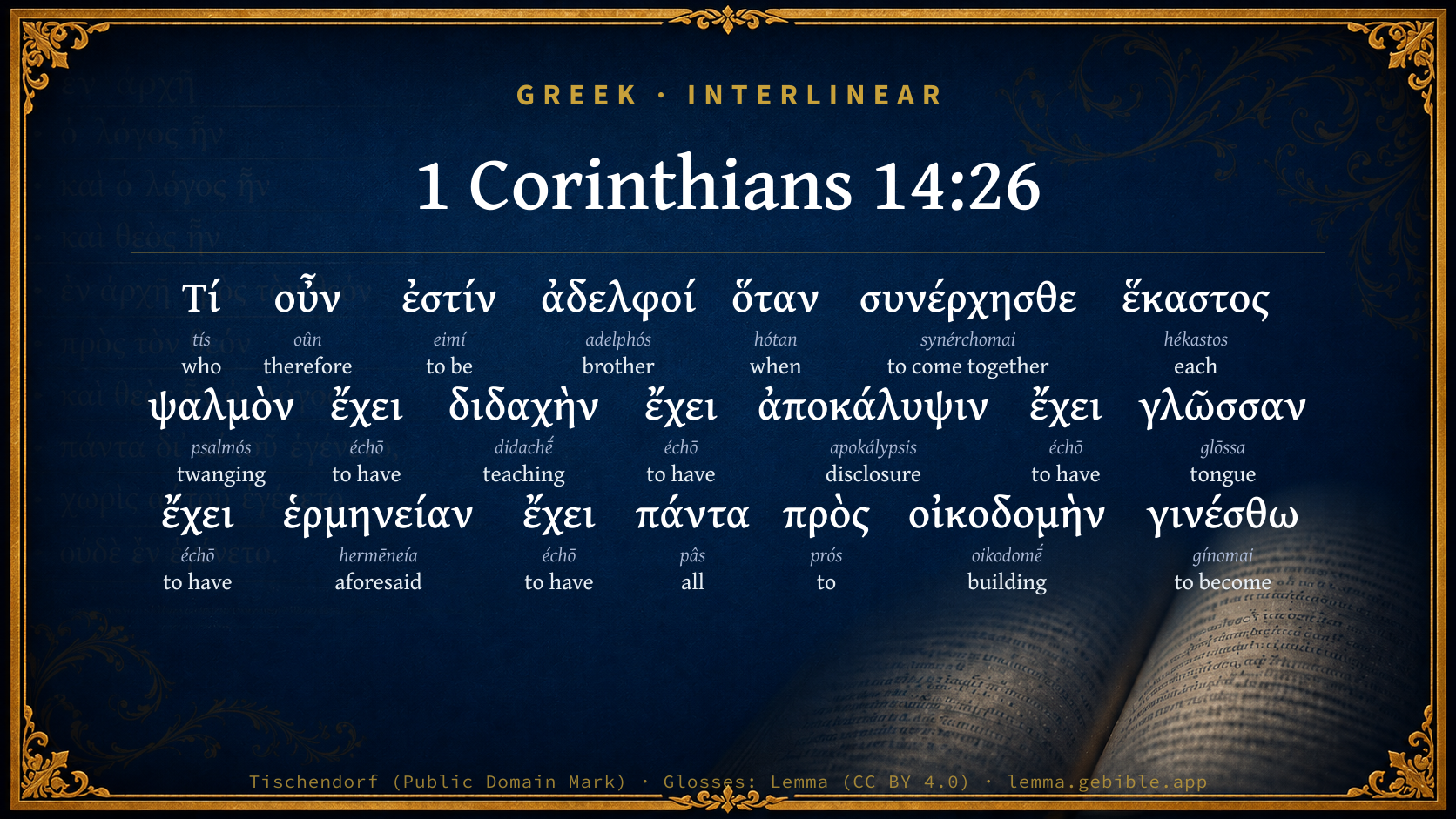
Greek (Tischendorf 8th ed.) 1 Corinthians 14:26 appears in the Greek New Testament. The text above is from the Tischendorf 8th edition. Each word links to its Strong’s number and a concise gloss. Click any word for its full Thayer’s Greek Lexicon entry.
Download image
Cite this verse

1 Corinthians 14:26 (World English Bible). Public Domain. Lemma interlinear Bible study tool, https://lemma.gebible.app/v/1-corinthians/14/26.

Show BibTeX & RIS
BibTeX
RIS
English Translation
What is it then, brothers? When you come together, each one of you has a psalm, has a teaching, has a revelation, has another language, has an interpretation. Let all things be done to build each other up.
World English Bible · Public Domain
Download a study sheet

One document with this verse’s original text, its word-by-word gloss line, the meaning frame, cross-references with their text, attributed commentary, and full source and license credits — printable, and it pastes into notes with its structure intact.

This verse Autodidact and up

Study sheet (.html) Plain text (.txt)

A passage Seminary Student

Up to 50 verses in one chapter. A passage sheet keeps up to 6 commentary sources and 12 cross-references per verse, in the order this page ranks them, and says so on the sheet whenever that leaves anything out. Ask for a single verse and you get the Autodidact verse sheet above.

Everything on this page stays free to read, with no account — the sheet is a download of what is already on screen, not access to it.

Want to remove ads? Support Godless Engineer
Compare translations 3

The same verse in 3 English versions, stacked beneath the original-language interlinear above. Click any original word for its lexicon entry.

Each is an independent rendering of the whole verse — the interlinear is not word-aligned to these translations.

Highlighted words mark where these versions differ — a whole-verse word diff, not a word-by-word alignment.

  • World English Bible Public Domain
    What is it then, brothers? When you come together, each one of you has a psalm, has a teaching, has a revelation, has another language, has an interpretation. Let all things be done to build each other up.
  • King James Version Public Domain
    How is it then, brethren? when ye come together, every one of you hath a psalm, hath a doctrine, hath a tongue, hath a revelation, hath an interpretation. Let all things be done unto edifying.
  • unfoldingWord Literal Text CC BY-SA 4.0
    What then is to be, brothers? When you come together, each one has a psalm, has a teaching, has a revelation, has a tongue, has an interpretation. Let all things happen for building up.

unfoldingWord Literal Text — © unfoldingWord, licensed CC BY-SA 4.0. Word-aligned USFM3 via Door43 (git.door43.org/unfoldingWord/en_ult).

Versions to compare (up to 4)

3 of 4 selected

Show all 19 translations

Every available English version of this verse, each an independent rendering of the whole verse.

  • World English Bible Public Domain
    What is it then, brothers? When you come together, each one of you has a psalm, has a teaching, has a revelation, has another language, has an interpretation. Let all things be done to build each other up.
  • Berean Standard Bible Public Domain
    What then shall we say, brothers? When you come together, everyone has a psalm or a teaching, a revelation, a tongue, or an interpretation. All of these must be done to build up the church.
  • Majority Standard Bible Public Domain
    What then shall we say, brothers? When you come together, each one of you has a psalm or a teaching, a tongue, a revelation, or an interpretation. All of these must be done to build up the church.
  • King James Version Public Domain
    How is it then, brethren? when ye come together, every one of you hath a psalm, hath a doctrine, hath a tongue, hath a revelation, hath an interpretation. Let all things be done unto edifying.
  • American Standard Version (1901) Public Domain
    What is it then, brethren? When ye come together, each one hath a psalm, hath a teaching, hath a revelation, hath a tongue, hath an interpretation. Let all things be done unto edifying.
  • Revised Version (1885) Public Domain
    What is it then, brethren? When ye come together, each one hath a psalm, hath a teaching, hath a revelation, hath a tongue, hath an interpretation. Let all things be done unto edifying.
  • Geneva Bible (1599) Public Domain
    What is to be done then, brethren? when ye come together, according as euery one of you hath a Psalme, or hath doctrine, or hath a tongue, or hath reuelation, or hath interpretation, let all things be done vnto edifying.
  • Douay-Rheims (1899) Public Domain
    How is it then, brethren? When you come together, every one of you hath a psalm, hath a doctrine, hath a revelation, hath a tongue, hath an interpretation: let all things be done to edification.
  • Young's Literal Translation Public Domain
    What then is it, brethren? whenever ye may come together, each of you hath a psalm, hath a teaching, hath a tongue, hath a revelation, hath an interpretation? let all things be for building up;
  • Literal Standard Version CC BY-SA 4.0
    What then is it, brothers? Whenever you may come together, each of you has a psalm, has a teaching, has a tongue, has a revelation, has an interpretation. Let all things be for building up;
  • Unlocked Literal Bible CC BY-SA 4.0
    What is next then, brothers? When you come together, each one has a psalm, a teaching, a revelation, a tongue, or an interpretation. Do everything so that you build up the church.
  • unfoldingWord Literal Text CC BY-SA 4.0
    What then is to be, brothers? When you come together, each one has a psalm, has a teaching, has a revelation, has a tongue, has an interpretation. Let all things happen for building up.
  • Darby Bible Public Domain
    What is it then, brethren? whenever ye come together, each [of you] has a psalm, has a teaching, has a tongue, has a revelation, has an interpretation. Let all things be done to edification.
  • World Messianic Bible Public Domain
    What is it then, brothers? When you come together, each one of you has a psalm, has a teaching, has a revelation, has another language, or has an interpretation. Let all things be done to build each other up.
  • Webster's Bible Public Domain
    How is it then, brethren? when ye are assembled, every one of you hath a psalm, hath a doctrine, hath a language, hath a revelation, hath an interpretation. Let all things be done to edification.
  • Free Bible Version CC BY-SA 4.0
    So then, brothers and sisters, what should you do? When you meet together, different people will sing, or teach, or share a special message, or speak in a tongue, or give an interpretation. But everything should be done to build up and encourage the church.
  • Bible in Basic English Public Domain
    What is it then, my brothers? when you come together everyone has a holy song, or a revelation, or a tongue, or is giving the sense of it. Let everything be done for the common good.
  • Text-Critical English NT CC BY 4.0
    What then should you do, brothers? When you come together, each one of you has a psalm, a teaching, a tongue, a revelation, or an interpretation. Everything must be done for edification.
  • Tyndale New Testament (1534) Public Domain
    How is it then brethren? When ye come to gedder every man hath his songe hath his doctryne hath his tonge hath his revelacion hath his interpretacion. Let all thinges be done vnto edifyinge.

Literal Standard Version (2020), Covenant Press — licensed CC BY-SA 4.0. Text via the HelloAO Bible API (eBible.org). Unlocked Literal Bible (unfoldingWord) — licensed CC BY-SA 4.0. Text via the HelloAO Bible API (eBible.org). unfoldingWord Literal Text — © unfoldingWord, licensed CC BY-SA 4.0. Word-aligned USFM3 via Door43 (git.door43.org/unfoldingWord/en_ult). Free Bible Version, Dr. Jonathan Gallagher — licensed CC BY-SA 4.0. Text via the HelloAO Bible API (eBible.org).

Word by word

More ways to search: Search by grammar → Find every occurrence → Compare this word →

Practice this passage: Drill this verse → Learn its vocabulary →

ἑρμηνείαν
hermēneía
G2058
“aforesaid”
Noun, Accusative, Singular, Feminine
Part of Speech
Noun
Case
Accusative
Number
Singular
Gender
Feminine
Full Thayer's Definition

Origin: from the same as G2059

TDNT: 13:01,3

a. interpretation 1. of what has been spoken more or less obscurely by others
  1. Τί tís G5101 “who” Interrogative pronoun, Nominative, Singular, Neuter
  2. οὖν oûn G3767 “therefore” Conjunction
  3. ἐστίν eimí G1510 “to be” Verb, Present, Active, Indicative, 3rd person, Singular
  4. ἀδελφοί adelphós G80 “brother” Noun, Vocative, Plural, Masculine
  5. ὅταν hótan G3752 “when” Conjunction
  6. συνέρχησθε synérchomai G4905 “to come together” Verb, Present, Middle or Passive deponent, Subjunctive, 2nd person, Plural
  7. ἕκαστος hékastos G1538 “each” Adjective, Nominative, Singular, Masculine
  8. ψαλμὸν psalmós G5568 “twanging” Noun, Accusative, Singular, Masculine
  9. ἔχει échō G2192 “to have” Verb, Present, Active, Indicative, 3rd person, Singular
  10. διδαχὴν didachḗ G1322 “teaching” Noun, Accusative, Singular, Feminine
  11. ἔχει échō G2192 “to have” Verb, Present, Active, Indicative, 3rd person, Singular
  12. ἀποκάλυψιν apokálypsis G602 “disclosure” Noun, Accusative, Singular, Feminine
  13. ἔχει échō G2192 “to have” Verb, Present, Active, Indicative, 3rd person, Singular
  14. γλῶσσαν glōssa G1100 “tongue” Noun, Accusative, Singular, Feminine
  15. ἔχει échō G2192 “to have” Verb, Present, Active, Indicative, 3rd person, Singular
  16. ἔχει échō G2192 “to have” Verb, Present, Active, Indicative, 3rd person, Singular
  17. πάντα pâs G3956 “all” Adjective, Nominative, Plural, Neuter
  18. πρὸς prós G4314 “to” Preposition
  19. οἰκοδομὴν oikodomḗ G3619 “building” Noun, Accusative, Singular, Feminine
  20. γινέσθω gínomai G1096 “to become” Verb, Present, Middle or Passive deponent, Imperative, 3rd person, Singular

About this verse

These counts appear in no published source. They are computed here, from the morphology-tagged text and Lemma’s own curated glosses. What Lemma adds →

21
words
17
distinct lemmas
Pauline Epistles
section

Notable vocabulary

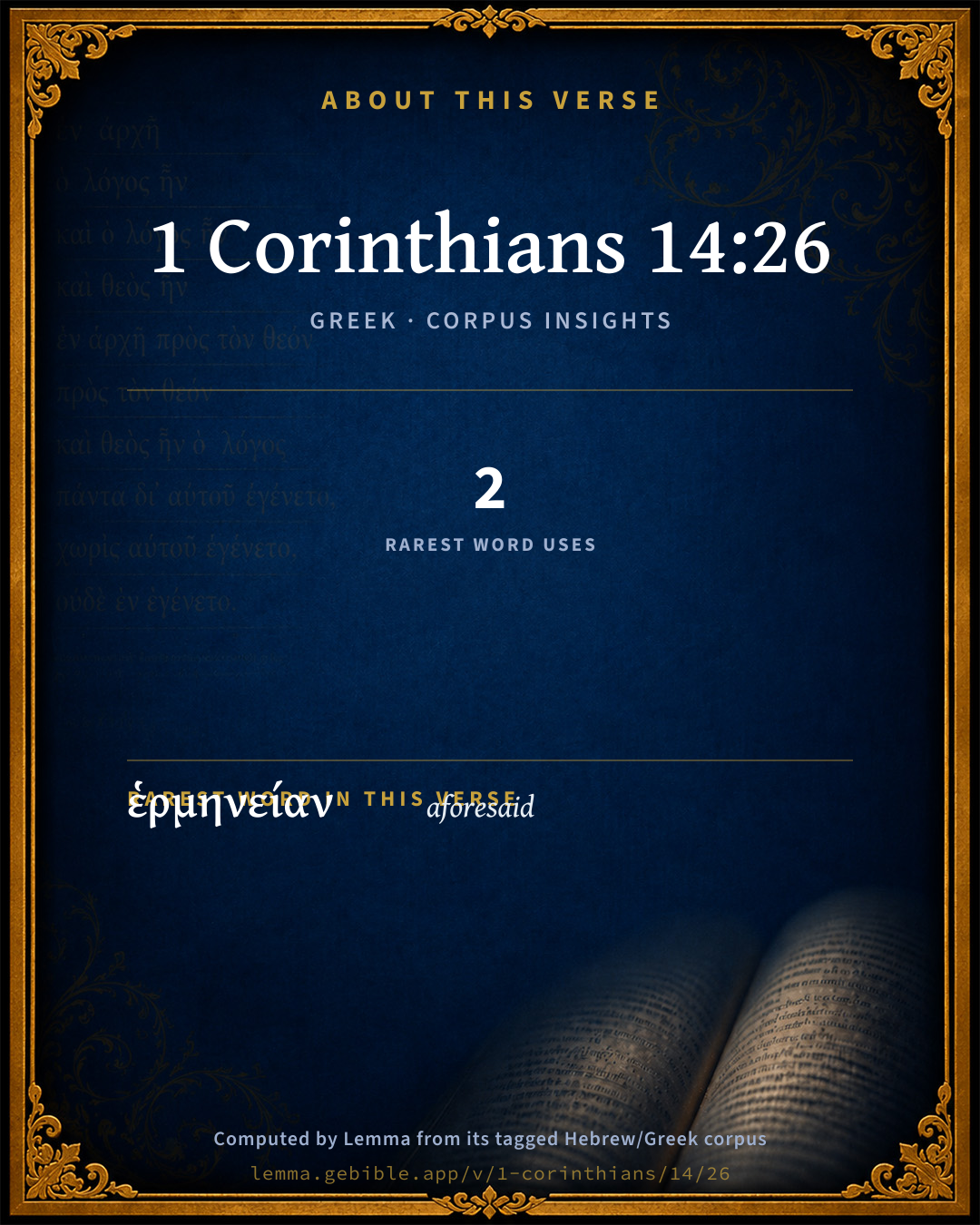
The rarest word here is ἑρμηνείαν aforesaid G2058 — appearing just 2 times in the whole Greek New Testament.

Shared distinctive vocabulary

ἑρμηνείαν aforesaid G2058 occurs in 2 verses of the Greek New Testament. Also found in:

Repetition

A word recurs within this verse:

  • ἔχει to have G2192 ×5

Cross-references

13

Topical passages linked to 1 Corinthians 14:26 in the Treasury of Scripture Knowledge — connected by theme and wording, ordered by reader-vote popularity; previews shown in the World English Bible.

  • Ephesians 5:19 speaking to one another in psalms, hymns, and spiritual songs; singing, and singing praises in your heart to the Lord;
  • Romans 14:19 So then, let us follow after things which make for peace, and things by which we may build one another up.
  • 1 Corinthians 12:7–10 But to each one is given the manifestation of the Spirit for the profit of all.
  • 1 Thessalonians 5:11 Therefore exhort one another, and build each other up, even as you also do.
  • Ephesians 4:16 from whom all the body, being fitted and knit together through that which every joint supplies, according to the working in measure of each individual part, makes the body increase to the building up of itself in love.
  • 1 Corinthians 14:12–13 So also you, since you are zealous for spiritual gifts, seek that you may abound to the building up of the assembly.
  • Ephesians 4:29 Let no corrupt speech proceed out of your mouth, but such as is good for building up as the need may be, that it may give grace to those who hear.
  • 1 Corinthians 14:40 Let all things be done decently and in order.
  • 2 Corinthians 12:19 Again, do you think that we are excusing ourselves to you? In the sight of God we speak in Christ. But all things, beloved, are for your edifying.
  • 2 Corinthians 13:10 For this cause I write these things while absent, that I may not deal sharply when present, according to the authority which the Lord gave me for building up, and not for tearing down.
  • Ephesians 4:12 for the perfecting of the saints, to the work of serving, to the building up of the body of Christ;
  • 1 Corinthians 14:4–6 He who speaks in another language edifies himself, but he who prophesies edifies the assembly.
  • 1 Corinthians 14:27 If any man speaks in another language, let it be two, or at the most three, and in turn; and let one interpret.

Cross-references courtesy of OpenBible.info (CC BY 4.0).

Where the printed editions differ

1 variant

Places in this verse where the major printed Greek editions disagree on the wording in a way that affects the translation — a comparison of editions, not a manuscript-by-manuscript collation. The editions are the modern critical texts (Nestlé-Aland 28/27, SBL, Westcott-Hort, Tregelles, Tyndale House) and the traditional texts behind the KJV (the Textus Receptus and the Byzantine/Majority text). It is not a claim about which reading is original.

  1. Extra text
    ὑμῶν

    “of you”

    In TRByz Not in NA28NA27TynSBLWHTreg

    ὑμῶν (humōn) 'of you' is only in traditional manuscripts (TR+Byz)

Textual data: Translators Amalgamated Greek New Testament (STEPBible TAGNT) · CC BY 4.0.

Commentary

Notes on 1 Corinthians 14:26 from classic Christian and Jewish commentators (each source and its license shown beneath its notes). The classic Christian expositions comment on the surrounding passage and are grouped to its opening verse, so a note may address several verses; the Jewish commentaries on the Tanakh (Rashi and others) are per-verse, so they appear only where the commentator wrote on this verse.

Lemma curates 59 commentaries, every one of them public domain or Creative Commons licensed, each selected and text-cleaned for this edition rather than reprinted as found. About our sources →

Matthew Henry's Commentary

In this passage the apostle reproves them for their disorder, and endeavours to correct and regulate their conduct for the future.

I. He blames them for the confusion they introduced into the assembly, by ostentation of their gifts (Co1 14:26): When you come together every one hath a psalm, hath a doctrine, hath a tongue, etc.; that is, "You are apt to confound the several parts of worship; and, while one has a psalm to utter by inspiration, another has a doctrine, or revelation;" or else, "You are apt to be confused in the same branch of worship, many of you having psalms or doctrines to propose at the same time, without staying for one another. Is not this perfect uproar? Can this be edifying? And yet all religious exercises in public assemblies should have this view, Let all things be done to edifying."

II. He corrects their faults, and lays down some regulations for their future conduct. 1. As to speaking in an unknown tongue, he orders that no more than two or three should do it at one meeting, and this not altogether, but successively, one after another. And even this was not to be done unless there were some one to interpret (Co1 14:27, Co1 14:28), some other interpreter besides himself, who spoke; for to speak in an unknown tongue what he himself was afterwards to interpret could only be for ostentation. But, if another were present who could interpret, two miraculous gifts might be exercised at once, and thereby the church edified, and the faith of the hearers confirmed at the same time. But, if there were none to interpret, he was to be silent in the church, and only exercise his gift between God and himself (Co1 14:28), that is (as I think) in private, at home; for all who are present at public worship should join in it, and not be at their private devotions in public assemblies. Solitary devotions are out of time and place when the church has met for social worship. 2. As to prophesying he orders, (1.) That two or three only should speak at one meeting (Co1 14:20), and this successively, not all at once; and that the other should examine and judge what he delivered, that is, discern and determine concerning it, whether it were of divine inspiration or not. There might be false prophets, mere pretenders to divine inspiration; and the true prophets were to judge of these, and discern and discover who was divinely inspired, and by such inspiration interpreted scripture, and taught the church, and who was not - what was of divine inspiration and what was not. This seems to be the meaning of this rule. For where a prophet was known to be such, and under the divine afflatus, he could not be judged; for this were to subject even the Holy Spirit to the judgment of men. He who was indeed inspired, and known to be so, was above all human judgment. (2.) He orders that, if any assistant prophet had a revelation, while another was prophesying, the other should hold his peace, be silent (Co1 14:30), before the inspired assistant uttered his revelation. Indeed, it is by many understood that the former speaker should immediately hold his peace. But this seems unnatural, and not so well to agree with the context. For why must one that was speaking by inspiration be immediately silent upon another man's being inspired, and suppress what was dictated to him by the same Spirit? Indeed, he who had the new revelation might claim liberty of speech in his turn, upon producing his vouchers; but why must liberty of speech be taken from him who was speaking before, and his mouth stopped, when he was delivering the dictates of the same Spirit, and could produce the same vouchers? Would the Spirit of God move one to speak, and, before he had delivered what he had to say, move another to interrupt him, and put him to silence? This seems to me an unnatural thought. Nor is it more agreeable to the context, and the reason annexed (Co1 14:31): That all might prophesy, one by one, or one after another, which could not be where any one was interrupted and silenced before he had done prophesying; but might easily be if he who was afterwards inspired forbore to deliver his new revelation till the former prophet had finished what he had to say. And, to confirm this sense, the apostle quickly adds, The spirits of the prophets are subject to the prophets (Co1 14:33); that is, the spiritual gifts they have leave them still possessed of their reason, and capable of using their own judgment in the exercise of them. Divine inspirations are not, like the diabolical possessions of heathen priests, violent and ungovernable, and prompting them to act as if they were beside themselves; but are sober and calm, and capable of regular conduct. The man inspired by the Spirit of God may still act the man, and observe the rules of natural order and decency in delivering his revelations. His spiritual gift is thus far subject to his pleasure, and to be managed by his discretion.

III. The apostle gives the reasons of these regulations. As, 1. That they would be for the church's benefit, their instruction and consolation. It is that all may learn, and all may be comforted or exhorted, that the prophets were to speak in the orderly manner the apostle advises. Note, The instruction, edification, and comfort of the church, is that for which God instituted the ministry. And surely ministers should, as much as possible, fit their ministrations to these purposes. 2. He tells them, God is not the God of confusion, but of peace and good order, Co1 14:33. Therefore divine inspiration should by no means throw Christian assemblies into confusion, and break through all rules of common decency, which yet would be unavoidable if several inspired men should all at once utter what was suggested to them by the Spirit of God, and not wait to take their turns. Note, The honour of God requires that things should be managed in Christian assemblies so as not to transgress the rules of natural decency. If they are managed in a tumultuous and confused manner, what a notion must this give of the God who is worshipped, to considerate observers! Does it look as if he were the God of peace and order, and an enemy to confusion? Things should be managed so in divine worship that no unlovely nor dishonourable notion of God should be formed in the minds of observers. 3. He adds that things were thus orderly managed in all the other churches: As in all the churches of the saints (Co1 14:33); they kept to these rules in the exercise of their spiritual gifts, which was a manifest proof that the church of Corinth might observe the same regulations. And it would be perfectly scandalous for them, who exceeded most churches in spiritual gifts, to be more disorderly than any in the exercise of them. Note, Though other churches are not to be our rule, yet the regard they pay to the rules of natural decency and order should restrain us from breaking these rules. Thus far they may be proposed as examples, and it is a shame not to follow them.

Matthew Henry's Commentary on the Whole Bible (1708–1710) — public domain (CC PDM 1.0). Text via the HelloAO Bible API.

Jamieson, Fausset & Brown

Robert Jamieson, A. R. Fausset & David Brown

RULES FOR THE EXERCISE OF GIFTS IN THE CONGREGATION. (Co1 14:26-40)

How is it then?--rather, "What then is the true rule to be observed as to the use of gifts?" Compare Co1 14:15, where the same Greek occurs.

a psalm--extemporary, inspired by the Spirit, as that of Mary, Zechariah, Simeon, and Anna (Luk 1:46-55, Luk 1:67-79; Luk 2:34-38).

a doctrine--to impart and set forth to the congregation.

a tongue . . . a revelation--The oldest manuscripts transpose the order: "revelation . . . tongue"; "interpretation" properly following "tongue" (Co1 14:13).

Let all things be done unto edifying--The general rule under which this particular case fails; an answer to the question at the beginning of this verse. Each is bound to obey the ordinances of his church not adverse to Scripture. See Article XXXIV, Church of England Prayer Book.

Jamieson, Fausset & Brown — Commentary Critical and Explanatory on the Whole Bible (1871) — public domain (CC PDM 1.0). Text via the HelloAO Bible API.

The Biblical Illustrator

Joseph S. Exell

1Co_14:26-40

How is it then, bretheren?

when ye come together, every one of you hath a psalm,… a doctrine.

Christian worship

I. What it includes.

1. Singing.

2. Teaching.

3. Prayer.

II. What its objects.

1. Mutual edification.

2. Instruction.

3. Comfort.

III. What it requires.

1. Order.

2. Attention.

3. Peace.

4. Propriety.

IV. What its spirit.

1. Humility.

2. Submission to Gods Word.

3. Desire.

4. Reverence. (J. Lyth, D. D.)

Five chords to the harp

This morning, in our coming together, we have this variety of living experiences and powers. We come into the Church out of a confused world--confusions of state, of science, of society, of the man himself. It seems as if we were in an orchestra in which every instrument is out of tune and every performer maintaining his performance to be the perfection of harmony. And what a confused Church it seems! What rival theories and speculations. Every point is disputed; all preach charity, but then it should be practised by the other side; every one hath an infallible standard, but then no one will submit to it. Every one hath a psalm, doctrine, tongue, etc., but little turns out to edifying. Yet this is not the intention of the apostle in the text. First, it is a voice to life, the description of the Church of the living God, and of the varied means of grace by which the spirit grows. It is the assurance that variety is no hindrance to edification, but rather the way to it, even as the various materials of a building do not interfere with the unity of the building, but help it forward. Then, second, it is an invocation to the sanctification of speech, with which compare Exo_4:11. As speech distinguishes man from all the other inhabitants of the earth, so sacred speech especially distinguishes the Christian man from other men. Speech is the glorious endowment which constitutes the poet, the singer, the orator. Speech so Divine in its origin and use is to flow back to God; it is to be converted. The song is to be converted to the psalm. How dreadful is unconverted speech and its effects! When the physician visits the sick patient, one of the first things he asks him to do is to put out his tongue. He tests the state of the body by the tongue. And I am almost disposed to say to the professing Christian, Put out your tongue. One of the first effects of holiness in the life is the purification of speech. If a man offend not in word, the same is a perfect man. But we have in the text the constituent elements of a Divine service. Here are the five chords of a human harp, by whose charm life grows into fulness and proportion. Every one hath something; let no one be depressed on his own account, let no one be scornful on account of his neighbour.

I. Strike the first chord--Every one of you hath a psalm, the musical adoration. Every one of you hath a psalm that is the gladness of life--life realised as good, when the soul says, O come, let us sing unto the Lord, etc. Even as a bird in a dark grove is heard in its sweet strain, so let your voice rise, the swell of your praise, the sob of your confession, of your grief. Say it first for yourself, Bless the Lord, O my soul! then say it aloud to all the congregation.

II. Then strike the second chord--everyone of you hath a doctrine. As there is a psalm of life, there is a doctrine of life. Man is a being of feet as well as wings. There is the practical aspect of Christian truth. Surely every one of you knows something; you have lines, you have laws and statutes, even as the noblest musician has his notes and bars and scale of melody! And the doctrine is the guide, the law of life. What is arithmetic without numbers? What is language without letters? So religion is intangible without creed.

III. And then strike the third chord--every one of you hath a tongue, i.e., language that is especially his own. The accent is the soul. How different are real words, real prayers, and yet the accent is true. Some tongues are as if tipped with shafts of fire, and some distil as the dew. Some words swell with passion, and some flow like music. How varied are the accents of Isaiah, Jeremiah, Paul, and John!

IV. Then there is the fourth chord--every one of you hath a revelation. Every Christian has had his own satisfying vision; this is the story of his soul, as when Paul said, It pleased God to reveal His Son in me; but let us not make our revelation the absolute standard to another.

V. Then there is the fifth chord--every one of you hath an interpretation, and that is the consolation of hope; and as the revelation is to a man, so will his interpretation be; what I have seen and felt in the Bible is that which I shall draw forth from it. Every one hath his own interpretation, his own mode of reading his Bible, if he read it with his own eyes; and of what avail is it to me to read my Bible with the eyes of another man? Conclusion: And life does all this. Life is the spirit in which all is performed; no life then, no psalm, no doctrine, etc. On the other hand, a living psalm, a living doctrine, etc., that all may be done to edifying. (Paxton Hood.)

Let all things be done unto edifying.--

Edification the aim of Christian speech

When Handels oratorio of the Messiah had won the admiration of many of the great, Lord Kinnoul took occasion to pay him some compliments on the noble entertainment which he had lately given the town. My lord, said Handel, I should be sorry if I only entertained them; I wish to make them better. It is to be feared that many speechmakers at public meetings could not say as much; and yet how dare any of us waste the time of our fellow-immortals in mere amusing talk! If we have nothing to speak to edification, hew much better to hold our tongue! (C. H. Spurgeon.)

Concerning edifying

I. The edification of others is a duty to which all Christians are obliged. And this will appear--

1. From its being so much insisted on in Scripture (1Th_5:11; Rom_14:19; Rom_15:2). And what he so much recommends Paul eminently exemplifies.

2. From the relation that all Christians have to Christ as to their common Lord and Head. Whenever they pray that His kingdom may come, they hereby declare that they desire to see the enlargement of Christs kingdom. And how is this consistent with being indifferent and unconcerned about the edification of others? Building is not more properly the business and employment of the professed builder than it is that of the Christian in all things to profit and edify his neighbour.

3. From the relation men have to one another, as being jointly members of the mystical body of Christ. We are not only members of Christs body, but members also one of another. And it is the great law of the gospel that, as such, we have love one towards another. Now unless that charity can be esteemed perfect which extends to mens bodies and not to their souls, we must look on ourselves as obliged as to a very considerable branch of Christian charity to study to edify one another. And therefore Paul makes it a mark of charity that it edifieth.

II. That especial manner wherein the ministers of Christ in particular are obliged to forward this good work. The edifying the Church is the particular business for which they are set apart, and therefore every part of their conduct should have a particular tendency to this very thing.

1. In their public instructions. Instructing the ignorant is but one part of the preachers business. To remind those that are careless and to induce those who are not so ignorant as some others to consideration is as much his business as the other, and is every whit as necessary. And if men are edified either way, then is preaching a proper means of edification.

2. When they are officiating in holy things. They whose duty it is to join with us in prayer will be differently affected according as they observe the several parts of Divine service to be performed negligently and perfunctorily, or with fitting care and decency. In the latter case they who bring proper sentiments to the house of God will feel their good dispositions cherished and encouraged, and will be apt to relish devotion more, and to find greater delight and satisfaction in such religious exercises. And as for those who are thoughtless, the decent and devotional deportment of those who officiate will be a powerful, though secret, check to their want of attention and levity, and will be the most likely way to awaken them from their heedlessness and indolence.

3. In the exemplariness of their lives. Concerning Christ, Lactantius has observed that He did not only point out to us the true way, but went Himself before us in it, and this He did that no one on account of the difficulty should be afraid of venturing into the ways of virtue. It is a secret objection men are apt to make within themselves against the doctrine of the gospel that it is a rule of too great perfection to be practised, and this objection cannot be more effectually removed than when the preachers of it are themselves examples of what they teach.

III. By way of motive to this work, note the following arguments.

1. The excellence of this work. It is doing our best towards restoring man to the image of his Maker; it is putting him into a state of liberty, and delivering him from the servitude of sin, and fitting him for Gods favour and rewards. And what a great honour is it to mortal man!

2. The great charity of this work, inasmuch as it consists in converting sinners from the error of their ways, it is saving of souls from death.

3. The great necessity that we in particular of the clergy are under of having this good work very much at heart (1Co_9:16).

4. The exceeding great reward that attends it (Dan_12:3).

5. The unspeakable comfort and God-like joy which must be felt even in this life by those who have been successful. It is the only thing we know of that even in heaven itself can make new joy.

IV. The wise provision made by our Church for the edification of its members.

1. The service in the vulgar tongue is certainly much better fitted to inspire those who are present with sentiments of piety and devotion than when it is in a language which they that hear it do not understand.

2. Our liturgy is in all its parts edifying.

3. It is certainly more for edification that the business of public instruction should be in the hands of persons who by their education have been qualified for this thing, and who have been approved and sent forth by the governors of the Church, than that so important a business should be left to every ones caprice who should take it into his head that he is qualified for this office.

4. That judicious choice which our Church has made in retaining some ceremonies avid abolishing others is another thing in which our constitution is well fitted to edifying. (Dean Claggett.)

Fellowship in order to edification

This is the only meeting where this is the primary object. It is therefore important as the gauge of Church life--at once a barometer, chronometer, thermometer. How far fellowship exists and how close it is cannot be judged by audiences on the Lords day. Often the minister is the personal magnet, and the Church falls into disintegration when he is withdrawn, as a sheaf of wheat when the bond is removed. But it is never so when the prayer-meeting is central. Note the requisites of a good prayer-meeting.

I. Attendance--all with one accord in one place (Act_1:13-14). Blessed unanimity!--itself a promise and prophecy of Pentecost. To promote this the meeting should be made attractive. The place, the time, the environment ought to be all favourable-light, heat, ventilation, home comfort. A fervent meeting cannot be expected with freezing feet. The household of believers should have a home atmosphere in a home gathering.

II. Agreement (Mat_18:19-20). A divided Church never has a true prayer service. Unity reacts on the meeting, drawing together by a common motive.

II. The sense of the presence of the master (Mat_18:20; 1Co_5:4). Every attendant helps to make the atmosphere of the meeting, and hence ought to go from the closet impelled by the expectation of seeing the Lord.

IV. Spontaneity. Participation should be voluntary. Anything constrained hurts the meeting. We need the flow of a fountain, not the spurt of a force-pump. Spontaneity indexes spirituality. The measure of the presence of the Spirit is shown by voluntariness of participation. If a believer takes part against his will, constrained by courtesy to the leader, his help is of doubtful value. Selection is too apt to he guided by intellectual standards. It is not always the most intelligent that most edify.

V. Informality (Act_16:13). The prayer-meeting in primitive days was held in such places as suggested free, familiar interchange. The nearer the approach to a family gathering the better. Formality kills; all undue ceremony and dignity are hurtful.

VI. Liberty (2Co_3:17). This must be cultivated in ourselves and encouraged in others. Hypercriticism is its implacable foe. An aristocrat persistently advised me to do all the praying and talking, and keep others from taking part, except two whom he mentioned. All others grated upon his ear. Alas! how are raw recruits to be developed to veterans without practice? The ideal meeting is where every one, even women, exercise the gift of the Spirit freely as led of God (Act_1:14).

VII. Simplicity. Rhetoric is generally addressed to the audience, not God. Even of the broken prayer the Lord takes the meaning.

VIII. A spiritual, scriptural tone. If young people and new converts could be gathered weekly for training by the pastor or some competent person in knowledge of the Word and practice in public prayer, the prayer-meeting would show results. Conclusion: A few hints may be added as to the various exercises.

1. Praise. Song is very important, yet often perverted. The prayer-meeting is not a concert or a singing-school. The time is short--all exercises should be brief; the instrument should not be abused for playing symphonies and interludes. Awkwardness and delay in finding, reading, and starting the hymns are hurtful to impression.

2. Prayer must be audible, brief, direct.

3. The Word of God should be exalted always. Nothing so inspires faith, hope, and love, as the truth of God. Let the leader give at the outset one great thought from the Word, and set an example of point, pith, power, practical suggestion, and, above all, a Scriptural, spiritual frame of mind. (A. T. Pierson, D. D.)

The importance of order in the Church

I. Its foundation.

1. The essential equality of the members before God; they are brethren.

II. Its objects.

1. Edification.

2. Instruction.

3. Comfort.

III. Its means.

1. Mutual service.

2. Submission.

3. Self-control.

IV. Its motives.

1. God is the author of peace.

2. Order is a distinguishing feature of the churches of the saints. (J. Lyth, D. D.)

Disorder in the Church

I. How occasioned. By self-seeking, forwardness, etc.

II. Why condemned. Because inconsistent with--

1. Brotherhood.

2. Common edification.

III. How prevented.

1. By keeping the main object in view.

2. By doing all things unto edifying. (J. Lyth, D. D.)

The excellency and usefulness of the common prayer

Before we prove that that form in particular which our Church hath prescribed is agreeable to this apostolic rule, it is necessary to prove first that the prescribing a form in general is so; for unless the prescribing a form in general be according to this rule, no form in particular that is prescribed can possibly agree with it. If every minister of a parish should be left to his own liberty to do what he pleased in his own congregation, although some, perhaps, might be so wise and prudent as to observe this rule as well as they could, yet, considering the corruption of human nature, we have much cause to fear that others would not. And besides that the prescribing a form in general is more for our edifying than to leave every one to do what seems good in his own eyes, we have the concurrent testimony, experience, and practice of the universal Church; for we never read or heard of any Church in the world from the apostles days to ours but what took this course. Nay, to oppose a form is not only to make a mans self wiser than all Christians, but wiser than Christ Himself, for it is impossible to prescribe any form of prayer in more plain terms than He hath done it (Luk_11:2). The same may be proved also from the nature of the thing itself by such arguments which do not only demonstrate that it is so, but likewise show how it comes to be so. For, first, in order to our being edified, so as to be made better and holier whensoever we meet together upon a religious account, it is necessary that the same good and holy things be always inculcated and pressed upon us after one and the same manner, for we cannot but all find by our own experience how difficult it is to fasten anything that is truly good either upon ourselves or others, and that it is rarely, if ever, effected without frequent repetitions of it. Moreover, that which conduceth to the quickening our souls, and to the raising up of our affections in our public devotions, must needs be acknowledged to conduce much to our edification. But it is plain that as to such purposes a set form of prayer is an extraordinary help to us; for if I hear another pray, and know not beforehand what he will say, I must first listen to what he will say next, then I am to consider whether what he saith be agreeable to sound doctrine, and whether it be proper and lawful for me to join with him in the petitions he puts up to Almighty God, and if I think it is so, then I am to do it. But before I can well do that he is got to another thing, by which means it is very difficult, if not morally impossible, to join with him in everything so regularly as I ought to do. But by a set form of prayer all this trouble is prevented. I have nothing else to do while the words are sounding in mine ears but to move my heart and affections suitably to them, to raise up my desires of those good things which are prayed for, to fix my mind wholly upon God whilst I am praising of Him, and so to employ, quicken, and lift up my whole soul in performing my devotions to Him. To this may be also added that, if we hear another praying a prayer of his own private composition or voluntary effusion, our minds are wholly bound up and confined to his words and expressions, and to his requests and petitions, be they what they will, so that at the best we can but pray his player, whereas when we pray by a form prescribed by the Church we pray the prayers of the whole Church we live in, which are common to the minister and people, to ourselves, and to all the members of the same Church, which cannot surely but be more effectual for the edifying, not only of ourselves in particular, but of the Church in general, than any private prayer can be. Lastly, in order to our being edified by our public devotions, as it is necessary that we know beforehand what we are to pray for, so it is necessary that we afterwards know what we have prayed for when we have done. Now, as this is a thing of greater consequence, so a set form of prayer is a greater help to us in it than it is commonly thought to be; for if we hear another utter a prayer extempore which he never said, nor we heard, before, nor ever shall do it again, it is much if he himself can remember the tenth part of what he said, how much less can we that heard him do it? And if we cannot possibly remember what we prayed for, how is it possible for us to expect it at the hands of God or to depend upon Him for it? But now it is quite otherwise when we use a set form of prayer, for by this means, when we have prayed, we can recollect ourselves, look over our prayers again, either in a book or in our minds, where they are imprinted; we can consider distinctly what we have asked at the hands of God, and so act our faith and confidence on Him for the granting every petition we have put up unto Him, according to the promises which He hath made us to that purpose. These things being duly weighed, I shall now proceed to show that that form in particular which our Church hath appointed to be used upon such occasions is agreeable to the apostolic rule in the text. First, as to the language, you all know that the whole service is preformed in English, the vulgar and common language of the nation, which every one understands, and so may be edified by it. Ours is truly common prayer, for it is written and read in that language which is common to all the congregations in the kingdom, and to every person in each congregation. So that all the people of the land, whatsoever rank or condition they are of, may join together in the use of everything that is in it, and so be jointly edified by it. But that which is chiefly to be considered in the language of the common prayer is that it is not only common, but proper too. Though the words there used be all but common words, yet they are so used that they properly express the things that are designed by them. This, I confess, may seem to be no great matter at first sight, yet it is that without which we might be subverted by that which was intended for our edification; for impropriety of speech in matters of religion hath given occasion to all or most of the schisms, errors, and heresies that ever infested this or any other Church, as might easily be demonstrated. Hence the apostle gave Timothy a form of sound words, and charged him to hold it fast (2Ti_1:13), as knowing that except the words whereby he usually expressed Divine truths were sound and proper, it would be impossible for his notions and opinions of the things themselves to be so. And as the words in the common prayer are all as edifying as words can be, so, in the second place, is the matter expressed by those words, for there is nothing in it but what is necessary for our edification, and all things that are or can be for our edification are plainly in it. First, I say there is nothing in our liturgy but what is necessary for our edification. There are none of those vain disputations and impertinent controversies which have been raised in the Church, to its great disturbance, rather than its edification. And as there is nothing in it but what is edifying, so all things that are or can be edifying are in it, for nothing can be necessary to edify and make us perfect Christians but what is necessary either to be believed or done or else obtained by us. But there is nothing necessary to be known or believed but we are taught it; nothing necessary to be done but we are enjoined it; nothing necessary to be obtained but we pray for it in our public form of Divine service. There is no vice or lust but we desire it may be subdued under us; no grace or virtue but we pray it may be planted and grow in us. Insomuch that we do but constantly and sincerely pray over all those prayers, and steadfastly believe and trust in God for His answering of them, we cannot but be as real and true saints, as happy and blessed creatures, as it is possible for us to be in this world, Neither do we here pray for ourselves only, but, according to the apostles advice, we make supplications, prayers, intercessions, and giving of thanks for all men; yea, for our very enemies, as our Saviour hath commanded us (Mat_5:44). And what can be desired more than all this to make the matter of the common prayer edifying either to ourselves or others? I cannot pass from this head before I have observed one thing more unto you concerning the prayers in general, and that is that they are not carried on in one continued discourse, but divided into many short players or collects, such as that is which our Lord Himself composed; and that might be one reason wherefore our Church so ordered it, that so she might follow our Lords example in it, who best knew what kind of prayers were fittest for us to use. There is a kind of necessity to break off sometimes to give ourselves a breathing time, that our thoughts being loosened for a while, they may with more ease and less danger of distraction be tied up again, as it is necessary they should be all the while that we are actually praying to the Supreme Being of the world. Besides that, in order to the performing our devotions aright to the Most High God, it is necessary that our souls be possessed all along with due apprehensions of His greatness and glory. To which purpose our short prayers contribute very much, for every one of them beginning with some of the properties or perfections of God, and so suggesting to our minds right apprehensions of Him at first, it is easy to preserve them in our minds during the space of a short prayer, which in a long one would be apt to scatter and vanish away. But that which I look upon as one of the principal reasons why our public devotions are and should be divided into short collects is this: our blessed Saviour, we know, hath often told us that whatsoever we ask in His name we shall receive. And so we see it is in the common prayer, for whatsoever it is we ask of God, we presently add, through Jesus Christ our Lord, or something to that purpose. The next thing to be considered in the common prayer is the method, which is admirable, and as edifying, if possible, as the matter itself. Confession, psalms, scripture, creeds. The last thing to be considered in it is the manner of its performance, by which I mean only the several postures of the body, as standing and kneeling, which are used in it, for they also are done to edifying, While we say or sing the hymns and psalms to the praise and glory of God we stand up, not only to signify, but to excite the elevation of our minds at that time. So when we pray unto Him, we fall down as low as we can towards the earth, not daring to present our supplications to the absolute Monarch of the whole world any other way than upon our knees. First, come not to our public prayers only out of custom or for fashions sake, as the manner of some is, but out of a sincere obedience to Gods commands, and with a sure trust and confidence in His promises for His blessing upon what you do. Secondly, frequent our public prayers as often as conveniently you can. The oftener you are at them, the better you will like them and the more edified you will be by them. Thirdly, if possible, come always at the beginning of Divine service, otherwise you will certainly miss something that would have been edifying to you, and perhaps of that which at that time might have done you more good than all the rest. Fourthly, all the while that you are in Gods house carry yourselves as in His special presence and suitably to the work you are about, standing while you praise God and kneeling while you pray unto Him, as our Church hath directed you. Lastly, take special care all along to keep your minds intent upon the matter in hand. By this means you will perform reasonable service unto God, and by consequence that which will be very acceptable unto Him and as profitable and edifying to yourselves. (Bp. Beveridge.)

If any man speak in an unknown tongue, let it be by two, or at the most three, and that by course; and let one interpret.

The Christian Church in assembly

Paul considered that--

I. It might be addressed by several speakers (verses 27, 29). If this be so--

1. Should Christian teaching be regarded us a profession? It is so now. Men are brought up to it, and live by it as doctors, lawyers, etc. Surely the preaching of the gospel should no more be regarded as a profession than the talk of loving parents to their children.

2. Is the Church justified in confining its ministry to one man? In most congregations there are some who, besides the stated minister, are qualified to instruct, comfort, etc. And is it not incumbent on every Christian to preach, i.e., call sinners to repentance?

II. It might allow its godly men to speak on the inspiration of the moment (verse 30). May it not be that under every discourse some one or more should be so Divinely excited with a rush of holy thought as to crave for utterance not for his own sake, but for that of others? Why, then, should he not have the opportunity? What an interest such an event would add to a religious service!

III. It should submit the utterances of its teachers to a devout critical judgment. Let others discern (or discriminate) (R.V.). The people were not to accept as a matter of course all that was spoken; they were to act as the Bereans.

IV. It should in all its services maintain order (verses 32, 33). A true teacher, however full of inspiration, will so master his impulses as to prevent confusion. Notwithstanding all the liberty of teaching, all the enthusiam of the new life, where Christianity reigns there will be no disorder. There is order in dead mechanism, and there is ,order, too, in the roar of the ocean and in the thunderstorm. All that is Divine is under law. (D. Thomas, D. D.)

Decency and order in the Church

Reflect on--

I. What the Church is.

1. The Church of the living God (1Ti_3:15).

2. The Church of Christ (Mat_16:18).

3. The abiding place of the Holy Ghost (1Co_3:16).

4. The great instrument for the conversion of the world.

II. The importance of everything connected with it being as free from fault as possible. Impropriety in the Church--

1. Dishonours God.

2. Grieves Christ.

3. Tends to quench the Spirit.

4. Reduces it to impotence.

III. What a vast responsibility rests upon those who violate the apostolic command (verse 40). God is a God of peace, but in this way He is made to appear a God of confusion. (E. Hurndall, M. A.)

The efficient conduct of public worship

I. Hints as to this.

1. It should be intelligible to all (verse 27).

2. Those who cannot speak to edification should be silent.

3. As a rule not more than two or three should speak on one occasion, and only one at a time (verse 27).

4. The rest should listen and judge.

5. Every one should be ready to give way to another.

II. The importance of these hints.

1. That all may learn.

2. That all may be comforted (verse 31). (J. Lyth, D. D.)

For ye may all prophesy.--

In the social gatherings of Gods people

1. All may speak.

2. All learn.

3. All may find comfort. (J. Lyth, D. D.)

Any person who understands Christianity may teach it

We complain of the general Ignorance of Christians: they do not understand their own religion. Why? They do not think it a duty to understand any other parts than those which immediately concern themselves: the rest they leave to their teachers. I exhort you first to search the Scriptures on this ground: the Scriptures contain the whole of revealed religion. Our second word of advice is, read the Scriptures as they were written, for they were not written as they are now printed. The proper way of reading the Gospels is to take what all the four evangelists say on any one subject, and to put the whole together. The four evangelists stand before us exactly in the light of four witnesses in a court. Our third word of advice is, as you read, dare to think for yourselves. Read the Scriptures with a generous love of truth, and always believe yourselves as free to think and judge for yourselves as any other creatures in the world are. Who can enough deplore the misery of such Christians as choose to live and die in shackles rather than assert the liberty wherewith Christ hath made them free! Our last word of advice is, reduce as much Christianity as you know to practice. Remember the saying of Jesus Christ (Joh_7:17). For example, you know it is the duty of the Christian to pray. Exercise yourselves in prayer, then. It is the duty of a Christian parent to teach his children. Instruct your children, then: and so of the rest. As you practise religion you will make an experiment of the ease and pleasure of religious practice, and consequently you will grow more and more into a persuasion that the knowledge of God is the chief good of man. On supposition that you understand religion yourselves, we proceed to show you how to teach it to others. We suppose first the welfare of your children to lie nearest your heart. In vain you provide the comforts of life, and a settlement in the world for them without training them up in the principles of religion. It is like loading a boat with valuable commodities and sending it down a stream into the ocean without any animal except a jackdaw aboard. These principles ought to be imparted in a manner suited to their own dignity, to yours, and to that of your children. There are two general ways of teaching children the truths of religion. Some make use of catechisms, which children are made to get by heart. This is an exercise of the memory, but not of the understanding, and therefore nothing is more common than to find children, who can repeat a whole catechism, without knowing anything more than how to repeat it. The other method is by hearing them read some little histories of Scripture, and by asking them questions to set them a-thinking and judging for themselves. This is an exercise of the understanding, and when the understanding is taught its own use, it is set a-going true, and if it gets no future damage it will go true through life. A third way of teaching religion is by conference. There the doubting man may open all his suspicions, and confirmed Christians will strengthen their belief. There the fearful may learn to be valiant for the truth. There the liberal may learn to devise liberal things. There the tongue of the stammerer may learn to speak plainly. There Paul may withstand Peter to the face, because he deserves to be blamed. There the gospel may be communicated severally to them of reputation. There, in one word, ye may all prophesy one by one, that all may learn, and all may be comforted. Finally, you have all a right if you have ability and opportunity to teach publicly. The ability we mean is at an equal distance from arrogance and slavish fear: it is what the Apostle Paul calls openness, or great plainness of speech. This ability, made up of knowledge and utterance, hath a certain proportion adapted to particular places, and that, which is equal to all the purposes of instruction in a small and obscure congregation, may be very unequal to the edification of a large and better instructed assembly: but as there are various assemblies of Christians in various circumstances, the part of a discreet man is to weigh circumstances and abilities together, and so to give them all their portion of meat in due season. All methods of teaching must be enforced by example, and without example all instruction is vain, if not wicked and dangerous. Let us finish by confirming the right of such teachers as we have been describing, to exercise their abilities to the edification of the Church. I said a right. To what? To teach, not to domineer, and play the lord and master with insolence and without control. Can anything be so wretched as to engage to think always through life as our teachers think, or, if we judge otherwise, to act against our own conviction for quiet sake? We said a right. To what? To teach, not to make a to,tune. If any man considers teaching as a trade to acquire wealth he renders his virtue doubtful, and if he exercises this trade with this view in our poor churches, he does no more honour to his understanding than to his heart. I said a right. To what? To teach, and not merely to talk. To fill up an hour, to kill time, to sound much and say nothing, to use vain repetitions; how easy are these to some men! To teach is to inform and to impress. I said a right. To what? To teach, and not to tattle. Teaching the gospel gives a man no right to interfere in the secular affairs of his brethren. When we say whoever understands Christianity hath a right to teach it, we do not say he hath a right to be heard, for as one man hath a right to teach, so another hath a right to hear, or not to hear, as he thinks proper; and the first ought not to exercise his right over the last without his consent. Sum up these articles, and they amount to this: any person who understands Christianity may teach it; but his teaching gives him no right to assume the character of a ruler over the consciences or property of his brethren, no right to trifle with their precious time, to interfere in their worldly affairs, to oblige any to hear without their consent, or under any pretence whatever to introduce disorder and inequality into a family, where one is the Master, even Christ, and all the rest without excepting one, all the rest are brethren, and where the highest endowments can make them no more. (R. Robinson.)

And the spirits of the prophets are subject to the prophets.--

Self-control in Divine worship

1. Is in all ordinary cases possible.

2. Does not interfere with the operations of Gods Spirit. He is a God of order and peace.

3. Is a religious duty, for the sake of edification and for the honour of religion. (J. Lyth, D. D.)

The Biblical Illustrator, edited by Joseph S. Exell (c. 1880s–1900s) — public domain. Text from a community e-Sword module.

Joseph Benson's Commentary

1Co 14:26. How is it then, (rather, what a thing is it,) brethren? — This was another disorder among them. When ye come together — For the purposes of social worship, in which all hearts should unite, each of you is desirous himself to officiate publicly in such a manner as best suits his present inclination, without any regard to decency and order: Every one of you hath a psalm, &c. — That is, at the same time, one begins to read or sing a psalm, another to inculcate a doctrine, another to speak in an unknown tongue, another to declare what had been revealed to him in explanation of some mystery, another to interpret what tie former had but just begun to speak: every one, probably, gathering a little company about him, just as they did in the schools of the philosophers. Dr. Macknight understands the passage in a somewhat different sense, paraphrasing it thus: “What is to be done, brethren, When ye are assembled, one of you, by inspiration, hath a psalm; another hath a discourse; another hath something made known to him in a foreign language; another, a revelation of some future event; another hath an interpretation of what was uttered in a foreign language. In such cases, let all these gifts be exercised to edification.” Grotius thinks the several clauses of this verse should be read interrogatively: Hath each of you a psalm? hath he a discourse? The inspired psalms of which the apostle speaks, were not metrical compositions, but compositions which were distinguished from prose by the sublimity of the sentiments, and the strength, beauty, and aptness of the expressions. Such was the inspired psalm which Mary, our Lord’s mother, uttered, Luk 1:46, and the inspired thanksgiving and prayer in which the disciples joined upon the deliverance of Peter and John from the council, recorded Act 4:24-30. The word διδαχη, rendered doctrine in our text, signifies not only the thing taught, but the discourse in which it is taught; and here, probably, a discourse for edification, exhortation, and consolation.

Joseph Benson's Commentary on the Old and New Testaments (1811–1818) — public domain. Text from a community e-Sword module.

Whedon's Commentary on the Bible

Daniel D. Whedon

c. Rules for the most orderly and effective exercise of both tongues and prophecy, 1Co_14:26-33.

26. Every one—Rather, each one. Used not to indicate that all of them had an exercise to offer, but to signify that the gifts were distributed one to an individual, and not all to one or all to all.

Hath a psalm—Some train of Christian thought expressed in rhythmical language, to be chanted or sung.

Hath a doctrine… revelation—See note on 1Co_14:6.

Edifying—St. Paul would again test the gift or the exercise by its results—does it profit, convert sinners, build up the Church?

Daniel D. Whedon (gen. ed.), Commentary on the Old and New Testaments (1874–1909) — public domain. Text from a community e-Sword module.

Tyndale Open Study Notes

Tyndale Open Resources

14:26-40 Paul gives specific procedures for the use of spiritual gifts in the church and emphasizes that they are to be expressed in an orderly way. Among the early Christians, church meetings were not led by professional pastors or priests. Instead, everyone shared with the others what God had given them for strengthening the church.

14:26 will sing: Literally has a psalm, either to be sung alone or for the fellowship to sing together (cp. Eph 5:19; Col 3:16). • Everything that is done in public worship is to be for the purpose of strengthening the church (see 1 Cor 12:7; 14:4, 6, 12, 26; cp. 8:1).

Tyndale Open Study Notes — © Tyndale Open Resources, licensed CC BY-SA 4.0. Text via the HelloAO Bible API.

Bengel's Gnomon

Johann Albrecht Bengel

1Co 14:26. Ἕκαστος, every one) The public assembly was at that time more fruitful, than in the present day, wherein one individual, whatever may be the state of his mind, must fill up the time with a sermon.—ψαλμὸν ἔχει) has a psalm, in habit of mind or in actual fact, either a little before, or only now: comp. 1Co 14:30. Extemporary hymns were given to them by the Spirit. Individuals had a psalm, wherewith to praise God, or a doctrine to be imparted to his neighbour; or a tongue, by which they might speak every one to himself. The word ἔχει, has, repeated, elegantly expresses the abundance of the gifts, which had been divided.—ἀποκάλυψιν, revelation) by which God communicates something to man; Gal 2:2, prophetical revelation, 1Co 14:30; 1Co 14:29.—ἑρμηνείαν, interpretation) by which one man may interpret an unknown tongue to another.—οἰκοδομὴν, edification) the best rule.

Bengel's Gnomon of the New Testament — English translation (T&T Clark, Edinburgh, 1860) — public domain. Text from a community e-Sword module.

Meyer's Critical & Exegetical Commentary

Heinrich August Wilhelm Meyer

1Co_14:26 ff. The theoretical part regarding the charismata is closed (1Co_14:1-25). There is now added as its sequel the regulative part regarding the proper application of the charismata, and (1) of the charismata in general (1Co_14:26); then, in particular, (2) of the glossolalia (1Co_14:27-28); and (3) of the gift of prophecy (1Co_14:29-33). Upon this follows, as an appendix, (4) the prohibition of public speaking on the part of women (1Co_14:34-36). And by way of conclusion, (5) the assertion of apostolic authority for the whole teaching now given (1Co_14:37-38); and (6) a summary repetition of the chief points (1Co_14:39-40).

1Co_14:26. Τί οὖν ἐστιν;] as in 1Co_14:15.

The apodosis begins with ἕκαστος, and πάντα on to γινέσθω is a sentence by itself. As often as you come together, every one (every one gifted with charismatic speech among you) has a psalm ready, i.e. he feels himself qualified and constrained to sing aloud such a spirit-given song. It is not, however, the glossolalic ψάλλειν which is meant, since afterwards γλῶσσαν ἔχει is specially mentioned in addition, but the intelligible singing of praise, which takes place with the νοῦς (comp. 1Co_14:15). Comp. generally on Eph_5:19. Grotius compares the improvised hymns of Deborah, Simeon, et.

ἔχει is neither interrogative (Grotius) nor: he may have (David Schulz), nor are we to supply in thought with Locke, ut moram ferre non possit; but it simply expresses the state of the case: in promptu habet. Bengel rightly judges of the repetition of the ἔχει: eleganter exprimit divisam donorum copiam.

διδαχήν] a doctrinal address. See on 1Co_12:10; 1Co_12:28.

γλῶσσαν] a tongue, i.e. a spirit-tongue, which seeks utterance. The matter is so conceived and described as that not every one has the use of a tongue in the sense of the glossolalia, but only the man gifted with this charisma, in whom there is present for this purpose a tongue as the organ of the Spiri.

ἀποκάλυψιν] a revelation, which he wishes to utter by a prophetic address, comp. 1Co_14:29 f.

ἑρμηνείαν] an interpretation, which he wishes to give of an address in a tongue already delivered.

The words ψάλμον to ἑρμ. ἔχει are the separate divisions of the ἕκαστος, as in 1Co_1:12. Then follows the general rule for all these charismata: all must be done for the furtherance of Christian perfection (of the church)! Observe how, according to this passage, public teaching was not restricted to one definite office. See Ritschl, altkath. K. p. 350.

Meyer — Critical and Exegetical Commentary on the New Testament — English translation by Peter Christie, edited by Frederick Crombie (T&T Clark, 1880) — public domain. Text from a community e-Sword module.

Expositor's Greek Testament

ed. W. Robertson Nicoll

1Co 14:26-33 . § 48. SELF-CONTROL IN RELIGIOUS EXERCISES. The enquiry of the Cor [2142] as to whether Tongues or Prophecy is the charism more to be coveted is now disposed of. P. supplements his answer by giving in the two last paragraphs of this chap. certain directions of a more general bearing relative to the conduct of Church meetings, which arise from the whole teaching of chh. 11 14: see the Introd. to Div. iv.

[2142] Corinth, Corinthian or Corinthians.

1Co 14:26 . τί οὖν ἐστίν ( cf. 1Co 14:15 ), ἀδελφοί ; “How then stands the case, brothers?” οὖν is widely resumptive, taking in the whole state of the Cor [2143] Church as now reviewed, with esp. ref [2144] to its abundance of charisms, amongst which Tongues and Prophecy are conspicuous; education must once more be insisted on as the true aim of them all. ὅταν συνέρχησθε , “whensoever you assemble” ( cf. 1Co 11:18 ff.): here pr .; the aor [2145] of 1Co 14:23 referred to particular occasions. “Each has a psalm (to sing) a teaching, a revelation (to impart) a tongue, an interpretation (to give).” The succession of the objects of ἔχει perhaps reflects the order commonly pursued in the Church meetings. For ἕκαστος , cf. 1Co 1:12 , etc.: every Cor [2146] Christian has his faculty; there is no lack of gifts for utterance or readiness to use them; cf. 1Co 1:5 , also 1Co 4:6 ff. This exuberance made the difficulty; all wanted to speak at once women as well as men (1Co 14:34 ); ἔχει , in promptu habet (Mr [2147] ) “iteratum, eleganter exprimit divisam donorum copiam” (Bg [2148] ). The ψαλμὸς might be an original song (though not chanted unintelligibly, ἐν γλώσσῃ the latter is enumerated distinctly: see note on ψαλῶ , 15), or an O.T. Psalm Christianly interpreted (see parls.); similarly Philo, De Vita Cont ., § 10, describing the Therapeutæ, ὁ ἀναστὰς ὑμῶν ὕμνον ᾄδει εἰς τ . Θεόν , ἢ καινὸν αὐτὸς πεποιηκώς , ἢ ἀρχαῖόν τινα τῶν πάλαι ποιητων . For N.T. psalms, see Luk 1:2 , Rev 4:11 ; Rev 5:9 f., 12 f., 1Co 15:3 f. διδαχὴ and ἀποκάλυψις (see 6 above; 1Co 12:28 f.), the two leading forms of Christian edification. Beside the γλῶσσα is set the complementary ἑρμηνία , by which it is utilised for the Church: cf. 1Co 12:10 ; 1Co 12:30 ; and 1Co 14:1-19 passim . πάντα πρὸς τὴν οἰκοδοὴν γινέσθω (pr [2149] impv [2150] ), “Let everything be carried on with a view to edification”.

[2143] Corinth, Corinthian or Corinthians.

[2144] reference.

[2145] aorist tense.

[2146] Corinth, Corinthian or Corinthians.

[2147] Meyer’s Critical and Exegetical Commentary (Eng. Trans.).

[2148] Bengel’s Gnomon Novi Testamenti.

[2149] present tense.

[2150] imperative mood.

The Expositor's Greek Testament, edited by W. Robertson Nicoll (1897–1910) — public domain. Text from a community e-Sword module.

Hodge's Commentary on Romans, Ephesians & First Corinthians

Charles Hodge

Special Directions as to the Mode of Conducting Their Public Assemblies 1Co_14:26-40

The apostle concludes this chapter with certain practical directions derived from the principles which he had laid down. He neither denied the reality of the extraordinary gifts with which the Corinthians were so richly endowed, nor forbade their exercise. He only enjoined that mutual edification should be the end aimed at, 1Co_14:26. With regard to those having the gift of tongues, he directed that not more than two, or at most three, should speak, and that in succession, while one interpreted. But in case no interpreter was present, there was to be no speaking with tongues, 1Co_14:27, 1Co_14:28. Of the prophets also only two or three were to speak, and the rest were to sit in judgment on what was said. In case a new revelation was made to one of the prophets, he was not to interrupt the speaker, but wait until he had concluded; or the one was to give way to the other. Both were not to speak at the same time, for God did not approve of confusion. As the influence of which the prophets were the subjects did not destroy their self-control, there could be no difficulty in obeying this injunction, 1Co_14:29-33. Women were not to speak in public; but to seek instruction at home. This prohibition rests on the divinely established subordination of the women, and on the instinct of propriety, 1Co_14:34, 1Co_14:35. The Corinthians were not to act in this matter as though they were the oldest or the only church, 1Co_14:36. The apostle requires all classes, no matter how highly gifted, to regard his directions as the commands of Christ, 1Co_14:37, 1Co_14:38. He sums up the chapter in two sentences.

1. Earnestly to seek the gift of prophecy, and not to prohibit the exercise of the gift of tongues.

2. To do all things with decency and order.

1Co_14:26

How is it then, brethren? when ye come together, every one of you hath a Psalm, hath a doctrine, hath a tongue, hath a revelation, hath an interpretation. Let all things be done unto edifying.

How is it then? i.e. as in 1Co_14:15, What is the conclusion from what has been said? What is the condition of things among you? How, in point of fact, do you conduct your public worship? When ye come together. That is, as often as ye come together. Every one of you hath, etc. Every one is used distributively; one has this and another that. A psalm, a song of praise to God. This can hardly mean one of the Psalms of the Old Testament but something prepared or suggested for the occasion. One was impelled by the Spirit to pour forth his heart in a song of praise. Comp. 1Co_14:15. Hath a doctrine, i.e. comes prepared to expound some doctrine. Hath a tongue, i.e. is able and impelled to deliver an address or to pray in an unknown tongue. Hath a revelation, i.e. as a prophet he has received a revelation from God which he desires to communicate. Hath an interpretation, i.e. is prepared to give the interpretation of some discourse previously delivered in an unknown tongue. This passage, and indeed the whole chapter, presents a lively image of an early Christian assembly. Although there were officers in every church, appointed to conduct the services and especially to teach, yet as the extraordinary gifts of the Spirit were not confined to them or to any particular class, any member present who experienced the working of the Spirit in any of its extraordinary manifestations, was authorized to use and exercise his gift. Under such circumstances confusion could hardly fail to ensue. That such disorder did prevail in the public assemblies in Corinth is clear enough from this chapter. To correct this evil is the apostles design in this whole passage. It was only so long as the gifts of tongues, of prophecy, of miracles, and others of a like kind continued in the church that the state of things here described prevailed. Since those gifts have ceased, no one has the right to rise in the church under the impulse of his own mind to take part in its services. The general rule which the apostle lays down, applicable to all gifts alike, is that every thing should be done unto edifying. That is, that the edification of the church should be the object aimed at in the exercise of these gifts. It was not enough that a man felt himself the subject of a divine influence; or that acting under it would be agreeable or even profitable to himself, he must sit in silence unless the exercise of his gift would benefit the brethren as a worshipping assembly.

Charles Hodge — Commentary on Romans (1835), First Corinthians (1857), and Ephesians (1856) — public domain. Text from a community e-Sword module.

Geneva Bible (1599)

Geneva Bible translators

The conclusion: The edifying of the Congregation is a rule and square of the right use of all spiritual gifts.

Geneva Bible (1599) marginal notes — public domain. Text via Bolls.life.

Adam Clarke's Commentary

Verse 26. How is it - every one of you hath a psalm, c.] Dr. Lightfoot understands this in the following manner: When the congregation came together, some were for spending the time in psalmody others in explaining particular doctrines; others in reading, praying, or speaking in the Hebrew tongue; others were curious to hear of farther revelations; and others wished to spend the time in the interpretation of what had already been spoken. This may be specious, but to me it is not satisfactory. It seems more likely that, when the whole Church came together, among whom there were many persons with extraordinary gifts, each of them wished to put himself forward, and occupy the time and attention of the congregation: hence confusion must necessarily take place, and perhaps not a little contention. This was contrary to that edifying which was the intention of these gifts.

Adam Clarke's Commentary on the Bible (1810–1826) — public domain. Text from a community e-Sword/MySword module.

John Calvin's Commentaries

26. What is it then? He now shows the way in which they may remedy those evils. In the first place, each gift must have its place, but in order and in measure. Farther, the Church must not be taken up to no purpose with unprofitable exercises, but must, in whatever is done, have an eye to edification. He speaks, however, in the first place of edification in this way: “Let every one, according as he has been endowed with some particular gift, make it his aim to lay it out for the advantage of all.” For it is in this way that we must understand the word rendered every one — that no one may take it as implying universality, as though all to a man were endowed with some such gift.

John Calvin's Commentaries (1540-1563) — public domain. Text from the Calvin Translation Society English edition (1840s-50s) via the Christian Classics Ethereal Library (ccel.org). Calvin's coverage is partial (roughly two-thirds of the Bible); uncommented books and verses are honest gaps, never fabricated. The 19th-century editor's footnotes and remarks are omitted so the notes are faithfully Calvin's own voice.

Ellicott's Commentary for English Readers

(26) How is it then, brethren?—From a discussion as to the relative value of the gift of tongue and that of prophecy, the Apostle now turns to practical instructions as to the method of their employment in public church assemblies. He first gives directions regarding the tongues (1Co_14:27-28), then regarding prophecy (1Co_14:29-36), and the concluding verses of this chapter contain a summing up and brief repetition of what has been already laid down. In this verse he introduces the practical application of the truths which he has been enforcing, by the question, “How is it, then?”—i.e., what should follow from all these arguments?—and, instead of answering the question directly, he first recalls the existing state of confusion in their public assemblies, which had rendered necessary the teaching of the previous verses, and which is to be remedied by the practical instructions which now follow.

When ye come together, every one of you hath . . .—Better, when ye are assembling together each one of you hath a psalm, &c. The uppermost thought in each mind as you are assembling for public worship is the individual gift which he possesses. One had the gift of pouring forth a psalm of praise; another could deliver a doctrinal discourse; another could speak to God in a tongue; another had some deep insight into the spiritual world; another could interpret the tongue. If these varied gifts were employed by each for his own gratification, or even for his own spiritual advancement, they would not be used worthy of the occasion. In public these gifts were to be exercised not by each one for himself, but for the building up of the whole Church.

A Bible Commentary for English Readers, edited by Charles John Ellicott (1878–1897) — public domain. Text from a community e-Sword module.

The Cambridge Bible for Schools and Colleges

gen. ed. J. J. S. Perowne

26–40. Regulations to insure decency and order

26. hath a psalm] The Apostle here reproves another fault. Not only are the Corinthians ambitious rather of the gifts which attract attention, than of those which do good to others, but in their exercise of those gifts they are utterly neglectful of Church order Each member of the teaching body (ch. 1Co_12:29 forbids us to include the whole Church) had his own special subject to bring before the Church; some hymn of praise, unpremeditated or otherwise, some point of Christian doctrine to enforce, some hidden mystery to reveal, some utterance in a foreign tongue, or some interpretation peculiar to himself of such utterance. This he desired to deliver just when the impulse seized him to do so, and all with a view of asserting himself, rather than of promoting the common welfare. The consequence was an amount of disorder which prevented the striking picture of the true effects of Christian prophecy in the last verse from being ever realized. For the various gifts mentioned in this verse see 1Co_14:2; 1Co_14:6; 1Co_14:13, and notes. The word psalm must be understood of a song of praise addressed to God, such as the Psalms of David, though it is by no means to be confined to them. Cf. Eph_5:19.

Let all things be done unto edifying] See ch. 1Co_6:12, 1Co_8:1, 1Co_10:23, 1Co_12:7; 2Co_12:19; 2Co_13:10. The Apostle corrects two errors in this section; (1) the disorderly manner in which the services of the Church were carried on; (2) the practice of women speaking in the public assembly.

The Cambridge Bible for Schools and Colleges (gen. ed. J. J. S. Perowne; Cambridge University Press, 1878–1918) — public domain. Text from a community e-Sword module.

John Gill's Exposition

If any man speak in an unknown tongue,.... He begins with the gift of tongues, with speaking in an unknown tongue, as the Hebrew language, because this they were desirous of: and the rule for this he would have observed is,

let it be by two, or at most by three, and that by course. The Arabic version reads it, "let him speak to two, or at most three, and separately"; as if it respected the number of persons he was to speak to at a time, and that in a separate and private manner: but the apostle's sense is, that two such persons as had the gift of speaking in an unknown tongue, or three at most, should be only employed at one opportunity, lest too much time should be taken up this way, and prevent a more useful and edifying exercise; and that these should speak not together, which would be a mere jargon and confusion, and make them took like madmen, and render them entirely useless indeed; but in course, one after another, that so an interpreter might be able to take their sense, and render what they said, and express it in a language the people understood: for it follows,

let one interpret what the two or three had said. This practice seems to be borrowed from the Jews, who had such an officer in the synagogue as a "Methurgeman", or "an interpreter". The rise of which office, and the rules to be observed in the performance of it, are as follow, delivered by Maimonides (s):

"from the times of Ezra it has been customary that an interpreter should interpret to the people what the reader reads in the law, so that they may understand the nature of things; and the reader reads one verse only, and is silent until the interpreter has interpreted it; then he returns and reads a second verse: a reader may not raise his voice above the interpreter, nor the interpreter raise his voice above the reader. The interpreter may not interpret until the verse is finished out of the mouth of the reader, and the reader may not read a verse until the interpretation is finished out of the mouth of the interpreter; and the interpreter might not lean neither upon a pillar, nor a beam, but must stand in trembling, and in fear; and he may not interpret by writing, but by mouth: and the reader may not help the interpreter; and they may not say the interpretation written in the law; and a little one may interpret by the means of a grown person, but it is no honour to a grown person to interpret by the means of a little one; and two may not interpret as one, but one reads , "and one interprets" (t).''

An interpreter might not interpret according to his own sense, nor according to the form of the words, or its literal sense; nor might he add of his own, but was obliged to go according to the Targum of Onkelos (u), which they say was the same that was delivered on Mount Sinai. The place they stood in was just before the reader; for so it is said (w),

"the interpreters stand before the wise man on the sabbath days, and hear from his mouth, and cause the multitude to hear.''

And elsewhere it is said (x),

"the interpreter stands before the wise man, the preacher, and the wise man (or doctor) whispers to him in the Hebrew language, and he interprets to the multitude in a language they hear,''

or understand. And sometimes these sat at his side, and only reported what the doctor whispered privately. So

"it is said (y), that when the son of R. Judah bar Ilai died, he went into the house of Midrash, or the school, and R. Chaniah ben Akabia went in and sat by his side, and he whispered to him, and he to the interpreter, and the interpreter caused the multitude to hear.''

And they never put any man into this office until he was fifty years of age (z). Several of the Jewish Rabbins were interpreters, as R. Chananiah before mentioned, and R. Chutzphit, and others (a).

(s) Hilchot Tephilla, c. 12 sect. 10. ll. (t) Vid. T. Bab. Roshhashana, fol. 27. 1. & Megilla, fol. 21. 2. (u) T. Bab. Kiddushin, fol. 49. 1. & Maimon. Hilchot Ishot, c. 8. sect. 4. (w) T. Bab. Pesachim, fol. 50. 2. Gloss. in ib. (x) Gloss. in T. Bab. Yoma, fol. 20. 2. (y) T. Bab. Moed Katon, fol. 21. 1. (z) Juchasin, fol. 44. 2. (a) Ib. fol. 42. 1. & 44. 1, 2.

John Gill's Exposition of the Whole Bible (1746–1763) — public domain (CC PDM 1.0). Text via the HelloAO Bible API.

Trapp's Complete Commentary

John Trapp

26 How is it then, brethren? when ye come together, every one of you hath a psalm, hath a doctrine, hath a tongue, hath a revelation, hath an interpretation. Let all things be done unto edifying.

Ver. 26. Let all things, &c.] There is edifying even in appointing of fit Psalms.

John Trapp, A Commentary or Exposition upon All the Books of the Old and New Testament (1647–1656) — public domain. Text from a community e-Sword module.

Albert Barnes' Notes on the Bible

How is it then, brethren? - See the note at 1Co 14:15. What is the fact? What actually occurs among you? Does that state of things exist which I have described? Is there that order in your public worship which is demanded and proper? It is implied in his asking this question that there might be some things among them which were improper, and which deserved reproof.

When ye come together - For worship.

Everyone of you ... - That is, all the things which are specified would be found among them. It is, evidently, not meant that all these things would be found in the same person, but would all exist at the same time; and thus confusion and disorder would be inevitable. Instead of waiting for an intimation from the presiding officer in the assembly, or speaking in succession and in order, each one probably regarded himself as under the influence of the Holy Spirit; as having an important message to communicate, or as being called on to celebrate the praises of God; and thus confusion and disorder would prevail. Many would be speaking at the same time, and a most unfavorable impression would be made on the minds of the strangers who should be present, 1Co 14:23. This implied reproof of the Corinthians is certainly a reproof of those public assemblies where many speak at the same time; or where a portion are engaged in praying, and others in exhortation. Nor can it be urged that in such cases those who engage in these exercises are under the influence of the Holy Spirit; for, however true that may be, yet it is no more true than it was in Corinth, and yet the apostle reproved the practice there. The Holy Spirit is the author of order, and not of confusion 1Co 14:33; and true religion prompts to peace and regularity, and not to discord and tumult.

Hath a psalm - Is disposed to sing; is inclined to praise; and, however irregular or improper, expresses his thanks in a public manner, see the note at 1Co 14:15.

Hath a doctrine - Has some religious truth on his mind which be deems it of special importance to inculcate, see the note at 1Co 14:6.

Hath a tongue - Has something made known to him in a foreign language, or has a power of speaking a foreign language, and exercises it, though it produces great confusion.

Hath a revelation - Some truth which has been particularly revealed to him; perhaps an explanation of some mystery (Doddridge); or a revelation ot some future event (Macknight); or a prophecy (Bloomfield); or a power of explaining some of the truths couched in the types and figures of the Old Testament. Grotius.

Hath an interpretation - An explanation of something that has been uttered by another in a foreign language; See the note at 1Co 12:10.

Let all things ... - Let this be the great principle, to promote the edification of the church; See the note at 1Co 14:12. If this rule were followed, it would prevent confusion and disorder.

Albert Barnes' Notes on the Bible (1834–1885) — public domain. Text from a community e-Sword/MySword module.

Haydock's Catholic Bible Commentary

When you come together, &c. St. Paul here settles the rules, which they are to observe in their meetings: one hath a psalm, the Spirit inspiring him with some psalm, or spiritual canticle, whereby to praise God: another hath the gift of doctrine, to instruct all there present: another the gift of tongues, which he will not have him to make use of, unless when there is one to interpret, that all things may be done in the most profitable manner unto edification. Two or three at a meeting may speak with tongues, if another interpret. (Witham)

George Leo Haydock (1774–1849), Haydock's Catholic Family Bible and Commentary, 1859 edition — public domain. Excludes Psalms (Douay-Rheims chapter numbering differs from Protestant) and Deuterocanonical books (Catholic canon only).

Matthew Poole's English Annotations

By what followeth in the two next verses, one would think that some of them, in their church meetings, were so absurd, as, being endued with several gifts, they would be using them all together, one singing, another preaching, a third speaking with tongues, &c.; but this is so apparent a confusion, that one must be very uncharitable to this famous church, to presume that they should be so absurd. Others therefore rather think, that those endued with several gifts, of which he reckoneth five, (under which he comprehendeth all others), were every one contending for his course to exercise his gift; one, for spending the time in singing the psalm he had made; another, for spending the time in hearing his doctrinal discourse; a third, for the spending it in hearing him discourse in an unknown tongue; a fourth, for the spending it in hearing his revelation; a fifth, for the spending it in hearing his interpretation; or at least desiring the time might be protracted, until they had been all successively heard.

Let all things be done unto edifying: to prevent this and other disorders, the apostle giveth several rules. The first is: That all things should be so done, as might tend best to promote in men faith and holiness; that is and ought to be the main and chief end of those who any way minister in sacred things.

Matthew Poole's English Annotations on the Holy Bible (1683–1685) — public domain. Text from a community e-Sword/MySword module.

The Pulpit Commentary

Vers. 26-33. Rules to check disorderly self-assertion in Christian assemblies.

How is it then? The same phrase as in ver. 15. Every one of you hath a psalm, etc. We see here a somewhat melancholy picture of the struggling self assertion of rival claimants to attention. A doctrine; rather, a teaching, The glossolaly had probably been promoted by Syrian enthusiasts, perhaps of the Petrine party; the egotism of oratory and itch of teaching now described (Jam_3:1) may have been developed in the Apollonian party. Unto edifying. The object is moral improvement, not idle self display, not the ostentation of individual gifts. (1Co_12:7, 1Co_12:8, 1Co_12:10) To this he recurs again and again (1Co_3:9 1Co_14:3; 2Co_5:1 2Co_10:8 2Co_11:19 2Co_13:10; and the verb frequently) The substantive, as used by St. Paul, only occurs again in Romans, (Rom_14:19 Rom_15:2) and in Ephesians. (Eph_2:21, etc.)

Vers. 26-33, 40. Decency and order in the Church.

I REFLECT UPON WHAT THE CHURCH IS.

1. It is the "Church of the living God. (1Ti_3:15) In its worship it worships the Eternal. It is the depository of his truth. It is the "temple of God". (1Co_3:16)

1. It is the Church of Christ. "My Church". (Mat_16:18)

1. It bears his Name;

2. is the place of his presence; (Mat_18:20 Mat_28:20)

3. redeemed by his blood; (1Pe_1:18, 1Pe_1:19)

4. his body; (1Co_12:27)

5. identified with him by the world;

6. the chief means by which his Name is made known in the earth;

7. it is light derived from him shining in a dark place.

8. The abiding place of the Holy Ghost. (1Co_3:16)

9. The great instrumentality for the conversion of the ungodly.

II THE IMPORTANCE OF EVERYTHING CONNECTED WITH THE CHURCH BEING AS FREE FROM FAULT AS POSSIBLE. Impropriety and disorder in the Church

(1) dishonour God;

(2) grieve Christ;

(3) tend to quench the Spirit, and

(4) to make the Church powerless for its mission.

III WHAT VAST RESPONSIBILITY RESTS UPON THOSE WHO VIOLATE THE APOSTOLIC COMMAND. (Ver. 40.) God is a God of peace, but in this way he is made to appear a God of confusion and disorder (ver. 33). H.

The Pulpit Commentary (1880–1919), ed. H.D.M. Spence-Jones & Joseph S. Exell — public domain. Text from a community e-Sword module.

John Wesley's Explanatory Notes

What a thing is it, brethren -- this was another disorder among them. Everyone hath a psalm - That is, at the same time one begins to sing a psalm; another to deliver a doctrine; another to speak in an unknown tongue; another to declare what has been revealed to him; another to interpret what the former is speaking; every one probably gathering a little company about him, just as they did in the schools of the philosophers. Let all be done to edification - So as to profit the hearers.

John Wesley, Explanatory Notes Upon the Whole Bible (1754–1765) — public domain. Text via the GEBible commentary corpus.

Kretzmann's Popular Commentary

Paul E. Kretzmann

The practical application of these truths in public worship:

v. 26. How is it, then, brethren? When ye come together, every one of you hath a psalm, hath a doctrine, hath a tongue, hath a revelation, hath an interpretation. Let all things be done unto edifying:

v. 27. If any man speak in an unknown tongue, let it be by two or, at the most, by three, and that by course; and let one interpret.

v. 28. But if there be no interpreter, let him keep silence in the church; and let him speak to himself and to God.

v. 29. Let the prophets speak two or three, and let the other judge.

v. 30. If anything be revealed to another that sitteth by, let the first hold his peace.

v. 31. For ye may all prophesy one by one, that all may learn and all may be comforted.

v. 32. And the spirits of the prophets are subject to the prophets.

v. 33. For God is not the author of confusion, but of peace, as in all churches of the saints.

The apostle here gives instructions about the arrangements of services, in order that his purpose of edification of the congregation may best be accomplished. What was to be done in Corinth, and what, all things being equal, is to be done in all Christian congregations about the order of public worship? As matters stood in Corinth at that time, each one contributed something at their meetings, according to the special spiritual gift which was given him: One has a psalm to chant; another has a doctrine, another a revelation to communicate; another has a tongue, another an interpretation to give. So there was no lack of gifts nor of a willingness to impart the gift; rather all were anxious to speak at once, women as well as men. The gifts were there, and they were not to be despised; the Spirit rather had use for them all. But all was to be done unto edification, with a view to building up the congregation. If they would continue to conduct services without order, the end would be hopeless confusion, if not unpleasant quarrels.

The apostle, therefore, proposes the following order in their meetings: If there were such present as had the gift of tongues, two or, at the most, three should be given an opportunity to speak, and in turn, one by one, not all speaking at once, to their own confusion and that of the congregation. After that, one having that gift should interpret the messages just received. By employing only one interpreter for several discourses of tongues, time would be gained for other edifying parts of worship. But if no interpreter were present, the person that wished to speak with tongues should abstain from speaking in the assembly and rather have his discourse with God alone; in secret converse with God he could still feel the full enjoyment of being a vessel of the Holy Spirit.

Then the persons having the gift of prophecy might also speak in turn, two or three in one meeting, and the others should discern, that is, those that assisted with preaching and had judgment with reference to the matter discussed, as Luther says. In doing so, these men were exercising a gift which is also very necessary in the Church, chap. 12:10; Rom 12:7. If, in the meantime, the Holy Spirit should give a special revelation to one of the prophets or teachers and he arose from his seat in token of that fact, the speaker should yield the floor to the new man, closing his own address as quickly as possible. In this way they could all, in rotation, prophesy, bring in their word of teaching and of admonition, that all the members of the congregation might learn and all might be encouraged, urged forward on the path of Sanctification, all hearers thus receiving benefit. And lest anyone think that the insistence upon order would interfere with the Spirit’s work, the apostle tells the Corinthians that the nature of prophetic inspiration did not hinder the maintenance of such order, but rather favored its promotion: The spirits of the prophets are subject to the prophets. The divine gift is not an irresponsible, erratic control, but may be exercised by the possessor’s will, with discretion and brotherly love. People claiming the possession of a spirit, but not being able to control its utterances, lack the necessary mark of the Holy Spirit’s indwelling. For God is not a God of disorder, but of peace. The supposition that God inspires His prophets two or three at a time, and thus creates confusion in public worship, is contrary to His nature. And lest the Corinthians think that Paul is laying upon them a burden from which he is excusing the other congregations, he adds: As it is in all the churches of the saints. In all the assemblies of the early Christians a decent order was observed, according to the same principles as here enunciated by Paul. Without such order, agreed upon or accepted by all, confusion and dissension would surely result, and this the apostle wanted to avoid by all means as contrary to the will of God.

Paul E. Kretzmann, Popular Commentary of the Bible (1921–1924) — public domain. Text from a community e-Sword module.

Burkitt's Expository Notes on the New Testament

William Burkitt

From this verse to the end of the chapter, the apostle lays down particular precepts for the preservation of decency and good order in the church of God; and first he advises, when they came together into the public assemblies, that if any of them had a psalm or hymn suggested to them by the Spirit of God, to his glory, and the church’s edification; or had a doctrine, either for instruction or consolation; or had a strange tongue, or the gift of interpreting tongues; let it be how it will, he exhorts that all be done so as may most and best tend to the benefit and edification of the church, which is the true end of church assemblies.

The great end, design and aim, which those who administer in holy things ought to propound to themselves in all their public administrations, is the church’s edification, the people’s growth and improvement in knowledge, faith, and holiness.

Let all things be done to edifying; that is, let all your public offices be so performed, and in such a manner, as may best conduce to the end for which they were designed.

William Burkitt's Expository Notes on the New Testament (1700–1703) — public domain. Text from a community e-Sword module.

Godbey's Commentary on the New Testament

William B. Godbey

DISORDERS CORRECTED

1Co 14:23-36

26. “Then what is it, brethren? when you come together, each one has a psalm, has a lesson, has a revelation, has a tongue, has an interpretation: let all things be done unto edification.

27. “If one speaks with a tongue, let it be by twos or at most by threes, and in turn; and let one interpret.

28. “And if there may be no interpreter, let him keep silent in the churches, and let him speak to himself and to God.

William B. Godbey, Commentary on the New Testament (1896–1900) — public domain. Text from a community e-Sword module.

McGarvey & Pendleton's Commentaries

J. W. McGarvey

What is it then, brethren? [See comment on 1Co_14:15 ] When ye come together, each one hath a psalm, hath a teaching, hath a revelation, hath a tongue, hath an interpretation. Let all things be done unto edifying .

J. W. McGarvey (with Philip Y. Pendleton), Commentaries on the New Testament (The Fourfold Gospel, 1914; Acts; and the epistles) — public domain. Text from a community e-Sword/MySword module.

The People's New Testament

B. W. Johnson

26–33. What is it then, brethren? What course should be pursued in the public assemblies of the church? When ye come together, each one hath, etc. When they come together, one comes purposing to sing a psalm; another to teach concerning some question; another, a prophet, has a revelation to present; another proposes to speak in a tongue; another, still, to interpret what is spoken. Now this must all be done unto edifying. All that will not tend to this must be left out.

B. W. Johnson's The People's New Testament with Notes (1889–1891) — public domain. Electronic text from the Christian Classics Ethereal Library (CCEL) ThML edition.

unfoldingWord translationNotes

Door43 World Missions Community

What is next then, brothers?

Paul uses a question to introduce the next part of his message. AT: "Because everything I have just told you is true, this is what you need to do, my fellow believers." (See: Rhetorical Question)

and each one in turn

"and they should speak one after another" or "and they should speak one at a time"

interpret what is said

This can be stated in active form. AT: "interpret what they said" (See: Active or Passive)

interpretation ... interpret

This means to tell what someone has said in a language to others who do not understand that language. See how "interpret" is translated in 1 Corinthians 2:13.

translationWords

brother

psalm

reveal

tongue

church

unfoldingWord translationNotes — © Distant Shores Media and the Door43 World Missions Community, licensed CC BY-SA 4.0. Source: git.door43.org/Door43/en_tn.

Cambridge Greek Testament for Schools and Colleges

26–40. REGULATIONS TO INSURE DECENCY AND ORDER

26. τί οὖν ἐστίν; Not ‘how is it,’ as A.V., but (see 1Co 14:15 and note) what is it? what then is the state of the case? i.e. to what condition has your self-seeking brought you?

ψαλμὸν ἔχει. The Apostle here reproves another fault. Not only are the Corinthians ambitious rather of the gifts which attract attention than of those which do good to others, but in the exercise of those gifts the same spirit of self-assertion creeps in to the utter destruction of all Church order. Each member of the teaching body (ch. 1Co 12:29 forbids us to include the whole Church) had his own special subject to bring before the Church; some hymn of praise, unpremeditated or otherwise, some point of Christian doctrine to enforce, some hidden mystery to reveal, some utterance in a foreign tongue, or some interpretation peculiar to himself of such utterance. This he desired to deliver just when the impulse seized him to do so, and all with a view of claiming prominence for himself, rather than of promoting the common welfare. The consequence was an amount of disorder which prevented the striking picture of the true effects of Christian prophecy in the last verse from being realized. For the various gifts mentioned in this verse see 1Co 14:2; 1Co 14:6; 1Co 14:13, and notes. The word psalm must be understood of a song of praise addressed to God, such as the Psalms of David, though it is by no means to be confined to them. Cf. Eph 5:19.

πρὸς οἰκοδομήν. See ch. 1Co 6:12, 1Co 8:1, 1Co 10:23, 1Co 12:7; 2Co 12:19; 2Co 13:10. The Apostle corrects two errors in this section: (1) the disorderly manner in which the services of the Church were carried on; (2) the practice of women speaking in the public assembly.

Cambridge Greek Testament for Schools and Colleges (Cambridge University Press, 1896; 21 vols, various authors incl. Carr, Maclear, Plummer, Farrar, Lumby, Moule, M. R. James, Simcox) — public domain. Text from a community e-Sword module.

Alford’s Greek Testament

Henry Alford

26-35.] Regulations respecting the exercise of spiritual gifts in the assemblies.

26.] The rule for all, proceeding on the fact of each having his gift to contribute when they come together: viz. that all things must be done with a view to edification.

τί οὖν ἐστιν] See ver. 15.

ὅτ. συν.] whenever ye happen to be assembling together: the present vividly describes each coming with his gift, eager to exercise it.

ψαλμόν] most probably a hymn of praise to sing in the power of the spirit, as did Miriam, Deborah, Symeon, &c. See ver. 15.

διδαχήν] an exposition of doctrine or moral teaching: belonging to the gift of prophecy, as indeed do also ψαλμ. and ἀποκάλ., the latter being something revealed to him, to be prophetically uttered.

γλῶσσαν] a tongue, i.e. an act of speaking in tongues: see vv. 18, 22.

ἑρμηνείαν] See below, and ver. 5.

πάντ. πρ. οἰκ. γιν.] The General rule, afterwards applied to the several gifts: and

27,

Henry Alford, The Greek Testament (1849–1861) — public domain. Text from a community e-Sword module.

International Critical Commentary

26-33. Regulations for the Orderly Exercise of Tongues and Prophesying in the Congregation

St Paul has here completed his treatment (12-14.) of πνευματικά. He now gives detailed directions as to their use.

26. Τί οὖν ἐστίν, ἀδελφοί; ‘What then is the result, brethren,’ of this discussion? Comp. v. 15. In answering his own question he first gives the facts of the case, then states the indispensable principle that all things are to be done unto edifying, and finally gives practical directions for applying this principle.

ὅταν συνέρχησθε. ‘Whenever ye are coming together (v. 23, 11:17, 18, 20), each has ready (comp. πάντες, vv. 23, 24) a psalm to improvise, a lesson to give, a revelation to make known, a Tongue to utter, an interpretation to explain the Tongue.’ All these gifts are there in the several individuals ready to be manifested. By all means let them be manifested. But never lose sight of the more excellent way of love: let the edification of others be the end ever in view.*

The spontaneous character of the manifestations is graphically indicated. There was no lack of persons eager to manifest some gift. But perhaps the Apostle intimates that they do not come to public worship quite in the right spirit. This readiness to come to the front would be sure to lead to abuse unless carefully controlled. What they ought to be eager to do is to use their gifts for the good of all. This is the optima norma. But we cannot safely infer that we have here the order in which the manifestations commonly took place at Corinth,—first a psalm, then instruction, and so on. Compare the account of Christian assemblies in Tertullian (Apol. 39). The account of the Therapeutae ought not to be quoted in illustration, still less as Philo’s: the περὶ βίου θεωρητικοῦ is possibly a Christian fiction, and perhaps wholly imaginative. With ἕκαστος ἔχει compare ἕκαστος λέγει (1:12), and for improvised psalms see Moses and Miriam (Exo_15.), Balaam (Num. 23., Num 23:24.), Deborah (Jdg_5), and the Canticles (Luk 1:2). It is remarkable that there is no προφητείαν ἔχει. Was that gift so despised at Corinth that those who possessed it did not often come forward? Ψαλμός occurs in N.T. in Paul and Luke only. Ἐρμηνία occurs nowhere else in N.T., excepting 12:10.

The ὐμῶν after ἕκαστος (D E F G K L, Vulg. A V.) is probably spurious: א A B 17, Copt. RV. omit. And ἀποκάλυψιν ἔχει should precede γλῶσσαν ἔχει (א A B D E F G 17, Latt. Syrr. Copt. Aeth. RV.), not follow it (1, Chrys. Thdrt., AV.). The Tongue and the interpretation would be mentioned together.

International Critical Commentary — older volumes (1896–1929), various authors — public domain. Text from a community e-Sword module.

Godet's Commentaries

Frédéric Louis Godet

Vv. 26. “How is it then, brethren? when ye come together, every one of you hath a psalm, hath a doctrine, hath a revelation, hath a discourse in a tongue, hath an interpretation. Let all things be done unto edifying.”

The meaning of the question: How is it then? is the same as in 1Co 14:15. The apostle would lead his readers themselves to draw the conclusions which flow from the principles laid down. Fundamental rule: No gift should be set aside. Every manifestation of the Spirit ought to have its place; enough that all turn to edification. The ἕκαστος ἔχει, every one hath, should be understood like the similar phrase 1Co 1:12; every one has not all, but every one ought or at least may have something. The proposition may be taken interrogatively. But it is better perhaps to understand it in the sense of a tentative affirmation: “If so be.” The repetition of the verb brings out, as Bengel says, the distribution of gifts. The apostle enumerates five of these manifestations. The ψαλμός, psalm, is not here a chant in the form of a tongue, the singing in the spirit, of 1Co 14:15. For special mention is afterwards made of discoursing in a tongue and of its interpretation. It is therefore a psalm, like those spoken of in Col 3:16 and Eph 5:19 (psalms, hymns, spiritual songs); a singing ἐν νοΐ, with sober mind (1Co 14:15), as is suitable to the opening of worship. It seems to me improbable that Paul has in view an Old Testament psalm or an already existing Christian hymn, recited or sung. The word ἔχειν, to have, does not prevent its being an improvisation. For, as is observed by Holsten, the term is afterwards applied to a tongue and its interpretation, which are immediate products of the Spirit’s working.

The διδαχή, doctrine, naturally comes after the psalm-singing, being the solid basis of worship. In a religion of light, everything ought to rest on clear and exact instruction. Here is the word of knowledge or wisdom spoken of 1Co 12:8.

According to the MS. L and the received text, there would now follow discourse in tongues, thanksgiving in the transport of ecstasy; but the Alex. and Greco-Lats. here place the ἀποκάλυψις, the revelation, expressed in a prophecy. In the first reading there would be a contrast: the calmest element, instruction, would be followed by the most emotional, the most excited, discoursing in a tongue. This order is less natural than that of the second reading, according to which doctrine is followed by a revelation, that is to say, a prophecy. The latter is already characterized by an immediate inspiration more pronounced and extraordinary. What further speaks in favour of this last reading, is the fact that it would be unnatural were speaking in tongues to be separated from interpretation by prophecy. The Byz. K, which almost always coincides with L, entirely omits the words γλῶσσαν ἔχει, hath a tongue; it is therefore probable that they were supplied in L, but misplaced by the corrector.

To revelation there is naturally attached speaking in a tongue; it is the highest degree of the ecstatic state, consequently the culminating point of worship; after which interpretation, which follows, closes by leading adoration back to that state of calm reflection in which the worship had begun (the psalm) and ought to finish. Thus it is that feeling rises by steps as to the third heaven, to return at the close to practical life. We have therefore in this series of actions the type of normal worship, in which all the elements of understanding and feeling are united, and in which every believer endowed from above can give free scope to his particular gift. It is a spiritual banquet, so to speak, to which every guest brings his quota, just as in the agapae (1Co 11:20 seq.).

The apostle now passes to the special rules relating to the exercise of glossolalia.

Frédéric Louis Godet — Commentaries on Luke, John, Romans, and 1 Corinthians — English translation (T&T Clark, Edinburgh, 1870s–1890s) — public domain. Text from a community e-Sword module.

Lesson kit

Teaching starters — assembled from the data on this page, not authored interpretation. Every prompt links to the verse data it draws on. Edit before teaching.

1 Corinthians, in the Pauline Epistles, opens this verse with 21 words (17 distinct Greek lemmas). Its most distinctive word is hermēneía (“aforesaid”). A historical commentator’s framing appears above. Read the whole chapter for the surrounding context.

Discussion questions

  1. The word hermēneía carries the sense “aforesaid.” How does it shape the verse?
  2. 1 Corinthians 12:10 shares the word «aforesaid» with this verse. How do the two illuminate each other?
  3. “to have” occurs 5× in this one verse. What is the effect of the repetition?
  4. These translations render this verse differently; the difference is in the English rendering, not the original. What questions does that raise?
  5. Reading how Matthew Henry's Commentary and Jamieson, Fausset & Brown read this verse, where do the two commentators agree and where do they part?

Things to notice

Reading settings

Reading text

Shown beneath each verse's original-language words.

Old Testament
Old Testament edition

Read the OT as the Masoretic Hebrew (MT) or the Greek Septuagint (LXX).

English shown for the Greek Septuagint (in the Hebrew ↔ Greek comparison).

Comparing translations? Open the Compare panel on any verse page to stack up to four side by side.