2 Corinthians 8:22

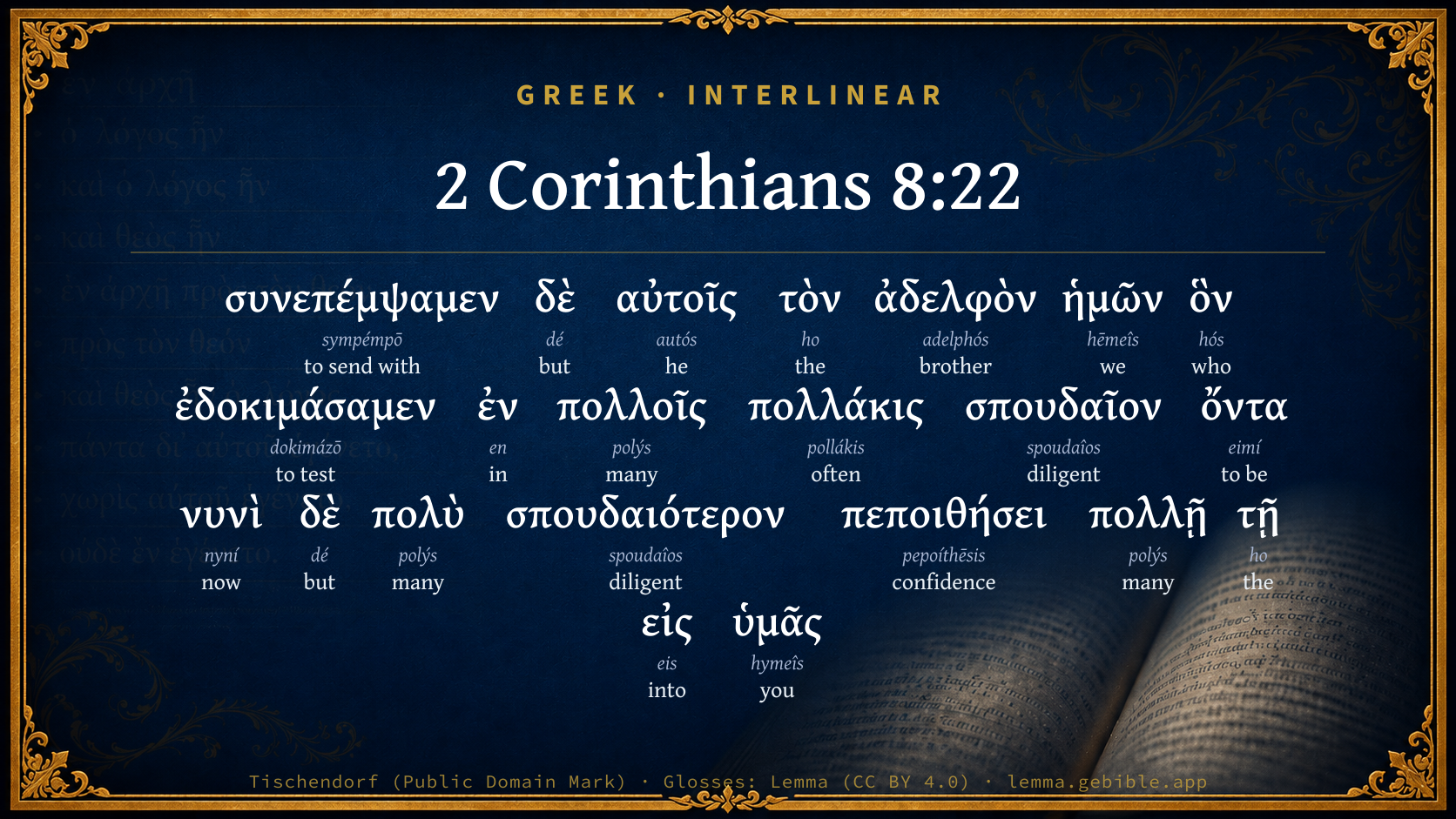
Greek (Tischendorf 8th ed.) 2 Corinthians 8:22 appears in the Greek New Testament. The text above is from the Tischendorf 8th edition. Each word links to its Strong’s number and a concise gloss. Click any word for its full Thayer’s Greek Lexicon entry.
Download image
Cite this verse

2 Corinthians 8:22 (World English Bible). Public Domain. Lemma interlinear Bible study tool, https://lemma.gebible.app/v/2-corinthians/8/22.

Show BibTeX & RIS
BibTeX
RIS
English Translation
We have sent with them our brother, whom we have many times proved earnest in many things, but now much more earnest, by reason of the great confidence which he has in you.
World English Bible · Public Domain
Download a study sheet

One document with this verse’s original text, its word-by-word gloss line, the meaning frame, cross-references with their text, attributed commentary, and full source and license credits — printable, and it pastes into notes with its structure intact.

This verse Autodidact and up

Study sheet (.html) Plain text (.txt)

A passage Seminary Student

Up to 50 verses in one chapter. A passage sheet keeps up to 6 commentary sources and 12 cross-references per verse, in the order this page ranks them, and says so on the sheet whenever that leaves anything out. Ask for a single verse and you get the Autodidact verse sheet above.

Everything on this page stays free to read, with no account — the sheet is a download of what is already on screen, not access to it.

Want to remove ads? Support Godless Engineer
Compare translations 3

The same verse in 3 English versions, stacked beneath the original-language interlinear above. Click any original word for its lexicon entry.

Each is an independent rendering of the whole verse — the interlinear is not word-aligned to these translations.

Highlighted words mark where these versions differ — a whole-verse word diff, not a word-by-word alignment.

  • World English Bible Public Domain
    We have sent with them our brother, whom we have many times proved earnest in many things, but now much more earnest, by reason of the great confidence which he has in you.
  • King James Version Public Domain
    And we have sent with them our brother, whom we have oftentimes proved diligent in many things, but now much more diligent, upon the great confidence which I have in you.
  • unfoldingWord Literal Text CC BY-SA 4.0
    Now we sent our brother with them, whom we proved in many ways, often being eager. But now he is even more eager great confidence that in you.

unfoldingWord Literal Text — © unfoldingWord, licensed CC BY-SA 4.0. Word-aligned USFM3 via Door43 (git.door43.org/unfoldingWord/en_ult).

Versions to compare (up to 4)

3 of 4 selected

Show all 19 translations

Every available English version of this verse, each an independent rendering of the whole verse.

  • World English Bible Public Domain
    We have sent with them our brother, whom we have many times proved earnest in many things, but now much more earnest, by reason of the great confidence which he has in you.
  • Berean Standard Bible Public Domain
    And we are sending along with them our brother whose earnestness has been proven many times and in many ways, and now even more so by his great confidence in you.
  • Majority Standard Bible Public Domain
    And we are sending along with them our brother who has proven his earnestness to us many times and in many ways, and now even more so by his great confidence in you.
  • King James Version Public Domain
    And we have sent with them our brother, whom we have oftentimes proved diligent in many things, but now much more diligent, upon the great confidence which I have in you.
  • American Standard Version (1901) Public Domain
    and we have sent with them our brother, whom we have many times proved earnest in many things, but now much more earnest, by reason of the great confidence which `he hath' in you.
  • Revised Version (1885) Public Domain
    And we have sent with them our brother, whom we have many times proved earnest in many things, but now much more earnest, by reason of the great confidence which he hath in you.
  • Geneva Bible (1599) Public Domain
    And we haue sent with them our brother, whom we haue oft times prooued to be diligent in many thinges, but nowe much more diligent, for the great confidence, which I haue in you.
  • Douay-Rheims (1899) Public Domain
    And we have sent with them our brother also, whom we have often proved diligent in many things; but now much more diligent, with much confidence in you,
  • Young's Literal Translation Public Domain
    and we sent with them our brother, whom we proved in many things many times being diligent, and now much more diligent, by the great confidence that is toward you,
  • Literal Standard Version CC BY-SA 4.0
    and we sent our brother with them, whom we proved being diligent many times in many things, and now much more diligent, by the great confidence that is toward you,
  • Unlocked Literal Bible CC BY-SA 4.0
    We are also sending another brother with them. We have tested him in many ways and found him diligent for many tasks. He is even more eager now because of the great confidence he has in you.
  • unfoldingWord Literal Text CC BY-SA 4.0
    Now we sent our brother with them, whom we proved in many ways, often being eager. But now he is even more eager great confidence that in you.
  • Darby Bible Public Domain
    And we have sent with them our brother whom we have often proved to be of diligent zeal in many things, and now more diligently zealous through the great confidence [he has] as to you.
  • World Messianic Bible Public Domain
    We have sent with them our brother whom we have many times proved earnest in many things, but now much more earnest, by reason of the great confidence which he has in you.
  • Webster's Bible Public Domain
    And we have sent with them our brother, whom we have often proved to be diligent in many things, but now much more diligent, upon the great confidence which I have in you.
  • Free Bible Version CC BY-SA 4.0
    We're also sending with them another brother who has proved to be reliable on many occasions, and who is eager to help. He is now even more eager to help because of the great confidence he has in you.
  • Bible in Basic English Public Domain
    And we have sent with them our brother, whose ready spirit has been made clear to us at times and in ways without number, but it is now all the more so because of the certain faith which he has in you.
  • Text-Critical English NT CC BY 4.0
    We are also sending with them our brother whom we have often tested and found to be earnest in many matters, and now he is even more earnest because of his great confidence in you.
  • Tyndale New Testament (1534) Public Domain
    We have sent with them a brother of oures whom we have ofte tymes proved diliget in many thynges but now moche more diligent. The great confidence which I have in you: hath caused me this to do:

Literal Standard Version (2020), Covenant Press — licensed CC BY-SA 4.0. Text via the HelloAO Bible API (eBible.org). Unlocked Literal Bible (unfoldingWord) — licensed CC BY-SA 4.0. Text via the HelloAO Bible API (eBible.org). unfoldingWord Literal Text — © unfoldingWord, licensed CC BY-SA 4.0. Word-aligned USFM3 via Door43 (git.door43.org/unfoldingWord/en_ult). Free Bible Version, Dr. Jonathan Gallagher — licensed CC BY-SA 4.0. Text via the HelloAO Bible API (eBible.org).

Word by word

More ways to search: Search by grammar → Find every occurrence → Compare this word →

Practice this passage: Drill this verse → Learn its vocabulary →

συνεπέμψαμεν
sympémpō
G4842
“to send with”
Verb, Aorist, Active, Indicative, 1st person, Plural
Part of Speech
Verb
Tense
Aorist
Voice
Active
Mood
Indicative
Person
1st person
Number
Plural
Full Thayer's Definition

Origin: from G4862 and G3992

TDNT: None

1. to send together with
  1. δὲ dé G1161 “but” Conjunction
  2. αὐτοῖς autós G846 “he” Personal pronoun, Dative, Plural, Masculine
  3. τὸν ho G3588 “the” Article, Accusative, Singular, Masculine
  4. ἀδελφὸν adelphós G80 “brother” Noun, Accusative, Singular, Masculine
  5. ἡμῶν hēmeîs G2249 “we” Personal pronoun, 1st person, Genitive, Plural
  6. ὃν hós G3739 “who” Relative pronoun, Accusative, Singular, Masculine
  7. ἐδοκιμάσαμεν dokimázō G1381 “to test” Verb, Aorist, Active, Indicative, 1st person, Plural
  8. ἐν en G1722 “in” Preposition
  9. πολλοῖς polýs G4183 “many” Adjective, Dative, Plural, Neuter
  10. πολλάκις pollákis G4178 “often” Adverb
  11. σπουδαῖον spoudaîos G4705 “diligent” Adjective, Accusative, Singular, Masculine
  12. ὄντα eimí G1510 “to be” Verb, Present, Active, Participle, Accusative, Singular, Masculine
  13. νυνὶ nyní G3570 “now” Adverb
  14. δὲ dé G1161 “but” Conjunction
  15. πολὺ polýs G4183 “many” Adjective, Accusative, Singular, Neuter
  16. σπουδαιότερον spoudaîos G4705 “diligent” Adverb, Comparative
  17. πεποιθήσει pepoíthēsis G4006 “confidence” Noun, Dative, Singular, Feminine
  18. πολλῇ polýs G4183 “many” Adjective, Dative, Singular, Feminine
  19. τῇ ho G3588 “the” Article, Dative, Singular, Feminine
  20. εἰς eis G1519 “into” Preposition
  21. ὑμᾶς hymeîs G5210 “you” Personal pronoun, 2nd person, Accusative, Plural

About this verse

These counts appear in no published source. They are computed here, from the morphology-tagged text and Lemma’s own curated glosses. What Lemma adds →

22
words
17
distinct lemmas
Pauline Epistles
section

Notable vocabulary

The rarest word here is συνεπέμψαμεν to send with G4842 — appearing just 2 times in the whole Greek New Testament.

Shared distinctive vocabulary

συνεπέμψαμεν to send with G4842 occurs in 2 verses of the Greek New Testament. Also found in:

Repetition

Words recur within this verse:

  • πολλοῖς many G4183 ×3
  • σπουδαῖον diligent G4705 ×2
  • δὲ but G1161 ×2
  • τὸν the G3588 ×2

Cross-references

1

Topical passages linked to 2 Corinthians 8:22 in the Treasury of Scripture Knowledge — connected by theme and wording, ordered by reader-vote popularity; previews shown in the World English Bible.

Cross-references courtesy of OpenBible.info (CC BY 4.0).

Commentary

Notes on 2 Corinthians 8:22 from classic Christian and Jewish commentators (each source and its license shown beneath its notes). The classic Christian expositions comment on the surrounding passage and are grouped to its opening verse, so a note may address several verses; the Jewish commentaries on the Tanakh (Rashi and others) are per-verse, so they appear only where the commentator wrote on this verse.

Lemma curates 59 commentaries, every one of them public domain or Creative Commons licensed, each selected and text-cleaned for this edition rather than reprinted as found. About our sources →

Bengel's Gnomon

Johann Albrecht Bengel

2Co 8:22. [51] Αὐτοῖς, with them) with Titus and the brother.—πεποιθήσει, through the confidence) construed with, we have sent along with, here and at 2Co 8:18: comp. v. 23.—εἰς ὑμᾶς, which we feel towards [in] you) concerning your liberality.

[51] Ενῶπιον ἀνθρώπων, in the sight of men) Men are depraved, and are therefore suspicious. Hence also it is just, that men of the highest integrity should avert all suspicion.—V. g.

Bengel's Gnomon of the New Testament — English translation (T&T Clark, Edinburgh, 1860) — public domain. Text from a community e-Sword module.

Meyer's Critical & Exegetical Commentary

Heinrich August Wilhelm Meyer

2Co_8:22. Commendatory mention of the second companio.

αὐτοῖς] with Titus and the brother already spoken o.

τὸν ἀδελφ. ἡμ.] This one, too, we do not know by name. Ἡμῶν does not point to him as in official relation to the apostle and Timothy, but denotes him as a Christian brother (see 2Co_8:23), so that the ἡμῶν embraces also the readers. Conjecture has lighted (but see previously on 2Co_8:18) on Epaenetus, Rom_16:5 (Grotius), on Apollos (Thomas, Lyra, and mentioned already in Theodoret), on Luke (Calvin and also Estius, who, however, does not discountenance the conjecture of Zenas, Tit_3:13, and Sosthenes), and even on Timothy (Cajetanus) and others. Wieseler (comp. on 2Co_8:18) understands it of Tychicus, and to this Hofmann also is inclined. The very plural ἡμῶν should have precluded Rückert from thinking of an actual brother of the apostle; see also on 2Co_8:18.

ἐν πολλοῖς πολλάκις] goes with ἐδοκ.: in many things many times. See on this collocation, Lobeck, Paral, p. 56.

νυνὶ δὲ πολὺ σπουδαιότερον πεποιθ. κ.τ.λ.] νυνί stands in contrast with the previous ἐδοκιμ. ἐν πολλοῖς πολλάκις: now, however, as much more zealous (than in the earlier cases) through the great confidence which he reposes in you. A high degree of good confidence in you has now increased very much his zeal. Others understand πεποιθήσει κ.τ.λ. of Pauls confidence, connecting it either with πολὺ σπουδαιότ. (Erasmus, Beza, Piscator, and others) or with συνεπέμψαμεν (Estius, Emmerling: sperans ut bene a vobis excipiantur). The latter is an inappropriate departure from the order of the words, depriving πολὺ σπουδαιότερον of the ground assigned for it (and how delicately is its ground assigned by this very πεποιθ. κ.τ.λ.!); and the former must necessarily have been denoted by a personal pronoun added to πεποιθ.

Meyer — Critical and Exegetical Commentary on the New Testament — English translation by Peter Christie, edited by Frederick Crombie (T&T Clark, 1880) — public domain. Text from a community e-Sword module.

Expositor's Greek Testament

ed. W. Robertson Nicoll

2Co 8:22 . συνεπέμψαμεν δὲ αὐτοῖς κ . τ . λ .: and we have sent with them our brother, whom we have many times proved earnest in many things, but now much more earnest because of the great confidence which he has in you ( cf. Gal 5:10 , πέποιθα εἰς ὑμᾶς ), i.e. , which was inspired by the account that Titus brought of their good conduct. It is as impossible to identify this “brother” as him of 2Co 8:18 ; like the first named he was an envoy of the contributing Churches (2Co 8:23 ), and further (what is not said of the first named) he was on terms of personal intimacy with St. Paul, as appears from this verse. The guess that he was Tychicus is a plausible one (see Act 20:4 , Eph 6:21 , Col 4:7 , 2Ti 4:12 , Tit 3:12 ), but it is only a guess and is incapable of verification. A few cursives (see on 2Co 13:13 ) give the name of Barnabas with those of Titus and Luke in the subscription at the end of the Epistle, and this may represent an early tradition.

The Expositor's Greek Testament, edited by W. Robertson Nicoll (1897–1910) — public domain. Text from a community e-Sword module.

Jamieson, Fausset & Brown

Robert Jamieson, A. R. Fausset & David Brown

This second brother, BIRKS supposes to be Trophimus: for a Macedonian is not meant (Co2 9:4) probably the same as was sent before with Titus (Co2 12:18); and therefore sent from Ephesus, and probably an Ephesian: all this is true of Trophimus.

oftentimes . . . in many things--Join and translate as in the Greek, "many times in many things."

upon the great confidence which I have in you--"through the great confidence WHICH HE HAS towards you" [ALFORD]. BENGEL better supports English Version, "We have sent . . . through the confidence WHICH WE FEEL in regard to your liberality."

Jamieson, Fausset & Brown — Commentary Critical and Explanatory on the Whole Bible (1871) — public domain (CC PDM 1.0). Text via the HelloAO Bible API.

Adam Clarke's Commentary

Verse 22. We have sent with them] Titus and, probably, Luke, our brother, probably Apollos.

Now much more diligent] Finding that I have the fullest confidence in your complete reformation and love to me, he engages in this business with alacrity, and exceeds even his former diligence.

Adam Clarke's Commentary on the Bible (1810–1826) — public domain. Text from a community e-Sword/MySword module.

John Calvin's Commentaries

22. On account of the great confidence. The meaning is, “I am not afraid of their coming to you proving vain and fruitless; for I have felt beforehand an assured confidence, that their embassy will have a happy issue; I am so well aware of their fidelity and diligence.” He says that the brother, whose name he does not mention, had felt more eagerly inclined; partly because he saw that he had a good opinion of the Corinthians, partly because he had been encouraged by Titus, and partly because he saw many distinguished men apply themselves to the same business with united efforts. Hence one thing only remained — that the Corinthians themselves should not be wanting on their part.

John Calvin's Commentaries (1540-1563) — public domain. Text from the Calvin Translation Society English edition (1840s-50s) via the Christian Classics Ethereal Library (ccel.org). Calvin's coverage is partial (roughly two-thirds of the Bible); uncommented books and verses are honest gaps, never fabricated. The 19th-century editor's footnotes and remarks are omitted so the notes are faithfully Calvin's own voice.

Ellicott's Commentary for English Readers

(22) And we have sent with them our brother.—Who this second unnamed brother was is again simply matter of conjecture. Of the names connected with St. Paul at this period, that of Tychicus seems to have the greatest balance of probabilities in its favour. He went up with St. Paul to Jerusalem on this very business (Act_20:4), and the tone in which the Apostle speaks of him in Eph_6:21, Col_4:7, exactly agrees with his language here. In 2Ti_4:12, Tit_3:12, we have further evidence of his being one of the most trusted of the couriers, or “messengers,” of the Apostolic Church. The name of Clement has, however, I think, some claim to consideration. St. Paul refers to him as an active fellow-worker (Php_4:3). He was connected with the Philippians. Assuming his identity with Clement of Rome, this gives him a point of contact with the Church of Corinth, to which Clement addressed his Epistle. On the other hand, the distinction drawn in 2Co_9:4 between these brethren and the Macedonians may seem to exclude Clement, as it has been thought to exclude Aristarchus and Sopater and Secundus. The word translated “diligent” (“earnest” in 2Co_8:16) is used by St. Paul only in this passage. It implies what we might almost call the “business-like” side of the Christian type of character, and is therefore employed with special fitness here.

A Bible Commentary for English Readers, edited by Charles John Ellicott (1878–1897) — public domain. Text from a community e-Sword module.

The Cambridge Bible for Schools and Colleges

gen. ed. J. J. S. Perowne

22. And we have sent with them] Literally, as before, 2Co_8:18, we sent with them, i.e. with the other two.

our brother, whom we have oftentimes proved diligent] See for this third brother, the note on 2Co_8:18. Dr Plumptre suggests Clement, as one dear to St Paul and known to the Philippians (Php_4:3).

upon the great confidence which I have in you] The margin, ‘he hath,’ is to be preferred. This brother had no doubt been at Corinth, and was quite certain that the Corinthians, in spite of all shortcomings, would in the end come up to St Paul’s highest anticipations.

The Cambridge Bible for Schools and Colleges (gen. ed. J. J. S. Perowne; Cambridge University Press, 1878–1918) — public domain. Text from a community e-Sword module.

John Gill's Exposition

Whether any do inquire of Titus,.... The apostle here sums up the characters of each of the above persons; as for Titus, he says,

he is my partner; he had been his companion in his travels, a partner with him in preaching the Gospel, as well as in the troubles and persecutions he had met with; and was one with whom he had had sweet communion and fellowship:

and fellow helper; or worker,

concerning you; he had been a joint instrument with him, either in their conversion, or consolation, and correction; or for their edification and instruction, and setting things right, which had been out of order among them:

or our brethren be inquired of; if their characters are asked after, as well as Titus's; by whom are meant not his fellow apostles, but the two brethren who were sent along with Titus; what may be truly said of them is,

they are the messengers of the churches; they were chosen and sent forth by the churches, not only to preach the Gospel, but particularly to take care of the ministration to the poor saints. They were messengers appointed by the churches for this service, and were also appointed to the service of the churches; respect seems to be had to the public minister in the synagogues, who was called "the messenger of the congregation", or "church" (z); whose business was to take care about the reading of the law and the prophets, to pray in public, and also to preach if there was no other; so we read (a) also of , "the messengers of the sanhedrim"; who were sent at the proper time to reap the sheaf of the first fruits, and of others who swore the high priest before the day of atonement (b); and of , "the messengers of the commandment" (c); who went to hear the exposition (of the traditions) and visit the head of the captivity:

and the glory of Christ: meaning either that the churches were the glory of Christ, in whom he is glorified, where his glory is seen, and his presence enjoyed; or rather the messengers of them, on whom the image of Christ was stamped, who faithfully performed the work of Christ, in all things sought his glory and not their own; and in and by whom his glory was displayed, and held forth to others.

(z) T. Bab. Sota, fol. 37. 2. Tosephot Beracot, fol. 34. 1. Misn. Beracot, c. 5. sect. 5. (a) Misn. Menachot, c. 10. 3. (b) Misn. Yoma, c. 1. 5. (c) T. Bab. Succa, fol. 26. 1.

John Gill's Exposition of the Whole Bible (1746–1763) — public domain (CC PDM 1.0). Text via the HelloAO Bible API.

Trapp's Complete Commentary

John Trapp

22 And we have sent with them our brother, whom we have oftentimes proved diligent in many things, but now much more diligent, upon the great confidence which I have in you.

Ver. 22. Whom we have oft] Some are of the opinion that Luke is here deciphered rather than 2Co 8:19. Whoever it was, it is much for his honour, that Apelles-like he was approved in Christ, and active for the Church, Rom 16:10.

John Trapp, A Commentary or Exposition upon All the Books of the Old and New Testament (1647–1656) — public domain. Text from a community e-Sword module.

Albert Barnes' Notes on the Bible

And we have sent with them our brother - Who this was is wholly unknown; and conjecture is useless. Some have supposed that it was Apollos, others Silas, others Timothy. But there are no means of ascertaining who it was; nor is it material. It was some one in whom Paul had entire confidence.

Whom we have oftentimes proved diligent - Of whom we have evidence that he has been faithful. It is evident, therefore, that he had been the companion and fellow-laborer of Paul.

But now much more diligent ... - Who will now prove himself much more diligent than ever before.

Upon the confidence ... - Margin, “he hath.” The margin is doubtless the more correct reading here. The idea is, that this brother had great confidence in the Corinthians that they would give liberally, and that he would, therefore, evince special diligence in the business.

Albert Barnes' Notes on the Bible (1834–1885) — public domain. Text from a community e-Sword/MySword module.

Haydock's Catholic Bible Commentary

With much confidence in you, either for Titus, &c. Some expound it of the confidence which this the third brother had in the Corinthians, but it seems rather to be understood of the confidence which St. Paul himself had in them, that they would shew great respect to Titus, and to the other brethren whom he sent. He concludes, (ver. 24.) by exhorting them to these charitable contributions, which he calls the manifestation of their charity, in the sight of the Churches. Literally, in the face of the Churches, in your public meetings. (Witham) --- Most commentators understand here Apollo, but without any certainty. (Bible de Vence)

George Leo Haydock (1774–1849), Haydock's Catholic Family Bible and Commentary, 1859 edition — public domain. Excludes Psalms (Douay-Rheims chapter numbering differs from Protestant) and Deuterocanonical books (Catholic canon only).

Matthew Poole's English Annotations

This brother is uncertainly guessed at, nor is it at all material for us to know whether it were Epenetus, or Apollos, or Sosthenes, or any other; it is sufficient for us to know, that he was a brother, and one of whose diligence and faithfulness the apostle, and the churches where Paul now was, had had experience; and that he was now very ready and forward to be employed in this service, upon the apostle’s recommendation of this church unto him.

Matthew Poole's English Annotations on the Holy Bible (1683–1685) — public domain. Text from a community e-Sword/MySword module.

Whedon's Commentary on the Bible

Daniel D. Whedon

22. Our brother—Mr. Baynes makes it clear that St. Paul here designates Erastus. He was sent by Paul with Timothy to Macedonia. The result of their labours there before St. Paul’s arrival is described in 2Co_8:1-6. Erastus soon after this is at Corinth, (Rom_16:23,) and took his residence there, 2Ti_4:20. It is, indeed, objected that the Erastus of Rom_16:23 could not have been Paul’s companion at Ephesus, inasmuch as he was chamberlain of the city. But how long he had laboured with Paul at Ephesus is not said; and in being sent around by Macedonia, he was only going by a circuitous route home to Corinth. Chamberlain means treasurer, financier; and this will accord with Paul’s eulogy, that he had been diligent in many things; that is, efficient in many business matters. Or it may be thought that Paul, in giving his greetings to Rome, mentions Erastus’ official rank as formerly having been city treasurer.

More diligent… confidence in you—Striking out the I have, inserted by the translators, we translate the passage, but now much more energetic from his much confidence in you. Erastus was all the more suitable for raising collections at Corinth from the fact that being himself a Corinthian he had full confidence of success.

Daniel D. Whedon (gen. ed.), Commentary on the Old and New Testaments (1874–1909) — public domain. Text from a community e-Sword module.

The Pulpit Commentary

Our brother. It is impossible to conjecture with any certainty who was the brother thus warmly eulogized. Clement, Epaenetus, Apollos, Luke, Zenas, Sosthenes, Trophimus, and Tychicus have all been suggested. Stanley conjectures that the two who accompanied Titus were the Ephesians Tychicus and Trophimus (Act_20:4 Act_21:9; Eph_6:21; Tit_3:12; Col_4:7)

The Pulpit Commentary (1880–1919), ed. H.D.M. Spence-Jones & Joseph S. Exell — public domain. Text from a community e-Sword module.

John Wesley's Explanatory Notes

With them - With Titus and Luke. Our brother - Perhaps Apollos.

John Wesley, Explanatory Notes Upon the Whole Bible (1754–1765) — public domain. Text via the GEBible commentary corpus.

McGarvey & Pendleton's Commentaries

J. W. McGarvey

And we have sent with them our brother, whom we have many times proved earnest in many things, but now much more earnest, by reason of the great confidence which he hath in you . [As to this third party, Alford well says, "Every possible person has been guessed." There is no means of determining who it was. Paul's words show that he had been often used by the apostle because of his earnestness, and that he was employed in this work because he evidently knew and had great confidence in the Corinthians.]

J. W. McGarvey (with Philip Y. Pendleton), Commentaries on the New Testament (The Fourfold Gospel, 1914; Acts; and the epistles) — public domain. Text from a community e-Sword/MySword module.

The People's New Testament

B. W. Johnson

22–24. We have sent with them. With Titus and the brother named in verse 18. The brother referred to here and commended so highly is nowhere named.

B. W. Johnson's The People's New Testament with Notes (1889–1891) — public domain. Electronic text from the Christian Classics Ethereal Library (CCEL) ThML edition.

unfoldingWord translationNotes

Door43 World Missions Community

with them

The word "them" refers to Titus and the previously mentioned brother.

he is my partner and fellow worker for you

"he is my partner who works with me to help you"

As for our brothers

This refers to the two other men who will accompany Titus.

they are sent by the churches

This can be stated in active form. AT: "the churches have sent them" (See: Active or Passive)

They are an honor to Christ

This can be stated with a verbal phrase. AT: "They will cause people to honor Christ" (See: Abstract Nouns)

translationWords

brother

test

Titus

church

honor

Christ

love

boast

unfoldingWord translationNotes — © Distant Shores Media and the Door43 World Missions Community, licensed CC BY-SA 4.0. Source: git.door43.org/Door43/en_tn.

Cambridge Greek Testament for Schools and Colleges

22. Commendation of the third delegate, who is to accompany Titus and ‘the brother’ of 2Co 8:18. And we are sending (see on 2Co 8:17) together with them our brother whom we have proved to be in earnest many times in many things. The characteristic alliteration here and 2Co 9:8 is worth preserving in translation. Comp. διὰ γὰρ τὸ πολλάκις καὶ πολλοὺς νενικηκέναι θαρροῦσιν (Arist. Eth. Nic. III. viii. 3). The suggestion that τὸν ἀδελφὸν ἡμῶν means the Apostle’s own brother, is extraordinary exegesis. Even if he had one to employ, to appoint him to such work would have aroused just those suspicions which S. Paul was so anxious to allay. This ‘brother’ was no doubt some one in whom the Corinthians had confidence; some conjecture Tychicus.

πολὺ σπουδαιότερον πεποιθήσει πολλῇ τῆ εἰς ὑμᾶς. Much more in earnest by reason of much confidence to you-ward. To change the second ‘much’ into ‘great’ (A.V., R.V.) spoils the repetition, which may be intentional. Neither ‘I have’ (A.V.) nor ‘he hath’ (R.V.) need be inserted, but ‘he hath’ is what is meant. “This brother had no doubt been at Corinth, and was quite certain that the Corinthians, in spite of all shortcomings, would in the end come up to St Paul’s highest anticipations” (Lias). It is possible that here and in 2Co 1:15 the Apostle purposely uses in a sense that is favourable to the Corinthians the term πεποίθησις, which in 2Co 10:2 he uses in an unfavourable sense. He wishes to remove the threatening tone of 2Co 10:2. If so, this is another item in favour of the view that 10–13 is part of the second lost letter. With the alliteration comp. 2Co 7:4, 2Co 9:8; 2Co 9:10.

Cambridge Greek Testament for Schools and Colleges (Cambridge University Press, 1896; 21 vols, various authors incl. Carr, Maclear, Plummer, Farrar, Lumby, Moule, M. R. James, Simcox) — public domain. Text from a community e-Sword module.

Alford’s Greek Testament

Henry Alford

22.] Still less can we determine who this second brother is. Every possible person has been guessed. Several would answer to the description, ‘whom we have many times in many matters proved to be earnest.’ By our uncertainty in these two cases, we may see how much is required, to fill up the apostolic history at all satisfactorily.

πεποιθήσει …] through the great confidence which he has towards you: belongs to σπουδαιότερον, and to the brother, not to συνεπέμψαμεν and to Paul. The brother had, by what he had heard from Titus, conceived a high opinion of the probable success of their mission.

Henry Alford, The Greek Testament (1849–1861) — public domain. Text from a community e-Sword module.

International Critical Commentary

22. συνπέμψαμεν δὲ αὐτοῖς. ‘And we are sending (epistolary aor.) together with them our brother whom we have proved to be in earnest many times in many things.’ ‘Our brother’ of course does not mean the brother of St Paul,† any more than ‘the brother’ in v. 18 means the brother of Titus. In both cases ‘brother’ means ‘fellow-Christians.’ Giving him a name is pure guesswork; some conjecture Tychicus, others Apollos. The freq. alliteration with π is conspicuous in this verse. Cf. 1:5, 7:4, 8:2, 9:8, 11, etc.

νυνὶ δὲ πολὺ σπουδαιότερον. ‘But now much more in earnest by reason of much confidence to you-ward.’ In this way it is easy to continue the alliteration. See on 1:15 for the Pauline word πεποίθησις, which no doubt means the envoy’s confidence (RV) rather than the Apostle’s (AV). The latter would require a pronoun to make it clear. But this mention of the envoy’s confidence respecting them does not prove that he had been in Corinth. What he had heard about them might make him eager to come. See Index IV.

International Critical Commentary — older volumes (1896–1929), various authors — public domain. Text from a community e-Sword module.

Lesson kit

Teaching starters — assembled from the data on this page, not authored interpretation. Every prompt links to the verse data it draws on. Edit before teaching.

2 Corinthians, in the Pauline Epistles, opens this verse with 22 words (17 distinct Greek lemmas). Its most distinctive word is sympémpō (“to send with”). A historical commentator’s framing appears above. Read the whole chapter for the surrounding context.

Discussion questions

  1. The word sympémpō carries the sense “to send with.” How does it shape the verse?
  2. 2 Corinthians 8:18 shares the word «to send with» with this verse. How do the two illuminate each other?
  3. “many” occurs 3× in this one verse. What is the effect of the repetition?
  4. These translations render this verse differently; the difference is in the English rendering, not the original. What questions does that raise?
  5. Reading how Bengel's Gnomon and Meyer's Critical & Exegetical Commentary read this verse, where do the two commentators agree and where do they part?

Things to notice

Reading settings

Reading text

Shown beneath each verse's original-language words.

Old Testament
Old Testament edition

Read the OT as the Masoretic Hebrew (MT) or the Greek Septuagint (LXX).

English shown for the Greek Septuagint (in the Hebrew ↔ Greek comparison).

Comparing translations? Open the Compare panel on any verse page to stack up to four side by side.