1 Corinthians 11:33

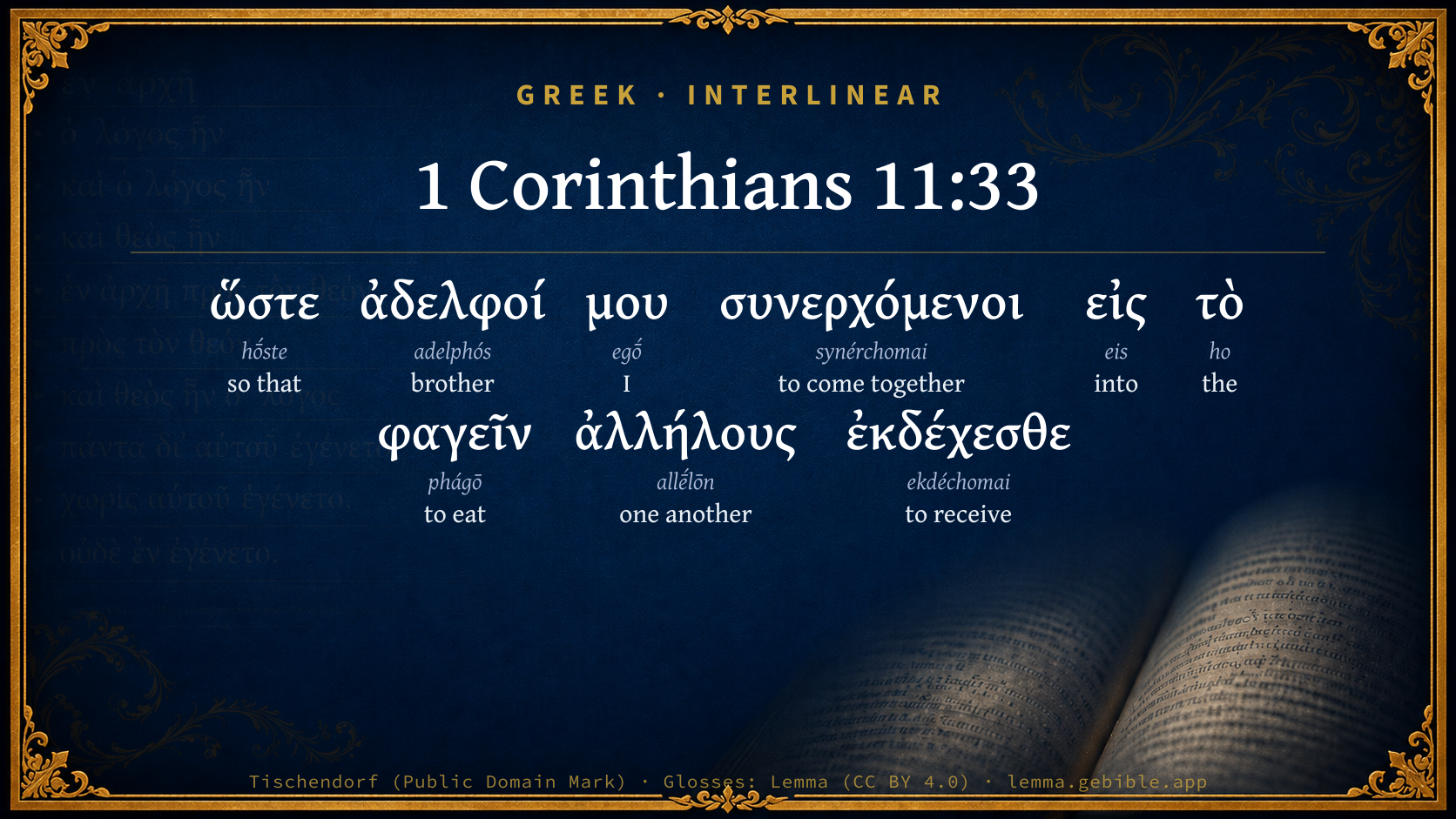
Greek (Tischendorf 8th ed.) 1 Corinthians 11:33 appears in the Greek New Testament. The text above is from the Tischendorf 8th edition. Each word links to its Strong’s number and a concise gloss. Click any word for its full Thayer’s Greek Lexicon entry.
Download image
Cite this verse

1 Corinthians 11:33 (World English Bible). Public Domain. Lemma interlinear Bible study tool, https://lemma.gebible.app/v/1-corinthians/11/33.

Show BibTeX & RIS
BibTeX
RIS
English Translation
Therefore, my brothers, when you come together to eat, wait one for another.
World English Bible · Public Domain
Download a study sheet

One document with this verse’s original text, its word-by-word gloss line, the meaning frame, cross-references with their text, attributed commentary, and full source and license credits — printable, and it pastes into notes with its structure intact.

This verse Autodidact and up

Study sheet (.html) Plain text (.txt)

A passage Seminary Student

Up to 50 verses in one chapter. A passage sheet keeps up to 6 commentary sources and 12 cross-references per verse, in the order this page ranks them, and says so on the sheet whenever that leaves anything out. Ask for a single verse and you get the Autodidact verse sheet above.

Everything on this page stays free to read, with no account — the sheet is a download of what is already on screen, not access to it.

Want to remove ads? Support Godless Engineer
Compare translations 3

The same verse in 3 English versions, stacked beneath the original-language interlinear above. Click any original word for its lexicon entry.

Each is an independent rendering of the whole verse — the interlinear is not word-aligned to these translations.

Highlighted words mark where these versions differ — a whole-verse word diff, not a word-by-word alignment.

  • World English Bible Public Domain
    Therefore, my brothers, when you come together to eat, wait one for another.
  • King James Version Public Domain
    Wherefore, my brethren, when ye come together to eat, tarry one for another.
  • unfoldingWord Literal Text CC BY-SA 4.0
    Therefore, my brothers, coming together to eat, wait for one another.

unfoldingWord Literal Text — © unfoldingWord, licensed CC BY-SA 4.0. Word-aligned USFM3 via Door43 (git.door43.org/unfoldingWord/en_ult).

Versions to compare (up to 4)

3 of 4 selected

Show all 19 translations

Every available English version of this verse, each an independent rendering of the whole verse.

  • World English Bible Public Domain
    Therefore, my brothers, when you come together to eat, wait one for another.
  • Berean Standard Bible Public Domain
    So, my brothers, when you come together to eat, wait for one another.
  • Majority Standard Bible Public Domain
    So, my brothers, when you come together to eat, wait for one another.
  • King James Version Public Domain
    Wherefore, my brethren, when ye come together to eat, tarry one for another.
  • American Standard Version (1901) Public Domain
    Wherefore, my brethren, when ye come together to eat, wait one for another.
  • Revised Version (1885) Public Domain
    Wherefore, my brethren, when ye come together to eat, wait one for another.
  • Geneva Bible (1599) Public Domain
    Wherefore, my brethren, when ye come together to eate, tary one for another.
  • Douay-Rheims (1899) Public Domain
    Wherefore, my brethren, when you come together to eat, wait for one another.
  • Young's Literal Translation Public Domain
    so then, my brethren, coming together to eat, for one another wait ye;
  • Literal Standard Version CC BY-SA 4.0
    so then, my brothers, coming together to eat, wait for one another;
  • Unlocked Literal Bible CC BY-SA 4.0
    Therefore, my brothers, when you come together to eat, wait for one another.
  • unfoldingWord Literal Text CC BY-SA 4.0
    Therefore, my brothers, coming together to eat, wait for one another.
  • Darby Bible Public Domain
    So that, my brethren, when ye come together to eat, wait for one another.
  • World Messianic Bible Public Domain
    Therefore, my brothers, when you come together to eat, wait for one another.
  • Webster's Bible Public Domain
    Wherefore, my brethren, when ye come together to eat, tarry one for another.
  • Free Bible Version CC BY-SA 4.0
    So my brothers and sisters, when you meet together to eat the Lord's Supper, wait for each other.
  • Bible in Basic English Public Domain
    So then, my brothers, when you come together to the holy meal of the Lord, let there be waiting for one another.
  • Text-Critical English NT CC BY 4.0
    So then, my brothers, when you come together to eat, wait for one another.
  • Tyndale New Testament (1534) Public Domain
    Wherfore my brethren when ye come to gedder to eate tary one for another.

Literal Standard Version (2020), Covenant Press — licensed CC BY-SA 4.0. Text via the HelloAO Bible API (eBible.org). Unlocked Literal Bible (unfoldingWord) — licensed CC BY-SA 4.0. Text via the HelloAO Bible API (eBible.org). unfoldingWord Literal Text — © unfoldingWord, licensed CC BY-SA 4.0. Word-aligned USFM3 via Door43 (git.door43.org/unfoldingWord/en_ult). Free Bible Version, Dr. Jonathan Gallagher — licensed CC BY-SA 4.0. Text via the HelloAO Bible API (eBible.org).

Word by word

More ways to search: Search by grammar → Find every occurrence → Compare this word →

Practice this passage: Drill this verse → Learn its vocabulary →

About this verse

These counts appear in no published source. They are computed here, from the morphology-tagged text and Lemma’s own curated glosses. What Lemma adds →

9
words
9
distinct lemmas
Pauline Epistles
section

Notable vocabulary

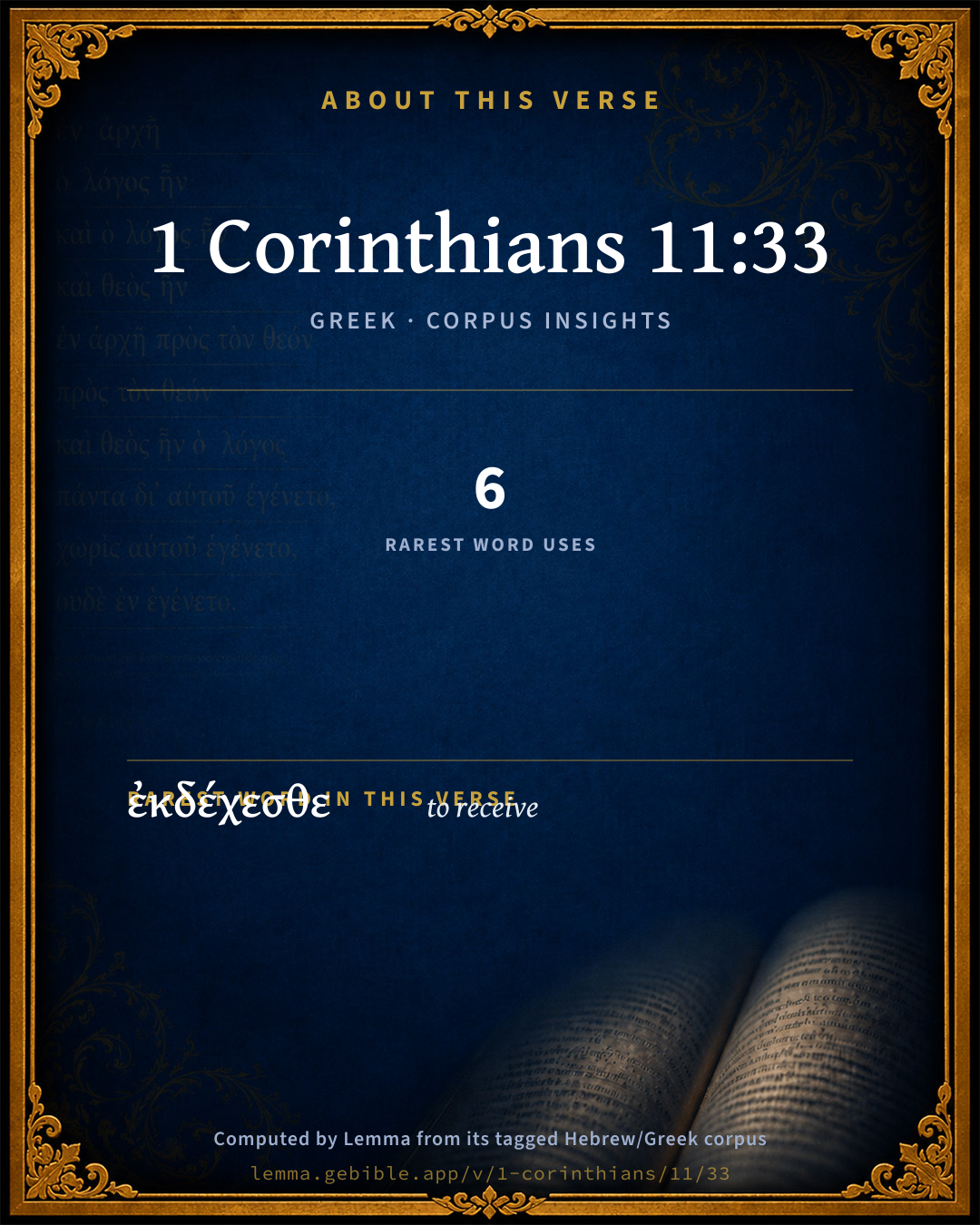
The rarest word here is ἐκδέχεσθε to receive G1551 — appearing just 6 times in the whole Greek New Testament.

Shared distinctive vocabulary

ἐκδέχεσθε to receive G1551 occurs in 6 verses of the Greek New Testament. Also found in:

Commentary

Notes on 1 Corinthians 11:33 from classic Christian and Jewish commentators (each source and its license shown beneath its notes). The classic Christian expositions comment on the surrounding passage and are grouped to its opening verse, so a note may address several verses; the Jewish commentaries on the Tanakh (Rashi and others) are per-verse, so they appear only where the commentator wrote on this verse.

Lemma curates 59 commentaries, every one of them public domain or Creative Commons licensed, each selected and text-cleaned for this edition rather than reprinted as found. About our sources →

The Biblical Illustrator

Joseph S. Exell

1Co_11:33-34

When ye come together to eat, tarry one for another.

Tarry one for another

1. These words glance at a state of things of which happily we can form little idea from any existing analogy. No one thinks now of bringing or sending food to satisfy his hunger. No one thinks of making distinctions between rich and poor, nor of beginning, in violation of the principle of fellowship, to eat and drink before the rest. We all tarry one for another.

2. But are not these words fall of meaning and value even to us? You sometimes picture to yourselves the Church lifted high above the world, with aspects and motions to the world above. But innumerable ties bind her also to the earth. She looks on to victory and rest, but also far around, to see who are coming to share in it. She makes no tarrying, and yet she tarries for all who need her help. Tarry--

I. For the young. You cannot look for the steady tread of those who have long been in the way in the ease of those who are just coming into it. Joseph and Mary went a days journey homeward before they missed their Son. So I seem to see the Church of manhood and womanhood more than a days journey ahead, with no yearning desire after the Church of adolescence. But when they found the young Jesus He was in the temple about His Fathers business. Reverence the children--the Church of the future. It is not given to fathers and mothers to divine all that their children may yet be and achieve. Tarry for them. Help the struggling thought; throw gentle airs and warm sunshine around the budding affections. Say well done when it has been well done. And when ye come up to the chief festival of life, do not seem as if you could comfortably come alone. Say to them, Come with us, until they respond, We will go with you, for we perceive that God is with you.

II. For the weak.

1. There never was an army without the sick and lame. But they are cared for as true soldiers. There never was a family of many children that had not some weaker than the rest. Where the law of love prevails, they are cared for in proportion to their weakness. Have you heard how in a band of workmen there are weak men; and when the others see their weakness, they will edge in a little help on each side, so as to keep that part of the work square with the rest, that the weak may claim full wage at the weeks end?

2. We, then, that are strong ought to bear the infirmities of the weak. The tender spirit of the New Testament in regard to weakness and the weak is everywhere. It had its source in the heart of our blessed Lord, who had compassion on the multitudes when He saw them. It filled the hearts, and it pervades the writings of His apostles. It is one of the notes of the true Church. It is her law which I now enforce. Some are fainting; but when they have rested awhile they will come. Some are hungry; when they are fed they will be stronger. Some have been sick; nothing can recruit them but time and gracious weather and kindly nourishment. Tarry one for another, and the weak shall be as David, and David as the angel of the Lord.

III. For the doubting. Not for the captious and the insincere, but for those who are honestly seeking for light.

1. A company of people, travelling through a forest, come to a place where many paths meet. Most of them are in no doubt which path to take. But some are in doubt. How, then, should they be treated by those from whom they part? Are we to cry, Farewell; we shall see you no more. Go your ways into famine and death? Are we not rather to say, We shall tarry for you; not indeed by staying our own progress, but by calling to you, by lighting our camp-fires at night, that you may see where we halt? You will not go far without seeing that you are wrong, and then take the path that leads right into ours. We shall be waiting for you.

2. There are many wanderers that are to be waited for. There are honest doubts, only to be resolved by time and light.

IV. For the stiricken. They are perhaps out of sight; for they are apt to fall out of the company. As the great Sufferer, now the great Conqueror, waits for us all, let us wait for one another.

V. For the whole world. Enemies as they are now, in the future they are to be friends. Let none doubt how the long conflict is to end. The Church can never submit herself to the world; but the world shall ground its weapons, and hold out the hand of friendship to the Church, and the conciliation shall be perfect. Conclusion: But to those of whom we have been speaking, for whom we have asked all patience and consideration, I would say, Be sure that you do not wait. Make haste; others are tarrying for you. (A. Raleigh, D.D.)

One missing

Sir Michael Costa was having a rehearsal with a great number of singers and musicians. When the mighty chorus pealed forth with the strains of the organ, the beating of drums, and the clashing of cymbals, one man who played the piccolo (a small kind of flute with very high notes) thought he was not needed and ceased to play. The conductor suddenly stopped, threw up his hands, and when all was quiet, cried, Where is the piccolo? The keen ear of the master missed it, and he felt that the chorus was incomplete. How many are missed by the great Master of assemblies, when He gathers His friends into His banqueting house!

The Biblical Illustrator, edited by Joseph S. Exell (c. 1880s–1900s) — public domain. Text from a community e-Sword module.

Joseph Benson's Commentary

1Co 11:33-34. Wherefore, my brethren — To conclude what I have to say to you on this subject; when ye come together to eat — To celebrate the Lord’s supper; tarry one for another — With decency and respectful love, till the whole assembly be convened, and then join all together at the same table and time, without such factions and divisions. And if any man hunger — Which probably was the pretence of those that were guilty of the fore- mentioned disorders; let him eat at home — At his own house; that ye come not together unto condemnation — That you may not, by profaning this holy ordinance, provoke God to punish you. And the rest — The other circumstances relating to the Lord’s supper, which require to be corrected; I will set in order — Will see regulated; when I come — To Corinth.

Joseph Benson's Commentary on the Old and New Testaments (1811–1818) — public domain. Text from a community e-Sword module.

Bengel's Gnomon

Johann Albrecht Bengel

1Co 11:33. ʼ Ωστε, therefore) The remedy and counsel suitably follow the reproof of vice, and the simpler the better.—’ Αδελφοί μον, my brethren) This appellation is suited to the conclusion.

34. Πεινᾷ is hungry) that he may not wait. Anticipation.[105]—λοιπὰ, the rest) regarding the Lord’s Supper; for presently after in this epistle he in like manner sets in order questions as to spiritual things.[106]

35. [105] See App. ‘Occupatio.’ It is the same as προκαταλῆψις. Anticipation of an objection which might be raised.—ED.

36. [106] Bengel, J. A. (1860). Vol. 3: Gnomon of the New Testament (M. E. Bengel & J. C. F. Steudel, Ed.) (J. Bryce, Trans.) (199–291). Edinburgh: T&T Clark.

Bengel's Gnomon of the New Testament — English translation (T&T Clark, Edinburgh, 1860) — public domain. Text from a community e-Sword module.

Meyer's Critical & Exegetical Commentary

Heinrich August Wilhelm Meyer

1Co_11:33. Conclusion from this proposition, general in its tenor, for the conduct of the readers at the love-feast, when they came together to keep it (εἰς τὸ φαγεῖν, not belonging to ἀλλ. ἐνδέχ.).

ἀδελφοί μου] perterrefactos rursum hac blanda compellatione solatur, Grotius.

ἀλλήλ. ἐκδέχεσθε] wait for one another (invicem exspectate, Vulg.), 1Co_16:11, so that no one ἴδιον δεῖπνον προλαμβάνει. This closing admonition corresponds to the censure, with which the section began in 1Co_11:21, and there is therefore no need for departing from this rendering, which is adopted by Luther, Erasmus, and the majority of commentators. Theophylact: δεικνύων, ὅτι κοινά εἰσι τὰ ἐκεῖσε εἰσφερόμενα, καὶ δεῖ ἀναμένειν τὴν κοινὴν συνέλευσιν. Others translate: Receive ye one another, namely, convivio, as a contrast to despising the other guests, and keeping them from sharing in what you yourselves have to give. So Pott, Rückert, Olshausen, Ewald, Hofmann, following Mosheim, Michaelis, Morus, Schulz, Rosenmüller. But in the N. T. ἐκδέχεσθαι (1Co_16:11) means always exspectare (comp Soph. Phil. 123; Polyb. xx. 4. 5, iii. 45. 6; Apollod. i. 9. 27; also in Plutarch, al[1897]), although in classical writers, as well as in the LXX. and Apocrypha, the meaning excipere is far more frequent. The latter sense Paul would have expressed by the simple δέχεσθαι, or by ΠΡΟΣΛΑΜΒΆΝΕΣΘΑΙ (Rom_14:1).

[1897] l. and others; and other passages; and other editions.

Meyer — Critical and Exegetical Commentary on the New Testament — English translation by Peter Christie, edited by Frederick Crombie (T&T Clark, 1880) — public domain. Text from a community e-Sword module.

Expositor's Greek Testament

ed. W. Robertson Nicoll

1Co 11:33-34 a . The “charge” (1Co 11:17 ) proceeds from inward to outward, from self-examination (1Co 11:28 ) to mutual accommodation respecting the Lord’s Supper. Religious decorum depends on two conditions, a becoming spirit associated with fitting external arrangements , such as good sense and reverence dictate: “And so, my brothers, when you meet for the meal, wait for one another ”. ἀδελφοί μου adds a touch of affection to what has been severely said. συνερχόμενοι carries us back to 1Co 11:17 ; 1Co 11:20 ; the same train of admonition throughout. τὸ φαγεῖν embraces the entire Church Supper; see notes on 1Co 11:20 f.; the order ἀλλήλους ἐκδέχεσθε ( invicem expectate , Vg [1800] ) forbids the hasty and schismatic τὸ ἴδιον δεῖπνον προλαβεῖν (1Co 11:21 ); no one must begin supper till the Church is gathered, so that all may commence together and share alike. To wait for others presumes waiting to feast with them . ἐκδέχομαι never means excipio ( receive : so Hf [1801] , and a few others), but always exspecto in the N.T.; with the former sense in cl [1802] Gr [1803] , it signifies to receive (a person) from some particular quarter. Some might object that hunger is pressing, and they cannot wait; to these Paul says, “If any one is hungry, let him eat at home ” staying his appetite before he comes to the meeting; cf. 1Co 11:21-22 a . The Church Supper is for good-fellowship, not for bodily need; to eat there like a famished man, absorbed in one’s food if nothing worse happen is to exclude Christian and religious thoughts. ἐν οἴκῳ , not ἐν ἐκκλησίᾳ (1Co 11:18 : note the absence of the art [1804] ). “Coming together εἰς κρίμα ” (for a judgment) defines the “coming together εἰς ἧσσον ” of 1Co 11:17 in terms of 1Co 11:29-32 . συνέρχησθε , pr [1805] sbj [1806] , of the stated meetings, as in 1Co 11:18 , etc. This warning ( ἵνα μή ) closes the παραγγελία introduced in 1Co 11:17 . For a clear and impartial account of the various doctrines of the Lord’s Supper connected with this passage, see Bt [1807] , pp. 206 ff.

[1800] Latin Vulgate Translation.

[1801] J. C. K. von Hofmann’s Die heilige Schrift N.T. untersucht , ii. 2 (2te Auflage, 1874).

[1802] classical.

[1803] Greek, or Grotius’ Annotationes in N.T.

[1804] grammatical article.

[1805] present tense.

[1806] subjunctive mood.

[1807] J. A. Beet’s St. Paul’s Epp. to the Corinthians (1882).

1Co 11:34 b . τὰ λοιπά , an etcetera appended to the charge “other matters,” probably of detail connected with the Church Supper and the κοινωνία . Ed [1808] takes this as the antithesis to the πρῶτον μὲν of 1Co 11:18 (see note), and supposes λοιπὰ to refer to other different matters, of which P. would postpone discussion till his arrival addressing himself notwithstanding to one of the principal of these λοιπὰ in 1Co 12:1 ff. ὡς ἄν ἔλθω , “according as I may come”: the Ap. is uncertain when and under what circumstances he may next visit Cor [1809] ( cf. 1Co 16:5-9 ); his intention to set matters in order is subject to this contingency. διατάξομαι (see parls.) refers, presumably, to points of external order, such as those just dealt with. Romanists (see Est.) justify by this text their alleged unwritten apostolic traditions respecting the Eucharist: fasting communion, e.g ., is placed amongst the unspecified λοιπά .

[1808] T. C. Edwards’ Commentary on the First Ep. to the Corinthians . 2

[1809] Corinth, Corinthian or Corinthians.

The Expositor's Greek Testament, edited by W. Robertson Nicoll (1897–1910) — public domain. Text from a community e-Sword module.

Hodge's Commentary on Romans, Ephesians & First Corinthians

Charles Hodge

1Co_11:33, 1Co_11:34

Wherefore, my brethren, when ye come together to eat, tarry one for another. And if any man hunger, let him eat at home; that ye come not together unto condemnation. And the rest will I set in order when I come.

The two great evils connected with the observance of the Lords supper at Corinth were, first, that it was not a communion, one took his supper before another, 1Co_11:21; and secondly, that they came to the Lords table to satisfy their hunger. That is, they made it an ordinary meal. They thus sinned against their brethren, 1Co_11:22, and they sinned against Christ, 1Co_11:27. In the conclusion, therefore, of the whole discussion, he exhorts them to correct these evils; to wait for each other, and make it a joint service; and to satisfy their hunger at home, and come together only to commemorate the Lords death. Mildly as this exhortation is expressed, it is enforced by the solemn warning already given, that ye come not together to condemnation, that is, so as to incur the displeasure of God. The rest will I set in order when (whenever ὡς ἄν) I may come. There were, it seems, other irregularities of less importance than those above mentioned, which the apostle leaves to be corrected until he should again visit Corinth. The epistles of Paul abound in evidence of the plenary authority exercised by the apostles over the churches. The word διατάσσω, to set in order, implies authoritative direction; see 1Co_7:17; 1Co_16:1. Mat_11:1. The apostles were rendered infallible, as the representatives of Christ, to teach his doctrines, to organize the church and determine its form of government, and to regulate its worship. And what they ordained has binding force on the church to this day. What Paul teaches in this chapter concerning the nature and mode of celebrating the Lords supper, has determined the views and practice of evangelical Christians in every part of the world. It is not at all wonderful, considering that the festivals of the Jews, and especially the Passover, as well as the sacrificial feasts of the Gentiles, were social repasts, and especially considering that our Lord instituted this ordinance in connection with the Paschal supper, that the early Christians should have so generally combined it with a social meal; or that this custom should have continued so long in the church. Nor is it a matter of surprise, that the social element in this combined service should so often have prevailed over the religious one. That this was to a lamentable degree the case in Corinth, is evident from this chapter; and it is probable from Jud_1:12, that the evil was by no means confined to Corinth. That apostle, speaking of certain sensual persons, says, These are spots in your feasts of charity, when they feast with you without fear. Hence the unspeakable importance of the instructions and directions given by St. Paul, which are specially designed to separate the Lords supper as a religious rite from the social element with which it was combined. The apostle urges that neither the sacrament itself, nor any feast with which it might be connected, should be regarded as the occasion of satisfying hunger. The communion of saints and the commemoration of the death of Christ as a sacrifice for our sins, are the only legitimate objects which could be contemplated in the service. And by exhibiting the intimate fellowship with the Lord involved in the right use of this ordinance, and the dreadful consequences of unworthily participating, he has raised it to a purely religious service, and made it the highest act of worship. From one extreme the church gradually passed over to the opposite. From regarding it as it had been in Corinth, little more than an ordinary meal, it came to be regarded as an awful mystery, a sacrifice which the people were to witness, and in which they were to adore the Redeemer as locally present in his corporeal nature under the form of a wafer! So strong a hold had this unscriptural view taken of the mind of the church, that Luther found it impossible to emancipate himself from the belief of the local presence of Christs real body in this sacrament. And even Calvin could not divest himself of the conviction, not only of its supernatural character, which all admit who regard it as a means of grace, but also of its being truly miraculous. It was only after a severe struggle that the Reformed church got back to the simple, yet sublime view of the ordinance presented by the apostle Paul. The danger has often since been that the church should go back to the Corinthian extreme, and look upon the Lords supper as a simple commemoration, involving nothing supernatural either in its nature or effects. Our only safety is in adhering strictly to the teachings of the Scriptures. The apostle tells us, on the authority of a direct revelation from the Lord himself, that while the ordinance is designed as a memorial of Christs death, it involves a participation of his body and blood, not of their material substance, but of their sacrificial efficacy, so that, although the body and blood of Christ are not corporally or carnally present in, with, or under the bread and wine in the Lords supper; and yet are spiritually present to the faith of the receiver, no less truly and really than the elements themselves are to their outward senses; so they that worthily communicate in the sacrament of the Lords supper, do therein feed upon the body and blood of Christ, not after a corporal or carnal, but in a spiritual manner; yet truly and really, while by faith they receive and apply unto themselves Christ crucified and all the benefits of his death. Larger Catechism.

Charles Hodge — Commentary on Romans (1835), First Corinthians (1857), and Ephesians (1856) — public domain. Text from a community e-Sword module.

Geneva Bible (1599)

Geneva Bible translators

The Supper of the Lord is a common action of the whole Church, and therefore there is no place, for private suppers.

Geneva Bible (1599) marginal notes — public domain. Text via Bolls.life.

Jamieson, Fausset & Brown

Robert Jamieson, A. R. Fausset & David Brown

tarry one for another--In contrast to Co1 11:21. The expression is not, "Give a share to one another," for all the viands brought to the feast were common property, and, therefore, they should "tarry" till all were met to partake together of the common feast of fellowship [THEOPHYLACT].

Jamieson, Fausset & Brown — Commentary Critical and Explanatory on the Whole Bible (1871) — public domain (CC PDM 1.0). Text via the HelloAO Bible API.

Adam Clarke's Commentary

Verse 33. When ye come together to eat] The Lord's Supper, tarry one for another-do not eat and drink in parties as ye have done heretofore; and do not connect it with any other meal.

Adam Clarke's Commentary on the Bible (1810–1826) — public domain. Text from a community e-Sword/MySword module.

John Calvin's Commentaries

33. Wherefore, my brethren From the discussion of a general doctrine, he returns to the particular subject with which he had set out, and comes to this conclusion, that equality must be observed in the Lord’s Supper, that there may be a real participation, as there ought to be, and that they may not celebrate every one his own supper; and farther, that this sacrament ought not to be mixed up with common feasts.

John Calvin's Commentaries (1540-1563) — public domain. Text from the Calvin Translation Society English edition (1840s-50s) via the Christian Classics Ethereal Library (ccel.org). Calvin's coverage is partial (roughly two-thirds of the Bible); uncommented books and verses are honest gaps, never fabricated. The 19th-century editor's footnotes and remarks are omitted so the notes are faithfully Calvin's own voice.

Ellicott's Commentary for English Readers

(33, 34) Wherefore, my brethren.—To correct the abuses of which he has spoken, and to enable them to escape the judgments which were falling upon them, the Apostle gives them this practical advice. When you come together to this eucharistic feast, do not eagerly eat what you have brought; wait until all have arrived, and then partake in common of this Christian meal. If, however, any man is really hungry, then let him satisfy his hunger at home, and come to this Supper so that he may partake of it not to his judgment.

A Bible Commentary for English Readers, edited by Charles John Ellicott (1878–1897) — public domain. Text from a community e-Sword module.

The Cambridge Bible for Schools and Colleges

gen. ed. J. J. S. Perowne

33. Wherefore, my brethren] The conclusion of the whole subject Every one is to wait till a fair and orderly distribution of the food has been made; and each is to remember that this is not an ordinary meal for the purpose of satisfying hunger, but the solemn commemoration of the Lord’s Death. A meal for the purpose of satisfying hunger had best be taken at home, to avoid the profanation which the Apostle has condemned.

The Cambridge Bible for Schools and Colleges (gen. ed. J. J. S. Perowne; Cambridge University Press, 1878–1918) — public domain. Text from a community e-Sword module.

John Gill's Exposition

And if any man hunger let him eat at home,.... Whereby the apostle shows his dislike of their ante-suppers in the place of public worship, at which they behaved in so indecent a manner, neglecting the poor, and too freely indulging themselves; and therefore if anyone was hungry, and could not wait till the Lord's supper was over, let him eat at home before he come to the place of worship, and satisfy his appetite, that he might with more ease and decency attend the table of the Lord:

that ye come not together unto condemnation or judgment; that is, that you may so behave when ye come together, that you may not bring upon you the judgment of the Lord, either by way of punishment or chastisement; that is to say, bodily diseases or death.

And the rest will I set in order when I come: meaning, not doctrines of faith, but things respecting ecclesiastical order and polity, which were amiss among them.

Next: 1 Corinthians Chapter 12

John Gill's Exposition of the Whole Bible (1746–1763) — public domain (CC PDM 1.0). Text via the HelloAO Bible API.

Trapp's Complete Commentary

John Trapp

33 Wherefore, my brethren, when ye come together to eat, tarry one for another.

Ver. 33. Wherefore, my brethren] He that reproveth and adviseth not, doth as it were snuff the lamp and not pour in oil.

John Trapp, A Commentary or Exposition upon All the Books of the Old and New Testament (1647–1656) — public domain. Text from a community e-Sword module.

Albert Barnes' Notes on the Bible

When ye come together to eat - Professedly to eat the Lord’s Supper.

Tarry one for another - Do not be guilty of disorder, intemperance, and gluttony; see the note at 1Co 11:21. Doddridge understands this of the feast that he supposes to have preceded the Lord’s Supper. But the more obvious interpretation is, to refer it to the Lord’s Supper itself; and to enjoin perfect order, respect, and sobriety. The idea is, that the table was common for the rich and the poor; and that the rich should claim no priority or precedence over the poor.

Albert Barnes' Notes on the Bible (1834–1885) — public domain. Text from a community e-Sword/MySword module.

Matthew Poole's English Annotations

The apostle concludes this discourse with an exhortation to them, for the time to come to take heed of these irreligious and irreverent behaviours, with relation to the Lord’s supper; that they should not take the sacrament before the whole church were met together, the rich should stay for the poor, and not receive it in parties, but as one body eat that one bread.

Matthew Poole's English Annotations on the Holy Bible (1683–1685) — public domain. Text from a community e-Sword/MySword module.

Whedon's Commentary on the Bible

Daniel D. Whedon

33. Wherefore—In view of the corrective and saving power of these judgments.

Tarry—We do not understand the injunction to be to wait until the others had all arrived at the place of meeting. It does not appear that one could not come as early as the other. Nor does the discourteous taketh before of 1Co_11:21 refer to an earlier coming and eating before the others had appeared; but to the richer parties refusing to wait for a spreading of all the contributions before the whole company, and their hurrying to the consumption of their own supply. To tarry, or wait, therefore, would be a social, deliberate placing each share at the common disposal, as if all were one, and had an equal right, irrespective of the amount contributed. But Wordsworth, Bloomfield, and others render the Greek word for tarry, receive, entertain one another, by a free interchange of provisions. This is a usual meaning of the word, and is far to be preferred, as accordant with Paul’s unselfish and whole-hearted spirit of courtesy.

Daniel D. Whedon (gen. ed.), Commentary on the Old and New Testaments (1874–1909) — public domain. Text from a community e-Sword module.

The Pulpit Commentary

Wherefore. He now briefly sums up the practical remedies for these discreditable scenes. My brethren. Introduced, as often, into a stern passage to show that the writer is only actuated by the spirit of love. Tarry one for another. This would prevent the scrambling greediness which he has already condemned in ver. 21.

The Pulpit Commentary (1880–1919), ed. H.D.M. Spence-Jones & Joseph S. Exell — public domain. Text from a community e-Sword module.

John Wesley's Explanatory Notes

The rest - The other circumstances relating to the Lord's supper.

John Wesley, Explanatory Notes Upon the Whole Bible (1754–1765) — public domain. Text via the GEBible commentary corpus.

Burkitt's Expository Notes on the New Testament

William Burkitt

Our apostle here concludes his discourse with an exhortation to the Corinthians, to take heed for time to come that all these fore-mentioned miscarriages may be rectified; that when they come together to eat the Lord’s supper, and the love-feasts, they should tarry one for another, that they may all feed and feast together. And if any man pretend to be hungry, let him eat at home before he comes, lest by these irreverent actions he bring down the judgments of God upon himself.

Lastly, he tells them, that as to other points of church order, he would determine them when he came among them; The rest will I set in order when I come. Such unchristian disorders may arise in the church as will require the presence and coming of an apostle to correct and reform them.

William Burkitt's Expository Notes on the New Testament (1700–1703) — public domain. Text from a community e-Sword module.

McGarvey & Pendleton's Commentaries

J. W. McGarvey

Wherefore [if you wish to remedy matters], my brethren, when ye come together to eat, wait one for another .

J. W. McGarvey (with Philip Y. Pendleton), Commentaries on the New Testament (The Fourfold Gospel, 1914; Acts; and the epistles) — public domain. Text from a community e-Sword/MySword module.

The People's New Testament

B. W. Johnson

33. Wherefore, when ye come together to eat, etc. Let all wait, and let all eat and partake of the Lord's supper together.

B. W. Johnson's The People's New Testament with Notes (1889–1891) — public domain. Electronic text from the Christian Classics Ethereal Library (CCEL) ThML edition.

unfoldingWord translationNotes

Door43 World Missions Community

come together to eat

gather to eat a meal together before celebrating the Lord's Supper

wait for one another

"allow the others to arrive before beginning the meal"

let him eat at home

"let him eat before attending this gathering"

it will not be for judgment

"it will not be an occasion for God to discipline you" (See: Metonymy)

translationWords

judge

unfoldingWord translationNotes — © Distant Shores Media and the Door43 World Missions Community, licensed CC BY-SA 4.0. Source: git.door43.org/Door43/en_tn.

Cambridge Greek Testament for Schools and Colleges

33. ὥστε. The conclusion of the whole subject. Every one is to wait till a fair and orderly distribution of the food has been made; and each is to remember that this is not an ordinary meal for the purpose of satisfying hunger, but the solemn commemoration of the Lord’s Death. A meal for the purpose of satisfying hunger had best be taken at home, to avoid the profanation which the Apostle has condemned.

Cambridge Greek Testament for Schools and Colleges (Cambridge University Press, 1896; 21 vols, various authors incl. Carr, Maclear, Plummer, Farrar, Lumby, Moule, M. R. James, Simcox) — public domain. Text from a community e-Sword module.

Alford’s Greek Testament

Henry Alford

33.] General conclusion respecting this disorder. So then (‘quæ cum ita sint’), my brethren (milder persuasive: as has been the assumption of the first person, vv. 31, 32), when ye are coming together to eat, wait for one another (contrast to ἕκαστος … προλαμβάνει, ver. 21: as Theophyl.: οὐκ εἶπεν, ἀλλήλοις μετάδοτε, ἀλλʼ, ἐκδέχεσθε· δεικνύων ὅτι κοινά εἰσι τὰ ἐκεῖσε εἰσφερόμενα. καὶ δεῖ ἀναμένειν τὴν κοινὴν συνέλευσιν).

Henry Alford, The Greek Testament (1849–1861) — public domain. Text from a community e-Sword module.

International Critical Commentary

33. ὥστε, ἀδελφοί μου. In vv. 31, 32 he has been regarding offences generally. He now returns to the disorders in connexion with the Lord’s Supper in order to close the subject, and in so doing he repeats the affectionate address (1:11) which still further migitates the recent severity. This conclusion indicates where the great fault has been: in the common meal of Christian love and fellowship there has been no love or fellowship. Having charged them to secure the necessary internal feeling by means of self-examination, he now insists upon the necessity for the external expression of it. To the last he harps upon συνέρχεσθαι. These are meetings, Christian gatherings, the object of which is to manifest mutual love. Moreover, the purpose of the congregational meal is spiritual, not physical; not to satisfy hunger, but to commemorate and to hold communion with Christ. Let them cease to come together εἰς ἧσσον, εἰς κρίμα. As in v. 21, τὸ φαγεῖν is a general expression for a common meal.

ἀλλήλους ἐκδέχεσθε. ‘Wait for one another,’ invicem expectate (Vulg.). This is the usual meaning of the verb in the N.T. (16:2; Heb 10:13, Heb 10:11:10; Act 17:16; Jas 5:7). The meaning ‘receive ye one another’ (common in the LXX and in class. Grk.) is less suitable: for this he would perhaps have used προσλαμβάνεσθαι (Rom 14:1, Rom 15:7). The waiting would prevent the greedy προλαμβάμειν (21): and Chrysostom points out the delicacy of the expression. It is the rich who are to wait for the poor; but neither rich nor poor are mentioned.

International Critical Commentary — older volumes (1896–1929), various authors — public domain. Text from a community e-Sword module.

Vincent's Word Studies in the New Testament

Marvin R. Vincent

Tarry [εκδεχεσθε] . In the usual New - Testament sense, as Joh 5:3; Act 17:16; though in some cases the idea of expectancy is emphasized, as Heb 10:13; Heb 11:10; Jas 5:7. Some render receive ye one another, in contrast with despising the poorer guests; but this is not according to New - Testament usage.

Marvin R. Vincent, Word Studies in the New Testament (1887–1900) — public domain. Text from a community e-Sword/MySword module.

Godet's Commentaries

Frédéric Louis Godet

Vv. 33, 34. “Wherefore, my brethren, when ye come together to eat, tarry one for another. 34. If any man hunger, let him eat at home, that ye come not together to incur judgment. The rest will I set in order when I come.”

This conclusion reminds us of the passage 1Co 10:23-33. Here, as there, Paul, after starting from an outward fact (the disorders in the love-feast), enters on a complete development, intended thoroughly to enlighten the conscience of the Church; then he winds up with some rules of conduct, apparently external, but in which there is concentrated the whole moral quintessence of the preceding exposition.

The affectionate address, my brethren, following warnings so serious, has in it something familiar and genial, fitted to open the hearts of his readers to the counsel with which he is about to close. The regimen εἰς τὸ φαγεῖν, to eat, might be connected with the following verb, tarry: “Tarry for one another to begin the feast.” But it is simpler to make it dependent on the verb come together: “When you come together, not for ordinary worship simply, but for a love-feast and the celebration of the Supper, tarry one for another to partake of the feast.” The verb ἐκδέχεσθαι signifies to wait and to welcome. The first meaning is the only one found in the New Testament. It is also that which is most suitable here; for the word forms an antithesis to προλαμβάνειν, to precede in eating, 1Co 11:21. The apostle wishes, that all seating themselves to eat together, the supper of each may become that of his neighbours; thereby it is that the feast becomes a true agape.

Vv. 34. The first words correspond exactly to the question of 1Co 11:22: “Have ye not houses to eat and to drink in?” In this feast the object is not in reality to take nourishment, but to eat together.

A judgment, such as that instanced by the apostle in 1Co 11:29.

The term: the other points, the rest, τὰ λοιπά, no doubt embraces a number of questions of detail relating to the celebration of the Supper, such as the frequency, the days, the time of day, the mode of the feast, etc. The Catholics have supposed that the matter in question here was the institution of the Mass, which, they say, became from that time the subject of an Episcopal tradition. But that would not have been a detail of secondary importance, like those which are evidently in the mind of the apostle.

In the representations of the agapae which are found in the Catacombs, there is seen a company of seven or eight persons grouped round the same table (Heinrici, p. 342). If it was so at Corinth, one can very easily understand the possibility of the abuse pointed out by the apostle; every company of friends might have gathered in a group separate from the rest of the Church. But did such a practice prevail at Corinth? Of this we have not the slightest proof.

The agapae of which Paul speaks have been compared to the feasts which were celebrated from time to time in Greece by the corporations which then existed in great number, with a view to certain common interests. But however that may be, the origin of the agapae is Jewish and not Greek. This feast indeed represented the last supper of Jesus with His apostles, in the course of which He instituted the Holy Communion. Besides, in the feasts of those Greek colleges, it was the common fund of the society which paid the banquet, while our chapter itself proves that in the agapae every family furnished its own provisions.

From certain notices, for which we are indebted to the historian Sozomenes (5th cent.), it appears that in some Churches (that of Alexandria, for example) the agape preceded the Holy Supper; according to Augustine, and no doubt in all the Churches of the West, it was the opposite: the Supper introduced the agape. Usage might vary according to place, and it certainly varied according to time, till the date when the agape was completely suppressed because of the abuses to which it gave rise.

Frédéric Louis Godet — Commentaries on Luke, John, Romans, and 1 Corinthians — English translation (T&T Clark, Edinburgh, 1870s–1890s) — public domain. Text from a community e-Sword module.

Lesson kit

Teaching starters — assembled from the data on this page, not authored interpretation. Every prompt links to the verse data it draws on. Edit before teaching.

1 Corinthians, in the Pauline Epistles, opens this verse with 9 words (9 distinct Greek lemmas). Its most distinctive word is ekdéchomai (“to receive”). A historical commentator’s framing appears above. Read the whole chapter for the surrounding context.

Discussion questions

  1. The word ekdéchomai carries the sense “to receive.” How does it shape the verse?
  2. How does Acts 17:16, which shares the word «to receive», read alongside this verse?
  3. These translations render this verse differently. What is at stake in choosing one wording over another?
  4. Compare how The Biblical Illustrator and Joseph Benson's Commentary read this verse. Where do they agree or differ?

Things to notice

Reading settings

Reading text

Shown beneath each verse's original-language words.

Old Testament
Old Testament edition

Read the OT as the Masoretic Hebrew (MT) or the Greek Septuagint (LXX).

English shown for the Greek Septuagint (in the Hebrew ↔ Greek comparison).

Comparing translations? Open the Compare panel on any verse page to stack up to four side by side.