Genesis 24:55

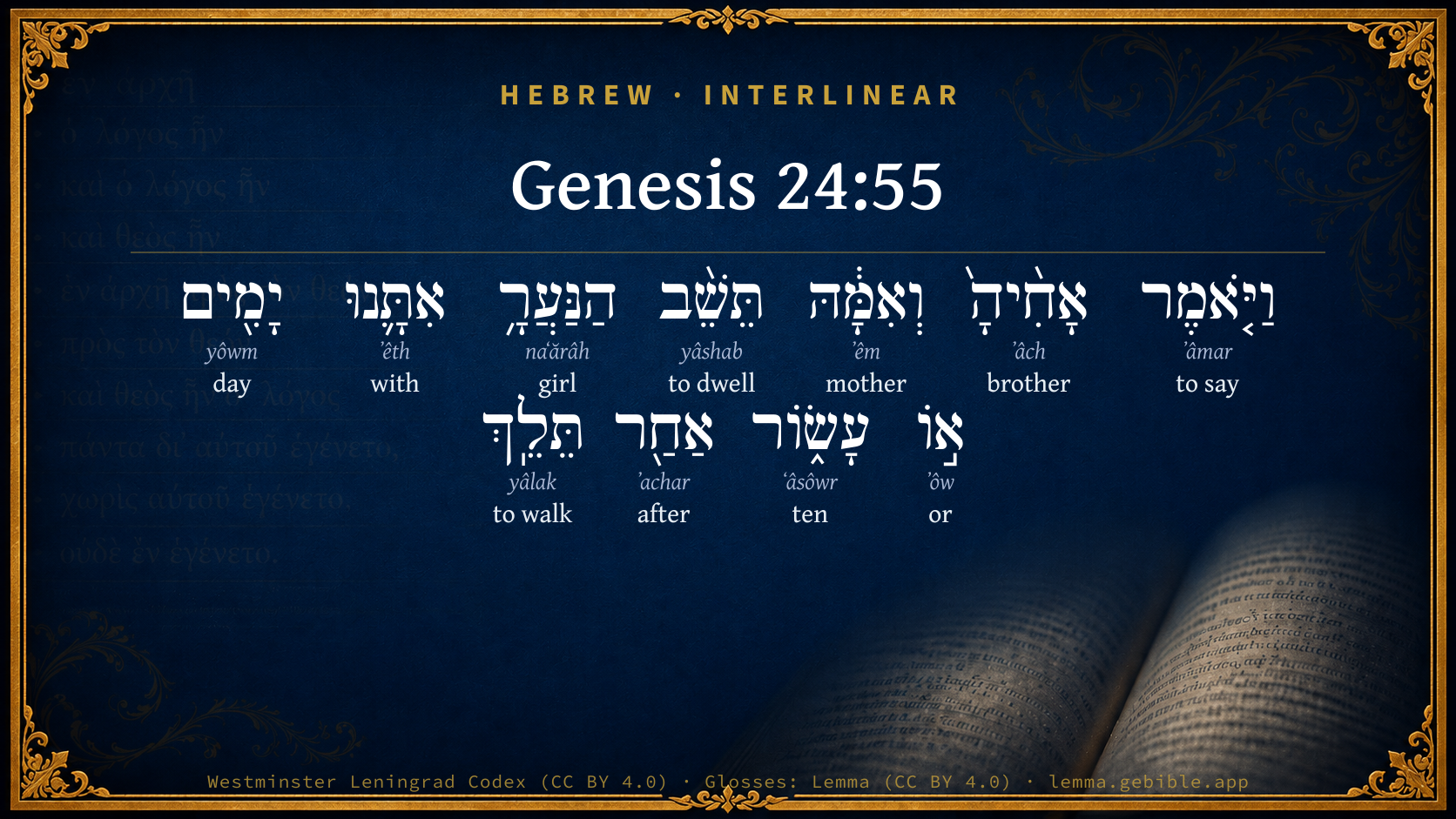
Hebrew (Westminster Leningrad Codex) Genesis 24:55 appears in the Hebrew Old Testament. The text above is from the Westminster Leningrad Codex. Each word links to its Strong’s number, a concise gloss, and parsing drawn from the Open Scriptures Hebrew Bible morphology. Click any word for its full Brown-Driver-Briggs (BDB) entry.
Download image
Cite this verse

Genesis 24:55 (World English Bible). Public Domain. Lemma interlinear Bible study tool, https://lemma.gebible.app/v/genesis/24/55.

Show BibTeX & RIS
BibTeX
RIS
English Translation
Her brother and her mother said, "Let the young lady stay with us a few days, at least ten. After that she will go."
World English Bible · Public Domain
Highlights
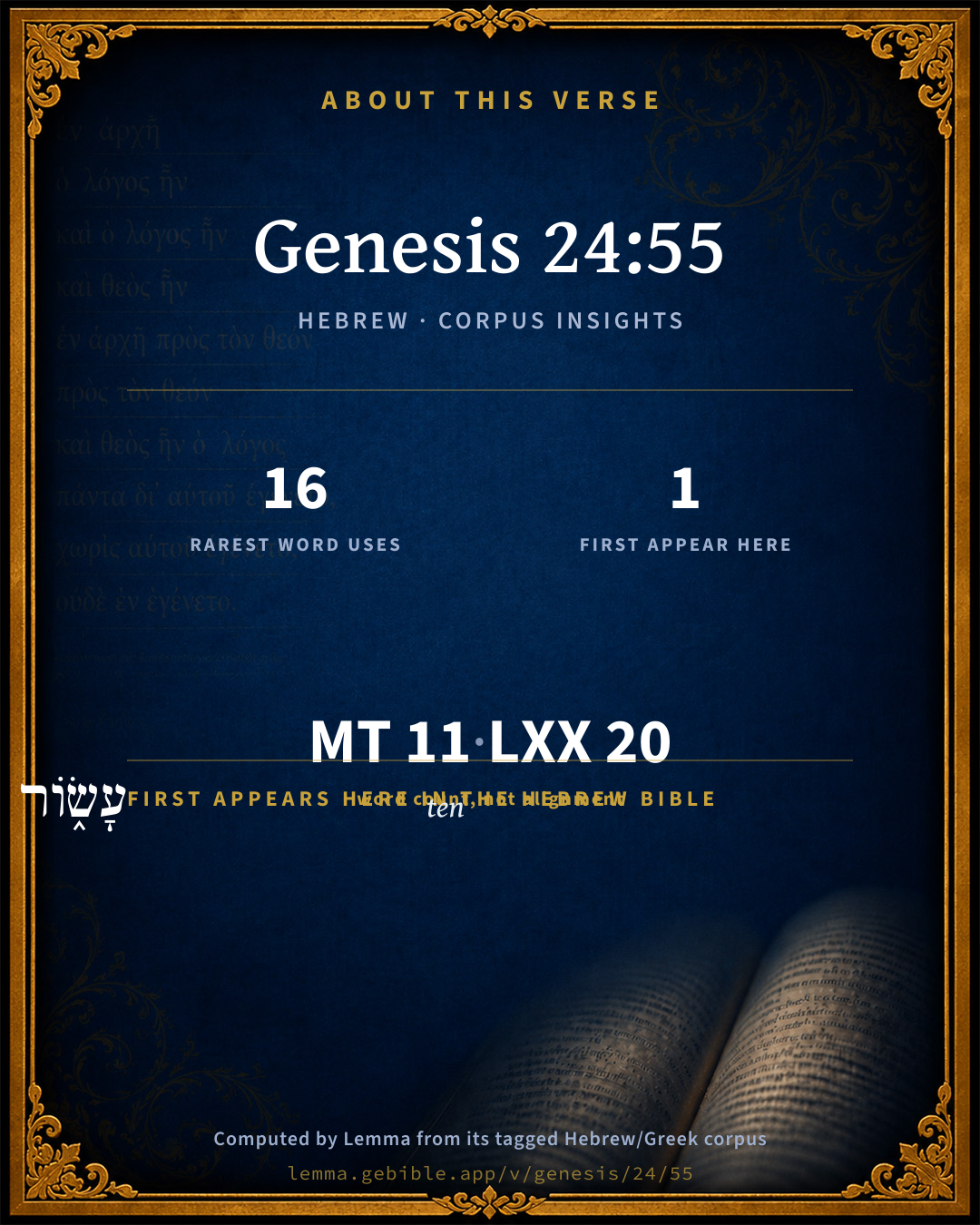
  • 1 first appearance in the Hebrew Bible
Full analysis ↓
Download a study sheet

One document with this verse’s original text, its word-by-word gloss line, the meaning frame, cross-references with their text, attributed commentary, and full source and license credits — printable, and it pastes into notes with its structure intact.

This verse Autodidact and up

Study sheet (.html) Plain text (.txt)

A passage Seminary Student

Up to 50 verses in one chapter. A passage sheet keeps up to 6 commentary sources and 12 cross-references per verse, in the order this page ranks them, and says so on the sheet whenever that leaves anything out. Ask for a single verse and you get the Autodidact verse sheet above.

Everything on this page stays free to read, with no account — the sheet is a download of what is already on screen, not access to it.

Want to remove ads? Support Godless Engineer
Compare translations 3

The same verse in 3 English versions, stacked beneath the original-language interlinear above. Click any original word for its lexicon entry.

Each is an independent rendering of the whole verse — the interlinear is not word-aligned to these translations.

Highlighted words mark where these versions differ — a whole-verse word diff, not a word-by-word alignment.

  • World English Bible Public Domain
    Her brother and her mother said, "Let the young lady stay with us a few days, at least ten. After that she will go."
  • King James Version Public Domain
    And her brother and her mother said, Let the damsel abide with us a few days, at the least ten; after that she shall go.
  • unfoldingWord Literal Text CC BY-SA 4.0
    But her brother and her mother said, “Let the young woman stay with us a few days, at least ten. After that she will go.”

unfoldingWord Literal Text — © unfoldingWord, licensed CC BY-SA 4.0. Word-aligned USFM3 via Door43 (git.door43.org/unfoldingWord/en_ult).

Versions to compare (up to 4)

3 of 4 selected

Show all 18 translations

Every available English version of this verse, each an independent rendering of the whole verse.

  • World English Bible Public Domain
    Her brother and her mother said, "Let the young lady stay with us a few days, at least ten. After that she will go."
  • Berean Standard Bible Public Domain
    But her brother and mother said, “Let the girl remain with us ten days or so. After that, she may go.”
  • Majority Standard Bible Public Domain
    But her brother and mother said, “Let the girl remain with us ten days or so. After that, she may go.”
  • King James Version Public Domain
    And her brother and her mother said, Let the damsel abide with us a few days, at the least ten; after that she shall go.
  • American Standard Version (1901) Public Domain
    And her brother and her mother said, Let the damsel abide with us `a few' days, at the least ten. After that she shall go.
  • Revised Version (1885) Public Domain
    And her brother and her mother said, Let the damsel abide with us a few days, at the least ten; after that she shall go.
  • Geneva Bible (1599) Public Domain
    Then her brother and her mother answered, Let the maide abide with vs, at the least ten dayes: then shall she goe.
  • Douay-Rheims (1899) Public Domain
    And her brother and mother answered: Let the maid stay at least ten days with us, and afterwards she shall depart.
  • Young's Literal Translation Public Domain
    and her brother saith -- her mother also -- `Let the young person abide with us a week or ten days, afterwards doth she go.'
  • Literal Standard Version CC BY-SA 4.0
    and her brother says—her mother also, “Let the young person abide with us a week or ten days, afterward she goes.”
  • Unlocked Literal Bible CC BY-SA 4.0
    Her brother and her mother said, “Let the young woman stay with us for a few more days, at least ten. After that she may go.”
  • unfoldingWord Literal Text CC BY-SA 4.0
    But her brother and her mother said, “Let the young woman stay with us a few days, at least ten. After that she will go.”
  • Darby Bible Public Domain
    And her brother and her mother said, Let the maiden abide with us [some] days, or [say] ten; after that she shall go.
  • World Messianic Bible Public Domain
    Her brother and her mother said, “Let the young lady stay with us a few days, at least ten. After that she will go.”
  • Webster's Bible Public Domain
    And her brother and her mother said, Let the damsel abide with us a few days, at the least ten; after that she shall go.
  • Free Bible Version CC BY-SA 4.0
    But her brother and her mother said, “Let her stay with us for another ten days or so. She can leave after that.”
  • Bible in Basic English Public Domain
    But her brother and her mother said, Let the girl be with us a week or ten days, and then she may go.
  • JPS Tanakh (1917) Public Domain
    And her brother and her mother said: 'Let the damsel abide with us a few days, at the least ten; after that she shall go.'

Literal Standard Version (2020), Covenant Press — licensed CC BY-SA 4.0. Text via the HelloAO Bible API (eBible.org). Unlocked Literal Bible (unfoldingWord) — licensed CC BY-SA 4.0. Text via the HelloAO Bible API (eBible.org). unfoldingWord Literal Text — © unfoldingWord, licensed CC BY-SA 4.0. Word-aligned USFM3 via Door43 (git.door43.org/unfoldingWord/en_ult). Free Bible Version, Dr. Jonathan Gallagher — licensed CC BY-SA 4.0. Text via the HelloAO Bible API (eBible.org).

Word by word

More ways to search: Search by grammar → Find every occurrence → Compare this word →

Practice this passage: Drill this verse → Learn its vocabulary →

עָשׂ֑וֹר
ʻâsôwr
H6218
“ten”
Noun, Common, Masculine, Singular, Absolute
Part of Speech
Noun
Type
Common
Gender
Masculine
Number
Singular
State
Absolute
Full BDB Definition

Origin: from H6235

TWOT: 1711d

ten, decade - ten, tenth - ten-stringed, harp
  1. וַיֹּ֤אמֶר ʼâmar H559 “and · to say” Conjunction + Verb, Qal, Sequential Imperfect, 3rd Person, Masculine, Singular
  2. אָחִ֨יהָ֙ ʼâch H251 “brother · her” Noun, Common, Masculine, Singular, Construct + Suffix, Personal, 3rd Person, Feminine, Singular
  3. וְאִמָּ֔הּ ʼêm H517 “and · mother · her” Conjunction + Noun, Common, Feminine, Singular, Construct + Suffix, Personal, 3rd Person, Feminine, Singular
  4. תֵּשֵׁ֨ב yâshab H3427 “to dwell” Verb, Qal, Imperfect, 3rd Person, Feminine, Singular
  5. הַנַּעֲרָ֥ naʻărâh H5291 “the · girl” Particle, Definite Article + Noun, Common, Feminine, Singular, Absolute
  6. אִתָּ֛נוּ ʼêth H854 “with · us” Preposition + Suffix, Personal, 1st Person, Common, Plural
  7. יָמִ֖ים yôwm H3117 “days” Noun, Common, Masculine, Plural, Absolute
  8. א֣וֹ ʼôw H176 “or” Conjunction
  9. אַחַ֖ר ʼachar H310 “after” Preposition
  10. תֵּלֵֽךְ yâlak H3212 “to walk” Verb, Qal, Imperfect, 2nd Person, Masculine, Singular

About this verse

These counts appear in no published source. They are computed here, from the morphology-tagged text and Lemma’s own curated glosses. What Lemma adds →

11
words
11
distinct lemmas
Pentateuch
section

Notable vocabulary

The rarest word here is עָשׂ֑וֹר ten H6218 — appearing just 16 times in the whole Hebrew Bible.

First appearance in Scripture

This word makes its first canonical appearance in the Hebrew Bible here:

  • עָשׂ֑וֹר ten H6218

Shared distinctive vocabulary

עָשׂ֑וֹר ten H6218 occurs in 16 verses of the Hebrew Bible. Also found in:

Grammatical profile

  • 3 verbs
  • 5 nouns
  • 2 prepositions
  • 1 conjunction

Verb forms

  • וַיֹּ֤אמֶר Qal · Sequential Imperfect
  • תֵּשֵׁ֨ב Qal · Imperfect
  • תֵּלֵֽךְ Qal · Imperfect

Hebrew & Septuagint length

In English translation the verse runs 24 words from the Hebrew and 22 from the Septuagint (LXX English) — closely comparable.

A rough comparison of the two English renderings, which tokenize alike — not a word-level alignment.

Word counts can differ between the Hebrew and the Greek without any difference in meaning — e.g. the Hebrew direct-object marker אֵת has no separate Greek word, and Greek often adds the article ὁ.

In the original languages it is 11 Hebrew tokens and 20 Greek tokens — but the two are counted differently (Hebrew bundles its prefixes and suffixes into one token; the Greek is in lemma form), so that isn’t a like-for-like length.

Cross-references

3

Topical passages linked to Genesis 24:55 in the Treasury of Scripture Knowledge — connected by theme and wording, ordered by reader-vote popularity; previews shown in the World English Bible.

  • Genesis 4:3 As time passed, it happened that Cain brought an offering to Yahweh from the fruit of the ground.
  • Leviticus 25:29 "'If a man sells a dwelling house in a walled city, then he may redeem it within a whole year after it has been sold. For a full year he shall have the right of redemption.
  • Judges 14:8 After a while he returned to take her; and he turned aside to see the carcass of the lion: and, behold, there was a swarm of bees in the body of the lion, and honey.

Cross-references courtesy of OpenBible.info (CC BY 4.0).

Hebrew and Greek witnesses Masoretic Hebrew ↔ Greek Septuagint

The same verse in the two great witnesses to the Old Testament, shown verse-for-verse.

These are two independent witnesses, not word-aligned to each other, and the Septuagint is shown in lemma (dictionary) form.

Hebrew Genesis 24:55 Masoretic · Westminster Leningrad Codex

וַיֹּ֤אמֶר אָחִ֨יהָ֙ וְאִמָּ֔הּ תֵּשֵׁ֨ב הַנַּעֲרָ֥ אִתָּ֛נוּ יָמִ֖ים א֣וֹ עָשׂ֑וֹר אַחַ֖ר תֵּלֵֽךְ

Her brother and her mother said, "Let the young lady stay with us a few days, at least ten. After that she will go."

World English Bible · Public Domain

Greek LXX Genesis 24:55 Septuagint · lemma form

εἶπον δέ ὁ ἀδελφός αὐτός καί ὁ μήτηρ μένω ὁ παρθένος μετά ἐγώ ἡμέρα ὡσεί δέκα καί μετά οὗτος ἀποἔρχομαι

And her brethren and her mother said, Let the virgin remain with us about ten days, and after that she shall depart.

LXX2012 (modern English Septuagint) · Public Domain

On this verse, Adam Clarke's Commentary discusses the Septuagint’s reading. Read the note in Commentary ↓

Hebrew: Westminster Leningrad Codex (CC BY 4.0). Greek: Septuagint (public domain); English from LXX2012 (modern English Septuagint) (Public Domain). How the Septuagint differs from the Hebrew →

Targum (Aramaic paraphrase)

2

The Targum is the ancient Jewish Aramaic paraphrase of the Hebrew Scriptures — an interpretive translation, not the Hebrew text itself. Onkelos (literal) and Pseudo-Jonathan (expansive) render the Torah, and Jonathan the Prophets. Coverage is partial: where no permissively-licensed English translation exists for a verse, only the Aramaic is shown. This is verse-level text, not a word-by-word alignment to the Hebrew.

  1. Targum Onkelos Torah (Genesis–Deuteronomy)
    וַאֲמַר אֲחוּהָ וְאִמַּהּ תָּתֵיב עוּלֶמְתָּא עִמָּנָא עִדַּן בְּעִדַּן אוֹ עַשְׂרָא יַרְחִין בָּתַר כֵּן תֵּיזִיל

    (no public-domain English translation for this verse)

    Targum Onkelos — Aramaic: “Onkelos Genesis” (public domain); “Onkelos Exodus” (public domain); “Onkelos Leviticus” (public domain); “Onkelos Numbers” (public domain); “Onkelos Deuteronomy” (public domain). English: “Sefaria Community Translation” (CC0 1.0 (public-domain dedication)); “J.W. Etheridge. The Targums of Onkelos and Jonathan Ben Uzziel on the Pentateuch. London: Longmans, Green, 1862” (public domain). Text via Sefaria.

  2. Targum Pseudo-Jonathan Torah (Genesis–Deuteronomy)
    וְעַל דִהֲווֹ מְמַלְלִין בְּרַמְשָׁא בְּתוּאֵל הֲוָה אָכִיל מֵהַהוּא תַבְשִׁילָא וְאַשְׁכְּחוּנוֹהִי בִּקְרִיצְתָּא דְהָא מִית וַאֲמַר אֲחוּהָא וְאִימָא תִּיתַב רִיבָא עִמָנָא יוֹמֵי שַׁתָּא חֲדָא אוֹ עֲשַר יַרְחִין וּבָתַר כְּדֵין תֵּיזִיל

    But as they were talking in the evening, Bethuel had eaten of that prepared food; and in the morning they found that he was dead. And the brother and mother said therefore, Let the damsel dwell with us the days of one year or ten months, and then she shall go.

    Targum Pseudo-Jonathan — Aramaic: “Targum Jonathan on Genesis” (public domain); “Targum Jonathan on Exodus” (public domain); “Targum Jonathan on Leviticus” (public domain); “Targum Jonathan on Numbers” (public domain); “Targum Jonathan on Deuteronomy” (public domain). English: “The Targum of Jonathan ben Uzziel, trans. J. W. Etheridge, London, 1862” (public domain). Text via Sefaria.

Commentary

Notes on Genesis 24:55 from classic Christian and Jewish commentators (each source and its license shown beneath its notes). The classic Christian expositions comment on the surrounding passage and are grouped to its opening verse, so a note may address several verses; the Jewish commentaries on the Tanakh (Rashi and others) are per-verse, so they appear only where the commentator wrote on this verse.

Lemma curates 59 commentaries, every one of them public domain or Creative Commons licensed, each selected and text-cleaned for this edition rather than reprinted as found. About our sources →

Trapp's Complete Commentary

John Trapp

Gen 24:55 And her brother and her mother said, Let the damsel abide with us [a few] days, at the least ten; after that she shall go.

Ver. 55. Let the damsel abide with us.] Men promise in baste; perform by leisure.

John Trapp, A Commentary or Exposition upon All the Books of the Old and New Testament (1647–1656) — public domain. Text from a community e-Sword module.

The Biblical Illustrator

Joseph S. Exell

Gen_24:55

Abide with us a few days

Delay is dangerous

We shall not have anything more to do with Laban to-night, than to use his desire to retain his good sister Rebekah as an illustration of the way in which this wicked world endeavours to meet the invitations of the gospel, by trying to retain the awakened sinner a little longer in its grasp.

Satans last counsel to his servants seems to have been, Do not openly oppose the gospel; give way to it, but suggest delay.

I. I want to draw your attention, first of all, to THE WORLDS PRETEXT FOR THIS DELAY. I stand knocking to-night at the worlds door, and I say, There is a young heart here I want for Christ; the world replies, All right, you shall have it one of these days, but there is time enough yet. I say of another, Here is a man whose strength and vigour I want for the Saviour. All right, says the world, do not be in such a fever about it; we are all agreed with you; we all think as you do that religion is important, but wait awhile, put it off, take time, tarry a little; there is no cause for all this hurry and this fuss. Then the world says, O stop a little longer; we should like these young people to know something about life. Well, but, base world, what dost thou mean by that? What hast thou to do with life? We, too, want the young people to know something about life: but what is life? Why true life is to be found only in the followers of Christ, in Whom is life. Ah! then, says the world, putting on its best smiles, it is all very well for you to talk, but we do not want our young people to give up all their pleasure. And what hast thou to do with pleasure, thou painted Jezebel? what hast thou to do with happiness, false deluder of souls?

II. Shall I tell you now WHAT IS THE DRIFT OR ALL THIS WAITING? Ten days did not seem too long; but they might have been ten days too late. To be too late for ever; yea, one minute too late is an eternity too late! Remember that if thou hast missed of Christ by but the ticking of a clock, thou hast missed of Christ for ever; so that minutes and ticks of clocks may be invested with a very solemn power, if we come to look at them in that light. But what the world means is just this, Ah! says Madam Bubble, here is a young person impressed--if we laugh at him it will deepen the impression; but we will say to him, Come, come; let the impression go for a little while; this is not the fit time; when you have a more convenient season, you can bring it on again. Moreover, the world says, Well, if they do go at last, yet we will exact from them as long a time of service as we can.

III. Thirdly, having exposed the pretexts of the world, and tried to show its cruel designs, our REAL OBJECT IS TO HAVE OUR HEARERS SAVED, AND TO HAVE THEM SAVED NOW. There were three reasons why Abrahams servant wished Rebekah to go with him at once, and these move me to desire your conversion to-night.

1. First, he desired it for his masters sake. He knew that Isaac was looking forward to the happy day when he should be married to his chosen bride. And oh! the heart of Jesus is longing after sinners.

2. Abrahams servant, too, desired it for his own sake, because he was a faithful steward, and wanted to do his business well. And how we desire your conversion for our sake! It will make us so happy I There is no bliss that can come to the soul of the Christian minister like the bliss of knowing that he has been made the means of bringing some to Christ.

3. But the principal reason that the man wished it was for Rebekahs sake. He knew that Isaac would make a good husband to her. And we know that Jesus Christ will make a blessed husband to your souls. He will enrich you with all the treasure of His grace.

IV. Now, lastly, WE BELIEVE THAT THIS DESIRE OF OURS IS A VERY REASONABLE ONE, and we think we can prove it without the necessity of entering upon a long argument. It is a snowy day, and some boys have put a few bricks together; they have made a sort of square box of them, and have set one up on edge on a piece of stick, and have scattered under it a few crumbs. Here comes a robin, and he picks up a crumb or two, and while he is picking, down comes the brick! I did not wait long, says the robin, but I am caught! I did not wait long, but I cannot get out! I did not wait long, but I have lost my liberty! I did not wait long, but it may be I shall lose my life! Ah! little robin, thou shalt be a preacher to some here. They have gone a little into sin, and they are inclined to-night to wait a little while. Take care that this is not your song one of these days, I did not wait long, but the devil caught me in his trap! I did not wait long, but I waited too long! I did not wait long, but I lost my soul for ever! God grant that this may not be your lot. (C. H. Spurgeon.)

The Biblical Illustrator, edited by Joseph S. Exell (c. 1880s–1900s) — public domain. Text from a community e-Sword module.

Joseph Benson's Commentary

Gen 24:55. Let her abide a few days, at least ten — The words in the Hebrew here, ימים או עשׂור, are rather equivocal, and may be rendered, as in the margin, a full year, or ten months, the word translated days being sometimes put for a year. And if we may credit Jewish writers, it was customary for a virgin to have twelve months allowed her to furnish herself with ornaments. But it is very improbable that Rebekah’s friends should desire or expect such a thing from this man, considering how anxious he was to return immediately.

Joseph Benson's Commentary on the Old and New Testaments (1811–1818) — public domain. Text from a community e-Sword module.

Geneva Bible (1599)

Geneva Bible translators

Hebrew, days, or ten.

Geneva Bible (1599) marginal notes — public domain. Text via Bolls.life.

Adam Clarke's Commentary

Verse 55. Let the damsel abide with us a few days, at the least ten] The original is very abrupt and obscure, because we are not acquainted with the precise meaning of the form of speech which is here used; ימים או עשור yamim o asor DAYS or TEN, probably meaning a year or ten months, as the margin reads it, or a week or ten days. This latter is the most likely sense, as there would be no propriety after having given their consent that she should go, in detaining her for a year or ten months. In matters of simple phraseology, or in those which concern peculiar customs, the Septuagint translation, especially in the Pentateuch, where it is most accurate and pure, may be considered a legitimate judge; this translation renders the words ἡμερας ὡσει δεκα, about ten days. Houbigant contends strongly that instead of the words ימים או עשור yamim o asor, days or ten, we should read חדש ימים chodesh yamim, a month of days, i.e., a full month; without which emendation he asserts, locus explicari non possit, "the passage cannot be explained." This emendation is supported by the Syriac version, which reads here [Arabic] yerach yomin, a month of days, or a full month. The reader may adopt the Syriac or the Septuagint, as he judges best.

Adam Clarke's Commentary on the Bible (1810–1826) — public domain. Text from a community e-Sword/MySword module.

Ellicott's Commentary for English Readers

(55) A few days, at the least ten.—Heb., days or a decade, which Onkelos, Saadja, Rashi, and others translate as in the margin: “a year or ten months.” But while this rendering has high Jewish authority for it, yet more probably decade was the name for the third part of a month. It would be curious thus to find that the family of Terah, either with or instead of weeks, measured time by periods of ten days, as was certainly the custom of the Egyptians at one period of their history.

A Bible Commentary for English Readers, edited by Charles John Ellicott (1878–1897) — public domain. Text from a community e-Sword module.

The Cambridge Bible for Schools and Colleges

gen. ed. J. J. S. Perowne

54–67. Abraham’s Servant brings Rebekah to Isaac

55. her brother and her mother] LXX and Lat. read “her brothers and her mother.”

a few days, at the least ten] Heb. “days or ten,” or, as we should say, “a week or ten days”; the word “or” meaning “or rather.” LXX ἡμέρας ὡσεὶ δέκα, Lat. saltem decem dies. The Syriac Peshitto, “a month in days.” A possible conjecture based on these variations is that of Olshausen, “a month of days, or ten.”

The Cambridge Bible for Schools and Colleges (gen. ed. J. J. S. Perowne; Cambridge University Press, 1878–1918) — public domain. Text from a community e-Sword module.

John Gill's Exposition

And they blessed Rebekah,.... That is, her parents and her friends, they wished the best and choicest of blessings might descend upon her:

and said unto her, thou art our sister; the Targum of Jonathan is,"hitherto thou hast been our sister,''as if the relation now ceased, having entered into another; and especially as she was going away from them into a distant country, and might never see her more, it was as if she was no more to them or to be enjoyed by them:

be thou the mother of thousands of millions; as she was, the Edomites and Israelites both springing from her:

and let thy seed possess the gate of those that hate them; exercise dominion and authority over their enemies: let them not only be numerous, but powerful and victorious, as both the nations were at times, and especially the latter; and particularly this had its accomplishment in Christ, who sprung from her in the line of Jacob, Mat 1:2; some respect seems to be had to the promise made to Abraham, Gen 22:17; of which this family might have knowledge from Abraham's servant, who might report not only how great his master was, but what promises were made to him with respect to his posterity.

John Gill's Exposition of the Whole Bible (1746–1763) — public domain (CC PDM 1.0). Text via the HelloAO Bible API.

Matthew Poole's English Annotations

Others thus, a year, or at the least ten months, the word days being put for a year, as elsewhere. But it is very improbable that they would demand or expect such a thing from this man, whom they saw bent so much upon expedition.

Matthew Poole's English Annotations on the Holy Bible (1683–1685) — public domain. Text from a community e-Sword/MySword module.

The Pulpit Commentary

And her brother and her mother Laban as usual (ver. 50) having the first place; probably because of the prominence which from this time he assumes in the theocratic historysaid, Let the damsel abide with us a few days, at least ten. Literally, days, at least (Vulgate, sagtem); as it were (LXX, &c.); perhaps (Murphy); or (Furst, Ewald, Kalisoh); if she wish, with the idea of choice. (Gesenius); a ten or decade of days; the rwOc; being used as a measure of time analogous to the Wbvor hebdomad. That ten months are meant (Chaldee, Arabic, Ainsworth) is probably incorrect. After that she shall go.

The Pulpit Commentary (1880–1919), ed. H.D.M. Spence-Jones & Joseph S. Exell — public domain. Text from a community e-Sword module.

John Wesley's Explanatory Notes

Let her abide a few days, at least ten - They had consented to the marriage, and yet were loth to part with her. It is an instance of the vanity of this world, that there is nothing in it so agreeable but has its allay. They were pleased that they had matched a daughter of their family so well, and yet it was with reluctancy that they sent her away.

John Wesley, Explanatory Notes Upon the Whole Bible (1754–1765) — public domain. Text via the GEBible commentary corpus.

Rashi

Rabbi Shlomo Yitzchaki (Rashi)

ויאמר אחיה ואמה AND HER BROTHER AND HER MOTHER SAID —But where was Bethuel? He wished to prevent the marriage therefore an angel came and killed him (Genesis Rabbah 60:12).

ימים (literally, days) means a year — just as (Leviticus 25:29) “For a whole year (ימים) shall he have the right of redemption” — for the custom was to give a maiden twelve months to provide herself with a trousseau (literally, ornaments) (Genesis Rabbah 60:12).

או עשור OR TEN — i. e. ten months. But if you say that it does really mean “days” (“a few days”, and that it does not mean a year) I reply that it is not usual for people who make a request to ask for a little and to say “If you do not agree to this, then give us even more” (Ketubot 57b).

Rashi on the Tanakh — English translations: “The Judaica Press complete Tanach with Rashi, translated by A. J. Rosenberg” (CC BY 4.0); “Pentateuch with Rashi's commentary by M. Rosenbaum and A.M. Silbermann, 1929-1934” (public domain); “The Metsudah Tanach series, Lakewood, N.J” (CC BY 4.0); and “The Book of Joshua, Metsudah Publications, 1997” (CC BY 4.0). Text via Sefaria.

Sforno

Rabbi Ovadia Sforno

A year. Give her time to adjust to the idea of moving to another country.

Sforno on the Tanakh — English translation: “Yalkut, Sifsei Chachomim Chumash, Metsudah Publications, 2009” (CC BY 4.0). Text via Sefaria.

Radak

Rabbi David Kimhi (Radak)

ויאמר אחיה ואמה, when there are both major and minor characters in a story, the Torah attributes what is happening primarily to the major character. Although Rivkah’s mother was senior to Lavan, he, in his capacity as the manager of this household was mentioned first. We find something similar in Numbers 12,1 where Miriam, who was junior to Aaron is mentioned first since she did the talking and Aaron only listened. This is also why Esther is mentioned first in Esther 9,29, although the position as prime minister occupied by Mordechai was senior to that of the queen. The initiative of what is reported in the verse was Esther’s, hence her name is mentioned first.

ימים או עשור. a year or at least 10 months. The word ימים meaning “a year” also occurs in Leviticus 25,29. Our sages arrived at the conclusion that this verse is the source for giving a bride a period of 12 months during which she may provide for herself economically before moving in with her husband.

ועשור, a general, as opposed to a specific adjective, including any number. This does not apply to such verses where the number is an ordinal number such as בעשור לחודש “on the tenth of the month” in Leviticus 23,27 and other places in the Torah. In those verses the word עשור is an adjective describing the tenth day of the month.

Radak on the Tanakh — English translations: “Sefaria Community Translation” (CC0 1.0 (public-domain dedication)); “Eliyahu Munk, HaChut Hameshulash” (CC BY 4.0); “Rabbi Mike Feuer, Jerusalem Anthology” (CC BY 4.0); and “R. David Kimhi on the first book of Psalms, Translated by R.G. Finch, London, 1919” (public domain). Text via Sefaria.

Ibn Ezra

Rabbi Abraham ibn Ezra

Her brother and mother said. Since they were the ones who received the gifts, they were the ones who spoke up. Alternatively, Lavan spoke in his father’s stead because he was the cleverer of the two.

Ibn Ezra on the Tanakh — English translations: “Sefaria Community Translation” (CC0 1.0 (public-domain dedication)); “Yalkut, Sifsei Chachomim Chumash, Metsudah Publications, 2009” (CC BY 4.0); and “Commentary of Ibn Ezra on Isaiah - trans. by M. Friedlander, 1873” (public domain). Text via Sefaria.

Lesson kit

Teaching starters — assembled from the data on this page, not authored interpretation. Every prompt links to the verse data it draws on. Edit before teaching.

Genesis, in the Pentateuch, opens this verse with 11 words (11 distinct Hebrew lemmas). Its most distinctive word is ʻâsôwr (“ten”). A historical commentator’s framing appears above. Read the whole chapter for the surrounding context.

Discussion questions

  1. The word ʻâsôwr carries the sense “ten.” How does it shape the verse?
  2. The word “ten” first appears here in Scripture. What is being introduced at this debut?
  3. Exodus 12:3 shares the word «ten» with this verse. How do the two illuminate each other?
  4. These translations render this verse differently. What is at stake in choosing one wording over another?
  5. The verb «וַיֹּ֤אמֶר» is Qal Sequential Imperfect. How does its form color the action?
  6. Reading how Trapp's Complete Commentary and The Biblical Illustrator read this verse, where do the two commentators agree and where do they part?

Things to notice

Reading settings

Reading text

Shown beneath each verse's original-language words.

Old Testament
Old Testament edition

Read the OT as the Masoretic Hebrew (MT) or the Greek Septuagint (LXX).

English shown for the Greek Septuagint (in the Hebrew ↔ Greek comparison).

Comparing translations? Open the Compare panel on any verse page to stack up to four side by side.