1 Corinthians 15:6

Greek (Tischendorf 8th ed.) 1 Corinthians 15:6 appears in the Greek New Testament. The text above is from the Tischendorf 8th edition. Each word links to its Strong’s number and a concise gloss. Click any word for its full Thayer’s Greek Lexicon entry.
Download image
Cite this verse

1 Corinthians 15:6 (World English Bible). Public Domain. Lemma interlinear Bible study tool, https://lemma.gebible.app/v/1-corinthians/15/6.

Show BibTeX & RIS
BibTeX
RIS
English Translation
Then he appeared to over five hundred brothers at once, most of whom remain until now, but some have also fallen asleep.
World English Bible · Public Domain
Download a study sheet

One document with this verse’s original text, its word-by-word gloss line, the meaning frame, cross-references with their text, attributed commentary, and full source and license credits — printable, and it pastes into notes with its structure intact.

This verse Autodidact and up

Study sheet (.html) Plain text (.txt)

A passage Seminary Student

Up to 50 verses in one chapter. A passage sheet keeps up to 6 commentary sources and 12 cross-references per verse, in the order this page ranks them, and says so on the sheet whenever that leaves anything out. Ask for a single verse and you get the Autodidact verse sheet above.

Everything on this page stays free to read, with no account — the sheet is a download of what is already on screen, not access to it.

Want to remove ads? Support Godless Engineer
Compare translations 3

The same verse in 3 English versions, stacked beneath the original-language interlinear above. Click any original word for its lexicon entry.

Each is an independent rendering of the whole verse — the interlinear is not word-aligned to these translations.

Highlighted words mark where these versions differ — a whole-verse word diff, not a word-by-word alignment.

  • World English Bible Public Domain
    Then he appeared to over five hundred brothers at once, most of whom remain until now, but some have also fallen asleep.
  • King James Version Public Domain
    After that, he was seen of above five hundred brethren at once; of whom the greater part remain unto this present, but some are fallen asleep.
  • unfoldingWord Literal Text CC BY-SA 4.0
    Then he was seen by more than 500 brothers at once, most of whom remain until now, but some have fallen asleep.

unfoldingWord Literal Text — © unfoldingWord, licensed CC BY-SA 4.0. Word-aligned USFM3 via Door43 (git.door43.org/unfoldingWord/en_ult).

Versions to compare (up to 4)

3 of 4 selected

Show all 19 translations

Every available English version of this verse, each an independent rendering of the whole verse.

  • World English Bible Public Domain
    Then he appeared to over five hundred brothers at once, most of whom remain until now, but some have also fallen asleep.
  • Berean Standard Bible Public Domain
    After that, He appeared to more than five hundred brothers at once, most of whom are still living, though some have fallen asleep.
  • Majority Standard Bible Public Domain
    After that, He appeared to more than five hundred brothers at once, most of whom are still living, though some have fallen asleep.
  • King James Version Public Domain
    After that, he was seen of above five hundred brethren at once; of whom the greater part remain unto this present, but some are fallen asleep.
  • American Standard Version (1901) Public Domain
    then he appeared to above five hundred brethren at once, of whom the greater part remain until now, but some are fallen asleep;
  • Revised Version (1885) Public Domain
    then he appeared to above five hundred brethren at once, of whom the greater part remain until now, but some are fallen asleep;
  • Geneva Bible (1599) Public Domain
    After that, he was seene of more then fiue hudreth brethren at once: whereof many remaine vnto this present, and some also are asleepe.
  • Douay-Rheims (1899) Public Domain
    Then he was seen by more than five hundred brethren at once: of whom many remain until this present, and some are fallen asleep.
  • Young's Literal Translation Public Domain
    afterwards he appeared to above five hundred brethren at once, of whom the greater part remain till now, and certain also did fall asleep;
  • Literal Standard Version CC BY-SA 4.0
    afterward He appeared to above five hundred brothers at once, of whom the greater part remain until now, and some also fell asleep;
  • Unlocked Literal Bible CC BY-SA 4.0
    then he appeared to more than five hundred brothers at once. Most of them are still alive, but some have fallen asleep.
  • unfoldingWord Literal Text CC BY-SA 4.0
    Then he was seen by more than 500 brothers at once, most of whom remain until now, but some have fallen asleep.
  • Darby Bible Public Domain
    Then he appeared to above five hundred brethren at once, of whom the most remain until now, but some also have fallen asleep.
  • World Messianic Bible Public Domain
    Then he appeared to over five hundred brothers at once, most of whom remain until now, but some have also fallen asleep.
  • Webster's Bible Public Domain
    After that he was seen by above five hundred brethren at once; of whom the greater part remain to this present, but some have fallen asleep.
  • Free Bible Version CC BY-SA 4.0
    After that he appeared to more than five hundred brothers and sisters at the same time, most of whom are still alive today, though some have died.
  • Bible in Basic English Public Domain
    Then by more than five hundred brothers at the same time, most of whom are still living, but some are sleeping;
  • Text-Critical English NT CC BY 4.0
    Next he appeared to more than five hundred brothers at once, most of whom are still living, but some have fallen asleep.
  • Tyndale New Testament (1534) Public Domain
    After that he was sene of moo the five hodred brethren at once: of which many remayne vnto this daye and many are fallen aslepe.

Literal Standard Version (2020), Covenant Press — licensed CC BY-SA 4.0. Text via the HelloAO Bible API (eBible.org). Unlocked Literal Bible (unfoldingWord) — licensed CC BY-SA 4.0. Text via the HelloAO Bible API (eBible.org). unfoldingWord Literal Text — © unfoldingWord, licensed CC BY-SA 4.0. Word-aligned USFM3 via Door43 (git.door43.org/unfoldingWord/en_ult). Free Bible Version, Dr. Jonathan Gallagher — licensed CC BY-SA 4.0. Text via the HelloAO Bible API (eBible.org).

Word by word

More ways to search: Search by grammar → Find every occurrence → Compare this word →

Practice this passage: Drill this verse → Learn its vocabulary →

πεντακοσίοις
pentakósioi
G4001
“five hundred”
Adjective, Dative, Plural, Masculine
Part of Speech
Adjective
Case
Dative
Number
Plural
Gender
Masculine
Full Thayer's Definition

Origin: from G4002 and G1540

TDNT: None

1. five hundred
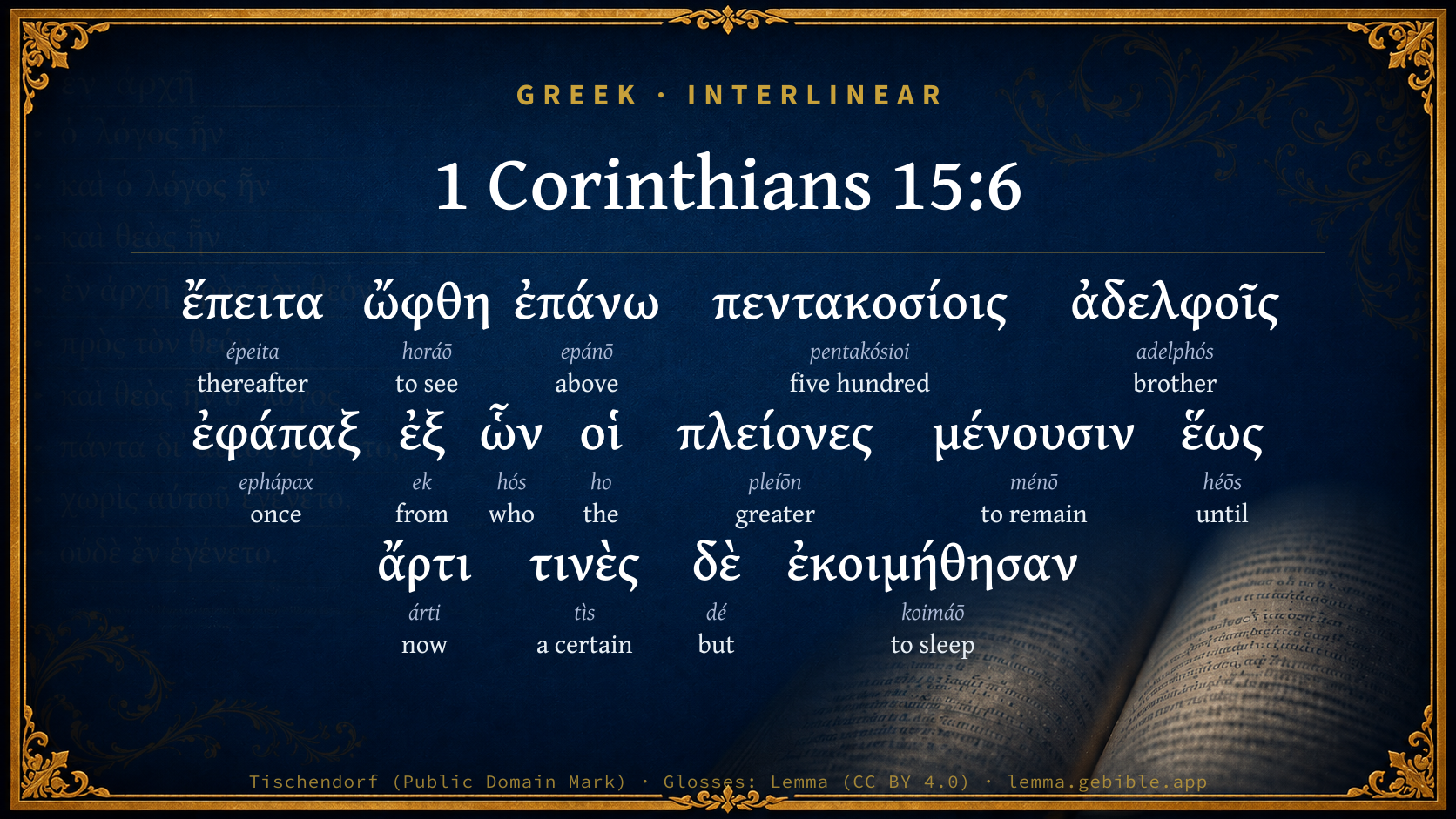
  1. ἔπειτα épeita G1899 “thereafter” Adverb
  2. ὤφθη horáō G3708 “to see” Verb, Aorist, Passive, Indicative, 3rd person, Singular
  3. ἐπάνω epánō G1883 “above” Adverb
  4. ἀδελφοῖς adelphós G80 “brother” Noun, Dative, Plural, Masculine
  5. ἐφάπαξ ephápax G2178 “once” Adverb
  6. ἐξ ek G1537 “from” Preposition
  7. ὧν hós G3739 “who” Relative pronoun, Genitive, Plural, Masculine
  8. οἱ ho G3588 “the” Article, Nominative, Plural, Masculine
  9. πλείονες pleíōn G4119 “greater” Adjective, Nominative, Plural, Masculine, Comparative
  10. μένουσιν ménō G3306 “to remain” Verb, Present, Active, Indicative, 3rd person, Plural
  11. ἕως héōs G2193 “until” Adverb
  12. ἄρτι árti G737 “now” Adverb
  13. τινὲς tìs G5100 “a certain” Indefinite pronoun, Nominative, Plural, Masculine
  14. δὲ dé G1161 “but” Conjunction
  15. ἐκοιμήθησαν koimáō G2837 “to sleep” Verb, Aorist, Passive, Indicative, 3rd person, Plural

About this verse

These counts appear in no published source. They are computed here, from the morphology-tagged text and Lemma’s own curated glosses. What Lemma adds →

16
words
16
distinct lemmas
Pauline Epistles
section

Notable vocabulary

The rarest word here is πεντακοσίοις five hundred G4001 — appearing just 2 times in the whole Greek New Testament.

Shared distinctive vocabulary

πεντακοσίοις five hundred G4001 occurs in 2 verses of the Greek New Testament. Also found in:

Cross-references

6

Topical passages linked to 1 Corinthians 15:6 in the Treasury of Scripture Knowledge — connected by theme and wording, ordered by reader-vote popularity; previews shown in the World English Bible.

  • Matthew 28:10 Then Jesus said to them, "Don't be afraid. Go tell my brothers that they should go into Galilee, and there they will see me."
  • Mark 16:7 But go, tell his disciples and Peter, 'He goes before you into Galilee. There you will see him, as he said to you.'"
  • Acts 13:36 For David, after he had in his own generation served the counsel of God, fell asleep, and was laid with his fathers, and saw decay.
  • Acts 7:60 He kneeled down, and cried with a loud voice, "Lord, don't hold this sin against them!" When he had said this, he fell asleep.
  • 1 Corinthians 15:18 Then they also who are fallen asleep in Christ have perished.
  • 2 Peter 3:4 and saying, "Where is the promise of his coming? For, from the day that the fathers fell asleep, all things continue as they were from the beginning of the creation."

Cross-references courtesy of OpenBible.info (CC BY 4.0).

Commentary

Notes on 1 Corinthians 15:6 from classic Christian and Jewish commentators (each source and its license shown beneath its notes). The classic Christian expositions comment on the surrounding passage and are grouped to its opening verse, so a note may address several verses; the Jewish commentaries on the Tanakh (Rashi and others) are per-verse, so they appear only where the commentator wrote on this verse.

Lemma curates 59 commentaries, every one of them public domain or Creative Commons licensed, each selected and text-cleaned for this edition rather than reprinted as found. About our sources →

Joseph Benson's Commentary

1Co 15:6-7. After that he was seen of above five hundred brethren at once — None of the evangelists have expressly mentioned this appearance, but Matthew seems to hint at it, Mat 28:10; for probably this appearance was made in Galilee, to which Jesus commanded his disciples to repair, promising that they should there see him; and to which, in obedience to his order, the eleven went, and where, doubtless, many others of his disciples assembled from all parts of the country, Christ having appointed a certain mountain, probably that on which he was transfigured, where he would be seen of them. See note on Mat 28:16. “As the greatest part of our Lord’s disciples lived in Galilee, it was highly proper, for their consolation, that he should show himself alive there in that public manner. For thus, besides the apostles, numbers, who had often attended him during his ministry in Galilee, and who were well acquainted with his person, having an opportunity to converse with him, could satisfy themselves by the testimony of their own senses concerning the truth of his resurrection, and attest it to others on the surest evidence. These, therefore, may have been the five hundred brethren of whom St. Paul speaks. And their testimony was appealed to by the apostle with the greatest propriety when proving the resurrection of Christ, because such a multitude cannot be supposed to have agreed for so long a time in publishing a falsehood to the world, without any one of them ever betraying the imposture, or even varying in their account of the fact.” Of whom the greater part remain unto this present — About twenty-eight years after the event, constituting a cloud of witnesses to this glorious and infinitely important event; but some are fallen asleep — Doubtless in Jesus, with whom they were gone to dwell. After that he was seen of James —

Of this appearance there is no mention in the gospels; but the fathers speak of it, and tell us that the person thus honoured was James the Less, or younger, our Lord’s brother, that is, his cousin-german, and the author of the epistle which bears his name. Eusebius (Chronicles, p. 43) says, this appearance happened in the first year after our Lord’s resurrection. But, from the order in which Paul hath placed it here, it seems more probable that it took place before our Lord’s ascension, at which all the apostles were present, as mentioned in the next clause.

Joseph Benson's Commentary on the Old and New Testaments (1811–1818) — public domain. Text from a community e-Sword module.

MacLaren's Expositions of Holy Scripture

Alexander MacLaren

1 Corinthians

REMAINING AND FALLING ASLEEP

1Co 15:6.

There were, then, some five-and-twenty years after the Resurrection, several hundred disciples who were known amongst the churches as having been eyewitnesses of the risen Saviour. The greater part survived; some, evidently a very few, had died. The proportion of the living to the dead, after five-and-twenty years, is generally the opposite. The greater part have ‘fallen asleep’; some, a comparatively few, remain ‘unto this present.’ Possibly there was some divine intervention which supernaturally prolonged the lives of these witnesses, in order that their testimony might be the more lasting. But, be that as it may, they evidently were men of mark, and some kind of honour and observance surrounded them, as was very natural, and as appears from the fact that Paul here knows so accurately {and can appeal to His fellow-Christians’ accurate knowledge} the proportion between the survivors and the departed. We read of one of them in the Acts of the Apostles at a later date than this, one Mnason, an ‘original disciple.’

So we get a glimpse into the conditions of life in the early Church, interesting and of value in an evidential point of view. But my purpose at present is to draw your attention to the remarkable language in which the Apostle here speaks of the living and the dead amongst these witnesses. In neither case does he use the simple, common words ‘living’ or ‘dead’; but in the one clause he speaks of their ‘remaining,’ and in the other of their ‘falling asleep’; both phrases being significant, and, as I take it, both being traced up to the fact of their having seen the risen Lord as the cause why their life could be described as a ‘remaining,’ and their death as a ‘falling asleep.’ In other words, we have here brought before us, by these two striking expressions, the transforming effect upon life and upon death of the faith in a risen Lord, whether grounded on sight or not. And it is simply to these two points that I desire to turn now.

I. First, then, we have to consider what life may become to those who see the risen Christ.

‘The greater part remain until this present.’ Now the word remain is no mere synonym for living or surviving. It not only tells us the fact that the survivors were living, but the kind of life that they did live. It is very significant that it is the same expression as our Lord used in the profound prophetic words, ‘If I will that he tarry till I come, what is that to thee?’ Now we are told in John’s Gospel that ‘that saying went abroad amongst the brethren,’ and inasmuch as it was a matter of common notoriety in the early Church, it is by no means a violent supposition that it may be floating in Paul’s memory here, and may determine his selection of this remarkable expression ‘they remain,’ or ‘they tarry,’ and they were tarrying till the Master came. So, then, I think if we give due weight to the significance of the phrase, we get two or three thoughts worth pondering.

One of them is that the sight of a risen Christ will make life calm and tranquil. Fancy one of these 500 brethren, after that vision, going back to his quiet rural home in some little village amongst the hills of Galilee. How small and remote from Him, and unworthy to ruffle or disturb the heart in which the memory of that vision was burning, would seem the things that otherwise would have been important and distracting! The faith which we have in the risen Christ ought to do the same thing for us, and will do it in the measure in which there shines clearly before that inward eye, which is our true means of apprehending Him, the vision which shone before the outward gaze of that company of wondering witnesses. If we build our nests amidst the tossing branches of the world’s trees, they will sway with every wind, and perhaps be blown from their hold altogether by such a storm as we all have sometimes to meet. But we may build our nests in the clefts of the rock, like the doves, and be quiet, as they are. Distractions will cease to distract, and troubles will cease to agitate, and across the heaving surface of the great ocean there will come a Form beneath whose feet the waves smooth themselves, and at whose voice the winds are still. They who see Christ need not be troubled. The ship that is empty is tossed upon the ocean, that which is well laden is steady. The heart that has Christ for a passenger need not fear being rocked by any storm. Calmness will come with the vision of the Lord, and we shall abide or ‘remain,’ for there will be no need for us to flee from this Refuge to that, nor shall we be driven from our secure abode by any contingencies. ‘He that believeth shall not make haste.’

It is a good thing to cultivate the disposition that says about most of the trifles of this life, ‘It does not much matter’; but the only way to prevent wholesome contempt of the world’s trivialities from degenerating into supercilious indifference is, to base it upon Christ, discerned as near us and bestowing upon us the calmness of His risen life. Make Him your scale of importance, and nothing will be too small to demand and be worthy of the best efforts of your work, but nothing will be too great to sweep you away from the serenity of your faith.

Again, the vision of the risen Christ will also lead to patient persistence in duty. If we have Him before us, the distasteful duty which He sets us will not be distasteful, and the small tasks, in which great faithfulness may be manifested, will cease to be small. If we have Him before us we have in that risen Christ the great and lasting Example of how patient continuance in well-doing triumphs over the sorrows that it bears, by and in patiently bearing them, and is crowned at last with glory and honour. The risen Christ is the Pattern for the men who will not be turned aside from the path of duty by any obstacles, dangers, or threats. The risen Christ is the signal Example of glory following upon faithfulness, and of the crown being the result of the Cross. The risen Christ is the manifest Helper of them that put their trust in Him; and one of the plainest lessons and of the most imperative commands which come from the believing gaze upon that Lord who died because He would do the will of the Father, and is throned and crowned in the heavens because He died, is-By patient continuance in well-doing let us commit the keeping of our souls to Him: and abide in the calling wherewith we are called.

And, again, the sight of the risen Christ leads to a life of calm expectancy. ‘If I will that He tarry till I come’ conveys that shade of meaning. The Apostle was to wait for the Lord from Heaven, and that vision which was given to these 500 men sent them home to their abodes to make all the rest of their lives one calm aspiration for, and patient expectation of, the return of the Lord. These primitive Christians expected that Jesus Christ would come speedily. That expectation was disappointed in so far as the date was concerned, but after nineteen centuries it still remains true that all vigorous and vital Christian life must have in it, as a very important element of its vitality, the onward look which ever is anticipating, which often is desiring, and which constantly is confident of, the coming of the Lord from Heaven. The Resurrection has for its consequences, its sequel and corollary, first the Ascension; then the long tract of time during which Jesus Christ is absent, but still in divine presence rules the world; and, finally, His coming again in that same body in which the disciples saw Him depart from them. And no Christian life is up to the level of its privileges, nor has any Christian faith grasped the whole articles of its creed, except that which sets in the very centre of all its visions of the future that great thought-He shall come again.

Questions of chronology have nothing to do with that. It stands there before us, the certain fact, made certain and inevitable by the past facts of the Cross and the Grave and Olivet. He has come, He will come; He has gone, He will come back. And for us the life that we live in the flesh ought to be a life of waiting for God’s Son from Heaven, and of patient, confident expectancy that when He shall be manifested we also shall be manifested with Him in glory.

So much, then, for life-calm, persistent in every duty, and animated by that blessed and far-off, but certain, hope, and all of these founded upon the vision and the faith of a risen Lord. What have fears and cares and distractions and faint-heartedness and gloomy sorrow to do with the eyes that have beheld the Christ, and with the lives that are based on faith in the risen Lord?

II. So, secondly, consider what death becomes to those who have seen Christ risen from the dead.

‘Some are fallen asleep.’ Now that most natural and obvious metaphor for death is not only a Christian idea, but is found, as would be expected, in many tongues, but yet with a great and significant difference. The Christian reason for calling death a sleep embraces a great deal more than the heathen reason for doing so, and in some respects is precisely the opposite of that, inasmuch as to most others who have used the word, death has been a sleep that knew no waking, whereas the very pith and centre of the Christian reason for employing the symbol are that it makes our waking sure. We have here what the act of dying and the condition of the dead become by virtue of faith in the Resurrection of Jesus Christ.

They have ‘fallen asleep.’ The act of dying is but a laying one’s self down to rest, and a dropping out of consciousness of the surrounding world. It is very remarkable and very beautiful that the new Testament scarcely ever employs the words dying and death for the act of separating body and spirit, or for the condition either of the spirit parted from the body, or of the body parted from the spirit. It keeps those grim words for the reality, the separation of the soul from God; and it only exceptionally uses them for the shadow and the symbol, the physical fact of the parting of the man from the house which here he has dwelt in. But the reason why Christianity uses these periphrases or metaphors, these euphemisms for death, is the opposite of the reason why the world uses them. The world is so afraid of dying that it durst not name the grim, ugly thing. The Christian, or at least the Christian faith, is so little afraid of death that it does not think such a trivial matter worth calling by the name, but only names it ‘falling asleep.’

Even when the circumstances of that dropping off to slumber are painful and violent, the Bible still employs the term. Is it not striking that the first martyr, kneeling outside the city, bruised by stones and dying a bloody death, should have been said to fall asleep? If ever there was an instance in which the gentle metaphor seemed all inappropriate it was that cruel death, amidst a howling crowd, and with fatal bruises, and bleeding limbs mangled by the heavy rocks that lay upon them. But yet, ‘when he had said this he fell asleep.’ If that be true of such a death, no physical pains of any kind make the sweet word inappropriate for any.

We have here not only the designation of the act of dying, but that of the condition of the dead. They are fallen asleep, and they continue asleep. How many great thoughts gather round that metaphor on which it is needless for me to try to dilate! They will suggest themselves without many words to you all.

There lies in it the idea of repose. ‘They rest from their labours.’ Sleep restores strength, and withdraws a man at once from effort on the outer world, and from communication from it. We may carry the analogy into that unseen world. We know nothing about the relations to an external universe of the departed who sleep in Jesus. It may be that, if they sleep in Him, since He knows all, they, through Him, may know, too, something-so much as He pleases to impart to them-of what is happening here. And it may even be that, if they sleep in Him, and He wields the energies of Omnipotence, they, through Him, may have some service to do, even while they wait for their house which is from heaven. But there is no need for, nor profit in, such speculations. It is enough that the sweet emblem suggests repose, and that in that sleep there are folded around the sleepers the arms of the Christ on whose bosom they rest, as an infant does on its first and happiest home-its mother’s breast.

But then, besides that, the emblem suggests the idea of continuous and conscious existence. A man asleep does not cease to be a man; a dead man does not cease to live. It has often been argued from this metaphor that we are to conceive of the space between death and the resurrection as being a period of unconsciousness, but the analogies seem to me to be in the opposite direction. A sleeping man does not cease to know himself to be, and he does not cease to know himself to be himself. That mysterious consciousness of personal identity survives the passage from waking to sleep, as dreams sufficiently show us. And, therefore, they that sleep know themselves to be.

And, finally, the emblem suggests the idea of waking. Sleep is a parenthesis. If the night comes, the morning comes. ‘If winter comes, can spring be far behind?’ They that sleep will awake, and be satisfied when they ‘awake with Thy likeness.’ And so these three things-repose, conscious, continuous existence, and the certainty of awaking-all lie in that metaphor.

Now, then, the risen Christ is the only ground of such hope, and faith in Him is the only state of mind which is entitled to cherish it. Nothing proves immortality except that open grave. Every other foundation is too weak to bear the weight of such a superstructure. The current of present opinion shows, I think, that neither metaphysical nor ethical arguments for the future life will stand the force of the disintegrating criticism which is brought to bear upon that hope by the fashionable materialism of this generation. There is one barrier that will resist that force, and only one, and that is the historical facts that Jesus Christ died, and that Jesus Christ has risen again. He rose; therefore death is not the end of individual existence. He rose; therefore life beyond the grave is possible for humanity. He rose; therefore His sacrifice for the world’s sin is accepted, and I may be delivered from my guilt and my burden. He rose; therefore He is declared to be the Son of God with power. He rose; therefore we, if we trust Him, may partake in His Resurrection and in some reflection of His glory. The old Greek architects were often careless of the solidity of the soil on which they built their temples, and so, many of them have fallen in ruins. The Temple of Immortality can be built only upon the rock of that proclamation-Jesus Christ is risen from the dead. And we, dear brethren, should have all our hopes founded upon that one fact.

So then, for us, the calm, peaceful passage from life into what else is the great darkness is possible on condition of our having beheld the risen Lord. These witnesses of whom my text speaks, Paul would suggest to us, laid themselves quietly down to sleep, because before them there still hovered the memory of the vision which they had beheld. Faith in the risen Christ is the anchor of the soul in death, and there is nothing else by which we can hold then.

As the same Apostle, in one of his other letters, puts it, the belief that Christ is risen is not only the irrefragable ground of our hope that we, too, shall rise, but has the power to change the whole aspect of our death. Did you ever observe the emphasis with which He says, ‘If we believe that Jesus died and rose again, even so them also which sleep in Jesus will God bring with Him?’ His death was death indeed, and faith in it softens ours to sleep. He bore the reality that we might never need to know it, and if our poor hearts are resting upon that dear Lord, then the flames are but painted ones and will not burn, and we shall pass through them, and no smell of fire will be upon us, and all that will be consumed will be the bonds which bind us. He has abolished death. The physical fact remains, but all which to men makes the idea of death is gone if we trust the risen Lord. So that, between two men dying under precisely the same circumstances, of the same disease, in adjacent beds in the same hospital, there may be such a difference as that the same word cannot be applied to the experiences of both.

My dear friends, we have each of us to pass through that last struggle; but we may make it either a quiet going to sleep with a loved Face bending over our closing eyes, like a mother’s over her child’s cradle, and the same Face meeting us when we open them in the morning of heaven; or we may make it a reluctant departure from all that we care for, and a trembling advance into all from which conscience and heart shrink.

Which is it going to be to you? The answer depends upon that to another question. Are you looking to that Christ that died and is alive for evermore as your life and your salvation? Do you hold fast that Gospel which Paul preached, ‘how that Christ died for our sins according to the Scriptures, and that He was buried, and that He rose again the third day, according to the Scriptures’ ? If you do, life will be a calm, persevering, expectant waiting upon Him, and death will be nothing more terrible than falling asleep.

Alexander MacLaren, Expositions of Holy Scripture (1904–1910) — public domain. Text from a community e-Sword module.

Tyndale Open Study Notes

Tyndale Open Resources

15:6 he was seen by more than 500: We have no other account of this event. • most of whom are still alive: When this letter was written (around AD 53–56), the factuality of Christ’s resurrection could be verified by consulting living eyewitnesses.

Tyndale Open Study Notes — © Tyndale Open Resources, licensed CC BY-SA 4.0. Text via the HelloAO Bible API.

Bengel's Gnomon

Johann Albrecht Bengel

1Co 15:6. Ἔπειτα, after that) advancing to a greater number.—ἐπάνω πεντακοσίοις, more than five hundred) A remarkable appearance. Paul puts himself behind all these.—οἱ πλείους, the greater part) About 300 at least; οἱ πλείους, the majority were providentially preserved in life so long for the very purpose of bearing testimony [as they had obtained an authority akin to that of the apostles.—V. g.]; comp. Jos 24:31.—μένουσιν, remain) in life. The opportunity of thoroughly sifting these witnesses remained unimpaired [undiminished.] Andronicus and Junius may be presumed to have been of that number, Rom 16:7.—καὶ, also) It was not of less importance to bring forward these as witnesses. They had died in this belief.—ἐκοιμήθησαν, have fallen asleep) as those, who are to rise again.

Bengel's Gnomon of the New Testament — English translation (T&T Clark, Edinburgh, 1860) — public domain. Text from a community e-Sword module.

Meyer's Critical & Exegetical Commentary

Heinrich August Wilhelm Meyer

1Co_15:6 exhibits a change in the constructionwhich does not continue further with ὅτιbut still belongs to the contents of the παρέδωκα and παρέλαβον down to ἀποστ. πᾶσιν (in opposition to Hofmann); for the point of view of the ὃ καὶ παρέλαβον reaches thus far, and it is only at 1Co_15:8 that personal experience comes in instead of it. Nor is it to be inferred from the transition from the dependent to the independent construction (so frequent also, as we know, in Greek writers), which naturally corresponds with the concrete vividness of the representation, that Paul had not included this appearance and those which follow in his preaching at Corinth, but, on the contrary, was now communicating them to his readers as something new (van Hengel). 1Co_15:8 is especially opposed to this view, since Paul, in referring to the appearances of the Risen One, had certainly not been silent upon that made to himself (comp. 1Co_9:1).

ἐπάνω] adverbial, not prepositional, Mar_14:5. Comp. ὑπέρ. Lobeck, ad Phryn. p. 410. Τινές, referred to by Chrysostom, were mistaken in holding it to mean: above, over their head.

πεντακοσ.] Consequently the number of the believers in general was already much greater than that of those who were assembled, Act_1:15. The remarks to the contrary by Baur and Zeller, according to whom the small number 120 is plainly shown by our passage to be incorrect, are not conclusive, since the appearance here mentioned may, without any arbitrariness, be placed at so early a stage that many pilgrims to the Passover may be conceived as still present in Jerusalem when it took place, and among these many extraneous disciples of Jesus, especially Galileans. The 120 who assembled afterwards were the stock of the congregation of Jerusalem itself. Comp. on Act_1:15. On the other hand, it is possible that the Lord appeared to the 500 brethren also in Galilee in an assembly of so many of His disciples there (Schleiermacher, Ewald). More precise evidence is wanting. Mat_28:16 ff. has nothing to do with our passage (in opposition to Lightfoot and Flatt), but applies only to the eleve.

ἐφάπαξ] not: once, for all (Bretschneider, comp. Rom_6:10; Heb_7:27; Heb_9:12; Heb_10:10), but, as it is usually understood: at once, simul (Luc. Dem. enc. 21). The former sense would need to be given by the context, which, however, from the largeness of the number, naturally suggests the latter. Van Hengel, too, wrongly insists upon the meaning semel, holding that this appearance took place only once, whereas 1Co_15:5 applies to several appearances. The peculiar importance of this appearance lies precisely in the simul (Vulgate), ἀνύποπτος δὲ τῶν τοσούτων ἡ μαρτυρία, Theodoret. This ἐφάπαξ and the multitude of the spectators exclude all the more decidedly the idea of a visionary or ecstatic seeing, although some have ascribed all the appearances of the Risen One to this source (see especially, Holsten, zum Ev. des Paul. u. Petr. p. 65 ff.). Here we should have upwards of 500 visions occurring at the same time and place, the same in substance and form, and that, too, as psychological acts of the individual mind.

οἱ πλείους] the majority, 1Co_10:5. Luther gives it wrongly: many still.

μένουσιν] superstites sunt. Comp. on Joh_21:22; Php_1:25. Ἔχω μάρτυρας ἔτι ζῶντας, Chrysostom. It may be added that the definite affirmation, οἱ πλείους μένουσιν, shows how earnestly the apostolic church concerned itself about the still surviving witnesses to the resurrection of Jesus, and how well it knew them.

Meyer — Critical and Exegetical Commentary on the New Testament — English translation by Peter Christie, edited by Frederick Crombie (T&T Clark, 1880) — public domain. Text from a community e-Sword module.

Expositor's Greek Testament

ed. W. Robertson Nicoll

1Co 15:6 carries forward ὤφθη into a new sentence, independent of παρέδωκα … ὅτι : the four remaining manifestations P. recites without indicating whether or not they formed a part of his original communication. ἔπειτα ( cf. 1Co 15:23 ; 1Co 15:46 , 1Co 12:28 ) ὤφθη κ . τ . λ .: “After t at ( deinde ) He appeared to above ( ἐπάνω , cf. Mar 14:5 ) five hundred brethren once for all” ( semel , Bz [2275] ). Nowhere else has ἐφάπαξ the meaning simul, at once (so Vg [2276] , and most interpreters, in violation of usage). This was the culminating manifestation of the risen Jesus, made at the general gathering to which His brethren were invited by Him in a body , as it is related in Mat 28:7 ; Mat 28:10 , Mar 16:7 ; the appearance to “the eleven” described in Mat 28:16 ff. is recorded as the sequel to this summons, and implies the presence of a larger assembly (see esp. the words οἱ δὲ ἐδίστασαν in 1Co 15:17 ), such as P. alludes to; the great charge of Mat 28:18 ff., closing the First Gospel, corresponds by its importance to this ἐφάπαξ . P. writes a quarter of a century after the event; the followers of Jesus were mostly young in age for “the majority” ( οἱ πλείονες ) to have been still alive. On ἕως ἄρτι , see 1Co 4:13 .

[2275] Beza’s Nov. Testamentum: Interpretatio et Annotationes (Cantab., 1642).

[2276] Latin Vulgate Translation.

The Expositor's Greek Testament, edited by W. Robertson Nicoll (1897–1910) — public domain. Text from a community e-Sword module.

Godet's Commentaries

Frédéric Louis Godet

Vv. 6. “After that He was seen of above five hundred brethren at once, of whom the greater part remain unto this present, and some are fallen asleep.”

The ἔπειτα, thereafter, separates more forcibly than the εἶτα, then, of 1Co 15:5; it makes the following appearance a new step in the series, and rightly so. This appearance took place considerably later, and certainly in Galilee. Already before His death Jesus had told His disciples that after His resurrection He would go before them into Galilee (Mat 26:32; Mar 14:28). The angel and Jesus Himself (according to Mat 28:10) had repeated this promise to the women on the day of His resurrection (Mar 16:7 and Mat 28:7). Moreover, Mat 28:16, mention is made of a command which Jesus gave to His disciples to gather together on a certain mountain in Galilee all the believers of that country. No doubt Matthew, in relating the appearance so solemnly prepared for, speaks only of the Eleven; but if it was, as it is impossible to doubt, that which the angel and, according to Matthew, Jesus Himself announced to the women on the morning of the resurrection, this gathering must have embraced all the followers of Jesus, and not only men, but also women. This is what explains a gathering together in a given place, at a certain time fixed beforehand. It must therefore be held that the appearance mentioned in our 1Co 15:6 is no other than that related by Matthew at the end of his gospel, and in which Jesus took leave of all His Galilean followers, that is to say, of His Church. The Eleven were there in the foremost rank, and it was to them in particular that the command was addressed to begin the mission to the whole world (Mat 28:18-20). This is no doubt the reason why Matthew mentions them only. We should not be surprised that the apostle so expressly mentions this testimony. It was that of the whole Church, the apostles included; what a difference between it and a simple private testimony! The word ἐπάνω, more than; above, is not a preposition, but an adverb; as a preposition it would govern the genitive (Mar 14:5). The word ἐφάπαξ does not here signify, as often, once for all, but at one time.

The words five hundred and still live have evidently, in the apostle’s view, an apologetic bearing: “You can go and ask them, if you like: there they are, still, and in great numbers.” Here we have a striking example of the small value which in criticism belongs to the argument taken from silence. Here is a fact of public notoriety, quoted in a writing the authenticity of which is indisputable, by a witness whose declaration is above suspicion; and the fact is omitted in our four Gospel narratives, or, if it appears in one of them, it is devoid of the circumstances which render it so striking in the narrative of it given by St. Paul. After this, what is to be thought of arguing against the reality of an act or saying of Jesus because it is mentioned only in one Gospel and not in the others!

The apostle now passes to a third group.

Frédéric Louis Godet — Commentaries on Luke, John, Romans, and 1 Corinthians — English translation (T&T Clark, Edinburgh, 1870s–1890s) — public domain. Text from a community e-Sword module.

Hodge's Commentary on Romans, Ephesians & First Corinthians

Charles Hodge

1Co_15:6

After that, he was seen of above five hundred brethren at once; of whom the greater part remain unto this present, but some are fallen asleep.

There is no distinct record of this event in the evangelical history. It may have taken place on the occasion when Christ met his disciples in Galilee. Before his death he told them, After I am risen again, I will go before you into Galilee, Mat_26:32. Early in the morning of his resurrection he met the women who had been at his tomb, and said to them, Be not afraid; go tell my brethren, that they go into Galilee, and there shall they see me, Mat_28:10; and accordingly in Mat_28:16, it is said, Then the eleven went away into Galilee, into a mountain where Jesus had appointed them. This, therefore, was a formally appointed meeting, and doubtless made known as extensively as possible to his followers, and it is probable, therefore, that there was a concourse of all who could come, not only from Jerusalem, but from the surrounding country, and from Galilee. Though intended specially for the eleven, it is probable that all attended who knew of the meeting, and could possibly reach the appointed place. Who would willingly be absent on such an occasion? Others think that this appearance took place at Jerusalem, where, in addition to the one hundred and twenty who constituted the nucleus of the church in the holy city, there were probably many disciples gathered from all parts of Judea in attendance on the Passover. The special value of this testimony to the fact of Christs resurrection, arises not only from the number of the witnesses, but from Pauls appeal to their testimony while the majority of them were still alive. Some have fallen asleep. This is the Christian expression for dying, 1Co_15:18, and 1Co_11:30. Death to the believer is a sleep for his body; a period of rest to be followed by a glorious day.

Charles Hodge — Commentary on Romans (1835), First Corinthians (1857), and Ephesians (1856) — public domain. Text from a community e-Sword module.

Geneva Bible (1599)

Geneva Bible translators

Not fewer all times, but together and at one instant.

Geneva Bible (1599) marginal notes — public domain. Text via Bolls.life.

Jamieson, Fausset & Brown

Robert Jamieson, A. R. Fausset & David Brown

five hundred--This appearance was probably on the mountain (Tabor, according to tradition), in Galilee, when His most solemn and public appearance, according to His special promise, was vouchsafed (Mat 26:32; Mat 28:7, Mat 28:10, Mat 28:16). He "appointed" this place, as one remote from Jerusalem, so that believers might assemble there more freely and securely. ALFORD'S theory of Jerusalem being the scene, is improbable; as such a multitude of believers could not, with any safety, have met in one place in the metropolis, after His crucifixion there. The number of disciples (Act 1:15) at Jerusalem shortly after, was one hundred and twenty, those in Galilee and elsewhere not being reckoned. Andronicus and JUNIUS were, perhaps, of the number (Rom 16:7): they are said to be "among the apostles" (who all were witnesses of the resurrection, Act 1:22).

remain unto this present--and, therefore, may be sifted thoroughly to ascertain the trustworthiness of their testimony.

fallen asleep--in the sure hope of awaking at the resurrection (Act 7:60).

Jamieson, Fausset & Brown — Commentary Critical and Explanatory on the Whole Bible (1871) — public domain (CC PDM 1.0). Text via the HelloAO Bible API.

Adam Clarke's Commentary

Verse 6. Above five hundred brethren at once] This was probably in Galilee, where our Lord had many disciples. See Mt 28:16. What a remarkable testimony is this to the truth of our Lord's resurrection! Five hundred persons saw him at one time; the greater part of whom were alive when the apostle wrote, and he might have been confronted by many if he had dared to assert a falsity.

Adam Clarke's Commentary on the Bible (1810–1826) — public domain. Text from a community e-Sword/MySword module.

Ellicott's Commentary for English Readers

(6) Fallen asleep.—The same word is used of Stephen’s death (see Act_7:60), so also in 1Co_15:18.

A Bible Commentary for English Readers, edited by Charles John Ellicott (1878–1897) — public domain. Text from a community e-Sword module.

John Gill's Exposition

After that he was seen of above five hundred brethren at once,.... Not at, or near Jerusalem, for the number of the disciples that were together there, made but about an hundred and twenty, Act 1:15 but in Galilee, where Christ, in the days of his flesh, had most chiefly conversed, most frequently preached and wrought his miracles, and where the number of his disciples and followers were very large: here he promised his disciples to go before them, and show himself to them after his resurrection, as he accordingly did, Mat 26:32. And this being signified by the apostles to the brethren there, it is no wonder that there was such a number of them gathered on that occasion:

of whom the greater part remain unto this present; and so might be personally applied unto for the truth of this, was it necessary; it being but about five or six and twenty years ago at the writing of this epistle:

and some were fallen asleep; were dead, as it might be reasonably thought there were among so many, and in such a length of time; though doubtless these had surviving friends, relations, and acquaintance, to whom they had communicated this important case, and who were ready to attest what they had heard them in the most solemn manner declare.

John Gill's Exposition of the Whole Bible (1746–1763) — public domain (CC PDM 1.0). Text via the HelloAO Bible API.

Trapp's Complete Commentary

John Trapp

6 After that, he was seen of above five hundred brethren at once; of whom the greater part remain unto this present, but some are fallen asleep.

Ver. 6. Above five hundred] The number of believers were then greater than some would gather out of Act 1:15. Those 120 may seem to have been chieftains, such as that any one of them might have been thought meet to succeed Judas in his apostleship.

John Trapp, A Commentary or Exposition upon All the Books of the Old and New Testament (1647–1656) — public domain. Text from a community e-Sword module.

Albert Barnes' Notes on the Bible

Above five hundred brethren at once - More than 500 Christians or followers of Jesus at one time. This was probably in Galilee, where the Lord Jesus had spent the greater part of his public ministry, and where he had made most disciples. The place, however, is not designated, and, of course, cannot be known. It is remarkable that this fact is omitted by all the evangelists; but why they should have omitted so remarkable a proof of the resurrection of the Lord Jesus, is unknown. There is a slight circumstance hinted at in Mat 28:10, which may throw some light on this passage. After his resurrection, Jesus said to the women who were at the sepulchre, “Go tell my brethren that they go into Galilee, and there shall they see me.” And in 1Co 15:16 it is said, “The eleven disciples went away into Galilee, into a mountain where Jesus had appointed them.” Jesus had spent most of his public life in Galilee. He had made most of his disciples there.

It was proper, therefore, that those disciples, who would, of course, hear of his death, should have some public confirmation of the fact that he had risen. It is very probable, also, that the eleven who went down into Galilee after he rose would apprize the brethren there of what had been said to them, that Jesus would meet them on a certain mountain; and it is morally certain that they who had followed him in so great numbers in Galilee would be drawn together by the report that the Lord Jesus, who had been put to death, was about to be seen there again alive. Such is human nature, and such was the attachment of these disciples to the Lord Jesus, that it is morally certain a large concourse would assemble on the slightest rumor that such an occurrence was to happen. Nothing more would be necessary anywhere to draw a concourse of people than a rumor that one who was dead would appear again; and in this instance, where they ardently loved him, and when, perhaps, many believed that he would rise, they would naturally assemble in great numbers to see him once more. One thing is proved by this, that the Lord Jesus had many more disciples than is generally supposed. If there were five hundred who could be assembled at once in a single part of the land where he had preached, there is every reason to suppose that there were many more in other parts of Judea.

The greater part remain unto this present - Are now alive, and can be appealed to, in proof that they saw him. What more conclusive argument for the truth of his resurrection could there be than that 500 persons had seen him, who had been intimately acquainted with him in his life, and who had become his followers? If the testimony of 500 could not avail to prove his resurrection, no number of witnesses could. And if 500 people could thus be deceived, any number could; and it would be impossible to substantiate any simple matter of fact by the testimony of eye-witnesses.

But some are fallen asleep - Have died. This is the usual expression employed in the Scripture to describe the death of saints. It denotes:

The calmness and peace with which, they die, like sinking into a gentle sleep; The hope of a resurrection, as we sink to sleep with the expectation of again awaking; see the Joh 11:11 note; 1Co 11:30 note.

Albert Barnes' Notes on the Bible (1834–1885) — public domain. Text from a community e-Sword/MySword module.

Matthew Poole's English Annotations

Of this appearance to above five hundred brethren at once the Gospels say nothing; but it is probably thought to be understood of that great meeting of the disciples in Galilee, where our Saviour promised to meet them, Mat 26:32; 28:7, after his resurrection. Wherever it was, the apostle saith, that the greater part of them were yet in a capacity to give a living testimony to the resurrection of Christ, though some of them were dead.

Matthew Poole's English Annotations on the Holy Bible (1683–1685) — public domain. Text from a community e-Sword/MySword module.

Whedon's Commentary on the Bible

Daniel D. Whedon

6. Five hundred—An appearance not elsewhere mentioned; nor do the conjectures of commentators much illustrate the time or place. But most probably, as indicated in Mat_28:16-17, in a mountain or highland of Galilee. (On the phrase a mountain, see our note on Luk_6:12.) As this was an appointment in Galilee, where so much of the ministry of Christ was spent, it were no wonder if there Jesus met a full assembly.

Greater part—A majority; more than two hundred and fifty. This event was between twenty and thirty years ago; but plenty of eyewitnesses still live. It was no myth formed by popular imagination.

Asleep—A beautiful image of death, implying the hope of an awakening to future life. See note on Luk_8:52. it conclusively implies that the same body that dies is raised, and not another substituted.

The epitaphs inscribed by the primitive Christians upon their tombs as found in the Roman catacombs abound in this cheerful image of repose and sleep. The following specimens are given by Mr. Withrow in his very interesting book on the Catacombs:

“We find also such expressions as follow: DEPOSTVS (sic) IN PACE FIDEI CATHOLICE, (sic)—’Buried in the peace of the Catholic faith,’ A.D. 462; HIC. REQ. IN PACE DEVS, (sic)— ‘Here rests in the peace of God,’ A.D. 500; IN PACE ECCLESIAE— ‘In the peace of the Church,’ A.D. 523; IN PACE ET BENEDICTIONE—’In peace and benediction;’ SEMPER FIDELIS MANEBIT APVD DEVM—’Ever faithful, he shall remain with God,’ (circ. 590); ZOTICVS HIC AD DORMIENDVM— ‘Zoticus here laid to sleep;’ DORMITIO ELPIDIS— ‘The sleeping-place of Elpis;’ DORMIVlT ET REQVIESCIT— ‘He has slept and is at rest;’ DORMIT SED VIVIT—’He sleeps but lives;’ QVIESCIT IN DOMINO IESV— ‘He reposes in the Lord Jesus;’ IVIT AD DEVM— ‘He went to God;’ EVOCATVS A DOMINO— ‘Called by God;’ ACCEPTA APVD DEVM— ‘Accepted with God;’ ΕΤΕΛΕΙΩΘΗ—’He finished his life;’ ΕΚΟΙΜΗΘΗ—’He fell asleep;’ DAMILIS HIC SIC - V - D—’Here lies Damalis, for so God wills.’”—Pp. 429, 430.

The following epitaphs given by Mr. Withrow show that the image of sleep was limited to the body. While the eyes are closed in sleep, the soul is awake, and living in

“The Celestial realms:” “Of similar character are also the following: SALONICE ISPIRITVS TVVS IN BONIS—’Salonice, thy spirit is among the good;’ REFRIGERAS SPIRITVS TVVS IN BONIS—’Thou refreshest thy spirit among the good;’ ΠΡΩΤΟC ΕΝ ΑΓΙΩ ΠΝΕΥΜΑΤΙ ΘΕΟΥ ΕΝΘΑΔΕ ΚΕΙΤΑΙ—’Here in the Holy Spirit of God lieth Protus;’ CORPVS HABET TELLVS ANIMAM CAELESTIA REGNA—’The earth has the body, celestial realms the soul;’ ΓΛΥΚΕΡΟΝ ΦΑΟC ΟΥ ΚΑΤΕΛΕΦΑΣ (sic) ΕΣΧΕΣ ΓΑΡ ΜΕΤΑ CΟΥ ΠΑΝΑΘΑΝΑΤΟΝ—’Thou didst not leave the sweet light, for thou hadst with thee Him who knows not death,’ literally, ‘the all-deathless One;’ AGAPE VIBIS IN ETERNVM—’Agape, thou livest forever;’ DORMIT ET VIVIT IN PACE XO, (sic)—’He sleeps and lives in the peace of Christ;’ MENS NESCIA MORTIS VIVIT ET ASPECTV FRVITVR BENE CONSCIA CHRISTI—’The soul lives unknowing of death, and consciously rejoices in the vision of Christ;’ PRIMA VIVIS IN GLORIA DEI ET IN PACE DOMINI NOSTRI XR.—’Prima, thou livest in the glory of God, and in the peace of Christ, our Lord.’”—Pp. 430, 431.

These epitaphs show the primitive Christian doctrines to have been: 1. That the self-same body that sleeps in death shall awake to the resurrection. 2. That between death and the resurrection the soul is in an intermediate state of blessed consciousness, awaiting the resurrection of its sleeping body.

Daniel D. Whedon (gen. ed.), Commentary on the Old and New Testaments (1874–1909) — public domain. Text from a community e-Sword module.

The Pulpit Commentary

Above five hundred brethren at once. We cannot be certain whether this memorable appearance took place in Jerusalem or in Galilee. It is, however, most probable that this was the appearance on the mountain (Mat_28:16, Mat_28:17; comp. Mat_26:32) Of whom the greater part remain unto this present. This sentence a confident contemporary appeal to a very large number of living witnesses, by one who would rather have died than lied is of the highest evidential value. It shows that the Resurrection was not "a thing done in a corner". (Act_26:26) Fallen asleep. The beautiful and common word for death in the New Testament. (Mat_27:52; Joh_11:11; Act_7:60, etc.) Hence the word "cemetery sleeping place." Some are fallen asleep.

Sleep is a metaphor for death, which has been employed by the heathen poets, and by the rabbinical writers, as well as by the inspired penmen of the Old and New Testaments. But Christianity has given to the figure an especial sanction and an especial appropriateness.

I OUR LORD HIMSELF HAS SET THE EXAMPLE OF DESIGNATING DEATH AS SLEEP. In speaking of Jairus"s daughter, he said, "The maiden is not dead, but sleepeth;" and of Lazarus he said, "Our friend Lazarus sleepeth." As on both these occasions he was misunderstood, it would seem that the usage was not a familiar one. But as he spake, it was natural and right that his disciples also should speak.

II DEATH TO THE CHRISTIAN IS SLEEP, FOR IT COMES AT THE CLOSE OF THE DAY"S TOIL. "After life"s fitful fever he sleeps well," is language which Shakespeare uses with reference to the murdered Duncan. But how far more appropriate is such language when used with reference to those who have served God faithfully and diligently during many years, and who rest from their labours! "David, after he had served his own generation, fell on sleep;" and the expression is one suitable in application to every true servant of the Divine Lord.

How blest the righteous when he dies! When sinks a weary soul to rest, How mildly beam the closing eyes! How gently heaves the expiring breast!

III DEATH TO THE CHRISTIAN IS SLEEP, FOR IT IS THE LIBERATION OF THE SPIRIT FROM EARTH AND ITS COMMUNION WITH HEAVEN. The body of the slave or of the exile may be still and silent in slumber, and the spirit may in the visions of the night wander to the congenial scenes of home, and may imagine the renewal of broken ties and the resumption of suspended joys. And in this sleep is the emblem of that death through which Christ"s people, absent from the body, are present with the Lord. On earth and in the life of the body, during the walk of faith, it sometimes seems that the beloved Saviour is far away, and that eternal joys are imaginary and remote. But when the frame sinks into the slumber of dissolution, the spirit wings its flight to the land where Jesus is, and where are pleasures forevermore.

IV DEATH TO THE CHRISTIAN IS SLEEP, BECAUSE IT IS FOLLOWED BY THE GLORIOUS AND EVERLASTING AWAKENING. "An eternal sleep" is the expression of the heathen poets, not of the Christian teacher. On the contrary, the whole argument of this chapter is to banish such a notion, and to substitute for it one far more bright and blessed and far more true. Even the ancient prophet foretold that many of those who sleep in the dust of the earth shall awake to everlasting life. And we know that "Christ hath been raised from the dead, the firstfruits of them that are asleep." It shall be an awaking which shall fill the saints with surprise and satisfaction and infinite joy, and which shall be a new and marvellous revelation of the love and life of God to natures purified and glorified. T.

The Pulpit Commentary (1880–1919), ed. H.D.M. Spence-Jones & Joseph S. Exell — public domain. Text from a community e-Sword module.

John Wesley's Explanatory Notes

Above five hundred - Probably in Galilee. A glorious and incontestable proof! The greater part remain - Alive.

John Wesley, Explanatory Notes Upon the Whole Bible (1754–1765) — public domain. Text via the GEBible commentary corpus.

Godbey's Commentary on the New Testament

William B. Godbey

THE RESURRECTION OF THE DEAD

1Co 15:1-21

6. “— of whom most remain to this day, but some are fallen asleep.” Our Savior corrected them when they said Lazarus was dead, refusing to receive their report. He said, “Lazarus is not dead, but sleepeth.” The great Bible truth involves the conclusion that man inherited immortality from the creative fiat appertaining to soul, mind and body. Hence the body is as immortal as the soul, only taking a nap in the dust, awaiting the mandate of God, revealed by the resurrection trumpet. It is very injudicious for us to speak of our departed loved ones as dead, as it is difficult to keep hearts and faces bright while indulging in blue talk. “Out of the abundance of the heart the mouth speaketh.” We should look upon and speak of our departed friends as yet alive, and living in a better country than ever before.

William B. Godbey, Commentary on the New Testament (1896–1900) — public domain. Text from a community e-Sword module.

McGarvey & Pendleton's Commentaries

J. W. McGarvey

then he appeared to above five hundred brethren at once, of whom the greater part remain [among the living] until now [and hence are producible as witnesses], but some are fallen asleep [ Mat_28:16 ];

J. W. McGarvey (with Philip Y. Pendleton), Commentaries on the New Testament (The Fourfold Gospel, 1914; Acts; and the epistles) — public domain. Text from a community e-Sword/MySword module.

The People's New Testament

B. W. Johnson

6. After that he was seen of above five hundred brethren at once. No other account of this appearance is recorded. It is probable that it took place in Galilee where Christ repeatedly directed the disciples to gather. It is possible that Matt. 28:16 refers to it. Paul had no doubt seen some of “the five hundred brethren,” “the greater part” of whom were still alive when he wrote.

B. W. Johnson's The People's New Testament with Notes (1889–1891) — public domain. Electronic text from the Christian Classics Ethereal Library (CCEL) ThML edition.

Cambridge Greek Testament for Schools and Colleges

6. [καί] bef. ἐκοιμήθησαν rec. Text אABDEFG Vetus Lat. Vulg. Peshito.

6. πεντακοσίοις ἀδελφοίς. This kind of appearance was one about which there could be no mistake or illusion. It either happened, or if not, its falsehood must have been capable of being exposed. St Paul must have seen and conversed with many of these persons.

μένουσιν. Observe the present. ‘They are still alive,’ as we should say.

Cambridge Greek Testament for Schools and Colleges (Cambridge University Press, 1896; 21 vols, various authors incl. Carr, Maclear, Plummer, Farrar, Lumby, Moule, M. R. James, Simcox) — public domain. Text from a community e-Sword module.

Alford’s Greek Testament

Henry Alford

6.] He drops the construction with ὅτι, dependent on παρέδωκα, and proceeds in a direct narration. But evidently the sense of the former construction continues: he is relating what he had received and preached to them.

ἐπάνω πεντακ. ἀδ. ἐφάπ.] From Mat 28:17, it appears (see note there) that others besides the eleven witnessed the appearance on the mountain in Galilee. But we cannot say that it is the appearance here referred to:—nor indeed is it likely that so many as 500 believers in Jesus would have been gathered together in Galilee: both from its position in the list, and from the number who witnessed it, this appearance would seem rather to have taken place at Jerusalem, and before the dispersion of the multitudes who had assembled at the passover: for we find that the church of Jerusalem itself (Act 1:15) subsequently contained only 120 persons.

ἐφάπαξ] not here in its commoner meaning of ‘once for all,’ but at once, at one and the same time; as Theodoret, οὐ καθʼ ἕνα, ἀλλʼ ὁμοῦ πᾶσιν.

μένουσιν] survive; see reff. The circumstance of most of them remaining alive is mentioned apparently by way of strengthening the evidence: q. d. “and can attest it, if required:”—hardly for the reason suggested by Stanley, that the dead among them would have been worse off even than others, if there were no resurrection, having been “tantalised by the glimpse of another world in the vision of their risen Lord.”

Henry Alford, The Greek Testament (1849–1861) — public domain. Text from a community e-Sword module.

International Critical Commentary

6. ἔπειτα ὤφθν ἐπάνω πεντακοσίοις ἀδελφοῖς ἐφάπαξ. Illustris apparitio (Beng.). The ὅτι is now dropped, probably to simplify the construction. It is likely that St Paul had previously cited this instance to the Corinthians; it was one which they could easily verify, as so many of the witnesses survived. The occasion of the appearance to the 500 is unknown; but it is probably to be identified with Mat 28:16, where only the Eleven are mentioned, because only to them was the great commission (18-20) given, although the presence of others seems to be implied in ‘some doubted.’ St Paul naturally mentions the large number of witnesses. See Swete, Appearances of our Lord, pp. 82, 83; Ellicott, Life of our Lord, Lect. 8. p. 410; Andrews, Life of our Lord, p. 628.*

When ἐπάνω qualifies a cardinal number, the cardinal retains its own case: it is not governed by ἐπάνω. In Mar 14:5, τριακοσίων δηναρίων is the genitive of price. Moul.-Win. p. 313. Chrysostom interprets ἐπάνω as ἄνω ἐκ τῶν οὐρανῶν. οὐ γὰρ ὲπὶ γῆς βαδίζων, αλλʼ ἄνω, καὶ ὑπὲρ κεφαλῆς αὐτοῖς ὤφθη, which cannot be right. Plus quam (Vulg.) is certainly the meaning. And ἐφάπαξ clearly does not mean ‘once for all’ (Rom 6:10; Heb 7:27, Heb 9:12), but ‘at once,’ simul (Vulg.).

οἱ πλείονες μένουσιν ἕως ἄρτι. ‘The majority survive until now,’ abide upon earth (Php 1:25; Joh 21:22). Those who had seen Christ after the Resurrection would soon become marked men. He had doubtless found most of His disciples among the younger generation; hence the large number who were still living more than twenty-five years after the Ascension, and could be questioned: eo significat, non allegoricam sed veram et naturalem fuisse resurrectionem; nam spiritualis resurrectionis oculi tests esse non possunt (Calv.).

τινὲς δὲ ἐκοιμήθησαν. While he speaks of his own life as a daily dying (v. 31), he speaks of actual death as a sleep. The expression is common both in Jewish and heathen literature, and does not of itself imply any belief in a future life. The resemblance between “Death and his brother Sleep” (Virg. Aen. vi. 278) is too obvious to escape notice. Nevertheless, it was because the word suggested a future awakening that Christians adopted it, and it has special point here: see on 11:30, and Ellicott and Milligan on 1Th 4:13. A poetic euphemism contains a blessed truth. These τινες had seen the Risen One and believed in Him, and had died in this faith. If there was no resurrection in store for them, how strange was their lot!

For πλείονες (א A B D E F G) K L P read πλείους. K L P also add καί after τινὲς δέ, and K adds ὲξ αὐτῶν. Correctors of א A D ins. the καί, with Orig. Eus. Chrys. and others; but it is not likely to be genuine. On the use of the aorist here, ‘fell asleep (at various times),’ and therefore ‘have fallen asleep,’ see J. H. Moulton, p. 136.

International Critical Commentary — older volumes (1896–1929), various authors — public domain. Text from a community e-Sword module.

Lesson kit

Teaching starters — assembled from the data on this page, not authored interpretation. Every prompt links to the verse data it draws on. Edit before teaching.

1 Corinthians, in the Pauline Epistles, opens this verse with 16 words (16 distinct Greek lemmas). Its most distinctive word is pentakósioi (“five hundred”). A historical commentator’s framing appears above. Read the whole chapter for the surrounding context.

Discussion questions

  1. What does “five hundred” (pentakósioi) contribute to the verse as a whole?
  2. How does Luke 7:41, which shares the word «five hundred», read alongside this verse?
  3. These translations render this verse differently. What is at stake in choosing one wording over another?
  4. Compare how Joseph Benson's Commentary and MacLaren's Expositions of Holy Scripture read this verse. Where do they agree or differ?

Things to notice

Reading settings

Reading text

Shown beneath each verse's original-language words.

Old Testament
Old Testament edition

Read the OT as the Masoretic Hebrew (MT) or the Greek Septuagint (LXX).

English shown for the Greek Septuagint (in the Hebrew ↔ Greek comparison).

Comparing translations? Open the Compare panel on any verse page to stack up to four side by side.