2 Corinthians 8:23

Greek (Tischendorf 8th ed.) 2 Corinthians 8:23 appears in the Greek New Testament. The text above is from the Tischendorf 8th edition. Each word links to its Strong’s number and a concise gloss. Click any word for its full Thayer’s Greek Lexicon entry.
Download image
Cite this verse

2 Corinthians 8:23 (World English Bible). Public Domain. Lemma interlinear Bible study tool, https://lemma.gebible.app/v/2-corinthians/8/23.

Show BibTeX & RIS
BibTeX
RIS
English Translation
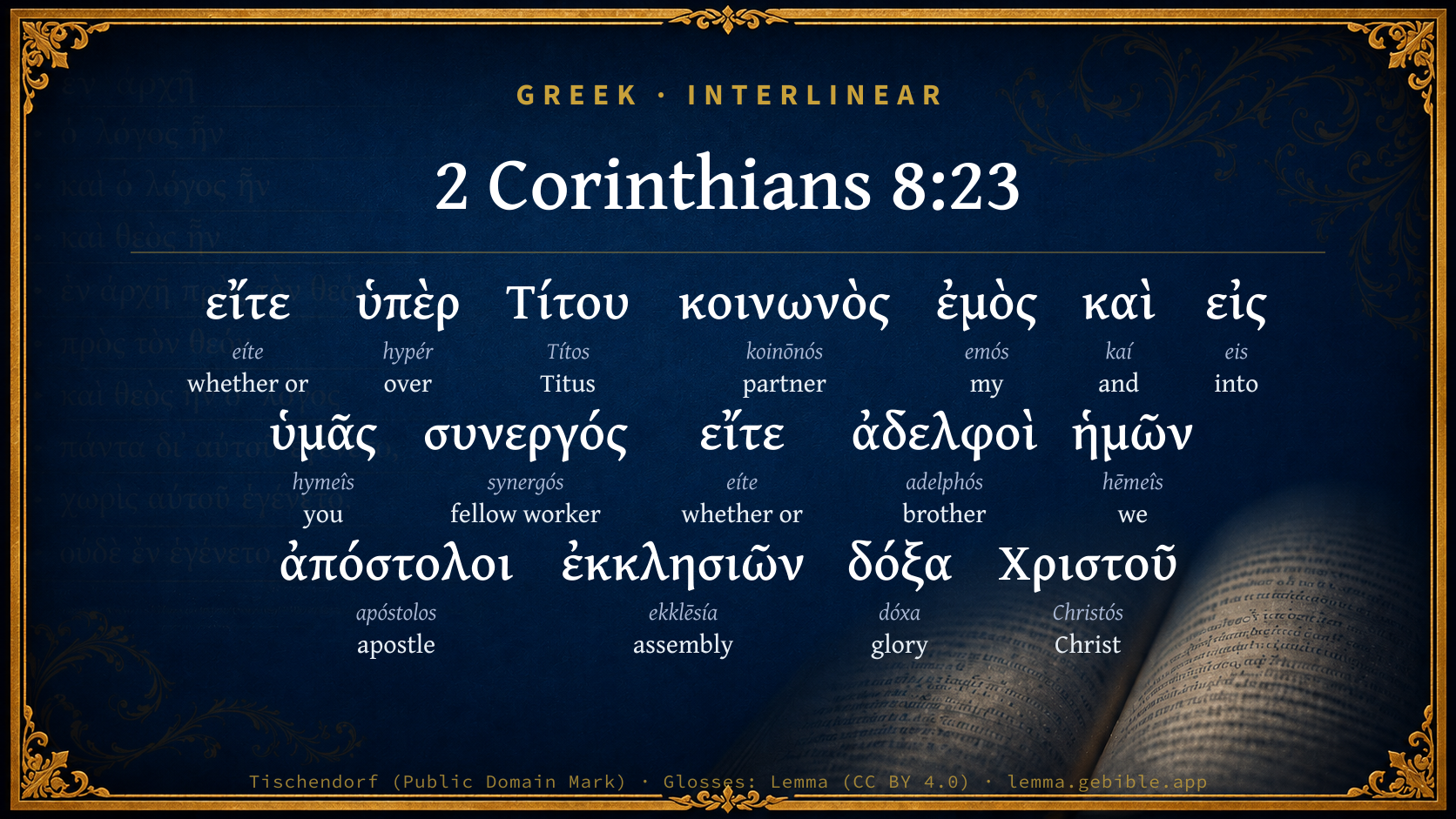
As for Titus, he is my partner and fellow worker for you. As for our brothers, they are the apostles of the assemblies, the glory of Christ.
World English Bible · Public Domain
Download a study sheet

One document with this verse’s original text, its word-by-word gloss line, the meaning frame, cross-references with their text, attributed commentary, and full source and license credits — printable, and it pastes into notes with its structure intact.

This verse Autodidact and up

Study sheet (.html) Plain text (.txt)

A passage Seminary Student

Up to 50 verses in one chapter. A passage sheet keeps up to 6 commentary sources and 12 cross-references per verse, in the order this page ranks them, and says so on the sheet whenever that leaves anything out. Ask for a single verse and you get the Autodidact verse sheet above.

Everything on this page stays free to read, with no account — the sheet is a download of what is already on screen, not access to it.

Want to remove ads? Support Godless Engineer
Compare translations 3

The same verse in 3 English versions, stacked beneath the original-language interlinear above. Click any original word for its lexicon entry.

Each is an independent rendering of the whole verse — the interlinear is not word-aligned to these translations.

Highlighted words mark where these versions differ — a whole-verse word diff, not a word-by-word alignment.

  • World English Bible Public Domain
    As for Titus, he is my partner and fellow worker for you. As for our brothers, they are the apostles of the assemblies, the glory of Christ.
  • King James Version Public Domain
    Whether any do enquire of Titus, he is my partner and fellowhelper concerning you: or our brethren be enquired of, they are the messengers of the churches, and the glory of Christ.
  • unfoldingWord Literal Text CC BY-SA 4.0
    As for Titus, my partner and fellow worker for you. As our brothers, messengers of the churches, a glory of Christ.

unfoldingWord Literal Text — © unfoldingWord, licensed CC BY-SA 4.0. Word-aligned USFM3 via Door43 (git.door43.org/unfoldingWord/en_ult).

Versions to compare (up to 4)

3 of 4 selected

Show all 19 translations

Every available English version of this verse, each an independent rendering of the whole verse.

  • World English Bible Public Domain
    As for Titus, he is my partner and fellow worker for you. As for our brothers, they are the apostles of the assemblies, the glory of Christ.
  • Berean Standard Bible Public Domain
    As for Titus, he is my partner and fellow worker among you. As for our brothers, they are messengers of the churches, to the glory of Christ.
  • Majority Standard Bible Public Domain
    As for Titus, he is my partner and fellow worker among you. As for our brothers, they are messengers of the churches, the glory of Christ.
  • King James Version Public Domain
    Whether any do enquire of Titus, he is my partner and fellowhelper concerning you: or our brethren be enquired of, they are the messengers of the churches, and the glory of Christ.
  • American Standard Version (1901) Public Domain
    Whether `any inquire' about Titus, `he is' my partner and `my' fellow-worker to you-ward, or our brethren, `they are' the messengers of the churches, `they are' the glory of Christ.
  • Revised Version (1885) Public Domain
    Whether any inquire about Titus, he is my partner and my fellow-worker to you-ward; or our brethren, they are the messengers of the churches, they are the glory of Christ.
  • Geneva Bible (1599) Public Domain
    Whether any doe inquire of Titus, he is my fellowe and helper to you ward: or of our brethren, they are messengers of the Churches, and the glorie of Christ.
  • Douay-Rheims (1899) Public Domain
    Either for Titus, who is my companion and fellow labourer towards you, or our brethren, the apostles of the churches, the glory of Christ.
  • Young's Literal Translation Public Domain
    whether -- about Titus -- my partner and towards you fellow-worker, whether -- our brethren, apostles of assemblies -- glory of Christ;
  • Literal Standard Version CC BY-SA 4.0
    whether—about Titus—my partner and fellow-worker toward you, whether—our brothers, apostles of assemblies—glory of Christ;
  • Unlocked Literal Bible CC BY-SA 4.0
    As for Titus, he is my partner and fellow worker for you. As for our brothers, they are sent by the churches. They are an honor to Christ.
  • unfoldingWord Literal Text CC BY-SA 4.0
    As for Titus, my partner and fellow worker for you. As our brothers, messengers of the churches, a glory of Christ.
  • Darby Bible Public Domain
    Whether as regards Titus, [he is] my companion and fellow-labourer in your behalf; or our brethren, [they are] deputed messengers of assemblies, Christ's glory.
  • World Messianic Bible Public Domain
    As for Titus, he is my partner and fellow worker for you. As for our brothers, they are the emissaries of the assemblies, the glory of Messiah.
  • Webster's Bible Public Domain
    If any inquire concerning Titus, he is my partner and fellow-helper concerning you: or our brethren be inquired of, they are the messengers of the churches, and the glory of Christ.
  • Free Bible Version CC BY-SA 4.0
    If anyone asks about Titus, he is my companion. He works with me on your behalf. The other brothers are representatives from the churches and an honor to Christ.
  • Bible in Basic English Public Domain
    If any question comes up about Titus, he is my brother-worker, working with me for you; or about the others, they are the representatives of the churches to the glory of Christ.
  • Text-Critical English NT CC BY 4.0
    If there is any question about Titus, he is my partner and fellow worker in your service. If there is any question about our brothers, they are delegates of the churches, the glory of Christ.
  • Tyndale New Testament (1534) Public Domain
    partly for Titus sake which is my felowe and helper as concernynge you partly because of other which are oure brethren and the messengers of the congregacions and the glory of Christ.

Literal Standard Version (2020), Covenant Press — licensed CC BY-SA 4.0. Text via the HelloAO Bible API (eBible.org). Unlocked Literal Bible (unfoldingWord) — licensed CC BY-SA 4.0. Text via the HelloAO Bible API (eBible.org). unfoldingWord Literal Text — © unfoldingWord, licensed CC BY-SA 4.0. Word-aligned USFM3 via Door43 (git.door43.org/unfoldingWord/en_ult). Free Bible Version, Dr. Jonathan Gallagher — licensed CC BY-SA 4.0. Text via the HelloAO Bible API (eBible.org).

Word by word

More ways to search: Search by grammar → Find every occurrence → Compare this word →

Practice this passage: Drill this verse → Learn its vocabulary →

κοινωνὸς
koinōnós
G2844
“partner”
Noun, Nominative, Singular, Masculine
Part of Speech
Noun
Case
Nominative
Number
Singular
Gender
Masculine
Full Thayer's Definition

Origin: from G2839

TDNT: 16:17,4

1. a partner, associate, comrade, companion 2. a partner, sharer, in anything a. of the altar in Jerusalem on which the sacrifices are offered 1. sharing in the worship of the Jews b. partakers of (or with) demons 1. brought into fellowship with them, because they are the authors of heathen worship
  1. εἴτε eíte G1535 “whether or” Conjunction
  2. ὑπὲρ hypér G5228 “over” Preposition
  3. Τίτου Títos G5103 “Titus” Noun, Genitive, Singular, Masculine
  4. ἐμὸς emós G1699 “my” Possessive pronoun, 1st person, Nominative, Singular, Masculine
  5. καὶ kaí G2532 “and” Conjunction
  6. εἰς eis G1519 “into” Preposition
  7. ὑμᾶς hymeîs G5210 “you” Personal pronoun, 2nd person, Accusative, Plural
  8. συνεργός synergós G4904 “fellow worker” Adjective, Nominative, Singular, Masculine
  9. εἴτε eíte G1535 “whether or” Conjunction
  10. ἀδελφοὶ adelphós G80 “brother” Noun, Nominative, Plural, Masculine
  11. ἡμῶν hēmeîs G2249 “we” Personal pronoun, 1st person, Genitive, Plural
  12. ἀπόστολοι apóstolos G652 “apostle” Noun, Nominative, Plural, Masculine
  13. ἐκκλησιῶν ekklēsía G1577 “assembly” Noun, Genitive, Plural, Feminine
  14. δόξα dóxa G1391 “glory” Noun, Nominative, Singular, Feminine
  15. Χριστοῦ Christós G5547 “Christ” Noun, Genitive, Singular, Masculine

About this verse

These counts appear in no published source. They are computed here, from the morphology-tagged text and Lemma’s own curated glosses. What Lemma adds →

16
words
15
distinct lemmas
Pauline Epistles
section

Notable vocabulary

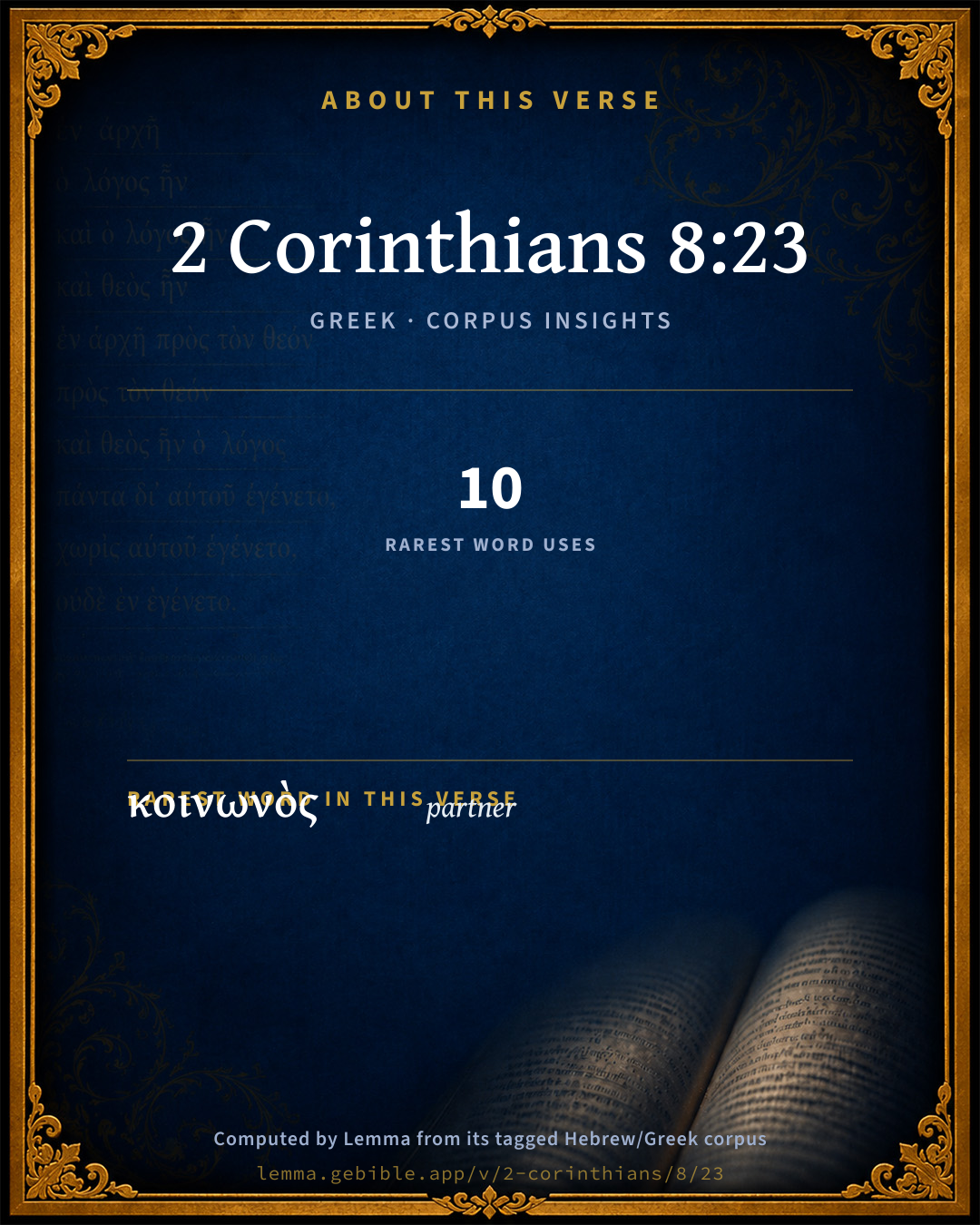
The rarest word here is κοινωνὸς partner G2844 — appearing just 10 times in the whole Greek New Testament.

Shared distinctive vocabulary

κοινωνὸς partner G2844 occurs in 10 verses of the Greek New Testament. Also found in:

Repetition

A word recurs within this verse:

  • εἴτε whether or G1535 ×2

Cross-references

14

Topical passages linked to 2 Corinthians 8:23 in the Treasury of Scripture Knowledge — connected by theme and wording, ordered by reader-vote popularity; previews shown in the World English Bible.

  • Philippians 2:25 But I counted it necessary to send to you Epaphroditus, my brother, fellow worker, fellow soldier, and your apostle and minister to my need;
  • Philemon 1:17 If then you count me a partner, receive him as you would receive me.
  • 2 Corinthians 8:6 So we urged Titus, that as he made a beginning before, so he would also complete in you this grace.
  • 3 John 1:8 We therefore ought to receive such, that we may be fellow workers for the truth.
  • Luke 5:7 They beckoned to their partners in the other boat, that they should come and help them. They came, and filled both boats, so that they began to sink.
  • Luke 5:10 and so also were James and John, sons of Zebedee, who were partners with Simon. Jesus said to Simon, "Don't be afraid. From now on you will be catching people alive."
  • 2 Corinthians 7:6 Nevertheless, he who comforts the lowly, God, comforted us by the coming of Titus;
  • 2 Corinthians 8:16 But thanks be to God, who puts the same earnest care for you into the heart of Titus.
  • 2 Corinthians 8:19 Not only so, but who was also appointed by the assemblies to travel with us in this grace, which is served by us to the glory of the Lord himself, and to show our readiness.
  • 2 Corinthians 12:18 I exhorted Titus, and I sent the brother with him. Did Titus take any advantage of you? Didn't we walk in the same spirit? Didn't we walk in the same steps?
  • Philippians 4:3 Yes, I beg you also, true yoke-fellow, help these women, for they labored with me in the Gospel, with Clement also, and the rest of my fellow workers, whose names are in the book of life.
  • Colossians 1:7 even as you learned of Epaphras our beloved fellow servant, who is a faithful minister of Christ on our behalf,
  • 1 Thessalonians 2:2 but having suffered before and been shamefully treated, as you know, at Philippi, we grew bold in our God to tell you the Gospel of God in much conflict.
  • Philemon 1:24 as do Mark, Aristarchus, Demas, and Luke, my fellow workers.

Cross-references courtesy of OpenBible.info (CC BY 4.0).

Commentary

Notes on 2 Corinthians 8:23 from classic Christian and Jewish commentators (each source and its license shown beneath its notes). The classic Christian expositions comment on the surrounding passage and are grouped to its opening verse, so a note may address several verses; the Jewish commentaries on the Tanakh (Rashi and others) are per-verse, so they appear only where the commentator wrote on this verse.

Lemma curates 59 commentaries, every one of them public domain or Creative Commons licensed, each selected and text-cleaned for this edition rather than reprinted as found. About our sources →

Joseph Benson's Commentary

2Co 8:23-24. Whether any inquire, &c. — As if he had said, If any be not yet satisfied, but desire to know more of those persons, and inquire concerning Titus, he is my partner — In my cares and labours; and fellow- helper concerning you — Always ready to act in concert with me in any attempt to correct what is amiss among you, and to promote your improvement in real Christianity. Or the meaning may be, He is my fellow- labourer with respect to you, having assisted me in planting the gospel among you. If it be inquired concerning our other brethren, whom I have mentioned above, and who accompany Titus, they are the messengers of the churches — Persons sent by the churches to go with me to Jerusalem; and the glory of Christ — Signal instruments of advancing his glory. “The apostle’s example in doing justice to the characters of his younger fellow- labourers, is highly worthy of the imitation of the more aged ministers of the gospel. They ought to introduce their younger brethren to the esteem and confidence of the people, by giving the praise which is due to them. For, as Doddridge observes, they will most effectually strengthen their own hands and edify the church, by being instrumental in setting forward others, who, on account of their faithfulness and diligence in the ministry, will in time merit the illustrious appellation of being the glory of Christ.” — Macknight. Wherefore show before the churches — Present by their messengers; the proof of your love to me and the saints — That is, an evidence that it is sincere; and of our boasting on your behalf — That it was not without foundation.

Joseph Benson's Commentary on the Old and New Testaments (1811–1818) — public domain. Text from a community e-Sword module.

Tyndale Open Study Notes

Tyndale Open Resources

8:23 they bring honor to Christ: Paul’s last phrase is even more expressive in Greek (literally they are the glory of Christ)—they are examples of Christians who reflect the Lord’s splendor (3:1-18).

Tyndale Open Study Notes — © Tyndale Open Resources, licensed CC BY-SA 4.0. Text via the HelloAO Bible API.

Bengel's Gnomon

Johann Albrecht Bengel

2Co 8:23. Ὑπὲρ, [pro] in behalf of, for) This gives the motive of the confidence.[52]—Τίτου, κοινωνὸς, in behalf of Titus, a partner) These words are in apposition; comp. [ch. 2Co 11:28] Luk 22:20 [διαθηκὴ ἐν τῷ αἳματί μου, τὸ ὑπὲρ ὑμῶν ἐκχυνόμενον], note.—ἀδελφοὶ, brethren) It might have been said for, or in behalf of our brethren, but the word κοινωνὸς, partner, coming in between as the nominative case, brethren is also put in the nominative, and the verb are is supplied, i.e., whether they are and are regarded as our brethren for the sake of whom we are confident you will be liberal].—ἀπόστολοι) deputies, messengers; persons who on the public account execute a pious office. Again supply are.

[52] i.e. We feel confident you will be liberal for the sake of Titus.—ED.

Bengel's Gnomon of the New Testament — English translation (T&T Clark, Edinburgh, 1860) — public domain. Text from a community e-Sword module.

Meyer's Critical & Exegetical Commentary

Heinrich August Wilhelm Meyer

2Co_8:23 f. Summary closing recommendation of all the three delegate.

εἴτε ὑπὲρ Τίτου] sc. λέγω or γράφω. Be it that I speak on behalf of Titus, he is my associate and (especially) in regard to you my fellow-worker, and my intercession is thus made with good reaso.

εἴτε ἀδελφοὶ ἡμῶν] be it that they are brothers of ours, namely, for whom I speak, they are delegates of churches,[283] an honour to Christ, people, whose personal character and working redound to Christs honour. The words to be supplied with εἴτε in both cases would occur of themselves to the reader of the incomplete passage. Comp. Fritzsche, ad Rom. III. p. 47 f. Observe, however, that ἀδελφοὶ ἡμῶν is predicative, and therewith qualitative; hence the absence of the article appears to be strictly regular,[284] denoting the category to which the subjects meant in this second half of the verse belong, and therefore neither unsuitable (Rückert) nor yet erroneous (Buttmann, neut. Gr. p. 76 [E. T. 87]; comp. Hofmann).

ἡμῶν] as in 2Co_8:22. The distinguishing of the two others from Titus, who holds a higher position, by the qualitative ἀδελφοὶ ἡμῶν, shows that ἀδελφοί are not official associates. Such a one Titus was; the two others, however, were only distinguished church-membersas it were, lay-brothers commissioned ad hoc, the one by the churches, the other by Paul.

[283] In so far as they did not come as private persons, but as agents in the business of the church, as which they were appointed partly by destination of the apostle (namely, the second of the brethren), partly by the choice of the Macedonian churches (the first of the brethren, ver. 18 f.).

[284] This absence of the article has led Hofmann wrongly to take all the nominatives in ver. 23 as subjects, but ὑπὲρ Τίτου as a parenthesis (which holds true of Titus), and then οὖν in ver. 24 as the οὖν of the apodosis. A groundless artificial construction, in which the awkward and unprecedented parenthesis (Paul would have said something like Τίτον δὲ λέγω, and that after συνεργός, comp. 1Co_10:29; Joh_6:71) would be simply superfluous in the highest degree, since, if κοινωνὸς κ.τ.λ. is the subject, the person thereby indicated would be self-evident. Just as uncalled for here after the short alleged protasis would be the epanaleptic οὖν of the apodosis. Comp. on Rom_2:17-24.

Meyer — Critical and Exegetical Commentary on the New Testament — English translation by Peter Christie, edited by Frederick Crombie (T&T Clark, 1880) — public domain. Text from a community e-Sword module.

Expositor's Greek Testament

ed. W. Robertson Nicoll

2Co 8:23 . εἴτε ὑπὲρ Τίτου κ . τ . λ .: whether you ask about Titus ( cf. on 2Co 1:8 for this use of ὑπέρ ), he is my colleague and my fellow worker to you ward (for him St. Paul will be personally responsible), or our brethren , they are the envoys of Churches, i.e. , they were duly χειροτονηθέντες (2Co 8:19 ). The term ἀπόστολος is generally used by St. Paul as a technical term; but occasionally, as here, and at Phi 2:25 (of Epaphroditus) and (possibly) at Rom 16:7 , he uses it in its primitive etymological meaning of “envoy” or “emissary” ( cf. 1Ki 14:6 ). These men are further described as δόξα Χριστοῦ , the glory of Christ , perhaps because their work is so specially ad majorem Dei gloriam (see 2Co 8:19 and 2Co 9:13 ).

The Expositor's Greek Testament, edited by W. Robertson Nicoll (1897–1910) — public domain. Text from a community e-Sword module.

Geneva Bible (1599)

Geneva Bible translators

By whom the glory of Christ is set forth.

Titus’s two companions.

Geneva Bible (1599) marginal notes — public domain. Text via Bolls.life.

Jamieson, Fausset & Brown

Robert Jamieson, A. R. Fausset & David Brown

fellow helper concerning you--Greek, "fellow worker towards you."

our brethren--the two mentioned in Co2 8:18, Co2 8:22.

messengers--rather, as the Greek, "apostles": in the less strict sense (Act 14:14).

of the churches--sent by the churches, as we are by the Lord (Phi 2:25). There was in the synagogue an ecclesiastical officer, called "the angel of the Church," whence the title seems derived (compare Rev 2:1).

Jamieson, Fausset & Brown — Commentary Critical and Explanatory on the Whole Bible (1871) — public domain (CC PDM 1.0). Text via the HelloAO Bible API.

Adam Clarke's Commentary

Verse 23. Whether any do inquire of Titus] Should it be asked, Who is this TITUS? I answer, he is my companion, and my fellow labourer in reference to you; 2Co 2:13; 2Co 7:6; 2Co 7:7. Should any inquire, Who are these brethren, Luke and Apollos? I answer, They are αποστολοι, apostles of the Churches, and intensely bent on promoting the glory of Christ.

Adam Clarke's Commentary on the Bible (1810–1826) — public domain. Text from a community e-Sword/MySword module.

John Calvin's Commentaries

In calling them the Apostles of the Churches, he might be understood in two senses — either as meaning that they had been set apart by God as Apostles to the Churches, or that they had been appointed by the Churches to undertake that office. The second of these is the more suitable. They are called also the glory of Christ, for this reason, that as he alone is the glory of believers, so he ought also to be glorified by them in return. Hence, all that excel in piety and holiness are the glory of Christ, because they have nothing but by Christ’s gift.

John Calvin's Commentaries (1540-1563) — public domain. Text from the Calvin Translation Society English edition (1840s-50s) via the Christian Classics Ethereal Library (ccel.org). Calvin's coverage is partial (roughly two-thirds of the Bible); uncommented books and verses are honest gaps, never fabricated. The 19th-century editor's footnotes and remarks are omitted so the notes are faithfully Calvin's own voice.

Ellicott's Commentary for English Readers

(23) Whether any do enquire of Titus.—There is no verb in the Greek, and its insertion is not required for the English. Our common phrase, As to Titus . . . as to our brethren, exactly expresses St. Paul’s meaning. In the “messengers” of the churches we find in the Greek the word “Apostles” used, as in Php_2:25, and possibly Rom_16:7, in a lower sense (the Greek has no article), for “delegates of the churches,” as the Twelve and Paul and Barnabas were delegates of Christ. The other epithet—“the glory of Christ”—is an unusual one. To say that they were working only to that glory, though true, seems hardly adequate, and we gain a deeper thought by connecting it with the language of 2Co_3:18. “These messengers,” he says, “are like Christ in character: they reflect His glory. You may see that glory in them.”

A Bible Commentary for English Readers, edited by Charles John Ellicott (1878–1897) — public domain. Text from a community e-Sword module.

The Cambridge Bible for Schools and Colleges

gen. ed. J. J. S. Perowne

23. he is my partner] Literally, sharer. See notes on the words communion and fellowship in the first Epistle. ‘The sharer of my labours and cares.

and fellow-helper concerning you] Better, and as regards you, my fellow-worker.

the messengers of the churches, and the glory of Christ] The word ‘and’ is not in the original, and detracts from the force of the sentence. The word here translated ‘messengers’ is Apostles in the original. But here, as in Php_2:25, it does not signify the official rank in the Church of the persons referred to, but simply the fact that they were sent. For ‘the glory of Christ’ see 2Co_8:19 and 1Co_11:7. A man is the glory of Christ when he manifests Christ’s glory, which is done either by displaying His power, or the holiness which comes from Him. Cf. Joh_1:14; Joh_2:11; Joh_11:40; Gal_1:24, and Act_21:19-20; also ch. 2Co_3:18. Both the brethren would seem from this passage to have been ‘chosen of the Churches.’

The Cambridge Bible for Schools and Colleges (gen. ed. J. J. S. Perowne; Cambridge University Press, 1878–1918) — public domain. Text from a community e-Sword module.

John Gill's Exposition

Wherefore show ye to them, and before the churches,.... This is the conclusion of the apostle, upon summing up the characters of these messengers; and his exhortation is, that since they were persons of so much note and worth, as they ought to be received with great marks of respect and affection, so they would take care evidently to make it appear to them who were sent by the churches, and before the churches, or before them who represented the churches; or so as that it might be known by the churches from whence they came, when they returned with their report; or be evident to the churches in Judea, when their liberality should be brought to them:

the proof of your love; to Christ and his poor members, how hearty and sincere it was:

and of our boasting on your behalf; how willing and forward they were to this good work, and how liberal they would be.

Next: 2 Corinthians Chapter 9

John Gill's Exposition of the Whole Bible (1746–1763) — public domain (CC PDM 1.0). Text via the HelloAO Bible API.

Trapp's Complete Commentary

John Trapp

23 Whether any do enquire of Titus, he is my partner and fellowhelper concerning you: or our brethren be enquired of, they are the messengers of the churches, and the glory of Christ.

Ver. 23. Messengers] Gr. apostles, emandati, ambassadors of special and high employment.

The glory of Christ] So the Church is called "the glory," Isa 4:5; God’s glory, Isa 46:13; a crown of glory, and a royal diadem in the hand of Jehovah, Isa 62:3; the throne of God, Exo 17:16; {margin}; the throne of glory, Jer 14:21; the ornament of God, yea, the beauty of his ornament, set in majesty, Eze 7:20. There is not so much of the glory of God (saith one) in all his works of creation and providence, as in one gracious action that a Christian performs.

John Trapp, A Commentary or Exposition upon All the Books of the Old and New Testament (1647–1656) — public domain. Text from a community e-Sword module.

Albert Barnes' Notes on the Bible

Whether any do inquire of Titus - It is to be observed that the words “any do inquire” are not in the original; nor is it clear that these are the most proper words to be introduced here. The Greek may mean either, “if any do inquire about Titus,” or it may mean “if anything is to be said about Titus.” The sense of the passage may either be, that some of the faction at Corinth might be disposed to inquire about the authority of Titus to engage in this work, or that Paul having said so much in commendation of the persons who went with Titus, it seemed proper also to say something in his favor also. The idea is, “If any inquiry is made from any quarter about him, or if it is necessary from any cause to say any thing about him, I would say he is my partner,” etc.

He is my partner ... - He partakes with me in preaching the gospel, and in establishing and organizing churches; compare Tit 1:5. To the Corinthians this fact would be a sufficient commendation of Titus.

Or our brethren be inquired of - That is, the brethren who accompanied Titus. If any inquiry was made about their character, or if it was necessary to say anything in regard to them.

They are the messengers of the churches - They have the entire confidence of the churches, having been selected and appointed by them to a work of labor and responsibility; compare Phi 2:25. The words here rendered “messengers of the churches,” are in the original “apostles of the churches,” (ἀπόστολοι ἐκκλησιῶν apostoloi ekklēsiōn). The word “apostles” here is used evidently in its proper sense, to denote one who is sent out to transact any business for others, or as an agent or legate. These persons were not apostles in the technical sense, and this is an instance where the word is applied in the New Testament to those who had no claim to the apostolic office. It is also applied in a similar way to Apollos and Barnabas, though neither, strictly speaking, were apostles.

And the glory of Christ - That is, they have a character so well known and established for piety; they are so eminent Christians and do such honor to the Christian name and calling, that they may be called the glory of Christ. It is an honor to Christ that he has called such persons into his church, and that he has so richly endowed them. Every Christian should so live as that it would appear to all the world that it was an honor and glory to the Redeemer that he had such followers; an honor to his gospel that it had converted such and brought them into his kingdom. It is sufficient honor, moreover, to any man to say that he is “the glory of Christ.” Such a character should be, and will be, as it was here, a recommendation sufficient for any to secure them the confidence of others.

Albert Barnes' Notes on the Bible (1834–1885) — public domain. Text from a community e-Sword/MySword module.

Matthew Poole's English Annotations

This verse contains the apostle’s credential letters, given to Titus, and the other two persons, sent about the business of making this collection in the church of Corinth. Many, in matters where the drawing of their purses is solicited and concerned, are very scrupulous and inquisitive, seeking all advantages to excuse themselves; one while pleading their own poverty, another while objecting against the state, or want, or quality of those for whom they are solicited; again, questioning whether their charity shall ever come to those persons for whom it is desired, objecting against the persons intrusted with the conveyance or distribution of it. The apostle having, therefore, before obviated some objections, he here obviateth the last mentioned, letting them know, that the persons intrusted with this service were unexceptionable persons. He calleth Titus his

partner and fellow-helper concerning them, that is, in the business of the gospel, and promoting the salvation of their souls. For the others, he tells them they were such as

the churches had thought fit to make their

messengers; so had the credit of the churches, whose messengers they were, who would not have intrusted them if they had not judged them faithful. He calleth either the churches, or them,

the glory of Christ. If the words be to be understood of the messengers. (which seemeth the fairest application of them), the meaning is, that they were instruments of the glory of Christ: or persons who, by their grace, did bring much glory to Christ. Every one that excelleth in the habits or exercise of grace, is the glory of Christ, because without Christ he can do nothing of that nature: I live; yet not I but Christ liveth in me, Gal 2:20. The acts and exercises of grace are indeed our acts, but the power by which we do them is from Christ: we glory in Christ, and by our holy conversations glorify Christ; and Christ glorieth in every pious and holy person, as God did concerning Job, Job 1:8; 2:3.

Matthew Poole's English Annotations on the Holy Bible (1683–1685) — public domain. Text from a community e-Sword/MySword module.

Whedon's Commentary on the Bible

Daniel D. Whedon

23. Inquire of Titus—In regard to Titus. To all questioning the standing of Titus, Paul gives his own certification. Titus is last mentioned, but the only one named. The others were but messengers, he partner and fellow helper. How faithfully he laboured and discharged the responsible duties committed to him by the apostle, is evident from Paul’s epistle to him at Crete.

Our brethren—The other two, Luke and Erastus; or rather, as without the Greek article, in general, brethren of ours.

Messengers— Greek, apostles; the word being used, however, in its broader sense of messengers; a class by whom the intercourse between the different Churches of the Christian republic was maintained.

Glory of Christ— Persons whose life is devoted to the honour of Jesus.

Daniel D. Whedon (gen. ed.), Commentary on the Old and New Testaments (1874–1909) — public domain. Text from a community e-Sword module.

The Pulpit Commentary

Whether any do inquire of Titus; literally, whether about Titus, or, as to Titus; i.e. "if I speak about Titus." (For the phrase, comp. 2Co_1:6, 2Co_1:8; 2Th_2:1) Titus, long afterwards, was delegated on a similar mission to Crete. (Tit_1:1-5 Tit_2:15) My partner and fellow helper concerning you; rather, my associate (Phm_1:17) and, as regards you, my fellow worker. Messengers; literally, apostles. The word is used in its original and untechnical sense of delegates. (Rom_16:7) The glory of Christ. Men whose work and worth redound to Christ"s honour. (Gal_1:24)

The appreciation of fellow labourers.

Anxious as Paul was that a generous contribution should be sent to Judaea for the relief and assistance of the poor Christians in that province, he was equally anxious that the mode in which this contribution was transmitted should be open and above all suspicion of carelessness or misappropriation. Hence he secured that Titus and two others should be appointed as trustees, so to speak, of the fund, to take charge of it and to carry it to the destined quarter. Of these three Christian men Paul speaks in terms of notable commendation. He terms them

I HIS OWN ASSOCIATES. The expressions used with this intent are three in number.

1. They are partners, engaged in the same work, under the same Master, and with the expectation of a similar reward, with himself.

2. They are fellow workers, each having his own faculty, his own implement, for labour, but all cooperating to the one end.

3. They are brethren; i.e. bound together by a personal tie, a spiritual kindred, in the Christian family and household of faith. These expressions involve a deep and lasting attachment, such as should unite those who are engaged in one and the same service rendered to the one great Master.

II MESSENGERS OF THE CHURCHES. The expression in the original is very strong. They are apostles; i.e. sent forth by the congregation as their representatives and plenipotentiaries. This gives a special dignity to the office and work of accredited servants of the body of Christ, and therefore of Christ himself.

III THE GLORY OF CHRIST. There is something mystical, something difficult to expound, in this epithet. It certainly implies that these faithful men were exalted to a position of very high honour, and were looked upon as related very closely to the Lord himself. Certainly it was to the glory of the Redeemer that a new principle of benevolence was introduced into human society, impelling the Gentile of Europe to display a practical interest in the welfare of the Jew of Palestine. Here was exhibited a moral glory radiating from Christ himself, before which the world might well bow down in wonder, admiration, and reverence. T.

What true Christian workers are.

I THEY ARE THE GLORY OF CHRIST.

1. They are the monuments of the triumph of Christ. They are "saved" to some purpose. Many assert that they are "saved," but they cannot discover, neither can any one else, unto what they are saved. They seem to be saved unto nothingness, and in this sense to have experienced a singularly complete redemption. But the active, devoted Christian proves the reality of his faith by works following. Christ has not only triumphed over the judgment and heart, but over all powers, which are now willingly dedicated to his service.

2. They resemble Christ. Christ was pre-eminently a worker. He "went about doing good;" they seek to do so. He practised self-denial and endured suffering that others might be benefited; they strive to imitate him.

3. They exalt Christ. They desire that his kingdom may be extended over the earth. Whilst they labour for others, they do this out of their love for him. He is first, all else second. The exaltation of Christ is their supreme wish. Their mission is to speak well of his Name wherever they go.

4. Christ delights in them. They are the fruitful trees which he loves. He cursed the barren tree, but these he blesses. They are the faithful servants of the absent Lord. He loves not idlers who filch the name of "servant;" but those who are servants indeed his soul rejoices in. He glories in these, for they show forth his praise.

II THEY SHOULD SEEK FULLY TO REALIZE THEIR HIGH CALLING.

1. The dignity of Christian work is not always perceived as fully as itshould be. It is infinitely superior to all other work.

2. Nor its privilege. Were this adequately realized, what alacrity therewould be in entering upon Christian service! As it is, alas! almost force has to be employed in some cases.

3. Nor its responsibility.

4. Nor how much the work done is affected by the life lived.

III THEY SHOULD BE HIGHLY ESTEEMED. They are the instruments through which God works. They are the means employed by him for the building up of the kingdom of Christ. They are the special representatives of Christ upon earth. They should be

(1) encouraged,

(2) helped,

(3) honoured. H.

The Pulpit Commentary (1880–1919), ed. H.D.M. Spence-Jones & Joseph S. Exell — public domain. Text from a community e-Sword module.

John Wesley's Explanatory Notes

My partner - In my cares and labours. The glory of Christ - Signal instruments of advancing his glory.

John Wesley, Explanatory Notes Upon the Whole Bible (1754–1765) — public domain. Text via the GEBible commentary corpus.

Burkitt's Expository Notes on the New Testament

William Burkitt

Observe here, What pains the apostle takes to answer all cavils and objections that might hinder the free collection and regular distribution of this charity. Some might pretend, possibly, to say then, (as many amongst us do now,) "We know not into whose hands this charity-money may fall; we know not whether ever they shall be the better for it, for whom it was intended." Therefore, says St. Paul, if any make that objection, that they do not know Titus, and inquire after him, or his trustiness, tell them he is my coadjutor, my partner and fellow-helper in converting you to Christianity; and if the other two be inquired after, they are our brethren, the messengers of the churches, and the glory of Christ; that is, the instruments of his glory; therefore let these messengers see, and the churches which did depute them, the proof of your love to me and to the saints, and that I did not boast of your liberality in vain.

Note here, The high honour which St. Paul puts upon the ministers of the gospel, in calling them the glory of Christ, that is, the glory of the gospel of Christ, the glory of the Christian profession, the instruments of Christ’s glory, by whom his honour and glory is greatly promoted; persons who by their exemplary gloriousness did bring much honour and glory to Christ. This title I conceive shows both our dignity and duty; our dignity, in that Christ accounts us his glory when we are found faithful to him; as the faithfulness of an ambassador redounds to the glory and honour of the prince that sends him. And it points out our duty, to promote the glory of Christ, to pray and endeavour that he would use us as instruments for the advancement of his glory; that as we glorify him on earth, he may glory in us, and be glorified by us, before his Father in heaven, and we be presented faultless before the presence of his glory with exceeding joy. Amen.

William Burkitt's Expository Notes on the New Testament (1700–1703) — public domain. Text from a community e-Sword module.

McGarvey & Pendleton's Commentaries

J. W. McGarvey

Whether any inquire about Titus, he is my partner and my fellow-worker to you-ward; or our brethren, they are the messengers of the churches, they are the glory of Christ .

J. W. McGarvey (with Philip Y. Pendleton), Commentaries on the New Testament (The Fourfold Gospel, 1914; Acts; and the epistles) — public domain. Text from a community e-Sword/MySword module.

The People's New Testament

B. W. Johnson

23. Whether any do inquire of Titus. The commendation given of these three brethren is official. Titus had long been a fellow laborer, and had recently visited Corinth. The other two were messengers of the Macedonian churches. Not only of the churches but of the glory of Christ, the Lord's messengers to show forth his glory in a great work of mercy.

B. W. Johnson's The People's New Testament with Notes (1889–1891) — public domain. Electronic text from the Christian Classics Ethereal Library (CCEL) ThML edition.

Cambridge Greek Testament for Schools and Colleges

23, 24. Summary, briefly commending all three of the delegates

23. εἴτε ὑπὲρ Τίτου, … εἴτε ἀδελφοὶ ἡμῶν. Broken construction, the ellipse in each half being different: ‘whether (anyone asks) about Titus … or our brethren (be asked about).’ Comp. Rom 12:7. As to Titus, he is my partner and fellow-worker to you-ward (2Co 8:22); or as to our brethren, they are apostles of Churches, a glory to Christ. It is more accurate to retain the usual translation of ἀπόστολος and leave the context to show that here, as in Php 2:25, ἀπόστολος is not used in the same sense as when it is applied to the Twelve and to S. Paul. He and the Twelve were messengers or delegates of Christ, whereas these brethren were only messengers or delegates of Churches, as Epaphroditus was the messenger of the Philippian Church. See Lightfoot, Philippians p. 194, Galatians p. 95. εἴτε is common in the Pauline Epp., esp. in 1 and 2 Cor. See on 2Co 1:6. Elsewhere in the N.T. in 1Pe 2:13-14 only.

Cambridge Greek Testament for Schools and Colleges (Cambridge University Press, 1896; 21 vols, various authors incl. Carr, Maclear, Plummer, Farrar, Lumby, Moule, M. R. James, Simcox) — public domain. Text from a community e-Sword module.

Alford’s Greek Testament

Henry Alford

23.] General recommendation of the three.

εἴτε ὑπ. Τίτου] Whether concerning Titus (we may supply λέγω or γράφω, or as in E. V., ‘any enquire:’ or we need not supply any thing), he is my partner and (especially) my fellow-worker towards you: whether our brethren (be in question:—viz. the two mentioned—but generalized by the absence of the article—‘whether [any] brethren of ours’), they are Apostles (in the more general sense of Act 14:14; 1Th 2:6; Php 2:25) of the churches (i.e. ‘are of the churches, what we are of the Lord’—persons sent out with authority), the glory of Christ (i.e. men whose work tends to Christ’s glory).

Henry Alford, The Greek Testament (1849–1861) — public domain. Text from a community e-Sword module.

International Critical Commentary

23. εἴτε ὑπὲρ Τίτου … εἴτε ἀδελφοὶ ἡμῶν. The constr. is broken in dictating. ‘Whether [anyone asks] about Titus, he is my partner and fellow-worker to you-ward; or our brethren [be asked about], they are apostles of Churches, a glory to Christ.’ Titus is to represent the Apostle; the two brethren are to represent the Macedonian Churches. Cf. 1Co 11:7. He does not say ‘Apostles of Christ’; that was true of himself and the Twelve, who had received their commission direct from our Lord, but it was not true of these two brethren who were merely messengers or delegates of Churches, as Epaphroditus of Philippi; legati, qui publico nomine pium exsequuntur officium (Beng.). See Harnack, Mission and Expansion, i. pp. 319, 327. Nevertheless, to be selected by their Churches was a guarantee for their characters and capacities. In these two verses he brings the commendatory section to a close. For εἴτε … εἴτε see on 1:6; cf. 1Co 3:21, 1Co 13:8. Its use without a verb is classical. Blass, § 78. 2. See Hastings, DB. and DCG. art. ‘Apostle.’

International Critical Commentary — older volumes (1896–1929), various authors — public domain. Text from a community e-Sword module.

Lesson kit

Teaching starters — assembled from the data on this page, not authored interpretation. Every prompt links to the verse data it draws on. Edit before teaching.

2 Corinthians, in the Pauline Epistles, opens this verse with 16 words (15 distinct Greek lemmas). Its most distinctive word is koinōnós (“partner”). A historical commentator’s framing appears above. Read the whole chapter for the surrounding context.

Discussion questions

  1. How does “partner” (koinōnós) shape what this verse is saying?
  2. How does Matthew 23:30, which shares the word «partner», read alongside this verse?
  3. What does the repetition of “whether or” (2× in this one verse) do in this verse?
  4. The translations on this page render this verse differently — a whole-verse word diff, not a word-by-word alignment. What might account for the different wordings?
  5. Compare how Joseph Benson's Commentary and Tyndale Open Study Notes read this verse. Where do they agree or differ?

Things to notice

  • These translations choose different wording for 15 words in this verse.
  • “whether or” occurs 2× in this single verse.
  • 15 distinct Greek lemmas span 16 words in this verse.

Reading settings

Reading text

Shown beneath each verse's original-language words.

Old Testament
Old Testament edition

Read the OT as the Masoretic Hebrew (MT) or the Greek Septuagint (LXX).

English shown for the Greek Septuagint (in the Hebrew ↔ Greek comparison).

Comparing translations? Open the Compare panel on any verse page to stack up to four side by side.