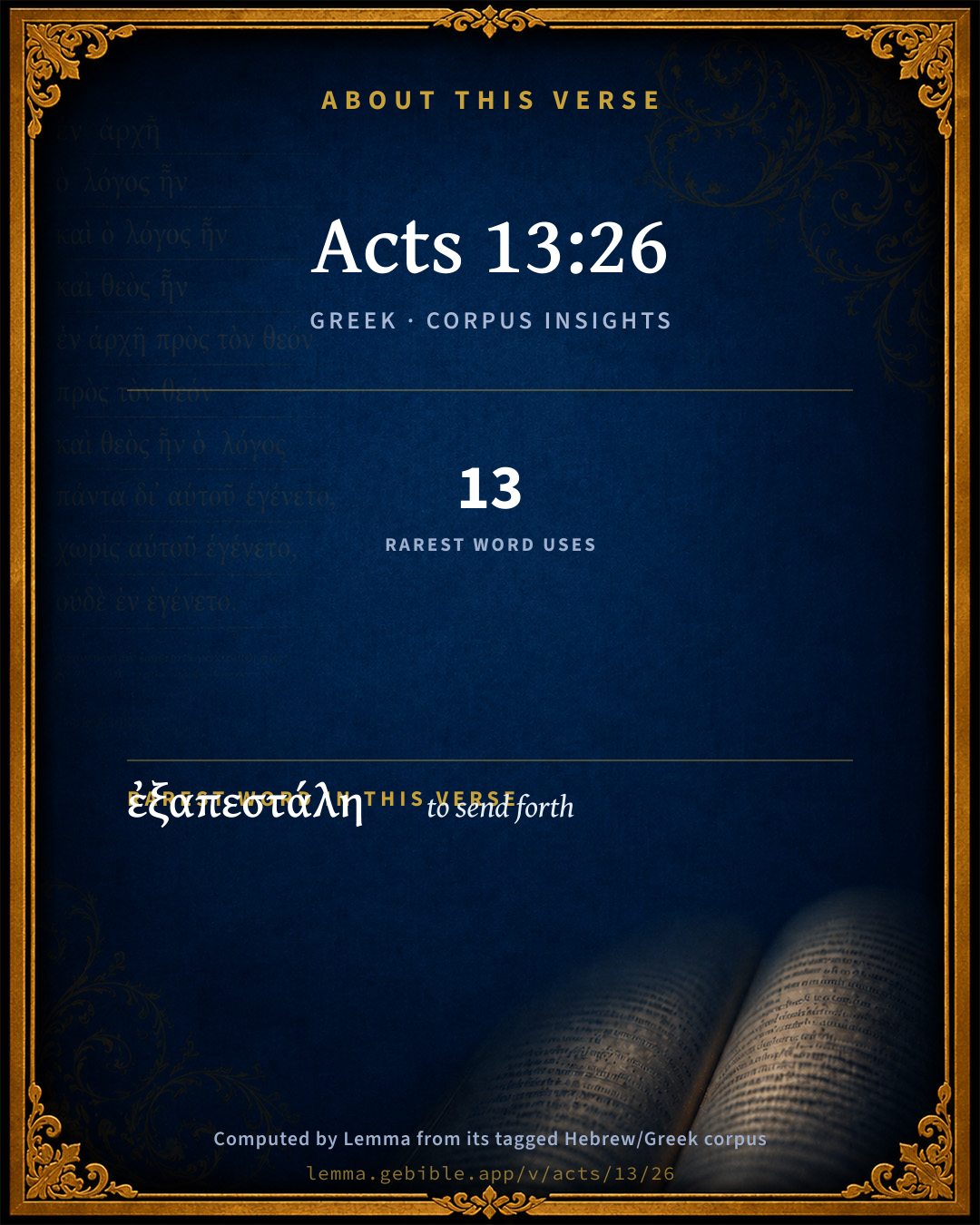
Acts 13:26

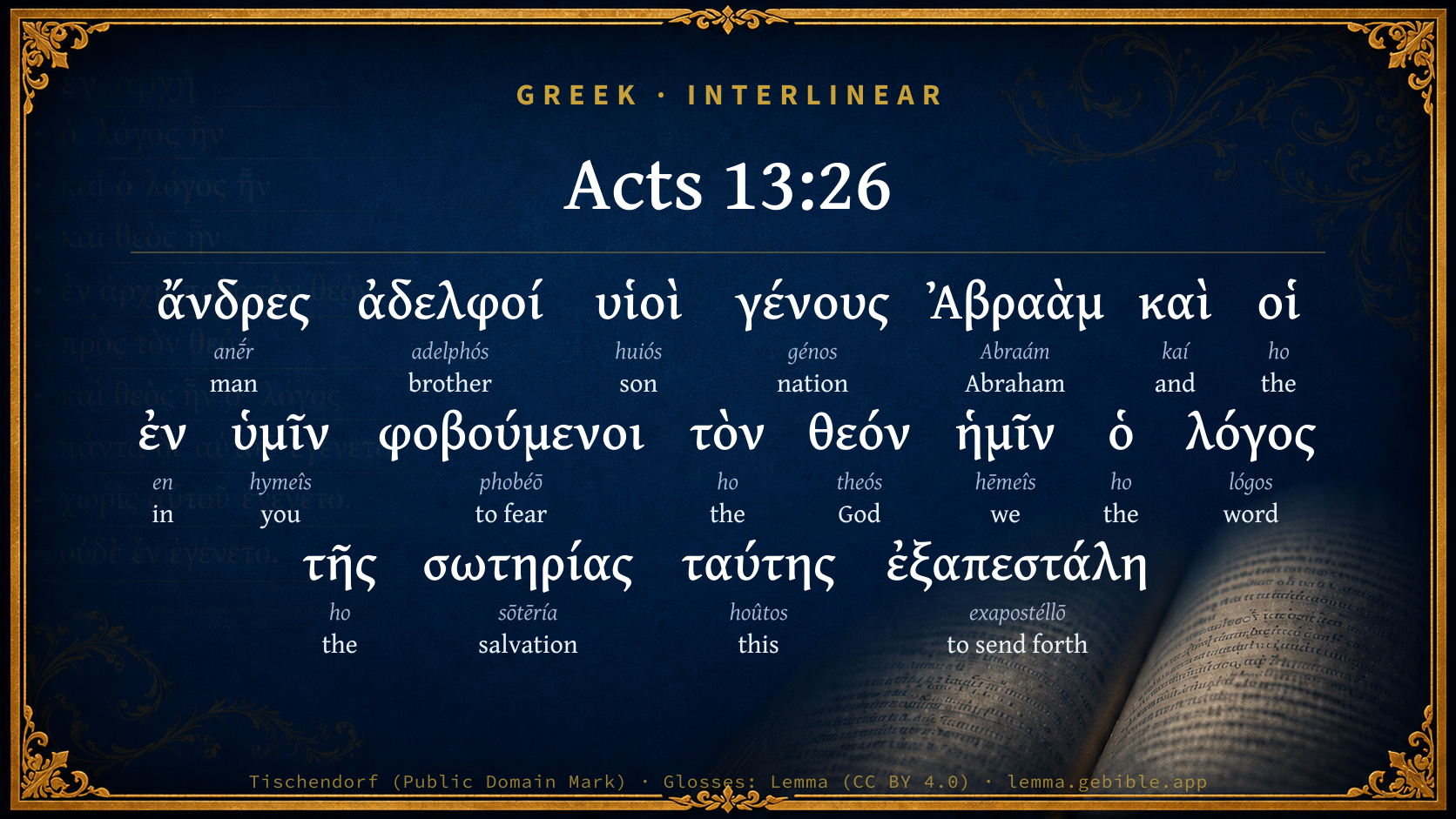
Greek (Tischendorf 8th ed.) Acts 13:26 appears in the Greek New Testament. The text above is from the Tischendorf 8th edition. Each word links to its Strong’s number and a concise gloss. Click any word for its full Thayer’s Greek Lexicon entry.
Download image
Cite this verse

Acts 13:26 (World English Bible). Public Domain. Lemma interlinear Bible study tool, https://lemma.gebible.app/v/acts/13/26.

Show BibTeX & RIS
BibTeX
RIS
English Translation
Brothers, children of the stock of Abraham, and those among you who fear God, the word of this salvation is sent out to you.
World English Bible · Public Domain
Download a study sheet

One document with this verse’s original text, its word-by-word gloss line, the meaning frame, cross-references with their text, attributed commentary, and full source and license credits — printable, and it pastes into notes with its structure intact.

This verse Autodidact and up

Study sheet (.html) Plain text (.txt)

A passage Seminary Student

Up to 50 verses in one chapter. A passage sheet keeps up to 6 commentary sources and 12 cross-references per verse, in the order this page ranks them, and says so on the sheet whenever that leaves anything out. Ask for a single verse and you get the Autodidact verse sheet above.

Everything on this page stays free to read, with no account — the sheet is a download of what is already on screen, not access to it.

Want to remove ads? Support Godless Engineer
Compare translations 3

The same verse in 3 English versions, stacked beneath the original-language interlinear above. Click any original word for its lexicon entry.

Each is an independent rendering of the whole verse — the interlinear is not word-aligned to these translations.

Highlighted words mark where these versions differ — a whole-verse word diff, not a word-by-word alignment.

  • World English Bible Public Domain
    Brothers, children of the stock of Abraham, and those among you who fear God, the word of this salvation is sent out to you.
  • King James Version Public Domain
    Men and brethren, children of the stock of Abraham, and whosoever among you feareth God, to you is the word of this salvation sent.
  • unfoldingWord Literal Text CC BY-SA 4.0
    Men, brothers, sons of the family of Abraham, and the ones among you fearing God, to us the word of this salvation has been sent.

unfoldingWord Literal Text — © unfoldingWord, licensed CC BY-SA 4.0. Word-aligned USFM3 via Door43 (git.door43.org/unfoldingWord/en_ult).

Versions to compare (up to 4)

3 of 4 selected

Show all 19 translations

Every available English version of this verse, each an independent rendering of the whole verse.

  • World English Bible Public Domain
    Brothers, children of the stock of Abraham, and those among you who fear God, the word of this salvation is sent out to you.
  • Berean Standard Bible Public Domain
    Brothers, children of Abraham, and you Gentiles who fear God, it is to us that this message of salvation has been sent.
  • Majority Standard Bible Public Domain
    Brothers, children of Abraham, and you Gentiles who fear God, it is to you that this message of salvation has been sent.
  • King James Version Public Domain
    Men and brethren, children of the stock of Abraham, and whosoever among you feareth God, to you is the word of this salvation sent.
  • American Standard Version (1901) Public Domain
    Brethren, children of the stock of Abraham, and those among you that fear God, to us is the word of this salvation sent forth.
  • Revised Version (1885) Public Domain
    Brethren, children of the stock of Abraham, and those among you that fear God, to us is the word of this salvation sent forth.
  • Geneva Bible (1599) Public Domain
    Yee men and brethren, children of the generation of Abraham, and whosoeuer among you feareth God, to you is the woorde of this saluation sent.
  • Douay-Rheims (1899) Public Domain
    Men, brethren, children of the stock of Abraham, and whosoever among you fear God, to you the word of this salvation is sent.
  • Young's Literal Translation Public Domain
    `Men, brethren, sons of the race of Abraham, and those among you fearing God, to you was the word of this salvation sent,
  • Literal Standard Version CC BY-SA 4.0
    Men, brothers, sons of the race of Abraham, and those among you fearing God, to you was the word of this salvation sent,
  • Unlocked Literal Bible CC BY-SA 4.0
    Brothers, children of the line of Abraham, and those among you who worship God, it is to us that the message about this salvation has been sent.
  • unfoldingWord Literal Text CC BY-SA 4.0
    Men, brothers, sons of the family of Abraham, and the ones among you fearing God, to us the word of this salvation has been sent.
  • Darby Bible Public Domain
    Brethren, sons of Abraham's race, and those who among you fear God, to you has the word of this salvation been sent:
  • World Messianic Bible Public Domain
    “Brothers, children of the stock of Abraham, and those among you who fear God, the word of this salvation is sent out to you.
  • Webster's Bible Public Domain
    Men, brethren, children of the stock of Abraham, and whoever among you feareth God, to you is the word of this salvation sent.
  • Free Bible Version CC BY-SA 4.0
    My brothers, children of Abraham and those of you who have reverence for God: the message of this salvation has been sent to us!
  • Bible in Basic English Public Domain
    My brothers, children of the family of Abraham, and those among you who have the fear of God, to us the word of this salvation is sent.
  • Text-Critical English NT CC BY 4.0
    “Brothers, sons of the family of Abraham, and those among you who fear God, to you the message of this salvation has been sent.
  • Tyndale New Testament (1534) Public Domain
    Ye men and brethren chyldren of the generacion of Abraham and whosoever amonge you feareth God to you is this worde of salvacion sent.

Literal Standard Version (2020), Covenant Press — licensed CC BY-SA 4.0. Text via the HelloAO Bible API (eBible.org). Unlocked Literal Bible (unfoldingWord) — licensed CC BY-SA 4.0. Text via the HelloAO Bible API (eBible.org). unfoldingWord Literal Text — © unfoldingWord, licensed CC BY-SA 4.0. Word-aligned USFM3 via Door43 (git.door43.org/unfoldingWord/en_ult). Free Bible Version, Dr. Jonathan Gallagher — licensed CC BY-SA 4.0. Text via the HelloAO Bible API (eBible.org).

Word by word

More ways to search: Search by grammar → Find every occurrence → Compare this word →

Practice this passage: Drill this verse → Learn its vocabulary →

ἐξαπεστάλη
exapostéllō
G1821
“to send forth”
Verb, Aorist, Passive, Indicative, 3rd person, Singular
Part of Speech
Verb
Tense
Aorist
Voice
Passive
Mood
Indicative
Person
3rd person
Number
Singular
Full Thayer's Definition

Origin: from G1537 and G649

TDNT: 07:46,7

1. to send forth 2. to send away
  1. ἄνδρες anḗr G435 “man” Noun, Vocative, Plural, Masculine
  2. ἀδελφοί adelphós G80 “brother” Noun, Vocative, Plural, Masculine
  3. υἱοὶ huiós G5207 “son” Noun, Vocative, Plural, Masculine
  4. γένους génos G1085 “nation” Noun, Genitive, Singular, Neuter
  5. Ἀβραὰμ Abraám G11 “Abraham” Noun, Proper, indeclinable
  6. καὶ kaí G2532 “and” Conjunction
  7. οἱ ho G3588 “the” Article, Nominative, Plural, Masculine
  8. ἐν en G1722 “in” Preposition
  9. ὑμῖν hymeîs G5210 “you” Personal pronoun, 2nd person, Dative, Plural
  10. φοβούμενοι phobéō G5399 “to fear” Verb, Present, Middle or Passive deponent, Participle, Nominative, Plural, Masculine
  11. τὸν ho G3588 “the” Article, Accusative, Singular, Masculine
  12. θεόν theós G2316 “God” Noun, Accusative, Singular, Masculine
  13. ἡμῖν hēmeîs G2249 “we” Personal pronoun, 1st person, Dative, Plural
  14. ὁ ho G3588 “the” Article, Nominative, Singular, Masculine
  15. λόγος lógos G3056 “word” Noun, Nominative, Singular, Masculine
  16. τῆς ho G3588 “the” Article, Genitive, Singular, Feminine
  17. σωτηρίας sōtēría G4991 “salvation” Noun, Genitive, Singular, Feminine
  18. ταύτης hoûtos G3778 “this” Demonstrative pronoun, Genitive, Singular, Feminine

About this verse

These counts appear in no published source. They are computed here, from the morphology-tagged text and Lemma’s own curated glosses. What Lemma adds →

19
words
16
distinct lemmas
Acts
section

Notable vocabulary

The rarest word here is ἐξαπεστάλη to send forth G1821 — appearing just 13 times in the whole Greek New Testament.

Shared distinctive vocabulary

ἐξαπεστάλη to send forth G1821 occurs in 13 verses of the Greek New Testament. Also found in:

Repetition

A word recurs within this verse:

Cross-references

25

Topical passages linked to Acts 13:26 in the Treasury of Scripture Knowledge — connected by theme and wording, ordered by reader-vote popularity; previews shown in the World English Bible.

  • Isaiah 46:13 I bring near my righteousness, it shall not be far off, and my salvation shall not wait; and I will place salvation in Zion for Israel my glory.
  • Luke 1:69 And has raised up a horn of salvation for us in the house of his servant David
  • Luke 1:77 To give knowledge of salvation to his people by the remission of their sins,
  • Romans 1:16 For I am not ashamed of the Gospel of Christ, for it is the power of God for salvation for everyone who believes; for the Jew first, and also for the Greek.
  • Ephesians 1:13 in whom you also, having heard the word of the truth, the Gospel of your salvation,--in whom, having also believed, you were sealed with the Holy Spirit of promise,
  • Colossians 1:5 because of the hope which is laid up for you in the heavens, of which you heard before in the word of the truth of the Gospel,
  • Psalms 147:19–20 He shows his word to Jacob; His statutes and his ordinances to Israel.
  • Matthew 3:9 Don't think to yourselves, 'We have Abraham for our father,' for I tell you that God is able to raise up children to Abraham from these stones.
  • Matthew 10:6 Rather, go to the lost sheep of the house of Israel.
  • Luke 24:47 and that repentance and remission of sins should be preached in his name to all the nations, beginning at Jerusalem.
  • Acts 4:12 There is salvation in none other, for neither is there any other name under heaven, that is given among men, by which we must be saved!"
  • Acts 5:20 "Go stand and speak in the temple to the people all the words of this life."
  • Acts 10:35 but in every nation he who fears him and works righteousness is acceptable to him.
  • Acts 13:43 Now when the synagogue broke up, many of the Jews and of the devout proselytes followed Paul and Barnabas; who, speaking to them, urged them to continue in the grace of God.
  • Acts 13:46 Paul and Barnabas spoke out boldly, and said, "It was necessary that God's word should be spoken to you first. Since indeed you thrust it from you, and judge yourselves unworthy of eternal life, behold, we turn to the Gentiles.
  • Acts 3:26 God, having raised up his servant, Jesus, sent him to you first, to bless you, in turning away everyone of you from your wickedness."
  • Acts 13:15–17 After the reading of the law and the prophets, the rulers of the synagogue sent to them, saying, "Brothers, if you have any word of exhortation for the people, speak."
  • Acts 16:17 Following Paul and us, she cried out, "These men are servants of the Most High God, who proclaim to us the way of salvation!"
  • 2 Corinthians 5:19–21 namely, that God was in Christ reconciling the world to himself, not reckoning to them their trespasses, and having committed to us the word of reconciliation.
  • Psalms 105:6 You seed of Abraham, his servant, You children of Jacob, his chosen ones.
  • Isaiah 48:1 Hear you this, house of Jacob, who are called by the name of Israel, and are come forth out of the waters of Judah; who swear by the name of Yahweh, and make mention of the God of Israel, but not in truth, nor in righteousness
  • Isaiah 51:1–2 Listen to me, you who follow after righteousness, you who seek Yahweh: look to the rock whence you were hewn, and to the hold of the pit whence you were dug.
  • Acts 28:28 "Be it known therefore to you, that the salvation of God is sent to the Gentiles. They will also listen."
  • 2 Chronicles 20:7 Did not you, our God, drive out the inhabitants of this land before your people Israel, and give it to the seed of Abraham your friend forever?
  • Isaiah 41:8 But you, Israel, my servant, Jacob whom I have chosen, the seed of Abraham my friend,

Cross-references courtesy of OpenBible.info (CC BY 4.0).

Where the printed editions differ

1 variant

Places in this verse where the major printed Greek editions disagree on the wording in a way that affects the translation — a comparison of editions, not a manuscript-by-manuscript collation. The editions are the modern critical texts (Nestlé-Aland 28/27, SBL, Westcott-Hort, Tregelles, Tyndale House) and the traditional texts behind the KJV (the Textus Receptus and the Byzantine/Majority text). It is not a claim about which reading is original.

  1. Different wording
    ἡμῖν

    “to us”

    In NA28NA27TynSBLWH Not in TregTRByz

    ὑμῖν (humin) 'to you' occurs in traditional manuscripts (Treg+TR+Byz) instead of ἡμῖν (hēmin) 'to us' in older manuscripts (NA28+NA27+Tyn+SBL+WH)

Textual data: Translators Amalgamated Greek New Testament (STEPBible TAGNT) · CC BY 4.0.

Commentary

Notes on Acts 13:26 from classic Christian and Jewish commentators (each source and its license shown beneath its notes). The classic Christian expositions comment on the surrounding passage and are grouped to its opening verse, so a note may address several verses; the Jewish commentaries on the Tanakh (Rashi and others) are per-verse, so they appear only where the commentator wrote on this verse.

Lemma curates 59 commentaries, every one of them public domain or Creative Commons licensed, each selected and text-cleaned for this edition rather than reprinted as found. About our sources →

The Biblical Illustrator

Joseph S. Exell

Act_13:26

Men and brethren, children of the stock of Abraham, and whosoever among you feareth God, to you is the word of this salvation sent.

To you

I. What is the word of this salvation?

1. It is the testimony that Jesus is the promised Saviour (Act_13:23).

2. The word which promises forgiveness to all who exhibit repentance of sin, and faith in the Lord Jesus (Act_13:38-39).

3. In a word, it is the proclamation of perfect salvation, through the risen Saviour (Act_13:32-33).

(1) It is comparable to a word for conciseness and simplicity.

(2) It is a word, as being spoken by God, and as being His present utterance even at this moment.

(3) It is a word; for it reveals Him who is truly the Word.

(4) It is a word of salvation; for it declares, describes, presents and presses home salvation.

(5) It is a word sent, for the gospel dispensation is a mission of mercy from God, the gospel is a message, Jesus is the Messiah, and the Holy Ghost Himself is sent to work salvation among men.

II. In what manner is the gospel sent to you?

1. In the general commission, which ordains that it be preached to every creature.

2. In the fact that the gospel is preached in our land, the Bible is in every house, and the word is proclaimed in our streets.

3. In the providence which has brought you this day to hear the word. Very specially may you be sent to the preacher, the preacher sent to you, and the special message be sent through the preacher to you.

4. In the peculiar adaptation of it to your case, character, and necessity, h medicine which suits your disease is evidently meant for you.

5. In the power which has attended it, while you have been hearing it, though you may have resisted that power. It would be a sad thing if we had to single out even one, and say, This word is not only sent to you; but we are under no such painful necessity.

III. In what position does it place you? In a position--

1. Of singular favour. Prophets and kings died without hearing what you hear (Mat_13:16).

2. Of notable indebtedness to martyrs and men of God, in past ages, and in these days; for these have lived and died to bring you the gospel.

3. Of great hopefulness; for we trust you will accept it and live.

4. Of serious responsibility; for if you neglect it, how will you escape? (Heb_2:3). It puts it out of your power to remain unaffected by the gospel. It must either save you, or increase your condemnation.

IV. In what manner will you treat this word?

1. Will you decidedly and honestly refuse it? This would be a terrible determination; but the very idea of so doing might startle you into a better mind?

2. Will you basely and foolishly delay your reply? This is a very dangerous course, and many perish in it.

3. Will you play the hypocrite, and pretend to receive it, while in your heart you reject it?

4. Will you act the part of the temporary convert?

5. Will you not rather accept the word of salvation with delight? Suppose the gospel should be taken from you by your removal to a place where it is not preached, or by the death of the minister whom you so greatly esteem. It would be just. It may happen. It has happened to others. Refuse the heavenly message no longer, lest your day of grace should end in an eternity of woe. (C. H. Spurgeon.)

To you is the word of salvation

I remember when Mr. Richard Weaver preached at Park Street Chapel, in his younger days, he came down from the pulpit, and ran over the pews to get at the people, that he might speak to them individually, and say, you, and you, and you. I am not nimble enough on my legs to do that, and I do not think I should try it if I were younger: but I wish I could, somehow or another, come to each one of you, and press home these glad tidings of great joy. You, my dear old friend, it means you! You, young woman, over there to the right, it means you! You, dear child, sitting with your grandmother, it means you! Whosoever shall call on the name of the Lord shall be saved. (C. H. Spurgeon.)

The word of salvation

I. The general character of the gospel. The gospel is the word of this salvation--

1. As being the sole authority on which we ascertain the possibility of that salvation. Without it we should be inextricably bewildered on the question whether or not our salvation could be made consistent with the character of God.

(1) We may learn much respecting the Divine character without the aid of written revelation. The heavens above, the earth beneath, the waters under the earth, startle us with the conviction that He who made them and still preserves them must necessarily be a God of wisdom and knowledge. We gaze on the stupendous structure and mechanism of the universe, and we perceive inscribed on every part of it the signs of an almighty hand. We look upon the creatures of various kinds that people this world of ours, and we remark indications equally expressive of the goodness of Him by whom all things consist. And in addition there is, in the law He has promulgated, a revelation of His perfect purity and justice.

(2) But whence are we to ascertain His mercy? Or by what means may we discover that God may be just and yet the justifier of those who have broken His commandment? From other quarters we look for information in vain. Or, if an answer come, it is to assure us that God will by no means clear the guilty.

(3) It is the gospel only, which satisfies us in this great inquiry, Here and here alone we learn that in the restoration of our nature, mercy and truth may meet together, and righteousness and peace embrace each other.

2. As it reveals to us the plan and means of our salvation. It opens to us the very principle and motive in which the plan originated, by assuring us that God so loved the world, and that it is not by works of righteousness which we have done, but according to His mercy He hath saved us. Do we inquire in what manner the purpose of this grace and mercy was carried into practical effect? We are informed it was by the gift of His well-beloved and only-begotten Son. Are we desirous of knowing in what respect this Son was given? We learn that though, being in the form of God, yet He humbled Himself and took upon Himself the form of a servant, and finally was put to death. Do we inquire, what was the immediate issue of the amazing series of sufferings through which He passed? We are assured that on the third day He rose again from the dead, and that therefore God hath highly exalted Him to be a Prince and a Saviour, to give repentance and remission of sins. Are we concerned to know by what means we are to receive the benefit of all this love and condescension? Directions clear and numerous are set before us, so that we need not miss our providential way.

3. As being the instrument by which it is effected. It is not merely the wisdom of God, or the grace of God, it is also the power of God unto salvation. The gospel is indebted for its former and its present triumphs, not to the zeal or eloquence of its ministers, but to that Divine power which was breathed into it on its original promulgation, and which still continues to make it effectual. Not by power, nor by might, but by My Spirit, saith the Lord of Hosts.

4. The character of the gospel as a word of salvation, becomes still more strikingly apparent, when it is compared with preceding revelations.

(1) Let it be compared, for instance, with the law of Moses. That law was eminently--

(a) A word of terror. How different were the circumstances under which grace and truth came by Jesus Christ to those under which the law came. Instead of being terrified and driven back with thunderings and lightnings, we are encouraged to come with boldness to a throne of grace, that we may obtain mercy, etc.

(b) A word of condemnation. How different are the accents in which the gospel speaks to us. For, whilst it fully secures the glory of the Divine holiness, it assures us at the same time that through this Man is preached unto us the forgiveness of sins.

(2) And the gospel is distinguished from all preceding revelations, as in comparison they were at best but words of promise. In their clearest discoveries they were but as the dimness of the twilight which precedes the glory of the risen day.

(3) And in contrast with false systems of religion, which, as regards their effects on the habits of civil life and of domestic society, are systems of destruction and cruelty, the gospel is a word of salvation; since it instructs us to do ourselves no harm, and directs us to love our neighbour as ourselves. And if it be contrasted with such systems, with regard to their effect upon mans spiritual and eternal interests, they appear not only systems of cruelty to the body, but also systems of awful destruction to the soul.

II. The practical duties which result from its communication. It has not indeed been sent to you as it was sent originally to the Jews, by special revelation from heaven, or by the personal ministry of Christ. Still it has been sent. And the practical duties are--

1. To receive implicitly the form of doctrine which that word inculcates. In matters which depend on human authority we have a right to doubt, and if we please, to contradict and to deny. But the word of the gospel is not the word of men; it is in truth the word of God. As such, it is clothed with an authority which precludes at once all right on our part to question any doctrine it proposes. Woe unto him that striveth with his Maker.

2. To gratefully accept the benefits it offers.

3. To expect that salvation which constitutes the subject of it. The very reason why, notwithstanding your repeated rejection of this word, it has continued to be sent to you, has been that God willeth not the death of a sinner, but would rather that all men should repent and live.

4. To send it to others. For every benefit bestowed upon us involves an obligation to be merciful even as our leather who is in heaven is merciful. (Jonathan Crowther.)

The word of salvation

I. Needed. What must I do to be saved? the question of questions.

1. Men are lost, and need saving from the consequences of their wandering.

2. Men are under condemnation, and need saving from the threatenings of the broken law.

3. Men are sundered from God, the Fountain of life and blessedness, and need saving from the death that never dies.

4. Men are in bondage to sin and evil habits, and need saving from that dire captivity. And where is the saving word? Nature is dumb on the subject of salvation; conscience emphasises the existence of the evil, but is silent as to the remedy; philosophy has grappled with the problem, but has left it where it was; educational and reformatory measures have removed a few symptoms, but left the root of the disease untouched. History is the arena on which many saving experiments have been tried; let the student say which has succeeded.

II. Best.

1. From whom?

(1) Not from man. The patient is unequal to effect his own cure. The declaration of the text is a disclaimer of originality to an age sick of original efforts to cure an inveterate disease--a disease, too, beyond the power of original physicians even to understand. The office of the gospel preacher is simply to tell what he has been told in the clearest way.

(2) From God who knows the evil thoroughly; who pities and loves the sinner; who desires above all things his salvation, and has made abundant provision for it in Christ.

2. To whom. You, whoever you may be.

(1) Jews ineffectually striving to work out their salvation by the works of the law.

(2) God-fearing Gentiles endeavouring to construct a salvation out of the elements of their morality.

(3) Sinners of every degree.

III. Accepted.

1. Heard. Hence the need of Scripture study, and attendance on the ministry of reconciliation. Ignorance is inexcusable in a land of Bibles and churches.

2. Believed in. A sick man who has no faith in his doctor or his prescriptions will hardly be persuaded to take his prescriptions. So there must be an assent to the verity and divinity of the gospel message.

3. Embraced. Not simply with the intellect, but with the heart. With the heart man believeth unto righteousness. When may the word of salvation be accepted? Now. For it is needed now; it is sent now. The need for it will not grow less by lapse of time; nor will time make it more acceptable. (J. W. Burn.)

The word of salvation

I. To whom sent. To all sinners, for all sinners need it, and it is suited to the case of all.

II. For what purpose sent. As a word of--

1. Pardon to the condemned sinner.

2. Peace to the rebellious sinner.

3. Life to the dead sinner.

4. Liberty to the captive sinner.

5. Healing to the diseased sinner.

6. Cleansing to the polluted sinner.

7. Direction to the bewildered sinner.

8. Refreshment to the weary sinner.

9. Comfort to the disconsolate sinner. (R. Erskine.)

The word of salvation delivered

I. The true character of the gospel which we preach. It--

1. Reveals salvation clearly.

2. Offers it freely.

3. Confers it actually on all who will receive it.

II. The commission which we hear in relation to the gospel. We must address--

1. Those who on account of their attachment to the law suppose themselves not to need it.

2. Those who through their alienation from God and His law suppose themselves beyond its reach. (C. Simeon, M. A.)

Words of salvation

Even in the ordinary experience of life men are saved by words--the words of their fellows. When a blind man avoids a precipice, and turns into a path of safety at the warning voice of a benevolent passenger, he has been saved by words. When the various portions of an army make a combined movement by orders of its chief, they are saved from ruin, and placed in safety, by words. Words, false and meaningless, however reverently they may be received, will not save, and on the other hand, words true and Divine will not save those who despise and neglect them. (W. Arnot.)

A message of salvation

It has been stated that Addison, the great essayist, found peace by believing in Christ ere he died. But it has remained for a recent biographer of Addison to inform us how it came about, for he was never known to have had any clerical friends who would be likely to influence him. It is now stated that a pastry cook sent home a pie on Christmas Day and under it he placed a page of Richard Baxters Call to the Unconverted. Addison, upon perusing it, purchased the whole book, which was the means of leading him to Jesus.

Words of salvation providentially sent

A young man in America was once at work upon his farm. He was careless about religion--indeed nobody had ever said a word to him about it; and as he had no Bible and only worldly friends, there seemed little chance of his ever hearing of Christ and salvation, and of heaven and hell. On this particular day, it was a bright morning in early summer, he had to take his cart, drawn by oxen, along the high road. He was thinking of nothing except his daily work and his daffy bread. A gentle breeze was blowing, and as he went along it stirred a little piece of paper which had been lying by the roadside, so that it fluttered in front of him. But on went the young man, the oxen and the cart, all the same. When he had gone a short way farther, however, a thought came over him, I wonder what that bit of paper was--Ive a great mind to go back and see. And, stopping his team, he did go back. He picked it up and read it as he walked along. It was a leaf out of the Bible. The summer passed away with its flowers and sunshine, and the corn grew ripe, and was gathered into the garner; there was another harvest, too, standing ready for the sickle. The young man who had found the leaf lay upon a sick and dying bed. A sore disease had smitten him, and his parents knew there was no hope of his life. They were stricken with grief, but he--oh, he was rejoicing! And now his lips were open to tell them what he had never told before. The leaf out of the Bible had brought to him first the sense of sin and then the knowledge of a Saviour. He sought for a whole Bible, and ever since it had been his constant companion, and now, though called almost suddenly away from life with all its happiness, he knew whom he had believed, and he was ready. He had an anchor, sure and steadfast, for the Lamb that was slain to take away sin had taken away his sin. And without a doubt or a fear he entered into rest.

Salvation, for all

If I were to come as an accredited agent to you from the upper sanctuary, with a letter of invitation to you, with your name and address on it, you would not doubt your warrant to accept it. Well, here is the Bible--your invitation to come to Christ. It does not bear your name and address; but it says, Whosoever: that takes you in. It says, All: that takes you in. It says, If any: that takes you in. What can be surer and freer than that? (T. Chalmers, D. D.)

Salvation, common

The gospel river of life does not branch out into divers streams. There is not a broad sweep of water for the rich, the intellectual, and the cultivated, and a little scant runnel where the poor may now and then come and get healed by the side of its precarious wave. There is no costly sanatorium beneath whose shade patrician leprosy may get by itself to be fashionably sprinkled and healed. Naaman, with all his retinue watching, must come and dip and plunge like common men in Jordan. There is no sort of salvation except the one ransom and deliverance that is purchased for rich and poor together by the sacrifice of the Lord Jesus Christ; and the poor beggar, his garment ragged from the havoc of a hundred storms, and his flesh bleeding from the ulcers of a hundred wounds, may dip eagerly into the same Bethesda, and emerge unscarred and comely as a child. (W. M. Punshon, LL. D.)

Salvation, neglecting

Most of the calamities of life are caused by simple neglect. By neglect of education, children grow up in ignorance; by neglect, a farm grows up to weeds and briers; by neglect, a house goes to decay; by neglect of sowing, a man will have no harvest; by neglect of reaping, the harvest would rot in the fields. No worldly interest can prosper where there is neglect; and why may it not be so in religion? There is nothing in earthly affairs that is valuable that will not be ruined if it is not attended to; and why may it not be so with the concerns of the soul? Let no one infer, therefore, that because he is not a drunkard, or an adulterer, or a murderer, that therefore he will be saved. Such an inference would be as irrational as it would be for a man to infer, that, because he is not a murderer, his farm will produce a harvest; or that, because he is not an adulterer, therefore his merchandise will take care of itself. Salvation would be worth nothing if it cost no effort; and there will be no salvation where no effort is put forth. (A. Barnes, D. D.)

Salvation, simplicity of

A physician who was anxious about his soul asked a believing patient of his how he should find peace. His patient replied, Doctor, I have felt that I could do nothing, and I have put my case in your hand: I am trusting in you. This is exactly what every poor sinner must do in the Lord Jesus. He saw the simplicity of the way, and soon found peace in Christ.

The Biblical Illustrator, edited by Joseph S. Exell (c. 1880s–1900s) — public domain. Text from a community e-Sword module.

Joseph Benson's Commentary

Act 13:26-31. Men and brethren — Even all you who are children of the stock of Abraham — Whether ye are my equals in years, or of more advanced age — And whosoever among you feareth God — Of whatever family or nation you may be; unto you is the word of this salvation sent — A great and important salvation, which I am commissioned to preach and offer to mankind. For they that dwell at Jerusalem, &c. — He here anticipates a strong objection, “Why did not the people at Jerusalem, and especially their rulers, believe?” They knew him not — Though God bore a most convincing testimony to him by the wonderful miracles which he performed; nor yet the voices of the prophets — They did not believe in him, because they understood not those very prophets whose writings they read or heard continually. Their very condemning him, innocent as he was, proves that they understood not the prophecies concerning him. And when they had — Inadvertently, without intending any thing of the kind; fulfilled all that was written of him — In such a circumstantial detail of particulars as is truly astonishing; they took him down from the tree — On which he had expired in the midst of ignominy and torture; and laid him in a sepulchre — Permitted his friends to bury him. But God raised him from the dead — According to the prediction of the prophets, and also his own prediction, frequently repeated, which they had heard from him before; but the accomplishment of which they were unable to hinder. And he was seen many days — After he was risen from the dead; of them which came up with him from Galilee — A little before his death. This last journey both presupposes all the rest, and was the most important of all. Who are his witnesses to the people — Of the Jews, among whom they still reside.

Joseph Benson's Commentary on the Old and New Testaments (1811–1818) — public domain. Text from a community e-Sword module.

Whedon's Commentary on the Bible

Daniel D. Whedon

3. The Jesus-history unfolded as sustained by prophecy and miracle, Act_13:26-31.

26. Men and brethren—Opening now the evangelic history the apostle makes an earnest recommencement.

To you… sent—He presents Jesus as a precious boon sent to them in consideration of their Abrahamic lineage.

Daniel D. Whedon (gen. ed.), Commentary on the Old and New Testaments (1874–1909) — public domain. Text from a community e-Sword module.

MacLaren's Expositions of Holy Scripture

Alexander MacLaren

Acts

THE FIRST PREACHING IN ASIA MINOR

Act 13:26 - Act 13:39.

The extended report of Paul’s sermon in the synagogue at Antioch of Pisidia marks it, in accordance with Luke’s method, as the first of a series. It was so because, though the composition of the audience was identical with that of those in the synagogues of Cyprus, this was the beginning of the special work of the tour, the preaching in the cities of Asia Minor. The part of the address contained in the passage falls into three sections,-the condensed narrative of the Gospel facts {Act 13:26 - Act 13:31}, the proof that the resurrection was prophesied {Act 13:32 - Act 13:37}, and the pungent personal application {Act 13:38 - Act 13:52}.

I. The substance of the narrative coincides, as it could not but do, with Peter’s sermons, but yet with differences, partly due to the different audience, partly to Paul’s idiosyncrasy.

After the preceding historical resume, he girds himself to his proper work of proclaiming the Gospel, and he marks the transition in Act 13:26 by reiterating his introductory words.

His audience comprised the two familiar classes of Jews and Gentile proselytes, and he seeks to win the ears of both. His heart goes out in his address to them all as ‘brethren,’ and in his classing himself and Barnabas among them as receivers of the message which he has to proclaim. What skill, if it were not something much more sacred, even humility and warm love, lies in that ‘to us is the word of this salvation sent’! He will not stand above them as if he had any other possession of his message than they might have. He, too, has received it, and what he is about to say is not his word, but God’s message to them and him. That is the way to preach.

Notice, too, how skilfully he introduces the narrative of the rejection of Jesus as the reason why the message has now come to them his hearers away in Antioch. It is ‘sent forth’ ‘to us,’ Asiatic Jews, for the people in the sacred city would not have it. Paul does not prick his hearers’ consciences, as Peter did, by charging home the guilt of the rejection of Jesus on them. They had no share in that initial crime. There is a faint purpose of dissociating himself and his hearers from the people of Jerusalem, to whom the Dispersion were accustomed to look up, in the designation, ‘they that dwell in Jerusalem, and their rulers.’ Thus far the Antioch Jews had had hands clean from that crime; they had now to choose whether they would mix themselves up with it.

We may further note that Paul says nothing about Christ’s life of gentle goodness, His miracles or teaching, but concentrates attention on His death and resurrection. From the beginning of his ministry these were the main elements of his ‘Gospel’ {1Co 15:3 - 1Co 15:4}. The full significance of that death is not declared here. Probably it was reserved for subsequent instruction. But it and the Resurrection, which interpreted it, are set in the forefront, as they should always be. The main point insisted on is that the men of Jerusalem were fulfilling prophecy in slaying Jesus. With tragic deafness, they knew not the voices of the prophets, clear and unanimous as they were, though they heard them every Sabbath of their lives, and yet they fulfilled them. A prophet’s words had just been read in the synagogue; Paul’s words might set some hearer asking whether a veil had been over his heart while his ears had heard the sound of the word.

The Resurrection is established by the only evidence for a historical fact, the testimony of competent eyewitnesses. Their competence is established by their familiar companionship with Jesus during His whole career; their opportunities for testing the reality of the fact, by the ‘many days’ of His appearances.

Paul does not put forward his own testimony to the Resurrection, though we know, from 1Co 15:8, that he regarded Christ’s appearance to him as being equally valid evidence with that afforded by the other appearances; but he distinguishes between the work of the Apostles, as ‘witnesses unto the people’-that is, the Jews of Palestine-and that of Barnabas and himself. They had to bear the message to the regions beyond. The Apostles and he had the same work, but different spheres.

II. The second part turns with more personal address to his hearers.

Its purport is not so much to preach the Resurrection, which could only be proved by testimony, as to establish the fact that it was the fulfilment of the promises to the fathers. Note how the idea of fulfilled prophecy runs in Paul’s head. The Jews had fulfilled it by their crime; God fulfilled it by the Resurrection. This reiteration of a key-word is a mark of Paul’s style in his Epistles, and its appearance here attests the accuracy of the report of his speech.

The second Psalm, from which Paul’s first quotation is made, is prophetic of Christ, inasmuch as it represents in vivid lyrical language the vain rebellion of earthly rulers against Messiah, and Jehovah’s establishing Him and His kingdom by a steadfast decree. Peter quoted its picture of the rebels, as fulfilled in the coalition of Herod, Pilate, and the Jewish rulers against Christ. The Messianic reference of the Psalm, then, was already seen; and we may not be going too far if we assume that Jesus Himself had included it among things written in the Psalms ‘concerning Himself,’ which He had explained to the disciples after the Resurrection. It depicts Jehovah speaking to Messiah, after the futile attempts of the rebels: ‘This day have I begotten Thee.’ That day is a definite point in time. The Resurrection was a birth from the dead; so Paul, in Col 1:18, calls Jesus ‘the first begotten from the dead.’ Rom 1:4,’declared to be the Son of God . . . by the resurrection from the dead,’ is the best commentary on Paul’s words here.

The second and third quotations must apparently be combined, for the second does not specifically refer to resurrection, but it promises to ‘you,’ that is to those who obey the call to partake in the Messianic blessings, a share in the ‘sure’ and enduring ‘mercies of David’; and the third quotation shows that not ‘to see corruption’ was one of these ‘mercies.’ That implies that the speaker in the Psalm was, in Paul’s view, David, and that his words were his believing answer to a divine promise. But David was dead. Had the ‘sure mercy’ proved, then, a broken reed? Not so: for Jesus, who is Messiah, and is God’s ‘Holy One’ in a deeper sense than David was, has not seen corruption. The Psalmist’s hopes are fulfilled in Him, and through Him, in all who will ‘eat’ that their ‘souls may live,’

III. But Paul’s yearning for his brethren’s salvation is not content with proclaiming the fact of Christ’s resurrection, nor with pointing to it as fulfilling prophecy; he gathers all up into a loving, urgent offer of salvation for every believing soul, and solemn warning to despisers.

Here the whole man flames out. Here the characteristic evangelical teaching, which is sometimes ticketed as ‘Pauline’ by way of stigma, is heard. Already had he grasped the great antithesis between Law and Gospel. Already his great word ‘justified’ has taken its place in his terminology. The essence of the Epistles to Romans and Galatians is here. Justification is the being pronounced and treated as not guilty. Law cannot justify. ‘In Him’ we are justified. Observe that this is an advance on the previous statement that ‘through Him’ we receive remission of sins.

‘In Him’ points, thought but incidentally and slightly, to the great truth of incorporation with Jesus, of which Paul had afterwards so much to write. The justifying in Christ is complete and absolute. And the sole sufficient condition of receiving it is faith. But the greater the glory of the light the darker the shadow which it casts. The broad offer of complete salvation has ever to be accompanied with the plain warning of the dread issue of rejecting it. Just because it is so free and full, and to be had on such terms, the warning has to be rung into deaf ears, ‘Beware therefore!’ Hope and fear are legitimately appealed to by the Christian evangelist. They are like the two wings which may lift the soul to soar to its safe shelter in the Rock of Ages.

Alexander MacLaren, Expositions of Holy Scripture (1904–1910) — public domain. Text from a community e-Sword module.

Tyndale Open Study Notes

Tyndale Open Resources

13:26-37 Paul reviewed the shameful treatment Jesus had received, involving unjust condemnation and death. But God raised Jesus from the dead, as attested by witnesses. This message provides good news, for through Jesus sinners can experience the forgiveness of sins. But this message must be met with faith, or dire consequences will follow.

Tyndale Open Study Notes — © Tyndale Open Resources, licensed CC BY-SA 4.0. Text via the HelloAO Bible API.

Bengel's Gnomon

Johann Albrecht Bengel

Act 13:26. Ὑμῖν, to you) The application. The word ὑμῖν belongs to the whole audience, and at the same time forms an antithesis to the people of Jerusalem: comp. in the fol. verse γὰρ, for: although the γὰρ, for, also is subservient to the connection between ἐπλήρωσαν, have fulfilled, and ἐξαπεστάλη, has been sent: Luk 24:46-47, “Thus it is written, and thus it behoved Christ to suffer—and that repentance, etc., should be preached in His name—beginning at Jerusalem.” Paul ascribes to the people of Jerusalem, not to the whole nation, the slaying of the Messiah.—ἐξαπεστάλη) An elegant double compound: “The word which God sent,” Act 10:36, was sent forth from Jerusalem into remote localities.

Bengel's Gnomon of the New Testament — English translation (T&T Clark, Edinburgh, 1860) — public domain. Text from a community e-Sword module.

Meyer's Critical & Exegetical Commentary

Heinrich August Wilhelm Meyer

Act_13:26. In affectionate address (ἄνδρες ἀδελφοί) earnestly appealing to the theocratic consciousness (υἱοὶ γεν. Ἀβρ.), Paul now brings home the announcement of this salvation (procured through Jesus, ὁ λόγος τῆς σωτ. ταύτης, comp. on Act_5:20) to the especial interest of the hearers. Comp. Act_2:29, Act_3:25 f.

ἐξαπεστάλη] namely, forth from God, Act_13:23; Act_10:36, not from Jerusalem (Bengel). But this ὑμῖν … ἐξαπεστ actually took place by the very arrival of Paul and his companions.

Meyer — Critical and Exegetical Commentary on the New Testament — English translation by Peter Christie, edited by Frederick Crombie (T&T Clark, 1880) — public domain. Text from a community e-Sword module.

Expositor's Greek Testament

ed. W. Robertson Nicoll

Act 13:26 . ἄνδρες ἀδελφοί : the address of Act 13:16 is here renewed in more affectionate tones, and here as in Act 13:16 both Jews and proselytes are two classes, here both regarded by Paul as ἀδελφοί . ὑμῖν , see critical notes. Some take it as marking a sharp antithesis between the Jews of Antioch and those of Jerusalem (an antithesis not removed by ἡμῖν ), as if the Jews at Antioch and of the Dispersion were contrasted with the Jews of the capital. But γὰρ need not mark a contrast, it may rather confirm the implication in σωτ . ταύτης that Jesus was the Saviour, for He had suffered and died, and so had fulfilled the predictions relating to the Messiah. Nor indeed was it true that those who crucified the Saviour had excluded themselves from the offer of the Gospel: ὁ λόγος τῆς σ ., cf. Eph 1:13 , Phi 2:16 , 1Th 2:13 , etc. ἀπεστάλη : if we read the compound ἐξαπ ., critical notes, R.V. “is sent forth,” i.e. , from God, cf. Act 10:36 . Weiss takes the verb as simply referring to the sending forth of the word from the place where it was first announced. But cf. on the other hand Gal 4:4 ; Gal 4:6 , and Act 13:23 above, where God is spoken of as the agent in the Messianic salvation, and on the possible force of ὁ λόγος τῆς σωτ . and ἐξαπεστάλη here see Ramsay, Expositor , December, 1898.

The Expositor's Greek Testament, edited by W. Robertson Nicoll (1897–1910) — public domain. Text from a community e-Sword module.

Geneva Bible (1599)

Geneva Bible translators

Christ was promised and sent properly to the Jews.

Geneva Bible (1599) marginal notes — public domain. Text via Bolls.life.

Jamieson, Fausset & Brown

Robert Jamieson, A. R. Fausset & David Brown

children . . . of Abraham, and whosoever among you feareth God--Gentile proselytes.

to you is the word of this salvation sent--both being regarded as one class, as "the Jew first," to whom the Gospel was to be addressed in the first instance.

Jamieson, Fausset & Brown — Commentary Critical and Explanatory on the Whole Bible (1871) — public domain (CC PDM 1.0). Text via the HelloAO Bible API.

Adam Clarke's Commentary

Verse 26. Men and brethren] This should have been translated brethren simply. See Clarke on Ac 7:2.

Children of the stock of Abraham] All ye that are Jews.

And whosoever among you feared God] That is, all ye who are Gentiles, and are now proselytes to the Jewish religion.

The word of this salvation] The doctrine that contains the promise of deliverance from sin, and the means by which it is brought about; all which is founded on Jesus, of the stock of David, dying and rising again for the salvation of Jews and Gentiles.

Adam Clarke's Commentary on the Bible (1810–1826) — public domain. Text from a community e-Sword/MySword module.

John Calvin's Commentaries

26. Men and brethren. Paul doth again prick forward the Jews to embrace Christ; for this ought to have raised no small study and attentiveness in their minds, when as they saw [heard] their salvation handled, and that the message of salvation was appointed properly for them. He calleth them children of Abraham not only for honor’s sake, but that they may know that they be heirs of eternal life; and he speaketh them so fair that it might not grieve them to depart from the scribes and priests whom they worshipped, because they must needs receive Christ. Furthermore, we must remember that which I said before, though the gate of the kingdom of heaven were set open to the Gentiles, yet were not the Jews thrown down from their estate; but were counted the first-begotten in God’s family; therefore is it that he saith, that salvation was sent to them, because they were first in order; yet because the carnal kindred was of itself of no great importance, and the ungodliness of many brake out, Paul speaketh specially unto the true worshippers of God, signifying that words were but vain, unless the fear of God reign in their hearts, which may receive them, and, receiving them, may foster them. We must note this title of the gospel, that it is called the word of salvation. Wherefore, their hardness must needs be great whom it doth not allure with the sweetness that is in it; but though it be such naturally, yet is it made accidentally “the savor of death unto death” to the reprobate, (2 Corinthians 2:16.)

John Calvin's Commentaries (1540-1563) — public domain. Text from the Calvin Translation Society English edition (1840s-50s) via the Christian Classics Ethereal Library (ccel.org). Calvin's coverage is partial (roughly two-thirds of the Bible); uncommented books and verses are honest gaps, never fabricated. The 19th-century editor's footnotes and remarks are omitted so the notes are faithfully Calvin's own voice.

Ellicott's Commentary for English Readers

(26) Children of the stock of Abraham, and whosoever among you feareth God.—The two classes are, as before (see Note on Act_13:16), again pointedly contrasted with each other.

To you is the word of this salvation sent.—The demonstrative pronoun implies that the salvation which St. Paul proclaimed rested on the work of Jesus the Saviour (Act_13:23), and was found in union with Him. (Comp. “this life” in Act_5:20.)

A Bible Commentary for English Readers, edited by Charles John Ellicott (1878–1897) — public domain. Text from a community e-Sword module.

The Cambridge Bible for Schools and Colleges

gen. ed. J. J. S. Perowne

26. Men and brethren] Read “Brethren,” see Act_1:16, note.

to you is the word of this salvation sent [forth] The oldest MSS. read “to us, &c.,” and this is quite in accord with the language of Act_13:17, “God chose our fathers.” The Apostle through the whole address avoids, as far as may be, wounding any Jewish prejudice and so classes himself with his hearers where the subject allows him to do so.

The Cambridge Bible for Schools and Colleges (gen. ed. J. J. S. Perowne; Cambridge University Press, 1878–1918) — public domain. Text from a community e-Sword module.

John Gill's Exposition

And though they found no cause of death in him,.... That is, no crime that deserved death; they sought for such, but could find none; they suborned false witnesses, who brought charges against him, but could not support them; wherefore Pilate, his judge, several times declared his innocence, and would have discharged him:

yet desired they Pilate that he should be slain; they were urgent and importunate with him, that he would order him to be put to death; the power of life and death being then in the hands of the Romans; the Vulgate Latin and Syriac versions read, "that they might slay him"; and the Arabic version, "that he might slay him"; and the Ethiopic version renders the whole quite contrary to the sense, "and they gave power to Pilate to hang him"; whereas the power of putting him to death was in Pilate, and not in them: and therefore they were pressing upon him, that he would order his execution, notwithstanding his innocence.

John Gill's Exposition of the Whole Bible (1746–1763) — public domain (CC PDM 1.0). Text via the HelloAO Bible API.

Trapp's Complete Commentary

John Trapp

26 Men and brethren, children of the stock of Abraham, and whosoever among you feareth God, to you is the word of this salvation sent.

Ver. 26. The word of this salvation] Salvation is potentially in the word, as the harvest is in the seed.

John Trapp, A Commentary or Exposition upon All the Books of the Old and New Testament (1647–1656) — public domain. Text from a community e-Sword module.

Albert Barnes' Notes on the Bible

Men and brethren - Paul now exhorts them to embrace the Lord Jesus as the Messiah. He uses, therefore, the most respectful and fraternal language.

Children of the stock of Abraham - Descendants of Abraham; you who regard Abraham as your ancestor. He means here to address particularly the native-born Jews; and this appellation is used because they valued themselves highly on account of their descent from Abraham (see the notes on Mat 3:9); and because the promise of the Messiah had been specially given to him.

And whosoever ... - Proselytes. See the notes on Act 13:16.

Is the word of this salvation sent - This message of salvation. It was sent particularly to the Jewish people. The Saviour was sent to that nation Mat 15:24; and the design was to offer to them first the message of life. See the notes on Act 13:46.

Albert Barnes' Notes on the Bible (1834–1885) — public domain. Text from a community e-Sword/MySword module.

Matthew Poole's English Annotations

Men and brethren; he speaks to the Jews according as the manner was amongst them; to the Jews he became as a Jew.

Whosoever among you feareth God; some think the devout Pisidians, or men of that country, are here meant; but rather it may insinuate the apostle’s hope concerning these Jews, that they were such as feared God, which hope they ought the rather to have carefully answered.

The word of this salvation:

1. Christ, who is the incarnate Word, or the Word made flesh, Joh 1:14; or the Gospel, which is glad tidings of salvation; as if the apostle had minded them, that it was not any business which belonged unto others alone, which he was speaking about: but of such things as pertained unto their salvation; and such a salvation (this salvation) as never greater was or ever will be published, this is certain, that we are concerned in it for ourselves, if we accept or neglect this salvation, it is for ourselves. Oh that in this respect self-interest were more prevalent with us!

Matthew Poole's English Annotations on the Holy Bible (1683–1685) — public domain. Text from a community e-Sword/MySword module.

The Pulpit Commentary

Brethren for men and brethren, A.V., as ver. 15; . those among you that fear for whosoever among you feareth, A.V.; to us for to you, A.V. and T.R.; sent forth for sent, A.V. and T.R. The same address in substance as that in ver. 16, comprising the Jews and the devout heathen. To us; see ver. 33; but on the other hand (ver. 38), "to you," seems preferable. This salvation proceeding from the Savior, mentioned in ver. 23. (Act_10:36, "The word which God sent

The Pulpit Commentary (1880–1919), ed. H.D.M. Spence-Jones & Joseph S. Exell — public domain. Text from a community e-Sword module.

Scofield Reference Notes

C. I. Scofield

salvation

(See Scofield "Rom 1:16").

The Scofield Reference Bible (1917 edition), notes by C. I. Scofield — public domain. Text from a community e-Sword module.

Kretzmann's Popular Commentary

Paul E. Kretzmann

Prophecy fulfilled in the death of Jesus:

v. 26. Men and brethren, children of the stock of Abraham, and whosoever among you feareth God, to you is the Word of this salvation sent.

v. 27. For they that dwell at Jerusalem, and their rulers, because they knew Him not, nor yet the voices of the prophets which are read every Sabbath-day, they have fulfilled them in condemning Him.

v. 28. And though they found no cause of death in Him, yet desired they Pilate that He should be slain.

v. 29. And when they had fulfilled all that was written of Him, they took Him down from the tree, and laid Him in a sepulcher.

Very abruptly Paul changes from the simple historical exposition to a direct appeal that his hearers feel a personal interest in the matters which he is presenting to them. He includes them all in the address of brethren, both the children of the family of Abraham, the Jews by descent and birth, and the other devout men present, assuming that they all were filled with fear and relevance toward God. The Word of this salvation is sent forth to them, concerns every one of them vitally. Unless a person realizes that the work of Christ, the entire redemption, is of the most extreme importance to himself, the preaching of the Gospel is without value to him. It was necessary for Paul to make this urgent appeal, for his next statements might seem an attack upon the leaders of the Jews at Jerusalem. The inhabitants of the capital and their rulers did not know Christ, they did not recognize Him for what He was in truth, and they did not understand the voices of prophecy, the references in all the books of the prophets, though they were read in the synagogues every Sabbath. If they had had a proper understanding, they surely would not have become guilty of the wrong which they finally committed, chap. 3:17. But in their very misunderstanding of the prophecies and the resultant condemnation of Christ they fulfilled the prophecies; for although they found no cause of death in Him, they yet demanded that Pilate must slay Him by Crucifixion. And when they had carried out all that had been written of Him, then they, speaking generally, some of the Jews, took Him down from the cross and laid Him into a tomb Very likely Luke’s report of Paul’s sermon is a brief summary. But the point which Paul wants to make stands out very plainly; for the crucifixion of Jesus, which in itself would be regarded as evidence that He was not the Messiah, was turned into an unanswerable argument in His favor. And incidentally the peculiar, carnal conception which the Jews held in regard to the Messiahship was properly corrected. The same argument may well be employed in our days, since the facts of Gospel history, compared with the clearness of the Old Testament prophecies, carry conviction with overwhelming force.

Paul E. Kretzmann, Popular Commentary of the Bible (1921–1924) — public domain. Text from a community e-Sword module.

McGarvey & Pendleton's Commentaries

J. W. McGarvey

26. Those who have been accustomed to watch the sympathy between a speaker and his audience can readily perceive, in the change of Paul's manner just here, evidence that he discovered some favorable emotions at work in his audience. He interrupts the thread of his argument, by warmly remarking: (26) " Brethren, children of the stock of Abraham, and those among you who fear God, to you is the word of this salvation sent. " But his impetuosity was not so great as to make him forget, altogether, the deep-seated prejudices to be overcome in his audience, or to waive the convincing and persuasive proofs he had yet to present. He proceeds, therefore, with renewed deliberation, to a fuller statement of the argument.

J. W. McGarvey (with Philip Y. Pendleton), Commentaries on the New Testament (The Fourfold Gospel, 1914; Acts; and the epistles) — public domain. Text from a community e-Sword/MySword module.

The People's New Testament

B. W. Johnson

26. Men and brethren. Having declared the coming of the Savior of the seed of David, he now shows to whom his salvation was offered, not only to “children of the stock of Abraham,” but to “whosoever among you feareth God,” Gentiles as well as Jews.

B. W. Johnson's The People's New Testament with Notes (1889–1891) — public domain. Electronic text from the Christian Classics Ethereal Library (CCEL) ThML edition.

unfoldingWord translationNotes

Door43 World Missions Community

General Information:

Here the word "us" includes Paul and his entire audience in the synagogue. (See: Inclusive "We")

General Information:

The word "they" and "their" refers to the Jews who lived in Jerusalem.

Brothers, children of the line of Abraham ... who worship God

Paul addresses his audience of Jews and Gentile converts to Judaism to remind them of their special status as worshiping the true God.

the message about this salvation has been sent

This can be stated in active form. AT: "God has sent the message about this salvation" (See: Active or Passive)

about this salvation

The word "salvation" can be translated with the verb "save." AT: "that God will save people" (See: Abstract Nouns)

did not recognize him

"did not realize that this man Jesus was the one whom God had sent to save them"

sayings of the prophets

Here the word "sayings" represents the message of the prophets. AT: "the writings of the prophets" or "the message of the prophets" (See: Metonymy)

that are read

This can be stated in active form. AT: "which someone reads" (See: Active or Passive)

they fulfilled sayings of the prophets

"they actually did just what the prophets said they would do in the books of the prophets"

translationWords

brother

Abraham

worship

send

save

Jerusalem

rule

Sabbath

unfoldingWord translationNotes — © Distant Shores Media and the Door43 World Missions Community, licensed CC BY-SA 4.0. Source: git.door43.org/Door43/en_tn.

Cambridge Greek Testament for Schools and Colleges

26. οἱ ἐν ὑμῖν φοβούμενοι τὸν θεόν. Cf. above on Act 13:16.

ὑμῖν ὁ λόγος … ἐξαπεστάλη, to you was the word of this salvation sent forth. Some of the oldest authorities read ἡμῖν here, and for the Apostle to say ‘to us’ is quite in accord with the language of Act 13:17, ‘God chose our fathers.’ Through the whole address he avoids, as far as may be, wounding any Jewish prejudice, and so classes himself with his hearers where the subject allows him to do so.

In λόγος σωτηρίας the reference is to the σωτήρ mentioned in Act 13:23, so that the meaning is ‘the message of the work of Jesus as Saviour.’

There appears to be a reference in the aorist ἐξαπεστάλη to the first announcement of the message of salvation.

Cambridge Greek Testament for Schools and Colleges (Cambridge University Press, 1896; 21 vols, various authors incl. Carr, Maclear, Plummer, Farrar, Lumby, Moule, M. R. James, Simcox) — public domain. Text from a community e-Sword module.

Alford’s Greek Testament

Henry Alford

26. [The same two classes (see on ver. 16), Jews and God-fearing gentiles, are here again addressed.]

τ. σωτηρίας ταύτης] viz. the salvation implied in Jesus being a σωτήρ—salvation by Him.

Henry Alford, The Greek Testament (1849–1861) — public domain. Text from a community e-Sword module.

Vincent's Word Studies in the New Testament

Marvin R. Vincent

To you. The best texts read to us.

Marvin R. Vincent, Word Studies in the New Testament (1887–1900) — public domain. Text from a community e-Sword/MySword module.

Lesson kit

Teaching starters — assembled from the data on this page, not authored interpretation. Every prompt links to the verse data it draws on. Edit before teaching.

Acts, in the Acts, opens this verse with 19 words (16 distinct Greek lemmas). Its most distinctive word is exapostéllō (“to send forth”). A historical commentator’s framing appears above. Read the whole chapter for the surrounding context.

Discussion questions

  1. What does “to send forth” (exapostéllō) contribute to the verse as a whole?
  2. How does Luke 1:53, which shares the word «to send forth», read alongside this verse?
  3. What does the repetition of “the” (4× in this one verse) do in this verse?
  4. These translations render this verse differently; the difference is in the English rendering, not the original. What questions does that raise?
  5. Compare how The Biblical Illustrator and Joseph Benson's Commentary read this verse. Where do they agree or differ?

Things to notice

Reading settings

Reading text

Shown beneath each verse's original-language words.

Old Testament
Old Testament edition

Read the OT as the Masoretic Hebrew (MT) or the Greek Septuagint (LXX).

English shown for the Greek Septuagint (in the Hebrew ↔ Greek comparison).

Comparing translations? Open the Compare panel on any verse page to stack up to four side by side.