
Acts 10:23

Greek (Tischendorf 8th ed.) Acts 10:23 appears in the Greek New Testament. The text above is from the Tischendorf 8th edition. Each word links to its Strong’s number and a concise gloss. Click any word for its full Thayer’s Greek Lexicon entry.
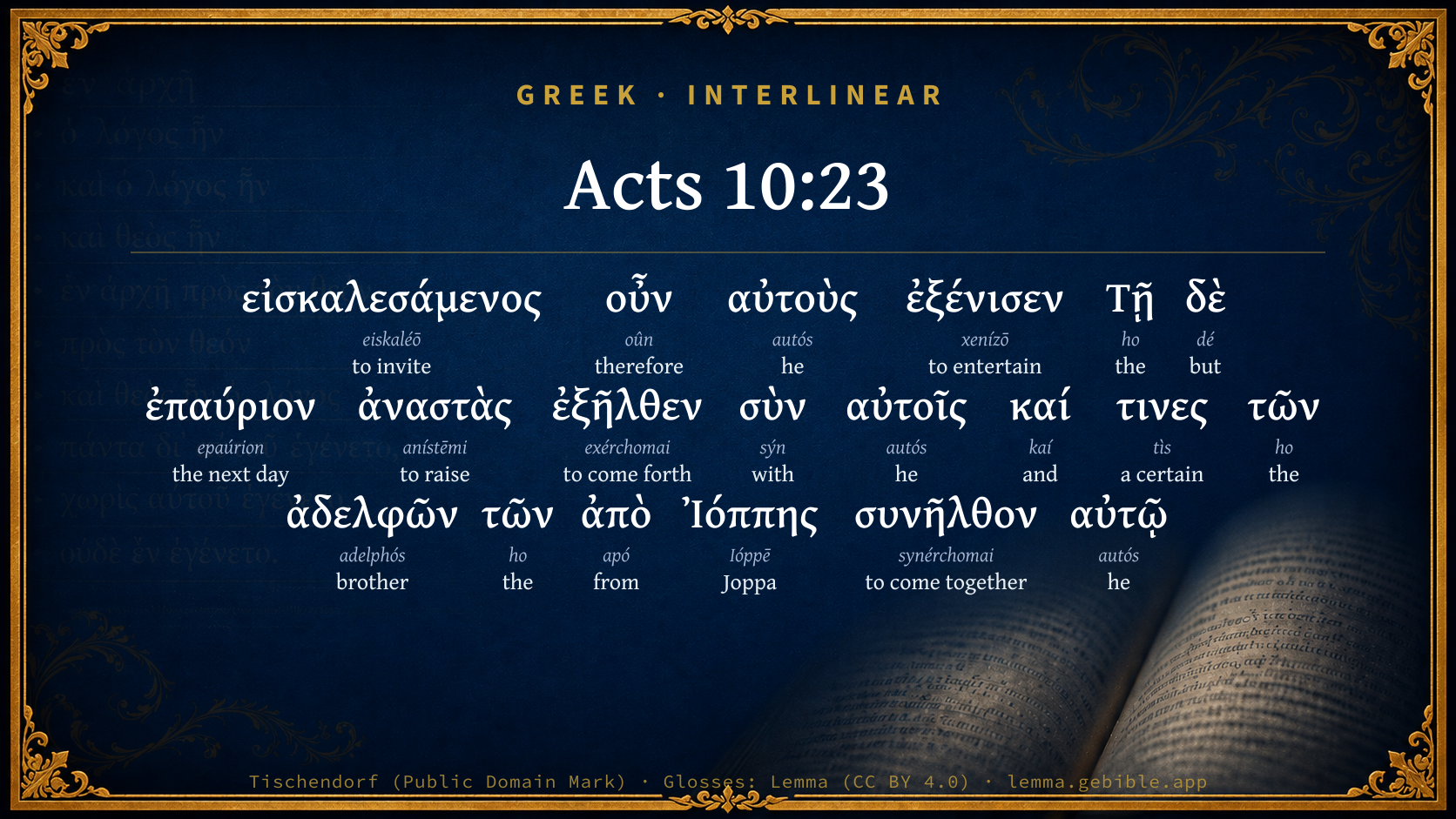
Download image
Cite this verse

Acts 10:23 (World English Bible). Public Domain. Lemma interlinear Bible study tool, https://lemma.gebible.app/v/acts/10/23.

Show BibTeX & RIS
BibTeX
RIS
English Translation
So he called them in and lodged them. On the next day Peter arose and went out with them, and some of the brothers from Joppa accompanied him.
World English Bible · Public Domain
Highlights
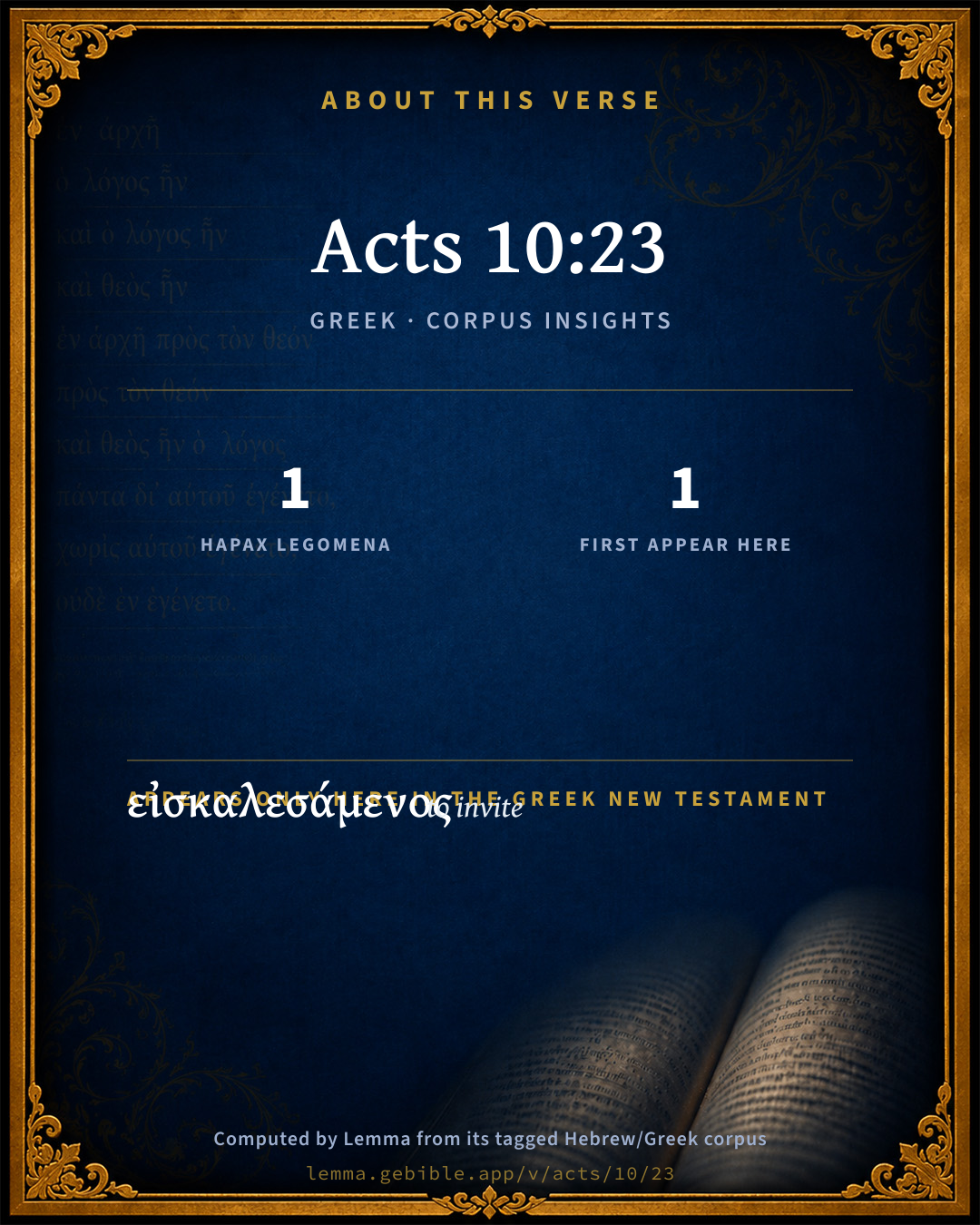
  • 1 hapax legomenon — only here in the Greek New Testament
  • 1 first appearance in the Greek New Testament
Full analysis ↓
Download a study sheet

One document with this verse’s original text, its word-by-word gloss line, the meaning frame, cross-references with their text, attributed commentary, and full source and license credits — printable, and it pastes into notes with its structure intact.

This verse Autodidact and up

Study sheet (.html) Plain text (.txt)

A passage Seminary Student

Up to 50 verses in one chapter. A passage sheet keeps up to 6 commentary sources and 12 cross-references per verse, in the order this page ranks them, and says so on the sheet whenever that leaves anything out. Ask for a single verse and you get the Autodidact verse sheet above.

Everything on this page stays free to read, with no account — the sheet is a download of what is already on screen, not access to it.

Want to remove ads? Support Godless Engineer
Compare translations 3

The same verse in 3 English versions, stacked beneath the original-language interlinear above. Click any original word for its lexicon entry.

Each is an independent rendering of the whole verse — the interlinear is not word-aligned to these translations.

Highlighted words mark where these versions differ — a whole-verse word diff, not a word-by-word alignment.

  • World English Bible Public Domain
    So he called them in and lodged them. On the next day Peter arose and went out with them, and some of the brothers from Joppa accompanied him.
  • King James Version Public Domain
    Then called he them in, and lodged them. And on the morrow Peter went away with them, and certain brethren from Joppa accompanied him.
  • unfoldingWord Literal Text CC BY-SA 4.0
    Therefore, having invited them, he hosted them. And on the next day, arising, he went out with them, and some of the brothers from Joppa accompanied him.

unfoldingWord Literal Text — © unfoldingWord, licensed CC BY-SA 4.0. Word-aligned USFM3 via Door43 (git.door43.org/unfoldingWord/en_ult).

Versions to compare (up to 4)

3 of 4 selected

Show all 19 translations

Every available English version of this verse, each an independent rendering of the whole verse.

  • World English Bible Public Domain
    So he called them in and lodged them. On the next day Peter arose and went out with them, and some of the brothers from Joppa accompanied him.
  • Berean Standard Bible Public Domain
    So Peter invited them in as his guests. And the next day he got ready and went with them, accompanied by some of the brothers from Joppa.
  • Majority Standard Bible Public Domain
    So Peter invited them in as his guests. And the next day he went with them, accompanied by some of the brothers from Joppa.
  • King James Version Public Domain
    Then called he them in, and lodged them. And on the morrow Peter went away with them, and certain brethren from Joppa accompanied him.
  • American Standard Version (1901) Public Domain
    So he called them in and lodged them. And on the morrow he arose and went forth with them, and certain of the brethren from Joppa accompanied him.
  • Revised Version (1885) Public Domain
    So he called them in and lodged them. And on the morrow he arose and went forth with them, and certain of the brethren from Joppa accompanied him.
  • Geneva Bible (1599) Public Domain
    Then called he them in, and lodged them, and the next day, Peter went foorth with them, and certaine brethren from Ioppa accompanied him.
  • Douay-Rheims (1899) Public Domain
    Then bringing them in, he lodged them. And the day following he arose, and went with them: and some of the brethren from Joppe accompanied him.
  • Young's Literal Translation Public Domain
    Having called them in, therefore, he lodged them, and on the morrow Peter went forth with them, and certain of the brethren from Joppa went with him,
  • Literal Standard Version CC BY-SA 4.0
    Having called them in, therefore, he lodged them, and on the next day Peter went forth with them, and certain of the brothers from Joppa went with him,
  • Unlocked Literal Bible CC BY-SA 4.0
    So Peter invited them to come in and stay with him. On the next morning he got up and went with them, and some of the brothers from Joppa accompanied him.
  • unfoldingWord Literal Text CC BY-SA 4.0
    Therefore, having invited them, he hosted them. And on the next day, arising, he went out with them, and some of the brothers from Joppa accompanied him.
  • Darby Bible Public Domain
    Having therefore invited them in, he lodged them. And on the morrow, rising up he went away with them, and certain of the brethren from Joppa went with him.
  • World Messianic Bible Public Domain
    So he called them in and provided a place to stay. On the next day Peter arose and went out with them, and some of the brothers from Joppa accompanied him.
  • Webster's Bible Public Domain
    Then he called them in, and lodged them. And on the morrow Peter went with them, and certain brethren from Joppa accompanied him.
  • Free Bible Version CC BY-SA 4.0
    So he invited them in and they stayed there. The next day he got up and left with them. Some of the brothers from Joppa went with them too.
  • Bible in Basic English Public Domain
    So he took them in for the night. And the day after, he went with them, taking some of the brothers from Joppa with him.
  • Text-Critical English NT CC BY 4.0
    So Peter invited them in and put them up for the night. The next day Peter went with them, and some of the brothers from Joppa accompanied him.
  • Tyndale New Testament (1534) Public Domain
    Then called he them in and lodged them. And on the morowe Peter wet awaye with them and certayne brethren from Ioppa accompanyed hym.

Literal Standard Version (2020), Covenant Press — licensed CC BY-SA 4.0. Text via the HelloAO Bible API (eBible.org). Unlocked Literal Bible (unfoldingWord) — licensed CC BY-SA 4.0. Text via the HelloAO Bible API (eBible.org). unfoldingWord Literal Text — © unfoldingWord, licensed CC BY-SA 4.0. Word-aligned USFM3 via Door43 (git.door43.org/unfoldingWord/en_ult). Free Bible Version, Dr. Jonathan Gallagher — licensed CC BY-SA 4.0. Text via the HelloAO Bible API (eBible.org).

Word by word

More ways to search: Search by grammar → Find every occurrence → Compare this word →

Practice this passage: Drill this verse → Learn its vocabulary →

εἰσκαλεσάμενος
eiskaléō
G1528
“to invite”
Verb, Aorist, Middle deponent, Participle, Nominative, Singular, Masculine
Part of Speech
Verb
Tense
Aorist
Voice
Middle deponent
Mood
Participle
Case
Nominative
Number
Singular
Gender
Masculine
Full Thayer's Definition

Origin: from G1519 and G2564

TDNT: 11:16,4

1. to call into one's self, to invite in to one's house
  1. οὖν oûn G3767 “therefore” Conjunction
  2. αὐτοὺς autós G846 “he” Personal pronoun, Accusative, Plural, Masculine
  3. ἐξένισεν xenízō G3579 “to entertain” Verb, Aorist, Active, Indicative, 3rd person, Singular
  4. Τῇ ho G3588 “the” Article, Dative, Singular, Feminine
  5. δὲ dé G1161 “but” Conjunction
  6. ἐπαύριον epaúrion G1887 “the next day” Adverb
  7. ἀναστὰς anístēmi G450 “to raise” Verb, Aorist, Active, Participle, Nominative, Singular, Masculine
  8. ἐξῆλθεν exérchomai G1831 “to come forth” Verb, Aorist, Active, Indicative, 3rd person, Singular
  9. σὺν sýn G4862 “with” Preposition
  10. αὐτοῖς autós G846 “he” Personal pronoun, Dative, Plural, Masculine
  11. καί kaí G2532 “and” Conjunction
  12. τινες tìs G5100 “a certain” Indefinite pronoun, Nominative, Plural, Masculine
  13. τῶν ho G3588 “the” Article, Genitive, Plural, Masculine
  14. ἀδελφῶν adelphós G80 “brother” Noun, Genitive, Plural, Masculine
  15. τῶν ho G3588 “the” Article, Genitive, Plural, Masculine
  16. ἀπὸ apó G575 “from” Preposition
  17. Ἰόππης Ióppē G2445 “Joppa” Noun, Genitive, Singular, Feminine
  18. συνῆλθον synérchomai G4905 “to come together” Verb, Aorist, Active, Indicative, 3rd person, Plural
  19. αὐτῷ autós G846 “he” Personal pronoun, Dative, Singular, Masculine

About this verse

These counts appear in no published source. They are computed here, from the morphology-tagged text and Lemma’s own curated glosses. What Lemma adds →

20
words
16
distinct lemmas
Acts
section

Notable vocabulary

1 hapax legomenon — a word that appears only here in the entire Greek New Testament:

  • εἰσκαλεσάμενος to invite G1528

First appearance in Scripture

This word makes its first canonical appearance in the Greek New Testament here:

  • εἰσκαλεσάμενος to invite G1528

Shared distinctive vocabulary

ἐξένισεν to entertain G3579 occurs in 10 verses of the Greek New Testament. Also found in:
Repetition

Words recur within this verse:

  • αὐτοὺς he G846 ×3
  • Τῇ the G3588 ×3

Cross-references

13

Topical passages linked to Acts 10:23 in the Treasury of Scripture Knowledge — connected by theme and wording, ordered by reader-vote popularity; previews shown in the World English Bible.

  • Acts 10:45 They of the circumcision who believed were amazed, as many as came with Peter, because the gift of the Holy Spirit was also poured out on the Gentiles.
  • Acts 11:12 The Spirit told me to go with them, without discriminating. These six brothers also accompanied me, and we entered into the man's house.
  • Hebrews 13:2 Don't forget to show hospitality to strangers, for in doing so, some have entertained angels without knowing it.
  • 1 Peter 4:9 Be hospitable one to another without grumbling.
  • Genesis 19:2–3 and he said, "See now, my lords, please turn aside into your servant's house, stay all night, wash your feet, and you will rise up early, and go on your way." They said, "No, but we will stay in the street all night."
  • Genesis 24:31–32 He said, "Come in, you blessed of Yahweh. Why do you stand outside? For I have prepared the house, and room for the camels."
  • Judges 19:19–21 Yet there is both straw and provender for our donkeys; and there is bread and wine also for me, and for your handmaid, and for the young man who is with your servants: there is no want of anything.
  • Ecclesiastes 9:10 Whatever your hand finds to do, do it with your might; for there is no work, nor device, nor knowledge, nor wisdom, in Sheol, where you are going.
  • Acts 9:38 As Lydda was near Joppa, the disciples, hearing that Peter was there, sent two men to him, imploring him not to delay in coming to them.
  • Acts 9:42 And it became known throughout all Joppa, and many believed in the Lord.
  • Acts 10:29 Therefore also I came without complaint when I was sent for. I ask therefore, why did you send for me?"
  • Acts 10:33 Therefore I sent to you at once, and it was good of you to come. Now therefore we are all here present in the sight of God to hear all things that have been commanded you by God."
  • 2 Corinthians 8:21 Having regard for honorable things, not only in the sight of the Lord, but also in the sight of men.

Cross-references courtesy of OpenBible.info (CC BY 4.0).

Where the printed editions differ

2 variants

Places in this verse where the major printed Greek editions disagree on the wording in a way that affects the translation — a comparison of editions, not a manuscript-by-manuscript collation. The editions are the modern critical texts (Nestlé-Aland 28/27, SBL, Westcott-Hort, Tregelles, Tyndale House) and the traditional texts behind the KJV (the Textus Receptus and the Byzantine/Majority text). It is not a claim about which reading is original.

  1. Extra text
    ἀναστὰς

    “having risen up”

    In NA28NA27TynSBLWHTreg Not in TRByz

    ἀναστὰς (anastas) 'having risen up' is only in older manuscripts (NA28+NA27+Tyn+SBL+WH+Treg)

  2. Extra text
    Πέτρος

    “Peter”

    In TRByz Not in NA28NA27TynSBLWHTreg

    Πέτρος (Petros) 'Peter' is only in traditional manuscripts (TR+Byz)

Textual data: Translators Amalgamated Greek New Testament (STEPBible TAGNT) · CC BY 4.0.

Commentary

Notes on Acts 10:23 from classic Christian and Jewish commentators (each source and its license shown beneath its notes). The classic Christian expositions comment on the surrounding passage and are grouped to its opening verse, so a note may address several verses; the Jewish commentaries on the Tanakh (Rashi and others) are per-verse, so they appear only where the commentator wrote on this verse.

Lemma curates 59 commentaries, every one of them public domain or Creative Commons licensed, each selected and text-cleaned for this edition rather than reprinted as found. About our sources →

Albert Barnes' Notes on the Bible

And lodged them - They remained with him through the night. Four days were occupied before Peter met Cornelius at Caesarea. On the first the angel appeared to Cornelius. On the second the messengers arrived at Joppa, Act 10:9. On the third, Peter returned with them, Act 10:23; and on the fourth they arrived at Caesarea, Act 10:24, Act 10:30.

And certain brethren - Some Christians. They were six in number, Act 11:12. It was usual for the early Christians to accompany the apostles in their journeys. See Rom 15:24; Act 15:3; 3Jo 1:6; 1Co 16:6, 1Co 16:11. As this was an important event in the history of the church - the bearing of the gospel to a Gentile - it was more natural and proper that Peter should be attended with others.

Albert Barnes' Notes on the Bible (1834–1885) — public domain. Text from a community e-Sword/MySword module.

Joseph Benson's Commentary

Act 10:23-24. Then called he them in, and lodged them — Or, hospitably entertained them that night. He did not bid them go to an inn, and refresh or repose themselves at their own charge, but was himself at the charge of entertaining them at his own quarters. He lodged them, though they were Gentiles, to show how readily he complied with the design of the vision, in eating with Gentiles. And, though they were two of them servants, and the other a common soldier, yet Peter thought it not below him to take them into his house. And on the morrow went away with them — Not delaying to obey the heavenly vision. And certain brethren — Namely, six in number, Act 11:12; accompanied him — Being probably desired by the apostle to go with him, that they might be witnesses of what happened, as this was an affair in which some difficulties might arise, and some censure be incurred from the Jewish converts, and such as were not apprized of his divine direction. How pleasing a mixture have we here, of prudence and humility! Sufficient to “teach us, on all proper occasions, to express at once a becoming deference to our brethren, and prudent caution in our own best intended actions; that even our good may not be evil spoken of, when it lies in our power to prevent it.” See Doddridge, and Rom 14:16. And on the morrow after they entered into Cesarea — Though it is probable they travelled on foot, yet as Joppa was only about fifteen leagues distant from Cesarea, they might easily arrive there the day after that on which they set out. And Cornelius waited for them — Not engaging himself in any secular business during that solemn time, but being altogether intent on this thing. And he called together his kinsmen — His relations; and near friends — Those with whom he was most intimate, and had the greatest love to. This, he thought, he could not better express, than by giving them an opportunity to hear the word of life, and to gain instruction for their souls. And, probably, those here spoken of were accounted near friends by Cornelius; because they were such as had forsaken all pagan idolatry, and were, with him, worshippers of the true and living God.

Joseph Benson's Commentary on the Old and New Testaments (1811–1818) — public domain. Text from a community e-Sword module.

Bengel's Gnomon

Johann Albrecht Bengel

Act 10:23. Εἰσκαλεσάμενος, having called them in) Peter had not moved a step (gone forth) from his house.—ἐξένισε, entertained them as guests) not distrusting them as strangers: not disdaining them as Gentiles. At first the Gentiles came to the Jews: afterwards these latter to the former.—τῇ δὲ ἐπαύριον, but on the morrow) In the case of a matter, however good, there is not always required urgent haste.—τινὲς, some) six; ch. Act 11:12. They were not divinely ordered to go; and yet it was with a pious feeling they did so. Many things are often left to the free discretion of the godly; in which, however, they are governed (guided) by the secret hand of GOD. Afterwards it became evident, how advantageous it was, that so many witnesses were present: ch. Act 11:12.[62]—ΣΥΝῆΛΘΟΝ, went with) A holy company, consisting of ten men of various ranks.

[62] They enabled him to meet the charge of those of the circumcision, ch. Act 11:2—E. and T.

Bengel's Gnomon of the New Testament — English translation (T&T Clark, Edinburgh, 1860) — public domain. Text from a community e-Sword module.

Expositor's Greek Testament

ed. W. Robertson Nicoll

Act 10:23 . εἰσκ .: only used here in N.T., so μετακ . in Act 10:32 ; both verbs are also frequent in medical writers, as Hobart urges, but both are found in classical Greek, and the latter three times in LXX, although the former not at all. ἐξένισε , recepit hospitio , Vulgate, cf. Heb 13:2 , and Westcott, l.c. ; verb used six times in Acts in this sense, but nowhere else in N.T.; cf. Sir 29:25 . In this Christian hospitality to Gentile strangers Peter had taken another step towards understanding what the will of the Lord was. τινες τῶν ἀδελφῶν = Act 11:12 .

The Expositor's Greek Testament, edited by W. Robertson Nicoll (1897–1910) — public domain. Text from a community e-Sword module.

Jamieson, Fausset & Brown

Robert Jamieson, A. R. Fausset & David Brown

called them in and lodged them--thus partially anticipating this fellowship with Gentiles.

Peter went . . . with them, and certain brethren--six in number (Act 11:12).

from Joppa--as witnesses of a transaction which Peter was prepared to believe pregnant with great consequences.

Jamieson, Fausset & Brown — Commentary Critical and Explanatory on the Whole Bible (1871) — public domain (CC PDM 1.0). Text via the HelloAO Bible API.

Adam Clarke's Commentary

Verse 23. Then called he them in, c.] They had already walked a long journey in a short time, and needed refreshment and it was thought expedient they should rest that night with Simon the tanner.

Certain brethren from Joppa] They were six in number, as we learn from Ac 11:12. It was necessary that there should be several witnesses of the important transactions which were about to take place; as on no slight evidence would even the converted Jews believe that repentance unto life, and the Holy Spirit, should be granted to the Gentiles.

Adam Clarke's Commentary on the Bible (1810–1826) — public domain. Text from a community e-Sword/MySword module.

John Calvin's Commentaries

23. And Peter also, being overcome with the authority of God, deliberateth no longer, but lodgeth the men, that he may go with them forthwith. So we must meekly submit ourselves to God; and there remaineth nothing after that we know his will, but that we run speedily thither whither he calleth us. There is no difficulty in the rest.

John Calvin's Commentaries (1540-1563) — public domain. Text from the Calvin Translation Society English edition (1840s-50s) via the Christian Classics Ethereal Library (ccel.org). Calvin's coverage is partial (roughly two-thirds of the Bible); uncommented books and verses are honest gaps, never fabricated. The 19th-century editor's footnotes and remarks are omitted so the notes are faithfully Calvin's own voice.

Ellicott's Commentary for English Readers

(23) Then called he them in.—As it was about noon when Peter went up to the house-top to pray, the arrival of the messengers, allowing an adequate interval for the trance and the vision, may be placed at some time in the afternoon.

Certain brethren from Joppa.—We learn from Act_11:12, that they were six in number. They were obviously taken that “in the mouth of two or three witnesses every word might be established” (Deu_17:6; Deu_19:15), that they might report to the Church at Joppa what had been done by the Apostle whom they had learnt to reverence.

A Bible Commentary for English Readers, edited by Charles John Ellicott (1878–1897) — public domain. Text from a community e-Sword module.

The Cambridge Bible for Schools and Colleges

gen. ed. J. J. S. Perowne

23. Then called he them in, and lodged them] This was the first step towards laying aside the scruples to which the Jews were so much attached.

And on the morrow Peter went away with them] The best texts read “And on the morrow he arose and went forth with them.”

and certain brethren from Joppa accompanied him] In Act_11:12 we are told they were six in number, and in Act_10:45 of this chapter they are called “they of the circumcision which believed.” So these men were Jews, and Peter took them for his companions that he might, if need were, afterwards appeal to them for testimony of what was done, and to explain why he had acted as he did. No doubt they were informed by him of the message which the servants of Cornelius had brought, and the good repute of this devout man would weigh with them and make them ready to go.

The Cambridge Bible for Schools and Colleges (gen. ed. J. J. S. Perowne; Cambridge University Press, 1878–1918) — public domain. Text from a community e-Sword module.

John Gill's Exposition

Then called he them in,.... Into Simon's house; not "into his own house", as the Ethiopic version adds; as yet they stood without, before the gate of the house; he took them in, no doubt, with the leave of Simon, his host, and set provisions before them, and lodged them that night:

and in the morning Peter went away with them; the next morning he set out with them towards Caesarea:

and certain brethren from Joppa accompanied him; there were six of them, as appears from Act 11:12 these went with him, not only to bear him company, and out of respect to him; but to be witnesses of what might be seen, heard, said, or done, and for Peter, should there be any occasion for it, as there afterwards was.

John Gill's Exposition of the Whole Bible (1746–1763) — public domain (CC PDM 1.0). Text via the HelloAO Bible API.

Trapp's Complete Commentary

John Trapp

23 Then called he them in, and lodged them. And on the morrow Peter went away with them, and certain brethren from Joppa accompanied him.

Ver. 23. Certain brethren from Joppa] Who were well paid for their courteous pains, when (for confirmation of their faith) they beheld the kingdom of Christ propagated and preached to the Gentiles also.

John Trapp, A Commentary or Exposition upon All the Books of the Old and New Testament (1647–1656) — public domain. Text from a community e-Sword module.

Matthew Poole's English Annotations

And on the morrow Peter went away with them; he delays not to obey the heavenly vision; but as Abraham took his journey the very next morning after that he had received the command, Gen 22:3, so did Peter here, and bis dat qui cito dat, he doubles his obedience that obeys speedily and cheerfully.

And certain brethren from Joppa accompanied him; these brethren were six in number, as Act 11:12; who might undertake this journey,

1. Out of respect to Peter, to accompany him.

2. Being moved at the extraordinary visions that were spoken of. But especially:

3. Disposed by the providence of God to accompany St. Peter, that they might testify the grace of God that was come unto the Gentiles, when it might be afterwards questioned.

Matthew Poole's English Annotations on the Holy Bible (1683–1685) — public domain. Text from a community e-Sword/MySword module.

Whedon's Commentary on the Bible

Daniel D. Whedon

23. Certain brethren—Six in number, (Act_11:12,) for the purpose doubtless of being witnesses to testify and defend, if Peter were arraigned for being too free with Gentiles.

Daniel D. Whedon (gen. ed.), Commentary on the Old and New Testaments (1874–1909) — public domain. Text from a community e-Sword module.

The Pulpit Commentary

So he called for then called he, A.V.; he arose and went forth for Paler went away, A.V. and T.R.; certain of the brethren for certain brethren, A.V. And lodged them is rather a feeble rendering of ejxenisen. The same word is rendered entertained in Heb_13:2, which is nearer the sense; "to entertain as a guest." The word carries with it that he showed them hospitality, and thus broke down the wall of partition between him and them. "He gave them friendly treatment, and made them at home with him" (Chrysostom) (For xenizomai, see ver. 32.) He arose and went forth. This was on the morrow of their arrival. It was two days" journey from Caesarea to Joppa, and two days" journey back again, the distance being thirty miles. They would probably stop the night at Apollonia, which was half-way, on the coast road. Certain of the brethren. The ready missionary spirit of the first disciples is here apparent. (Act_20:4)

Vers. 23-34. Peter and Cornelius.

I THE RECEPTION OF THE CHRISTIAN APOSTLE BY THE GENTILE CONVERT. Here were Jew, Gentile, and Christian visibly brought into juncture and unity in the persons of these two men.

1. The Roman officer gives a noble reception to Peter, at once a true Jew and a true Christian, by calling together his kindred and friends. He desires that others may partake of spiritual gifts and blessings a true mark of love. We become poor by giving earthly goods away; rich by imparting of those that are spiritual. Perhaps there is commonly too much reserve in such relations. We assume reluctance where we might meet with a ready response on the part of friends to such invitations.

2. Cornelius feels deep reverence for the person of the apostle; fell at his feet on his entrance, to do him homage. The Romans were an intensely religious people in their way. They recognized the numen, or Divine power, in all the great objects of the creation. It was a profound mystical instinct, needing only proper direction.

II THE CHRISTIAN APOSTLE"S DEMEANOUR TOWARDS THE GENTILE CONVERT. "Rise! I also am a man." "Depart from me; for I am a sinful man, O Lord!" had been his confession to Jesus; and on this he had been appointed fisher of men. Perhaps he remembers that incident now, and, in view of the respect and preparations of Cornelius, repeats, "I am also a man." "Cornelius does too much in his reverence towards a living and genuine saint; then how can prayer to the images of saints be justified?" No true successor of Peter is he, nor has he Peter"s humble mind, who suffers his feet to be kissed. The worship of the instrument obscures the honor of the Divine Agent. The word of Peter rebukes, not only the worship of saints, but all excessive hero-reverence and worship paid to great men in the Church.

III THE CONNECTION OF EVENTS EXPLAINED.

1. There was a great prejudice to be overcome. (Ver. 28.) The prejudice of the Jew against intercourse with the stranger. No barrier in nature, no mountain to be crossed or traveled, river to be forded, waste to be reclaimed, is comparable to the obstinacy and difficulty of prejudice, most of all of religious prejudice. And where in all the pages of history do we find a prejudice equal in strength to that of the Jew against the Gentile?

2. The Divine victory over prejudice. God had shown that "no man is to be called common or unclean. " Immense word! Not yet has its meaning been exhausted; not yet, perhaps, begun to be truly unfolded. How profound the strength and the comfort which flows from such a clear word of God? For the preacher, teacher, missionary, every kind of worker for anthropic good, it is a clear light, a clue to hand and heart alike. The ideal human nature is pure and beautiful, for God made it whatever actual human nature in the individual may be. "Tis this thought gives inspiration. Peter will not hesitate to come to the Gentile"s house when he is filled with it; and we may face the facts of the life of the nations, as they are now being so abundantly unfolded to us by scientific inquiry, with intelligent interest and cheerful hope, with the light of the gospel resting broadly over the whole field of inquiry. Such is the impulse which has brought Peter hither. But why have they sent for him? The answer will disclose:

3. Further coincidences. Cornelius now relates his vision. He, too, had been praying and seeking. To him, too, an apocalypse had been given; and the Divine finger had pointed Jew-wards, as to Peter it had pointed Gentile-wards. Equally Divine is the call; with equal promptness obeyed. Cornelius has sent, Peter has done well to come. Happy meeting, divinely brought about, and pregnant with Divine consequences! Such a series of events indicates God"s hand, prepares the mind to listen to God"s voice.

The inarticulate voice of events is his voice, and it prepares us to listen to that which is clear and definite. J.

Vers. 23-43. The first trumpet-sound of the gospel in the heathen world.

I A REPRESENTATIVE ASSEMBLY.

1. Cornelius, his kinsmen, his near friends, probably some of them devout soldiers.

2. Peter, his brethren from Joppa. The different states of mind. Inquiry after truth, perplexity as to duty. The helplessness of the heathen world well set forth in Cornelius"s salutation. The sense of darkness and spiritual want a temptation to worship men instead of God. The false Church accepts such worship. The true says, "Stand Up! I myself also am a man.

II THE LIGHT OF GOD the only true light in which differences are removed and blessings are recognized. Peter brings into that light his Jewish prejudice, and it vanishes. Cornelius brings into it his desire for knowledge and equality with all God"s children, and it is abundantly satisfied. So in the controversies of men, let them meet together "in the sight of God," and to hear his voice, and all will be well.

III THE TRUMPET-SOUNDS awaking the Gentile world.

1. The personal Redeemer.

2. The witnessing Church.

3. The universal invitation. The true evangel the true liberty, equality, and fraternity. The Holy Spirit spake by Peter"s mouth. R.

The Pulpit Commentary (1880–1919), ed. H.D.M. Spence-Jones & Joseph S. Exell — public domain. Text from a community e-Sword module.

Kretzmann's Popular Commentary

Paul E. Kretzmann

The meeting of Peter and Cornelius:

v. 23. And on the morrow Peter went away with them, and certain brethren from Joppa accompanied him.

v. 24. And the morrow after they entered in to Caesarea. And Cornelius waited for them, and had called together his kinsmen and near friends.

v. 25. And as Peter was coming in, Cornelius met him, and fell down at his feet, and worshiped him.

v. 26. But Peter took him up, saying, Stand up; I myself also am a man.

v. 27. And as he talked with him, he went in and found many that were come together.

v. 28. And he said unto’ them, Ye know how that it is an unlawful thing for a man that is a Jew to keep company, or come unto one of another nation; but God hath showed me that I should not call any man common or unclean.

v. 29. Therefore came I unto you without gainsaying, as soon as I was sent for. I ask therefore for what intent ye have sent for me.

It was not possible for Peter to leave Joppa at once, principally because he wanted some of the brethren from Joppa to accompany him on this trip. But the next morning the messengers set out with Peter, and some of the members of the congregation at Joppa went with them. Since they did not travel quite so fast as the servants with the soldier had in coming down, they were on the road all day and did not reach Caesarea until the next morning. But Cornelius, versed in military matters, had figured out with considerable exactness when be might look for them. He was confidently expecting them on that morning, and had therefore called together his relatives and his intimate friends, such upon whose discretion he could depend, and who were probably of a like mind with him concerning the worship of the true God. The state of mind in which Cornelius found himself on this morning may be pictured from his behavior when Peter finally entered his house. Acting upon the idea, no doubt, that the servant and messenger of the Lord, whose very coming was directed by an angel, must be worthy of extraordinary relevance, he advanced to meet Peter and fell down at his feet to worship him, to honor God in him. But Peter wanted nothing of such worship. He lifted Cornelius to his feet, gently chiding him meanwhile, by bidding him get up, since he himself was only a man. Note: This plain statement of Peter ought to discourage every idea of saint worship; for if he refuses to accept such adoration while he could hear the prayers that might be directed to him, how much more must it be considered foolish and harmful to address prayers to him now that he is removed from the presence of the Christian congregation! Immediately after this greeting the two men started a conversation and, while they were conversing together, entered into the inner room, the atrium, where Peter found many people assembled, all waiting, in interested expectation, for the words which Peter was to speak to them. The apostle first of all addressed a few words to the assembly to make the situation clear; for they were very well aware how "unlawful," how much at variance with the Law as understood by the Jews, his behavior must be, since he, a Jew, was here coming to, and intermingling with, Gentiles, people of a foreign race, in any way becoming intimate with them. Note the tact of Peter in using the word "of foreign race" instead of the harsher "heathen. " There was no express prohibition of such behavior by Moses, but the traditions of the rabbis carried the principle of separation to such an extreme. But Peter here declares, not only that God had told him, but that He had distinctly and unmistakably shown him, that he should not speak of nor call any person common and unclean. The men present in the house of Cornelius may not have been members of the Jewish Church by virtue of circumcision, but they belonged to the people for whose sake the Messiah had come, and were therefore entitled to the preaching of the Gospel. Knowing this, Peter had come to them without contradiction or resistance, in simple obedience to the word of the Lord, when they had’ sent for him. And now his question was for what purpose they had sent for him, what object they had in making him travel this distance and appear before them.

Paul E. Kretzmann, Popular Commentary of the Bible (1921–1924) — public domain. Text from a community e-Sword module.

McGarvey & Pendleton's Commentaries

J. W. McGarvey

23. As the Spirit had directed, he does not hesitate as to the line of duty, but at once announces to the messengers that the journey shall begin to-morrow. (23) " Then, calling them in, he lodged them; and on the next day Peter went out with them, and certain brethren from Joppa went with him. " It was a wise precaution that he took other brethren with him, so that the whole of this new movement might be properly attested by competent and disinterested witnesses.

J. W. McGarvey (with Philip Y. Pendleton), Commentaries on the New Testament (The Fourfold Gospel, 1914; Acts; and the epistles) — public domain. Text from a community e-Sword/MySword module.

Cambridge Greek Testament for Schools and Colleges

23. ἀναστὰς for ὁ Πέτρος with אABD. Vulg. ‘surgens.’

23. εἰσκαλεσάμενος οὖν αὐτοὺς ἐξένισεν, then he called them in and lodged them. This was the first step towards laying aside the scruples to which the Jews were so much attached.

τῇ δὲ ἐπαύριον ἀναστὰς ἐξῆλθεν σὺν αὐτοῖς, and on the morrow he arose and went forth with them. They would start in the early part of the day to get through as much of their way as they could on the first day.

καί τινες τῶν ἀδελφῶν κ.τ.λ., and certain of the brethren from Joppa accompanied him. In Act 11:12 we are told that there were six of them, and in Act 10:45 of this chapter they are called οἱ ἐκ περιτομῆς πιστοί. So these men were Jewish Christians, and Peter took them for his companions that he might, if need were, afterwards appeal to them for testimony of what had been done, and to explain why he had acted as he did. No doubt they were informed by him of the message which the servants of Cornelius had brought, and the good repute of this devout man would weigh with them and make them ready to go.

Cambridge Greek Testament for Schools and Colleges (Cambridge University Press, 1896; 21 vols, various authors incl. Carr, Maclear, Plummer, Farrar, Lumby, Moule, M. R. James, Simcox) — public domain. Text from a community e-Sword module.

Alford’s Greek Testament

Henry Alford

23. ἐξένισεν] This was his first consorting with men uncircumcised and eating with them (ch. 11:3): though perhaps this latter is not necessarily implied.

τινες τῶν ἀδ.] Six, ch. 11:12: in expectation of some weighty event to which hereafter their testimony might be required, as indeed it was, ib.

Henry Alford, The Greek Testament (1849–1861) — public domain. Text from a community e-Sword module.

Lesson kit

Teaching starters — assembled from the data on this page, not authored interpretation. Every prompt links to the verse data it draws on. Edit before teaching.

Acts, in the Acts, opens this verse with 20 words (16 distinct Greek lemmas). Its most distinctive word is eiskaléō (“to invite”). A historical commentator’s framing appears above. Read the whole chapter for the surrounding context.

Discussion questions

  1. What does “to invite” (eiskaléō) contribute to the verse as a whole?
  2. 1 word here appears nowhere else in the Greek New Testament. Why might the author reach for such rare wording?
  3. This is the first place “to invite” appears in Scripture (first appears here). What does its debut here establish?
  4. How does Acts 10:6, which shares the word «to entertain», read alongside this verse?
  5. What does the repetition of “he” (3× in this one verse) do in this verse?
  6. These translations render this verse differently; the difference is in the English rendering, not the original. What questions does that raise?
  7. Compare how Albert Barnes' Notes on the Bible and Joseph Benson's Commentary read this verse. Where do they agree or differ?

Things to notice

  • 1 word in this verse appears nowhere else in the Greek New Testament.
  • 1 word makes its first canonical appearance in Scripture here.
  • These translations choose different wording for 18 words in this verse.
  • “he” occurs 3× in this single verse.
  • 16 distinct Greek lemmas span 20 words in this verse.

Reading settings

Reading text

Shown beneath each verse's original-language words.

Old Testament
Old Testament edition

Read the OT as the Masoretic Hebrew (MT) or the Greek Septuagint (LXX).

English shown for the Greek Septuagint (in the Hebrew ↔ Greek comparison).

Comparing translations? Open the Compare panel on any verse page to stack up to four side by side.