
Romans 16:23

Greek (Tischendorf 8th ed.) Romans 16:23 appears in the Greek New Testament. The text above is from the Tischendorf 8th edition. Each word links to its Strong’s number and a concise gloss. Click any word for its full Thayer’s Greek Lexicon entry.
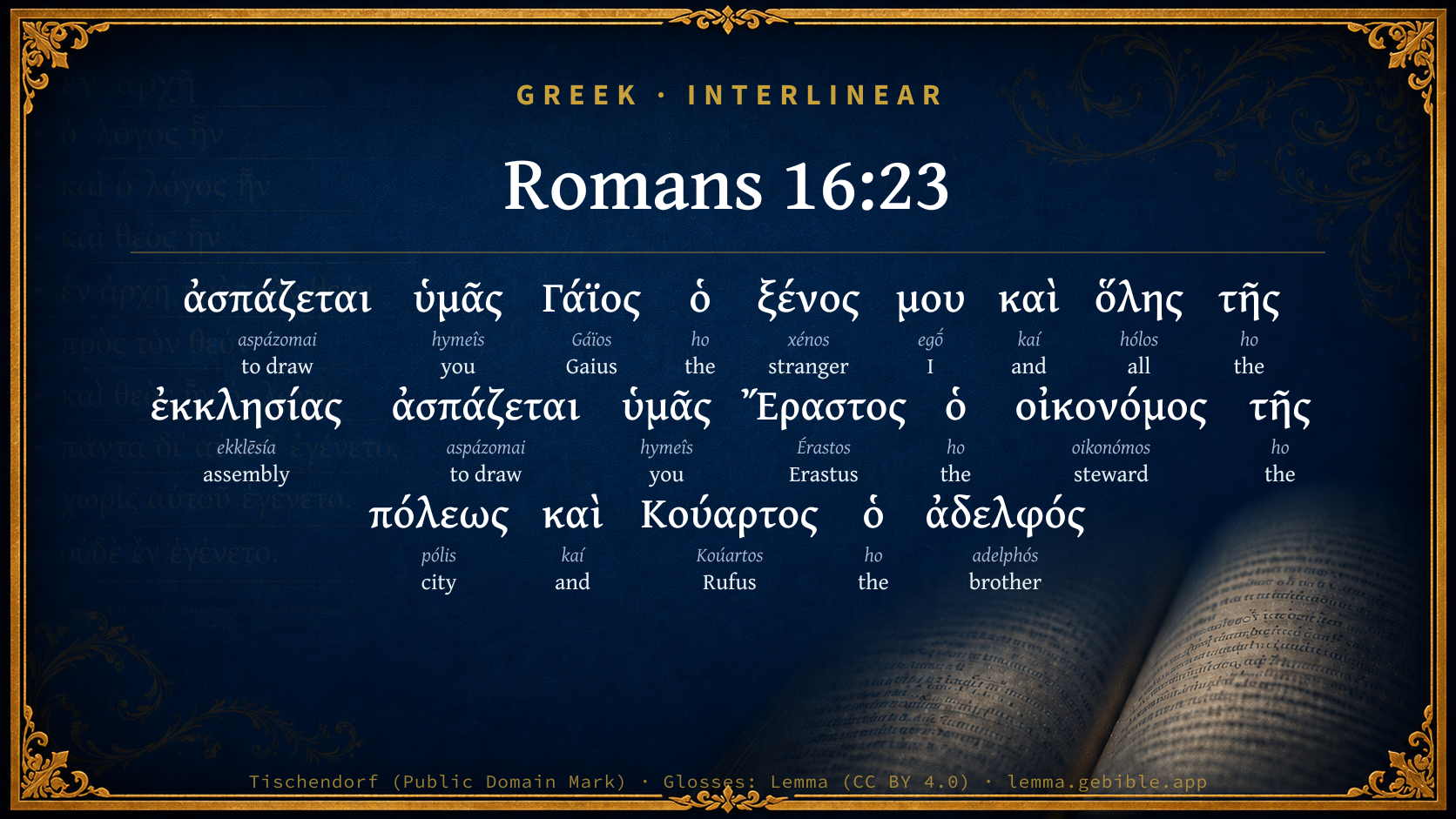
Download image
Cite this verse

Romans 16:23 (World English Bible). Public Domain. Lemma interlinear Bible study tool, https://lemma.gebible.app/v/romans/16/23.

Show BibTeX & RIS
BibTeX
RIS
English Translation
Gaius, my host and host of the whole assembly, greets you. Erastus, the treasurer of the city, greets you, as does Quartus, the brother.
World English Bible · Public Domain
Highlights
  • 1 hapax legomenon — only here in the Greek New Testament
  • 1 first appearance in the Greek New Testament
Full analysis ↓
Download a study sheet

One document with this verse’s original text, its word-by-word gloss line, the meaning frame, cross-references with their text, attributed commentary, and full source and license credits — printable, and it pastes into notes with its structure intact.

This verse Autodidact and up

Study sheet (.html) Plain text (.txt)

A passage Seminary Student

Up to 50 verses in one chapter. A passage sheet keeps up to 6 commentary sources and 12 cross-references per verse, in the order this page ranks them, and says so on the sheet whenever that leaves anything out. Ask for a single verse and you get the Autodidact verse sheet above.

Everything on this page stays free to read, with no account — the sheet is a download of what is already on screen, not access to it.

Want to remove ads? Support Godless Engineer
Compare translations 3

The same verse in 3 English versions, stacked beneath the original-language interlinear above. Click any original word for its lexicon entry.

Each is an independent rendering of the whole verse — the interlinear is not word-aligned to these translations.

Highlighted words mark where these versions differ — a whole-verse word diff, not a word-by-word alignment.

  • World English Bible Public Domain
    Gaius, my host and host of the whole assembly, greets you. Erastus, the treasurer of the city, greets you, as does Quartus, the brother.
  • King James Version Public Domain
    Gaius mine host, and of the whole church, saluteth you. Erastus the chamberlain of the city saluteth you, and Quartus a brother.
  • unfoldingWord Literal Text CC BY-SA 4.0
    Gaius, the host for me and for the whole church, greets you. Erastus, the steward of the city, greets you, and Quartus the brother.

unfoldingWord Literal Text — © unfoldingWord, licensed CC BY-SA 4.0. Word-aligned USFM3 via Door43 (git.door43.org/unfoldingWord/en_ult).

Versions to compare (up to 4)

3 of 4 selected

Show all 19 translations

Every available English version of this verse, each an independent rendering of the whole verse.

  • World English Bible Public Domain
    Gaius, my host and host of the whole assembly, greets you. Erastus, the treasurer of the city, greets you, as does Quartus, the brother.
  • Berean Standard Bible Public Domain
    Gaius, who has hosted me and all the church, sends you greetings. Erastus, the city treasurer, sends you greetings, as does our brother Quartus.
  • Majority Standard Bible Public Domain
    Gaius, who has hosted me and all the church, sends you greetings. Erastus, the city treasurer, sends you greetings, as does our brother Quartus.
  • King James Version Public Domain
    Gaius mine host, and of the whole church, saluteth you. Erastus the chamberlain of the city saluteth you, and Quartus a brother.
  • American Standard Version (1901) Public Domain
    Gaius my host, and of the whole church, saluteth you. Erastus the treasurer of the city saluteth you, and Quartus the brother.
  • Revised Version (1885) Public Domain
    Gaius my host, and of the whole church, saluteth you. Erastus the treasurer of the city saluteth you, and Quartus the brother.
  • Geneva Bible (1599) Public Domain
    Gains mine hoste, and of the whole Church saluteth you. Erastus the steward of the citie saluteth you, and Quartus a brother.
  • Douay-Rheims (1899) Public Domain
    Caius, my host, and the whole church, saluteth you. Erastus, the treasurer of the city, saluteth you, and Quartus, a brother.
  • Young's Literal Translation Public Domain
    salute you doth Gaius, my host, and of the whole assembly; salute you doth Erastus, the steward of the city, and Quartus the brother,
  • Literal Standard Version CC BY-SA 4.0
    Gaius greets you, my host, and of the whole Assembly; Erastus greets you, the steward of the city, and Quartus the brother.
  • Unlocked Literal Bible CC BY-SA 4.0
    Gaius, the host for me and for the whole church, greets you. Erastus, the treasurer of the city, greets you, with Quartus the brother.
  • unfoldingWord Literal Text CC BY-SA 4.0
    Gaius, the host for me and for the whole church, greets you. Erastus, the steward of the city, greets you, and Quartus the brother.
  • Darby Bible Public Domain
    Gaius, my host and of the whole assembly, salutes you. Erastus, the steward of the city, salutes you, and the brother Quartus.
  • World Messianic Bible Public Domain
    Gaius, my host and host of the whole assembly, greets you. Erastus, the treasurer of the city, greets you, as does Quartus, the brother.
  • Webster's Bible Public Domain
    Gaius my host, and of the whole church, saluteth you. Erastus the chamberlain of the city saluteth you, and Quartus a brother.
  • Free Bible Version CC BY-SA 4.0
    My host Gaius, and the whole church here, send you greetings. Erastus the city treasurer, sends his best wishes, as does our fellow-believer Quartus.
  • Bible in Basic English Public Domain
    Gaius, with whom I am living, whose house is open to all the church, sends his love, so does Erastus, the manager of the accounts of the town, and Quartus, the brother.
  • Text-Critical English NT CC BY 4.0
    Gaius, who is host to me and to the whole church, greets you. Erastus, the treasurer of the city, greets you, and so does Quartus, our brother.
  • Tyndale New Testament (1534) Public Domain
    Gaius myne hoste and the hoste of all the congregacions saluteth you. Erastus the chamberlayne of the cite saluteth you. And Quartus a brother saluteth you.

Literal Standard Version (2020), Covenant Press — licensed CC BY-SA 4.0. Text via the HelloAO Bible API (eBible.org). Unlocked Literal Bible (unfoldingWord) — licensed CC BY-SA 4.0. Text via the HelloAO Bible API (eBible.org). unfoldingWord Literal Text — © unfoldingWord, licensed CC BY-SA 4.0. Word-aligned USFM3 via Door43 (git.door43.org/unfoldingWord/en_ult). Free Bible Version, Dr. Jonathan Gallagher — licensed CC BY-SA 4.0. Text via the HelloAO Bible API (eBible.org).

Word by word

More ways to search: Search by grammar → Find every occurrence → Compare this word →

Practice this passage: Drill this verse → Learn its vocabulary →

Κούαρτος
Koúartos
G2890
“Rufus”
Noun, Nominative, Singular, Masculine
Part of Speech
Noun
Case
Nominative
Number
Singular
Gender
Masculine
Full Thayer's Definition

Origin: of Latin origin (fourth)

TDNT: None

Quartus = "fourth" 1. a Roman; probably before he lived at Rome, and therefore sends his salutations to the Christians there: he is mentioned among the seventy disciples, and said to be bishop of Berytus. (Gill)
  1. ἀσπάζεται aspázomai G782 “to draw” Verb, Present, Middle or Passive deponent, Indicative, 3rd person, Singular
  2. ὑμᾶς hymeîs G5210 “you” Personal pronoun, 2nd person, Accusative, Plural
  3. Γάϊος Gáïos G1050 “Gaius” Noun, Nominative, Singular, Masculine
  4. ὁ ho G3588 “the” Article, Nominative, Singular, Masculine
  5. ξένος xénos G3581 “stranger” Adjective, Nominative, Singular, Masculine
  6. μου egṓ G1473 “I” Personal pronoun, 1st person, Genitive, Singular
  7. καὶ kaí G2532 “and” Conjunction
  8. ὅλης hólos G3650 “all” Adjective, Genitive, Singular, Feminine
  9. τῆς ho G3588 “the” Article, Genitive, Singular, Feminine
  10. ἐκκλησίας ekklēsía G1577 “assembly” Noun, Genitive, Singular, Feminine
  11. ἀσπάζεται aspázomai G782 “to draw” Verb, Present, Middle or Passive deponent, Indicative, 3rd person, Singular
  12. ὑμᾶς hymeîs G5210 “you” Personal pronoun, 2nd person, Accusative, Plural
  13. Ἔραστος Érastos G2037 “Erastus” Noun, Nominative, Singular, Masculine
  14. ὁ ho G3588 “the” Article, Nominative, Singular, Masculine
  15. οἰκονόμος oikonómos G3623 “steward” Noun, Nominative, Singular, Masculine
  16. τῆς ho G3588 “the” Article, Genitive, Singular, Feminine
  17. πόλεως pólis G4172 “city” Noun, Genitive, Singular, Feminine
  18. καὶ kaí G2532 “and” Conjunction
  19. ὁ ho G3588 “the” Article, Nominative, Singular, Masculine
  20. ἀδελφός adelphós G80 “brother” Noun, Nominative, Singular, Masculine

About this verse

These counts appear in no published source. They are computed here, from the morphology-tagged text and Lemma’s own curated glosses. What Lemma adds →

21
words
14
distinct lemmas
Pauline Epistles
section

Notable vocabulary

1 hapax legomenon — a word that appears only here in the entire Greek New Testament:

  • Κούαρτος Rufus G2890

First appearance in Scripture

This word makes its first canonical appearance in the Greek New Testament here:

  • Κούαρτος Rufus G2890

Shared distinctive vocabulary

Ἔραστος Erastus G2037 occurs in 3 verses of the Greek New Testament. Also found in:
Repetition

Words recur within this verse:

  • ἀσπάζεται to draw G782 ×2
  • ὁ the G3588 ×5
  • ὑμᾶς you G5210 ×2
  • καὶ and G2532 ×2

Cross-references

6

Topical passages linked to Romans 16:23 in the Treasury of Scripture Knowledge — connected by theme and wording, ordered by reader-vote popularity; previews shown in the World English Bible.

  • Acts 19:22 Having sent into Macedonia two of those who ministered to him, Timothy and Erastus, he himself stayed in Asia for a while.
  • 1 Corinthians 1:14 I thank God that I baptized none of you, except Crispus and Gaius,
  • 2 Timothy 4:20 Erastus remained at Corinth, but I left Trophimus at Miletus sick.
  • 3 John 1:1–6 The elder to Gaius the beloved, whom I love in truth.
  • Acts 19:29 The whole city was filled with confusion, and they rushed with one accord into the theater, having seized Gaius and Aristarchus, men of Macedonia, Paul's companions in travel.
  • Acts 20:4 These accompanied him as far as Asia: Sopater of Beroea; Aristarchus and Secundus of the Thessalonians; Gaius of Derbe; Timothy; and Tychicus and Trophimus of Asia.

Cross-references courtesy of OpenBible.info (CC BY 4.0).

Commentary

Notes on Romans 16:23 from classic Christian and Jewish commentators (each source and its license shown beneath its notes). The classic Christian expositions comment on the surrounding passage and are grouped to its opening verse, so a note may address several verses; the Jewish commentaries on the Tanakh (Rashi and others) are per-verse, so they appear only where the commentator wrote on this verse.

Lemma curates 59 commentaries, every one of them public domain or Creative Commons licensed, each selected and text-cleaned for this edition rather than reprinted as found. About our sources →

MacLaren's Expositions of Holy Scripture

Alexander MacLaren

Romans

QUARTUS A BROTHER

Rom 16:23.

I am afraid very few of us read often, or with much interest, those long lists of names at the end of Paul’s letters. And yet there are plenty of lessons in them, if anybody will look at them lovingly and carefully. There does not seem much in these three words; but I am very much mistaken if they will not prove to be full of beauty and pathos, and to open out into a wonderful revelation of what Christianity is and does, as soon as we try to freshen them up into some kind of human interest.

It is easy for us to make a little picture of this brother Quartus. He is evidently an entire stranger to the Church in Rome. They had never heard his name before: none of them knew anything about him. Further, he is evidently a man of no especial reputation or position in the Church at Corinth, from which Paul writes. He contrasts strikingly with the others who send salutations to Rome. ‘Timotheus, my work-fellow’-the companion and helper of the Apostle, whose name was known everywhere among the Churches, heads the list. Then come other prominent men of his more immediate circle. Then follows a loving greeting from Paul’s amanuensis, who, naturally, as the pen is in his own hand, says: ‘I, Tertius, who wrote this epistle, salute you in the Lord.’ Then Paul begins again to dictate, and the list runs on. Next comes a message from ‘Gaius mine host, and of the whole Church’-an influential man in the community, apparently rich, and willing, as well as able, to extend to them large and loving hospitality. Erastus, the chamberlain or treasurer of the city, follows-a man of consequence in Corinth. And then, among all these people of mark, comes the modest, quiet Quartus. He has no wealth like Gaius, nor civic position like Erastus, nor wide reputation like Timothy. He is only a good, simple, unknown Christian. He feels a spring of love open in his heart to these brethren far across the sea, whom he never met. He would like them to know that he thought lovingly of them, and to be lovingly thought of by them. So he begs a little corner in Paul’s letter, and gets it; and there, in his little niche, like some statue of a forgotten saint, scarce seen amidst the glories of a great cathedral, ‘Quartus a brother’ stands to all time.

The first thing that strikes me in connection with these words is, how deep and real they show that new bond of Christian love to have been.

A little incident of this sort is more impressive than any amount of mere talk about the uniting influence of the Gospel. Here we get a glimpse of the power in actual operation in a man’s heart, and if we think of all that this simple greeting presupposes and implies, and of all that had to be overcome before it could have been sent, we may well see in it the sign of the greatest revolution that was ever wrought in men’s relations to one another, Quartus was an inhabitant of Corinth, from which city this letter was written. His Roman name may indicate Roman descent, but of that we cannot be sure. Just as probably he may have been a Greek by birth, and so have had to stretch his hand across a deep crevasse of national antipathy, in order to clasp the hands of his brethren in the great city. There was little love lost between Rome, the rough imperious conqueror, and Corinth, prostrate and yet restive under her bonds, and nourishing remembrances of a freedom which Rome had crushed, and of a culture that Rome haltingly followed.

And how many other deep gulfs of separation had to be bridged before that Christian sense of oneness could be felt! It is impossible for us to throw ourselves completely back to the condition of things which the Gospel found. The world then was like some great field of cooled lava on the slopes of a volcano, all broken up by a labyrinth of clefts and cracks, at the bottom of which one can see the flicker of sulphurous flames. Great gulfs of national hatred, of fierce enmities of race, language, and religion; wide separations of social condition, far profounder than anything of the sort which we know, split mankind into fragments. On the one side was the freeman, on the other, the slave; on the one side, the Gentile, on the other, the Jew; on the one side, the insolence and hard-handedness of Roman rule, on the other, the impotent, and therefore envenomed, hatred of conquered peoples.

And all this fabric, full of active repulsions and disintegrating forces, was bound together into an artificial and unreal unity by the iron clamp of Rome’s power, holding up the bulging walls that were ready to fall-the unity of the slave-gang manacled together for easier driving. Into this hideous condition of things the Gospel comes, and silently flings its clasping tendrils over the wide gaps, and binds the crumbling structure of human society with a new bond, real and living. We know well enough that that was so, but we are helped to apprehend it by seeing, as it were, the very process going on before our eyes, in this message from ‘Quartus a brother.’

It reminds us that the very notion of humanity, and of the brotherhood of man, is purely Christian. A world-embracing society, held together by love, was not dreamt of before the Gospel came; and since the Gospel came it is more than a dream. If you wrench away the idea from its foundation, as people do who talk about fraternity, and seek to bring it to pass without Christ, it is a mere piece of Utopian sentiment-a fine dream. But in Christianity it worked. It works imperfectly enough, God knows. Still there is some reality in it, and some power. The Gospel first of all produced the thing and the practice, and then the theory came afterwards. The Church did not talk much about the brotherhood of man, or the unity of the race; but simply ignored all distinctions, and gathered into the fold the slave and his master, the Roman and his subject, fair-haired Goths and swarthy Arabians, the worshippers of Odin and of Zeus, the Jew and the Gentile. That actual unity, utterly irrespective of all distinctions, which came naturally in the train of the Gospel, was the first attempt to realise the oneness of the race, and first taught the world that all men were brethren.

And before this simple word of greeting could have been sent, and the unknown man in Corinth felt love to a company of unknown men in Rome, some profound new impulse must have been given to the world; something altogether unlike any of the forces hitherto in existence. What was that? What should it be but the story of One who gave Himself for the whole world, who binds men into a unity because of His common relation to them all, and through whom the great proclamation can be made: ‘There is neither Jew nor Greek, there is neither bond nor free, there is neither male nor female, for ye are all one in Christ Jesus.’ Brother Quartus’ message, like some tiny flower above-ground which tells of a spreading root beneath, is a modest witness to that mighty revolution, and presupposes the preaching of a Saviour in whom he and his unseen friends in Rome are one.

So let us learn not to confine our sympathy and the play of our Christian affection within the limits of our personal knowledge. We must go further a-field than that. Like this man, let us sometimes send our thoughts across mountains and seas. He knew nobody in the Roman Church, and nobody knew him, but he wished to stretch out his hand to them, and to feel, as it were, the pressure of their fingers in his palm. That is a pattern for us.

Let me suggest another thing. Quartus was a Corinthian. The Corinthian Church was remarkable for its quarrellings and dissensions. One said, ‘I am of Paul, and another, I of Apollos, and I of Cephas, and I of Christ.’ I wonder if our friend Quartus belonged to any of these parties? There is nothing more likely than that he had a much warmer glow of Christian love to the brethren over there in Rome than to those who sat on the same bench with him in the upper room at Corinth. For you know that sometimes it is true about people, as well as about scenery, that ‘distance lends enchantment to the view.’ A great many of us have much keener sympathies with ‘brethren’ who are well out of our reach, and whose peculiarities do not jar against ours, than with those who are nearest. I do not say Quartus was one of these, but he may very well have been one of the wranglers in Corinth who found it much easier to love his brother whom he had not seen than his brother whom he had seen. So take the hint, if you need it. Do not let your Christian love go wandering away abroad only, but keep some for home consumption.

Again, how simply, and with what unconscious beauty, the deep reason for our Christian unity is given in that one word, a ‘Brother.’ As if he had said, Never mind telling them anything about what I am, what place I hold, or what I do. Tell them I am a brother, that will be enough. It is the only name by which I care to be known; it is the name which explains my love to them.

We are brethren because we are sons of one Father. So that favourite name, by which the early Christians knew each other, rested upon and proclaimed the deep truth that they knew themselves to be all partakers of a common life derived from one Parent. When they said they were brethren, they implied, ‘We have been born again by the word of God, which liveth and abideth for ever.’ The great Christian truth of regeneration, the communication of a divine life from God the Father, through Christ the Son, by the Holy Spirit, is the foundation of Christian brotherhood. So the name is no mere piece of effusive sentiment, but expresses a profound fact. ‘To as many as received Him, to them gave He power to become the sons of God,’ and therein to become the brethren of all His sons.

That is the true ground of our unity, and of our obligation to love all who are begotten of Him. You cannot safely put them on any other footing. All else-identity of opinion, similarity of practice and ceremonial, local or national ties, and the like-all else is insufficient. It may be necessary for Christian communities to require in addition a general identity of opinion, and even some uniformity in government and form of worship; but if ever they come to fancy that such subordinate conditions of visible oneness are the grounds of their spiritual unity, and to enforce these as such, they are slipping off the real foundation, and are perilling their character as Churches of Christ. The true ground of the unity of all Christians is here: ‘Have we not all one Father?’ We possess a kindred life derived from Him. We are a family of brethren because we are sons.

Another remark is, how strangely and unwittingly this good man has got himself an immortality by that passing thought of his. One loving message has won for him the prize for which men have joyfully given life itself,-an eternal place in history. Wheresoever the Gospel is preached there also shall this be told as a memorial of him. How much surprised he would have been if, as he leaned forward to Tertius hurrying to end his task and said, ‘Send my love too,’ anybody had told him that that one act of his would last as long as the world, and his name be known for ever! And how much ashamed some of the other people in the New Testament would have been if they had known that their passing faults-the quarrel of Euodia and Syntyche for instance-were to be gibbeted for ever in the same fashion! How careful they would have been, and we would be, of our behaviour if we knew that it was to be pounced down upon and made immortal in that style! Suppose you were to be told-Your thoughts and acts to-morrow at twelve o’clock will be recorded for all the world to read-you would be pretty careful how you behaved. When a speaker sees the reporters in front of him, he weighs his words.

Well, Quartus’ little message is written down here, and the world knows it. All our words and works are getting put down too, in another Book up there, and it is going to be read out one day. It does seem wonderful that you and I should live as we do, knowing that all the while that God is recording it all. If we are not ashamed to do things, and let Him note them on His tablets that they may be for the time to come, for ever and ever, it is strange that we should be more careful to attitudinise and pose ourselves before one another than before Him. Let us then keep ever in mind ‘those pure eyes and perfect witness of the all-judging’ God. The eternal record of this little message is only a symbol of the eternal life and eternal record of all our transient and trivial thoughts and deeds before Him. Let us live so that each act, if recorded, would shine with some modest ray of true light like brother Quartus’ greeting, and let us seek that, like him,-all else about us being forgotten, position, talents, wealth, buried in the dust,-we may be remembered, if we are remembered at all, by such a biography as is condensed into these three words. Who would not wish to be embalmed, so to speak, in such a record? Who would not wish to have such an epitaph as this? A sweet fate to live for ever in the world’s memory by three words which tell his name, his Christianity, and his brotherly love! So far as we are remembered at all, may the like be our life’s history and our epitaph!

Alexander MacLaren, Expositions of Holy Scripture (1904–1910) — public domain. Text from a community e-Sword module.

Tyndale Open Study Notes

Tyndale Open Resources

16:23 This Erastus was probably the individual Paul sent from Ephesus to Macedonia during his third missionary journey (Acts 19:21-22; see 2 Tim 4:20). An inscription in Corinth mentions an Erastus who was a city magistrate, possibly the same Erastus mentioned here.

Tyndale Open Study Notes — © Tyndale Open Resources, licensed CC BY-SA 4.0. Text via the HelloAO Bible API.

Bengel's Gnomon

Johann Albrecht Bengel

Rom 16:23. Γάϊος, Gaius) a Corinthian, 1Co 1:14.—ὅλης, of the whole) For very many used to resort to Paul.[172]—οἰκονόμος, the chamberlain) The faith of a man so very high in station could not but be a matter of joy to the Romans.—τῆς πόλεως, of the city) doubtless of Corinth.

[172] Whom, as well as Paul, Gaius entertained.—ED.

Bengel's Gnomon of the New Testament — English translation (T&T Clark, Edinburgh, 1860) — public domain. Text from a community e-Sword module.

Meyer's Critical & Exegetical Commentary

Heinrich August Wilhelm Meyer

Rom_16:23. Γάϊος] Perhaps the same who is mentioned in 1Co_1:14; it may at the same time be assumed, that the person mentioned in Act_20:4 (not also he who appears in Act_19:29) is not a different one, against which the circumstance that he was of Derbe is no proof. But considering the great frequency of the name (see also 3Jn_1:1; Constitt. ap. vii. 46. 1; Martyr. Polyc. 22), no decision can be given. Origen: Fertur traditione majorum, quod hic Cajus fuit episcopus Thessalonicensis ecclesiae.

ξένος, guest-friend, is in the Greek writers not merely the person entertained, but also, as here, the entertainer (see Sturz, Lex. Xen. III. p. 218; Duncan, ed. Rost. p. 799). Paul lodged with Caius, as during his first sojourn in Corinth with Aquila, and then with Justus (Act_18:1-7).

καὶ τῆς ἐκκλ. ὅλ.] Whether this be a reference to the circumstance that Caius gave his house for the meetings of the church (Grotius), or to the fact that, while the apostle lodged with him, there were at the same time very numerous visits of persons belonging to the church of Corinth, whom Caius hospitably received,a view which corresponds better to the thoughtfully chosen designationin any case ξένος does not stand to τῆς ἐκκλ. ὅλ. in the same strict relation as to μου. Comp. Rom_16:13, τὴν μητέρα αὐτοῦ καὶ ἐμοῦ. If the lodging of those coming from abroad (Hofmann, following Erasmus and others) were meant, τῆς ἐκκλ. ὅλης would have been understood of the collective Christian body, and the hyperbolical expression would appear more jesting than thoughtful. Comp. rather on ἡ ἐκκλησία ὅλη, 1Co_14:23, also Rom_5:11, Rom_15:22. Nor is the expression suitable to the Roman church, in so far, namely, as Paul converted many of its members during their exile (Märcker), because it would be too disproportionate.

Ἔραστος] Different from the one mentioned in Act_19:22 and 2Ti_4:20; for the person sending greeting here was not, like Timothy, a travelling assistant of the apostle, but administrator of the city-chest, city-chamberlain in Corinth (arcarius civitatis, see Wetstein); unless we should assumefor which, however, no necessity presents itselfthat he had given up his civic position and is here designated according to his former office (Pelagius, Estius, Calovius, Klee, and others, comp. also Reiche). For another, but forced explanation, see Otto, Pastoralbr. p. 55. The name Erastus was very frequent. The less are we, with Lucht, to discover an error in Act_19:22 and 2Ti_4:20. Grotius, moreover, has rightly observed: Vides jam ab initio, quamquam paucos, aliquos tamen fuisse Christianos in dignitate positos. Comp. 1Co_1:26 ff.

Respecting Quartus absolutely nothing is known. Were ἀδελφός a brother according to the flesh, namely of Erastus, Paul would have added αὐτοῦ (comp. Rom_16:15); hence it is to be understood in the sense of Christian brotherhood, and to be assumed that the relations of this Quartus suggested to the apostle no more precise predicate, and were well known to the readers.

Meyer — Critical and Exegetical Commentary on the New Testament — English translation by Peter Christie, edited by Frederick Crombie (T&T Clark, 1880) — public domain. Text from a community e-Sword module.

Expositor's Greek Testament

ed. W. Robertson Nicoll

Rom 16:23 . Γάϊος ὁ ξένος μου κ . ὅλης τῆς ἐκκλησίας : As the Epistle to the Romans was written from Corinth this hospitable Christian is probably the same who is mentioned in 1Co 1:14 . Three other persons (apparently) of the same name are mentioned in Act 19:29 ; Act 20:4 , and 3 John. By ὁ ξένος μου is meant that Gaius was Paul’s host in Corinth; ὁ ξένος ὅλης τῆς ἐκκλησίας might either mean that the whole Christian community met in his house ( cf. Rom 16:5 ; Rom 16:14-15 ), or that he made all Christians who came to Corinth welcome. Ἔραστος ὁ οἰκονόμος τῆς πόλεως . We cannot be sure that this is the Erastus of Act 19:22 , 2Ti 4:20 : the latter seems to have been at Paul’s disposal in connection with his work. But they may be the same, and Paul may here be designating Erastus by an office which he had once held, but held no longer. The city treasurer ( arcarius civitatis ) would be an important person in a poor community (1Co 1:26 ff.), and he and Gaius (whose boundless hospitality implies means) are probably mentioned here as representing the Corinthian Church. Κούαρτος ὁ ἀδελφός : Quartus, known to Paul only as a Christian, had perhaps some connection with Rome which entitled him to have his salutation inserted.

The Expositor's Greek Testament, edited by W. Robertson Nicoll (1897–1910) — public domain. Text from a community e-Sword module.

Jamieson, Fausset & Brown

Robert Jamieson, A. R. Fausset & David Brown

Gaius mine host, and--the host

of the whole church--(See Act 20:4). It would appear that he was one of only two persons whom Paul baptized with his own hand (compare Jo3 1:1). His Christian hospitality appears to have been something uncommon.

Erastus the chamberlain--"treasurer."

of the city--doubtless of Corinth. (See Act 19:22; Ti2 4:20).

and Quartus a brother--rather, "the" or "our brother"; as Sosthenes and Timothy are called (Co1 1:1; Co2 1:1, Greek). Nothing more is known of this Quartus.

Jamieson, Fausset & Brown — Commentary Critical and Explanatory on the Whole Bible (1871) — public domain (CC PDM 1.0). Text via the HelloAO Bible API.

Adam Clarke's Commentary

Verse 23. Gaius mine host] Gaius in Greek is the same as Caius in Latin, which was a very common name among the Romans. St. Luke (Ac 19:29) mentions one Gaius of Macedonia, who was exposed to much violence at Ephesus in the tumult excited by Demetrius the silversmith against St. Paul and his companions; and it is very possible that this was the same person. He is here called not only the host ξενος, the entertainer of St. Paul, or Tertius, (if he wrote this and the following verse,) but also of the whole Church: that is, he received and lodged the apostles who came from different places, as well as the messengers of the Churches. All made his house their home; and he must have been a person of considerable property to be able to bear this expense; and of much piety and love to the cause of Christ, else he had not employed that property in this way.

Erastus the chamberlain of the city] Treasurer of the city of Corinth, from which St. Paul wrote this epistle. This is supposed to be the same person as is mentioned Ac 19:22. He was one of St. Paul's companions, and, as appears from 2Ti 4:20, was left about this time by the apostle at Corinth. He is called the chamberlain οικονομος, which signifies the same as treasurer; he to whom the receipt and expenditure of the public money were intrusted. He received the tolls, customs, c., belonging to the city, and out of them paid the public expenses. Such persons were in very high credit and if Erastus was at this time treasurer, it would appear that Christianity was then in considerable repute in Corinth. But if the Erastus of the Acts was the same with the Erastus mentioned here, it is not likely that he now held the office, for this could not at all comport with his travelling with St. Paul. Hence several, both ancients and moderns, who believe the identity of the persons, suppose that Erastus was not now treasurer, but that having formerly been so he still retained the title. Chrysostom thought that he still retained the employment.

Quartus a brother.] Whether the brother of Erastus or of Tertius we know not; probably nothing more is meant than that he was a Christian-one of the heavenly family, a brother in the Lord.

Adam Clarke's Commentary on the Bible (1810–1826) — public domain. Text from a community e-Sword/MySword module.

Ellicott's Commentary for English Readers

(23) Gaius.—Three persons of this name are mentioned, Gains of Corinth (1Co_1:14), Gains, a Macedonian (Act_19:29), and Gaius of Derbe in Lycaonia (Act_20:4). The Gaius of the Epistle would probably be identical with the first of these. The name was a common one.

Mine host, and of the whole church.—St. Paul was now lodging in the house of Gaius, as on his previous visit, first in that of Aquila and then in that of Justus (Act_18:2; Act_18:7). It would seem that Gaius lent his house for the meetings of the Church, or it is possible that St. Paul may be alluding, with graceful hyperbole, to the hospitality which he was always ready to exercise.

Erastus.—It is not quite easy to identify this Erastus with the one mentioned in Act_19:22, 2Ti_4:20, who there appears as a travelling companion of the Apostle. The office of “treasurer” to an important city like Corinth would naturally, we should suppose, involve a fixed residence.

Chamberlain.—A better word would seem to be treasurer. The officer hi question had charge of the revenues of the city. The title appears upon inscriptions.

A brother.—Rather, the brother. No special predicate seems to be needed, and therefore St. Paul (or Tertius) simply describes him as the Christian of that name.

A Bible Commentary for English Readers, edited by Charles John Ellicott (1878–1897) — public domain. Text from a community e-Sword module.

The Cambridge Bible for Schools and Colleges

gen. ed. J. J. S. Perowne

23. Gaius] The same Latin name as Caius. This Gaius may be the same as Gaius of Macedonia, (Act_19:29,) or as Gaius of Derbe, (Act_20:4;) and again the Gaius of 2 John may be identical with either of these. But the name was exceedingly common.

We may be fairly sure that the Gaius here and the Gaius of 1Co_1:14 are the same. In this Christian’s house St Paul seems to have lodged on this visit to Corinth; and it was a house ever open to Christian guests. Perhaps the words “and of the whole church” mean that St Paul’s stay with Gaius led to a large concourse of other Christian visitors there, whether Corinthian residents or not.

Erastus] A Greek name. This was probably not the Erastus of Act_19:22, (and probably also of 2Ti_4:20,) who was an assistant to St Paul, like Timotheus.

chamberlain] Better, treasurer. Erastus stands almost alone in the apostolic history as a convert from the dignified ranks. Cp. Act_17:34, and perhaps Act_13:12. See 1Co_1:26.

the city] Corinth. The brief phrase indicates the eminence of the place whence the letter is written.—See Introduction, ii. § 1.

Quartus] A Latin name; (in its Greek form here, Kouartos.) Possibly Quartus, like Tertius, was a Roman. We know him only from this verse.

a brother] Lit. the brother; i.e. “our fellow-Christian.”

The Cambridge Bible for Schools and Colleges (gen. ed. J. J. S. Perowne; Cambridge University Press, 1878–1918) — public domain. Text from a community e-Sword module.

John Gill's Exposition

The grace of our Lord Jesus Christ be with you all. Amen. This verse is placed by the Syriac at the end of the chapter, and is wanting in the Ethiopic version, and in one ancient copy, being, excepting the word all, the same as at the end of Rom 16:20; but inasmuch as it is in all other copies, it ought to be repeated and stand here: the reason of the repetition may either be, because the former might be written by his amanuensis, and this with his own hand, as was usual with him in all his epistles, by which they might be known to be his, Th2 3:17; or the apostle having so great an affection for this church, knew not how to take his leave of them, but repeats his valediction again and again, as here, and in Rom 16:20. Rom 16:25 are placed in some copies, at the end of Rom 16:14, and omitted here, as they are by the Arabic version, which begins thus, "to the only most wise God, Jesus Christ": and so considers the following doxology as be, longing to Christ, and to him as God, and as the only most wise God.

, and omitted here, as they are by the Arabic version, which begins thus, "to the only most wise God, Jesus Christ": and so considers the following doxology as be, longing to Christ, and to him as God, and as the only most wise God.

Romans 16:25

rom 16:25

rom 16:25

rom 16:25Now to him that is of power to stablish you,.... God is here described by his power, and the particular instance of it is the establishing of his people; that is, in the Gospel, as the Syriac version reads the next clause, and in the profession of it, with grace in their hearts, and in the exercise of it, and more lively and cheerful discharge of duty; See Gill on Rom 1:11;

according to my Gospel; this is the means by which God usually establishes his people in faith and holiness; it is, indeed, an act of divine power, and which there is reason to hope and believe will be exerted; for words which express the power of God to do this, or the other thing, generally import willingness to do it, as the word does here; but then this is commonly done in the use of means: and that is the Gospel, than which nothing has a greater tendency to, and is better calculated for, and with a divine blessing always issues in the establishment of the saints. The apostle calls the Gospel his, not because he was the author of it, or the subject of it; but because he was the minister of it; it was that Gospel which he was sent and qualified to preach, and did preach fully and faithfully, and which he explains by the following clauses:

and the preaching of Jesus Christ: being that Gospel which Jesus Christ himself preached, for which he was anointed and sent, and which first began to be spoken by him in its power and purity, and in such a manner as it never was before or since: and of which he also is the subject; it treats of his person, offices, righteousness, blood, sacrifice, and salvation; and which when preached aright is done in his name, by his authority, through gifts, grace, and strength received from him, and with a view to his glory: it follows as a further explanation of it,

according to the revelation of the mystery; by which is meant, not, as some think, only the calling and conversion of the Gentiles through the preaching of the Gospel, though what is said of it well agrees with it; see Eph 3:3; nor merely the mystery of Christ's incarnation and redemption by him; but the whole Gospel, and all the truths of it, which is often in Scripture called a "mystery", because the reason of many of its important doctrines does not clearly appear to the carnal reason of men; and the "modus" of several of them will ever remain inexplicable by us, as the doctrine of the Trinity, the sonship of Christ, and his incarnation, the resurrection, &c. though the things themselves are most clearly revealed, as here "revelation" is ascribed unto them; by which is meant not that internal revelation of them, by the Spirit of God to the souls of men, though absolutely necessary to the understanding of them in a spiritual manner; nor the revelation of them to the apostles by Christ, by which, and not by men, they were taught and received; but that revelation which they have made of them in the external ministry of the word:

which was kept secret since the world began, or "from eternal times": from all the ages of the former dispensation, or that have run out from the beginning of the world; not that this mystery of the Gospel was entirely unknown, nor any hints given of it in those ages; for there certainly were, as to our first parents after the fall, to Abraham, Moses, David, Isaiah, and others; but it was but obscurely revealed, only some dark intimations were given of it; it was exhibited in types, shadows, and sacrifices; and, in a comparative sense, was wrapped up in darkness and silence, in reference to the more clear discovery and open exhibition of it under the Gospel dispensation.

John Gill's Exposition of the Whole Bible (1746–1763) — public domain (CC PDM 1.0). Text via the HelloAO Bible API.

Trapp's Complete Commentary

John Trapp

23 Gaius mine host, and of the whole church, saluteth you. Erastus the chamberlain of the city saluteth you, and Quartus a brother.

Ver. 23. Gaius mine host] Baptized by Paul, for whom therefore, and for other good men, he thought he could never do enough, 1Co 1:14. Such another was Phoebe, Rom 16:2, who had been a helper, or a hostess, to many, and to myself, saith Paul, Multis hospitium praebuit. provided much hospitality.

John Trapp, A Commentary or Exposition upon All the Books of the Old and New Testament (1647–1656) — public domain. Text from a community e-Sword module.

Albert Barnes' Notes on the Bible

Gaius mine host - Who has received me into his house, and shown me hospitality. The word “host” means one who entertains another at his own house without reward.

And of the whole church - Who has opened his house to entertain “all” Christians; or to show hospitality to them all. He was baptized by Paul himself at Corinth 1Co 1:14; and was so highly esteemed by the church that John wrote an epistle to him; 3Jo 1:1. He was probably a wealthy citizen of Corinth, who freely opened his house to entertain Christians, and for the purpose of religious worship.

Erastus - Erastus is mentioned Act 19:22 as having been sent by Paul with Timothy into Macedonia. He is also mentioned 2Ti 4:20 as having resided at Corinth.

The chamberlain - A chamberlain is properly an officer who has charge of a chamber, or of chambers. In England, the lord chamberlain is the sixth officer of the crown, and has charge of the king’s lodgings, and wardrobe, etc. He has also an important rank on days of public solemnities, as the coronation day, etc. The word used here is commonly in the New Testament translated “steward.” It properly means one who has charge of domestic affairs, to provide for a family, to pay the servants, etc. In this place it means one who presided over the pecuniary affairs of the “city,” and should have been translated “the treasurer; the city treasurer;” an once of trust and of some importance, showing that, “all” who were converted at Corinth were not of the lowest rank. This is implied in 1Co 1:26, “Not many wise men, not many mighty, not many noble, are called,” implying that there were some such.

Quartus a brother - A fellow-Christian.

Albert Barnes' Notes on the Bible (1834–1885) — public domain. Text from a community e-Sword/MySword module.

Matthew Poole's English Annotations

Gaius: we read of more than one that bore this name; there was Gaius of Macedonia, of whom you read, in Act 19:29; there was Gaius of Derbe, of whom you read, Act 20:4; he is most likely the person here meant. There was one of this name whom Paul baptized at Corinth, 1Co 1:14; and there was another Gaius, to whom St. John wrote his Third Epistle: whether any of those were the same, or whether they were all different persons, is uncertain.

Mine host, and of the whole church; i.e. he entertained the apostle, and all Christian strangers that passed that way. That Gaius to whom the apostle John wrote, is commended for the like hospitality, 3Jo 1:5,6.

Erastus the chamberlain of the city; or the receiver or steward of the city; one that had the management of the city’s stock or public treasure. The city was Corinth, from whence the apostle wrote this Epistle. There Erastus is said to abide, 2Ti 4:20, possibly to attend upon his office. Yet we find, Act 19:22, that he was one of them that ministered to the apostle, and was sent by him hither and thither, as he had occasion, which would not well consist with his being chamberlain or steward of so great a city; therefore some are of opinion, that he is so called, because that had been his office in time past. So Abigail is called the wife of Nabal, 2Sa 3:3, because she formerly stood in that relation to him.

Quartus; this is no word of number, but it was his name: we had Tertius in the foregoing verse; and we read of Secundus, Act 20:4. Histories also speak of the name of Quintus, and Sextus, &c.

Matthew Poole's English Annotations on the Holy Bible (1683–1685) — public domain. Text from a community e-Sword/MySword module.

Whedon's Commentary on the Bible

Daniel D. Whedon

23. Of the whole church—Either by opening his house for a congregation of worshippers, or by his general hospitality to Christians.

Erastus—The chamberlain or treasurer of Corinth. He accompanied Timothy in bearing Paul’s second letter to the Corinthians from Ephesus, and resided at Corinth, (2Ti_4:20.)

A brother—The last and simplest title, perhaps meekly dictated by the owner.

Daniel D. Whedon (gen. ed.), Commentary on the Old and New Testaments (1874–1909) — public domain. Text from a community e-Sword module.

The Pulpit Commentary

Vers. 23, 24. Gaius mine host, and of the whole Church, saluteth you. Probably the person mentioned in 1Co_1:14 as baptized by St. Paul himself at Corinth. There is no reason for identifying him with those of the same name mentioned in Act_19:29 Act_20:4 3Jn_1:1. Gaius was a common name. He appears to have been one who exercised extensive hospitality to Christians, which the apostle was enjoying at the time of writing. Erastus the chamberlain, (rather, treasurer) of the city (not to be identified with the Erastus of Act_19:22 and 2Ti_4:20) and Quartus the brother. The grace of our Lord Jesus Christ he with you all. Amen.

The Pulpit Commentary (1880–1919), ed. H.D.M. Spence-Jones & Joseph S. Exell — public domain. Text from a community e-Sword module.

John Wesley's Explanatory Notes

The chamberlain of the city - Of Corinth.

John Wesley, Explanatory Notes Upon the Whole Bible (1754–1765) — public domain. Text via the GEBible commentary corpus.

McGarvey & Pendleton's Commentaries

J. W. McGarvey

Gaius my host, and of the whole church, saluteth you . [Very likely the Gaius of 1Co_1:14 . The name is found elsewhere ( Act_19:29 ; Act_20:4 ; 3Jo_1:1 ). This Gaius evidently entertained Paul at the time the Epistle was written, and at least occasionally, probably to hear Paul preach, the many sections of the entire Corinthian church met at his house. It must have been a capacious home-- Act_18:8-11 ] Erastus [possibly the person mentioned at Act_19:22 and 2Ti_4:20 ] the treasurer of the city saluteth you, and Quartus the brother . [Here end the salutations, and there follows the most condensed yet most comprehensive benediction ever penned.]

J. W. McGarvey (with Philip Y. Pendleton), Commentaries on the New Testament (The Fourfold Gospel, 1914; Acts; and the epistles) — public domain. Text from a community e-Sword/MySword module.

The People's New Testament

B. W. Johnson

23. Gaius, mine host. Paul baptized a Gaius at Corinth (1 Cor. 1:14). The name occurs several times. He was noted for his hospitality. Erastus the chamberlain. The city treasurer, hence a man of high position. The name occurs in Acts 19:22, and in 2 Tim. 4:20.

B. W. Johnson's The People's New Testament with Notes (1889–1891) — public domain. Electronic text from the Christian Classics Ethereal Library (CCEL) ThML edition.

unfoldingWord translationNotes

Door43 World Missions Community

Gaius ... Erastus ... Quartus

These are men's names. (See: How to Translate Names)

the host

This refers to Gaius, the person in whose house Paul and his fellow believers gathered for worship.

the treasurer

This is a person who takes care of the money for a group.

translationWords

church

grace

lord

Jesus

amen

unfoldingWord translationNotes — © Distant Shores Media and the Door43 World Missions Community, licensed CC BY-SA 4.0. Source: git.door43.org/Door43/en_tn.

Cambridge Greek Testament for Schools and Colleges

23. Γαῖος ὁ ξ. μου. Perh. = 1Co 1:14: for ὅ. τ. ἐ. cf. Rom 16:4; prob. refers to hospitality exercised by Gaius in Corinth to all Christian travellers—not to his house being the place of assembly for Corinthian Christians. It is not probable that they had only one such place.

Ἔραστος. Cf. 2Ti 4:20.

οἰκονόμος. “In civitatibus Graecis saepe commemoratur” Herwerden; cf. Dittenberg for Ephesus, Magnesia, Cos; and for Egypt, Pap. Berl. alibi; ‘the treasurer.’

Κούαρτος ὁ ἀδελφός. S. Paul seems to use this title of men who were closely associated with him in his work. Cf. 1Co 1:1; 1Co 16:12; 2Co 1:1; 2Co 8:22; Eph 6:21; Php 2:25 alibi

Cambridge Greek Testament for Schools and Colleges (Cambridge University Press, 1896; 21 vols, various authors incl. Carr, Maclear, Plummer, Farrar, Lumby, Moule, M. R. James, Simcox) — public domain. Text from a community e-Sword module.

Alford’s Greek Testament

Henry Alford

23.] Gaius is mentioned 1Co 1:14, as having been baptized by Paul. The host of the whole church probably implies that the assemblies of the church were held in his house:—or perhaps, that his hospitality to Christians was universal. Erastus, holding this office (οἰκονόμος, the public treasurer, ὁ ἐπὶ τῆς δημοσίας τραπέζης, arcarius, Wetst., who quotes from inscriptions, Νείλῳ οἰκονόμῳ Ἀσίας,—Secundus, arkarius Reip. Armerinorum), can hardly have been the same who was with the Apostle in Ephesus, Act 19:22. It is more probable that the Erastus of 2Ti 4:20 is identical with this than with that other.

ὁ ἀδελφός, our brother [see 1Co 1:1],—the generic singular; one among οἱ ἀδελφοί, ‘the brethren.’ The rest have been specified by their services or offices.

[

Henry Alford, The Greek Testament (1849–1861) — public domain. Text from a community e-Sword module.

International Critical Commentary

23. Γάϊος who is described as the host of St. Paul and of the whole Church is possibly the Gaius of 1Co 1:14. In all probability the Christian assembly met in his house. Erastus (cf. 2Ti 4:20) who held the important office of οἰκόνομος τῆς πόλεως, ‘the city treasurer,’ is presumably mentioned as the most influential member of the community.

THE CONCLUDING DOXOLOGY

16:25-27. And now let me give praise to God, who can make you firm believers, duly trained and established according to the Gospel that I proclaim, the preaching which announces Jesus the Messiah; that preaching in which God’s eternal purpose, the mystery of his working, kept silent since the world began, has been revealed, a purpose which the Prophets of old foretold, which has been preached now by God’s express command, which announces to all the Gentiles the message of obedience in faith: to God, I say, to Him who is alone wise, be the glory for ever through Jesus Messiah. Amen.

International Critical Commentary — older volumes (1896–1929), various authors — public domain. Text from a community e-Sword module.

Vincent's Word Studies in the New Testament

Marvin R. Vincent

Gaius. See Act 19:29; Act 20:4; 1Co 1:14. Possibly the same in all three references.

Chamberlain [οικονομος] . See on Luk 16:1. The word appears in the New Testament in two senses : 1. The slave who was employed to give the other slaves their rations. So Luk 7:42. 2. The land - steward, as Luk 16:1. Probably here the administrator of the city lands.

Marvin R. Vincent, Word Studies in the New Testament (1887–1900) — public domain. Text from a community e-Sword/MySword module.

Godet's Commentaries

Frédéric Louis Godet

Vv. 23. Yet another fellow-laborer, but of a wholly different kind: he is Paul’s host, under whose roof he is composing this work. This Gaius can neither be the Gaius of Derbe in Asia Minor, Act 20:4, nor the Gaius of a church in the neighborhood of Ephesus, 3Jn 1:1. He is evidently the person of whom Paul speaks 1Co 1:14, one of the first believers of Corinth whom he had baptized with his own hand before the arrival of Silas and Timothy. Paul calls him at once his host and that of the whole church. These last words might signify that when the church of Corinth held a full meeting (1Co 14:23), it was at the house of Gaius that these assemblies took place. But there attaches to the term ξένος, host, rather the idea of welcome given to strangers. Paul means, therefore, no doubt that the house of Gaius is the place of hospitality by way of eminence, that which at Corinth is ever open to receive Christian strangers. From Gaius, the first member of the church of Corinth named here, the apostle naturally passes to two other distinguished Christians of the same church, and who had personal relations to some of the Christians of Rome. Erastus, occupying an exalted post in the administration of the city (probably as treasurer), cannot be the evangelist of this name mentioned Act 19:22; he is more likely the person of whom Paul speaks 2Ti 4:20. We know nothing of Quartus.

One sees, then, that all these persons are placed with the order, tact, and discernment which never failed the apostle, even in the minutest details of his letters.

Frédéric Louis Godet — Commentaries on Luke, John, Romans, and 1 Corinthians — English translation (T&T Clark, Edinburgh, 1870s–1890s) — public domain. Text from a community e-Sword module.

Hodge's Commentary on Romans, Ephesians & First Corinthians

Charles Hodge

Rom_16:21-24

These verses contain the salutations of the apostles companions to the Roman Christians, and a repetition of the prayer just mentioned. I Tertius, who wrote this epistle, salute you in the Lord. Tertius was Pauls amanuensis. The apostle seldom wrote his epistles with his own hand; hence he refers to the fact of having himself written the letter to the Galatians as something unusual; Gal_6:11, Ye see how large a letter I have written unto you with my own hand. In order to authenticate his epistles, he generally wrote himself the salutation or benediction at the close; 1Co_16:21, The salutation of me Paul, with mine own hand; 2Th_3:17, The salutation of Paul with mine own hand; which is the token in every epistle: so I write. Gaius mine host, and of the whole church, i.e. Gaius, who not only entertains me, but Christians generally; or, in whose house the congregation is accustomed to assemble. Erastus the chamberlain of the city, (οἰκονόμος) the treasurer of the city, the quaestor.

Charles Hodge — Commentary on Romans (1835), First Corinthians (1857), and Ephesians (1856) — public domain. Text from a community e-Sword module.

Lesson kit

Teaching starters — assembled from the data on this page, not authored interpretation. Every prompt links to the verse data it draws on. Edit before teaching.

Romans, in the Pauline Epistles, opens this verse with 21 words (14 distinct Greek lemmas). Its most distinctive word is Koúartos (“Rufus”). A historical commentator’s framing appears above. Read the whole chapter for the surrounding context.

Discussion questions

  1. The word Koúartos carries the sense “Rufus.” How does it shape the verse?
  2. This verse holds 1 word here found nowhere else in the Greek New Testament. What might the rare word draw attention to?
  3. The word “Rufus” first appears here in Scripture. What is being introduced at this debut?
  4. Acts 19:22 shares the word «Erastus» with this verse. How do the two illuminate each other?
  5. “to draw” occurs 2× in this one verse. What is the effect of the repetition?
  6. These translations render this verse differently. What is at stake in choosing one wording over another?
  7. Reading how MacLaren's Expositions of Holy Scripture and Tyndale Open Study Notes read this verse, where do the two commentators agree and where do they part?

Things to notice

  • 1 word in this verse appears nowhere else in the Greek New Testament.
  • 1 word makes its first canonical appearance in Scripture here.
  • These translations choose different wording for 10 words in this verse.
  • “to draw” occurs 2× in this single verse.
  • 14 distinct Greek lemmas span 21 words in this verse.

Reading settings

Reading text

Shown beneath each verse's original-language words.

Old Testament
Old Testament edition

Read the OT as the Masoretic Hebrew (MT) or the Greek Septuagint (LXX).

English shown for the Greek Septuagint (in the Hebrew ↔ Greek comparison).

Comparing translations? Open the Compare panel on any verse page to stack up to four side by side.