Acts 12:2

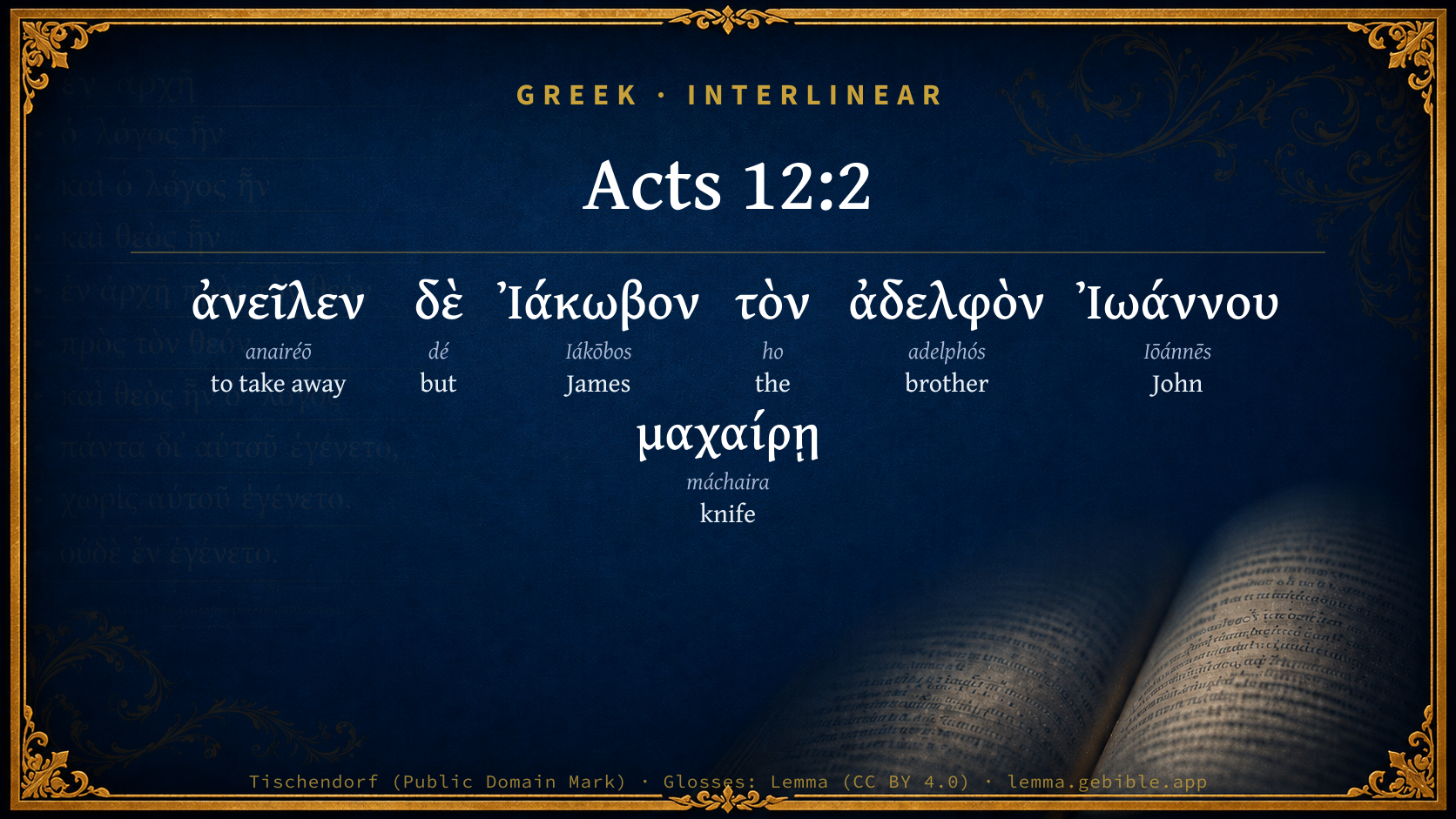
Greek (Tischendorf 8th ed.) Acts 12:2 appears in the Greek New Testament. The text above is from the Tischendorf 8th edition. Each word links to its Strong’s number and a concise gloss. Click any word for its full Thayer’s Greek Lexicon entry.
Download image
Cite this verse

Acts 12:2 (World English Bible). Public Domain. Lemma interlinear Bible study tool, https://lemma.gebible.app/v/acts/12/2.

Show BibTeX & RIS
BibTeX
RIS
English Translation
He killed James, the brother of John, with the sword.
World English Bible · Public Domain
Download a study sheet

One document with this verse’s original text, its word-by-word gloss line, the meaning frame, cross-references with their text, attributed commentary, and full source and license credits — printable, and it pastes into notes with its structure intact.

This verse Autodidact and up

Study sheet (.html) Plain text (.txt)

A passage Seminary Student

Up to 50 verses in one chapter. A passage sheet keeps up to 6 commentary sources and 12 cross-references per verse, in the order this page ranks them, and says so on the sheet whenever that leaves anything out. Ask for a single verse and you get the Autodidact verse sheet above.

Everything on this page stays free to read, with no account — the sheet is a download of what is already on screen, not access to it.

Want to remove ads? Support Godless Engineer
Compare translations 3

The same verse in 3 English versions, stacked beneath the original-language interlinear above. Click any original word for its lexicon entry.

Each is an independent rendering of the whole verse — the interlinear is not word-aligned to these translations.

Highlighted words mark where these versions differ — a whole-verse word diff, not a word-by-word alignment.

  • World English Bible Public Domain
    He killed James, the brother of John, with the sword.
  • King James Version Public Domain
    And he killed James the brother of John with the sword.
  • unfoldingWord Literal Text CC BY-SA 4.0
    And he killed James, the brother of John, with the sword.

unfoldingWord Literal Text — © unfoldingWord, licensed CC BY-SA 4.0. Word-aligned USFM3 via Door43 (git.door43.org/unfoldingWord/en_ult).

Versions to compare (up to 4)

3 of 4 selected

Show all 19 translations

Every available English version of this verse, each an independent rendering of the whole verse.

  • World English Bible Public Domain
    He killed James, the brother of John, with the sword.
  • Berean Standard Bible Public Domain
    He had James, the brother of John, put to death with the sword.
  • Majority Standard Bible Public Domain
    He had James, the brother of John, put to death with the sword.
  • King James Version Public Domain
    And he killed James the brother of John with the sword.
  • American Standard Version (1901) Public Domain
    And he killed James the brother of John with the sword.
  • Revised Version (1885) Public Domain
    And he killed James the brother of John with the sword.
  • Geneva Bible (1599) Public Domain
    And he killed Iames the brother of Iohn with the sword.
  • Douay-Rheims (1899) Public Domain
    And he killed James, the brother of John, with the sword.
  • Young's Literal Translation Public Domain
    and he killed James, the brother of John, with the sword,
  • Literal Standard Version CC BY-SA 4.0
    and he killed James, the brother of John, with the sword,
  • Unlocked Literal Bible CC BY-SA 4.0
    He killed James the brother of John with the sword.
  • unfoldingWord Literal Text CC BY-SA 4.0
    And he killed James, the brother of John, with the sword.
  • Darby Bible Public Domain
    and slew James, the brother of John, with the sword.
  • World Messianic Bible Public Domain
    He killed Jacob, the brother of Yochanan, with the sword.
  • Webster's Bible Public Domain
    And he killed James the brother of John with the sword.
  • Free Bible Version CC BY-SA 4.0
    He had James, John's brother, executed by the sword.
  • Bible in Basic English Public Domain
    And he put James, the brother of John, to death with the sword.
  • Text-Critical English NT CC BY 4.0
    He killed James the brother of John with the sword.
  • Tyndale New Testament (1534) Public Domain
    And he kylled Iames the brother of Iohn with the swerde:

Literal Standard Version (2020), Covenant Press — licensed CC BY-SA 4.0. Text via the HelloAO Bible API (eBible.org). Unlocked Literal Bible (unfoldingWord) — licensed CC BY-SA 4.0. Text via the HelloAO Bible API (eBible.org). unfoldingWord Literal Text — © unfoldingWord, licensed CC BY-SA 4.0. Word-aligned USFM3 via Door43 (git.door43.org/unfoldingWord/en_ult). Free Bible Version, Dr. Jonathan Gallagher — licensed CC BY-SA 4.0. Text via the HelloAO Bible API (eBible.org).

Word by word

More ways to search: Search by grammar → Find every occurrence → Compare this word →

Practice this passage: Drill this verse → Learn its vocabulary →

About this verse

These counts appear in no published source. They are computed here, from the morphology-tagged text and Lemma’s own curated glosses. What Lemma adds →

7
words
7
distinct lemmas
Acts
section

Notable vocabulary

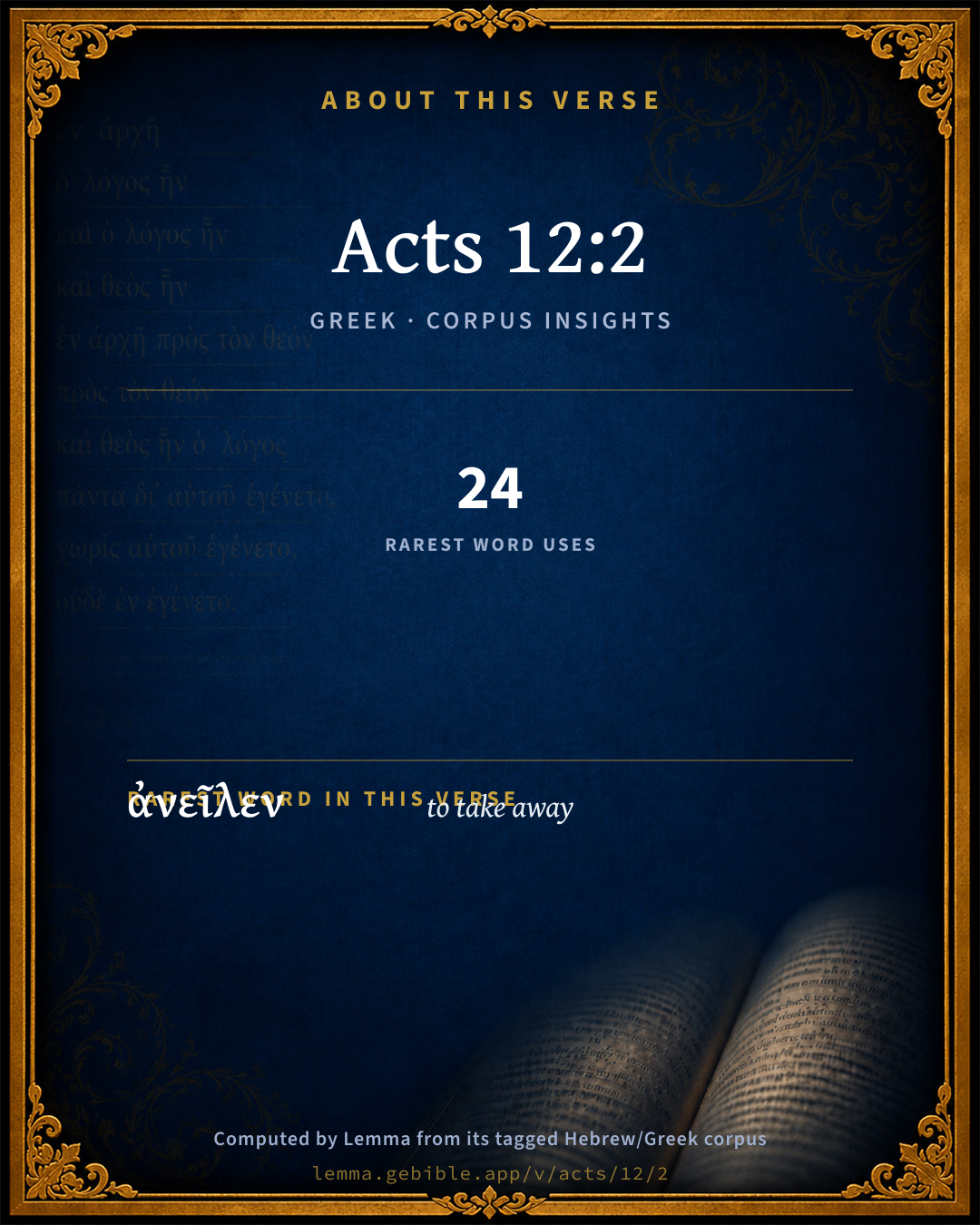
The rarest word here is ἀνεῖλεν to take away G337 — appearing just 24 times in the whole Greek New Testament.

Shared distinctive vocabulary

ἀνεῖλεν to take away G337 occurs in 23 verses of the Greek New Testament. Also found in:

Cross-references

7

Topical passages linked to Acts 12:2 in the Treasury of Scripture Knowledge — connected by theme and wording, ordered by reader-vote popularity; previews shown in the World English Bible.

  • Hebrews 11:37 They were stoned. They were sawn apart. They were tempted. They were slain with the sword. They went around in sheep skins and in goat skins; being destitute, afflicted, ill-treated
  • Matthew 4:21–22 Going on from there, he saw two other brothers, James the son of Zebedee, and John his brother, in the boat with Zebedee their father, mending their nets. He called them.
  • Matthew 20:23 He said to them, "You will indeed drink my cup, and be baptized with the baptism that I am baptized with, but to sit on my right hand and on my left hand is not mine to give; but it is for whom it has been prepared by my Father."
  • Mark 10:35 James and John, the sons of Zebedee, came near to him, saying, "Teacher, we want you to do for us whatever we will ask."
  • Mark 10:38 But Jesus said to them, "You don't know what you are asking. Are you able to drink the cup that I drink, and to be baptized with the baptism that I am baptized with?"
  • 1 Kings 19:1 Ahab told Jezebel all that Elijah had done, and withal how he had slain all the prophets with the sword.
  • 1 Kings 19:10 He said, I have been very jealous for Yahweh, the God of hosts; for the children of Israel have forsaken your covenant, thrown down your altars, and slain your prophets with the sword: and I, even I only, am left; and they seek my life, to take it away.

Cross-references courtesy of OpenBible.info (CC BY 4.0).

Commentary

Notes on Acts 12:2 from classic Christian and Jewish commentators (each source and its license shown beneath its notes). The classic Christian expositions comment on the surrounding passage and are grouped to its opening verse, so a note may address several verses; the Jewish commentaries on the Tanakh (Rashi and others) are per-verse, so they appear only where the commentator wrote on this verse.

Lemma curates 59 commentaries, every one of them public domain or Creative Commons licensed, each selected and text-cleaned for this edition rather than reprinted as found. About our sources →

MacLaren's Expositions of Holy Scripture

Alexander MacLaren

Acts

THE MARTYRDOM OF JAMES

Act 12:2.

One might have expected more than a clause to be spared to tell the death of a chief man and the first martyr amongst the Apostles. James, as we know, was one of the group of the Apostles who were in especially close connection with Jesus Christ. He is associated in the Gospels with Peter and his brother John, and is always named before John, as if he were the more important of the two, by reason of age or of other circumstances unknown to us. But yet we know next to nothing about him. In the Acts of the Apostles he is a mere lay figure; his name is only mentioned in the catalogue at the beginning, and here again in the brief notice of his death. The reticent and merely incidental character of the notice of his martyrdom is sufficiently remarkable. I think the lessons of the fact, and of the, I was going to say, slight way in which the writer of this book refers to it, may perhaps be most pointedly brought out if we take four contrasts-James and Stephen, James and Peter, James and John, James and James. Now, if we take these four I think we shall learn something.

I. First, then, James and Stephen.

Look at the different scale on which the incidents of the deaths of these two are told: the martyrdom of the one is beaten out over chapters, the martyrdom of the other is crammed into a corner of a sentence. And yet, of the two men, the one who is the less noticed filled the larger place officially, and the other was only a simple deacon and preacher of the Word. The fact that Stephen was the first Christian to follow his Lord in martyrdom is not sufficient to account for the extraordinary difference. The difference is to be sought for in another direction altogether. The Bible cares so little about the people whom it names because its true theme is the works of God, and not of man; and the reason why the ‘Acts of the Apostles’ kills off one of the chief Apostles in this fashion is simply that, as the writer tells us, his theme is ‘all that Jesus’ continued ‘to do and to teach after He was taken up.’ Since it is Christ who is the true actor, it matters uncommonly little what becomes of James or of the other ten. This book is not the ‘Acts of the Apostles,’ but it is the Acts of Jesus Christ.

I might suggest, too, in like manner, that there is another contrast which I have not included in my four, between the scale on which the death of Jesus Christ is told by Luke, and that on which this death is narrated. What is the reason why so disproportionate a space of the Gospel is concerned with the last two days of our Lord’s life on earth? What is the reason why years are leaped over in silence and moments are spread out in detail, but that the death of a man is only a death, but the death of the Christ is the life of the world? It is little needful that we should have poetical, emotional, picturesque descriptions of martyrdoms and the like in a book which is altogether devoted to tracking the footsteps of Christ in history; and which regards men as nothing more than the successive instruments of His purpose, and the depositories of His grace.

Another lesson which we may draw from the reticence in the case of the Apostle, and the expansiveness in the case of the protomartyr, is that of a wise indifference to the utterly insignificant accident of posthumous memory or oblivion of us and our deeds and sufferings. James sleeps none the less sweetly in his grave, or, rather, wakes none the less triumphantly in heaven, because his life and death are both so scantily narrated. If we ‘self-infold the large results’ of faithful service, we need not trouble ourselves about its record on earth.

But another lesson which may be learned from this cursory notice of the Apostle’s martyrdom is-how small a thing death really is! Looked at from beside the Lord of life and death, which is the point of view of the author of this narrative, ‘great death’ dwindles to a very little thing. We need to revise our notions if we would understand how trivial it really is. To us it frowns like a black cliff blocking the upper end of our valley, but there is a path round its base, and though the throat of the pass be narrow, it has room for us to get through and up to the sunny uplands beyond. From a mountain top the country below seems level plain, and what looked like an impassable precipice has dwindled to be indistinguishable. The triviality of death, to those who look upon it from the heights of eternity, is well represented by these brief words which tell of the first breach thereby in the circle of the Apostles.

II. There is another contrast, James and Peter.

Now this chapter tells of two things: the death of one of that pair of friends; the miracle that was wrought for the deliverance of the other from death. Why could not the parts have been exchanged, or why could not the miraculous hand that was stretched out to save the one fisherman of Bethsaida have been put forth to save the other? Why should James be slain, and Peter miraculously delivered? A question easily asked; a question not to be answered by us. We may say that the one was more useful for the development of the Church than the other. But we have all seen lives that, to our poor vision, seemed to be all but indispensable, ruthlessly swept away, and lives that seemed to be, and were, perfectly profitless, prolonged to extreme old age. We may say that maturity of character, development of Christian graces, made the man ready for glory. But we have all seen some struck down when anything but ready; and others left for the blessing of mankind many, many a day after they were far fitter for heaven than thousands that, we hope, have gone there.

So all these little explanations do not go down to the bottom of the matter, and we are obliged just to leave the whole question in the loving Hands that hold the keys of life and death for us all. Only we may be sure of this, that James was as dear to Christ as Peter was, and that there was no greater love shown in sending the angel that delivered the one out of the ‘hand of Herod and from all the expectation of the people of the Jews,’ than was shown in sending the angel that stood behind the headsman and directed the stroke of the fatal sword on the neck of the other.

The one was as dear to the Christ as the other-ay, and the one was as surely, and more blessedly, delivered ‘from the mouth of the lion’ as the other was, though the one seemed to be dragged from his teeth, and the other seemed to be crushed by his powerful jaws. James escaped from Herod when Herod slew him but could not make him unfaithful to his Master, and his deliverance was not less complete than the deliverance of his friend.

But let us remember, also, that if thus, to two equally beloved, there were dealt out these two different fates, it must be because that evil, which, as I said, is not so great as it looks, is also not so bitter as it tastes, and there is no real evil, for the loving heart, in the stroke that breaks its bands and knits it to Jesus Christ. If we are Christians, the deepest desire of our souls is fuller communion with our Lord. We realise that, in some stunted and scanty measure, by life; but oh! is it not strange that we should shrink from that change which will enable us to realise it fully and eternally? The contrast of James and Peter may teach us the equal love that presides over the life of the living and the death of the dying.

III. Another contrast is that of James and John.

The close union, and subsequent separation by this martyrdom, of that pair of brothers is striking and pathetic. They seem to have together pursued their humble trade of fishermen in the little fishing village of Bethsaida, apparently as working partners with their father Zebedee. They were not divided by discipleship, as was the sad fate of many a brother delivered by a brother to death. If we may attach any weight to the suggestion that the expression in John’s narrative, ‘He first findeth his own brother, Simon,’ implies that ‘the other disciple’ did the same by his brother, James was brought to Jesus by John, and new tenderness and strength thereby given to their affection. They were closely associated in their Apostleship, and were together the companions of Jesus in the chief incidents of His life. They were afterwards united in the leadership of the Church. By death they were separated very far: the one the first of all the Apostles to ‘become a prey to Satan’s rage,’ the other ‘lingering out his fellows all,’ and ‘dying in bloodless age,’ living to be a hundred years old or more, and looking back through all the long parting to the brother who had joined with him in the wish that even Messiah’s Kingdom should not part them, and yet had been parted so soon and parted so long.

Ah! may we not learn the lesson that we should recognise the mercy and wisdom of the ministry of Death the separator, and should tread with patience the lonely road, do calmly the day’s work, and tarry till He comes, though those that stood beside us be gone? We may look forward with the assurance that ‘God keeps a niche in heaven to hide our idols’; and ‘albeit He breaks them to our face,’ yet shall we find them again, like Memnon’s statue, vocal in the rising sunshine of the heavens.

The brothers, so closely knit, so soon parted, so long separated, were at last reunited. Even to us here, with the chronology of earth still ours, the few years between the early martyrdom of James and the death of the centenarian John seem but a span. The lapse of the centuries that have rolled away since then makes the difference of the dates of the two deaths seem very small, even to us. What a mere nothing it will have looked to them, joined together once more before God!

IV. Lastly, James and James. In his hot youth, when he deserved the name of a son of thunder-so energetic, boisterous, I suppose, destructive perhaps, he was-he and his brother, and their foolish mother, whose name is kindly not told us, go to Christ and say, ‘Grant that we may sit, the one on Thy right hand and the other on Thy left, in Thy kingdom.’ That was what he wished and hoped for, and what he got was years of service, and a taste of persecution, and finally the swish of the headsman’s sword.

And so our dreams get disappointed, and their disappointment is often the road to their fulfilment, for Jesus Christ was answering James’ prayer, ‘Grant that we may sit on Thy right hand in Thy kingdom,’ when He called him to Himself, by the brief and bloody passage of martyrdom. James said, when he did not know what he meant, and the vow was noble though it was ignorant, ‘we can drink of the cup that Thou drinkest.’ And all honour to him! he stuck to his vow; and when the cup was proffered to him he manfully, and like a Christian, took it and drank it to the dregs; and, I suppose, went silently to his grave. But the change between his ardent anticipations and his calm resignation, and between his foolish dream and the stern reality, may well teach us that, whether our wishes he fulfilled or disappointed, they all need to be purified, and that the disappointment of them on earth is often God’s way of fulfilling them for us in higher fashion than we dreamed or asked.

So, brethren, let us leave for ourselves, and for all dear ones, that question of living or dying, to His decision. Only let us be sure that whether our lives be long like John’s, or short like James’, ‘living or dying we are the Lord’s.’ And then, whatever be the length of life or the manner of death, both will bring us the fulfilment of our highest wishes, and will lead us to His side at whose right hand all those shall sit who have loved Him here, and, though long parted, shall be reunited in common enjoyment of the pleasures for evermore which bloom unfading there. ‘And so shall we ever be with the Lord.’

Alexander MacLaren, Expositions of Holy Scripture (1904–1910) — public domain. Text from a community e-Sword module.

Bengel's Gnomon

Johann Albrecht Bengel

Act 12:2. Ἰάκωβον τὸν ἀδελφὸν Ἰωάννου, James the brother of John) The one of these two brothers left the world at the earliest time, the other at a time long subsequent. At the time that Luke wrote, John, who survived, was better known than James, who is designated from John.

Bengel's Gnomon of the New Testament — English translation (T&T Clark, Edinburgh, 1860) — public domain. Text from a community e-Sword module.

Expositor's Greek Testament

ed. W. Robertson Nicoll

Act 12:2 . ἀνεῖλε , characteristic word, see on v. Act 5:33 . Ἰάκωβον τὸν ἀ . Ἰ .: St. Chrysostom reminds us of our Lord’s prophecy in Mar 10:38 ff. (Mat 20:23 ), distinguished thus from the James of Act 1:13 . Possibly his prominent position, and his characteristic nature as a son of Thunder marked him out as an early victim. μαχαίρᾳ : so in the case of John the Baptist. This mode of death was regarded as very disgraceful among the Jews (J. Lightfoot, Wetstein), and as in the Baptist’s case so here, the mode of execution shows that the punishment was not for blasphemy, but that James was apprehended and killed by the political power. For the touching account of his martyrdom narrated by Clement of Alexandria, see Eus., H. E. , ii., 9. Whatever St. Luke’s reason for the brevity of the account, whether he knew no more, or whether he intended to write a third book giving an account of the other Apostles besides Peter and Paul, and so only mentioned here what concerned the following history (so Meyer, but see Wendt, p. 267 (1888)), his brief notice is at least in striking contrast ( ἀπλῶς καὶ ὡς ἔτυχεν , Chrys.) with the details of later martyrologies.

The Expositor's Greek Testament, edited by W. Robertson Nicoll (1897–1910) — public domain. Text from a community e-Sword module.

Geneva Bible (1599)

Geneva Bible translators

Violently, his cause being not once heard.

Geneva Bible (1599) marginal notes — public domain. Text via Bolls.life.

Jamieson, Fausset & Brown

Robert Jamieson, A. R. Fausset & David Brown

killed James . . . with the sword--beheaded him; a most ignominious mode of punishment, according to the Jews. Blessed martyr! Thou hast indeed "drunk of thy Lord's cup, and hast been baptized with his baptism." (See on Mar 10:38-40.) A grievous loss this would be to the Church; for though nothing is known of him beyond what we read in the Gospels, the place which he had as one of the three whom the Lord admitted to His closest intimacy would lead the Church to look up to him with a reverence and affection which even their enemies would come to hear of. They could spring only upon one more prized victim; and flushed with their first success, they prevail upon Herod to seize him also.

Jamieson, Fausset & Brown — Commentary Critical and Explanatory on the Whole Bible (1871) — public domain (CC PDM 1.0). Text via the HelloAO Bible API.

Adam Clarke's Commentary

Verse 2. He killed James the brother of John with the sword.] This was James the greater, son of Zebedee, and must be distinguished from James the less, son of Alpheus. This latter was put to death by Ananias the high priest, during the reign of Nero. This James with his brother John were those who requested to sit on the right and left hand of our Lord, see Mt 20:23; and our Lord's prediction was now fulfilled in one of them, who by his martyrdom drank of our Lord's cup, and was baptized with his baptism. By the death of James, the number of the apostles was reduced to eleven; and we do not find that ever it was filled up. The apostles never had any successors: God has continued their doctrine, but not their order.

By killing with the sword we are to understand beheading. Among the Jews there were four kinds of deaths:

1. Stoning;

2. burning;

3. killing with the sword, or beheading; and,

4. strangling.

The third was a Roman as well as a Jewish mode of punishment. Killing with the sword was the punishment which, according to the Talmud, was inflicted on those who drew away the people to any strange worship, Sanhedr. fol. iii. James was probably accused of this, and hence the punishment mentioned in the text.

Adam Clarke's Commentary on the Bible (1810–1826) — public domain. Text from a community e-Sword/MySword module.

Ellicott's Commentary for English Readers

(2) He killed James the brother of John with the sword.—Had the Apostle been tried by the Sanhedrin on a charge of blasphemy and heresy, the sentence would have been death by stoning. Decapitation showed, as in the case of John the Baptist, that the sentence was pronounced by a civil ruler, adopting Roman modes of punishment, and striking terror by them in proportion as they were hateful to the Jews. The death of James reminds us of his Lord’s prediction that he, too, should drink of His cup, and be baptised with His baptism (Mat_20:23). The fulfilment of that prophecy was found for one brother in his being the proto-martyr of the apostolic company, as it was found for the other in his being the last survivor of it. What led to his being selected as the first victim we can only conjecture; but the prominent position which he occupies in the Gospels, in company with Peter and John, probably continued, and the natural vehemence indicated in the name of Son of Thunder may have marked him out as among the foremost teachers of the Church. The brevity of St. Luke’s record presents a marked contrast to the fulness of later martyrologies. A tradition preserved by Eusebius (Hist. ii. 9) as coming from Clement of Alexandria, records that his accuser was converted by beholding his faith and patience, confessed his new faith, and was led to execution in company with the Apostle, who bestowed on him the parting benediction of “Peace be with thee.”

A Bible Commentary for English Readers, edited by Charles John Ellicott (1878–1897) — public domain. Text from a community e-Sword module.

The Cambridge Bible for Schools and Colleges

gen. ed. J. J. S. Perowne

2. And he killed James the brother of John] One of the two sons of Zebedee, who had been among the three specially favoured disciples of Jesus. It is therefore likely that he would take a leading part in the labours of the Church, and so Agrippa’s attention would be drawn to him as a proper person to be first struck down. All the accusations which had been laid against Stephen, that the Christian leader spake against the Temple and the Law, would be used with effect to such a zealous observer of Mosaic ritual as Herod Agrippa was.

with the sword] This was the third in order of the modes of execution appointed among the Jews. These are stoning, burning, decapitation, and strangulation. In connection with the execution of James the words of the Mishna are interesting: “The manner of putting to death by the sword is as follows: the man’s head is cut off with the sword as is wont to be done by royal command.” See Surenhusius on Sanhedrin p. 238 (misprinted 248), where there is a discussion about the position of the prisoner, whether he should stand erect or have his head on a block.

The Cambridge Bible for Schools and Colleges (gen. ed. J. J. S. Perowne; Cambridge University Press, 1878–1918) — public domain. Text from a community e-Sword module.

John Gill's Exposition

And he killed James the brother of John with the sword. This was James, the son of Zebedee, whom our Lord told, that he should be baptized with the baptism he was baptized with, Mat 20:22 meaning the baptism of martyrdom; and he was the first martyr among the apostles: the death he was put to was one of the four capital punishments among the Jews, and was reckoned by them the most disgraceful of them all, and was inflicted upon deceivers of the people; and such an one James was thought to be (e).

(e) Misn. Sanhedrin, c. 7. sect. 1, 3. & 11. 4.

John Gill's Exposition of the Whole Bible (1746–1763) — public domain (CC PDM 1.0). Text via the HelloAO Bible API.

Trapp's Complete Commentary

John Trapp

2 And he killed James the brother of John with the sword.

Ver. 2. And he killed James the brother] So styled to distinguish him from the other James, called James the Less, kinsman to Christ, and bishop of Jerusalem, as the ancients style him. (Chrysost. Hom. xxxiii, in Act.) It was wonder that Herod killed no more, seeing this took so well with the people, whose favour he coveted. When Stephen the protomartyr of the Church was stoned, Dorotheus testifieth that two thousand other believers were put to death the same day; but God hath set bounds to that sea of malice that is in persecutors’ hearts, which they cannot go beyond: Psa 76:10; "The remainder of wrath shalt thou restrain."

John Trapp, A Commentary or Exposition upon All the Books of the Old and New Testament (1647–1656) — public domain. Text from a community e-Sword module.

Albert Barnes' Notes on the Bible

And he killed ... - He caused to be put to death with a sword, either by beheading, or piercing him through. The Roman procurators were entrusted with authority over life, though in the time of Pilate the Jews had not this authority.

James, the brother of John - This was the son of Zebedee, Mat 4:21. He is commonly called James the Greater, in contradistinction from James, the son of Alpheus, who is called James the Less, Mat 10:3. In this manner were the predictions of our Saviour respecting him fulfilled, Mat 20:23, “Ye shall indeed drink of my cup, and be baptized with the baptism that I am baptized with.”

Albert Barnes' Notes on the Bible (1834–1885) — public domain. Text from a community e-Sword/MySword module.

Haydock's Catholic Bible Commentary

St. James the elder, brother of St. John the evangelist.

George Leo Haydock (1774–1849), Haydock's Catholic Family Bible and Commentary, 1859 edition — public domain. Excludes Psalms (Douay-Rheims chapter numbering differs from Protestant) and Deuterocanonical books (Catholic canon only).

Matthew Poole's English Annotations

Who had especially the care of the church at Jerusalem: one eminent amongst the apostles, and one of the sons of thunder, (or Boanerges), for his zealous and earnest preaching, and therefore the more hated by Herod: so that which our Saviour had foretold him came now to pass, Mat 20:23, that he drank of the cup our Savionr did drink of. There was another James, who wrote the Epistle known by his name, and was called James the Less; because, as some think, he was brought to the knowledge of Christ after the other, of whom we read, Mar 15:40.

Matthew Poole's English Annotations on the Holy Bible (1683–1685) — public domain. Text from a community e-Sword/MySword module.

Whedon's Commentary on the Bible

Daniel D. Whedon

2. James, the brother of John—Son of Zebedee, “son of thunder,” first of apostolic martyrs, brother of an evangelist, one of the elect three of the elect twelve. His prominence, even though Peter was near, made him the first victim of the persecutor’s experiment.

Sword—The instrument of his beheading, ordered summarily and without trial. Thus under a Roman procurator the Jews were restrained from taking Christian life; but the moment a native king ruled blood began to flow. (See note on Mat_10:3.)

Daniel D. Whedon (gen. ed.), Commentary on the Old and New Testaments (1874–1909) — public domain. Text from a community e-Sword module.

The Pulpit Commentary

James, the son of Zebedee, or James the Elder, to whom, with his brother John, our Lord gave the surname of Boanerges (which is a corruption of vgd yneb), sons of thunder. Nothing is recorded of him in the Acts but his presence in the upper room at Jerusalem after the Ascension, (Act_1:13) and this his martyrdom, which was the fulfillment of our Lord"s prediction in Mat_20:23. His being singled out by Herod for death in company with Peter is rather an indication of his zeal and activity in the Lord"s service, though we know nothing of his work. Eusebius relates an anecdote of his martyrdom, extracted from the lost work of Clement of Alexandria, called the JUpotutwseiv (or in Latin Adumbrationes), which Clement professed to have received by tradition from his predecessors, to the effect that the informer who accused James was so struck with his constancy in confessing Christ before the judge, that he came forward and confessed himself a Christian too. The two were then led off to execution together; and on the way the informer asked James"s forgiveness. After a moment"s hesitation, James said to him, "Peace be unto thee," and kissed him. They were then both beheaded ("Eccl. Hist.," 2. 9.). As Clement flourished about A.D. 190, the tradition need not have passed through more than three persons. It has been thought strange that Luke relates the death of a chief apostle with such brevity. But it did not bear on the main object of his work. Lightfoot ("Works," vol. 8. p. 282, etc.) mentions a fanciful story related by Rabauus Maurus, that about this time the apostles composed the Apostles" Creed, each contributing one clause, and that the clause contributed by James the brother of John was, "And in Jesus Christ his only Son our Lord."

The Pulpit Commentary (1880–1919), ed. H.D.M. Spence-Jones & Joseph S. Exell — public domain. Text from a community e-Sword module.

John Wesley's Explanatory Notes

James the brother of John - So one of the brothers went to God the first, the other the last of the apostles.

John Wesley, Explanatory Notes Upon the Whole Bible (1754–1765) — public domain. Text via the GEBible commentary corpus.

Burkitt's Expository Notes on the New Testament

William Burkitt

Note here, 1. The person slain by the sword of Herod, James the brother of John. We read in the gospel that he was one of the sons of Zebedee, that desired of Christ the pre-eminence to sit at his right hand in his kingdom: and now he is the first of the apostles that suffered matrydom who drank of Christ’s cup, and was baptized with his baptism. He was called Boanerges, or a son of thunder, for his zealous and earnest preaching: No wonder then that Herod and the enraged Jews hated him, and were stirred up by Satan to destroy him. For such as are most useful to, and most eminent in the church, are always the objects of Satan’s wrath and anger, and of the persecutor’s rage and fury: "He killed James the brother of John with the sword."

Observe, 2. James being slain, Peter is to follow; "He proceeded further to take Peter also." The rage of persecutors is not easily satisfied, and the blood which they shed, is but oil to feed the flames of their revenge.

But mark the over-ruling power and goodness of God, though St. James was murdered, St. Peter shall be but imprisoned: The husbandman doth not permit all his corn to the oven, but saves some for seed.

Persecutors cannot do all the mischief they would, and they shall not do all they can.

William Burkitt's Expository Notes on the New Testament (1700–1703) — public domain. Text from a community e-Sword module.

McGarvey & Pendleton's Commentaries

J. W. McGarvey

See notes one verse 1

J. W. McGarvey (with Philip Y. Pendleton), Commentaries on the New Testament (The Fourfold Gospel, 1914; Acts; and the epistles) — public domain. Text from a community e-Sword/MySword module.

The People's New Testament

B. W. Johnson

2. He killed James the brother of John. One of the three apostles most intimate with the Savior. The first apostle to suffer martyrdom. He is the only apostle whose death is recorded in the New Testament, save Judas the betrayer. With the sword. He beheaded James. This James, the apostle, is to be distinguished from James, the brother of the Lord (Gal. 1:19), whose name appears after this in Acts, and who wrote the Epistle of James.

B. W. Johnson's The People's New Testament with Notes (1889–1891) — public domain. Electronic text from the Christian Classics Ethereal Library (CCEL) ThML edition.

Cambridge Greek Testament for Schools and Colleges

2. Ἰάκωβον τὸν ἀδελφὸν Ἰουδαίοις, James, the brother of John. This was one of the two sons of Zebedee, who had been among the three specially favoured disciples of Jesus. It is therefore likely that he would take a leading part in the labours of the Church. Thus Agrippa’s attention would be drawn to him as a proper person to be first struck down. All the accusations which had been laid against Stephen, that the Christian leader spake against the Temple and the Law, would be used with effect to such a zealous observer of Mosaic ritual as Herod Agrippa was.

μαχαίρῃ, with the sword. This was the third in order of the modes of execution appointed among the Jews. These modes were (1) stoning, (2) burning, (3) the sword, and (4) strangulation. In connexion with the execution of James the words of the Mishna are interesting: ‘The ordinance for putting to death by the sword is as follows: the man’s head is cut off with the sword as is wont to be done by royal command.’ See Surenhusius on Sanhedrin, p. 248, where there is a discussion about the position of the prisoner, whether he should stand erect or have his head on a block.

Cambridge Greek Testament for Schools and Colleges (Cambridge University Press, 1896; 21 vols, various authors incl. Carr, Maclear, Plummer, Farrar, Lumby, Moule, M. R. James, Simcox) — public domain. Text from a community e-Sword module.

Alford’s Greek Testament

Henry Alford

2. Ἰάκωβον] Of him we know nothing besides what is related in the Gospels. He was the son of Zebedee, called (Mat 4:21) together with John his brother: was one of the favoured Three admitted to the death-chamber of Jairus’s daughter (Mar 5:37), to the mount of transfiguration (Mat 17:1), and to the agony in the garden (Mat 26:37). He, together with John his brother (named by our Lord ‘Boanerges,’ ‘sons of thunder’), wished to call down fire on the inhospitable Samaritans (Luk 9:54),—and prayed that his brother and himself might sit, one on the right hand and the other on the left, in the Lord’s kingdom (Mat 20:20-24). It was then that He foretold to them their drinking of the cup of suffering and being baptized with the baptism which He was baptized with: a prophecy which James was the first to fulfil.

This is the only Apostle of whose death we have any certain record. With regard to all the rest, tradition varies, more or less, as to the place, or the manner, or the time of their deaths.

Eusebius, H. E. ii. 9, relates, from the Hypotyposes of Clemens, who had received it ἐκ παραδόσεως τῶν πρὸ αὐτοῦ, that the accuser of James, struck by his confession, became a Christian, and was led away with him to martyrdom, συναπήχθησαν οὖν ἄμφω, φησί, καὶ κατὰ τὴν ὁδὸν ἠξίωσεν ἀφεθῆναι αὐτῷ ὑπὸ τοῦ Ἰακώβου. ὁ δὲ ὀλίγον σκεψάμενος, εἰρήνη σοι, εἶπε, καὶ κατεφίλησεν αὐτόν. καὶ οὕτως ἀμφότεροι ὁμοῦ ἐκαρατομήθησαν.

μαχαίρῃ] Probably according to the Roman method of beheading, which became common among the later Jews. It was a punishment accounted extremely disgraceful by the Jews: see Lightf. in loc.

Henry Alford, The Greek Testament (1849–1861) — public domain. Text from a community e-Sword module.

Vincent's Word Studies in the New Testament

Marvin R. Vincent

Killed - with the sword. While the martyrdom of Stephen is described at length, that of James, the first martyr among the apostles, is related in two words.

Marvin R. Vincent, Word Studies in the New Testament (1887–1900) — public domain. Text from a community e-Sword/MySword module.

Lesson kit

Teaching starters — assembled from the data on this page, not authored interpretation. Every prompt links to the verse data it draws on. Edit before teaching.

Acts, in the Acts, opens this verse with 7 words (7 distinct Greek lemmas). Its most distinctive word is anairéō (“to take away”). A historical commentator’s framing appears above. Read the whole chapter for the surrounding context.

Discussion questions

  1. How does “to take away” (anairéō) shape what this verse is saying?
  2. Matthew 2:16 shares the word «to take away» with this verse. How do the two illuminate each other?
  3. Reading how MacLaren's Expositions of Holy Scripture and Bengel's Gnomon read this verse, where do the two commentators agree and where do they part?

Reading settings

Reading text

Shown beneath each verse's original-language words.

Old Testament
Old Testament edition

Read the OT as the Masoretic Hebrew (MT) or the Greek Septuagint (LXX).

English shown for the Greek Septuagint (in the Hebrew ↔ Greek comparison).

Comparing translations? Open the Compare panel on any verse page to stack up to four side by side.