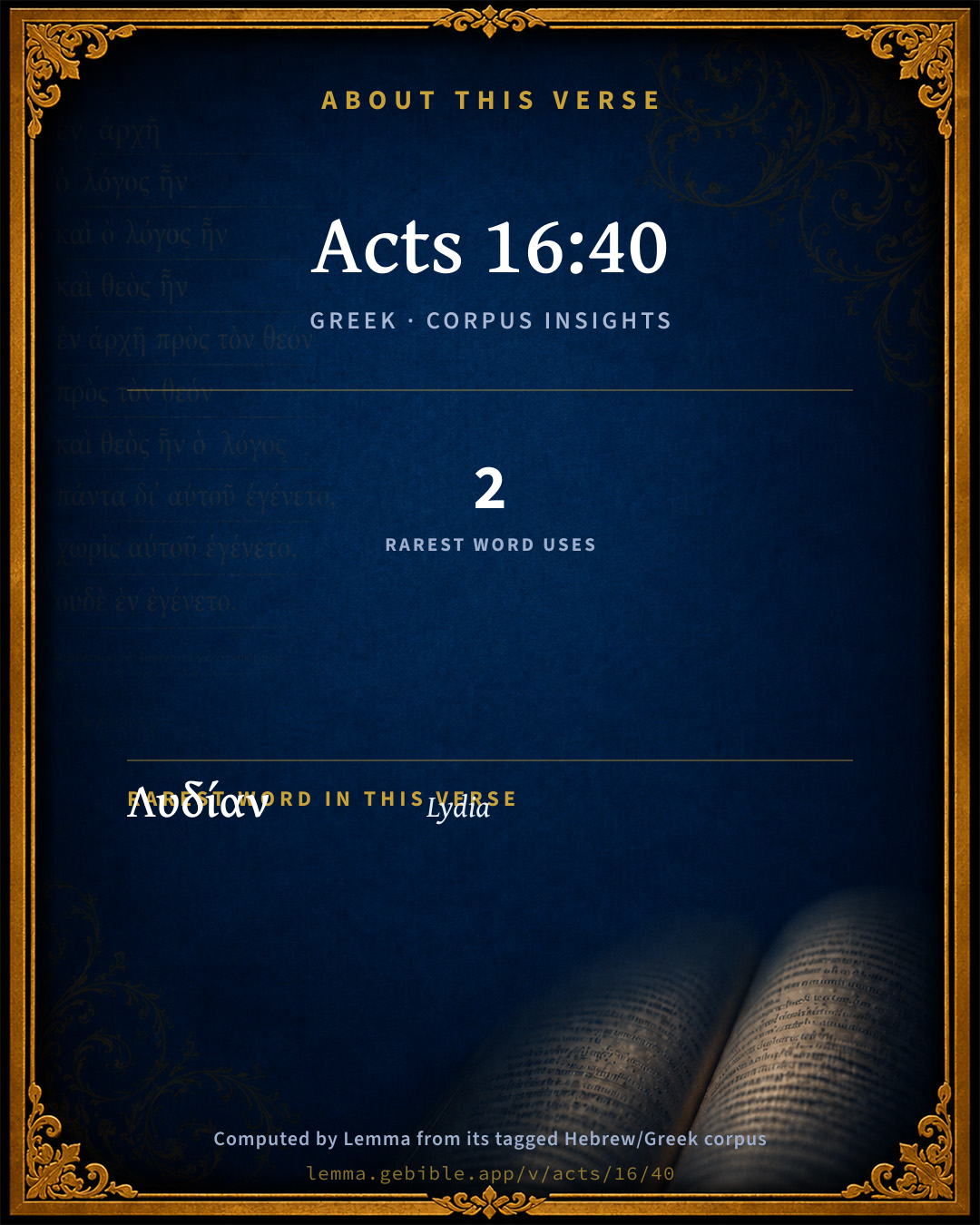
Acts 16:40

Greek (Tischendorf 8th ed.) Acts 16:40 appears in the Greek New Testament. The text above is from the Tischendorf 8th edition. Each word links to its Strong’s number and a concise gloss. Click any word for its full Thayer’s Greek Lexicon entry.

Download image
Cite this verse

Acts 16:40 (World English Bible). Public Domain. Lemma interlinear Bible study tool, https://lemma.gebible.app/v/acts/16/40.

Show BibTeX & RIS
BibTeX
RIS
English Translation
They went out of the prison, and entered into Lydia's house. When they had seen the brothers, they encouraged them, and departed.
World English Bible · Public Domain
Download a study sheet

One document with this verse’s original text, its word-by-word gloss line, the meaning frame, cross-references with their text, attributed commentary, and full source and license credits — printable, and it pastes into notes with its structure intact.

This verse Autodidact and up

Study sheet (.html) Plain text (.txt)

A passage Seminary Student

Up to 50 verses in one chapter. A passage sheet keeps up to 6 commentary sources and 12 cross-references per verse, in the order this page ranks them, and says so on the sheet whenever that leaves anything out. Ask for a single verse and you get the Autodidact verse sheet above.

Everything on this page stays free to read, with no account — the sheet is a download of what is already on screen, not access to it.

Want to remove ads? Support Godless Engineer
Compare translations 3

The same verse in 3 English versions, stacked beneath the original-language interlinear above. Click any original word for its lexicon entry.

Each is an independent rendering of the whole verse — the interlinear is not word-aligned to these translations.

Highlighted words mark where these versions differ — a whole-verse word diff, not a word-by-word alignment.

  • World English Bible Public Domain
    They went out of the prison, and entered into Lydia's house. When they had seen the brothers, they encouraged them, and departed.
  • King James Version Public Domain
    And they went out of the prison, and entered into the house of Lydia: and when they had seen the brethren, they comforted them, and departed.
  • unfoldingWord Literal Text CC BY-SA 4.0
    So going out from the prison, they came to Lydia. And seeing the brothers, they exhorted them and went out.

unfoldingWord Literal Text — © unfoldingWord, licensed CC BY-SA 4.0. Word-aligned USFM3 via Door43 (git.door43.org/unfoldingWord/en_ult).

Versions to compare (up to 4)

3 of 4 selected

Show all 19 translations

Every available English version of this verse, each an independent rendering of the whole verse.

  • World English Bible Public Domain
    They went out of the prison, and entered into Lydia's house. When they had seen the brothers, they encouraged them, and departed.
  • Berean Standard Bible Public Domain
    After Paul and Silas came out of the prison, they went to Lydia’s house to see the brothers and encourage them. Then they left the city.
  • Majority Standard Bible Public Domain
    After Paul and Silas came out of the prison, they went to Lydia’s house to see the brothers and encourage them. Then they left the city.
  • King James Version Public Domain
    And they went out of the prison, and entered into the house of Lydia: and when they had seen the brethren, they comforted them, and departed.
  • American Standard Version (1901) Public Domain
    And they went out of the prison, and entered into `the house' of Lydia: and when they had seen the brethren, they comforted them, and departed.
  • Revised Version (1885) Public Domain
    And they went out of the prison, and entered into the house of Lydia: and when they had seen the brethren, they comforted them, and departed.
  • Geneva Bible (1599) Public Domain
    And they went out of the prison, and entred into the house of Lydia: and when they had seene the brethren, they comforted them, and departed.
  • Douay-Rheims (1899) Public Domain
    And they went out of the prison, and entered into the house of Lydia; and having seen the brethren, they comforted them, and departed.
  • Young's Literal Translation Public Domain
    and they, having gone forth out of the prison, entered into `the house of' Lydia, and having seen the brethren, they comforted them, and went forth.
  • Literal Standard Version CC BY-SA 4.0
    and they, having gone forth out of the prison, entered into [the house of] Lydia, and having seen the brothers, they comforted them, and went forth.
  • Unlocked Literal Bible CC BY-SA 4.0
    So Paul and Silas went out of the prison and came to the house of Lydia. When Paul and Silas saw the brothers, they encouraged them and then departed from the city.
  • unfoldingWord Literal Text CC BY-SA 4.0
    So going out from the prison, they came to Lydia. And seeing the brothers, they exhorted them and went out.
  • Darby Bible Public Domain
    And having gone out of the prison, they came to Lydia; and having seen the brethren, they exhorted them and went away.
  • World Messianic Bible Public Domain
    They went out of the prison and entered into Lydia’s house. When they had seen the brothers, they encouraged them, then departed.
  • Webster's Bible Public Domain
    And they went out of the prison, and entered into the house of Lydia: and when they had seen the brethren, they comforted them, and departed.
  • Free Bible Version CC BY-SA 4.0
    So Paul and Silas left the prison and went to Lydia's house. There they met with the believers, encouraged them, and then went on their way.
  • Bible in Basic English Public Domain
    And they came out of the prison and went to the house of Lydia: and when they had seen the brothers they gave them comfort and went away.
  • Text-Critical English NT CC BY 4.0
    So Paul and Silas came out of the prison and went to Lydia's house. And after seeing the brothers and encouraging them, they departed.
  • Tyndale New Testament (1534) Public Domain
    And they wet out of the preson and entred into the housse of Lidia and when they had sene the brethren they comforted them and departed.

Literal Standard Version (2020), Covenant Press — licensed CC BY-SA 4.0. Text via the HelloAO Bible API (eBible.org). Unlocked Literal Bible (unfoldingWord) — licensed CC BY-SA 4.0. Text via the HelloAO Bible API (eBible.org). unfoldingWord Literal Text — © unfoldingWord, licensed CC BY-SA 4.0. Word-aligned USFM3 via Door43 (git.door43.org/unfoldingWord/en_ult). Free Bible Version, Dr. Jonathan Gallagher — licensed CC BY-SA 4.0. Text via the HelloAO Bible API (eBible.org).

Word by word

More ways to search: Search by grammar → Find every occurrence → Compare this word →

Practice this passage: Drill this verse → Learn its vocabulary →

Λυδίαν
Lydía
G3070
“Lydia”
Noun, Accusative, Singular, Feminine
Part of Speech
Noun
Case
Accusative
Number
Singular
Gender
Feminine
Full Thayer's Definition

Origin: properly, feminine of Ludios [of foreign origin] (a Lydian, in Asia Minor)

TDNT: None

Lydia = "travail" 1. a woman of Thyatira, a seller of purple, the first European convert of Paul, and afterward his hostess during his first stay at Philippi
  1. ἐξελθόντες exérchomai G1831 “to come forth” Verb, Aorist, Active, Participle, Nominative, Plural, Masculine
  2. δὲ dé G1161 “but” Conjunction
  3. ἀπὸ apó G575 “from” Preposition
  4. τῆς ho G3588 “the” Article, Genitive, Singular, Feminine
  5. φυλακῆς phylakḗ G5438 “guard” Noun, Genitive, Singular, Feminine
  6. εἰσῆλθον eisérchomai G1525 “to enter” Verb, Aorist, Active, Indicative, 3rd person, Plural
  7. πρὸς prós G4314 “to” Preposition
  8. τὴν ho G3588 “the” Article, Accusative, Singular, Feminine
  9. καὶ kaí G2532 “and” Conjunction
  10. ἰδόντες horáō G3708 “to see” Verb, Aorist, Active, Participle, Nominative, Plural, Masculine
  11. παρεκάλεσαν parakaléō G3870 “to call beside” Verb, Aorist, Active, Indicative, 3rd person, Plural
  12. τοὺς ho G3588 “the” Article, Accusative, Plural, Masculine
  13. ἀδελφοὺς adelphós G80 “brother” Noun, Accusative, Plural, Masculine
  14. καὶ kaí G2532 “and” Conjunction
  15. ἐξῆλθαν exérchomai G1831 “to come forth” Verb, Aorist, Active, Indicative, 3rd person, Plural

About this verse

These counts appear in no published source. They are computed here, from the morphology-tagged text and Lemma’s own curated glosses. What Lemma adds →

16
words
12
distinct lemmas
Acts
section

Notable vocabulary

The rarest word here is Λυδίαν Lydia G3070 — appearing just 2 times in the whole Greek New Testament.

Shared distinctive vocabulary

Λυδίαν Lydia G3070 occurs in 2 verses of the Greek New Testament. Also found in:

Repetition

Words recur within this verse:

  • ἐξελθόντες to come forth G1831 ×2
  • τῆς the G3588 ×3
  • καὶ and G2532 ×2

Cross-references

9

Topical passages linked to Acts 16:40 in the Treasury of Scripture Knowledge — connected by theme and wording, ordered by reader-vote popularity; previews shown in the World English Bible.

  • Acts 14:22 confirming the souls of the disciples, exhorting them to continue in the faith, and that through many afflictions we must enter into the Kingdom of God.
  • Acts 16:14 A certain woman named Lydia, a seller of purple, of the city of Thyatira, one who worshiped God, heard us; whose heart the Lord opened to listen to the things which were spoken by Paul.
  • 1 Thessalonians 3:2–3 and sent Timothy, our brother and God's servant in the Gospel of Christ, to establish you, and to comfort you concerning your faith;
  • 2 Corinthians 1:3–7 Blessed be the God and Father of our Lord Jesus Christ, the Father of mercies and God of all comfort;
  • 2 Corinthians 4:16–18 Therefore we don't faint, but though our outward man is decaying, yet our inward man is renewed day by day.
  • 2 Corinthians 4:8–12 We are pressed on every side, yet not crushed; perplexed, yet not to despair;
  • Acts 4:23 Being let go, they came to their own company, and reported all that the chief priests and the elders had said to them.
  • Acts 12:12–17 Thinking about that, he came to the house of Mary, the mother of John whose surname was Mark, where many were gathered together and were praying.
  • Acts 16:2 The brothers who were at Lystra and Iconium gave a good testimony about him.

Cross-references courtesy of OpenBible.info (CC BY 4.0).

Commentary

Notes on Acts 16:40 from classic Christian and Jewish commentators (each source and its license shown beneath its notes). The classic Christian expositions comment on the surrounding passage and are grouped to its opening verse, so a note may address several verses; the Jewish commentaries on the Tanakh (Rashi and others) are per-verse, so they appear only where the commentator wrote on this verse.

Lemma curates 59 commentaries, every one of them public domain or Creative Commons licensed, each selected and text-cleaned for this edition rather than reprinted as found. About our sources →

Joseph Benson's Commentary

Act 16:40. And they went out, &c. — The servants of Christ, being honourably cleared from every crime by this public release, left the prison quietly, and went to the house of Lydia — With whom they had lodged before; and when they had seen the brethren — The disciples whom they had made; they comforted them — By rehearsing what God had done both for them and by them, in prison; and exhorted them (as the word also signifies) to steadfastness in the faith, and such exemplary conduct as Christianity always requires, and was peculiarly suitable to their present circumstances; and then they departed — Though many circumstances now invited their stay at Philippi; yet they showed great wisdom in complying with the request of the magistrates, that they might not seem to express any degree of obstinacy or revenge, or give any suspicion of a design to stir up the people.

We may observe here, that of all the churches planted by Paul, this at Philippi seems to have loved and respected him the most. The sufferings he had undergone in their city, for the sake of giving them the knowledge of the gospel, more precious than gold, greatly endeared him to them. Accordingly, while he was at Thessalonica, they sent him money twice, that, by making the gospel without expense to the Thessalonians, they might give the more heed to the things which Paul spake, when they found him a teacher of a different character from the Greek philosophers, who taught only for hire. They likewise sent him money during his first imprisonment at Rome, that he might want nothing necessary for him. In short, the injurious treatment which Paul and Silas met with in this first city of Europe, where they had preached, was abundantly compensated by the readiness of mind with which many of its inhabitants received the gospel; and by the excellent disposition which they showed after their conversion, in the great love which they all along expressed toward their spiritual father.

Joseph Benson's Commentary on the Old and New Testaments (1811–1818) — public domain. Text from a community e-Sword module.

Tyndale Open Study Notes

Tyndale Open Resources

16:40 This meeting in the home of Lydia bolstered the spirits of the Philippian Christians who had to deal with the fallout from the missionaries’ work there.

Tyndale Open Study Notes — © Tyndale Open Resources, licensed CC BY-SA 4.0. Text via the HelloAO Bible API.

Bengel's Gnomon

Johann Albrecht Bengel

Act 16:40. Ἐκ τῆς φυλακῆς, out of the prison) out of the place or state of imprisonment whither they had betaken themselves (Act 16:34), in order not to cause danger to the gaoler (by staying in his house): or else from the higher part of the house.—ἴδοντες, having seen) They show thereby that they were not forced to be in a hurry.—τοὺς ἀδελφοὺς, the brethren) the companions of their journey, or those recently converted.—παρεκάλεσαν, they comforted them) that they should not be offended (caused to stumble) at adversities.

Bengel's Gnomon of the New Testament — English translation (T&T Clark, Edinburgh, 1860) — public domain. Text from a community e-Sword module.

Meyer's Critical & Exegetical Commentary

Heinrich August Wilhelm Meyer

Act_16:40. Before they comply with the ἐξελθεῖν τῆς πόλεως (Act_16:39), the apostolic heartfelt longing constrains them first to repair to the house of Lydia, to exhort (παρεκάλεσαν) the new converts assembled there that they should not become wavering in their Christian confession. And from this house grew the church, to which, of all that Paul founded, he has erected the most eulogistic monument in his Epistlein this sense also the first church which he established in Europe.

ἐξῆλθον] Only Paul and Silas, as they alone were affected by the inquiry, appear now to have departed from Philippi. Luke at least, as the use of the third person teaches us, did not go with them. Paul left him behind to build up the youthful church. Whether, however, Timothy (Act_16:1 ff.) also remained behind, cannot be determined. He is not again named until Act_17:14, but he may nevertheless have already departed from Philippi, and need not necessarily have rejoined them till in Beroea or Thessalonica.

REMARK.

In the rejection of the entire history as history Baur and Zeller (comp. Hausrath) essentially agree; it is alleged to be formed in accordance with Act_12:7 ff., as an apologetic parallelism of Paul with Peter. But as Philippian persecutions are mentioned also in 1Th_2:2, the opinions formed by them concerning the relation of the two passages are opposite. Baur makes 1Th_2:2 to be derived from the narrative before us; whereas Zeller, considering the Epistles to the Thessalonians as older, supposes the author of the Acts to have concocted (p. 258) his narrative from 1Th_2:2.

Meyer — Critical and Exegetical Commentary on the New Testament — English translation by Peter Christie, edited by Frederick Crombie (T&T Clark, 1880) — public domain. Text from a community e-Sword module.

Expositor's Greek Testament

ed. W. Robertson Nicoll

Act 16:40 . εἰς , see critical notes; they would not leave the city without once more visiting the household out of which grew the Church dearest to St. Paul; see Lightfoot’s remarks on the growth of the Church from “the Church in the house,” Philippians , pp. 57, 58. ἐξῆλθον : the third person indicates that the narrator of the “We” section, Act 16:9-10 , remained at Philippi, Timothy probably accompanying Paul and Silas. In Act 20:5 we again have ἡμᾶς introduced, and the inference is that St. Luke remained at Philippi during the interval, or at least for a part of it; and it is reasonable to infer that he laboured there in the Gospel, although he modestly refrains (as elsewhere) from any notice of his own work. The Apostle’s first visit to Philippi represented in epitome the universality of the Gospel, so characteristic of St. Luke’s record of our Lord’s teaching, and so characteristic of the mind of St. Paul. Both from a religious and social point of view the conversions at Philippi are full of significance. The Jew could express his thankfulness in his morning prayer that God had not made him a Gentile a woman a slave. But at Philippi St. Paul taught in action the principle which he enforced in his Galatian Epistle, Gal 3:28 , and again in writing to the Col 3:11 : “Christ was all and in all”; in Him the soothsaying slave-girl, the proselyte of Thyatira, the Roman jailor, were each and all the children of God, and fellow-citizens with the saints, Lightfoot, Introduction to Philippians; Taylor, Sayings of the Jewish Fathers , pp. 15, 26, 137 (second edition).

The narrative of St. Paul’s visit to Philippi has been made the object of attack from various quarters. Most of the objections have been stated and met by Professor Ramsay, and a summary of them with their refutation is aptly given in a recent article by Dr. Giesekke ( Studien und Kritiken , 1898) described at length in the Expository Times , March, 1898, see also Knabenbauer, pp. 292, 293. The view that the narrative is simply a fiction modelled upon the escape of St. Peter in Act 4:31 ; Act 4:12 is untenable in face of the many differences in the narratives (see the points of contrast in Nösgen, Apostel geschichte , pp. 315, 316). (Schneckenburger in his list of parallels between Peter and Paul in Acts apparently makes no mention of the supposed parallel here.) Zeller’s attempt to connect the narrative with the story in Lucian’s Toxaris , c. 27, is still more absurd, cf. Zöckler, Apostelgeschichte , p. 262 (second edition), and Farrar, St. Paul , i., 501, whilst more recently Schmiedel (1898) attempts to find a parallel in Euripides, Bacchæ , 436 441, 502, 602 628, see Wendt’s note, p. 282 (1899). Weizsäckcr boldly refuses to admit even the imprisonment as a fact, and regards only the meeting of Paul with the soothsayer as historical. But it should be noted that he allows the Apostle’s intercourse with Lydia and his instruction of the women to be genuine historical incidents, and he makes the important remark that the name of Lydia is the more credible, since the Philippian Epistle seems to support the idea that women received Paul and contributed to the planting of the Church ( Apostolic Age , i., 284, E.T.). Holtzmann represents in a general manner the standpoint of modern advanced criticism, when he divides the narrative of the events at Philippi into two parts, the one concerned with events transacted under the open heaven, belonging not only to the “We” source but bearing also the stamp of reality, whilst the other part is not guaranteed by the “We” source, and is full of legendary matter. Thus Act 16:25-34 are dismissed as a later addition, and Ramsay’s fresh and careful explanations are dismissed by Holtzmann as “humbug”! Theologische Literaturzeitung , No. 7, 1899.

Additional Note. Chap. Act 16:12 , “which is a city of Macedonia, the first of the district,” R.V. This might mean, so far as πρώτη is concerned, that Philippi was the city nearest in the district, and the city which they first reached. Neapolis, which actually came first on the route, was not generally regarded as Macedonian but Thracian; so Lightfoot, Rendall, O. Holtzmann. Or it might also mean that it was “the chief” (A.V.), the leading city of its division of Macedonia (Ramsay). Here again Ramsay sees a proof of St. Luke’s intimate acquaintance with the rivalries of the Greek cities, and of his special interest in Philippi. In B.C. 167 the province Macedonia had been divided by the Romans into four districts, μερίς , and even if this division were obsolete at the time, another would be likely to succeed to it (so Ramsay, Church in the Roman Empire , p. 158, as against Lightfoot, Phil. , p. 50, who takes πρώτη as denoting not the political but the geographical position of Philippi.) At this time Amphipolis was the chief ( πρώτη ) city of the district to which both it and Philippi belonged, but though Amphipolis held the rank, Philippi claimed the same title, a case of rivalry between two or even three cities which often occurred. This single passage Ramsay regards as conclusive of the claims of Philippi, see St. Paul , p. 207, and Cities and Bishoprics of Phrygia , ii., 429. As to whether μερίς can be used in the sense of a division of a province, cf. Ramsay, Church in the Roman Empire , p. 158, and the instances quoted from Egypt, and also Expositor , October, 1897, p. 320, as against Hort’s limitation of the term. Hort, W.H [301] , App. 96 (to whose view Rendall inclines, cf. also Zahn, Einleitung , i., p. 375), thinks that μερίδος must be a corruption, and proposes Πιερίδος , Pieria being an ancient name of that part of Macedonia; but he declines to draw any positive conclusion in its favour. Wendt, following Meyer, regards πρώτη as signifying rank, and so far he is in agreement with Ramsay. But as Amphipolis was really the chief town of the district, he contends that πόλις κολωνία might be taken as one phrase (see also Hackett, Overbeck, Weiss, Holtzmann), and so he regards the whole expression as signifying that Philippi is spoken of as the most considerable colony-town in that district of Macedonia, whilst he agrees with Hort and Lightfoot in maintaining that πρώτη is only classical as an absolute title of towns in Asia Minor. This Ramsay allows, but the title was frequent in Asia and Cilicia, and might easily have been used elsewhere, Church in the Roman Empire , p. 156; Holtzmann quite admits that the term may have been applied as in Asian towns to signify the enjoyment of certain privileges. For Ramsay’s criticism of Codex [302] , which substitutes κεφαλὴ τῆς Μ . and omits μερίδος altogether, see Church in the Roman Empire , pp. 156, 157, and Expositor, u. s. , κεφαλή being evidently substituted because the term πρώτη is ambiguous, and so liable to be misunderstood. Blass himself finds fault with , and also considers πρώτη wrong, not only because Amphipolis was superior in rank, but because Thessalonica was called πρώτη Μακεδόνων , C. T. Gr [303] , 1967. But this would not prevent the rivalry amongst other towns in the various subdivisions of the province. Blass reads in β πρώτης μερίδος (a reading which Lightfoot thinks might deserve some consideration, though unsupported, if the original Roman fourfold division of the provinces were still maintained, see above, p. 355), and takes it as referring to Philippi as a city of the first of the four regiones .

[301] Westcott and Hort’s The New Testament in Greek: Critical Text and Notes.

[302] Codex Claromontanus (sæc. vi.), a Græco-Latin MS. at Paris, edited by Tischendorf in 1852.

[303] Greek, or Grotius’ Annotationes in N.T.

The Expositor's Greek Testament, edited by W. Robertson Nicoll (1897–1910) — public domain. Text from a community e-Sword module.

Geneva Bible (1599)

Geneva Bible translators

We may eschew dangers, so that we never neglect our duty.

Geneva Bible (1599) marginal notes — public domain. Text via Bolls.life.

Jamieson, Fausset & Brown

Robert Jamieson, A. R. Fausset & David Brown

And they went out of the prison--Having attained their object--to vindicate their civil rights, by the infraction of which in this case the Gospel in their persons had been illegally affronted--they had no mind to carry the matter farther. Their citizenship was valuable to them only as a shield against unnecessary injuries to their Master's cause. What a beautiful mixture of dignity and meekness is this! Nothing secular, which may be turned to the account of the Gospel, is morbidly disregarded; in any other view, nothing of this nature is set store by:--an example this for all ages.

and entered into the house of Lydia--as if to show by this leisurely proceeding that they had not been made to leave, but were at full liberty to consult their own convenience.

and when they had seen the brethren--not only her family and the jailer's, but probably others now gained to the Gospel.

they comforted them--rather, perhaps, "exhorted" them, which would include comfort. "This assembly of believers in the house of Lydia was the first church that had been founded in Europe" [BAUMGARTEN].

and departed--but not all; for two of the company remained behind (see on Act 17:14): Timotheus, of whom the Philippians "learned the proof" that he honestly cared for their state, and was truly like-minded with Paul, "serving with him in the Gospel as a son with his father" (Phi 2:19-23); and Luke, "whose praise is in the Gospel," though he never praises himself or relates his own labors, and though we only trace his movements in connection with Paul, by the change of a pronoun, or the unconscious variation of his style. In the seventeenth chapter the narrative is again in the third person, and the pronoun is not changed to the second till we come to Act 20:5. The modesty with which Luke leaves out all mention of his own labors need hardly be pointed out. We shall trace him again when he rejoins Paul in the same neighborhood. His vocation as a physician may have brought him into connection with these contiguous coasts of Asia and Europe, and he may (as MR. SMITH suggests, "Shipwreck," &c.) have been in the habit of exercising his professional skill as a surgeon at sea [HOWSON].

Next: Acts Chapter 17

Jamieson, Fausset & Brown — Commentary Critical and Explanatory on the Whole Bible (1871) — public domain (CC PDM 1.0). Text via the HelloAO Bible API.

Adam Clarke's Commentary

Verse 40. Entered into the house of Lydia] This was the place of their residence while at Philippi: see Ac 16:15.

They comforted them, and departed.] The magistrates were sufficiently humbled, and the public at large, hearing of this circumstance, must be satisfied of the innocency of the apostles. They, therefore, after staying a reasonable time at the house of Lydia, and exhorting the brethren, departed; having as yet to go farther into Macedonia, and to preach the Gospel in the most polished city in the world, the city of Athens. See the succeeding chapter.

GREAT and lasting good was done by this visit to Philippi: a Church was there founded, and the members of it did credit to their profession. To them the apostle, who had suffered so much for their sakes, was exceedingly dear; and they evidenced this by their contributions to his support in the times of his necessity. They sent him money twice to Thessalonica, Phi 4:16, and once to Corinth, 2Co 11:9, and long afterwards, when he was prisoner in Rome, Phi 4:9, Phi 4:14, Phi 4:18. About five or six years after this, St. Paul visited Philippi on his way to Jerusalem, and he wrote his epistle to them about ten years after his first journey thither. The first members of the Church of Christ in this place were Lydia and her family; and the next in all probability were the jailor and his family. These doubtless became the instruments of bringing many more to the faith; for the false imprisonment and public acquittal of the apostles by the magistrates must have made their cause popular; and thus the means which were used to prevent the sowing of the seed of life in this city became the means by which it was sown and established. Thus the wrath of man praised God; and the remainder of it he did restrain. Never were these words more exactly fulfilled than on this occasion.

Adam Clarke's Commentary on the Bible (1810–1826) — public domain. Text from a community e-Sword/MySword module.

John Calvin's Commentaries

40. When they saw, etc. They were desired to part presently; yet it became them to regard the brethren, lest the tender seed of the gospel should perish, and undoubtedly they would have tarried longer if they had been suffered, but the prayers and requests of the magistrates were imperious and armed, which they are enforced to obey. Nevertheless, they foreslow [neglect] not their necessary duty, but they exhort the brethren to be constant. And whereas they went straight to Lydia, it is a token, that though the Church were increased, yet that woman was the chief even of a greater number, as touching diligence in duties of godliness; and that appeareth more plainly thereby, because all the godly were assembled in her house.

John Calvin's Commentaries (1540-1563) — public domain. Text from the Calvin Translation Society English edition (1840s-50s) via the Christian Classics Ethereal Library (ccel.org). Calvin's coverage is partial (roughly two-thirds of the Bible); uncommented books and verses are honest gaps, never fabricated. The 19th-century editor's footnotes and remarks are omitted so the notes are faithfully Calvin's own voice.

Ellicott's Commentary for English Readers

(40) They comforted them, and departed.—Lydia’s house appears to have been the meeting-place of the brethren, as well as the lodging of the Apostle and his party. As the third person is now resumed, we may infer that St. Luke remained at Philippi, Timothy accompanying the other two. It would seem from Act_20:2 that the Evangelist made Philippi the centre of his evangelising work for many years. Under the care of the beloved physician, the good work went on, and we may probably trace to his influence, and to Lydia’s kindness, the generous help which was sent to St. Paul once and again when he was at Thessalonica (Php_4:15-16), and, probably, at Corinth also (2Co_11:9). Long years afterwards he cherished a grateful memory of the men and women who had laboured with him at Philippi. Among these we may think of the Clement, of whom he thus speaks, possibly identical with the Flavius Clemens, who occupies a prominent position among the apostolic fathers, and was traditionally the third Bishop of Rome. (See, however, Note on Php_4:3.)

A Bible Commentary for English Readers, edited by Charles John Ellicott (1878–1897) — public domain. Text from a community e-Sword module.

The Cambridge Bible for Schools and Colleges

gen. ed. J. J. S. Perowne

40. into the house of Lydia] Waiting there probably till they were fit to travel farther. But in the midst of the suffering they still exhort and comfort the Christians whom in their stay they had gathered into a church.

How deep the mutual affection which existed between St Paul and these Philippians, his first European converts, is manifest in every line of the Epistle which he wrote to them from Rome in his first imprisonment. They are his greatest joy, they have given him no cause for sorrow, and from first to last have ministered to his afflictions, and made manifest how they prized their “Father in Christ.” The jubilant language of the letter is marked by the oft-repeated “Rejoice in the Lord.”

The Cambridge Bible for Schools and Colleges (gen. ed. J. J. S. Perowne; Cambridge University Press, 1878–1918) — public domain. Text from a community e-Sword module.

John Gill's Exposition

And they went out of the prison,.... In a public manner, with great honour and reputation, at the request of the magistrates that put them there:

and entered into the house of Lydia; whom Paul had baptized, Act 16:14. The word "house" is rightly supplied, for the sense is not, that they went into the country of Lydia, as some have been tempted to think; but they went to the woman Lydia, whose heart the Lord had opened, and was become a disciple and follower of Christ; they went to her house it being in the city of Philippi, where she now abode,

and when they had seen the brethren: the men of Lydia's house, her servants, who were converted, and had been baptized with her, and are therefore called brethren; and whomsoever else they might have been instrumental in the conversion of, who might meet them in Lydia's house: in Beza's above mentioned copy, it is here added, "they declared what the Lord had done for them"; they related the earthquake and the effects of it, and how they had been useful for the conversion of the jailer and his family, who had been baptized by them, and by what means they were released from prison; all which they ascribe to the Lord, who has all power, and the hearts of all in his hands: and thus,

they comforted them; with what God had done for them, or exhorted them: to cleave to the Lord, to continue in the faith, and abide by the truths and ordinances of the Gospel:

and departed; that is, out of the city of Philippi; this is wanting in the Syriac and Arabic versions here, but is placed in the beginning of the next chapter: and now these two families, Lydia's and the jailer's, laid the foundation of a Gospel church in this city of Philippi, and which continued for ages after; Erastus, of whom mention is made in Act 19:22 is said to be bishop of this church, and it may be also Epaphroditus, for there were more bishops than one in this church in the apostle's time, Phi 1:1, in the "second" century there was a church, to which Ignatius and Polycarp are said to send epistles; and there are epistles to the Philippians which go under their names, that are still extant: in the "third" century, Tertullian (o), among other churches, makes mention of the church at Philippi, as sound in the faith; and in the "fourth" and "fifth" centuries we read of a church in this place; in the "seventh" century, when it went by the name of Chrysopolis, there was a church in it, and a bishop of it, who was present at the sixth council in Constantinople; there were Christians dwelling here in the "ninth" century (p).

(o) De praescript. Heret. c. 36. (p) Magdeburg. Hist. Eccles. cent. 4. c. 2. p. 6. & cent. 5. c. 2. p. 6. cent. 7. c. 2. p. 3, 5. cent. 9. c. 2. p. 4.

Next: Acts Chapter 17

John Gill's Exposition of the Whole Bible (1746–1763) — public domain (CC PDM 1.0). Text via the HelloAO Bible API.

Trapp's Complete Commentary

John Trapp

40 And they went out of the prison, and entered into the house of Lydia: and when they had seen the brethren, they comforted them, and departed.

Ver. 40. And departed] Yet so, as that St Paul soon after visited them with that golden Epistle to the Philippians.

John Trapp, A Commentary or Exposition upon All the Books of the Old and New Testament (1647–1656) — public domain. Text from a community e-Sword module.

Albert Barnes' Notes on the Bible

They comforted them - They exhorted them, and encouraged them to persevere, notwithstanding the opposition and persecution which they might meet with.

And departed - That is, Paul and Silas departed. It would appear probable that Luke and Timothy remained in Philippi, or, at least, did not attend Paul and Silas. For Luke, who, in Act 16:10, uses the first person, and speaks of himself as with Paul and Silas, speaks of them now in the third person, implying that he was not with them until Paul had arrived at Troas, where Luke joined him from Philippi, Act 20:5-6. In Act 17:14, also, Timothy is mentioned as being at Berea in company with Silas, from which it appears that he did not accompany Paul and Silas to Thessalonica. Compare Act 17:1, Act 17:4. Paul and Silas, when they departed from Philippi, went to Thessalonica, Act 17:1.

Albert Barnes' Notes on the Bible (1834–1885) — public domain. Text from a community e-Sword/MySword module.

Matthew Poole's English Annotations

Entered into the house of Lydia; of whom, Act 16:14. They do not shun dangers, so as to neglect their duty. They comforted them, in respect of the tribulation they had endured, and were still to endure; or exhorted them to prepare for suffering, and to submit unto God in it, and to make a holy use of it.

Matthew Poole's English Annotations on the Holy Bible (1683–1685) — public domain. Text from a community e-Sword/MySword module.

Whedon's Commentary on the Bible

Daniel D. Whedon

40. They… departed—The use of the third person indicates that Luke was left at Philippi. While Paul and Silas, as leaders, are assailed by the opposers, and shut in prison. Timothy and Luke retire to the house of Lydia. When the chiefs depart with Timothy, Luke is left at Philippi, as Silas and Timothy unquestionably are at Berea, Act_16:14. That Luke was left to care for the Church for the ensuing six years we have already (Act_16:10) shown reason to believe. His skill as a physician, his thorough knowledge of the Christ-history, his gentleness and holy character, would all combine to establish Christianity in Macedonia. Luke, Lydia, and the jailer may be well supposed to have largely contributed to make the Church of Philippi that loving and holy communion which Paul in his epistle describes it. When Paul, coming into Macedonia, visited Philippi, and thence wrote his second epistle, beyond all doubt the author of the third Gospel was the brother “whose praise is in the Gospel, throughout all the Churches,” by whose hand that epistle was sent. 2Co_8:18.

Departed—Deliberately the apostles go out of the prison, pause to return their thanks and adieus to their hostess, Lydia, and then depart in peace, and in genuine, though unostentatious, triumph. In all this scene of suffering and trial Luke and Timothy, as mere attendants, are unmolested.

And now, on the dark shores of Europe the first candle is lighted! There may, indeed, already be the elements of a Church formed at Rome by accidental Christian comers, (probably dispersed, however, by imperial decree—see note on Act_18:2.) but as the landing of scattered old Northmen on the icy shores of Northern America does not invalidate the fame of Columbus as the discoverer of the continent, so the unknown beginnings at Rome cannot weaken the claim of Paul as the founder of Christian Europe. From Paul’s Epistle to the Philippians (which should always be read in connexion with this narrative) we learn that their candle did continue to burn most brightly.

Daniel D. Whedon (gen. ed.), Commentary on the Old and New Testaments (1874–1909) — public domain. Text from a community e-Sword module.

The Pulpit Commentary

Departed; i.e. from Philippi, according to the magistrates" request in ver. 39. This is much clearer in the T.R. and A.V. than in the Revised Text and Version, because the same word, ejxelqein, is used in both places. The R.T. in ver. 39 ajpelqein ajpo destroys the reference, and rather suggests that they merely" went out "of Lydia"s house, which they had "entered into." It appears from the first verse of Acts 17. (they had passed," etc.) that St. Luke stopped at Philippi, and probably made it his head-quarters till St. Paul"s last journey from Macedonia to Jerusalem, some six or seven years later. (Act_20:6) What became of Timothy we are not expressly told, only we find him at Beroea in Act_17:14 and 1Th_3:5; and at Corinth (1Th_1:1; 2Th_1:1; 1Th_3:6) Probably he accompanied St. Paul, but is not named, being still only a subordinate person in the mission.

The Pulpit Commentary (1880–1919), ed. H.D.M. Spence-Jones & Joseph S. Exell — public domain. Text from a community e-Sword module.

John Wesley's Explanatory Notes

When they had seen the brethren, they comforted them and departed - Though many circumstances now invited their stay, yet they wisely complied with the request of the magistrates, that they might not seem to express any degree of obstinacy or revenge, or give any suspicion of a design to stir up the people.

John Wesley, Explanatory Notes Upon the Whole Bible (1754–1765) — public domain. Text via the GEBible commentary corpus.

Godbey's Commentary on the New Testament

William B. Godbey

40. Paul and Silas now come to the house of Lydia, where they find Timothy and Luke, who, along with the few disciples converted in the woman’s meeting, have spent a night of agonizing prayer and solitude, and now are much delighted to receive them and hear all the good news.

William B. Godbey, Commentary on the New Testament (1896–1900) — public domain. Text from a community e-Sword module.

McGarvey & Pendleton's Commentaries

J. W. McGarvey

40. When they were discharged, they took their own time to comply with the polite request of the magistrates. (40) " Then they went out of the prison, and went into the house of Lydia; and having seen the brethren, and exhorted them, they departed. " Who these "brethren" were, besides Luke and Timothy, we can not tell; but the presumption is, that they were others who had been immersed during their stay in the city.

J. W. McGarvey (with Philip Y. Pendleton), Commentaries on the New Testament (The Fourfold Gospel, 1914; Acts; and the epistles) — public domain. Text from a community e-Sword/MySword module.

unfoldingWord translationNotes

Door43 World Missions Community

Connecting Statement:

This is the end of Paul and Silas' time in Philippi. (See: End of Story)

General Information:

Here the word "they" refers to Paul and Silas. The word "them" refers to the believers in Philippi.

came to the house

Here "came" can be translated as "went." (See: Go and Come)

the house of Lydia

"the home of Lydia"

saw the brothers

Here "brothers" refers to believers whether male or female. AT: "saw the believers" (See: When Masculine Words Include Women)

translationWords

Paul

Silas

prison

brother

courage

unfoldingWord translationNotes — © Distant Shores Media and the Door43 World Missions Community, licensed CC BY-SA 4.0. Source: git.door43.org/Door43/en_tn.

Cambridge Greek Testament for Schools and Colleges

40. πρὸς τὴν Λυδίαν with אABDEHLP. Vulg. ‘ad.’

παρεκάλεσαν τοὺς ἀδελφούς omitting αὐτούς with אAB. Vulg. ‘visis fratribus consolati sunt eos.’

40. πρὸς τὴν Λυδίαν, into the house of Lydia. Waiting there probably till they were fit to travel farther. But in the midst of the suffering they still exhort and comfort the Christians whom in their stay they had gathered into a Church.

How deep the mutual affection was, which afterwards existed between St Paul and these Philippians, his first European converts, is manifest in every line of the Epistle which he wrote to them from Rome in his first imprisonment. They are his greatest joy, they have given him no cause for sorrow, and from first to last have ministered to his afflictions, and made manifest how they prized their ‘Father in Christ.’ The jubilant language of the letter is marked by the oft-repeated ‘Rejoice in the Lord.’

Cambridge Greek Testament for Schools and Colleges (Cambridge University Press, 1896; 21 vols, various authors incl. Carr, Maclear, Plummer, Farrar, Lumby, Moule, M. R. James, Simcox) — public domain. Text from a community e-Sword module.

Alford’s Greek Testament

Henry Alford

40.] They do not depart hastily, or as though forced, but wait to reassure the brethren. πρός has probably been altered to εἰς, on account of the verb, not because Λυδίαν was mistaken (Meyer) for the country of that name.

παρεκ.] exhorted, is better than ‘comforted,’ E. V. The one in this case would imply the other.

Henry Alford, The Greek Testament (1849–1861) — public domain. Text from a community e-Sword module.

Vincent's Word Studies in the New Testament

Marvin R. Vincent

They went out. Note that Luke here resumes the third person, implying that he did not accompany them.

Marvin R. Vincent, Word Studies in the New Testament (1887–1900) — public domain. Text from a community e-Sword/MySword module.

Lesson kit

Teaching starters — assembled from the data on this page, not authored interpretation. Every prompt links to the verse data it draws on. Edit before teaching.

Acts, in the Acts, opens this verse with 16 words (12 distinct Greek lemmas). Its most distinctive word is Lydía (“Lydia”). A historical commentator’s framing appears above. Read the whole chapter for the surrounding context.

Discussion questions

  1. The word Lydía carries the sense “Lydia.” How does it shape the verse?
  2. Acts 16:14 shares the word «Lydia» with this verse. How do the two illuminate each other?
  3. “to come forth” occurs 2× in this one verse. What is the effect of the repetition?
  4. These translations render this verse differently; the difference is in the English rendering, not the original. What questions does that raise?
  5. Reading how Joseph Benson's Commentary and Tyndale Open Study Notes read this verse, where do the two commentators agree and where do they part?

Things to notice

  • These translations choose different wording for 17 words in this verse.
  • “to come forth” occurs 2× in this single verse.
  • 12 distinct Greek lemmas span 16 words in this verse.

Reading settings

Reading text

Shown beneath each verse's original-language words.

Old Testament
Old Testament edition

Read the OT as the Masoretic Hebrew (MT) or the Greek Septuagint (LXX).

English shown for the Greek Septuagint (in the Hebrew ↔ Greek comparison).

Comparing translations? Open the Compare panel on any verse page to stack up to four side by side.