
Acts 13:15

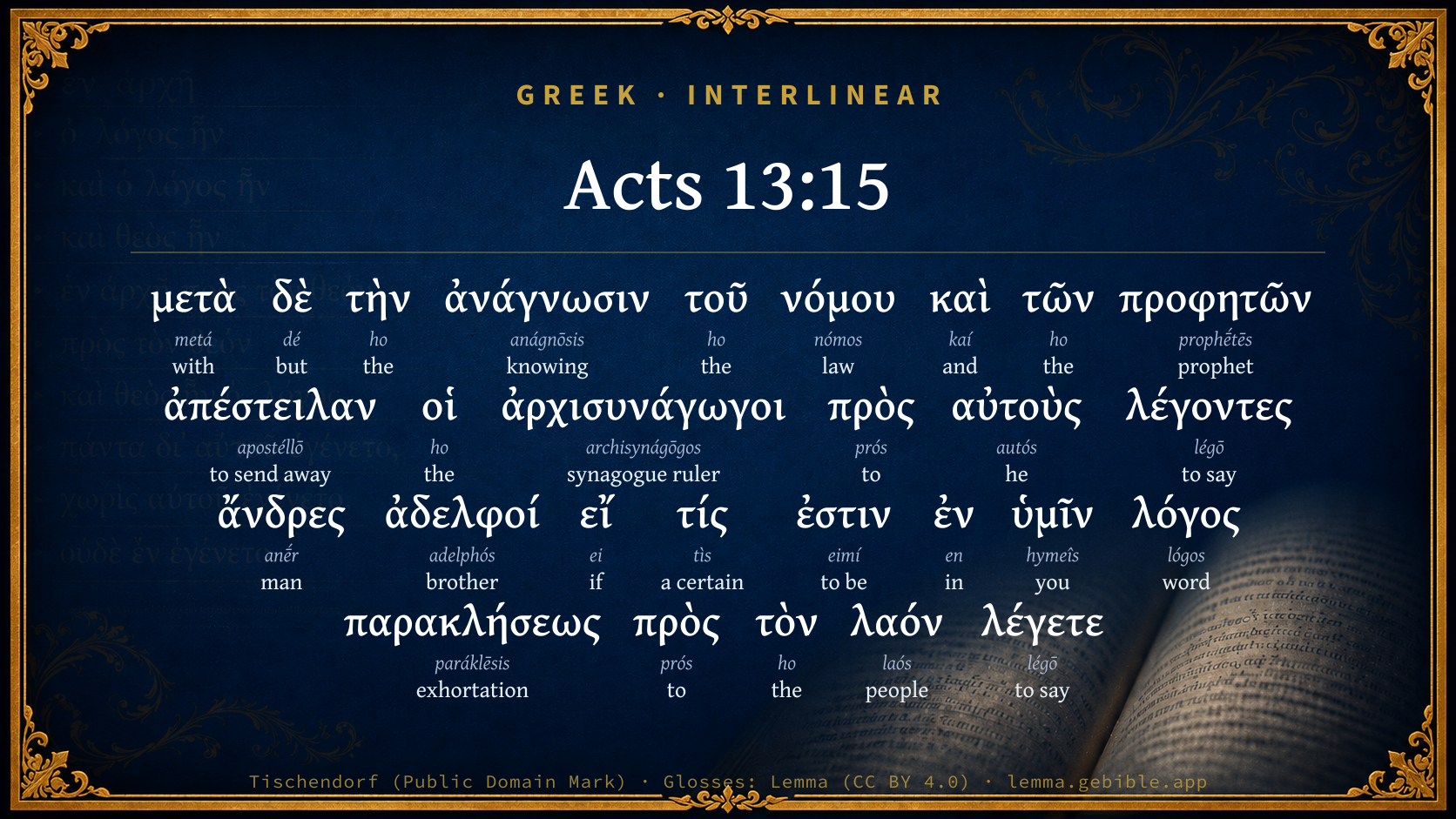
Greek (Tischendorf 8th ed.) Acts 13:15 appears in the Greek New Testament. The text above is from the Tischendorf 8th edition. Each word links to its Strong’s number and a concise gloss. Click any word for its full Thayer’s Greek Lexicon entry.
Download image
Cite this verse

Acts 13:15 (World English Bible). Public Domain. Lemma interlinear Bible study tool, https://lemma.gebible.app/v/acts/13/15.

Show BibTeX & RIS
BibTeX
RIS
English Translation
After the reading of the law and the prophets, the rulers of the synagogue sent to them, saying, "Brothers, if you have any word of exhortation for the people, speak."
World English Bible · Public Domain
Highlights
  • 1 first appearance in the Greek New Testament
Full analysis ↓
Download a study sheet

One document with this verse’s original text, its word-by-word gloss line, the meaning frame, cross-references with their text, attributed commentary, and full source and license credits — printable, and it pastes into notes with its structure intact.

This verse Autodidact and up

Study sheet (.html) Plain text (.txt)

A passage Seminary Student

Up to 50 verses in one chapter. A passage sheet keeps up to 6 commentary sources and 12 cross-references per verse, in the order this page ranks them, and says so on the sheet whenever that leaves anything out. Ask for a single verse and you get the Autodidact verse sheet above.

Everything on this page stays free to read, with no account — the sheet is a download of what is already on screen, not access to it.

Want to remove ads? Support Godless Engineer
Compare translations 3

The same verse in 3 English versions, stacked beneath the original-language interlinear above. Click any original word for its lexicon entry.

Each is an independent rendering of the whole verse — the interlinear is not word-aligned to these translations.

Highlighted words mark where these versions differ — a whole-verse word diff, not a word-by-word alignment.

  • World English Bible Public Domain
    After the reading of the law and the prophets, the rulers of the synagogue sent to them, saying, "Brothers, if you have any word of exhortation for the people, speak."
  • King James Version Public Domain
    And after the reading of the law and the prophets the rulers of the synagogue sent unto them, saying, Ye men and brethren, if ye have any word of exhortation for the people, say on.
  • unfoldingWord Literal Text CC BY-SA 4.0
    And after the reading of the Law and the Prophets, the synagogue leaders sent to them, saying, “Men, brothers, if any word of exhortation for the people is in you, speak.”

unfoldingWord Literal Text — © unfoldingWord, licensed CC BY-SA 4.0. Word-aligned USFM3 via Door43 (git.door43.org/unfoldingWord/en_ult).

Versions to compare (up to 4)

3 of 4 selected

Show all 19 translations

Every available English version of this verse, each an independent rendering of the whole verse.

  • World English Bible Public Domain
    After the reading of the law and the prophets, the rulers of the synagogue sent to them, saying, "Brothers, if you have any word of exhortation for the people, speak."
  • Berean Standard Bible Public Domain
    After the reading from the Law and the Prophets, the synagogue leaders sent word to them: “Brothers, if you have a word of encouragement for the people, please speak.”
  • Majority Standard Bible Public Domain
    After the reading from the Law and the Prophets, the synagogue leaders sent word to them: “Brothers, if you have a word of encouragement for the people, please speak.”
  • King James Version Public Domain
    And after the reading of the law and the prophets the rulers of the synagogue sent unto them, saying, Ye men and brethren, if ye have any word of exhortation for the people, say on.
  • American Standard Version (1901) Public Domain
    And after the reading of the law and the prophets the rulers of the synagogue sent unto them, saying, Brethren, if ye have any word of exhortation for the people, say on.
  • Revised Version (1885) Public Domain
    And after the reading of the law and the prophets the rulers of the synagogue sent unto them, saying, Brethren, if ye have any word of exhortation for the people, say on.
  • Geneva Bible (1599) Public Domain
    And after the lecture of the Law and Prophets, the rulers of ye Synagogue sent vnto them, saying, Ye men and brethren, if ye haue any word of exhortation for the people, say on.
  • Douay-Rheims (1899) Public Domain
    And after the reading of the law and the prophets, the rulers of the synagogue sent to them, saying: Ye men, brethren, if you have any word of exhortation to make to the people, speak.
  • Young's Literal Translation Public Domain
    and after the reading of the law and of the prophets, the chief men of the synagogue sent unto them, saying, `Men, brethren, if there be a word in you of exhortation unto the people -- say on.'
  • Literal Standard Version CC BY-SA 4.0
    and after the reading of the Law and of the Prophets, the chief men of the synagogue sent to them, saying, “Men, brothers, if there be a word in you of exhortation to the people—say on.”
  • Unlocked Literal Bible CC BY-SA 4.0
    After the reading of the law and the prophets, the leaders of the synagogue sent them a message saying, “Brothers, if you have any message of encouragement for the people here, say it.”
  • unfoldingWord Literal Text CC BY-SA 4.0
    And after the reading of the Law and the Prophets, the synagogue leaders sent to them, saying, “Men, brothers, if any word of exhortation for the people is in you, speak.”
  • Darby Bible Public Domain
    And after the reading of the law and the prophets, the rulers of the synagogue sent to them, saying, Brethren, if ye have any word of exhortation to the people, speak.
  • World Messianic Bible Public Domain
    After the reading of the Torah and the Prophets, the rulers of the synagogue sent to them, saying, “Brothers, if you have any word of exhortation for the people, speak.”
  • Webster's Bible Public Domain
    And after the reading of the law and the prophets, the rulers of the synagogue sent to them, saying, Men, brethren, if ye have any word of exhortation for the people, speak.
  • Free Bible Version CC BY-SA 4.0
    After the readings from the Law and the Prophets, the synagogue leaders sent them a message saying, “Brothers, please share with the congregation any words of encouragement you may have.”
  • Bible in Basic English Public Domain
    And after the reading of the law and the prophets, the rulers of the Synagogue sent to them, saying, Brothers, if you have a word of comfort for the people, say on.
  • Text-Critical English NT CC BY 4.0
    After the reading of the Law and the Prophets, the rulers of the synagogue sent them a message, saying, “Brothers, if you have any word of exhortation for the people, speak it.”
  • Tyndale New Testament (1534) Public Domain
    And after the lawe and the Prophetes were redde the rulers of the synagoge sent vnto them sayinge: Ye men and brethren yf ye have eny sermon to exhorte ye people saye on.

Literal Standard Version (2020), Covenant Press — licensed CC BY-SA 4.0. Text via the HelloAO Bible API (eBible.org). Unlocked Literal Bible (unfoldingWord) — licensed CC BY-SA 4.0. Text via the HelloAO Bible API (eBible.org). unfoldingWord Literal Text — © unfoldingWord, licensed CC BY-SA 4.0. Word-aligned USFM3 via Door43 (git.door43.org/unfoldingWord/en_ult). Free Bible Version, Dr. Jonathan Gallagher — licensed CC BY-SA 4.0. Text via the HelloAO Bible API (eBible.org).

Word by word

More ways to search: Search by grammar → Find every occurrence → Compare this word →

Practice this passage: Drill this verse → Learn its vocabulary →

ἀνάγνωσιν
anágnōsis
G320
“knowing”
Noun, Accusative, Singular, Feminine
Part of Speech
Noun
Case
Accusative
Number
Singular
Gender
Feminine
Full Thayer's Definition

Origin: from G314

TDNT: 06:43,6

1. knowing a. a knowing again, owning b. reading
  1. μετὰ metá G3326 “with” Preposition
  2. δὲ dé G1161 “but” Conjunction
  3. τὴν ho G3588 “the” Article, Accusative, Singular, Feminine
  4. τοῦ ho G3588 “the” Article, Genitive, Singular, Masculine
  5. νόμου nómos G3551 “law” Noun, Genitive, Singular, Masculine
  6. καὶ kaí G2532 “and” Conjunction
  7. τῶν ho G3588 “the” Article, Genitive, Plural, Masculine
  8. προφητῶν prophḗtēs G4396 “prophet” Noun, Genitive, Plural, Masculine
  9. ἀπέστειλαν apostéllō G649 “to send away” Verb, Aorist, Active, Indicative, 3rd person, Plural
  10. οἱ ho G3588 “the” Article, Nominative, Plural, Masculine
  11. ἀρχισυνάγωγοι archisynágōgos G752 “synagogue ruler” Noun, Nominative, Plural, Masculine
  12. πρὸς prós G4314 “to” Preposition
  13. αὐτοὺς autós G846 “he” Personal pronoun, Accusative, Plural, Masculine
  14. λέγοντες légō G3004 “to say” Verb, Present, Active, Participle, Nominative, Plural, Masculine
  15. ἄνδρες anḗr G435 “man” Noun, Vocative, Plural, Masculine
  16. ἀδελφοί adelphós G80 “brother” Noun, Vocative, Plural, Masculine
  17. εἴ ei G1487 “if” Conditional
  18. τίς tìs G5100 “a certain” Indefinite pronoun, Nominative, Singular, Masculine
  19. ἐστιν eimí G1510 “to be” Verb, Present, Active, Indicative, 3rd person, Singular
  20. ἐν en G1722 “in” Preposition
  21. ὑμῖν hymeîs G5210 “you” Personal pronoun, 2nd person, Dative, Plural
  22. λόγος lógos G3056 “word” Noun, Nominative, Singular, Masculine
  23. παρακλήσεως paráklēsis G3874 “exhortation” Noun, Genitive, Singular, Feminine
  24. πρὸς prós G4314 “to” Preposition
  25. τὸν ho G3588 “the” Article, Accusative, Singular, Masculine
  26. λαόν laós G2992 “people” Noun, Accusative, Singular, Masculine
  27. λέγετε légō G3004 “to say” Verb, Present, Active, Imperative, 2nd person, Plural

About this verse

These counts appear in no published source. They are computed here, from the morphology-tagged text and Lemma’s own curated glosses. What Lemma adds →

28
words
22
distinct lemmas
Acts
section

Notable vocabulary

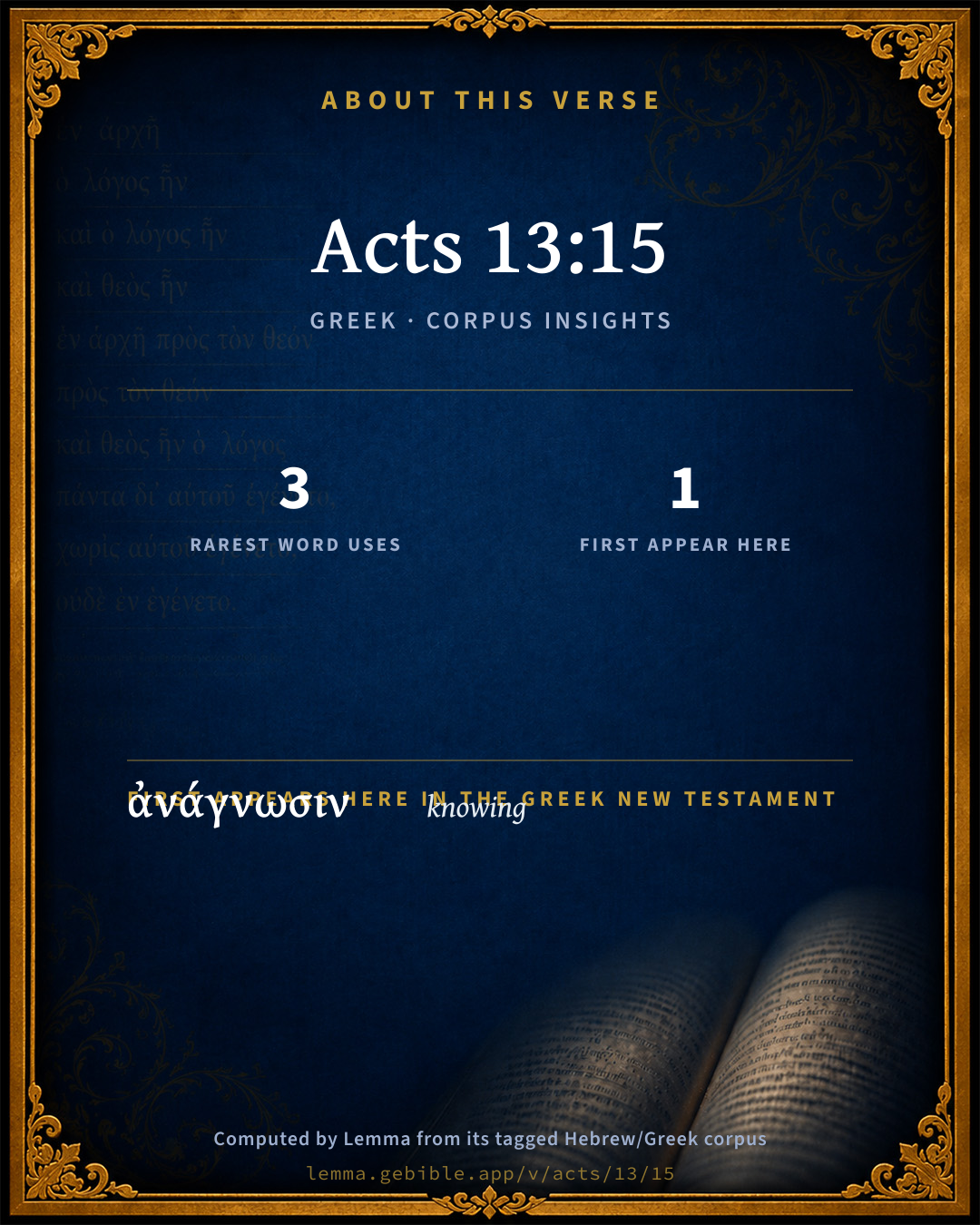
The rarest word here is ἀνάγνωσιν knowing G320 — appearing just 3 times in the whole Greek New Testament.

First appearance in Scripture

This word makes its first canonical appearance in the Greek New Testament here:

  • ἀνάγνωσιν knowing G320

Shared distinctive vocabulary

ἀνάγνωσιν knowing G320 occurs in 3 verses of the Greek New Testament. Also found in:
Repetition

Words recur within this verse:

  • λέγοντες to say G3004 ×2
  • τὴν the G3588 ×5
  • πρὸς to G4314 ×2

Cross-references

18

Topical passages linked to Acts 13:15 in the Treasury of Scripture Knowledge — connected by theme and wording, ordered by reader-vote popularity; previews shown in the World English Bible.

  • Hebrews 13:22 But I exhort you, brothers, endure the word of exhortation, for I have written to you in few words.
  • Acts 15:21 For Moses from generations of old has in every city those who preach him, being read in the synagogues every Sabbath."
  • Mark 5:22 Behold, one of the rulers of the synagogue, Jairus by name, came; and seeing him, he fell at his feet,
  • Luke 4:16–18 He came to Nazareth, where he had been brought up. He entered, as was his custom, into the synagogue on the Sabbath day, and stood up to read.
  • Acts 13:27 For those who dwell in Jerusalem, and their rulers, because they didn't know him, nor the voices of the prophets which are read every Sabbath, fulfilled them by condemning him.
  • Acts 18:17 Then all the Greeks laid hold on Sosthenes, the ruler of the synagogue, and beat him before the judgment seat. Gallio didn't care about any of these things.
  • Acts 22:1 "Brothers and fathers, listen to the defense which I now make to you."
  • Romans 12:8 or he who exhorts, to his exhorting: he who gives, let him do it with liberality; he who rules, with diligence; he who shows mercy, with cheerfulness.
  • 1 Corinthians 14:3 But he who prophesies speaks to men for their edification, exhortation, and consolation.
  • Luke 16:16 The law and the prophets were until John. From that time the Gospel of the Kingdom of God is preached, and everyone is forcing his way into it.
  • Acts 1:16 "Brothers, it was necessary that this Scripture should be fulfilled, which the Holy Spirit spoke before by the mouth of David concerning Judas, who was guide to those who took Jesus.
  • Acts 2:4 They were all filled with the Holy Spirit, and began to speak with other languages, as the Spirit gave them the ability to speak.
  • Acts 2:29 "Brothers, I may tell you freely of the patriarch David, that he both died and was buried, and his tomb is with us to this day.
  • Acts 2:37 Now when they heard this, they were cut to the heart, and said to Peter and the rest of the apostles, "Brothers, what shall we do?"
  • Acts 7:2 He said, "Brothers and fathers, listen. The God of glory appeared to our father Abraham, when he was in Mesopotamia, before he lived in Haran,
  • Acts 15:7 When there had been much discussion, Peter rose up and said to them, "Brothers, you know that a good while ago God made choice among you, that by my mouth the Gentiles should hear the word of the Gospel, and believe.
  • Acts 18:8 Crispus, the ruler of the synagogue, believed in the Lord with all his house. Many of the Corinthians, when they heard, believed and were baptized.
  • Acts 20:2 When he had gone through those parts, and had encouraged them with many words, he came into Greece.

Cross-references courtesy of OpenBible.info (CC BY 4.0).

Commentary

Notes on Acts 13:15 from classic Christian and Jewish commentators (each source and its license shown beneath its notes). The classic Christian expositions comment on the surrounding passage and are grouped to its opening verse, so a note may address several verses; the Jewish commentaries on the Tanakh (Rashi and others) are per-verse, so they appear only where the commentator wrote on this verse.

Lemma curates 59 commentaries, every one of them public domain or Creative Commons licensed, each selected and text-cleaned for this edition rather than reprinted as found. About our sources →

Tyndale Open Study Notes

Tyndale Open Resources

13:15 After the usual Scriptures for the day had been read, one from the books of Moses and the other from the prophets (see Luke 4:16-28), the officials of the synagogue invited the visitors to speak any word of encouragement for the people.

Tyndale Open Study Notes — © Tyndale Open Resources, licensed CC BY-SA 4.0. Text via the HelloAO Bible API.

Bengel's Gnomon

Johann Albrecht Bengel

Act 13:15. Τὴν ἀνάγνωσιν, the reading) the customary reading, whereby Moses’ writings used to be read through on the Sabbaths in the course of the year; and readings (lessons) in the earlier and latter prophets, consonant with the Mosaic lessons, used to be subjoined. “Elias in Thisbi, upon the word פטה [from which the lessons are called Haphtara], shows that the reading of the prophets arose after the times of Antiochus Epiphanes, and not earlier, when the reading of the law was openly and severely forbidden; but that it was retained subsequently.”—L. de Dieu.—οι ἀρχισυνάγωγοι, the rulers of the synagogue) who kept themselves (had their place) in a different part of the synagogue. The several synagogues had a ruler for each: therefore the term in this place is taken in a wider sense, as ἀρχιερεῖς in the plural. See Rhenferd. op. philol. p. 430.—εἰ ἔστι, if there be, if ye have any) It is not all who are the fit persons to speak, nor at all times. [And it is in no small degree truly conducive to edification, when the province of discussing a subject is always committed to those, to whom it is most seasonable (fit) to commit it, and that too with the understanding, that these very persons are not to proceed further than so long as their speech flows freely. When the condition of the Church at the time is poor (when there are few, if any, possessing the word of edification), it is right that God should be implored in prayer, that He would deign to come to the relief of man’s need.—V. g.] This pair of men never wanted words to speak.—ἐν ὑμῖν, among you) It may have been already made evident, by various indications, that they were fit persons to speak.—παρακλήσεως, of exhortation) from which the name Barnabas is derived [= Son of paraclesis, consolation, or exhortation, ch. Act 4:36].

Bengel's Gnomon of the New Testament — English translation (T&T Clark, Edinburgh, 1860) — public domain. Text from a community e-Sword module.

Expositor's Greek Testament

ed. W. Robertson Nicoll

Act 13:15 . τὴν ἀνάγ . τοῦ ν . καὶ τῶν π .: the first and second lesson, Edersheim, u. s. , p. 278, History of the Jewish Nation , p. 443; Schürer, Jewish People , div. ii., vol. ii., p. 79 ff., E.T., the first from the Pentateuch, and the second a paragraph from the Prophets, including the older historical books. As there is no evidence that the lectionary of the Prophets existed in the time of our Lord, it is precarious to attempt to fix the particular Sabbath for St. Paul’s address. It is however significant that he uses two remarkable words from the LXX, Deu 1:31 : ἐτροφ . (see critical notes), in Act 13:18 , and from Isa 1:2 : ὕψωσεν in Act 13:17 , and that in the present table of Jewish lessons that from the Law for the forty-fourth Sabbath in the year is Deu 1:1 to Deu 3:22 , while the corresponding lesson from the Prophets is Isa 1:1-22 ; see Bengel on Act 13:18 , and Farrar, St. Paul , i., pp. 368, 369; Plumptre, in loco. But we cannot safely go beyond the view of Ramsay, St. Paul , p. 100, who points out that the present list of Jewish lessons is of decidedly later origin, but adds that “probably it was often determined by older custom and traditional ideas of suitable accompaniment”. ἀπέστειλαν : the words seem hardly consistent with Lumby’s view that St. Paul was himself the Haphtarist. οἱ ἀρχισυνάγωγοι ; generally only one, Luk 13:14 , but cf. Mar 5:22 (Weiss, in loco ), and the passage before us; the office was specially concerned with the care of public worship, and the name was given to those who conducted the assemblies for that purpose. They had to guard against anything unfitting taking place in the synagogue (Luk 13:14 ), and to appoint readers and preachers, Schürer, Jewish People , div. ii., vol. ii., p. 65, E.T.; Edersheim, Jewish Social Life , p. 281, and on the present passage, Jesus the Messiah , i. 434, and for the title in inscriptions, Grimm-Thayer, sub v. ; see also below on Act 14:2 . ἄνδρες ἀδελφοί : courteous address, Act 2:37 , “Gentlemen, brethren” (Ramsay).

The Expositor's Greek Testament, edited by W. Robertson Nicoll (1897–1910) — public domain. Text from a community e-Sword module.

Geneva Bible (1599)

Geneva Bible translators

In the Synagogue of the Jews (according to the pattern whereof Christian Congregations were instituted) first the Scriptures were read, then such as were learned were licensed by the rulers of the Synagogue to speak and expound.

Word for word, If there be any word in you: and this is a kind of speech taken from the Hebrews, whereby is meant, that the gifts of God’s grace are in us, as it were in treasure houses, and that they are not ours, but God’s: In like sort saith David, Thou hast put a new song in my mouth, Ps. 40:1.

Geneva Bible (1599) marginal notes — public domain. Text via Bolls.life.

Jamieson, Fausset & Brown

Robert Jamieson, A. R. Fausset & David Brown

Then Paul stood up, and beckoning with his hand--as was his manner on such occasions (Act 21:40; and see Act 26:1).

Men of Israel, and ye that fear God--by the latter expression meaning religious proselytes, who united with the Jews in all acts of ordinary worship.

and exalted the people when they dwelt as strangers in Egypt--by marvellous interpositions for them in their deepest depression.

Jamieson, Fausset & Brown — Commentary Critical and Explanatory on the Whole Bible (1871) — public domain (CC PDM 1.0). Text via the HelloAO Bible API.

Adam Clarke's Commentary

Verse 15. After the reading of the law and the prophets] A certain portion of the law and another of the prophets, was read every Sabbath; and the law was so divided as to be read over once every year. In the notes at the conclusion of Deuteronomy, I have considered this subject at large, and given a complete table of the Parashoth, sections of the law, and Haphtaroth, sections of the prophets, which are read every Sabbath in the year in the Jewish synagogues. To have an exact view of every part of the Jewish ecclesiastical economy, the reader will do well to consult the above mentioned table, and those which follow it: they have been drawn up with great care, attention, and indescribable labour.

It has been a question, in what language were the law and prophets read in a synagogue of Pisidia, for in that district Strabo informs us that four languages were spoken, viz. the Pisidian, the Solyman, the Greek, and the Lydian. Dr. Lightfoot conjectures, with great probability, that the Scriptures were read in the original Hebrew; and that an interpreter tendered the reading to the people in their mother tongue. There is no doubt that the Jews and proselytes understood the Greek tongue well; and they certainly had the Septuagint version among them.

The rulers of the synagogue] These were the persons whose business it was to read the appointed sections, and to take care of the synagogue and its concerns; and to see that all was done decently and in order.

Sent unto them] Seeing them to be Jews, they wished them to give some suitable address to the people, i.e. to the Jews who were then engaged in Divine worship; for the whole of the following discourse, which greatly resembles that of St. Stephen, Ac 7:1-53, is directed to the Jews alone; and this was probably spoken either in Hebrew or Greek.

Ye men and brethren] ανδρες αδελφοι, Men brethren, a Hebraism for, "Ye men who are our brethren," i.e. Jews, as we ourselves are; but ανδρες is often an expletive, as we have already seen. See Clarke on Ac 7:2.

If ye have any word of exhortation] ει εστι λογος εν υμιν παρακλησεως. If ye have any subject of consolation, any word of comfort to us, who are sojourners in this strange land, speak it. The Consolation of Israel was an epithet of the Messiah among the Jews; and it is probable that it was in reference to him that the rulers of the synagogue spoke. That παρακλησις is to be understood here as meaning consolation, and this in reference to the Messiah, the whole of the following discourse will prove to the attentive reader; in which Paul shows the care and protection of God towards his people Israel, and the abundant provision he had made for their salvation by Jesus Christ. They wished for consolation, and he declared unto them glad tidings, and many felt the power and comfort of the doctrine of the cross.

Adam Clarke's Commentary on the Bible (1810–1826) — public domain. Text from a community e-Sword/MySword module.

John Calvin's Commentaries

15. After the lecture [reading] of the law. There is no mention made of prayers, and yet, undoubtedly, they were not omitted or foreslowed, [neglected;] but because Luke did intend to set down the sermon made there by Paul, no marvel if he reckon up those things only which did belong unto the order of teaching. And this is a notable place, out of which we learn after what sort they handled doctrine at that time among the Jews. The law and the prophets had the first place; because there must nothing be set before the Church which was not drawn out of that fountain. Also we gather by this that the Scripture was not suppressed among a few, but that both one and other were admitted to the reading thereof, afterward those who were able, and had the grace to teach and exhort, had the second place, as interpreters of the Scripture which was read. Notwithstanding Luke showeth, last of all, that every one was not suffered to speak, lest confusion should arise by liberty; but the office of exhorting was committed to certain men, whom he calleth rulers of the synagogue, or masters. Therefore Paul and Barnabas begin not forthwith to speak, lest they disturb the accustomed order with too much haste; but they do modestly stay till they have liberty granted them to speak, and that with their leave who had authority by public consent. We know how corrupt the state of that people was then; and Luke will at length declare, in the end of the chapter, that these men of Antioch were too stout and stubborn in receiving the grace of Christ; and yet there remained this goodness among them, that their assemblies were honestly and decently governed; for which cause such evil favored confusion is so much the more shame fill which is seen at this day among those who will be counted Christians. The Papists do indeed sing the Scriptures in their churches with shrill and sounding voice, but in an unknown tongue, so that the people reap no fruit thereby. There is seldom any doctrine used; and it were better for the wicked babblers even then to hold their peace, who thrust in their own unclean inventions instead of the Word of God, and pollute with the stink of their impiety whatsoever is holy.

If there be in you? This speech doth signify that what grace soever is in men to edify the Church, it is, as it were, committed to them; although the word in, according to the Hebrew phrase, may be superfluous. Therefore, I stand not greatly upon that, because the sense may be plain, If you have any exhortation which is apt and profitable for the people. An exhortation doth not exclude doctrine. But it seemeth that this word was commonly used among them; because it is properly the office of the teacher to utter no new thing of his own brain, but to apply the Scripture, wherein is comprehended the whole wisdom of the godly, unto the present use of the people. Thus, they do not only teach, but also apply the doctrine which they have elsewhere, unto the edifying of the Church, which I think is meant by the word exhortation.

John Calvin's Commentaries (1540-1563) — public domain. Text from the Calvin Translation Society English edition (1840s-50s) via the Christian Classics Ethereal Library (ccel.org). Calvin's coverage is partial (roughly two-thirds of the Bible); uncommented books and verses are honest gaps, never fabricated. The 19th-century editor's footnotes and remarks are omitted so the notes are faithfully Calvin's own voice.

Ellicott's Commentary for English Readers

(15) After the reading of the law and the prophets.—The order of the Sabbath lessons was fixed as by a kind of calendar, the Law—i.e., the Pentateuch—being divided into fifty-three or fifty-four paraschioth, or sections. These, probably, came into use soon after the return from Babylon. To these were afterwards added special lessons, known technically as the Haphtaroth, from the prophets. We are enabled, by two curious coincidences, to fix, with very little uncertainty, the precise Sabbath on which the mission-work at Antioch opened. The opening words of St. Paul refer to Deu_1:31 (see Note on Act_13:18) and this was the lesson for the forty-fourth Sabbath in the year, which fell in July or August; the corresponding second lesson from the prophets being Isa_1:1-27, from which he also quotes. He starts, as was natural, from what the people had just been listening to, as the text of his discourse.

The rulers of the synagogue sent unto them . . .—The elders apparently saw strangers taking the position of teachers, probably in the garb of Rabbis, and it belonged to their office to offer such persons an opportunity of addressing the people.

A Bible Commentary for English Readers, edited by Charles John Ellicott (1878–1897) — public domain. Text from a community e-Sword module.

The Cambridge Bible for Schools and Colleges

gen. ed. J. J. S. Perowne

15. And after the reading of the law and the prophets] For the better understanding of what was here done, and also at the time when our Lord “stood up for to read” in the synagogue at Nazareth (Luk_4:16), it seems worth while to give a somewhat detailed account of the manner in which the Law and the Prophets are read by the Jews[3].

[3] See Excursus at the end of the Chapter.

the rulers of the synagogue sent unto them] They having the control of the arrangements for calling up readers and preachers.

Ye men and brethren] Read “Brethren,” see Act_1:16.

if ye have any word of exhortation for the people] Barnabas was called (Act_4:36) “Son of exhortation,” where there is the same word in the original as here. The purport of the “word of exhortation” is well seen in Heb_13:22, where the writer calls his whole Epistle by that name.

The Cambridge Bible for Schools and Colleges (gen. ed. J. J. S. Perowne; Cambridge University Press, 1878–1918) — public domain. Text from a community e-Sword module.

John Gill's Exposition

And after the reading of the law and the prophets,.... Which was done every sabbath day, Act 15:21 The five books of Moses, which are meant by the law, were divided into sections: Genesis was divided into twelve, Exodus into eleven, Leviticus into ten, Numbers into ten, and Deuteronomy into ten, which in all make fifty three sections: and so by reading one on each sabbath, and two on one day, they read through the whole law in the course of a year, and which they finished at the close of the feast of tabernacles; and that day was called "the rejoicing of the law"; it was a day of rejoicing, that the law was read through. Some make fifty four sections, and then two of them must be read together, on two sabbath days, to finish the whole in the year. In some synagogues the section was divided into three parts, and so they finished the law in three years; but this custom was less common (p). The custom of reading the law, the Jews say, was one hundred and seventy years before the time of Jesus Christ; though some say the division of the law, into sections, was made by Ezra; and others refer it to Moses himself: it is certain it obtained in the times of Christ and his apostles, as did also the reading of the prophets, and which was introduced in this way, and upon this account. When Antiochus Epiphanes burnt the book of the law, and forbad the reading of it, the Jews in the room of it selected some passages out of the prophets, which they thought came nearest in words and sense to the sections of the law, and read them in their stead; and when the law was restored again, they still continued the reading of the prophetic sections; and the section for the day was called "the dismission", because usually the people were dismissed upon it, unless anyone stood up, and preached or expounded the word of God unto the people: hence the following message and address to the apostles,

the rulers of the synagogue sent unto them; that is, those who were the principal men in the synagogue, the ruler of it, together with the elders; for there was but one ruler in a synagogue; See Gill on Mat 9:18 though there were more elders; and so the Syriac version here renders it, "the elders of the synagogue"; but it may be asked, why should they send to the apostles? how did they know that they were teachers, being strangers? this they might conclude from their outward appearance, their gravity and solidity; for as for habit or dress there was no distinction; or from their sitting down when they came into the synagogue, which was the custom of teachers; or they might have had some knowledge of them, and conversation with them, before they came into the synagogue; for it cannot be reasonably thought that they admitted anyone, whether they knew him or not, to teach in their synagogues:

saying, ye men and brethren: which was the common style of the Jews, they used in addresses, and especially to their own countrymen, as they might perceive Paul and Barnabas were; see Act 2:29.

if ye have any word of exhortation for the people, say on; the sense is, if they were prepared to preach, or had anything upon their minds to say to the people; or if they had, as it is in the original text, "any word of exhortation or comfort" in them, as they had indeed a rich treasure in their earthen vessels, they had leave and liberty to speak it to the people. "A word of exhortation" designs any doctrine that might be for instruction and comfort, and this was agreeably to the practice of the Jews. For it is said (q).

"on the sabbath day, , "they preach a sermon", or expound to housekeepers (or masters of families), who are employed in business all the days of the week; and in the midst of the sermon they teach them the traditions, concerning what is forbidden, and what is lawful; and it is better for them to hear than to read in the Hagiographa;''

which books they did not read publicly, as is said in the same place, only the law and the prophets; with the latter of which they dismissed the people, unless a sermon was preached; and which, when done, was chiefly for the sake of the common people, men and women: and it is said (r), that

"the women, and the people of the earth (or the common people), come to hear the sermon, and the preachers ought to draw out their hearts;''

speak out their whole mind, and deliver all they know that may be instructive and profitable.

(p) Maimon. Hilchot Tephilla, c. 13. sect. 1. Benjamin Itinerar. p. 114, 115. (q) Gloss. in T. Bab. Sabbat, fol. 115. 1. (r) Ib. fol. 30. 2.

John Gill's Exposition of the Whole Bible (1746–1763) — public domain (CC PDM 1.0). Text via the HelloAO Bible API.

Trapp's Complete Commentary

John Trapp

15 And after the reading of the law and the prophets the rulers of the synagogue sent unto them, saying, Ye men and brethren, if ye have any word of exhortation for the people, say on.

Ver. 15. And after the reading] In the synagogues, the Scripture was first read, and then opened and applied; so it ought to be in the Christian churches.

If ye have any word of exhortation] {See Trapp on "Act 9:15"}

John Trapp, A Commentary or Exposition upon All the Books of the Old and New Testament (1647–1656) — public domain. Text from a community e-Sword module.

Albert Barnes' Notes on the Bible

And after the reading of the law and the prophets - See notes on Luk 4:16.

The rulers of the synagogue - Those were persons who had the general charge of the synagogue and its service, to keep everything in order, and to direct the affairs of public worship. They designated the individuals who were to read the Law; and called on those whom they pleased to address the people, and had the power also of inflicting punishment, and of excommunicating, etc. (Schleusner), Mar 5:22, Mar 5:35-36, Mar 5:38; Luk 8:49; Luk 13:14; Act 18:8, Act 18:17. Seeing that Paul and Barnabas were Jews, though strangers, they sent to them, supposing it probable that they would wish to address their brethren.

Men and brethren - An affectionate manner of commencing a discourse, recognizing them as their own countrymen, and as originally of the same religion.

Say on - Greek: “speak!”

Albert Barnes' Notes on the Bible (1834–1885) — public domain. Text from a community e-Sword/MySword module.

Matthew Poole's English Annotations

The reading of the law was commanded by Moses; and they say that Ezra commanded the reading of the prophets also in their synagogues, which was used, as we may see in Act 13:27; and so divided into several sections, that once a year they might be all read over.

The rulers of the synagogue; they were such as had the oversight of this service of God in their synagogues, that it might be performed according to the prescription.

Men and brethren; a usual compellation which the Jews gave one another, owning them to serve the same God, and professing a suitable respect for them.

If ye have any word of exhortation for the people, say on; after the reading before spoken of, there followed a sermon, or exhortation; which the apostles are desired to make, the rulers of the synagogue, as it is supposed, having had some previous knowledge of them.

Matthew Poole's English Annotations on the Holy Bible (1683–1685) — public domain. Text from a community e-Sword/MySword module.

Whedon's Commentary on the Bible

Daniel D. Whedon

15. Sent unto them—As strangers of Jewish features, pious demeanour, and intellectual expression.

Men and brethren—Literally, men-brethren, or simply brethren.

Word of exhortation—Or consolation. For with Israel in her history of sorrows, consolation and exhortation were the same word. And by that same word, consolation of Israel, (Luk_2:25,) was the Messiah designated. When Paul, therefore, unfolded the Messiah to their view, he very suitably responded to their courteous, we might almost say Christian, invitation.

Daniel D. Whedon (gen. ed.), Commentary on the Old and New Testaments (1874–1909) — public domain. Text from a community e-Sword module.

The Pulpit Commentary

Brethren for ye men and brethren, A.V. The order of the synagogue service was first the prayers, read by the Sheliach, or angel of the synagogue, the people standing. Then came the reading of the Law in Hebrew by the reader, and the interpretation by the interpreter, who, outside of Judaea, generally used the version of the LXX This reading, or lesson, was called the Parashah. Next came the reading and interpreting of the prophets, called the Haphtorah, either by the regular reader or by any one invited by the ruler of the synagogue. (Luk_4:16, Luk_4:17) Then came the Midrash, the exposition or sermon, which Paul undertook at the invitation of the ruler of the synagogue. Our Lord at Nazareth seems to have delivered the Midrash sitting; (Luk_4:20) here St. Paul stands (ver. 16).

The Pulpit Commentary (1880–1919), ed. H.D.M. Spence-Jones & Joseph S. Exell — public domain. Text from a community e-Sword module.

John Wesley's Explanatory Notes

And after the reading of the law and the prophets, the chief of the synagogue sent to them - The law was read over once every year, a portion of it every Sabbath: to which was added a lesson taken out of the prophets. After this was over, any one might speak to the people, on any subject he thought convenient. Yet it was a circumstance of decency which Paul and Barnabas would hardly omit, to acquaint the rulers with their desire of doing it: probably by some message before the service began.

John Wesley, Explanatory Notes Upon the Whole Bible (1754–1765) — public domain. Text via the GEBible commentary corpus.

Godbey's Commentary on the New Testament

William B. Godbey

15-21. They constantly everywhere make free to attend the Jewish synagogues on the Sabbath, preaching on the streets and from house to house through the week. Hence they go in and sit in the audience, by physique and costume recognized as Jews by the entire audience. Having passed through the routine of Sabbath service, the leader sends a person back to invite them to speak freely as the Lord will. Thus Paul proceeds with a historic sermon on the plan of salvation in the former dispensation, culminating in the fulfillment of all the types, symbols and ceremonies in Jesus of Nazareth, whom he preaches to them as the veritable Shiloh of prophecy and the Christ.

William B. Godbey, Commentary on the New Testament (1896–1900) — public domain. Text from a community e-Sword module.

McGarvey & Pendleton's Commentaries

J. W. McGarvey

See notes one verse 14

J. W. McGarvey (with Philip Y. Pendleton), Commentaries on the New Testament (The Fourfold Gospel, 1914; Acts; and the epistles) — public domain. Text from a community e-Sword/MySword module.

The People's New Testament

B. W. Johnson

15. After the reading. In the synagogue worship the reading of the Scriptures made a very important part. As copies of the Scriptures were very rare, this reading was necessary to convey scriptural instruction to the people. They were read in course, two lessons each Sabbath, one from the five books of Moses, the other from the other books of the Old Testament. Plumptre insists that we are enabled by two curious coincidences to fix, with very little uncertainty, the precise Sabbath on which the mission work at Antioch opened. The opening words of Paul refer to Deut. 1:31, and this was the lesson for the forty-fourth Sabbath in the year, which fell in July or August; the corresponding second lesson from the prophets being Isa. 1:1–27, from which he also quotes. He starts, as was natural, from what the people had just been listening to, as the text of his discourse. The rulers of the synagogue. The synagogue was governed by a board of elders.

B. W. Johnson's The People's New Testament with Notes (1889–1891) — public domain. Electronic text from the Christian Classics Ethereal Library (CCEL) ThML edition.

Cambridge Greek Testament for Schools and Colleges

15. εἴ τις ἔστιν ἐν υμῖν λόγος with אABC. Vulg. ‘si quis est in vobis sermo.’

15. μετὰ δὲ τὴν ἀνάγνωσιν τοῦ νόμου καὶ τῶν προφητῶν, and after the reading of the Law and the Prophets. Which was a prominent portion of the synagogue-service. For the better understanding of what was here done, and also at the time when our Lord ‘stood up for to read’ in the synagogue at Nazareth (Luk 4:15) it seems worth while to give in detail an account of the manner in which the Scriptures are read in the Jewish synagogues. For this see the Excursus at the end of this chapter.

ἀπέστειλαν οἱ ἀρχισυνάγωγοι πρὸς αὐτούς, the rulers of the synagogue sent unto them. These were the persons who had the control of the arrangements for calling up readers and preachers.

εἴ τις ἔστιν ἐν ὑμῖν λόγος παρακλήσεως, if ye have any word of exhortation. The sense of λόγος παρακλήσεως is well seen from Heb 13:22, where the writer calls his whole epistle by that name. λόγοι παρακλήσεως are spoken of 1Ma 10:24, where the A.V. renders ‘words of encouragement,’ while a similar expression, ἡ ἐν τοῖς ἀγαθοῖς λόγοις παράκλησις (2Ma 15:11), is rendered ‘comfortable and good words.’

Cambridge Greek Testament for Schools and Colleges (Cambridge University Press, 1896; 21 vols, various authors incl. Carr, Maclear, Plummer, Farrar, Lumby, Moule, M. R. James, Simcox) — public domain. Text from a community e-Sword module.

Alford’s Greek Testament

Henry Alford

15.] The divisions of the law and prophets at present in use among the Jews were probably not yet arranged. Before the time of Antiochus Epiphanes, the Law only was read in the synagogues: but, this having been forbidden by him, the Prophets were substituted:—and, when the Maccabees restored the reading of the Law, that of the prophets continued as well.

ἀπέστειλαν] Then they were not sitting in the πρωτοκαθεδρίαι, Mat 23:6, but somewhere among the congregation. The message was probably sent to them as having previously to this taught in the city, and thus being known to have come for that purpose. See, as illustrating our narrative, Luk 4:17 ff. and notes.

Henry Alford, The Greek Testament (1849–1861) — public domain. Text from a community e-Sword module.

Vincent's Word Studies in the New Testament

Marvin R. Vincent

Exhortation. See on ch. Act 9:31.

Marvin R. Vincent, Word Studies in the New Testament (1887–1900) — public domain. Text from a community e-Sword/MySword module.

Lesson kit

Teaching starters — assembled from the data on this page, not authored interpretation. Every prompt links to the verse data it draws on. Edit before teaching.

Acts, in the Acts, opens this verse with 28 words (22 distinct Greek lemmas). Its most distinctive word is anágnōsis (“knowing”). A historical commentator’s framing appears above. Read the whole chapter for the surrounding context.

Discussion questions

  1. What does “knowing” (anágnōsis) contribute to the verse as a whole?
  2. This is the first place “knowing” appears in Scripture (first appears here). What does its debut here establish?
  3. How does 2 Corinthians 3:14, which shares the word «knowing», read alongside this verse?
  4. What does the repetition of “to say” (2× in this one verse) do in this verse?
  5. These translations render this verse differently. What is at stake in choosing one wording over another?
  6. Compare how Tyndale Open Study Notes and Bengel's Gnomon read this verse. Where do they agree or differ?

Things to notice

  • 1 word makes its first canonical appearance in Scripture here.
  • These translations choose different wording for 9 words in this verse.
  • “to say” occurs 2× in this single verse.
  • 22 distinct Greek lemmas span 28 words in this verse.

Reading settings

Reading text

Shown beneath each verse's original-language words.

Old Testament
Old Testament edition

Read the OT as the Masoretic Hebrew (MT) or the Greek Septuagint (LXX).

English shown for the Greek Septuagint (in the Hebrew ↔ Greek comparison).

Comparing translations? Open the Compare panel on any verse page to stack up to four side by side.