1 Corinthians 14:6

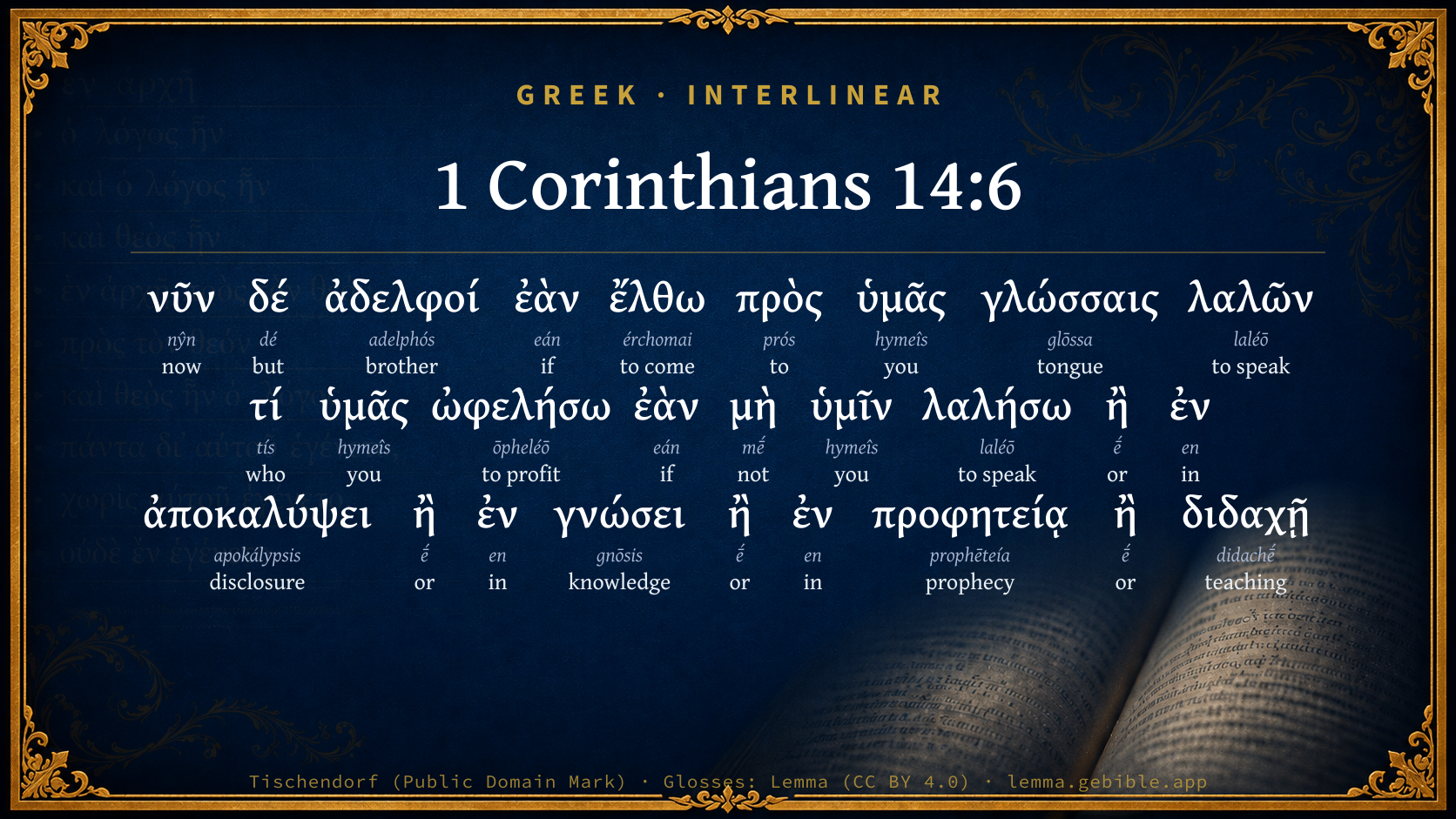
Greek (Tischendorf 8th ed.) 1 Corinthians 14:6 appears in the Greek New Testament. The text above is from the Tischendorf 8th edition. Each word links to its Strong’s number and a concise gloss. Click any word for its full Thayer’s Greek Lexicon entry.
Download image
Cite this verse

1 Corinthians 14:6 (World English Bible). Public Domain. Lemma interlinear Bible study tool, https://lemma.gebible.app/v/1-corinthians/14/6.

Show BibTeX & RIS
BibTeX
RIS
English Translation
But now, brothers, if I come to you speaking with other languages, what would I profit you, unless I speak to you either by way of revelation, or of knowledge, or of prophesying, or of teaching?
World English Bible · Public Domain
Download a study sheet

One document with this verse’s original text, its word-by-word gloss line, the meaning frame, cross-references with their text, attributed commentary, and full source and license credits — printable, and it pastes into notes with its structure intact.

This verse Autodidact and up

Study sheet (.html) Plain text (.txt)

A passage Seminary Student

Up to 50 verses in one chapter. A passage sheet keeps up to 6 commentary sources and 12 cross-references per verse, in the order this page ranks them, and says so on the sheet whenever that leaves anything out. Ask for a single verse and you get the Autodidact verse sheet above.

Everything on this page stays free to read, with no account — the sheet is a download of what is already on screen, not access to it.

Want to remove ads? Support Godless Engineer
Compare translations 3

The same verse in 3 English versions, stacked beneath the original-language interlinear above. Click any original word for its lexicon entry.

Each is an independent rendering of the whole verse — the interlinear is not word-aligned to these translations.

Highlighted words mark where these versions differ — a whole-verse word diff, not a word-by-word alignment.

  • World English Bible Public Domain
    But now, brothers, if I come to you speaking with other languages, what would I profit you, unless I speak to you either by way of revelation, or of knowledge, or of prophesying, or of teaching?
  • King James Version Public Domain
    Now, brethren, if I come unto you speaking with tongues, what shall I profit you, except I shall speak to you either by revelation, or by knowledge, or by prophesying, or by doctrine?
  • unfoldingWord Literal Text CC BY-SA 4.0
    But now, brothers, if I come to you speaking in tongues, what will I benefit you unless I speak to you either in revelation or in knowledge or in prophecy or teaching?

unfoldingWord Literal Text — © unfoldingWord, licensed CC BY-SA 4.0. Word-aligned USFM3 via Door43 (git.door43.org/unfoldingWord/en_ult).

Versions to compare (up to 4)

3 of 4 selected

Show all 19 translations

Every available English version of this verse, each an independent rendering of the whole verse.

  • World English Bible Public Domain
    But now, brothers, if I come to you speaking with other languages, what would I profit you, unless I speak to you either by way of revelation, or of knowledge, or of prophesying, or of teaching?
  • Berean Standard Bible Public Domain
    Now, brothers, if I come to you speaking in tongues, how will I benefit you, unless I bring you some revelation or knowledge or prophecy or teaching?
  • Majority Standard Bible Public Domain
    Now, brothers, if I come to you speaking in tongues, how will I benefit you, unless I bring you some revelation or knowledge or prophecy or teaching?
  • King James Version Public Domain
    Now, brethren, if I come unto you speaking with tongues, what shall I profit you, except I shall speak to you either by revelation, or by knowledge, or by prophesying, or by doctrine?
  • American Standard Version (1901) Public Domain
    But now, brethren, if I come unto you speaking with tongues, what shall I profit you, unless I speak to you either by way of revelation, or of knowledge, or of prophesying, or of teaching?
  • Revised Version (1885) Public Domain
    But now, brethren, if I come unto you speaking with tongues, what shall I profit you, unless I speak to you either by way of revelation, or of knowledge, or of prophesying, or of teaching?
  • Geneva Bible (1599) Public Domain
    And nowe, brethren, if I come vnto you speaking diuers tongues, what shall I profite you, except I speake to you, either by reuelation, or by knowledge, or by prophecying, or by doctrine?
  • Douay-Rheims (1899) Public Domain
    But now, brethren, if I come to you speaking with tongues, what shall I profit you, unless I speak to you either in revelation, or in knowledge, or in prophecy, or in doctrine?
  • Young's Literal Translation Public Domain
    And now, brethren, if I may come unto you speaking tongues, what shall I profit you, except I shall speak to you either in revelation, or in knowledge, or in prophesying, or in teaching?
  • Literal Standard Version CC BY-SA 4.0
    And now, brothers, if I may come to you speaking tongues, what will I profit you, except I will speak to you either in revelation, or in knowledge, or in prophesying, or in teaching?
  • Unlocked Literal Bible CC BY-SA 4.0
    But now, brothers, if I come to you speaking in tongues, how will I benefit you? I cannot, unless I speak to you with revelation, or knowledge, or prophecy, or teaching.
  • unfoldingWord Literal Text CC BY-SA 4.0
    But now, brothers, if I come to you speaking in tongues, what will I benefit you unless I speak to you either in revelation or in knowledge or in prophecy or teaching?
  • Darby Bible Public Domain
    And now, brethren, if I come to you speaking with tongues, what shall I profit you, unless I shall speak to you either in revelation, or in knowledge, or in prophecy, or in teaching?
  • World Messianic Bible Public Domain
    But now, brothers, if I come to you speaking with other languages, what would I profit you unless I speak to you either by way of revelation, or of knowledge, or of prophesying, or of teaching?
  • Webster's Bible Public Domain
    Now, brethren, if I come to you speaking in languages, what shall I profit you, except I shall speak to you either by revelation, or by knowledge, or by prophesying, or by doctrine?
  • Free Bible Version CC BY-SA 4.0
    Brothers and sisters, if I come to you speaking in tongues, what benefit would I be to you unless I bring you some revelation, or knowledge, or prophetic message, or teaching?
  • Bible in Basic English Public Domain
    But, now, my brothers, if I come to you using tongues, what profit will it be to you, if I do not give you a revelation, or knowledge, or the word of the prophet, or teaching?
  • Text-Critical English NT CC BY 4.0
    Now, brothers, if I come to you speaking in tongues, how will I benefit you unless I speak to you with a revelation or knowledge or prophecy or teaching?
  • Tyndale New Testament (1534) Public Domain
    Now brehren if I come vnto you speakige with tonges: what shall I profit you excepte I speake vnto you other by revelacion or knowledge or prophesyinge or doctrine.

Literal Standard Version (2020), Covenant Press — licensed CC BY-SA 4.0. Text via the HelloAO Bible API (eBible.org). Unlocked Literal Bible (unfoldingWord) — licensed CC BY-SA 4.0. Text via the HelloAO Bible API (eBible.org). unfoldingWord Literal Text — © unfoldingWord, licensed CC BY-SA 4.0. Word-aligned USFM3 via Door43 (git.door43.org/unfoldingWord/en_ult). Free Bible Version, Dr. Jonathan Gallagher — licensed CC BY-SA 4.0. Text via the HelloAO Bible API (eBible.org).

Word by word

More ways to search: Search by grammar → Find every occurrence → Compare this word →

Practice this passage: Drill this verse → Learn its vocabulary →

ὠφελήσω
ōpheléō
G5623
“to profit”
Verb, Future, Active, Indicative, 1st person, Singular
Part of Speech
Verb
Tense
Future
Voice
Active
Mood
Indicative
Person
1st person
Number
Singular
Full Thayer's Definition

Origin: from the same as G5622

TDNT: None

1. to assist, to be useful or advantageous, to profit
  1. νῦν nŷn G3568 “now” Adverb
  2. δέ dé G1161 “but” Conjunction
  3. ἀδελφοί adelphós G80 “brother” Noun, Vocative, Plural, Masculine
  4. ἐὰν eán G1437 “if” Conditional
  5. ἔλθω érchomai G2064 “to come” Verb, Aorist, Active, Subjunctive, 1st person, Singular
  6. πρὸς prós G4314 “to” Preposition
  7. ὑμᾶς hymeîs G5210 “you” Personal pronoun, 2nd person, Accusative, Plural
  8. γλώσσαις glōssa G1100 “tongue” Noun, Dative, Plural, Feminine
  9. λαλῶν laléō G2980 “to speak” Verb, Present, Active, Participle, Nominative, Singular, Masculine
  10. τί tís G5101 “who” Interrogative pronoun, Accusative, Singular, Neuter
  11. ὑμᾶς hymeîs G5210 “you” Personal pronoun, 2nd person, Accusative, Plural
  12. ἐὰν eán G1437 “if” Conditional
  13. μὴ mḗ G3361 “not” Particle, Negative
  14. ὑμῖν hymeîs G5210 “you” Personal pronoun, 2nd person, Dative, Plural
  15. λαλήσω laléō G2980 “to speak” Verb, Aorist, Active, Subjunctive, 1st person, Singular
  16. ἢ ḗ G2228 “or” Particle
  17. ἐν en G1722 “in” Preposition
  18. ἀποκαλύψει apokálypsis G602 “disclosure” Noun, Dative, Singular, Feminine
  19. ἢ ḗ G2228 “or” Particle
  20. ἐν en G1722 “in” Preposition
  21. γνώσει gnōsis G1108 “knowledge” Noun, Dative, Singular, Feminine
  22. ἢ ḗ G2228 “or” Particle
  23. ἐν en G1722 “in” Preposition
  24. προφητείᾳ prophēteía G4394 “prophecy” Noun, Dative, Singular, Feminine
  25. ἢ ḗ G2228 “or” Particle
  26. διδαχῇ didachḗ G1322 “teaching” Noun, Dative, Singular, Feminine

About this verse

These counts appear in no published source. They are computed here, from the morphology-tagged text and Lemma’s own curated glosses. What Lemma adds →

27
words
18
distinct lemmas
Pauline Epistles
section

Notable vocabulary

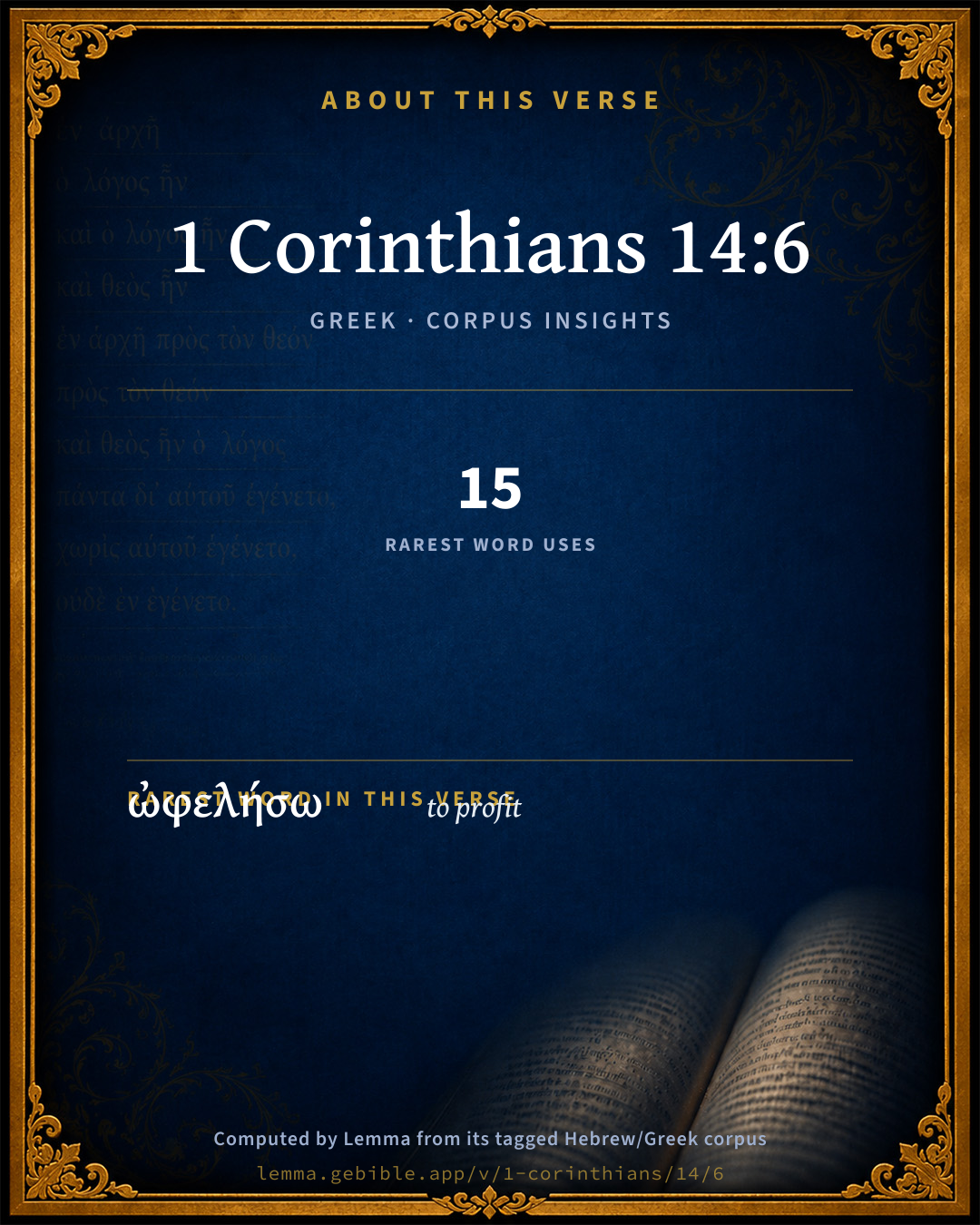
The rarest word here is ὠφελήσω to profit G5623 — appearing just 15 times in the whole Greek New Testament.

Shared distinctive vocabulary

ὠφελήσω to profit G5623 occurs in 15 verses of the Greek New Testament. Also found in:

Repetition

Words recur within this verse:

Cross-references

31

Topical passages linked to 1 Corinthians 14:6 in the Treasury of Scripture Knowledge — connected by theme and wording, ordered by reader-vote popularity; previews shown in the World English Bible.

  • Ephesians 1:17 that the God of our Lord Jesus Christ, the Father of glory, may give to you a spirit of wisdom and revelation in the knowledge of him;
  • Romans 6:17 But thanks be to God, that, whereas you were bondservants of sin, you became obedient from the heart to that form of teaching whereunto you were delivered.
  • 2 Timothy 3:16 Every writing inspired by God is profitable for teaching, for reproof, for correction, and for instruction which is in righteousness,
  • 1 Corinthians 14:1 Follow after love, and earnestly desire spiritual gifts, but especially that you may prophesy.
  • 1 Corinthians 14:26–30 What is it then, brothers? When you come together, each one of you has a psalm, has a teaching, has a revelation, has another language, has an interpretation. Let all things be done to build each other up.
  • Hebrews 13:9 Don't be carried away by various and strange teachings, for it is good that the heart be established by grace, not by food, through which those who were so occupied were not benefited.
  • 2 Peter 3:18 But grow in the grace and knowledge of our Lord and Savior Jesus Christ. To him be the glory both now and forever. Amen.
  • 2 John 1:9 Whoever transgresses and doesn't remain in the teaching of Christ, doesn't have God. He who remains in the teaching, the same has both the Father and the Son.
  • 1 Samuel 12:21 and don't turn aside; for [then would you go] after vain things which can't profit nor deliver, for they are vain.
  • Jeremiah 16:19 Yahweh, my strength, and my stronghold, and my refuge in the day of affliction, to you shall the nations come from the ends of the earth, and shall say, Our fathers have inherited nothing but lies, [even] vanity and things in which there is no profit.
  • Jeremiah 23:32 Behold, I am against those who prophesy lying dreams, says Yahweh, and do tell them, and cause my people to err by their lies, and by their vain boasting: yet I didn't send them, nor commanded them; neither do they profit this people at all, says Yahweh.
  • Matthew 11:25 At that time, Jesus answered, "I thank you, Father, Lord of heaven and earth, that you hid these things from the wise and understanding, and revealed them to infants.
  • Matthew 16:17 Jesus answered him, "Blessed are you, Simon Bar Jonah, for flesh and blood has not revealed this to you, but my Father who is in heaven.
  • Matthew 16:26 For what will it profit a man, if he gains the whole world, and forfeits his life? Or what will a man give in exchange for his life?
  • Acts 2:42 They continued steadfastly in the apostles' teaching and fellowship, in the breaking of bread, and prayer.
  • Romans 15:14 I myself am also persuaded about you, my brothers, that you yourselves are full of goodness, filled with all knowledge, able also to admonish others.
  • Romans 16:17 Now I beg you, brothers, look out for those who are causing the divisions and occasions of stumbling, contrary to the doctrine which you learned, and turn away from them.
  • 1 Corinthians 10:33 even as I also please all men in all things, not seeking my own profit, but the profit of the many, that they may be saved.
  • 1 Corinthians 12:7–8 But to each one is given the manifestation of the Spirit for the profit of all.
  • 1 Corinthians 13:2–3 If I have the gift of prophecy, and know all mysteries and all knowledge; and if I have all faith, so as to remove mountains, but don't have love, I am nothing.
  • 1 Corinthians 13:8–9 Love never fails. But where there are prophecies, they will be done away with. Where there are various languages, they will cease. Where there is knowledge, it will be done away with.
  • 2 Corinthians 11:6 But though I am unskilled in speech, yet I am not unskilled in knowledge. No, in every way we have been revealed to you in all things.
  • 2 Corinthians 12:1 It is doubtless not profitable for me to boast. For I will come to visions and revelations of the Lord.
  • 2 Corinthians 12:7 By reason of the exceeding greatness of the revelations, that I should not be exalted excessively, there was given to me a thorn in the flesh, a messenger of Satan to buffet me, that I should not be exalted excessively.
  • Ephesians 3:4 by which, when you read, you can perceive my understanding in the mystery of Christ;
  • Philippians 3:15 Let us therefore, as many as are perfect, think this way. If in anything you think otherwise, God will also reveal that to you.
  • 2 Timothy 2:14 Remind them of these things, charging them in the sight of the Lord, that they don't argue about words, to no profit, to the subverting of those who hear.
  • 2 Timothy 3:10 But you did follow my teaching, conduct, purpose, faith, patience, love, steadfastness,
  • 2 Timothy 4:2 preach the word; be urgent in season and out of season; reprove, rebuke, and exhort, with all patience and teaching.
  • Titus 3:8 This saying is faithful, and concerning these things I desire that you affirm confidently, so that those who have believed God may be careful to maintain good works. These things are good and profitable to men;
  • 2 Peter 1:5 Yes, and for this very cause adding on your part all diligence, in your faith supply moral excellence; and in moral excellence, knowledge;

Cross-references courtesy of OpenBible.info (CC BY 4.0).

Commentary

Notes on 1 Corinthians 14:6 from classic Christian and Jewish commentators (each source and its license shown beneath its notes). The classic Christian expositions comment on the surrounding passage and are grouped to its opening verse, so a note may address several verses; the Jewish commentaries on the Tanakh (Rashi and others) are per-verse, so they appear only where the commentator wrote on this verse.

Lemma curates 59 commentaries, every one of them public domain or Creative Commons licensed, each selected and text-cleaned for this edition rather than reprinted as found. About our sources →

Matthew Henry's Commentary

In this paragraph he goes on to show how vain a thing the ostentation of speaking unknown and unintelligible language must be. It was altogether unedifying and unprofitable (Co1 14:6): If I come to you speaking with tongues, what will it profit you, unless I speak to you by revelation, or by knowledge, or by prophesying, or by doctrine? It would signify nothing to utter any of these in an unknown tongue. An apostle, with all his furniture, could not edify, unless he spoke to the capacity of his hearers. New revelations, the most clear explications of old ones, the most instructive discourses in themselves, would be unprofitable in a language not understood. Nay, interpretations of scripture made in an unknown tongue would need to be interpreted over again, before they could be of any use.

I. He illustrates this by several allusions. 1. To a pipe and a harp playing always in one tone. Of what use can this be to those who are dancing? If there be no distinction of sounds, how should they order their steps or motions? Unintelligible language is like piping or harping without distinction of sounds: it gives no more direction how a man should order his conversation than a pipe with but one stop or a harp with but one string can direct a dancer how he should order his steps, Co1 14:7. 2. To a trumpet giving an uncertain sound, adēlon phōnēn, a sound not manifest; either not the proper sound for the purpose, or not distinct enough to be discerned from every other sound. If, instead of sounding on onset, it sounded a retreat, or sounded one knew not what, who would prepare for the battle? To talk in an unknown language in a Christian assembly is altogether as vain and to no purpose as for a trumpet to give no certain sound in the field or day of battle. The army in one case, and the congregation in the other, must be all in suspense, and at a perfect nonplus. To speak words that have no significancy to those who hear them is to leave them ignorant of what is spoken; it is speaking to the air, Co1 14:9. Words without a meaning can convey no notion nor instruction to the mind; and words not understood have no meaning with those who do not understand them: to talk to them in such language is to waste our breath. 3. He compares the speaking in an unknown tongue to the gibberish of barbarians. There are, as he says (Co1 14:10), many kinds of voices in the world, none of which is without its proper signification. This is true of the several languages spoken by different nations. All of them have their proper signification. Without this they would be phōnai aphōnoi - a voice, and no voice. For that is no language, nor can it answer the end of speaking, which has no meaning. But whatever proper signification the words of any language may have in themselves, and to those who understand them, they are perfect gibberish to men of another language, who understand them not. In this case, speaker and hearers are barbarians to each other (Co1 14:11), they talk and hear only sounds without sense; for this is to be a barbarian. For thus says the polite Ovid, when banished into Pontus,

Barbarus hic ego sum, quia non intelligor ulli,

I am a barbarian here, none understand me.

To speak in the church in an unknown tongue is to talk gibberish; it is to play the barbarian; it is to confound the audience, instead of instructing them; and for this reason is utterly vain and unprofitable.

II. Having thus established his point, in the two next verses he applies, 1. By advising them to be chiefly desirous of those gifts that were most for the church's edification, Co1 14:12. "Forasmuch as you are zealous of spiritual gifts, this way it will become commendable zeal, be zealous to edify the church, to promote Christian knowledge and practice, and covet those gifts most that will do the best service to men's souls." This is the great rule he gives, which, 2. He applies to the matter in hand, that, if they did speak a foreign language, they should beg of God the gift of interpreting it, Co1 14:13. That these were different gifts, see Co1 12:10. Those might speak and understand a foreign language who could not readily translate it into their own: and yet was this necessary to the church's edification; for the church must understand, that it might be edified, which yet it could not do till the foreign language was translated into its own. Let him therefore pray for the gift of interpreting what he speaks in an unknown tongue; or rather covet and ask of God the gift of interpreting than of speaking in a language that needs interpretation, this being most for the church's benefit, and therefore among the gifts that excel; vide Co1 14:12. Some understand it, "Let him pray so as to interpret what he utters in prayer in a language unintelligible without it." The sum is that they should perform all religious exercises in their assemblies so that all might join in them and profit by them. 3. He enforces this advice with a proper reason, that, if he prayed in an unknown tongue, his spirit might pray, that is, a spiritual gift might be exercised in prayer, or his own mind might be devoutly engaged, but his understanding would be unfruitful (Co1 14:14), that is, the sense and meaning of his words would be unfruitful, he would not be understood, nor therefore would others join with him in his devotions. Note, It should be the concern of such as pray in public to pray intelligibly, not in a foreign language, nor in a language that, if it be not foreign, is above the level of his audience. Language that is most obvious and easy to be understood is the most proper for public devotion and other religious exercises.

Matthew Henry's Commentary on the Whole Bible (1708–1710) — public domain (CC PDM 1.0). Text via the HelloAO Bible API.

Joseph Benson's Commentary

1Co 14:6. Now, brethren — As if he had said, I wonder whether that which you so much admire in others would please you in me: if I come unto you speaking with tongues — Supposing the next time I make you a visit at Corinth, I should address you in a variety of languages which you do not understand; what shall I profit you — Who are supposed not to understand me; except I speak to you — In a language with which you are acquainted; either by revelation — Of some gospel mystery; or by knowledge — Explaining the ancient types and prophecies; or by prophesying — Foretelling some future event; or by doctrine — For the regulation of your tempers and lives. Perhaps this may be the sense of these obscure expressions.

Joseph Benson's Commentary on the Old and New Testaments (1811–1818) — public domain. Text from a community e-Sword module.

Bengel's Gnomon

Johann Albrecht Bengel

1Co 14:6. Ἢ ἐν ἀποκαλύψει, ἢ ἐν γνώσει, ἢ ἐν προφητείᾳ, ἢ ἐν διδαχῇ, either in revelation, or in knowledge, or in prophecy, or in doctrine) Here are four kinds of prophecy broadly so called; the two former refer to the person himself, who rejoices in the gift; the two latter at the same time show more of a leaning towards the hearers.[122] On the difference of prophecy (which corresponds to revelation) and of knowledge (with which doctrine agrees) see 1Co 12:8; 1Co 12:10: and on the whole subject, below at 1Co 14:26, etc. Prophecy has relation to particular points, formerly not well understood, to mysteries to be known finally [and only] by revelation. Doctrine and knowledge are brought from the common storehouse of believers, and refer to things obvious in the matter of salvation.

[122] What Ernesti approves in Moldenhauer evidently agrees with these views.—Bibl. Theol., T. viii., p. 673.—E. B.

Bengel's Gnomon of the New Testament — English translation (T&T Clark, Edinburgh, 1860) — public domain. Text from a community e-Sword module.

Meyer's Critical & Exegetical Commentary

Heinrich August Wilhelm Meyer

1Co_14:6. Νυνὶ δέ] But so, i.e. but in this condition of things, since, namely, prophecy is greater than the speaking with tongues when left without edifying interpretation, I, if I came to you as a speaker with tongues, would only then be useful to you when I united with it prophetical or doctrinal discourse. Hofmann is wrong in wishing to refer νυνὶ δέ to the main thought of 1Co_14:5; in that case the second part of 1Co_14:5 is all the more arbitrarily overlooked, seeing that the ἐὰν μή in 1Co_14:6 is manifestly correlative to the ἑκτὸς εἰ μή in 1Co_14:5. Others take it otherwise. But the key to the interpretation which is in accordance with the context and logically correct lies in this, that the two uses of ἐάν are not co-ordinate (which was my own former view), so as in that way to give to the principal clause, τί ὑμᾶς ὠφελήσω, two parallel subordinate clauses (comp. on Mat_5:18); but, on the contrary, that ἐὰν μή, corresponding to the ἑκτὸς εἰ μή, 1Co_14:5, is subordinated to the first ἐάν. Paul might, forsooth, instead of ἐὰν μὴ … διδαχῇ have written simply: ἐὰν μὴ ὑμῖν διερμηνεύσω. Instead of doing so, however, he specifies the two kinds of discourse in which he might give an interpretation of his speech in tongues, and says: If I shall have come to you speaking with tongues, what shall I profit you, if I shall not have spoken to you (for the sake, namely, of expounding my speech in tongues, 1Co_14:5), either in revelation, etc. The apostle possessed the gift of glossolalia (1Co_14:18), but might also be his own διερμηνευτής, and might apply to the διερμηνεύειν the other apostolic charismata which belonged to him for teaching, prophecy, and διδαχή (1Co_13:9; Act_13:1).

ἢ ἐν ἀποκαλ. κ.τ.λ.] not four, but two charismatic modes of teaching are here designatedprophecy and didascalia. For the former, the condition is ἀποκάλυψις; for the latter, γνῶσις. See Estius in loc. The prophet spoke in an extempore way what was unfolded and furnished to him by revelation of the Spirit; the teacher (if he did not simply deliver a λόγος σοφίας, 1Co_12:8) developed the deep knowledge which he had acquired by investigation, in which he was himself active, but yet was empowered and guided by the Spirit. This twofold division is not at variance with 1Co_13:2, from which passage, on the contrary, it is plain that there belonged to prophecy γνῶσις and ἀποκάλυψις, the latter of which was not included as a condition of the didascalia; so that the characteristic mark of distinction in prophecy is thus the ἀποκάλυψις. Comp. 1Co_14:30.

ἐν denotes the inward (ἀποκαλ., γνωσ.) and outward (προφ., διδ) form in which the λαλεῖν takes place. Comp. Mat_13:3.

Note further the use of the first person, in which Paul comes forward himself with all the more convincing force in support of what he says.

Meyer — Critical and Exegetical Commentary on the New Testament — English translation by Peter Christie, edited by Frederick Crombie (T&T Clark, 1880) — public domain. Text from a community e-Sword module.

Expositor's Greek Testament

ed. W. Robertson Nicoll

1Co 14:6 . What the Ap. has said touching the criterion of edification , he applies to his own approaching visit (1Co 4:18 ff., 1Co 16:5 ff.): “But at the present time, brothers,” νῦν δέ , temporal , as in 1Co 5:11 , etc.; not logical , as in 1Co 7:14 , 1Co 13:13 , etc. (see Hf [2030] , against most interpreters). It is the situation at Cor . which gives point to this ref [2031] : what help could the Ap. bring to his readers in their troubled state, if he were to offer them nothing but confused mutterings and ravings? ( cf. 1Co 14:7-11 ) an appeal to common sense. The hypotheses are parl [2032] (expressing by ἐὰν actual possibility, cf. 1Co 14:18 ; not mere conceivability) the second the negative of the first: “if I should come to you speaking with tongues, wherein shall I profit you if I do not speak in (the way of) revelation or knowledge, or prophesying or teaching?” In the four ἢ clauses, the second pair matches the first: revelation comes through the prophet, knowledge through the teacher ( cf. 1Co 12:8 ; 1Co 12:10 ; 1Co 12:28 , etc.). For ἔρχομαι with ptp [2033] of the character or capacity in which one comes “a (mere) speaker with tongues,” unable to interpret (see 5) cf. Act 19:18 , Mat 11:18 f., Mar 1:39 , Luk 13:7 .

[2030] J. C. K. von Hofmann’s Die heilige Schrift N.T. untersucht , ii. 2 (2te Auflage, 1874).

[2031] reference.

[2032] parallel.

[2033] participle

The Expositor's Greek Testament, edited by W. Robertson Nicoll (1897–1910) — public domain. Text from a community e-Sword module.

Godet's Commentaries

Frédéric Louis Godet

Vv. 6. “But now, brethren, if I come unto you speaking in tongues, what shall I profit you, except I shall speak to you either in revelation, or in knowledge, or in prophesying, or in doctrine?”

The first example Paul offers to the Corinthians is that of his own person; they all knew what power his presence in a Church exercised; many of them promised themselves considerable edification from the visit he announced to them. Well! there was a way of making this visit utterly useless: in place of prophesying and teaching, let him set himself to play among them the part of glossolalete; and if this holds in Paul’s case, how much more in all others!

The δέ is adversative; it contrasts the glossolalia without translation, which Paul by hypothesis ascribes to himself in 1Co 14:6, with glossolalia with interpretation in 1Co 14:5 b.

Νυνί, now: “things being so.” Hofmann gives this word the temporal meaning: “If I come now among you;” but this connection of νυνί with ἔλθω is forced.

By the address brethren, he appeals to their good sense. — Meyer thinks that the second ἐάν, if [ἐὰν μή, if not = except], is subordinate to the first, and that the speaking, referred to at the close of the verse, relates to the interpreting of the discourse in a tongue, so that the meaning of the verse would amount to this: “Wherein shall I be useful to you if I speak to you in a tongue, but without giving an interpretation in the form either of prophecy, or doctrine, of what I at first said in an unintelligible form?” This meaning is inadmissible; for nowhere are prophecy and doctrine represented by Paul as the interpretation of a tongue. The meaning is this: “Wherein should I be useful to you if I figured among you only as one speaking in tongues, and not besides as prophet or teacher?” Of course he speaks of glossolalia in itself and apart from interpretation.

The four terms at the end of the verse evidently form two parallel pairs. On the one hand: revelation and knowledge—these are inward Divine gifts; on the other: prophecy and doctrine—these are the external manifestations of the twofold Divine communication: revelation expressing itself in prophecy, and knowledge in doctrine. Revelation, which makes the prophet, is a sudden and lively perception, produced by the Spirit’s operation, of some aspect of the Divine mystery, the work of salvation; this view, immediately expressed in its first freshness, forms prophecy (1Co 14:27). Knowledge is the result of an exercise of thought directed by the Holy Spirit (1Co 12:8 : κατά, according to), which leads to the distinct understanding of some element of salvation and of its relation to all the rest; this knowledge is expressed in a doctrinal discourse. In the two first terms, the meaning of the ἐν, in, is therefore this: “a speaking resting on a revelation, on an act of knowledge,” and, in the two last terms: “a speaking taking effect by a prophecy, by a doctrine.” Heinrici’s objections to this double correlation of the four terms: revelation, prophecy, knowledge, doctrine, seem to me without force. Modern commentators are unanimous in recognising it.

To this decisive example, the apostle adds others, taken from ordinary life. And first he instances musical instruments:

Frédéric Louis Godet — Commentaries on Luke, John, Romans, and 1 Corinthians — English translation (T&T Clark, Edinburgh, 1870s–1890s) — public domain. Text from a community e-Sword module.

Hodge's Commentary on Romans, Ephesians & First Corinthians

Charles Hodge

1Co_14:6

Now, brethren, if I come unto you speaking with tongues, what shall I profit you, except I shall speak to you either by revelation, or by knowledge, or by prophesying, or by doctrine?

Now (νυνὶ δέ), since things are so, i.e. since speaking with tongues without interpreting is unedifying, what shall I profit you, asks the apostle, if I should come to you speaking in a language which you do not understand? He then varies the question, What shall I profit you unless I speak to you as a prophet, by (or rather with, ἐν) a revelation, or as a teacher, with a doctrine. There are not four, but only two modes of address contemplated in this verb. Revelation and prophecy belong to one; and knowledge and doctrine to the other. He who received revelations was a prophet, he who had the word of knowledge was a teacher.

Charles Hodge — Commentary on Romans (1835), First Corinthians (1857), and Ephesians (1856) — public domain. Text from a community e-Sword module.

Jamieson, Fausset & Brown

Robert Jamieson, A. R. Fausset & David Brown

Translate, "But now"; seeing there is no edification without interpretation.

revelation . . . prophesying--corresponding one to the other; "revelation" being the supernatural unveiling of divine truths to man, "prophesying" the enunciation to men of such revelations. So "knowledge" corresponds to "doctrine," which is the gift of teaching to others our knowledge. As the former pair refers to specially revealed mysteries, so the latter pair refers to the general obvious truths of salvation, brought from the common storehouse of believers.

Jamieson, Fausset & Brown — Commentary Critical and Explanatory on the Whole Bible (1871) — public domain (CC PDM 1.0). Text via the HelloAO Bible API.

Adam Clarke's Commentary

Verse 6. Speaking with tongues] Without interpreting.

What shall I profit you?] i.e. I shall not profit you;

Except I shall speak to you either by revelation] Of some secret thing; or by knowledge, of some mystery; or by prophesying, foretelling some future event; or by doctrine, instructing you what to believe and practise.-See Whitby. These four words are taken in different acceptations by learned men. The general sense of the terms is that given above: but the peculiar meaning of the apostle is perhaps not easily discerned.

Adam Clarke's Commentary on the Bible (1810–1826) — public domain. Text from a community e-Sword/MySword module.

John Calvin's Commentaries

6. Now, brethren, if I should come. He proposes himself as an example, because in his person the case was exhibited more strikingly The Corinthians experienced in themselves abundant fruit from his doctrine. He asks them, then, of what advantage it would be to them, if he were to make use of foreign languages among them. He shows them by this instance, how much better it were to apply their minds to prophesyings. Besides, it was less invidious to reprove this vice in his own person, than in that of another.

He mentions, however, four different kinds of edification — revelation, knowledge, prophesying, and doctrine As there are a variety of opinions among interpreters respecting them, let me be permitted, also, to bring forward my conjecture. As, however, it is but a conjecture, I leave my readers to judge of it. Revelation and prophesying I put in one class, and I am of opinion that the latter is the administration of the former. I am of the same opinion as to knowledge and doctrine What, therefore, any one has obtained by revelation, he dispenses by prophesying. Doctrine is the way of communicating knowledge. Thus a Prophet will be — one who interprets and administers revelation. This is rather in favor of the definition that I have given above, than at variance with it. For we have said that prophesying does not consist of a simple and bare interpretation of Scripture, but includes also knowledge for applying it to present use — which is obtained only by revelation, and the special inspiration of God.

John Calvin's Commentaries (1540-1563) — public domain. Text from the Calvin Translation Society English edition (1840s-50s) via the Christian Classics Ethereal Library (ccel.org). Calvin's coverage is partial (roughly two-thirds of the Bible); uncommented books and verses are honest gaps, never fabricated. The 19th-century editor's footnotes and remarks are omitted so the notes are faithfully Calvin's own voice.

Ellicott's Commentary for English Readers

(6) Now, brethren.—Transferring these things to himself in an image the Apostle reinforces the preceding teaching. Now (i.e., seeing that these things are so), what profit would I be to come to you speaking in tongues? I have been telling you that you cannot profit others: I ask you, do you think I speaking in tongues could profit you?

Except I shall speak to you either . . .—Here is an expansion of the “interpretation of tongues” of the previous verse, and which is the condition on which depends any usefulness of the gift. The “revelation” and the “knowledge” are the internal gifts in the teacher himself which are the sources of his power to communicate “prophecy” (i.e., general exhortation), or “doctrine” (i.e., systematic religious instruction) to his hearers.

A Bible Commentary for English Readers, edited by Charles John Ellicott (1878–1897) — public domain. Text from a community e-Sword module.

The Cambridge Bible for Schools and Colleges

gen. ed. J. J. S. Perowne

6. by revelation] That which comes directly to the spirit from on high.

by knowledge] That which is gained by observation and study, see ch. 1Co_12:8.

by prophesying] The outward expression of that which has come from above by revelation.

by doctrine] Or rather, teaching, the outward expression of knowledge. See the distinction between the prophet and the teacher in ch. 1Co_12:28.

The Cambridge Bible for Schools and Colleges (gen. ed. J. J. S. Perowne; Cambridge University Press, 1878–1918) — public domain. Text from a community e-Sword module.

John Gill's Exposition

Now, brethren, if I come unto you speaking with tongues,.... The apostle exemplifies this matter in himself, and supposes it his own case, that should he who was the apostle of the Gentiles, and to be received by them as such, when he came to them, come with this gift of tongues, which he was capable of, as much, or more than any, see Co1 14:18 and only make use of that,

what shall I profit you? of what use would my ministry be to you? what instruction, comfort, and edification, could you receive by it?

except I shall speak to you, either by revelation; by the revelation of Jesus Christ, whereby he received the Gospel he preached; or by the spirit of wisdom and revelation in the knowledge of Christ, and the mysteries of his grace, by which they were made known unto him at first, or by a fresh immediate revelation from heaven:

or by knowledge; the word of knowledge, one of the peculiar gifts of the Spirit, Co1 12:8.

Or by prophesying; the gift of prophecy, another of the extraordinary gifts of the Spirit, mentioned in the same chapter, Co1 12:10 and already explained:

or by doctrine? the same with the word of wisdom, another gift of the same Spirit, in Co1 12:8. The apostle intimates, that by the use and exercise of these gifts, he might be profitable to them, to lead them into a clearer view of the doctrines of the Gospel, and for the further improvement of their knowledge in the Scriptures of truth, which could never be done by bare speaking with tongues, and with tongues they understood not.

John Gill's Exposition of the Whole Bible (1746–1763) — public domain (CC PDM 1.0). Text via the HelloAO Bible API.

Trapp's Complete Commentary

John Trapp

6 Now, brethren, if I come unto you speaking with tongues, what shall I profit you, except I shall speak to you either by revelation, or by knowledge, or by prophesying, or by doctrine?

Ver. 6. If I come unto you, &c.] This you would not like in me. And is that Venus in Caio Venus in Gaius, that is Naevus in Titio? a mole in Titius, a blemish in one that is a beauty in another?

By revelation, or by knowledge, or, &c.] Piscator reads it by revelation or by knowledge; that is, either by prophesying or by doctrine. The apostle expounding himself.

John Trapp, A Commentary or Exposition upon All the Books of the Old and New Testament (1647–1656) — public domain. Text from a community e-Sword module.

Albert Barnes' Notes on the Bible

Now, brethren, if I come unto you ... - The truth which the apostle had been illustrating in an abstract manner, he proceeds to illustrate by applying it to himself. If he should come among them speaking foreign languages, it could be of no use unless it were interpreted to them.

Speaking with tongues - Speaking foreign languages; that is, speaking them “only,” without any interpreter. Paul had the power of speaking foreign languages 1Co 14:18; but he did not use this power for ostentation or display, but merely to communicate the gospel to those who did not understand his native tongue.

Either by revelation - Macknight renders this, “speak intelligibly;” that is, as he explains it, “by the revelation peculiar to an apostle.” Doddridge, “by the revelation of some gospel doctrine and mystery.” Locke interprets it, that you might understand the revelation, or knowledge,” etc.; but says in a note, that we cannot now certainly understand the difference between the meaning of the four words here used. “It is sufficient,” says he, “to know that these reruns stand for some intelligible discourse tending to the edification of the church.” Rosenmuller supposes the word “revelation” stands for some “clear and open knowledge of any truth arising from meditation.” It is probable that the word here does not refer to divine inspiration, as it usually does, but that it stands opposed to that which is unknown and unintelligible, as that which is “revealed” ἀποκαλύψις apokalupsis stands opposed to what is unknown, concealed, “hidden,” obscure. Here, therefore, it is synonymous, perhaps, with “explained.” “What shall it profit, unless that which I speak be brought out of the obscurity and darkness of a foreign language, and uncovered or explained!” The original sense of the word “revelation” here is, I suppose, intended ἀποκαλύψις apokalupsis, from ἀποκαλύπτω apokaluptō, “to uncover”), and means that the sense should be uncovered, that is, explained or what was spoken could not be of value.

Or by knowledge - By making it intelligible. By so explaining it as to make it understood. Knowledge here stands opposed to the “ignorance” and “obscurity” which would attend a communication in a foreign language.

Or by prophesying - See the note at 1Co 14:1. That is, unless it be communicated, through interpretation, in the manner in which the prophetic teachers spoke; that is, made intelligible, and explained, and actually brought down to the usual characteristics of communications made in their own language.

Or by doctrine - By teaching (διδαχῇ didachē). By instruction; in the usual mode of plain and familiar instruction. The sense of this passage, therefore, is clear. Though Paul should utter among them, as he had abundant ability to do, the most weighty and important truths, yet, unless he interpreted what he said in a manner clear from obscurity, like “revelation;” or intelligibly, and so as to constitute “knowledge;” or in the manner that the prophets spoke, in a plain and intelligible manner; or in the manner usual in simple and plain “instruction,” it would be useless to them. The perplexities of commentators may be seen stated in Locke, Bloomfield, and Doddridge.

Albert Barnes' Notes on the Bible (1834–1885) — public domain. Text from a community e-Sword/MySword module.

Haydock's Catholic Bible Commentary

If I come to you, speaking with tongues in this manner, what shall I profit you, unless in revelation, &c. that is, unless I reveal, and expound to you the meaning, by some other gift, as in knowledge, in prophecy, in doctrine? To speak tongues only without interpreting, is no ways instructive. He that speaks to me, what I understand not, is not better than a barbarian to me, (so the Greeks called those that spoke not their language.) He signifies this inconvenience of not being understood, by the example of instruments, pipes, harps, trumpets, which would not move persons to different affections, nor excite them to different actions, unless the sound, and manner they were played upon, were different; seek, then, and endeavour to make use of the gifts of the Spirit, to edification of the Church, or of the hearers. (Witham)

George Leo Haydock (1774–1849), Haydock's Catholic Family Bible and Commentary, 1859 edition — public domain. Excludes Psalms (Douay-Rheims chapter numbering differs from Protestant) and Deuterocanonical books (Catholic canon only).

Matthew Poole's English Annotations

God hath given me an ability to speak with tongues; suppose I should come to you speaking in the Arabian, Scythian, or Parthian language, what good would it do you? How should it any way

profit you, except I shall speak to you either by revelation, or by knowledge, or by prophesying, or by doctrine? Some make these four things distinct each from other; others think that they all signify no more, than the interpreting mentioned in the former verse. Those who distinguish them say, by revelation is meant the explication of the types and figures of the Old Testament; or some such revelation as John had in Patmos; or the expounding the mysteries of the gospel.

By knowledge they understand the knowledge of history, or any other ordinary knowledge.

By prophesying, the explication of the difficult texts of Scripture.

By doctrine, catechetical or practical doctrine. But these are all but uncertain guesses; the sense is plainly no more, than, if I should come speaking with unknown tongues, and no way by interpretation make what I say intelligible unto you.

Matthew Poole's English Annotations on the Holy Bible (1683–1685) — public domain. Text from a community e-Sword/MySword module.

Whedon's Commentary on the Bible

Daniel D. Whedon

6. If I—St. Paul states, as often, the disparaging supposition as of himself. He makes this supposition in order at some length to unfold the lesser utility of tongues.

Either by—Some process by which intelligent thought is conveyed. Of the four, revelation means some vision or announcement from the spiritual world; knowledge, some perception by the discerner of spirits; prophesying, some prediction or supernaturally heart-searching discourse; doctrine, or teaching, some exposition of the established truths of Christianity or of the Old Testament.

Daniel D. Whedon (gen. ed.), Commentary on the Old and New Testaments (1874–1909) — public domain. Text from a community e-Sword module.

The Pulpit Commentary

Except I shall speak to you either by revelation, or by knowledge, or by prophesying, or by doctrine? My "tongue" will be useless to you unless I also speak to you of what I know by revelation, or by my thoughtful study, which may take the form of preaching or of teaching. (1Co_12:28)

Vers. 6-13.

Argument continued and illustrated.

Greater is the teacher than the speaker in a tongue not interpreted, was the statement of the apostle in the fifth verse. Suppose, then, that even he were to address these Corinthians "with tongues;" would not the edification be confined to himself? There would be no exception in his case, none in his favour as the apostle of the Gentiles, and hence his usefulness, no matter what he might say, would be at an end, for lack of interpretation. "What shall I profit you?" The profit is only possible by means of doctrine and knowledge. Tongues unexplained convey no doctrine and knowledge, and hence, as relative to the hearers, are nugatory. For instance, there are musical instruments, "pipe or harp," that have a language in the broad sense of the word, and convey their meanings if skilfully used. The instrument in the hands of an intelligent performer, though in itself "without life," yet receives life as it were from him who knows how to handle it. A dead thing, yet his breath or his touch imparts a representative vitality to its sounds, and you hear in those sounds the sentiments and emotions of the soul. What a range they have, rising and falling by turns, exulting, sorrowing, shouting, wailing! To effect this, there must be "a distinction in the sounds;" the instrument must obey its laws, and the laws are dictated by the art of music. And he argues further, that a trumpet in battle can give such discriminating sounds as to direct the movements of soldiers. The commanding officer, though distant, speaks to the trumpeter, and the trumpeter conveys the order through the trumpet. A thing "without life," and yet it outreaches the compass of the living voice and is fully understood, for it gives no "uncertain sound." Musical instruments are interpreters. Their utility exists in their intelligible modulations. If it were otherwise, they would but confuse and bewilder. The comparison is promptly applied. "So likewise ye," with all your admiration for "tongues" and your disposition to give them pre-eminence among the gifts, are indulging in a wild and incoherent display, unless you "utter by the tongue words easy to be understood." Words are not sufficient; they must be words easy to be understood. The capacity of the hearer, the humblest in the congregation, must be thoughtfully regarded, otherwise they are to him idle rhapsodies; "ye shall speak into the air." If neither "pipe," nor "harp," nor "trumpet" give an "uncertain sound," still less could it be said of human voices (languages) that they are unintelligible. "Many kinds are in the world, and none of them without signification." Varieties exist. The surface of the globe is not more diversified than language, and yet, as the globe is one, so are these languages one, although very unequal as to capacity for the conveyance of ideas. But is the "tongue" like these voices? If not, then he that speaketh in this way is a barbarian; and would you barbarians in your Christian relations, outside foreigners, you and your fellow citizens in the commonwealth of Christ shut out from intelligible communication with one another? We can see, while reading St. Paul"s argument, what force it contains. Pentecost had restored what Babel had destroyed; the ambitious tower that was to reach so high had been arrested by confusion of tongues; men had scattered from one great centre, and human centralization had been stopped in the evil form threatened. Pentecost had enabled men to cooperate; all languages could now be used as vehicles of making known the gospel, and the builders could work together on the temple of the Church. Pentecost, however, was here annulled, and Corinth was making ready to scatter her Christian population, to alienate them from community of impulse and aim, and changing the members of the Church in this respect into barbarians to one another. "Even so ye," declares the apostle, who are "zealous of spiritual gifts," should esteem it your first concern to edify the Church. "Wherefore," he adds in application, let the speaker in an unknown tongue "pray that he may interpret." Whatever construction may be given this difficult passage, it is certain that St. Paul intended to teach the Corinthians the absolute insulation of this sort of speech, its essential characteristic as opposed to the true function of language, and the complete exclusion of its possessor from the fellowship of the outward world. L.

The Pulpit Commentary (1880–1919), ed. H.D.M. Spence-Jones & Joseph S. Exell — public domain. Text from a community e-Sword module.

John Wesley's Explanatory Notes

Revelation - Of some gospel mystery. Knowledge - Explaining the ancient types and prophecies. Prophecy - Foretelling some future event. Doctrine - To regulate your tempers and lives. Perhaps this may be the sense of these obscure words.

John Wesley, Explanatory Notes Upon the Whole Bible (1754–1765) — public domain. Text via the GEBible commentary corpus.

McGarvey & Pendleton's Commentaries

J. W. McGarvey

But now, brethren, if I come unto you speaking with tongues, what shall I profit you, unless I speak to you either by way of revelation, or of knowledge, or of prophesying, or of teaching? [The gift of tongues had a subordinate use in the church of God, as an evidence of the presence of the Spirit of God. Moreover, it was a reserve of power, liable to be brought into active use at any time by the scattering of the church through persecution. For these reasons, and also to show that he writes in a spirit of generous good-will, Paul expresses a wish that all the churches in Corinth might be endowed with this gift. But, as a more practical wish, he prefers that they shall be able to prophesy, since the church would not be edified by the use of the gift of tongues, unless the foreign language used was interpreted. If Paul came to them as a visitor or missionary, his profit to them would not lie in his speaking with tongues (even though he, a Jew, spake to them miraculously in their own Greek language); but it would lie in the subject-matter of his utterance, in the edification which he conveyed. Paul names the four ways in which men may be edified by the use of words, and all these four manners were as much at the command of prophecy as they were at that of the gift of tongues. Revelation is the unveiling of divine truth to a prophet, and prophecy is the impartation of that truth to others. Knowledge is the divine illumination of the mind as to the bearing and significance of a truth, and doctrine is the impartation to another of the truth thus grasped. These are all matters of sense, and not of sound only. But speaking with tongues in the presence of those not understanding the language spoken, is sound without sense, and fails to convey any prophecy, doctrine, etc. Paul goes on to show that sound without sense is not only profitless, but may even be baneful.]

J. W. McGarvey (with Philip Y. Pendleton), Commentaries on the New Testament (The Fourfold Gospel, 1914; Acts; and the epistles) — public domain. Text from a community e-Sword/MySword module.

The People's New Testament

B. W. Johnson

6–11. What shall I profit you, etc. The gift of tongues, exercised to the church, cannot profit unless it does one of four things named: A revelation. The inspired utterance of him who prophesies. Knowledge. The gift of teaching the inspired truths of the Scriptures, or those revealed by the prophets.

B. W. Johnson's The People's New Testament with Notes (1889–1891) — public domain. Electronic text from the Christian Classics Ethereal Library (CCEL) ThML edition.

Cambridge Greek Testament for Schools and Colleges

6. ἐὰν ἔλθω. ‘If I shall have come.’ So ἐὰν μὴ λαλήσω ‘unless I shall have spoken.’ Throughout the chapter the conditional protasis is followed by the apodosis in the fut. indic. See 1Co 14:8-9; 1Co 14:11; 1Co 14:16, &c.

ἐν ἀποκαλύψει. Rather more than ‘by revelation.’ It signifies the spirit in which the Apostle’s instruction is carried on. So in the rest of the sentence.

ἐν γνώσει. See ch. 1Co 12:8.

ἐν προφητείᾳ. See note on προφητεύητε above, 1Co 14:1.

ἐν διδαχῇ. Care must be taken not to understand this word, frequently translated doctrine in the A.V., in the technical sense the word has now acquired. The word means no more than teaching. ‘Unless I come with a view of teaching you.’ See the distinction between the prophet and the teacher in ch. 1Co 12:28.

Cambridge Greek Testament for Schools and Colleges (Cambridge University Press, 1896; 21 vols, various authors incl. Carr, Maclear, Plummer, Farrar, Lumby, Moule, M. R. James, Simcox) — public domain. Text from a community e-Sword module.

Alford’s Greek Testament

Henry Alford

6.] Example of the unprofitableness of speaking with tongues without interpreting,—expressed in the first person as of himself.

νῦν δέ] ‘quod cum ita sit’—viz. that there is no edification without interpretation.

ἐὰν ἔλθω] Chrys. understands the first person to imply ‘not even I myself should profit you,’ &c. But then αὐτὸς ἐγώ or some expression similarly emphatic would have been used.

The second ἐάν is parallel to the first, not dependent on ὠφελήσω. It is the negative side of the supposition, as ἐὰν ἔλθω κ.τ.λ. was the affirmative. On this double apodosis Hermann remarks, Soph. Aj. 827,—‘Est enim hæc verborum complexio ex eo genere, cujus jam apud Homerum exempla inveniuntur, quod duplicem habet apodosin, alteram præmissam, sequentem alteram: quæ ratio ibi maxime apta est, ubi in magno animi motu, quasi non satis sit id quod præmissum est, aliud infertur secunda apodosi, quod gravius sit et fortius.’

ἢ ἐν ἀποκ …] It seems best here, with Estius, to understand ‘duo juga, ut conjugata sint revelatio et prophetia, ac rursus conjugata scientia et doctrina.’ So also Meyer, who observes that the ground of προφητεία is ἀποκάλυψις, and that of διδαχή, γνῶσις: the former being a direct speaking in the Spirit, and the latter a laying forth by the aid of the Spirit of knowledge acquired. Thus ἐν, as referred to ἀποκ. and γνώς., denotes the internal element:—as referred to προφ. and διδ., the external element, of the spiritual activity.

Henry Alford, The Greek Testament (1849–1861) — public domain. Text from a community e-Sword module.

International Critical Commentary

6. The first of a series of three arguments, drawn from their experience of him as a teacher. They are hoping to see him again. What good would he do them, if all that they got from him was ecstatic language, in which he excelled, but which they would not understand. To do them good he must speak intelligible language, of which he gives four examples in pairs that correspond: revelation is imparted by inspired preaching, and knowledge by doctrine; i.e. ἀποκάλυψις and γνῶσις are the internal gifts of which προφητεία and διδαχή are the external manifestation.* The ἐν expresses the form in which the λαλεῖν takes place. Dionysius of Alexandria seems to have had this passage in his mind in famous criticism of the Johannine writiags (Eus. H.E. VII xxv. 26).

‘But, as it is (seeing that without interpretation there can be no general edification), if I should come unto you (16:3) speaking in Tongues, what shall I profit you (Gal 5:2)? What shall I profit you, unless I should speak to you either in the way of revelation?’ etc. See the paraphrase above.

νῦν (א A B D* F G P) rather than νυνί (E K L). The νῦν is logical, as in 5:11, 7:14, 12:18, 20, and as νυνί in 13:13, not temporal; and in the construction of the verse τί ὑμᾶς ὠφ. is virtually repeated. ‘Teaching,’ the act of giving instruction,’ is better than ‘doctrine’ (AV.) for διδαχή: ‘doctrine’ would be διδασκαλία (Eph 4:14; Col 2:22; 1Ti 1:10, etc.). But the distinction is not always observed.

International Critical Commentary — older volumes (1896–1929), various authors — public domain. Text from a community e-Sword module.

Lesson kit

Teaching starters — assembled from the data on this page, not authored interpretation. Every prompt links to the verse data it draws on. Edit before teaching.

1 Corinthians, in the Pauline Epistles, opens this verse with 27 words (18 distinct Greek lemmas). Its most distinctive word is ōpheléō (“to profit”). A historical commentator’s framing appears above. Read the whole chapter for the surrounding context.

Discussion questions

  1. What does “to profit” (ōpheléō) contribute to the verse as a whole?
  2. Matthew 15:5 shares the word «to profit» with this verse. How do the two illuminate each other?
  3. “to speak” occurs 2× in this one verse. What is the effect of the repetition?
  4. These translations render this verse differently; the difference is in the English rendering, not the original. What questions does that raise?
  5. Reading how Matthew Henry's Commentary and Joseph Benson's Commentary read this verse, where do the two commentators agree and where do they part?

Things to notice

  • These translations choose different wording for 17 words in this verse.
  • “to speak” occurs 2× in this single verse.
  • 18 distinct Greek lemmas span 27 words in this verse.

Reading settings

Reading text

Shown beneath each verse's original-language words.

Old Testament
Old Testament edition

Read the OT as the Masoretic Hebrew (MT) or the Greek Septuagint (LXX).

English shown for the Greek Septuagint (in the Hebrew ↔ Greek comparison).

Comparing translations? Open the Compare panel on any verse page to stack up to four side by side.