

Luke 6:42
Greek (Tischendorf 8th ed.) Luke 6:42 appears in the Greek New Testament. The text above is from the Tischendorf 8th edition. Each word links to its Strong’s number and a concise gloss. Click any word for its full Thayer’s Greek Lexicon entry.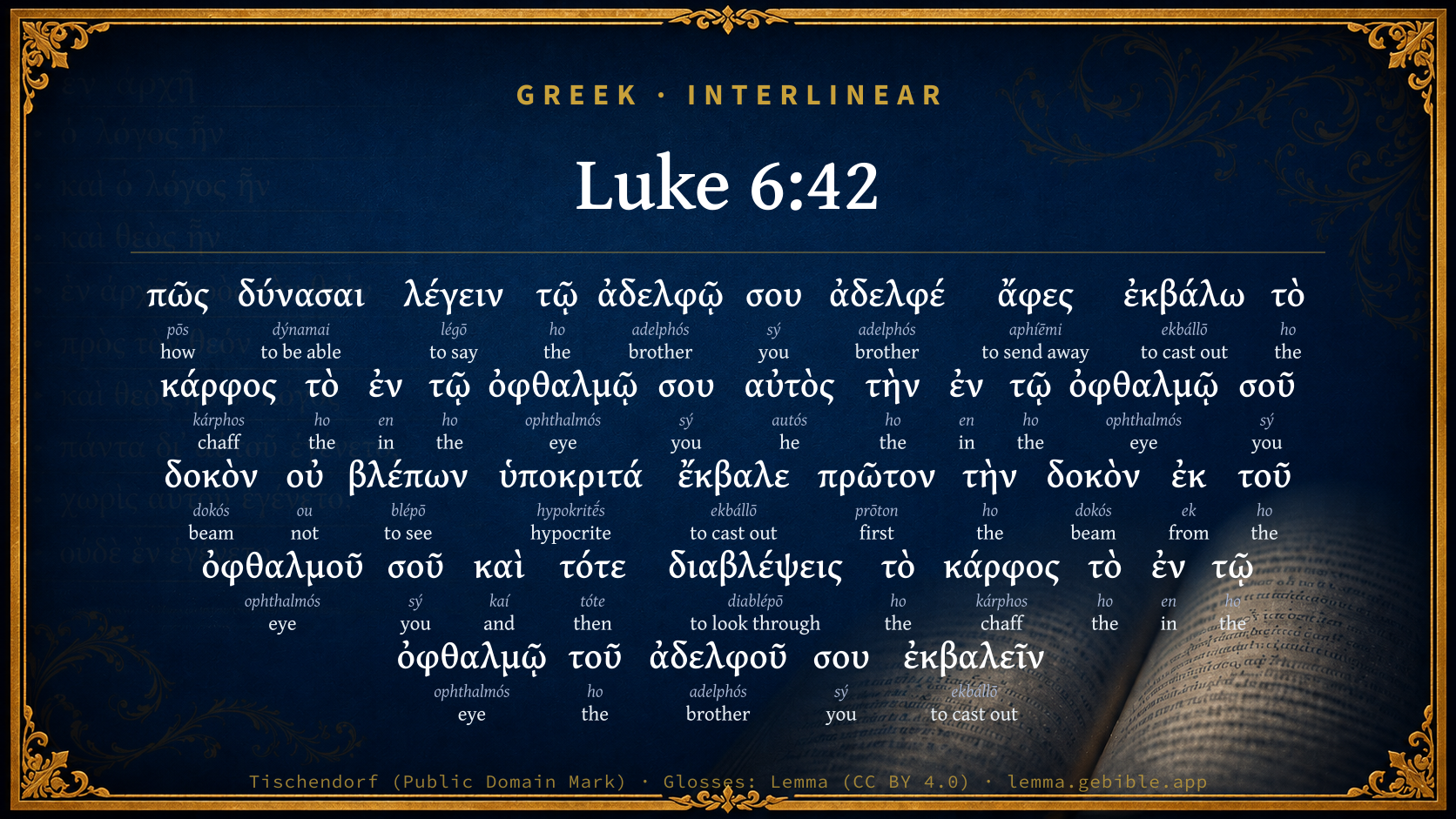
Or how can you tell your brother, 'Brother, let me remove the speck of chaff that is in your eye,' when you yourself don't see the beam that is in your own eye? You hypocrite! First remove the beam from your own eye, and then you can see clearly to remove the speck of chaff that is in your brother's eye.
Download a study sheet
One document with this verse’s original text, its word-by-word gloss line, the meaning frame, cross-references with their text, attributed commentary, and full source and license credits — printable, and it pastes into notes with its structure intact.
This verse Autodidact and up
A passage Seminary Student
Up to 50 verses in one chapter. A passage sheet keeps up to 6 commentary sources and 12 cross-references per verse, in the order this page ranks them, and says so on the sheet whenever that leaves anything out. Ask for a single verse and you get the Autodidact verse sheet above.
Everything on this page stays free to read, with no account — the sheet is a download of what is already on screen, not access to it.
Compare translations 3
The same verse in 3 English versions, stacked beneath the original-language interlinear above. Click any original word for its lexicon entry.
Each is an independent rendering of the whole verse — the interlinear is not word-aligned to these translations.
Highlighted words mark where these versions differ — a whole-verse word diff, not a word-by-word alignment.
-
World English Bible Public Domain
Or how can you tell your brother, 'Brother, let me remove the speck of chaff that is in your eye,' when you yourself don't see the beam that is in your own eye? You hypocrite! First remove the beam from your own eye, and then you can see clearly to remove the speck of chaff that is in your brother's eye.
-
King James Version Public Domain
Either how canst thou say to thy brother, Brother, let me pull out the mote that is in thine eye, when thou thyself beholdest not the beam that is in thine own eye? Thou hypocrite, cast out first the beam out of thine own eye, and then shalt thou see clearly to pull out the mote that is in thy brother's eye.
-
unfoldingWord Literal Text CC BY-SA 4.0
How can you say to your brother, ‘Brother, let me take out the speck of wood that in your eye,’ you yourself not seeing the log in your eye? You hypocrite! First take out the log from your eye, and then you will see clearly to take out the speck of wood in the eye of your brother.
unfoldingWord Literal Text — © unfoldingWord, licensed CC BY-SA 4.0. Word-aligned USFM3 via Door43 (git.door43.org/unfoldingWord/en_ult).
Show all 19 translations
Every available English version of this verse, each an independent rendering of the whole verse.
-
World English Bible Public Domain
Or how can you tell your brother, 'Brother, let me remove the speck of chaff that is in your eye,' when you yourself don't see the beam that is in your own eye? You hypocrite! First remove the beam from your own eye, and then you can see clearly to remove the speck of chaff that is in your brother's eye.
-
Berean Standard Bible Public Domain
How can you say, ‘Brother, let me take the speck out of your eye,’ while you yourself fail to see the beam in your own eye? You hypocrite! First take the beam out of your own eye, and then you will see clearly to remove the speck from your brother’s eye.
-
Majority Standard Bible Public Domain
Or how can you say, ‘Brother, let me take the speck out of your eye,’ while you yourself fail to see the beam in your own eye? You hypocrite! First take the beam out of your own eye, and then you will see clearly to remove the speck from your brother’s eye.
-
King James Version Public Domain
Either how canst thou say to thy brother, Brother, let me pull out the mote that is in thine eye, when thou thyself beholdest not the beam that is in thine own eye? Thou hypocrite, cast out first the beam out of thine own eye, and then shalt thou see clearly to pull out the mote that is in thy brother's eye.
-
American Standard Version (1901) Public Domain
Or how canst thou say to thy brother, Brother, let me cast out the mote that is in thine eye, when thou thyself beholdest not the beam that is in thine own eye? Thou hypocrite, cast out first the beam out of thine own eye, and then shalt thou see clearly to cast out the mote that is in thy brother's eye.
-
Revised Version (1885) Public Domain
Or how canst thou say to thy brother, Brother, let me cast out the mote that is in thine eye, when thou thyself beholdest not the beam that is in thine own eye? Thou hypocrite, cast out first the beam out of thine own eye, and then shalt thou see clearly to cast out the mote that is in thy brother’s eye.
-
Geneva Bible (1599) Public Domain
Either howe canst thou say to thy brother, Brother, let me pull out the mote that is in thine eye, when thou seest not the beame that is in thine owne eye? Hypocrite, cast out the beame out of thine owne eye first, and then shalt thou see, perfectly to pull out the mote that is in thy brothers eye.
-
Douay-Rheims (1899) Public Domain
Or how canst thou say to thy brother: Brother, let me pull the mote out of thy eye, when thou thyself seest not the beam in thy own eye? Hypocrite, cast first the beam out of thy own eye; and then shalt thou see clearly to take out the mote from thy brother's eye.
-
Young's Literal Translation Public Domain
or how art thou able to say to thy brother, Brother, suffer, I may take out the mote that `is' in thine eye -- thyself the beam in thine own eye not beholding? Hypocrite, take first the beam out of thine own eye, and then thou shalt see clearly to take out the mote that `is' in thy brother's eye.
-
Literal Standard Version CC BY-SA 4.0
Or how are you able to say to your brother, Brother, permit, I may take out the speck that [is] in your eye—yourself not beholding the beam in your own eye? Hypocrite, first take the beam out of your own eye, and then you will see clearly to take out the speck that [is] in your brother’s eye.
-
Unlocked Literal Bible CC BY-SA 4.0
How can you say to your brother, 'Brother, let me take out the piece of straw that is in your eye,' when you yourself do not even see the log that is in your own eye? You hypocrite! First take the log out of your own eye, and then you will see clearly to take out the piece of straw that is in your brother's eye.
-
unfoldingWord Literal Text CC BY-SA 4.0
How can you say to your brother, ‘Brother, let me take out the speck of wood that in your eye,’ you yourself not seeing the log in your eye? You hypocrite! First take out the log from your eye, and then you will see clearly to take out the speck of wood in the eye of your brother.
-
Darby Bible Public Domain
or how canst thou say to thy brother, Brother, allow [me], I will cast out the mote that is in thine eye, thyself not seeing the beam that is in thine eye? Hypocrite, cast out first the beam out of thine eye, and then thou shalt see clear to cast out the mote which is in the eye of thy brother.
-
World Messianic Bible Public Domain
Or how can you tell your brother, ‘Brother, let me remove the speck of chaff that is in your eye,’ when you yourself don’t see the beam that is in your own eye? You hypocrite! First remove the beam from your own eye, and then you can see clearly to remove the speck of chaff that is in your brother’s eye.
-
Webster's Bible Public Domain
Either how canst thou say to thy brother, Brother, let me pull out the mote that is in thy eye, when thou thyself beholdest not the beam that is in thy own eye? Thou hypocrite, cast out first the beam out of thy own eye, and then shalt thou see clearly to pull out the mote that is in thy brother's eye.
-
Free Bible Version CC BY-SA 4.0
How can you say to your brother, ‘Brother, let me take out the speck that's in your eye,’ when you don't even see the plank that's in your own eye? Hypocrite! Take out the plank from your own eye first, and then you'll be able to see well enough to take out the speck from your brother's eye.
-
Bible in Basic English Public Domain
How will you say to your brother, Brother, let me take the grain of dust out of your eye, when you yourself do not see the bit of wood in your eye? O false one! first take the wood out of your eye and then you will see clearly to take the dust out of your brother's eye.
-
Text-Critical English NT CC BY 4.0
Or how can yoʋ say to yoʋr brother, ‘Brother, let me take the speck out of yoʋr eye,’ when yoʋ yoʋrself do not see the beam in yoʋr own eye? Hypocrite! First take the beam out of yoʋr own eye, and then yoʋ will see clearly to take the speck out of yoʋr brother's eye.
-
Tyndale New Testament (1534) Public Domain
Ether how cannest thou saye to thy brother: Brother let me pull out the moote that is in thyne eye: when thou perceavest not the beame that is in thyne awne eye? Ypocrite cast out the beame out of thyne awne eye fyrst and then shalt thou se perfectly to pull out the moote out of thy brothers eye.
Literal Standard Version (2020), Covenant Press — licensed CC BY-SA 4.0. Text via the HelloAO Bible API (eBible.org). Unlocked Literal Bible (unfoldingWord) — licensed CC BY-SA 4.0. Text via the HelloAO Bible API (eBible.org). unfoldingWord Literal Text — © unfoldingWord, licensed CC BY-SA 4.0. Word-aligned USFM3 via Door43 (git.door43.org/unfoldingWord/en_ult). Free Bible Version, Dr. Jonathan Gallagher — licensed CC BY-SA 4.0. Text via the HelloAO Bible API (eBible.org).
Word by word
More ways to search: Search by grammar → Find every occurrence → Compare this word →
Practice this passage: Drill this verse → Learn its vocabulary →
- Appears 3× in the Greek New Testament
- First appears at Matthew 7:5
- Part of Speech
- Verb
- Tense
- Future
- Voice
- Active
- Mood
- Indicative
- Person
- 2nd person
- Number
- Singular
Full Thayer's Definition
- πῶς pōs G4459 “how” Adverb, Interrogative
- δύνασαι dýnamai G1410 “to be able” Verb, Present, Middle or Passive deponent, Indicative, 2nd person, Singular
- λέγειν légō G3004 “to say” Verb, Present, Active, Infinitive
- τῷ ho G3588 “the” Article, Dative, Singular, Masculine
- ἀδελφῷ adelphós G80 “brother” Noun, Dative, Singular, Masculine
- σου sý G4771 “you” Personal pronoun, 2nd person, Genitive, Singular
- ἀδελφέ adelphós G80 “brother” Noun, Vocative, Singular, Masculine
- ἄφες aphíēmi G863 “to send away” Verb, Aorist, Active, Imperative, 2nd person, Singular
- ἐκβάλω ekbállō G1544 “to cast out” Verb, Aorist, Active, Subjunctive, 1st person, Singular
- τὸ ho G3588 “the” Article, Accusative, Singular, Neuter
- κάρφος kárphos G2595 “chaff” Noun, Accusative, Singular, Neuter
- τὸ ho G3588 “the” Article, Accusative, Singular, Neuter
- ἐν en G1722 “in” Preposition
- τῷ ho G3588 “the” Article, Dative, Singular, Masculine
- ὀφθαλμῷ ophthalmós G3788 “eye” Noun, Dative, Singular, Masculine
- σου sý G4771 “you” Personal pronoun, 2nd person, Genitive, Singular
- αὐτὸς autós G846 “he” Personal pronoun, Nominative, Singular, Masculine
- τὴν ho G3588 “the” Article, Accusative, Singular, Feminine
- ἐν en G1722 “in” Preposition
- τῷ ho G3588 “the” Article, Dative, Singular, Masculine
- ὀφθαλμῷ ophthalmós G3788 “eye” Noun, Dative, Singular, Masculine
- σοῦ sý G4771 “you” Personal pronoun, 2nd person, Genitive, Singular
- δοκὸν dokós G1385 “beam” Noun, Accusative, Singular, Feminine
- οὐ ou G3756 “not” Particle, Negative
- βλέπων blépō G991 “to see” Verb, Present, Active, Participle, Nominative, Singular, Masculine
- ὑποκριτά hypokritḗs G5273 “hypocrite” Noun, Vocative, Singular, Masculine
- ἔκβαλε ekbállō G1544 “to cast out” Verb, Aorist, Active, Imperative, 2nd person, Singular
- πρῶτον prōton G4412 “first” Adverb, Superlative
- τὴν ho G3588 “the” Article, Accusative, Singular, Feminine
- δοκὸν dokós G1385 “beam” Noun, Accusative, Singular, Feminine
- ἐκ ek G1537 “from” Preposition
- τοῦ ho G3588 “the” Article, Genitive, Singular, Masculine
- ὀφθαλμοῦ ophthalmós G3788 “eye” Noun, Genitive, Singular, Masculine
- σοῦ sý G4771 “you” Personal pronoun, 2nd person, Genitive, Singular
- καὶ kaí G2532 “and” Conjunction
- τότε tóte G5119 “then” Adverb
- διαβλέψεις diablépō G1227 “to look through” Verb, Future, Active, Indicative, 2nd person, Singular
- τὸ ho G3588 “the” Article, Accusative, Singular, Neuter
- κάρφος kárphos G2595 “chaff” Noun, Accusative, Singular, Neuter
- τὸ ho G3588 “the” Article, Accusative, Singular, Neuter
- ἐν en G1722 “in” Preposition
- τῷ ho G3588 “the” Article, Dative, Singular, Masculine
- ὀφθαλμῷ ophthalmós G3788 “eye” Noun, Dative, Singular, Masculine
- τοῦ ho G3588 “the” Article, Genitive, Singular, Masculine
- ἀδελφοῦ adelphós G80 “brother” Noun, Genitive, Singular, Masculine
- σου sý G4771 “you” Personal pronoun, 2nd person, Genitive, Singular
- ἐκβαλεῖν ekbállō G1544 “to cast out” Verb, Aorist, Active, Infinitive
About this verse
These counts appear in no published source. They are computed here, from the morphology-tagged text and Lemma’s own curated glosses. What Lemma adds →
- 47
- words
- 21
- distinct lemmas
- Gospels
- section
Cross-references
20Topical passages linked to Luke 6:42 in the Treasury of Scripture Knowledge — connected by theme and wording, ordered by reader-vote popularity; previews shown in the World English Bible.
- Romans 2:21–29 You therefore who teach another, don't you teach yourself? You who preach that a man shouldn't steal, do you steal?
- Psalms 51:9–13 Hide your face from my sins, And blot out all of my iniquities.
- Matthew 23:13–15 "Woe to you, scribes and Pharisees, hypocrites! For you devour widows' houses, and as a pretense you make long prayers. Therefore you will receive greater condemnation.
- 1 Thessalonians 2:10–12 You are witnesses with God, how holy, righteously, and blamelessly we behaved ourselves toward you who believe.
- Proverbs 18:17 He who pleads his cause first seems right; Until another comes and questions him.
- Matthew 26:75 Peter remembered the word which Jesus had said to him, "Before the rooster crows, you will deny me three times." He went out and wept bitterly.
- Luke 13:15 Therefore the Lord answered him, "You hypocrites! Doesn't each one of you free his ox or his donkey from the stall on the Sabbath, and lead him away to water?
- Luke 22:32 but I prayed for you, that your faith wouldn't fail. You, when once you have turned again, establish your brothers."
- Acts 2:38 Peter said to them, "Repent, and be baptized, everyone of you, in the name of Jesus Christ for the forgiveness of sins, and you will receive the gift of the Holy Spirit.
- Acts 8:21 You have neither part nor lot in this matter, for your heart isn't right before God.
- Acts 9:9–20 He was without sight for three days, and neither ate nor drank.
- Acts 13:10 and said, "Full of all deceit and all cunning, you son of the devil, you enemy of all righteousness, will you not cease to pervert the right ways of the Lord?
- Romans 2:1 Therefore you are without excuse, O man, whoever you are who judge. For in that which you judge another, you condemn yourself. For you who judge practice the same things.
- 2 Corinthians 5:18 But all things are of God, who reconciled us to himself through Jesus Christ, and gave to us the ministry of reconciliation;
- 2 Timothy 2:21 If anyone therefore purges himself from these, he will be a vessel for honor, sanctified, and suitable for the master's use, prepared for every good work.
- Philemon 1:10–11 I beg you for my child, whom I have become the father of in my chains, Onesimus,
- Revelation 3:17–18 Because you say, 'I am rich, and have gotten riches, and have need of nothing;' and don't know that you are the wretched one, miserable, poor, blind, and naked;
- Psalms 50:16–21 But to the wicked God says, "What right do you have to declare my statutes, That you have taken my covenant on your lips,
- Matthew 6:22–23 "The lamp of the body is the eye. If therefore your eye is sound, your whole body will be full of light.
- 2 Peter 1:9 For he who lacks these things is blind, seeing only what is near, having forgotten the cleansing from his old sins.
Cross-references courtesy of OpenBible.info (CC BY 4.0).
Lesson kit
Teaching starters — assembled from the data on this page, not authored interpretation. Every prompt links to the verse data it draws on. Edit before teaching.
Luke, in the Gospels, opens this verse with 47 words (21 distinct Greek lemmas). Its most distinctive word is diablépō (“to look through”). A historical commentator’s framing appears above. Read the whole chapter for the surrounding context.
Discussion questions
- How does “to look through” (diablépō) shape what this verse is saying?
- How does Matthew 7:5, which shares the word «to look through», read alongside this verse?
- What does the repetition of “eye” (4× in this one verse) do in this verse?
- The translations on this page render this verse differently — a whole-verse word diff, not a word-by-word alignment. What might account for the different wordings?
- Compare how Bengel's Gnomon and Expositor's Greek Testament read this verse. Where do they agree or differ?
Things to notice
- These translations choose different wording for 26 words in this verse.
- “eye” occurs 4× in this single verse.
- 21 distinct Greek lemmas span 47 words in this verse.
Commentary
Notes on Luke 6:42 from classic Christian and Jewish commentators (each source and its license shown beneath its notes). The classic Christian expositions comment on the surrounding passage and are grouped to its opening verse, so a note may address several verses; the Jewish commentaries on the Tanakh (Rashi and others) are per-verse, so they appear only where the commentator wrote on this verse.
Lemma curates 59 commentaries, every one of them public domain or Creative Commons licensed, each selected and text-cleaned for this edition rather than reprinted as found. About our sources →
Bengel's Gnomon
Johann Albrecht Bengel
Bengel's Gnomon of the New Testament — English translation (T&T Clark, Edinburgh, 1860) — public domain. Text from a community e-Sword module.
Expositor's Greek Testament
ed. W. Robertson Nicoll
The Expositor's Greek Testament, edited by W. Robertson Nicoll (1897–1910) — public domain. Text from a community e-Sword module.
The Cambridge Bible for Schools and Colleges
gen. ed. J. J. S. Perowne
The Cambridge Bible for Schools and Colleges (gen. ed. J. J. S. Perowne; Cambridge University Press, 1878–1918) — public domain. Text from a community e-Sword module.
John Gill's Exposition
John Gill's Exposition of the Whole Bible (1746–1763) — public domain (CC PDM 1.0). Text via the HelloAO Bible API.
Cambridge Greek Testament for Schools and Colleges
Cambridge Greek Testament for Schools and Colleges (Cambridge University Press, 1896; 21 vols, various authors incl. Carr, Maclear, Plummer, Farrar, Lumby, Moule, M. R. James, Simcox) — public domain. Text from a community e-Sword module.
International Critical Commentary
International Critical Commentary — older volumes (1896–1929), various authors — public domain. Text from a community e-Sword module.
Vincent's Word Studies in the New Testament
Marvin R. Vincent
Marvin R. Vincent, Word Studies in the New Testament (1887–1900) — public domain. Text from a community e-Sword/MySword module.