1 Corinthians 7:15

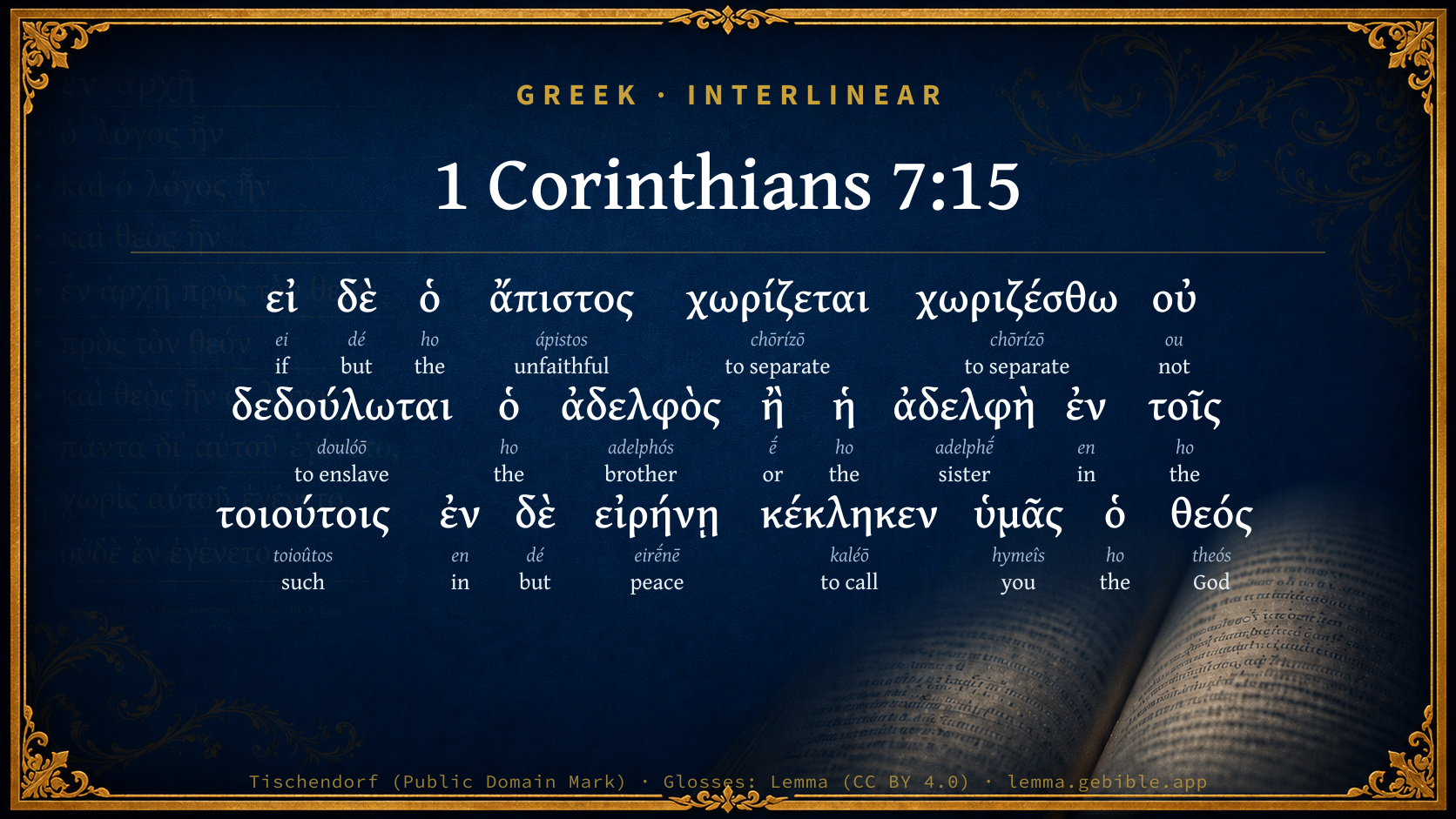
Greek (Tischendorf 8th ed.) 1 Corinthians 7:15 appears in the Greek New Testament. The text above is from the Tischendorf 8th edition. Each word links to its Strong’s number and a concise gloss. Click any word for its full Thayer’s Greek Lexicon entry.
Download image
Cite this verse

1 Corinthians 7:15 (World English Bible). Public Domain. Lemma interlinear Bible study tool, https://lemma.gebible.app/v/1-corinthians/7/15.

Show BibTeX & RIS
BibTeX
RIS
English Translation
Yet if the unbeliever departs, let there be separation. The brother or the sister is not under bondage in such cases, but God has called us in peace.
World English Bible · Public Domain
Download a study sheet

One document with this verse’s original text, its word-by-word gloss line, the meaning frame, cross-references with their text, attributed commentary, and full source and license credits — printable, and it pastes into notes with its structure intact.

This verse Autodidact and up

Study sheet (.html) Plain text (.txt)

A passage Seminary Student

Up to 50 verses in one chapter. A passage sheet keeps up to 6 commentary sources and 12 cross-references per verse, in the order this page ranks them, and says so on the sheet whenever that leaves anything out. Ask for a single verse and you get the Autodidact verse sheet above.

Everything on this page stays free to read, with no account — the sheet is a download of what is already on screen, not access to it.

Want to remove ads? Support Godless Engineer
Compare translations 3

The same verse in 3 English versions, stacked beneath the original-language interlinear above. Click any original word for its lexicon entry.

Each is an independent rendering of the whole verse — the interlinear is not word-aligned to these translations.

Highlighted words mark where these versions differ — a whole-verse word diff, not a word-by-word alignment.

  • World English Bible Public Domain
    Yet if the unbeliever departs, let there be separation. The brother or the sister is not under bondage in such cases, but God has called us in peace.
  • King James Version Public Domain
    But if the unbelieving depart, let him depart. A brother or a sister is not under bondage in such cases: but God hath called us to peace.
  • unfoldingWord Literal Text CC BY-SA 4.0
    But if the unbeliever departs, let him go. In such cases, the brother or the sister is not bound, but God has called us to peace.

unfoldingWord Literal Text — © unfoldingWord, licensed CC BY-SA 4.0. Word-aligned USFM3 via Door43 (git.door43.org/unfoldingWord/en_ult).

Versions to compare (up to 4)

3 of 4 selected

Show all 19 translations

Every available English version of this verse, each an independent rendering of the whole verse.

  • World English Bible Public Domain
    Yet if the unbeliever departs, let there be separation. The brother or the sister is not under bondage in such cases, but God has called us in peace.
  • Berean Standard Bible Public Domain
    But if the unbeliever leaves, let him go. The believing brother or sister is not bound in such cases. God has called you to live in peace.
  • Majority Standard Bible Public Domain
    But if the unbeliever leaves, let him go. The believing brother or sister is not bound in such cases. God has called us to live in peace.
  • King James Version Public Domain
    But if the unbelieving depart, let him depart. A brother or a sister is not under bondage in such cases: but God hath called us to peace.
  • American Standard Version (1901) Public Domain
    Yet if the unbelieving departeth, let him depart: the brother or the sister is not under bondage in such `cases': but God hath called us in peace.
  • Revised Version (1885) Public Domain
    Yet if the unbelieving departeth, let him depart: the brother or the sister is not under bondage in such cases: but God hath called us in peace.
  • Geneva Bible (1599) Public Domain
    But if the vnbeleeuing depart, let him depart: a brother or a sister is not in subiection in such things: but God hath called vs in peace.
  • Douay-Rheims (1899) Public Domain
    But if the unbeliever depart, let him depart. For a brother or sister is not under servitude in such cases. But God hath called us in peace.
  • Young's Literal Translation Public Domain
    And, if the unbelieving doth separate himself -- let him separate himself: the brother or the sister is not under servitude in such `cases', and in peace hath God called us;
  • Literal Standard Version CC BY-SA 4.0
    And if the unbelieving separates himself—let him separate himself: the brother or the sister is not under servitude in such [cases], and in peace has God called us;
  • Unlocked Literal Bible CC BY-SA 4.0
    But if the unbelieving partner departs, let him go. In such cases, the brother or sister is not bound to their vows. God has called us to live in peace.
  • unfoldingWord Literal Text CC BY-SA 4.0
    But if the unbeliever departs, let him go. In such cases, the brother or the sister is not bound, but God has called us to peace.
  • Darby Bible Public Domain
    But if the unbeliever go away, let them go away; a brother or a sister is not bound in such [cases], but God has called us in peace.
  • World Messianic Bible Public Domain
    Yet if the unbeliever departs, let there be separation. The brother or the sister is not under bondage in such cases, but God has called us in peace.
  • Webster's Bible Public Domain
    But if the unbelieving departeth, let him depart. A brother or a sister is not under bondage in such cases; but God hath called us to peace.
  • Free Bible Version CC BY-SA 4.0
    However, if the non-Christian spouse leaves, let them leave. In such cases the Christian man or woman is not slavishly bound, for God has called us to live in peace.
  • Bible in Basic English Public Domain
    But if the one who is not a Christian has a desire to go away, let it be so: the brother or the sister in such a position is not forced to do one thing or the other: but it is God's pleasure that we may be at peace with one another.
  • Text-Critical English NT CC BY 4.0
    But if the unbelieving spouse separates, let it be so. The brother or the sister is not enslaved in such cases. God has called us to live in peace.
  • Tyndale New Testament (1534) Public Domain
    But and yf the vnbelevynge departe let him departe. A brother or a sister is not in subiection to soche. God hath called vs in peace.

Literal Standard Version (2020), Covenant Press — licensed CC BY-SA 4.0. Text via the HelloAO Bible API (eBible.org). Unlocked Literal Bible (unfoldingWord) — licensed CC BY-SA 4.0. Text via the HelloAO Bible API (eBible.org). unfoldingWord Literal Text — © unfoldingWord, licensed CC BY-SA 4.0. Word-aligned USFM3 via Door43 (git.door43.org/unfoldingWord/en_ult). Free Bible Version, Dr. Jonathan Gallagher — licensed CC BY-SA 4.0. Text via the HelloAO Bible API (eBible.org).

Word by word

More ways to search: Search by grammar → Find every occurrence → Compare this word →

Practice this passage: Drill this verse → Learn its vocabulary →

δεδούλωται
doulóō
G1402
“to enslave”
Verb, Perfect, Passive, Indicative, 3rd person, Singular
Part of Speech
Verb
Tense
Perfect
Voice
Passive
Mood
Indicative
Person
3rd person
Number
Singular
Full Thayer's Definition

Origin: from G1401

TDNT: 06:39,2

1. to make a slave of, reduce to bondage 2. metaph. give myself wholly to one's needs and service, make myself a bondman to him
  1. εἰ ei G1487 “if” Conditional
  2. δὲ dé G1161 “but” Conjunction
  3. ὁ ho G3588 “the” Article, Nominative, Singular, Masculine
  4. ἄπιστος ápistos G571 “unfaithful” Adjective, Nominative, Singular, Masculine
  5. χωρίζεται chōrízō G5563 “to separate” Verb, Present, Middle, Indicative, 3rd person, Singular
  6. χωριζέσθω chōrízō G5563 “to separate” Verb, Present, Passive, Imperative, 3rd person, Singular
  7. οὐ ou G3756 “not” Particle, Negative
  8. ὁ ho G3588 “the” Article, Nominative, Singular, Masculine
  9. ἀδελφὸς adelphós G80 “brother” Noun, Nominative, Singular, Masculine
  10. ἢ ḗ G2228 “or” Particle
  11. ἡ ho G3588 “the” Article, Nominative, Singular, Feminine
  12. ἀδελφὴ adelphḗ G79 “sister” Noun, Nominative, Singular, Feminine
  13. ἐν en G1722 “in” Preposition
  14. τοῖς ho G3588 “the” Article, Dative, Plural, Neuter
  15. τοιούτοις toioûtos G5108 “such” Demonstrative pronoun, Dative, Plural, Neuter
  16. ἐν en G1722 “in” Preposition
  17. δὲ dé G1161 “but” Conjunction
  18. εἰρήνῃ eirḗnē G1515 “peace” Noun, Dative, Singular, Feminine
  19. κέκληκεν kaléō G2564 “to call” Verb, Perfect, Active, Indicative, 3rd person, Singular
  20. ὑμᾶς hymeîs G5210 “you” Personal pronoun, 2nd person, Accusative, Plural
  21. ὁ ho G3588 “the” Article, Nominative, Singular, Masculine
  22. θεός theós G2316 “God” Noun, Nominative, Singular, Masculine

About this verse

These counts appear in no published source. They are computed here, from the morphology-tagged text and Lemma’s own curated glosses. What Lemma adds →

23
words
16
distinct lemmas
Pauline Epistles
section

Notable vocabulary

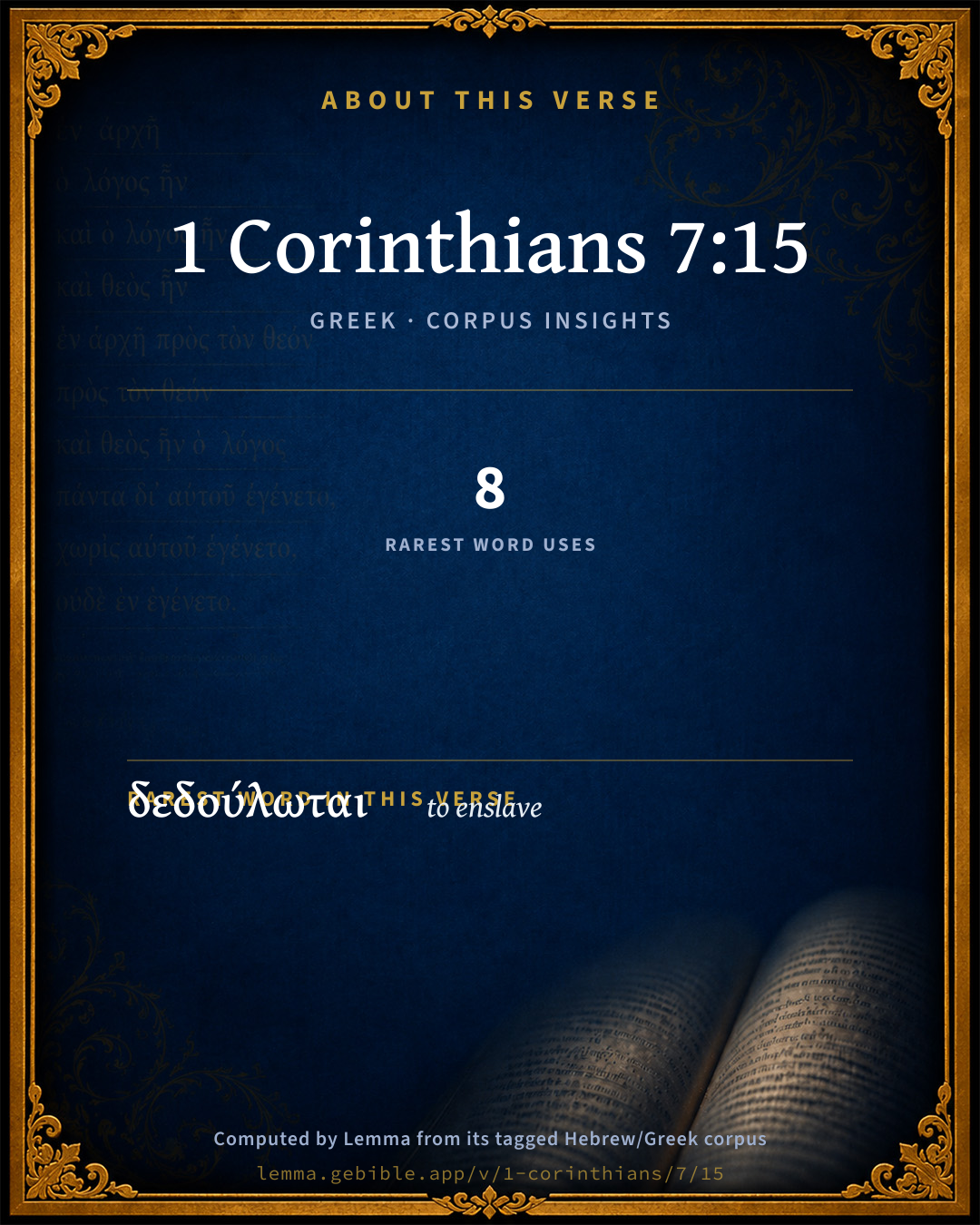
The rarest word here is δεδούλωται to enslave G1402 — appearing just 8 times in the whole Greek New Testament.

Shared distinctive vocabulary

δεδούλωται to enslave G1402 occurs in 8 verses of the Greek New Testament. Also found in:

Repetition

Words recur within this verse:

Cross-references

9

Topical passages linked to 1 Corinthians 7:15 in the Treasury of Scripture Knowledge — connected by theme and wording, ordered by reader-vote popularity; previews shown in the World English Bible.

  • Romans 14:19 So then, let us follow after things which make for peace, and things by which we may build one another up.
  • 2 Corinthians 13:11 Finally, brothers, rejoice. Be perfected, be comforted, be of the same mind, live in peace, and the God of love and peace will be with you.
  • James 3:17–18 But the wisdom that is from above is first pure, then peaceful, gentle, reasonable, full of mercy and good fruits, without partiality, and without hypocrisy.
  • Matthew 12:50 For whoever does the will of my Father who is in heaven, he is my brother, and sister, and mother."
  • Romans 12:18 If it is possible, as much as it is up to you, be at peace with all men.
  • 1 Corinthians 14:33 for God is not a God of confusion, but of peace. As in all the assemblies of the saints,
  • Galatians 5:22 But the fruit of the Spirit is love, joy, peace, patience, kindness, goodness, faithfulness,
  • Hebrews 12:14 Follow after peace with all men, and the sanctification without which no man will see the Lord,
  • James 2:15 And if a brother or sister is naked and in lack of daily food,

Cross-references courtesy of OpenBible.info (CC BY 4.0).

Where the printed editions differ

1 variant

Places in this verse where the major printed Greek editions disagree on the wording in a way that affects the translation — a comparison of editions, not a manuscript-by-manuscript collation. The editions are the modern critical texts (Nestlé-Aland 28/27, SBL, Westcott-Hort, Tregelles, Tyndale House) and the traditional texts behind the KJV (the Textus Receptus and the Byzantine/Majority text). It is not a claim about which reading is original.

  1. Different wording
    ὑμᾶς

    “you”

    In NA28NA27WH Not in TynSBLTregTRByz

    ἡμᾶς (hēmas) 'us' occurs in traditional manuscripts (Tyn+SBL+Treg+TR+Byz) instead of ὑμᾶς (humas) 'you' in older manuscripts (NA28+NA27+WH)

Textual data: Translators Amalgamated Greek New Testament (STEPBible TAGNT) · CC BY 4.0.

Commentary

Notes on 1 Corinthians 7:15 from classic Christian and Jewish commentators (each source and its license shown beneath its notes). The classic Christian expositions comment on the surrounding passage and are grouped to its opening verse, so a note may address several verses; the Jewish commentaries on the Tanakh (Rashi and others) are per-verse, so they appear only where the commentator wrote on this verse.

Lemma curates 59 commentaries, every one of them public domain or Creative Commons licensed, each selected and text-cleaned for this edition rather than reprinted as found. About our sources →

Joseph Benson's Commentary

1Co 7:15-17. But if the unbelieving party depart, let him, or her depart — And take the course they think best. A brother or sister — A Christian man or woman; is not under bondage — Is at full liberty; in such cases: but — Let it be always remembered; God hath called us to peace — To live peaceably with them, if it be possible: and therefore it ought to be our care to behave in as inoffensive a manner as may be, in all the relations of life; that so, if there must be a breach, the blame may not be chargeable upon the Christian. For what knowest thou, &c. — As if he had said, It is of great importance that you should conduct yourselves properly toward those who thus make, as it were, a part of yourselves, and that you should adorn the gospel by the most amiable and engaging behaviour possible, that thereby the unbeliever may be gained over to Christianity. And surely the everlasting happiness of the person, now the companion of your life, will be more than an equivalent for all the self-denial to which you may be required at present to submit. See on 1Pe 3:1-2. But — However it be, whether the unbeliever be converted or not; as God hath distributed to every man — The various stations of life, and various relations, let him take care to discharge his duty therein; for the gospel disannuls none of them: And as the Lord hath called every one, so let him walk — “By declaring here, and 1Co 7:20; 1Co 7:24, that men were bound, after their conversion, to continue under all the moral and just political obligations, which lay on them before their conversion, the apostle condemned the error of Judaizers, who taught, that, by embracing the true religion, all the former obligations, under which the convert lay, were dissolved. The gospel, instead of weakening any moral or just political obligation, strengthens them all.” This I ordain in all churches — This I lay down as a general rule for all Christians to observe, and insist on it, as a matter of the greatest importance.

Joseph Benson's Commentary on the Old and New Testaments (1811–1818) — public domain. Text from a community e-Sword module.

Tyndale Open Study Notes

Tyndale Open Resources

7:15 If the unbeliever breaks up the marriage, the believing husband or wife is free to let them go. • has called you: God’s desire is that his people live in peace, rather than in the intolerable conflict of a mixed marriage no longer desired by the non-Christian spouse.

Tyndale Open Study Notes — © Tyndale Open Resources, licensed CC BY-SA 4.0. Text via the HelloAO Bible API.

Bengel's Gnomon

Johann Albrecht Bengel

1Co 7:15. Ὁ) ἢ ἡ ἄπιστος.—χωριζέσθω, let—be separated) Let him be divorced. A brother or a sister should be patient, and not think that that ought to be changed, which he or she cannot change. [The believing party is not bound to renounce the faith for the sake of the unbelieving party.—V. g.]—οὐ δεδούλωται, is not under bondage) There was more decided liberty in the latter case on this account, that the believing party was not likely to obtain much assistance from the unbelieving magistrate; although, even in the present day, the same principle holds good for liberty and peace; but with that exception [proviso], let her remain unmarried, 1Co 7:11.—ἐν δὲ εἰρήνῃ, but in peace) An axiomatic truth; one that proceeds from things internal to things external. There had been formerly enmity, Eph 2:15.

Bengel's Gnomon of the New Testament — English translation (T&T Clark, Edinburgh, 1860) — public domain. Text from a community e-Sword module.

Meyer's Critical & Exegetical Commentary

Heinrich August Wilhelm Meyer

1Co_7:15. Paul had before enjoined that the Christian partner should not make a separation if the non-Christian consents to remain. But what, if the non-Christian partner seeks separation? In that case they were to let such an one go without detention (χωριζέσθω, permissive, see Winer, p. 291 [E. T. 390]); suas sibi res habeat; frater sororve sit aequo animo, Bengel. And the reason for this was: A believer in such circumstances is not enslaved, nay, surely (δέ after the negative clause) it is in peace that God has called us, so that this our calling forbids such a living together as would be unpeaceful through constraint.

οὐ δεδούλ.] is not enslaved, so, namely, as still to remain bound in marriage to such a χωριζόμενος.[1128] The expression brings out the unworthy character of such a relationship. Comp Gal_4:3; Plato, Pol. ix. p. 589 E; Soph. Trach. 256; 4Ma_3:3 f., 1Co_13:2. See, on the other hand, the simple δέδεται in 1Co_7:39.

ἘΝ ΤΟῖς ΤΟΙΟΎΤΟΙς] not, as Hofmann takes it: In matters of the natural life, to which marriage belongs, but in accordance with the context: under such circumstances, i.e. in such a position of things, where the non-believing consort separates himself. Luthers renders well: in solchen Fällen. Comp ἘΝ ΤΟῖΣΔΕ, Soph. Oed. Tyr. 892. ἐν τούτοις, Plut. Glor. Ath. p. 350 A; Php_4:11; ἐν οἷς, Antiph. i. 6, and Maetzner in loc[1131], p. 131. Only a comma should be placed after ΤΟΙΟΎΤΟΙς

ἘΝ ΕἸΡΉΝῌ] is not the same as ΕἸς ΕἸΡΉΝΗΝ (Rosenmüller, Flatt, Rückert, following older expositors; comp also Billroth), or ἽΝΑ ὮΜΕΝ ἘΝ ΕἸΡ. (de Wette, Osiander, Gratama, Maier); for that which is stated is not to what God has called us (see, on the other hand, 1Co_7:22; 1Pe_5:10), but in what ethical form Gods call has taken place. He has so called us, namely, to the Messiahs kingdom, that He therewith caused peace to be proclaimed to us in respect of our relation to others (Eph_2:14 ff.). Analogous to this is the ἐν in Eph_4:4; 1Th_4:7; comp also on Gal_1:6. To understand, however, the ΕἸΡΉΝΗ as referring to the peace of the soul with God (Harless, Hofmann) would be possible only if δεδούλ. were to be referred to binding of the conscience. And even in that case we should expect as correlative rather ἐν or ἘΠʼ ἘΛΕΥΘΕΡΊᾼ (Gal_5:13).

[1128] Weiss, in the Deutsch. Zeitschr. 1866, p. 267 (comp. his bibl. Theol. p. 423), understands δεδούλ. of the burden of the conscience in view of Christs command respecting the indissolubleness of marriage. Precisely so Hofmann. But had Paul meant this, he must have indicated it more particularly. According to the context, οὐ δεδούλ. is the opposite of the μὴ ἀφιέτω in vv. 12, 13, denoting legal necessity, like δἑδεται in ver. 39

[1131] n loc. refers to the note of the commentator or editor named on the particular passage.

REMARK.

Since desertion (χωρίζεται) appears here as an admissible ground for divorce, this has been thought to conflict with Mat_5:32; Mat_19:9, and various explanations have been attempted (see Wolf in lo[1134]). But the seeming contradiction vanishes, if we consider 1Co_7:12, according to which Jesus had given no judgment upon mixed marriages; Mat_5:32, therefore, can only bind the believing consort, in so far that he may not be the one who leaves. If, however, he is left by the non-believing partner, then, as this case does not fall under the utterance of Christ, the marriage may be looked upon as practically dissolved, and the believing partner is not bound. But to apply, as is often done, the permissive χωριζέσθω also to such marriages as are Christian on both sidesthe χωριζόμενος, that is to say, being an unchristianly-minded Christian (Harless)is exegetically inadmissible, seeing that the ΛΟΙΠΟΊ who are here spoken of (see 1Co_7:12) constitute the specific category of mixed marriages, in which, therefore, the one partner in each case falls to be reckoned among τοὺς ἔξω. So also pref. to 4th ed. p. vii. f.

Our text gives no express information upon the point, whether Paul would allow the Christian partner in such a union to marry again. For what οὐ δεδούλωται negatives is not the constraint ut caelebs maneat (Grotius, al[1135]), but the necessity for the marriage being continued.[1136] It may be inferred, however, that as in Pauls view mixed marriages did not come under Christs prohibition of divorce, so neither would he have applied the prohibition of remarriage in Mat_5:32 to the case of such unions. Olshausen is wrong in holding a second marriage in such cases unlawful, on the ground of its being, according to Matthew, l.c[1137], a μοιχεία. Christ Himself took no account of mixed marriages. Nor would 1Co_7:11, which does not refer to marriages of that kind, be at variance with the remarriage of the believing partner (in opposition to Weiss, bibl. Theol. l.c[1138]).

[1134] n loc refers to the note of the commentator or editor named on the particular passage.

[1135] l. and others; and other passages; and other editions.

[1136] Photius, as cited by Oecumenius, says very justly: οὐκ ἔχει ἀνάγκην ὁ πιστὸς ἢ ἡ πιστὴ ἐν τοῖς ἀπίστοις τοιαύτην, οἷα αὐτῷ ἐπίκειται ἐπὶ τῶν πιστῶν· ἐκεῖ μὲν γὰρ παντὶ τρόπῳ, χωρὶς λόγου πορνείας οὐκ ἔξεστιν ἀπʼ ἀλλήλων τοὺς συναφθέντας χωρισθῆναι· ἐνταῦθα δὲ, ἂν μὲν συνευδοκῇ τὸ ἄπιστον μέρον τῷ πιστῷ συνοικεῖν, δεῖ μὴ λύειν τὸ συνοικέσιον· ἂν δὲ στασιάζῃ καὶ τὴν λύσιν ἐκεῖνος ποιῇ, οὐ δεδούλωται ὁ πιστὸς εἰς τὸ μὴ χωρισθῆναι.

[1137] .c. loco citato or laudato.

[1138] .c. loco citato or laudato.

Meyer — Critical and Exegetical Commentary on the New Testament — English translation by Peter Christie, edited by Frederick Crombie (T&T Clark, 1880) — public domain. Text from a community e-Sword module.

Expositor's Greek Testament

ed. W. Robertson Nicoll

1Co 7:15 a . The Christian wife or husband is not to seek divorce from the non-Christian (1Co 7:12-14 ); but if the latter insists on separation, it is not to be refused: “But if the unbeliever separates, he may separate” let the separation take its course ( χωριζὲσθω , pr [1049] impv [1050] ): for this impv [1051] of consent, cf. 1Co 7:36 , 1Co 14:38 . οὐ δεδούλωται (pf. of fixed condition ) “the brother or the sister in such circumstances is not kept in bondage”; cf. 1Co 7:39 the stronger vb [1052] of this passage implies that for the repudiated party to continue bound to the repudiator would be slavery . Christ’s law forbids putting away (1Co 7:10 ff.), but does not forbid the one put away to accept dismissal. Whether the freedom of the innocent divorced extends to remarriage , does not appear: the Roman Church takes the negative view though contrary to the Canon Law (see Wordsworth, in loc. ); the Lutheran Church the affirmative, allowing remarriage on desertio malitiosa ; “in view of 1Co 7:11 , the inference that the divorced should remain unmarried is the safer” (so Hn [1053] , against Mr [1054] ). If, however, the repudiator forms a new union, cutting off the hope of restoration, the case appears then to come under the exception made in Mat 5:31 . With ἐν τοιούτοις , neut., cf. ἐν τούτοις , Rom 8:37 ; and ἐν οἷς , Phi 4:11 .

[1049] present tense.

[1050] imperative mood.

[1051] imperative mood.

[1052] verb

[1053] C. F. G. Heinrici’s Erklärung der Korintherbriefe (1880), or 1 Korinther in Meyer’s krit.-exegetisches Kommentar (1896).

[1054] Meyer’s Critical and Exegetical Commentary (Eng. Trans.).

1Co 7:15 b , 1Co 7:16 . ἐν δὲ εἰρήνῃ ὁ Θεός … σώσεις ; The Christian spouse forsaken by the heathen is free from the former yoke; but such freedom is undesirable . Two considerations make against it: Peace is better for a Christian than disruption ( 1Co 7:15 b ); and there is the possibility of saving the unbeliever by remaining with him, or her (1Co 7:16 ). Thus P. reverts, by the contrastive δέ , to his prevailing thought, that the marriage tie, once formed, should in every way possible be maintained. On this view of the connexion, the full stop should be set at ἐν τοιούτοις , and the colon at ὁ Θεός . “In peace,” etc. opposed to χωριζέσθω , like καταλλαγήτω in 1Co 7:11 appeals to the ruling temper of the Christian life, determined once for all by God’s call in the Gospel, “ex quo consequitur retinendum esse nobis infidelem, ac omnibus officiis demerendum; nedum ut vel eum ipsi deseramus, vel ad nos deserendos provocemus” (Bz [1055] ); cf. Rom 12:18 , for the general thought. For the construction of ἐν εἰρήνῃ , cf. 1Th 4:7 , Gal 1:6 , Eph 4:4 .

[1055] Beza’s Nov. Testamentum: Interpretatio et Annotationes (Cantab., 1642).

The Expositor's Greek Testament, edited by W. Robertson Nicoll (1897–1910) — public domain. Text from a community e-Sword module.

Godet's Commentaries

Frédéric Louis Godet

Vv. 15, 16. “But if the unbelieving depart, let him depart; a brother or a sister is not under bondage in such things; but God hath called us in peace. 16. For what knowest thou, O wife, whether thou shalt save thy husband? and how knowest thou, O man, whether thou shalt save thy wife?”

The rule to be followed in this case is given in 1Co 7:15; the reason follows in 1Co 7:16. The Christian spouse should in this case consent to a separation which she could not refuse without going in the face of incessant conflicts. The word, let him depart, throws back the whole responsibility on the non-believer. The expression ἐν τοῖς τοιούτοις might signify, in such circumstances (the refusal of the heathen spouse). But the plural leads more naturally to the sense, in such things, in this kind of matters. The apostle is no doubt thinking of the transient element in earthly relations in general, when compared with the eternal interests which alone can bind the believer absolutely. He has probably already in view the other analogous relations with which he proceeds to deal in this connection from 1Co 7:17. The words ἐν εἰρήνῃ, in peace, have often been understood as if they were εἰς εἰρήνην, “to peace.” But if this had been Paul’s idea, why not express himself so? He means rather that the call to faith which they accepted, bore from the first a pacific character, for it consisted in the offer of peace with God; and consequently the stamp of peace ought to be impressed on all their earthly conduct. Chrysostom regarded this last remark as intended to restrict the liberty of separation granted in the previous words; in this sense: “Nevertheless consider well that it is to peace thy Master has called thee, and see yet whether thou couldest not maintain the union.” But as Edwards says, if the non-believer has left the Christian, how is it possible to exhort the latter to live in peace with the former? Is it not clear that by persisting to impose her presence, the Christian spouse would put herself directly in contradiction to the spirit of peace? For this conduct could not fail to issue in a state of perpetual war. The δέ is adversative: but. It contrasts with the subjection, which is denied, the duty of living in peace, which is affirmed. One might also, like Beet, translate the δέ in the sense of, and moreover; this would give a gradation: “And not only are ye not subject in this case..., but moreover there is a duty to...”

The difficult question in regard to this verse is to determine whether the is not under bondage includes, besides the right of separation, that of remarriage for the Christian spouse. Edwards cites the fact that this was the opinion of Ambrosiaster, whereas the Council of Arles (314) decided the question in the opposite sense. Among Protestants, malicious desertion—such is the judicial name for the χωρίζεσθαι on the part of one of the spouses—is regarded in general as equivalent to adultery, and consequently as authorizing a new marriage. I do not think that it is possible exegetically, as Edwards proposes, to decide the question in the latter sense, for, as Meyer observes, the οὐ δεδούλωται simply authorizes separation, without containing, either explicity or implicitly, the idea of a new union. In any case, in application to our present circumstances, it must not be forgotten that separation between a Christian and a heathen spouse is not subject to the same conditions as separation between two Christian spouses. For the latter, the rule has been given, and that by the Lord Himself, 1Co 7:10-11.

The two questions of 1Co 7:16 have been frequently understood, from Chrysostom to Tholuck, in a sense opposed to liberty of separation: “What knowest thou whether thou shalt not save...?” Edwards has proved by several examples, taken from classic Greek, the grammatical possibility of taking εἰ in the sense of whether; comp. moreover in the LXX. Joe 2:14; Jon 3:9. But, as he rightly says, the context is decidedly opposed to this interpretation. It would assume that meaning of the preceding proposition which we have been obliged to reject; and so understood, the saying would demand of the Christian, with a view to a result very problematical and rendered almost impossible by the refusal of cohabitation on the part of the heathen spouse, an altogether disproportionate sacrifice.

Frédéric Louis Godet — Commentaries on Luke, John, Romans, and 1 Corinthians — English translation (T&T Clark, Edinburgh, 1870s–1890s) — public domain. Text from a community e-Sword module.

Hodge's Commentary on Romans, Ephesians & First Corinthians

Charles Hodge

1Co_7:15

But if the unbelieving depart, let him depart. A brother or a sister is not under bondage in such (cases): but God hath called us to peace.

The command in the preceding verse was founded on the assumption, that the unbelieving party consented to remain in the marriage relation. If the unbeliever refused thus to remain, the believer was then free. The believer was not to repudiate the unbelieving husband or wife; but if the unbeliever broke up the marriage, the Christian partner was thereby liberated from the contract. This is the interpretation which Protestants have almost universally given to this verse. It is a passage of great importance, because it is the foundation of the Protestant doctrine that willful desertion is a legitimate ground of divorce. And such is certainly the natural sense of the passage. The question before the apostle was, What is to be done in the case of these mixed marriages? His answer is, Let not the believer put away the unbeliever, for Christ has forbidden a man to put away his wife for any cause except that of adultery, Mat_5:32. But if the unbeliever breaks up the marriage, the believer is no longer bound. There is no conflict here between Christs command and Pauls instructions. Both say, a man cannot put away his wife (nor of course a wife her husband) on account of difference of religion, or for any other reason but the one above specified. The apostle only adds that if the believing party be, without just cause, put away, he or she is free.

A brother or sister is not in bondage (οὐ δεδούλωται, equivalent to οὐ δέδεται, 1Co_7:39), i.e. is not bound; if the unbeliever consent to remain, the believer is bound; if the unbeliever will not consent, the believer is not bound. In the one case the marriage contract binds him; in the other case it does not bind him. This seems to be the simple meaning of the passage. Others understand the apostle as saying that the believer is not bound to continue the marriage that is, is under no obligation to live with a partner who is unwilling to live with him. But the one part of the verse should be allowed to explain the other. An obligation which is said to exist in one case, Paul denies exists in another. If the unbeliever is willing to remain, the believer is bound by the marriage contract; but if she be unwilling, he is not bound.

But God hath called us in peace (ἐν εἰρήνῃ i.e. ὥστε εἶναι ἐν εἰρήνῃ). Peace is the state in which the called should live. The gospel was not designed to break up families or to separate husbands and wives. Therefore, though the believer is free if deserted by his unbelieving partner, the separation should be avoided if possible. Let them live together if they can; and let all proper means be taken to bring the unbelieving party to a sense of duty, and to induce him to fulfill the marriage covenant. This is the common view of the meaning of this clause. Others understand it in a directly opposite sense, viz., as assigning a reason why the separation should take place, or at least why the attempt to detain an unwilling husband or wife should not be pressed too far. As God hath called us to live in peace, it is contrary to the nature of our vocation to keep up these ill-assorted connections. This, however, is contrary to the whole animus of the apostle. He is evidently laboring throughout these verses to prevent all unnecessary disruptions of social ties.

Charles Hodge — Commentary on Romans (1835), First Corinthians (1857), and Ephesians (1856) — public domain. Text from a community e-Sword module.

Geneva Bible (1599)

Geneva Bible translators

When any such thing falleth out.

Lest any man upon pretence of this liberty should give occasion to the unfaithful to depart, he giveth to understand, that marriage contracted with an infidel, ought peaceably to be kept, that if it be possible the infidel may be won to the faith.

He answereth to a question: what if the unfaithful forsake the faithful? then is the faithful free, saith he, because he is forsaken of the unfaithful.

Geneva Bible (1599) marginal notes — public domain. Text via Bolls.life.

Jamieson, Fausset & Brown

Robert Jamieson, A. R. Fausset & David Brown

if . . . depart--that is, wishes for separation. Translate, "separateth himself": offended with her Christianity, and refusing to live with her unless she renounce it.

brother or a sister is not under bondage--is not bound to renounce the faith for the sake of retaining her unbelieving husband [HAMMOND]. So Deu 13:6; Mat 10:35-37; Luk 14:26. The believer does not lie under the same obligation in the case of a union with an unbeliever, as in the case of one with a believer. In the former case he is not bound not to separate, if the unbeliever separate or "depart," in the latter nothing but "fornication" justifies separation [PHOTIUS in Æcumenius].

but God hath called us to peace--Our Christian calling is one that tends to "peace" (Rom 12:18), not quarrelling; therefore the believer should not ordinarily depart from the unbelieving consort (Co1 7:12-14), on the one hand; and on the other, in the exceptional case of the unbeliever desiring to depart, the believer is not bound to force the other party to stay in a state of continual discord (Mat 5:32). Better still it would be not to enter into such unequal alliances at all (Co1 7:40; Co2 6:14).

Jamieson, Fausset & Brown — Commentary Critical and Explanatory on the Whole Bible (1871) — public domain (CC PDM 1.0). Text via the HelloAO Bible API.

Adam Clarke's Commentary

Verse 15. But if the unbelieving, depart] Whether husband or wife: if such obstinately depart and utterly refuse all cohabitation, a brother or a sister-a Christian man or woman, is not under bondage to any particular laws, so as to be prevented from remarrying. Such, probably, the law stood then; but it is not so now; for the marriage can only be dissolved by death, or by the ecclesiastical court. Even fornication or adultery does not dissolve the marriage contract; nor will the obstinate separation of any of the parties, however long continued, give the party abandoned authority to remarry. If the person have been beyond sea, and not heard of for seven years, it is presumed he may be dead; and marriage has been connived at in such cases. If there be no person to complain, it may be presumed that there is none injured. But I have known instances where even a marriage after seven years' absence has been very unfortunate; the husband returning at the end of ten or twelve years, and to his utter distress finding his wife married to another man, and with issue of that marriage! There can be no safety in this case, unless there be absolute certainty of the death of the party in question.

God hath called us to peace.] The refractory and disagreeing party should not be compelled to fulfil such matrimonial engagements as would produce continual jarring and discord. At the same time each should take care that he give no cause for disagreements and separations, for the author of the Christian religion is the author of peace, and has called us to it.

Adam Clarke's Commentary on the Bible (1810–1826) — public domain. Text from a community e-Sword/MySword module.

John Calvin's Commentaries

15. But if an unbeliever depart. This is the second department of his statement, in which he sets at liberty a believing husband, who is prepared to dwell with an unbelieving wife, but is rejected by her, and in like manner a woman who is, without any fault on her part, repudiated by her husband; for in that case the unbelieving party makes a divorce with God rather than with his or her partner. There is, therefore, in this case a special reason, inasmuch as the first and chief bond is not merely loosed, but even utterly broken through. While some are of opinion that we are at this day situated in a much similar way with Papists, we ought to consider wisely what difference there is between the two cases, that we may not attempt anything rashly.

In peace. Here, too, interpreters differ; for some take it in this way — “We are called in peace: let us therefore avoid all ground and occasion of quarrels.” I take it in a more simple way: “Let us, so far as we can, cultivate peace with all, to which we have been called. We must not, therefore, rashly separate from unbelievers, unless they first make a divorce. God, therefore, has called us in peace to this end, that we might cultivate peace with all, by acting properly towards every one.” This, then, belongs to the former department of his statement — that

believers ought to remain with unbelievers, if they are pleased, etc., (1 Corinthians 7:12 and 13,)

because a desire for divorce is at variance with our profession.

John Calvin's Commentaries (1540-1563) — public domain. Text from the Calvin Translation Society English edition (1840s-50s) via the Christian Classics Ethereal Library (ccel.org). Calvin's coverage is partial (roughly two-thirds of the Bible); uncommented books and verses are honest gaps, never fabricated. The 19th-century editor's footnotes and remarks are omitted so the notes are faithfully Calvin's own voice.

Ellicott's Commentary for English Readers

(15) But if the unbelieving depart.—Supposing, however, the desire for separation arises from the unbelieving partner, how is the Christian partner to act? If the married life, for example, be made intolerable by the unbeliever urging the believer to join in such religious acts as conscience cannot approve, the Apostle’s previous commands for continued union do not hold good: a brother or a sister, in such cases, is not bound to insist upon the continuation of the union. “Let the unbeliever, if he so desire, depart.”

This permission is in no way contrary to our Lord’s permission of divorce on only one ground, for the Apostle has carefully reminded his readers that our Lord’s command does not apply to the case of a marriage between a believer and a heathen. In ouch cases we have no command from Him.

A brother or a sister.—That is, a Christian. In such cases, when the unbelieving partner wishes to depart, let him or her do so. The Christian partner is not, under such circumstances, bound by the marriage to continue together. Their doing so might destroy that very peace in which (not “to peace” as in the English) God has called us.

A Bible Commentary for English Readers, edited by Charles John Ellicott (1878–1897) — public domain. Text from a community e-Sword module.

The Cambridge Bible for Schools and Colleges

gen. ed. J. J. S. Perowne

15. A brother or a sister is not under bondage (literally, enslaved) in such cases] The Roman Catholic divines, e.g. à Lapide and Ambrosiaster, as well as the Canon law, held that in the case of the heathen partner refusing to live with the other when he or she embraced Christianity, the Christian was justified in contracting a fresh marriage. See Wordsworth, in loc.

to peace] The marginal in peace is to be preferred, as signifying the spirit in which God called us.

The Cambridge Bible for Schools and Colleges (gen. ed. J. J. S. Perowne; Cambridge University Press, 1878–1918) — public domain. Text from a community e-Sword module.

John Gill's Exposition

But if the unbelieving depart,.... If the unbelieving party, man or woman, separate themselves from the believing party on account of religion, and in hatred to it, and will not live with the believer unless Christ is denied, his Gospel abjured, and his ordinances and worship relinquished:

let him depart; he or she, though not without making use of all proper means to retain them; but if, after all, they will go, unless such things are complied with as are unreasonable and sinful, they are not to be held, but let go; and the deserted person may sit down contented, being not to be blamed, the fault entirely lying upon the deserter:

a brother or a sister is not under bondage in such cases. The Ethiopic version reads it, "to such an one"; one that is called by grace a church member, and so a brother or sister in Christ, is not to be subject to an unbeliever in matters of conscience, in things appertaining to the worship of God, and the service and glory of Christ; nor, being in such circumstances, that either Christ must be forsaken, or the unbeliever will depart, are they obliged to yield to such an one, but rather suffer a departure; nor are they bound to remain unmarried, but are free to marry another person, after all proper methods have been tried for a reconciliation, and that appears to be impracticable; desertion in such a case, and attended with such circumstances, is a breach of the marriage contract, and a dissolution of the bond, and the deserted person may lawfully marry again; otherwise a brother, or a sister in such a case, would be in subjection and bondage to such a person:

but God hath called us to peace; which ought to be sought after and maintained, so far as it can be consistent with truth, the glory of God, the honour of Christ, and interest of religion. The believing party being threatened with a desertion, ought as much as possible to seek for peace and reconciliation, and do all that can be to prevent a departure; for saints are called by the grace of God, to follow after and cultivate peace, not only with one another in their Christian communion as saints, but with all men, even their enemies, and especially with such as are so nearly allied; wherefore the departure should not be easily admitted, or a new marriage be suddenly entered into, reconciliation, if it can be obtained, being most eligible and becoming a Christian.

John Gill's Exposition of the Whole Bible (1746–1763) — public domain (CC PDM 1.0). Text via the HelloAO Bible API.

Trapp's Complete Commentary

John Trapp

15 But if the unbelieving depart, let him depart. A brother or a sister is not under bondage in such cases: but God hath called us to peace.

Ver. 15. But God hath called us to peace] To domestic peace, which they that lack, Plus quam dimidiae beatitudinis suae parte privati sunt, saith Aristotle; They have lost the greater half of the happiness of their lives. This was verified in Phoroneus the lawgiver, and Sulla the Roman general. (Bruson.)

John Trapp, A Commentary or Exposition upon All the Books of the Old and New Testament (1647–1656) — public domain. Text from a community e-Sword module.

Albert Barnes' Notes on the Bible

But if the unbelieving depart - If they choose to leave you.

Let him depart - You cannot prevent it, and you are to submit to it patiently, and bear it as a Christian.

A brother or a sister is not under bondage ... - Many have supposed that this means that they would be at liberty to marry again when the unbelieving wife or husband had gone away; as Calvin, Grotius, Rosenmuller, etc. But this is contrary to the strain of the argument of the apostle. The sense of the expression “is not bound,” etc. is, that if they forcibly depart, the one that is left is not bound by the marriage tie to make provision for the one that departed; to do acts that might be prejudicial to religion by a violent effort to compel the departing husband or wife to live with the one that is forsaken; but is at liberty to live separate, and should regard it as proper so to do.

God hath called us to peace - Religion is peaceful. It would prevent contentions and broils. This is to be a grand principle. If it cannot be obtained by living together, there should be a peaceful separation; and “where” such a separation has taken place, the one which has departed should be suffered to remain separate in peace. God has called us to live in peace with all if we can. This is the general principle of religion on which we are always to act. In our relation to our partners in life, as well as in all other relations and circumstances, this is to guide us. Calvin supposes that this declaration pertains to the former part of this verse; and that Paul means to say, that if the unbelieving depart, he is to be suffered to do so peaceably rather than to have contention and strife, for God has called us to a life of peace.

Albert Barnes' Notes on the Bible (1834–1885) — public domain. Text from a community e-Sword/MySword module.

Matthew Poole's English Annotations

If the unbelieving husband or the unbelieving wife will leave his or her correlate, that is, so leave them as to return no more to live as a husband or as a wife with her or him that is Christian,

let him depart. Such a person hath broken the bond of marriage, and in such cases Christians are

not under bondage, they are not tied by law to fetch them again, nor by the laws of God to keep themselves unmarried for their perverseness. But it may be objected, that nothing but adultery, by the Divine law, breaketh that bond.

Answer. That is denied. Nothing but adultery is a justifiable cause of divorce: no man may put away his wife, nor any wife put away her husband, but for adultery. But the husband’s voluntary leaving his wife, or the wife’s voluntary leaving her husband, with a resolution to return no more to them, breaks also the bond of marriage, frustrating it as to the ends for which God hath appointed it; and, after all due means used to bring again the party departing to their duty, doth certainly free the correlate. So that although nothing can justify repudiation, or putting away a wife or a husband, and marrying another, but the adultery of the person so divorced and repudiated; yet the departure either of husband or wife without the other’s consent for a long time, and refusal to return after all due means used, especially if the party so going away doth it out of a hatred and abomination of the other’s religion, will justify the persons so deserted, after due waiting and use of means to reduce him or her to their duty, wholly to cast off the person deserting; for no Christian in such a case, by God’s law, is under bondage.

But God hath called us to peace; for God hath called Christians unto peace, and in his ordinance of marriage aimed at the quiet and peace of his people in their service of him in their families and relations; and therefore as Christians ought not to disturb the peace of their own consciences, turning away their relations, though they be unbelievers; yet neither are they bound, if such will leave them, to court their own continual trouble and disturbance.

Matthew Poole's English Annotations on the Holy Bible (1683–1685) — public domain. Text from a community e-Sword/MySword module.

Whedon's Commentary on the Bible

Daniel D. Whedon

15. If the unbelieving depart—The Christian may not desert the infidel; but suppose the infidel desert the Christian?

Let him depart—Use no legal obstacles to prevent his going.

Is not under bondage—Literally, is not enslaved; but the question now is, How far is the Christian emancipated? Different replies have been given, as, 1. That the Christian is released from the duty of compelling the unbeliever to remain in cohabitation; but to this the obvious replies are, first, that no such duty of compulsion to cohabit can have been supposed to exist, and, therefore, no emancipation from such duty was needed: and, second, it is a very awkward interpretation to make the apostle say, that the Christian is not enslaved to the duty of enslaving the opposite party. 2. That the Christian is required to let the infidel depart rather than give up Christianity in order to retain him. But, surely, Paul could not have understood any Corinthian believer as inquiring whether he should not apostatize in order to save the marriage cohabitation! Obviously, therefore, the only meaning is, that though the Christian may not dissolve the marriage tie, the infidel may.

To peace— But the Christian calling to peace forbids the so conducting as to induce the unbeliever to depart. On the contrary, the Christian spirit should be most earnestly exerted to induce the unbeliever to remain, with the hope, expressed in the next verse, of a conversion to Christianity.

Daniel D. Whedon (gen. ed.), Commentary on the Old and New Testaments (1874–1909) — public domain. Text from a community e-Sword module.

The Pulpit Commentary

If the unbelieving depart. The sense of the word rendered "depart" is rather "wishes to be separated." Is not under bondage; literally, has not been enslaved. Our Lord assumes one cause alone unfaithfulness as adequate for the disruption of the marriage tie; but he was not contemplating, as St. Paul is, the case of mixed marriages. To peace; rather, in peace. Peace is to be the sphere in which the calling comes, and in which it issues. Milton, in his "Tetrachordon," quotes Maimonides to the effect that "divorce was permitted by Moses to preserve peace in marriage and quiet in the family." Similarly, a voluntary separation might be the only possible means of preserving moral peace where the union was between souls separated from each other by so vast a gulf as those of a pagan and a Christian.

Vers. 15-24.

Abide in Christliness, whatever the condition in life.

if the unbelieving depart, let him depart," etc. As St. Paul seems desirous that most of his utterances in this chapter should not be regarded as the language of inspiration, but rather that of his own private judgment (for twice he gives the assurance), we may be justified in criticizing his opinions. His opinions here refer to three conditions in man"s existence on earth: matrimonial life, ecclesiastical connection, and domestic slavery; and concerning each of these, he says, "Let every man abide in the same calling wherein he was called," Now, if by "calling" here he means that condition of life in which we find ourselves, irrespective of our choice, or into which we have entered by depraved choice, I can scarcely think that his principle here can be accepted. Apply it for example to

I MATRIMONIAL LIFE. If two persons have entered into this, of all relationships the most solemn, whose temperaments, beliefs, tendencies, tastes, and habits are soon found to be so antipathetic as to produce nothing but constant quarrellings and mutual miseries, are they to "abide" in that state? If Paul means this, we cannot accept his counsel, for such unions are not marriages at all. But he does not mean that, for in the fifteenth and other verses of this chapter he seems to authorize a separation. "But if the unbelieving depart, let him depart. A brother or a sister is not under bondage in such cases." Chain two vessels together on the ocean, allowing them to be some yards or even feet apart, and in the storm they will soon tear themselves to pieces and go down into the depths. But if you so rivet them together that the twain will be one, they will be mutual helps, and they will stand the tempest. So in marriage. Unless the two souls are so tightly riveted or clasped together by the strongest mutual affection, it is better to separate. If they are only joined by a chain forged by civil or ecclesiastical law, the speedier that chain is snapped asunder the better for both. Philanthropy is justified in promoting the divorce of such, and in this age methinks, it will find plenty of this merciful work to do.

II ECCLESIASTICAL CONNECTION. "Is any man called being circumcised? let him not become uncircumcised. Is any called in uncircumcision? let him not be circumcised." Does Paul mean by this If you find yourself in an ecclesiastical system which has worthless or pernicious rites and ceremonies, abide in it, make no effort to abolish the unspiritual institutions? If you are in a Church which exalts ceremonies and creeds, works for money and by money, and thus misrepresents the sublime genius of the gospel, continue where you are? If he does, we cannot accept his advice. But he does not mean this, for it is opposed, not only to his own teaching, but to his own religious life.

III DOMESTIC SLAVERY. "Art thou called being a servant slave?" Does Paul mean If you find yourself the legal property of another, and treated by your master as mere goods and chattels, make no effort to break your bonds and to win your freedom? If he meant this, we repudiate his doctrine; it strikes against those aspirations for liberty, which are as deep as the human soul and as wide as humanity. But he does not mean this, as the history of his life and the genius of his teaching show. What, then, does he mean? The principle, "Let every man abide in the same calling wherein he was called," he here lays down in connection with these three things matrimonial life, ecclesiastical connection, and. domestic slavery. And if he means by "calling," condition of life, it cannot apply to either. But by "calling" Paul does not mean this. here must not be regarded in the modern sense of profession or condition of life; it is nowhere so used in the New Testament, but always signifies God calling to us. (see Romans Eph_1:18) Continue to be Christians of the kind which God"s call to Christianity made you. If you were circumcised, and so God"s call into the Christian Church made you a circumcised Christian, continue so; don"t do anything which would seem to imply, that some other change in addition to your call was necessary to complete your admission to the Church." Understanding the "calling" here, as I do, to be personal religion, or Christliness, which is elsewhere called the "heavenly calling," Paul"s advice to abide in that state, in whatever relationship or condition we are found, is intelligible and right. In relation to matrimony, it will then mean this Though you feel your conjugal relation to be such a bondage and misery that you break away from it, sever your connection with your partner, don"t fail to "abide in your calling" or in your religion. Whatever your domestic grievances and storms and separations, hold fast to your religion. Though you lose your wife or your husband, hold fast your religion, your "calling." In relation to ecclesiastical connections, it will mean this Whether you are "circumcised" or uncircumcised, whether you continue in your old Church connections or break away from them, "abide in your calling," your religion; that is something that is independent of all ecclesiastical institutions and ceremonies, can live with or without them. In relation to domestic slavery, it will mean this Whether you are satisfied with your bondage, and settle down in it, or struggle to break your fetters and rise into full freedom, "abide in your calling," your religion. Personal Christianity may exist in all conditions of life; it is independent of family relations, independent of ecclesiastical institutions, independent of social distinctions, whether slave or master, rich or poor, and where it exists it should be retained amidst all changes and at all costs. "Abide in your calling."

The Pulpit Commentary (1880–1919), ed. H.D.M. Spence-Jones & Joseph S. Exell — public domain. Text from a community e-Sword module.

John Wesley's Explanatory Notes

A brother or a sister - A Christian man or woman. Is not enslaved - is at full liberty. In such cases: but God hath called us to peace - To live peaceably with them, if it be possible.

John Wesley, Explanatory Notes Upon the Whole Bible (1754–1765) — public domain. Text via the GEBible commentary corpus.

Burkitt's Expository Notes on the New Testament

William Burkitt

Here another doubt is resolved by the apostle, in case the unbelieving party, either husband or wife, depart, that is, refuse to cohabit and dwell with their believing yoke-fellow, and so make void, as much as in him or her lieth, the marriage-bond, out of hatred to the faith.

In that case, if they will go, let them; you are not bound to leave your family to follow them. However, let every Christian husband or wife omit nothing, but endeavour in every thing to the utmost, to oblige and win, to incline and engage, their unbelieving yoke-fellows to live quietly with them: for God hath called us to peace; and therefore we must give no occasion of quarrel with, or separation from, so near a relation.

And besides, by the peaceable dwelling together, there is hope of, and a fair opportunity for, the gaining and bringing over the unbeliever to the faith of Christ, and of being the instrument of his or her salvation. But however that may be, let every Christian discharge his duty in every relation in which God has set him.

This order I appoint in all churches to Christianity, knowing it to be agreeable to the mind of God, "That no Christian could pretend his profession of religion to excuse him from the duties of any relation."

William Burkitt's Expository Notes on the New Testament (1700–1703) — public domain. Text from a community e-Sword module.

Godbey's Commentary on the New Testament

William B. Godbey

15-16. “If the unbeliever depart, let him depart: a brother or sister has not been enslaved in such things, but God has called you in peace.” From this verse we see that you are to be true to God, in every case and regardless of consequences, even though your companion may abandon you forever. “For how do you know, O wife, if you shall save your husband, and how do you know, O husband, if you shall save your wife?” There is certainly a strong probability that by the grace of God you will save your companion. This, however, you can only do by a life of unswerving devotion to God.

If you are not true, heroic and steadfast, your companion will destroy you instead of getting saved. Many foolish women have pandered to the wicked caprices of their worldly husbands, till they have grieved the Holy Spirit away, forfeited all their power to save their husbands, and gone with them into sin and perdition.

William B. Godbey, Commentary on the New Testament (1896–1900) — public domain. Text from a community e-Sword module.

McGarvey & Pendleton's Commentaries

J. W. McGarvey

Yet if the unbelieving departeth, let him depart: the brother or the sister is not under bondage in such cases: but God hath called us in peace .

J. W. McGarvey (with Philip Y. Pendleton), Commentaries on the New Testament (The Fourfold Gospel, 1914; Acts; and the epistles) — public domain. Text from a community e-Sword/MySword module.

The People's New Testament

B. W. Johnson

15. But if the unbelieving depart. If the unbelieving husband or wife insists upon making the Christian profession a ground of separation, let them have their way. Examples of this kind occur in every age, and the rule is always applicable. God hath called us to peace. Hence, if strife must prevail to prevent separation, let the other go.

B. W. Johnson's The People's New Testament with Notes (1889–1891) — public domain. Electronic text from the Christian Classics Ethereal Library (CCEL) ThML edition.

unfoldingWord translationNotes

Door43 World Missions Community

In such cases, the brother or sister is not bound to their vows

Here "brother" and "sister" refers to a Christian husband or wife. Here "not bound to their vows" is a metaphor that mean the person is not obligated to do what they vowed to do. This can be stated in active form. AT: "In such cases, God does not require the believing spouse to continue to obey the marriage vow" (See: Metaphor and Active or Passive)

do you know, woman ... you will save your husband ... do you know, man ... you will save your wife

Paul is speaking to the Corinthians as if they were one person, so all instances of "you" and "your" here are singular. (See: Forms of You)

how do you know, woman, whether you will save your husband?

Paul uses a question to cause women to think deeply about what he is saying. AT: "you cannot know if you will save your unbelieving husband." (See: Rhetorical Question)

how do you know, man, whether you will save your wife?

Paul uses a question to cause men to think deeply about what he is saying. AT: "you cannot know if you will save your unbelieving wife." (See: Rhetorical Question)

translationWords

brother

sister

bind

vow

God

call

peace

know

save

unfoldingWord translationNotes — © Distant Shores Media and the Door43 World Missions Community, licensed CC BY-SA 4.0. Source: git.door43.org/Door43/en_tn.

Cambridge Greek Testament for Schools and Colleges

15. οὐ δεδούλωται. Literally, is not enslaved. The Roman Catholic divines, e.g. à Lapide and Ambrosiaster, as well as the Canon law, held that in the case of the heathen partner divorcing the other when he or she embraced Christianity, the Christian was justified in contracting a fresh marriage. See Wordsworth, in loc. Also Chrysostom cited above, 1Co 7:10. The law countenanced this view, for after divorce the previous marriage had of course no validity.

ἐν εἰρήνῃ. In peace, as R.V., and A.V. in margin.

Cambridge Greek Testament for Schools and Colleges (Cambridge University Press, 1896; 21 vols, various authors incl. Carr, Maclear, Plummer, Farrar, Lumby, Moule, M. R. James, Simcox) — public domain. Text from a community e-Sword module.

Alford’s Greek Testament

Henry Alford

15.] But if the wish for separation (implied by the present χωρίζεται,—is for being separated, see Winer, edn. 6, § 40. 2. a, and compare Joh 10:32, Joh 10:13:6, Joh 10:27) proceed from the side of the unbeliever (emphasis on ὁ ἄπιστος), let him (or her) depart (be separated off).

οὐ δεδούλ.] οὐκ ἔχει ἀνάγκην ὁ πιστὸς ἢ ἡ πιστὴ ἐν τοῖς ἀπίστοις τοιαύτην, οἵα αὐτῷ ἐπίκειται ἐπὶ τῶν πιστῶν. ἐκεῖ μὲν γὰρ παντὶ τρόπῳ, χωρὶς λόγῳ πορνείας, οὐκ ἔξεστιν ἀπʼ ἀλλήλων τοὺς συναφθέντας χωριαθῆναι· ἐνταῦθα δέ, ἂν μὲν συνευδοκῇ τὸ ἄπιστον μέρος τῷ πιστῷ συνοικεῖν, δεῖ μὴ λύειν τὸ συνοικέσιον. ἂν δὲ στασιάζῃ καὶ τὴν λύσιν ἐκεῖνος ποιῇ, οὐ δεδούλωται ὁ πιστὸς εἰς τὸ μὴ χωρισθῆναι. Photius, in Œcumenius.

ἐν τοῖς τοιούτοις may be taken as masc., in the case of such persons,—as above by :—but the ἐν seems harsh; it is better therefore to render it, in such cases.

ἐν δὲ εἰρ.] Not = εἰς εἰρήνην [E. V.], but signifying the moral element in which we are called to be: see reff. and ver. 22 below.

The meaning is, ‘let the unbeliever depart, rather than by attempting to retain the union, endanger that peace of household and peace of spirit, which is part of the calling of a Christian.’

Observe, (1) that there is no contradiction, in this licence of breaking off such a marriage, to the command of our Lord in Mat 5:32,—because the Apostle expressly asserts, ver. 12, that our Lord’s words do not apply to such marriages as are here contemplated. They were spoken to those within the covenant, and as such apply immediately to the wedlock of Christians (ver. 10), but not to mixed marriages.

De Wette denies this, and holds that Paul is speaking only of the Christian’s duty in cases where the marriage is already virtually broken off,—and by his remarks on Mat 5:32, seems to take πορνεία in a wide sense, and to regard it as a justifiable cause of divorce because it is such a breaking off. This however appears hardly consistent with ver. 12; for, if it were so, there would be a command of the Lord regarding this case. At all events, we may safely assume that where the Apostle is distinctly referring to our Lord’s command, and supplying what it did not contain, there can be no real inconsistency: if such appear to be, it must be in our apprehension, not in his words. (2) That the question of re-marrying after such a separation, is here left open: ou this, see note on Mat 5:32. (3) That not a word here said can be so strained as to imply any licence to contract marriages with unbelievers. Only those already contracted are dealt with: the ἑτεροζυγεῖν ἀπίστοις is expressly forbidden, 2Co 6:14, and by implication below, ver. 39.

Henry Alford, The Greek Testament (1849–1861) — public domain. Text from a community e-Sword module.

International Critical Commentary

15. εἰ δὲ ὁ ἄπιστος χωρίζεται. ‘But if it is the unbeliever that is for separating.’ The emphasis is on ὁ ἄπιστος, and the present tense indicates the heathen partner’s state of mind. What follows shows that ὁ ἄπιστος, covers both sexes, and in such cases the Apostle has no injunction to give to the unbeliever. ‘For what have I to do with judging them that are without’? (5:12); so the responsibility rests with them, and they may do as they please, χωριζέσθω. If, therefore, the heathen partner seeks divorce, the Christian partner may consent. The Christian partner is under no slavish obligation to refuse to be set free. Just to this extent the law against divorce has its limits. Marriages between Jews ought not to be dissolved, and marriages between Christians ought not to be dissolved; but heathen marriages stand on a different basis. These ought to be respected as long as possible, even when one of the parties becomes a Christian. But if the one who remains a heathen demands divorce, the Christian is not bound to oppose divorce. In such matters the Christian οὐ δεδούλωται, has not lost all freedom of action; independence still survives.

We cannot safely argue with Luther that οὐ δεδούλωται implies that the Christian partner, when divorced by the heathen partner, may marry again. And Luther would have it that this implies that the Christian partner, when divorced by “a false Christian,” may marry again. Who is to decide whether the Christian is “false” or not? And the principle, which is far older than Luther, that “reverence for the marriage-tie is not due to one who has no reverence for the Author of the marriage-tie” will carry one to disastrous conclusions. Basil (letter to Amphilochius, Canonica Prima, Ep. clxxxviii. 9) does not write with precision. All that οὐ δεδούλωται clearly means is that he or she need not feel so bound by Christ’s prohibition of divorce as to be afraid to depart when the heathen partner insists on separation.

ἐν δὲ εἰρήνῃ κέκληκεν ὑμᾶς. ‘It is in an atmosphere of peace that God has called you.’ This is ambiguous. To what is the ‘peace’ opposed? If to bondage, which seems natural, then the meaning will be that to feel bound to remain with a heathen partner, who objects to your remaining, would violate the peace in which you were called to be a Christian. If ‘peace’ is opposed to separation, then the meaning will be that you ought to do your utmost to avoid divorce. The former is probably right: cf. Col 3:15. Heathen animus against Christianity would greatly increase the difficulty of insisting upon living with a heathen who was anxious for a divorce. In such a state of things Christian peace would be impossible. With ἐν εἰρήνῃ compare ἐν ἁγιασμῷ, 1Th 4:7. The δέ supplies the positive complement to the negative οὐ δεδούλωται.

Editors are much divided as to whether ὑμᾶς (א* A C K, Copt.) or ἡμᾶς (א3 B D E F, Latt. Syrr. AV. RV.) is the better reading.

International Critical Commentary — older volumes (1896–1929), various authors — public domain. Text from a community e-Sword module.

Vincent's Word Studies in the New Testament

Marvin R. Vincent

Is not under bondage [ου δεδουλωται] . A strong word, indicating that Christianity has not made marriage a state of slavery to believers. Compare dedetai is bound, ver. 39, a milder word. The meaning clearly is that willful desertion on the part of the unbelieving husband or wife sets the other party free. Such cases are not comprehended in Christ 's words. Hath called us to peace [εν ειρηνη κεκληκεν ημας] . Rev., correctly, in peace. Compare Gal 1:6, "into the grace" (ejn cariti, Rev., in); Eph 4:4, in one hope [εν μια ελπιδι] ; 1Th 4:7, in sanctification [εν αγιασμω] . Denoting the sphere or element of the divine calling. Enslavement in the marriage relation between the believer and the unbeliever is contrary to the spirit and intent of this calling.

Marvin R. Vincent, Word Studies in the New Testament (1887–1900) — public domain. Text from a community e-Sword/MySword module.

Lesson kit

Teaching starters — assembled from the data on this page, not authored interpretation. Every prompt links to the verse data it draws on. Edit before teaching.

1 Corinthians, in the Pauline Epistles, opens this verse with 23 words (16 distinct Greek lemmas). Its most distinctive word is doulóō (“to enslave”). A historical commentator’s framing appears above. Read the whole chapter for the surrounding context.

Discussion questions

  1. The word doulóō carries the sense “to enslave.” How does it shape the verse?
  2. Acts 7:6 shares the word «to enslave» with this verse. How do the two illuminate each other?
  3. “to separate” occurs 2× in this one verse. What is the effect of the repetition?
  4. These translations render this verse differently; the difference is in the English rendering, not the original. What questions does that raise?
  5. Reading how Joseph Benson's Commentary and Tyndale Open Study Notes read this verse, where do the two commentators agree and where do they part?

Things to notice

  • These translations choose different wording for 12 words in this verse.
  • “to separate” occurs 2× in this single verse.
  • 16 distinct Greek lemmas span 23 words in this verse.

Reading settings

Reading text

Shown beneath each verse's original-language words.

Old Testament
Old Testament edition

Read the OT as the Masoretic Hebrew (MT) or the Greek Septuagint (LXX).

English shown for the Greek Septuagint (in the Hebrew ↔ Greek comparison).

Comparing translations? Open the Compare panel on any verse page to stack up to four side by side.