
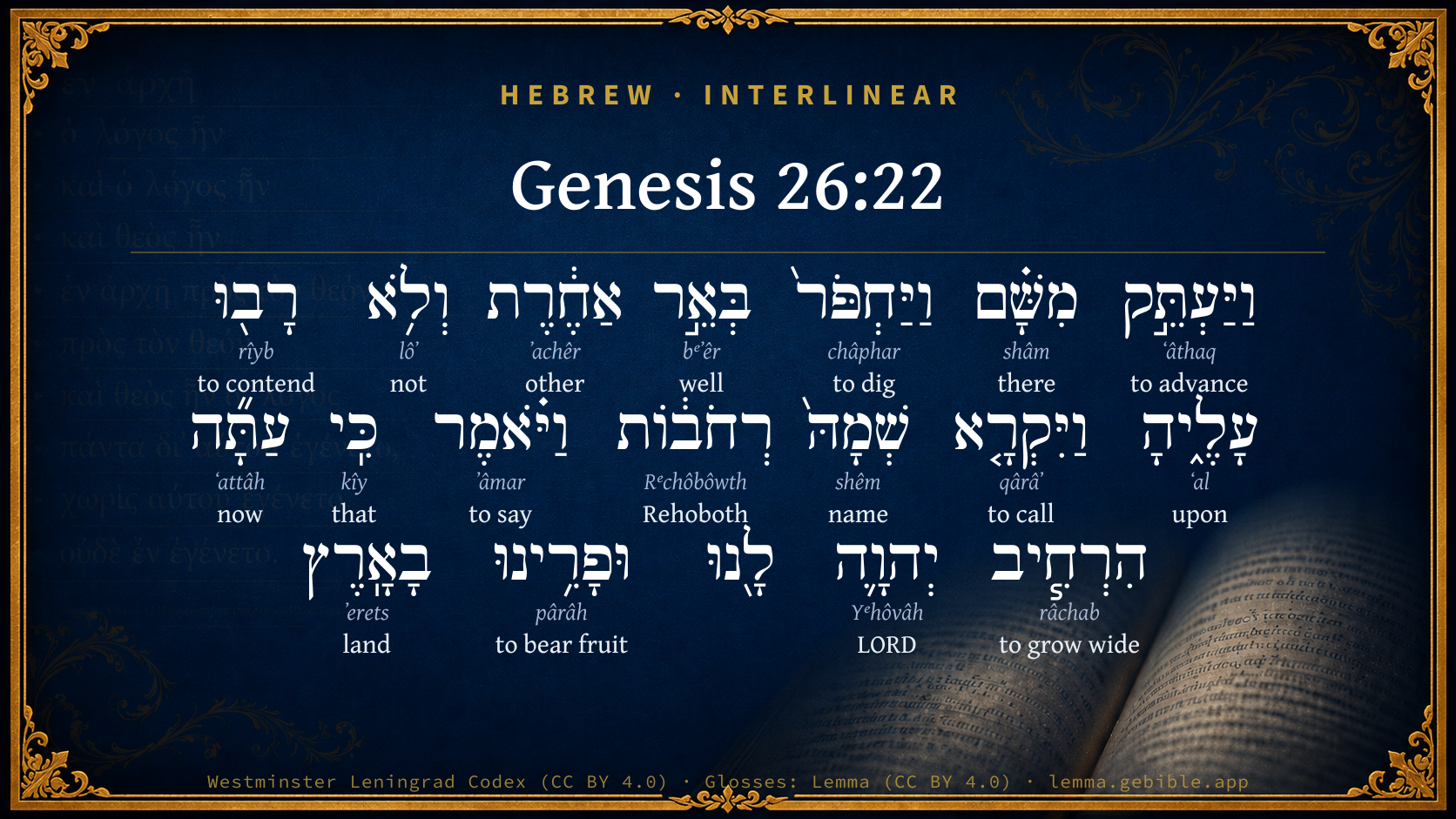
Genesis 26:22

Hebrew (Westminster Leningrad Codex) Genesis 26:22 appears in the Hebrew Old Testament. The text above is from the Westminster Leningrad Codex. Each word links to its Strong’s number, a concise gloss, and parsing drawn from the Open Scriptures Hebrew Bible morphology. Click any word for its full Brown-Driver-Briggs (BDB) entry.
Download image
Cite this verse

Genesis 26:22 (World English Bible). Public Domain. Lemma interlinear Bible study tool, https://lemma.gebible.app/v/genesis/26/22.

Show BibTeX & RIS
BibTeX
RIS
English Translation
He left that place, and dug another well. They didn't argue over that one. He called it Rehoboth. He said, "For now Yahweh has made room for us, and we will be fruitful in the land."
World English Bible · Public Domain
Highlights
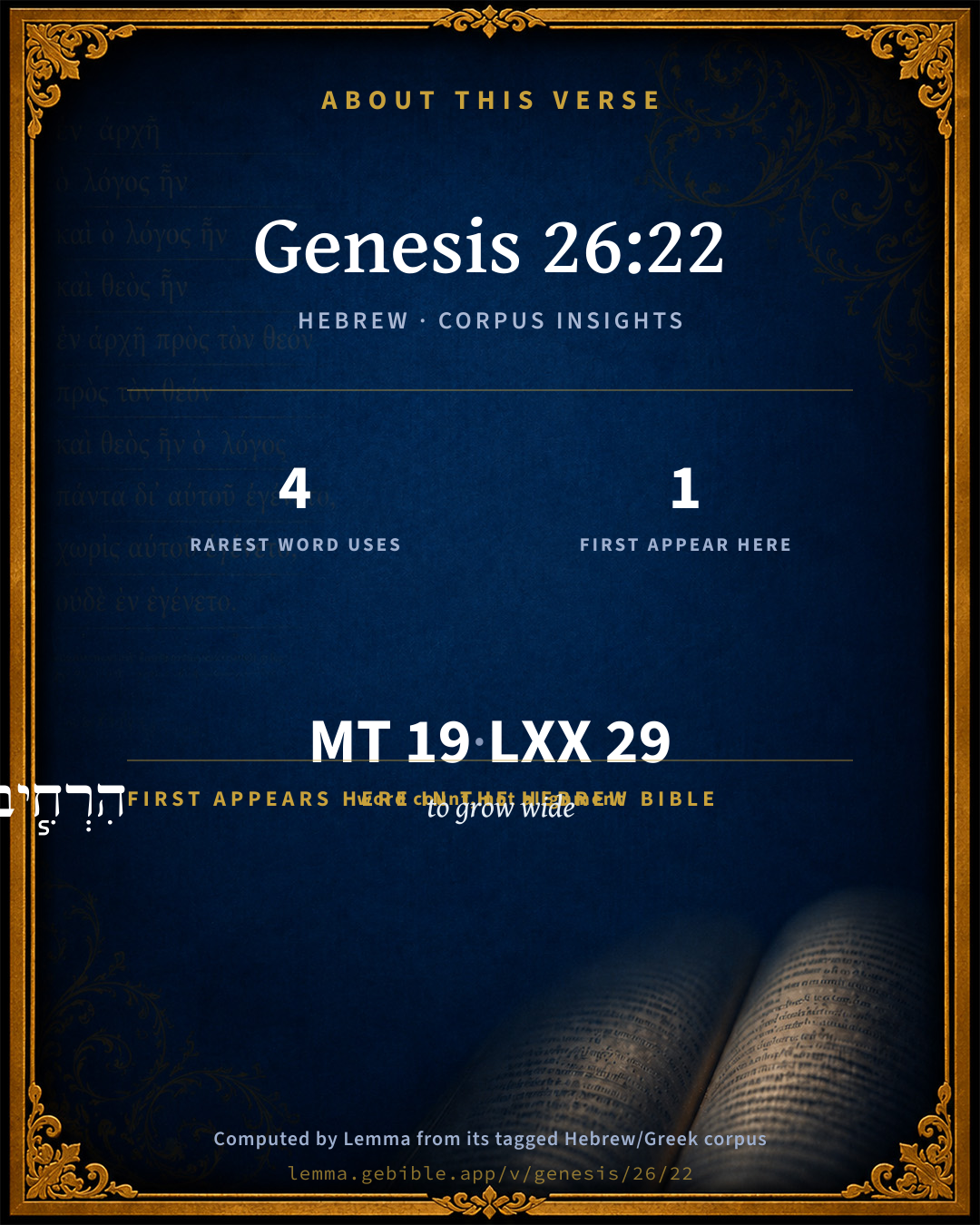
  • 1 first appearance in the Hebrew Bible
Full analysis ↓
Download a study sheet

One document with this verse’s original text, its word-by-word gloss line, the meaning frame, cross-references with their text, attributed commentary, and full source and license credits — printable, and it pastes into notes with its structure intact.

This verse Autodidact and up

Study sheet (.html) Plain text (.txt)

A passage Seminary Student

Up to 50 verses in one chapter. A passage sheet keeps up to 6 commentary sources and 12 cross-references per verse, in the order this page ranks them, and says so on the sheet whenever that leaves anything out. Ask for a single verse and you get the Autodidact verse sheet above.

Everything on this page stays free to read, with no account — the sheet is a download of what is already on screen, not access to it.

Want to remove ads? Support Godless Engineer
Compare translations 3

The same verse in 3 English versions, stacked beneath the original-language interlinear above. Click any original word for its lexicon entry.

Each is an independent rendering of the whole verse — the interlinear is not word-aligned to these translations.

Highlighted words mark where these versions differ — a whole-verse word diff, not a word-by-word alignment.

  • World English Bible Public Domain
    He left that place, and dug another well. They didn't argue over that one. He called it Rehoboth. He said, "For now Yahweh has made room for us, and we will be fruitful in the land."
  • King James Version Public Domain
    And he removed from thence, and digged another well; and for that they strove not: and he called the name of it Rehoboth; and he said, For now the LORD hath made room for us, and we shall be fruitful in the land.
  • unfoldingWord Literal Text CC BY-SA 4.0
    Then he moved from there and he dug another well, and they did not quarrel over it, so he called its name Rehoboth, and he said, “Because now Yahweh has made space for us, and we will be fruitful in the land.”

unfoldingWord Literal Text — © unfoldingWord, licensed CC BY-SA 4.0. Word-aligned USFM3 via Door43 (git.door43.org/unfoldingWord/en_ult).

Versions to compare (up to 4)

3 of 4 selected

Show all 18 translations

Every available English version of this verse, each an independent rendering of the whole verse.

  • World English Bible Public Domain
    He left that place, and dug another well. They didn't argue over that one. He called it Rehoboth. He said, "For now Yahweh has made room for us, and we will be fruitful in the land."
  • Berean Standard Bible Public Domain
    He moved on from there and dug another well, and they did not quarrel over it. He named it Rehoboth and said, “At last the LORD has made room for us, and we will be fruitful in the land.”
  • Majority Standard Bible Public Domain
    He moved on from there and dug another well, and they did not quarrel over it. He named it Rehoboth and said, “At last the LORD has made room for us, and we will be fruitful in the land.”
  • King James Version Public Domain
    And he removed from thence, and digged another well; and for that they strove not: and he called the name of it Rehoboth; and he said, For now the LORD hath made room for us, and we shall be fruitful in the land.
  • American Standard Version (1901) Public Domain
    And he removed from thence, and digged another well. And for that they strove not. And he called the name of it Rehoboth. And he said, For now Jehovah hath made room for us, and we shall be fruitful in the land.
  • Revised Version (1885) Public Domain
    And he removed from thence, and digged another well; and for that they strove not: and he called the name of it Rehoboth; and he said, For now the LORD hath made room for us, and we shall be fruitful in the land.
  • Geneva Bible (1599) Public Domain
    Then he remoued thence, and digged an other well, for the which they stroue not: therefore called hee the name of it Rehoboth, and sayde, Because the Lord hath nowe made vs roome, we shall increase vpon the earth.
  • Douay-Rheims (1899) Public Domain
    Going forward from thence, he digged another well, for which they contended not: therefore he called the name thereof, Latitude, saying: Now hath the Lord given us room, and made us to increase upon the earth.
  • Young's Literal Translation Public Domain
    And he removeth from thence, and diggeth another well, and they have not striven for it, and he calleth its name Enlargements, and saith, `For -- now hath Jehovah given enlargement to us, and we have been fruitful in the land.'
  • Literal Standard Version CC BY-SA 4.0
    And he removes from there, and digs another well, and they have not striven for it, and he calls its name “Enlargements,” and says, “For—now has YHWH given enlargement to us, and we have been fruitful in the land.”
  • Unlocked Literal Bible CC BY-SA 4.0
    He left there and dug yet another well, but they did not quarrel over that one. So he called it Rehoboth, and he said, “Now Yahweh has made room for us, and we will prosper in the land.”
  • unfoldingWord Literal Text CC BY-SA 4.0
    Then he moved from there and he dug another well, and they did not quarrel over it, so he called its name Rehoboth, and he said, “Because now Yahweh has made space for us, and we will be fruitful in the land.”
  • Darby Bible Public Domain
    And he removed thence and dug another well; and they did not strive for that. And he called the name of it Rehoboth, and said, For now Jehovah has made room for us, and we shall be fruitful in the land.
  • World Messianic Bible Public Domain
    He left that place, and dug another well. They didn’t argue over that one. So he called it Rehoboth. He said, “For now the LORD has made room for us, and we will be fruitful in the land.”
  • Webster's Bible Public Domain
    And he removed from thence, and digged another well; and for that they did not contend: and he called the name of it Rehoboth; and he said, For now the LORD hath made room for us, and we shall be fruitful in the land.
  • Free Bible Version CC BY-SA 4.0
    So they moved on from there and he had another well dug. This time there was no argument so he named the well, “Freedom,” saying, “Now the Lord has given us freedom to expand and be successful in this land.”
  • Bible in Basic English Public Domain
    Then he went away from there, and made another water-hole, about which there was no fighting: so he gave it the name of Rehoboth, for he said, Now the Lord has made room for us, and we will have fruit in this land.
  • JPS Tanakh (1917) Public Domain
    And he removed from thence, and digged another well; and for that they strove not. And he called the name of it Rehoboth; and he said: 'For now the LORD hath made room for us, and we shall be fruitful in the land.'

Literal Standard Version (2020), Covenant Press — licensed CC BY-SA 4.0. Text via the HelloAO Bible API (eBible.org). Unlocked Literal Bible (unfoldingWord) — licensed CC BY-SA 4.0. Text via the HelloAO Bible API (eBible.org). unfoldingWord Literal Text — © unfoldingWord, licensed CC BY-SA 4.0. Word-aligned USFM3 via Door43 (git.door43.org/unfoldingWord/en_ult). Free Bible Version, Dr. Jonathan Gallagher — licensed CC BY-SA 4.0. Text via the HelloAO Bible API (eBible.org).

Word by word

More ways to search: Search by grammar → Find every occurrence → Compare this word →

Practice this passage: Drill this verse → Learn its vocabulary →

רְחֹב֔וֹת
Rᵉchôbôwth
H7344
“Rehoboth”
Noun, Proper
Part of Speech
Noun
Type
Proper
Full BDB Definition

Origin: pl. of H7339

TWOT: None

Rehoboth = "wide places or streets" - the 3rd of a series of wells dug by Isaac in the territory of the Philistines - one of the 4 cities built by Asshur or by Nimrod in Asshur located close to Nineveh - a city of Saul or Shaul, one of the early kings of the Edomites
  1. וַיַּעְתֵּ֣ק ʻâthaq H6275 “and · to advance” Conjunction + Verb, Hiphil, Sequential Imperfect, 3rd Person, Masculine, Singular
  2. מִשָּׁ֗ם shâm H8033 “from · there” Preposition + Adverb
  3. וַיַּחְפֹּר֙ châphar H2658 “and · to dig” Conjunction + Verb, Qal, Sequential Imperfect, 3rd Person, Masculine, Singular
  4. בְּאֵ֣ר bᵉʼêr H875 “well” Noun, Common, Feminine, Singular, Absolute
  5. אַחֶ֔רֶת ʼachêr H312 “other” Adjective, Adjective, Feminine, Singular, Absolute
  6. וְלֹ֥א lôʼ H3808 “and · not” Conjunction + Particle, Negative
  7. רָב֖וּ rîyb H7378 “to contend” Verb, Qal, Perfect, 3rd Person, Common, Plural
  8. עָלֶ֑יהָ ʻal H5921 “upon · her” Preposition + Suffix, Personal, 3rd Person, Feminine, Singular
  9. וַיִּקְרָ֤א qârâʼ H7121 “and · to call” Conjunction + Verb, Qal, Sequential Imperfect, 3rd Person, Masculine, Singular
  10. שְׁמָהּ֙ shêm H8034 “name · her” Noun, Common, Masculine, Singular, Construct + Suffix, Personal, 3rd Person, Feminine, Singular
  11. וַיֹּ֗אמֶר ʼâmar H559 “and · to say” Conjunction + Verb, Qal, Sequential Imperfect, 3rd Person, Masculine, Singular
  12. כִּֽי kîy H3588 “that” Conjunction
  13. עַתָּ֞ה ʻattâh H6258 “now” Adverb
  14. הִרְחִ֧יב râchab H7337 “to grow wide” Verb, Hiphil, Perfect, 3rd Person, Masculine, Singular
  15. יְהוָ֛ה Yᵉhôvâh H3068 “LORD” Noun, Proper
  16. וּפָרִ֥ינוּ pârâh H6509 “and · to bear fruit” Conjunction + Verb, Qal, Perfect, 1st Person, Common, Plural
  17. בָאָֽרֶץ ʼerets H776 “in/at the · land” Preposition, Determined + Noun, Common, Both, Singular, Absolute

About this verse

These counts appear in no published source. They are computed here, from the morphology-tagged text and Lemma’s own curated glosses. What Lemma adds →

19
words
18
distinct lemmas
Pentateuch
section

Notable vocabulary

The rarest word here is רְחֹב֔וֹת Rehoboth H7344 — appearing just 4 times in the whole Hebrew Bible.

First appearance in Scripture

This word makes its first canonical appearance in the Hebrew Bible here:

  • הִרְחִ֧יב to grow wide H7337

Shared distinctive vocabulary

רְחֹב֔וֹת Rehoboth H7344 occurs in 4 verses of the Hebrew Bible. Also found in:

Grammatical profile

  • 7 verbs
  • 5 nouns
  • 1 adjective
  • 2 prepositions
  • 1 conjunction
  • 2 adverbs
  • 1 particle

Verb forms

  • וַיַּעְתֵּ֣ק Hiphil · Sequential Imperfect
  • וַיַּחְפֹּר֙ Qal · Sequential Imperfect
  • רָב֖וּ Qal · Perfect
  • וַיִּקְרָ֤א Qal · Sequential Imperfect
  • וַיֹּ֗אמֶר Qal · Sequential Imperfect
  • הִרְחִ֧יב Hiphil · Perfect
  • וּפָרִ֥ינוּ Qal · Perfect

Hebrew & Septuagint length

In English translation the verse runs 36 words from the Hebrew and 40 from the Septuagint (LXX English) — closely comparable.

A rough comparison of the two English renderings, which tokenize alike — not a word-level alignment.

Word counts can differ between the Hebrew and the Greek without any difference in meaning — e.g. the Hebrew direct-object marker אֵת has no separate Greek word, and Greek often adds the article ὁ.

In the original languages it is 19 Hebrew tokens and 29 Greek tokens — but the two are counted differently (Hebrew bundles its prefixes and suffixes into one token; the Greek is in lemma form), so that isn’t a like-for-like length.

Cross-references

7

Topical passages linked to Genesis 26:22 in the Treasury of Scripture Knowledge — connected by theme and wording, ordered by reader-vote popularity; previews shown in the World English Bible.

  • Genesis 17:6 I will make you exceeding fruitful, and I will make nations of you. Kings will come out of you.
  • Exodus 1:7 The children of Israel were fruitful, and increased abundantly, and multiplied, and grew exceedingly mighty; and the land was filled with them.
  • Psalms 118:5 Out of my distress, I called on Yah. Yah answered me with freedom.
  • Genesis 28:3 May God Almighty bless you, and make you fruitful, and multiply you, that you may be a company of peoples,
  • Genesis 41:52 The name of the second, he called Ephraim: "For God has made me fruitful in the land of my affliction."
  • Psalms 4:1 Answer me when I call, God of my righteousness. Give me relief from my distress. Have mercy on me, and hear my prayer.
  • Psalms 18:19 He brought me forth also into a large place. He delivered me, because he delighted in me.

Cross-references courtesy of OpenBible.info (CC BY 4.0).

Hebrew and Greek witnesses Masoretic Hebrew ↔ Greek Septuagint

The same verse in the two great witnesses to the Old Testament, shown verse-for-verse.

These are two independent witnesses, not word-aligned to each other, and the Septuagint is shown in lemma (dictionary) form.

Hebrew Genesis 26:22 Masoretic · Westminster Leningrad Codex

וַיַּעְתֵּ֣ק מִשָּׁ֗ם וַיַּחְפֹּר֙ בְּאֵ֣ר אַחֶ֔רֶת וְלֹ֥א רָב֖וּ עָלֶ֑יהָ וַיִּקְרָ֤א שְׁמָהּ֙ רְחֹב֔וֹת וַיֹּ֗אמֶר כִּֽי עַתָּ֞ה הִרְחִ֧יב יְהוָ֛ה לָ֖נוּ וּפָרִ֥ינוּ בָאָֽרֶץ

He left that place, and dug another well. They didn't argue over that one. He called it Rehoboth. He said, "For now Yahweh has made room for us, and we will be fruitful in the land."

World English Bible · Public Domain

Greek LXX Genesis 26:22 Septuagint · lemma form

ἀποαἴρω δέ ἐκεῖθεν ὀρύσσω φρέαρ ἕτερος καί οὐ μάχομαι περί αὐτός καί ἐπιὀνομάζω ὁ ὄνομα αὐτός εὐρυχωρία λέγω διότι νῦν πλατύνω κύριος ἐγώ καί αὐξάνω ἐγώ ἐπί ὁ γῆ

And he departed thence and dug another well; and they did not strive about that; and he named the name of it, Room, saying, Because now the Lord has made room for us, and has increased us upon the earth.

LXX2012 (modern English Septuagint) · Public Domain

On this verse, The Cambridge Bible for Schools and Colleges discusses the Septuagint’s reading. Read the note in Commentary ↓

Hebrew: Westminster Leningrad Codex (CC BY 4.0). Greek: Septuagint (public domain); English from LXX2012 (modern English Septuagint) (Public Domain). How the Septuagint differs from the Hebrew →

Targum (Aramaic paraphrase)

2

The Targum is the ancient Jewish Aramaic paraphrase of the Hebrew Scriptures — an interpretive translation, not the Hebrew text itself. Onkelos (literal) and Pseudo-Jonathan (expansive) render the Torah, and Jonathan the Prophets. Coverage is partial: where no permissively-licensed English translation exists for a verse, only the Aramaic is shown. This is verse-level text, not a word-by-word alignment to the Hebrew.

  1. Targum Onkelos Torah (Genesis–Deuteronomy)
    וְאִסְתַּלַּק מִתַּמָּן וַחֲפַר בֵּירָא אָחֳרִי וְלָא נְצוֹ עֲלַהּ וּקְרָא שְׁמַהּ רְחֹבוֹת וַאֲמַר אֲרֵי כְעַן אַפְתֵּי יְיָ לָנָא וְנִיפוּשׁ בְּאַרְעָא

    (no public-domain English translation for this verse)

    Targum Onkelos — Aramaic: “Onkelos Genesis” (public domain); “Onkelos Exodus” (public domain); “Onkelos Leviticus” (public domain); “Onkelos Numbers” (public domain); “Onkelos Deuteronomy” (public domain). English: “Sefaria Community Translation” (CC0 1.0 (public-domain dedication)); “J.W. Etheridge. The Targums of Onkelos and Jonathan Ben Uzziel on the Pentateuch. London: Longmans, Green, 1862” (public domain). Text via Sefaria.

  2. Targum Pseudo-Jonathan Torah (Genesis–Deuteronomy)
    וְאִסְתַּלֵק מִתַּמָן וַחֲפַר בִּיר אוֹחֲרִי וְלָא נִצוּ עֲלָהּ הֵי כְּקַדְמָאֵי וּקְרָא שְׁמָהּ רַוְוחָתָא וְאָמַר אֲרוּם כְּדוּן אַרְוַוח יְיָ לָנָא וְיַפְשִׁנָנָא בְּאַרְעָא

    And he removed from thence and digged another well, and for that they did not contend as formerly, and he called the name of it (Ravchatha) Spaciousness; for he said, Now hath the Lord given us space to spread us abroad in the land.

    Targum Pseudo-Jonathan — Aramaic: “Targum Jonathan on Genesis” (public domain); “Targum Jonathan on Exodus” (public domain); “Targum Jonathan on Leviticus” (public domain); “Targum Jonathan on Numbers” (public domain); “Targum Jonathan on Deuteronomy” (public domain). English: “The Targum of Jonathan ben Uzziel, trans. J. W. Etheridge, London, 1862” (public domain). Text via Sefaria.

Commentary

Notes on Genesis 26:22 from classic Christian and Jewish commentators (each source and its license shown beneath its notes). The classic Christian expositions comment on the surrounding passage and are grouped to its opening verse, so a note may address several verses; the Jewish commentaries on the Tanakh (Rashi and others) are per-verse, so they appear only where the commentator wrote on this verse.

Lemma curates 59 commentaries, every one of them public domain or Creative Commons licensed, each selected and text-cleaned for this edition rather than reprinted as found. About our sources →

Trapp's Complete Commentary

John Trapp

Gen 26:22 And he removed from thence, and digged another well; and for that they strove not: and he called the name of it Rehoboth; and he said, For now the LORD hath made room for us, and we shall be fruitful in the land.

Ver. 22. And he removed from thence, &c.] See here a pattern of a patient and peaceable disposition, not broken by the continual injuries and affronts of the Philistines, that maligned and molested him, "I am peace," saith David; {Psa 120:7} and I, saith Isaac; and I, saith every son of peace, every child of wisdom. How well might good Isaac take up that of David, and say, "My feet stand in an even place" {a} {Psa 26:12} now that he was at Rehoboth especially, and God had made room for him: The scales of his mind neither rose up toward the beam, through their own lightness; nor were too much depressed with any load of sorrow: but, hanging equally and unmoved between both, gave him liberty, in all occurrences, to enjoy himself. Our minds, saith a divine, {b} should be like to the adamant, that no knife can cut; the salamander, that no fire can burn; the rock, which no waves can shake; the cypress tree, which no weather can alter; the hill Olympus, higher than storm or tempest, wind or weather can reach unto; or rather, "like mount Zion, that cannot be removed, but standeth fast for ever". {Psa 125:1} Thus Paul had "learned how to abound, and to be abased". {Php 4:11} Bradford, if the Queen would give him life, he would thank her; if banish him, he would thank her; if burn him, he will thank her; if condemn him to perpetual imprisonment, he will thank her; as he told one Cresswell, that offered to intercede for him. {c} Praeclara est, aequabilitas in omni vita, et idem semper vultus eademque frons, ut de Socrate, idemque de C. Laelio accepimus, saith Cicero, in his books of offices, {d} which book the old Lord Burleigh, Lord High Treasurer to Queen Elizabeth, would always carry about him, to his dying day, either in his bosom or pocket: {e} and what use he made of it, take M. Camden’s {f} testimony: Burleigh, Lord Treasurer, was wont to say, that he overcame envy more by patience than pertinacy. His private estate he managed with that integrity, that he never sued any man, no man ever sued him. He was in the number of those few, that both lived and died with glory.

{a} Barthol. Westmer., in Ps. xxvi.

{b} Ambros.

{c} Act. and Mon.

{d} Aelian., lib. ix. - Solln., cap. 8.

{e} Peacham’s Complete Gentleman, p. 45.

{f} Camden’s Elisabeth, fol. 495.

John Trapp, A Commentary or Exposition upon All the Books of the Old and New Testament (1647–1656) — public domain. Text from a community e-Sword module.

Joseph Benson's Commentary

Gen 26:22. He digged a well, and for that they strove not — Those that follow peace, sooner or later shall find peace. Those that study to be quiet, seldom fail of being so. This well they called Rehoboth, enlargement, room enough.

Joseph Benson's Commentary on the Old and New Testaments (1811–1818) — public domain. Text from a community e-Sword module.

Geneva Bible (1599)

Geneva Bible translators

Or, largeness, room.

Geneva Bible (1599) marginal notes — public domain. Text via Bolls.life.

The Cambridge Bible for Schools and Colleges

gen. ed. J. J. S. Perowne

22. Rehoboth] That is, Broad places, or, Room. LXX Εὐρυχωρία; Lat. Latitudo. This has been identified by modern travellers with a place called. er-Ruḥaibeh, 20 miles S. W. of Beer-sheba, where there is a well.

we shall be fruitful] i.e. prosperous. Prosperity depended upon unhindered access to a supply of water. The same word is used as in Gen_1:22, Gen_41:52, Gen_49:22.

The Cambridge Bible for Schools and Colleges (gen. ed. J. J. S. Perowne; Cambridge University Press, 1878–1918) — public domain. Text from a community e-Sword module.

John Gill's Exposition

And he went up from thence to Beersheba. From the place he last, removed unto Beersheba; the famine being over, he returns to the place where he and his rather formerly lived, Gen 21:33.

.

Genesis 26:24

gen 26:24

gen 26:24

gen 26:24And the Lord appeared to him in the same night,.... The first night he came to Beersheba, in a dream or vision, in which the Lord was represented as speaking to him:

and said, I am the God of Abraham thy father; though he was dead, he remembered the covenant he made with him, and the promises he made unto him: and besides, though Abraham was dead as to his body, yet alive in his soul; for God is not the God of the dead, but of the living, Mat 22:32,

fear not; any future famine, nor want of any good things, nor any enemies, the Philistines his neighbours, who had driven him from their country, and had harassed him from place to place:

for I am with thee, and will bless thee; and if God is with his people, they have nothing to fear from men; and if he blesses them, they are blessed, and no curse can light upon them:

and multiply thy seed, for my servant Abraham's sake; who was a faithful, diligent, servant of his; whose service was, not forgotten by him, but would be rewarded in a way of grace, though not of debt.

John Gill's Exposition of the Whole Bible (1746–1763) — public domain (CC PDM 1.0). Text via the HelloAO Bible API.

Haydock's Catholic Bible Commentary

Latitude. That is, wideness, or room. (Challoner) --- Hebrew Reheboth, widely extended streams, latitudines. See chap. x. 11.

George Leo Haydock (1774–1849), Haydock's Catholic Family Bible and Commentary, 1859 edition — public domain. Excludes Psalms (Douay-Rheims chapter numbering differs from Protestant) and Deuterocanonical books (Catholic canon only).

The Pulpit Commentary

And he removed from thence (yielding that too), and digged another well; and for that they strove not (perhaps as being beyond the boundaries of Gerar): and he called the name of it Reheboth; i.e. "Wide spaces" (hence "streets,"; Gen_19:2) from bjr to be or become broad; conjectured to have been situated in the Wady Ruhaibeh, about eight and a half hours to the south of Beersheba, where are still found a well named Bir-Rohebeh and ruins of a city of the same name (Robinson, vol. 1. p. 289; Thomson, "Land and Book," p. 558)and he said, For now the Lord hath made room (literally, hath made a broad space) for us, and we shall be fruitful in the land.

HOMILIES BY J.F. MONTGOMERY

Ver. 22.

Digging wells of salvation.

he removed from thence, and digged another well." Historically, an instance of a meek and quiet spirit in contact with the world. Wells precious. Often formed with much labor. Herdsmen of Gerar took what Isaac had digged. Twice he yielded for the sake of peace. Then he digged another, and for it they strove not. His example (cf. Mat_5:39; 1Co_6:7) But we may also observe a typical significance. Wells, fountains, sources of "living water" (Isa_12:3; Zec_13:1) connected with spiritual blessings. (cf. 1Co_10:4 with Joh_4:14 Joh_7:39)

I ISAAC DIGGED, to find "the gift of God" (common. Eastern name for water). The gift is from God alone (Isa_44:3; Zec_12:10) His will to bless appears through the whole Bible in the first formation of man, and in care for the salvation of sinners. (Luk_19:10) But many, though thirsty, do not seek living water. They have not peace. Separation from God brings unrest. (Isa_57:20) But the cause is not believed, and the way of comfort not loved. Many try all ways to find peace except the right one. They will follow preachers, or take up systems, or join associations. But Christ"s word is "Come unto me." Again, many will not dig; content merely to wish. God who bestows the gift has appointed means. (Mat_11:12) These do not really desire a work of grace in their souls. Want to be made safe, not to be renewed; to be delivered from fear, but not disturbed just now. Hence do not search their, (Psa_119:130) or pray for the Holy Spirit, (Eze_37:9) or care for the salvation of others. (1Jn_3:17) It is God"s will we should dig. He may send a blessing unsought. But usually he works through means. The Bible, prayer, the Lord"s table, Christian converse, Christian work, (Pro_11:25) all are as wells, means for getting the water of life; nothing in themselves, yet made effectual where the blessing is desired.

II HINDRANCES. Let none expect to possess wells of salvation without. They form the trial of faith. (1Pe_1:7) From those who love not God. A Christian member of a worldly family, or cast among careless associates, meets many hindrances. They may be open or veiled; in opposition or in mistaken kindness. And time for prayer is intruded on, and work for God is hindered, and a constant opposing influence is felt to chill the love of God. Or the hindrance may be from within. In prayer the mind overpowered by intrusive thoughts; besetting sins constantly gaining the victory; our spirits not in harmony with the "still small voice." Remember it is God"s will through trial to give victory. (1Co_10:13) Amalek fought against Israel (Ex 17) as the herdsmen strove against Isaac, but the way of victory was the same in both instances trust and perseverance.

III DIGGED ANOTHER WELL. (Gal_6:9) Will the Lord fail his people though surrounded by hindrances? Is some means of grace debarred? Is some line of Christian work, some way of Christian progress, closed against thee? Dig another well. Seek and pray for other channels in which to consecrate thy life. Perhaps the real foe hindering thee was self-will, and God has helped thee to put down self. Jesus cried, "Come unto me and drink." Whatever be the well, he is the source of its spring. Make it clear to your own heart that you are pressing to him. Tell God that it is indeed so. Then in some form or other the prayer, "Spring up, O well," shall have an abundant answer. M.

The Pulpit Commentary (1880–1919), ed. H.D.M. Spence-Jones & Joseph S. Exell — public domain. Text from a community e-Sword module.

John Wesley's Explanatory Notes

He digged a well, and for that they strove not - Those that follow peace, sooner or later, shall find peace: those that study to be quiet seldom fail of being so. This well they called Rehoboth - Enlargements, room enough.

John Wesley, Explanatory Notes Upon the Whole Bible (1754–1765) — public domain. Text via the GEBible commentary corpus.

Rashi

Rabbi Shlomo Yitzchaki (Rashi)

ופרינו בארץ WE SHALL BE FRUITFUL IN THE LAND — as the Targum translates it וניפוש and we shall increase in the land).

Rashi on the Tanakh — English translations: “The Judaica Press complete Tanach with Rashi, translated by A. J. Rosenberg” (CC BY 4.0); “Pentateuch with Rashi's commentary by M. Rosenbaum and A.M. Silbermann, 1929-1934” (public domain); “The Metsudah Tanach series, Lakewood, N.J” (CC BY 4.0); and “The Book of Joshua, Metsudah Publications, 1997” (CC BY 4.0). Text via Sefaria.

Radak

Rabbi David Kimhi (Radak)

ויעתק, he removed his digging tools from the immediate neighbourhood so that the shepherds of Gerar should not be able to claim future discoveries of water as belonging to them. It was clear beyond doubt that the area where Yitzchok’s servants dug now belonged to the region of Beer Sheva. This is why he called this well רחובות, to inform subsequent generations that the ownership of this well had never been disputed.

ופרינו בארץ, seeing that this is not subject to dispute we can now become fruitful and multiply in this land.

Radak on the Tanakh — English translations: “Sefaria Community Translation” (CC0 1.0 (public-domain dedication)); “Eliyahu Munk, HaChut Hameshulash” (CC BY 4.0); “Rabbi Mike Feuer, Jerusalem Anthology” (CC BY 4.0); and “R. David Kimhi on the first book of Psalms, Translated by R.G. Finch, London, 1919” (public domain). Text via Sefaria.

Lesson kit

Teaching starters — assembled from the data on this page, not authored interpretation. Every prompt links to the verse data it draws on. Edit before teaching.

Genesis, in the Pentateuch, opens this verse with 19 words (18 distinct Hebrew lemmas). Its most distinctive word is Rᵉchôbôwth (“Rehoboth”). A historical commentator’s framing appears above. Read the whole chapter for the surrounding context.

Discussion questions

  1. How does “Rehoboth” (Rᵉchôbôwth) shape what this verse is saying?
  2. The word “to grow wide” first appears here in Scripture. What is being introduced at this debut?
  3. Genesis 10:11 shares the word «Rehoboth» with this verse. How do the two illuminate each other?
  4. The translations on this page render this verse differently — a whole-verse word diff, not a word-by-word alignment. What might account for the different wordings?
  5. The verb «וַיַּעְתֵּ֣ק» is Hiphil Sequential Imperfect. How does its form color the action?
  6. Reading how Trapp's Complete Commentary and Joseph Benson's Commentary read this verse, where do the two commentators agree and where do they part?

Things to notice

Reading settings

Reading text

Shown beneath each verse's original-language words.

Old Testament
Old Testament edition

Read the OT as the Masoretic Hebrew (MT) or the Greek Septuagint (LXX).

English shown for the Greek Septuagint (in the Hebrew ↔ Greek comparison).

Comparing translations? Open the Compare panel on any verse page to stack up to four side by side.