Revelation 13:17

Greek (Tischendorf 8th ed.) Revelation 13:17 appears in the Greek New Testament. The text above is from the Tischendorf 8th edition. Each word links to its Strong’s number and a concise gloss. Click any word for its full Thayer’s Greek Lexicon entry.
Download image
Cite this verse

Revelation 13:17 (World English Bible). Public Domain. Lemma interlinear Bible study tool, https://lemma.gebible.app/v/revelation/13/17.

Show BibTeX & RIS
BibTeX
RIS
English Translation
and that no one would be able to buy or to sell, unless he has that mark, the name of the beast or the number of his name.
World English Bible · Public Domain
Download a study sheet

One document with this verse’s original text, its word-by-word gloss line, the meaning frame, cross-references with their text, attributed commentary, and full source and license credits — printable, and it pastes into notes with its structure intact.

This verse Autodidact and up

Study sheet (.html) Plain text (.txt)

A passage Seminary Student

Up to 50 verses in one chapter. A passage sheet keeps up to 6 commentary sources and 12 cross-references per verse, in the order this page ranks them, and says so on the sheet whenever that leaves anything out. Ask for a single verse and you get the Autodidact verse sheet above.

Everything on this page stays free to read, with no account — the sheet is a download of what is already on screen, not access to it.

Want to remove ads? Support Godless Engineer
Compare translations 3

The same verse in 3 English versions, stacked beneath the original-language interlinear above. Click any original word for its lexicon entry.

Each is an independent rendering of the whole verse — the interlinear is not word-aligned to these translations.

Highlighted words mark where these versions differ — a whole-verse word diff, not a word-by-word alignment.

  • World English Bible Public Domain
    and that no one would be able to buy or to sell, unless he has that mark, the name of the beast or the number of his name.
  • King James Version Public Domain
    And that no man might buy or sell, save he that had the mark, or the name of the beast, or the number of his name.
  • unfoldingWord Literal Text CC BY-SA 4.0
    and that no one would be able to buy or to sell except the one having the mark, the name of the beast or the number of its name.

unfoldingWord Literal Text — © unfoldingWord, licensed CC BY-SA 4.0. Word-aligned USFM3 via Door43 (git.door43.org/unfoldingWord/en_ult).

Versions to compare (up to 4)

3 of 4 selected

Show all 19 translations

Every available English version of this verse, each an independent rendering of the whole verse.

  • World English Bible Public Domain
    and that no one would be able to buy or to sell, unless he has that mark, the name of the beast or the number of his name.
  • Berean Standard Bible Public Domain
    so that no one could buy or sell unless he had the mark—the name of the beast or the number of its name.
  • Majority Standard Bible Public Domain
    so that no one could buy or sell unless he had the mark—the name of the beast or the number of its name.
  • King James Version Public Domain
    And that no man might buy or sell, save he that had the mark, or the name of the beast, or the number of his name.
  • American Standard Version (1901) Public Domain
    and that no man should be able to buy or to sell, save he that hath the mark, `even' the name of the beast or the number of his name.
  • Revised Version (1885) Public Domain
    and that no man should be able to buy or to sell, save he that hath the mark, even the name of the beast or the number of his name.
  • Geneva Bible (1599) Public Domain
    And that no man might buy or sell, saue hee that had the marke, or the name of the beast, or the number of his name.
  • Douay-Rheims (1899) Public Domain
    And that no man might buy or sell, but he that hath the character, or the name of the beast, or the number of his name.
  • Young's Literal Translation Public Domain
    and that no one may be able to buy, or to sell, except he who is having the mark, or the name of the beast, or the number of his name.
  • Literal Standard Version CC BY-SA 4.0
    and that no one may be able to buy, or to sell, except he who is having the mark, or the name of the beast, or the number of his name.
  • Unlocked Literal Bible CC BY-SA 4.0
    It was impossible for anyone to buy or sell unless he had the mark of the beast, that is, the number representing its name.
  • unfoldingWord Literal Text CC BY-SA 4.0
    and that no one would be able to buy or to sell except the one having the mark, the name of the beast or the number of its name.
  • Darby Bible Public Domain
    and that no one should be able to buy or sell save he that had the mark, the name of the beast, or the number of its name.
  • World Messianic Bible Public Domain
    and that no one would be able to buy or to sell unless he has that mark, which is the name of the beast or the number of his name.
  • Webster's Bible Public Domain
    And that no man might buy or sell, save him that had the mark, or the name of the beast, or the number of his name.
  • Free Bible Version CC BY-SA 4.0
    Nobody was permitted to buy or sell except those who had the mark, which was the name of the beast or the number of his name.
  • Bible in Basic English Public Domain
    So that no man might be able to do trade but he who has the mark, even the name of the beast or the number of his name.
  • Text-Critical English NT CC BY 4.0
    so that no one could buy or sell unless he had the mark, that is, the name of the beast or the number of his name.
  • Tyndale New Testament (1534) Public Domain
    And that no man myght by or sell save he that had the marke or the name of the beest other the nombre of his name.

Literal Standard Version (2020), Covenant Press — licensed CC BY-SA 4.0. Text via the HelloAO Bible API (eBible.org). Unlocked Literal Bible (unfoldingWord) — licensed CC BY-SA 4.0. Text via the HelloAO Bible API (eBible.org). unfoldingWord Literal Text — © unfoldingWord, licensed CC BY-SA 4.0. Word-aligned USFM3 via Door43 (git.door43.org/unfoldingWord/en_ult). Free Bible Version, Dr. Jonathan Gallagher — licensed CC BY-SA 4.0. Text via the HelloAO Bible API (eBible.org).

Word by word

More ways to search: Search by grammar → Find every occurrence → Compare this word →

Practice this passage: Drill this verse → Learn its vocabulary →

χάραγμα
cháragma
G5480
“engraved mark”
Noun, Accusative, Singular, Neuter
Part of Speech
Noun
Case
Accusative
Number
Singular
Gender
Neuter
Full Thayer's Definition

Origin: from the same as G5482

TDNT: 15:56,1

1. a stamp, an imprinted mark a. of the mark stamped on the forehead or the right hand as the badge of the followers of the Antichrist b. the mark branded upon horses 2. thing carved, sculpture, graven work a. of idolatrous images
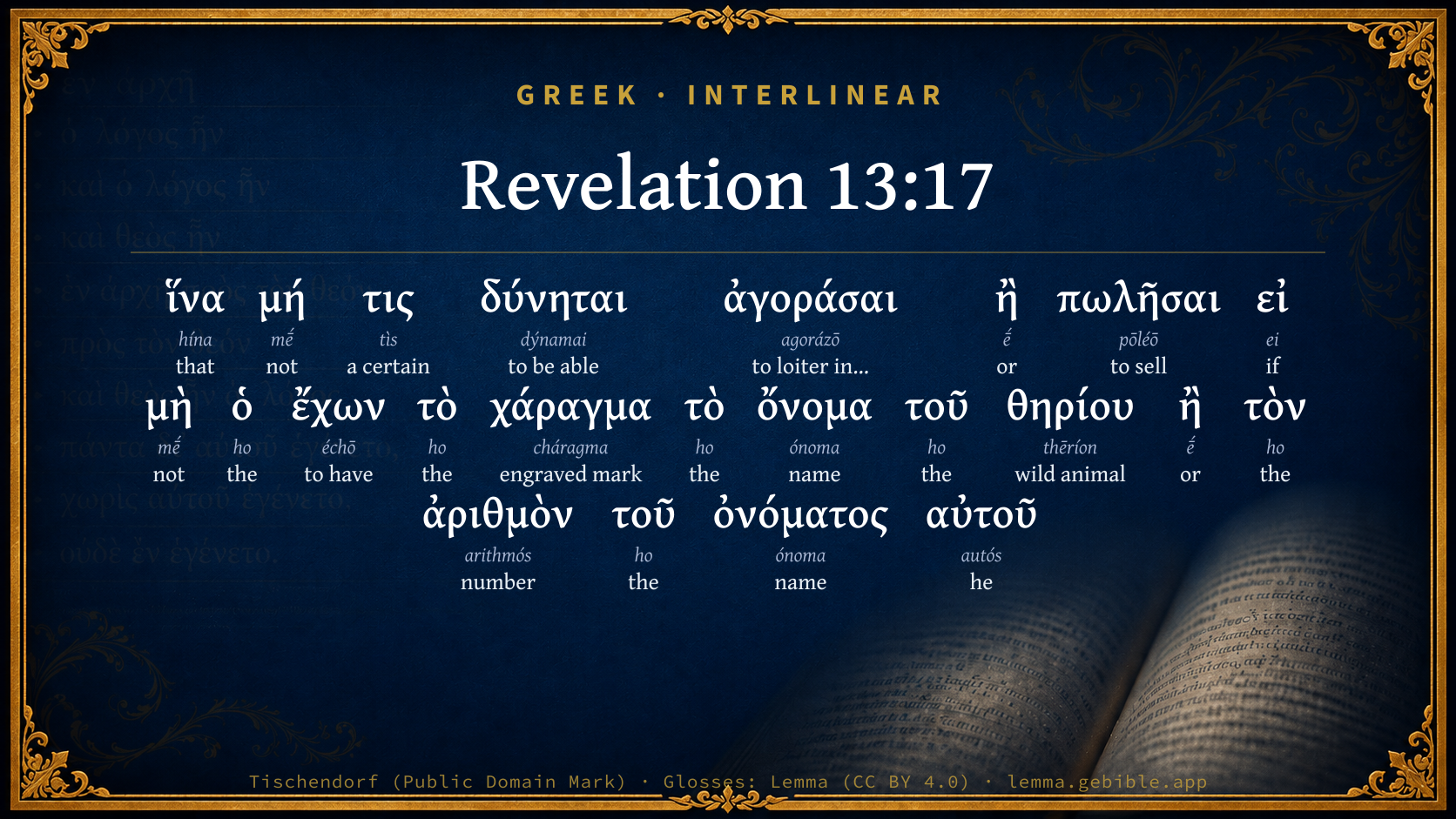
  1. ἵνα hína G2443 “that” Conjunction
  2. μή mḗ G3361 “not” Particle, Negative
  3. τις tìs G5100 “a certain” Indefinite pronoun, Nominative, Singular, Masculine
  4. δύνηται dýnamai G1410 “to be able” Verb, Present, Middle or Passive deponent, Subjunctive, 3rd person, Singular
  5. ἀγοράσαι agorázō G59 “to loiter in marketplace” Verb, Aorist, Active, Infinitive
  6. ἢ ḗ G2228 “or” Particle
  7. πωλῆσαι pōléō G4453 “to sell” Verb, Aorist, Active, Infinitive
  8. εἰ ei G1487 “if” Conditional
  9. μὴ mḗ G3361 “not” Particle, Negative
  10. ὁ ho G3588 “the” Article, Nominative, Singular, Masculine
  11. ἔχων échō G2192 “to have” Verb, Present, Active, Participle, Nominative, Singular, Masculine
  12. τὸ ho G3588 “the” Article, Accusative, Singular, Neuter
  13. τὸ ho G3588 “the” Article, Accusative, Singular, Neuter
  14. ὄνομα ónoma G3686 “name” Noun, Accusative, Singular, Neuter
  15. τοῦ ho G3588 “the” Article, Genitive, Singular, Neuter
  16. θηρίου thēríon G2342 “wild animal” Noun, Genitive, Singular, Neuter
  17. ἢ ḗ G2228 “or” Particle
  18. τὸν ho G3588 “the” Article, Accusative, Singular, Masculine
  19. ἀριθμὸν arithmós G706 “number” Noun, Accusative, Singular, Masculine
  20. τοῦ ho G3588 “the” Article, Genitive, Singular, Neuter
  21. ὀνόματος ónoma G3686 “name” Noun, Genitive, Singular, Neuter
  22. αὐτοῦ autós G846 “he” Personal pronoun, Genitive, Singular, Neuter

About this verse

These counts appear in no published source. They are computed here, from the morphology-tagged text and Lemma’s own curated glosses. What Lemma adds →

23
words
15
distinct lemmas
Revelation
section

Notable vocabulary

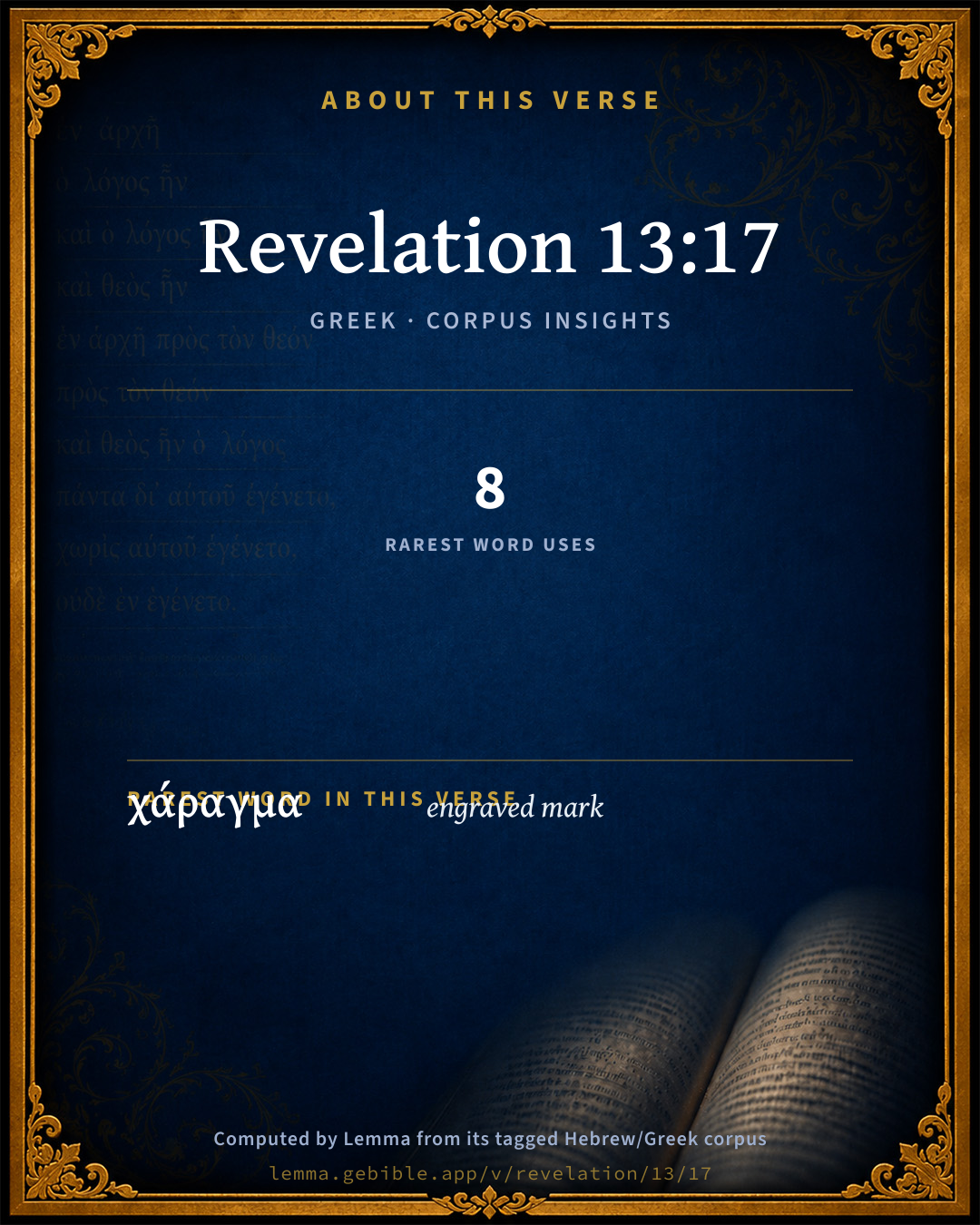
The rarest word here is χάραγμα engraved mark G5480 — appearing just 8 times in the whole Greek New Testament.

Shared distinctive vocabulary

χάραγμα engraved mark G5480 occurs in 8 verses of the Greek New Testament. Also found in:

Repetition

Words recur within this verse:

Cross-references

8

Topical passages linked to Revelation 13:17 in the Treasury of Scripture Knowledge — connected by theme and wording, ordered by reader-vote popularity; previews shown in the World English Bible.

  • Revelation 13:16 He causes all, the small and the great, the rich and the poor, and the free and the slave, to be given marks on their right hands, or on their foreheads;
  • Revelation 14:11 The smoke of their torment goes up forever and ever. They have no rest day and night, those who worship the beast and his image, and whoever receives the mark of his name.
  • Revelation 15:2 I saw something like a sea of glass mixed with fire, and those who overcame the beast, his image, and the number of his name, standing on the sea of glass, having harps of God.
  • Revelation 13:18 Here is wisdom. He who has understanding, let him calculate the number of the beast, for it is the number of a man. His number is six hundred sixty-six.
  • Revelation 14:9 Another angel, a third, followed them, saying with a great voice, "If anyone worships the beast and his image, and receives a mark on his forehead, or on his hand,
  • Revelation 22:4 They will see his face, and his name will be on their foreheads.
  • Revelation 3:12 He who overcomes, I will make him a pillar in the temple of my God, and he will go out from there no more. I will write on him the name of my God, and the name of the city of my God, the new Jerusalem, which comes down out of heaven from my God, and my own new name.
  • Revelation 17:5 And on her forehead a name was written, "MYSTERY, BABYLON THE GREAT, THE MOTHER OF THE PROSTITUTES AND OF THE ABOMINATIONS OF THE EARTH."

Cross-references courtesy of OpenBible.info (CC BY 4.0).

Where the printed editions differ

1 variant

Places in this verse where the major printed Greek editions disagree on the wording in a way that affects the translation — a comparison of editions, not a manuscript-by-manuscript collation. The editions are the modern critical texts (Nestlé-Aland 28/27, SBL, Westcott-Hort, Tregelles, Tyndale House) and the traditional texts behind the KJV (the Textus Receptus and the Byzantine/Majority text). It is not a claim about which reading is original.

  1. Extra text
    ἢ,

    “or”

    In TR Not in NA28NA27TynSBLWHTregByz

    ἢ, (ē) 'or' is only in traditional manuscripts (TR)

Textual data: Translators Amalgamated Greek New Testament (STEPBible TAGNT) · CC BY 4.0.

Commentary

Notes on Revelation 13:17 from classic Christian and Jewish commentators (each source and its license shown beneath its notes). The classic Christian expositions comment on the surrounding passage and are grouped to its opening verse, so a note may address several verses; the Jewish commentaries on the Tanakh (Rashi and others) are per-verse, so they appear only where the commentator wrote on this verse.

Lemma curates 59 commentaries, every one of them public domain or Creative Commons licensed, each selected and text-cleaned for this edition rather than reprinted as found. About our sources →

The Cambridge Bible for Schools and Colleges

gen. ed. J. J. S. Perowne

The Number of the Name of the Beast, Rev_13:17-18

17. and that] “And” should not improbably be omitted, the construction then, being, he causeth all … that they give them a mark, … that no man may …”

no man might buy or sell] Such disabilities seem to have been actually imposed, at least in the Diocletian persecution, by requiring business transactions to be preceded by pagan formulas.

the mark, or the name] Om. “or:” the true reading is, “the mark—the name of the Beast, or the number of his name.”

the number of his name] In Hebrew and in Greek, letters were used for numerals, every letter having its own proper significance as a number. Among the Jews (and to some extent among early Christians, especially heretics) this suggested the possibility of finding numbers mystically corresponding to any word: the numerical value of all the letters might be added together, and the sum would represent the word. This process was called by the Jews Gematria, a corruption of the Greek Geometria. Ridiculous as were many of the attempts made to find mystical meanings in the words of Scripture by this process, it remains true that a Jew of St John’s time would probably mean, by “the number of a name,” the number formed by Gematria from its letters: and probably the numerous guesses, from St Irenaeus’ time to our own, that have been based on this method are so far on the right track. But there are too many that are plausible for any one to be probable. There are in fact an indefinite number of proper names whose letters will amount to 666 (or 616, see below) either in Hebrew or Greek—at least when the names are neither Hebrew nor Greek, and so have to be arbitrarily transliterated. Thus neither Lateinos, i.e. Latinus (one of several mentioned by St Irenaeus) nor Nerôn Kêsar i.e. Nero Caesar (adopted by many modern interpreters) is convincing: and no other name (Genseric, Mohammed, and even Napoleon have been tried, with more or less violence) has any real chance of being right. The letters of Lateinos must be taken with their numeral value in Greek, those of Neron Kesar as Hebrew. If neither of these be the true one, we may be pretty certain it will not be discovered till Antichrist appears: and then believers will be able to identify him by this token.

The Cambridge Bible for Schools and Colleges (gen. ed. J. J. S. Perowne; Cambridge University Press, 1878–1918) — public domain. Text from a community e-Sword module.

Bengel's Gnomon

Johann Albrecht Bengel

Rev 13:17. Ἵνα) Others, καὶ ἵνα. Wolf approves of this, remarking, however, that καὶ is omitted even by the Coptic Version. In truth the shorter reading is supported by the most ancient authorities. Add to the Latins, Apringius, Ansbert, Etherius.[147] See above, on ch. Rev 6:4. The construction is this, δῶσι χάραγμα, ἵνα, κ.τ.λ. We have shown, on Rev 13:1, that there are three Periods of duration. In the last part of the first period arises the most grievous calamity, the length of which can scarcely he defined, unless it be the number of clays agreeing by analogy with the number of the beast, of which we shall speak presently.

[147] AB Vulg. support καί. Ch Iren. 316, Memph. Syr. omit it.—E.

Bengel's Gnomon of the New Testament — English translation (T&T Clark, Edinburgh, 1860) — public domain. Text from a community e-Sword module.

Geneva Bible (1599)

Geneva Bible translators

Here the false Prophets do require three things, which are set down in the order of their greatness, a character, a name and the number of the name. The meaning is, that man that hath not first their anointing and clerical tonsure or shaving: secondly holy orders, by reserving whereof is communicated the same of the beast: or finally hath not attained that high degree of Pontifical knowledge, and of the Law (as they call it) Canonical, and hath not as it were made up in account and cast the number of the mysteries thereof: for in these things consisteth the number of that name of the beast. And this is excellently set forth in the next verse.

That is, have any traffic or intercourse with men, but they only those which have this anointing and consecration of Clearkely tonsure, as they call it. Read Gratian de Consecratione, distinct. s. c. omnes, cap. Spiritus, etc. of these matters.

Geneva Bible (1599) marginal notes — public domain. Text via Bolls.life.

Jamieson, Fausset & Brown

Robert Jamieson, A. R. Fausset & David Brown

And--So A, B, and Vulgate read. C, IRENÆUS, 316, Coptic, and Syriac omit it.

might buy--Greek, "may be able to buy."

the mark, or the name--Greek, "the mark (namely), the name of the beast." The mark may be, as in the case of the sealing of the saints in the forehead, not a visible mark, but symbolical of allegiance. So the sign of the cross in Popery. The Pope's interdict has often shut out the excommunicate from social and commercial intercourse. Under the final Antichrist this shall come to pass in its most violent form.

number of his name--implying that the name has some numerical meaning.

Jamieson, Fausset & Brown — Commentary Critical and Explanatory on the Whole Bible (1871) — public domain (CC PDM 1.0). Text via the HelloAO Bible API.

Adam Clarke's Commentary

Verse 17. And that no man might buy or sell, save he that had the mark] "If any," observes Bishop Newton, "dissent from the stated and authorized forms; they are condemned and excommunicated as heretics; and in consequence of that they are no longer suffered to buy or sell; they are interdicted from traffic and commerce, and all the benefits of civil society. So Roger Hoveden relates of William the Conqueror, that he was so dutiful to the pope that he would not permit any one in his power to buy or sell any thing whom he found disobedient to the apostolic see. So the canon of the council of Lateran, under Pope Alexander III., made against the Waldenses and Albigenses, enjoins, upon pain of anathema, that no man presume to entertain or cherish them in his house or land, or exercise traffic with them. The synod of Tours, in France, under the same pope, orders, under the like intermination, that no man should presume to receive or assist them, no, not so much as hold any communion with them, in selling or buying; that, being deprived of the comfort of humanity they may be compelled to repent of the error of their way." In the tenth and eleventh centuries the severity against the excommunicated was carried to so high a pitch, that nobody might come near them, not even their own wives, children, or servants; they forfeited all their natural legal rights and privileges, and were excluded from all kinds of offices. The form of excommunication in the Romish Church is to take lighted torches, throw them upon the ground with curses and anathemas, and trample them out under foot to the ringing of the bells. It is in this and similar ways that the false prophet has terrified the Latin world, and kept it in subjection to the secular and spiritual powers. Those interdicted by the two-horned beast from all offices of civil life are also such as have not:-

The name of the beast, or the number of his name.] See on the following verse.

Adam Clarke's Commentary on the Bible (1810–1826) — public domain. Text from a community e-Sword/MySword module.

John Gill's Exposition

Here is wisdom,.... Not only in the above description of the two beasts, but in what follows as to the number of the beast, these two now coalescing in one, and have one and the same number; and to wrap it up, and conceal it in such an obscure manner, shows great wisdom in God, as it requires much in men, and serves greatly to exercise all his intellectual powers to find it out:

let him that hath understanding count the number of, the beast; whoever has skill numbers, let him make use of it, that he may know the name and nature of the antichristian beast, and the numerical letters of his name, or the number of him, and of the time when he arose, and when he will expire:

for it is the number of a man: either a number that may be reckoned by man, or which is in common use among men; see Rev 21:17; or that which is contained in the name of a man:

and his number is six hundred threescore and six: which some think refers to the time of the rise of antichrist, in the year 666; but that seems rather to be in the year 859, when the bishop of Rome obtained the name of universal bishop; others have been of opinion that it refers to the expiration of the beast, which they thought would have been in the year 1666, the number of the thousand being dropped, as it is in our common way of speaking; as when we say the Spanish invasion was in 88, meaning 1588, and the civil wars began in 41, that is, 1641; but time has shown that this was a mistaken sense; the more prevailing opinion is that of Mr. Potter, who has wrote a peculiar and learned treatise upon this passage, who makes the counting of this number to be no other than the extracting of its root, which is the number 25, which when multiplied into itself, and the fraction in working it 41 is added, makes up the square number 666; and now 25 being added to A. D. 33, make 58, which was the time of the beast's conception, to which if 666 is added, it brings us to the year 724, when he arrived to his age of manhood, and when the war about the worshipping of images broke out: but others think that the numeral letters in some man's name which amount to this date, and which agrees with antichrist, are intended; and here various conjectures are made; some have observed, that in genealogical arithmetic the number of Adonikam's posterity is 666, Ezr 2:13; whose name signifies "a lord rising up", or "risen"; and suits very well with antichrist, who is risen up, and assumes a lordly domination over the kings of the earth; and it is further observed, that the Hebrew word which signifies "Roman", and, having the word beast or kingdom joined to it, designs the Roman beast, or kingdom, consists of numeral letters, which make up this sum; and so the Hebrew word "Sethut", which is the name of a man, Num 13:13, and signifies "mystery", in its numeral letters comes just to this number, and one of the names of the whore of Babylon is "mystery", Rev 17:5; but the name "Lateinos" bids as fair as any, which is mentioned by so ancient a writer as Irenaeus, who was a hearer of Polycarp, a disciple of John, the writer of this book; now the numeral value of the letters of this word makes up exactly 666, thus; 30. 1. 300. 5. 10. 50. 70. 200. in all 666; and it is well known that the church of Rome is called the Latin Church and the pope of Rome the head of the Latin church, and his seat is in the Latin empire, and the service of the beast is in the Latin tongue, and the Bible is kept in that language, from the reading of the common people: it has been observed that the numeral letters in Ludovicus, or Lewis, which is a common name of the French kings, and is the name of the present French king, make up this same number; and may denote the destruction of antichrist, which will quickly follow the downfall of the kingdom of France, under a king of this name; and the rather, since this was the last of the ten kingdoms that was set up, and in which the primitive beast subsists, and the only one that has not yet been conquered, or in which a revolution has not been; and since this is the tenth part of the city which shall fall a little before the third woe comes on: and that it may fall under Ludovicus, or Lewis, the present French king (a), may be hoped for, and is desirable.

(a) The reader will bear in mind that the original edition of this work was published in the year 1747. --Ed.

Next: Revelation Chapter 14

John Gill's Exposition of the Whole Bible (1746–1763) — public domain (CC PDM 1.0). Text via the HelloAO Bible API.

Trapp's Complete Commentary

John Trapp

17 And that no man might buy or sell, save he that had the mark, or the name of the beast, or the number of his name.

Ver. 17. Might buy or sell] As at Rome, oaths, laws, vows, are soluble, and all things else are saleable. Romoe omnia venalia.

" Vendit Alexander cruces, altaria, Christum:

Vendere iure potest: emerat ills prius."

"The pope sells crosses, altars, Christ, and all:

Well he may sell, for he bought them at the stall."

Also it is well known that the pope flatly forbids trade and traffic with all whom he hath excommunicated, as he did with the Albigenses in the Lateran Council, and as he did with one Tooly in Queen Mary’s days, who being hanged for felony, and defying the pope, was (after his death) suspended and excomunicated, that no man should eat or drink, buy or sell with him, bid him good morrow. (Acts and Mon.)

Or the name of the beast] To be called a Roman Catholic, which is better esteemed among Papists than the name of a Christian. It is notoriously known, saith Dr Fulke, that the most honourable name of Christian is in Italy and at Rome a name of reproach, and usually abused to signify a fool or a dolt. (Armor. in Acts xi. sec. 4.)

Or the number of his name] That keep somewhat more aloof, and yet privily comply with Papists, and drive the same design with them, though more slyly and covertly, and to themselves perhaps unperceivedly. What is the reason the pope will not dispense in Spain or Italy, if a Papist marry a Protestant, yet here he will; but because such Protestants receive the number of his name, and will soon be drawn to him?

John Trapp, A Commentary or Exposition upon All the Books of the Old and New Testament (1647–1656) — public domain. Text from a community e-Sword module.

Albert Barnes' Notes on the Bible

And that no man might buy or sell - That is, this mighty power would claim jurisdiction over the traffic of the world, and endeavor to make it tributary to its own purposes. Compare Rev 18:11-13, Rev 18:17-19. This is represented by saying that no one might “buy or sell” except by its permission; and it is clear that where this power exists of determining who may “buy and sell,” there is absolute control over the wealth of the world.

Save he that had the mark - To keep it all among its own friends; among those who showed allegiance to this power.

Or the name of the beast - That is, the “mark” referred to was either the name of the beast, or the number of his name. The meaning is, that he had something branded on him that showed that he belonged to the beast - as a slave had the name of his master; in other words, there was something that certainly showed that he was subject to its authority.

Or the number of his name - In regard to what is denoted by the number of the beast, see the notes on Rev 13:18. The idea here is, that that “number,” whatever it was, was so marked on him as to show to whom he belonged. According to the interpretation here proposed, the meaning of this passage is, that the papacy would claim jurisdiction over traffic and commerce; or would endeavor to bring it under its control, and make it subservient to its own ends. Traffic or commerce is one of the principal means by which property is acquired, and he who has the control of this has, to a great degree, the control of the wealth of a nation; and the question now is, whether any such jurisdiction has been set up, or whether any such control has in fact been exercised, so that the wealth of the world has been subject to papal Rome? For a more full illustration of this I may refer to the notes on Rev 18:11-13, Rev 18:16-17; but at present it may be sufficient to remark, that the manifest aim of the papacy, in all its history, has been to control the world, and to get dominion over its wealth, in order that it might accomplish its own purposes. But, besides this, there have been numerous specified acts more particularly designed to control the business of “buying and selling.” It has been common in Rome to prohibit, by express law, all traffic with heretics. Thus a canon of the Lateran council, under Pope Alexander III., commanded that no man should entertain or cherish them in his house or land, or traffic with them (Hard. vi., 2:1684). The synod of Tours, under the same Pope Alexander, passed the law that no man should presume to receive or assist the heretics, no, not so much as to exercise commerce with them in selling or buying. And so, too, the Constance council as expressed in Pope Martin’s bull (Elliott, vol. 3, pp. 220, 221).

Albert Barnes' Notes on the Bible (1834–1885) — public domain. Text from a community e-Sword/MySword module.

Matthew Poole's English Annotations

And that no man might buy or sell: this the popish church effects by its excommunications; it was begun in the council of Lateran, anathematizing all who entertained any of the Waldenses, or traded with them; and the late learned bishop of Armagh, in his book Deu Successione Ecclesiae, hath given us an account of such a canon of a synod in France, which in express terms forbade any commerce with heretics in buying or selling. Paraeus tells us Pope Martin the Fifth hath best interpreted this prophecy, in his bull added to the council of Constance, where he prohibits Roman Catholics to suffer any heretics to have any dwellings in their countries, or to make any bargains, or use any trades, or to perform to them any civil offices.

Save he that had the mark, or the name of the beast, or the number of his name: there have been great disputes about the name and number of the beast. I must profess myself not able to distinguish between the mark, name, and number of the beast; they may all signify the same thing, viz. the profession of the Romish religion. Some think the number is contained in the name, and that the name is ΔΑΤΕΙΝΟΣ, in which the number six hundred and sixty-six is contained; of which we shall speak more by and by.

Matthew Poole's English Annotations on the Holy Bible (1683–1685) — public domain. Text from a community e-Sword/MySword module.

Whedon's Commentary on the Bible

Daniel D. Whedon

17. No man might buy—Says E.B. Elliott: “A canon of the Lateran Council, under Pope Alexander III., commanded that no man should entertain or cherish them in his house or land, or exercise traffic with them. The Synod of Tours, (just when the Waldenses and Albigenses had begun to excite attention,) under the same Pope Alexander, passed the law that no man should presume to receive or assist the heretics, no, not so much as to exercise commerce with them in selling or buying. And so, too, as expressed in Pope Martin’s Bull, the Constance Council. How the mass of the clergy urged its execution in other days throughout the popedom is notorious.”—Vol, iii, p. 217. We may add that to-day, in revising these notes, we find in a New York daily paper the report of a trial, in these United States, of a Roman priest for prohibiting his people from continuing their custom to an excommunicated parishioner, the damages being laid at ten thousand dollars, the jury’s verdict being over three thousand. Such is this persecuting power to this day.

Daniel D. Whedon (gen. ed.), Commentary on the Old and New Testaments (1874–1909) — public domain. Text from a community e-Sword module.

The Pulpit Commentary

And that no man might bay or sell, save he that had the mark, or the name of the beast, or the number of his name. "And" is omitted in a, C, some cursives and versions and Fathers: no man should be able to buy, etc. A, B, C, P, and most cursives also omit h , "or," before "the name," thus reading, as in the Revised Version: save he that hath the mark, even the name of the beast, or the number of his name. This expressly asserts what we might have gathered from the analogy of the mark of the true Christian (see on ver. 16), viz. that "the mark" was "the name" or "the number of his name." The manner in which this was fulfilled in the early ages of the Church is sufficiently notorious. Then faithfulness to the cause of Christ frequently meant banishment from friends, kindred, and home. St. John himself was feeling the effect of this at the time when he wrote these words in exile at Patmos. So, at the present day, the Jews regard as an utter alien any one of their number who embraces Christianity. So also, at the present day, the faithful Christian is often interdicted the society of the world, is declared a social nuisance, and is shunned by the worldly minded, who pay allegiance to the beast. (On the "number," see on ver. 18)

The Pulpit Commentary (1880–1919), ed. H.D.M. Spence-Jones & Joseph S. Exell — public domain. Text from a community e-Sword module.

John Wesley's Explanatory Notes

That no man might buy or sell - Such edicts have been published long since against the poor Vaudois. But he that had the mark, namely, the name of the first beast, or the number of his name - The name of the beast is that which he bears through his whole duration; namely, that of Papa or Pope: the number of his name is the whole time during which he bears this name. Whosoever, therefore, receives the mark of the beast does as much as if he said expressly, "I acknowledge the present Papacy, as proceeding from God;" or, "I acknowledge that what St. Gregory VII. has done, according to his legend, (authorized by Benedict XIII.,) and what has been maintained in virtue thereof, by his successors to this day, is from God." By the former, a man hath the name of the beast as a mark; by the latter, the number of his name. In a word, to have the name of the beast is, to acknowledge His papal Holiness; to have the number of his name is, to acknowledge the papal succession. The second beast will enforce the receiving this mark under the severest penalties.

John Wesley, Explanatory Notes Upon the Whole Bible (1754–1765) — public domain. Text via the GEBible commentary corpus.

The People's New Testament

B. W. Johnson

17. No man might buy or sell, etc. It has been common for Catholics to be forbidden to patronize those who were not loyal to the Pope. At least three councils are named, those of Tours, of Constance and the Lateran, which have expressly forbidden business intercourse with heretics.

THE NUMBER OF THE BEAST.

B. W. Johnson's The People's New Testament with Notes (1889–1891) — public domain. Electronic text from the Christian Classics Ethereal Library (CCEL) ThML edition.

Cambridge Greek Testament for Schools and Colleges

17, 18. THE NUMBER OF THE NAME OF THE BEAST

17. καὶ ἵνα. So Text. Rec[457] Treg[458] and Weiss with אcAB2P. Lach[459] and Tisch[460] omit (and W. H[461] bracket) καὶ with א* and C.

[457] Rec. Textus Receptus as printed by Scrivener.

[458] Tregelles.

[459] Lachmann’s larger edition.

[460] Tischendorf: eighth edition; where the text aud notes differ the latter are cited.

[461] H. Westcott aud Hort.

τὸ χάραγμα, τὸ ὄνομα τοῦ θηρίου, ἤ τὸν ἀριθμὸν τοῦ ὀνόματος αὐτοῦ with AP. C has τ. χ. τοῦ ὀνόματος κ.τ.λ.; א τὸ χ. τοῦ θ. ἢ τὸ ὄνομα αὐτοῦ; B2 τ. χ. τ. ὄ. τ. θ. ἤ τὸν ἀριθμὸν τοῦ θηρίου ἢ κ.τ.λ.

17. καὶ ἵνα. See crit. note. If καὶ be retained, the verb depends on ποιεῖ in Rev 13:16; if omitted, the clause marks the purpose of the χάραγμα.

ἵνα μήτις … πωλῆσαι. Such disabilities seem to have been actually imposed, at least in the Diocletian persecution, by requiring business transactions to be preceded by pagan formulas.

τὸν ἀριθμὸν τοῦ ὀνόματος αὐτοῦ. In Hebrew and in Greek, letters were used for numerals, every letter having its own proper significance as a number. Among the Jews (and to some extent among early Christians, especially heretics) this suggested the possibility of finding numbers mystically corresponding to any word: the numerical value of all the letters might be added together, and the sum would represent the word. This process was called by the Jews Gematria, a corruption of the Greek Geometria. Ridiculous as were many of the attempts made to find mystical meanings in the words of Scripture by this process, it remains true that a Jew of St John’s time would probably mean, by “the number of a name,” the number formed by Gematria from its letters: and probably the numerous guesses, from St Irenæus’ time to our own, that have been based on this method are so far on the right track. But there are too many that are plausible for any one to be probable. There are in fact an indefinite number of proper names whose letters will amount to 666 (or 616, see below) either in Hebrew or Greek—at least when the names are neither Hebrew nor Greek, and so have to be arbitrarily transliterated.

The attempts which are generally thought of most importance are Λατεινος, and Nerôn (or Nerô) Kêsar; the latter has the advantage that the alternative Hebrew transliterations of his chief titles give 666 or 616 as we retain or drop the final n. Both the solution Λατεινος and the reading 616 are as old as St Irenæus, who criticises the latter in a way to suggest that it was already interpreted of Nero. He insists that in a Greek book we should expect the name to be conveyed by the numerical value of Greek letters: he speaks of the reading 616 as due to an ‘idiotism’—a mispronunciation such as uneducated persons might fall into—an educated Greek would take care of the final n. Völter hardly presses his own objection that Kêsar ought to be written with a Yod between the Koph and the Samech: and whether Nero were living or dead at the moment of the vision it was equally dangerous to name him plainly. If he were alive it was treason against him to say he was the beast, if he were dead it was treason against the reigning emperor to say Nero would come back from the dead. Völter’s own ingenious solution—Trajanus Hadrianus—which gives either 666 or 616 also in Hebrew, cannot stand apart from his general theory of the book. If 616 were otherwise probable, it could be read of Gaius. ἔχιδνα gives the right number and might be referred to Nero as a matricide, for the viper’s birth was supposed to be fatal to the mother, and the three letters might be arranged as a rough outline of a snake. No other name (Genseric, Mohammed, and even Napoleon, have been tried with more or less violence) has any real chance of being right. Failing Λατεινος and Kêsar NerÔn, we may be pretty certain it will not be discovered till Antichrist appears: and then believers will be able to recognise him by this token.

Cambridge Greek Testament for Schools and Colleges (Cambridge University Press, 1896; 21 vols, various authors incl. Carr, Maclear, Plummer, Farrar, Lumby, Moule, M. R. James, Simcox) — public domain. Text from a community e-Sword module.

Vincent's Word Studies in the New Testament

Marvin R. Vincent

The number. The method of mystic numbering obtained alike among pagan Greeks, Gnostics, Christian Fathers, and Jewish Cabbalists. Jupiter was invoked under the number 717 contained in the letters H APXH the beginning. The Gnostics affixed to their gems and amulets the mystic word ajbrasax or ajbraxav, under the idea of some virtue attaching to its number, 365, as being that of the days of the solar cycle. Barnabas and Clement of Alexandria speak of the virtue of the number 318 as being that of IHT, the common abbreviation for Jesus crucified. In the pseudo - Sybilline verses, written by Christians, about the end probably of the second century, are found versified enigmas giving the number and requiring the name. The translation of one of these on the word Jesus is as follows : "He will come upon earth clothed with flesh like mortal men. His name contains four vowels and two consonants : two of the former being sounded together. And I will declare the entire number. For the name will exhibit to incredulous men eight units, eight tens, and eight hundreds."

Marvin R. Vincent, Word Studies in the New Testament (1887–1900) — public domain. Text from a community e-Sword/MySword module.

Lesson kit

Teaching starters — assembled from the data on this page, not authored interpretation. Every prompt links to the verse data it draws on. Edit before teaching.

Revelation, in the Revelation, opens this verse with 23 words (15 distinct Greek lemmas). Its most distinctive word is cháragma (“engraved mark”). A historical commentator’s framing appears above. Read the whole chapter for the surrounding context.

Discussion questions

  1. How does “engraved mark” (cháragma) shape what this verse is saying?
  2. How does Acts 17:29, which shares the word «engraved mark», read alongside this verse?
  3. What does the repetition of “name” (2× in this one verse) do in this verse?
  4. These translations render this verse differently; the difference is in the English rendering, not the original. What questions does that raise?
  5. Compare how The Cambridge Bible for Schools and Colleges and Bengel's Gnomon read this verse. Where do they agree or differ?

Things to notice

Reading settings

Reading text

Shown beneath each verse's original-language words.

Old Testament
Old Testament edition

Read the OT as the Masoretic Hebrew (MT) or the Greek Septuagint (LXX).

English shown for the Greek Septuagint (in the Hebrew ↔ Greek comparison).

Comparing translations? Open the Compare panel on any verse page to stack up to four side by side.